Conformational Selection vs. Induced Fit: Decoding Molecular Recognition Mechanisms for Advanced Drug Design
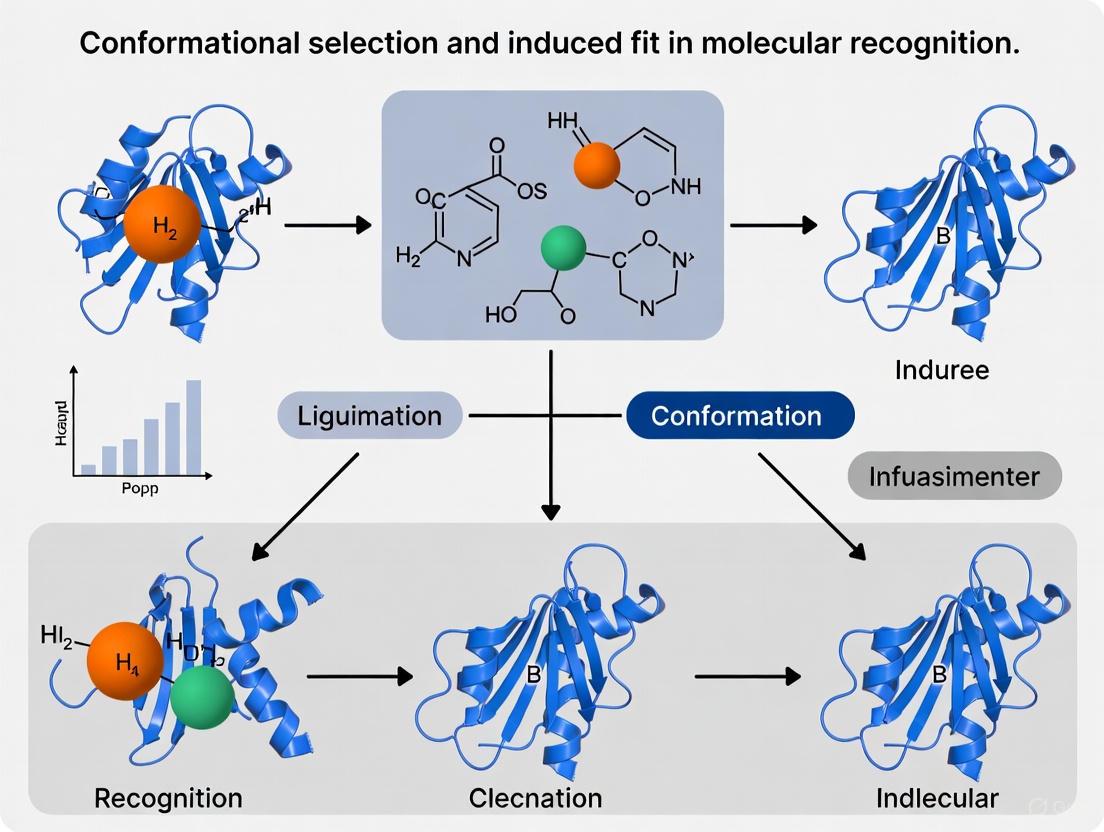
This article provides a comprehensive analysis of the two dominant paradigms in molecular recognition—conformational selection and induced fit—and their critical implications for structure-based drug discovery.
Conformational Selection vs. Induced Fit: Decoding Molecular Recognition Mechanisms for Advanced Drug Design
Abstract
This article provides a comprehensive analysis of the two dominant paradigms in molecular recognition—conformational selection and induced fit—and their critical implications for structure-based drug discovery. We explore the foundational thermodynamic and kinetic principles that distinguish these mechanisms, detailing advanced computational methodologies like IFD-MD and ensemble docking that address protein flexibility. For researchers and drug development professionals, the content offers practical insights on troubleshooting pose prediction inaccuracies and validating models through free energy calculations and kinetic analysis. By synthesizing current evidence that conformational selection may be more prevalent than historically assumed, and highlighting the emergence of hybrid mechanisms, this guide aims to equip scientists with the knowledge to select optimal strategies for predicting ligand binding and accelerating therapeutic development.
Lock-and-Key and Beyond: Foundational Models of Molecular Recognition
The mechanism by which proteins recognize and bind their ligands represents a fundamental problem in molecular biology with profound implications for understanding cellular signaling, enzyme catalysis, and rational drug design. For over a century, our conceptual framework for describing these interactions has evolved substantially—from viewing biomolecules as static structures to understanding them as dynamic entities exploring complex energy landscapes. This evolution reflects a deeper understanding of protein dynamics and how conformational flexibility dictates function. Within the context of modern molecular recognition research, a central thesis has emerged: the debate between conformational selection and induced fit as competing or complementary mechanisms for binding. While early models presented these as mutually exclusive pathways, contemporary research reveals a more nuanced reality where both processes often operate in concert, with their relative contributions determined by the specific biological system, experimental conditions, and temporal scales examined. This whitepaper traces the conceptual journey from rigid structural models to dynamic ensemble-based perspectives, synthesizing current experimental and computational approaches for dissecting binding mechanisms, and providing researchers with methodological frameworks for probing these fundamental biological processes.
Historical Trajectory of Binding Models
The Lock-and-Key Hypothesis (1894)
- Proposer: Emil Fischer
- Core Principle: Complementarity in rigid structures; the ligand (key) possesses a shape that perfectly fits the static binding site of the protein (lock).
- Historical Context: This model provided a foundational understanding of molecular specificity, explaining how enzymes distinguish between stereoisomers. Its limitation lay in the inability to explain allosteric regulation or binding-induced conformational changes.
- Modern Perspective: Now understood as a special case within broader models, applicable primarily to systems with minimal conformational change upon binding [1] [2].
The Induced Fit Model (1958)
- Proposer: Daniel Koshland
- Core Principle: Binding precedes conformational change; the initial collision between a protein and ligand induces a structural rearrangement in the protein to form a complementary binding interface [3] [4].
- Significance: Successfully explained cooperativity in allosteric proteins and how proteins can bind multiple different ligands. It represented the first major step toward incorporating protein flexibility into recognition models.
- Kinetic Signature: Under pseudo-first-order conditions ([L]â‚€ >> [P]â‚€), the dominant relaxation rate (kâ‚’bâ‚›) increases monotonically with ligand concentration [L]â‚€ [5].
The Conformational Selection Model (1964+)
- Proposers: Straub (concept), Frauenfelder, Sligar, and Wolynes (energy landscape theory)
- Core Principle: Conformational change precedes binding; an unliganded protein exists in a dynamic equilibrium between multiple conformations. The ligand selectively binds to and stabilizes a pre-existing complementary conformation, shifting the equilibrium toward the bound state [1] [4].
- Significance: Emphasized the intrinsic dynamics of proteins and connected binding phenomena to the energy landscape theory.
- Kinetic Signature: The relationship between kâ‚’bâ‚› and [L]â‚€ is more complex. kâ‚’bâ‚› can decrease monotonically with [L]â‚€ (when conformational excitation rate kâ‚‘ < unbinding rate kâ‚‹) or increase under other conditions [5].
Table 1: Core Characteristics of Historical Binding Models
| Model | Temporal Order | View of Protein Dynamics | Theoretical Basis | Key Limitation |
|---|---|---|---|---|
| Lock-and-Key | N/A | Proteins are essentially rigid. | Structural complementarity. | Cannot explain conformational changes or allostery. |
| Induced Fit | Binding => Change | Flexibility is induced by the ligand. | KNF allosteric model. | Downplays intrinsic protein dynamics in the unbound state. |
| Conformational Selection | Change => Binding | Proteins are dynamic ensembles. | MWC allosteric model & energy landscape theory. | Can underemphasize ligand-induced adjustments. |
Figure 1: The conceptual evolution of protein-ligand binding models, culminating in the modern integrated view.
The Modern Synthesis: An Integrated View of Binding
The historical dichotomy between induced fit and conformational selection has been largely resolved by experimental evidence showing that both mechanisms are often at play in a single binding event, forming an extended conformational selection model [1] [2] [6].
The Extended Conformational Selection Model
This generalized framework posits that binding occurs through a repertoire of selection and adjustment steps [1]. The initial encounter may involve selection from a pre-existing ensemble of protein conformations, followed by subsequent, often minor, induced-fit adjustments to optimize complementarity and binding affinity. This model successfully incorporates the older models as special cases:
- Lock-and-Key: A single, rigid pre-existing conformation is selected.
- Pure Conformational Selection: Binding to a pre-existing state without subsequent adjustment.
- Pure Induced Fit: Binding to an initial state followed by a major conformational change.
Factors Governing the Dominant Mechanism
The balance between selection and induced fit is influenced by system-specific variables:
- Ligand Concentration: High ligand concentrations favor induced fit by increasing the probability of initial collision with the dominant, unliganded state [1].
- Interaction Nature: Strong, long-range electrostatic interactions favor induced fit, while weaker, short-range hydrophobic interactions favor conformational selection [3] [4].
- Timescales: Conformational selection dominates when intrinsic protein dynamics are slow relative to binding; induced fit dominates when conformational transitions are fast [3] [4].
- Partner Rigidity: A large flexibility difference between partners (e.g., a rigid small molecule and a flexible protein) favors induced fit in the more flexible partner [1].
Table 2: Experimental Distinction Between Induced Fit and Conformational Selection
| Characteristic | Induced Fit | Conformational Selection |
|---|---|---|
| Temporal Sequence | Ligand binds before conformational change. | Conformational change occurs before binding. |
| Ligand Role | Active inducer of change. | Passive selector of pre-existing state. |
| Kinetics (kâ‚’bâ‚› vs. [L]â‚€) | Monotonic increase under pseudo-first-order conditions. | Can decrease or increase; complex dependence. |
| Dominant When... | Ligand concentration is high; conformational transitions are fast. | Ligand concentration is low; conformational transitions are slow. |
| Representative System | GID4 E3 Ubiquitin Ligase [7] | LAO Protein (partial mechanism) [3] [4] |
Experimental Toolkit for Dissecting Binding Mechanisms
Distinguishing between binding mechanisms requires techniques that probe protein structure, dynamics, and kinetics, often under native-like conditions.
Key Biophysical Techniques
- Nuclear Magnetic Resonance (NMR) Spectroscopy: Ideal for detecting low-populated, excited states in the unliganded protein and characterizing dynamics on microsecond-to-millisecond timescales. Chemical shift perturbations and relaxation dispersion can reveal pre-existing conformations.
- Single-Molecule Fluorescence/FRET: Allows direct observation of heterogeneity in conformational states and dynamics without ensemble averaging. Can track individual molecules transitioning between states before and after binding.
- Stopped-Flow Chemical Relaxation: The gold-standard for kinetic analysis. By rapidly perturbing binding equilibrium (e.g., by temperature jump or rapid mixing) and monitoring the relaxation of the system, one can measure the dominant relaxation rate kâ‚’bâ‚› as a function of ligand concentration [L]â‚€, which provides the critical signature for mechanism identification [5].
- X-ray Crystallography & Cryo-EM: Provide high-resolution structural snapshots of end states (apo and holo). Comparison can reveal the scale of conformational change but cannot directly speak to dynamics or the order of events.
Critical Reagents and Assays
Table 3: Research Reagent Solutions for Binding Mechanism Studies
| Reagent / Assay | Function in Research | Key Utility |
|---|---|---|
| Isotopically Labeled Proteins (¹âµN, ¹³C) | Enables detailed NMR spectroscopy by providing observable nuclei. | Essential for probing backbone and side-chain dynamics and identifying minor states. |
| Fluorescent Dyes (Donor/Acceptor Pairs) | Label proteins for FRET-based distance measurements. | Critical for single-molecule and ensemble FRET studies tracking conformational changes in real time. |
| Stopped-Flow Instrumentation | Rapidly mixes protein and ligand solutions to initiate binding. | Enables measurement of binding kinetics on millisecond timescales. |
| Site-Directed Mutagenesis Kits | Generates proteins with specific mutations in the binding site or allosteric networks. | Tests the functional role of specific residues in stabilizing certain conformations. |
| T-Type calcium channel inhibitor 2 | T-Type Calcium Channel Inhibitor 2|CaV3 Blocker | T-Type Calcium Channel Inhibitor 2 is a potent CaV3.1, CaV3.2, and CaV3.3 blocker for neurology and cancer research. For Research Use Only. Not for human or veterinary use. |
| Pim1-IN-7 | Pim1-IN-7, MF:C23H23N5O, MW:385.5 g/mol | Chemical Reagent |
Quantitative Framework: Kinetic and Thermodynamic Analysis
The most rigorous method for distinguishing mechanisms is through the quantitative analysis of binding kinetics.
General Kinetic Analysis Beyond Pseudo-First-Order Conditions
Traditional analyses often rely on the pseudo-first-order approximation ([L]â‚€ >> [P]â‚€). However, recent work provides general analytical results for the dominant relaxation rate kâ‚’bâ‚› that are valid for all protein and ligand concentrations [5]. This is critical because an increase of kâ‚’bâ‚› with [L]â‚€ under pseudo-first-order conditions is ambiguous, as it can occur in both induced fit and conformational selection.
- For Induced Fit Binding: The function kâ‚’bâ‚›([L]â‚€) exhibits a symmetrical minimum at [L]â‚€áµâ±â¿ = [P]â‚€ - Kð’¹ for [P]â‚€ > Kð’¹. At high [P]â‚€, kâ‚’bâ‚› approaches the same value for [L]â‚€ << [P]â‚€ and [L]â‚€ >> [P]â‚€ [5].
- For Conformational Selection Binding: The function kâ‚’bâ‚›([L]â‚€) can exhibit a minimum, but it is not symmetrical. At high [P]â‚€, the value of kâ‚’bâ‚› for [L]â‚€ << [P]â‚€ can be much larger than for [L]â‚€ >> [P]â‚€ [5].
Experimental Protocol: Temperature-Jump Relaxation Kinetics
This is a classic method for probing the kinetics of biological reactions.
- Objective: To measure the rate at which a protein-ligand mixture returns to equilibrium after a rapid perturbation.
- Procedure: a. Prepare a solution of protein and ligand at a defined concentration ratio and allow it to reach binding equilibrium. b. Apply a rapid temperature jump (e.g., using an infrared laser pulse), which instantaneously shifts the equilibrium constant. c. Monitor a spectroscopic signal (e.g., fluorescence, UV-Vis absorbance) as a function of time as the system relaxes to the new equilibrium. d. Fit the relaxation curve to extract the observed rate constant(s), kâ‚’bâ‚›. e. Repeat the experiment across a wide range of total ligand [L]â‚€ and protein [P]â‚€ concentrations.
- Data Analysis: Plot kâ‚’bâ‚› as a function of [L]â‚€. The shape and symmetry of this plot are used to discriminate between the induced fit and conformational selection models according to the general principles outlined above [5].
Figure 2: A generalized workflow for using chemical relaxation kinetics to distinguish between binding mechanisms.
Case Studies in Hybrid Binding Mechanisms
LAO Binding Protein
The LAO protein, which undergoes a large open-to-closed transition upon binding arginine, was long assumed to operate via a pure induced fit mechanism because the closed state completely buries the ligand.
- Finding: Atomistic simulations using Markov State Models (MSMs) revealed a more complex picture. The ligand-free protein can sample a partially closed "encounter complex" state, indicating conformational selection. However, the fully closed state was only achieved after ligand binding to this intermediate, demonstrating a clear induced fit step [3] [4].
- Mechanism: Conformational selection (Open ⇌ Partially Closed) followed by induced fit (Partially Closed + Ligand → Closed).
GID4 E3 Ubiquitin Ligase
GID4 recognizes N-degrons, with structural data showing loop rearrangements upon peptide binding, suggesting induced fit.
- Finding: All-atom molecular dynamics simulations showed that the binding loops are highly flexible and spontaneously sample "open" and "closed" conformations even without the ligand.
- Mechanism: A hybrid mechanism where the ligand selects for pre-existing closed-conformer populations, with binding subsequently inducing further structural quakes to optimize the interaction [7].
Calreticulin Family of Chaperones
These lectins specifically recognize monoglucosylated N-glycan during ER protein folding.
- Finding: Simulations of the carbohydrate recognition domain (CRD) in free and bound states showed an ensemble of conformations. The initial contact is driven by conformational selection, which is then followed by glycan-induced fluctuations in key residues for stronger binding [6].
- Mechanism: A mixed mechanism of conformational selection and induced fit is critical for selective recognition among a pool of similar glycans [6].
The evolution of binding models from rigid bodies to dynamic partners underscores a fundamental shift in molecular biology: a transition from a purely structural view to a statistical mechanical and kinetic perspective. The "extended conformational selection" model, which integrates concepts of selection and adjustment, currently provides the most comprehensive framework for understanding molecular recognition. The prevailing thesis in the field is that pure mechanisms are the exception; most biological binding events proceed through a combination of pathways, with the dominant route influenced by environmental conditions and intrinsic protein properties.
For researchers and drug development professionals, this integrated view has critical implications. Rational drug design, particularly for allosteric modulators, must account for the intrinsic conformational landscape of the target protein. Strategies that combine ensemble-based docking (to account for conformational selection) with flexibility in the binding site (to account for induced fit) are likely to be more successful. The future of unravelling binding mechanisms lies in the integration of multiple experimental techniques with advanced computational simulations, such as MSMs, to map the complete energy landscape of binding, thereby bridging the gap between static structural biology and the dynamic reality of protein function in the cellular environment.
The Induced Fit Hypothesis stands as a foundational concept in molecular biology, proposing that the conformational change in a protein occurs after the initial binding of a ligand. This model contrasts with the Conformational Selection mechanism, wherein the ligand selectively binds to a pre-existing, minor conformation within the protein's dynamic ensemble. The distinction between these two mechanisms—whether a conformational change happens before (Conformational Selection) or after (Induced Fit) ligand binding—is not merely academic; it has profound implications for understanding signaling kinetics, allosteric regulation, and rational drug design [8] [5].
For decades, the Induced Fit model, introduced by Daniel Koshland, has provided a intuitive framework for explaining how enzymes achieve specificity and how ligands can stabilize active conformations. This technical guide deconstructs the Induced Fit hypothesis by examining the fundamental principles, experimental methodologies, and computational tools used to characterize ligand-induced conformational changes. Furthermore, it situates this mechanism within the modern context of conformational ensembles, where the binary view of Induced Fit versus Conformational Selection is increasingly giving way to a more integrated perspective that acknowledges contributions from both pathways [9] [10].
Core Principles and the Energetics of Induced Fit
The central tenet of the Induced Fit model is that the binding event itself alters the energy landscape of the protein, making previously inaccessible conformational states thermally accessible. In this mechanism, the ligand first binds to the protein in a conformation that may not be the most complementary, forming an initial encounter complex. This binding then induces a conformational rearrangement—often involving sidechain reorientations, loop movements, or shifts in secondary structure elements—that results in the final, stable complex [8].
From a thermodynamic perspective, the stabilization of the bound conformation is described by the dissociation free energy. When a ligand binds, the protein-ligand complex is stabilized, leading to measurable changes in the protein's energetic properties. These include an increase in thermodynamic stability and a decrease in the unfolding rate. This stabilization forms the basis for energetics-based methods to detect and study protein-ligand interactions, as the ligand-bound form will be more resistant to denaturation by chaotropic agents or proteolysis [11].
A key functional outcome of Induced Fit is the creation of a complementary binding surface. The initial binding site may be more open or accessible, with the final, high-affinity interface forming only after the conformational change. This process is particularly relevant for enzymes and receptors where precise alignment of catalytic residues or gating elements is required for function.
Distinguishing Induced Fit from Conformational Selection
While both Induced Fit and Conformational Selection can lead to the same final ligand-bound structure, their kinetic pathways and ligand concentration dependencies are fundamentally different. Accurately distinguishing between them is crucial for a mechanistic understanding.
Kinetic Signatures and Mutational Analysis
The most definitive way to distinguish these mechanisms is through kinetic analysis, specifically by examining how the dominant relaxation rate ((k_{obs})) of the binding reaction changes as a function of total ligand concentration ([L]â‚€) and through the use of allosteric mutants [8] [5].
- Induced Fit Mechanism: The conformational change occurs after binding. Therefore, an allosteric mutation that affects the conformational equilibrium will predominantly alter the dissociation rate constant ((k{off})), while the association rate constant ((k{on})) remains relatively unaffected. The plot of (k_{obs}) versus [L]â‚€ is symmetric and exhibits a minimum at [L]â‚€ = [P]â‚€ - Kd for protein concentrations [P]â‚€ larger than the dissociation constant Kd [5].
- Conformational Selection Mechanism: The conformational change occurs before binding. Here, the same allosteric mutation will primarily affect (k{on}), as it alters the population of the pre-existing binding-competent state. The function (k{obs})([L]â‚€) is not symmetric and can decrease monotonically with [L]â‚€ (for low conformational excitation rates) or show a minimum at a different location than in Induced Fit [5].
This kinetic strategy was successfully applied to a cyclic nucleotide-gated channel. Mutagenesis of allosteric residues was found to affect only the dissociation rate constant, providing strong evidence that binding follows an Induced Fit mechanism [8].
Table 1: Key Characteristics for Distinguishing Binding Mechanisms
| Feature | Induced Fit | Conformational Selection |
|---|---|---|
| Temporal Order | Conformational change occurs after ligand binding. | Conformational change occurs before ligand binding. |
| Effect of Allosteric Mutant on (k_{on}) | Minimal or no effect. | Significant effect. |
| Effect of Allosteric Mutant on (k_{off}) | Significant effect. | Minimal or no effect. |
| Dependence of (k_{obs}) on [L]â‚€ | Symmetric function with a minimum at [L]â‚€ = [P]â‚€ - Kd. | Not symmetric; can decrease monotonically or show a minimum at a different [L]â‚€. |
| Pre-existing Conformation | Not required; the active state may be poorly populated or non-existent without ligand. | Required; the active state must exist, albeit potentially at low population, in the apo ensemble. |
Experimental Workflow for Kinetic Discrimination
The following diagram illustrates a generalized experimental workflow for distinguishing between Induced Fit and Conformational Selection using kinetic analysis.
Quantitative Experimental Methods and Protocols
Several sophisticated biophysical and biochemical techniques are employed to detect and quantify ligand-induced conformational changes.
Stopped-Flow Fluorescence Kinetics
This rapid-mixing technique is ideal for measuring the kinetics of binding and conformational changes on millisecond timescales [8].
- Protocol:
- Sample Preparation: Purify the protein (e.g., a cyclic nucleotide-binding domain) and ensure it is free of endogenous ligand. The ligand is typically conjugated to a fluorescent probe like 8-NBD-cAMP.
- Instrument Setup: Utilize a stopped-flow apparatus (e.g., SFM-400) with a microcuvette and a dead time of approximately 325 μs. Set appropriate excitation and emission filters.
- Data Collection: Mix protein and ligand solutions at a 1:1 ratio under pseudo-first-order conditions (where [L]â‚€ >> [P]â‚€). Monitor the fluorescence change over time.
- Data Analysis: Fit the fluorescence traces to the solution of the bimolecular rate equation to extract the apparent rate constants ((k{app})). Derive the association ((k{on})) and dissociation ((k{off})) rate constants from experiments at multiple ligand concentrations. Perform competition experiments with non-fluorescent ligands to directly determine (k{off}) [8].
Energetics-Based Target Identification via Pulse Proteolysis
This method leverages the increase in thermodynamic stability upon ligand binding to identify protein targets in complex mixtures like cell lysates [11].
- Protocol:
- Incubation with Ligand: Incubate a cell lysate (e.g., from E. coli) with and without the test ligand (e.g., ATPγS) in a buffer containing a denaturant like urea (e.g., 3.0 M).
- Pulse Proteolysis: Subject both samples to a brief, controlled proteolysis (e.g., 0.20 mg/mL thermolysin for 1 minute). The stabilized, folded proteins will be resistant to digestion.
- Analysis: Analyze the remaining proteins by 2D gel electrophoresis. Identify protein spots whose intensity is consistently higher in the ligand-treated sample compared to the control.
- Validation: Identify the stabilized proteins using mass spectrometry (e.g., MALDI-TOF-TOF) and validate binding through independent assays [11].
Hydrogen-Deuterium Exchange Mass Spectrometry (HDX-MS)
HDX-MS measures the exchange rate of backbone amide hydrogens with deuterium in the solvent. A slowed exchange rate in specific regions upon ligand binding indicates stabilization and often a conformational change.
- Protocol:
- Labeling: Dilute the apo and ligand-bound protein into a deuterated buffer for a defined period.
- Quenching: Lower the pH and temperature to quench the exchange reaction.
- Digestion and Analysis: Digest the protein with pepsin and analyze the peptide fragments using mass spectrometry to determine the deuteration level of each peptide.
- Mapping: Map the peptides with reduced deuteration in the ligand-bound state onto the protein structure to identify the regions involved in the conformational change.
Computational and Simulation Approaches
Molecular dynamics (MD) simulations provide an atomistic view of conformational dynamics, complementing experimental observations.
Molecular Dynamics (MD) Simulations with Enhanced Sampling
Conventional MD simulations may not sufficiently sample rare conformational transitions. Enhanced sampling methods are critical for studying Induced Fit events [9] [10].
- Protocol:
- System Preparation: Obtain a starting structure (from crystallography or homology modeling). Dock the ligand if necessary. Solvate the protein-ligand system in a water box and add ions to neutralize the system.
- Enhanced Sampling: Run simulations using methods like accelerated MD (aMD) or metadynamics. These methods reduce the energy barriers between states, allowing the system to explore its conformational landscape more efficiently.
- Ensemble Generation and Analysis: Generate ensembles of structures for both the apo and ligand-bound states. Use clustering algorithms and dimensionality reduction techniques (like Principal Component Analysis) to identify dominant conformational states. Analyze how the population of these states shifts upon ligand binding [9] [10]. For example, studies on nuclear receptors showed that agonist binding shifted the conformational ensemble toward active states characterized by the stable positioning of helix 12 [10].
Advanced Analysis with Tools like gmx_RRCS
Specialized analysis tools have been developed to detect subtle conformational changes that standard metrics like Root Mean Square Deviation (RMSD) might miss. The gmx_RRCS tool quantifies interaction strengths between residues by analyzing residue-residue contact scores (RRCS) throughout a simulation trajectory [12].
- Application: This tool can reveal subtle sidechain reorientations and the dynamics of salt bridges or hydrophobic packing that are crucial for the Induced Fit mechanism. It has been applied to systems like PI3Kα to distinguish conformational states of oncogenic mutants [12].
The Scientist's Toolkit: Essential Research Reagents and Solutions
Table 2: Key Reagents and Materials for Studying Induced Fit
| Reagent / Material | Function and Application |
|---|---|
| Stopped-Flow Apparatus | Allows rapid mixing (dead-times < 1 ms) and monitoring of fast binding kinetics via fluorescence or absorbance. |
| Fluorescent Ligand Analogs | Enable direct observation of binding events; e.g., 8-NBD-cAMP for studying cyclic nucleotide-binding domains. |
| Thermolysin | A robust protease used in pulse proteolysis experiments to distinguish stabilized (ligand-bound) from destabilized proteins. |
| Urea / Guanidine HCl | Chaotropic denaturants used to create a stability challenge in pulse proteolysis or equilibrium unfolding assays. |
| Allosteric Mutants | Engineered protein variants used to perturb the conformational equilibrium and dissect the kinetic mechanism. |
| Molecular Dynamics Software | Software like NAMD or GROMACS for running MD simulations to visualize and quantify conformational trajectories. |
| Enhanced Sampling Plugins | Tools like PLUMED or built-in methods (aMD, metadynamics) to overcome sampling limitations in MD. |
| Ezh2-IN-14 | Ezh2-IN-14, MF:C31H39N7O2, MW:541.7 g/mol |
| Hdac10-IN-2 | Hdac10-IN-2, MF:C19H22N2O2, MW:310.4 g/mol |
Biological Case Studies
Nuclear Receptors
Nuclear receptors are classic models for studying ligand-induced conformational changes. They function as ligand-regulated transcription factors. Research on an ancestral steroid receptor demonstrated that different ligands shift the conformational ensemble of the receptor in distinct ways [9] [10]. Using accelerated MD simulations, it was observed that agonist ligands shift the ensemble population toward the active state, where the C-terminal helix (H12) is positioned to form a docking site for coactivator proteins. The degree of this population shift correlated directly with the ligand's transcriptional efficacy, providing a quantitative link between an Induced Fit-like ensemble shift and biological function [10].
Ion Channels: Nicotinic Acetylcholine Receptors
MD simulations of the α7 nicotinic receptor ligand-binding domain revealed how different ligands induce distinct conformational states. Simulations with the agonist acetylcholine (ACh) promoted a more open and symmetric arrangement of the five subunits, particularly in the lower portion of the domain near the channel gate. In contrast, simulations without ligand or with the antagonist d-tubocurarine resulted in a more closed and asymmetric arrangement. This demonstrated how an agonist-induced change in the binding domain could be transmitted to the transmembrane gate, a hallmark of Induced Fit signaling [13].
Enzymes: Caffeoyl coenzyme A O-methyltransferase (CCoAOMT)
Comparative MD simulations of the enzyme CCoAOMT in its apo and substrate-bound forms revealed a significant conformational switch. Upon binding its substrate (CCoA), the enzyme's structure became more compact, and the substrate transport channel transitioned from an open to a closed state. This ligand-induced closure, trapping the substrate in the active site, is a clear example of an Induced Fit mechanism that is critical for the enzyme's function in lignin biosynthesis [14].
Implications for Drug Discovery
Understanding Induced Fit is critical in rational drug design. The conformational changes induced by a ligand can influence:
- Drug Specificity: A drug can be designed to preferentially bind to and stabilize a specific protein conformation that is unique to a target, reducing off-target effects.
- Allosteric Modulator Design: Allosteric drugs often work by inducing conformational changes that either enhance or inhibit the protein's activity. The principles of Induced Fit guide the design of such molecules.
- Membrane Protein Drug Design: For membrane proteins, where many drug binding sites are embedded in the lipid bilayer, the ligand's properties must facilitate partitioning into the membrane and then induce the desired conformational change at the protein-lipid interface [15]. Ligands for these sites often have distinct chemical properties, such as higher lipophilicity (clogP) and molecular weight [15].
The Induced Fit hypothesis remains a vital and powerful model for explaining how proteins dynamically respond to their chemical environment. While the simple dichotomy between Induced Fit and Conformational Selection is evolving, the core concept that ligand binding can actively reshape a protein's structure is undeniable. Modern research, leveraging advanced kinetic experiments, energetics-based profiling, and sophisticated computational simulations, has deconstructed the hypothesis to reveal a complex reality where proteins exist as dynamic conformational ensembles. Within this framework, ligand binding often acts to shift the equilibrium of these pre-existing ensembles, stabilizing a specific functional state—a process that kinetically manifests as Induced Fit [9] [10] [5].
This refined understanding provides a more powerful and predictive framework for molecular recognition. For researchers and drug developers, the ability to not only visualize but also quantitatively predict how a ligand will alter a protein's conformational landscape is invaluable. It enables the rational design of synthetic modulators with precise efficacy and specificity, ultimately illuminating the path to targeting therapeutically relevant proteins with unprecedented control.
The conformational selection model represents a fundamental shift in our understanding of molecular recognition, challenging the long-held view that proteins exist as single, static structures awaiting ligand binding. This model posits that proteins inherently sample a diverse ensemble of conformational states even in their unliganded form, and ligands selectively bind to and stabilize pre-existing conformations that complement their binding interface [16] [17]. This framework stands in contrast to the induced fit hypothesis, which asserts that conformational changes occur only after initial ligand contact, effectively "inducing" the protein to adopt a complementary shape [16] [18].
Historically, induced fit and conformational selection were regarded as mutually exclusive mechanisms [19]. However, contemporary research reveals this to be a "false dichotomy" [19]. These mechanisms are now understood to operate alongside one another within a thermodynamic cycle, with their relative contributions determined by specific kinetic parameters and ligand concentration [19] [20]. The conformational selection model is grounded in the energy landscape theory of protein dynamics, which describes proteins as navigating a complex topography of conformational substates through thermal fluctuations [16]. From this perspective, ligand binding does not create new structures but rather causes a population shift in the equilibrium distribution of pre-existing conformations [16].
This whitepaper provides an in-depth technical examination of the conformational selection model, detailing its theoretical foundations, experimental validation, and significant implications for drug discovery and therapeutic development.
Theoretical Framework and Fundamental Principles
Core Mechanism and Temporal Ordering
The defining characteristic of conformational selection is the temporal ordering of molecular events: a conformational change precedes the binding event [20]. In this mechanism, an unbound protein transiently samples a higher-energy, excited-state conformation through thermal fluctuations. A ligand then selectively binds to this rare conformation, which structurally resembles the final bound state.
The reverse process follows an induced-change pathway: during unbinding, the conformational change occurs after the ligand dissociates [20]. This relationship illustrates that conformational selection and induced fit are "two sides of the same coin," differentiated by the sequence of chemical and physical steps in binding versus unbinding directions [20].
The Energy Landscape Perspective
The conformational selection model finds its foundation in the energy landscape theory of protein structure and dynamics [16]. A protein's free energy landscape comprises numerous conformational substates in dynamic equilibrium. Rather than residing in a single rigid structure, proteins exist as statistical ensembles of interconverting conformations [16].
- Pre-existing Conformations: Conformations observed in ligand-bound complexes fundamentally pre-exist within the ensemble sampled by the unliganded protein [16]. Binding does not create novel structures but selects and stabilizes functionally competent conformations that already occur, albeit potentially with low probability, in the absence of ligand.
- Population Shift: Ligand binding alters the thermodynamic equilibrium between conformational states. The bound conformation becomes more populated, while other conformations decrease in abundance [16]. This redistribution occurs without changing the inherent structural repertoire of the protein.
- Barrier Crossing: Transitions between conformational states involve crossing free-energy barriers. The actual "transition time" for crossing these barriers is significantly shorter than the dwell times in stable states, making conformational changes appear as sudden jumps in experimental observations [20].
Quantitative Kinetic and Thermodynamic Basis
The thermodynamic cycle for conformational selection can be represented through discrete states and transitions, characterized by specific kinetic rate constants that dictate which recognition pathway dominates under given conditions [19] [16].
Table 1: Key Rate Constants in the Conformational Selection Model
| Rate Constant | Description | Role in Mechanism |
|---|---|---|
| k1,CS | Conformational transition from unbound ground state (P1) to unbound excited state (P2) | Determines spontaneous population of bind-competent state |
| k-1,CS | Reverse conformational transition (P2 to P1) | Competes with binding from P2 state |
| k2,CS | Ligand binding to pre-existing conformation P2 | Bimolecular step forming final complex |
| k-2,CS | Ligand dissociation from P2L complex | Determines complex stability |
The diagram below illustrates the conformational selection pathway and its relationship with induced fit within a complete thermodynamic cycle:
Figure 1: Thermodynamic cycle of conformational selection and induced fit mechanisms. The conformational selection pathway (blue) involves a conformational change preceding binding, while induced fit (green) involves binding followed by conformational adjustment.
A critical insight from recent studies is that the relative contribution of induced fit increases with ligand concentration [19]. At low ligand concentrations, conformational selection typically dominates, as the rare, bind-competent conformations are sufficient to accommodate limited ligand molecules. At high concentrations, induced fit becomes more significant as ligands initially bind with lower affinity to more abundant conformations, subsequently inducing conformational changes. This concentration-dependent interplay underscores why these mechanisms are no longer considered mutually exclusive [19].
Experimental Evidence and Validation
Key Experimental Methodologies
Multiple advanced experimental techniques have been crucial in validating the conformational selection model by detecting and characterizing the pre-existing conformational ensembles of proteins.
Table 2: Experimental Methods for Studying Conformational Selection
| Method | Key Principle | Information Obtained | Applications & Examples |
|---|---|---|---|
| NMR Spectroscopy | Measures chemical shift perturbations and dynamics on μs-ms timescales | Detects low-population excited states; determines kinetic rates of conformational exchange | Ubiquitin conformational ensembles [16] [17]; Ribonuclease A; Dihydrofolate reductase [16] |
| Relaxation Dispersion NMR | Analyzes R₂ relaxation rates to characterize μs-ms exchange processes | Quantifies populations, chemical shifts, and kinetics of invisible excited states | Adenylate kinase open/closed states [16] |
| Single-Molecule FRET | Measures distance changes via energy transfer between fluorophores | Observes real-time transitions between conformational states | Protein folding/unfolding dynamics; Conformational heterogeneity [20] [16] |
| Residual Dipolar Coupling (RDC) | Measures residual anisotropic interactions in weakly aligned molecules | Provides structural restraints for characterizing conformational ensembles | Ubiquitin solution structures matching bound conformations [17] |
| Chemical Relaxation | Probes kinetics of system relaxation to equilibrium after perturbation | Determines dominant relaxation rate kobs and its ligand concentration dependence | Distinguishing CS vs. IF mechanisms [21] |
| Computational Solvent Mapping | Computationally docks small probe molecules to protein surfaces | Identifies binding hot spots and pre-formed binding sites in unbound ensembles | Binding site formation in protein-protein interfaces [22] |
Critical Experimental Findings
Evidence supporting conformational selection has emerged across diverse biological systems:
Antibody-Antigen Recognition: Studies of the SPE7 antibody demonstrated that a single antibody molecule can exist in multiple pre-existing conformations capable of binding distinct antigens [17] [23]. Crystallographic analyses revealed different conformations in the absence of antigen, with each conformation specialized for binding particular antigenic structures [16].
Ubiquitin Signaling: Groundbreaking NMR studies compared ensembles of free ubiquitin structures with ubiquitin bound to various target proteins [17]. For each bound ubiquitin structure, the unbound ensemble contained members with remarkable structural similarity, strongly supporting conformational selection as the primary recognition mechanism [17] [22].
Enzyme Catalysis: Numerous enzymes previously classified as induced-fit systems, including adenylate kinase, ribonuclease A, and dihydrofolate reductase, have been re-evaluated through relaxation dispersion NMR [16]. These studies revealed conformational exchange between ground and excited states on microsecond-to-millisecond timescales, with excited states matching ligand-bound conformations [16].
Distinguishing Conformational Selection from Induced Fit
A critical advancement in the field has been the development of methodologies to quantitatively distinguish conformational selection from induced fit based on chemical relaxation rates [21]. The characteristic dependence of the dominant relaxation rate (kobs) on ligand concentration provides a key diagnostic tool:
Figure 2: Characteristic dependence of observed relaxation rate (kobs) on ligand concentration for conformational selection versus induced fit mechanisms.
Under pseudo-first-order conditions (high ligand concentration), conformational selection typically exhibits a decreasing kobs with increasing [L] when the conformational excitation rate ke is lower than the unbinding rate k- [21]. Induced fit consistently shows an increasing kobs with [L] under these conditions. However, distinction becomes unambiguous only when considering a broader range of protein and ligand concentrations beyond pseudo-first-order conditions [21].
Computational Approaches and Modern Methodologies
Contemporary research into conformational selection employs an integrated suite of experimental and computational resources.
Table 3: Essential Research Tools for Conformational Selection Studies
| Tool/Resource | Type | Primary Function | Key Features |
|---|---|---|---|
| NMR Spectrometer | Instrumentation | Detects atomic-level structure and dynamics | Measures chemical shifts, relaxation rates, residual dipolar couplings |
| Molecular Dynamics Software | Software | Simulates physical movements of atoms and molecules | Captures conformational transitions; Examples: GROMACS, AMBER, OpenMM, CHARMM [24] |
| ATLAS Database | Database | Stores molecular dynamics trajectories | ~2000 representative proteins; 5841 trajectories [24] |
| GPCRmd Database | Database | Specialized MD database for GPCR proteins | 705 simulations; 2115 trajectories [24] |
| FiveFold Methodology | Computational Method | Ensemble-based structure prediction | Combines 5 algorithms (AlphaFold2, RoseTTAFold, etc.) [25] |
| Computational Solvent Mapping | Computational Method | Identifies binding hot spots | Uses small molecular probes to map binding sites [22] |
Advanced Computational Modeling
The emergence of artificial intelligence has revolutionized protein structure prediction, with methods like AlphaFold achieving remarkable accuracy for static structures [24] [25]. However, these methods face challenges in capturing the intrinsic conformational diversity essential for biological function. Several innovative approaches have been developed to address this limitation:
Ensemble-Based Prediction Methods: The FiveFold methodology represents a paradigm-shifting advancement that combines predictions from five complementary algorithms (AlphaFold2, RoseTTAFold, OmegaFold, ESMFold, and EMBER3D) to model conformational diversity [25]. This approach explicitly acknowledges and models the inherent conformational heterogeneity of proteins through its Protein Folding Shape Code and Protein Folding Variation Matrix systems [25].
Molecular Dynamics Simulations: MD simulations directly simulate the physical movements of atoms and molecules over time, providing atomic-level insights into conformational transitions [24]. Specialized databases such as ATLAS and GPCRmd collect and curate MD simulation data, making conformational dynamics data accessible to the research community [24].
Generative Models: Recent advances include diffusion and flow matching models that can predict equilibrium distributions of molecular systems, enabling sampling of diverse and functionally relevant structures [24]. These approaches show promise in overcoming limitations of traditional structure prediction methods.
Implications for Drug Discovery and Therapeutic Development
Expanding the Druggable Proteome
The conformational selection paradigm has profound implications for drug discovery, particularly for targeting proteins traditionally considered "undruggable." Approximately 80% of human proteins fall into this category when using conventional structure-based drug design approaches [25]. Many challenging targets, including transcription factors, protein-protein interaction interfaces, and intrinsically disordered proteins, require therapeutic strategies that account for conformational flexibility and transient binding sites [25].
Ensemble-based structure prediction methods like FiveFold show particular promise in expanding the druggable proteome by modeling multiple conformational states simultaneously [25]. This capability enables the identification of cryptic binding pockets and transient binding sites that may not be apparent in single, static structures [25] [22].
Targeting Intrinsically Disordered Proteins
Intrinsically disordered proteins (IDPs), which comprise approximately 30-40% of the human proteome, represent a particularly compelling application for conformational selection principles [25]. IDPs lack stable tertiary structure under physiological conditions yet play crucial roles in cellular regulation and disease pathways [25].
These proteins often contain Molecular Recognition Features (MoRFs) - short regions that undergo disorder-to-order transitions upon binding [23]. The conformational selection model provides a framework for understanding how these flexible regions sample bound-like conformations even in their unbound state, enabling highly specific binding interactions despite their inherent flexibility [23].
Kinetic and Thermodynamic Optimization of Therapeutics
Understanding the conformational selection mechanism enables more rational optimization of drug binding kinetics and residence times, which are increasingly recognized as critical determinants of in vivo drug efficacy [19]. Drugs with longer residence times often demonstrate superior target selectivity and duration of action [19].
The flux-based analysis approach reveals that a limited set of "microscopic" rate constants regulate the relative contributions of conformational selection and induced fit across different ligand concentrations [19]. This insight allows medicinal chemists to deliberately design compounds that preferentially utilize specific binding pathways optimized for therapeutic effect.
The conformational selection model represents a fundamental advancement in our understanding of molecular recognition, displacing the historical view of proteins as static entities with a dynamic perspective of proteins as conformational ensembles. This paradigm shift from structure to ensemble has far-reaching implications for basic biological research and therapeutic development.
Rather than operating in isolation, conformational selection and induced fit function as complementary mechanisms within a unified thermodynamic framework [19] [20]. Their relative contributions are governed by specific kinetic parameters and ligand concentrations, explaining why both mechanisms are observed across different experimental systems and conditions [19].
The ongoing integration of advanced experimental techniques with sophisticated computational approaches continues to reveal the intricate relationship between conformational dynamics and biological function. As ensemble-based drug discovery strategies mature, they hold significant promise for addressing currently intractable therapeutic targets and advancing precision medicine. The conformational selection model thus represents not merely a theoretical concept but a practical framework with transformative potential for biomedical research and drug development.
The binding of a ligand to its biological target is a fundamental process in biochemistry, central to drug design and therapeutic development. The affinity of this interaction is quantifiably expressed by the change in Gibbs free energy, ΔG, which represents the thermodynamic driving force for binding. As defined by the fundamental equation ΔG = ΔH - TΔS, the binding free energy is partitioned into two components: the enthalpic change (ΔH), which reflects the heat released or absorbed during bond formation and breaking, and the entropic change (-TΔS), which represents the change in system disorder, encompassing conformational, solvation, and rotational degrees of freedom [26].
A phenomenon frequently observed in ligand-binding studies is enthalpy-entropy compensation (EEC). This occurs when a modification to a ligand or protein results in a favorable change in one thermodynamic component (e.g., a more negative ΔH) that is partially or fully offset by an unfavorable change in the other (e.g., a more negative TΔS). In its most severe form, this leads to no net change in binding affinity (ΔΔG ≈ 0) despite significant underlying thermodynamic perturbations, posing a substantial challenge for rational ligand optimization in drug discovery [26]. This whitepaper explores the evidence for EEC, its physical origins, and its critical interrelationship with the mechanisms of molecular recognition—conformational selection and induced fit—framed for an audience of researchers, scientists, and drug development professionals.
The Phenomenon of Enthalpy-Entropy Compensation
Defining Compensation
In the context of ligand binding, enthalpy-entropy compensation generally describes a situation where a ligand modification produces a change in the enthalpic contribution to binding (ΔΔH), which is opposed by a corresponding change in the entropic contribution (TΔΔS). For a strong, nearly complete compensation where the net change in binding affinity is minimal, the relationship ΔΔH ≈ TΔΔS holds true [26]. Evidence for EEC is often presented graphically, with TΔS plotted against ΔH for a series of related ligands or systems; a linear regression with a slope near unity is frequently interpreted as signature of compensation [26].
Experimental Evidence and Calorimetric Insights
The widespread adoption of isothermal titration calorimetry (ITC) has provided a rich dataset of binding thermodynamics, fueling the observation of EEC. ITC simultaneously measures the equilibrium constant ((K_a)) and the enthalpy change (ΔH) in a single experiment, allowing for the direct calculation of ΔG and TΔS [26].
Numerous ITC studies have reported apparent EEC. A meta-analysis of approximately 100 protein-ligand complexes from the BindingDB database concluded that a plot of ΔH versus TΔS showed a slope of nearly unity, suggesting a pervasive form of severe compensation [26]. Specific case studies further illustrate this:
- HIV-1 Protease Inhibitors: Introducing a hydrogen bond acceptor into an inhibitor resulted in a substantial enthalpic gain of 3.9 kcal/mol. However, this was entirely offset by an entropic penalty of similar magnitude, resulting in no net improvement in affinity. This was interpreted as the entropic cost of structuring associated with hydrogen bond formation [26].
- Trypsin Inhibitors: A study of para-substituted benzamidinium inhibitors of trypsin found that nearly all ligands in the series exhibited EEC, with the free energy of binding remaining almost constant despite large variations in ΔH and TΔS [26].
- Thrombin Ligands: Studies on congeneric series of thrombin ligands indicated that chemical modifications could lead to competing entropic and enthalpic responses, creating apparent non-additive effects [26].
Table 1: Documented Cases of Apparent Enthalpy-Entropy Compensation
| Protein Target | Ligand Modification | Observed ΔΔH | Observed TΔΔS | Net ΔΔG | Citation |
|---|---|---|---|---|---|
| HIV-1 Protease | Introduction of H-bond acceptor | ~ -3.9 kcal/mol | ~ -3.9 kcal/mol | ~ 0 kcal/mol | [26] |
| Trypsin | para-substitution of benzamidinium | Large variation | Opposing variation | Minimal change | [26] |
| Thrombin | Congeneric series modifications | Competing changes | Competing changes | Non-additive | [26] |
The Conformational Selection vs. Induced Fit Paradigm
The mechanism by which a ligand and its protein target recognize each other is intrinsically linked to the observed binding thermodynamics. The two dominant, historically competing models are induced fit and conformational selection [1].
The Induced Fit Model
This model posits that the binding partner, often the protein, is initially in a conformation that does not perfectly complement the ligand. The binding event itself induces a conformational change in the protein to achieve optimal fit and binding [1] [27]. This model aligns with the traditional view where binding precedes structural adjustment.
The Conformational Selection Model
This model proposes that the unliganded protein exists in a dynamic equilibrium of multiple conformations. The ligand does not induce a new shape but rather selects and binds preferentially to a pre-existing, complementary conformation. This binding event shifts the population equilibrium toward the selected state [1] [27].
An Integrated View: The Extended Conformational Selection Model
Modern understanding, supported by single-molecule studies and NMR, reveals that the distinction between these models is not absolute. An extended conformational selection model has been proposed, which embraces a repertoire of selection and adjustment processes [1]. In this integrated view, binding often begins with conformational selection of a roughly compatible state, which is then followed by local induced-fit adjustments to optimize the interaction. The lock-and-key, induced fit, and pure conformational selection models can all be seen as special cases of this broader repertoire [1]. Recent research on the calreticulin family of proteins, for instance, demonstrated a mixed mechanism initially driven by conformational selection, followed by glycan-induced fluctuations in key residues to strengthen binding [6].
Diagram 1: An integrated binding mechanism showing initial conformational selection from a dynamic ensemble, followed by a final induced-fit adjustment.
Interplay Between Recognition Mechanisms and Thermodynamics
The chosen molecular recognition pathway has profound and distinguishable implications for the observed thermodynamics and kinetics of binding, which in turn influence EEC.
Kinetic Signatures and the Pitfalls of Interpretation
A classic method for distinguishing between induced fit and conformational selection relies on analyzing the observed rate constant for binding ((k_{obs})) as a function of ligand concentration ([L]) [27].
- Induced Fit Prediction: (k_{obs}) increases with [L], eventually plateauing at high concentrations.
- Conformational Selection Prediction: (k_{obs}) decreases with [L], eventually reaching a lower limit at high concentrations.
However, this diagnostic, based on the rapid-equilibrium approximation, is not universally reliable. A more rigorous kinetic analysis reveals that conformational selection can exhibit a rich repertoire of kinetic properties. While a decrease in (k{obs}) with [L] remains unequivocal evidence for conformational selection, an increase in (k{obs}) with [L] is not unequivocal evidence for induced-fit and can, under certain conditions, also be consistent with conformational selection [27]. This complexity suggests that conformational selection may be a far more common mechanism than previously assumed.
Thermodynamic Footprints and Compensation
The recognition mechanism directly dictates the thermodynamic "price" paid upon binding.
- Induced Fit is typically associated with a significant entropic penalty.
- Conformational Selection also incurs an entropic cost, known as a "conformational entropy penalty".
- Solvent Reorganization: Both mechanisms involve changes in solvent structure. The release of ordered water molecules from hydrophobic surfaces into the bulk solvent is a classic example of an entropic gain that can drive binding, while the formation of new hydrogen bonds can be enthalpically favorable but entropically costly if they restrict motion.
The phenomenon of EEC often arises from the intricate balance between these factors. For example, a ligand engineered to form an additional hydrogen bond (a favorable enthalpic change, ΔΔH < 0) may rigidify the protein structure or restrict water motion, leading to a loss of entropy (unfavorable entropic change, TΔΔS < 0). If the system operates under a paradigm where conformational flexibility is key, this entropic penalty can be substantial, leading to compensation. The mixed mechanism revealed in the calreticulin family suggests a hierarchical contribution to this balance, where the initial selection step governs the major thermodynamic signature, which is then fine-tuned by subsequent adjustments [6].
Experimental Protocols for Probing Thermodynamics and Mechanism
Isothermal Titration Calorimetry (ITC) Protocol
ITC is the gold standard for directly measuring the thermodynamic parameters of binding.
- Objective: To directly determine the binding affinity ((K_d)), stoichiometry (n), enthalpy change (ΔH), and by calculation, the free energy change (ΔG) and entropic change (TΔS).
- Methodology:
- The protein solution is loaded into the sample cell of the calorimeter.
- The ligand solution is loaded into the injection syringe.
- The instrument performs a series of automated injections of the ligand into the protein cell.
- After each injection, the instrument measures the minute amount of heat released or absorbed to maintain thermal equilibrium between the sample and reference cells.
- The raw data is a plot of power (μcal/s) versus time (min).
- Data Analysis:
- The integrated heat from each injection is plotted against the molar ratio of ligand to protein.
- This isotherm is fit to a suitable binding model.
- The fit directly yields n, (Ka) (1/(Kd)), and ΔH.
- ΔG is calculated as (\Delta G = -RT \ln(K_a)).
- TΔS is calculated from the relationship (T\Delta S = \Delta H - \Delta G) [26].
Stopped-Flow Fluorescence Kinetics Protocol
This technique is used to probe the kinetics and mechanism of binding, complementing the thermodynamic data from ITC.
- Objective: To measure the observed rate constant ((k_{obs})) of binding as a function of ligand concentration ([L]) to distinguish between potential binding mechanisms.
- Methodology:
- One syringe is filled with the protein solution, and another with the ligand solution.
- The solutions are rapidly pushed into a mixing chamber and then into an observation cell, achieving complete mixing in milliseconds.
- The fluorescence of a tryptophan residue (intrinsic) or an added fluorescent probe, which changes upon binding, is monitored over time.
- The experiment is repeated at multiple ligand concentrations.
- Data Analysis:
- Each fluorescence trace is fit to a single or multi-exponential equation to extract the (k{obs}).
- The values of (k{obs}) are then plotted against the corresponding [L].
- The shape of this plot (increasing, decreasing, or more complex) is analyzed using the full kinetic equations for multi-step mechanisms (e.g., Schemes 2 and 3 from [27]) to infer the underlying mechanism, moving beyond the rapid-equilibrium approximation.
Table 2: Key Experimental Techniques for Studying Binding Thermodynamics and Mechanisms
| Technique | Primary Measured Output(s) | Derived Information | Utility for Studying EEC |
|---|---|---|---|
| Isothermal Titration Calorimetry (ITC) | (K_a), ΔH, n | ΔG, TΔS | Directly measures the enthalpic and entropic components for a full thermodynamic profile. Essential for observing EEC. |
| Stopped-Flow Fluorescence | (k_{obs}) vs. [L] | Kinetic mechanism (Conformational Selection vs. Induced Fit) | Provides mechanistic context for observed thermodynamic compensation. |
| Van't Hoff Analysis | (K_a) at multiple temperatures | ΔH, ΔS, Δcₚ | Provides an alternative, indirect route to ΔH and ΔS. Can reveal the heat capacity change. |
| Molecular Dynamics (MD) Simulations | Atomic-level trajectories of motion | Conformational ensembles, dynamics, interaction energies | Offers atomistic insight into the structural origins of entropic penalties and enthalpic gains, e.g., as in [6]. |
Implications for Drug Discovery and Ligand Engineering
The prevalence of EEC, particularly its severe form, poses a significant challenge in rational drug design.
- The Frustration of Optimization: Efforts to improve affinity by introducing groups to form strong, enthalpically favorable interactions (e.g., hydrogen bonds, salt bridges) can be thwarted if they introduce conformational rigidity or alter solvation in a way that produces a compensatory entropic penalty [26]. Conversely, strategies to reduce entropic penalties by pre-organizing the ligand can result in enthalpic penalties if the rigidified ligand cannot perfectly adapt to the binding site.
- A Shift in Design Strategy: Given the difficulty of predicting or measuring entropic and enthalpic changes with useful precision, and the prevalence of compensation, a pragmatic approach is to focus ligand engineering efforts on computational and experimental methodologies that directly assess changes in binding free energy (ΔG) [26]. While understanding the thermodynamic partitioning is insightful, the primary goal should be net affinity improvement.
- Leveraging Mechanism: Understanding whether a system follows conformational selection or induced fit can inform design. For a system dominated by conformational selection, designing ligands that better complement the shape and chemistry of the rarely populated, high-affinity conformation could be a powerful strategy. The mixed mechanism suggests that ligands should be designed not only for optimal fit to a selected state but also with flexibility to accommodate subsequent fine-tuning adjustments [6].
The Scientist's Toolkit: Essential Reagents and Materials
Table 3: Key Research Reagent Solutions for Thermodynamic Binding Studies
| Reagent / Material | Function and Importance in Research |
|---|---|
| High-Purity, Well-Characterized Protein | The protein target must be highly pure and monodisperse. Stability and the absence of aggregates are critical for obtaining reliable ITC and kinetic data. |
| Isothermal Titration Calorimeter (ITC) | The primary instrument for directly measuring binding thermodynamics. It provides a complete dataset (Ka, ΔH, n) from a single experiment. |
| Stopped-Flow Spectrofluorimeter | An essential instrument for rapid kinetics studies. It allows the measurement of binding rates on millisecond timescales, which is crucial for mechanistic discrimination. |
| Congeneric Ligand Series | A series of structurally related ligands with systematic modifications is fundamental for probing structure-thermodynamic relationships and observing EEC. |
| High-Affinity Binding Site Probe (e.g., PABA for serine proteases) | A fluorescent probe like p-aminobenzamidine (PABA), which exhibits a strong fluorescence signal sensitive to its binding environment, is invaluable for stopped-flow binding studies [27]. |
| Molecular Dynamics (MD) Simulation Software | Software like GROMACS, AMBER, or NAMD allows researchers to simulate the dynamic behavior of proteins and ligands, providing atomistic insights into conformational ensembles and binding pathways [6]. |
| Eleven-Nineteen-Leukemia Protein IN-3 | ENL Inhibitor: Eleven-Nineteen-Leukemia Protein IN-3 |
| Atr-IN-22 | Atr-IN-22, MF:C25H31N7O, MW:445.6 g/mol |
Molecular recognition, the fundamental process by which biological molecules interact specifically and transiently with their partners, serves as the cornerstone of nearly all biological processes, including enzymatic catalysis, immune recognition, cellular signaling, and genomic regulation. The physical basis for these precise interactions lies primarily in the realm of non-covalent chemistry—specifically, the coordinated action of hydrogen bonding, van der Waals forces, and hydrophobic effects. These interactions, while individually weak compared to covalent bonds, collectively confer the specificity, directionality, and reversibility essential to biological function [28] [29].
For decades, two competing paradigms have sought to explain the mechanism of molecular recognition: induced fit and conformational selection. The induced fit model, introduced by Koshland, posits that the ligand first binds to its target, subsequently inducing the conformational change necessary for optimal complementarity. In contrast, the conformational selection model suggests that the target protein exists in an equilibrium of conformations, with the ligand selectively binding to and stabilizing a pre-existing complementary state [27] [30]. Historically, these were viewed as mutually exclusive mechanisms, but a growing body of evidence now reveals that they are often intertwined, with many systems employing a hybrid approach where conformational selection provides the initial recognition and induced fit refines the binding interface [31] [6] [3].
This whitepaper provides an in-depth analysis of the three primary non-covalent interactions, their quantitative energetics, and their integrated roles in molecular recognition mechanisms. Designed for researchers and drug development professionals, it also synthesizes current experimental approaches for distinguishing binding mechanisms and explores the critical implications for rational drug design.
Fundamental Non-Covalent Interactions
Hydrogen Bonding
Hydrogen bonds are a specific type of electrostatic interaction involving a partially positive hydrogen atom bound to a highly electronegative donor (most commonly oxygen or nitrogen) and a partially negative acceptor atom, typically oxygen, nitrogen, or fluorine [28]. While not covalent bonds, they represent one of the strongest non-covalent interactions, with energies typically ranging from 10–40 kJ/mol, and in some specific contexts, can be as strong as 40 kcal/mol (∼167 kJ/mol) [28]. The strength of a hydrogen bond is primarily determined by electrostatic factors, making it highly directional and dependent on the geometry of the participating atoms [28].
In biological systems, hydrogen bonds are indispensable for maintaining the three-dimensional structure of proteins and nucleic acids. They are responsible for the stability of the DNA double helix through base pairing and form the backbone of secondary structural elements in proteins, such as α-helices and β-sheets [28] [29]. In molecular recognition, hydrogen bonds provide fine-tuning for specificity, as seen in the precise interactions between enzymes and their substrates or antibodies and their antigens [29].
Van der Waals Forces
Van der Waals forces are a subset of electrostatic interactions involving permanent or induced dipoles. They encompass three distinct types of interactions [28]:
- Keesom forces: Interactions between two permanent dipoles.
- Debye forces: Interactions between a permanent dipole and an induced dipole.
- London dispersion forces: Interactions between two instantaneously induced dipoles.
London dispersion forces, the weakest among non-covalent interactions (0.4–4 kJ/mol), are also the most universal, present between all atoms and molecules [28] [29]. Despite their individual weakness, the cumulative effect of numerous van der Waals contacts across a molecular interface can contribute significantly to binding affinity and specificity. These forces are highly dependent on the polarizability of the interacting atoms and the distance between them, following a 1/rⶠdependence [28]. In drug-protein interactions, van der Waals forces are often the initial driving force that allows a drug molecule to enter a hydrophobic pocket [29].
Hydrophobic Effects
The hydrophobic effect describes the tendency of non-polar molecules or molecular surfaces to aggregate in an aqueous environment to minimize their contact with water molecules. This phenomenon is not driven by an attractive force between the non-polar species but rather by the entropic gain of the surrounding water molecules. When a hydrophobic solute is immersed in water, the water molecules form a more ordered "cage" or clathrate structure around it, resulting in a decrease in entropy. The aggregation of hydrophobic groups reduces the total surface area exposed to water, thereby minimizing the entropic penalty [32].
The hydrophobic effect is a major driving force in biological processes such as protein folding, membrane formation, and the stabilization of protein complexes [32] [29]. Its strength is context-dependent, with hydration free energy scaling with the volume of small solutes but with the surface area of large solutes, exhibiting a crossover on the nanometer length scale [32]. The classic view of hydrophobic interactions as purely entropy-driven is being revised, as some systems show that complexation can be enthalpy-driven at room temperature, attributed to the release of poorly hydrogen-bonded water molecules from the interface into the bulk solvent [32].
Table 1: Comparative Overview of Key Non-Covalent Interactions
| Interaction Type | Energy Range (kJ/mol) | Distance Dependence | Key Features & Biological Roles |
|---|---|---|---|
| Hydrogen Bonding | 10 - 40 (up to ~167 in specific cases) | ~1/r³ | Directional; fine-tunes specificity in enzyme-substrate and antigen-antibody binding. |
| Van der Waals Forces | 0.4 - 4 | ~1/rⶠ| Universal, weak, and additive; crucial for molecular packing and drug binding. |
| Hydrophobic Effect | 10 - 40 | N/A (Collective Phenomenon) | Entropically driven; key for protein folding, membrane formation, and molecular aggregation. |
Conformational Selection vs. Induced Fit: A Kinetic and Structural Perspective
Kinetic Distinctions Between the Mechanisms
The induced fit and conformational selection mechanisms can be distinguished through detailed kinetic analysis, particularly by observing the dependence of the observed rate constant ((k_{obs})) on ligand concentration ([L]) [27] [30].
Induced Fit Mechanism: In this model, the ligand (L) first binds to the protein's ground state (E) to form an encounter complex (E:L), which then undergoes a conformational change to the final bound state (E:L). The (k_{obs}) for this mechanism increases hyperbolically with [L], approaching a maximum limit at saturating ligand concentrations. The reaction can be simplified as: ( E + L \rightleftharpoons E:L \rightarrow E:L )
Conformational Selection Mechanism: Here, the protein exists in a dynamic equilibrium between at least two conformations (E and E), with only one (E) being competent for binding. The ligand selectively binds to this pre-existing, minor population. The (k_{obs}) for this mechanism decreases hyperbolically with increasing [L]. The reaction pathway is: ( E \rightleftharpoons E* + L \rightleftharpoons E*:L )
A critical advancement in this field is the recognition that a hyperbolic increase in (k{obs}) with [L] can be consistent with *both* models. However, a definitive diagnosis of conformational selection is possible when (k{obs}) decreases with increasing ligand concentration. Conversely, while an increase in (k_{obs}) suggests induced fit, it is not conclusive proof on its own [27] [30].
Diagram 1: Distinguishing binding mechanisms by kinetics.
The Emergence of Hybrid Mechanisms
Advanced analytical techniques, particularly NMR and molecular dynamics simulations, have revealed that a strict dichotomy between conformational selection and induced fit is often an oversimplification. For many systems, a hybrid mechanism is operative [6] [3].
A seminal study on the LAO binding protein used Markov State Models (MSMs) built from atomistic simulations to dissect its binding mechanism. The research identified an intermediate encounter complex state, where the protein is partially closed and only weakly interacts with the substrate. The simulations showed that the ligand-free protein could spontaneously sample this partially closed state, demonstrating conformational selection. However, the transition from this encounter complex to the fully closed, bound state was driven by interactions with the ligand, a clear example of induced fit [3].
Similarly, an extensive structural analysis of ubiquitin binding demonstrated that conformational selection and induced fit work sequentially. The unbound ubiquitin samples conformational states that are globally similar to its various bound forms, supporting a conformational selection step. However, after this initial selection, the region immediately surrounding the binding site undergoes significant structural adjustments. These localized changes, comparable in magnitude to the initial selection, constitute a subsequent induced-fit process that optimizes the binding interface [31]. This two-step model—initial conformational selection followed by induced-fit refinement—is now believed to be widespread in molecular recognition [6].
Quantitative Energetics and Experimental Characterization
Energetic Contributions and Context Dependence
The free energy of binding ((ΔG)) is the ultimate determinant of molecular recognition, and it results from the sum of the favorable energetic contributions of non-covalent interactions and the unfavorable energy required for any desolvation and conformational change.
Table 2: Energetic Contributions and Context-Dependent Behaviors
| Interaction | Typical Contribution to ΔG | Context-Dependent Behavior & Anomalies |
|---|---|---|
| Hydrogen Bonding | -10 to -40 kJ/mol | Strength is highly directional. A single bond can be worth ~5 kJ/mol in organic solvents. Net contribution can be minimal if bond formation requires desolvation of polar groups. |
| Van der Waals Forces | -0.4 to -4 kJ/mol per contact | Collective effect of many contacts is significant. Weakened in polarizable solvents. Can regulate hydrophobic hydration via weak H-bonds at the VDW limit [33]. |
| Hydrophobic Effect | -10 to -40 kJ/mol | Can be entropy-driven (classic) or enthalpy-driven ("non-classic") due to release of poorly H-bonded water [32]. Strength depends on solute size (volume vs. surface area scaling) [32]. |
Experimental Techniques for Probing Interactions and Mechanisms
A variety of biophysical techniques are employed to characterize non-covalent interactions and distinguish binding mechanisms.
Surface Plasmon Resonance (SPR): SPR is a powerful label-free technique that monitors biomolecular interactions in real-time. When a molecule binds to a target immobilized on a sensor chip, it causes a change in the refractive index at the surface, which is detected as a resonance angle shift. SPR can provide both kinetic rate constants ((k{on}), (k{off})) and the equilibrium binding affinity ((K_D)), which are essential for mechanistic studies [29] [30]. Its main limitations are a relatively narrow detection range and reduced effectiveness for small molecules or low-affinity interactions [29].
Nuclear Magnetic Resonance (NMR): NMR provides atomic-resolution insights into protein structure, dynamics, and interactions. By measuring chemical shifts, residual dipolar couplings, and paramagnetic relaxation enhancement, NMR can identify low-populated conformational states in the unbound protein that resemble the bound state—a key evidence for conformational selection [31] [3]. Its main drawbacks are low sensitivity, requiring high protein concentrations, and spectral complexity for large systems [29].
Stopped-Flow Fluorescence Spectroscopy: This rapid-kinetics technique is ideal for measuring the observed rate constant ((k{obs})) of binding over a wide range of ligand concentrations. By analyzing the dependence of (k{obs}) on [L], as detailed in Section 3.1, one can discriminate between induced fit and conformational selection mechanisms [27] [30].
Isothermal Titration Calorimetry (ITC): ITC directly measures the heat change associated with a binding event, providing a complete thermodynamic profile, including the binding constant ((K_A)), enthalpy change ((ΔH)), and entropy change ((ΔS)). This helps elucidate the driving forces behind an interaction (e.g., enthalpy-driven vs. entropy-driven) [32] [30].
Synchrotron FTIR Microspectroscopy & Terahertz Spectroscopy: These techniques probe low-frequency vibrations sensitive to weak intramolecular forces, such as van der Waals interactions that form weak hydrogen bonds. They are used to study temperature-dependent changes in molecular conformations and hydration shells, which is crucial for understanding the behavior of biocompatible materials [33].
The Scientist's Toolkit: Key Reagents and Methodologies
Table 3: Essential Research Reagents and Materials for Non-Covalent Interaction Studies
| Reagent / Material | Function in Research | Example Application |
|---|---|---|
| Choline Chloride / Acrylic Acid DES | A deep eutectic solvent (DES) used to create eutectogel matrices. | Serves as both solvent and monomer for polymerizing stable, self-supporting eutectogels to study biomolecule confinement and non-covalent stabilization [34]. |
| p-Aminobenzamidine (PABA) | A fluorescent active-site inhibitor for trypsin-like proteases. | Acts as a reporter ligand in stopped-flow fluorescence studies to probe binding kinetics and mechanism in proteases like thrombin [27]. |
| 2-Methacryloyloxyethyl Phosphorylcholine (MPC) | Monomer for constructing biocompatible polymers. | Used in vibrational spectroscopy studies (FTIR, THz) to investigate how VDW interactions and weak H-bonding regulate hydrophobic hydration and confer protein resistance [33]. |
| Synchrotron Radiation Source | High-intensity light source for Fourier Transform Infrared (FTIR) microspectroscopy. | Enables high-resolution measurement of low-frequency (FIR) vibrational modes to detect weak intramolecular hydrogen bonds and VDW interactions [33]. |
| Ionic Liquids (e.g., Choline Chloride based) | Green solvent systems with tunable polarity and high ionic density. | Used as media in eutectogel formation to study the role of hydrogen bonds, π-π stacking, and electrostatic interactions in forming 3D networks [34]. |
| Autophagy-IN-2 | Autophagy-IN-2, MF:C17H19N5O, MW:309.4 g/mol | Chemical Reagent |
| Ac-Lys-D-Ala-D-lactic acid | Ac-Lys-D-Ala-D-lactic acid, MF:C14H25N3O6, MW:331.36 g/mol | Chemical Reagent |
Implications for Drug Discovery and Biotherapeutics
Understanding the intricacies of non-covalent interactions and the mechanisms of molecular recognition has profound implications for rational drug design and the development of advanced biotherapeutics.
The paradigm shift from pure induced fit to a more nuanced view incorporating conformational selection and hybrid models opens new avenues for drug discovery. If a protein spontaneously samples a drug-compatible conformation, even rarely, it is possible to design compounds that selectively bind to and stabilize this state, effectively shifting the conformational equilibrium. This approach, known as conformational control, is particularly relevant for targeting allosteric sites and proteins that lack traditional binding pockets [3] [30].
In the field of targeted drug delivery, non-covalent interactions are exploited to construct sophisticated nanocarriers. Carbon nanotubes and polymer nanoparticles can be non-covalently functionalized with drugs (via π-π stacking and hydrophobic interactions) and targeting ligands (like antibodies or peptides). These ligands utilize non-covalent forces to recognize specific receptors on diseased cells, enabling precise drug delivery. The non-covalent nature of these assemblies allows for controlled drug release in response to specific environmental triggers, such as the acidic pH of the tumor microenvironment [29].
Furthermore, the design of eutectogels—soft materials where a deep eutectic solvent (DES) is locked in a 3D network—showcases the power of non-covalent synthesis. By manipulating hydrogen bonds, van der Waals forces, and π-π stacking within these gels, researchers can create materials with exceptional mechanical strength, extended electrochemical stability, and biocompatibility, making them promising for applications in flexible electronics and biomedicine [34].
Diagram 2: From binding mechanisms to therapeutic applications.
Computational Strategies for Modeling Flexible Receptor-Ligand Interactions
The Critical Challenge of Protein Flexibility in Molecular Recognition
Molecular recognition, the fundamental process by which biomolecules interact through non-covalent forces, is not a static event but a dynamic process underpinned by protein flexibility [35] [36]. This flexibility is essential for critical cellular functions, including signal transduction and biochemical reactivity. Traditional structure-based drug design (SBDD) has largely relied on the "rigid receptor" model, where a single, static protein snapshot is used to screen for potential small-molecule binders. This approach, while computationally convenient, ignores the reality that proteins are highly dynamic entities that exist as an ensemble of conformational substates [35].
The limitations of the rigid receptor assumption are profound. A single crystallographic structure may represent only one point on a complex conformational landscape and can be inadequate for identifying high-affinity drugs that bind to different conformational substates. For instance, studies on HIV-1 reverse transcriptase (HIV-1 RT) reveal a remarkable degree of plasticity. In its unbound state, the non-nucleoside reverse transcriptase inhibitor (NNRTI) binding pocket is collapsed and occluded. However, when bound to an NNRTI, the pocket opens significantly due to large torsional shifts of key tyrosine residues [35]. Such dramatic conformational changes, which are vital for productive binding, are completely missed by rigid docking. Even more subtle side-chain movements can modulate the shape and volume of a binding pocket, leading to the mis-docking of ligands when a non-native protein conformation is used [35]. This underscores the critical need for computational methods that incorporate protein flexibility to improve the accuracy and success rate of virtual screening in drug discovery.
Induced Fit Docking: A Solution to the Flexibility Problem
Induced Fit Docking (IFD) is a computational methodology designed to address the challenge of protein flexibility by modeling the mutual adaptation that occurs between a protein and a ligand during binding. The core premise of IFD aligns with the induced fit model of molecular recognition, which posits that conformational changes are induced in the receptor upon interaction with the ligand [6]. This stands in contrast to the older "lock and key" hypothesis, which emphasizes strict pre-existing complementarity, and the "conformational selection" model, which proposes that the ligand selects a complementary conformation from a pre-existing ensemble of protein states [6].
The IFD method is typically an iterative procedure that avoids the computational expense of simulating full protein flexibility over long timescales, as in Molecular Dynamics (MD) simulations [35]. A generalized IFD protocol involves the following key stages, designed to balance computational efficiency with a more realistic representation of the binding process.
Conceptual Workflow of Induced Fit Docking
The diagram below illustrates the logical flow and key decision points in a standard Induced Fit Docking protocol.
Detailed Experimental Protocol for IFD
The following table outlines a generalized, step-by-step methodology for performing an Induced Fit Docking study, synthesizing common practices in the field.
Table 1: Generalized Step-by-Step Protocol for Induced Fit Docking
| Step | Action | Description | Key Considerations |
|---|---|---|---|
| 1 | System Preparation | Prepare the 3D structures of the protein receptor and the small molecule ligand. | Protein: Add hydrogens, assign protonation states, remove crystallographic water molecules unless critical. Ligand: Generate 3D coordinates, optimize geometry, set correct tautomeric and ionization states. |
| 2 | Initial Rigid Docking | Perform an initial docking of the ligand into the rigid protein structure using a standard docking algorithm. | Use a softened potential function or low conformational search depth to allow for minor steric clashes, acknowledging that the initial protein conformation may not be perfect. |
| 3 | Pose Clustering & Selection | Cluster the resulting ligand poses based on their spatial similarity and select a representative subset for protein refinement. | Selecting a diverse set of poses (e.g., 10-20) ensures a broader exploration of the induced fit conformational space. |
| 4 | Protein Structure Refinement | For each selected ligand pose, refine the surrounding protein residues. | This step can involve side-chain conformational sampling, limited backbone minimization, or MD-based relaxation within a defined region (e.g., residues within 5-10 Ã… of the ligand). |
| 5 | Final Re-docking | Re-dock the ligand into each of the refined protein structures, now using a standard (non-softened) potential. | This step determines the optimal ligand pose within the newly adapted binding site. |
| 6 | Scoring & Ranking | Score the final protein-ligand complexes using a more rigorous scoring function to estimate binding affinity and rank the poses. | Consider using MM/GBSA or MM/PBSA for post-processing to get a more refined affinity estimate. |
Comparative Analysis of Flexibility Modeling Techniques
While IFD is a powerful and computationally efficient approach, it is one of several strategies developed to model protein flexibility. The choice of method often involves a trade-off between computational cost and the extent of conformational sampling.
Table 2: Comparison of Computational Methods for Modeling Protein Flexibility in Docking
| Method | Core Principle | Flexibility Scope | Advantages | Disadvantages |
|---|---|---|---|---|
| Induced Fit Docking (IFD) | Iterative pose prediction and local protein refinement. | Primarily side-chains, limited backbone in binding site. | More computationally efficient than full MD; accounts for ligand-induced changes. | May miss large-scale conformational changes; quality depends on initial poses. |
| Molecular Dynamics (MD) Simulations | Numerically simulate physical motions of all atoms over time. | Full flexibility of protein and ligand in explicit solvent. | Most accurate representation of motion; captures coupled motions and rare events. | Extremely computationally demanding; limited by simulation timescales (ns-µs). |
| Ensemble Docking | Dock ligands against a collection of multiple receptor conformations. | Global flexibility, as captured by the input ensemble. | Computationally cheap post-ensemble generation; can use experimental (NMR, X-ray) structures. | Quality is limited by the diversity and relevance of the input conformational ensemble. |
| Soft Docking | Reduce steric clash penalties in the scoring function. | Implicit, minimal flexibility. | Very fast and simple to implement. | High false positive rate; the binding site shape does not physically change. |
The Scientist's Toolkit: Essential Research Reagents and Computational Solutions
Implementing IFD and related studies requires a suite of software tools and resources. The following table details key components of the modern computational scientist's toolkit for studying molecular recognition.
Table 3: Research Reagent Solutions for Molecular Recognition Studies
| Tool/Reagent | Type | Primary Function in IFD/Molecular Recognition |
|---|---|---|
| Schrödinger Suite | Commercial Software | Provides a widely used, integrated implementation of the Induced Fit Docking protocol, combining Glide for docking and Prime for refinement. |
| AutoDock FR | Algorithm/Software | A docking algorithm specifically designed for flexible receptors by modeling side-chain flexibility through a rotamer library. |
| AMBER, GROMACS | MD Software Package | Used for running all-atom molecular dynamics simulations to generate ensembles of protein conformations for subsequent ensemble docking or to validate IFD results. |
| AlphaFold 3 | AI-based Prediction Tool | Predicts the structure of biomolecular complexes, including protein-ligand interactions, potentially eliminating the need for traditional docking for some targets [36]. |
| MM/PBSA & MM/GBSA | Post-processing Method | Computational methods used to calculate binding free energies after docking or MD simulation, providing a more refined estimate than standard docking scores. |
| Molecular Operating Environment (MOE) | Commercial Software | Provides a comprehensive environment for structure-based design, including tools for docking, homology modeling, and molecular mechanics calculations. |
| Picoxystrobin-d3 | Picoxystrobin-d3, MF:C18H16F3NO4, MW:370.3 g/mol | Chemical Reagent |
| Mip-IN-1 | Mip-IN-1, MF:C27H29FN4O4S, MW:524.6 g/mol | Chemical Reagent |
Integrating Induced Fit within a Broader Molecular Recognition Framework
The historical debate in molecular recognition has often been framed as a binary choice between "induced fit" and "conformational selection." However, growing evidence from experimental and computational studies suggests that a hybrid mechanism is frequently at play [6]. In this integrated model, the initial binding event may involve the selection of a pre-existing, favorable conformation from the protein's dynamic ensemble (conformational selection), which is then followed by further local optimization and stabilization of the complex through induced fit adjustments.
This mixed mechanism is elegantly demonstrated in studies of the calreticulin family of lectin chaperones. Molecular dynamics simulations of these proteins in free and glycan-bound states revealed that they sample a range of conformations. Some of these pre-existing states are favorable for binding, indicative of conformational selection. However, upon glycan binding, key residues in the carbohydrate recognition domain undergo further glycan-induced fluctuations that strengthen the interaction, a clear signature of induced fit [6]. This hierarchy in binding—selection followed by induction—highlights that the two models are not mutually exclusive but are often complementary.
The relationship between these concepts and the practical application of IFD can be visualized as a spectrum of recognition events, where IFD primarily captures the latter stage of the process.
This nuanced understanding is crucial for drug discovery. While IFD as a computational technique is explicitly designed to model the induced fit component, its success often depends on the initial protein structure being a reasonable starting point for induction—a concept that touches on conformational selection. Therefore, using IFD in conjunction with methods that generate diverse protein conformations (e.g., MD simulations or experimental ensembles) provides a more comprehensive strategy for addressing the full spectrum of protein flexibility in molecular recognition.
The specific recognition between a protein and a small molecule ligand is fundamental to virtually all biological processes and a critical component of drug discovery. For decades, two primary mechanisms have dominated our understanding of molecular recognition: conformational selection and induced fit [27]. The conformational selection model proposes that proteins exist in an equilibrium of pre-existing conformations, with ligands selectively binding to those that provide complementary binding surfaces. In contrast, the induced fit model suggests that ligand binding induces conformational changes in the protein to achieve optimal complementarity [27]. In practice, most protein-ligand binding events involve elements of both mechanisms, creating a significant challenge for computational prediction methods.
Traditional molecular docking approaches often treat the protein receptor as a rigid body, an approximation that fails when binding involves substantial structural rearrangements [37]. This "induced fit docking problem" is particularly pronounced when docking novel chemical scaffolds into proteins previously crystallized with different ligands, or when using homology models and AlphaFold2-predicted structures for drug discovery [38]. IFD-MD (Induced Fit Docking with Molecular Dynamics) has emerged as a powerful solution to this challenge, integrating molecular docking with more sophisticated sampling techniques to accurately predict protein-ligand binding modes in cases requiring conformational changes [39] [40].
The Theoretical Framework: Conformational Selection vs. Induced Fit
The debate between conformational selection and induced fit mechanisms has profound implications for computational drug discovery. For almost five decades, these competing paradigms have shaped our interpretation of ligand binding to biological macromolecules [27]. Historically, kinetic analysis of binding events under the "rapid equilibrium approximation" suggested that induced fit was the dominant mechanism in most protein-ligand interactions. However, more recent theoretical work has demonstrated that this interpretation was often oversimplified [27].
Conformational selection occurs when a ligand selectively binds to a pre-existing protein conformation that is already complementary to the ligand. This mechanism is characterized by a decreasing observed rate constant (k~obs~) with increasing ligand concentration [27]. In contrast, induced fit involves ligand binding to one protein conformation, followed by a structural rearrangement to form the optimal complex. This mechanism typically shows an increasing k~obs~ with ligand concentration [27]. Modern analysis reveals that conformational selection may be far more common than previously believed, with many systems exhibiting features of both mechanisms.
This theoretical understanding directly informs IFD-MD methodology. While early induced fit docking approaches primarily modeled the induced fit pathway, contemporary IFD-MD workflows incorporate elements of both mechanisms by sampling multiple protein conformations (acknowledging conformational selection) while allowing structural adjustments during binding (accommodating induced fit) [39] [40] [37].
IFD-MD Methodology: Core Workflows and Techniques
The Schrödinger IFD-MD Workflow
Schrödinger's IFD-MD represents a sophisticated implementation that combines multiple computational techniques into a unified workflow [39] [40]. This approach integrates ligand-based pharmacophore docking using Phase, rigid receptor docking with Glide, protein structure refinement with Prime, explicit solvent molecular dynamics simulations, and metadynamics for pose assessment [40]. The workflow employs WaterMap to incorporate thermodynamic properties of hydration sites, explicitly modeling the critical role of water molecules in binding interactions [39] [40].
The key advancement in IFD-MD over previous induced fit methods is its comprehensive approach to sampling and scoring. By generating an ensemble of receptor conformations and subjecting promising poses to molecular dynamics simulations, IFD-MD more thoroughly explores the conformational landscape than was previously practical [40]. The method is computationally efficient enough to be completed overnight using modest cloud computing resources, making it feasible for active drug discovery projects [40].
Figure 1: The Schrödinger IFD-MD workflow integrates multiple computational techniques to predict protein-ligand binding modes, accounting for receptor flexibility and hydration effects [39] [40].
Alternative Implementations: CHARMM-GUI IFD and OpenEye Floes
Beyond Schrödinger's proprietary implementation, alternative IFD-MD workflows have been developed to address the induced fit docking problem. The CHARMM-GUI Induced Fit Docking (CGUI-IFD) workflow provides an academic alternative that utilizes the LBS Finder & Refiner and High-Throughput Simulator modules [37]. This approach generates an ensemble of receptor binding site conformations through template-based refinement, performs rigid receptor docking, and evaluates binding stability using molecular dynamics simulations with explicit solvents [37].
Similarly, OpenEye's Induced-Fit Posing (IFP) floes implement a confined induced-fit docking approach that combines OEDocking with molecular dynamics refinement [41]. This workflow performs initial docking, followed by sidechain pruning and MD simulations to optimize the binding pose [41]. These alternative implementations demonstrate the general applicability of combining docking with molecular dynamics to address protein flexibility.
Performance Benchmarks and Quantitative Validation
Rigorous validation has demonstrated IFD-MD's significant improvement over traditional docking methods. In a comprehensive benchmark study using 258 cross-docking protein-ligand pairs across 41 targets, IFD-MD achieved success rates of 90% or better (defined as predicting binding modes within 2.5 Å RMSD of experimental structures) [40] [42]. This represents a substantial improvement over traditional rigid receptor docking (≤41% success) and earlier induced fit docking methods (≤70% success) [40].
Table 1: Performance Comparison of Docking Methods on Cross-Docking Benchmark
| Method | Success Rate (%) | Key Advantages | Limitations |
|---|---|---|---|
| Rigid Receptor Docking | ≤41% [40] | Fast computation; High throughput | Cannot handle receptor flexibility |
| Traditional IFD | ≤70% [40] | Models sidechain flexibility | Limited backbone flexibility; Sampling issues |
| IFD-MD | ≥90% [40] [42] | Models backbone & sidechain flexibility; Explicit solvent; Approach experimental accuracy | Higher computational cost; Longer runtime |
| CGUI-IFD | 80% [37] | Academic accessibility; Template-based refinement | Slightly lower accuracy than IFD-MD |
The CHARMM-GUI IFD workflow has demonstrated slightly lower but still impressive performance, achieving approximately 80% success on the same benchmark dataset of 258 cross-docking cases [37]. This confirms that the general approach of combining ensemble docking with MD refinement consistently outperforms traditional methods.
The accuracy of IFD-MD approaches has proven sufficient for subsequent free energy perturbation (FEP+) calculations, enabling a complete in silico structure-based drug discovery workflow from model generation to affinity prediction [39] [40]. This capability is particularly valuable for drug discovery programs where experimental structures are unavailable or difficult to obtain.
Practical Applications in Drug Discovery
Handling Challenging Drug Targets
IFD-MD has proven particularly valuable for challenging target classes where structural flexibility presents obstacles to traditional structure-based drug design. Membrane proteins and GPCRs represent one such class, where experimental structure determination remains difficult and computational models must account for substantial flexibility [39] [40]. Specialized IFD-MD protocols have been developed for membrane-bound proteins, incorporating membrane-specific parameters during the molecular dynamics stages [39].
Another important application is in drugging protein-protein interfaces, which typically involve large, flat surfaces with limited deep pockets for small-molecule binding [38]. When combined with AlphaFold2-predicted structures, IFD-MD can help identify and characterize binding sites at these challenging interfaces, enabling the design of PPI modulators [38].
Leveraging predicted and experimental structures
IFD-MD has shown remarkable versatility in working with diverse structural inputs. The method performs effectively with AlphaFold2-predicted models, which increasingly serve as starting points for drug discovery programs targeting proteins without experimental structures [39] [38]. Comparative studies have shown that docking against AF2 models can yield results comparable to experimental structures, particularly when supplemented with MD refinement [38].
Furthermore, IFD-MD can extract maximum value from experimental structures determined with different ligands through cross-docking applications [39]. This capability is particularly valuable in lead optimization, where researchers need to predict how novel chemical scaffolds will bind to targets for which only structures with unrelated chemotypes are available.
Table 2: Research Reagent Solutions for IFD-MD Workflows
| Tool/Category | Specific Examples | Function in IFD-MD |
|---|---|---|
| Docking Engines | Glide [39], OEDocking [41] | Initial pose generation and scoring |
| Protein Modeling | Prime [39], CHARMM-GUI [37] | Protein structure prediction and refinement |
| MD Engines | Desmond [39], OpenMM [41], GROMACS [41] | Explicit solvent molecular dynamics simulations |
| Specialized Analysis | WaterMap [39], Metadynamics [40] | Hydration site analysis and enhanced sampling |
| Force Fields | Amber14SB [41], OpenFF [41] | Molecular mechanics parameters for MD |
Experimental Protocol: Implementing IFD-MD
System Preparation
Protein Preparation: Begin with a high-quality protein structure, either experimental or predicted. For Schrödinger IFD-MD, prepare the protein using the Protein Preparation Wizard, ensuring proper assignment of protonation states, optimization of hydrogen bonding networks, and removal of structural artifacts [39]. For membrane proteins, incorporate membrane-specific parameters [39].
Ligand Preparation: Generate accurate 3D structures of ligands using tools like LigPrep. Consider possible tautomeric states, protonation states, and stereoisomers that might influence binding [40]. For covalently bound ligands, special parameterization is required [39].
Binding Site Definition: Precisely define the binding site region based on known ligand positions, structural motifs, or computational prediction. For consensus IFD-MD applications targeting selectivity, multiple binding sites (e.g., on-target and off-target) may be defined simultaneously [39].
Execution Parameters
Initial Docking Phase: Employ pharmacophore-guided docking (Phase) followed by rigid receptor docking (Glide) to generate an initial ensemble of poses [40]. Typically, 50-100 poses per ligand are generated at this stage to ensure adequate sampling of possible binding modes.
Structure Refinement: Use Prime for protein structure refinement around high-scoring ligand poses. This step models sidechain flexibility and limited backbone adjustments to relieve steric clashes and optimize complementarity [40].
Molecular Dynamics Simulation: Subject promising complexes to explicit solvent MD simulations using Desmond [39] or alternative MD engines. Typical production times range from 2-10 ns, with trajectory frames saved at 4-20 ps intervals for subsequent analysis [41]. For enhanced sampling, apply metadynamics to assess pose stability [40].
Scoring and Selection: Employ composite scoring functions that combine force field energies, solvation terms, and consistency with experimental data (when available) to rank final poses [40]. For maximum reliability, validate models retrospectively using FEP+ when possible before prospective application [40].
Integration with Broader Drug Discovery Workflows
IFD-MD does not operate in isolation but serves as a critical component in integrated drug discovery pipelines. The method's primary value lies in generating reliable structural models for subsequent computational techniques, particularly free energy perturbation (FEP+) calculations [39] [40]. By providing accurate starting structures, IFD-MD extends the applicability of FEP+ to targets without experimental ligand-bound structures, addressing a major limitation cited in industry-wide assessments of free energy methods [40].
Furthermore, IFD-MD complements experimental structural biology techniques. While X-ray crystallography provides high-resolution static snapshots, it often misses dynamic aspects of binding and cannot visualize hydrogen atoms directly [43]. IFD-MD can generate structural hypotheses that explain experimental binding data and guide targeted experimental efforts. The integration of NMR-derived constraints with IFD-MD represents a particularly powerful approach, as NMR can provide experimental measurements of hydrogen bonding and dynamic information missing from crystal structures [43].
Figure 2: IFD-MD serves as a bridge between experimental/computational structures and advanced drug design applications, enabling structure-based optimization even when experimental ligand-bound structures are unavailable [39] [40] [38].
The continued evolution of IFD-MD methodologies points toward several promising directions. Tighter integration with AlphaFold2 and other deep learning-based structure prediction tools represents an obvious pathway, potentially enabling fully automated workflows from sequence to validated docking models [38]. Additionally, improved scoring functions incorporating machine learning approaches may further enhance pose selection accuracy, addressing one of the persistent challenges in molecular docking [38].
Another exciting frontier involves more extensive sampling of protein flexibility, including larger-scale backbone movements and loop rearrangements that are currently challenging for most IFD-MD implementations [40] [41]. As computational resources continue to grow and algorithms become more efficient, the boundary between limited induced fit docking and extensive conformational sampling will increasingly blur.
In conclusion, IFD-MD has established itself as a solution to the long-standing induced fit docking problem, achieving accuracy approaching experimental methods at a fraction of the cost and time [39] [40]. By thoughtfully integrating elements of both conformational selection and induced fit mechanisms, these workflows successfully address the fundamental reality that molecular recognition involves complex interplay between pre-existing populations and binding-induced conformational changes [27]. As the methodology continues to mature and integrate with emerging computational and experimental techniques, IFD-MD is poised to remain an indispensable tool for unlocking challenging targets in structure-based drug discovery.
The paradigm of molecular recognition has evolved significantly from Fischer's rigid "lock and key" model to acknowledge the dynamic nature of proteins. Two principal frameworks describe this dynamism: induced fit, where the ligand binding event actively molds the receptor's conformation, and conformational selection, where the ligand selects from a pre-existing ensemble of receptor conformations [44]. This theoretical framework is not merely academic; it has profound implications for structure-based drug design. Traditional molecular docking, which treats the receptor as a rigid body, often fails when confronted with protein flexibility, a key contributor to false positives in virtual screening [45] [46]. Ensemble docking addresses this limitation by utilizing multiple receptor conformations, thereby capturing aspects of both conformational selection and induced fit. A specialized implementation of this approach, known as 4D docking, incorporates the ensemble as an additional dimension in the docking calculation, offering a sophisticated and computationally efficient strategy to account for receptor flexibility in the drug discovery process [47] [45].
The Core of 4D Docking: Methodology and Workflow
Fundamental Principles of 4D Docking
The 4D docking method, implemented in the ICM software, is built upon the concept of treating receptor flexibility as a discrete fourth dimension. The most efficient way to account for receptor flexibility is to use an ensemble of conformations, an approach known as Multiple Receptor Conformation (MRC) docking [47]. In 4D docking, potential energy grid maps are generated for each receptor conformation in the ensemble and stored in a single multi-dimensional data structure called a 4D grid. During the docking simulation, the ligand samples not only the three-dimensional Cartesian coordinates but also a fourth coordinate—the indexed receptor conformations—via a special type of random move within the Biased Probability Monte Carlo (BPMC) algorithm [47] [45].
A significant advantage of this approach is its computational efficiency. Benchmark studies have demonstrated that the convergence time for 4D docking is comparable to that of regular rigid docking and is significantly faster than conventional multiple receptor docking procedures where each conformation is docked to separately [47]. This method was rigorously validated on a benchmark of 99 therapeutically relevant proteins and 300 diverse ligands, achieving an accuracy of approximately 77-80% in correct ligand pose prediction [47] [45].
Comparative Analysis of Flexibility Methods
Table 1: Methods for Incorporating Receptor Flexibility in Docking
| Method | Key Features | Advantages | Limitations |
|---|---|---|---|
| 4D Docking | Uses ensemble of conformations in a single 4D grid; ligand samples receptor index as fourth dimension [47] [45] | Fast convergence; handles diverse backbone movements; ~80% pose prediction accuracy [45] | Requires prior generation of conformational ensemble |
| Hybrid Partially Explicit Maps | Selected explicit atoms defined inside grid maps; useful for small re-orientable groups [47] | More efficient and accurate than fully explicit representation; good for hydroxyl groups [47] | Limited to small side-chain movements |
| Explicit Receptor Refinement | Explicit receptor sampling for side-chain refinement [47] | Allows minor adjustments to optimize complex [47] | Cannot efficiently sample large conformational changes; may generate artifacts [47] |
| Traditional Ensemble Docking | Multiple independent docking runs to different receptor conformations [45] [46] | Simple implementation; conceptually straightforward | Computational cost increases linearly with ensemble size [45] |
Generating Receptor Ensembles: From Theory to Practice
Experimental and Computational Approaches
The efficacy of ensemble docking hinges on the quality and diversity of the receptor conformational ensemble. This ensemble can be constructed through various methods:
- Experimental Structures: Utilizing multiple X-ray crystallographic structures of the same receptor provides experimentally validated conformational diversity. This approach benefits from representing specific regions of conformational space that best suit binding events, including challenging backbone and loop transitions [45].
- Ligand-Guided Modeling: This method uses a fully flexible seed ligand, known to bind to the receptor, to mold the binding pocket. The ligand is docked to the protein while sampling and optimizing pocket side-chains and sometimes backbone atoms. The resulting ensemble of structures can be clustered and filtered down to a few selected conformations [47]. This approach has proven successful for challenging targets like GPCRs, accurately predicting agonist binding pockets before experimental structures were available [47].
- Normal Modes Analysis: This computational method employs a spring-like representation of the pocket backbone atoms, enabling sampling of a wide conformational space. It uses a Hookean potential to describe interaction energy between atoms and doesn't require a priori knowledge of the region being sampled [47]. The method has performed well in cross-docking benchmarks and was successfully used in the 2008 blind GPCR modeling competition [47].
- Fumigation: This technique, developed by Ruben Abagyan's lab at UCSD, generates druggable conformations of apo small molecule binding pockets by sampling torsion angles of pocket side-chains in the presence of a repulsive density representing a generic ligand. The procedure creates an ensemble of pockets suitable for virtual ligand screening and has been applied to discover protein-protein interaction inhibitors [47].
Advanced Ensemble Refinement Techniques
Beyond initial ensemble generation, sophisticated algorithms can optimize the ensemble for docking performance:
- SCARE (Dual Alanine Scanning and Refinement): This method systematically accounts for induced fit upon ligand docking by scanning pairs of neighboring side-chains, replacing them with Alanine, and docking a ligand to each "gapped" model [47].
- Graph-Based Redundancy Removal: For targets with numerous available structures (e.g., CDK2 with 315 chains), this approach more efficiently selects non-redundant conformations compared to traditional clustering methods, facilitating machine learning applications [44].
- Shape-Focused Pharmacophore Models (O-LAP): A graph clustering algorithm generates cavity-filling models by clumping together overlapping atomic content from flexibly docked active ligands, creating shape-focused pharmacophore models for improved docking rescoring [48].
Quantitative Validation and Performance Metrics
Rigorous benchmarking is essential to validate the performance of ensemble and 4D docking methods. A landmark study tested the 4D docking approach on a comprehensive benchmark of 99 therapeutically relevant proteins and 300 diverse ligands (half of them experimental or marketed drugs) [45]. The conformational variability of binding pockets was represented by 1113 available crystallographic structures.
Table 2: Performance Benchmark of 4D Docking on 99 Protein Targets
| Metric | Performance | Context |
|---|---|---|
| Pose Prediction Accuracy | 77.3% | Reproduction of correct ligand binding geometry [45] |
| Sampling Time | ~25% of traditional ensemble docking | Compared to conventional multiple receptor docking [45] |
| Convergence Time | Comparable to rigid docking | Significantly faster than conventional MRC docking [47] |
| Application Success | Discovery of nanomolar inhibitors | For targets like Androgen Receptor and GPCRs [47] |
The success of ensemble docking extends beyond pose prediction to virtual screening performance. In a study on the human Androgen Receptor, ligand guided modeling was applied to choose models for virtual screening of more than 2000 marketed drugs. Experimental testing of 11 top-scoring compounds identified four antipsychotic drugs that inhibited AR at 300-500nM concentrations [47]. Similarly, application to the Melanin Concentrating Hormone receptor (a GPCR) resulted in screening of >187,000 compounds, with 281 tested experimentally yielding 6 active compounds—a greater than 10-fold enrichment rate compared to traditional high-throughput screening [47].
Machine Learning Enhanced Ensemble Docking
A significant recent advancement is the integration of machine learning (ML) with ensemble docking to improve virtual screening performance. Traditional consensus strategies for combining ensemble docking scores (e.g., taking the minimum or average score) provide only modest improvements over single-structure docking [46]. ML classifiers, particularly logistic regression and gradient boosting trees, significantly outperform these traditional consensus strategies [46].
The ML approach processes raw docking scores from multiple receptor conformations through cross-validation to train classifiers that can more effectively distinguish active from inactive compounds. This methodology addresses the critical challenge of how to aggregate ensemble docking results to obtain the final ligand ranking—a longstanding open question in the field [46].
Ensemble learning methods, such as random forest (RF) and boosted regression trees (BRT), serve as machine learning counterparts to the "wisdom of the crowd," combining results from multiple base learners to compensate for individual errors through weighting and aggregation procedures [44]. These methods not only avoid overfitting with small datasets but also tackle the curse of dimensionality inherent in large ensemble docking results [44].
Practical Implementation and Protocols
Experimental Workflow for 4D Docking
The following diagram illustrates the comprehensive workflow for implementing 4D docking in drug discovery projects:
Step-by-Step ICM Protocol for 4D Docking
The following protocol provides a detailed guide for implementing 4D docking using ICM software, demonstrated with Aldose Reductase as an example [49]:
Initial Structure Preparation
- Load the PDB file (e.g., 1pwm) and delete any non-relevant atoms (e.g., chlorine atom).
- Separate the co-crystallized ligand from the receptor structure.
- Convert the structure into an ICM object and rename the small molecule object "ligand" and the receptor object "receptor".
Docking Project Setup
- Select the ligand in the ICM workspace and use the "Define Site Around Selected Ligand" button to define the binding site.
- Position the docking probe and adjust the purple mapping box to be as close to the pocket as possible.
Initial Rigid Docking Assessment
- Dock a database of known inhibitors (e.g., ALDR_ligs.sdf) to the single receptor conformation.
- Browse the docked compounds and note the limitations, particularly regarding flexible loops (e.g., residues 298:302) that may impede correct binding.
Ensemble Generation via Loop Modeling
- Model the flexible loop using MolMechanics/Loop/Sampling-Modeling.
- Upon completion, retain the top 4 energetically favorable conformations from the sampled stack and delete the remainder.
4D Grid Setup and Docking
- Build the maps for each loop conformation using "Docking/Flexible Receptor/Setup 4D Grid".
- Dock the ligand database again to the multiple receptors using "Docking/Dock Chemical Table".
- Compare the results with the initial rigid docking to observe improved scores and poses accommodated by the flexible loop.
The Scientist's Toolkit: Essential Research Reagents
Table 3: Key Software and Tools for Ensemble Docking
| Tool/Resource | Type | Primary Function | Application Context |
|---|---|---|---|
| ICM Software | Docking Platform | 4D docking with BPMC sampling [47] [49] | Main platform for 4D docking implementations |
| DINC-Ensemble | Web Server | Docking large ligands incrementally to receptor ensembles [50] | Specialized docking of large, flexible ligands |
| O-LAP | Graph Clustering Algorithm | Generating shape-focused pharmacophore models [48] | Docking rescoring and rigid docking |
| PLANTS | Docking Software | Flexible ligand docking for ensemble input [48] | Pose generation for O-LAP modeling |
| AutoDock Vina/Vinardo | Docking Scoring Function | Scoring function for ensemble docking [46] | Ensemble docking simulations |
| ProDy | Python Library | Protein structural dynamics analysis [46] | Ensemble construction and analysis |
| POVME | Pocket Analysis | Binding pocket shape and volume measurement [46] | Ensemble diversity assessment |
The integration of ensemble and 4D docking methodologies represents a significant advancement in structure-based drug design, directly addressing the challenges posed by receptor flexibility. By framing these techniques within the broader theoretical context of conformational selection versus induced fit, researchers can make more informed decisions about ensemble construction and application. The quantitative validation of 4D docking across therapeutically diverse targets, combined with emerging machine learning approaches for results integration, provides a robust framework for improving virtual screening success rates. As structural databases expand and computational methods evolve, the strategic utilization of multiple receptor conformations will continue to enhance our ability to discover novel therapeutic compounds, bridging the gap between theoretical models of molecular recognition and practical drug development.
Explicit Side-Chain Flexibility and SCARE Methods for Local Induced Fit
The paradigm of molecular recognition has evolved significantly from the static "lock-and-key" model to dynamic mechanisms that acknowledge protein flexibility as a fundamental requirement for biological function. Among these, conformational selection and induced fit represent two complementary frameworks for understanding how proteins and ligands achieve high-affinity binding [5]. Conformational selection posits that proteins exist as an ensemble of pre-existing conformations, with ligands selectively binding to and stabilizing a compatible substate [51]. In contrast, the induced fit model suggests that the binding event itself induces conformational changes in the protein to accommodate the ligand [5]. The SCARE (Single-Cycle Alternative Residue Ensembles) method represents a sophisticated computational approach designed to address the challenges of local induced fit, specifically through the systematic handling of explicit side-chain flexibility during molecular docking [47].
The importance of accurately modeling protein flexibility in structure-based drug design cannot be overstated. Traditional docking methods often treat the protein receptor as rigid, which represents a significant limitation as proteins are highly dynamic entities [35]. This rigidity can lead to inaccurate binding mode predictions and failed virtual screening campaigns, particularly when the side-chain conformations in the apo protein structure differ substantially from those required for ligand binding [52]. The SCARE methodology addresses this challenge by implementing a targeted approach to side-chain flexibility that balances computational efficiency with biological realism, positioning it as a valuable tool for advancing molecular recognition research and drug discovery.
Theoretical Background: Conformational Selection vs. Induced Fit
The ongoing scientific discourse between conformational selection and induced fit mechanisms represents a central theme in modern molecular recognition research [51]. These mechanisms are not necessarily mutually exclusive; rather, they often operate concurrently, with their relative contributions varying across different protein-ligand systems [53].
Distinguishing Between the Mechanisms
Conformational selection describes a process where the ligand selectively binds to a pre-existing, typically low-populated conformation of the protein [5]. This mechanism implies that the protein's conformational dynamics occur independently of ligand binding. In this model, the ligand acts as a selector that stabilizes a particular conformational substate that already exists within the protein's native ensemble.
Induced fit, conversely, proposes that the ligand first binds to the protein in its ground state conformation, subsequently inducing structural rearrangements to form the optimal binding interface [5]. This mechanism emphasizes the role of the ligand in actively reshaping the protein's conformational landscape.
Experimental distinction between these mechanisms can be achieved through kinetic studies, particularly by analyzing how the dominant relaxation rate (kobs) varies with ligand concentration [5]. As shown in Table 1, each mechanism exhibits characteristic kinetic signatures that can be identified under appropriate experimental conditions.
Table 1: Characteristic Kinetic Signatures for Distinguishing Binding Mechanisms
| Mechanism | Dependence of kobs on [L]â‚€ | Distinguishing Features |
|---|---|---|
| Induced Fit | Increases monotonically under pseudo-first-order conditions; exhibits symmetric minimum at [L]â‚€min = [P]â‚€ - Kd when [P]â‚€ > Kd [5] | Conformational change occurs after initial binding event |
| Conformational Selection | Decreases with increasing [L]â‚€ for ke < k-; may exhibit asymmetric minimum for ke > k- [5] | Conformational change occurs prior to binding event |
| Mixed Mechanisms | Complex concentration dependence showing features of both mechanisms [53] | Both pre-existing equilibria and binding-induced conformational changes contribute |
Biological Implications and Functional Relevance
The distinction between these mechanisms has significant functional implications. Proteins operating primarily through conformational selection may exhibit broader substrate promiscuity, as multiple pre-existing conformations can accommodate different ligands [51]. Conversely, induced fit mechanisms may enable more precise allosteric regulation and fine-tuned responses to specific ligands. Understanding which mechanism dominates for a particular protein-ligand system provides valuable insights for drug design, as the strategies for optimizing binding affinity and specificity may differ substantially between the two cases.
The SCARE Methodology: Technical Framework
The SCARE method represents a computational approach specifically designed to address the challenges of local induced fit in protein-ligand docking [47]. This method operates on the principle that side-chain flexibility is critical for accurate binding mode prediction, but that exhaustive sampling of all possible side-chain conformations is computationally prohibitive.
Core Algorithm and Workflow
The SCARE protocol employs a dual alanine scanning and refinement approach that systematically addresses side-chain flexibility in binding sites [47]. The methodology proceeds through several distinct phases:
System Preparation: The initial protein structure is prepared, typically with optimized hydrogen bonding networks and protonation states appropriate for the physiological pH of interest.
Binding Site Definition: The relevant binding pocket is identified, focusing on residues within a specified distance cutoff from the native ligand or expected binding location.
Pairwise Residue Selection: Neighboring side-chain pairs within the binding site are systematically identified for scanning, prioritizing residues with potential steric conflicts or those known to participate in ligand recognition.
Alanine Scanning: Each selected side-chain pair is temporarily mutated to alanine, effectively creating a "gapped" model that removes potential steric hindrances to ligand binding.
Ligand Docking: The ligand is docked into each gapped model, allowing it to explore binding orientations without the constraints imposed by the original side-chain conformations.
Side-Chain Reconstruction and Optimization: The original side-chains are rebuilt onto the alanine scaffolds, followed by energy minimization and conformational sampling to optimize interactions with the docked ligand.
Ensemble Clustering and Selection: The resulting structures are clustered based on similarity, and representative conformations are selected for subsequent virtual screening or further analysis.
Table 2: SCARE Method Parameters and Typical Implementation Settings
| Parameter Category | Specific Parameters | Typical Settings |
|---|---|---|
| System Preparation | Hydrogen atom addition, Protonation states, Solvation model | Automated H-add, Physiological pH, Implicit solvent |
| Binding Site Definition | Distance cutoff from reference ligand, Inclusion of allosteric sites | 5-10 Ã… radius, User-defined inclusion |
| Residue Selection | Side-chain flexibility criteria, Neighbor distance cutoff | RMSD > 1.0 Ã… from alternative structures, 4-6 Ã… |
| Docking Parameters | Sampling thoroughness, Energy function, Cluster tolerance | Standard docking precision, Force field-specific, 0.5-1.0 Ã… RMSD |
Comparison with Alternative Flexibility Methods
The SCARE method occupies a specific niche within the broader landscape of protein flexibility modeling approaches. Unlike methods that incorporate full backbone flexibility or use simplified "soft" potentials, SCARE focuses specifically on explicit side-chain movements with atomic detail [47]. This targeted approach provides several advantages:
Computational Efficiency: By focusing on side-chains rather than full backbone flexibility, SCARE remains computationally tractable for virtual screening applications [47].
Physical Realism: The explicit atom representation provides more physically meaningful models than "soft docking" approaches that merely relax steric constraints [52].
Minimal Perturbation: The method aligns with evidence suggesting that most binding-induced conformational changes involve relatively small side-chain adjustments rather than complete rotamer changes [52].
The following diagram illustrates the conceptual relationship between different approaches to handling protein flexibility in docking, positioning SCARE within the broader methodological landscape:
Diagram 1: Classification of protein flexibility methods in molecular docking, showing the positioning of the SCARE approach.
Experimental Protocols and Validation
Implementation Workflow
The practical implementation of the SCARE methodology follows a structured workflow that can be divided into distinct stages, each with specific objectives and procedures:
Diagram 2: SCARE method workflow showing the sequential steps from initial structure preparation to final ensemble generation.
Validation Studies and Performance Metrics
The SCARE method has been validated across multiple protein systems, demonstrating its utility for handling local induced fit in molecular docking. Validation typically involves several key assessments:
Redocking Accuracy: The ability to reproduce crystallographically observed binding modes when starting from apo structures or alternative conformations [47]. Successful performance is measured by low root-mean-square deviation (RMSD) values between predicted and experimental ligand poses.
Cross-docking Performance: Docking multiple diverse ligands to the same protein structure, assessing the method's capacity to accommodate ligand-specific conformational adjustments [52]. This is particularly important for proteins exhibiting significant plasticity, such as HIV-1 reverse transcriptase, which shows remarkable conformational diversity when binding different NNRTI inhibitors [35].
Virtual Screening Enrichment: The ability to distinguish known active compounds from decoys in database screening, measured through enrichment factors and receiver operating characteristic (ROC) curves [47]. This represents the most practically relevant metric for drug discovery applications.
Table 3: Performance Comparison of Flexibility Methods in Molecular Docking
| Method | Strength | Limitations | Typical Applications |
|---|---|---|---|
| SCARE | Explicit side-chain modeling with physical realism; Computationally efficient for virtual screening [47] | Limited backbone flexibility; Requires careful parameterization | Local induced fit; Side-chain rearrangements |
| Soft Docking | Simple implementation; Low computational overhead [52] | High false positive rate; Non-physical atomic overlaps | Initial screening; Systems with minor flexibility |
| Ensemble Docking (4D) | Accounts for multiple pre-existing conformations; Good for conformational selection [47] | Dependent on quality and diversity of input structures | Targets with multiple known conformations |
| Molecular Dynamics | Physically realistic sampling; Full flexibility [35] | Extremely computationally intensive; Sampling limitations | Detailed mechanism studies; Binding pathway analysis |
| Normal Modes | Efficient backbone sampling; Physically meaningful large motions [47] | Limited atomic detail; Challenging for side-chains | Large-scale conformational changes |
Research Applications and Case Studies
Successful Implementations in Drug Discovery
The SCARE methodology and related side-chain flexibility approaches have been successfully applied to various drug discovery campaigns, addressing challenging structural biology problems:
GPCR Drug Discovery: Ligand-guided modeling approaches incorporating side-chain flexibility have enabled accurate prediction of agonist-bound conformations of G-protein coupled receptors prior to their experimental structure determination [47]. For the β2-adrenergic receptor and adenosine A2A receptor, models generated with flexibility methods closely matched later crystal structures, with binding pose predictions differing by less than 0.8Å [47].
Kinase Inhibitor Design: Protein kinases often exhibit complex conformational changes upon inhibitor binding, including the well-characterized "DFG-flip" transition [53]. Studies of c-Src kinase binding with the anticancer drug Imatinib revealed that both conformational selection and induced fit mechanisms operate, with side-chain rearrangements playing crucial roles in accommodating the drug molecule [53].
HIV-1 Reverse Transcriptase Inhibition: The NNRTI binding pocket of HIV-1 RT exhibits remarkable plasticity, with tyrosine side-chains undergoing dramatic torsional shifts to open the binding site upon inhibitor binding [35]. This system exemplifies cases where substantial side-chain rearrangements are essential for forming productive protein-ligand complexes.
Integration with Modern Structural Biology Approaches
Recent advances in structural biology and computational methods have created new opportunities for enhancing SCARE-based approaches:
Integration with AlphaFold Predictions: Deep learning methods like AlphaFold have revolutionized protein structure prediction, but typically generate static conformations that may not represent ligand-bound states [54]. SCARE can refine these predictions by introducing ligand-specific side-chain adjustments, potentially bridging the gap between apo and holo conformations.
Complementarity with Enhanced Sampling MD: While molecular dynamics simulations can provide comprehensive flexibility modeling, they remain computationally demanding for routine virtual screening [55]. SCARE offers a complementary approach for rapid side-chain optimization that can be applied prior to more intensive MD-based refinement.
Cryptic Pocket Identification: Some binding sites are not apparent in apo protein structures but emerge through side-chain rearrangements and backbone movements [54]. SCARE's systematic exploration of alternative side-chain conformations can help identify such cryptic pockets, expanding the druggable proteome.
Successful implementation of side-chain flexibility studies requires specialized computational tools and resources. The following table outlines key components of the methodological toolkit for SCARE and related approaches:
Table 4: Essential Research Toolkit for Side-Chain Flexibility Studies
| Tool Category | Specific Tools/Resources | Function and Application |
|---|---|---|
| Molecular Docking Software | ICM Suite [47], SLIDE [52], AutoDock, GOLD | Core platform for flexible docking and SCARE implementation |
| Molecular Dynamics Packages | GROMACS, AMBER, NAMD, OpenMM | Detailed flexibility modeling and enhanced sampling simulations |
| Force Fields | CHARMM, AMBER, OPLS-AA, RSFF2C [56] | Energy functions for conformational sampling and scoring |
| Structure Analysis Tools | Pymol, VMD, Chimera, MDTraj | Visualization and analysis of conformational ensembles |
| Specialized Sampling Tools | PLUMED, MSMBuilder, Enspara | Enhanced sampling and analysis of conformational states |
| Experimental Validation | X-ray crystallography, NMR spectroscopy, SPR | Experimental validation of predicted conformational changes |
The SCARE methodology represents a sophisticated approach to addressing the challenges of explicit side-chain flexibility in molecular docking, operating within the broader theoretical framework of induced fit mechanisms. By systematically exploring alternative side-chain conformations through its dual alanine scanning and refinement protocol, SCARE provides a balanced solution that incorporates atomic-level physical realism while maintaining computational tractability for drug discovery applications.
The continuing evolution of molecular recognition research suggests that future advances will increasingly integrate concepts from both induced fit and conformational selection paradigms [51]. The view of proteins as conformational ensembles, with both ligand-free and ligand-bound states representing distributions of interconverting structures, provides a more comprehensive framework for understanding binding mechanisms [51] [53]. Within this framework, methods like SCARE that explicitly model the structural adjustments accompanying ligand binding will remain essential tools for bridging the gap between static structural snapshots and the dynamic reality of protein-ligand interactions.
As computational power increases and algorithms become more sophisticated, we can anticipate further refinement of side-chain flexibility methods, potentially incorporating more extensive backbone movements and longer-timescale dynamics. The integration of machine learning approaches with physical modeling, as exemplified by methods like DynamicBind [54], represents a promising direction for more efficiently exploring complex conformational landscapes. Through these continued methodological advances, the precise modeling of explicit side-chain flexibility will remain a cornerstone of accurate molecular recognition studies and structure-based drug design.
Molecular docking serves as a pivotal component in computer-aided drug design (CADD), consistently contributing to pharmaceutical research by predicting how small molecule ligands interact with protein targets [18]. However, a significant challenge in docking arises from the induced fit effect, where receptor binding sites undergo conformational changes upon ligand binding to achieve optimal binding modes [57]. This work explores the CHARMM-GUI Induced Fit Docking (CGUI-IFD) workflow, which integrates ligand-binding site refinement, rigid receptor docking, and high-throughput molecular dynamics (MD) simulations to generate reliable protein-ligand binding modes. The protocol is framed within the broader context of molecular recognition mechanisms, contrasting the historically significant induced fit model with the more recent conformational selection model. The CGUI-IFD workflow demonstrates an 80% success rate in predicting binding modes within 2.5 Ã… RMSD of experimental structures across a diverse benchmark set, making it a valuable resource for researchers and drug development professionals engaged in structure-based drug discovery [57].
Protein-ligand interactions are central to understanding biological function and form the basis of rational drug design. Drugs often act as inhibitors, and insights into these interactions are vital for pharmaceutical development [18]. The physical basis of these interactions relies on non-covalent forces—hydrogen bonds, ionic interactions, van der Waals forces, and hydrophobic effects—whose cumulative effect determines binding affinity and specificity [18].
Theoretical Models of Molecular Recognition
Three primary models describe the mechanism of molecular recognition:
- Lock-and-Key Model: This entropy-dominated process theorizes that the binding interfaces of the protein and ligand are pre-formed and complementary, assuming rigid bodies without conformational change upon binding [18].
- Induced Fit Model: This model proposes that conformational change occurs in the protein during binding to better accommodate the ligand, adding flexibility to the lock-and-key concept [18].
- Conformational Selection Model: This model posits that ligands bind selectively to the most suitable conformational state from an ensemble of pre-existing protein substates [18]. An extended mechanism includes initial selection followed by further conformational rearrangement [18].
The induced fit effect presents a persistent challenge in molecular docking, as rigid receptor docking algorithms often fail to account for the structural adaptations that occur upon ligand binding [57]. This limitation has spurred the development of advanced computational workflows like CGUI-IFD, which explicitly handle receptor flexibility to generate more reliable binding modes.
The CHARMM-GUI Induced Fit Docking (CGUI-IFD) Workflow
The CHARMM-GUI Induced Fit Docking workflow provides a straightforward, integrated process to predict reliable protein-ligand complex structures. This workflow is built upon the robust CHARMM-GUI environment, leveraging its LBS Finder & Refiner and High-Throughput Simulator (HTS) modules [57]. The following diagram illustrates the integrated workflow, from initial input to final analysis.
Step-by-Step Protocol
The CGUI-IFD workflow consists of three major phases, each with specific methodologies and objectives.
Phase 1: Ligand-Binding Site (LBS) Ensemble Generation
- Objective: To generate an ensemble of receptor binding site conformations to account for flexibility.
- Method: Utilize the LBS Finder & Refiner module within CHARMM-GUI. This tool refines the initial binding site structure, often from a crystal structure (e.g., from the Protein Data Bank), to produce multiple plausible conformations. This step is crucial for introducing the flexibility needed to move beyond the rigid receptor assumption of the lock-and-key model [57].
Phase 2: Rigid Receptor Docking
- Objective: To perform initial docking of ligand libraries into each conformation of the binding site ensemble.
- Method: Standard rigid-body docking programs, such as Vina, are used to dock each ligand against every refined receptor conformation generated in Phase 1. This produces an initial set of protein-ligand complex structures for further refinement [57] [58].
Phase 3: High-Throughput MD Simulation and Analysis
- Objective: To refine docked poses and evaluate their stability using molecular dynamics.
- Method: The High-Throughput Simulator (HTS) automates system preparation for dozens to hundreds of protein-ligand complexes [58].
- System Building: For each complex, HTS solvates the structure in explicit water, adds ions to neutralize the system, and generates necessary force field parameters for the ligands using options like CGenFF, GAFF2, or OpenFF [58].
- Simulation Execution: HTS generates input files for major MD programs (NAMD, GROMACS, AMBER, OpenMM, etc.) to run equilibration and production simulations [58].
- Post-Simulation Analysis: The stability of each simulated complex is evaluated using two primary metrics [57]:
- Ligand RMSD-based Stability: The root-mean-square deviation (RMSD) of the ligand relative to the initial docked pose is calculated over the simulation trajectory. A stable binding mode maintains a low RMSD.
- Binding Energy Calculation: The molecular mechanics generalized Born surface area (MM/GBSA) method is used to compute the binding free energy, providing a quantitative estimate of binding affinity.
Quantitative Performance and Validation
The efficacy of the CGUI-IFD workflow was rigorously tested on a benchmark data set, demonstrating its high predictive accuracy.
Table 1: Performance Metrics of the CGUI-IFD Workflow on a Benchmark Data Set [57]
| Metric | Value | Description |
|---|---|---|
| Success Rate | 80% | Percentage of predicted binding modes within 2.5 Ã… RMSD of the experimental structure. |
| Benchmark Size | 258 pairs | Number of cross-docking protein-ligand pairs used for validation. |
| Target Diversity | 41 proteins | Number of distinct target proteins included in the benchmark. |
| Key Evaluation Metric | Ligand RMSD | Root-mean-square deviation between predicted and experimental ligand pose. |
| Supplementary Metric | MM/GBSA Energy | Molecular Mechanics/Generalized Born Surface Area binding energy. |
This performance, achieving an 80% success rate on a diverse cross-docking set, underscores the workflow's utility in overcoming the challenges posed by induced fit effects. The integration of high-throughput MD simulations provides a significant improvement over docking alone, offering a more realistic representation of the dynamic binding process that may involve elements of both induced fit and conformational selection [57].
Successful execution of the CGUI-IFD workflow requires a suite of software tools and data resources.
Table 2: Essential Research Reagents and Computational Tools for CGUI-IFD
| Resource | Type | Primary Function in the Workflow |
|---|---|---|
| CHARMM-GUI | Web-Based Portal | Provides integrated access to the LBS Finder & Refiner and High-Throughput Simulator (HTS) modules [57] [58]. |
| PDB (Protein Data Bank) | Structural Database | Source for initial three-dimensional structures of the target protein or protein-ligand complexes [18]. |
| Molecular Docking Software (e.g., Vina) | Software Tool | Performs the initial rigid receptor docking into the ensemble of binding site conformations [58]. |
| MD Engine (e.g., NAMD, GROMACS, AMBER, OpenMM) | Simulation Software | Executes the high-throughput molecular dynamics simulations in explicit solvent [58]. |
| CGenFF/GAFF2/OpenFF | Force Field | Provides parameters for the small molecule ligands, describing their energy landscape and atomic interactions during MD simulations [58]. |
The CHARMM-GUI Induced Fit Docking workflow represents a significant advancement in making sophisticated, flexibility-aware docking protocols more accessible to the research community. By integrating ligand-binding site refinement, high-throughput docking, and ensemble molecular dynamics simulations, the CGUI-IFD workflow directly addresses the critical challenge of the induced fit effect. Its demonstrated high success rate in predicting accurate binding modes makes it a powerful tool for structure-based drug design. Furthermore, by generating an ensemble of receptor conformations and simulating the dynamic behavior of complexes, this workflow provides a practical computational framework that captures the nuanced interplay between conformational selection and induced fit, moving beyond simplistic rigid-model docking towards a more physiologically realistic model of molecular recognition.
Optimizing Predictive Accuracy and Overcoming Sampling Challenges
Identifying and Mitigating Failures in Cross-Docking Experiments
Molecular docking stands as a pivotal computational methodology in structure-based drug design (SBDD), consistently contributing to advancements in pharmaceutical research [18]. In essence, it employs algorithms to identify the optimal binding orientation between a ligand and a biological target, typically a protein [18]. The reliability of these predictions is paramount for effective virtual screening and lead optimization. Within the broader thesis on the roles of conformational selection versus induced fit in molecular recognition, cross-docking emerges as a critical, rigorous testing ground. Unlike self-docking—where a ligand is docked back into its own crystal structure—cross-docking evaluates a method's ability to predict how a ligand binds to a receptor structure determined with a different ligand [59]. This practice is more representative of real-world drug discovery, where novel compounds are docked into existing protein structures, but it introduces significant challenges related to protein flexibility and conformational heterogeneity [59] [60].
The core challenge lies in the fact that proteins are dynamic entities. The predominant models of molecular recognition—lock-and-key, induced fit, and conformational selection—offer different frameworks for understanding these dynamics [18] [60]. Fischer's lock-and-key model assumes pre-complementary, rigid shapes [18] [60]. Koshland's induced-fit model proposes that the binding event itself induces conformational changes in the protein [18] [60]. Finally, the conformational selection model suggests that the protein exists in an equilibrium of pre-existing conformations, with the ligand selectively binding to and stabilizing the most compatible one [7] [60]. Cross-docking experiments frequently fail because they often treat the protein target as rigid (a lock-and-key approach), while in reality, mechanisms like induced fit and conformational selection are at play. This discrepancy is a primary source of failure, leading to inaccurate pose predictions and unreliable binding affinity estimates [59] [60]. This guide provides an in-depth analysis of the causes of cross-docking failures and offers detailed, actionable protocols for their mitigation, firmly within the context of modern molecular recognition theory.
The Theoretical Framework: Linking Failure to Recognition Models
The accuracy of cross-docking is intrinsically linked to the physical mechanism of binding. A failure to account for the correct recognition pathway dooms a docking experiment from the outset.
Table 1: Molecular Recognition Models and Their Impact on Cross-Docking
| Recognition Model | Core Principle | Typical Docking Approach | Associated Cross-Docking Failure |
|---|---|---|---|
| Lock-and-Key [18] [60] | Rigid complementarity between protein and ligand. | Rigid-protein docking. | Fails when the protein's binding site conformation differs from the crystal structure used for docking, leading to steric clashes and incorrect poses [59]. |
| Induced Fit [18] [60] | Ligand binding induces a conformational change in the protein. | Flexible docking, side-chain optimization. | May fail for large-scale conformational changes or if the simulated induced fit does not match the true biological pathway [60]. |
| Conformational Selection [18] [7] [60] | The ligand selects and stabilizes a pre-existing minority conformation from a protein ensemble. | Ensemble docking, using multiple receptor structures. | Fails if the structural ensemble is insufficient or non-representative, missing the crucial conformation selected by the ligand [7]. |
| Hybrid Mechanisms [7] | A mix of conformational selection and induced fit. | Advanced flexible docking and molecular dynamics. | The most biologically realistic but computationally complex; failures arise from simplified scoring functions that cannot capture the multi-step process [60]. |
The relationship between these models and the logical workflow for diagnosing docking failures can be visualized as a decision pathway. The following diagram outlines the primary causes of cross-docking failures and connects them to the underlying recognition models, providing a framework for systematic troubleshooting.
(Caption: Diagnosis and Mitigation Pathway for Docking Failures)
Quantifying the Problem: Empirical Evidence of Cross-Docking Failures
A critical evaluation of docking performance reveals that the best-scoring solution is not always the correct one. A seminal study investigating this issue performed self-docking and cross-docking on 30 known protein-ligand complexes using multiple docking programs (Glide HTVS, SP, XP, and AutoDock) [59]. The success was measured by the Root-Mean-Square Deviation (RMSD) of the top-ranked docking pose compared to the crystallographic reference, with an RMSD ≤ 2.0 Å considered a "good" solution [59].
Table 2: Empirical Success Rates of Self-Docking vs. Cross-Docking
| Docking Scenario | Docking Method | Success Rate (Top Pose RMSD ≤ 2.0 Å) | Key Finding |
|---|---|---|---|
| Self-Docking [59] | Glide (SP & XP) | Variable; highest for B-RAF | The top-ranked pose was not always the correct solution, with success depending on the target and method. |
| Self-Docking [59] | AutoDock | Lower than Glide for MAO-B & Thrombin | Demonstrated significant method-dependent variability in pose reproduction. |
| Cross-Docking [59] | Multiple Methods | Lower than Self-Docking | The practice of selecting the top-score pose was found to be even less reliable in cross-docking. |
The central conclusion is that the best energy score is not a reliable criterion to select the best solution in common docking applications [59]. This is because standard scoring functions, which estimate binding affinity, often fail to correlate with experimental data [60]. They primarily focus on the binding step (modeling interactions like hydrogen bonds and van der Waals forces) but frequently ignore the dissociation rate, which is equally critical for the binding affinity constant (Kd = koff / kon) [60]. Mechanisms like ligand trapping, which dramatically increase affinity by slowing dissociation, are not captured by current scoring functions, leading to fundamental prediction failures [60].
Mitigation Strategies: A Technical Guide
Strategy 1: Implementing Ensemble Docking
To address protein flexibility and the conformational selection model, move beyond a single static protein structure.
- Protocol:
- Structure Compilation: Collect multiple high-resolution crystal or NMR structures of the target protein from the PDB. Prioritize structures in different conformational states (e.g., apo, holo, bound to different ligand classes) [7].
- Structure Preparation: Prepare all structures uniformly: add hydrogens, assign correct protonation states, and fix missing side chains or loops.
- Docking Execution: Dock the ligand of interest against each member of the prepared structural ensemble.
- Result Analysis: Analyze the results by either (a) selecting the pose with the best score across all ensembles, or (b) clustering the poses to identify consensus binding modes that are independent of the initial receptor conformation.
Strategy 2: Applying Structural and Pharmacophore Filters
To overcome the limitation of over-relying on scoring functions, integrate biochemical knowledge.
- Protocol:
- Define Essential Interactions: Before docking, review the literature and known mutagenesis data to define crucial interactions (e.g., a specific hydrogen bond with a backbone amide, a key ionic interaction, or hydrophobic contact) [59].
- Generate Poses: Run the docking calculation to generate a large number of potential poses (e.g., 50-100 per ligand).
- Filter Poses: Programmatically filter the output to retain only poses that satisfy the pre-defined essential interaction criteria.
- Re-rank: Re-rank the filtered poses based on the docking score or a more advanced scoring method to select the final prediction.
Strategy 3: Employing Consensus Scoring
Leverage the strengths of different scoring functions to improve robustness.
- Protocol:
- Multiple Scoring Functions: For a given set of docking poses, calculate scores using three or more distinct scoring functions (e.g., an empirical function, a force-field based function, and a knowledge-based function) [60].
- Normalize Scores: Normalize the scores from each function to a common scale (e.g., Z-scores) to allow for comparison.
- Rank Aggregation: Assign a final rank to each pose based on its average rank or average normalized score across all the scoring functions. Poses consistently ranked high by multiple methods are more likely to be correct.
The following workflow integrates these advanced strategies into a cohesive experimental plan designed to maximize cross-docking reliability.
(Caption: Robust Cross-Docking Workflow)
Table 3: Key Resources for Reliable Cross-Docking Experiments
| Tool / Resource | Type | Primary Function in Mitigation | Relevance to Recognition Models |
|---|---|---|---|
| Protein Data Bank (PDB) [18] | Database | Source for obtaining multiple protein structures to build a conformational ensemble. | Directly enables conformational selection-based docking. |
| Molecular Dynamics (MD) Simulation [7] | Software/Algorithm | Generates alternative protein conformations from a single starting structure, complementing the PDB ensemble. | Models full protein dynamics, capturing induced fit and conformational selection. |
| Glide (Schrödinger) [59] | Docking Software | Provides multiple levels of docking precision (HTVS, SP, XP) and scoring functions for evaluation. | Standard tool for pose generation and scoring. |
| AutoDock [59] | Docking Software | A widely used open-source alternative for molecular docking. | Standard tool for pose generation and scoring. |
| MM/GBSA & MM/PBSA [60] | Scoring Method | Post-docking rescoring methods that provide a more rigorous estimate of binding energy than standard docking scores. | Improves affinity estimation but may still miss slow off-rates. |
Cross-docking is an indispensable yet challenging component of computational drug design. Its high failure rate when using naive protocols is a direct consequence of oversimplifying the complex physical principles of molecular recognition, particularly the roles of induced fit and conformational selection. By moving beyond the rigid lock-and-key paradigm and adopting a robust workflow that incorporates ensemble docking, structural filtering, and consensus scoring, researchers can significantly enhance the reliability of their predictions. Integrating an understanding of kinetics and mechanisms like ligand trapping will be the next frontier in developing scoring functions that truly capture binding affinity, ultimately strengthening the bridge between computational prediction and experimental reality in pharmaceutical research.
Understanding the complete spectrum of protein motions is fundamental to elucidating the mechanisms of molecular recognition, particularly in the long-standing debate between conformational selection and induced fit pathways. The conformational selection model posits that proteins exist in an equilibrium of multiple conformations, with ligands selectively binding to pre-existing complementary forms [61] [60]. In contrast, the induced fit mechanism suggests that ligand binding initiates conformational changes in the protein [60]. However, this dichotomy is increasingly viewed as oversimplified, with growing evidence supporting hybrid models where both mechanisms operate, either sequentially or concurrently [61] [7]. The challenge in characterizing these processes lies in the sampling limitations of computational and experimental methods—specifically, the difficulty in capturing essential backbone and side-chain motions that occur across multiple time scales and involve crossing high energy barriers [62] [63].
These limitations have direct implications for drug design, where accurate prediction of binding affinity depends on modeling both the binding and dissociation processes, which in turn require a complete understanding of protein flexibility [60]. This technical guide examines the core challenges in sampling protein conformational dynamics and outlines strategic solutions, with a particular focus on how enhanced sampling methods provide insights into molecular recognition mechanisms.
Fundamental Sampling Challenges in Biomolecular Simulations
The Timescale Disparity and Energy Landscape Ruggedness
The primary challenge in simulating functional protein motions is the vast disparity between computationally accessible time scales (typically nanoseconds to microseconds) and biologically relevant time scales for conformational changes (often milliseconds to seconds or longer) [62]. This timescale gap of several orders of magnitude means that molecular dynamics (MD) simulations frequently become trapped in local energy minima, unable to sample the complete conformational landscape essential for understanding function [62].
Proteins navigate a rugged energy landscape featuring numerous metastable conformations separated by energy barriers [62]. The deepest valley in this landscape typically corresponds to the native structure, while other valleys represent functionally important conformational states. Transitions between these states are critical for processes such as enzymatic catalysis, allostery, and ligand binding [62]. The high energy barriers separating these states necessitate enhanced sampling techniques to observe transitions within feasible simulation timeframes.
Limitations of Fixed-Backbone Approximations
Traditional computational approaches often treat protein backbones as rigid structures, focusing sampling efforts exclusively on side-chain rotations. However, this fixed-backbone approximation significantly limits the accurate modeling of side-chain flexibility [63]. Research has demonstrated that keeping the backbone fixed leads to substantial inaccuracies in predicting side-chain motional amplitudes, as measured by NMR relaxation order parameters [63].
The intrinsic coupling between backbone and side-chain motions means that restricting backbone flexibility artificially constrains the conformational space accessible to side-chains. This limitation is particularly problematic for accurately modeling allosteric networks and binding interactions, where correlated backbone-sidechain movements often play crucial functional roles [63]. As Frauenfelder suggested, representing proteins as single static structures constitutes a substantial simplification of their true dynamic nature [63].
Advanced Sampling Strategies for Protein Motions
Enhanced Sampling via True Reaction Coordinates
The bottleneck in enhanced sampling lies in identifying optimal collective variables (CVs) that effectively accelerate protein conformational changes without distorting the natural transition pathways. True reaction coordinates (tRCs) represent the optimal solution to this challenge, as they are the few essential protein coordinates that fully determine the committor probability (pB), which precisely tracks the progression of conformational changes [62].
Recent methodological advances have enabled the identification of tRCs through analysis of both conformational changes and energy relaxation processes [62]. The generalized work functional (GWF) method generates an orthonormal coordinate system that disentangles tRCs from non-essential coordinates by maximizing the potential energy flows (PEFs) through individual coordinates [62]. The PEF through a coordinate qáµ¢ during a finite period is given by:
ΔWáµ¢(tâ‚,tâ‚‚) = -∫_{qáµ¢(tâ‚)}^{qáµ¢(tâ‚‚)} [∂U(q)/∂qáµ¢] dqáµ¢
where U(q) represents the potential energy of the system. Coordinates with the highest PEFs represent the tRCs, as they incur the greatest energy cost during conformational transitions [62].
Biasing tRCs in molecular dynamics simulations has demonstrated remarkable acceleration of conformational changes—for example, accelerating flap opening and ligand unbinding in HIV-1 protease (with an experimental lifetime of 8.9×10âµ s) to just 200 ps, representing a 10âµ to 10¹âµ-fold enhancement [62]. Crucially, trajectories generated using tRC biases follow natural transition pathways, enabling efficient generation of unbiased reactive trajectories for analysis [62].
Backrub Motions for Modeling Correlated Backbone-Sidechain Flexibility
Backrub motions provide a computationally efficient model for simulating correlated backbone and side-chain movements inspired by conformational variations observed in ultra-high-resolution crystal structures [64] [63]. These motions involve a concerted rotation about an axis defined by flanking backbone atoms, which changes six internal backbone degrees of freedom: the Φ, ψ, and N-Cα-C bond angles at both pivots [64].
Table 1: Comparison of Sampling Methods for Protein Motions
| Method | Sampling Approach | Key Advantages | Limitations |
|---|---|---|---|
| True Reaction Coordinates [62] | Bias potentials applied to essential coordinates identified via energy flow analysis | 10âµ-10¹âµ-fold acceleration; follows natural transition pathways | Requires specialized analysis to identify tRCs |
| Backrub Motions [64] [63] | Monte Carlo sampling of correlated backbone-sidechain motions | Computationally efficient; based on observed crystal structure variations | Limited to local conformational changes |
| AIM/MC [65] | Combines alchemical transformation with conformational Monte Carlo | Overcomes large torsional barriers; improves convergence | Requires knowledge of slow degrees of freedom |
| Conformational Selection & Induced Fit [61] [7] | Molecular dynamics of free and bound forms | Reveals hybrid mechanisms in molecular recognition | Computationally intensive for large systems |
This sampling method is particularly valuable because it makes certain side-chain conformations accessible that would not be reachable in the starting backbone conformation [64]. Incorporating Backrub motions into side-chain flexibility modeling has demonstrated significant improvements in predicting side-chain order parameters compared to fixed-backbone approaches, achieving better agreement with NMR experimental data [63]. The improvements were observed for 10 out of 17 proteins in a validation set, with either no significant effect or decreased accuracy for the remaining proteins [63].
Adaptive Integration with Monte Carlo Sampling
For challenging cases involving ligands with high torsional barriers, the AIM/MC (Adaptive Integration Method with Monte Carlo) approach combines alchemical transformation with conformational Monte Carlo sampling [65]. This method is particularly effective for ligands containing asymmetrically substituted phenyl or pyridine rings, where bulky functional groups create substantial energy barriers between alternative conformations [65].
In AIM/MC, Monte Carlo moves are performed when the relevant molecular moiety is in a decoupled state (where it doesn't interact with the environment), thereby increasing acceptance probabilities by avoiding steric clashes [65]. The acceptance criterion for these conformational changes follows the standard Metropolis rule:
Pacc = min(1, exp(-ΔUconf/kT))
where ΔUconf represents the difference in potential energy between the initial and final conformations [65]. This hybrid approach has demonstrated improved convergence in binding free energy calculations for ligand-protein systems where traditional methods fail to adequately sample alternative ring conformations [65].
Experimental Protocols and Workflows
Workflow for Identifying True Reaction Coordinates
Diagram 1: Workflow for identifying and using true reaction coordinates to sample protein conformational changes, following the methodology described in Nature Communications (2025) [62].
Protocol for Modeling Backbone Flexibility with Backrub Moves
The protocol for implementing Backrub motions to model backbone flexibility involves the following steps, which can be executed using Rosetta software tools [64]:
Initial Structure Preparation: Obtain the starting protein structure in PDB format. For point mutation predictions, include both wild-type and mutant structures.
Backrub Parameter Configuration: Set the Backrub simulation parameters, including:
- Number of trials (typically 10,000 moves per simulation)
- Pivot residues (specify which residues can serve as pivots for Backrub moves)
- Temperature parameter (kT value, typically 0.6 for Metropolis criterion)
Side-chain Sampling Options: Enable additional side-chain sampling flags:
-ex1and-ex2: Expand rotamer sampling for chi1 and chi2 dihedral angles-extrachi_cutoff 0: Remove restrictions on number of rotamers sampled-use_input_sc: Use input side-chain conformations as starting point
Execution Command Example:
Analysis of Results: The lowest-scoring conformation from multiple independent simulations represents the best prediction. For modeling conformational heterogeneity, analyze the ensemble of generated structures [64].
This approach has been validated through improved agreement with experimental side-chain order parameters from NMR studies, particularly for proteins where fixed-backbone approximations proved inadequate [63].
The Scientist's Toolkit: Essential Research Reagents and Solutions
Table 2: Key Computational Tools for Sampling Protein Motions
| Tool/Resource | Type | Primary Function | Application Context |
|---|---|---|---|
| Rosetta Backrub [64] | Software Module | Monte Carlo sampling of correlated backbone-sidechain motions | Modeling point mutations, alternative conformations, conformational heterogeneity |
| GWF Method [62] | Algorithmic Framework | Identification of true reaction coordinates from energy relaxation | Enhanced sampling of large-scale conformational changes |
| AIM/MC [65] | Hybrid Method | Combines alchemical transformation with Monte Carlo for ligand sampling | Relative binding free energy calculations for ligands with high torsional barriers |
| Molecular Dynamics [61] [7] | Simulation Platform | All-atom dynamics with explicit or implicit solvent | Capturing complete conformational space, studying lectin-glycan interactions |
| MM/PBSA & MM/GBSA [60] | Scoring Method | Binding affinity calculation from MD trajectories | End-point free energy methods for protein-ligand complexes |
Case Studies: Sampling Limitations in Molecular Recognition
Hybrid Mechanism in Calreticulin Family Proteins
Research on the calreticulin family of chaperones, which recognize monoglucosylated N-glycans during protein folding, demonstrates a hybrid mechanism of molecular recognition [61]. Molecular dynamics simulations of these lectins in free and bound forms revealed that they exist in multiple conformations spanning from favorable to unfavorable for glycan binding [61].
The recognition process follows a specific sequence: initially driven by conformational selection, where the glycan selectively binds to pre-existing complementary protein conformations, followed by glycan-induced fluctuations in key residues that strengthen binding interactions [61]. This two-step mechanism leverages the intrinsic conformational ensemble of the lectins while allowing for post-binding optimization through induced fit.
Analysis of the carbohydrate recognition domain (CRD) through SASA, RMSF, and protein surface topography mapping demonstrated the involvement of Tyr and Trp residues in interacting with the non-reducing end glucose and central mannose residues, creating specific binding interactions [61]. This case illustrates how comprehensive sampling of both backbone and side-chain motions is essential for elucidating complex recognition mechanisms that transcend simplistic dichotomies.
E3 Ubiquitin Ligase Substrate Recognition
Studies on the GID4 subunit of the GID ubiquitin ligase reveal another example of hybrid recognition mechanism [7]. Structural studies showed that peptide binding induces significant rearrangements in the L2 and L3 loops connecting β-strands, suggesting a classical induced-fit mechanism [7].
However, all-atom molecular dynamics simulations, binding energy calculations, and mutational analyses revealed that peptide binding significantly reduces the intrinsic fluctuations of GID4 [7]. The hairpin loops directly contacting the peptide display higher flexibility than other regions and drive transitions between open and closed conformations of the binding pocket [7].
This system demonstrates how conformational flexibility in specific structural elements enables a combination of selection and induced-fit pathways, allowing the ligase to efficiently identify its substrates among many cellular proteins. The findings underscore the importance of integrating dynamic analyses with structural snapshots to fully understand molecular recognition, analogous to appreciating a dance performance through motion rather than still photographs [7].
Addressing sampling limitations in molecular simulations requires a multifaceted approach that combines sophisticated enhanced sampling algorithms with computationally efficient models of protein flexibility. The strategic application of true reaction coordinates, Backrub motions, and hybrid sampling methods like AIM/MC enables researchers to overcome the timescale and energy barrier challenges that have traditionally limited molecular dynamics simulations.
These advanced sampling techniques are revolutionizing our understanding of molecular recognition mechanisms, revealing that the functional reality typically involves hybrid pathways that combine elements of both conformational selection and induced fit [61] [7]. As these methods continue to mature and integrate with machine learning approaches and experimental data, they promise to unlock new opportunities in drug design and protein engineering by providing more complete and accurate characterization of protein conformational landscapes.
The future of conformational sampling lies in developing increasingly intelligent methods that can automatically identify relevant collective variables, adaptively refine sampling strategies, and seamlessly integrate multimodal experimental data to guide simulations toward functionally important regions of the conformational landscape.
Selecting Appropriate Templates for Ligand-Binding Site Refinement
The accurate refinement of ligand-binding sites is a cornerstone of structure-based drug design, a process intrinsically linked to the fundamental mechanisms of molecular recognition. For decades, the scientific community has debated whether proteins and ligands associate primarily through conformational selection (where ligands select pre-existing protein conformations from an ensemble) or induced fit (where binding induces conformational changes in the protein) [18]. This debate is not merely academic; it directly influences how we select and refine structural templates for drug discovery. Whereas conformational selection suggests prioritizing templates from ensembles of apo structures, induced fit implies that holo structures may provide better starting points.
Modern research, such as studies on the LAO protein, reveals that both mechanisms often operate synergistically during binding events [66]. Ligands may initially form encounter complexes via conformational selection of partially closed states, followed by induced-fit transitions to fully bound states. This nuanced understanding necessitates sophisticated template selection strategies that account for protein dynamics and ligand-specific effects. This guide provides a technical framework for selecting appropriate templates for ligand-binding site refinement, grounded in contemporary research and the practical imperative to bridge the conformational selection versus induced fit paradigm.
Theoretical Foundation: Molecular Recognition Models
The selection of a structural template is fundamentally a hypothesis about the binding mechanism. The three historical models of molecular recognition provide a conceptual framework for this choice.
Lock-and-Key Model
This model posits rigid complementarity between the protein and ligand, akin to a key fitting into a lock [18]. The binding interface is pre-formed and requires no significant conformational adjustment. From a template selection perspective, this model suggests that any high-resolution structure of the protein, whether apo or holo, may suffice, as the binding site is considered static. However, this model is now considered an oversimplification for most biological systems.
Induced-Fit Model
Koshland's induced-fit hypothesis proposes that the binding site undergoes conformational changes to accommodate the ligand [18]. This is analogous to a "hand in glove" model, where the glove (protein) reshapes around the hand (ligand). When this mechanism is suspected, the ideal template is often a holo structure bound to a similar ligand, as it may better represent the geometry of the bound state, even if it is not identical.
Conformational Selection Model
This model proposes that proteins exist in a dynamic equilibrium of multiple conformations, and ligands selectively bind to and stabilize a specific, pre-existing state [18]. This framework implies that the apo state ensemble already contains the holo-like conformation, albeit potentially at a low population. Therefore, a diverse ensemble of apo structures or molecular dynamics (MD) snapshots may be a suitable source of templates, as the correct conformation may be present within the ensemble.
In practice, most binding events involve elements of both conformational selection and induced fit [66]. The LAO protein study demonstrated that an initial encounter complex can form via conformational selection, followed by an induced-fit step to achieve the final bound state. Consequently, effective template selection strategies must be flexible enough to account for this complexity.
Current Methodologies for Binding Site Prediction and Analysis
Before refinement can occur, the binding site must be identified. A recent benchmark study (LIGYSIS) evaluated 13 ligand binding site prediction methods, providing critical performance data to inform tool selection [67].
Table 1: Performance of Select Ligand Binding Site Prediction Methods (LIGYSIS Benchmark)
| Method | Type | Key Features | Top-1 Recall (%) | Top-N+2 Recall (%) |
|---|---|---|---|---|
| fpocket | Geometry-based | Voronoi tessellation, alpha spheres | ~40 | ~55 |
| P2Rank | Machine Learning | Random Forest on SAS points, sequence conservation | ~50 | ~65 |
| DeepPocket | Deep Learning | 3D CNN for pocket shape detection and scoring | N/A | ~60 |
| PUResNet | Deep Learning | Residual & Convolutional networks on voxels, DBSCAN clustering | ~45 | ~60 |
| VN-EGNN | Deep Learning | Equivariant GNN with ESM-2 embeddings | ~42 | ~58 |
| IF-SitePred | Machine Learning | ESM-IF1 embeddings, LightGBM models, DBSCAN | ~39 | ~55 |
| GrASP | Deep Learning | Graph Attention networks on surface atoms | ~45 | ~60 |
The benchmark highlights that machine learning and deep learning methods generally outperform older geometry-based approaches [67]. Furthermore, re-scoring the pockets predicted by geometry-based methods like fpocket with more modern scoring functions (e.g., using PRANK or DeepPocketRESC) can improve recall by up to 14% [67]. The Top-N+2 recall metric is proposed as a robust benchmark, where N is the true number of binding sites in the structure, as it accounts for methods that over-predict pockets [67].
A Workflow for Template Selection and Refinement
The following diagram outlines a systematic workflow for selecting and validating templates for ligand-binding site refinement, integrating the principles discussed.
Diagram 1: A workflow for template selection and refinement.
Data Collection and Curation
The first step involves gathering all possible structural and chemical data for the target.
- Experimental Structures: Source high-resolution (ideally ≤2.0 Å) X-ray, Cryo-EM, or NMR structures from the PDB [18] [68]. Prefer structures from biological assemblies over asymmetric units to avoid crystal packing artifacts [67].
- Computational Models: When experimental data is scarce, use predicted structures from AlphaFold2 (AF2) or Molecular Dynamics (MD) ensembles [38] [68]. Studies show AF2 models perform comparably to experimental apo structures in docking benchmarks for protein-protein interfaces [38]. For large conformational changes, dynamic docking tools like DynamicBind can refine AF2-predicted apo conformations to ligand-specific holo states [54].
- Ligand Information: Consult curated libraries like the R-BIND (for RNA targets) or BioLiP to understand the physicochemical properties of known binders and the characteristics of their binding sites [69] [67].
Template Quality Assessment and Selection
Evaluate potential templates using multiple, complementary criteria.
- Geometric and Physicochemical Features: Use tools like fpocketR (for RNA) or P2Rank to calculate pocket descriptors such as volume, depth, hydrophobicity, and polarity [69] [67]. Pockets that can bind "drug-like" ligands (with high QED scores) typically have distinct shapes, often described by normalized principal ratios (NPRs) of their principal moments of inertia [69].
- Conformational Diversity and Dynamics: Analyze MD trajectories or structural ensembles to assess flexibility. The MISATO dataset, which includes MD traces for over 20,000 complexes, can be a valuable resource for understanding intrinsic dynamics [68]. Look for templates that represent different metastable states, especially if the binding mechanism is suspected to involve conformational selection.
The final choice between an apo-dominated strategy (conformational selection) and a holo-dominated strategy (induced fit) depends on the target's known behavior. For highly flexible targets with known large-scale motions (e.g., kinase DFG-flip), an ensemble-based approach is superior [54]. For more rigid targets, a single high-resolution holo structure may be adequate.
Experimental Protocols for Validation
After template selection and refinement, the resulting models must be rigorously validated. The following protocols are standard in the field.
Molecular Docking and Virtual Screening
Purpose: To test the predictive power of the refined binding site by assessing its ability to correctly pose known ligands and enrich active compounds from a decoy library. Detailed Protocol:
- Prepare the Protein Structure: Add hydrogen atoms, assign protonation states, and optimize side-chain orientations using tools like PD2LP or the Protein Preparation Wizard (Schrödinger).
- Prepare the Ligand Library: Curate a set of known active ligands and decoy molecules. Generate 3D conformers and assign correct charges.
- Perform Docking: Use multiple docking algorithms (e.g., Glide, GNINA, AutoDock Vina) to dock each ligand into the refined binding site [38]. For protocols requiring protein flexibility, use DynamicBind or induced-fit docking (IFD) [54].
- Analysis: Calculate the root-mean-square deviation (RMSD) of the top-scoring docked pose compared to the experimental reference structure. A successful prediction typically has an RMSD < 2.0 Ã… [54]. For virtual screening, analyze enrichment factors and plot ROC curves to evaluate performance.
Binding Free Energy Calculations
Purpose: To quantitatively estimate the strength of interaction, providing a more rigorous validation than docking scores alone. Detailed Protocol:
- System Setup: Solvate the protein-ligand complex in an explicit water box (e.g., TIP3P) and add ions to neutralize the system.
- Molecular Dynamics Simulation: Perform energy minimization, followed by equilibration (NVT and NPT ensembles) and a production run (≥100 ns) using MD software like GROMACS or AMBER.
- Free Energy Calculation: Utilize methods such as Molecular Mechanics/Generalized Born Surface Area (MM/GBSA) or Thermodynamic Integration (TI) to compute the binding free energy (ΔG_bind) [18].
- Analysis: Compare the calculated ΔG_bind with experimentally determined values (e.g., from ITC or SPR). Strong correlation validates the structural and energetic accuracy of the refined model.
Table 2: Key Software and Datasets for Binding Site Refinement
| Resource Name | Type | Primary Function | Relevance to Template Selection |
|---|---|---|---|
| PDB | Database | Repository of experimentally determined 3D structures of proteins and nucleic acids. | Primary source for experimental structural templates [18]. |
| AlphaFold DB | Database | Repository of high-accuracy protein structure predictions generated by AlphaFold2. | Source of reliable structural models when experimental templates are unavailable [38] [54]. |
| MISATO | Dataset | A curated dataset combining QM-refined protein-ligand structures and associated MD trajectories. | Provides quantum-chemically refined structures and dynamic information for improved template selection and ML training [68]. |
| LIGYSIS | Dataset | A curated reference dataset of protein-ligand complexes aggregating biologically relevant interfaces. | Gold-standard benchmark for validating binding site prediction and refinement methods [67]. |
| fpocketR | Software | An optimized package for identifying, characterizing, and visualizing ligand-binding sites in RNA. | Essential for pocket detection and analysis in RNA targets, identifying pockets for drug-like ligands [69]. |
| P2Rank | Software | Machine learning-based ligand binding site prediction tool. | State-of-the-art for rapid and accurate pocket detection in proteins, useful for initial site assessment [67]. |
| DynamicBind | Software | A deep learning model for predicting ligand-specific protein-ligand complex structures from apo templates. | Dynamically refines the protein conformation from an apo state to a holo state, handling large conformational changes [54]. |
| MD Software (GROMACS/AMBER) | Software | Packages for performing molecular dynamics simulations. | Generates conformational ensembles for analysis and provides a method for binding free energy validation [68]. |
The selection of appropriate templates for ligand-binding site refinement is a critical step that bridges theoretical models of molecular recognition and practical success in structure-based drug discovery. The historical dichotomy between conformational selection and induced fit is giving way to a more integrated view, where both mechanisms coexist and influence the binding pathway. This new understanding demands equally sophisticated template selection strategies that prioritize conformational diversity and dynamic data.
The emergence of powerful new datasets like MISATO, advanced binding site predictors like P2Rank and fpocketR, and dynamic docking tools like DynamicBind provides the modern researcher with an unprecedented ability to model and refine binding sites with high accuracy. By systematically applying the workflow and validation protocols outlined in this guide, researchers can make informed decisions in their template selection process, ultimately accelerating the discovery and optimization of novel therapeutics against challenging drug targets.
Balancing Computational Cost and Accuracy in High-Throughput Scenarios
The precise prediction of molecular recognition events, such as the binding of a drug candidate to its protein target, represents a cornerstone of modern computational chemistry and drug discovery. For decades, the scientific community has operated within a conceptual framework dominated by two primary models of molecular recognition: conformational selection and induced fit [16]. The conformational selection model postulates that unliganded proteins exist in a dynamic equilibrium of multiple conformations, with ligands selectively binding to and stabilizing pre-existing complementary forms. In contrast, the induced-fit model proposes that ligand binding induces conformational changes in the protein target, reshaping the binding site into a complementary form [27] [16]. Understanding which mechanism dominates a specific binding interaction is not merely academic; it has profound implications for the design of computational protocols that balance the competing demands of accuracy and computational efficiency in high-throughput scenarios.
The rigid-receptor approximation, which treats proteins as static binding entities, has historically enabled high-throughput virtual screening by minimizing computational expense. However, this simplification often fails to account for the dynamic nature of proteins, limiting predictive accuracy, particularly for systems that undergo significant conformational rearrangements upon ligand binding [40]. Recent methodological advances, including hybrid algorithms and machine learning approaches, now offer promising pathways to reconcile this fundamental trade-off. This technical guide examines current strategies for navigating the cost-accuracy landscape, providing researchers with a structured framework for selecting appropriate methodologies based on their specific project requirements and constraints.
Theoretical Framework: Molecular Recognition Mechanisms
Kinetic and Thermodynamic Distinctions
The distinction between conformational selection and induced-fit mechanisms has traditionally been elucidated through kinetic analysis. Under the rapid-equilibrium approximation, where binding/dissociation events are significantly faster than conformational transitions, the observed rate constant ((k{obs})) for approach to equilibrium displays a characteristic dependence on ligand concentration ([L]) [27]. For conformational selection, (k{obs}) decreases hyperbolically with increasing [L], whereas for induced-fit, (k_{obs}) increases hyperbolically with [L] [27]. However, this simplified interpretation requires careful reconsideration, as recent analyses demonstrate that conformational selection can exhibit a richer repertoire of kinetic properties than previously recognized [27].
From a thermodynamic perspective, these mechanisms can be understood within the framework of energy landscape theory. Proteins are now understood not as single static structures but as dynamic ensembles of interconverting conformations [16]. The conformational selection model is inherently linked to this view, positing that the ligand binds selectively to a weakly populated, higher-energy conformation that pre-exists within the ensemble, leading to a subsequent population shift toward the bound conformation [16]. In contrast, the induced-fit model suggests that the bound conformation does not significantly populate the unliganded ensemble but is instead stabilized through interactions formed after the initial binding event.
Structural and Biological Implications
Conformational selection has been experimentally observed across diverse biological interactions, including protein-ligand, protein-protein, protein-DNA, and RNA-ligand systems [16]. This mechanism has significant implications for signaling, catalysis, gene regulation, and protein aggregation in disease. The textbook example of adenylate kinase, long considered a paradigm of induced-fit, has been re-evaluated through NMR studies, which revealed conformational exchange between open and closed states in the absence of ligand, consistent with conformational selection [16].
The energy landscape perspective suggests that both mechanisms may operate along a continuum, with many binding events potentially involving elements of both processes [16]. A primary conformational selection event may be followed by localized induced-fit optimization of side-chain and backbone interactions. This integrated view necessitates computational approaches capable of capturing both the breadth of the conformational ensemble and the potential for ligand-induced structural adjustments.
Table 1: Characteristics of Molecular Recognition Mechanisms
| Feature | Conformational Selection | Induced Fit |
|---|---|---|
| Pre-existing conformations | Bound conformation exists in unliganded ensemble | Bound conformation forms only after ligand binding |
| Kinetic signature ((k_{obs}) vs [L]) | Decreases with [L] (under rapid equilibrium) | Increases with [L] (under rapid equilibrium) |
| Population shift | Redistribution toward bound conformation | Ligand stabilizes otherwise inaccessible state |
| Computational challenge | Sampling rare but relevant conformational states | Modeling ligand-induced conformational changes |
| Typical applications | Antibody-antigen recognition, allosteric regulation | Systems with substantial backbone rearrangement |
Computational Methodologies: Spectrum of Approaches
Molecular Dynamics-Based Approaches
Molecular dynamics (MD) simulations model protein dynamics by numerically solving Newton's equations of motion for all atoms in the system, typically using time steps of 1-2 femtoseconds [70]. While capable of providing atomic-level insights into binding processes, straightforward MD simulations face significant limitations in high-throughput applications due to the enormous computational cost of simulating biologically relevant timescales.
The introduction of coarse-grained models, which reduce computational complexity by representing multiple atoms with single interaction sites, can enhance simulation efficiency by several orders of magnitude [70]. However, this acceleration comes at the cost of atomic detail, potentially limiting predictive accuracy for specific molecular interactions. Specialized sampling techniques, including replica-exchange MD (REMD) and metadynamics (MtD), can improve conformational sampling efficiency by accelerating barrier crossing and systematically exploring free energy landscapes [70] [40].
Diagram 1: Molecular dynamics workflow for binding pose prediction
Docking and Hybrid Approaches
Traditional molecular docking methods, such as rigid receptor docking, offer high computational efficiency but often fail to account for protein flexibility, limiting their accuracy for systems undergoing conformational changes upon ligand binding [40]. Induced-fit docking (IFD) methods attempt to address this limitation by incorporating varying degrees of protein flexibility, typically through iterative cycles of side-chain optimization, backbone refinement, and ligand docking.
The IFD-MD method represents a sophisticated hybrid approach that integrates pharmacophore docking, protein structure refinement, and short molecular dynamics simulations with metadynamics to assess pose stability [40]. This methodology has demonstrated success in reproducing key features of crystal structures while maintaining computational requirements manageable for project timelines, typically completing within overnight computations using modest cloud resources [40].
Machine Learning and Emerging Paradigms
Recent advances in machine learning have introduced novel frameworks for predicting compound-protein interactions (CPIs) that explicitly account for molecular flexibility. The ColdstartCPI framework, inspired by induced-fit theory, treats proteins and compounds as flexible entities and uses Transformer architectures to learn interaction features [71]. This approach leverages unsupervised pre-training on molecular representations (Mol2Vec for compounds and ProtTrans for proteins) to extract meaningful features, then applies attention mechanisms to model the mutual adaptation between binding partners [71].
Such methods represent a significant departure from traditional structure-based approaches, as they do not require explicit 3D structural information as input but instead operate on sequence-based representations (SMILES for compounds and amino acid sequences for proteins). This characteristic makes them particularly valuable for targets with limited structural characterization, such as many membrane proteins and GPCRs [71].
Table 2: Computational Methods for Molecular Recognition Prediction
| Method | Computational Cost | Accuracy | Flexibility Handling | Best Use Cases |
|---|---|---|---|---|
| Rigid Receptor Docking | Low | Low to Moderate | None | High-throughput screening of congeneric series |
| Induced-Fit Docking (IFD) | Moderate | Moderate | Side-chain and limited backbone | Systems with minor binding site adjustments |
| IFD-MD | High | High | Side-chain and moderate backbone | Projects requiring high reliability for lead optimization |
| Brute-Force MD | Very High | Very High | Full flexibility | Detailed mechanistic studies of select systems |
| Machine Learning (ColdstartCPI) | Low (after training) | Moderate to High | Implicit through feature learning | Cold-start problems and novel target prediction |
Experimental Protocols and Methodologies
IFD-MD Protocol for Binding Pose Prediction
The IFD-MD protocol represents an integrated workflow that combines multiple computational techniques to balance accuracy and efficiency [40]:
Initial Pose Generation: Ligand poses are generated using pharmacophore-based docking with the Phase module, which identifies favorable interaction patterns without requiring extensive protein flexibility.
Structure Refinement: The Prime module performs protein structure refinement through side-chain optimization and limited backbone adjustments in the binding site region, creating multiple protein conformations for subsequent evaluation.
Pose Redocking and Scoring: Refined protein structures are subjected to redocking with Glide, followed by binding affinity estimation using the GlideScore function to rank potential binding modes.
Hydration Site Analysis: WaterMap calculations estimate thermodynamic properties of hydration sites in the binding pocket, informing strategic water placement or displacement decisions during binding.
System Equilibration: Short molecular dynamics simulations equilibrate the solvated protein-ligand system, allowing for relaxation of the complex in an explicit solvent environment.
Pose Validation with Metadynamics: Short metadynamics simulations assess binding pose stability through enhanced sampling along collective variables, providing a robust validation metric beyond static scoring.
This integrated protocol has demonstrated a 90% or higher success rate in reproducing key features of crystal structures across diverse test systems, significantly outperforming both rigid receptor docking and earlier IFD methodologies [40].
ColdstartCPI Framework for Compound-Protein Interaction Prediction
The ColdstartCPI framework addresses the challenge of predicting interactions for novel compounds and proteins through a structured workflow [71]:
Input Representation: Compounds are represented as SMILES strings, while proteins are represented as amino acid sequences, eliminating the requirement for 3D structural information.
Pre-trained Feature Extraction: Molecular representations are generated using unsupervised pre-trained models - Mol2Vec for compound substructures and ProtTrans for protein amino acid sequences. These representations capture fine-grained chemical and biological properties relevant to molecular recognition.
Feature Decoupling: Separate multi-layer perceptrons (MLPs) process the compound and protein features to unify their representation spaces and decouple feature extraction from interaction prediction.
Transformer-Based Interaction Modeling: A joint compound-protein representation is fed into a Transformer module that learns inter- and intra-molecular interaction characteristics through self-attention mechanisms, effectively modeling the mutual induced-fit adaptation between molecules.
Interaction Prediction: The refined compound and protein features are concatenated and processed through a three-layer fully connected neural network with dropout regularization to predict the probability of interaction.
This framework has demonstrated strong performance in cold-start scenarios, where predictions are required for compounds or proteins not seen during training, outperforming state-of-the-art sequence-based models particularly under conditions of data sparsity and low similarity [71].
Diagram 2: ColdstartCPI workflow for compound-protein interaction prediction
The Scientist's Toolkit: Essential Research Reagents and Computational Solutions
Table 3: Key Computational Tools for Molecular Recognition Studies
| Tool/Solution | Function | Application Context |
|---|---|---|
| Glide | Molecular docking and scoring | High-throughput virtual screening and pose prediction |
| Prime | Protein structure modeling and refinement | Side-chain optimization and loop modeling in IFD protocols |
| WaterMap | Hydration site analysis and thermodynamic characterization | Predicting displaceable water molecules in binding sites |
| Desmond | Molecular dynamics simulation | System equilibration and trajectory analysis |
| Metadynamics | Enhanced sampling along collective variables | Binding pose validation and free energy estimation |
| Mol2Vec | Unsupervised compound feature learning | Generating molecular representations for machine learning |
| ProtTrans | Protein language model for feature extraction | Learning sequence-structure-function relationships |
| Transformer Modules | Modeling inter- and intra-molecular interactions | Capturing induced-fit effects in deep learning frameworks |
Strategic Implementation in High-Throughput Environments
Method Selection Framework
Choosing an appropriate computational strategy requires careful consideration of project goals, structural data availability, and computational resources. The following decision framework provides guidance for method selection:
For Ultra-High-Throughput Screening (>>100,000 compounds): Rigid receptor docking offers the most practical approach when the target system conforms reasonably well to the lock-and-key paradigm. For systems with known conformational flexibility, ensemble docking against multiple static receptor conformations may provide a balanced compromise.
For Intermediate-Throughput Screening (1,000-100,000 compounds): IFD methods provide significantly improved accuracy for systems requiring side-chain flexibility with manageable computational overhead. Recent algorithmic improvements have reduced IFD-MD computation times to overnight runs using cloud resources [40].
For Focused Libraries and Lead Optimization (<1,000 compounds): IFD-MD and machine learning approaches like ColdstartCPI offer the best accuracy for predicting binding modes, particularly for novel scaffolds or targets with limited structural characterization [71] [40].
For Cold-Start Problems and Novel Targets: Machine learning frameworks that leverage pre-trained features and induced-fit inspired architectures demonstrate particular strength when predicting interactions for compounds or proteins with limited experimental data [71].
Validation and Quality Control
Regardless of the chosen method, rigorous validation is essential for establishing confidence in computational predictions, particularly when experimental structures are unavailable. The following quality control measures are recommended:
Retrospective FEP+ Validation: When possible, validate computational models using free energy perturbation calculations on known ligands. Strong correlation between calculated and experimental binding affinities provides strong support for model reliability [40].
Ensemble Agreement: Evaluate the consistency of predictions across multiple methods or sampling replicates. Convergent results from independent approaches increase confidence in predictions.
Structural Plausibility Assessment: Examine predicted complexes for appropriate molecular interactions (hydrogen bonds, hydrophobic contacts, salt bridges) and compare with known binding motifs from related systems.
Experimental Verification: Whenever feasible, validate key predictions through experimental testing, such as functional assays or, ideally, structural determination of representative complexes.
The enduring trade-off between computational cost and predictive accuracy in high-throughput molecular recognition studies continues to evolve through methodological innovations. The traditional dichotomy between conformational selection and induced-fit mechanisms is increasingly understood as a continuum, with both processes potentially contributing to binding events in biologically relevant systems [16]. This nuanced understanding necessitates computational approaches that can accommodate both the sampling of pre-existing conformational states and the modeling of binding-induced structural adjustments.
Recent advances in hybrid algorithms like IFD-MD and machine learning frameworks like ColdstartCPI demonstrate that substantial improvements in accuracy are achievable without prohibitive computational expense [71] [40]. The strategic integration of these methods into drug discovery pipelines, complemented by rigorous validation protocols, offers a promising path forward for addressing challenging molecular recognition problems across diverse target classes. As these methodologies continue to mature, they will undoubtedly expand the domain of applicability of computational prediction in structure-based drug design, particularly for therapeutically important but structurally challenging target classes such as membrane proteins and GPCRs.
Molecular recognition, the fundamental process by which proteins interact with ligands and other macromolecules, is classically explained by two dominant mechanistic models: "induced fit" and "conformational selection." Discriminating between these models and accurately refining the three-dimensional poses of molecular complexes are critical challenges in structural biology and drug discovery. This whitepaper provides an in-depth technical examination of how modern computational methods, specifically metadynamics and short-trajectory molecular dynamics (MD) simulations, are employed to elucidate binding mechanisms and refine structural models. By integrating enhanced sampling techniques with the analysis of rapid dynamics, these approaches provide an atomic-resolution view of the pathways and energy landscapes governing molecular recognition, moving beyond the static picture offered by traditional structural biology. The ensuing sections detail the theoretical foundations, present validated experimental protocols, and demonstrate applications through case studies, equipping researchers with the knowledge to implement these techniques in their own investigations.
The interaction between a protein and its ligand is a dynamic process. For decades, the "induced fit" model, where the binding partner induces a conformational change in the protein, was the prevailing explanation [72]. In contrast, the "conformational selection" model posits that the protein exists in an equilibrium of multiple conformations, from which the ligand selectively binds to and stabilizes a pre-existing, compatible state [72]. In practice, these models are not mutually exclusive; a hybrid model is often the most accurate description for many biological systems. The distinction, however, has profound implications for understanding function and guiding drug design. The stability of a ligand-receptor complex, often quantified by its residence time (RT), is increasingly recognized as a critical parameter in drug discovery, influencing both efficacy and pharmacodynamics beyond traditional affinity measures [72].
Accurately determining the three-dimensional atomic structure, or "pose," of a complex is a prerequisite for understanding these mechanisms. However, experimental techniques like X-ray crystallography often capture a single, stable state, while computational methods like molecular docking can produce numerous plausible poses with limited information on their dynamic stability. This is where molecular dynamics simulations become indispensable. While conventional MD can simulate the natural motion of a biomolecular system, its ability to sample rare events like ligand unbinding or large-scale conformational changes is often limited by the available timescale. Metadynamics addresses this by applying a bias potential to encourage the exploration of low-probability regions of the energy landscape, allowing for the efficient reconstruction of free energy surfaces [73]. Conversely, short-trajectory MD leverages many rapid, parallel simulations to probe local dynamics and conformational heterogeneity, providing insights into the initial recognition and selection processes [74]. Together, they form a powerful toolkit for probing the atomic-level details of molecular recognition.
Metadynamics for Pose Refinement and Free Energy Estimation
Metadynamics is an enhanced sampling technique designed to overcome the timescale limitations of conventional MD. It works by depositing repulsive Gaussian potentials along carefully chosen collective variables (CVs), which are descriptors of the system's geometry (e.g., a distance, an angle, or a root-mean-square deviation). This history-dependent bias "fills up" the free energy basins the system has already visited, forcing it to explore new configurations. A variant known as Well-Tempered Metadynamics moderates the bias deposition over time, ensuring a more controlled convergence and allowing for the direct calculation of free energies [73] [75].
Key Methodological Protocols
The successful application of metadynamics for pose refinement hinges on several critical steps, as demonstrated in studies of DNA methyltransferases and peptide systems [73] [75].
- System Setup: The process begins with an initial structural model of the protein-ligand complex. This model can be derived from crystal structures (e.g., PDB ID: 2HMY [73]), homology modeling [76], or docking poses. The system is then prepared using an all-atom force field (e.g., CHARMM27), solvated in an explicit water box (e.g., TIP3P), and neutralized with counterions.
- Collective Variable (CV) Selection: The choice of CVs is the most crucial step. They must be capable of distinguishing between the different conformational states of interest. For pose refinement and studying binding, common CVs include:
- Distance-based CVs: The distance between key protein and ligand atoms.
- Path Collective Variables: These describe the progress of the system along a predefined pathway, such as the transition from an unbound to a bound state or the conformational change of a protein loop. This was used to track the motion of the catalytic loop (residues Cys81–Leu100) in M.HhaI [73].
- Simulation Execution: A Well-Tempered Metadynamics simulation is run, adding Gaussian biases to the selected CVs. The simulation parameters (Gaussian height, width, and deposition rate) must be optimized for the system.
- Free Energy and Pose Analysis: The accumulated bias potential is used to reconstruct the free energy surface as a function of the CVs. The stable states (free energy minima) correspond to the refined poses, and the barriers between them provide kinetic information, such as the stability of a binding mode.
Table 1: Key Collective Variables for Metadynamics in Pose Refinement
| Collective Variable Type | Description | Application Example |
|---|---|---|
| Distance & Angles | Distance between protein and ligand heavy atoms; coordination numbers. | Probing ligand binding and unbinding pathways. |
| Path Collective Variables | Progress (s) and distance (z) from a reference path [73]. | Tracking large-scale conformational changes, like loop closure. |
| Root-Mean-Square Deviation (RMSD) | Deviation from a reference structure after alignment. | Distinguishing between different binding poses or protein conformations. |
Research Reagent Solutions
Table 2: Essential Computational Tools for Metadynamics
| Reagent / Software | Function | Technical Note |
|---|---|---|
| AMBER (ff99SBnmr2), CHARMM | All-atom molecular dynamics force fields. | ff99SBnmr2 incorporates residue-specific backbone potentials for accurate IDP ensembles [74]. |
| GROMACS, NAMD, OpenMM | Molecular dynamics simulation engines. | High-performance software supporting plug-ins for enhanced sampling. |
| PLUMED | Open-source library for enhanced sampling, including metadynamics. | Essential for defining complex CVs and applying the bias potential. |
| TIP4P-D Water Model | Explicit water model for solvation. | Reduces over-compaction of disordered proteins in simulation [74]. |
Short-Trajectory MD for Probing Ensemble Dynamics
While metadynamics focuses on accelerating rare events, short-trajectory MD employs a different philosophy: running many independent, conventional MD simulations, each for a short duration (nanoseconds to microseconds). This approach is exceptionally powerful for characterizing the inherent dynamics and conformational heterogeneity of biological molecules, particularly intrinsically disordered proteins (IDPs) and flexible complexes [74]. By aggregating data from hundreds or thousands of these trajectories, researchers can build a statistically robust picture of the conformational ensemble, which is vital for assessing the "conformational selection" model.
Key Methodological Protocols
The protocol for using short-trajectory MD to study ensemble dynamics involves the following steps, as applied to systems like the p53 transactivation domain (p53TAD) [74]:
- Ensemble Generation: A set of initial structures is generated, often through methods like replica exchange MD to ensure a diverse starting ensemble. Multiple independent simulations are then launched from these different starting points.
- Trajectory Analysis: Each short trajectory is analyzed for key properties. The aggregate data from all trajectories provides the ensemble average. Crucial analytical measures include:
- Radius of Gyration (Rg): Measures the overall compactness of the molecule. The distribution of Rg values reveals the population of extended, partially folded, and compact states [74].
- NMR Spin Relaxation Rates (R1, R2): These rates are sensitive to ps-ns timescale motions and provide a rigorous experimental benchmark for validating the accuracy of the MD-generated dynamics [74].
- Inter-residue Contact Maps: Graph theory can be applied to identify transient but recurrent contact clusters within the ensemble, revealing preferred interaction networks [74].
- Validation against Experiment: The computed ensemble properties (e.g., Rg distributions, NMR parameters) are directly compared with experimental data to validate the simulation's accuracy without the need for reweighting [74].
Table 3: Quantitative Metrics from Short-Trajectory MD for Validating Conformational Ensembles
| Metric | What it Reveals | Comparison with Experiment |
|---|---|---|
| <Rg> Distribution | Global shape and compactness of the ensemble. | Small-angle X-ray scattering (SAXS) data; polymer theory predictions [74]. |
| NMR ¹âµN R1/R2 Rates | Picosecond-to-nanosecond timescale backbone dynamics. | Direct comparison with experimental NMR relaxation rates [74]. |
| Scalar ³J-Couplings | Local backbone dihedral angle (φ,ψ) populations. | Validation against experimental J-coupling constants [74]. |
| Contact Propensity | Likelihood of specific inter-residue interactions. | Comparison with paramagnetic relaxation enhancement (PRE) data [74]. |
Case Studies in Molecular Recognition
Induced-Fit in DNA Methylation by M.HhaI
A classic example of the induced-fit mechanism was elucidated through a combination of metadynamics and conventional MD on the HhaI DNA methyltransferase (M.HhaI) [73]. The study revealed that DNA initially binds nonspecifically to a shallow pocket near the enzyme's catalytic loop. This binding event then induces a major conformational change, closing the catalytic loop around the DNA. This closure is coupled to the flipping of the target cytosine base out of the DNA helix and into the enzyme's active site—a process actively driven by the protein's conformational reorganization. Metadynamics simulations were crucial for observing the full transition of the catalytic loop from an open/inactive to a closed/active state, providing direct evidence for an induced-fit mechanism [73].
Conformational Selection and Binding Stability in SARS-CoV-2
Research on the SARS-CoV-2 spike protein variants binding to the ACE2 receptor provides insights consistent with conformational selection. Molecular dynamics simulations compared the unbound (apo) and bound (holo) forms of different spike variants [77]. The findings indicated that variants with higher binding affinity were those where the unbound spike protein was inherently more rigid and pre-populated conformational states similar to the ACE2-bound structure. This suggests that the virus evolved to optimize binding not by inducing a new shape upon contact, but by pre-existing in a compatible conformation, which the receptor then selects from the ensemble. This stability in the apo state was directly linked to stronger binding [77].
Integrated Workflow for Discriminating Binding Mechanisms
The combined use of metadynamics and short-trajectory MD enables a robust strategy for distinguishing between induced fit and conformational selection. The following diagram and workflow outline this integrative approach.
The workflow begins by generating an ensemble of the protein's apo state using short-trajectory MD. In parallel, metadynamics is used to simulate the full binding pathway and identify the stable bound pose(s). The key discriminatory step is to compare the metadynamics-refined bound pose against the apo ensemble. If the bound pose is already present in the apo ensemble, it supports a conformational selection mechanism. If the bound pose is absent and can only be reached via a significant, protein-wide conformational change driven by the ligand, the evidence points toward an induced-fit mechanism.
The integration of metadynamics and short-trajectory molecular dynamics simulations has profoundly advanced our understanding of molecular recognition. Metadynamics provides the means to efficiently explore complex energy landscapes, refine structural poses, and quantify the free energy differences between states. Short-trajectory MD, on the other hand, offers a statistically powerful method to characterize the intrinsic dynamics and conformational heterogeneity of biomolecules. Together, they move computational structural biology beyond static snapshots, enabling a dynamic and mechanistic view of processes like ligand binding. By applying the protocols and analyses outlined in this whitepaper, researchers can critically evaluate the interplay between induced-fit and conformational selection in their systems of interest. This nuanced understanding is fundamental to rational drug design, particularly in the targeting of dynamic proteins and the optimization of drug residence times for improved therapeutic outcomes.
Validating Mechanisms and Comparing Method Performance
The precise mechanism by which a biological macromolecule recognizes and binds its ligand is fundamental to all biological processes, from enzymatic catalysis to cellular signaling and structure-based drug design. For decades, two competing mechanisms have dominated our interpretation of ligand binding: induced fit and conformational selection [78]. The induced fit model, proposed by Koshland in 1958, posits that the ligand first binds to the receptor in a non-ideal conformation, and this binding event subsequently induces the receptor to transition to the ideal conformation [79] [30]. In contrast, the conformational selection model, originally proposed by Monod, Wyman, and Changeux, suggests that multiple receptor conformations pre-exist in a dynamic equilibrium, and the ligand selectively binds to the conformation that provides the optimal fit, thereby shifting the equilibrium toward the bound state [27] [78]. Distinguishing between these mechanisms is not merely an academic exercise; it is crucial for understanding biological processes at the molecular level and is a critical prerequisite for the rational design of effective drugs and new therapeutics [27].
Kinetic analysis, specifically the study of the rate of approach to equilibrium (kobs) as a function of ligand concentration ([L]), provides the most compelling experimental method to differentiate these mechanisms [78] [30]. The characteristic behavior of kobs serves as a "kinetic fingerprint" that can identify the underlying binding pathway. This whitepaper provides an in-depth technical guide on the theory, measurement, and interpretation of these kinetic fingerprints, framed within the ongoing scientific discourse on the roles of conformational selection and induced fit in molecular recognition.
Theoretical Foundations: Kinetic Signatures of Binding Mechanisms
Fundamental Kinetic Schemes and Their Equations
The simplest model of ligand binding ignores conformational changes and is treated as a single-step, rigid-body collision. In this case, the observed rate constant, kobs, increases linearly with ligand concentration: kobs = k_off + k_on[L] [27]. However, to account for conformational transitions, this simple scheme must be extended. The two limiting two-step mechanisms, along with their corresponding kinetic signatures under the rapid-equilibrium approximation, are detailed below.
Table 1: Core Kinetic Models and Their Signatures under the Rapid-Equilibrium Approximation
| Binding Mechanism | Reaction Scheme | Dependence of kobs on [L] |
Equation for kobs |
|---|---|---|---|
| Conformational Selection (CS) | E* ⇄ E ⇄ E:L Conformational change precedes binding |
Hyperbolically decreases with increasing [L] |
k_obs = k_r + k_(-r) / (1 + K_a[L]) [27] [78] |
| Induced Fit (IF) | E ⇄ E:L ⇄ E*:L Binding precedes conformational change |
Hyperbolically increases with increasing [L] |
k_obs = k_(-r) + k_r (K_a[L] / (1 + K_a[L])) [27] [78] |
Under the rapid-equilibrium approximation, which assumes binding/dissociation events are fast compared to conformational transitions, the behavior of kobs is considered diagnostic [27]. A decreasing kobs is an unequivocal signature of conformational selection, while an increasing kobs is typically attributed to induced fit [78] [30]. This simple distinction has led to a widespread belief that induced fit is the dominant mechanism in biology [27].
Beyond the Approximation: A Critical Appraisal
Recent critical analyses have revealed that the rapid-equilibrium approximation does not hold in general and that the kinetic repertoire of conformational selection is far richer than previously assumed [27] [79]. For the conformational selection mechanism, the slow relaxation (kobs) can decrease, increase, or remain independent of [L] depending on the relative magnitudes of the ligand dissociation rate (k_off) and the rate of conformational isomerization (k_r) [27].
The most significant finding is that while a decrease in kobs with [L] is unequivocal evidence for conformational selection, a hyperbolic increase is not unequivocal evidence for induced fit [27] [79]. This increase can also be generated by a conformational selection mechanism when k_off < k_r [27] [79]. This ambiguity complicates the interpretation of kinetic data and suggests that conformational selection may be a far more common mechanism than currently believed [27]. In fact, it has been mathematically demonstrated that induced fit is a special case of the more general conformational selection model [79].
Experimental Methodologies for Kinetic Fingerprinting
Core Technique: Stopped-Flow Kinetics
The primary experimental method for determining kobs across a range of ligand concentrations is stopped-flow spectrometry.
- Principle: Two syringes—one containing the macromolecule (e.g., protein) and the other containing the ligand—are rapidly mixed, and the reaction is monitored as it proceeds to equilibrium.
- Observation: The binding event is tracked using a signal change intrinsic to the system, such as:
- Data Collection: Individual kinetic traces are fit to a single- or double-exponential equation to extract the observed rate constant (
kobs) for the approach to equilibrium [27] [79]. - Titration: The experiment is repeated at multiple ligand concentrations, and the resulting
kobsvalues are plotted against[L]to generate the kinetic fingerprint [27].
Table 2: Key Research Reagent Solutions for Stopped-Flow Binding Studies
| Reagent / Material | Function / Role in Experiment |
|---|---|
| Stopped-Flow Spectrometer | Instrument for rapid mixing and real-time monitoring of binding reactions on millisecond timescales. |
| Target Macromolecule (e.g., Thrombin) | The biological receptor of interest; often engineered (e.g., S195A substitution) to be catalytically inert while retaining binding properties. |
| Fluorescent Ligands/Probes (e.g., FPR, PABA) | Ligands whose binding produces a measurable change in fluorescence signal, enabling kinetic tracking. |
| Buffers (e.g., Tris, Choline Chloride) | Maintain constant pH and ionic strength, ensuring consistent experimental conditions and protein stability. |
A Definitive Test: Varying Macromolecule Concentration
When a hyperbolic increase in kobs with [L] is observed—a signature compatible with both mechanisms—a decisive experiment involves studying the kinetics under conditions where the macromolecule concentration [E] is in excess over the ligand [30].
- For an Induced Fit mechanism, the slow relaxation (
kobs) depends only on[L]and will be identical in experiments where[L]is varied at excess[E]and where[E]is varied at excess[L]. - For a Conformational Selection mechanism, the slow relaxation depends on
[E]in a distinct way and will show different dependencies in the two types of experiments [30].
This method provides a theoretical means to always distinguish between the two mechanisms, though it can be experimentally challenging to achieve the required high concentrations of the macromolecule [30].
Flowchart for Distinguishing Binding Mechanisms from Kinetic Data
Case Studies and Quantitative Data
Biological and Synthetic Systems
Kinetic fingerprinting has been successfully applied across diverse systems.
- Glucokinase, Thrombin, and Prethrombin-2: Analysis of
kobsfor ligand binding to these proteins revealed kinetic properties consistent with conformational selection, challenging the prior assumption of induced fit dominance [27]. - A Synthetic Macrocyclic Receptor: Researchers designed a macrocyclic host that unambiguously follows a conformational selection mechanism [78]. Its two conformers coexist and interconvert slowly, and only one binds the ligand. Stopped-flow kinetics confirmed that
kobsfor guest binding strictly decreased with guest concentration, perfectly fitting the conformational selection equation [78]. - E3 Ubiquitin Ligase (GID4): Studies on the GID4 subunit revealed that peptide binding reduces intrinsic protein fluctuations. The flexible hairpin loops driving the binding pocket between open and closed states indicate a hybrid mechanism where both conformational selection and induced fit contribute to substrate recognition [7].
- Calreticulin Family of Lectins: Molecular dynamics simulations of these chaperones suggest a mixed mechanism initially driven by conformational selection, where the glycan selects a pre-existing lectin conformation, followed by induced-fit adjustments in key residues to strengthen binding [61].
Representative Kinetic Data
The following table summarizes quantitative kinetic parameters reported for systems studied via stopped-flow kinetics.
Table 3: Experimentally Determined Kinetic Parameters from Stopped-Flow Studies
| Macromolecule | Ligand | Observed Trend of kobs vs [L] | Proposed Mechanism | Key Kinetic Parameters |
|---|---|---|---|---|
| Macrocycle 1 [78] | Various Guests | Hyperbolic decrease | Conformational Selection | k_r and k_(-r) determined from fit to Eq. (1). |
| Thrombin (Wild-Type) [79] | FPR (chromogenic substrate) | Hyperbolic increase | Ambiguous (Compatible with both IF and CS) | k_obs values fitted to a two-step binding model. |
| Thrombin (W215A Mutant) [79] | FPR (chromogenic substrate) | Hyperbolic increase | Ambiguous (Compatible with both IF and CS) | k_obs values fitted to a two-step binding model; distinct from wild-type. |
| Prethrombin-2 [27] | FPR, PABA, Cations (Na+, K+) | Variable (System-dependent) | Primarily Conformational Selection | k_off and k_r relationship determines k_obs trend. |
The interpretation of kinetic fingerprints, specifically the concentration dependence of relaxation rates, is a powerful but nuanced tool for elucidating mechanisms of molecular recognition. The long-standing view of induced fit as the dominant mechanism has been successfully challenged by rigorous kinetic analysis, showing that conformational selection is a more versatile and likely more prevalent mechanism than previously assumed [27] [79]. The discovery that a hyperbolic increase in kobs with [L] is not unique to induced fit but can also arise from conformational selection necessitates a re-evaluation of past data and the application of more definitive tests, such as varying macromolecule concentration [30].
Future research will continue to leverage advanced techniques like NMR spectroscopy, molecular dynamics simulations, and single-molecule studies to capture the dynamic conformational ensembles of biomolecules [61] [7]. The emerging paradigm is that purely induced fit or conformational selection pathways may be less common than mixed mechanisms, where both processes operate either in parallel or sequentially, to achieve efficient and specific molecular recognition in biology [61] [7]. This refined understanding will be crucial for guiding the rational design of drugs that can allosterically modulate protein function by targeting specific conformational states.
The accurate prediction of a ligand's binding mode, or "pose," within a protein's binding site is a cornerstone of structure-based drug design. The standard metric for success, a Root Mean Square Deviation (RMSD) of less than 2.0-2.5 Ã… from the experimental structure, signifies a near-native prediction that can reliably inform compound optimization [80]. This whitepaper provides an in-depth technical examination of pose prediction accuracy, benchmarking the performance of contemporary methodologies against this rigorous threshold. Furthermore, we frame these computational achievements within the fundamental biochemical context of molecular recognition, exploring how the competing theories of conformational selection and induced fit are being reconciled into a mixed mechanism that more accurately reflects the dynamic process of binding [61] [1].
Molecular docking is a well-established technique in structure-based drug design with the dual goal of determining the binding conformation of a ligand and estimating the binding affinity of the resulting complex [80]. The process involves two main steps: sampling, which explores different ligand conformations within the binding pocket, and scoring, which evaluates the generated docking poses. A successful docking experiment is one where the top-ranked pose, selected by the scoring function, is "near-native," typically defined as having an RMSD of less than 2.0 Ã… from the experimentally determined structure [80].
The ability to correctly identify this true binding mode is not an academic exercise; it is crucial for obtaining meaningful scores, correctly ranking compounds, and, most importantly, for rationally designing and optimizing new hit compounds based on accurate target-ligand interactions [80]. However, the identification of the near-native binding pose remains a challenging task. This is because most classical scoring functions are parameterized to predict binding affinity and often fail to correctly identify the ligand's native binding conformation [80]. This challenge is intrinsically linked to the very nature of protein-ligand interactions, which are governed by the dynamic interplay of pre-existing protein conformations and ligand-induced structural adjustments—a concept at the heart of the conformational selection versus induced fit debate.
Theoretical Framework: Conformational Selection, Induced Fit, and the Mixed Mechanism
The mechanism by which a protein and ligand recognize and bind to one another is a fundamental aspect of biochemistry. Two primary models have historically been used to describe this process, and understanding them is key to interpreting the challenges and successes of computational pose prediction.
The Competing Theories of Molecular Recognition
- Conformational Selection: This model posits that an unbound protein exists in a dynamic equilibrium of multiple conformations. The ligand does not "induce" a new shape but rather selectively binds to and stabilizes a pre-existing complementary conformation, shifting the conformational ensemble toward this bound state [1].
- Induced Fit: In this model, the ligand binds to the protein in an initial conformation, and this binding event itself induces a conformational change in the protein to form the final, stable complex [1].
The Emergence of a Hybrid Mechanism
A growing body of evidence, particularly from molecular dynamics simulations, suggests that a strict dichotomy between these models is often unrealistic. Instead, a mixed mechanism is frequently at play. Studies on the calreticulin family of proteins, for instance, demonstrate a hybrid mechanism where binding is initially driven by conformational selection, followed by glycan-induced fluctuations in key residues to strengthen the interaction—an induced fit-type adjustment [61]. This extended model embraces a repertoire of selection and adjustment processes, where induced fit can be viewed as a subset of this broader repertoire [1].
Table 1: Key Models of Molecular Recognition
| Model | Core Principle | Implications for Pose Prediction |
|---|---|---|
| Lock-and-Key | Static, perfect complementarity between rigid protein and ligand. | Simplest case for docking if the correct protein conformation is known. |
| Induced Fit | Ligand binding induces a conformational change in the protein. | Requires methods that can model protein flexibility upon ligand binding. |
| Conformational Selection | Ligand selects a pre-existing protein conformation from an ensemble. | Requires docking into multiple protein structures to account for conformational diversity. |
| Mixed Mechanism | A combination of conformational selection and induced fit. | Demands the most sophisticated methods that handle both protein ensembles and flexibility. |
The following diagram illustrates the logical relationship between these binding theories and their implications for the computational methods required for accurate pose prediction.
Diagram 1: Relationship between binding theories and required computational methods.
Benchmarking Pose Prediction Accuracy: A Quantitative Analysis
The field has progressed from validating methods by "cognate docking" (re-docking a ligand into its original protein structure) to the more realistic and challenging task of "cross-docking" (predicting the pose of a new, different ligand) [81]. Performance is typically measured as the percentage of ligands for which a top-ranked pose falls below an RMSD threshold, with 2.0 Ã… being the standard for a successful prediction [80] [81].
Performance of Established Docking Methods
Recent benchmarks on genuinely difficult cross-docking problems, including nearly 1000 ligands across diverse pharmaceutical targets, show that advanced protocols can achieve high success rates. The combination of the ForceGen conformational search method and the Surflex-Dock scoring function has demonstrated a 68% success rate for the top-scoring pose family, increasing to 79% when considering the top-two pose families [81]. These results far exceeded those observed for alternative methods like AutoDock Vina and Gnina on the same sets [81].
The Rise of Deep Learning Approaches
Deep learning (DL) has introduced a paradigm shift in pose prediction. DL-based scoring functions can extract relevant information directly from the 3D structural representation of the protein-ligand complex, overcoming limitations of classical scoring functions that assume a predetermined linear relationship [80]. The most dramatic advances come from co-folding models like AlphaFold3 (AF3) and RoseTTAFold All-Atom (RFAA), which predict the protein and ligand structure simultaneously. In blind docking benchmarks, AF3 achieved an unprecedented accuracy of approximately 81%, a significant leap over the 38% accuracy of the previous best-in-class method, DiffDock [82]. When the binding site is provided, AF3's accuracy exceeds 93%, compared to about 60% for traditional physics-based methods like AutoDock Vina [82].
Table 2: Benchmarking Pose Prediction Success Rates (RMSD < 2.0 Ã…)
| Method | Category | Benchmark Context | Success Rate | Key Citation |
|---|---|---|---|---|
| Surflex-Dock & ForceGen | Classical Docking | Cross-docking (974 ligands) | 68% (Top-1) | [81] |
| AutoDock Vina | Classical Docking | Cross-docking (974 ligands) | Lower than Surflex-Dock | [81] |
| AlphaFold3 (AF3) | Deep Learning (Co-folding) | Blind Docking | ~81% | [82] |
| DiffDock | Deep Learning (Docking) | Blind Docking | ~38% | [82] |
| AlphaFold3 (AF3) | Deep Learning (Co-folding) | Defined Binding Site | >93% | [82] |
| AutoDock Vina | Classical Docking | Defined Binding Site | ~60% | [82] |
Experimental Protocols for Pose Prediction
Achieving high prediction accuracy requires robust and detailed experimental workflows. Below are detailed methodologies for two key approaches: a classical docking protocol that accounts for protein flexibility through ensemble docking, and an MD-based protocol for pose refinement.
Multi-Targeted Docking Protocol
This protocol, designed to model protein backbone flexibility, uses multiple rigid protein structures in docking rather than a single one [83].
Protein Preparation:
- Source Multiple Structures: Collect a set of crystallographic structures of the target protein (both apo and holo forms) from the Protein Data Bank [83].
- Structural Preprocessing: Isolate chain A, remove all water molecules and redundant protein chains.
- Sequence Normalization: Use point mutations to ensure all prepared structures have an identical amino acid sequence, eliminating bias from crystallographically motivated mutations [83].
- Assign Protonation States: Analyze the apo structure with a tool like H++ to predict protonation states at physiological pH (e.g., 7.4) and transfer these states to all other structures [83].
Ligand Preparation:
- 2D to 3D Conversion: Add hydrogen atoms to the 2D molecular structure at the desired pH and perform an initial geometry optimization in vacuum using a force field like MMFF94 [83].
- Parameterization: Parameterize the ligand using a force field such as GAFF, with partial charges assigned via the AM1-BCC procedure [83].
Docking Execution:
- Grid Definition: For each protein structure, define a grid box (e.g., 15x15x15 Ã…) centered on the binding site.
- Docking Run: Dock each ligand into every protein structure in the ensemble using a docking program like AutoDock Vina, with a standard "exhaustiveness" setting [83].
- Pose Selection: The top-predicted pose across all docking runs (the one with the best score) is selected as the final prediction [83].
Molecular Dynamics (MD) Protocol for Pose Refinement
MD simulations can be used to validate and refine docking poses with a more accurate treatment of solvation and flexibility [83].
System Setup:
- Force Field Selection: Use a comprehensive force field such as Amber ff14SB for the protein and GAFF for the ligand.
- Solvation: Place the docked protein-ligand complex in a solvent box (e.g., TIP3P water model) and add ions to neutralize the system.
Simulation Procedure:
- Energy Minimization: Minimize the energy of the system to remove any steric clashes.
- Equilibration: Gradually heat the system to the target temperature (e.g., 300 K) and equilibrate under constant pressure (NPT ensemble).
- Production Run: Perform a long-scale production MD simulation (typically hundreds of nanoseconds to microseconds) to sample the conformational space of the complex.
Analysis:
- Pose Stability: Monitor the RMSD of the ligand relative to its starting (docked) position. A stable, low RMSD suggests the pose is stable in a more realistic environment.
- Cluster Analysis: Cluster the simulated poses to identify the most representative binding mode. It is important to note that MD simulations started from docked structures are often remarkably stable but may show almost no tendency to refine the structure closer to the experimental pose if the initial pose is incorrect [83].
The following workflow diagram outlines the key steps in the multi-targeted docking and MD refinement protocol.
Diagram 2: Multi-targeted docking and MD refinement workflow.
This section details key computational "reagents" and tools essential for conducting rigorous pose prediction studies, as featured in the cited research.
Table 3: Key Research Reagent Solutions for Pose Prediction
| Tool / Resource | Category | Function in Pose Prediction |
|---|---|---|
| AutoDock Vina | Docking Engine | Performs the core sampling and scoring of ligand poses within a defined protein binding site. Uses an empirical scoring function [83]. |
| Surflex-Dock | Docking Engine | An alternative docking tool that uses a protomol concept for alignment and has been benchmarked extensively on cross-docking tasks [81]. |
| ForceGen | Conformational Search | Generates a comprehensive ensemble of low-energy ligand conformations prior to docking, which is critical for success, especially with macrocyclic ligands [81]. |
| AlphaFold3 (AF3) | Deep Learning Co-folding | Predicts the joint 3D structure of a protein and ligand simultaneously using a diffusion-based approach, achieving state-of-the-art accuracy [82]. |
| GAFF (Generalized Amber Force Field) | Force Field | Provides parameters for small organic molecules, enabling their simulation and energy evaluation in protocols like MD and some docking methods [83]. |
| Amber ff14SB | Force Field | A high-quality force field for proteins, used in MD simulations to refine docked poses and assess their stability [83]. |
| PLA15 Benchmark Set | Benchmarking Data | A curated set of 15 protein-ligand complexes with high-level quantum chemically derived interaction energies, used for validating energy methods [84]. |
| PINC Benchmark | Benchmarking Data | An extended benchmark for cross-docking performance assessment using temporal splits and macrocyclic ligands, providing a realistic testbed [81]. |
Discussion and Future Directions
The benchmarking data clearly shows that the field of pose prediction is advancing rapidly, with deep learning co-folding models like AlphaFold3 setting a new benchmark for raw accuracy. However, it is critical to understand the limitations and underlying physical principles of these methods. Recent adversarial testing of AF3 and RFAA has revealed that these models can be overfit to particular data features, sometimes producing poses that are biased toward known binding modes even when the binding site has been mutated to disrupt key interactions [82]. This indicates that while exceptionally accurate on standard benchmarks, these models may not yet fully learn the underlying physics of protein-ligand interactions and can struggle to generalize in biologically plausible but novel scenarios [82].
This insight brings the discussion back to the theoretical framework of conformational selection and induced fit. The superior performance of "multi-targeted docking" using an ensemble of protein structures is a direct computational implementation of the conformational selection paradigm, acknowledging that the unbound protein exists in multiple states [83]. Conversely, the use of MD simulations for refinement allows for induced-fit adjustments after the initial binding event. The most robust future methods will likely be those that can seamlessly integrate both principles, perhaps through AI models that are more strongly guided by physical constraints. As the community moves forward, rigorous benchmarking on challenging, real-world cross-docking sets like PINC, combined with physical robustness checks, will be essential for translating computational pose prediction success into genuine drug discovery breakthroughs.
The Critical Role of Free Energy Perturbation (FEP+) in Model Validation
Understanding the precise mechanisms of molecular recognition—how proteins and ligands identify and bind to each other—remains a fundamental challenge in structural biology and drug discovery. For decades, two primary models have dominated this discourse: induced fit, where ligand binding directly causes conformational changes in the protein, and conformational selection, where ligands selectively bind to pre-existing protein conformations from an ensemble of states [85]. The biological reality often involves a complex interplay of both mechanisms, creating significant challenges for accurate computational prediction of binding affinities [7] [27]. Within this context, Free Energy Perturbation (FEP+) has emerged as a crucial validation methodology that enables researchers to rigorously test and validate molecular models against experimental data, providing unprecedented accuracy in predicting binding energies and elucidating recognition mechanisms.
FEP+ represents a physics-based computational approach that calculates the free energy differences between related systems through a series of molecular dynamics simulations. By providing predictive accuracy approaching experimental methods (typically within 1 kcal/mol), FEP+ allows researchers to validate hypothetical binding models, assess protein conformational states, and discriminate between competing mechanistic hypotheses of molecular recognition [86]. This technical guide explores the foundational principles, methodological implementations, and practical applications of FEP+ in validating models within the framework of conformational selection versus induced fit paradigms.
Theoretical Foundations: Molecular Recognition Mechanisms
Conceptual Models of Binding
The mechanism by which proteins recognize ligands has long been a hot subject for investigation, with two primary models dominating the literature [7]:
- Induced Fit Model: The ligand binds to the protein in its apo (unbound) state, and this interaction drives the conformational change toward the holo (bound) form. This follows the Koshland-Neméthy-Filmer (KNF) model of allostery [85].
- Conformational Selection Model: The protein naturally samples both apo and holo states, with the ligand selectively binding to the pre-existing holo form. The populations and interconversion rates between these conformers are influenced by environmental conditions. This aligns with the Monod-Wyman-Changeux (MWC) model of allostery [85].
In a simplified dynamic energy-landscape model, the two mechanisms can be characterized as different paths between ligand-unoccupied and ligand-bound states [85]. Recent experimental and computational studies suggest that many systems employ a hybrid mechanism involving elements of both conformational selection and induced fit [7] [87]. For example, studies on the GID4 ubiquitin ligase reveal that peptide binding significantly reduces the intrinsic fluctuations of GID4, with hairpin loops driving the binding pocket between open and closed conformations through a mixed mechanism [7] [87].
Energy Landscapes and Binding Kinetics
The relationship between ligand-protein interaction strength and mechanism of conformational change follows an intuitive trend based on free-energy landscapes [85]:
- Strong, long-range interactions typically favor the induced-fit mechanism
- Weak, short-range interactions typically favor the conformational-selection mechanism
Table 1: Relationship Between Energy Landscapes and Binding Mechanisms
| Energy Landscape Scenario | Mechanism Favored | Ligand-Protein Interaction Requirement |
|---|---|---|
| Large free-energy difference between apo and holo conformation | Induced Fit | Strong protein-ligand interactions to induce and stabilize holo conformation |
| Small free-energy difference between apo and holo conformation | Conformational Selection | Weaker protein-ligand interaction sufficient to stabilize holo form |
Kinetic measurements can help distinguish between these mechanisms. Under the rapid-equilibrium approximation, the observed rate constant (k~obs~) decreases with ligand concentration [L] for conformational selection but increases for induced fit [27]. However, this simplified interpretation requires caution, as conformational selection exhibits a rich repertoire of kinetic properties dependent on the relative magnitude of ligand dissociation (k~off~) and conformational isomerization (k~r~) rates [27].
FEP+ Methodology and Technical Implementation
Fundamental Principles of Free Energy Perturbation
Free Energy Perturbation calculations are based on statistical mechanics principles first introduced by Zwanzig in 1954 [88]. The methodology computes the free energy difference between two states by gradually transforming one system into another through a series of non-physical intermediate states using a coupling parameter, λ, which ranges from 0 (initial state) to 1 (final state). Modern implementations like FEP+ incorporate substantial improvements in throughput, sampling efficiency, and force field accuracy [88].
FEP+ can be applied through two primary approaches:
- Relative Binding Free Energy (RBFE): Calculates binding energy differences between similar ligands, typically limited to a 10-atom change in a molecule pair [89]
- Absolute Binding Free Energy (ABFE): Calculates absolute binding energies for individual ligands independently, offering greater freedom for diverse compounds but requiring more computational resources [89]
Table 2: Comparison of FEP+ Methodological Approaches
| Parameter | Relative Binding FEP (RBFE) | Absolute Binding FEP (ABFE) |
|---|---|---|
| Chemical Scope | Limited to congeneric series (~10-atom changes) | Broad applicability to diverse chemotypes |
| Computational Cost | ~100 GPU hours for 10 ligands | ~1000 GPU hours for 10 ligands |
| Setup Complexity | Requires careful tinkering and testing | Less dependent on manual setup |
| Primary Application | Lead optimization | Hit identification and virtual screening |
| Accuracy Challenges | Limited chemical transformations | Offset errors from simplified binding process description |
Advanced Sampling Protocols
A critical advancement in FEP+ methodology involves improved sampling protocols to address protein flexibility. Standard protocols may be insufficient for systems with significant conformational changes. An improved FEP/REST (replica exchange with solute tempering) sampling protocol has demonstrated enhanced predictive accuracy for flexible ligand-binding domains [90].
Key improvements include:
- Extended pre-REST sampling: Increasing from 0.24 ns/λ to 5 ns/λ for regular flexible-loop motions, and 2 × 10 ns/λ for significant structural changes
- Extended REST simulations: Extending from 5 ns to 8 ns for reasonable free energy convergence
- Comprehensive REST region application: Implementing REST to the entire ligand plus important flexible protein residues (pREST region) rather than solely the perturbed region [90]
Preliminary molecular dynamics runs are recommended to establish correct binding modes and identify critical flexible residues for inclusion in the pREST region, particularly for systems with significant protein flexibility [90].
Diagram 1: Enhanced FEP+ Sampling Workflow for Flexible Protein Systems
FEP+ in Model Validation: Addressing Key Challenges
Force Field Parameterization and Electrostatic Interactions
At the center of any FEP calculation is how the system is described and modeled. Getting this right is essential for generating reliable simulation results [89]. Significant advances have been made in force field development, particularly through initiatives like the Open Force Field Initiative, which has developed more accurate ligand force fields that can be used with macromolecular force fields such as AMBER [89].
Key considerations for force field parameterization include:
- Torsion parameter refinement: Using quantum mechanics calculations to generate improved parameters for specific torsions poorly described by standard force fields [89]
- Covalent inhibitor modeling: Developing parameters to connect ligand-based and macromolecular force fields for covalent inhibitor systems [89]
- Charge modeling: Implementing counterions to neutralize charged ligands to retain the same formal charge across perturbation maps, with longer simulations to improve reliability for charge changes [89]
Recent benchmarks demonstrate that careful treatment of alternate protonation states for titratable amino acids yields improved correlation with and reduced error compared to experimental binding free energies [88].
Solvation and Hydration Effects
The position of water molecules in molecular simulations is crucial, especially for FEP experiments. Relative Binding Free Energy calculations can be susceptible to different hydration environments, potentially resulting in hysteresis between forward and reverse transformations [89].
Advanced techniques to address hydration challenges include:
- 3D-RISM and GIST: Helping understand where initial hydration is lacking in the system [89]
- Grand Canonical Non-equilibrium Candidate Monte-Carlo (GCNCMC): Using Monte-Carlo steps to simultaneously add/remove water molecules to ensure appropriate ligand hydration [89]
- Explicit solvent modeling: Maintaining resolved crystal water molecules during system preparation [90]
Performance Benchmarks and Validation Metrics
Large-scale validation studies across diverse ligands and protein classes have established FEP+ as a gold-standard approach with predictive accuracy approaching experimental methods [86]. In protein-protein binding affinity predictions for single point mutations, FEP+ has demonstrated robust performance across a variety of systems [88].
Table 3: FEP+ Performance Benchmarks Across Various Applications
| Application Domain | System Type | Reported Accuracy | Key Challenges |
|---|---|---|---|
| Small Molecule Optimization | Diverse protein classes | ~1.0 kcal/mol average error | Limited chemical transformations in RBFE |
| Protein-Protein Interactions | Single point mutations | Improved correlation with experimental ΔΔG | Buried charge artifacts |
| Membrane Protein Targets | GPCRs and other membrane proteins | Good results with system truncation | Large system size requiring extensive processor time |
| Kinase Inhibitors | JNK1, TYK2, AKT1, THR | 0.4-0.7 kcal/mol with optimized protocols | Flexible loop regions |
| Protein Thermostability | T4 lysozyme | Accurate prediction of melting temperatures | Cavity hydration effects |
For prospective studies, automated protocols have been developed to detect probable outlier cases that may require additional scrutiny, with empirical corrections for specific charge-related artifacts [88].
Case Studies: FEP+ in Molecular Recognition Research
GID4 Ubiquitin Ligase: Hybrid Recognition Mechanism
The GID4 subunit of the GID ubiquitin ligase recognizes N-degrons containing a proline residue at the second position. Structural studies of GID4 in both apo- and peptide-bound states show that binding induces significant rearrangements in the L2 and L3 loops, indicating a classical induced-fit mechanism [7]. However, all-atom molecular dynamics simulations, binding energy calculations, and mutational analyses reveal that peptide binding significantly reduces the intrinsic fluctuations of GID4, with hairpin loops driving the binding pocket between open and closed conformations, pointing to a hybrid mechanism involving both conformational selection and induced fit [7] [87].
This case study exemplifies how FEP+ and molecular dynamics simulations can elucidate complex recognition mechanisms that transcend simple binary classifications, providing validated models for targeted therapeutic intervention.
Kinase Targets: Flexible Binding Sites
Protein kinases represent particularly challenging targets for computational methods due to their highly flexible activation loops and allosteric regulation mechanisms. Application of the improved FEP+ sampling protocol to kinase systems such as TYK2 and AKT1 has demonstrated significant improvements in binding affinity predictions [90].
The implementation of pREST to include important flexible protein residues in the ligand binding domain, informed by preliminary molecular dynamics simulations, considerably improved FEP+ results in most studied cases [90]. This approach enables more accurate validation of binding models for kinase inhibitors, which often induce significant conformational changes in the activation loops.
Active Learning for Expanded Chemical Space Exploration
One of the most significant recent advances in FEP+ methodology involves the integration with active learning approaches to expand the explorable chemical space. This workflow combines the accuracy of FEP+ with the efficiency of ligand-based methods [89]:
- FEP simulations provide accurate binding predictions for a subset of molecules
- QSAR methods use ligand-based information to rapidly predict binding for larger compound sets
- Interesting molecules from the larger set are added to the FEP set
- The process iterates until no further improvement is obtained [89]
This approach is particularly valuable for hit identification stages where exploration of larger areas of chemical space is necessary, overcoming the traditional limitations of RBFE which is restricted to congeneric series [89].
Diagram 2: Molecular Recognition Mechanisms and Their Interrelationships
Research Reagent Solutions: The FEP+ Toolkit
Table 4: Essential Computational Tools for FEP+ Implementation
| Tool Category | Specific Solutions | Function & Application |
|---|---|---|
| Sampling Algorithms | FEP/REST (Replica Exchange with Solute Tempering) | Enhanced conformational sampling for flexible systems |
| System Preparation | Protein Preparation Wizard, LigPrep | Structure optimization, hydrogen bonding network optimization, assignment of ionization states |
| Force Fields | OPLS4, OPLS5, OpenFF | Accurate description of molecular interactions and energetics |
| Binding Pose Generation | Glide Dock, IFD-MD (Induced Fit Docking) | Prediction of ligand binding modes and protein conformational changes |
| Analysis Platforms | Maestro, LiveDesign | Simulation analysis, data visualization, and collaborative decision-making |
| Specialized Applications | pREST (protein REST), WaterMap | Targeted sampling of protein flexibility, hydration site analysis |
Free Energy Perturbation using FEP+ has established itself as an indispensable methodology for model validation in structural biology and drug discovery. By providing rigorous, physics-based assessment of binding models within the complex framework of conformational selection and induced fit mechanisms, FEP+ enables researchers to advance beyond simplistic structural snapshots to dynamic, validated understanding of molecular recognition events.
The continuing evolution of FEP+ methodology—including enhanced sampling protocols, more accurate force fields, active learning integration, and automated outlier detection—promises to further expand its domain of applicability to increasingly challenging biological targets. As these methodologies mature, FEP+ is poised to become an even more central component of the molecular model validation toolkit, enabling more efficient and effective drug discovery campaigns against difficult targets with complex binding landscapes.
The integration of FEP+ with experimental structural biology techniques creates a powerful feedback loop for hypothesis testing and model refinement, particularly for systems that exhibit complex mixed mechanisms of molecular recognition. This synergistic approach represents the future of quantitative, validated molecular modeling in biomedical research.
Molecular docking stands as a pivotal element in computer-aided drug design (CADD), employing computational algorithms to identify the optimal binding mode between a protein receptor and a small molecule ligand [18]. This process is crucial for predicting protein-ligand complex structures, which provide critical insights into binding modes and physicochemical interactions at atomic resolution—key information for structure-based drug design [37] [18]. However, a persistent challenge has limited docking accuracy for decades: the induced fit effect, where receptor binding sites undergo conformational changes upon ligand binding to achieve optimal binding modes [37].
The fundamental problem lies in the historical treatment of proteins as rigid entities in standard docking methods, an approach rooted in Fischer's century-old lock-and-key model where a rigid receptor binding pocket serves as a lock and a specific ligand conformation as the complementary key [37]. While computationally efficient, this rigid-receptor approximation fails dramatically when receptors undergo induced fit conformational changes to accommodate specific ligands [37] [40]. The more nuanced understanding of protein-ligand binding recognizes that proteins are dynamic entities that sample multiple conformations, with binding mechanisms operating through both induced fit (where ligand binding induces conformational changes) and conformational selection (where ligands selectively bind to pre-existing conformational substates) [91].
This case study analysis examines how advanced induced fit docking methods, particularly IFD-MD, address protein flexibility compared to standard docking approaches, evaluating their performance through quantitative benchmarks and exploring their implications for understanding molecular recognition mechanisms.
Theoretical Framework: Molecular Recognition Models
The mechanistic understanding of protein-ligand binding has evolved through three primary models that conceptualize the recognition process, each with distinct implications for computational docking methodologies.
Lock-and-Key Model
- Concept: Proposed by Fischer, this model theorizes perfectly complementary, rigid binding interfaces between the protein and ligand [18]
- Characteristics: The protein and ligand maintain identical conformations before and after binding, with recognition dominated by geometric complementarity [18]
- Docking Implications: Standard rigid-receptor docking algorithms are based on this principle, prioritizing shape complementarity without accounting for binding-induced structural adaptations [37]
Induced-Fit Model
- Concept: Introduced by Koshland, this hypothesis proposes that conformational changes occur in the protein during binding to optimally accommodate the ligand [37] [18]
- Characteristics: Described as a "hand in glove" model, it introduces protein flexibility upon Fischer's original idea, recognizing that binding sites can reorganize to fit ligand structures [18]
- Docking Implications: Induced fit docking methods explicitly simulate sidechain and sometimes backbone movements in response to ligand binding, though significant conformational changes remain challenging to predict [92]
Conformational Selection Model
- Concept: Ligands bind selectively to the most suitable conformational state among an ensemble of pre-existing substates [18] [91]
- Characteristics: Proteins exist as dynamic ensembles of interconverting conformations; ligand binding stabilizes complementary substates through population shift mechanisms [91]
- Docking Implications: Ensemble docking approaches leverage multiple receptor conformations (from MD simulations or experimental structures) to account for inherent protein flexibility before ligand binding [37]
In practice, biological systems often employ hybrid mechanisms combining aspects of both conformational selection and induced fit, with the dominant mechanism varying across different protein-ligand systems [91]. Modern computational approaches aim to address both paradigms through flexible sampling algorithms and ensemble-based methods.
Methodology & Workflows
Standard Docking (Rigid Receptor)
Standard molecular docking methods operate primarily on the lock-and-key principle, treating the protein receptor as a rigid entity while sampling various ligand conformations and orientations [37] [18]. The workflow typically involves:
- Receptor Preparation: A single protein structure (often from crystallography) is prepared with fixed atomic coordinates
- Ligand Sampling: Multiple conformations and orientations of the ligand are generated within the binding site
- Scoring: Each pose is evaluated using scoring functions that estimate binding affinity based on complementary surface, hydrogen bonding, and other physicochemical descriptors [18]
These methods are computationally efficient but fundamentally limited when protein flexibility significantly influences binding interactions [37] [40].
CHARMM-GUI Induced Fit Docking (CGUI-IFD)
The CGUI-IFD workflow integrates template-based binding site refinement with molecular dynamics simulations to account for induced fit effects [37] [92]:
CGUI-IFD Workflow
Key Methodological Components:
- LBS-FR (Ligand-Binding Site Finder & Refiner): Uses G-LoSA for local structure alignment against a library of 45,940+ nonredundant holo-structures to identify biologically relevant binding pocket conformations [37]
- Template-Based Refinement: Applies distance restraint potentials (force constant: 1.5 kcal/(mol·Å²)) from top-ranked templates to generate an ensemble of receptor conformations [37]
- High-Throughput MD: Runs explicit solvent molecular dynamics simulations on multiple poses simultaneously using CHARMM-GUI HTS [37]
- Binding Evaluation: Assesses poses using ligand RMSD-based binding stability and MMGBSA (Molecular Mechanics Generalized Born Surface Area) binding energy calculations [37]
Schrödinger IFD-MD
IFD-MD integrates multiple sampling and refinement techniques in a comprehensive workflow [40]:
IFD-MD Workflow
Key Methodological Components:
- Pharmacophore Docking: Initial pose generation using ligand-based pharmacophore models to identify plausible binding modes [40]
- Iterative Refinement: Combines protein structure refinement with Prime and redocking with Glide in an iterative process [40]
- Hydration Site Analysis: Uses WaterMap to calculate thermodynamic properties of hydration sites for informed water placement [40]
- Metadynamics Simulations: Employs metadynamics to assess pose stability and escape trajectories efficiently [40]
- Composite Scoring: Applies a multifaceted scoring function incorporating multiple energy terms and simulation data [40]
Performance Comparison & Benchmark Results
Quantitative Performance Metrics
Table 1: Success Rates in Cross-Docking Benchmark (258 Protein-Ligand Pairs)
| Method | Success Rate (%) | RMSD Threshold | Key Advantages | Computational Demand |
|---|---|---|---|---|
| Standard Docking (GlideSP) | Variable (Lower) | 2.5 Ã… | Speed, simplicity | Low |
| CHARMM-GUI IFD | 80% | 2.5 Ã… | Template-based refinement, explicit solvent MD | Moderate-High |
| Schrödinger IFD-MD | 85% | 2.5 Å | Comprehensive sampling, metadynamics assessment | Moderate-High |
| Original IFD (Glide/Prime) | Lower than IFD-MD | 2.5 Ã… | Balance of accuracy/speed | Moderate |
The benchmark results demonstrate that both advanced IFD methods significantly outperform standard docking approaches, particularly for cross-docking scenarios where different ligands bind to the same receptor [37] [40]. The 80-85% success rates represent substantial improvements over rigid receptor docking, especially for systems involving sidechain rearrangements and minor backbone adjustments [37] [40].
Case Study: Proprietary Drug Discovery Systems
Table 2: Performance in Prospective Drug Discovery Applications
| System | Backbone Reorganization | GlideSP Performance | IFD Performance | IFD-MD Performance |
|---|---|---|---|---|
| System 1 | Minimal | Low | Moderate | High (100% success) |
| System 2 | Minimal | Low | Moderate | High (100% success) |
| System 3 | Minimal | Low | Moderate | High (100% success) |
| System 4 | Significant | Low | Low | Moderate (Not 100%) |
| System 5 | Minimal | Low | Moderate | High (100% success) |
In prospective drug discovery applications, IFD-MD consistently outperformed both standard docking and earlier IFD approaches across multiple proprietary systems [40]. The only system that did not achieve 100% success required significant backbone reorganization beyond the current scope of most IFD methods [40]. This highlights a fundamental limitation: current IFD approaches excel at sampling sidechain flexibility and minor backbone adjustments but struggle with large-scale backbone rearrangements [92].
Research Reagents & Computational Tools
Table 3: Essential Research Reagents and Computational Solutions
| Tool/Solution | Type | Function | Availability |
|---|---|---|---|
| CHARMM-GUI | Web-based platform | Preparation of complex molecular simulation systems | Academic/Commercial |
| LBS Finder & Refiner | CHARMM-GUI module | Template-based binding site conformation generation | Academic/Commercial |
| High-Throughput Simulator | CHARMM-GUI module | Parallel MD simulation of multiple complexes | Academic/Commercial |
| Glide | Docking program | High-accuracy ligand posing and scoring | Commercial |
| Prime | Protein modeling software | Protein structure refinement and loop modeling | Commercial |
| WaterMap | Hydration analysis tool | Calculation of hydration site thermodynamics | Commercial |
| Desmond | MD engine | Molecular dynamics simulations | Academic/Commercial |
| OpenMM | MD engine | High-performance molecular dynamics | Open Source |
| GROMACS | MD engine | Molecular dynamics simulations | Open Source |
Discussion: Implications for Conformational Selection vs. Induced Fit
The performance characteristics of advanced docking methods provide intriguing insights into the ongoing debate between conformational selection and induced fit mechanisms in molecular recognition.
Methodological Alignment with Recognition Mechanisms
The CGUI-IFD approach, with its template-based ensemble generation, leans toward the conformational selection paradigm. By refining receptor structures using experimentally determined holo-structures from its library, it essentially samples biologically relevant pre-existing conformations that ligands can selectively bind [37]. This contrasts with the more traditional induced fit simulation that explicitly models the conformational adaptation process during binding.
The success of both CGUI-IFD (80%) and IFD-MD (85%) suggests that practical molecular recognition often involves hybrid mechanisms combining elements of both conformational selection and induced fit [91]. The template-based approach of CGUI-IFD efficiently captures common binding site conformations that naturally occur across diverse protein-ligand complexes, while the sophisticated sampling in IFD-MD can model more ligand-specific adaptations [37] [40].
Limitations and Future Directions
Both methods face challenges when substantial backbone reorganization is required for ligand binding [40] [92]. This limitation suggests that either the conformational selection of relevant backbone states is inadequate in current template libraries, or the induced fit simulation of backbone movements remains computationally prohibitive. The observation that conformational selection may dominate for larger-scale motions while induced fit mechanisms operate on smaller, local adjustments might explain these performance boundaries [91].
Future methodological improvements will likely focus on better integration of both recognition mechanisms—perhaps through enhanced template libraries that capture diverse backbone conformations combined with more efficient algorithms for sampling backbone flexibility during the docking process.
This case study analysis demonstrates that advanced induced fit docking methods, particularly IFD-MD and CGUI-IFD, significantly outperform standard docking approaches by addressing the critical challenge of protein flexibility in molecular recognition. With success rates of 80-85% in comprehensive benchmarks, these methods represent substantial progress toward computational binding mode prediction that rivals experimental approaches in accuracy while offering tremendous advantages in speed and cost-effectiveness.
The performance characteristics of these methods provide practical insights into molecular recognition mechanisms, suggesting that biological systems employ context-dependent combinations of conformational selection and induced fit. While current methods excel at handling sidechain flexibility and local adjustments, substantial backbone rearrangements remain challenging, pointing to important directions for future methodological development.
For drug discovery researchers, these advanced IFD methods now offer reliable tools for generating accurate structural models even when experimental complexes are unavailable, particularly when validated with free energy calculations. This capability significantly expands the scope of structure-based drug design, especially for challenging targets where crystallography proves difficult, potentially accelerating the discovery of novel therapeutic agents.
The long-standing debate in molecular recognition has centered on two primary mechanisms: conformational selection and induced fit. The conformational selection model posits that an unliganded protein exists in an equilibrium of multiple conformations, with the ligand selectively binding to and stabilizing a pre-existing complementary form [93]. In contrast, the induced fit model proposes that the ligand binds to the dominant ground state of the protein, inducing a conformational change to form the optimal binding interface [30]. For decades, these were often presented as mutually exclusive pathways.
However, a paradigm shift has occurred with accumulating evidence demonstrating that these mechanisms are not dichotomous. Instead, hybrid models prevail across diverse biological systems, where both conformational selection and induced fit operate either sequentially or cooperatively to facilitate efficient molecular recognition. This whitepaper synthesizes recent structural, kinetic, and computational evidence establishing the hybrid reality of biomolecular binding, with particular emphasis on implications for modern drug discovery.
Quantitative Evidence for Hybrid Mechanisms
Recent experimental investigations across multiple protein families have provided quantitative data supporting hybrid recognition mechanisms. The table below summarizes key findings from seminal studies.
Table 1: Experimental Evidence for Hybrid Conformational Selection and Induced Fit Mechanisms
| System Studied | Experimental Methods | Key Findings | Quantitative Data |
|---|---|---|---|
| Calreticulin Family Lectins [6] | Molecular dynamics simulations, binding affinity (mmPBSA), protein surface topography analysis | A sequential hybrid mechanism: conformational selection precedes glycan-induced fluctuations. | Sequence similarity in CRD region: 39.06% to 93.94%; Specific residues (Tyr, Trp) identified for post-binding stabilization. |
| Backtracked RNA Polymerase [94] | Multiple explicit-solvent molecular dynamics (MD) simulations, kinetics analysis, free energy landscape | Recognition follows an induced fit mechanism for the DNA/RNA hybrid and conformational selection for the polymerase. | RMSD analyses and Kolmogorov-Smirnov P-test; Two-state unfolding kinetics at high temperature (498 K). |
| Macrocyclic Host-Guest Systems [95] | Hamiltonian Replica Exchange (HREM) MD vs. standard MD simulations | One host (phenyl-based) exhibits induced fit, while another (naphthyl-based) follows conformational selection, demonstrating system-dependence. | HREM required for reliable sampling of naphthyl-based host's rugged energy landscape; short MD replicates sufficient for phenyl-based host. |
Detailed Experimental Protocols
To empower researchers in validating and exploring hybrid mechanisms, this section outlines detailed methodologies for key experiments cited in this review.
Molecular Dynamics Simulation and Analysis for Lectin-Glycan Systems
This protocol is adapted from the study on the calreticulin family of proteins [6].
- System Preparation:
- Obtain crystal structures of lectin chaperones (e.g., calnexin, calreticulin) in apo and glycan-bound states from the Protein Data Bank.
- Prepare the Carbohydrate Recognition Domain (CRD) by isolating residues from the full-length structure. Solvate the system in a triclinic water box with a 10 Ã… buffer, adding counter-ions to achieve neutrality.
- Simulation Parameters:
- Use AMBER or GROMACS with force fields such as parm99SBildn for proteins and GLYCAM for carbohydrates.
- Employ Particle Mesh Ewald for long-range electrostatics and the SHAKE algorithm to constrain bonds involving hydrogen.
- Perform energy minimization (1000-step steepest descent), followed by equilibration in the NVT ensemble (20 ps, 298 K).
- Production Simulations:
- Run multiple independent, explicit-solvent molecular dynamics trajectories (e.g., 6 trajectories of 10.0 ns each) in the NPT ensemble at 298 K to study folded states.
- For unfolding kinetics, run additional trajectories at high temperature (e.g., 498 K) in the NVT ensemble.
- Data Analysis:
- Conformational Ensemble: Cluster simulation snapshots to identify distinct conformations of the apo lectin. Compare to the bound-state conformation.
- Binding Energetics: Calculate binding free energies for different apo-derived conformations using the mmPBSA approach.
- Residue-Specific Interactions: Analyze trajectories for non-covalent interactions (H-bonds, hydrophobic contacts) between key residues (e.g., Tyr, Trp) and glycan moieties.
- Surface Topography: Map electrostatic and hydrophobic potentials of the CRD surface for apo and bound states using tools like PYMOL or APBS.
Kinetic Analysis to Distinguish Binding Pathways
This protocol provides a general framework for distinguishing mechanisms via kinetics, based on established principles [30].
- Experimental Setup:
- Use stopped-flow or surface plasmon resonance (SPR) to monitor binding in real-time.
- Conduct two sets of experiments: 1) Vary ligand concentration ([L]) with the protein in excess, and 2) Vary protein concentration ([P]) with the ligand in excess.
- Data Collection:
- Measure the observed rate constant (λ) for the binding reaction across a wide range of concentrations in both experimental setups.
- Data Interpretation:
- Plot the observed rate constant (λ) against reactant concentration for both datasets.
- Induced Fit Signature: A hyperbolic increase in λ with increasing [L] that is identical to the curve with increasing [P].
- Conformational Selection Signature: A hyperbolic increase in λ with increasing [L], but a hyperbolic decrease in λ with increasing [P].
- Hybrid Mechanism: The kinetics may be multiphasic or require more complex modeling to deconvolute the contributions of both pathways.
Visualization of Hybrid Mechanisms and Workflows
The following diagrams, generated using Graphviz DOT language, illustrate the core concepts and experimental workflows related to hybrid molecular recognition.
The Hybrid Recognition Mechanism
MD Simulation Workflow for Mechanism Elucidation
The Scientist's Toolkit: Essential Research Reagents and Materials
The following table details key reagents, software, and computational tools essential for conducting research into hybrid molecular recognition mechanisms.
Table 2: Essential Research Reagents and Computational Tools
| Item Name | Function / Application | Specific Example / Vendor |
|---|---|---|
| Molecular Dynamics Software | Simulate biomolecular motion and conformational sampling. | AMBER [94], GROMACS, ORAC (for adaptive HREM) [95] |
| Force Fields | Define potential energy functions for atoms in simulations. | parm99SBildn (proteins) [94], GLYCAM (carbohydrates) |
| Hamiltonian Replica Exchange (HREM) | Enhanced sampling technique for rugged energy landscapes. | Implemented in MD packages like ORAC; requires optimization of replica spacing [95] |
| Stopped-Flow Spectrometer | Measure rapid binding kinetics (millisecond to second timescale). | Applied Photophysics, Hi-Tech Scientific [30] |
| Surface Plasmon Resonance (SPR) | Label-free analysis of biomolecular interactions in real-time. | Biacore (Cytiva) |
| Calreticulin Family Proteins | Model system for studying lectin-glycan recognition. | Recombinant expression (e.g., human calnexin CRD) [6] |
| Monoglucosylated N-glycan | Native ligand for calreticulin family chaperones. | Chemoenzymatic synthesis; available from specialty suppliers (e.g., Dextra) [6] |
The body of evidence from diverse systems—from lectin-glycan interactions and transcriptional complexes to designed macrocycles—conclusively demonstrates that a hybrid mechanistic reality governs molecular recognition. The initial encounter is often guided by conformational selection from a pre-existing ensemble, which is subsequently refined and stabilized by induced-fit rearrangements to achieve optimal complementarity. Acknowledging and quantitatively characterizing this hybrid nature is not merely an academic exercise. It is fundamental for rational drug design, as the relative contributions of conformational selection and induced fit can dramatically impact the kinetics, specificity, and allosteric regulation of therapeutic targets. Embracing this complexity paves the way for more predictive computational models and smarter screening strategies in the next generation of AI-driven drug discovery.
Conclusion
The historical dichotomy between conformational selection and induced fit is giving way to a more nuanced understanding where both mechanisms coexist, often as complementary pathways within hybrid models. Current evidence strongly suggests that conformational selection is a fundamental and likely more prevalent mechanism than previously acknowledged, necessitating a paradigm shift in computational drug design. The advent of robust methods like IFD-MD and ensemble-based approaches, validated by free energy calculations and kinetic analysis, now provides researchers with powerful tools to reliably predict binding modes for previously intractable targets. Future directions point toward the increased integration of long-timescale molecular dynamics, machine learning for predicting conformational landscapes, and the application of these dynamic principles to the design of allosteric modulators and covalent inhibitors. Embracing this dynamic view of molecular recognition is no longer optional but essential for advancing the next generation of structure-based drug discovery, particularly for challenging target classes like GPCRs and protein-protein interactions.
References
- 1. Induced fit, conformational selection and independent ... [https://pmc.ncbi.nlm.nih.gov/articles/PMC3018770/]
- 2. Induced fit, conformational selection and independent ... [https://www.sciencedirect.com/science/article/abs/pii/S0968000410000885]
- 3. A Role for Both Conformational Selection and Induced Fit in ... [https://journals.plos.org/ploscompbiol/article?id=10.1371/journal.pcbi.1002054]
- 4. A Role for Both Conformational Selection and Induced Fit in ... [https://pmc.ncbi.nlm.nih.gov/articles/PMC3102756/]
- 5. How to Distinguish Conformational Selection and Induced Fit ... [https://pmc.ncbi.nlm.nih.gov/articles/PMC5026370/]
- 6. Mixed mechanism of conformational selection and induced fit ... [https://journals.plos.org/ploscompbiol/article?id=10.1371/journal.pcbi.1010661]
- 7. A Mix of Conformational Selection and Induced Fit ... [https://www.biophysics.org/blog/a-mix-of-conformational-selection-and-induced-fit-pathways-helps-the-e3-ubiquitin-ligase-identify-its-substrate]
- 8. Kinetics of Ligand-Receptor Interaction Reveals an ... [https://pmc.ncbi.nlm.nih.gov/articles/PMC3540248/]
- 9. Ligand-induced shifts in conformational ensembles that ... [https://pubmed.ncbi.nlm.nih.gov/36222302/]
- 10. Ligand-induced shifts in conformational ensembles that ... [https://elifesciences.org/articles/80140]
- 11. Energetics-based Discovery of Protein–Ligand Interactions ... [https://pmc.ncbi.nlm.nih.gov/articles/PMC3073411/]
- 12. gmx_RRCS: A Precision Tool for Detecting Subtle ... [https://pubmed.ncbi.nlm.nih.gov/40188940/]
- 13. Ligand-Induced Conformational Change in the α7 Nicotinic ... [https://pmc.ncbi.nlm.nih.gov/articles/PMC1305353/]
- 14. Conformational switch upon substrate binding informs the ... [https://www.nature.com/articles/s41598-025-19623-1]
- 15. A quantitative analysis of ligand binding at the protein-lipid ... [https://www.nature.com/articles/s42004-025-01472-8]
- 16. The role of dynamic conformational ensembles in ... [https://pmc.ncbi.nlm.nih.gov/articles/PMC2916928/]
- 17. C6. Conformational Selection [https://chem.libretexts.org/Courses/CSU_Chico/CSU_Chico%3A_CHEM_451_-_Biochemistry_I/CHEM_451_Test/07%3A_Binding/7.3%3A_Model_Binding_Systems/C6._Conformational_Selection]
- 18. Docking strategies for predicting protein-ligand interactions ... [https://pmc.ncbi.nlm.nih.gov/articles/PMC11583305/]
- 19. : From rate constants to... Induced fit versus conformational selection [https://pmc.ncbi.nlm.nih.gov/articles/PMC8404059/]
- 20. Conformational selection in protein binding and function - PMC [https://pmc.ncbi.nlm.nih.gov/articles/PMC4241102/]
- 21. How to Distinguish Conformational and Selection Based... Induced Fit [https://journals.plos.org/ploscompbiol/article?id=10.1371/journal.pcbi.1005067]
- 22. Evidence of Conformational Selection Driving the Formation of ... [https://journals.plos.org/ploscompbiol/article?id=10.1371/journal.pcbi.1003872]
- 23. 5.6: Binding - Conformational Selections and Intrinsically ... [https://bio.libretexts.org/Bookshelves/Biochemistry/Fundamentals_of_Biochemistry_(Jakubowski_and_Flatt)/01%3A_Unit_I-_Structure_and_Catalysis/05%3A_Protein_Function/5.06%3A__Binding_-_Conformational_Selections_and_Intrinsically_Disordered_Proteins]
- 24. Beyond static structures: protein dynamic conformations ... [https://pmc.ncbi.nlm.nih.gov/articles/PMC12262120/]
- 25. A comprehensive application of FiveFold for conformation ... [https://www.nature.com/articles/s41598-025-17022-0]
- 26. Entropy-enthalpy compensation: Role and ramifications in ... [https://pmc.ncbi.nlm.nih.gov/articles/PMC4124006/]
- 27. Conformational selection or induced-fit? A critical appraisal of ... [https://pmc.ncbi.nlm.nih.gov/articles/PMC3550001/]
- 28. Non-covalent interaction [https://en.wikipedia.org/wiki/Non-covalent_interaction]
- 29. Challenges and Future Directions in Non-Covalent Binding ... [https://bioconjugation.bocsci.com/resources/challenges-and-future-directions-in-non-covalent-binding-research.html]
- 30. Distinguishing induced fit from conformational selection [https://www.sciencedirect.com/science/article/abs/pii/S0301462214000428]
- 31. Conformational selection and induced fit mechanism underlie ... [https://pmc.ncbi.nlm.nih.gov/articles/PMC2780739/]
- 32. The Hydrophobic Effects: Our Current Understanding - PMC [https://pmc.ncbi.nlm.nih.gov/articles/PMC9609269/]
- 33. Van der Waals interactions regulating the hydration of 2- ... [https://www.nature.com/articles/s41598-022-24841-y]
- 34. Non-covalent interactions in action: Advancing eutectogels ... [https://www.sciencedirect.com/science/article/abs/pii/S0032386124005986]
- 35. Molecular Recognition in the Case of Flexible Targets - PMC [https://pmc.ncbi.nlm.nih.gov/articles/PMC3271729/]
- 36. Editorial: Exploring molecular recognition: integrating ... [https://pmc.ncbi.nlm.nih.gov/articles/PMC12185926/]
- 37. CHARMM-GUI-Based Induced Fit Docking Workflow to ... [https://pmc.ncbi.nlm.nih.gov/articles/PMC10428204/]
- 38. Evaluating ligand docking methods for drugging protein ... [https://jcheminf.biomedcentral.com/articles/10.1186/s13321-025-01067-4]
- 39. IFD-MD | Schrödinger [https://www.schrodinger.com/platform/products/ifd-md/]
- 40. The new solution to the induced fit docking problem: How IFD ... [https://www.schrodinger.com/life-science/learn/white-papers/ifd-md-rapidly-reliably-predicts-accurate-ligand-binding/]
- 41. Induced-Fit Posing (Confined) [IFP] [IFD ... [https://docs.eyesopen.com/floe/modules/oemdaffinity/docs/source/floes/Induced-Fit_Posing_%28Confined%29_%5BIFP%5D_%5BIFD%5D_%5BInduced-Fit_Docking%5D.html]
- 42. A Reliable and Accurate Solution to the Induced Fit ... [https://chemrxiv.org/engage/chemrxiv/article-details/60c753030f50db590f397ab3]
- 43. NMR-driven structure-based drug discovery by unveiling ... [https://www.nature.com/articles/s42004-025-01542-x]
- 44. Ensemble learning from ensemble docking: revisiting the ... [https://www.nature.com/articles/s41598-021-04448-5]
- 45. Four-dimensional Docking: a Fast and Accurate Account of ... [https://pmc.ncbi.nlm.nih.gov/articles/PMC2662720/]
- 46. Improving structure-based virtual screening with ensemble ... [https://pmc.ncbi.nlm.nih.gov/articles/PMC8865842/]
- 47. ICM Methods for Induced Fit Docking [https://molsoft.com/induced-fit.html]
- 48. Building shape-focused pharmacophore models for effective ... [https://jcheminf.biomedcentral.com/articles/10.1186/s13321-024-00857-6]
- 49. ICM User's Guide: Induced Fit (Flexibility) Docking Tutorials [https://www.molsoft.com/gui/induced-fit.html]
- 50. DINC-ensemble: A web server for docking large ligands ... [https://pubmed.ncbi.nlm.nih.gov/40268232/]
- 51. Analytical and functional aspects of protein-ligand interactions [https://pubmed.ncbi.nlm.nih.gov/34715072/]
- 52. Side-chain flexibility in protein–ligand binding: The minimal ... [https://pmc.ncbi.nlm.nih.gov/articles/PMC2253453/]
- 53. Conformational Selection and Induced Fit Mechanisms in ... [https://www.nature.com/articles/srep24439]
- 54. DynamicBind: predicting ligand-specific protein ... [https://www.nature.com/articles/s41467-024-45461-2]
- 55. Dealing with Induced Fit, Conformational Selection, and ... [https://pubmed.ncbi.nlm.nih.gov/38037326/]
- 56. Quizalofop–Ethyl with Molecular Dynamics Simulation ... [https://www.mdpi.com/1422-0067/25/18/9964]
- 57. CHARMM-GUI-Based Induced Fit Docking Workflow to ... [https://pubmed.ncbi.nlm.nih.gov/37462607/]
- 58. High-Throughput Simulator: Solution Systems [https://www.charmm-gui.org/demo/hts]
- 59. Is It Reliable to Take the Molecular Docking Top Scoring Position ... [https://www.mdpi.com/1420-3049/23/5/1038?type=check_update&version=1]
- 60. Binding Affinity Determination in Drug Design [https://www.mdpi.com/1422-0067/25/13/7124]
- 61. Mixed mechanism of conformational selection and induced fit ... [https://pmc.ncbi.nlm.nih.gov/articles/PMC9744295/]
- 62. Enhanced sampling of protein conformational changes via ... [https://www.nature.com/articles/s41467-025-55983-y]
- 63. A simple model of backbone flexibility improves ... [https://pmc.ncbi.nlm.nih.gov/articles/PMC3574579/]
- 64. Methods in Enzymology: “Flexible backbone sampling ... [https://pmc.ncbi.nlm.nih.gov/articles/PMC3750959/]
- 65. Enhanced Ligand Sampling for Relative Protein–Ligand ... [https://pmc.ncbi.nlm.nih.gov/articles/PMC4442669/]
- 66. A role for both conformational selection and induced fit in ... [https://profiles.wustl.edu/en/publications/a-role-for-both-conformational-selection-and-induced-fit-in-ligan/]
- 67. Comparative evaluation of methods for the prediction of ... [https://jcheminf.biomedcentral.com/articles/10.1186/s13321-024-00923-z]
- 68. MISATO: machine learning dataset of protein–ligand ... [https://www.nature.com/articles/s43588-024-00627-2]
- 69. fpocketR: A platform for identification and analysis of ligand ... [https://pmc.ncbi.nlm.nih.gov/articles/PMC11974927/]
- 70. Computational techniques for efficient conformational ... [https://pmc.ncbi.nlm.nih.gov/articles/PMC2465814/]
- 71. ColdstartCPI: Induced-fit theory-guided DTI predictive model ... [https://pmc.ncbi.nlm.nih.gov/articles/PMC12254244/]
- 72. Residence time in drug discovery: current insights and ... [https://pmc.ncbi.nlm.nih.gov/articles/PMC12241192/]
- 73. Metadynamics Simulation Study on the Conformational ... [https://pmc.ncbi.nlm.nih.gov/articles/PMC4090504/]
- 74. Quantitative prediction of ensemble dynamics, shapes and ... [https://pmc.ncbi.nlm.nih.gov/articles/PMC9491582/]
- 75. Linking Well-Tempered Metadynamics Simulations with ... [https://www.sciencedirect.com/science/article/pii/S0006349510001980]
- 76. AI-driven drug repurposing and binding pose meta ... [https://www.sciencedirect.com/science/article/pii/S1876034123000722]
- 77. the case of SARS-CoV-2 spike binding with ACE2 [https://www.sciencedirect.com/science/article/pii/S2001037025004350]
- 78. A supramolecular system that strictly follows the binding ... [https://www.nature.com/articles/s41467-020-16534-9]
- 79. Induced fit is a special case of conformational selection [https://pmc.ncbi.nlm.nih.gov/articles/PMC5554585/]
- 80. Addressing docking pose selection with structure-based ... [https://pmc.ncbi.nlm.nih.gov/articles/PMC11141151/]
- 81. Non-cognate docking extended to macrocyclic ligands [https://link.springer.com/article/10.1007/s10822-024-00574-0]
- 82. Investigating whether deep learning models for co-folding ... [https://www.nature.com/articles/s41467-025-63947-5]
- 83. Prediction of binding poses to FXR using multi-targeted ... [https://pmc.ncbi.nlm.nih.gov/articles/PMC5767213/]
- 84. Benchmarking Protein–Ligand Interaction Energy | Rowan [https://www.rowansci.com/blog/benchmarking-protein-ligand-interaction-energy]
- 85. Efficient incorporation of protein flexibility and dynamics into ... [https://pmc.ncbi.nlm.nih.gov/articles/PMC3172316/]
- 86. FEP+ - Schrödinger [https://www.schrodinger.com/platform/products/fep/]
- 87. Article GID4 recognition of Pro/N-degron peptides [https://www.sciencedirect.com/science/article/pii/S000634952500311X]
- 88. Robust prediction of relative binding energies for protein ... [https://pmc.ncbi.nlm.nih.gov/articles/PMC11339910/]
- 89. FEP in 2025: We're Going to Need a Bigger Drug Discovery ... [https://cresset-group.com/science/science-resources/fep-in-2025/]
- 90. An Improved Free Energy Perturbation FEP+ Sampling ... [https://www.nature.com/articles/s41598-019-53133-1]
- 91. Single molecule insights on conformational selection and ... [https://www.sciencedirect.com/science/article/abs/pii/S0301462213001956]
- 92. Challenges of Induced Fit Docking Between Protein and ... [https://prismbiolab.com/challenges-of-induced-fit-docking-between-protein-and-ligand-peptide/]
- 93. Conformational selection or induced fit? 50 years of debate ... [https://pmc.ncbi.nlm.nih.gov/articles/PMC3169905/]
- 94. and Conformational for RNA polymerase and... selection induced fit [https://pmc.ncbi.nlm.nih.gov/articles/PMC4633505/]
- 95. Dealing with induced , fit and secondary... conformational selection [https://chemrxiv.org/engage/chemrxiv/article-details/64d259b769bfb8925a95af10]