A Comprehensive Guide to Multi-Omics Data Collection and Integration for Precision Medicine
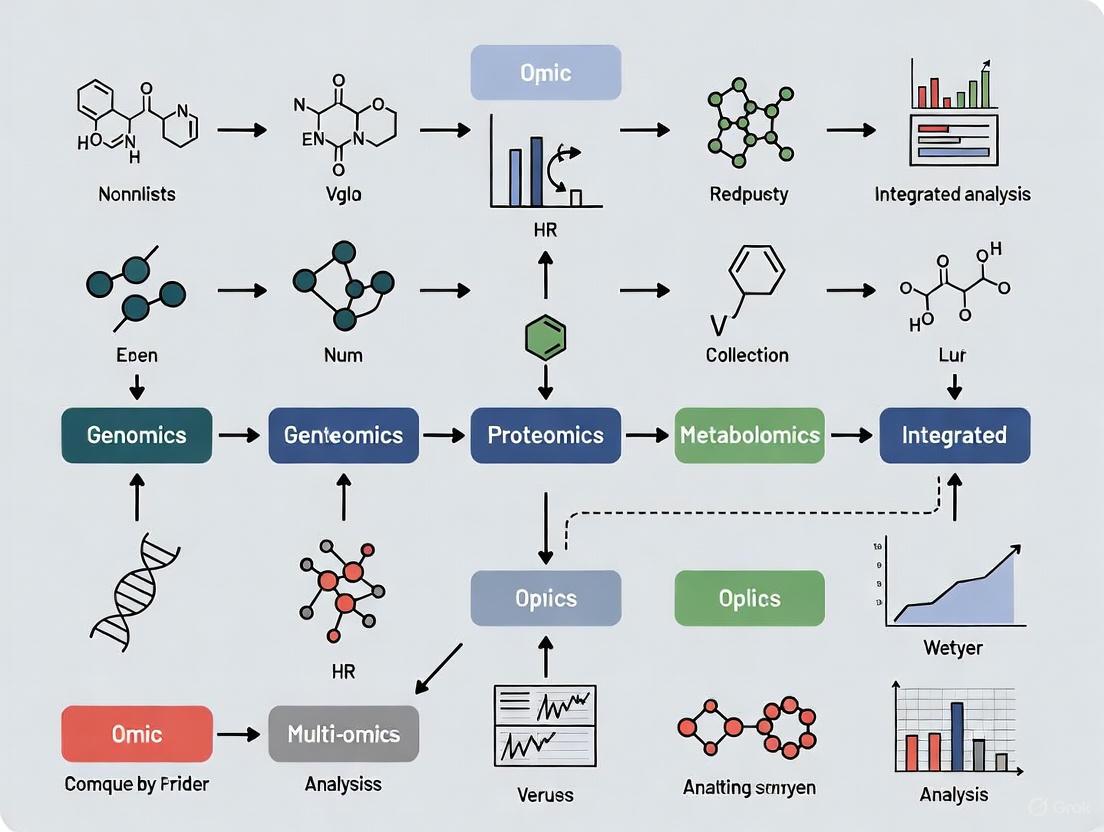
This guide provides researchers, scientists, and drug development professionals with a comprehensive framework for multi-omics data collection and integration.
A Comprehensive Guide to Multi-Omics Data Collection and Integration for Precision Medicine
Abstract
This guide provides researchers, scientists, and drug development professionals with a comprehensive framework for multi-omics data collection and integration. It covers foundational principles, from defining omics layers and their biological significance to explaining data structures like matched versus unmatched datasets. The article delves into the core challenges of data heterogeneity, missing values, and batch effects, offering practical troubleshooting strategies. A detailed comparison of statistical, multivariate, and machine learning integration methods—including MOFA+, DIABLO, and deep learning approaches—is presented to inform method selection. The guide also outlines rigorous validation techniques, from clinical association to biological interpretation, ensuring robust and biologically meaningful insights. By synthesizing current methodologies and emerging trends, this resource aims to empower the translation of complex multi-omics data into actionable discoveries for biomarker identification, disease subtyping, and therapeutic development.
Understanding Multi-Omics: Core Concepts, Data Types, and Biological Significance
The study of biological systems has been revolutionized by the development of high-throughput technologies that allow for the comprehensive analysis of biomolecules on a massive scale. These fields, collectively known as "omics" technologies, enable researchers to move beyond studying individual molecules to understanding entire systems. The core omics fields—genomics, transcriptomics, proteomics, and metabolomics—each focus on a distinct layer of biological information, from genetic blueprint to functional endpoints. Together, they provide complementary insights into the complex molecular networks that underlie health and disease [1].
The integration of these multi-modal datasets represents a paradigm shift in biomedical research, offering holistic views into biological systems that single data types cannot provide [2]. This integrated approach is particularly valuable for precision medicine, where the goal is to tailor treatments based on a patient's unique molecular profile rather than population averages [2] [3]. However, this integration presents significant challenges due to the heterogeneity, scale, and complexity of the data generated by each omics platform [2] [4].
Comparative Analysis of Omics Fields
The four major omics fields each interrogate a specific level of the biological hierarchy, from genetic instruction to metabolic activity. The table below provides a structured comparison of their core characteristics, methodologies, and outputs.
Table 1: Technical Comparison of Core Omics Fields
| Omics Field | Molecule Studied | Key Analytical Technologies | Primary Output | Temporal Dynamics |
|---|---|---|---|---|
| Genomics [1] [4] | DNA | Sanger sequencing, DNA microarrays, Next-Generation Sequencing (NGS) including Whole Genome Sequencing (WGS) & Whole Exome Sequencing (WES) | Catalog of genetic variants (SNVs, CNVs, indels) | Static (with minor exceptions) |
| Transcriptomics [1] [5] | RNA (especially mRNA) | RNA sequencing (RNA-seq), microarrays | Gene expression profiles, quantification of transcript levels | Dynamic (minutes to hours) |
| Proteomics [1] [3] | Proteins and post-translational modifications | Liquid Chromatography with Tandem Mass Spectrometry (LC-MS/MS), Data-Independent Acquisition (DIA), Tandem Mass Tags (TMT) | Protein identification, quantification, and characterization of modifications | Dynamic (hours to days) |
| Metabolomics [1] [3] | Small molecule metabolites | Gas Chromatography-MS (GC-MS), Liquid Chromatography-MS (LC-MS), Nuclear Magnetic Resonance (NMR) | Concentration profiles of metabolites, metabolic pathway activity | Highly dynamic (seconds to minutes) |
Detailed Field Specifications
Genomics
Genomics is the study of an organism's complete set of DNA, including both coding and non-coding regions [4]. While genetics focuses on individual genes, genomics examines the entire genome and the interactions between multiple genes [1]. The human genome consists of approximately 3 billion DNA base pairs encoding about 20,000 genes, with coding regions representing only 1-2% of the entire genome [4]. Genomics captures various types of genetic variants, including single nucleotide variations (SNVs), insertions/deletions (indels), and structural variations (SVs) such as copy number variants (CNVs) [4]. In medical applications, genomics is used not only for diagnosing difficult-to-identify conditions but is increasingly being applied to identify inherited health risks and guide cancer treatment by identifying targetable mutations [1].
Transcriptomics
Transcriptomics focuses on the complete set of RNA transcripts, known as the transcriptome, produced in a cell or population of cells [1]. The primary transcript of interest is messenger RNA (mRNA), which carries genetic information from DNA to the protein synthesis machinery. A key insight from transcriptomics is that the transcriptome varies significantly between different cell types, despite all cells containing the same genomic DNA, reflecting cell-specific gene expression patterns [1]. While transcriptomics can measure gene expression more directly than genomics, it has an important limitation: mRNA levels do not always correlate perfectly with protein abundance due to various post-transcriptional regulatory mechanisms [5]. In clinical practice, transcriptomic tests exist for conditions like breast cancer, where they help determine the likely benefit of chemotherapy [1].
Proteomics
Proteomics is the large-scale study of proteins, their structures, functions, interactions, and modifications [1] [3]. Unlike the genome, the proteome is highly dynamic and reflects the functional state of a biological system at a given time. Proteomic approaches can be categorized into three main types: expression proteomics (quantifying protein levels), structural proteomics (determining protein structures and locations), and functional proteomics (characterizing protein activities and interactions) [1]. A critical aspect of proteomics is the study of post-translational modifications (PTMs)—chemical changes such as phosphorylation, acetylation, and ubiquitination that dramatically alter protein activity [3]. Proteomics faces technical challenges including the detection of low-abundance proteins, the dynamic range problem where abundant proteins mask rare ones, and a lack of standardization in sample processing [3] [5].
Metabolomics
Metabolomics is the systematic study of small-molecule metabolites, typically under 1,500 Da in molecular weight, that represent the end products of cellular processes [1] [3]. The metabolome provides the most direct reflection of a cell's physiological state and responds rapidly to environmental or pathological changes. Metabolites include diverse classes of compounds such as amino acids, lipids, sugars, and organic acids [3]. Because metabolomics captures the functional outcome of molecular activity, it is often described as providing a molecular "phenotype" that integrates information from genomics, transcriptomics, and proteomics [1]. Metabolomics is particularly valuable for studying conditions like obesity, diabetes, cancer, and neurodegenerative diseases, and for understanding individual variations in response to drugs and environmental factors [1].
Multi-Omics Integration Methodologies
Conceptual Framework for Data Integration
The integration of multi-omics data requires sophisticated computational and statistical approaches to extract meaningful biological insights from these complex, heterogeneous datasets. The integration strategy can be categorized based on when in the analytical process the datasets are combined, each with distinct advantages and challenges [2].
Table 2: Multi-Omics Data Integration Strategies
| Integration Strategy | Timing of Integration | Key Advantages | Principal Challenges |
|---|---|---|---|
| Early Integration (Concatenation-based) [2] [6] | Before analysis | Captures all potential cross-omics interactions; preserves raw information | Extremely high dimensionality; computationally intensive; risk of spurious correlations |
| Intermediate Integration (Transformation-based) [2] [6] | During analysis | Reduces complexity; incorporates biological context through networks | Requires domain knowledge; may lose some raw information during transformation |
| Late Integration (Model-based) [2] [6] | After individual analysis | Handles missing data well; computationally efficient; robust | May miss subtle cross-omics interactions not captured by individual models |
Computational Approaches and AI Applications
The analysis of integrated multi-omics data relies heavily on advanced computational methods, particularly machine learning and artificial intelligence, which can detect subtle patterns across millions of data points that are invisible to conventional analysis [2]. Several state-of-the-art approaches have proven particularly effective for multi-omics integration:
Deep Learning Methods: Autoencoders (AEs) and Variational Autoencoders (VAEs) are unsupervised neural networks that compress high-dimensional omics data into a dense, lower-dimensional "latent space," making integration computationally feasible while preserving key biological patterns [2]. Graph Convolutional Networks (GCNs) learn from biological network structures, making them effective for integrating multi-omics data onto protein-protein interaction or gene co-expression networks [2].
Network-Based Integration: Similarity Network Fusion (SNF) creates patient-similarity networks from each omics layer and iteratively fuses them into a single comprehensive network, enabling more accurate disease subtyping [2]. This approach strengthens strong similarities and removes weak ones across data modalities.
Multivariate Statistical Methods: Tools like MixOmics (an R package) provide multivariate methods including Partial Least Squares (PLS) to uncover correlations across datasets [3]. MOFA2 (Multi-Omics Factor Analysis) captures latent factors driving variation across multiple omics layers [3].
Experimental Protocols for Multi-Omics Research
Integrated Workflow for Proteomics and Metabolomics
The integration of proteomics and metabolomics is particularly powerful for systems biology as it connects molecular regulators (proteins) with their functional outcomes (metabolites) [3]. Below is a detailed protocol for a typical proteomics-metabolomics integrated study:
Step 1: Sample Preparation The goal is to obtain high-quality extracts of both proteins and metabolites from the same biological material. Best practices include using joint extraction protocols where possible, keeping samples on ice to minimize degradation, and adding internal standards (e.g., isotope-labeled peptides and metabolites) for accurate quantification [3]. A key challenge is balancing conditions that preserve proteins (which often require denaturants) with those that stabilize metabolites (which may be heat- or solvent-sensitive) [3].
Step 2: Data Acquisition For proteomics, data acquisition typically involves high-resolution mass spectrometry, with common strategies including Data-Dependent Acquisition (DDA) and Data-Independent Acquisition (DIA) for comprehensive detection, or targeted approaches like Parallel Reaction Monitoring (PRM) for specific proteins [3]. For metabolomics, untargeted profiling uses LC-MS or GC-MS to broadly capture metabolites, while targeted approaches use LC-MS/MS with Multiple Reaction Monitoring (MRM) or NMR for precise quantification of predefined metabolites [3].
Step 3: Data Processing and Integration Data preprocessing applies normalization techniques (e.g., quantile normalization, log transformation) to harmonize proteomic and metabolomic scales, and uses batch effect correction tools like ComBat to minimize technical variation [2] [3]. Integration employs statistical correlation analysis (e.g., Pearson/Spearman correlation) and network-based methods to identify protein-metabolite relationships [3].
Essential Research Reagents and Materials
Successful multi-omics research requires carefully selected reagents and analytical tools. The table below details key solutions and their applications in integrated omics studies.
Table 3: Essential Research Reagent Solutions for Multi-Omics Studies
| Reagent/Material | Function/Application | Specific Use Cases |
|---|---|---|
| Tandem Mass Tags (TMT) [3] | Multiplexed protein quantification | Enables simultaneous analysis of multiple samples in proteomics, improving throughput and reducing technical variability |
| Stable Isotope-Labeled Standards [3] | Internal standards for quantification | Allows accurate quantification of both peptides and metabolites by correcting for technical variation in MS analysis |
| Liquid Chromatography Columns [3] | Separation of complex mixtures | Reversed-phase columns for peptide/protein separation; HILIC columns for polar metabolite separation in LC-MS |
| Cross-linking Reagents | Protein-protein interaction studies | Captures transient protein interactions for structural proteomics and network analysis |
| Antibody Conjugates [5] | Protein detection and quantification | Metal-tagged antibodies for CyTOF technology enable high-parameter single-cell protein analysis |
| RNAscope Probes [5] | Spatial transcriptomics | Enables precise localization of RNA transcripts in tissue samples when combined with proteomic imaging |
The integration of genomics, transcriptomics, proteomics, and metabolomics represents a fundamental shift in biological research, moving from reductionist approaches to systems-level understanding. Each omics field provides a unique and essential perspective on biological systems, from the static genetic blueprint to the dynamic functional state. The true power of these technologies emerges when they are integrated, enabling researchers to construct comprehensive models of biological systems and disease processes [2] [4] [3].
The future of multi-omics research will be shaped by advances in several key areas. Technologically, improvements in mass spectrometry sensitivity, single-cell omics applications, and spatial omics technologies will provide unprecedented resolution [5]. Computationally, more sophisticated AI and machine learning methods will be essential for extracting biologically meaningful patterns from these complex, high-dimensional datasets [2]. Clinically, the transition of multi-omics from research to routine clinical application will require standardized protocols, robust analytical frameworks, and thoughtful attention to ethical considerations [2] [4]. As these technologies continue to mature and integrate, they hold immense promise for advancing precision medicine and delivering tailored therapeutic interventions based on a comprehensive understanding of individual molecular profiles.
The complexity of human diseases, influenced by multifaceted interactions between genetic, environmental, and molecular factors, has long challenged traditional biological research. Single-omics approaches—which analyze one molecular layer such as genomics or transcriptomics in isolation—often fail to capture the complete biological picture, generating inconsistent biomarkers and providing limited insights into causal disease mechanisms [7]. Multi-omics, the integrated analysis of diverse biological datasets including genomics, transcriptomics, proteomics, epigenomics, and metabolomics, has emerged as a transformative solution. By simultaneously examining multiple molecular layers, multi-omics provides a comprehensive, systems-level view of biological processes, enabling researchers to uncover intricate molecular interactions that drive disease pathogenesis [8] [7].
This integrated approach is revolutionizing biomedical research and therapeutic development. Where single-omics studies might identify a genetic mutation associated with disease, multi-omics can reveal how that mutation affects RNA expression, protein function, and metabolic pathways, ultimately elucidating the complete mechanistic pathway from genetic predisposition to physiological manifestation [8]. The power of multi-omics integration lies in its ability to connect these disparate biological layers, providing unprecedented insights into disease mechanisms and opening new avenues for diagnosis, treatment, and personalized medicine [9] [10].
Multi-Omics Integration Methodologies and Technical Approaches
Integrating multiple omics datasets requires sophisticated computational and statistical strategies that can handle the heterogeneity, high dimensionality, and complex noise profiles inherent in different molecular data types. The integration methodologies can be broadly categorized into three principal approaches: early, intermediate, and late integration [11].
Early integration involves combining raw data from different omics layers at the beginning of the analysis pipeline. While this approach can identify direct correlations between different molecular types, it may introduce significant challenges related to data scaling, normalization, and information loss due to the varying structures and distributions of each datatype [11].
Intermediate integration employs sophisticated algorithms to extract features from each omics dataset separately before combining them for joint analysis. This balanced approach preserves the unique characteristics of each datatype while enabling the identification of cross-omics patterns. Key intermediate integration methods include:
- Similarity Network Fusion (SNF): Constructs sample-similarity networks for each omics dataset and fuses them via non-linear processes to generate an integrated network that captures complementary information from all omics layers [12].
- Multi-Omics Factor Analysis (MOFA): An unsupervised Bayesian framework that infers a set of latent factors that capture principal sources of variation across multiple data types, effectively decomposing each datatype-specific matrix into shared and unique components [12].
- Data Integration Analysis for Biomarker discovery using Latent Components (DIABLO): A supervised integration method that uses known phenotype labels to identify shared latent components across omics datasets that are most relevant to the outcome of interest [12].
Late integration involves analyzing each omics dataset independently and combining the results at the final interpretation stage. This approach preserves dataset-specific analyses but may miss important inter-omics relationships [11].
Table 1: Comparison of Major Multi-Omics Integration Methods
| Method | Integration Type | Key Characteristics | Best Use Cases |
|---|---|---|---|
| MOFA | Intermediate, Unsupervised | Bayesian factor analysis; identifies latent factors across datasets; no phenotype requirement | Exploratory analysis of shared variation across omics layers |
| DIABLO | Intermediate, Supervised | Uses phenotype labels; multivariate methodology; identifies discriminative features | Biomarker discovery; patient stratification; classification tasks |
| SNF | Intermediate, Unsupervised | Network-based fusion; constructs similarity networks; non-linear integration | Identifying patient subgroups; cancer subtyping |
| MCIA | Intermediate, Unsupervised | Covariance optimization; aligns multiple omics features onto shared dimensional space | Joint analysis of multiple high-dimensional datasets |
| xMWAS | Early/Intermediate | Pairwise association analysis; PLS components; creates integrative networks | Correlation network analysis; identifying inter-omics connections |
Machine Learning and AI in Multi-Omics Integration
Artificial intelligence, particularly deep learning, is becoming increasingly prominent in multi-omics research due to its ability to handle the complexity and high dimensionality of integrated biological data [13]. These methods can be categorized into non-generative approaches (feedforward neural networks, graph convolutional networks, autoencoders) designed for direct feature extraction and classification, and generative methods (variational autoencoders, generative adversarial networks, generative pretrained transformers) that create adaptable representations shared across modalities [13].
AI-driven multi-omics integration has demonstrated particular success in oncology research, where models trained on TCGA (The Cancer Genome Atlas) data have outperformed traditional statistical approaches in predicting patient outcomes, identifying novel biomarkers, and understanding therapeutic resistance mechanisms [13]. However, most AI models remain at the proof-of-concept stage with limited clinical validation, presenting a significant opportunity for future translation into clinical practice [13].
Experimental Design and Workflow for Multi-Omics Studies
Implementing a robust multi-omics study requires careful planning and execution across multiple experimental and computational phases. The workflow below illustrates the key stages in a comprehensive multi-omics investigation:
Sample Preparation and Data Generation
The foundation of any successful multi-omics study lies in proper sample collection and processing. For matched multi-omics analysis—where multiple molecular layers are profiled from the same sample set—careful preservation methods are essential to maintain the integrity of DNA, RNA, proteins, and metabolites [12]. Recent advances in single-cell and spatial technologies have further enhanced multi-omics capabilities, allowing researchers to analyze molecular profiles at cellular resolution within their native tissue context [8] [10].
High-throughput technologies for data generation include:
- Next-generation sequencing for genomics, transcriptomics, and epigenomics
- Mass spectrometry for proteomics and metabolomics
- Spatial transcriptomics and proteomics for mapping molecular distributions within tissues
Data Processing and Computational Integration
The processing of multi-omics data requires specialized computational pipelines to address challenges such as batch effects, varying data distributions, missing values, and data harmonization [12] [14]. Tailored preprocessing pipelines are typically applied to each datatype before integration, including normalization, quality control, and feature selection [14].
Table 2: Essential Research Reagents and Platforms for Multi-Omics Studies
| Category | Specific Technologies/Platforms | Primary Function |
|---|---|---|
| Sequencing Platforms | Illumina NovaSeq, PacBio, Oxford Nanopore | Genomics, transcriptomics, epigenomics profiling |
| Proteomics Technologies | Mass spectrometry (LC-MS/MS), Olink, SomaScan | Protein identification and quantification |
| Spatial Omics Platforms | 10x Genomics Visium, Nanostring GeoMx, Akoya CODEX | Spatial mapping of transcripts and proteins |
| Single-Cell Technologies | 10x Genomics Single Cell, Parse Biosciences | Single-cell multi-omics profiling |
| Computational Tools | MOFA+, DIABLO, SNF, Omics Playground | Data integration and analysis |
| Bioinformatics Resources | TCGA, GTEx, Human Cell Atlas, Bioconductor | Reference data and analytical packages |
Application in Disease Mechanism Elucidation: Breast Cancer Case Study
The power of multi-omics integration is powerfully demonstrated in oncology, particularly breast cancer research. A 2025 study published in Scientific Reports developed an adaptive multi-omics integration framework for breast cancer survival analysis that combined genomics, transcriptomics, and epigenomics data from The Cancer Genome Atlas [11]. The methodology and outcomes provide a compelling template for how multi-omics reveals disease mechanisms.
Experimental Protocol and Implementation
The breast cancer survival study employed a sophisticated multi-stage analytical approach:
Data Acquisition and Preprocessing: Collected genomic (SNVs, CNVs), transcriptomic (RNA-seq), and epigenomic (DNA methylation) data from TCGA breast cancer samples. Each datatype underwent modality-specific preprocessing, normalization, and batch effect correction [11].
Feature Selection: Implemented genetic programming to evolutionarily optimize feature selection from each omics layer, identifying the most informative molecular features associated with survival outcomes [11].
Multi-Omics Integration: Applied intermediate integration using the genetic programming framework to combine selected features from all omics layers into a unified model [11].
Survival Modeling: Developed a Cox proportional hazards model using the integrated multi-omics features to predict patient survival, evaluated using the concordance index (C-index) [11].
The integrated multi-omics approach achieved a C-index of 78.31 during cross-validation and 67.94 on the test set, significantly outperforming single-omics models [11]. This demonstrates the superior predictive power of multi-omics integration for clinical outcome prediction.
Biological Insights Gained
Beyond improved prediction accuracy, the multi-omics approach revealed previously obscured molecular networks driving breast cancer progression. The integrated analysis identified:
- Cross-omics regulatory networks where genetic alterations epigenetically influenced gene expression patterns
- Novel biomarker combinations spanning multiple molecular layers that better defined cancer subtypes
- Mechanistic pathways connecting genetic susceptibility with transcriptional and epigenetic dysregulation
These insights provide a more comprehensive understanding of breast cancer heterogeneity and progression, enabling better patient stratification and personalized treatment approaches [11].
Advanced Applications and Emerging Frontiers
Single-Cell and Spatial Multi-Omics
The integration of single-cell technologies with multi-omics represents one of the most exciting frontiers in biomedical research. Single-cell multi-omics allows researchers to analyze genomic, transcriptomic, and proteomic changes at the individual cell level, revealing cellular heterogeneity and rare cell populations that bulk analyses cannot detect [9] [10]. When combined with spatial technologies, which preserve the architectural context of tissues, researchers can map molecular interactions within their native tissue microenvironment, providing unprecedented insights into cellular communication and tissue organization in health and disease [8] [15].
Clinical Translation and Precision Medicine
Multi-omics is increasingly driving advances in clinical diagnostics and therapeutic development. In rare disease diagnosis, integrated analysis of genomic, transcriptomic, and epigenomic data has significantly improved diagnostic yields compared to single-omics approaches alone [7]. For complex diseases like Alzheimer's, multi-omics studies have identified epigenetic alterations and molecular networks associated with disease progression, revealing potential therapeutic targets [7].
Liquid biopsies exemplify the clinical impact of multi-omics, analyzing biomarkers like cell-free DNA, RNA, proteins, and metabolites non-invasively [9] [10]. Initially focused on oncology, these approaches are expanding into other medical domains, enabling early detection, treatment monitoring, and personalized therapeutic strategies through multi-analyte integration [9].
The following diagram illustrates how AI-driven multi-omics analysis transforms raw data into clinical insights:
Challenges and Future Directions
Despite its transformative potential, multi-omics integration faces significant challenges that must be addressed to fully realize its capabilities. Key limitations include:
Data Integration and Computational Challenges: The heterogeneous nature of multi-omics data, with varying scales, resolutions, and noise profiles, creates substantial barriers to effective integration [8] [12]. The massive volume of data generated requires advanced computational infrastructure, scalable storage solutions, and specialized analytical expertise [9] [8]. Development of user-friendly analytical platforms like Omics Playground aims to democratize multi-omics analysis for researchers without extensive computational backgrounds [12].
Standardization and Reproducibility: The absence of standardized preprocessing protocols and analytical pipelines threatens the reproducibility of multi-omics studies [12]. Establishing community-wide standards for data quality control, normalization, and integration methodologies is essential for advancing the field [9].
Clinical Implementation and Equity: Translating multi-omics discoveries into clinical practice requires addressing regulatory considerations, demonstrating clinical utility, and ensuring accessibility across diverse populations [9]. Engaging underrepresented populations in multi-omics research is critical to ensure that biomarker discoveries and therapeutic benefits are broadly applicable and do not perpetuate health disparities [9].
Future advancements in multi-omics will be driven by continued technological innovations, particularly in single-cell and spatial profiling, improved AI and machine learning algorithms for data integration, and greater emphasis on longitudinal multi-omics profiling to understand dynamic biological processes [8] [10]. As these technologies mature and challenges are addressed, multi-omics integration will increasingly become the cornerstone approach for unraveling disease mechanisms and enabling precision medicine.
Multi-omics integration represents a paradigm shift in biological research and clinical medicine. By simultaneously analyzing multiple molecular layers, this approach provides unprecedented insights into the complex mechanisms underlying human diseases, overcoming the limitations of single-omics methodologies. While significant challenges remain in data integration, standardization, and clinical translation, ongoing advancements in computational methods, AI technologies, and analytical frameworks are rapidly addressing these barriers. As multi-omics continues to evolve and mature, it promises to revolutionize our understanding of disease pathogenesis, accelerate therapeutic development, and ultimately enable truly personalized precision medicine approaches tailored to the unique molecular profile of each patient.
The advent of high-throughput technologies has enabled the concurrent measurement of multiple molecular layers—such as the genome, epigenome, transcriptome, proteome, and metabolome—within biological systems. This approach, known as multi-omics, provides an unprecedented, holistic view of biological processes and disease mechanisms. The principal value of multi-omics lies in integration: the computational and statistical harmonization of these distinct data types. While each omic layer provides valuable insights alone, their integration can reveal novel cell subtypes, regulatory interactions, and pathways that are not detectable when analyzing layers in isolation [16] [12]. This is because biological components operate within a highly interconnected network; for instance, a genetic variant (genomics) might influence how a gene is regulated (epigenomics), affecting its expression (transcriptomics) and ultimately the abundance of its corresponding protein (proteomics). Multi-omics integration serves to disentangle these complex, causal relationships to properly capture cellular phenotype [16].
However, integrating these diverse datasets presents significant bioinformatics challenges. Each omic data type has a unique scale, statistical distribution, noise profile, and preprocessing requirements, making integration a complex task without a universal "one-size-fits-all" solution [16] [12]. This technical guide outlines the core data structures underpinning multi-omics integration, focusing on the critical distinctions between matched and unmatched, and horizontal and vertical integration strategies. Framing the integration problem through these lenses is a fundamental first step for researchers and drug development professionals designing robust, biologically meaningful multi-omics studies.
Core Data Structures and Integration Typologies
The strategy for integrating multi-omics data is profoundly influenced by the experimental design, specifically whether the same cell or sample was used to generate the different omics measurements. This leads to the primary distinction between matched and unmatched data, which in turn dictates the computational approach, often categorized as horizontal, vertical, or diagonal integration.
Matched vs. Unmatched Data
The concepts of matched and unmatched data define the fundamental structure of the input data for integration tools.
- Matched Data: In this structure, multi-omics profiles are measured from the same cell or the same set of samples. For example, single-cell technologies can simultaneously profile the transcriptome (RNA) and epigenome (ATAC-seq) from within a single cell [16] [12]. This design keeps the biological context consistent and allows for the direct investigation of non-linear relationships between molecular modalities within the same biological unit.
- Unmatched Data: Here, the different omics data types are generated from different, unpaired cells or samples. This could involve integrating transcriptomic data from one set of cells with proteomic data from a different set of cells from the same tissue, or even from different studies altogether [16]. This scenario is technically easier to perform experimentally but presents a greater computational challenge for integration.
Horizontal, Vertical, and Diagonal Integration
These terms describe the computational strategies used to merge the data based on its structure.
- Vertical Integration: This strategy is used for matched data. It merges data from different omics layers (e.g., RNA, DNA methylation, chromatin accessibility) within the same set of samples. The sample or cell itself is used as a natural anchor to bring the different omic layers together [16] [12]. This is often considered the most desirable form of integration as it preserves the direct biological context from the same source.
- Horizontal Integration: This involves merging datasets of the same omic type across multiple different studies or batches. For instance, combining RNA-seq data from multiple experiments to increase statistical power. While a form of data integration, it is not considered true multi-omics integration and will not be a focus of this guide [16].
- Diagonal Integration: This is the most technically challenging form of integration and is applied to unmatched data. It involves integrating different omics types from different cells or different studies. Since the cell cannot be used as an anchor, the method must instead project cells into a co-embedded space or use prior biological knowledge to find commonalities between the disparate datasets [16].
The following diagram illustrates the logical relationships and workflows between these core data structures and integration types.
The table below provides a structured comparison of these integration approaches, including their defining characteristics, challenges, and example computational tools.
| Integration Type | Data Structure | Key Characteristic | Primary Challenge | Example Tools |
|---|---|---|---|---|
| Vertical Integration [16] [12] | Matched | The cell/sample is the anchor for integration. | Managing different data scales and noise ratios from the same cell. | MOFA+ [16], Seurat v4 [16], totalVI [16] |
| Diagonal Integration [16] | Unmatched | No common cell anchor; requires creating a shared latent space. | Finding biological commonality between cells from different populations/studies. | GLUE [16], LIGER [16], Pamona [16] |
| Mosaic Integration [16] | Partially Matched | Integrates datasets with various, overlapping omics combinations. | Leveraging sparse, overlapping measurements to create a unified representation. | StabMap [16], Cobolt [16], Bridge Integration [16] |
| Horizontal Integration [16] | Unmatched (Same Omics) | Merges the same omic type from multiple datasets. | Batch effect correction and data normalization. | (Not the focus of this guide) |
Methodologies and Experimental Protocols
Selecting the appropriate computational method is critical for successful multi-omics integration. The choice depends on the data structure (matched or unmatched) and the specific biological question. The following workflow chart outlines a structured decision-making process for selecting and applying an integration method, from data input to biological validation.
Protocols for Key Integration Methods
Below are detailed methodologies for three prominent multi-omics integration tools, each representing a different computational approach.
MOFA+ (Multi-Omics Factor Analysis)
- Methodology Type: Unsupervised, probabilistic factor analysis (Bayesian framework) [12].
- Core Protocol:
- Input: MOFA+ accepts multiple matched omics data matrices (e.g., mRNA, DNA methylation, chromatin accessibility) from the same set of samples [16] [12].
- Decomposition: The model decomposes each data matrix into a set of latent factors (shared across all omics) and weight matrices (specific to each omics modality), plus a residual noise term [12].
- Training: It is trained to infer the set of latent factors and weights that best explain the variance in the observed multi-omics data.
- Output: The result is a low-dimensional representation where each factor captures an independent source of variation across the datasets. Researchers can then analyze how much variance each factor explains in each omics modality and associate factors with sample phenotypes [12].
- Ideal Use Case: Exploratory analysis of matched multi-omics data to identify major, unlabeled sources of biological and technical variation.
GLUE (Graph-Linked Unified Embedding)
- Methodology Type: Unsupervised, graph-based variational autoencoder [16].
- Core Protocol:
- Input: GLUE is designed for unmatched integration and can handle multiple omics layers (e.g., chromatin accessibility, DNA methylation, mRNA) [16].
- Prior Knowledge: A key innovation is the use of a prior knowledge graph that defines known biological relationships between features across omics layers (e.g., linking a transcription factor to its target genes) [16].
- Integration: The model uses a graph variational autoencoder to learn a co-embedded space for cells from different modalities. The prior knowledge graph acts as a guide to "link" the omics and align the cells meaningfully.
- Output: A unified low-dimensional embedding of all cells from all omics types, enabling joint analysis such as clustering and trajectory inference on unmatched data [16].
- Ideal Use Case: Integrating multiple unpaired omics datasets (diagonal integration) where a reliable prior knowledge base is available.
SNF (Similarity Network Fusion)
- Methodology Type: Unsupervised, network-based method [12].
- Core Protocol:
- Input: SNF operates on multiple omics data matrices.
- Network Construction: Instead of merging raw data, SNF first constructs a sample-similarity network for each individual omics dataset. In these networks, nodes represent samples, and edges represent the similarity between samples (e.g., based on Euclidean distance) [12].
- Fusion: These datatype-specific networks are then fused into a single, consolidated network using a non-linear process that iteratively updates each network based on the information from the others.
- Output: A fused network that captures complementary information from all omics layers. This network can be used for downstream analyses like clustering patients into integrative subtypes [12].
- Ideal Use Case: Integrating data from different omics to discover disease subtypes or patient subgroups based on multiple layers of molecular information.
Successful multi-omics research relies on both computational tools and high-quality biological data. The following table details key resources mentioned in this guide.
| Resource / Tool Name | Type | Primary Function in Multi-Omics | Reference |
|---|---|---|---|
| MOFA+ | Computational Tool / R Package | Unsupervised integration of matched multi-omics data using factor analysis to identify latent sources of variation. | [16] [12] |
| Seurat v4/v5 | Computational Tool / R Package | A comprehensive toolkit for single-cell analysis, including weighted nearest-neighbor (WNN) methods for vertical integration and bridge integration for unmatched data. | [16] |
| GLUE (Graph-Linked Unified Embedding) | Computational Tool / Python Package | Unsupervised integration of unmatched multi-omics data using a graph-guided variational autoencoder. | [16] |
| TCGA (The Cancer Genome Atlas) | Public Data Repository | A vast resource of publicly available multi-omic data (RNA-Seq, DNA-Seq, methylation) across many tumor types, used for robust, large-scale analyses. | [12] |
| Omics Playground | Integrated Analysis Platform | A code-free platform that provides multiple state-of-the-art integration methods (like MOFA and SNF) and visualization capabilities for multi-omics data analysis. | [12] |
The strategic integration of multi-omics data is a powerful paradigm for advancing biomedical research and drug development. The initial and most critical step in this process is understanding and defining the underlying data structure—whether it is matched or unmatched—as this directly dictates the applicable integration strategy, be it vertical or diagonal. While vertical integration of matched data is often more straightforward and provides direct correlative power within a single cell, real-world constraints frequently necessitate the use of more complex diagonal and mosaic integration methods for unmatched data.
As the field continues to evolve, the development of more sophisticated computational tools that can leverage prior biological knowledge, handle missing data, and provide interpretable results will be crucial. For researchers, the path forward involves careful experimental planning to maximize data compatibility, coupled with a reasoned selection of integration methods that align with both their data structure and biological objectives. By systematically applying the principles of data structures and integration typologies outlined in this guide, scientists can more effectively unlock the profound insights hidden within coordinated multi-omics datasets.
The landscape of disease research and therapeutic development is undergoing a fundamental transformation, shifting from a traditional, symptom-focused approach to a molecular-driven, systems-level understanding. This paradigm shift is powered by multi-omics—the integrated analysis of diverse biological datasets spanning the genome, epigenome, transcriptome, proteome, and metabolome [17] [8]. Where single-omics approaches could only provide a fragmented view, multi-omics integration delivers a holistic picture of the complex molecular interactions that underlie health and disease. This comprehensive perspective is critical for uncovering robust biomarkers and designing personalized treatment strategies that align with an individual's unique molecular profile [18] [19].
The central thesis of this whitepaper is that the effective collection, integration, and interpretation of multi-omics data serves as the foundational guide for modern biomedical research, directly linking biomarker discovery to clinically actionable insights. The journey from data to therapy faces significant challenges, including the "tar pit" of biomarker validation, where countless candidates fail to achieve clinical utility [20]. However, by employing a structured framework for multi-omics data integration, researchers can systematically bridge this gap, thereby accelerating the development of precision medicine [18] [17]. This guide will detail the key biological insights, computational strategies, and experimental protocols that are defining the future of biomarker discovery and personalized treatment.
Computational Strategies for Multi-Omics Data Integration
The immense volume and heterogeneity of multi-omics data necessitate sophisticated computational methods for integration and interpretation. These methods can be broadly categorized based on their approach to data synthesis and their intended analytical objectives.
Integration Methodologies and Analytical Objectives
The choice of integration strategy is heavily influenced by the specific scientific question at hand. Studies aiming to identify patient subtypes or discover disease-associated patterns often employ intermediate integration methods that learn a joint representation from multiple omics datasets [18]. These approaches are particularly powerful for finding co-varying features across molecular layers that define distinct disease subgroups with prognostic or therapeutic implications. For objectives such as understanding regulatory mechanisms or predicting drug response, other methods, including network-based integration or knowledge-driven approaches, may be more appropriate [18] [19]. These techniques often leverage prior biological knowledge to connect disparate omics findings into a coherent model of disease pathophysiology.
Table 1: Multi-Omics Data Repositories for Biomarker Discovery
| Repository Name | Primary Focus | Available Omics Data Types | Key Utility |
|---|---|---|---|
| The Cancer Genome Atlas (TCGA) [19] | Pan-Cancer | Genomics, Transcriptomics, Epigenomics, Proteomics | Molecular profiling of >33 cancer types; foundational for cancer biomarker discovery. |
| Clinical Proteomic Tumor Analysis Consortium (CPTAC) [17] [19] | Cancer Proteomics | Proteomics, Post-translational Modifications | Provides proteomic data correlated with TCGA genomic cohorts. |
| International Cancer Genomics Consortium (ICGC) [19] | Pan-Cancer Genomics | Whole Genome Sequencing, Somatic/Germline Mutations | Catalogs genomic alterations across cancer types and ethnicities. |
| Cancer Cell Line Encyclopedia (CCLE) [19] | Preclinical Models | Gene Expression, Copy Number, Drug Response | Facilitates in vitro validation of biomarker candidates and drug sensitivity testing. |
| Answer ALS [18] | Neurodegenerative Disease | Genomics, Transcriptomics, Epigenomics, Proteomics | Integrated omics and deep clinical data for Amyotrophic Lateral Sclerosis. |
Workflow for Multi-Omics Data Processing
A standardized workflow is essential for transforming raw multi-omics data into reliable biological insights. The process typically involves sequential stages of data acquisition, preprocessing, integration, and model interpretation [21]. The initial preprocessing and quality control stage is critical, as it addresses the technical variability and noise inherent in high-throughput technologies, ensuring that downstream analyses are based on clean, standardized data [17] [22]. Following this, intra-omics harmonization aligns data from different platforms or studies, while inter-omics integration seeks to find statistical and biological relationships across the different molecular layers [17].
The following diagram illustrates a generalized logical workflow for a multi-omics biomarker discovery project, from data collection to clinical application.
The Biomarker Discovery Pipeline: From Candidates to Clinical Application
The biomarker discovery pipeline is a multi-stage, rigorous process designed to systematically identify and verify measurable indicators of biological processes or therapeutic responses.
Pipeline Stages and Key Methodologies
The pipeline can be conceptualized in three core stages [21]. The journey begins with the acquisition of high-quality biological samples and the generation of multi-omics data, followed by extensive preprocessing and feature extraction using AI/ML models to identify meaningful molecular patterns [17] [21]. The final and most demanding stage is clinical validation, where biomarker candidates are tested for reliability, sensitivity, and specificity across large, diverse patient populations to confirm their clinical utility [20] [21].
A persistent challenge is the high attrition rate, with only about 0.1% of published biomarker candidates progressing to routine clinical use [23]. This bottleneck is most pronounced in the verification stage, where the transition from discovery to validation requires reliable assays to credential candidates before costly large-scale clinical trials [20].
Experimental Protocols for Biomarker Verification
Advancements in analytical technologies are crucial for overcoming the verification bottleneck. While traditional methods like ELISA have been the gold standard, newer platforms offer superior performance.
Table 2: Key Technologies for Biomarker Verification and Validation
| Technology / Reagent | Function | Key Advantage | Considerations |
|---|---|---|---|
| LC-MS/MS (Liquid Chromatography Tandem Mass Spectrometry) [23] | Targeted proteomics; quantification of specific proteins/peptides. | High specificity and sensitivity; ability to detect low-abundance species. | Requires expertise; complex data analysis. |
| MSD (Meso Scale Discovery) U-PLEX [23] | Multiplexed immunoassay for simultaneous analyte measurement. | High dynamic range & sensitivity; cost-effective for multiple analytes. | Dependent on antibody quality. |
| Next-Generation Sequencing (NGS) [17] | Genome/Transcriptome-wide profiling for mutation and expression analysis. | Provides comprehensive view of genetic and transcriptomic alterations. | Data volume and storage challenges. |
| Reverse Phase Protein Array (RPPA) [19] | High-throughput antibody-based protein quantification. | Allows profiling of known proteins and signaling phospho-proteins. | Limited to available antibodies. |
Detailed Protocol: Biomarker Verification using LC-MS/MS and MSD A fit-for-purpose validation protocol must be established, tailored to the biomarker's intended clinical use [23].
- Sample Preparation: For LC-MS/MS, proteins are extracted from biofluids (e.g., plasma) or tissues and digested into peptides using a protease like trypsin. For MSD assays, samples are typically diluted in a specific buffer provided in the kit.
- Assay Configuration: For LC-MS/MS, stable isotope-labeled synthetic peptides (SIS peptides) are spiked into the sample as internal standards for precise quantification. For MSD, a U-PLEX plate coated with capture antibodies is used.
- Analysis and Quantification: In LC-MS/MS, peptides are separated by liquid chromatography and analyzed by mass spectrometry, monitoring specific ion transitions (MRM or PRM). The ratio of the native peptide to the SIS peptide provides absolute quantification. In MSD, after incubation with detection antibodies, the plate is read using an MSD instrument that measures electrochemiluminescence signal, which is proportional to analyte concentration.
- Validation Parameters: The assay must be characterized for:
- Specificity: Ability to accurately measure the target analyte in the presence of similar compounds.
- Sensitivity (LLOQ): The lowest concentration that can be quantified with acceptable precision and accuracy.
- Precision and Accuracy: Intra- and inter-assay reproducibility and closeness to the true value.
- Dynamic Range: The range of concentrations over which the assay provides a linear response.
Application in Personalized Oncology: A Case Study in Laryngeal Cancer
The integration of multi-omics data is revolutionizing oncology by enabling molecularly guided patient stratification and treatment. Laryngeal squamous cell carcinoma (LSCC) serves as a compelling case study.
Key Genetic Drivers and Dysregulated Pathways
Comprehensive molecular profiling of LSCC has identified recurrent genetic alterations that drive tumorigenesis and serve as potential biomarkers and therapeutic targets. Key among these are mutations in the tumor suppressor gene TP53 (occurring in up to 70% of cases), which are associated with poor prognosis and therapy resistance [24]. Other frequently altered genes include CDKN2A, which promotes uncontrolled cell cycle progression, and PIK3CA, whose mutations lead to hyperactivation of the PI3K/AKT/mTOR pro-survival and proliferation pathway, making it a compelling therapeutic target [24]. Furthermore, alterations in NOTCH1 and epigenetic changes, such as promoter methylation of MGMT, have been identified as key players, with the latter also serving as a predictive biomarker for response to temozolomide in glioblastoma, highlighting a translatable insight [17] [24].
The following diagram summarizes the key signaling pathways and their interactions in the context of LSCC, illustrating potential therapeutic targets.
Integrating Biomarkers for Personalized Treatment Strategies
The ultimate goal of multi-omics profiling is to inform clinical decision-making. In LSCC, biomarker integration enables personalized strategies across several domains:
- Prognostic Stratification: Combining TP53 mutation status with CDKN2A loss and high-risk gene expression signatures can identify patients with aggressive disease who may benefit from more intensive or novel treatment regimens [24].
- Predictive Biomarkers for Therapy Selection: The presence of PD-L1 expression, high Tumor Mutational Burden (TMB), and specific immune cell infiltrates in the tumor microenvironment can predict response to immune checkpoint inhibitors (e.g., anti-PD-1/PD-L1 antibodies) [24]. TMB, for instance, has been validated as a predictive biomarker for pembrolizumab across solid tumors [17].
- Targeted Therapy Guidance: Identifying specific driver alterations, such as PIK3CA mutations, opens the door for targeted therapies, including PI3K or AKT inhibitors, within clinical trials or off-label use [24].
Persistent Challenges in Clinical Translation
Despite its promise, the translation of multi-omics insights into validated biomarkers and routine clinical practice faces significant hurdles. Data heterogeneity from different omics platforms and studies complicates integration and requires sophisticated harmonization [17] [8]. The "small n, large p" problem—where the number of features (genes, proteins) vastly exceeds the number of patient samples—poses a major statistical challenge for robust biomarker discovery [21]. Furthermore, issues of analytical variability and a lack of reproducibility across labs undermine the validation process [21]. Finally, navigating ethical considerations, data privacy, and establishing clear data governance frameworks are essential for fostering the large-scale collaboration needed to validate biomarkers across diverse populations [8] [21].
The Future Multi-Omics Toolkit
Emerging technologies and approaches are poised to address these challenges and deepen our biological insights. Single-cell and spatial multi-omics technologies are revolutionizing our understanding of tumor heterogeneity and the tumor microenvironment by allowing molecular profiling at the individual cell level within its spatial context [17] [8]. The synergy between multi-omics and Artificial Intelligence (AI) and Machine Learning (ML) is powerful; AI models can detect complex, non-linear patterns in high-dimensional datasets that are beyond human discernment, improving target identification and drug response prediction [17] [8]. Finally, the adoption of FAIR (Findable, Accessible, Interoperable, Reusable) data principles and open-source pipelines, such as the Digital Biomarker Discovery Pipeline (DBDP), promotes standardization, transparency, and collaboration, which are critical for accelerating the entire biomarker development pipeline [21].
The integration of multi-omics data represents a fundamental advancement in our approach to understanding and treating complex diseases. By systematically connecting molecular profiles from multiple biological layers to clinical phenotypes, researchers can uncover key biological insights that drive the discovery of robust biomarkers and the design of personalized treatment strategies. While challenges in data integration, validation, and clinical implementation remain, the continued evolution of computational methods, analytical technologies, and collaborative frameworks is steadily bridging the gap between biomarker discovery and patient benefit. As this field matures, multi-omics will undoubtedly become an indispensable component of a future where medicine is not only personalized but also predictive and preventive.
Multi-Omics Integration Strategies: From Statistical Models to AI-Driven Approaches
In the field of multi-omics research, data integration is a critical step for achieving a holistic understanding of complex biological systems. Integration models, primarily categorized into early, intermediate, and late fusion, provide structured methodologies for combining diverse omics data types, such as genomics, transcriptomics, proteomics, and metabolomics [25]. These strategies enable researchers to uncover interactions across different molecular layers that are often invisible when analyzing single omics datasets in isolation [25]. The choice of fusion strategy directly impacts the biological insights gained, influencing everything from cancer subtyping and biomarker discovery to personalized treatment selection [25] [26]. This guide provides a technical overview of these core integration models, their applications, and implementation protocols for a research audience.
Core Fusion Strategies
The three primary fusion strategies—early, intermediate, and late—differ based on the stage at which data from multiple omics sources are integrated. The following table summarizes their key characteristics, advantages, and challenges.
Table 1: Comparison of Multi-Omics Data Fusion Strategies
| Feature | Early Fusion (Data-Level) | Intermediate Fusion (Feature-Level) | Late Fusion (Decision-Level) |
|---|---|---|---|
| Integration Stage | Combines raw or pre-processed data from different omics platforms before model input [25]. | Integrates learned features or patterns from each omics layer for joint analysis [25]. | Combines predictions or decisions from models trained independently on each omics modality [25] [26]. |
| Key Methodology | Principal Component Analysis (PCA), Canonical Correlation Analysis (CCA) [25]. | Network-based methods, multi-omics factor analysis (MOFA), DIABLO [25] [12]. | Weighted voting, weighted averaging, machine learning-based fusion [25] [26]. |
| Advantages | Discovers novel cross-omics patterns; preserves maximum information [25]. | Balances information retention and computational feasibility; allows incorporation of biological knowledge [25]. | Robust against noise in individual omics layers; handles missing data well; modular and interpretable workflow [25] [26]. |
| Disadvantages | High computational demand; requires sophisticated pre-processing to handle data heterogeneity [25] [12]. | May miss subtle raw-level interactions; complex biological interpretation [25]. | Might miss subtle cross-omics interactions present in the raw data [25]. |
| Ideal Use Case | Hypothesis-free discovery of novel, complex patterns across omics layers. | Balanced analysis leveraging feature selection for large-scale studies. | Clinical settings with potential for missing data, or when interpretability of each omics layer is key. |
The workflow for selecting and applying these fusion strategies can be visualized as follows:
Detailed Methodologies and Experimental Protocols
Early Fusion (Data-Level Fusion)
Early fusion involves concatenating or merging raw or pre-processed data from different omics sources into a single, combined dataset before analysis [25]. The key to successful early fusion lies in robust preprocessing to manage the high heterogeneity of multi-omics data.
Experimental Protocol:
- Data Normalization: Apply omics-specific normalization techniques to each dataset individually (e.g., quantile normalization for RNA-Seq, z-score standardization for proteomics) to make values comparable across platforms [25] [12].
- Feature Space Alignment: Use dimensionality reduction techniques like Principal Component Analysis (PCA) or Canonical Correlation Analysis (CCA) on the normalized data to project different omics modalities into a shared feature space [25].
- Data Concatenation: Combine the top principal components or canonical variates from each omics dataset into a unified feature matrix.
- Model Training: Input the combined matrix into a machine learning model (e.g., random forest, support vector machine, or deep neural network) for classification or regression tasks.
Intermediate Fusion (Feature-Level Fusion)
Intermediate fusion first transforms each omics dataset into a set of relevant features or latent representations, which are then integrated. This approach effectively reduces dimensionality while preserving cross-omics interactions.
Experimental Protocol using MOFA+:
- Individual Data Processing: Normalize and preprocess each omics dataset (e.g., RNA-Seq, DNA methylation) separately to handle technical noise and batch effects [25] [12].
- Model Application: Input the processed data matrices into the MOFA+ (Multi-Omics Factor Analysis) framework. MOFA+ is an unsupervised Bayesian model that infers a set of latent factors that capture the principal sources of variation across all omics datasets [12].
- Variance Decomposition: Analyze the model output to determine the variance explained by each factor in each omics modality. This identifies factors that are shared across omics layers and those that are dataset-specific.
- Biological Interpretation: Correlate the inferred factors with known sample phenotypes (e.g., disease status, survival) and use functional enrichment analysis on the highly weighted features (genes, proteins) in significant factors to derive biological insights [12].
Late Fusion (Decision-Level Fusion)
Late fusion involves training separate models on each omics dataset and then combining their predictions. This method is highly flexible and robust to missing modalities.
Experimental Protocol for NSCLC Subtyping: This protocol is based on a study that achieved high performance (AUC > 0.99) in classifying Non-Small Cell Lung Cancer (NSCLC) subtypes [26].
- Independent Model Training: Train a specialized machine learning model for each available omics modality (e.g., a CNN for whole-slide images, a Random Forest for RNA-Seq data, an SVM for miRNA-Seq) [26].
- Prediction Generation: Each model outputs a set of probabilities for the sample belonging to each class (e.g., LUAD, LUSC, control).
- Fusion Weight Optimization: Instead of simple averaging, use an optimization algorithm (e.g., gradient descent) to learn the optimal weights for combining the probability outputs from each model. The objective is to minimize the classification error on a validation set [26].
- Final Decision Making: Compute the weighted sum of the probabilities from all models and assign the sample to the class with the highest fused probability score.
The data flow and model architecture for this late fusion approach are illustrated below:
The Scientist's Toolkit: Key Research Reagents and Computational Solutions
Successful implementation of multi-omics fusion strategies relies on a suite of computational tools and resources. The following table details essential "research reagents" for the field.
Table 2: Essential Computational Tools for Multi-Omics Data Integration
| Tool/Solution Name | Type/Function | Key Utility in Multi-Omics Research |
|---|---|---|
| MOFA+ [12] | Software Package (R/Python) | An unsupervised Bayesian method for factor analysis that identifies latent factors representing shared and specific variations across multiple omics datasets. |
| DIABLO [12] | Software Package (R mixOmics) | A supervised integration method designed for biomarker discovery, identifying features highly correlated across omics datasets and predictive of a phenotype. |
| Similarity Network Fusion (SNF) [12] | Computational Algorithm | Constructs sample-similarity networks for each data type and then fuses them into a single network that captures complementary information. |
| Omics Playground [12] | Integrated Bioinformatics Platform | Provides a code-free interface with multiple state-of-the-art integration methods (including MOFA and SNF) and extensive visualization capabilities. |
| Cloud & Hybrid Computing Infrastructures [27] | Data Infrastructure | Scalable computational platforms (e.g., cloud services) essential for handling the storage and processing demands of large, heterogeneous multi-omics datasets. |
| TensorFlow/PyTorch | Deep Learning Frameworks | Enable the building of custom deep learning models for fusion, including autoencoders for intermediate fusion and neural networks for late fusion [26] [28]. |
Performance Comparison and Application Insights
The performance of fusion strategies is highly context-dependent. The following table synthesizes quantitative results from real-world studies, highlighting the superior performance of integrated approaches over single-omics methods.
Table 3: Performance Comparison of Fusion Strategies in Biomedical Applications
| Application Context | Fusion Strategy | Reported Performance | Key Insight |
|---|---|---|---|
| NSCLC Subtype Classification [26] | Late Fusion (5 modalities: RNA-Seq, miRNA-Seq, WSI, CNV, DNA methylation) | AUC: 0.993, F1-score: 96.81% | Late fusion of multiple modalities significantly outperformed results from any single modality, improving diagnostic precision. |
| Cancer Subtyping (Pan-Cancer) [25] | Multi-Omics Integration (various strategies) | Major improvement in classification accuracy vs. single-omics | Integrated approaches consistently show superior performance for classifying cancer subtypes across multiple cancer types. |
| Alzheimer's Disease Diagnosis [25] | Multi-Omics Signatures | Diagnostic accuracy >95% (in some studies) | Integrated multi-omics signatures significantly outperformed single-biomarker methods. |
| Prostate Cancer Classification [28] | Early Fusion (with CNNs) | Outperformed unimodal approaches | The fusion of clinical, imaging, and molecular data provided a more comprehensive understanding than any single data type. |
Early, intermediate, and late fusion strategies each offer distinct advantages for multi-omics data integration. The choice of strategy should be guided by the specific research question, data characteristics, and computational resources. Early fusion is powerful for uncovering novel patterns but is computationally intensive. Intermediate fusion strikes a balance, effectively reducing dimensionality while capturing biological interactions. Late fusion provides robustness and is particularly suited for clinical translation where model interpretability and handling missing data are crucial.
The future of multi-omics integration lies in the development of more sophisticated, explainable AI models and scalable computational infrastructures that can seamlessly combine these fusion strategies to accelerate the translation of molecular insights into clinical applications [25] [27].
The complexity of biological systems necessitates computational strategies that can integrate multiple layers of molecular information. Multi-omics integration methods have emerged as powerful tools to address this challenge, moving beyond single-omics analyses to provide a holistic view of biological processes and disease mechanisms. These methods enable researchers to disentangle coordinated sources of variation across different molecular layers, including genome, epigenome, transcriptome, proteome, and metabolome [19]. By simultaneously analyzing multiple data modalities, these approaches can reveal interconnected biological networks that would remain hidden when examining individual omics layers in isolation.
The fundamental goal of multi-omics integration is to characterize heterogeneity between samples as manifested across multiple data modalities, particularly when the relevant axes of variation are not known a priori [29]. These methods help bridge the gap from genotype to phenotype by assessing the flow of information from one omics level to another, thereby providing more comprehensive insights into the biological systems under study. Integrated approaches have demonstrated superior ability to improve prognostics and predictive accuracy of disease phenotypes compared to single-omics analyses, ultimately contributing to better treatment and prevention strategies [19].
This technical guide focuses on three prominent statistical and multivariate methods for multi-omics integration: MOFA+ (Multi-Omics Factor Analysis+), DIABLO (Data Integration Analysis for Biomarker discovery using Latent cOmponents), and MCIA (Multiple Co-Inertia Analysis). Each method offers distinct mathematical frameworks and is suited to different biological questions and experimental designs. Understanding their core principles, applications, and implementation requirements is essential for researchers seeking to leverage these powerful tools in their multi-omics research programs.
Core Principles and Mathematical Frameworks
MOFA+ is a statistical framework for the comprehensive and scalable integration of single-cell multi-modal data. It reconstructs a low-dimensional representation of the data using computationally efficient variational inference and supports flexible sparsity constraints, allowing researchers to jointly model variation across multiple sample groups and data modalities [30]. Intuitively, MOFA+ can be viewed as a statistically rigorous generalization of principal component analysis (PCA) to multi-omics data [29]. The model employs Automatic Relevance Determination (ARD), a hierarchical prior structure that facilitates untangling variation shared across multiple modalities from variability present in a single modality. The sparsity assumptions on the weights facilitate the association of molecular features with each factor, enhancing interpretability [30].
DIABLO (Data Integration Analysis for Biomarker discovery using Latent cOmponents) is a supervised method that focuses on uncovering disease-associated multi-omic patterns [31]. As a generalization of Partial Least Squares Discriminant Analysis (PLS-DA) to multiple datasets, DIABLO identifies components that maximize covariance between omics datasets while simultaneously achieving optimal separation between predefined sample groups. This makes it particularly valuable for classification problems and biomarker discovery where the outcome variable is known. DIABLO constructs a correlation-based network that integrates multiple omics datasets to identify key variables that drive the separation between classes [31].
MCIA (Multiple Co-Inertia Analysis) is a multivariate method that extends co-inertia analysis to multiple datasets. It identifies successive orthogonal components that maximize the covariance between scores from different omics datasets, thereby revealing common structures across multiple data tables. MCIA operates by finding a consensus space in which the projections of all datasets have maximum variance while being as similar as possible. Unlike DIABLO, MCIA is unsupervised and does not require predefined sample classes, making it suitable for exploratory analysis of multi-omics datasets where class labels are unavailable or uncertain.
Comparative Analysis of Methodologies
Table 1: Comparative Analysis of MOFA+, DIABLO, and MCIA
| Feature | MOFA+ | DIABLO | MCIA |
|---|---|---|---|
| Analysis Type | Unsupervised | Supervised | Unsupervised |
| Primary Application | Identifying latent factors driving variation | Biomarker discovery and classification | Exploratory analysis of common structure |
| Data Structure | Multiple groups and views | Single group with multiple views | Multiple tables without group structure |
| Handling Missing Data | Explicitly designed to handle missing values | Requires complete cases or imputation | Requires complete cases or imputation |
| Scalability | High (GPU acceleration available) | Moderate | Moderate |
| Output | Latent factors with sample activities and feature weights | Integrated components and variable loadings | Common components and table projections |
| Interpretation | Variance decomposition by factor and view | Classification performance and variable selection | Variance explained across tables |
Table 2: Suitability for Different Research Objectives
| Research Objective | Recommended Method | Rationale |
|---|---|---|
| Exploratory Analysis | MOFA+ or MCIA | Unsupervised approach ideal for hypothesis generation |
| Biomarker Discovery | DIABLO | Supervised framework optimized for predictive biomarker identification |
| Patient Stratification | MOFA+ | Identifies latent factors that define patient subgroups |
| Temporal/Spatial Data | MOFA+ (MEFISTO extension) | Explicitly models temporal or spatial dependencies |
| Pathway Analysis | DIABLO or MOFA+ | Both provide feature weights for functional interpretation |
MOFA+ in Detail
Core Algorithm and Implementation
MOFA+ builds upon the Bayesian Group Factor Analysis framework, employing stochastic variational inference to enable the analysis of datasets with potentially millions of cells [30]. The model inputs consist of multiple datasets where features have been aggregated into non-overlapping sets of modalities (views) and where cells have been aggregated into non-overlapping sets of groups. During model training, MOFA+ infers K latent factors with associated feature weight matrices that explain the major axes of variation across the datasets [30].
The mathematical foundation of MOFA+ relies on a hierarchical Bayesian framework with group-wise sparsity priors. The model assumes that the observed data for each view can be approximated as a linear combination of the latent factors, with view-specific weights and additive noise. Let ( X^{(m)} ) denote the data matrix for view m, the model can be represented as:
[ X^{(m)} = Z W^{(m)T} + \epsilon^{(m)} ]
where Z is the matrix of latent factors, ( W^{(m)} ) is the weight matrix for view m, and ( \epsilon^{(m)} ) is the noise term. MOFA+ employs ARD priors over the weights to automatically determine the number of relevant factors and encourage sparsity, facilitating interpretability [30].
The implementation of MOFA+ is available as open-source software in both R (MOFA2) and Python (mofapy2) [32]. The framework includes comprehensive documentation, tutorials, and an interactive web server for exploratory analysis. For large-scale datasets, MOFA+ supports GPU-accelerated training through its stochastic variational inference implementation, achieving up to a 20-fold increase in speed compared to conventional variational inference [30].
Experimental Protocol and Application
A representative application of MOFA+ can be found in a study of chronic kidney disease (CKD) progression, where researchers applied MOFA+ to integrate transcriptomic, proteomic, and metabolomic data [31]. The experimental protocol followed these key steps:
Step 1: Data Preprocessing
- Collected multi-omics data from 37 participants with CKD, including tubulointerstitial transcriptomics (16,840 features), urine proteomics (1,301 features), plasma proteomics (1,301 features), and metabolomics (164 features)
- Normalized data dimensionality by retaining the top 20% most variable gene expression profiles, resulting in 3,368 gene expression features
- Combined all input features into a total of 6,134 features for integration [31]
Step 2: Model Training
- Selected 7 independent factors based on MOFA guidelines for factor selection
- Trained the model using standard variational inference (deterministic approach)
- Configured the model to handle different data distributions appropriate for each omics type [31]
Step 3: Result Interpretation
- Evaluated the proportion of variance explained by each factor across different omics types
- Identified Factors 2 and 3 as significantly associated with CKD progression using Kaplan-Meier survival analysis
- Examined feature weights to identify biological drivers of each factor [31]
The analysis revealed that MOFA+ Factors 2 and 3 were significantly associated with long-term kidney outcomes, with lower factor levels correlating with disease progression. Factor 2 was primarily explained by variance in urine proteomic profiles, while Factor 3 captured variance across multiple omics types. Key urinary proteins including F9, F10, APOL1, and AGT were identified as important contributors to Factor 2 [31].
Figure 1: MOFA+ Experimental Workflow for CKD Study
DIABLO in Detail
Core Algorithm and Implementation
DIABLO (Data Integration Analysis for Biomarker discovery using Latent cOmponents) is a supervised multivariate method designed to identify multi-omics biomarker panels that discriminate between predefined sample classes. The method builds on the PLS framework extended to multiple blocks of omics data, seeking components that maximize covariance between omics datasets while achieving optimal separation between classes.
The DIABLO algorithm operates by analyzing multiple omics datasets measured on the same samples. Let ( X1, X2, ..., X_M ) represent M omics data blocks and Y represent the outcome matrix indicating class membership. DIABLO seeks to find component vectors that maximize the sum of covariances between the components of different blocks, under the constraint that the components are correlated with the outcome. The optimization problem can be formulated as:
[ \max{w1,...,wM} \sum{i
where ( w_i ) are the loading vectors for each omics block and λ controls the balance between integration and discrimination. DIABLO incorporates a built-in variable selection mechanism through L1 penalization, producing sparse models that identify the most discriminative variables from each omics platform.
Experimental Protocol and Application
In the same CKD study that applied MOFA+, researchers implemented DIABLO to provide a complementary supervised perspective on multi-omics integration [31]. The experimental protocol included:
Step 1: Data Preparation and Preprocessing
- Utilized the same multi-omics datasets as in the MOFA+ analysis (transcriptomics, urine proteomics, plasma proteomics, metabolomics)
- Defined the classification outcome based on CKD progression (40% loss of eGFR or kidney failure)
- Applied appropriate normalization and scaling for each data type [31]
Step 2: Model Training and Cross-Validation
- Implemented DIABLO using the mixOmics package in R
- Performed cross-validation to determine the optimal number of components and the number of variables to select from each omics type
- Balanced model complexity with predictive performance to avoid overfitting [31]
Step 3: Result Interpretation and Validation
- Identified key discriminative variables across omics platforms
- Constructed a multi-omics biomarker panel for CKD progression
- Validated the identified biomarkers using an independent cohort of 94 participants from the same study [31]
The DIABLO analysis identified 8 urinary proteins significantly associated with long-term CKD outcomes, which were subsequently validated in the independent cohort. Additionally, both MOFA+ and DIABLO identified three shared enriched pathways: the complement and coagulation cascades, cytokine-cytokine receptor interaction pathway, and the JAK/STAT signaling pathway, despite their different mathematical frameworks [31].
Figure 2: DIABLO Experimental Workflow for Biomarker Discovery
MCIA in Detail
Core Algorithm and Implementation
Multiple Co-Inertia Analysis (MCIA) is an unsupervised multivariate method designed to identify common patterns across multiple omics datasets. MCIA extends co-inertia analysis, which measures the covariance between two sets of variables, to the case of multiple datasets. The method projects multiple omics data tables into a common space where the structures are as similar as possible.
The MCIA algorithm operates by finding successive orthogonal components that maximize the sum of squared covariances between the scores of all pairs of omics tables. For M omics tables ( X1, X2, ..., XM ), MCIA seeks components ( c1, c2, ..., cM ) that maximize:
[ \sum{i
subject to orthogonality constraints. This optimization results in a consensus space that captures the common structure across all omics tables. MCIA also provides partial projections for each individual table, allowing researchers to assess how closely each dataset aligns with the consensus structure.
Unlike DIABLO, MCIA does not utilize class labels, making it purely exploratory. However, once the common structure is identified, samples can be colored by clinical variables in the visualization phase to interpret the biological meaning of the components.
Experimental Protocol and Application
While the search results do not contain a specific application of MCIA, a generalized experimental protocol for implementing MCIA in multi-omics studies would include:
Step 1: Data Preparation
- Collect multiple omics datasets from the same set of samples
- Perform platform-specific normalization and quality control
- Ensure proper scaling to make variables comparable across platforms
Step 2: Model Implementation
- Apply MCIA using available implementations in R (omicade4, mogsa) or Python
- Determine the optimal number of components using scree plots or permutation tests
- Examine the variance explained by each component across different omics types
Step 3: Result Interpretation
- Visualize sample projections in the common factor space
- Identify samples with similar multi-omics profiles across different molecular layers
- Examine variable loadings to interpret the biological meaning of each component
- Correlate component scores with clinical variables to derive biological insights
MCIA is particularly valuable in studies where the primary goal is exploratory analysis without predefined hypotheses about sample groupings. The method can reveal novel sample stratifications that are consistent across multiple molecular layers, providing a robust foundation for subsequent hypothesis generation.
Table 3: Essential Computational Tools and Resources
| Tool/Resource | Function | Implementation |
|---|---|---|
| MOFA2 | R package for MOFA+ implementation | Available on Bioconductor [33] |
| mofapy2 | Python package for MOFA+ implementation | Available via Pip [33] |
| mixOmics | R package containing DIABLO implementation | Available on CRAN [31] |
| omicade4 | R package for MCIA implementation | Available on Bioconductor |
| TCGA | Multi-omics data repository | Publicly available [19] |
| CPTAC | Proteogenomic data resource | Publicly available [19] |
| C-PROBE | Chronic kidney disease multi-omics cohort | Available for collaborative research [31] |
Table 4: Key Analytical Parameters and Considerations
| Parameter | MOFA+ | DIABLO | MCIA |
|---|---|---|---|
| Number of Factors/Components | Determined by ELBO or variance explained | Cross-validation | Scree plot or permutation test |
| Data Distribution | Supports Gaussian, Bernoulli, Poisson | Primarily Gaussian | Primarily Gaussian |
| Missing Data Handling | Native support for missing values | Requires imputation | Requires imputation |
| Variable Selection | Automatic through ARD priors | L1 penalization | No built-in selection |
| Visualization | Factor plots, weights, variance decomposition | Sample plots, loadings, circos plots | Common factor plots, partial projections |
Integrated Analysis of Chronic Kidney Disease: A Case Study
The comparative application of MOFA+ and DIABLO to chronic kidney disease provides a compelling case study in complementary multi-omics integration approaches [31]. This research demonstrated how unsupervised and supervised methods can be applied to the same dataset to extract distinct but complementary biological insights.
The study analyzed baseline biosamples from 37 participants with CKD in the Clinical Phenotyping and Resource Biobank Core (C-PROBE) cohort with prospective longitudinal outcome data ascertained over 5 years. Molecular profiling included tissue transcriptomics, urine and plasma proteomics, and targeted urine metabolomics. The integration aimed to characterize molecular heterogeneity underlying CKD progression and identify prognostic biomarkers [31].
The MOFA+ analysis identified 7 independent factors that captured distinct sources of biological variation. Factors 2 and 3 demonstrated significant association with CKD progression, with lower factor values predicting worse outcomes. Factor 2 was primarily driven by urine proteomic profiles, with key contributors including F9, F10, APOL1, and AGT. Factor 3 captured coordinated variation across multiple omics types. Pathway enrichment analysis of the top features associated with these factors revealed involvement of complement and coagulation cascades [31].
In parallel, the DIABLO analysis focused specifically on identifying multi-omics patterns predictive of CKD progression. The supervised framework identified 8 urinary proteins that significantly associated with long-term outcomes, which were subsequently validated in an independent cohort of 94 participants. Notably, both methods converged on three key pathways: complement and coagulation cascades, cytokine-cytokine receptor interaction, and JAK/STAT signaling, despite their different mathematical foundations and objectives [31].
This case study illustrates the power of applying complementary integration methods to the same dataset. MOFA+ provided a broad overview of the major axes of biological variation, while DIABLO specifically focused on patterns related to the clinical outcome of interest. The convergence on common pathways strengthened the biological validity of the findings and provided a multi-faceted understanding of CKD progression mechanisms.
Figure 3: Integrated Multi-Omics Analysis of CKD Using MOFA+ and DIABLO
MOFA+, DIABLO, and MCIA represent powerful statistical and multivariate approaches for multi-omics data integration, each with distinct strengths and applications. MOFA+ excels in unsupervised discovery of latent factors driving variation across multiple sample groups and data modalities. DIABLO provides a supervised framework for identifying multi-omics biomarker panels predictive of clinical outcomes. MCIA offers an unsupervised method for exploring common structures across multiple omics datasets.
The application of these methods to chronic kidney disease demonstrates how complementary integration approaches can provide a more comprehensive understanding of complex biological systems than any single method alone. By leveraging the strengths of each approach, researchers can uncover both the fundamental axes of biological variation and patterns specifically associated with clinical phenotypes.
As multi-omics technologies continue to evolve and datasets grow in scale and complexity, these integration methods will play an increasingly important role in translational research, biomarker discovery, and personalized medicine. Future developments will likely focus on enhancing computational efficiency, improving interpretability, and extending integration capabilities to emerging data types such as single-cell multi-omics and spatial transcriptomics.
The rapid advancement of high-throughput technologies has enabled the comprehensive characterization of biological systems across multiple molecular layers, or "omics" data, including genomics, transcriptomics, proteomics, and epigenomics [34]. Multi-omics studies provide a holistic perspective of biological systems, uncovering disease mechanisms, identifying molecular subtypes, and discovering new drug targets and biomarkers for clinical applications [34]. Large-scale consortia such as The Cancer Genome Atlas (TCGA) have generated invaluable multi-omics datasets, particularly for cancer studies, containing RNA-Seq, DNA-Seq, miRNA-Seq, SNV, CNV, and DNA methylation data across numerous tumor types [12].
However, integrating these datasets remains challenging due to their high-dimensionality, heterogeneity, and sparsity [34]. Multi-omics datasets often comprise thousands of features with inconsistent data distributions generated through diverse laboratory techniques [34]. The high dimensionality, where the number of features far exceeds the number of samples (P ≫ N), poses significant challenges for classical statistical methods and machine learning techniques [35]. Furthermore, technical variations, batch effects, and missing data complicate integration efforts [2].
Deep learning methods have emerged as powerful tools for addressing these challenges due to their flexibility in identifying non-linear patterns and ability to learn hierarchical representations automatically without linear constraints [35]. This technical review explores three fundamental deep learning architectures—autoencoders, graph convolutional networks (GCNs), and transformers—for multi-omics data integration, providing experimental protocols, performance comparisons, and implementation guidelines for researchers and drug development professionals.
Deep Learning Architectures for Multi-Omics Integration
Autoencoders and Variational Autoencoders
Autoencoders (AEs) are deep learning approaches that find latent representations of input data with lower dimensions while preserving necessary information to reconstruct the original input [35]. An AE consists of an encoder function (f(\cdot)) parameterized by (\mathbf{\theta}) and a decoder function (g(\cdot)) parameterized by (\mathbf{\phi}) such that for a single input (\textbf{x}), (g{\mathbf{\phi}}(f{\mathbf{\theta}}(\textbf{x}))\approx \textbf{x}), where (f{\mathbf{\theta}}(\textbf{x})) is the embedding of the original input and (\mathbf{x'} = g{\mathbf{\phi}}(f_{\mathbf{\theta}}(\textbf{x}))) is the reconstructed input [35]. The model minimizes reconstruction error, typically measured by mean squared error: ({\varvec{L}}(\mathbf{\theta}, \mathbf{\phi}) = \frac{1}{n}||\textbf{X}-\mathbf{X'}||^2) [35].
When (f{\mathbf{\theta}}(\cdot)) and (g{\mathbf{\phi}}(\cdot)) are linear functions, (\mathbf{X'}) lies in the principal component subspace, making AE similar to PCA. With nonlinear functions, the input maps onto a lower-dimensional manifold that can capture non-linear interactions in the data [35]. Several AE architectures have been developed for multi-omics integration:
- Concatenated Autoencoder (CNC_AE): Simply concatenates scaled data sources as input for AE [35]
- X-shaped Autoencoder (X_AE): Preprocesses individual data sources separately before joining them [35]
- Mixed-Modal Autoencoder (MM_AE): Uses pair-wise mutual concatenation of inputs to leverage shared information [35]
- Multi-omics data clustering and cancer subtyping via shared and specific representation learning (MOCSS): Creates separate AEs for shared and specific components with contrastive learning [35]
- Joint and Individual Simultaneous Autoencoder (JISAE): Derives joint components from concatenated data sources and individual components from corresponding data sources with orthogonal penalties [35]
Variational Autoencoders (VAEs) extend this approach with probabilistic foundations, enabling data imputation, augmentation, and batch effect correction [34]. VAEs have gained prominence since 2020 for creating joint embeddings of multi-omics data [34]. Regularization techniques including adversarial training, disentanglement, and contrastive learning have been applied to enhance VAE performance [34].
Table 1: Performance Comparison of Autoencoder Architectures in Cancer Classification Tasks
| Model Architecture | Classification Accuracy | Reconstruction Loss | Key Advantages |
|---|---|---|---|
| JISAE with Orthogonal Constraints | Highest (~90% on test sets) | Slightly better | Explicit separation of shared and specific information |
| MOCSS | Lower than JISAE | Moderate | Contrastive learning for shared component alignment |
| CNC_AE | High | Moderate | Simple implementation |
| X_AE | High | Moderate | Separate preprocessing per modality |
| MM_AE | High | Moderate | Leverages shared information |
Experimental Protocol: JISAE with Orthogonal Constraints
Architecture Design:
- Input Processing: Begin with individual omics data sources and their concatenation as three separate inputs
- Encoder Structure: Process each input through 4 fully connected layers including separate final embedding layers
- Orthogonal Loss: Apply orthogonal penalty between embedding layers of joint and individual inputs to encourage separation of shared and specific information
- Decoder Structure: Reconstruct original inputs from the combined embeddings
Loss Function: The total loss combines reconstruction loss and orthogonal penalty: [ {\varvec{L}}{\text{total}} = {\varvec{L}}{\text{reconstruction}} + \lambda {\varvec{L}}{\text{orthogonal}} ] where ({\varvec{L}}{\text{reconstruction}} = \frac{1}{n}(||\textbf{X}{\textbf{1}}-\mathbf{X'}{\textbf{1}}||^2 + ||\textbf{X}{\textbf{2}}-\mathbf{X'}{\textbf{2}}||^2)) and ({\varvec{L}}_{\text{orthogonal}}) imposes orthogonality between shared and specific embeddings [35].
Implementation Details:
- Apply L2 normalization to inputs over embedding dimensions
- Use Adam optimizer with learning rate of 0.001
- Implement in PyTorch or TensorFlow with early stopping
- Set orthogonal penalty parameter λ through cross-validation
Graph Convolutional Networks (GCNs)
Graph Convolutional Networks (GCNs) extend convolutional neural networks to graph-structured data, making them particularly suitable for biological networks and multi-omics integration [36]. In multi-omics analysis, GCNs leverage both omics features and correlations between samples described by similarity networks for improved classification performance [36].
The Multi-Omics Graph Convolutional Network (MOGONET) exemplifies this approach, unifying omics-specific learning with multi-omics integrative classification at the label space [36]. MOGONET utilizes GCNs for omics-specific learning and View Correlation Discovery Network (VCDN) to explore cross-omics correlations at the label space [36].
Key GCN Components in Multi-Omics Integration:
- Similarity Network Construction: Create weighted sample similarity networks for each omics data type using cosine similarity or other metrics
- Omics-Specific GCNs: Train separate GCNs for each omics type using both features and similarity networks
- Cross-Omics Integration: Use VCDN to learn correlations between initial predictions from omics-specific GCNs
- End-to-End Training: Alternate training between omics-specific GCNs and VCDN until convergence
Table 2: MOGONET Performance Across Cancer Types Using Multi-Omics Data
| Cancer Type / Disease | Omics Data Types | Classification Accuracy | F1 Score | AUC |
|---|---|---|---|---|
| Alzheimer's Disease (ROSMAP) | mRNA, DNA methylation, miRNA | 87.5% | 0.872 | 0.932 |
| Low-Grade Glioma (LGG) | mRNA, DNA methylation, miRNA | 91.2% | 0.908 | 0.961 |
| Kidney Cancer (KIPAN) | mRNA, DNA methylation, miRNA | 95.7% | 0.956 | 0.988 |
| Breast Cancer (BRCA) | mRNA, DNA methylation, miRNA | 84.3% | 0.837 | 0.914 |
Experimental Protocol: MOGONET Implementation
Preprocessing Pipeline:
- Feature Preselection: Remove noise and redundant features from each omics dataset
- Data Normalization: Apply modality-specific normalization (e.g., TPM for RNA-seq, beta value normalization for methylation)
- Similarity Network Construction: Compute cosine similarity between samples for each omics type: [ S{ij} = \frac{\mathbf{x}i \cdot \mathbf{x}j}{||\mathbf{x}i|| ||\mathbf{x}j||} ] where (\mathbf{x}i) and (\mathbf{x}_j) are feature vectors for samples i and j
GCN Architecture:
- Graph Convolutional Layers: Implement two-layer GCN with ReLU activation
- Hidden Dimensions: Set first layer to 400 dimensions, second layer to 100 dimensions
- Dropout: Apply dropout (rate=0.3) for regularization
- Classifier: Final softmax layer for classification
VCDN Implementation:
- Input: Initial predictions from all omics-specific GCNs
- Cross-Omics Discovery Tensor: Construct tensor capturing label correlations across omics types
- Network Architecture: Fully connected layers to process reshaped tensor
- Output: Final integrated prediction
Training Protocol:
- Use cross-entropy loss for each omics-specific GCN and VCDN
- Employ Adam optimizer with learning rate 0.001
- Implement early stopping with patience of 100 epochs
- Train omics-specific GCNs and VCDN alternatively
Transformer-Based Architectures
Transformer architectures, originally developed for natural language processing, have recently been adapted for multi-omics data integration, leveraging their self-attention mechanisms to capture complex relationships across omics modalities [37] [38]. Transformers excel at modeling long-range dependencies and weighing the importance of different features and data types, allowing them to identify critical biomarkers from noisy high-dimensional data [2].
Key Transformer Components in Multi-Omics:
- Self-Attention Mechanism: Computes attention weights between all pairs of features, capturing global dependencies
- Positional Encoding: Incorporates sequence information crucial for genomic data
- Multi-Head Attention: Allows the model to jointly attend to information from different representation subspaces
- Feed-Forward Networks: Applies non-linear transformations to captured features
DeePathNet represents a cutting-edge transformer-based approach that integrates cancer-specific pathway information into multi-omics analysis [38]. This model combines multi-omics data (genomic mutation, copy number variation, gene expression, DNA methylation, protein intensity) with knowledge of cancer pathways using a transformer architecture [38].
Experimental Protocol: Transformer for Multi-Omics Integration
Data Preprocessing and Sequence Formulation:
- VCF Processing: Process cfDNA variant call format (VCF) files through standard bioinformatic pipelines, convert to binary variation profiles across genomic windows
- Expression Quantization: Normalize cfRNA expression as transcripts per million (TPM), log-transform using log2(TPM + 1), scale to integer values, generate artificial sequences by proportionally repeating gene tokens according to integer counts
- Sequence Integration: Combine quantized DNA and RNA representations before input into the transformer model
Transformer Architecture:
- Embedding Layer: Map gene sequences into high-dimensional space using foundation models like GeneLLM
- Transformer Encoder: Multi-head self-attention with 8 heads, hidden dimension of 512
- Multi-Scale Feature Extraction: Residual connections and adaptive pooling to capture subtle genomic interactions
- Classification Head: Fully connected layers with softmax activation for final prediction
Model Training:
- Use 10-fold cross-validation for robust performance evaluation
- Apply learning rate warmup and linear decay scheduling
- Implement gradient clipping to prevent explosion
- Use weighted cross-entropy loss for imbalanced datasets
Table 3: Performance of Transformer Models in Preterm Birth Prediction Using Multi-Omics Data
| Model Input | Training AUC | Validation AUC | Test AUC | 95% CI |
|---|---|---|---|---|
| cfDNA only | 0.995 | 0.840 | 0.822 | 0.737-0.907 |
| cfRNA only | 0.994 | 0.886 | 0.851 | 0.759-0.943 |
| Integrated cfDNA + cfRNA | 0.996 | 0.834 | 0.890 | 0.827-0.953 |
Table 4: Essential Research Reagents and Computational Resources for Multi-Omics Integration
| Resource Category | Specific Tools/Platforms | Function/Purpose | Key Features |
|---|---|---|---|
| Data Sources | TCGA (The Cancer Genome Atlas) | Provides multi-omics data for various cancer types | Includes RNA-Seq, DNA-Seq, miRNA-Seq, methylation data |
| ICGC (International Cancer Genome Consortium) | Complementary cancer genomics data | International collaboration data | |
| ROSMAP (Religious Orders Study and Memory and Aging Project) | Neurodegenerative disease multi-omics data | Alzheimer's focused datasets | |
| Preprocessing Tools | PALM-Seq | cfRNA sequencing method | Captures various RNA biotypes |
| Infinium MethylationEPIC | DNA methylation array | 850k methylation sites | |
| ComBat | Batch effect correction | Removes technical variability | |
| Computational Frameworks | PyTorch/TensorFlow | Deep learning implementation | Flexible model development |
| MOGONET Framework | Multi-omics GCN implementation | Graph-based integration | |
| DeePathNet | Transformer with pathway integration | Biological knowledge incorporation | |
| Analysis Platforms | Omics Playground | Multi-omics analysis platform | Code-free interface for integration |
| Lifebit AI Platform | Federated data analysis | Secure multi-omics integration |
Comparative Analysis and Implementation Guidelines
Performance Comparison Across Architectures
Table 5: Comparative Analysis of Deep Learning Architectures for Multi-Omics Integration
| Architecture | Best Suited Applications | Handling Data Heterogeneity | Interpretability | Computational Requirements | Implementation Complexity |
|---|---|---|---|---|---|
| Autoencoders (AEs) | Dimension reduction, data imputation, feature learning | Moderate (requires careful normalization) | Moderate (latent space analysis) | Low to Moderate | Low to Moderate |
| Graph CNNs (GCNs) | Patient classification, biomarker identification, network medicine | High (leverages similarity networks) | High (feature importance, biomarkers) | Moderate | High |
| Transformers | Complex pattern recognition, temporal modeling, pathway integration | High (self-attention weights features) | Moderate (attention maps) | High | High |
Integration Strategy Selection Framework
Choosing the appropriate integration strategy and architecture depends on multiple factors:
Early Integration is suitable when:
- All omics data types are complete with minimal missingness
- Computational resources are sufficient for high-dimensional input
- Potential interactions between all feature types need to be captured
Intermediate Integration using GCNs is optimal when:
- Sample relationships or biological networks are available
- The analysis requires robust handling of technical variations
- Interpretable feature importance is needed for biomarker discovery
Late Integration with transformers works best when:
- Temporal or sequential dependencies exist in the data
- Pathway information or biological knowledge can be incorporated
- The highest predictive accuracy is required regardless of complexity
Deep learning architectures including autoencoders, graph convolutional networks, and transformers have revolutionized multi-omics data integration by effectively addressing challenges of high-dimensionality, heterogeneity, and non-linear relationships. Autoencoders provide powerful dimension reduction and feature learning capabilities, with novel architectures like JISAE explicitly modeling shared and specific information across omics modalities. Graph convolutional networks like MOGONET leverage sample similarity networks and cross-omics correlations for enhanced classification performance and biomarker identification. Transformer-based models represent the cutting edge, incorporating biological pathway knowledge and self-attention mechanisms to achieve state-of-the-art predictive accuracy in applications ranging from cancer subtyping to preterm birth prediction.
The choice of architecture depends on specific research goals, data characteristics, and computational resources. Autoencoders offer balance between performance and complexity, GCNs provide excellent interpretability for biomarker discovery, while transformers deliver maximum predictive power for complex pattern recognition. As multi-omics technologies continue to advance, these deep learning approaches will play increasingly critical roles in unlocking comprehensive biological understanding and advancing precision medicine.
The advent of high-throughput technologies has generated vast amounts of biological data across multiple molecular layers, including genomics, transcriptomics, proteomics, and metabolomics. While each omics layer provides valuable insights independently, integrating these diverse datasets reveals a more comprehensive picture of biological systems and disease mechanisms. This integration presents substantial computational challenges due to data heterogeneity, scale, and technical variation [16] [2]. Sophisticated computational tools are essential to overcome these hurdles and extract meaningful biological insights. Within this landscape, OmicsPlayground, mixOmics, and OmicsAnalyst have emerged as prominent platforms, each offering distinct approaches to multi-omics data analysis and integration. This technical guide provides a comparative analysis of these three platforms, detailing their methodologies, capabilities, and optimal use cases to inform researchers and drug development professionals in selecting appropriate tools for their multi-omics research.
Omics Playground
Omics Playground is a user-friendly, centralized bioinformatics platform designed for interactive visualization and analysis of transcriptomics and proteomics data, with extended capabilities for metabolomics and single-cell RNA-seq in its latest version. The platform focuses strongly on tertiary analysis (data interpretation), providing over 18 interactive analysis modules while handling primary and secondary analysis through established methods [39] [40]. Its architecture combines offline precomputation with a Shiny web interface for real-time interaction, minimizing latency during exploratory data analysis [40].
Key Methodologies: Omics Playground employs multiple algorithms for differential expression analysis (including limma, edgeR, and DESeq2) and gene set enrichment analysis using more than 50,000 gene sets from various databases [40]. For batch correction, it implements both supervised (ComBat, Limma RemoveBatchEffects) and unsupervised methods (SVA, RUV), including its novel NPmatch method for deterministic batch effect correction without requiring prior batch information [41]. Normalization typically involves log2CPM transformation with optional quantile normalization [41].
mixOmics
The mixOmics R package provides a comprehensive toolkit for the exploration and integration of multiple omics datasets using multivariate statistical methods. Unlike Omics Playground's interactive approach, mixOmics operates primarily through programmatic execution within R, offering greater flexibility for users comfortable with coding [42] [43]. The package specializes in dimension reduction and variable selection, with recent extensions including Φ-Space for continuous phenotyping of single-cell multi-omics data [42].
Key Methodologies: mixOmics employs projection-based methods including Principal Component Analysis (PCA), Partial Least Squares Discriminant Analysis (PLS-DA), sparse PLS-DA for variable selection, Integrative Principal Component Analysis (IPCA), and multilevel analysis for repeated measurements designs [42]. Its multivariate approach identifies relationships between multiple datasets simultaneously, identifying key features (molecules) that contribute to the patterns observed across omics layers [43].
OmicsAnalyst
OmicsAnalyst is a web-based platform that supports the analysis and integration of various omics data types, including transcriptomics, metabolomics, and microbiome data. The platform provides statistical and visual analytics tools, though detailed methodological information is less extensively documented in the available search results compared to the other platforms [44]. User forum discussions indicate capabilities for correlation analysis, network visualization, and heatmap generation, with users reporting challenges in data upload formatting and result generation [44].
Comparative Technical Specifications
Table 1: Platform Capabilities and Technical Specifications
| Feature | Omics Playground | mixOmics | OmicsAnalyst |
|---|---|---|---|
| Primary User Interface | Web-based (Shiny) with GUI | R package (programmatic) | Web-based GUI |
| Multi-omics Integration | Yes (transcriptomics, proteomics, metabolomics) [45] | Yes (multiple data types) [42] | Yes (transcriptomics, metabolomics, microbiome) [44] |
| Supported Data Types | RNA-seq (bulk & single-cell), proteomics, metabolomics [39] [45] | Multiple omics data types | Transcriptomics, metabolomics, microbiome data [44] |
| Key Analytical Methods | Differential expression, enrichment analysis, batch correction, clustering [40] [41] | Multivariate projection methods (PCA, PLS), integration models [42] | Correlation analysis, network visualization, heatmaps [44] |
| Species Support | Human, mouse, custom organisms [45] | Agnostic to species | Information limited |
| Learning Curve | Low (GUI-based) [39] | Moderate to high (requires R proficiency) [43] | Low (GUI-based) |
| Reproducibility | Standardized workflows | Script-based for full reproducibility | Limited information |
Table 2: Data Processing and Integration Capabilities
| Feature | Omics Playground | mixOmics | OmicsAnalyst |
|---|---|---|---|
| Normalization Methods | log2CPM, quantile normalization [41] | Data pre-processing for count data [43] | Limited information |
| Batch Correction | ComBat, Limma, SVA, RUV, NPmatch [41] | Methods for batch effects in study design [46] | Limited information |
| Integration Strategies | Combined visualization & analysis [45] | Simultaneous integration of multiple datasets [42] | Correlation-based integration [44] |
| Missing Data Handling | Filtering based on missing values [40] | Estimation of missing values [43] | Limited information |
Workflow and Experimental Protocols
Multi-Omics Data Integration Workflow
The following diagram illustrates a generalized multi-omics integration workflow, highlighting steps where each platform provides specific capabilities:
Detailed Methodological Protocols
Omics Playground Data Upload and Preprocessing Protocol
For multi-omics analysis in Omics Playground v4, researchers follow a structured upload process [45]:
Data Preparation: Prepare count matrices in CSV format with specific prefixes indicating data types: "gx:" for transcriptomics, "px:" for proteomics, and "mx:" for metabolomics features.
Upload Method Selection: Choose between three upload options:
- Multi-CSV: Upload separate CSV files for each omics type
- PGX: Select previously uploaded datasets
- Single-CSV: Upload one combined CSV file with prefixes
Quality Control: Utilize the dedicated QC module with outlier detection based on three combined z-scores: median-based z-score of pairwise sample correlation, Euclidean distance, and gene expression.
Normalization: Apply log2CPM transformation with quantile normalization for cross-sample comparison.
Batch Correction: Address technical variation using methods like ComBat (empirical Bayesian), RemoveBatchEffects (linear modeling), or NPmatch (nearest-pair matching).
mixOmics Multivariate Integration Protocol
The mixOmics workflow for multi-omics integration involves [42] [43]:
Data Preprocessing: Normalize and preprocess each omics dataset individually, including filtering and transformation appropriate to each data type.
Dimension Reduction: Apply methods like PCA or IPCA to reduce dimensionality while preserving biological signal.
Data Integration: Use multivariate methods such as DIABLO or sGCCA to identify relationships between different omics datasets:
- Identify correlated variables across omics types
- Extract latent components that explain covariation
- Select discriminative variables through sparse methods
Validation: Employ cross-validation to assess model performance and prevent overfitting.
Visualization: Create sample plots, variable plots, and network visualizations to interpret integration results.
Essential Research Reagent Solutions
Table 3: Key Analytical Components for Multi-Omics Research
| Component | Function | Platform Implementation |
|---|---|---|
| Batch Correction Algorithms | Correct for technical variation from different processing batches | Omics Playground: ComBat, Limma, NPmatch [41]; mixOmics: Statistical adjustment in experimental design [46] |
| Normalization Methods | Remove technical artifacts to enable cross-sample comparison | Omics Playground: log2CPM + quantile normalization [41]; mixOmics: Preprocessing for count data [43] |
| Dimension Reduction Techniques | Reduce high-dimensional data to lower dimensions for visualization & analysis | mixOmics: PCA, PLS, IPCA [42]; Omics Playground: t-SNE, PCA [40] |
| Enrichment Analysis Databases | Identify biologically meaningful patterns in gene/protein lists | Omics Playground: >50,000 gene sets from multiple databases [40] |
| Variable Selection Methods | Identify key features driving observed patterns | mixOmics: Sparse PLS with LASSO penalty [42]; Omics Playground: Biomarker selection modules [40] |
Platform Selection Guidelines
Use Case Scenarios
The following diagram illustrates platform selection based on researcher expertise and project objectives:
Selection Criteria
Choose Omics Playground when: Prioritizing user-friendly interactive exploration without coding; analyzing RNA-seq, proteomics, or metabolomics data; requiring comprehensive visualization capabilities; working within a collaborative environment with mixed expertise [39] [45].
Select mixOmics when: Needing advanced multivariate integration methods; conducting hypothesis-free exploratory analysis; possessing R programming proficiency; implementing custom analytical workflows; addressing complex experimental designs including longitudinal studies [42] [43].
Consider OmicsAnalyst when: Seeking a web-based platform for correlation analysis and network visualization; integrating microbiome with other omics data; preferring GUI-based interaction over programming; when detailed methodological transparency is less critical [44].
OmicsPlayground, mixOmics, and OmicsAnalyst offer complementary approaches to multi-omics data integration, each with distinct strengths and optimal use cases. OmicsPlayground excels in interactive visualization and user-friendly analysis, particularly for transcriptomics and proteomics. mixOmics provides sophisticated multivariate integration methods for researchers with computational expertise. OmicsAnalyst offers accessibility for correlation-based integration of diverse data types including microbiome data. Platform selection should be guided by research objectives, data types, and technical expertise of the research team. As multi-omics technologies continue to evolve, these platforms will play increasingly critical roles in translating complex molecular measurements into biological insights and clinical applications.
Cancer subtype classification is a cornerstone of precision oncology, enabling the development of personalized treatment strategies that significantly improve patient outcomes [47] [48]. The inherent molecular heterogeneity of cancer means that tumors originating from the same tissue can exhibit dramatically different clinical behaviors and drug responses [49]. For instance, breast cancer is categorized into distinct subtypes including Luminal A, Luminal B, Basal, and HER2, each requiring different therapeutic approaches [50].
Traditional methods relying on single-omics data often fail to capture the complete molecular landscape of cancer [51] [47]. The integration of multi-omics data—spanning genomics, transcriptomics, epigenomics, and proteomics—provides a more comprehensive view of the biological mechanisms driving cancer heterogeneity [52]. Artificial intelligence (AI), particularly deep learning, has emerged as a powerful tool for integrating these complex, high-dimensional datasets to identify reproducible molecular subtypes with clinical significance [51] [47] [48]. This technical guide provides a step-by-step workflow for implementing a cancer subtype classification system, framed within the broader context of multi-omics data integration.
Multi-Omics Data Collection and Preprocessing
Data Acquisition from Public Repositories
The first step involves gathering multi-omics data from large-scale public cancer genomics initiatives. The Cancer Genome Atlas (TCGA) remains the most comprehensive resource, containing molecular data from over 11,000 tumor samples across 33 cancer types [49]. Additional resources include the International Cancer Genome Consortium (ICGC), Pan-Cancer Analysis of Whole Genomes (PCAWG), and Gene Expression Omnibus (GEO) [50] [49].
Table 1: Essential Multi-Omics Data Types for Cancer Subtype Classification
| Data Type | Biological Insight | Common Technologies | Clinical Utility |
|---|---|---|---|
| mRNA Expression | Gene activity levels | RNA-Seq, Microarrays | Identification of dysregulated pathways and therapeutic targets [49] |
| miRNA Expression | Post-transcriptional regulation | Small RNA-Seq | Biomarker discovery; regulation of oncogenes/tumor suppressors [51] [49] |
| DNA Methylation | Epigenetic regulation | Methylation arrays, Bisulfite-Seq | Early detection; prognostic stratification [51] [52] |
| Copy Number Variation (CNV) | Genomic amplifications/deletions | SNP arrays, WGS | Identification of driver genes; drug target discovery [47] [49] |
| Proteomic Data | Protein expression and modification | RPPA, Mass Spectrometry | Direct measurement of functional effectors; drug response prediction [47] [52] |
Data Preprocessing and Quality Control
Raw data requires extensive preprocessing before analysis. For RNA-Seq data, this includes adapter trimming, quality assessment, read alignment, and count quantification. For microarray data, normalization procedures such as quantile normalization are essential to remove technical artifacts [52]. Proteomic data from Reverse Phase Protein Arrays (RPPA) requires background correction and normalization [47].
Critical quality control metrics include:
- RNA-Seq: Mapping rates (>70%), ribosomal RNA contamination (<5%), and library complexity [52]
- Methylation arrays: Detection P-values, bisulfite conversion efficiency, and sample identity verification [52]
- Proteomic data: Signal-to-noise ratios, spike-in controls, and correlation with transcriptomic data [52]
Batch effects—technical variations introduced by different processing dates or platforms—must be identified and corrected using methods like ComBat to prevent spurious findings [52].
Feature Selection and Data Integration Frameworks
Biologically Informed Feature Selection
High-dimensional omics data necessitates rigorous feature selection to reduce noise and enhance model interpretability. One effective approach combines gene set enrichment analysis with survival analysis to identify clinically relevant features [51].
Step-by-Step Protocol: Hybrid Feature Selection
- Perform Gene Set Enrichment Analysis (GSEA) on gene expression data to identify genes involved in molecular functions, biological processes, and cellular components (p < 0.05) [51]
- Subject significant genes to univariate Cox regression analysis using clinical survival data to identify prognostic features (p < 0.05) [51]
- For miRNA data, identify molecules targeting the survival-associated genes through validated target databases (e.g., TargetScan, miRTarBase) [51]
- For methylation data, screen CpG sites located in promoter regions of survival-associated genes [51]
- Generate three distinct data matrices: (1) expression matrix of prognostic genes, (2) miRNA expression matrix, and (3) methylation matrix of associated CpG sites [51]
Multi-Omics Data Integration
A critical challenge is integrating the selected multi-omics features into a unified analytical framework. Multiple approaches exist, each with distinct advantages:
Early Integration: Concatenating multiple omics data types into a single matrix before model training. This approach preserves cross-omics interactions but creates very high-dimensional data [51].
Intermediate Integration: Using specialized architectures that model each omics type separately before combining them. Autoencoders are particularly effective for this approach [51] [47].
Late Integration: Building separate models for each omics type and combining their predictions. This approach is robust to missing data but may miss important cross-omics interactions [47].
Diagram 1: Multi-omics integration workflow using an autoencoder to create a latent space representation, which is then used for subtype classification [51].
Deep Learning Models for Subtype Classification
Model Architectures and Implementation
Deep learning approaches have demonstrated superior performance for cancer subtype classification by automatically learning hierarchical representations from complex multi-omics data [48] [52]. Several architectures have shown particular promise:
Autoencoder-based Integration (CNC-AE)
- Architecture: A hybrid framework that uses separate encoder networks for each omics type (gene expression, miRNA, methylation) [51]
- Implementation: Each omics type is transformed through hidden layers before integration in a bottleneck layer with 64 dimensions [51]
- Performance: Achieved 96.67% (± 0.07) accuracy for tissue of origin classification and 87.31-94.0% accuracy for subtype classification across 30 cancer types [51]
Densely Connected Graph Convolutional Network (DEGCN)
- Architecture: Integrates a three-channel Variational Autoencoder (VAE) for dimensionality reduction with a densely connected GCN for classification [47]
- Implementation:
- VAE extracts compact feature representations while preserving data similarity [47]
- Construct Patient Similarity Network (PSN) using Similarity Network Fusion (SNF) to integrate similarity networks from different omics [47]
- Four-layer densely connected GCN enhances feature propagation and mitigates gradient vanishing [47]
- Performance: Achieved 97.06% ± 2.04% cross-validated accuracy for renal cancer subtypes and generalizes well to breast (89.82% ± 2.29%) and gastric cancers (88.64% ± 5.24%) [47]
Convolutional Neural Network with Bidirectional GRU (DCGN)
- Architecture: Combines CNN for local feature extraction with BiGRU for retaining important sequential information [48]
- Implementation:
- Addresses class imbalance using Synthetic Minority Oversampling Technique (SMOTE) [48]
- Feature normalization to zero mean and unit variance [48]
- Feature learning through fully connected layer, convolution layer, BiGRU layer, and additional convolution layer [48]
- Uses Gaussian Error Linear Unit (GELU) activation function for superior performance [48]
Diagram 2: DEGCN architecture showing multi-omics integration through VAE and Patient Similarity Network, followed by classification using a densely connected Graph Convolutional Network [47].
Handling Data Imbalance and Small Sample Sizes
Cancer datasets often exhibit significant class imbalance, where some subtypes have substantially fewer samples than others. The SMOTE algorithm effectively addresses this by generating synthetic samples for minority classes [48]. The algorithm:
- Identifies minority classes where sample size is less than 15% of the total [48]
- For each sample in the minority class, computes K-nearest neighbors [48]
- Generates synthetic samples using:
x_new = x_i + (x_n - x_i) * rand(0,1)where xi is the original sample and xn is a randomly selected neighbor [48]
Model Validation and Biological Interpretation
Performance Evaluation Metrics
Robust validation is essential for ensuring clinical applicability of subtype classifiers. Recommended practices include:
- Stratified k-fold cross-validation (typically k=10) to account for class imbalance [47]
- External validation on independent datasets from different institutions [51]
- Multiple metrics: Accuracy, F1-score, precision, recall, and AUC-ROC [47]
Table 2: Performance Comparison of Deep Learning Models for Cancer Subtype Classification
| Model | Cancer Types | Omics Data Used | Accuracy | Key Advantages |
|---|---|---|---|---|
| CNC-AE [51] | 30 cancer types | mRNA, miRNA, Methylation | 87.31-94.0% (subtypes) | Biologically informed feature selection; explainable AI |
| DEGCN [47] | Renal, Breast, Gastric | mRNA, Methylation, CNV, Proteomics | 97.06% (renal) | Dense connections prevent gradient vanishing; excellent generalization |
| DCGN [48] | Breast, Bladder | mRNA | Superior to 7 comparison methods | Handles high-dimensional sparse data; SMOTE for class imbalance |
| ERGCN [50] | Breast, GBM, Lung | mRNA | 82.58-85.13% | Incorporates sample similarity networks; residual connections |
Biological Validation and Clinical Interpretation
Merely achieving high accuracy is insufficient; models must provide biologically meaningful and clinically actionable insights:
Pathway Enrichment Analysis
- Identify biological pathways significantly enriched in each subtype using databases like KEGG and GO [53]
- Connect molecular subtypes to dysregulated biological processes [51] [53]
Survival Analysis
- Perform Kaplan-Meier analysis to validate prognostic differences between subtypes [53] [50]
- Subtypes should show statistically significant differences in overall survival [50]
Explainable AI (XAI) Techniques
- Apply SHapley Additive exPlanations (SHAP) to interpret feature importance [52]
- Use guided Grad-CAM to identify biomarkers in deep learning models [49]
Table 3: Key Research Reagent Solutions for Cancer Subtype Classification
| Reagent/Resource | Function | Application Example | Considerations |
|---|---|---|---|
| TCGA Multi-omics Data | Training and validation datasets | Pan-cancer analysis of 30+ cancer types [51] [49] | Requires data use agreements; heterogeneity in data quality |
| RNA Extraction Kits (e.g., Qiagen, Illumina) | Isolate high-quality RNA from tumor samples | Transcriptomic profiling (mRNA, miRNA, lncRNA) [49] | RNA integrity number (RIN) >7.0 for sequencing |
| Methylation Arrays (e.g., Illumina EPIC) | Genome-wide methylation profiling | Epigenetic subtyping [51] [52] | Coverage of ~850,000 CpG sites; bisulfite conversion efficiency |
| SMOTE Algorithm | Address class imbalance in datasets | Generating synthetic samples for rare subtypes [48] | Can create unrealistic samples if not properly constrained |
| Similarity Network Fusion (SNF) | Integrate multiple patient similarity networks | Constructing unified Patient Similarity Networks [47] | Computationally intensive for large datasets |
| Graph Convolutional Networks | Model relationships between samples | Incorporating patient similarity into classification [47] [50] | Hyperparameter tuning critical for performance |
This workflow provides a comprehensive framework for implementing cancer subtype classification using multi-omics data integration and deep learning. The key to success lies in rigorous data preprocessing, biologically informed feature selection, appropriate model architecture choice, and thorough validation using both statistical and biological methods.
Future directions in the field include:
- Spatial multi-omics for capturing tumor microenvironment interactions [52]
- Federated learning approaches enabling collaborative model training without sharing sensitive patient data [52]
- Transfer learning from foundation models pre-trained on large-scale omics datasets [52]
- Dynamic subtype classification that incorporates longitudinal data to track subtype evolution during treatment [52]
As these technologies mature, automated cancer subtype classification will become an increasingly integral component of precision oncology, enabling truly personalized treatment strategies based on the comprehensive molecular characterization of individual tumors.
Navigating Multi-Omics Pitfalls: Data Challenges and Computational Solutions
The integration of multi-omics data represents a paradigm shift in biomedical research, enabling unprecedented comprehensive understanding of biological systems and disease mechanisms. By combining diverse datasets—including genomics, transcriptomics, proteomics, metabolomics, and clinical records—researchers can construct a holistic picture of a patient's health and disease status [2]. This integrated approach reveals how genes, proteins, and metabolites interact to drive disease processes, facilitates personalized treatment matching based on unique molecular profiles, enables early disease detection through novel biomarkers, accelerates drug discovery by pinpointing therapeutic targets, and improves clinical trial success through accurate patient stratification [2]. The potential impact is transformative, with scientific publications in multi-omics more than doubling in just two years (2022-2023) compared to the previous two decades, reflecting rapidly growing interest and investment in this field [54].
However, the path to effective multi-omics integration is fraught with technical challenges centered around data heterogeneity. Each biological layer generates massive, complex datasets with distinct characteristics, formats, scales, and biases [2]. Genomics provides the static DNA blueprint through 3 billion base pairs, transcriptomics reveals dynamic RNA expression patterns, proteomics measures functional proteins and their modifications, and metabolomics captures real-time snapshots of cellular processes through small molecules [2]. Beyond these omics layers, clinical data from electronic health records and medical imaging adds further complexity with both structured and unstructured information [2]. This fundamental heterogeneity creates what researchers often describe as trying to read a story where "each chapter is in a different language" [2].
The core challenge of data heterogeneity manifests across multiple dimensions: technical variations from different platforms and laboratories, biological variations in the dynamics and responsiveness of different molecular layers, and structural variations in data formats and feature representations [55]. For instance, the transcriptome can shift dynamically in response to treatments or environmental changes, potentially requiring more frequent assessment than more stable layers like the genome [54]. Furthermore, the high-dimensionality problem—where features far outnumber samples—can break traditional analytical methods and increase the risk of identifying spurious correlations [2]. Without robust strategies to conquer this heterogeneity, the promise of multi-omics integration remains unrealized. This technical guide addresses these challenges through a comprehensive examination of normalization, scaling, and harmonization protocols essential for effective multi-omics data integration.
Understanding Multi-Omics Data Characteristics and Hierarchies
Fundamental Properties of Omics Layers
Each omics layer possesses distinct molecular properties, dynamic ranges, and technical characteristics that directly impact integration strategies. The genome serves as the foundational layer, providing a static snapshot of an individual's DNA sequence and genetic variations that influence disease predisposition and drug metabolism [54]. While stable throughout life, genomic data provides the essential reference framework for interpreting other omics layers. The epigenome represents a more dynamic layer comprising chemical modifications to DNA and histones that regulate gene activity without altering the underlying sequence [54]. These modifications can change in response to environmental factors, developmental stages, and disease processes, creating an important regulatory interface between fixed genetic code and cellular responses.
The transcriptome, representing the complete set of RNA molecules, exhibits high sensitivity to external stimuli and internal cellular states. Research demonstrates that approximately 3% of the human transcriptome shows significant up-regulation or down-regulation in response to conditions like night-shift work, illustrating its dynamic nature [54]. This responsiveness makes transcriptomic profiling particularly valuable for understanding acute cellular responses to treatments, environmental changes, and disease states. The proteome encompasses the entire complement of proteins, including their expression levels, post-translational modifications, and functional interactions [54]. Proteins serve as the primary functional executors in biological systems, with modifications such as phosphorylation dramatically altering protein activity and function. Compared to transcriptomic changes, proteomic alterations often reflect more stable functional states due to the longer half-lives of most proteins.
The metabolome comprises small molecules involved in cellular metabolic processes, providing the most immediate reflection of cellular physiology and biochemical activity [54]. As the downstream product of genomic, transcriptomic, and proteomic regulation, metabolomics offers a real-time snapshot of physiological status and represents the final link to observable phenotype. Each layer operates at different biological time scales, with metabolites and transcripts typically showing more rapid turnover compared to proteins and epigenetic marks [54].
Temporal Hierarchies and Sampling Considerations
A critical consideration in multi-omics study design is the temporal hierarchy of different molecular layers, which dictates optimal sampling frequencies and integration approaches. Not all omics layers change at the same rate, and understanding these dynamics is essential for meaningful data integration [54]. The transcriptome's responsiveness to environmental factors, treatments, and behavioral changes often necessitates more frequent sampling compared to more stable layers [54]. For example, studies of shift workers revealed significant changes in gene expression rhythms after just a few days of altered sleep-wake cycles [54].
In contrast, proteomic profiling generally requires lower testing frequency due to the relative stability of proteins and their longer half-lives compared to RNA or metabolites [54]. Proteomic changes often integrate signals over longer timeframes, making them suitable for assessing sustained biological responses. Metabolomic profiling occupies an intermediate position, with some metabolites showing rapid turnover while others remain more stable, depending on the specific biochemical pathways involved [54].
This temporal hierarchy has profound implications for multi-omics integration. A rational sampling approach proposed by Hasin et al. considers the genome and epigenome as foundational layers requiring less frequent assessment, while positioning the transcriptome, proteome, and metabolome as more dynamic layers that may need repeated measurement to capture biologically meaningful changes [54]. The specific disease context, research objectives, and biological questions should ultimately drive sampling strategy decisions, with certain conditions potentially requiring more frequent assessment of proteomic or metabolomic layers depending on their pathophysiological relevance [54].
Normalization and Scaling Strategies for Multi-Omics Data
Foundational Principles of Data Normalization
Data normalization serves as the critical first step in addressing technical heterogeneity across multi-omics datasets. The primary objective of normalization is to remove non-biological systematic errors while preserving genuine biological variation, thereby enabling meaningful cross-sample and cross-platform comparisons [56]. This process is particularly crucial in mass spectrometry-based omics technologies, where systematic variations can arise from multiple sources including sample preparation inconsistencies, instrument performance drift, and matrix effects [56]. Effective normalization ensures that quantitative differences reflect true biological states rather than technical artifacts, forming the foundation for all subsequent integrative analyses.
The importance of proper normalization is magnified in temporal studies, where inappropriate normalization methods can inadvertently mask or distort time-dependent biological patterns [56]. In multi-omics integration, the normalization challenge extends beyond individual datasets to encompass coordinated normalization across different molecular layers. This requires careful consideration of how normalization approaches applied to one data type might impact cross-omics correlations and downstream integration. Recent research emphasizes that normalization should be evaluated not merely by technical metrics of variance reduction, but by its ability to enhance biological signal detection while maintaining data integrity [56].
Method-Specific Normalization Approaches
Different omics technologies and experimental designs require specialized normalization approaches tailored to their specific characteristics. For mass spectrometry-based metabolomics, lipidomics, and proteomics data, Probabilistic Quotient Normalization (PQN) has demonstrated particular effectiveness [56]. PQN operates on the principle that most metabolites or proteins do not change concentration between samples, and therefore normalizes based on the constant quotient between study samples and a reference sample. This method has shown robust performance in temporal multi-omics studies, effectively reducing technical variance while preserving biological patterns [56].
Locally Estimated Scatterplot Smoothing (LOESS) normalization, particularly in quality control-based implementations (LOESS QC), represents another powerful approach for mass spectrometry data. This method applies local regression to quality control samples analyzed throughout the analytical sequence, effectively modeling and removing technical variations over time [56]. The flexibility of LOESS makes it well-suited for handling complex, non-linear technical artifacts that can occur in extended analytical runs.
For proteomics data, Median Normalization provides a straightforward yet effective approach, scaling samples based on median protein abundances under the assumption that most proteins remain unchanged across conditions [56]. This method has proven particularly valuable in multi-omics integration contexts, where its simplicity and robustness facilitate coordinated analysis across different data types.
Emerging machine learning approaches such as Systematic Error Removal using Random Forest (SERRF) offer sophisticated alternatives for normalization. SERRF uses random forest models trained on quality control samples to predict and remove technical variations [56]. While potentially powerful, these methods require careful validation, as they may inadvertently remove biological signal in certain experimental designs [56].
Table 1: Normalization Methods for Mass Spectrometry-Based Multi-Omics Data
| Normalization Method | Applicable Omics Types | Key Principles | Advantages | Limitations |
|---|---|---|---|---|
| Probabilistic Quotient Normalization (PQN) | Metabolomics, Lipidomics, Proteomics | Assumes constant sum of metabolite concentrations; uses reference sample | Robust to dilution effects; preserves biological variance | Reference sample quality critical; may struggle with extensive changes |
| LOESS Quality Control | Metabolomics, Lipidomics | Local regression on quality control samples to model technical variation | Handles non-linear technical artifacts; effective for temporal studies | Requires intensive QC sampling; computationally demanding |
| Median Normalization | Proteomics | Scales samples to have common median intensity | Simple implementation; robust for proteomic data | Assumes most features unchanged; may not handle complex batch effects |
| SERRF (Machine Learning) | Metabolomics | Random forest trained on QC samples to predict technical variation | Captures complex patterns; adaptive to specific datasets | Risk of removing biological signal; complex implementation |
Experimental and Sample-Specific Normalization Protocols
Beyond computational normalization of acquired data, careful consideration of experimental normalization during sample preparation is equally critical for reliable multi-omics analysis. For tissue-based studies, research indicates that a two-step normalization approach—first by tissue weight before extraction and subsequently by protein concentration after extraction—results in the lowest sample variation and most accurate revelation of true biological differences [57]. This combined experimental-computational approach addresses multiple sources of variation, from initial sample handling to analytical measurement.
The importance of sample-specific normalization protocols is particularly evident in complex disease models. In neurodegenerative disease research using GRN knockout mouse models, appropriate normalization has been essential for identifying meaningful proteomic, lipidomic, and metabolomic changes associated with lysosomal dysfunction and neuroinflammation [57]. Without proper experimental normalization, technical artifacts can obscure these biologically significant patterns, leading to erroneous conclusions.
Different sample types—whether tissues, biofluids, or cell cultures—require tailored normalization strategies. Tissue weight normalization provides a straightforward approach for solid samples, while protein concentration measurements offer an internal standardization method applicable to various sample types. The optimal approach often involves leveraging multiple complementary normalization strategies throughout the experimental workflow, from sample collection through data acquisition [57].
Data Harmonization Frameworks and Integration Strategies
Conceptual Approaches to Data Integration
The harmonization of multi-omics data encompasses multiple conceptual frameworks, each with distinct advantages and applications. Horizontal integration involves merging the same omics data type across multiple datasets, studies, or cohorts, addressing technical variability while examining consistent biological questions [55]. This approach is essential for increasing statistical power through meta-analysis but does not constitute true multi-omics integration. Vertical integration combines different omics modalities within the same set of samples, leveraging the cell or sample itself as the anchor to bring diverse data types together [16]. This represents the core approach for genuine multi-omics analysis, enabling direct correlation of different molecular layers within identical biological contexts.
The most technically challenging framework, diagonal integration, merges different omics data from different cells or different studies [16]. This approach requires sophisticated computational methods to establish meaningful biological correspondence without the benefit of shared sample anchors. The complexity of diagonal integration necessitates advanced algorithms that can identify latent biological commonalities across disparate datasets and measurement modalities [16].
Beyond these broad categorizations, integration strategies can be classified based on the timing of data combination relative to analysis. Early integration (feature-level) merges all omics features into a single concatenated matrix before analysis [2] [58]. This approach preserves all raw information and can capture complex cross-omics interactions but creates extremely high-dimensional data spaces that challenge conventional statistical methods [2]. Intermediate integration transforms each omics dataset into new representations before combination, often incorporating biological networks or other contextual information [2] [55]. This strategy reduces complexity while maintaining cross-omics relationships, though it may require substantial domain knowledge for implementation. Late integration (model-level) analyzes each omics dataset separately and combines the results or predictions at the final stage [2] [58]. This approach handles missing data effectively and is computationally efficient but risks missing subtle cross-omics interactions that require simultaneous analysis [2].
Table 2: Multi-Omics Integration Strategies Based on Timing
| Integration Strategy | Timing of Integration | Key Advantages | Major Challenges | Typical Applications |
|---|---|---|---|---|
| Early Integration | Before analysis | Captures all cross-omics interactions; preserves raw information | Extreme dimensionality; computationally intensive; noise amplification | Deep learning applications; small-scale detailed studies |
| Intermediate Integration | During analysis | Reduces complexity; incorporates biological context through networks | Requires domain knowledge; may lose some raw information | Network analysis; pathway-based studies |
| Late Integration | After individual analysis | Handles missing data well; computationally efficient; robust | May miss subtle cross-omics interactions; limited cross-modal learning | Clinical prediction; diagnostic biomarker development |
| Hierarchical Integration | Throughout analysis | Embodies true trans-omics analysis; includes regulatory relationships | Nascent field; limited generalizability; complex implementation | Regulatory network inference; systems biology |
Computational Tools and Methodologies
The computational landscape for multi-omics integration has evolved rapidly, with tools now specialized for different data types and integration scenarios. For matched multi-omics data (vertical integration), popular tools include Seurat v4, which employs weighted nearest-neighbor methods to integrate mRNA, protein, chromatin accessibility, and spatial data [16]. MOFA+ uses factor analysis to integrate multiple omics layers including genomics, transcriptomics, and epigenomics, effectively identifying latent factors that capture shared and specific variations across data types [16]. Deep learning approaches such as variational autoencoders (e.g., scMVAE, totalVI) have demonstrated strong performance for integrating transcriptomic and proteomic data by learning shared latent representations [16].
For the more challenging unmatched multi-omics data (diagonal integration), methods must establish biological correspondence without shared sample anchors. Graph-Linked Unified Embedding (GLUE) uses variational autoencoders with prior biological knowledge to link omics data through regulatory networks, enabling triple-omic integration even without matched samples [16] [59]. BindSC applies canonical correlation analysis to learn linear projections that map features from different modalities to a maximally correlated common space [59]. Recent advances like MaxFuse further enhance this approach with iterative matching and data fusion techniques [59].
Emerging deep learning frameworks address the critical challenge of integrating modalities with weak feature relationships. scMODAL, a recently developed deep learning framework, uses neural networks and generative adversarial networks (GANs) to align cell embeddings while preserving feature topology [59]. This approach demonstrates particular effectiveness even when known linked features are limited, leveraging mutual nearest neighborhood pairs as integration anchors while maintaining the geometric structure of each dataset [59].
Advanced Deep Learning Integration Architectures
Deep learning approaches have revolutionized multi-omics integration by providing flexible frameworks for handling high-dimensional, heterogeneous data. Autoencoders (AEs) and Variational Autoencoders (VAEs) serve as foundational architectures, compressing high-dimensional omics data into lower-dimensional latent spaces where integration becomes computationally tractable while preserving key biological patterns [2] [58]. These unsupervised neural networks learn efficient data encodings by reconstructing their inputs, forcing the model to capture essential features in the bottleneck layer.
Graph Convolutional Networks (GCNs) extend deep learning to biological network structures, representing genes and proteins as nodes and their interactions as edges [2]. By aggregating information from neighboring nodes, GCNs learn from biological network topology to make predictions about cellular states and drug responses [2]. This approach naturally incorporates prior biological knowledge, enhancing interpretability and biological relevance.
Similarity Network Fusion (SNF) creates patient-similarity networks from each omics layer and iteratively fuses them into a single comprehensive network [2]. This method strengthens robust similarities while dampening weak correlations, enabling more accurate disease subtyping and prognosis prediction. The network-based approach of SNF makes it particularly suitable for patient stratification and precision medicine applications.
More specialized architectures include Recurrent Neural Networks (RNNs) for analyzing longitudinal omics data, capturing temporal dependencies to model disease progression [2]. Transformer models, originally developed for natural language processing, have been adapted for biological data through self-attention mechanisms that weigh the importance of different features and data types [2]. These advanced architectures identify critical biomarkers from noisy, high-dimensional data by learning which modalities and features matter most for specific predictions.
Experimental Design and Workflow Visualization
Multi-Omics Integration Workflow
The following diagram illustrates a comprehensive workflow for multi-omics data integration, encompassing key stages from data preprocessing through validation:
Deep Learning Integration Architecture
The following diagram illustrates the architecture of advanced deep learning models for multi-omics integration, such as the scMODAL framework:
Successful multi-omics integration requires both wet-laboratory reagents and dry-laboratory computational resources. The following table catalogues essential tools and materials referenced in recent methodological research:
Table 3: Essential Research Resources for Multi-Omics Integration
| Resource Category | Specific Tools/Reagents | Function and Application | Key Features |
|---|---|---|---|
| Wet-Lab Reagents | Acetylcholine-active compounds (for neuronal studies) | Stimulation of primary human cardiomyocytes and motor neurons in temporal multi-omics studies [56] | Enables study of dynamic molecular responses to physiological stimuli |
| Antibody-derived tags (ADTs) for CITE-seq | Simultaneous quantification of transcriptome and surface proteins in single cells [59] | Enables matched multi-modal profiling at single-cell resolution | |
| GRN knockout mouse model | Study of neurodegenerative pathways through integrated proteomics, lipidomics, and metabolomics [57] | Models human frontotemporal dementia; reveals lysosomal dysfunction | |
| Computational Tools | Seurat (v4/v5) | Weighted nearest-neighbor integration of multiple modalities including mRNA, protein, chromatin accessibility [16] | Comprehensive toolkit for single-cell multi-omics; handles matched and unmatched data |
| MOFA+ | Factor analysis for integrating genomics, transcriptomics, epigenomics datasets [16] | Identifies latent factors representing shared and specific variations | |
| scMODAL | Deep learning framework for single-cell multi-omics alignment with limited linked features [59] | Uses GANs and neural networks; preserves topological structure | |
| OmicsIntegrator | Robust data integration capabilities for diverse multi-omics datasets [60] | Streamlines harmonization process; customizable workflows | |
| MaxFuse | Iterative matching and fusion for integrating weakly correlated modalities [59] | Particularly effective for protein-RNA integration |
The field of multi-omics integration stands at a transformative juncture, where overcoming data heterogeneity through robust normalization, scaling, and harmonization protocols will unlock unprecedented biological insights and clinical applications. The protocols and strategies outlined in this technical guide provide a roadmap for researchers navigating the complexities of heterogeneous multi-omics data. From foundational normalization methods like PQN and LOESS that address technical variance to advanced deep learning architectures like scMODAL that enable integration of weakly correlated modalities, the methodological toolkit available continues to expand in sophistication and effectiveness [56] [59].
Future advancements in multi-omics integration will likely focus on several key directions. The integration of single-cell multi-omics data will continue to advance, providing unprecedented resolution for understanding cellular heterogeneity and dynamics [60]. Temporal multi-omics approaches will mature, enabling more sophisticated modeling of disease progression and treatment responses through longitudinal design [56]. Spatial multi-omics integration represents another frontier, combining molecular profiling with spatial context to understand tissue organization and cellular neighborhoods [16]. Additionally, the development of standardized ontologies and metadata frameworks will enhance data interoperability and reproducibility across platforms and studies [60].
Perhaps most importantly, the translation of multi-omics integration from research to clinical applications will accelerate, driven by more robust and standardized protocols. As normalization and harmonization methods become more established and validated, multi-omics approaches will increasingly inform diagnostic development, therapeutic targeting, and personalized treatment strategies [2] [54]. The convergence of technological advancements in molecular profiling, computational innovations in data integration, and biological insights into cross-omics regulatory networks will ultimately fulfill the promise of precision medicine—where multi-dimensional molecular understanding guides clinical decision-making for improved patient outcomes.
Addressing Missing Data and High-Dimensionality (HDLSS) Problems
In multi-omics research, the integration of diverse molecular data types—such as genomics, transcriptomics, proteomics, and metabolomics—presents two fundamental computational challenges: missing data and high-dimensionality with small sample sizes (HDLSS). The high-throughput nature of omics technologies frequently generates datasets where the number of features (p) vastly exceeds the number of samples (n), creating the "curse of dimensionality" where traditional statistical methods lose efficacy [14]. Simultaneously, technical variability, sensor failures, and biological constraints result in significant missing data, which can introduce substantial bias if not handled properly [61] [62]. These issues are particularly pronounced in multi-omics integration, where data complexity and heterogeneity increase dramatically with each additional omics layer [14].
Addressing these challenges is crucial for precision oncology and complex disease research, where accurate decision-making depends on integrating complete, high-quality multimodal molecular information [63]. This technical guide examines current methodologies for handling missing data and HDLSS problems, providing experimental protocols, performance comparisons, and implementation frameworks to enhance the reliability of multi-omics data integration in biomedical research.
Handling Missing Data in Multi-Omics Studies
Missing data occurs frequently in omics studies due to technical limitations in assays, sample quality issues, or data processing artifacts. Proper handling is essential to avoid biased results and maintain statistical power [62].
Machine Learning-Based Imputation Methods
XGBoost-MICE (Multiple Imputation by Chained Equations) represents an advanced approach that combines the predictive power of XGBoost with the robustness of multiple imputation [61]. The method trains XGBoost models on observed ventilation parameters to predict missing values, while MICE generates multiple complete datasets through iterative processes, reducing the bias inherent in single imputation methods.
Table 1: Performance Metrics of XGBoost-MICE Under Different Missing Data Scenarios
| Missing Rate | Mean Squared Error (MSE) | Explained Variance | Mean Absolute Error (MAE) |
|---|---|---|---|
| 5% | 0.0445 | 0.988309 | Baseline |
| 10% | Not reported | Not reported | +0.29 increase |
| 15% | 0.3254 | 0.943267 | Not reported |
The XGBoost algorithm functions as an ensemble method that builds multiple decision trees iteratively, with each new tree correcting errors of the previous ones. The model is trained by minimizing a regularized loss function [61]:
where l(yᵢ, ŷᵢ) is the loss function measuring prediction error, and Ω(f₋ₖ) is the regularization term controlling model complexity to prevent overfitting [61].
Deep learning approaches have also shown promise for missing data imputation in high-dimensional settings. These methods can capture complex nonlinear relationships in the data, making them particularly suitable for multi-omics datasets where traditional linear assumptions may not hold [62].
Experimental Protocol for Imputation Method Validation
To evaluate imputation methods for mine ventilation parameters (or other domain-specific applications), researchers can follow this experimental protocol [61]:
- Dataset Preparation: Use historical system data with complete records as ground truth.
- Missing Data Simulation: Artificially introduce missing values at different rates (5%, 10%, 15%) in complete datasets.
- Imputation Implementation: Apply XGBoost-MICE and comparator methods to each missing data scenario.
- Performance Assessment: Calculate MSE, Explained Variance, and MAE between imputed values and actual values.
- Convergence Testing: Monitor iteration experiments until error metrics stabilize.
For the "frictional resistance per 100 meters" attribute, experiments showed that MSE and MAE converged after approximately six iterations, indicating stable performance of the XGBoost-MICE method [61].
Diagram 1: XGBoost-MICE Imputation Workflow. This flowchart illustrates the experimental protocol for validating missing data imputation methods, from dataset preparation to final convergence.
Addressing High-Dimensionality (HDLSS) in Multi-Omics Data
High-dimensional data, where feature count exceeds sample size, presents significant challenges for multi-omics integration. Specialized computational approaches are required to extract meaningful biological signals while avoiding overfitting.
Multi-Omics Integration Frameworks
Flexynesis is a deep learning toolkit specifically designed for bulk multi-omics data integration in precision oncology [63]. It provides a flexible framework that streamlines data processing, feature selection, and hyperparameter tuning while supporting both deep learning architectures and classical machine learning methods.
The toolkit supports diverse analytical tasks:
- Single-task modeling: Predicting one outcome variable (regression, classification, or survival analysis)
- Multi-task modeling: Joint prediction of multiple outcome variables simultaneously
- Multi-omics integration: Combining data from various molecular layers
In cancer subtype classification using gene expression and promoter methylation profiles to predict microsatellite instability status, Flexynesis achieved an AUC of 0.981, demonstrating excellent performance in high-dimensional classification tasks [63].
mmMOI is an end-to-end multi-omics integration framework that incorporates multi-label guided learning and multi-scale attention fusion [64]. This approach directly processes raw high-dimensional omics data without manual feature selection, eliminating biases introduced by feature preselecting. The framework employs:
- Multi-label guided multi-view graph neural networks to adaptively learn omics representations
- Multi-scale attention fusion networks integrating global and local attention mechanisms
- Dynamic integration of different omics layers to capture complex biological interactions
Table 2: Comparison of Multi-Omics Integration Frameworks for HDLSS Data
| Framework | Core Methodology | HDLSS Handling Approach | Supported Tasks | Key Advantages |
|---|---|---|---|---|
| Flexynesis [63] | Deep learning architectures & classical ML | Automated feature selection & hyperparameter tuning | Regression, Classification, Survival analysis | Modularity, transparency, deployability |
| mmMOI [64] | Multi-label GNN & multi-scale attention | Direct processing of raw high-dimensional data | Classification, Biomarker discovery | No manual feature selection needed |
| scMRDR [65] | Regularized disentangled representations | Modality-shared and modality-specific components | Single-cell multi-omics integration | Preserves biological heterogeneity |
Dimensionality Reduction and Representation Learning
Autoencoders are widely used for dimensionality reduction in omics data [64]. These neural network architectures learn efficient compressed representations of high-dimensional data by training the network to reconstruct its inputs after passing through a bottleneck layer.
The mmMOI framework employs dimensionality reduction autoencoders where for any omics data ( X ∈ R^{n×p} ) (with n samples and p features), an encoder ( f{enc} ) maps the input to a latent space ( Z ∈ R^{n×k} ) (where k << p), and a decoder ( f{dec} ) reconstructs the data: ( X' = f{dec}(f{enc}(X)) ) [64]. The model is trained to minimize reconstruction loss between X and X'.
Graph Neural Networks effectively capture sample relationships in high-dimensional space [64]. The node relationship matrix is constructed from low-dimensional features using:
where zᵢ and zⱼ are latent representations of samples i and j, and τ is a predefined threshold [64].
Diagram 2: HDLSS Representation Learning Pipeline. This workflow shows the process from high-dimensional omics data to integrated representations using autoencoders and graph networks.
Integrated Workflow for Multi-Omics Data Challenges
Combining solutions for missing data and high-dimensionality enables robust multi-omics integration. The following workflow provides a comprehensive approach to addressing both challenges simultaneously.
Complete Analytical Pipeline
Data Preprocessing and Imputation
- Assess missing data patterns and mechanisms
- Apply appropriate imputation methods (XGBoost-MICE for complex relationships)
- Validate imputation quality using known values
Dimensionality Reduction
- Apply autoencoders to each omics dataset separately
- Extract low-dimensional representations preserving biological variance
- Construct sample similarity networks based on latent representations
Multi-Omics Integration
- Utilize frameworks like Flexynesis or mmMOI for integrated analysis
- Employ multi-scale attention mechanisms to weight omics contributions
- Perform supervised or unsupervised learning tasks on integrated data
Validation and Interpretation
- Assess biological relevance of identified patterns
- Validate findings using independent datasets
- Interpret results in context of known biological pathways
Diagram 3: Complete Multi-Omics Analysis Workflow. This end-to-end pipeline addresses both missing data and high-dimensionality challenges.
The Scientist's Toolkit: Essential Research Reagents
Table 3: Key Computational Tools for Addressing Missing Data and HDLSS Problems
| Tool/Resource | Function | Application Context |
|---|---|---|
| Flexynesis [63] | Deep learning-based multi-omics integration | Precision oncology, bulk multi-omics data |
| XGBoost-MICE [61] | Missing data imputation | High-dimensional data with complex relationships |
| mmMOI [64] | Multi-label guided integration | Classification tasks, biomarker discovery |
| scMRDR [65] | Unpaired single-cell data integration | Single-cell multi-omics, disentangled representations |
| Autoencoders [64] | Dimensionality reduction | HDLSS problems across all omics types |
| WGCNA [14] | Weighted correlation network analysis | Identifying co-expression modules in high-dim data |
| xMWAS [14] | Correlation and multivariate analysis | Pairwise association analysis in multi-omics data |
Addressing missing data and high-dimensionality challenges is fundamental for robust multi-omics integration. Machine learning approaches like XGBoost-MICE provide effective solutions for missing data imputation, while deep learning frameworks such as Flexynesis and mmMOI offer powerful methods for handling HDLSS problems in multi-omics studies. As multi-omics technologies continue to evolve, further development of computational methods that simultaneously address both challenges will be crucial for advancing precision medicine and therapeutic development.
Researchers should select methods based on their specific data characteristics and analytical needs, considering factors such as omics data types, sample sizes, missing data mechanisms, and desired analytical outcomes. By implementing the protocols and frameworks outlined in this guide, scientists can enhance the reliability and biological relevance of their multi-omics investigations.
Identifying and Correcting for Batch Effects and Technical Noise
Batch effects and technical noise represent fundamental challenges in omics research, introducing non-biological variations that can compromise data integrity, lead to false discoveries, and hinder reproducibility. This technical guide comprehensively addresses the identification, assessment, and correction of these unwanted variations across multiple omics modalities. We examine the profound impact of batch effects on scientific conclusions, systematically evaluate correction methodologies for both balanced and confounded experimental designs, and provide practical frameworks for implementation. By integrating recent advances in reference materials, computational algorithms, and quality control metrics, this whitepaper establishes a rigorous foundation for managing technical variability in large-scale multi-omics studies, thereby enabling more reliable biological insights and accelerating translational applications.
Batch effects are systematic technical variations introduced during experimental processes that are unrelated to the biological factors under investigation. These unwanted variations arise from differences in reagent lots, instrumentation, personnel, processing times, and laboratory conditions [66] [67]. In multi-omics studies—which integrate data from genomics, transcriptomics, proteomics, and metabolomics—batch effects present particularly complex challenges due to the diverse technologies, platforms, and measurement scales involved [68] [67]. The fundamental issue stems from the assumption that instrument readouts linearly reflect biological analyte concentrations, when in practice, the relationship fluctuates across experimental conditions [67].
The negative impacts of batch effects range from reduced statistical power to detect true biological signals to completely misleading conclusions. In severe cases, batch effects have led to incorrect clinical classifications, with documented instances where patients received inappropriate treatments due to batch-effect-driven errors in risk assessment [66] [67]. Furthermore, batch effects constitute a paramount factor contributing to the reproducibility crisis in biomedical research, with surveys indicating that 90% of researchers believe there is a significant reproducibility problem, largely driven by technical variations [67]. As multi-omics approaches become increasingly central to biomarker discovery, disease subtyping, and therapeutic development, establishing robust frameworks for identifying and correcting batch effects has become an essential prerequisite for generating reliable scientific insights.
Consequences of Uncorrected Batch Effects
The ramifications of uncorrected batch effects extend throughout the data analysis pipeline, potentially compromising study conclusions and downstream applications. Key impacts include:
False Discoveries in Differential Analysis: Batch-correlated features can be erroneously identified as differentially expressed, leading to false-positive findings and wasted validation resources [66] [67]. Conversely, true biological signals may be obscured by technical noise, resulting in false negatives.
Irreproducible Findings: Studies have demonstrated that batch effects are a major contributor to the irreproducibility of scientific findings, sometimes leading to retracted publications when key results cannot be replicated across laboratories [67].
Clinical Misinterpretation: In translational applications, batch effects have directly impacted patient care. One documented case involved a change in RNA-extraction solution that altered gene-based risk calculations, leading to incorrect treatment decisions for 28 patients [67].
Compromised Multi-Omics Integration: Batch effects become particularly problematic when integrating data across different omics layers, as technical variations can create spurious correlations or obscure true biological relationships across modalities [68].
Batch effects originate at virtually every stage of the omics workflow, with both common sources across omics types and platform-specific variations:
Table: Major Sources of Batch Effects in Omics Studies
| Experimental Stage | Sources of Variation | Affected Omics Types |
|---|---|---|
| Study Design | Confounded designs, non-randomized sample allocation, minor treatment effect size | All omics types |
| Sample Preparation | Protocol variations, technician differences, reagent lots, storage conditions | All omics types |
| Data Generation | Sequencing platforms, LC-MS instrumentation, calibration differences, flow cell variations | RNA-seq, proteomics, metabolomics |
| Data Processing | Analysis pipelines, normalization methods, feature quantification algorithms | All omics types |
The complexity of batch effects increases substantially in single-cell technologies compared to bulk measurements, with scRNA-seq exhibiting higher technical variations due to lower RNA input, higher dropout rates, and greater cell-to-cell variability [67]. Additionally, longitudinal and multi-center studies present particular challenges when technical variables become confounded with time or treatment variables of interest [66].
Detection and Assessment of Batch Effects
Visual Diagnostic Methods
Effective detection begins with visualization techniques that reveal systematic patterns associated with batch variables:
Principal Component Analysis (PCA): The most widely used method, where clustering of samples by batch rather than biological condition in principal component space indicates substantial batch effects [68] [69].
t-Distributed Stochastic Neighbor Embedding (t-SNE): Particularly valuable for single-cell data, t-SNE can reveal batch-associated clustering in high-dimensional datasets [68].
Uniform Manifold Approximation and Projection (UMAP): Effective for visualizing complex batch effects in both bulk and single-cell data, often revealing subtle technical patterns that may be missed by PCA [69].
These visualization approaches should be applied both before and after correction to assess the effectiveness of batch effect mitigation strategies.
Quantitative Metrics for Batch Effect Assessment
Beyond visual inspection, quantitative metrics provide objective assessment of batch effect severity and correction efficacy:
Table: Key Metrics for Assessing Batch Effects
| Metric | Purpose | Interpretation |
|---|---|---|
| Signal-to-Noise Ratio (SNR) | Quantifies separation of biological groups after multi-batch integration | Higher values indicate better preservation of biological signal |
| Relative Correlation (RC) | Measures consistency with reference datasets in terms of fold changes | Values closer to 1 indicate better agreement with benchmark data |
| * Matthews Correlation Coefficient (MCC)* | Evaluates accuracy in identifying differentially expressed features | Ranges from -1 to 1, with higher values indicating better performance |
| Average Silhouette Width (ASW) | Assesses clustering quality and batch mixing | Higher values indicate better separation of biological groups |
| kBET | Tests local batch mixing using k-nearest neighbors | Higher acceptance rates indicate better batch integration |
These metrics collectively evaluate different aspects of batch effects, including their impact on biological signal detection, consistency with reference standards, and clustering performance [68] [69]. For comprehensive assessment, multiple metrics should be employed alongside visual diagnostics.
Batch Effect Correction Methodologies
Reference Material-Based Approaches
The ratio-based method has emerged as a particularly effective approach for batch effect correction, especially in challenging confounded scenarios where biological variables are completely confounded with batch variables. This method involves scaling absolute feature values of study samples relative to those of concurrently profiled reference materials:
Workflow of Ratio-Based Batch Correction Using Reference Materials
The ratio method transforms raw intensity values (I) to ratio-based values (R) using the formula:
R = Istudy / Ireference
Where Istudy represents the absolute feature intensity for a study sample and Ireference represents the corresponding intensity from a reference material profiled in the same batch [68]. This approach effectively cancels out batch-specific technical variations while preserving biological signals. Large-scale assessments using the Quartet Project reference materials have demonstrated the superior performance of ratio-based correction, particularly when batch effects are completely confounded with biological factors of interest [68] [70].
Computational Correction Algorithms
Multiple computational approaches have been developed for batch effect correction, each with distinct strengths, limitations, and optimal application scenarios:
Table: Comparison of Major Batch Effect Correction Algorithms
| Algorithm | Underlying Principle | Optimal Use Cases | Key Limitations |
|---|---|---|---|
| ComBat | Empirical Bayes framework to adjust for known batch variables | Structured bulk RNA-seq data with known batch information | Requires known batch labels; may not handle nonlinear effects |
| SVA | Estimates and removes hidden sources of variation using surrogate variables | When batch variables are unknown or partially observed | Risk of removing biological signal with overcorrection |
| Harmony | Iterative clustering based on PCA to integrate datasets | Single-cell data, multi-sample integration | Primarily designed for single-cell applications |
| RUV系列 | Removes unwanted variation using control genes or replicate samples | Studies with negative controls or technical replicates | Requires appropriate control features |
| Ratio-Based | Scaling to reference materials profiled in each batch | Confounded batch-group scenarios; multi-omics studies | Requires access to appropriate reference materials |
| RECODE | High-dimensional statistics for technical noise reduction | Single-cell RNA-seq, Hi-C, spatial transcriptomics | Newer method with less extensive validation |
Algorithm performance varies significantly based on the omics type, study design, and degree of confounding between batch and biological variables. In balanced designs where biological groups are evenly distributed across batches, most algorithms perform adequately. However, in confounded scenarios where biological groups are completely confounded with batches, reference-based methods like ratio scaling demonstrate superior performance [68].
Multi-Omics Integration Considerations
Batch effect correction in multi-omics studies requires additional considerations due to the heterogeneous nature of the data. Effective strategies include:
Modality-Specific Correction: Applying appropriate correction methods for each omics type before integration, acknowledging that different technologies have distinct sources of technical variation [68].
Integration-Friendly Methods: Utilizing algorithms like Harmony that can handle diverse data types and preserve cross-modality relationships [70].
Reference Material Synchronization: Using the same reference materials across different omics profiling pipelines to maintain comparability [68] [70].
Recent advances have demonstrated that for MS-based proteomics, performing batch effect correction at the protein level rather than the precursor or peptide level enhances robustness in large-scale studies [70]. This highlights the importance of considering the appropriate level for correction within each omics technology.
Experimental Design for Batch Effect Mitigation
Proactive Experimental Planning
The most effective approach to batch effects involves preventing them through careful experimental design:
Randomization: Distributing biological groups evenly across batches to avoid confounding between technical and biological variables [69].
Replication: Including technical replicates across batches to enable assessment and correction of batch effects [68].
Reference Materials: Incorporating well-characterized reference materials in each batch to enable ratio-based correction [68] [70].
Balanced Designs: Ensuring each biological condition is represented in multiple batches rather than concentrating conditions in specific batches [68].
Recommended Experimental Design with Reference Materials Across Batches
The Scientist's Toolkit: Essential Research Reagents
Implementing effective batch effect correction requires specific research reagents and materials:
Table: Key Research Reagents for Batch Effect Management
| Reagent/Material | Function | Application Examples |
|---|---|---|
| Quartet Reference Materials | Multi-omics reference materials from four family members | Provides benchmark for ratio-based correction in transcriptomics, proteomics, metabolomics |
| Quality Control (QC) Samples | Technical replicates for monitoring technical variation | Enables detection of batch effects and method validation |
| Internal Standards | Spike-in controls for normalization | Metabolomics and proteomics for instrument drift correction |
| Universal Reference RNA | Standardized RNA for cross-batch normalization | Transcriptomics studies using microarrays or RNA-seq |
| Pooled Plasma/Sera | Biological reference for plasma/serum proteomics | Normalization in clinical proteomics studies |
The Quartet Project reference materials have emerged as particularly valuable resources, providing matched DNA, RNA, protein, and metabolite reference materials derived from the same B-lymphoblastoid cell lines, enabling synchronized batch effect correction across multiple omics layers [68] [70].
Implementation Workflows and Best Practices
Step-by-Step Correction Protocol
Based on comprehensive benchmarking studies, the following workflow represents current best practices for batch effect correction:
Batch Effect Assessment: Perform PCA and calculate quantitative metrics (SNR, kBET) to evaluate batch effect severity.
Method Selection: Choose appropriate correction algorithms based on omics type, study design, and whether reference materials are available.
Correction Implementation: Apply selected methods, with special attention to confounded scenarios where ratio-based methods may be preferable.
Validation: Assess correction efficacy using both visual (PCA, UMAP) and quantitative (MCC, RC) metrics to ensure biological signals are preserved.
Downstream Analysis: Proceed with differential expression, clustering, or other analyses using corrected data.
For multi-omics studies, this workflow should be applied to each omics modality separately before integration, with additional checks for consistency across data types.
Special Considerations for Different Omics Technologies
Each omics technology presents unique batch effect challenges that require tailored approaches:
Transcriptomics: Library preparation artifacts represent major sources of variation; methods like ComBat and SVA are widely used, with ratio-based methods showing advantage in confounded designs [68] [69].
Proteomics: Recent evidence supports performing correction at the protein level rather than peptide or precursor level for enhanced robustness [70].
Metabolomics: Heavy reliance on quality control samples and internal standards for continuous monitoring of instrument performance [69].
Single-Cell Omics: Higher technical noise requires specialized methods like Harmony, fastMNN, or RECODE that handle sparse data structures [71] [72].
The RECODE platform represents a recent advance specifically designed for single-cell data, simultaneously reducing technical and batch noise across transcriptomic, epigenomic, and spatial domains [71].
Batch effects and technical noise remain significant challenges in multi-omics research, but systematic approaches to their identification and correction can substantially improve data quality and research reproducibility. The ratio-based method using reference materials has demonstrated particular effectiveness in challenging confounded scenarios, while computational algorithms like ComBat, SVA, and Harmony offer solutions when reference materials are unavailable. As multi-omics studies continue to increase in scale and complexity, implementing robust batch effect correction workflows will be essential for generating reliable biological insights and advancing translational applications. By integrating proactive experimental design with appropriate correction methodologies and rigorous validation, researchers can effectively mitigate the impact of technical variations and focus on meaningful biological discoveries.
Multi-omics approaches, which integrate data from genomics, transcriptomics, proteomics, and metabolomics, are revolutionizing biomedical research by providing a holistic view of biological systems [73]. However, the scale and complexity of the data generated pose significant computational challenges. The transition from siloed, specialized applications to integrated multi-omics analyses has created an urgent need for robust computational frameworks that can manage massive datasets while ensuring reproducibility and transparency [9]. This technical guide outlines best practices for managing the computational lifecycle of multi-omics research, from data handling and infrastructure to analytical integration and reproducibility frameworks, providing researchers with actionable methodologies for conducting rigorous, reproducible science.
Managing Data Scale and Computational Infrastructure
The volume and heterogeneity of multi-omics data require sophisticated infrastructure and data management strategies. Advancements in sequencing technologies now enable investigators to obtain genomic, transcriptomic, and epigenomic information from the same sample, correlating molecular changes within the same cells [9].
Infrastructure Requirements
Table 1: Computational Infrastructure for Multi-Omics Analysis
| Infrastructure Component | Specifications & Considerations | Purpose in Multi-Omics Workflow |
|---|---|---|
| Storage Systems | Scalable, cloud-native solutions; Federated storage architectures | Handling massive raw sequencing data, intermediate files, and processed results [9] |
| Computing Resources | High-performance computing (HPC) clusters; Cloud-based elastic computing | Running computationally intensive analyses like sequence alignment, network modeling [9] |
| Data Integration Platforms | Purpose-built analysis tools; Containerized environments | Integrating disparate data types (genomics, transcriptomics, proteomics) into unified models [9] |
| Data Transfer Networks | High-speed interconnects (e.g., 100Gbps+) | Moving large datasets between storage and compute resources or between collaborating institutions |
Addressing Data Heterogeneity
Multi-omics integration faces fundamental technical hurdles due to the inherent differences in data structure, scale, and noise profiles across modalities [16]. Key challenges include:
- Dimensionality Disparity: scRNA-seq can profile thousands of genes, while proteomic methods typically capture only about 100 proteins, creating imbalance in feature representation [16].
- Noise Variance: Each omics modality has unique noise characteristics and requires specific preprocessing, making unified analysis difficult [16].
- Modality Disconnect: Biological correlations between layers may not be straightforward (e.g., high gene expression doesn't always correlate with abundant protein levels) [16].
Ensuring Computational Reproducibility
Reproducibility of computational research is increasingly challenging despite established guidelines and best practices. The scientific community faces a 'reproducibility crisis', compounded by increasing data size, methodological complexity, and multi-disciplinarity [74].
The ENCORE Framework
The ENCORE (ENhancing COmputational REproducibility) framework provides a practical implementation to improve transparency and reproducibility by structuring computational projects systematically [74]. Developed through iterative refinement since 2018, ENCORE integrates all project components into a standardized file system structure (sFSS) that serves as a self-contained project compendium.
Core Principles of ENCORE:
- Standardized directory structures across all projects
- Pre-defined files as documentation templates
- Integration with version control systems (Git/GitHub)
- HTML-based navigation for project exploration
- Agnosticism to specific computational tools, languages, or infrastructure [74]
Implementation Challenges
While frameworks like ENCORE significantly improve reproducibility, implementation faces practical barriers. Internal evaluations revealed that only about half of projects were fully reproducible despite using the framework, due to issues such as undocumented manual processing steps, unavailability of specific software versions, and incomplete documentation [74]. The most significant challenge to routine adoption is the lack of incentives for researchers to dedicate sufficient time and effort to reproducibility practices [74].
Multi-Omics Data Integration Strategies
Multi-omics integration methods can be categorized based on whether data originates from the same cells (matched) or different cells (unmatched), each requiring distinct computational approaches [16].
Integration Methodologies
Table 2: Multi-Omics Data Integration Approaches
| Integration Type | Data Characteristics | Common Methods & Tools | Best Use Cases |
|---|---|---|---|
| Matched (Vertical) Integration | Multiple omics measured from same single cells | Seurat v4, MOFA+, totalVI, scMVAE [16] | Cellular-level mechanistic studies where direct correlation between omics layers is essential |
| Unmatched (Diagonal) Integration | Different omics from different cells/samples | GLUE, Pamona, UnionCom, Seurat v3 [16] | Cohort studies integrating data from different experimental batches or published datasets |
| Mosaic Integration | Various omics combinations across samples with sufficient overlap | COBOLT, MultiVI, StabMap [16] | Studies with complex experimental designs where not all omics are profiled for all samples |
| Network & Pathway Integration | Leverages prior biological knowledge | STATegra, OmicsON, pathway databases [73] | Hypothesis-driven research connecting multi-omics data to established biological mechanisms |
Integration Workflow
Experimental Protocols for Multi-Omics Studies
Spatial Multi-Omics Integration Protocol
Spatial multi-omics technologies analyze individual cells within intact tissue, preserving spatial context that is lost in conventional bulk analyses [75]. The following protocol outlines a standardized approach for spatial multi-omics data generation and integration:
Sample Preparation:
- Collect fresh frozen or FFPE tissue sections (5-10μm thickness) onto appropriate slides
- Perform H&E staining adjacent to sections used for omics analyses for histological reference
- For spatial transcriptomics: use barcoded spatial capture arrays
- For mass spectrometry imaging (MSI): apply matrix to tissue sections using automated sprayers
Data Generation:
- Spatial Transcriptomics: Sequence libraries using Illumina platforms with minimum 50,000 reads per spot
- Mass Spectrometry Imaging: Use MALDI-TOF or DESI platforms with spatial resolution of 10-100μm
- Immunohistochemistry: Multiplexed antibody staining with fluorescent or metal-tagged antibodies
- Metadata Collection: Document sample type, processing date, instrument parameters, and quality control metrics
Data Integration:
- Spatial Registration: Align all omics layers to common coordinate system using histological images as reference
- Cell Type Deconvolution: Use reference scRNA-seq data to infer cell type composition in each spatial spot
- Pathway Analysis: Integrate molecular features across omics layers to map activated pathways in tissue regions
- Visualization: Create multi-layer spatial maps showing co-localization of molecular features
Quality Control:
- RNA Quality: RIN >7 for spatial transcriptomics
- MSI Signal: S/N ratio >5 for key metabolites
- Spatial Resolution: Verify alignment accuracy (<20μm error)
Computational Toolkits for Multi-Omics Research
Table 3: Essential Computational Tools for Multi-Omics Analysis
| Tool Category | Specific Tools | Function & Application | Data Type |
|---|---|---|---|
| Data Integration | MOFA+, Seurat (v4/v5), LIGER | Integrate multiple omics datasets into unified representation | Matched & unmatched multi-omics |
| Network Analysis | OmicsON, STATegra, Cytoscape | Map multi-omics data onto biological pathways and networks | All omics data types |
| Spatial Analysis | ArchR, Giotto, Squidpy | Analyze and integrate spatial omics data | Spatial transcriptomics, proteomics |
| Reproducibility | ENCORE, Jupyter, Galaxy | Standardize workflows and ensure computational reproducibility | All computational analyses |
| Visualization | ggplot2, Scanpy, Vitessce | Create publication-quality visualizations of integrated data | All omics data types |
Future Directions and Sustainability
As multi-omics technologies advance, several emerging trends will shape computational best practices. The development of artificial intelligence-based and other novel computational methods will be essential for understanding how each multi-omic change contributes to cellular state and function [9]. Purpose-built analysis tools specifically designed for multi-omics data will become increasingly important, as most current analytical pipelines work best for a single data type [9].
Sustainable open infrastructure is critical for the long-term viability of multi-omics research. Initiatives like the Essential Open Source Software for Science (EOSS) program address the maintenance challenges of scientific open source software, which incurs ongoing costs as user bases grow [76]. Organizations like Invest in Open Infrastructure (IOI) and the International Interactive Computing Collaboration (2i2c) work to ensure the resilience of open tools essential for computational research [76].
Training programs like Reproducibility for Everyone (R4E) help bridge the gap between reproducibility principles and practice, making associated skills accessible to researchers and trainees [76]. As these initiatives mature, they will form an essential ecosystem supporting robust, reproducible multi-omics research.
The integration of multi-omics data represents a paradigm shift in biological research, moving away from siloed, single-omic analyses toward a comprehensive approach that combines genomics, transcriptomics, proteomics, metabolomics, and other molecular layers. This integrated approach enables researchers to capture a broader spectrum of molecular information, providing deeper insights into biological systems and their complex interactions [6]. The primary challenge in multi-omics research lies in effectively managing, processing, and integrating these diverse data types, each with unique characteristics, scales, and noise profiles [16].
Current multi-omics workflows must address several critical challenges, including data heterogeneity, where different omics technologies exhibit varying precision levels and signal-to-noise ratios [77]. Additional complexities arise from differences in experimental protocols, sample types, and analytical platforms, creating significant obstacles for data integration and interpretation [77]. Furthermore, the massive data volumes generated by modern multi-omics studies demand scalable computational infrastructure and specialized analytical approaches [9]. This technical guide provides a comprehensive framework for optimizing multi-omics workflows from initial data pre-processing through final model selection, with a specific focus on addressing these pervasive challenges in the context of biological research and drug development.
Data Pre-processing and Quality Control
Foundational Data Quality Assessment
The foundation of any successful multi-omics analysis rests upon rigorous data pre-processing and quality control. This initial phase requires careful attention to each omic data type's specific characteristics while maintaining awareness of how these datasets will eventually integrate. For untargeted metabolomics data, which presents particular challenges due to its sizeable and abstract nature, visualization strategies become crucial components of data inspection, evaluation, and quality affirmation [78]. Similar principles apply across all omics technologies, where researchers must manually validate pre-processing steps and conclusions at each workflow stage [78].
Data pre-processing typically involves multiple critical steps: normalization to account for technical variations, handling of missing values through appropriate imputation methods, detection and correction of batch effects that may introduce non-biological variations, identification and management of outliers, and addressing issues of sparse or low-variance features and multicollinearity [77]. Each processing decision carries significant implications for downstream analyses, making this phase arguably the most critical in the entire multi-omics workflow. The complex extraction and separation of features, cross-sample alignment of features affected by retention time and mass shifts, and validity assessment of library matches or annotations all require expert "human-in-the-loop" input despite increasing automation in analytical tools [78].
Multi-Omics Specific Pre-processing Considerations
Multi-omics studies introduce additional pre-processing complexities beyond single-omics approaches. Statistical power imbalance frequently occurs when collecting equal numbers of samples results in different statistical power across omics layers, or when matching statistical power requires unequal sample counts across omics [77]. Incomplete data at some omics levels presents another challenge, as quality control filtering often further reduces the number of relevant samples available for integrated analysis. Importantly, imputing missing samples violates independence assumptions and can bias downstream analyses [77].
Effective pre-processing for multi-omics integration must also address data harmonization issues that arise when samples from multiple cohorts are analyzed in different laboratories worldwide [9]. These technical variations can complicate data integration if not properly addressed during pre-processing. Furthermore, researchers must consider that each omic modality has unique data scales, noise ratios, and preprocessing requirements, making a one-size-fits-all approach ineffective [16]. The relationship between different omic layers isn't always straightforward—for instance, actively transcribed genes should theoretically have greater open chromatin accessibility, but the most abundant protein may not correlate with high gene expression when integrating RNA-seq and protein data [16].
Table: Common Multi-Omics Data Pre-processing Challenges and Solutions
| Challenge | Impact on Analysis | Recommended Solutions |
|---|---|---|
| Data Heterogeneity | Different precision levels and signal-to-noise ratios between omics [77] | Technology-specific normalization; Batch effect correction |
| Missing Values | Reduces sample size; Violates statistical assumptions if imputed improperly [77] | Appropriate imputation methods; Careful sample filtering |
| Batch Effects | Introduces non-biological variation that can obscure true signals [77] | Combat, SVA, or other batch correction algorithms |
| Statistical Power Imbalance | Different power across omics even with equal sample sizes [77] | Power-aware experimental design; Statistical methods that accommodate uneven power |
Data Integration Strategies and Methodologies
Computational Frameworks for Integration
Multi-omics data integration methodologies can be broadly categorized into three primary frameworks: concatenation-based (low-level), transformation-based (mid-level), and model-based (high-level) approaches [6]. Concatenation-based methods combine raw datasets from different omics layers early in the analytical process, creating a unified feature matrix for downstream analysis. While conceptually straightforward, this approach often struggles with noise and the distinct meanings of values across different omic types, which can confuse integration results [16]. Transformation-based methods apply dimensionality reduction or other transformations to each omic dataset before integration, helping to address noise and technical variability. Model-based approaches represent the most sophisticated category, employing statistical or machine learning models to capture complex relationships across omic layers.
The choice between matched (vertical) and unmatched (diagonal) integration strategies represents another critical decision point in multi-omics workflow design [16]. Matched integration operates on multi-omics data profiled from the same cell or sample, using the biological unit itself as an anchor to bring different omic layers together. This approach benefits from natural biological correspondence but requires sophisticated experimental techniques to generate the necessary data. Unmatched integration addresses the more challenging scenario of integrating omics data drawn from distinct populations or cells, requiring computational derivation of anchors through projection into co-embedded spaces or non-linear manifolds to find commonality between cells in the omics space [16].
Advanced Integration Approaches
Recent methodological advances have introduced several sophisticated integration frameworks. Mosaic integration has emerged as an alternative to diagonal integration, applicable when experimental designs feature various combinations of omics that create sufficient overlap across samples [16]. For example, if one sample undergoes transcriptomics and proteomics profiling, another receives transcriptomics and epigenomics, and a third undergoes proteomics and epigenomics, the overlapping measurements provide enough commonality for integration using tools like COBOLT, MultiVI, or StabMap [16].
Knowledge graphs coupled with Graph Retrieval-Augmented Generation (GraphRAG) represent another advanced approach for structuring multi-omics data [77]. This method creates a graph of nodes (entities or concepts) and edges (relationships between them), enabling explicit representation of biological relationships. In a biological context, nodes can represent genes, proteins, metabolites, diseases, or drugs, while edges represent biological or clinical relationships such as protein-protein interactions, gene-disease associations, or metabolic pathways [77]. GraphRAG allows datasets and literature to be jointly embedded in the same retrieval space, enabling seamless cross-validation of candidates across data types and facilitating more transparent reasoning chains in analytical workflows.
Integration Workflow: Data to Insights
Model Selection Framework
Criteria for Model Selection
Selecting appropriate computational models for multi-omics data integration requires careful consideration of multiple factors, including the specific biological question, data characteristics, and analytical objectives. The integration of molecular data with clinical measurements enables applications such as disease-associated molecular pattern detection, subtype identification, diagnosis/prognosis, drug response prediction, and understanding regulatory processes [79]. Each application may benefit from different modeling approaches, necessitating a flexible framework for model selection.
Several key criteria should guide model selection for multi-omics integration. The data integration level required—whether low-level (concatenation-based), mid-level (transformation-based), or high-level (model-based)—represents a primary consideration [6]. The matched vs. unmatched nature of samples across omic layers significantly influences appropriate method selection, with matched data allowing for cell-based anchoring and unmatched data requiring computational derivation of anchors [16]. The specific omics combinations being integrated also impact model choice, as some tools specialize in particular modality pairs like RNA with protein or RNA with epigenomic data [16]. Finally, the analytical objectives, whether discriminative, predictive, or mechanistic, determine which model classes will be most effective.
Model Categories and Representative Tools
The multi-omics integration landscape features diverse computational approaches, each with distinct strengths and applications. Matrix factorization methods like MOFA+ enable the decomposition of multi-omics data into latent factors that capture shared and specific variations across modalities [16]. Neural network-based approaches, including variational autoencoders (scMVAE), deep canonical correlation analysis (DCCA), and other autoencoder-like architectures, learn non-linear representations that integrate multiple omic layers [16]. Network-based methods such as citeFUSE and Seurat v4 leverage graph-based algorithms to model relationships across modalities [16]. Probabilistic modeling approaches including totalVI and BREM-SC employ Bayesian frameworks to capture uncertainty in integrated analyses [16].
Table: Multi-Omics Integration Tools and Their Applications
| Tool Name | Year | Methodology | Integration Capacity | Best For |
|---|---|---|---|---|
| MOFA+ | 2020 | Factor analysis | mRNA, DNA methylation, chromatin accessibility [16] | Identifying latent factors across omics |
| Seurat v4 | 2020 | Weighted nearest-neighbour | mRNA, spatial coordinates, protein, accessible chromatin [16] | Integrated single-cell analysis |
| totalVI | 2020 | Deep generative | mRNA, protein [16] | Probabilistic modeling of CITE-seq data |
| GLUE | 2022 | Variational autoencoders | Chromatin accessibility, DNA methylation, mRNA [16] | Triple-omic integration with prior knowledge |
| Flexynesis | 2025 | Deep learning toolkit | Bulk multi-omics for precision oncology [63] | Clinical translation with multiple outcome variables |
For researchers seeking accessible entry points into multi-omics integration, tools like Flexynesis provide comprehensive deep learning toolkits specifically designed for bulk multi-omics data integration in precision oncology and beyond [63]. This recently introduced framework streamlines data processing, feature selection, hyperparameter tuning, and marker discovery while offering both deep learning architectures and classical supervised machine learning methods through a standardized input interface [63]. Such tools are particularly valuable for translational research projects involving heterogeneous cohorts of cancer patients and pre-clinical disease models with multi-omics profiles.
Visualization and Interpretation Techniques
Strategic Data Visualization Approaches
Effective visualization represents a critical component throughout the multi-omics workflow, serving essential functions in data quality assessment, analytical reasoning, and insight communication. Visualization strategies are particularly vital in untargeted metabolomics, where researchers must manually validate pre-processing steps and conclusions at each analysis stage [78]. However, similar principles apply across all omics technologies, with visualizations augmenting researchers' decision-making capabilities by summarizing data, extracting and highlighting patterns, and organizing relations between data elements [78].
Multi-omics visualization should be viewed as a strategic process rather than merely a reporting step. Visualizations extend human cognitive abilities by translating complex data into more accessible visual channels, enabling researchers to hold more information in working memory during analytical reasoning [78]. This approach is especially valuable for assessing the applicability or distortions caused by statistical measures, as visual inspection can reveal patterns and relationships that summary statistics might obscure [78]. For instance, the "datasaurus dataset" concept powerfully illustrates how dramatically different datasets can produce nearly identical summary statistics, underscoring the indispensable role of visualization in comprehensive data analysis [78].
Multi-Omics Specific Visualization Techniques
Different stages of the multi-omics workflow benefit from specialized visualization approaches. During quality control and pre-processing, scatter plots, boxplots, and density plots help identify technical artifacts, batch effects, and outliers [78]. For exploratory data analysis, dimensionality reduction visualizations like PCA, t-SNE, and UMAP plots provide overviews of sample relationships across multiple omic layers. Differential analysis results are effectively communicated through volcano plots, which simultaneously display statistical significance and magnitude of change [78]. For integrated analysis, cluster heatmaps visualize patterns across samples and features, while network visualizations effectively represent complex biological relationships across omic layers [78].
Advanced visualization approaches specifically designed for multi-omics data include MOFA+ plots that visualize factor weights across omics layers, Cytoscape networks that integrate multiple node and edge types representing different biological entities, and COSMOS diagrams that map integrated multi-omics relationships [80]. The development of artificial intelligence-based and other novel computational methods has further enhanced visualization capabilities, enabling researchers to understand how each multi-omic change contributes to the overall state and function of biological systems [9].
Visualization Strategy Mapping
Computational Tools and Platforms
Successful multi-omics research requires access to specialized computational tools and platforms designed to handle the unique challenges of heterogeneous, high-dimensional biological data. The Flexynesis toolkit represents a notable recent addition to this landscape, providing a deep learning framework specifically designed for bulk multi-omics data integration that supports regression, classification, and survival modeling tasks [63]. This tool addresses critical limitations in existing methods by offering transparency, modularity, and deployability while accommodating both deep learning architectures and classical machine learning methods through a standardized interface [63].
For single-cell multi-omics integration, Seurat (particularly versions 4 and 5) provides comprehensive capabilities for analyzing multi-modal single-cell data, including weighted nearest-neighbor integration for mRNA, spatial coordinates, protein, and accessible chromatin data [16]. MOFA+ offers a factor analysis framework that effectively identifies hidden factors driving variation across multiple omics layers, making it particularly valuable for exploratory analysis of matched multi-omics datasets [16]. For knowledge graph construction and analysis, GraphRAG approaches enable the structuring of multi-omics data into entity-relationship graphs that facilitate semantic search and reasoning across biological domains [77].
High-quality multi-omics research depends on access to well-curated data resources and specialized training opportunities. Major international initiatives have developed comprehensive multi-omic databases including The Cancer Genome Atlas (TCGA) and the Cancer Cell Line Encyclopedia (CCLE) that provide essential reference data for methodological development and validation [63]. These resources enable researchers to benchmark analytical approaches against standardized datasets and facilitate comparative method assessment.
Educational opportunities specifically focused on multi-omics data integration have expanded to meet growing demand. Specialized courses, such as the EMBL-EBI "Introduction to multi-omics data integration and visualisation," provide foundational training in using public data resources and open access tools for integrated analysis, with emphasis on data visualization techniques [80]. These training programs typically address critical topics including data curation and ID mapping, quality control for data integration, and practical experience with analysis and visualization tools like Cytoscape, Multi-omics factor analysis (MOFA), and COSMOS [80].
Table: Essential Multi-Omics Research Resources
| Resource Category | Specific Tools/Resources | Primary Function | Access Information |
|---|---|---|---|
| Integration Toolkits | Flexynesis, MOFA+, Seurat | Multi-omics data integration and analysis | PyPi, Bioconda, Galaxy Server (Flexynesis) [63] |
| Visualization Platforms | Cytoscape, MOFA+ viewer, COSMOS | Biological network visualization and interpretation | Open source [80] |
| Reference Databases | TCGA, CCLE, 100,000 Genomes Project | Reference multi-omics datasets for benchmarking | Publicly available [9] [63] |
| Educational Resources | EMBL-EBI Training, Galaxy Server | Training courses and accessible analytical platforms | Online [80] [63] |
The field of multi-omics research continues to evolve rapidly, with several emerging trends likely to shape workflow optimization in the coming years. The growing adoption of single-cell multi-omics technologies represents one particularly significant development, enabling researchers to analyze genomic, transcriptomic, and proteomic changes at cellular resolution rather than bulk tissue level [9] [10]. This approach provides unparalleled insights into cellular heterogeneity and tissue biology but introduces additional computational challenges related to data sparsity and scale. The integration of spatial technologies with multi-omics frameworks represents another frontier, adding geographical context to molecular measurements and creating opportunities to understand tissue organization and cell-cell interactions [15].
Advancements in artificial intelligence and machine learning will continue to drive progress in multi-omics integration, with approaches like GraphRAG showing particular promise for improving retrieval precision, contextual depth, and consistency of results [77]. However, these sophisticated methods create new requirements for computational infrastructure, including appropriate computing and storage resources alongside federated computing approaches specifically designed for multi-omic data [9]. Future methodological development must also address critical challenges in standardization and reproducibility, as current practices often lack robust protocols for data integration, undermining reliability and replicability [9]. Finally, increasing clinical translation of multi-omics approaches will require enhanced attention to validation, regulatory considerations, and demonstration of clinical utility across diverse patient populations [9] [10]. By addressing these evolving challenges while leveraging emerging technologies, researchers can continue to advance multi-omics workflows toward more comprehensive, predictive, and clinically actionable biological insights.
Ensuring Robust Results: Validation Frameworks and Method Benchmarking
The integration of multi-omics data—encompassing genomics, transcriptomics, proteomics, and metabolomics—presents a formidable challenge in computational biology. The complexity, high-dimensionality, and heterogeneity of these datasets necessitate robust validation frameworks to ensure biological findings are reliable and reproducible [81] [2]. For researchers and drug development professionals, selecting appropriate validation metrics is not merely a technical formality but a critical determinant of success in precision medicine initiatives. Without proper validation, models may appear effective while failing to capture biologically meaningful patterns, potentially leading to erroneous conclusions in disease subtyping, biomarker discovery, and therapeutic target identification [82] [2].
This guide establishes a comprehensive framework for validation metric selection, focusing on two complementary approaches: internal clustering indices for unsupervised learning and the F1-score for classification performance. Within multi-omics research, clustering techniques frequently identify novel disease subtypes from molecular data, while classification models predict patient outcomes or treatment responses. The choice of validation metrics directly impacts the interpretability and clinical relevance of these models, making metric selection a fundamental aspect of study design in computational biology [81] [82].
Core Concepts: Classification Performance with F1-Score
Foundations of Classification Metrics
In supervised machine learning, particularly for classification tasks, models are trained to assign categorical labels to instances. For multi-omics integration, this might involve classifying cancer subtypes based on genomic, transcriptomic, and epigenomic data [82]. Performance evaluation begins with the confusion matrix, which categorizes predictions into four outcomes:
- True Positives (TP): Correctly identified positive cases
- True Negatives (TN): Correctly identified negative cases
- False Positives (FP): Incorrectly identified positive cases
- False Negatives (FN): Incorrectly identified negative cases [83] [84]
From these fundamental outcomes, primary classification metrics are derived:
- Accuracy: Overall correctness across all classes ((\text{TP} + \text{TN}) / \text{Total}) [84]
- Precision: Measure of quality among positive predictions (\text{TP} / (\text{TP} + \text{FP})) [83] [84]
- Recall (Sensitivity): Measure of coverage of actual positives (\text{TP} / (\text{TP} + \text{FN})) [83] [84]
The F1-Score as a Balanced Metric
The F1-score represents the harmonic mean of precision and recall, providing a single metric that balances both concerns [83] [85] [84]:
[F1 = 2 \times \frac{\text{Precision} \times \text{Recall}}{\text{Precision} + \text{Recall}} = \frac{2 \times \text{TP}}{2 \times \text{TP} + \text{FP} + \text{FN}}]
This harmonic mean penalizes extreme values more severely than the arithmetic mean, making it particularly valuable when precision and recall values diverge significantly [83]. The F1-score ranges from 0 to 1, where 1 indicates perfect precision and recall, while 0 represents worst-case performance.
Table 1: Interpretation Guidelines for F1-Score Values
| F1-Score Range | Interpretation | Suitability for Multi-Omics Applications |
|---|---|---|
| 0.9 - 1.0 | Excellent | Production-ready models for critical diagnostics |
| 0.8 - 0.9 | Very Good | Robust biomarkers for patient stratification |
| 0.7 - 0.8 | Good | Exploratory biomarker discovery |
| 0.6 - 0.7 | Fair | Preliminary feature selection |
| < 0.6 | Poor | Requires significant model improvement |
Multi-Class Extensions: F1 Macro and F1 Weighted
In multi-omics classification tasks such as cancer subtyping, where more than two classes exist, the binary F1-score extends to two primary variants:
- F1 Macro: Computes F1 for each class independently and averages them, treating all classes equally regardless of support [81]
- F1 Weighted: Computes F1 for each class independently and averages them, weighted by support (number of true instances for each class) [81]
F1 Macro is appropriate when class importance is equal, while F1 Weighted is preferred with class imbalance, as commonly encountered in biomedical datasets [81] [82].
Core Concepts: Clustering Validation Indices
Foundations of Clustering Validation
In unsupervised learning, clustering algorithms group similar data points without predefined labels. For multi-omics data, this approach can reveal novel disease subtypes without prior biological assumptions [81] [82]. Cluster Validity Indices (CVIs) provide quantitative measures to evaluate resulting cluster quality and determine optimal cluster numbers. CVIs are broadly categorized as:
- Internal Indices: Evaluate cluster quality based solely on intrinsic data structure and separation [86] [87] [88]
- External Indices: Compare clustering results to known ground truth labels [88]
- Relative Indices: Compare multiple clustering results to select best performing [88]
Key Internal Clustering Validation Indices
Internal CVIs typically balance two fundamental concepts: compactness (how closely grouped points are within clusters) and separation (how distinct clusters are from each other) [86] [89] [88].
Table 2: Key Internal Clustering Validation Indices for Multi-Omics Data
| Index Name | Optimal Value | Mathematical Formula | Strengths | Weaknesses |
|---|---|---|---|---|
| Silhouette Index (SI) | Maximize | ( s(i) = \frac{b(i) - a(i)}{\max{a(i), b(i)}} ) | Intuitive interpretation; Works with any distance metric | Computationally expensive for large datasets [86] |
| Calinski-Harabasz (CH) | Maximize | ( \frac{\text{SS}B / (k-1)}{\text{SS}W / (n-k)} ) | Fast computation; Good for compact clusters | Biased toward spherical clusters [86] |
| Davies-Bouldin (DB) | Minimize | ( \frac{1}{k} \sum{i=1}^k \max{j \neq i} \left( \frac{\sigmai + \sigmaj}{d(ci, cj)} \right) ) | Simple calculation; Well-established | Sensitive to cluster density variations [86] [82] |
| Dunn Index | Maximize | ( \frac{\min{1 \leq i < j \leq k} \delta(Ci, Cj)}{\max{1 \leq l \leq k} \Delta_l} ) | Robust to noise; Handles arbitrary shapes | Computationally complex [86] |
Recent Advances in Clustering Validation
Novel CVIs continue to emerge addressing limitations of traditional approaches. The Relative Higher Density (RHD) Index uses minimum distance to higher-density points to measure compactness, enabling identification of arbitrary-shaped clusters and automatic outlier exclusion [89]. Other advanced indices include the WL Index, incorporating median center distances to enhance separation measurement, and the I Index, employing Jeffrey divergence to account for cluster size and density variations [89].
Experimental Protocols for Metric Validation
Benchmarking Methodology for Clustering Indices
Comprehensive benchmarking of CVIs requires rigorous methodology. Recent studies propose multi-faceted approaches addressing limitations of earlier work [87]:
Dataset Curation: Assemble diverse datasets with varying properties (cluster shapes, densities, noise levels). The benchmark should include both synthetic datasets with known ground truth and real-world biological datasets [86] [87].
Algorithm Selection: Apply multiple clustering algorithms (K-Means, Spectral Clustering, HDBSCAN*, etc.) to generate candidate partitions [87].
Evaluation Framework: Implement complementary sub-methodologies assessing:
- Ability to identify optimal partitions
- Correlation with external validity indices
- Robustness across diverse data structures [87]
Performance Quantification: Measure both success rate in identifying optimal partitions and ranking quality across all candidate solutions [87].
CVI Benchmarking Workflow
Classification Metric Validation Protocol
Validating classification metrics like F1-score requires structured experimental design:
Dataset Preparation with Ground Truth: Utilize labeled multi-omics datasets with confirmed biological classes (e.g., TCGA cancer subtypes with PAM50 labels) [82].
Model Training with Cross-Validation: Implement multiple classification algorithms (Support Vector Machines, Logistic Regression, etc.) using k-fold cross-validation to prevent overfitting [82].
Multi-Metric Assessment: Calculate F1-score alongside complementary metrics (Accuracy, Precision, Recall, AUC-ROC) for comprehensive evaluation [81] [82].
Statistical Significance Testing: Employ appropriate statistical tests (e.g., paired t-tests) to determine significant performance differences between models or integration methods [82].
Application in Multi-Omics Research
Case Study: Breast Cancer Subtype Classification
A 2025 study compared statistical (MOFA+) and deep learning (MoGCN) multi-omics integration approaches for breast cancer subtype classification using transcriptomics, epigenomics, and microbiomics data [82]. The evaluation employed F1-score as the primary metric due to imbalanced subtype distribution. MOFA+ achieved superior performance (F1=0.75) compared to MoGCN in nonlinear classification models, demonstrating how proper metric selection guides method choice [82].
Benchmarking Deep Learning Integration Methods
A comprehensive benchmark of 16 deep learning-based multi-omics integration methods evaluated classification performance using Accuracy, F1 Macro, and F1 Weighted [81]. The study revealed moGAT achieved best classification performance, while efmmdVAE, efVAE, and lfmmdVAE showed most promising clustering performance across complementary contexts [81].
Multi-Omics Evaluation Framework
Table 3: Essential Research Resources for Multi-Omics Validation Studies
| Resource Category | Specific Tools/Solutions | Function in Validation | Application Context |
|---|---|---|---|
| Multi-Omics Data Sources | TCGA (The Cancer Genome Atlas), cBioPortal | Provide curated multi-omics datasets with clinical annotations | Benchmarking validation metrics against biological ground truth [82] |
| Integration Algorithms | MOFA+, MOGCN, SNF | Statistical and deep learning methods for combining omics layers | Comparing method performance using appropriate validation metrics [81] [82] |
| Clustering Packages | Scikit-learn, Enhanced FA-K-means | Implement clustering algorithms and validity indices | Evaluating cluster quality and determining optimal cluster numbers [86] |
| Classification Libraries | Scikit-learn, TensorFlow, PyTorch | Train and evaluate classification models | Calculating F1-score and related classification metrics [82] [84] |
| Visualization Tools | t-SNE, UMAP, OmicsNet 2.0 | Visualize high-dimensional clustering results and biological networks | Interpreting and validating clustering outcomes biologically [82] |
Integrated Validation Framework for Multi-Omics Studies
Metric Selection Guidelines
Choosing appropriate validation metrics requires consideration of specific research questions and data characteristics:
- For balanced classification tasks with equal importance across classes: Use Accuracy and F1 Macro [81] [84]
- For imbalanced classification common in disease subtyping: Prioritize F1 Weighted and examine Precision-Recall curves [83] [82]
- For cluster shape versatility: Employ density-based indices like RHD or CVM alongside traditional metrics [89]
- For comprehensive clustering validation: Combine multiple complementary indices (e.g., Silhouette with Calinski-Harabasz) [86] [87]
Emerging Trends and Future Directions
Validation in multi-omics research continues evolving with several promising developments:
- Integrated metric frameworks combining internal and external validation principles [87] [88]
- Dynamic validation approaches for longitudinal multi-omics data [2]
- Interpretability-focused metrics linking statistical validation to biological plausibility [82]
- Federated learning validation for privacy-preserving multi-institutional studies [2]
As multi-omics technologies advance toward routine clinical application, robust validation frameworks will become increasingly critical for translating computational findings into actionable biological insights and therapeutic interventions. The establishment of standardized validation protocols using appropriate clustering indices and classification performance metrics represents a fundamental requirement for realizing the promise of precision medicine.
Multi-omics integration has emerged as a cornerstone of modern computational biology, enabling researchers to achieve a more comprehensive understanding of complex biological systems and disease mechanisms. The heterogeneity of complex diseases like cancer necessitates methods that can synthesize information across multiple molecular layers, including genomics, transcriptomics, epigenomics, and proteomics. Among the diverse computational strategies developed for this integration, approaches generally fall into two broad categories: statistical methods and deep learning methods. This whitepaper provides an in-depth technical comparison between these paradigms, focusing on two representative tools: MOFA+ (Multi-Omics Factor Analysis+), a statistical framework, and MoGCN (Multi-omics Graph Convolutional Network), a deep learning approach. Framed within the broader context of multi-omics data collection and integration guide research, this analysis draws on recent benchmarking studies and practical applications to delineate the strengths, limitations, and optimal use cases for each method, providing actionable insights for researchers, scientists, and drug development professionals.
Methodological Foundations: MOFA+ vs. MoGCN
MOFA+: A Statistical Framework for Multi-Omics Integration
MOFA+ is an unsupervised statistical framework based on a hierarchical Bayesian model. It builds upon the Group Factor Analysis framework to infer a low-dimensional representation of multi-omics data by capturing global sources of variability across modalities [30]. The model treats different omics datasets as distinct views and incorporates Automatic Relevance Determination (ARD) priors to automatically infer the number of relevant factors and differentiate between variation that is shared across multiple modalities and variation specific to a single modality [30] [90]. Its extension, MOFA+, introduces a stochastic variational inference framework that enhances its scalability, allowing application to datasets comprising hundreds of thousands of cells, and incorporates group-wise ARD priors to jointly model multiple sample groups and data modalities [30].
MoGCN: A Deep Learning Approach for Multi-Omics Integration
MoGCN is a supervised deep learning model that leverages Graph Convolutional Networks (GCNs) for cancer subtype classification and analysis [91]. Its core innovation lies in processing non-Euclidean structure data by constructing a Patient Similarity Network (PSN). The method employs a multi-modal autoencoder (AE) to reduce noise and dimensionality from multiple omics input matrices, learning a joint latent representation. Simultaneously, it uses Similarity Network Fusion (SNF) to construct a PSN that integrates similarities derived from various omics data types [91]. The vector features from the autoencoder and the adjacency matrix from the PSN are then fed into a GCN for training and prediction, enabling the model to leverage both feature content and graph structure for classification [91].
Core Architectural Differences
The table below summarizes the fundamental differences between MOFA+ and MoGCN.
Table 1: Fundamental Methodological Differences between MOFA+ and MoGCN
| Aspect | MOFA+ (Statistical) | MoGCN (Deep Learning) |
|---|---|---|
| Learning Paradigm | Unsupervised | Supervised |
| Core Methodology | Bayesian Factor Analysis | Graph Convolutional Network (GCN) |
| Integration Strategy | Latent factor model on a common sample space | Patient Similarity Network (PSN) and autoencoder fusion |
| Primary Output | Latent factors and feature loadings | Sample classifications and feature importance scores |
| Key Strength | Interpretability, variance decomposition, scalability | Capturing non-linear relationships, network-based learning |
| Model Interpretability | High; factors are linearly decipherable | Moderate; relies on post-hoc explainability methods |
Performance Analysis: A Case Study in Breast Cancer Subtyping
A direct comparative study on Breast Cancer (BC) subtype classification provides quantitative data to evaluate the practical performance of MOFA+ and MoGCN.
Experimental Setup and Data Processing
The analysis utilized multi-omics data from 960 breast cancer patient samples from The Cancer Genome Atlas (TCGA), incorporating three omics layers: host transcriptomics, epigenomics (methylation), and shotgun microbiomics [82]. Patient samples were classified into five PAM50 subtypes: Basal, Luminal A, Luminal B, HER2-enriched, and Normal-like [82]. Key preprocessing steps included batch effect correction using ComBat (transcriptomics and microbiomics) and Harman (methylation), followed by filtering out features with zero expression in over 50% of samples [82]. For a fair comparison, both models were configured to select the top 100 features from each omics layer, resulting in a unified input of 300 features per sample for downstream evaluation [82].
Evaluation Metrics and Classification Performance
The features selected by MOFA+ and MoGCN were evaluated based on two primary criteria: their discriminative power in classifying BC subtypes using linear and nonlinear machine learning models, and the biological relevance of the selected features [82]. The F1 score was used as the key metric due to the imbalance in subtype labels [82].
Table 2: Performance Comparison in Breast Cancer Subtype Classification [82]
| Evaluation Metric | MOFA+ | MoGCN |
|---|---|---|
| Nonlinear Model F1 Score | 0.75 | Lower than MOFA+ |
| Linear Model F1 Score | Performance details available in [82] | Performance details available in [82] |
| Pathway Enrichment | 121 relevant pathways | 100 relevant pathways |
| Key Identified Pathways | Fc gamma R-mediated phagocytosis, SNARE pathway | Details available in [82] |
| Clustering Quality (t-SNE) | Better performance per qualitative assessment | Qualitative assessment details in [82] |
The results demonstrated that MOFA+ outperformed MoGCN in feature selection, achieving a superior F1 score of 0.75 in the nonlinear classification model [82]. Furthermore, the biological pathway analysis of the selected transcriptomic features revealed that MOFA+ identified 121 relevant pathways compared to 100 for MoGCN, suggesting that the features selected by the statistical method were more biologically informative [82]. Notably, MOFA+ implicated key pathways such as Fc gamma R-mediated phagocytosis and the SNARE pathway, which offer insights into immune responses and tumor progression [82].
Detailed Experimental Protocols
MOFA+ Implementation Protocol
The following protocol outlines the steps for applying MOFA+ to multi-omics data, as described in the comparative study [82] and the method's foundational paper [30].
- Data Input and Setup: Format the multi-omics data into an
mofa2object in R, where different omics types are specified as distinct views and different sample groups (e.g., batches, conditions) are specified as groups [30]. - Model Training: Train the MOFA+ model using stochastic variational inference. The study by [82] used specific parameters including 400,000 iterations and a convergence threshold. The number of factors is not fixed a priori; MOFA+ uses ARD to prune factors that do not explain sufficient variance.
- Factor and Feature Selection: Select Latent Factors (LFs) that explain a minimum of 5% variance in at least one data type. For feature selection, calculate the absolute loadings from the latent factor explaining the highest shared variance (e.g., Factor 1) across all omics layers. Select the top features based on these loading scores [82].
- Downstream Analysis: Use the model outputs for:
- Variance Decomposition: Quantify the variance explained by each factor in each omics view and group.
- Interpretation of Factors: Correlate factors with sample metadata and visualize the top-weighting features for biological interpretation.
- Dimensionality Reduction: Use the factor values as a low-dimensional embedding for clustering or as input for other predictive models.
MoGCN Implementation Protocol
The following protocol for MoGCN is based on its original publication [91] and the benchmarking study [82].
- Data Preparation and Input: Prepare multi-omics expression matrices (e.g., CNV, RNA-seq, RPPA) for a common set of samples. The original study on BRCA used data from 511 patients [91].
- Dimensionality Reduction with Autoencoder: Train a multi-modal autoencoder with separate encoder-decoder pathways for each omics type. The encoders map the original high-dimensional data to a shared latent layer (e.g., with 100 neurons), and the decoders reconstruct the input. The loss function is a weighted sum of the reconstruction losses for each omics type [91].
- Patient Similarity Network (PSN) Construction: For each omics type, construct a sample similarity network. Apply Similarity Network Fusion (SNF) to integrate these individual networks into a single, fused PSN that captures shared similarity patterns across all omics layers [91].
- Graph Convolutional Network Training: Input the fused PSN (as an adjacency matrix) and the latent features from the autoencoder (as node features) into the GCN. The GCN is trained in a supervised manner for the classification task (e.g., cancer subtyping). A 10-fold cross-validation strategy is typically employed [91].
- Feature Extraction and Interpretation: Extract feature importance scores. In the comparative study, this was computed by "multiplying the absolute encoder weights by the standard deviation of each input feature" to prioritize features with high model influence and biological variability [82].
Successfully implementing multi-omics integration studies requires a suite of computational tools and data resources. The table below catalogues essential "research reagents" used in the featured studies.
Table 3: Essential Reagents for Multi-Omics Integration Research
| Resource Name | Type | Primary Function | Relevant Context |
|---|---|---|---|
| The Cancer Genome Atlas (TCGA) | Data Repository | Provides curated, multi-omics data from thousands of cancer patients. | Primary data source for benchmark studies (e.g., BRCA, KIPAN) [82] [91] [92]. |
| cBioPortal / UCSC Xena | Data Access & Visualization | Platforms for downloading, visualizing, and analyzing cancer genomics datasets. | Common sources for acquiring and pre-processing TCGA data [82] [91] [92]. |
| MOFA+ (R Package) | Software Package | Statistical tool for unsupervised integration of multi-omics data via factor analysis. | Used for feature selection and latent space representation [82] [30] [90]. |
| MoGCN (Python Tool) | Software Package | Deep learning tool for supervised integration and classification using GCNs. | Available on GitHub; used for cancer subtype classification [91] [93]. |
| Similarity Network Fusion (SNF) | Algorithm/Method | Constructs a unified patient network by fusing similarities from multiple omics data types. | Critical component for building the graph input for MoGCN and related methods [91] [94]. |
| OmicsNet 2.0 / IntAct | Network & Pathway Analysis | Tools for constructing molecular interaction networks and performing pathway enrichment analysis. | Used to validate biological relevance of selected features (e.g., pathway enrichment) [82]. |
| Scikit-learn | Software Library | Python library providing efficient tools for machine learning and statistical modeling. | Used for training linear (SVC) and nonlinear (Logistic Regression) evaluation models [82]. |
Discussion and Future Directions in Multi-Omics Integration
The comparative analysis reveals a nuanced landscape where the choice between statistical and deep learning methods is highly dependent on the research goals. MOFA+ excels in unsupervised exploratory analysis, providing highly interpretable, linear factors that are directly linked to biological and technical sources of variation. Its strength lies in variance decomposition and robust feature selection, as evidenced by its superior performance in identifying biologically relevant pathways for breast cancer subtyping [82]. Furthermore, its scalability due to stochastic variational inference makes it suitable for large-scale datasets [30]. In contrast, MoGCN and other deep learning approaches leverage non-linear modeling and graph-based structures to capture complex relationships between samples, which can be powerful for supervised prediction tasks when sample similarity is informative [91] [92].
Recent benchmarking efforts and methodological advancements highlight several key trends. First, there is a move toward dynamic and supervised graph learning. Methods like MOGLAM address a limitation of early GCN models by learning the patient similarity network adaptively during training rather than relying on a fixed, pre-computed graph, which can improve classification performance [92]. Second, there is a growing emphasis on integrating prior biological knowledge. Frameworks like GNNRAI use GNNs not on sample-similarity networks, but on knowledge graphs that represent known relationships between molecular features (e.g., genes, proteins), leading to more functionally interpretable biomarkers [95]. Finally, comprehensive benchmarks like the one published in Nature Methods [90] are becoming essential for guiding method selection, as they show that method performance is highly dependent on the specific task (e.g., dimension reduction, clustering, feature selection) and the combination of data modalities involved.
In conclusion, statistical methods like MOFA+ remain the tool of choice for unsupervised, broad-scale exploration of multi-omics data where interpretability is paramount. Deep learning methods like MoGCN offer a powerful framework for supervised prediction tasks, with the field rapidly evolving to address limitations in interpretability and biological integration through dynamic graph learning and knowledge-guided architectures. The optimal strategy for researchers may often involve a hybrid approach, leveraging the complementary strengths of both paradigms.
The integration of multi-omics data has revolutionized biomedical research by providing comprehensive molecular profiles of cells and tissues. In translational research and drug development, this multi-layered information enables deeper understanding of disease mechanisms and enhances prognostic model accuracy. Clinical and biological validation represents the crucial process of confirming that molecular signatures and statistical predictions have genuine biological relevance and clinical utility. This technical guide provides an in-depth examination of two fundamental analytical pillars in this validation process: survival analysis for assessing clinical relevance and pathway enrichment analysis for elucidating biological mechanisms. These methodologies transform complex molecular measurements into actionable insights for precision medicine.
Within the broader context of multi-omics data collection and integration, survival analysis establishes the clinical significance of molecular features by linking them to time-to-event outcomes such as overall survival or progression-free survival. Pathway enrichment analysis then bridges the gap between statistical findings and biological interpretation by mapping significant molecules to known biological processes, molecular functions, and cellular components. When applied to validated survival-associated features, pathway analysis reveals the mechanistic underpinnings of disease progression and treatment response, enabling more targeted therapeutic development.
Survival Analysis Fundamentals
Core Concepts and Methodological Considerations
Survival analysis, or time-to-event (TTE) analysis, specializes in analyzing the expected duration until one or more events of interest occur. Its unique ability to handle censored data—where the event of interest has not been observed for all subjects during the study period—makes it indispensable in clinical research and oncology studies [96].
The foundational elements of survival analysis include several key components. The survival function, denoted as S(t), represents the probability that an individual survives beyond time t, formally defined as S(t) = Pr(T > t), where T is the survival time. The hazard function, h(t), captures the instantaneous potential of experiencing an event at time t, conditional on having survived to that time. Censoring occurs when some individuals do not experience the event by the study's end, with right-censoring being most common, where the event time is only known to exceed a certain value [96].
Four critical methodological considerations must be addressed in any survival analysis: clearly defining the target event, establishing the time origin, selecting an appropriate time scale, and specifying how participants exit the study. The time origin—when follow-up time starts—can vary from baseline time or baseline age to diagnosis or exposure onset, with age sometimes providing less biased estimates than time-on-study [96].
A core assumption in survival analysis is non-informative censoring, meaning censored individuals have the same probability of subsequent events as those who remain in the study. Violations of this assumption can introduce bias, necessitating sensitivity analyses. Other simplifying assumptions include no cohort effect on survival, right-censoring only, and independent events [96].
Table 1: Key Functions in Survival Analysis
| Function | Notation | Interpretation | Research Question |
|---|---|---|---|
| Survival Function | S(t) | Probability of surviving beyond time t | What proportion will remain event-free after time t? |
| Cumulative Incidence | F(t) | Probability of event by time t | What proportion will experience the event after time t? |
| Hazard Function | h(t) | Instantaneous event risk at time t | What is the risk of the event at a specific time among survivors? |
| Cumulative Hazard | H(t) | Integrated hazard from time 0 to t | Total accumulated hazard up to time t |
Statistical Approaches and Machine Learning Methods
Survival analysis encompasses three primary methodological approaches: non-parametric, semi-parametric, and parametric models. Non-parametric methods like the Kaplan-Meier estimator and Nelson-Aalen estimator describe survival data without assuming an underlying distribution, making them ideal for initial exploratory analysis and visualization [96]. The Kaplan-Meier method estimates survival probabilities by breaking time into intervals based on observed events, while the Nelson-Aalen estimator focuses on cumulative hazard.
Semi-parametric approaches, most notably the Cox Proportional Hazards (CPH) model, allow investigators to assess the effect of multiple covariates on the hazard rate without specifying the baseline hazard function. The CPH model has been widely adopted in clinical research due to its flexibility, though it requires the proportional hazards assumption to be met [97].
Parametric models assume a specific distribution for survival times, such as exponential, Weibull, or log-logistic distributions. These models can more accurately capture complex hazard shapes when the distributional assumptions are met, and are particularly valuable for extrapolation beyond the observed data period in economic evaluations [98].
Modern machine learning methods have expanded the survival analysis toolkit, with algorithms like Random Survival Forests (RSF), gradient boosting machines, and neural networks demonstrating strong performance, particularly with high-dimensional omics data [99] [100] [97]. These methods can capture complex, non-linear relationships without strong prior assumptions, though they may require larger sample sizes and can be less interpretable than traditional methods.
Table 2: Comparison of Survival Analysis Methods
| Method | Type | Key Features | Best Suited For |
|---|---|---|---|
| Kaplan-Meier | Non-parametric | Step-function estimate of survival; allows univariable group comparisons | Descriptive statistics; visualizing differences between categorical groups |
| Cox Proportional Hazards | Semi-parametric | Models hazard ratios for covariates without specifying baseline hazard | Multivariable analysis with censored data; primary clinical trial analysis |
| Parametric Models (Weibull, etc.) | Parametric | Assumes specific survival distribution; can model complex hazard shapes | When theoretical distribution is known; economic modeling requiring extrapolation |
| Random Survival Forest | Machine Learning | Ensemble tree method; handles non-linear effects and interactions | High-dimensional data; complex relationships between predictors and survival |
| Deep Survival Models | Machine Learning | Neural network-based; flexible representation learning | Very high-dimensional multi-omics data; capturing complex patterns |
Pathway Enrichment Analysis
Foundational Concepts and Methods
Pathway enrichment analysis is a computational biology method that identifies biological pathways significantly overrepresented in a gene or protein list compared to what would be expected by chance. This approach helps researchers interpret high-throughput omics data by translating lists of significant molecules into functionally coherent biological concepts, facilitating hypothesis generation about underlying mechanisms [101].
The methodological foundation of enrichment analysis typically involves the Fisher's exact test or hypergeometric test, which assesses whether the overlap between a submitted gene set and a predefined pathway gene set is statistically significant. More advanced methods like Gene Set Enrichment Analysis (GSEA) take a different approach by analyzing ranked gene lists without applying arbitrary significance thresholds, instead identifying pathways where genes show concordant differences between biological states [102].
Several established tools and databases support pathway enrichment analysis. GSEA and its Molecular Signatures Database (MSigDB) provide curated collections of gene sets representing various biological states and pathways [102]. Enrichr offers a user-friendly web interface with access to hundreds of gene set libraries from diverse sources, including Gene Ontology, KEGG, and Reactome [103]. The ActivePathways method implements data fusion techniques that integrate multiple omics datasets for combined pathway enrichment analysis [101].
Directional Integration in Multi-Omics Pathway Analysis
A significant advancement in pathway analysis is the incorporation of directional information, particularly relevant when integrating multiple omics datasets. The Directional P-value Merging (DPM) method, implemented in the ActivePathways package, enables researchers to specify expected directional relationships between different omics datasets based on biological knowledge or experimental design [101].
DPM integrates P-values and directional changes across multiple omics datasets using a user-defined constraints vector (CV) that specifies how different datasets are expected to interact. For example, researchers can specify that mRNA and protein expression should correlate positively (consistent with the central dogma), while DNA methylation and gene expression should correlate negatively (reflecting transcriptional repression). The method prioritizes genes showing significant changes consistent with the specified directional constraints while penalizing those with conflicting directions [101].
The mathematical formulation of DPM computes a directionally weighted score X_DPM across k datasets as:
Where Pi represents the P-value from dataset i, oi is the observed directional change, and e_i is the expected direction defined in the constraints vector. This formulation allows simultaneous integration of both directional and non-directional datasets in a unified analysis framework [101].
Integrated Protocols for Multi-Omics Validation
Protocol 1: Survival Analysis with Multi-Omics Data
Objective: To identify and validate molecular features associated with clinical outcomes using survival analysis approaches on multi-omics data.
Materials and Reagents:
- Clinical data with survival endpoints (overall survival, progression-free survival)
- Multi-omics datasets (transcriptomics, proteomics, epigenomics, etc.)
- Statistical software with survival analysis capabilities (R, Python, Stata)
- High-performance computing resources for machine learning approaches
Methodology:
Data Preprocessing and Integration:
- Harmonize sample identifiers across clinical and multi-omics datasets
- Perform quality control on survival data: verify event coding, time variables, and censoring patterns
- Normalize and batch-correct omics data using appropriate methods (e.g., quantile normalization, ComBat)
- Handle missing data through imputation or complete-case analysis
Feature Selection:
- For high-dimensional omics data, apply dimensionality reduction (PCA, UMAP) or feature selection methods (LASSO, univariate screening)
- Consider biological prior knowledge to prioritize functionally relevant features
Model Building and Validation:
- Split data into training and validation sets (typically 70:30 ratio) [97]
- Fit survival models using appropriate methods based on data characteristics:
- Cox PH models for clinical covariates with proportional hazards
- Random Survival Forests for high-dimensional, non-linear relationships [99]
- Parametric models (Weibull, exponential) when specific hazard shapes are expected
- Validate models using cross-validation or bootstrap resampling
- Assess model performance using concordance index (C-index), integrated Brier score, and calibration plots [97]
Interpretation and Visualization:
- Generate Kaplan-Meier curves for significant features using optimal cutpoints
- Create risk score plots and survival probability curves
- Perform sensitivity analyses to assess robustness of findings
Figure 1: Survival Analysis Workflow for Multi-Omics Data
Protocol 2: Directional Pathway Enrichment Analysis
Objective: To identify biological pathways significantly enriched in multi-omics data while accounting for directional relationships between molecular layers.
Materials and Reagents:
- Processed multi-omics datasets with statistical significance measures (P-values) and effect directions
- Pathway databases (GO, Reactome, KEGG, MSigDB)
- Computational tools: ActivePathways (for DPM), GSEA, Enrichr
- High-performance computing resources for permutation testing
Methodology:
Input Data Preparation:
- For each omics dataset, compute gene-level or protein-level statistics (P-values, fold changes)
- Create a matrix of P-values and a matrix of directional changes across all measured features
- Map features to standard gene identifiers (e.g., Ensembl, Entrez)
Define Directional Constraints:
- Specify the constraints vector (CV) based on biological relationships:
- [+1, +1] for concordant directions (e.g., transcriptomics and proteomics)
- [+1, -1] for discordant directions (e.g., methylation and transcriptomics)
- [0] for non-directional datasets (e.g., mutation burden)
- Justify constraints based on established biological knowledge or experimental design
- Specify the constraints vector (CV) based on biological relationships:
Perform Directional Integration:
- Run DPM analysis using the ActivePathways package
- Set appropriate parameters: number of permutations, significance thresholds
- Generate merged P-values that reflect both statistical significance and directional consistency
Pathway Enrichment Analysis:
- Use the DPM-integrated gene list as input for pathway enrichment
- Perform over-representation analysis using Fisher's exact test or competitive enrichment using GSEA
- Correct for multiple testing using Benjamini-Hochberg FDR or similar methods
- Visualize results using enrichment maps, bar plots, or volcano plots
Biological Interpretation:
- Identify significantly enriched pathways (FDR < 0.05)
- Annotate pathways with directional information from contributing omics datasets
- Relate enriched pathways to disease mechanisms or therapeutic targets
Figure 2: Directional Pathway Enrichment Workflow
Protocol 3: Multi-Omics Validation in Ovarian Cancer Case Study
Objective: To demonstrate an integrated validation approach combining survival analysis and pathway enrichment in a real-world cancer study.
Materials and Reagents:
- Ovarian cancer multi-omics data (TCGA, GEO datasets)
- Clinical survival data with follow-up information
- Cell line models (A2780, OVCAR3, etc.) for experimental validation
- Molecular biology reagents for functional assays (siRNA, qPCR, migration assay reagents)
Methodology:
Computational Discovery:
- Identify differentially expressed genes across multiple ovarian cancer datasets (GSE54388, GSE40595, GSE18521, GSE12470) [104]
- Construct protein-protein interaction networks and identify hub genes using centrality measures
- Perform survival analysis to assess prognostic significance of candidate hub genes
Multi-Omics Corroboration:
- Analyze promoter methylation patterns of significant genes
- Examine correlation with immune cell infiltration and checkpoint expression
- Integrate miRNA regulatory networks targeting hub genes
Experimental Validation:
- Culture ovarian cancer cell lines (A2780, OVCAR3) and normal ovarian epithelial controls
- Knock down candidate genes using siRNA in cancer cell lines
- Assess functional outcomes: proliferation (MTT), colony formation, migration (transwell), apoptosis (flow cytometry)
- Validate expression changes using RT-qPCR
Clinical Translation Assessment:
- Evaluate diagnostic accuracy using ROC analysis
- Assess drug sensitivity associations using pharmacogenomic databases
- Develop integrative models combining multiple omics layers for improved prognostic stratification
Table 3: Essential Research Reagents and Computational Tools
| Category | Specific Tool/Reagent | Function/Purpose | Example Use Case |
|---|---|---|---|
| Survival Analysis Software | R Survival Package | Implements Cox models, parametric survival, and Kaplan-Meier analysis | Fitting multivariable survival models with clinical and omics data |
| Random Survival Forest | Machine learning for survival data with complex interactions | Handling high-dimensional multi-omics predictors without proportional hazards assumption | |
| Flexynesis | Deep learning toolkit for multi-omics integration | Predicting survival from bulk multi-omics data using neural networks [63] | |
| Pathway Analysis Tools | GSEA | Gene set enrichment analysis without pre-defined thresholds | Identifying pathways with concordant changes in expression data [102] |
| Enrichr | Web-based enrichment analysis with extensive library support | Rapid functional annotation of gene lists from diverse omics experiments [103] | |
| ActivePathways with DPM | Directional multi-omics data integration for pathway analysis | Prioritizing pathways with consistent directional changes across omics layers [101] | |
| Data Resources | TCGA | The Cancer Genome Atlas multi-omics data | Accessing standardized multi-omics profiles for cancer samples [100] |
| GEO | Gene Expression Omnibus repository | Retrieving published omics datasets for validation and meta-analysis [104] | |
| STRING Database | Protein-protein interaction networks | Constructing interaction networks for hub gene identification [104] | |
| Experimental Reagents | Ovarian Cancer Cell Lines | In vitro disease models | Functional validation of candidate genes (e.g., A2780, OVCAR3) [104] |
| siRNA Reagents | Gene knockdown | Investigating gene function through targeted suppression | |
| RT-qPCR Assays | Gene expression quantification | Validating expression differences in candidate genes |
Advanced Applications and Future Directions
The integration of survival analysis and pathway enrichment continues to evolve with methodological advancements. Dynamic survival analysis approaches now enable updated risk predictions as new longitudinal data becomes available, with methods like landmarking and joint modeling offering frameworks for incorporating time-dependent covariates [99]. These approaches are particularly valuable in neurological diseases and cancer, where disease progression may follow complex trajectories.
Meta-learning frameworks applied to pan-cancer multi-omics data have demonstrated improved survival prediction performance compared to single-omics approaches, while also enhancing pathway enrichment results through sophisticated variable importance analysis [100]. These methods facilitate knowledge transfer across cancer types and enable more robust biomarker discovery.
Emerging deep learning architectures specifically designed for multi-omics integration, such as Flexynesis, provide flexible frameworks for simultaneous modeling of multiple outcome types, including survival endpoints, classification tasks, and regression problems [63]. These tools increasingly incorporate explainable AI techniques to enhance interpretability of complex models.
Future developments will likely focus on temporal multi-omics integration, where pathway enrichment methods account for dynamic changes in molecular networks over disease progression or treatment response. Additionally, causal pathway analysis approaches that move beyond correlation to establish causal relationships between molecular features and clinical outcomes will represent a significant advancement in validation methodology.
The ongoing challenge of clinical translation will require closer integration of computational methods with experimental validation, as demonstrated in the ovarian cancer case study where bioinformatics discoveries were corroborated through functional assays in relevant cell line models [104]. This multi-disciplinary approach ensures that computational findings have genuine biological relevance and potential clinical utility.
The integration of sophisticated benchmarking studies is revolutionizing oncology research and drug development. These studies provide critical quantitative frameworks for evaluating performance across diverse domains, from artificial intelligence (AI) clinical applications to the complex landscape of clinical trial design. Within the overarching context of multi-omics data collection and integration, benchmarking establishes essential baselines that enable researchers to compare methodologies, track progress over time, and identify areas requiring improvement. As oncology increasingly embraces complex molecular profiling and data-driven approaches, the insights derived from rigorous benchmarking are becoming indispensable for advancing both scientific understanding and clinical application. This guide examines key real-world applications of benchmarking in oncology, detailing methodological frameworks, performance metrics, and their practical implications for research and clinical care.
Benchmarking studies are particularly crucial in oncology due to the field's inherent complexity, the narrow patient populations often under study, and the high stakes of therapeutic decision-making. These studies provide objective measures that help reconcile the rapid pace of technological innovation with the stringent requirements of clinical validation. By establishing performance standards across different technologies and methodologies, benchmarking enables more effective integration of multi-omics approaches into translational research pipelines, ultimately supporting the transition toward more personalized and precise oncology care.
Benchmarking AI Clinical Decision Support in Radiation Oncology
Experimental Protocol and Methodology
A recent comprehensive study benchmarked GPT-5, a large language model specifically marketed for oncology use, within radiation oncology to assess its potential for clinical decision support and medical education [105]. The investigation employed two complementary benchmarks:
Standardized Examination Benchmark: Performance was evaluated using the American College of Radiology Radiation Oncology In-Training Examination (TXIT, 2021), comprising 300 multiple-choice items. This provided a standardized assessment of domain knowledge across various subfields within radiation oncology [105].
Clinical Vignette Evaluation: Researchers curated a set of 60 authentic radiation oncologic vignettes representing diverse disease sites and treatment indications. For this component, GPT-5 was instructed to generate both structured therapeutic plans and concise two-line summaries [105].
To ensure rigorous assessment, four board-certified radiation oncologists independently rated the AI-generated outputs against three key parameters: (1) correctness, (2) comprehensiveness, and (3) presence of hallucinations. Inter-rater reliability was quantified using Fleiss' κ to account for variability in clinical judgment [105]. The study design directly compared GPT-5 results against previously published baselines for GPT-3.5 and GPT-4, enabling longitudinal assessment of performance improvements across model generations [105].
Key Benchmarking Results and Quantitative Findings
The benchmarking study revealed significant performance improvements in the latest model iteration, while also highlighting persistent challenges requiring clinical oversight.
Table 1: Performance Benchmarking of LLMs in Radiation Oncology
| Model | TXIT Examination Mean Accuracy | Vignette Correctness (Mean /4) | Vignette Comprehensiveness (Mean /4) | Hallucination Rate |
|---|---|---|---|---|
| GPT-3.5 | 62.1% | Not Reported | Not Reported | Not Reported |
| GPT-4 | 78.8% | Not Reported | Not Reported | Not Reported |
| GPT-5 | 92.8% | 3.24 (95% CI: 3.11–3.38) | 3.59 (95% CI: 3.49–3.69) | 10.0% of assessments |
The results demonstrated that GPT-5 clearly outperformed prior model variants on the radiation oncology multiple-choice benchmark, with domain-specific gains most pronounced in dose specification and diagnosis [105]. In the more clinically relevant vignette evaluation, GPT-5's treatment recommendations were rated highly for both correctness and comprehensiveness, with hallucinations being relatively rare [105]. However, the study found low inter-rater agreement (Fleiss' κ 0.083 for correctness), reflecting inherent variability in clinical judgment and the challenge of achieving consistent expert evaluation [105]. Importantly, errors were not random but clustered in complex scenarios requiring precise trial knowledge or detailed clinical adaptation, precisely those areas where clinical expertise remains indispensable [105].
Research Reagent Solutions for AI Benchmarking
Table 2: Essential Research Reagents for AI Clinical Benchmarking Studies
| Research Reagent | Function in Benchmarking | Specific Application Example |
|---|---|---|
| ACR TXIT Examination | Standardized knowledge assessment | Provides validated multiple-choice items for objective performance comparison [105] |
| Clinical Vignette Repository | Authentic scenario simulation | Enables evaluation of clinical reasoning across diverse disease sites [105] |
| Structured Rating Rubric | Standardized output assessment | Facilitates consistent evaluation of correctness, comprehensiveness, and hallucinations [105] |
| Specialist Expert Panel | Clinical validation | Provides domain expertise for rating outputs and establishing ground truth [105] |
Benchmarking Clinical Trial Protocol Design and Performance
Methodology for Protocol Complexity Assessment
Tufts Center for the Study of Drug Development (CSDD), in collaboration with a working group of 20 major and mid-sized pharmaceutical companies and CROs, established a comprehensive benchmarking methodology for clinical trial protocol design [106]. The study analyzed 187 protocols completed just prior to the COVID-19 pandemic, with data collection focusing on both scientific and executional design characteristics [106].
The methodology captured key protocol design variables including:
- Number and type of endpoints (core vs. non-core)
- Number of eligibility criteria
- Number of distinct and total procedures performed
- Number of countries and investigative sites
- Number of planned study volunteer visits per month
- Total protocol pages and data points collected [106]
Performance and quality metrics were rigorously defined and measured:
- Study Initiation Duration: Days from protocol approval to first patient first visit
- Enrollment Duration: Days from first patient first visit to last patient first visit
- Treatment Duration: Days from last patient first visit to last patient last visit
- Study Close-out Duration: Days from last patient last visit to database lock
- Patient Randomization Rate: Ratio of patients enrolled to total number screened
- Patient Completion Rate: Ratio of patients completing the trial to total number enrolled [106]
Benchmark Findings in Oncology vs. Non-Oncology Trials
The benchmarking analysis revealed significant differences between oncology and non-oncology protocols, with important implications for trial planning and resource allocation.
Table 3: Oncology vs. Non-Oncology Clinical Trial Protocol Benchmarks
| Protocol Characteristic | Oncology Protocols | Non-Oncology Protocols | Performance Implications |
|---|---|---|---|
| Amendment Prevalence | 91.1% | 72.1% | Higher operational complexity [107] |
| Mean Number of Amendments | 4.0 | 3.0 | Increased costs and timeline delays [107] |
| Participant Completion Rates | Significantly lower with amendments | No significant difference with amendments | Greater recruitment/retention challenges [107] |
| Post-COVID Amendment Impact | Increased substantial amendments | Less pronounced impact | Greater pandemic-related disruption [107] |
The data demonstrated that oncology protocols have significantly higher complexity and amendment rates compared to non-oncology trials [107]. This complexity was reflected in difficult-to-predict cycle times, barriers to recruitment and retention, and consequently, more protocol amendments [107]. During the COVID-19 pandemic, the study found an increased number of substantial amendments, lower completion rates, and higher dropout rates specifically among oncology protocols compared to pre-pandemic benchmarks [107].
A separate analysis of phase II and III protocols revealed that oncology and rare disease protocols have much lower enrolled-to-completion rates, involve more countries and investigative sites, require more planned patient visits, and generate considerably more clinical research data [106]. These factors collectively contribute to longer clinical trial cycle times in oncology—most notably during periods after study startup and prior to database lock—due to intense patient recruitment and retention challenges [106].
Diagram 1: Factors driving complexity in oncology clinical trials
Multi-Omics Integration Strategies and Benchmarking Challenges
Computational Integration Approaches
Within the context of multi-omics research, benchmarking faces unique challenges due to the diversity of integration methods and data types. Multi-omics integration strategies can be broadly categorized based on the nature of the input data and the computational approaches employed:
Data Integration Types:
- Matched (Vertical) Integration: Merges data from different omics within the same set of samples, using the cell itself as an anchor. This approach is typical for technologies that profile multiple distinct modalities from a single cell [16].
- Unmatched (Diagonal) Integration: Combines different omics from different cells or different studies, requiring the derivation of anchors through computational methods that project cells into a co-embedded space to find commonality [16].
- Mosaic Integration: Employed when experimental designs have various combinations of omics that create sufficient overlap across samples, using tools that create a single representation of cells across datasets [16].
Computational Methodologies: The field utilizes diverse computational approaches for integration, including:
- Matrix factorization methods (e.g., MOFA+)
- Neural network-based approaches (e.g., scMVAE, DCCA)
- Network-based methods (e.g., cite-Fuse, Seurat v4)
- Bayesian mixture models (e.g., BREM-SC)
- Manifold alignment techniques (e.g., Pamona) [16]
Benchmarking Challenges in Multi-Omics Integration
Benchmarking multi-omics integration methods presents distinct challenges that reflect the complexity of the data and analysis tasks:
Data Heterogeneity: Each omic has a unique data scale, noise ratio, and preprocessing requirements, making direct comparisons difficult [16]. The correlation between different omic layers within the same sample is not fully understood, and expected correlations (e.g., between actively transcribed genes and chromatin accessibility) may not always hold true [16].
Feature Imbalance: Different omics technologies capture vastly different numbers of features. For example, scRNA-seq can profile thousands of genes, while current proteomic methods might measure only 100 proteins, making cross-modality cell-cell similarity more difficult to measure accurately [16].
Missing Data: Omics are not captured with the same breadth, inevitably resulting in missing data, which complicates integration and benchmarking efforts [16].
Objective-Specific Evaluation: The performance of integration methods varies significantly depending on the scientific objective, whether it's disease subtyping, detection of molecular patterns, understanding regulatory processes, diagnosis/prognosis, or drug response prediction [18]. This necessitates tailored benchmarking approaches for different application contexts.
Diagram 2: Multi-omics integration workflow for oncology applications
Benchmarking studies provide invaluable insights for optimizing oncology research and clinical applications. The findings from AI clinical decision support benchmarking indicate that while large language models show remarkable progress in medical knowledge and treatment recommendation generation, persistent challenges in complex scenarios necessitate ongoing expert oversight [105]. The clinical trial protocol benchmarks reveal that oncology trials face particular challenges related to complexity, amendment rates, and patient completion, suggesting opportunities for more efficient design approaches [107] [106].
For multi-omics integration, the absence of one-size-fits-all solutions underscores the need for objective-specific benchmarking that accounts for different data types, integration methods, and research objectives [16] [18]. As the field advances, developing standardized benchmarking frameworks will be crucial for evaluating new methodologies, particularly with the growing importance of real-world evidence and spatial multi-omics technologies.
The consistent theme across these domains is that thoughtful benchmarking not only measures current performance but also guides future innovation by identifying critical limitations and opportunities for improvement. For oncology researchers and drug development professionals, leveraging these benchmarking insights can inform more effective study designs, appropriate technology adoption, and ultimately, accelerated progress toward improved patient outcomes.
The advent of high-throughput technologies has generated a paradigm shift in biomedical research, enabling the simultaneous measurement of multiple molecular layers including genomics, transcriptomics, proteomics, and metabolomics from the same patient samples [18]. This multi-omics approach provides unprecedented opportunities for understanding complex biological systems and disease mechanisms. However, the transformation of these complex datasets into actionable biological insights remains a significant challenge [12]. The critical bottleneck has shifted from data generation to meaningful interpretation—specifically, how to extract biologically relevant hypotheses from integrated analytical models that researchers can then validate experimentally [18] [19]. This challenge is particularly acute in translational medicine and drug development, where understanding compound mode of action (MoA) and disease-associated molecular patterns directly impacts clinical success rates [108]. The interpretation process must not only reveal statistically significant patterns but also provide biologically plausible mechanisms that can be prioritized for experimental validation, ultimately bridging the gap between computational findings and therapeutic applications [108] [19].
Computational Foundations for Interpretable Multi-Omics Analysis
Core Methodological Approaches
Interpretable multi-omics analysis employs diverse computational strategies that balance predictive performance with biological plausibility. These approaches can be broadly categorized into statistical, multivariate, and machine learning frameworks, each with distinct advantages for hypothesis generation [14].
Network-based integration methods provide a powerful framework for biological interpretation by mapping multi-omics data onto molecular interaction networks. Tools such as PIUMet and Omics Integrator use network optimization to identify relevant subnetworks that connect alterations across omics layers [108]. These approaches explicitly model known biological relationships, making their outputs inherently interpretable as they highlight dysregulated pathways and interconnected molecular functions rather than isolated features [18] [108].
Factorization methods like Multi-Omics Factor Analysis (MOFA) infer latent factors that capture shared sources of variation across different omics datasets [12] [16]. MOFA employs a probabilistic Bayesian framework to decompose multi-omics data into factors representing coordinated patterns across molecular layers, with each factor characterized by its weight in different omics modalities [12]. The resulting factors can be correlated with sample metadata to interpret their biological meaning, such as associating specific factors with disease status or treatment response [12].
Supervised integration methods including Data Integration Analysis for Biomarker discovery using Latent Components (DIABLO) use known phenotype labels to guide integration and feature selection [12]. These methods identify shared latent components across omics datasets that are most relevant to the outcome of interest, making them particularly suited for biomarker discovery and classification tasks where interpretation directly relates to phenotypic associations [12].
Machine Learning for Interpretable Mode of Action Discovery
Interpretable machine learning approaches have demonstrated particular utility in uncovering compound MoAs from multi-omics data. A notable example comes from Huntington's disease research, where researchers developed a hierarchical profiling strategy combined with network optimization to identify autophagy activation and mitochondrial respiration inhibition as key MoAs for protective compounds [108]. This approach successfully identified common MoAs for structurally unrelated compounds and predicted divergent mechanisms for FDA-approved antihistamines, which were subsequently validated experimentally [108].
The critical advantage of this methodology was its ability to function without reference compounds or large databases of experimental data, making it applicable to rare diseases and compounds with completely uncharacterized mechanisms [108]. By mapping each type of molecular data to networks of molecular interactions and then optimizing these networks to highlight functional changes, the approach prioritized disease-relevant processes from hundreds of potentially significant pathways [108].
Table 1: Key Computational Methods for Interpretable Multi-Omics Analysis
| Method | Category | Interpretability Features | Primary Applications | Implementation |
|---|---|---|---|---|
| MOFA+ | Factorization | Latent factors with omics-specific weights | Disease subtyping, biomarker discovery | R/Python package [12] [16] |
| DIABLO | Supervised integration | Feature selection with phenotypic guidance | Biomarker prediction, classification | R/mixOmics package [12] |
| Similarity Network Fusion (SNF) | Network-based | Fused patient similarity networks | Subtype identification, patient stratification | R/Omics Playground [12] |
| WGCNA | Correlation networks | Modules of highly correlated genes | Co-expression analysis, module-trait associations | R package [14] |
| xMWAS | Correlation-based | Multi-omics association networks | Inter-omics correlation analysis | Web-based tool [14] |
| Network Optimization | Knowledge-driven | Dysregulated pathways and subnetworks | Mode of action discovery, functional insight | PIUMet, Omics Integrator [108] |
From Model Outputs to Biological Hypotheses: A Methodological Framework
Structured Interpretation Workflow
Translating complex model outputs into testable biological hypotheses requires a systematic approach that combines computational rigor with biological domain knowledge. The following workflow outlines a proven methodology for hypothesis generation from integrated multi-omics models:
Step 1: Molecular Pattern Identification begins with examining the primary outputs of integration models, whether latent factors, network modules, or selected features. For factorization methods like MOFA, this involves analyzing factor loadings across omics to identify which molecular features contribute most strongly to each latent dimension [12]. Concurrently, sample factor values should be correlated with clinical or phenotypic metadata to establish biological relevance [18] [12].
Step 2: Multi-Layer Biological Contextualization places these statistical patterns within established biological knowledge. Functional enrichment analysis using databases like Gene Ontology (GO) and KEGG identifies overrepresented biological processes, pathways, and molecular functions among feature sets [108]. For network-based approaches, community detection algorithms such as the multilevel community method can identify highly interconnected node clusters that often correspond to functional units [14].
Step 3: Cross-Omic Mechanistic Hypothesis formulation integrates findings across molecular layers to propose testable mechanisms. This involves examining consistency and discordance across omics—for instance, whether transcriptomic changes are reflected at the proteomic level, or whether epigenetic alterations might explain expression patterns [14] [19]. The resulting hypotheses should specify directional relationships and prioritize key driver molecules for experimental validation [108].
Case Study: Mode of Action Discovery in Huntington's Disease
A compelling example of this framework comes from a multi-omics study of protective compounds in Huntington's disease models [108]. Researchers began with 30 compounds reported to alleviate HD phenotypes and first determined their protective effects in STHdhQ111 cellular models using viability assays [108]. They then profiled transcriptomics and metabolomics for the 14 protective compounds, revealing unexpected similarities between compounds with unrelated structures and connectivity scores [108].
Network optimization of the integrated data prioritized autophagy and mitochondrial respiration as key processes, leading to the specific hypothesis that meclizine (an antihistamine) inhibits mitochondrial respiration while cyproheptadine activates autophagy [108]. These computationally-derived hypotheses were subsequently validated through cellular imaging, biochemical assays, and energetics measurements, confirming the predicted mechanisms across species and cell types [108].
Table 2: Experimental Reagents and Platforms for Multi-Omics Validation
| Reagent/Platform | Function | Application Context | Considerations |
|---|---|---|---|
| RNA-Seq | Transcriptome profiling | Gene expression analysis | Depth: 20-30 million reads/sample; QC: RIN > 8.0 [108] |
| Untargeted Metabolomics | Global metabolite detection | Metabolic pathway analysis | Platforms: GC-MS, LC-MS; 1000+ metabolites detectable [108] |
| Global Proteomics | Protein expression quantification | Proteome-wide analysis | Platforms: LC-MS/MS; Coverage: 5000+ proteins [108] |
| Phosphoproteomics | Post-translational modification analysis | Signaling network mapping | Enrichment methods: TiO2, IMAC; 2500+ phosphosites [108] |
| Viability Assays | Cell survival/death quantification | Compound protectiveness assessment | Methods: MTT, ATP-based; Multiple concentrations [108] |
| STHdh Cell Models | Huntington's disease cellular model | HD mechanism studies | Isoforms: Q7 (wild-type), Q111 (mutant) [108] |
Actionable Experimental Validation Protocols
Hypothesis-Driven Functional Validation
The transition from computational hypotheses to biological insights requires carefully designed experimental validation. The following protocols provide detailed methodologies for testing predictions derived from multi-omics models:
Protocol 1: Autophagy Flux Measurement for validating predicted autophagy activation [108]:
- Cell Preparation: Plate STHdhQ111 cells in 24-well plates at 50,000 cells/well and culture for 24 hours
- Compound Treatment: Apply test compounds at IC50 concentrations determined in viability assays, include 100nM bafilomycin A1 as positive control
- Staining: Incubate with CYTO-ID Autophagy dye (1:1000 dilution) for 30 minutes at 37°C
- Imaging: Acquire images using confocal microscopy with 40x objective, maintain constant exposure across conditions
- Quantification: Analyze puncta formation using ImageJ with automated particle counting, normalize to vehicle control
- Interpretation: Significant increase in puncta formation indicates autophagy activation; confirm with LC3-I/II western blot
Protocol 2: Mitochondrial Respiration Assessment for validating predicted bioenergetic effects [108]:
- Cell Preparation: Seed STHdhQ111 cells in XF24 cell culture microplates at 40,000 cells/well
- Compound Treatment: Incubate with test compounds for 24 hours at determined protective concentrations
- Assay Setup: Replace medium with XF assay medium supplemented with 10mM glucose, 1mM pyruvate, 2mM glutamine
- OCR Measurement: Using Seahorse XF Analyzer, measure basal respiration followed by sequential injection of 1μM oligomycin, 0.5μM FCCP, and 0.5μM rotenone/antimycin A
- Data Analysis: Normalize OCR values to protein content, calculate ATP-linked respiration, proton leak, maximal respiration, and spare respiratory capacity
- Interpretation: Significant decrease in basal and ATP-linked respiration indicates mitochondrial complex inhibition
Multi-Omics Specific Quality Considerations
Robust interpretation of multi-omics data requires stringent quality control measures tailored to each molecular modality [109]. Technical validation should address both absolute quality (signal strength, measurement precision) and relative quality (fitness to biological standards or references) [109]. Batch effects represent a particular challenge in multi-omics studies and must be addressed through experimental design and computational correction [109]. Additionally, the inherent heterogeneity in data quality across omics measurements necessitates careful filtering thresholds that balance data usability with reliability [109].
For sequential validation experiments, consistency in biological models and experimental conditions is paramount. The Huntington's disease case study demonstrated the importance of reproducing effects across species and cell types to ensure generalizability of findings [108]. Furthermore, orthogonal validation methods—such as combining imaging-based autophagy assessment with western blot analysis of LC3 processing—provide complementary evidence strengthening mechanistic conclusions [108].
Computational Toolkits for Practical Implementation
Several software platforms and resources facilitate the implementation of interpretable multi-omics analysis:
Omics Playground provides an integrated solution for multi-omics data analysis with state-of-the-art integration methods and visualization capabilities [12]. The platform supports multiple integration methods including MOFA, DIABLO, and SNF within a code-free interface, making advanced analytics accessible to biologists and translational researchers [12].
Public Data Repositories offer essential reference data for comparative analysis and method validation. The Cancer Genome Atlas (TCGA) provides comprehensive multi-omics data including genomics, epigenomics, transcriptomics, and proteomics for over 33 cancer types [18] [19]. The Cancer Cell Line Encyclopedia (CCLE) houses molecular profiles and drug response data for hundreds of cancer cell lines, enabling in silico hypothesis testing [19]. Other resources include the Clinical Proteomic Tumor Analysis Consortium (CPTAC), International Cancer Genomics Consortium (ICGC), and METABRIC for breast cancer [19].
Specialized Algorithms for specific interpretability tasks include xMWAS for correlation-based network analysis [14], WGCNA for weighted gene co-expression network analysis [14], and various network optimization tools for functional insight [108]. These tools employ distinct mathematical approaches suited to different biological questions and data characteristics, with no universal solution currently existing [12] [16].
Navigating Method Selection Challenges
Choosing appropriate integration methods requires careful consideration of study objectives and data characteristics [12] [16]. Key considerations include:
- Data Structure: Matched multi-omics (from same samples) enables vertical integration approaches, while unmatched data requires diagonal integration strategies [12] [16]
- Study Objectives: Subtype identification benefits from unsupervised methods like MOFA, while biomarker discovery may leverage supervised approaches like DIABLO [18] [12]
- Interpretability Needs: Network-based methods provide explicit biological context, while factorization methods require additional annotation of latent factors [108] [14]
- Scalability: Deep learning approaches handle large-scale data but may sacrifice interpretability, requiring careful architecture design [110] [111]
No single method outperforms others across all scenarios, emphasizing the importance of multiple methodological approaches and consensus findings [12] [16]. Tool selection should prioritize biological interpretability and actionable output generation specific to the experimental validation pipeline.
The interpretability and actionable potential of multi-omics models fundamentally determines their utility in advancing biological knowledge and therapeutic development. By employing structured interpretation workflows that combine computational rigor with biological expertise, researchers can transform complex model outputs into testable mechanistic hypotheses. The integration of diverse omics layers provides unique opportunities to uncover system-level mechanisms that remain invisible in single-omics analyses, as demonstrated by the discovery of convergent MoAs for structurally diverse compounds [108]. As multi-omics technologies continue to evolve and computational methods become increasingly sophisticated, the principles of biological interpretability and experimental actionability will remain essential for translating data-driven discoveries into meaningful advances in human health.
Conclusion
Multi-omics integration has matured from a promising concept into an indispensable framework for modern biomedical research, fundamentally enhancing our ability to decipher complex diseases and advance precision medicine. This guide has synthesized the journey from foundational data collection through sophisticated computational integration, highlighting that success hinges on carefully addressing data challenges, strategically selecting integration methods suited to the biological question, and rigorously validating findings. The future points toward the routine incorporation of single-cell and spatial multi-omics, the deepening use of AI to uncover non-linear relationships, and the critical integration of non-omics clinical data for a truly holistic view of patient health. For these advances to realize their full potential, the field must prioritize collaboration to establish standardized protocols, develop scalable computational infrastructure, and ensure diverse population representation in datasets. By mastering the principles outlined in this guide, researchers and clinicians are poised to unlock novel biomarkers, refine disease subtyping, and accelerate the development of personalized, effective therapies.
References
- 1. The Big 'Omics: Genomics, Transcriptomics, Proteomics, & ... [https://www.medreport.foundation/post/the-big-omics-genomics-transcriptomics-proteomics-metabolomics]
- 2. Integrating Multi-Omics for Precision Medicine: 2025 Guide [https://lifebit.ai/blog/integrating-multi-modal-genomic-and-multi-omics-data-for-precision-medicine/]
- 3. Integrating Proteomics with Metabolomics: A Multi-Omics ... [https://www.metwarebio.com/integrating-proteomics-with-metabolomics-a-multi-omics-strategy-for-systems-biology/]
- 4. Genome, transcriptome and proteome: the rise of omics data ... [https://pmc.ncbi.nlm.nih.gov/articles/PMC6018996/]
- 5. The power of multi-omics [https://www.standardbio.com/resources/blog-articles/transcriptomics-vs-proteomics]
- 6. A Comprehensive Protocol and Step-by-Step Guide for ... [https://pubmed.ncbi.nlm.nih.gov/40853860/]
- 7. Editorial: Multi-omics approaches in the study of human ... [https://www.frontiersin.org/journals/bioinformatics/articles/10.3389/fbinf.2024.1546680/full]
- 8. Advancing drug discovery through multiomics [https://www.ddw-online.com/advancing-drug-discovery-through-multiomics-37448-202510/]
- 9. 2025 Trends: Multiomics [https://www.genengnews.com/topics/omics/2025-trends-multiomics/]
- 10. Multiomics Trends in 2025 [https://aimed-analytics.com/blog/multiomics-trends-in-2025]
- 11. Adaptive multi-omics integration framework for breast ... [https://www.nature.com/articles/s41598-025-22202-z]
- 12. Multi-Omics: Challenges and Solutions [https://bigomics.ch/blog/key-challenges-in-multi-omics-data-integration/]
- 13. Challenges in AI-driven multi-omics data analysis for ... [https://www.sciencedirect.com/science/article/pii/S2352914825000681]
- 14. Algorithms and tools for data-driven omics integration to ... [https://translational-medicine.biomedcentral.com/articles/10.1186/s12967-025-06446-x]
- 15. NextGen Omics & Spatial Biology US 2025 [https://oxfordglobal.com/precision-medicine/events/nextgen-omics-us-2025/archive]
- 16. A Guide to Multi-omics Integration Strategies [https://frontlinegenomics.com/a-guide-to-multi-omics-integration-strategies/]
- 17. Multi-omics strategies for biomarker discovery and application ... [https://pmc.ncbi.nlm.nih.gov/articles/PMC12638490/]
- 18. A guide to multi-omics data collection and integration for ... [https://pmc.ncbi.nlm.nih.gov/articles/PMC9747357/]
- 19. Multi-omics Data Integration, Interpretation, and Its Application [https://pmc.ncbi.nlm.nih.gov/articles/PMC7003173/]
- 20. The tar pit of the protein biomarker pipeline [https://pmc.ncbi.nlm.nih.gov/articles/PMC2957839/]
- 21. Biomarker discovery pipeline: 3 Critical Steps 2025 [https://lifebit.ai/blog/biomarker-discovery-pipeline/]
- 22. A practical data processing workflow for multi-OMICS projects [https://www.sciencedirect.com/science/article/pii/S1570963913000927]
- 23. Beyond ELISA: the future of biomarker validation [https://www.drugtargetreview.com/article/154316/beyond-elisa-the-future-of-biomarker-validation/]
- 24. Personalized Treatment Strategies via Integration of Gene ... [https://www.mdpi.com/2075-4426/14/10/1048]
- 25. Multi-Omics Biomarker Integration: A Systems Approach [https://www.motif.bio/blog/multi-omics-biomarker-integration-2025]
- 26. Machine-Learning-Based Late Fusion on Multi-Omics and ... [https://pmc.ncbi.nlm.nih.gov/articles/PMC9025878/]
- 27. The Challenges and Future of Multi-Omics Data Integration [https://oxfordglobal.com/discovery-development/resources/unlocking-insights-the-challenges-and-future-of-multi-omics-data-integration]
- 28. A Systematic Review of Multimodal Deep Learning and ... [https://pmc.ncbi.nlm.nih.gov/articles/PMC12363724/]
- 29. Multi‐Omics Factor Analysis—a framework for ... [https://pmc.ncbi.nlm.nih.gov/articles/PMC6010767/]
- 30. MOFA+: a statistical framework for comprehensive integration ... [https://genomebiology.biomedcentral.com/articles/10.1186/s13059-020-02015-1]
- 31. Leveraging complementary multi-omics data integration ... [https://pmc.ncbi.nlm.nih.gov/articles/PMC11949029/]
- 32. MOFA | Multi-Omics Factor Analysis - GitHub Pages [https://biofam.github.io/MOFA2/]
- 33. Tutorials | Multi-Omics Factor Analysis [https://biofam.github.io/MOFA2/tutorials.html]
- 34. A technical review of multi-omics data integration methods [https://pmc.ncbi.nlm.nih.gov/articles/PMC12315550/]
- 35. Autoencoders with shared and specific embeddings for multi ... [https://bmcbioinformatics.biomedcentral.com/articles/10.1186/s12859-025-06245-7]
- 36. MOGONET integrates multi-omics data using graph ... [https://www.nature.com/articles/s41467-021-23774-w]
- 37. A novel sequence-based transformer model architecture ... [https://www.nature.com/articles/s41746-025-01942-2]
- 38. DeePathNet: A Transformer-Based Deep Learning Model ... [https://pmc.ncbi.nlm.nih.gov/articles/PMC11652962/]
- 39. Interactive Bioinformatics Software | Omics Playground [https://bigomics.ch/omics-playground/]
- 40. Omics Playground: a comprehensive self-service platform ... [https://pmc.ncbi.nlm.nih.gov/articles/PMC7671354/]
- 41. Methods — Omics Playground documentation - Read the Docs [https://omicsplayground.readthedocs.io/en/latest/methods/]
- 42. Category: Methods [https://mixomics.org/category/methods-2/]
- 43. [completed] 3-day mixOmics workshop in person, 22 [https://mixomics.org/2025/09/mixomics-workshop-22-24-sept-2025-lund-uni/]
- 44. Latest OmicsAnalyst topics [https://omicsforum.ca/c/omicsanalyst/8]
- 45. Omics Playground 4 - Discover the Latest Features [https://bigomics.ch/blog/omics-playground-4-discover-the-latest-features/]
- 46. News [https://mixomics.org/updates/]
- 47. A densely connected framework for cancer subtype classification [https://bmcbioinformatics.biomedcentral.com/articles/10.1186/s12859-025-06230-0]
- 48. Deep learning approach for cancer subtype classification ... [https://pmc.ncbi.nlm.nih.gov/articles/PMC9575247/]
- 49. Computational models for pan-cancer classification based ... [https://www.frontiersin.org/journals/genetics/articles/10.3389/fgene.2025.1667325/full]
- 50. Identifying Cancer Subtypes Using a Residual Graph ... [https://pmc.ncbi.nlm.nih.gov/articles/PMC8774659/]
- 51. Biologically explainable multi-omics feature demonstrates ... [https://www.nature.com/articles/s41598-025-24352-6]
- 52. AI-driven multi-omics integration in precision oncology [https://pmc.ncbi.nlm.nih.gov/articles/PMC12634751/]
- 53. A contrast set mining based approach for cancer subtype ... [https://www.sciencedirect.com/science/article/pii/S0933365723001045]
- 54. Navigating Challenges and Opportunities in Multi-Omics ... [https://pmc.ncbi.nlm.nih.gov/articles/PMC11274472/]
- 55. Challenges in multi-omics data integration [https://www.mindwalkai.com/blog/challenges-in-multi-omics-data-integration]
- 56. Evaluation of normalization strategies for mass ... [https://pubmed.ncbi.nlm.nih.gov/40593232/]
- 57. Evaluating sample normalization methods for MS-based ... [https://pubs.rsc.org/en/content/articlelanding/2025/an/d4an01573h]
- 58. Deep learning–driven multi-omics analysis: enhancing cancer ... [https://pmc.ncbi.nlm.nih.gov/articles/PMC12392270/]
- 59. scMODAL: a general deep learning framework for ... [https://www.nature.com/articles/s41467-025-60333-z]
- 60. Harmonized Multi-Omics Data Analysis - How Does It ... [https://oxfordglobal.com/precision-medicine/resources/harmonized-multi-omics-data-analysis-how-does-it-impact-pharmaceutical-research]
- 61. Handling missing data of using the XGBoost-based ... [https://www.frontiersin.org/journals/artificial-intelligence/articles/10.3389/frai.2025.1553220/full]
- 62. Handling high-dimensional data with missing values by ... [https://pmc.ncbi.nlm.nih.gov/articles/PMC9930810/]
- 63. Flexynesis: A deep learning toolkit for bulk multi-omics data ... [https://www.nature.com/articles/s41467-025-63688-5]
- 64. A multi-omics integration framework using multi-label guided ... [https://pmc.ncbi.nlm.nih.gov/articles/PMC12461718/]
- 65. A scalable and flexible framework for unpaired single-cell ... [https://arxiv.org/abs/2510.24987]
- 66. Assessing and mitigating batch effects in large-scale omics ... [https://pmc.ncbi.nlm.nih.gov/articles/PMC11447944/]
- 67. Assessing and mitigating batch effects in large-scale omics ... [https://genomebiology.biomedcentral.com/articles/10.1186/s13059-024-03401-9]
- 68. Correcting batch effects in large-scale multiomics studies ... [https://genomebiology.biomedcentral.com/articles/10.1186/s13059-023-03047-z]
- 69. Why You Must Correct Batch Effects in Transcriptomics Data? [https://www.metwarebio.com/transcriptomics-batch-effect-correction/]
- 70. Protein-level batch-effect correction enhances robustness ... [https://www.nature.com/articles/s41467-025-64718-y]
- 71. Comprehensive noise reduction in single-cell data with the ... [https://pubmed.ncbi.nlm.nih.gov/40967209/]
- 72. Are batch effects still relevant in the age of big data? [https://www.sciencedirect.com/science/article/pii/S0167779922000361]
- 73. Multi-Omics Integration for the Design of Novel Therapies and ... [https://pmc.ncbi.nlm.nih.gov/articles/PMC10594525/]
- 74. ENCORE: a practical implementation to improve ... [https://www.nature.com/articles/s41467-024-52446-8]
- 75. How multi-omics may transform drug development [https://www.astrazeneca.com/content/astraz/what-science-can-do/topics/disease-understanding/new-era-multi-omic-data-analysis-oncology.html]
- 76. Scaling Open Infrastructure and Reproducibility in Biomedicine [https://cziscience.medium.com/scaling-open-infrastructure-and-reproducibility-in-biomedicine-69546a399747]
- 77. How to Structure Your Multi-Omics Data: Knowledge Graph + ... [https://blackthorn.ai/blog/how-to-structure-your-multi-omics-data/]
- 78. Effective data visualization strategies in untargeted ... [https://pubs.rsc.org/en/content/articlehtml/2025/np/d4np00039k]
- 79. A guide to multi-omics data collection and integration for ... [https://www.sciencedirect.com/science/article/pii/S200103702200544X]
- 80. Introduction to multi-omics data integration and visualisation [https://www.ebi.ac.uk/training/events/introduction-multi-omics-data-integration-and-visualisation-2025]
- 81. A benchmark study of deep learning-based multi-omics ... [https://pmc.ncbi.nlm.nih.gov/articles/PMC9361561/]
- 82. Comparative analysis of statistical and deep learning-based ... [https://translational-medicine.biomedcentral.com/articles/10.1186/s12967-025-06662-5]
- 83. F1 Score in Machine Learning Explained [https://encord.com/blog/f1-score-in-machine-learning/]
- 84. Evaluation Metrics in Machine Learning [https://www.geeksforgeeks.org/machine-learning/metrics-for-machine-learning-model/]
- 85. F1 Score: A Balanced Metric for Precision and Recall [https://www.datacamp.com/tutorial/f1-score]
- 86. Benchmarking validity indices for evolutionary K-means ... [https://www.nature.com/articles/s41598-025-08473-6]
- 87. Benchmarking of Clustering Validity Measures Revisited [https://arxiv.org/html/2511.05983v1]
- 88. From A-to-Z review of clustering validation indices [https://www.sciencedirect.com/science/article/abs/pii/S092523122400969X]
- 89. A New Cluster Validity Index Based on Local Density of ... [https://www.mdpi.com/2075-1680/14/8/578]
- 90. Multitask benchmarking of single-cell multimodal omics ... [https://www.nature.com/articles/s41592-025-02856-3]
- 91. MoGCN: A Multi-Omics Integration Method Based on ... [https://www.frontiersin.org/journals/genetics/articles/10.3389/fgene.2022.806842/full]
- 92. Integration of multi-omics data using adaptive graph ... [https://www.sciencedirect.com/science/article/abs/pii/S0010482523007680]
- 93. mahmoudmohsen33/Comparative-Analysis-of-Statistical- ... [https://github.com/mahmoudmohsen33/Comparative-Analysis-of-Statistical-and-Deep-Learning-Based-Multi-Omics-Integration-for-Breast-Cance]
- 94. SynOmics: integrating multi-omics data through feature ... [https://pmc.ncbi.nlm.nih.gov/articles/PMC12613832/]
- 95. Effective integration of multi-omics with prior knowledge to ... [https://www.nature.com/articles/s41540-025-00519-9]
- 96. Time-To-Event (TTE) Data Analysis [https://www.publichealth.columbia.edu/research/population-health-methods/time-event-data-analysis]
- 97. A comparative analysis of parametric survival models and ... [https://www.nature.com/articles/s41598-025-15696-0]
- 98. Survival analysis TSD | NICE Decision and Technical ... [https://sheffield.ac.uk/nice-dsu/tsds/survival-analysis]
- 99. A comparative study of methods for dynamic survival analysis [https://www.frontiersin.org/journals/neurology/articles/10.3389/fneur.2025.1504535/full]
- 100. Interpretable meta-learning of multi-omics data for survival ... [https://pmc.ncbi.nlm.nih.gov/articles/PMC10079355/]
- 101. Directional integration and pathway enrichment analysis ... [https://www.nature.com/articles/s41467-024-49986-4]
- 102. GSEA [https://www.gsea-msigdb.org/]
- 103. Enrichr - Ma'ayan Lab – Computational Systems Biology [https://maayanlab.cloud/enrichr/]
- 104. Multi-Omics analysis and in vitro validation reveal diagnostic ... [https://hereditasjournal.biomedcentral.com/articles/10.1186/s41065-025-00535-z]
- 105. Benchmarking GPT-5 in Radiation Oncology [https://www.frontiersin.org/journals/oncology/articles/10.3389/fonc.2025.1695468/full]
- 106. Protocol Design and Performance Benchmarks by Phase ... [https://pmc.ncbi.nlm.nih.gov/articles/PMC9373886/]
- 107. New Benchmarks on Protocol Amendment Experience in ... [https://pubmed.ncbi.nlm.nih.gov/38530628/]
- 108. A Multi-Omics Interpretable Machine Learning Model ... [https://www.nature.com/articles/s41598-020-57691-7]
- 109. Interpretation of omics data analyses - PMC [https://pmc.ncbi.nlm.nih.gov/articles/PMC7728595/]
- 110. Applications of machine learning in drug discovery and ... [https://pmc.ncbi.nlm.nih.gov/articles/PMC6552674/]
- 111. Multiomics Research: Principles and Challenges in ... [https://www.sciencedirect.com/science/article/pii/S2693125725000019]