Automated ddPCR Data Analysis Pipeline for CCR5 Allele Quantification: A Comprehensive Guide for Researchers and Drug Developers
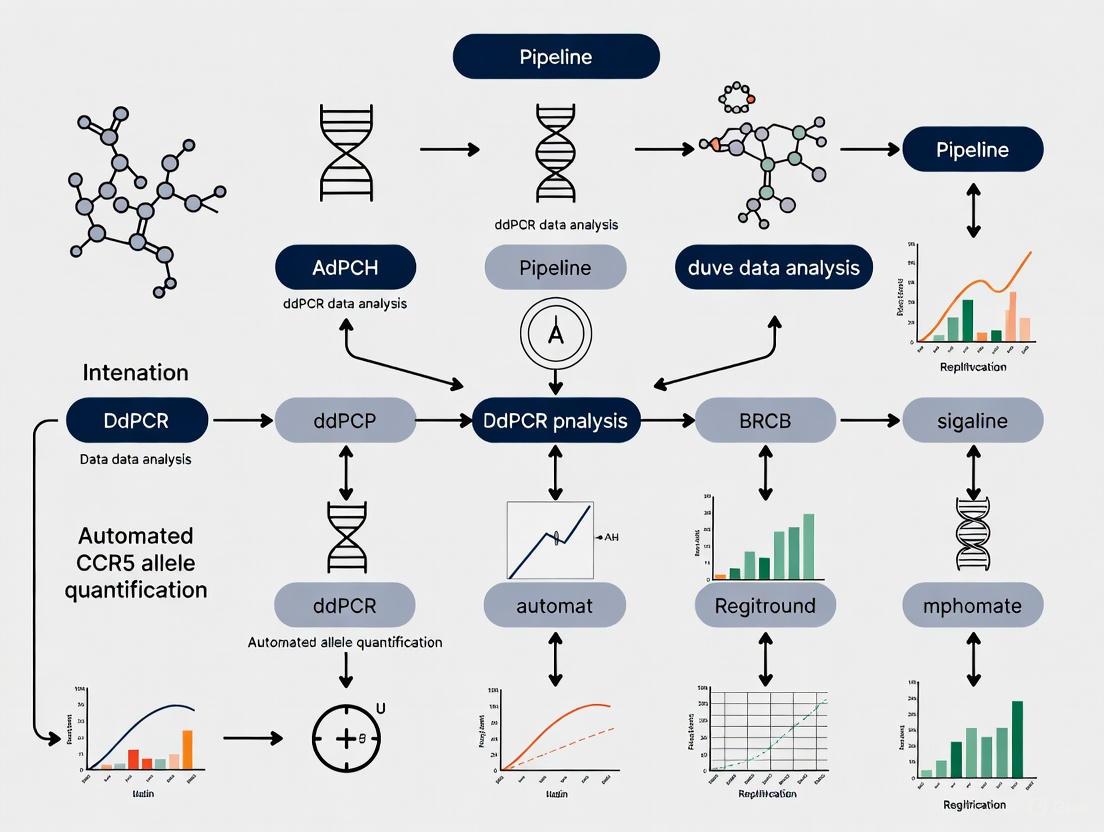
This article provides a comprehensive guide for developing and implementing an automated droplet digital PCR (ddPCR) pipeline for the precise quantification of CCR5 alleles, including the CCR5Δ32 mutant.
Automated ddPCR Data Analysis Pipeline for CCR5 Allele Quantification: A Comprehensive Guide for Researchers and Drug Developers
Abstract
This article provides a comprehensive guide for developing and implementing an automated droplet digital PCR (ddPCR) pipeline for the precise quantification of CCR5 alleles, including the CCR5Δ32 mutant. Tailored for researchers, scientists, and drug development professionals, it covers the foundational principles of ddPCR, a step-by-step methodological workflow for assay design, systematic troubleshooting and optimization strategies to address common challenges like amplification bias, and rigorous validation protocols. By integrating current best practices and comparative analyses, this resource aims to support critical applications in cell and gene therapy development, particularly for HIV treatment strategies, ensuring reliable, high-quality data for preclinical and clinical studies.
The Critical Role of CCR5 Quantification and ddPCR Fundamentals
CCR5 Biology and the Clinical Significance of the Δ32 Mutation in HIV Therapies
CCR5 Core Biology and HIV Entry Mechanism
What is the fundamental biological role of CCR5?
CCR5 (C-C chemokine receptor type 5) is a G protein-coupled receptor (GPCR) constitutively expressed on the surface of various immune cells, including T cells, macrophages, dendritic cells, and microglia [1] [2]. Its primary physiological function is to bind pro-inflammatory chemokines such as CCL3 (MIP-1α), CCL4 (MIP-1β), and CCL5 (RANTES) [3] [1]. This interaction initiates intracellular signaling cascades that coordinate immune responses, primarily by directing the chemotaxis (movement) of leukocytes to sites of inflammation [3].
How does CCR5 function as an HIV co-receptor?
HIV-1 most commonly uses CCR5 as a co-receptor, alongside the primary receptor CD4, to enter target immune cells [4] [1]. The process involves a specific interaction with the viral envelope glycoproteins:
- The gp120 subunit of the HIV-1 envelope binds first to the CD4 receptor on the host cell surface [4] [1].
- This binding induces a conformational change in gp120, allowing it to subsequently interact with the CCR5 coreceptor [1]. The tyrosine-sulfated amino terminus of CCR5 is an essential determinant for this binding [1].
- The V3 loop of the gp120 glycoprotein is the primary determinant for CCR5 coreceptor specificity [4] [1].
- Once this heterotrimeric complex (CD4-gp120-CCR5) is formed, it triggers the release of the gp41 fusion peptide, facilitating the fusion of the viral membrane with the host cell membrane and subsequent viral entry [4] [1].
Table: Key Characteristics of the CCR5 Receptor
| Feature | Description |
|---|---|
| Protein Family | Class A G protein-coupled receptor (GPCR) [1] |
| Gene Location | Chromosome 3 (3p21.31) [1] |
| Natural Ligands | CCL3 (MIP-1α), CCL4 (MIP-1β), CCL5 (RANTES) [3] [1] |
| Cell Expression | T cells, macrophages, dendritic cells, microglia [3] [1] |
| Role in HIV | Primary co-receptor for R5-tropic (macrophage-tropic) HIV-1 strains [3] [4] |
Diagram: Sequential Mechanism of HIV-1 Entry via CCR5 Coreceptor
The CCR5-Δ32 Mutation: Natural Resistance and Clinical Significance
What is the CCR5-Δ32 mutation and how does it confer HIV resistance?
The CCR5-Δ32 mutation is a 32-base pair deletion in the coding region of the CCR5 gene, resulting in a frameshift and the production of a severely truncated, non-functional receptor that is not expressed on the cell surface [3] [1] [5]. Individuals who are homozygous for this mutation (having two copies of Δ32) are substantially resistant to infection by R5-tropic HIV-1 strains, which are the viruses predominantly responsible for initial transmission and the early stages of infection [3] [2] [5]. This is because the virus cannot utilize the absent CCR5 coreceptor to enter target cells [1]. Heterozygous individuals (one copy of Δ32) do not show resistance to infection, but often experience a slower disease progression, attributed to reduced levels of CCR5 expression on their cells [3] [5].
What is the clinical evidence supporting the protective role of Δ32?
The protective effect of the Δ32 mutation was first identified in individuals who remained uninfected despite multiple high-risk exposures to HIV [6] [5]. Early studies found a significant enrichment of the Δ32/Δ32 genotype in these exposed seronegative cohorts [5]. Furthermore, landmark cases like the "Berlin Patient" and the "London Patient," who were cured of HIV after receiving stem cell transplants from Δ32/Δ32 donors, provided profound clinical validation for CCR5 as a therapeutic target [4].
Table: Clinical Impact of CCR5-Δ32 Genotypes
| Genotype | Receptor Expression | Susceptibility to R5 HIV | Disease Progression |
|---|---|---|---|
| Wild-type / Wild-type | Normal | High | Standard rate |
| Δ32 / Wild-type (Heterozygous) | Reduced | High | Slower than average [3] [5] |
| Δ32 / Δ32 (Homozygous) | Not functional / Not expressed | Highly resistant [3] [1] | Protection from infection |
ddPCR for Automated CCR5 Allele Quantification: A Technical Guide
What are the core principles of ddPCR that make it suitable for CCR5 quantification?
Digital PCR (dPCR), and specifically Droplet Digital PCR (ddPCR), is a third-generation PCR technology that enables absolute nucleic acid quantification without the need for a standard curve [7]. The method is based on:
- Partitioning: A PCR mixture is divided into thousands to millions of nanoliter-sized droplets or microchambers, effectively creating a massive array of individual reactions [7].
- Poisson Distribution: The nucleic acid targets are randomly distributed across these partitions, so that each contains zero, one, or a few target molecules [7].
- End-point PCR Amplification: Each partition undergoes a full PCR amplification cycle.
- Fluorescence Counting: Partitions are analyzed using fluorescence probes (e.g., FAM, HEX). Partitions containing the target sequence fluoresce, while those without do not [7] [6].
- Absolute Quantification: The target concentration in the original sample is calculated directly from the fraction of positive partitions using Poisson statistics [7]. This provides high sensitivity, precision, and tolerance to PCR inhibitors, making it ideal for accurately quantifying allele frequencies like CCR5-Δ32.
How do I design a ddPCR assay for CCR5 allele quantification?
A robust ddPCR assay for CCR5 requires careful design to distinguish between the wild-type and Δ32 alleles.
- Assay Design: Design two probe-based assays. One assay targets a sequence within the 32bp deleted region (specific to the wild-type allele). A second assay targets a stable reference gene (e.g., RNase P) or a conserved region of CCR5 outside the deletion for total copy number control [6].
- Multiplexing Potential: These assays can be multiplexed in a single well using fluorescent probes with different dyes (e.g., FAM for wild-type CCR5, HEX/VIC for the reference gene) [6].
- Interpretation: A droplet positive only for the reference probe indicates the Δ32 allele. A droplet positive for both probes indicates the wild-type allele.
Diagram: ddPCR Workflow for Absolute Quantification
Troubleshooting Guide: Common Challenges in CCR5 ddPCR
FAQ 1: I am observing a high rate of failed or low-quality droplets. What could be the cause?
- Potential Cause: Impurities in the DNA sample, such as salts, proteins, or organic compounds, can interfere with droplet integrity and stability [7].
- Solution:
- Assess DNA Purity: Check the A260/A280 and A260/A230 ratios. Re-purify the DNA sample if necessary.
- Optimize Sample Input: Avoid overloading the reaction with too much DNA. Titrate the DNA input to find the optimal concentration (e.g., 1-100 ng per reaction) that maintains droplet quality.
- Use Stabilized Droplets: Ensure the droplet stabilizer in the oil is fresh and effective to prevent coalescence during thermal cycling [7].
FAQ 2: My results show low precision or high variation between technical replicates. How can I improve this?
- Potential Cause: Inadequate mixing of the PCR master mix before partitioning, or inconsistent droplet generation.
- Solution:
- Vortex and Centrifuge: Thoroughly vortex the PCR master mix and template before loading, followed by a brief spin to collect the mixture at the bottom of the tube.
- Consistent Pipetting: Use calibrated pipettes and techniques to ensure consistent volume transfer during droplet generation.
- Sufficient Droplet Count: Ensure a high number of accepted droplets (e.g., >10,000) per reaction for robust Poisson statistics [7]. Low droplet counts lead to higher quantification uncertainty.
FAQ 3: How can I validate that my assay is specifically detecting the Δ32 deletion and not other non-specific products?
- Potential Cause: Non-specific amplification or probe binding.
- Solution:
- Use Validated Controls: Include well-characterized genomic DNA controls from genotyped individuals (Wild-type/Wild-type, Δ32/Wild-type, Δ32/Δ32) in every run [6].
- Bioanalyzer Confirmation: Run the ddPCR products on a bioanalyzer or gel electrophoresis to confirm the expected amplicon size.
- Sanger Sequencing: Sort droplets (positive and negative populations if possible) and perform Sanger sequencing to confirm the identity of the amplified product.
FAQ 4: The calculated allele frequency does not match expectations. What are the possible sources of error?
- Potential Cause 1: Poor partition separation in the 2D plot, leading to misclassification of droplets.
- Solution: Redesign probes/primers to improve assay specificity and increase the fluorescence amplitude gap between positive and negative populations.
- Potential Cause 2: PCR inhibition not fully overcome by dilution.
- Solution: Further dilute the DNA sample or use a DNA clean-up kit.
- Potential Cause 3: Incorrect threshold setting.
- Solution: Manually review and set thresholds based on the clear separation between negative and positive droplet clusters, using the no-template control (NTC) and positive controls as guides.
Table: Key Research Reagent Solutions for CCR5 and ddPCR Studies
| Reagent / Tool | Function / Application | Example / Note |
|---|---|---|
| CCR5 Wild-type & Δ32 Controls | Essential assay validation and run controls | Genotyped human genomic DNA [6] |
| ddPCR Supermix | Optimized buffer for partition generation and amplification | Use a supermix compatible with your probe chemistry (e.g., ddPCR Supermix for Probes) |
| Sequence-Specific Probes | Allele discrimination in multiplex assays | FAM-labeled probe for wild-type CCR5; HEX-labeled probe for reference gene [6] |
| Droplet Generation Oil | Creates stable, monodisperse droplets for partitioning | Critical for consistent results; use manufacturer-recommended oil [7] |
| CCR5 Inhibitors (Therapeutic) | Tool compounds for functional validation studies | Maraviroc (FDA-approved CCR5 antagonist) [1] |
| ddPCR Plate & Sealing Foil | Reaction vessel and thermal cycling seal | Use optically clear foil for fluorescence readout |
Why ddPCR? Advantages Over qPCR for Absolute Quantification of Rare Alleles
Core Technological Advantages of ddPCR
Digital PCR (dPCR), and specifically Droplet Digital PCR (ddPCR), represents a significant methodological advancement over quantitative PCR (qPCR) for applications requiring absolute quantification and high precision, such as rare allele detection in CCR5 research.
Table 1: Fundamental Differences Between qPCR and ddPCR
| Feature | Real-Time PCR (qPCR) | Droplet Digital PCR (ddPCR) |
|---|---|---|
| Quantification Method | Relative (requires a standard curve) | Absolute (direct molecule counting) [8] [7] |
| Data Acquisition | Measures during exponential amplification phase (Cq) | End-point measurement of partitioned reactions [9] [10] |
| Principle | Bulk reaction in a single tube | Partitioning into thousands of nanoliter droplets [11] [7] |
| Impact of PCR Inhibitors | Sensitive; reduces amplification efficiency | More tolerant; partitioning dilutes inhibitors [8] [10] |
| Precision for Rare Targets | Limited; detection of mutation rates >1% | High; can detect mutation rates ≥ 0.1% [9] |
| Optimal Dynamic Range | Wide (6-7 orders of magnitude) | Narrower, but superior for low concentration targets [8] |
The fundamental difference lies in sample partitioning. In ddPCR, a single PCR reaction is partitioned into tens of thousands of nanoliter-sized water-in-oil droplets, effectively creating a massive array of individual PCR reactions [11] [7]. Following amplification, each droplet is analyzed for fluorescence to be counted as positive or negative for the target. The absolute concentration of the target molecule in the original sample is then calculated using Poisson statistics based on the ratio of positive to negative droplets, eliminating the need for a standard curve [8] [7].
Figure 1: The ddPCR Workflow for Absolute Quantification.
Quantitative Evidence: Superior Accuracy and Precision
Independent research consistently demonstrates ddPCR's superior performance in quantification tasks, particularly for copy number variation (CNV) and low-abundance targets.
A 2025 study published in Scientific Reports directly compared ddPCR to the gold standard, Pulsed Field Gel Electrophoresis (PFGE), for quantifying the highly variable DEFA1A3 gene. The results underscore ddPCR's remarkable accuracy [11].
Table 2: Method Comparison for DEFA1A3 Copy Number Quantification [11]
| Method | Concordance with PFGE | Spearman Correlation (r) with PFGE | Average Difference from PFGE |
|---|---|---|---|
| ddPCR | 95% (38/40 samples) | 0.90 (p < 0.0001) | 5% |
| qPCR | 60% (24/40 samples) | 0.57 (p < 0.0001) | 22% |
The study concluded that ddPCR is a "low-cost, high-throughput technique with accurate resolution of CNV at both low and high DNA copy numbers," making it ideal for clinical CNV testing [11]. This high concordance is due to ddPCR's ability to count molecules directly, unlike qPCR, which relies on indirect Cq measurements that become increasingly unreliable at higher copy numbers due to compounding effects of small PCR inefficiencies and pipetting variations [11].
Furthermore, for low abundant targets, ddPCR generates publication-quality data with high reproducibility. A 2017 study found that for samples with low nucleic acid levels (Cq ≥ 29) or variable contaminants, "ddPCR technology will produce more precise, reproducible and statistically significant results" compared to qPCR [10].
Essential Protocols for CCR5 Allele Quantification
A. Optimized ddPCR Assay Workflow
The following protocol is adapted for the precise quantification of CCR5 alleles.
- Reaction Mixture Preparation:
- Prepare a 20 µL reaction mix containing:
- 1X ddPCR Supermix [12]
- Target Assay: 400-900 nM each of forward and reverse primers specific to the CCR5 allele of interest.
- Reference Assay: 400-900 nM each of primers for a reference gene (e.g., RNase P).
- Probes: 125-250 nM of each FAM- and HEX-labeled probe for the target and reference, respectively.
- Template: 1-100 ng of genomic DNA.
- Prepare a 20 µL reaction mix containing:
- Droplet Generation:
- Load the 20 µL reaction mix into a droplet generator cartridge along with 70 µL of droplet generation oil.
- Place the cartridge in a droplet generator. This creates approximately 20,000 nanoliter-sized droplets per sample [12].
- PCR Amplification:
- Droplet Reading and Analysis:
- Place the plate in a droplet reader, which measures the fluorescence in each droplet.
- Use analysis software (e.g., QuantaSoft) to set thresholds and distinguish positive and negative droplets.
- The software calculates the absolute concentration (in copies/µL) of both target and reference genes using Poisson statistics.
B. Critical Reagent Solutions
Table 3: Research Reagent Solutions for ddPCR
| Reagent/Solution | Function | Key Considerations |
|---|---|---|
| ddPCR Supermix | Provides optimized buffer, dNTPs, and Taq polymerase for droplet formation and amplification. | Essential for stable droplet generation. Do not substitute with standard PCR mixes [12]. |
| Droplet Generation Oil | Creates the immiscible oil phase required to form the water-in-oil emulsion. | Must be used with a compatible surfactant to prevent droplet coalescence during thermal cycling [7]. |
| FAM & HEX Probes | Hydrolysis probes (TaqMan) for specific detection of target (CCR5 allele) and reference genes. | Ensure probes are designed with a Tm ~10°C higher than primers. Avoid G at the 5' end [13]. |
| Nuclease-Free Water | Diluent for reaction mix. | High purity is critical to avoid enzymatic degradation and background fluorescence. |
Troubleshooting Common ddPCR Challenges
FAQ 1: How can I improve the separation between positive and negative droplet clusters (reduce "rain")? Rain—droplets with intermediate fluorescence—can obscure threshold setting. To minimize it:
- Optimize Annealing Temperature: Perform a thermal gradient test to find the temperature that maximizes fluorescence amplitude separation between clusters [14].
- Titrate Primer/Probe Concentrations: High concentrations can increase background fluorescence. Test concentrations in the range of 400-900 nM for primers and 125-250 nM for probes [14] [13].
- Use Advanced Analysis Tools: For low target numbers, bioinformatic tools like "definetherain" (www.definetherain.org.uk) can improve droplet calling by applying k-nearest neighbour clustering to define positive and negative populations more accurately [12].
FAQ 2: My ddPCR results show high variation between replicates. What could be the cause? High variation often points to issues with partitioning or the sample itself.
- Check Droplet Count: Ensure the number of accepted droplets is consistently high (>10,000) and similar across all wells. Low droplet counts reduce statistical power and increase variance.
- Verify Sample Homogeneity: Ensure the DNA template is thoroughly mixed before aliquoting into the reaction mix. Viscous samples or pipetting errors can lead to uneven target distribution.
- Inspect Droplet Quality: If droplets are unstable and coalesce, the effective number of partitions drops. Ensure the droplet generator is clean and functioning properly [7].
FAQ 3: When should I use the "Rare Event Detection" mode, and what are its limitations? Rare Event Detection mode in analysis software (e.g., Bio-Rad's QuantaSoft) increases sensitivity for very low-abundance targets (< 0.1% fractional abundance) by lowering the fluorescence threshold for positive calls.
- When to Use: Reserve it for detecting very rare mutations or alleles present in a small minority of cells.
- Limitation: This mode can increase false positives by classifying some of the "rain" as positive signals. It is crucial to run appropriate negative controls (wild-type only samples) to establish a baseline and validate the assay's specificity [12].
Figure 2: Troubleshooting Guide for Common ddPCR Issues.
Droplet Digital PCR (ddPCR) is a powerful method for the absolute quantification of nucleic acids. The technology partitions a sample into thousands of nanoliter-sized droplets, performs PCR amplification within each individual droplet, and then uses a droplet reader to count the positive and negative droplets to provide absolute quantification of the target molecule without the need for standard curves [15]. The following diagram illustrates the core workflow.
Technical Troubleshooting Guide
Common Experimental Issues and Solutions
| Problem | Possible Causes | Recommended Solutions |
|---|---|---|
| Poor droplet generation | High sample viscosity [16], genomic DNA not digested [17], incorrect oil-to-sample ratio | Digest high molecular weight genomic DNA with restriction enzymes [16]; Ensure DNA concentration is appropriate; Verify reagent volumes |
| Low amplitude separation | Inefficient PCR amplification [16], suboptimal primer/probe concentrations [18], inhibitor presence [16] | Optimize primer (e.g., 450 nM) and probe (e.g., 250 nM) concentrations [18]; Check sample purity and dilute inhibitors [16] |
| Excessive rain | Suboptimal annealing temperature [18], too many PCR cycles [18], degraded sample [16] | Optimize thermal cycling conditions (e.g., annealing temperature 57°C) [18]; Check sample integrity and avoid degradation [16] |
| High false positives in NTC | Contaminated reagents [16], amplicon contamination | Use clean workspace and labware [16]; Include non-template controls (NTCs); Prepare fresh reagent aliquots |
| Inaccurate quantification | Template concentration too high [17], uneven droplet size [15], incorrect Poisson correction [17] | Dilute sample to ideal concentration (0.5-3 copies/partition) [16]; Ensure proper droplet generator function [15] |
Essential Research Reagent Solutions
| Reagent/Material | Function | Key Considerations |
|---|---|---|
| ddPCR Supermix | Provides optimized buffer, enzymes, and dNTPs for droplet-compatible PCR [18] | Use manufacturer-recommended formulation; Contains components for droplet stabilization |
| Primers & Probes | Sequence-specific amplification and detection [18] | Use higher concentrations than qPCR (e.g., 0.5-0.9 µM primers, 0.25 µM probes) [16]; Store in TE buffer, pH 8.0 (except Cy5/Cy5.5 probes use pH 7.0) [16] |
| Droplet Generation Oil | Creates water-in-oil emulsion for partitioning [15] | Use manufacturer-specified oil; Critical for uniform droplet formation |
| Template DNA/RNA | Nucleic acid target for quantification | Assess purity (A260/280 ~1.8-2.0) [16]; Digest large genomic DNA to reduce viscosity [16] [17]; For FFPE DNA, keep amplicons short [16] |
| Restriction Enzymes | Digest large DNA templates for even partitioning [16] | Select enzymes that do not cut within amplicon sequence [16]; Reduces viscosity of genomic DNA |
Frequently Asked Questions (FAQs)
What is the key difference between ddPCR and qPCR? ddPCR provides absolute quantification without standard curves by partitioning samples into thousands of droplets and counting positive/negative reactions, while qPCR provides relative quantification based on comparison to standard curves and Ct values. ddPCR offers higher sensitivity and precision, especially for detecting rare mutations or small fold-changes [15] [17].
How do I calculate the correct template input amount for my ddPCR experiment? For human genomic DNA, approximately 3.3 pg represents one haploid genome copy. Therefore, 10 ng of human gDNA contains ~3,000 copies of a single-copy gene [16]. The ideal range is 0.5-3 copies per partition on average. For a 20,000-droplet system, this translates to approximately 10,000-60,000 total copies per 20μL reaction.
What causes "rain" (intermediate fluorescence droplets) and how can it be minimized? Rain appears as droplets with ambiguous fluorescence signals between clear positive and negative clusters. This can be caused by suboptimal annealing temperature, too many PCR cycles, degraded sample quality, or inhibitor presence [16] [19]. To minimize rain, optimize thermal cycling conditions (particularly annealing temperature), limit PCR cycles to what's necessary, ensure high sample quality, and verify primer/probe specificity [18] [16].
How sensitive is ddPCR for detecting rare mutations like CCR5 variants? Properly optimized ddPCR assays can detect rare mutations at variant allele frequencies as low as 0.01% with appropriate validation [18]. This exceptional sensitivity makes it ideal for detecting rare allelic variants in a wild-type background, such as CCR5 allele quantification in heterogeneous samples.
What are the critical steps for ensuring reproducible ddPCR results? Key steps include: (1) Using high-purity nucleic acid templates free of inhibitors [16]; (2) Properly storing primers and probes in TE buffer to prevent degradation [16]; (3) Maintaining consistent droplet generation quality [15]; (4) Including appropriate controls (negative, positive, non-template controls) [16]; and (5) Analyzing samples in replicate to account for pipetting variability [16].
When should I consider using restriction enzyme digestion prior to ddPCR? Restriction digestion is recommended when working with: highly viscous solutions (high molecular weight genomic DNA), linked or tandem gene copies, supercoiled plasmids, or large DNA molecules (>30 kb) [16]. Digestion helps ensure even distribution of templates across droplets, preventing over-quantification and ensuring accurate copy number determination.
Digital PCR (dPCR) represents the third generation of PCR technology, providing calibration-free absolute quantification of nucleic acids with high sensitivity, accuracy, and reproducibility [7]. This technology partitions a PCR reaction into thousands to millions of parallel nanoscale reactions, allowing individual molecules to be amplified and counted according to Poisson distribution, enabling single-molecule detection [7]. For cell therapies and gene-editing applications, dPCR offers the precise quantification necessary to ensure safety and efficacy, particularly in monitoring vector copy number, editing efficiency, and unintended genotoxic events [20] [21]. The technology's ability to detect rare mutations against a background of wild-type genes makes it invaluable for tumor heterogeneity analysis and liquid biopsy applications in oncology, as well as for quality control in therapeutic development [7].
The emergence of customizable endonucleases like CRISPR-Cas9 has accelerated the pace of genetic mutation generation in animal models and cell lines, making efficient genotyping a critical bottleneck in research and therapeutic development [22]. Digital PCR addresses this challenge by providing rapid, accurate quantification of editing outcomes, including small insertions and deletions (indels), large deletions, double-strand breaks (DSBs), and other structural variations that conventional methods often miss [20]. This technical support center provides comprehensive troubleshooting guides and FAQs to help researchers optimize dPCR experiments specifically for monitoring cell therapies and gene-editing outcomes, with particular emphasis on CCR5 allele quantification research.
Technical Support Center: dPCR Troubleshooting Guides and FAQs
Sample Preparation and Quality Assessment
Q: My dPCR results show reduced fluorescence amplitude and poor separation between positive and negative partitions. What could be causing this?
A: This issue commonly stems from sample impurities that interfere with the enzymatic reaction or fluorescence detection. Contaminants to watch for include:
- Alcohols and salts: Impair primer and probe annealing properties, reducing amplification efficiency [16]
- Humic acids: Quench the fluorescence of dsDNA-binding dyes like EvaGreen [16]
- Phenol and urea: Denature the Taq polymerase enzyme [16]
- Acidic polysaccharides: Form dead-end complexes with Taq polymerase [16]
Solution: Use dedicated purification kits suitable for your template type (genomic DNA, FFPE DNA, cfDNA) and ensure high nucleic acid purity. For FFPE samples, use specialized kits designed to recover DNA from crosslinked samples [16].
Q: When should I use restriction digestion prior to dPCR?
A: Restriction digestion is recommended in these specific scenarios [16]:
- Highly viscous solutions: Reduces viscosity to enable accurate measurement of higher DNA concentrations
- Linked or tandem gene copies: Physically separates gene copies to prevent multiple copies from being counted as one
- Supercoiled plasmids: Linearizes plasmid DNA to improve primer/probe binding efficiency
- Large DNA molecules (>30 kb): Prevents uneven partitioning that leads to over-quantification
Important: When selecting restriction enzymes, ensure they do not cut within your amplicon sequence [16].
Q: How do I calculate the appropriate template input for my dPCR experiment?
A: The optimal template concentration depends on your dPCR technology, but generally, the average number of copies per partition should be between 0.5-3 to stay within the "digital range" [16] [23]. Use the following formula for genomic DNA:
Genome size (bp) × average weight of a single base pair (1.096 × 10⁻²¹ g/bp) = mass per haploid genome [16]
For the human genome (3.3 × 10⁹ bp), this calculation is: 3.3 × 10⁹ bp × 1.096 × 10⁻²¹ g/bp = 3.3 pg [16].
Table 1: Gene Copies in 10 ng Genomic DNA from Model Organisms
| Organism | Genome Size (bp) | Gene Copies (1 copy/haploid genome) in 10 ng gDNA |
|---|---|---|
| Homo sapiens | 3.3 × 10⁹ | 3,000 |
| Zebrafish | 1.7 × 10⁹ | 5,400 |
| Saccharomyces cerevisiae | 1.2 × 10⁷ | 760,500 |
| Escherichia coli | 4.6 × 10⁶ | 2,000,000 |
| Standard plasmid DNA | 3.5 × 10³ | 2,600,000,000 |
Assay Design and Optimization
Q: What are the key differences between primer and probe design for dPCR compared to qPCR?
A: While dPCR follows similar design rules as qPCR, several key differences exist [16]:
- Higher concentrations: Primer and probe concentrations in dPCR tend to be higher than in qPCR to increase fluorescence intensity and improve separation of background noise from specific signals
- Optimal concentrations: Final primer set concentration between 0.5-0.9 μM and probe concentration at 0.25 μM per reaction typically yield optimal results
- Storage considerations: Fluorescently labeled probes are stable for 6-9 months at -20°C when stored in TE buffer, with repeated freeze-thaw cycles avoided
Q: How should I handle hydrolysis probes to prevent background signal issues?
A: Avoid combinations where the quencher's emission spectrum overlaps with the fluorescent dye's emission, as this creates background signals that adversely affect cluster separation and peak resolution [16]. For probes labeled with Cy5 and Cy5.5 fluorescent dyes, store in TE buffer at pH 7.0 as they tend to degrade at higher pH [16].
Q: What detection chemistry should I use for my gene-editing experiment?
A: The choice depends on your specific application [16]:
- DNA-binding dyes (e.g., EvaGreen): Bind all double-stranded DNA molecules, enabling analysis of many different targets without target-specific labeled probes. Require high PCR specificity as nonspecific products and primer dimers contribute to fluorescent signal.
- Hydrolysis probes (e.g., TaqMan): Provide sequence-specific detection through fluorophore-quencher separation during amplification. Ideal for multiplex assays and distinguishing specific alleles in editing outcomes.
Data Analysis and Interpretation
Q: My analysis software shows poor threshold setting. What should I check?
A: First, verify that your samples are in the "digital range" - sufficiently diluted so that some partitions contain template while others do not [23]. Running a chip or plate with no sample can cause analysis problems. Check the threshold setting in your analysis software and adjust manually if necessary [23].
Q: How do I properly account for dilution factors in my concentration calculations?
A: The software requires all necessary dilution factors to calculate copies/μL in your stock. Consider both the dilution of the sample in the reaction and any dilution of the stock made before adding it to the dPCR reaction [23]. For example:
- If you add 1 μL of a sample diluted 1:10 from stock to a reaction with final volume of 16 μL
- The dilution factor is (1/16) × 0.1 = 0.00625 (1:160)
- Enter this value in the "Dilution" column of your analysis software
Q: What methods are available for uncertainty estimation in dPCR data?
A: Traditional binomial-assumption methods can inaccurately estimate standard error. Two flexible approaches improve estimation [24]:
- NonPVar: A generic approach for calculating variance in dPCR data
- BinomVar: Another flexible method applicable to complex functions of partition counts These methods are particularly useful for copy number variation (CNV), fractional abundance, and DNA integrity calculations, and are available through an R Shiny app with a graphical interface [24].
Advanced dPCR Methodologies for Gene-Editing Analysis
CLEAR-time dPCR for Comprehensive Editing Assessment
For advanced gene-editing applications like CCR5 allele quantification, the CLEAR-time dPCR (Cleavage and Lesion Evaluation via Absolute Real-time dPCR) method provides a comprehensive approach to quantifying genome integrity at targeted sites [20]. This modular ensemble of multiplexed dPCR assays quantifies:
- Wildtype sequences, indels, and non-indel aberrations using an "Edge assay" with primers on either side of the RNP target site, a FAM probe at the cleavage site, and a HEX probe distal to the cleavage site [20]
- Double-strand breaks, large deletions, and structural mutations using a "Flanking assay" with two amplicons flanking the cleavage site [20]
- Aneuploidy using primers and probes in sub-telomeric regions of chromosome arms [20]
- Target-integrated and episomal donor templates using a "Targeted integration and episomal" assay [20]
This method reveals biases inherent in conventional mutation screening assays and can quantify up to 90% of loci with unresolved DSBs, providing one of the most precise analyses of DNA repair and mutation dynamics for gene therapy applications [20].
CLEAR-time dPCR Assay Components
Allele-Specific Quantification Methods
For genotyping edited alleles, allele-specific qPCR (ASQ) provides a rapid, cost-effective method that can be adapted to dPCR platforms [22]. This open-source system utilizes:
- Allele-specific primers with a 3' terminal nucleotide complementary to the wild-type or mutant sequence
- A locus-specific reverse primer
- Universal fluorescent probes and quenchers
- Hot start DNA polymerase
The method shows 98-100% concordance with RFLP or Sanger sequencing outcomes and can genotype germline mutants through either threshold cycle (Ct) or end-point fluorescence reading, making it ideal for high-throughput screening of edited cell lines [22].
Essential Reagents and Materials for dPCR Experiments
Table 2: Research Reagent Solutions for dPCR Gene-Editing Applications
| Reagent/Material | Function | Application Notes |
|---|---|---|
| High-purity nucleic acid templates | PCR substrate | Critical for amplification efficiency; use specialized kits for FFPE, cfDNA, or gDNA [16] |
| Restriction enzymes | DNA fragmentation | Improves partitioning efficiency for complex templates; select enzymes that don't cut within amplicon [16] |
| Hydrolysis probes (TaqMan) | Sequence-specific detection | Ideal for multiplex assays; avoid reporter-quencher emission overlap [16] |
| DNA-binding dyes (EvaGreen) | Non-specific detection | Enables analysis of multiple targets without probe synthesis; requires high PCR specificity [16] |
| Hot-start DNA polymerase | Amplification enzyme | Reduces non-specific amplification; essential for complex genomes [22] [25] |
| dNTPs | PCR substrates | Use balanced concentrations; aliquot to reduce freeze-thaw degradation [25] |
| TE buffer (pH 8.0) | Primer/Probe storage | Maintains stability of primers and probes; use pH 7.0 for Cy5 and Cy5.5 probes [16] |
Experimental Workflow for CCR5 Allele Quantification
dPCR Workflow for Gene-Editing Analysis
Digital PCR provides an essential toolset for monitoring cell therapies and gene-editing outcomes, offering the sensitivity and precision required for CCR5 allele quantification and similar applications. By addressing common technical challenges through optimized sample preparation, assay design, and data analysis, researchers can leverage this technology to advance the development of safer and more effective genetic therapies. The continued refinement of dPCR methodologies, including CLEAR-time dPCR and allele-specific approaches, will further enhance our ability to characterize editing outcomes and ensure therapeutic quality.
Building Your Automated CCR5 ddPCR Assay: A Step-by-Step Protocol
Primer and Probe Selection for Multiplexed CCR5 and Δ32 Detection
Frequently Asked Questions (FAQs)
Q1: What are the key advantages of using ddPCR over qPCR for CCR5 Δ32 quantification?
ddPCR provides absolute quantification of nucleic acids without the need for a standard curve, offering higher sensitivity and precision for detecting rare mutations. This is particularly crucial for accurately measuring the proportion of CCR5 Δ32 mutant alleles in heterogeneous cell mixtures, with demonstrated sensitivity down to 0.8% mutant content [26]. Furthermore, ddPCR is less susceptible to inhibition from sample impurities and provides a digital readout (positive/negative droplets) that enables more robust detection of low-frequency variants [7].
Q2: Which primer sequences are validated for ddPCR-based CCR5 Δ32 genotyping?
The following primer sequences have been successfully used in PCR amplification of the CCR5 locus for subsequent Δ32 analysis [26]:
- Forward: 5'-CCCAGGAATCATCTTTACCA-3'
- Reverse: 5'-GACACCGAAGCAGAGTTT-3' This primer set flanks the 32-base pair deletion region, generating amplicons of different sizes for wild-type and Δ32 alleles, which can be distinguished using sequence-specific probes.
Q3: How do I design probes to distinguish wild-type CCR5 from the Δ32 variant in a multiplex assay?
Probe design should leverage the specific sequence alteration caused by the 32-bp deletion.
- The wild-type probe should bind to a sequence internal to the deleted region. Its binding site is absent in the Δ32 allele, so fluorescence will only be generated from wild-type templates [27].
- The Δ32 mutant probe should be designed to span the deletion junction. This chimeric sequence is unique to the Δ32 allele, ensuring specific binding and fluorescence only from the mutant templates [27]. Using two different fluorescent dyes (e.g., FAM and HEX/VIC) for these probes allows for multiplexed detection in a single reaction [19].
Q4: What is a major source of "rain" in my 2D ddPCR plot, and how can I minimize it?
"Rain" refers to droplets with ambiguous fluorescence signals that fall between the well-defined positive and negative clusters. A significant source of rain in CCR5 Δ32 assays can be suboptimal probe annealing specificity or efficiency. To minimize rain:
- Validate probe specificity in silico and empirically.
- Optimize annealing temperatures during thermal cycling.
- Utilize analysis software with advanced gating algorithms that account for rain, such as the
ddpcrR package, which uses kernel density estimation and Gaussian mixture models for more accurate droplet classification [19].
Q5: My assay shows low signal intensity for the Δ32 probe. What could be the cause?
Low signal for the mutant-specific probe can result from several factors:
- Low abundance of the Δ32 allele in your sample. Consider that the mutant allele may be present at a very low frequency.
- Inefficient probe binding due to suboptimal sequence design or secondary structure at the deletion junction.
- Probe degradation or incorrect concentration. Verify the performance of your assay using control samples with known genotypes (wild-type homozygous, heterozygous, and Δ32 homozygous) to isolate the issue to the sample or the assay conditions [26].
Troubleshooting Guide
| Problem | Possible Causes | Recommendations |
|---|---|---|
| No Fluorescent Signal | - Critical reagent (e.g., probe, primer) omitted- PCR amplification failure- Target sequence not present | - Confirm all reagents were added [28]- Check instrument calibration and run positive controls- Verify template quality and concentration [29] |
| High Background or Non-Specific Signal | - Probe concentration too high- Incomplete washing steps- Non-specific probe binding | - Titrate probe to find optimal concentration [28]- Ensure complete washing using magnetic separation [29]- Review probe design for specificity; optimize annealing temperature |
| Inaccurate Δ32 Quantification | - Inefficient droplet separation (coalescence)- Poor gating between clusters due to "rain"- Sample matrix effects | - Stabilize droplets with appropriate surfactant [7]- Use automated analysis pipelines (e.g., ddpcr R package) for consistent gating [19]- Clarify samples by centrifugation to remove debris/lipids [30] [29] |
| Low Digital PCR Efficiency / Droplet Count | - Bead/physical clogging in the system- Sample viscosity too high- Bead aggregation | - Perform system wash/rinse cycles; clean or replace needle [30]- Dilute sample with appropriate buffer; centrifuge to clarify [30] [29]- Vortex bead suspension thoroughly before use [30] |
Experimental Protocol: ddPCR for CCR5 Δ32 Quantification
This protocol summarizes the key steps for detecting and quantifying the CCR5 Δ32 allele using droplet digital PCR, based on established methodologies [26].
The diagram below illustrates the complete experimental workflow for CCR5 Δ32 detection and analysis.
Detailed Step-by-Step Methodology
Sample Preparation and Nucleic Acid Extraction
ddPCR Reaction Setup
- Prepare the PCR mixture on ice. A typical 20-22 µL reaction volume may contain:
- Template DNA: 5-100 ng of gDNA.
- Primers: Forward and reverse primers (final concentration typically 200-900 nM each) targeting the CCR5 locus [26].
- Probes: FAM-labeled probe specific for the Δ32 deletion junction and HEX/VIC-labeled probe specific for the wild-type sequence (final concentration typically 100-250 nM each).
- ddPCR Supermix: Use a commercial ddPCR master mix suitable for probe-based assays.
- Nuclease-free Water: To volume.
- Gently mix and briefly centrifuge the reaction mixture.
- Prepare the PCR mixture on ice. A typical 20-22 µL reaction volume may contain:
Droplet Generation
- Transfer the reaction mixture to a DG8 cartridge along with droplet generation oil.
- Generate droplets using a droplet generator (e.g., QX200 Droplet Generator from Bio-Rad).
- Carefully transfer the generated droplets (~40 µL) to a 96-well PCR plate. Seal the plate with a foil heat seal.
PCR Amplification
- Place the sealed plate in a thermal cycler and run the following profile:
- Enzyme Activation: 95°C for 10 minutes.
- Amplification (35-45 cycles):
- Denature: 94°C for 30 seconds.
- Anneal/Extend: 55-60°C (optimize based on primers/probes) for 60 seconds.
- Enzyme Deactivation: 98°C for 10 minutes.
- Hold: 4°C or 12°C indefinitely.
- Use a ramp rate of 2°C/second.
- Place the sealed plate in a thermal cycler and run the following profile:
Droplet Reading and Data Analysis
- Place the PCR plate in a droplet reader (e.g., QX200 Droplet Reader) which sequentially reads each well.
- The reader measures the end-point fluorescence in two channels (FAM and HEX) for each droplet.
- Analyze the data using the instrument's software (e.g., QuantaSoft) or open-source alternatives like the
ddpcrR package [19]. - Set thresholds to distinguish positive and negative droplets for each channel, identifying four primary populations: double-negative (empty), FAM-positive (Δ32 mutant), HEX-positive (wild-type), and double-positive (theoretical or atypical signals). The software automatically calculates the concentration (copies/µL) of each target in the original sample using Poisson statistics.
Research Reagent Solutions
The table below lists essential materials and reagents used in the featured ddPCR experiments for CCR5 Δ32 analysis.
| Item | Function/Description | Example |
|---|---|---|
| Cell Lines | Source of genomic DNA for assay development and control; MT-4 is a human T-cell line used [26]. | MT-4 Human T-Cell Line |
| Primers | Oligonucleotides that flank the 32-bp deletion in CCR5 for specific amplification [26]. | F: 5'-CCCAGGAATCATCTTTACCA-3'R: 5'-GACACCGAAGCAGAGTTT-3' |
| Probes | Sequence-specific, dye-labeled (FAM/HEX) oligonucleotides to distinguish wild-type and Δ32 alleles [27]. | FAM-Δ32 Junction ProbeHEX-Wild-Type Probe |
| ddPCR Supermix | Optimized buffer containing DNA polymerase, dNTPs, and stabilizers for robust digital PCR [26]. | ddPCR Supermix for Probes (Bio-Rad) |
| Droplet Generation Oil | Immiscible oil used to create stable, monodisperse water-in-oil droplets for partitioning [7]. | Droplet Generation Oil for Probes |
| Silica-Based DNA Kit | For purification of high-quality genomic DNA from cell lines or patient samples [26]. | "ExtractDNA Blood and Cells Kit" (Evrogen) |
R Package ddpcr |
Open-source tool for advanced analysis, visualization, and automated gating of 2-channel ddPCR data [19]. | ddpcr R package |
Frequently Asked Questions (FAQs)
Q1: Why is the purity of isolated DNA particularly critical for ddPCR assays in automated quantification pipelines? While ddPCR is more robust to inhibitors than qPCR, contaminants can significantly impact data quality. Impurities such as salts, alcohols, humic acids, or residual proteins can impair primer and probe annealing, reduce amplification efficiency, and quench fluorescence signals. This can lead to reduced fluorescence in positive droplets, poor separation between positive and negative droplet clusters, and increased intermediate fluorescence or "rain," complicating automated analysis and compromising the accuracy of absolute quantification [16] [31].
Q2: How does the integrity and structure of DNA affect quantification in a ddPCR assay for allele counting? DNA integrity directly influences quantification accuracy. Degraded DNA (e.g., from FFPE or cell-free DNA samples) may contain abasic sites or crosslinks that prevent amplification, leading to an underestimation of the target copy number. Furthermore, long or complex DNA molecules (>30 kb) and supercoiled plasmids can partition unevenly across droplets. In the context of CCR5 allele quantification, if two linked gene copies reside in the same droplet, they would be counted as a single molecule. Restriction enzyme digestion of the DNA sample before ddPCR is recommended to ensure random and independent partitioning of target molecules, thereby ensuring accurate quantification [16].
Q3: What controls are essential for a reliable ddPCR experiment when working with heterogeneous cell mixtures? Implementing a comprehensive set of controls is mandatory for validating results.
- Negative and Non-Template Controls (NTCs): Used to monitor for false positives arising from contamination in reagents or the workflow [16].
- Positive Controls: Including an organismal positive control (e.g., DNA with a known CCR5 genotype) helps verify that amplification occurs under the set reaction conditions. An environmental positive control (the target DNA spiked into the same matrix as your samples) is also valuable to demonstrate optimal amplification when affected by potential inhibitors present in your sample type [32].
Q4: My ddPCR data shows a high degree of "rain" (droplets with intermediate fluorescence). How can sample preparation contribute to this? "Rain" can be caused by several factors related to sample quality. Inhibitors present in the DNA extract can lead to delayed or reduced amplification efficiency, resulting in droplets that do not reach full fluorescence [32] [31]. Additionally, physically degraded or fragmented template DNA can cause incomplete amplification [32]. Ensuring high-purity DNA extraction and optimizing its input amount can help mitigate this issue.
Troubleshooting Guide
The following table outlines common problems, their potential causes related to sample preparation, and recommended solutions.
Table 1: Troubleshooting Guide for DNA Preparation in ddPCR
| Problem | Potential Causes | Recommended Solutions |
|---|---|---|
| Low DNA Yield or Purity | Inefficient cell lysis, inappropriate extraction kit for sample type, carrier RNA not used for cfDNA, incomplete removal of contaminants. | Pre-lyse difficult samples; use specialized kits (e.g., for blood, tissue, cfDNA); add carrier RNA; include wash steps & measure A260/A280 ratio (~1.8 for pure DNA) [33] [16]. |
| Inaccurate Quantification (Bias) | Non-uniform DNA distribution: long molecules, linked alleles, or supercoiled plasmids partitio.n unevenly. | Linearize DNA with restriction enzymes that do not cut within amplicon [16]. |
| Inhibition & Increased "Rain" | Co-extraction of PCR inhibitors (humic acids, heparin, salts, organic solvents). | Further purify DNA with clean-up kits; dilute DNA sample to dilute inhibitors; use digital PCR which is more robust to inhibition [31] [16]. |
| High Background/False Positives | Contamination from previous PCR products, cross-contamination between samples, or degraded fluorescent probes. | Use separate pre- and post-PCR areas; use uracil-DNA glycosylase (UDG) treatment; aliquot probes, avoid freeze-thaw cycles, store in appropriate buffer (e.g., TE, pH 8.0) [25] [16]. |
| Poor Precision & High Variance | Pipetting errors during reaction assembly, inaccurate DNA quantification leading to suboptimal copy/partition ratio. | Analyze samples in duplicate or triplicate; pool data from replicates to increase measured events and improve precision [16]. |
Experimental Protocols
Protocol: Assessment of DNA Quality and Quantity for ddPCR
Principle: This protocol outlines the steps to qualify a DNA sample for use in a ddPCR assay, ensuring it is pure, intact, and accurately quantified to achieve an optimal target copy number per partition.
Materials:
- Extracted DNA sample
- Spectrophotometer (e.g., NanoDrop) or fluorometer (e.g., Qubit)
- Agarose gel electrophoresis system or TapeStation/fragment analyzer
Procedure:
- Quantification:
- Use a spectrophotometer to measure the absorbance at 260 nm and 280 nm. An A260/A280 ratio of ~1.8 is generally accepted for pure DNA. Significant deviation may indicate protein or other contamination [16].
- For a more accurate quantification of double-stranded DNA, especially for low-concentration samples, use a fluorescence-based method (e.g., Qubit dsDNA HS Assay).
Quality Assessment:
- Visualization: Run the DNA sample on an agarose gel. A high-molecular-weight genomic DNA sample should appear as a tight, high-molecular-weight band. A smeared appearance indicates degradation. For cell-free DNA, a smear between 160-200 bp is expected.
- DNA Integrity Number (DIN): If using a fragment analyzer, the software can calculate a DIN, which provides a numerical assessment of DNA integrity (a DIN >7 is considered high quality for genomic DNA).
Copy Number Calculation:
- Calculate the required DNA input mass to achieve an optimal number of target molecules per ddPCR reaction (typically 0.5-3 copies/partition for a single-copy gene). Use the formula:
- Mass per haploid genome (pg) = Genome size (bp) × 1.096 × 10⁻²¹ g/bp [16].
- For the human genome (3.3 × 10⁹ bp), the mass per haploid genome is approximately 3.3 pg. Therefore, 10 ng of human gDNA contains about 3,000 copies of a single-copy gene [16].
- Calculate the required DNA input mass to achieve an optimal number of target molecules per ddPCR reaction (typically 0.5-3 copies/partition for a single-copy gene). Use the formula:
Protocol: High-Throughput gDNA Extraction from Cell Pellet or Tissue using Magnetic Beads
Principle: This protocol describes an automated, magnetic bead-based method for the parallel purification of genomic DNA from multiple samples. This method ensures high reproducibility and is suitable for preparing samples for high-throughput ddPCR analysis [33].
Materials:
- Cell pellet or tissue sample
- Lysis buffer with Proteinase K
- Magnetic bead-based DNA extraction kit (e.g., MagMAX DNA Multi-Sample Ultra 2.0 Kit)
- RNase A
- Automated magnetic particle processor (e.g., KingFisher Flex System)
- GentleMACS Octo Dissociator (for tissue)
Procedure:
- Homogenization: For tissue samples, homogenize the tissue in PBS containing 15 mM EDTA using a dissociator [33].
- Lysis:
- Transfer the cell pellet or tissue homogenate to a deep-well plate.
- Add binding enhancer solution, lysis buffer, and Proteinase K. Mix thoroughly.
- Incubate the plate at 65°C overnight (or as per kit instructions) to ensure complete digestion and lysis [33].
- DNA Binding:
- Add magnetic beads and isopropanol to the lysate to create conditions favorable for DNA binding to the beads.
- Automated Purification:
- Transfer the plate to the magnetic particle processor.
- Run the manufacturer-recommended program, which will automatically perform the following steps: transfer beads through wash buffers to remove contaminants, and finally elute the purified DNA in a low-salt elution buffer like TE or nuclease-free water [33].
- Post-Extraction QC:
- Quantify and qualify the eluted DNA as described in Protocol 3.1.
Workflow Visualization
The following diagram illustrates the complete DNA preparation and quality control workflow for ddPCR analysis.
DNA Preparation and QC Workflow for ddPCR
The Scientist's Toolkit: Research Reagent Solutions
Table 2: Essential Materials for DNA Isolation and Quality Control
| Item | Function | Example/Kits |
|---|---|---|
| Nucleic Acid Extraction Kits | Standardized protocols for purifying DNA from specific sample types (blood, tissue, cells). | PowerSoil DNA Isolation Kit [32], DNeasy Blood & Tissue Kit [31], MagMAX DNA Multi-Sample Ultra 2.0 Kit [33]. |
| Restriction Enzymes | Digest high-molecular-weight DNA to ensure even partitioning; linearize plasmids. | EcoRI-HF, XbaI [33]. Critical: Enzyme must not cut within the amplicon sequence [16]. |
| DNA Quantification Tools | Accurately measure DNA concentration and assess purity. | Spectrophotometer (NanoDrop), Fluorometer (Qubit dsDNA HS Assay) [16]. |
| DNA Integrity Assays | Visually assess the degree of DNA fragmentation. | Agarose Gel Electrophoresis, Fragment Analyzer (for DNA Integrity Number) [16]. |
| Automated Extraction System | High-throughput, reproducible nucleic acid purification using magnetic beads. | KingFisher Flex System [33]. |
| Tissue Homogenizer | Efficiently disrupt tough tissue structures to release DNA. | GentleMACS Octo Dissociator [33]. |
This technical support center provides troubleshooting guides and FAQs for researchers using automated Droplet Digital PCR (ddPCR) workflows, specifically within the context of a thesis on developing a ddPCR data analysis pipeline for automated CCR5 allele quantification.
The automated ddPCR process for CCR5 allele quantification involves a precise sequence of steps, from sample preparation to data analysis. The following diagrams outline the core workflow and the subsequent data analysis pipeline.
Diagram 1: Automated ddPCR Workflow
Diagram 2: Data Analysis Pipeline for CCR5 Alleles
Troubleshooting Common Workflow Issues
Table 1: Troubleshooting Automated ddPCR Workflow Components
| Workflow Step | Common Issue | Potential Cause | Solution |
|---|---|---|---|
| Automated Liquid Handling | High Ct value variation, poor reproducibility [34] | Pipetting inaccuracies, improper pipette calibration [34] | Implement regular pipette calibration; use automated liquid handlers to minimize human error [34] |
| Droplet Generation | Low droplet count, irregular droplet size | Microfluidic chip obstruction, unstable emulsification [7] | Check chip for debris; ensure proper oil-surfactant ratio and homogenization [7] |
| PCR Amplification | Poor amplification, low fluorescence intensity | Inhibitors in sample, suboptimal primer/probe design, inefficient PCR mix | Purify DNA/RNA sample; redesign primers/probes using specialized software; optimize annealing temperature [34] |
| Data Analysis | Inaccurate copy number, high variance | Improper thresholding, cluster merging, ignored Poisson statistics [24] | Use flexible variance estimation methods (e.g., BinomVar); validate with positive controls [24] |
Frequently Asked Questions (FAQs)
Q1: How does ddPCR improve the accuracy of CCR5 copy number quantification compared to qPCR?
ddPCR provides absolute quantification by partitioning a sample into thousands of nanoliter-sized droplets and counting positive reactions, without relying on a standard curve [7]. This makes it exceptionally accurate for copy number variation (CNV) determination. A recent study demonstrated 95% concordance between ddPCR and the gold-standard PFGE method for CNV analysis, while qPCR showed only 60% concordance and a tendency to underestimate copy number at higher ranges [11].
Q2: What are the key advantages of automating the ddPCR workflow?
Automation significantly enhances reproducibility, reduces human error, and increases throughput [34]. Automated liquid handlers ensure consistent pipetting, which is critical for the precision of miniaturized reactions. This is vital for high-stakes applications like CCR5 quantification, where pipetting inaccuracies can lead to significant errors in final copy number assignment [35] [34].
Q3: Our data shows high variance between replicates. How can we improve reproducibility?
First, review your automated liquid handler's performance and calibration for consistent reagent dispensing [34]. Second, ensure robust droplet generation. Finally, for data analysis, consider using advanced statistical methods like NonPVar or BinomVar for variance estimation, as classical methods that assume a perfect binomial distribution can be inaccurate [24].
Q4: Can ddPCR reliably distinguish between different CCR5 alleles, such as the Δ32 mutation?
Yes. The core strength of ddPCR is its ability to perform absolute quantification of specific sequences. By designing specific fluorescent probes (e.g., FAM for wild-type and HEX/VIC for the Δ32 allele), the platform can independently count the copies of each allele in a duplex reaction, providing a precise ratio or copy number for each [7] [20]. Assays like the "Edge" assay can be designed to quantify wildtype sequences and indels (mutations) simultaneously [20].
Q5: What is the role of Poisson statistics in ddPCR data analysis?
Poisson statistics is fundamental. It corrects for the fact that, during partitioning, a single droplet may contain more than one target molecule. By analyzing the fraction of negative (empty) droplets, the software uses Poisson models to back-calculate the true, absolute concentration of the target in the original sample, ensuring high accuracy [7].
Research Reagent Solutions for CCR5 Allele Quantification
Table 2: Essential Reagents and Materials for Automated ddPCR
| Item | Function | Considerations for Automation |
|---|---|---|
| ddPCR Supermix | Provides optimized reagents for PCR in droplets | Use a supermix compatible with your probe chemistry (e.g., TaqMan) and stable at room temperature for automated dispensing. |
| CCR5-specific Primers & Probes | Amplifies and detects the specific CCR5 allele (e.g., wild-type vs. Δ32) | Design assays with high efficiency and specificity. Use different fluorescent dyes (FAM/HEX) for multiplexed allele detection [20]. |
| Droplet Generation Oil | Creates a stable water-in-oil emulsion for partitioning | Use oil with a specific surfactant formulation to prevent droplet coalescence during thermal cycling [7]. |
| Microfluidic Cartridges/Chips | Physical device for generating uniform droplets | Ensure compatibility with your automated liquid handler and ddPCR instrument. Check for clog-free designs. |
| DNA Sample & Nuclease-free Water | The target analyte and reaction diluent | Use high-quality, purified DNA. Nuclease-free water is critical to prevent degradation of reagents and sample. |
Fundamental Principles of Fluorescence Detection in ddPCR
How does fluorescence detection work in a droplet digital PCR (ddPCR) system?
In ddPCR, fluorescence is measured at the end of the amplification process (end-point measurement) to determine which partitions (droplets) contain the amplified target sequence. The core principle relies on the use of fluorescence to identify "positive" partitions.
- Probe-Based Detection (Hydrolysis Probes): The most common method uses sequence-specific TaqMan probes. These are oligonucleotides with a fluorophore attached to the 5' end and a quencher near the 3' end.
- When the probe is intact, the quencher suppresses the fluorophore's signal.
- During the PCR amplification, the DNA polymerase's 5'→3' exonuclease activity cleaves the probe, which physically separates the fluorophore from the quencher.
- This separation results in a permanent, detectable fluorescent signal within the droplet [36] [16].
- DNA-Binding Dyes: An alternative method uses fluorescent dyes, such as EvaGreen, that bind nonspecifically to double-stranded DNA. The fluorescence intensity increases as the amplicon accumulates with each PCR cycle. However, this method requires high PCR specificity, as any non-specific products (like primer dimers) will also generate a fluorescent signal and can interfere with analysis [16].
After amplification, droplets are analyzed one-by-one in a droplet reader. Each droplet passes through a detection point where it is illuminated, and its fluorescence is measured on one or more channels. Droplets containing the target sequence (positive) will fluoresce brightly above a set threshold, while those without it (negative) will have a low fluorescence signal [7] [17].
What is the critical difference between qPCR and ddPCR in how fluorescence data is used?
The key difference lies in the nature of quantification.
- In qPCR, fluorescence is monitored in real-time during every cycle. The cycle at which the fluorescence crosses a predetermined threshold (Cq value) is used to relatively quantify the initial amount of target, typically by comparison to a standard curve [36] [7].
- In ddPCR, fluorescence is measured only at the end-point of the amplification. The result is a simple binary readout for each partition: positive (1) or negative (0). The concentration of the target nucleic acid is then calculated absolutely using Poisson statistics on the ratio of positive to negative droplets, without the need for a standard curve [7] [17].
Troubleshooting Fluorescence and Partition Analysis
Here are answers to frequently encountered issues during the data acquisition phase.
FAQ 1: My positive and negative droplet clusters are not well separated. What could be the cause?
Poor cluster separation makes it difficult to set a reliable threshold and can lead to inaccurate quantification. Common causes and solutions are listed in the table below.
Table 1: Troubleshooting Poor Cluster Separation in ddPCR
| Observed Issue | Potential Cause | Recommended Solution |
|---|---|---|
| Low fluorescence amplitude (weak positive signal) | Sample impurities (e.g., salts, alcohols, EDTA) inhibiting the polymerase or quenching fluorescence [16]. | Re-purify the nucleic acid sample using dedicated kits (e.g., for gDNA, cfDNA). Ensure high template purity. |
| Suboptimal primer/probe concentration, leading to inefficient amplification [16]. | Titrate primer and probe concentrations. For dPCR, higher concentrations (e.g., 0.5–0.9 µM for primers, 0.25 µM for probes) can increase fluorescence intensity. | |
| Probe degradation due to improper storage or repeated freeze-thaw cycles [16]. | Store fluorescent probes in aliquots at -20°C in low-salt TE buffer (pH 7.0 for Cy5/Cy5.5 dyes) and avoid repeated freezing/thawing. | |
| High background fluorescence in negative droplets | Non-specific amplification or formation of primer-dimers, especially when using DNA-binding dyes [16]. | Re-design assays for greater specificity. Use probe-based chemistry if possible. Optimize annealing temperature. |
| Spectral overlap between the fluorophore's emission spectrum and the quencher [16]. | Verify the compatibility of fluorophore-quencher pairs. Avoid combinations where the quencher's emission overlaps with the dye's fluorescence. |
FAQ 2: Why is the number of analyzed partitions lower than expected, and how does this impact my results for CCR5 allele quantification?
A low partition count reduces the statistical power of the assay and can affect its sensitivity and dynamic range.
- Cause: In droplet-based systems, this can be due to droplet instability leading to coalescence or breakage, especially during the thermal cycling steps if the ramp rate is too high. Improper droplet generation or pipetting that damages droplets can also be a cause [7] [17].
- Solution: Use a thermal cycler with a controlled ramp rate. A recommended rate is 2.5°C/sec to ensure all droplets heat and cool uniformly, maintaining their integrity. Use gentle pipetting techniques with wide-bore tips when handling generated droplets [17].
- Impact on CCR5 Quantification: For automated CCR5 allele quantification, a lower partition count directly raises the limit of detection. Accurately quantifying a rare allele requires analyzing a sufficiently high number of partitions to ensure it is captured within the Poisson distribution. The precision of the final result is dependent on the total number of partitions analyzed [37] [17].
FAQ 3: I am not detecting any fluorescent signal. What should I check?
A complete absence of signal suggests a fundamental failure in the reaction setup or detection hardware.
- Verify Instrument Setup: Confirm that the correct fluorescent dyes (e.g., FAM, HEX) are selected in the software and that the detector assignments are correct [36].
- Check Reagent Viability: Ensure the DNA polymerase and other reaction components are active. Run a positive control sample with a known, well-functioning assay to rule out reagent failure [16].
- Confirm Probe Integrity: Check that the probe was reconstituted correctly and has not degraded.
- Inspect Template Quality: For RNA templates (in RT-ddPCR), ensure it is not degraded. For DNA, check purity and integrity. Highly fragmented or cross-linked DNA (e.g., from FFPE samples) may require specialized extraction and repair protocols [16].
Experimental Protocol: Validating Fluorescence Detection for an Allele-Specific ddPCR Assay
The following protocol is adapted from a recent study on HTT allele quantification and can be applied to the development of a robust CCR5 allele quantification assay [37].
Aim: To establish and validate a duplex ddPCR assay for the simultaneous quantification of wild-type and mutant CCR5 alleles.
Workflow Overview:
Step-by-Step Methodology:
Reaction Setup:
- Prepare a duplex ddPCR reaction mix containing:
- DNA template (e.g., 50 ng of gDNA from cell lines). Note: For high-molecular-weight gDNA, consider restriction digestion to reduce viscosity and ensure random partitioning, provided the enzyme does not cut within the CCR5 amplicon [17] [16].
- PCR master mix.
- Primers and Probes: Two sets of primers and allele-specific TaqMan probes.
- Probe 1: Specific to the wild-type CCR5 allele, labeled with FAM.
- Probe 2: Specific to the mutant CCR5 allele (e.g., CCR5-Δ32), labeled with HEX.
- Use a final primer concentration of 0.5–0.9 µM and a probe concentration of 0.25 µM per reaction for optimal fluorescence amplitude [16].
- The total reaction volume is adjusted according to the droplet generator's requirements.
- Prepare a duplex ddPCR reaction mix containing:
Droplet Generation and PCR Amplification:
- Generate droplets using a commercial droplet generator according to the manufacturer's instructions.
- Transfer the emulsion to a PCR plate carefully, using gentle pipetting to avoid droplet breakage [17].
- Perform PCR amplification on a thermal cycler with the following critical parameter:
- Set the ramp rate to 2.5°C/sec to ensure uniform thermal conditions for all droplets [17].
Endpoint Fluorescence Readout:
Initial Partition Analysis:
- The instrument's software will generate a 2D plot (FAM vs. HEX amplitude) displaying four distinct droplet populations:
- FAM-positive/HEX-negative (wild-type allele only)
- HEX-positive/FAM-negative (mutant allele only)
- Double-positive (potentially heterozygous or non-specific signal)
- Double-negative (no target present)
- The software counts the number of droplets in each population. This raw count is the fundamental data for absolute quantification using Poisson statistics [37] [17].
- The instrument's software will generate a 2D plot (FAM vs. HEX amplitude) displaying four distinct droplet populations:
Table 2: Key Research Reagent Solutions for Allele-Specific ddPCR
| Reagent/Material | Function in the Assay | Critical Consideration for CCR5 Allele Quantification |
|---|---|---|
| TaqMan Probes (FAM & HEX labeled) | Enable sequence-specific detection and differentiation of wild-type and mutant alleles. | Probes must be designed to bind specifically to the unique sequence of each CCR5 variant. |
| Droplet Generation Oil & Surfactant | Creates stable, monodisperse water-in-oil emulsions for partitioning. | Essential for generating a high number of valid partitions; prevents droplet coalescence during thermal cycling [7]. |
| High-Purity gDNA / Cell Line Samples | The source of the target CCR5 alleles for quantification. | Sample purity is critical. Contaminants can inhibit PCR and quench fluorescence, leading to poor cluster separation [16]. |
| Restriction Enzymes | Fragment high-molecular-weight genomic DNA to ensure random distribution of templates into droplets. | Must be selected to not cut within the CCR5 amplicon sequence. This step improves quantification accuracy [16]. |
Frequently Asked Questions (FAQs)
Q1: What are the main advantages of using automated analysis over manual gating for ddPCR data? Automated analysis provides greater objectivity, reproducibility, and throughput compared to manual gating. Manual gating is subjective and non-reproducible, while automated algorithms consistently apply the same criteria across all samples. This is particularly crucial for clinical diagnostics and high-throughput experiments where consistency is paramount [19].
Q2: What programming languages and tools are available for automated ddPCR analysis?
R is a popular open-source, cross-platform language for ddPCR analysis. The ddpcr R package provides a comprehensive toolkit for analyzing two-channel ddPCR data and includes an interactive web application powered by the Shiny R package for point-and-click analysis without requiring extensive programming knowledge [19].
Q3: How does the analysis algorithm typically work in automated ddPCR analysis packages? Automated analysis pipelines generally follow these key steps: identifying and excluding failed wells; identifying and excluding outlier droplets; excluding empty droplets; calculating starting template concentrations; assigning droplets to clusters using statistical models; and finally, counting droplets in each cluster. These steps ensure robust and accurate quantification [19].
Q4: What are the specific requirements for preparing data from Bio-Rad's ddPCR systems for automated analysis?
The raw data from the fluorescence detector is in a proprietary format that must first be opened in QuantaSoft and exported to CSV (comma-separated values) files. These CSV files, along with a metadata file containing well information, serve as the input for analysis packages like the ddpcr R package [19].
Q5: How can researchers validate their automated ddPCR analysis results? Validation can be performed by comparing results against established gold standard methods. For copy number variation analysis, this might include pulsed field gel electrophoresis (PFGE), which is considered highly accurate. Strong concordance between ddPCR and PFGE results (e.g., 95% concordance as demonstrated in one study) validates the automated approach [11].
Troubleshooting Guides
Common Issues in Automated ddPCR Analysis
Table 1: Troubleshooting Common ddPCR Analysis Problems
| Problem | Possible Causes | Solutions |
|---|---|---|
| Excessive "Rain" (Droplets with ambiguous fluorescence signals between clear positive and negative clusters) | Suboptimal PCR efficiency, poor probe design, or low template quality [19]. | - Optimize primer/probe design following MIQE guidelines [38].- Ensure high DNA quality and use restriction enzymes if needed to improve template accessibility [39]. |
| Poor Cluster Separation | Low signal-to-noise ratio, improper fluorescence threshold setting, or assay design issues. | - Use kernel density estimation and Gaussian mixture models for better cluster identification [19].- Visually inspect plots to confirm automated gating accuracy. |
| Inaccurate Copy Number Quantification at High CNVs | Limitations of traditional qPCR methods; error compounding from small inefficiencies [11]. | - Use ddPCR for absolute quantification, as it is less prone to such errors [11].- Ensure sufficient numbers of partitions for precise high-copy number measurement. |
| Low Precision Between Replicates | Pipetting errors, inhibitor presence, or platform-specific issues. | - Use automated liquid handling to reduce pipetting variation.- Compare platform precision; CVs can vary between systems like QX200 and QIAcuity [39]. |
| Failure in Automated Gating | Unusual cluster patterns not accounted for by standard algorithms. | - Use the ddpcr package's manual gating option for secondary verification and difficult samples [19].- Check and customize analysis parameters for specific assay types. |
Step-by-Step Resolution for a Defined Problem: Handling Excessive Rain
Problem: A significant number of droplets fall between clear positive and negative clusters in the 2D scatter plot, making automated clustering unreliable.
Investigation & Resolution:
- Verify Assay Optimization: Confirm that your primers and probes meet MIQE guidelines, including PCR efficiency (90-110%) and primer melting temperature specifications [38] [40].
- Check Template Quality: For challenging templates like those in FFPE samples or with high GC content, consider using restriction enzymes (e.g., HaeIII) to enhance precision, as enzyme choice can significantly impact results [39].
- Utilize Advanced Analysis Software: Employ the
ddpcrR package, which uses kernel density estimation and Gaussian mixture models specifically designed to account for rain, providing better cluster distinction than some vendor-supplied software [19]. - Manual Verification: After automated analysis with
ddpcr, use the package's plotting functions to visually inspect the gating. Manually adjust gates if necessary for final verification, especially for critical samples.
Essential Workflow for Automated ddPCR Data Analysis
The following diagram illustrates the standard workflow for automated analysis of ddPCR data, from initial data export to final quantification.
Research Reagent Solutions
Table 2: Key Reagents and Materials for ddPCR Automated Analysis
| Item | Function/Benefit in Automated Analysis |
|---|---|
ddpcr R Package |
An open-source tool for analyzing two-channel ddPCR data. It automates gating using statistical models, handles "rain," and includes a Shiny web app for a user-friendly interface [19]. |
| Restriction Enzymes (e.g., HaeIII) | Used to digest DNA before ddPCR to improve template accessibility, especially for complex regions. This enhances precision and can reduce variation between platforms [39]. |
| High-Quality DNA Extraction Kits | Essential for obtaining reliable input material. Low-quality DNA can lead to failed reactions and increased "rain," compromising automated analysis [11]. |
| Validated Primer/Probe Sets | Hydrolysis probes (e.g., TaqMan) are commonly used. Primers must be validated for specificity and efficiency (R² > 0.98, efficiency 90-110%) as per MIQE guidelines for robust automated quantification [38] [40]. |
| Nuclease-Free Water | A critical reagent to prevent degradation of primers, probes, and sample DNA, which could introduce errors and affect automated clustering. |
Solving Common Challenges: Optimizing Precision and Minimizing Artifacts
Addressing Amplification Bias and 'Rain' in Cluster Separation
Understanding Amplification Bias and 'Rain'
What are amplification bias and "rain" in ddPCR?
Amplification bias refers to the unequal amplification of nucleic acid targets during the PCR process within droplets. This bias, often caused by factors like high GC content, secondary structures, or suboptimal reaction efficiency, leads to the phenomenon known as "rain" [41] [42]. "Rain" appears as a cloud of droplets with intermediate fluorescence values between the clearly positive and negative clusters, complicating the accurate assignment of droplets and thus the absolute quantification of the target [41] [43].
What causes "rain" in my ddPCR experiments?
The causes are multifaceted and can include [41] [42]:
- Template-related issues: High GC content (e.g., over 70%) can cause secondary structures like hairpins, leading to inefficient amplification. Sequence variances can also cause suboptimal PCR amplification [42].
- PCR inhibition: Partial inhibition from compounds in complex samples (e.g., humic acids in environmental DNA) can reduce the fluorescence amplitude of positive droplets [43] [31].
- Suboptimal assay conditions: This includes poorly designed primers/probes, and non-ideal thermal cycling conditions [41].
- Physical droplet issues: Droplet damage, coagulation of multiple droplets, or irregular droplet size can also contribute [41].
Systematic Troubleshooting and Optimization Guide
Optimizing Experimental Parameters
A methodical approach to optimizing your ddPCR assay is the most effective strategy to minimize rain. The following workflow outlines a step-by-step protocol for assay optimization, from template preparation to data analysis.
Step 1: Template and Sample Preparation
- DNA Digestion: For long or complex genomic DNA, digestion with restriction enzymes can enhance access to the target and improve amplification efficiency [41].
- Inhibitor Dilution: If inhibitors are suspected, dilute the template to a concentration where the effect of inhibitors is minimized while the target is still detectable [44].
- DNA Quality: Ensure high-quality DNA extraction. Repeat isolation with a method suited to your sample type if degradation or contamination is suspected [44].
Step 2: Primer and Probe Optimization Systematically test a range of primer and probe concentrations. While some assays are insensitive to primer concentration changes, a lower probe concentration can sometimes improve cluster separation [42]. The table below summarizes key parameters to optimize.
Table 1: Optimization of Reaction Components and Conditions
| Parameter | Optimization Strategy | Observed Effect / Goal | Reference |
|---|---|---|---|
| Primer Concentration | Test a range (e.g., 300-1100 nM) | Find concentration for maximum efficiency without spurious products. Separation may be unaffected beyond a point. | [42] |
| Probe Concentration | Test a range (e.g., 50-450 nM) | Lower concentrations (e.g., 50-100 nM) can significantly improve cluster separation (k value). | [42] |
| PCR Additives | Include additives like betaine (5-10%) | Destabilize GC-rich secondary structures, promote uniform amplification, and reduce rain. | [45] |
| Cycle Number | Increase total cycles (e.g., to 50) | Enhances fluorescence signal from positive droplets, improving cluster definition. | [41] [43] |
| Annealing Temperature | Optimize via gradient PCR | Find the temperature that maximizes specificity and yield for your specific primer-template pair. | [45] |
Step 3: Thermal Cycling Optimization
- Extended Times and Increased Cycles: Modifying the PCR program is highly effective. Prolonged extension times and an increased number of amplification cycles (e.g., from 40 to 50 cycles) have been shown to improve fluorescence separation between positive and negative droplets [41] [43].
- Ramp Rate: A standard ramp rate (e.g., 2°C/s) is typically used, but its optimization can be explored if other factors fail [41].
Step 4: Data Analysis and Thresholding for Challenging Samples When experimental optimization alone is insufficient, especially for inhibited or low-concentration samples, advanced data analysis techniques are required.
- Double Threshold Method: For samples with inhibitors or very low target concentrations, a single threshold is inadequate. A double threshold method accounts for both the reduced fluorescence of inhibited positives and the artifactual high-fluorescence droplets ("stars") that can appear in low-concentration samples, preventing false negatives and false positives [43] [31].
- Specialized Software: Utilize software tools like
definetherain[41] [42] orddpcRquant[41] that provide more objective and flexible ways to set thresholds and classify droplets, moving beyond the default instrument software.
The Scientist's Toolkit: Research Reagent Solutions
Table 2: Essential Reagents and Kits for ddPCR Assay Development
| Reagent / Kit | Primary Function | Application Note |
|---|---|---|
| ddPCR Master Mix for Probes | Provides optimized buffer, dNTPs, and polymerase for probe-based ddPCR. | Essential for the Bio-Rad ddPCR system. Use the no-dUTP version for assays involving uracil-DNA glycosylase (UDG) to prevent carryover contamination. |
| Restriction Enzymes (e.g., FastDigest BamHI) | Digests long genomic DNA into smaller fragments. | Improves target accessibility and can reduce rain caused by inefficient amplification of long templates [41]. |
| PCR Additives (Betaine, DMSO) | Cosolvents that destabilize secondary structures, homogenize melting temperatures. | Crucial for amplifying GC-rich targets (e.g., >70% GC) by preventing hairpin formation and polymerase stalling [42] [45]. |
| Hot-Start DNA Polymerase | Inhibits polymerase activity at room temperature. | Reduces non-specific amplification and primer-dimer formation during reaction setup, improving assay specificity [45]. |
| DNA Extraction Kits (e.g., Qiagen DNeasy) | Isolate high-quality, inhibitor-free genomic DNA from various sample types. | Critical for eDNA and clinical samples. Consistent DNA quality is a prerequisite for reproducible ddPCR results [43] [31]. |
Frequently Asked Questions (FAQs)
Q: My assay worked perfectly in qPCR, but shows significant rain in ddPCR. Why? A: This is a common issue. ddPCR is more sensitive to subtle amplification inefficiencies because it measures an endpoint fluorescence from thousands of individual reactions, rather than a bulk signal in real-time. Factors like slightly suboptimal primer efficiency or secondary structures that were masked in qPCR become apparent as rain in ddPCR [42]. A direct transfer of qPCR conditions to ddPCR often requires re-optimization.
Q: How can I objectively measure the improvement in my cluster separation after optimization?
A: Use quantitative metrics. The definetherain algorithm provides a separation coefficient (k) which offers a reproducible metric for evaluating droplet cluster separation. A higher k value indicates better-defined clusters [42]. The Bhattacharyya distance is another tool that can be used for this purpose [42].
Q: Are there specific challenges for quantifying GC-rich targets like CCR5? A: Yes, GC-rich genomes can form stable secondary structures that hinder polymerase progression, leading to biased amplification and rain [42]. In such cases, the use of PCR enhancers like betaine is highly recommended, along with systematic optimization of thermal cycling conditions and reagent concentrations as detailed in the protocols above [42] [45].
Systematic Optimization of Primer and Probe Concentrations
The precise quantification of nucleic acid targets in droplet digital PCR (ddPCR) is highly dependent on the optimal concentration of primers and probes. Suboptimal concentrations can lead to reduced amplification efficiency, increased background fluorescence, and the appearance of intermediate amplitude droplets known as "rain," which complicates data interpretation and reduces quantification accuracy [46]. Systematic optimization of these critical reaction components is therefore essential for developing robust ddPCR assays, particularly for sensitive applications such as CCR5 allele quantification in HIV cure research [26]. This guide provides comprehensive troubleshooting and optimization strategies for researchers developing ddPCR assays.
Key Optimization Parameters and Their Effects
Table 1: Critical Parameters for Primer and Probe Optimization in ddPCR
| Parameter | Typical Range | Effect of Low Concentration | Effect of High Concentration | Optimization Priority |
|---|---|---|---|---|
| Primer Concentration | 200-900 nM | Reduced amplification efficiency, low positive droplet count | Non-specific amplification, increased rain | High |
| Probe Concentration | 50-250 nM | Weak fluorescence signal, poor cluster separation | Increased background fluorescence, inhibitory effects | High |
| Annealing Temperature | 55-65°C | Non-specific amplification, poor specificity | Reduced efficiency, low positive droplet count | Medium |
| Reaction Volume | 20-22 μL | Potential pipetting inaccuracies | Cartridge capacity limitations | Low |
Systematic Optimization Workflow
Figure 1: Workflow for systematic optimization of primer and probe concentrations in ddPCR assays.
Experimental Protocol for Concentration Optimization
Initial Concentration Screening:
- Prepare reaction mixtures with varying primer concentrations (200, 500, 900 nM) while maintaining probe concentration at 250 nM [46].
- Test different probe concentrations (50, 150, 250 nM) while using the optimal primer concentration identified in step 1 [46].
- Use control DNA with known target copy numbers to evaluate performance across concentrations.
- Run ddPCR reactions using standardized thermal cycling conditions: initial denaturation at 95°C for 10 minutes, followed by 40 cycles of 94°C for 30 seconds and a gradient of annealing temperatures from 55-65°C for 1 minute, with a final enzyme deactivation at 98°C for 10 minutes [47] [46].
- Analyze results using quantitative metrics including cluster separation, rain reduction, and signal-to-noise ratio.
Performance Evaluation Metrics: Calculate the droplet separation value based on both absolute fluorescence signal distance between positive and negative droplet populations and the variation within these populations [46]. Assess the total number of accepted droplets, the amplitude of positive clusters, and the percentage of rain between clusters.
Troubleshooting Common Issues
FAQ 1: How do I address poor separation between positive and negative droplet clusters?
Problem: Indistinct separation between positive and negative populations, making threshold determination difficult.
Solutions:
- Increase primer concentration from 200 nM to 500-900 nM to improve amplification efficiency [46].
- Optimize probe concentration between 150-250 nM to enhance fluorescence signal without increasing background [46].
- Adjust annealing temperature in 2°C increments between 55-65°C to improve specificity [46].
- Verify probe quality and ensure proper quenching to reduce background signal.
FAQ 2: What causes excessive "rain" between clusters and how can it be reduced?
Problem: Numerous droplets with intermediate fluorescence intensity between clearly positive and negative clusters.
Solutions:
- Reduce primer concentration if non-specific amplification is suspected (test 200-500 nM range) [46].
- Decrease probe concentration to minimize background fluorescence (test 50-150 nM range) [46].
- Increase annealing temperature by 2-5°C to enhance reaction specificity [46].
- Check DNA quality and add purification steps if inhibitors are suspected [47].
FAQ 3: How can I optimize assays for rare variant detection like CCR5Δ32?
Problem: Difficulty detecting low-frequency mutations (e.g., CCR5Δ32) in heterogeneous cell mixtures.
Solutions:
- Utilize specialized primers such as SuperSelective primers for rare single nucleotide variant detection [48].
- Optimize for sensitivity by testing higher primer concentrations (up to 900 nM) to ensure efficient amplification of rare targets [26] [48].
- Validate limit of detection using controlled mixtures with known variant allele frequencies as low as 0.1% [48].
- Implement duplex assays with reference gene detection to normalize for DNA input variations [46].
FAQ 4: Why is my signal intensity low even with successful amplification?
Problem: Positive clusters show correct separation but with low fluorescence intensity.
Solutions:
- Increase probe concentration systematically from 50 nM to 250 nM [46].
- Verify probe integrity and storage conditions to prevent degradation.
- Check fluorophore compatibility with your ddPCR system detection channels.
- Extend probe annealing/extension time to ensure complete hydrolysis.
Application-Specific Optimization Guidelines
Table 2: Recommended Conditions for Specific ddPCR Applications
| Application Type | Recommended Primer Concentration | Recommended Probe Concentration | Special Considerations |
|---|---|---|---|
| CCR5Δ32 Mutation Detection [26] | 500-900 nM | 150-250 nM | Requires high sensitivity for low-frequency variants (down to 0.8%) |
| Rare SNV Quantification [48] | 500-900 nM | 150-250 nM | SuperSelective primers recommended for variants at ≤5% allele frequency |
| Pathogen Detection (e.g., E. histolytica) [47] | 400-600 nM | 100-200 nM | Focus on reducing false positives in complex samples |
| GMO Quantification [46] | 400-800 nM | 150-250 nM | Multiplexing with reference genes requires balanced concentrations |
The Scientist's Toolkit: Essential Research Reagents
Table 3: Key Reagent Solutions for ddPCR Optimization
| Reagent/Component | Function/Purpose | Optimization Considerations |
|---|---|---|
| ddPCR Supermix for Probes [47] [46] | Provides optimized buffer, enzymes, and dNTPs for probe-based ddPCR | Use the same master mix lot throughout optimization for consistency |
| Hydrolysis Probes (FAM, HEX/VIC) [46] | Sequence-specific detection with fluorescent reporter and quencher | Test different fluorophores for multiplex applications; ensure compatibility with detection system |
| SuperSelective Primers [48] | Selective amplification of rare single-nucleotide variants | Design with long 5'-anchor and short 3'-foot sequence for mismatch discrimination |
| Control DNA Templates [26] [48] | Assay validation and optimization reference | Use both wild-type and mutant controls at known concentrations for quantitative optimization |
| Droplet Generator Cartridges [46] | Partition samples into nanoliter-sized droplets | Ensure consistent droplet generation across optimization experiments |
Advanced Optimization Techniques
Experience Matrix Approach
For laboratories establishing multiple ddPCR assays, creating an "experience matrix" can systematically capture optimization parameters and outcomes [46]. This matrix should include:
- Assay identification and target information
- Oligonucleotide concentrations tested (primer and probe)
- Thermal cycling conditions including annealing temperature gradients
- Droplet separation values and rain assessment
- Final recommended conditions for routine use
This approach enables laboratories to build institutional knowledge and rapidly optimize new assays based on previous experience with similar targets.
Validation and Quality Control
After identifying optimal concentrations, validate assay performance using:
- Limit of detection (LOD) studies with serial dilutions of target DNA [48]
- Precision assessment through replicate measurements at different concentrations [26]
- Specificity testing against closely related non-target sequences [48]
- Dynamic range evaluation across expected target concentrations in sample types [26]
For CCR5Δ32 quantification specifically, validate sensitivity using controlled cell mixtures with known ratios of wild-type and mutant cells, demonstrating reliable detection at the required sensitivity level (e.g., down to 0.8% for HIV cure applications) [26].
Fine-Tuning Thermal Cycling Conditions and Annealing Temperature Gradients
Core Concepts: The Foundation of Thermal Cycling
What are the essential steps of a PCR thermal cycle and why are they critical for ddPCR?
A standard Polymerase Chain Reaction (PCR) thermal cycle consists of three fundamental temperature steps that are repeated 25 to 40 times. In digital PCR (dPCR), and specifically for droplet digital PCR (ddPCR) used in automated CCR5 allele quantification, the precision of these steps directly impacts the accuracy of absolute quantification [7] [49].
- Denaturation (94–98 °C): This high-temperature step breaks the hydrogen bonds between double-stranded DNA, creating single-stranded templates for primer binding. Insufficient denaturation can lead to incomplete strand separation and reduced amplification efficiency, which is particularly detrimental in ddPCR where each droplet must be a perfectly isolated reaction [49] [50].
- Annealing (50–65 °C): At this stage, primers bind to their complementary target sequences on the template DNA. The annealing temperature must be carefully optimized to balance specificity and efficiency—too low causes non-specific binding, while too high reduces binding efficiency and product yield [49].
- Extension (72 °C): The DNA polymerase synthesizes new DNA strands by extending from the primer ends. The extension time depends on both the enzyme's processivity and the length of the target DNA fragment, with a general rule of 1 minute per 1 kilobase for Taq polymerase [49].
How do thermal cycling conditions differ between conventional PCR and ddPCR?
While the fundamental principles remain the same, ddPCR presents unique thermal cycling considerations compared to conventional PCR or quantitative PCR (qPCR). The partitioning of reactions into thousands of nanoliter-sized droplets in ddPCR creates distinct thermal transfer characteristics that require optimization [7] [51]. Advanced ddPCR systems may implement specialized thermal control mechanisms, such as thermoelectric cyclic-thermal regulators (TEcR) based on the Peltier effect, to achieve rapid heating and cooling rates essential for efficient thermal cycling [52]. One study achieved heating and cooling rates of 8.78 °C/s and 5.33 °C/s respectively under PID control, enabling more precise temperature management for microfluidic systems [52].
Table 1: Standard Thermal Cycling Parameters for PCR
| Step | Temperature Range | Time | Primary Function |
|---|---|---|---|
| Initial Denaturation | 93–95 °C | 2–10 minutes | Complete strand separation; polymerase activation |
| Denaturation | 94–98 °C | 20–30 seconds | DNA melting for primer access |
| Annealing | 50–65 °C | 20–40 seconds | Specific primer-template binding |
| Extension | 68–72 °C | 15–60 sec/kb | New DNA strand synthesis |
| Final Extension | 68–72 °C | 5–10 minutes | Complete all amplified fragments |
ddPCR-Specific Optimization
What special thermal cycling considerations apply to ddPCR for CCR5 allele quantification?
ddPCR's partitioned nature necessitates specific optimization strategies distinct from other PCR formats. A key advantage of ddPCR for CCR5 allele quantification is its ability to perform absolute quantification without a standard curve by counting positive and negative partitions according to Poisson statistics [7]. This requires optimal amplification efficiency across all partitions to ensure accurate digital readout.
Partition stability during thermal cycling is crucial. Water-in-oil droplets used in ddPCR are prone to coalescence, especially during the harsh temperature variations of PCR protocols. Appropriate surfactant stabilization is essential to maintain partition integrity throughout the thermal cycling process [7]. Emulsion-based ddPCR protocols must be meticulously optimized to prevent droplet breakdown during repeated temperature cycles, which could lead to cross-contamination and quantification errors in CCR5 genotyping assays.
What are the consequences of suboptimal thermal cycling in ddPCR?
Suboptimal thermal conditions in ddPCR can manifest through several issues that compromise data quality and experimental outcomes:
- "Rain" in ddPCR plots: Intermediate fluorescence values between clearly positive and negative partitions often result from imperfect amplification within droplets, frequently caused by suboptimal annealing temperatures or inhibitor presence [51]. This ambiguity can lead to positive judgment errors of up to 17% depending on threshold application [51].
- Reduced precision in absolute quantification: Since ddPCR relies on Poisson distribution analysis of positive and negative partitions [7], any factor reducing amplification efficiency—such as insufficient denaturation temperature or time—will skew concentration measurements for CCR5 alleles.
- Partition loss or degradation: Excessive denaturation temperatures or times may compromise droplet stability, particularly in emulsion-based systems, leading to reduced partition count and potentially biased quantification [7].
Annealing Temperature Optimization
What is the relationship between primer Tm and optimal annealing temperature?
The annealing temperature (Ta) is arguably the most critical parameter for PCR specificity. For most protocols, the optimal annealing temperature is 3–5 °C below the calculated melting temperature (Tm) of the primers [49] [50] [53]. This relationship ensures sufficient stringency for specific binding while allowing stable primer-template hybridization.
The Tm represents the temperature at which 50% of the primer-template duplexes dissociate. Setting the Ta slightly below this value promotes specific binding while minimizing non-specific amplification. If the Ta is too high, primers cannot anneal efficiently, resulting in reduced or failed amplification. Conversely, if the Ta is too low, primers may bind non-specifically to similar sequences throughout the template DNA, producing unintended amplification products [53].
How can I determine the optimal annealing temperature for my CCR5 assay?
The most effective method for determining the optimal annealing temperature is empirical testing using a gradient thermal cycler [50] [53]. This approach involves:
- Gradient PCR: Running the same reaction across a temperature range (typically ±5°C from the calculated Tm) in a single plate [53].
- Product Analysis: Evaluating amplification yield and specificity at each temperature using gel electrophoresis or ddPCR analysis.
- Optimal Temperature Selection: Choosing the highest temperature that provides robust, specific amplification of the target CCR5 sequence.
For ddPCR applications, this optimization is particularly important as it directly impacts the clear separation between positive and negative droplets, minimizing the "rain" effect [51]. Recent advancements in ddPCR technology have incorporated artificial intelligence techniques to analyze real-time amplification graphs and better distinguish true positives from false positives, further enhancing quantification accuracy [51].
Table 2: Troubleshooting Common Thermal Cycling Issues in ddPCR
| Problem | Potential Causes | Recommended Solutions |
|---|---|---|
| Low or No Amplification | Denaturation temperature too low/time too shortAnnealing temperature too highInsufficient number of cyclesExtension time too short | Increase denaturation temperature/time [50]Lower annealing temperature in 1-2°C increments [50]Increase cycles to 35-40 for low copy targets [50]Increase extension time (1 min/kb rule) [49] |
| Non-specific Amplification | Annealing temperature too lowExcessive Mg2+ concentrationPrimer concentration too high | Increase annealing temperature [50] [53]Optimize Mg2+ concentration [50] [53]Reduce primer concentration (0.1-1 μM range) [50] |
| "Rain" in ddPCR Plots | Suboptimal annealing temperatureInhibitors in reactionPoor partition stability | Optimize annealing temperature using gradient [51]Dilute template or purify DNA [50] [53]Ensure proper surfactant in droplet oil [7] |
Advanced Optimization Strategies
What advanced techniques can improve thermal cycling efficiency?
Beyond basic temperature optimization, several advanced strategies can enhance PCR performance for challenging applications like CCR5 allele quantification:
- Hot-Start Polymerases: These enzymes remain inactive at room temperature and require heat activation, preventing non-specific amplification during reaction setup and early cycling stages. This is particularly valuable for ddPCR where reaction mixtures may be at room temperature during the partitioning process [50].
- Additives for Challenging Templates: For GC-rich targets or templates with strong secondary structures, additives like DMSO (2-10%) or betaine (1-2 M) can help denature stubborn structures and improve amplification efficiency [50] [53]. DMSO lowers the Tm of DNA templates, helping resolve secondary structures, while betaine homogenizes the thermodynamic stability of GC-rich and AT-rich regions [53].
- Touchdown PCR: This technique starts with an annealing temperature higher than the expected Tm and gradually decreases it in subsequent cycles. This approach enhances specificity by favoring amplification of specific targets in early cycles [50].
How do I optimize other thermal cycling parameters?
Comprehensive thermal cycling optimization extends beyond the three main temperature steps:
- Ramp Rates: The speed of temperature transitions between steps can impact specificity and efficiency. Slower ramp rates may improve yields for difficult amplicons but extend cycle times.
- Temperature Uniformity: In ddPCR, consistent temperature across all partitions is crucial for synchronized amplification. Verify your thermal cyclier's block uniformity, especially when using ddPCR systems [52].
- Cycle Number Optimization: For ddPCR, the optimal cycle number typically provides clear endpoint fluorescence separation without excessive amplification that might compromise droplet integrity. Generally, 35-40 cycles are appropriate, with higher copy targets requiring fewer cycles [50].
Experimental Protocol: Annealing Temperature Gradient Optimization for ddPCR
How do I implement a systematic annealing temperature optimization protocol?
Follow this detailed protocol to optimize annealing temperatures for your CCR5 ddPCR assay:
Materials Needed:
- Gradient-capable thermal cycler (or multiple cyclers with different set temperatures)
- ddPCR reaction mixture for CCR5 assay (including primers, probes, master mix)
- Droplet generation equipment and appropriate oil
- ddPCR reader system
Procedure:
- Prepare Reaction Mixture: Create a master mix containing all ddPCR components except template DNA, according to manufacturer recommendations. Include fluorescent probes appropriate for your detection system.
- Calculate Temperature Range: Based on primer Tm calculations, establish a gradient range of ±7°C around the predicted optimal temperature.
- Set Up Gradient Reactions: Distribute the reaction mixture across multiple tubes or wells, adding template DNA last. Use the gradient function on your thermal cycler or program multiple instruments with different fixed annealing temperatures.
- Run Thermal Cycling Protocol:
- Initial denaturation: 95°C for 10 minutes
- 40 cycles of:
- Denaturation: 94°C for 30 seconds
- Annealing: Gradient temperatures (e.g., 55°C, 57°C, 59°C, 61°C, 63°C) for 60 seconds
- Extension: 72°C for 60 seconds
- Final extension: 72°C for 10 minutes
- Hold: 4°C indefinitely
- Droplet Generation and Reading: Generate droplets according to manufacturer protocol and read on an appropriate ddPCR reader.
- Data Analysis: Evaluate results based on:
- Amplification efficiency (number of positive droplets)
- Specificity (separation between positive and negative populations, minimal "rain")
- Signal intensity (fluorescence amplitude of positive droplets)
Select the annealing temperature that provides the highest combination of amplification efficiency and specificity for your CCR5 assay.
Diagram: Systematic workflow for optimizing PCR annealing temperature through empirical testing and validation.
Research Reagent Solutions for ddPCR
Table 3: Essential Reagents for ddPCR Thermal Cycling Optimization
| Reagent Category | Specific Examples | Function in ddPCR | Optimization Considerations |
|---|---|---|---|
| Polymerase Enzymes | Hot-Start DNA polymerases, High-fidelity enzymes (Pfu, KOD) | Catalyzes DNA amplification with specific fidelity profiles | Hot-start prevents pre-cycling activity [50]; High-fidelity reduces errors (error rate 10⁻⁶ to 10⁻⁷) [53] |
| Buffer Additives | DMSO (2-10%), Betaine (1-2 M), GC Enhancers | Improves amplification of difficult templates (GC-rich, secondary structures) | DMSO lowers template Tm [53]; Betaine homogenizes base stability [53]; Optimize concentration carefully [50] |
| Magnesium Salts | MgCl₂, MgSO₄ | Essential polymerase cofactor affecting enzyme activity and fidelity | Typical optimal concentration 1.5-2.5 mM [53]; Titrate for each primer set [50]; Excess promotes non-specificity [50] |
| Droplet Stabilizers | Appropriate surfactants, Stabilizing oils | Maintains partition integrity during thermal cycling | Prevents droplet coalescence at high temperatures [7]; Critical for emulsion-based ddPCR [7] |
Frequently Asked Questions (FAQs)
What is the most common cause of non-specific amplification in ddPCR?
The most frequent cause is an annealing temperature that is too low, reducing the stringency of primer-template binding and allowing primers to anneal to off-target sequences [53]. This problem is particularly consequential in ddPCR as it can increase "rain" between positive and negative populations and compromise absolute quantification accuracy. Increase the annealing temperature in 1-2°C increments using a gradient approach to determine the optimal temperature that maximizes specificity while maintaining robust amplification of your target CCR5 sequence [50].
How does high-fidelity polymerase differ from standard Taq polymerase in ddPCR applications?
High-fidelity polymerases possess 3'→5' exonuclease (proofreading) activity that corrects misincorporated nucleotides during amplification, resulting in significantly lower error rates (as low as 10⁻⁷ compared to 10⁻⁵ for standard Taq) [53]. This enhanced accuracy is valuable in ddPCR applications like CCR5 allele quantification where sequence integrity is critical. However, proofreading polymerases may have different buffer requirements and processivity characteristics that necessitate re-optimization of thermal cycling conditions [53].
When should I use buffer additives like DMSO in my ddPCR assay?
Consider additives like DMSO when amplifying challenging templates such as GC-rich regions (above 65% GC content) or sequences with strong secondary structures [53]. DMSO helps destabilize these structures by lowering the overall Tm of the DNA template. However, additives can affect primer binding efficiency and may require adjustment of annealing temperatures. Always titrate additive concentrations and include appropriate controls, as excessive concentrations can inhibit amplification [50].
Why is Mg²⁺ concentration optimization critical for ddPCR assays?
Magnesium ions serve as an essential cofactor for DNA polymerase activity, affecting enzyme processivity, fidelity, and primer-template binding stability [53]. Suboptimal Mg²⁺ concentrations directly impact amplification efficiency across partitions in ddPCR, potentially causing dramatic changes in the apparent target concentration. Too little Mg²⁺ reduces enzyme activity and yield, while too much promotes non-specific amplification and reduces fidelity [50] [53]. The typical optimal range is 1.5-2.5 mM, but this should be empirically determined for each specific primer-template system [53].
How can I reduce "rain" in my ddPCR plots for CCR5 quantification?
"Rain" - droplets with intermediate fluorescence values between clearly positive and negative populations - can be addressed through several optimization strategies:
- Precisely optimize annealing temperature using gradient PCR [51]
- Ensure template DNA purity to remove potential inhibitors [50]
- Verify primer and probe specificity for the target CCR5 sequence
- Use appropriate droplet stabilization chemistry to maintain partition integrity [7]
- Consider advanced analysis methods, such as artificial intelligence-assisted classification of true positives being incorporated in newer ddPCR systems [51]
Diagram: Standard PCR thermal cycling process showing the three fundamental temperature steps and their relationships.
Strategies for GC-Rich Targets and Inhibitor Removal
FAQs and Troubleshooting Guides
FAQ: What makes GC-rich targets particularly challenging in ddPCR?
Answer: GC-rich DNA sequences, typically defined as those with 60% or greater guanine-cytosine content, present multiple challenges in digital PCR applications. The primary issue stems from the fact that G-C base pairs form three hydrogen bonds compared to only two in A-T pairs, creating stronger, more thermostable structures that resist denaturation. These regions are particularly prone to forming complex secondary structures like hairpins and stem-loops, which can block polymerase progression and prevent primer annealing. Additionally, primers designed for GC-rich templates often form dimers, further reducing amplification efficiency. These challenges can result in failed amplification, reduced fluorescence amplitude, and ultimately impaired separation between positive and negative partitions during ddPCR analysis [54].
FAQ: What specific strategies can improve amplification of GC-rich targets?
Answer: Several evidence-based strategies can significantly improve GC-rich target amplification:
Polymerase Selection: Standard Taq polymerase often struggles with GC-rich templates. Instead, use polymerases specifically optimized for challenging templates, such as Q5 High-Fidelity DNA Polymerase or OneTaq DNA Polymerase, which are supplied with specialized GC buffers and enhancers. These enzymes are better equipped to handle the complex secondary structures that form in GC-rich regions [54] [55].
Chemical Additives: Incorporate additives that reduce secondary structure formation. DMSO, glycerol, betaine, and formamide can help denature stubborn GC-rich structures. Many commercial GC enhancer solutions contain optimized mixtures of these additives. For instance, Q5 High GC Enhancer enables robust amplification of templates with up to 80% GC content [54].
Thermal Cycling Optimization: Increase denaturation temperature and time, and utilize temperature gradients to establish optimal annealing conditions. A higher annealing temperature can help prevent non-specific amplification while separating secondary structures [54].
Primer Concentration Management: For primers containing G-rich sequences (especially consecutive G-tracks), reduce concentration to minimize inhibition of proofreading polymerases. Studies show that lowering primer concentration from 0.2μM to 0.1μM or 0.067μM can restore amplification efficiency when G-quadruplex forming sequences are present [55].
FAQ: How do inhibitors affect ddPCR results and how can they be removed?
Answer: Inhibitors affect ddPCR by reducing amplification efficiency, which manifests as reduced fluorescence in positive partitions and can impede discrimination between positive and negative partitions. Common inhibitors include alcohols, salts, humic acids, nucleases, urea, phenol, and acidic polysaccharides, which can denature polymerase, quench fluorescence, or degrade nucleic acids [16].
Effective removal strategies include:
Nucleic Acid Purification Kits: Use specialized kits designed for your sample type (blood, FFPE, soil, etc.) to achieve high nucleic acid purity.
Restriction Enzyme Digestion: For complex templates like high-molecular-weight DNA, supercoiled plasmids, or linked gene copies, restriction digestion prior to ddPCR improves accessibility and partitioning accuracy. This is particularly valuable for templates with tandem repeats or complex secondary structures [16].
Sample Dilution: Diluting the sample can reduce inhibitor concentration below effective levels while maintaining target detectability in ddPCR's sensitive format.
Alternative Polymerases: Some polymerases show greater resistance to specific inhibitors. For blood samples, Q5 Blood Direct 2X Master Mix provides increased resistance to inhibitors naturally present in blood [54].
FAQ: How does restriction enzyme choice impact precision in gene copy number quantification?
Answer: Restriction enzyme selection significantly impacts quantification precision, especially for targets with complex structures or tandem repeats. A 2025 study comparing ddPCR platforms demonstrated that enzyme choice affected precision differently across systems. When using EcoRI, the QX200 system showed highly variable CV values (2.5%-62.1%) across different cell numbers, while switching to HaeIII dramatically improved precision with all CVs below 5%. The QIAcuity system showed less variability between enzymes but still benefited from optimized restriction enzyme selection [56].
The critical consideration is that the restriction enzyme must not cut within the amplicon sequence itself, while effectively linearizing the template and separating linked gene copies to ensure independent segregation into partitions [16].
Experimental Protocols
Protocol: Restriction Digestion for Improved Partitioning
Purpose: To enhance partitioning efficiency and quantification accuracy for complex DNA templates in ddPCR.
Materials:
- DNA template (up to 1μg)
- Appropriate restriction enzyme (e.g., HaeIII, EcoRI)
- Compatible restriction buffer
- Nuclease-free water
Procedure:
- Prepare digestion reaction:
- DNA template: X μL (up to 1μg)
- 10X restriction buffer: 2μL
- Restriction enzyme: 1μL (5-10 units)
- Nuclease-free water to 20μL total volume
Mix gently and centrifuge briefly.
Incubate at enzyme-specific temperature (typically 37°C) for 30-60 minutes.
Optional: Heat-inactivate enzyme according to manufacturer's instructions.
Proceed directly to ddPCR reaction setup using digested DNA.
When designing assays, verify that restriction enzyme recognition sites do not occur within the amplicon sequence [16].
Protocol: Optimization of GC-Rich Target Amplification
Purpose: To establish optimal conditions for challenging GC-rich targets in ddPCR.
Materials:
- High-fidelity DNA polymerase with GC enhancement capability (e.g., Q5 High-Fidelity DNA Polymerase)
- GC enhancer solution
- MgCl₂ solution
- Optimized primers
- Template DNA
Procedure:
- Initial setup: Prepare master mix according to manufacturer instructions, including GC enhancer at recommended starting concentration (typically 5-10% of reaction volume) [54].
Mg²⁺ optimization: If amplification remains suboptimal, test MgCl₂ concentrations from 1.0-4.0 mM in 0.5 mM increments to identify optimal conditions for your specific target [54].
Thermal cycling optimization:
- Extend denaturation time to 20-30 seconds
- Implement a 2-3°C touchdown protocol for the first 5-10 cycles
- Consider a higher extension temperature (70-72°C) to reduce secondary structure
- Increase cycle number by 5-10 cycles to compensate for reduced efficiency
Primer concentration titration: For problematic primers, test concentrations from 0.05-0.3 μM to balance amplification efficiency with potential inhibitory effects [55].
Validate optimization: Compare pre- and post-optimization results using metrics like fluorescence amplitude, partition classification clarity, and calculated copy number variation.
Data Presentation
Table 1: Digital PCR Platform Performance Comparison for GC-Rich Targets
| Parameter | QX200 Droplet Digital PCR | QIAcuity Nanoplate Digital PCR |
|---|---|---|
| Limit of Detection (LOD) | 0.17 copies/μL input [56] | 0.39 copies/μL input [56] |
| Limit of Quantification (LOQ) | 4.26 copies/μL input [56] | 1.35 copies/μL input [56] |
| Optimal Dynamic Range | Highest precision at ~270 copies/μL input [56] | Consistent precision across 31-534 copies/μL input [56] |
| Precision with EcoRI | CV: 2.5-62.1% (varies by cell number) [56] | CV: 0.6-27.7% (varies by cell number) [56] |
| Precision with HaeIII | CV: <5% (all cell numbers) [56] | CV: 1.6-14.6% (varies by cell number) [56] |
| Inhibition Resistance | Less prone to inhibition than qPCR [56] | Less prone to inhibition than qPCR [56] |
Table 2: Research Reagent Solutions for GC-Rich Target Analysis
| Reagent Category | Specific Examples | Function/Application | Key Features/Benefits |
|---|---|---|---|
| Specialized Polymerases | Q5 High-Fidelity DNA Polymerase [54] | Amplification of GC-rich templates | >280x fidelity of Taq; compatible with GC enhancer for up to 80% GC content |
| OneTaq DNA Polymerase [54] | Routine and GC-rich PCR | 2x fidelity of Taq; available with standard and GC buffers | |
| Enhancement Reagents | GC Enhancer [54] | Suppression of secondary structures | Contains DMSO, betaine, or other additives; reduces hairpin formation |
| Q5 High GC Enhancer [54] | Challenging GC-rich targets | Enables amplification of up to 80% GC content with Q5 polymerase | |
| Restriction Enzymes | HaeIII [56] | Template linearization | Improved precision in copy number quantification; especially for QX200 system |
| EcoRI [56] | Template linearization | Alternative for specific applications; verify performance with target template | |
| Inhibition-Resistant Master Mixes | Q5 Blood Direct 2X Master Mix [54] | Direct amplification from blood | Resistant to inhibitors in blood; works with up to 30% whole human blood |
Workflow Visualization
GC-Rich Target ddPCR Workflow
This workflow systematically addresses the major challenges in GC-rich target quantification, incorporating both inhibitor removal and amplification optimization strategies based on current evidence and best practices.
Implementing Restriction Enzymes to Improve Precision and Data Clarity
Troubleshooting Guide: Restriction Enzyme Digestion
This guide addresses common issues encountered during restriction enzyme digestion, a critical step for preparing high-quality DNA templates for ddPCR assays, such as automated CCR5 allele quantification.
Problem 1: Incomplete or No Digestion
You do not observe the expected DNA fragments on an agarose gel, or the DNA appears uncut.
| Possible Cause | Solution |
|---|---|
| Inactive Enzyme | Check the enzyme's expiration date and ensure storage at –20°C. Avoid repeated freeze-thaw cycles (no more than three) [57] [58]. |
| Suboptimal Buffer | Always use the manufacturer's recommended reaction buffer. For double digests, use a buffer compatible with both enzymes or enzymes designed for a single buffer [57] [59]. |
| DNA Methylation | Check if your enzyme is sensitive to Dam, Dcm, or CpG methylation. Propagate plasmids in a dam–/dcm– E. coli strain if methylation blocks cleavage [60] [57] [59]. |
| Low Enzyme Concentration | Use 3–5 units of enzyme per µg of DNA. Increase to 5–10 units per µg for supercoiled plasmid DNA [60] [57] [58]. |
| Short Incubation Time | Increase the incubation time; 1–2 hours is typically sufficient, but some situations require longer [60] [61]. |
| DNA Contaminants | Purify DNA to remove inhibitors like salts, SDS, or ethanol. For unpurified PCR products, ensure the PCR mix is no more than one-third of the total reaction volume [60] [57] [59]. |
| Incorrect Recognition Site | Re-check or sequence the DNA template to confirm the presence of the restriction site. When introducing a site via PCR primers, include 4–8 extra flanking bases [57] [59]. |
Problem 2: Unexpected Cleavage Pattern (Including Star Activity)
You observe extra DNA bands on the gel that do not match the expected fragment sizes.
| Possible Cause | Solution |
|---|---|
| Star Activity | Reduce the number of enzyme units. Avoid prolonged incubation and ensure glycerol concentration is <5% (enzyme volume ≤10% of total reaction). Use the recommended buffer and consider High-Fidelity (HF) enzymes engineered to reduce star activity [60] [57] [59]. |
| Partial Digestion | This appears as bands larger than expected. Ensure complete digestion by using sufficient enzyme, allowing adequate time, and purifying DNA to remove contaminants [57] [59]. |
| Gel Shift (Enzyme Bound to DNA) | The enzyme remains bound to the DNA, altering its migration. Heat the digested DNA at 65°C for 10 minutes with a loading buffer containing 0.1–0.5% SDS before loading the gel [60] [57]. |
| Contamination | The enzyme or buffer stock may be contaminated with another nuclease. Use fresh tubes of enzyme and buffer [57] [59]. |
Problem 3: Smeared or Diffuse DNA Bands
DNA bands appear fuzzy, blurry, or as a smear on the agarose gel, making interpretation difficult.
| Possible Cause | Solution |
|---|---|
| Nuclease Contamination | Use fresh running buffer and a fresh agarose gel. Repurify the DNA sample [60] [62]. |
| Poor DNA Quality | Examine the undigested DNA on a gel for signs of degradation (smearing). If degraded, repurify the DNA [57] [62]. |
| Enzyme Bound to DNA | As with unexpected cleavage patterns, lower the number of enzyme units used or add SDS to the loading buffer [60] [62]. |
FAQs on Restriction Enzymes and ddPCR
Why is my restriction digest not working even though I followed the protocol? Most failures are due to buffer incompatibility, an inactive enzyme, or contaminants in the DNA preparation. Systematically check that you are using the correct buffer, that your enzyme has been stored properly, and that your DNA is clean. Always include a control digestion with a standard DNA (e.g., lambda DNA) to verify enzyme activity [57] [58].
How does DNA methylation specifically impact CCR5 allele quantification? If a restriction enzyme used in your ddPCR pipeline is sensitive to CpG methylation, which is common in eukaryotic DNA, it may fail to cut CCR5 alleles derived from genomic DNA. This would lead to an underestimation of allele counts. Using methylation-insensitive isoschizomers or pre-treating DNA can mitigate this [57] [59].
Can restriction enzyme quality affect my ddPCR results? Yes. Incomplete digestion or star activity can generate heterogeneous DNA templates. In ddPCR, this can lead to an inaccurate partition count, misclassification of droplets, and ultimately, errors in the absolute quantification of CCR5 alleles [60] [63]. Using high-quality, well-characterized enzymes is critical for precision.
What is the best order for setting up a restriction digest? The recommended order is: nuclease-free water, reaction buffer, DNA, and finally, the restriction enzyme. Adding the enzyme last prevents it from being inactivated by coming into direct contact with a concentrated buffer without its substrate [58].
Research Reagent Solutions
The following reagents are essential for successful restriction enzyme-based workflows.
| Item | Function |
|---|---|
| High-Fidelity (HF) Restriction Enzymes | Engineered enzymes that minimize star activity, ensuring precise cleavage and improved data clarity for sensitive applications like ddPCR [60]. |
| Single-Buffer Systems | Specialized reaction buffers that allow simultaneous digestion of DNA with multiple restriction enzymes, streamlining workflow and increasing efficiency [57]. |
| DNA Cleanup Kits (Spin Columns) | Kits designed to remove contaminants such as salts, enzymes, and inhibitors from DNA samples, which is crucial for achieving complete digestion [60] [57]. |
| dam–/dcm– E. coli Strains | Bacterial strains used for plasmid propagation that lack specific methylation systems, preventing methylation from blocking restriction enzyme recognition sites [60] [59]. |
| Gel Loading Dye with SDS | A specialized loading dye containing SDS (0.1-0.5%) that dissociates restriction enzymes from DNA fragments, preventing gel shift and ensuring accurate band migration [60] [57]. |
Experimental Workflow and Protocol
Standard Restriction Digest Protocol
This protocol is adapted for creating precise DNA fragments for downstream ddPCR analysis.
- Assemble the Reaction on ice:
- Nuclease-free water to a final volume of 50 µL.
- 5 µL of 10X recommended reaction buffer.
- 1 µg of purified DNA (e.g., CCR5 plasmid or genomic DNA fragment).
- 10 units (or 3-5 units/µg DNA) of restriction enzyme.
- Mix the components gently by pipetting. Do not vortex.
- Incubate at the enzyme's optimal temperature (usually 37°C) for 1 hour.
- Heat-Inactivate the enzyme (if applicable) according to the manufacturer's instructions.
- Purify the digested DNA using a DNA cleanup kit or ethanol precipitation before proceeding to ddPCR setup.
Workflow: From Digestion to Data Clarity
The following diagram illustrates the logical pathway for implementing restriction enzymes to enhance ddPCR precision.
Ensuring Accuracy: Assay Validation, Cross-Platform Comparison, and Quality Control
In the development of a robust ddPCR data analysis pipeline for automated CCR5 allele quantification, validating your assay is a critical step. This process ensures that your results are not only reliable and reproducible but also accurate enough to support meaningful scientific and clinical decisions. This guide addresses frequently asked questions to help you define and troubleshoot the core validation parameters of Limit of Detection (LOD), Limit of Quantification (LOQ), Specificity, and Precision.
► Frequently Asked Questions (FAQs)
FAQ 1: What is the difference between LOD and LOQ in ddPCR?
The distinction between the Limit of Detection (LOD) and the Limit of Quantification (LOQ) is fundamental to understanding the capabilities of your ddPCR assay.
- Limit of Detection (LOD) is the lowest concentration of a target that can be detected in a sample, but not necessarily quantified as an exact value. It answers the question: "Is the target there?" [64].
- Limit of Quantification (LOQ) is the lowest concentration that can be quantitatively measured with stated acceptable precision and accuracy [64]. It answers the question: "How much of the target is there?"
In practice, for ddPCR, the LOQ is the more relevant benchmark for the lower limit of your assay, as it defines the point at which you can trust the numerical copy number value [64]. A recent 2025 study comparing ddPCR platforms provides a concrete example of how these values are determined and can differ between systems, as summarized in the table below [56].
FAQ 2: How can I improve the precision of my ddPCR assay for gene copy number variants?
Precision, which measures the variation between repeated measurements of the same sample, can be affected by several factors. Key strategies to achieve high precision include:
- Optimize Sample Input: Ensure the average number of target copies per partition is within the ideal range of 0.5 to 3 to avoid saturation and ensure Poisson statistics are accurate [16].
- Use Restriction Enzymes: For targets like gene alleles that may be in tandem repeats or within large, complex DNA molecules, restriction digestion is highly recommended. Enzymes physically separate linked copies, ensuring they segregate independently into partitions and preventing multiple copies from being counted as one. A 2025 study demonstrated that using the HaeIII restriction enzyme significantly improved precision compared to EcoRI, especially in a droplet-based system [56].
- Run Replicates: Analyzing samples in duplicate or triplicate helps to mitigate pipetting errors and increases the number of measured events, thereby enhancing the precision of the final quantification [16].
FAQ 3: My assay specificity is low. What are the main areas to troubleshoot?
Specificity ensures your assay only detects and amplifies the intended CCR5 allele target. Low specificity can lead to false positives or inaccurate quantification.
- Primer and Probe Design: The most common source of specificity issues is the assay design itself. Ensure your primers and probes are specific to your target sequence by checking against databases (e.g., NCBI BLAST) to avoid cross-reactivity. Focus on parameters such as melting temperature, absence of self-complementarity (to prevent primer-dimer formation), and amplicon length [16].
- Detection Chemistry: If you are using a DNA-binding dye like EvaGreen, be aware that it will bind to any double-stranded DNA, including non-specific PCR products and primer dimers. If you observe non-specific amplification, switching to sequence-specific TaqMan hydrolysis probes can dramatically improve specificity [16].
- Sample Purity: Contaminants like salts, alcohols, or acidic polysaccharides can inhibit the polymerase or quench fluorescence, leading to poor assay performance and specificity issues. Using high-purity nucleic acid templates is crucial [16].
► Experimental Protocols for Key Validation Experiments
Protocol 1: Determining LOD and LOQ
This protocol outlines the standard method for establishing the sensitivity of your ddPCR assay.
- Prepare a Dilution Series: Create a series of dilutions for your target DNA, spanning from a concentration expected to be above the limit of detection down to several logs below. Using a synthetic standard, such as a gBlock or plasmid with the CCR5 target sequence, is ideal for known concentration [56] [65].
- Run ddPCR Analysis: Process each dilution in replicate (at least 3-5 times) using your optimized ddPCR protocol.
- Calculate LOD: The LOD is typically determined as the lowest concentration where the target is detected in ≥95% of replicates [64].
- Calculate LOQ: The LOQ is the lowest concentration at which the quantitative result shows acceptable precision (e.g., a coefficient of variation (CV) of ≤25%) and accuracy (measurement within 20% of the expected value). This can be determined by identifying the point where the measured concentrations stop being co-linear with the expected input [56] [64].
Protocol 2: Assessing Assay Precision
This procedure evaluates the repeatability (intra-assay precision) and reproducibility (inter-assay precision) of your assay.
- Sample Selection: Select at least two samples representing different concentrations (e.g., one low and one high within the expected dynamic range).
- Intra-Assay Precision: Run multiple replicates (e.g., n=5 or more) of each sample within the same ddPCR run.
- Inter-Assay Precision: Run multiple replicates of each sample across different ddPCR runs, ideally on different days, by different operators, or using different instruments if possible [64].
- Data Analysis: Calculate the mean, standard deviation, and Coefficient of Variation (CV = Standard Deviation / Mean × 100%) for the copy number concentration for each set of replicates. A CV of <10% is generally considered to indicate good precision [56].
The workflow for a full ddPCR assay validation, from setup to data interpretation, can be summarized as follows:
► Comparative Performance of ddPCR Platforms
A 2025 comparative study of two digital PCR platforms provides benchmark data for key validation parameters. The findings below, derived from testing with synthetic oligonucleotides and protist DNA, can serve as a reference for your CCR5 assay development [56].
Table 1: Comparison of LOD and LOQ across dPCR Platforms
| Platform | LOD (copies/µL input) | LOQ (copies/µL input) | Key Finding |
|---|---|---|---|
| Nanoplate-based dPCR (QIAcuity) | 0.39 | 1.35 | Demonstrated high precision (CV 7-11%) for concentrations above the LOQ [56]. |
| Droplet-based ddPCR (QX200) | 0.17 | 4.26 | Showed highest precision at mid-range concentrations (~270 copies/µL) with CVs of 6-13% [56]. |
Table 2: Impact of Restriction Enzymes on Precision (%CV)
| Cell Numbers | ddPCR with EcoRI | ddPCR with HaeIII | Key Finding |
|---|---|---|---|
| 50 cells | CV up to 62.1% | CV < 5% | Using an optimized restriction enzyme (HaeIII) drastically improved precision for the ddPCR system, making it essential for analyzing complex genomic targets [56]. |
| 1000 cells | ~2.5% | CV < 5% | Precision improves with higher target concentration, but enzyme choice remains critical [56]. |
The strategic use of restriction enzymes to separate linked gene copies before partitioning is a critical step for accurate quantification. This process prevents over-counting and improves precision.
► The Scientist's Toolkit: Essential Research Reagents
Table 3: Key Reagents for ddPCR Assay Validation
| Reagent / Material | Function in Validation | Key Consideration |
|---|---|---|
| Synthetic Oligonucleotides (gBlocks) | Serve as a known concentration standard for determining LOD, LOQ, and accuracy [56]. | Ensures the expected copy number is known for absolute quantification. |
| Restriction Enzymes | Fragment large genomic DNA and separate tandemly repeated gene copies to ensure even partitioning and accurate quantification [16] [56]. | Must not cut within the target amplicon sequence. |
| TaqMan Hydrolysis Probes | Provide sequence-specific detection, enhancing assay specificity and reducing background from primer-dimers [16]. | Fluorophore and quencher combinations must be compatible with your ddPCR system. |
| High-Purity Nucleic Acid Templates | Minimize the impact of inhibitors (salts, alcohols, polysaccharides) on PCR efficiency and fluorescence detection [16]. | Essential for achieving high precision and accuracy. |
| Positive & Negative Controls | Validate assay performance and monitor for contamination in every run [16]. | Critical for diagnosing issues with specificity and reproducibility. |
Establishing a Linear Dynamic Range and Limits of Detection for Low VAFs
FAQs and Troubleshooting Guides
Frequently Asked Questions
FAQ 1: What are the key steps to validate a ddPCR assay for low VAF quantification? A robust validation must determine the Limit of Blank (LOB), the Limit of Detection (LOD), and the linear dynamic range. This involves testing wild-type samples to establish background noise (LOB) and performing serial dilution studies of mutant DNA into wild-type DNA to find the lowest VAF that can be reliably detected (LOD) and to confirm linearity across the intended measurement range [66] [67].
FAQ 2: How can I improve the sensitivity and precision of my ddPCR assay for rare alleles? Sensitivity is maximized by optimizing primer and probe sequences and amplification conditions. Precision at low VAFs is enhanced by ensuring a high number of total analyzed partitions (droplets), which provides a larger absolute number of mutant DNA copies for quantification, thereby reducing Poisson noise [66]. Using a multiplex reference gene panel instead of a single gene for normalization can also lower measurement uncertainty and mitigate bias from genomic instability [68].
FAQ 3: My ddPCR results for a known VAF are inconsistent with NGS. What could be the cause? Discordance between platforms can arise from assay-specific biases. For example, studies have shown that performance can vary based on the variant type (e.g., SNV vs. indel) and the source of the quality control material (QCM) used for validation [67]. Orthogonal validation using a different, highly sensitive method (like a second ddPCR assay) is recommended to investigate such discrepancies.
FAQ 4: Why is determining the LOB critical for low VAF analysis? The Limit of Blank (LOB) defines the background false-positive signal of your assay. Accurately determining the LOB is essential for setting a reliable threshold to distinguish true low-level mutations from technical noise, which is paramount for accurate VAF quantification near the detection limit [66].
Troubleshooting Common Experimental Issues
Problem: High background signal or false positives in wild-type controls.
- Potential Cause: Probe degradation or non-specific primer binding.
- Solution: Redesign primers/probes to improve specificity; aliquot and store probes properly to avoid freeze-thaw cycles; include multiple negative and wild-type controls in every run.
Problem: Poor linearity in serial dilution studies.
- Potential Cause: Pipetting errors, degradation of the stock mutant DNA, or assay saturation at high concentrations.
- Solution: Use calibrated pipettes and master mixes for serial dilutions; quality-check input DNA; ensure the dynamic range of the ddPCR assay is not exceeded [66].
Problem: Low number of total droplets, leading to high measurement uncertainty.
- Potential Cause: Issues with droplet generator, improper oil-to-sample ratio, or sample viscosity.
- Solution: Follow manufacturer's protocols for droplet generation meticulously; ensure samples are properly digested and free of inhibitors.
Experimental Protocols for LOD and Linearity
This section provides detailed methodologies for the key experiments required to establish the performance of your ddPCR assay for automated CCR5 allele quantification.
Protocol 1: Determining Limit of Blank (LOB) and Limit of Detection (LOD)
This protocol is adapted from validated IDH1/2 ddPCR assays for Minimal Residual Disease (MRD) in AML [66].
Determine the Limit of Blank (LOB):
- Run a minimum of 29-40 replicates of a known wild-type sample (blank) [66].
- Perform ddPCR analysis and record the measured VAF for each replicate.
- The LOB is defined as the 95th percentile of the VAF values obtained from these wild-type samples. Any result below this value in test samples is considered undetectable.
Determine the Limit of Detection (LOD) via Serial Dilution:
- Prepare a stock of DNA harboring the target CCR5 mutation with a known, high VAF.
- Serially dilute this positive DNA into wild-type CCR5 DNA to generate a series of samples with theoretical VAFs spanning from above the expected LOD down to very low levels (e.g., 0.05%) [66] [67].
- For each dilution point, prepare a minimum of 5-8 technical replicates [66].
- Run all replicates via ddPCR and calculate the observed VAF for each.
- The LOD is the lowest VAF level at which ≥95% of the replicates return a positive result (i.e., with a measured VAF above the pre-established LOB) [66].
Protocol 2: Establishing Linear Dynamic Range
This protocol outlines how to validate the linearity and quantitative accuracy of the assay across a wide range of VAFs.
Sample Preparation:
Data Acquisition and Analysis:
- Run each dilution point in multiple replicates via ddPCR.
- Plot the theoretical VAF (input) against the measured VAF (output).
- Perform log-log regression analysis. A slope (β) close to 1.0 and a high coefficient of determination (R² > 0.95) indicate excellent linearity and proportional quantification [66]. The linear dynamic range is the region over which this strong linear relationship holds.
Data Presentation: Quantitative Performance
The following tables summarize key performance metrics from recent studies, providing benchmarks for assay validation.
Table 1: Analytical Performance of Validated ddPCR Assays for Low VAF Detection
| Target Gene / Application | Mutation/Variant | Limit of Detection (LOD) | Linear Dynamic Range (Key Findings) | Source |
|---|---|---|---|---|
| IDH1/2 in AML | IDH1 R132H | 0.07% VAF | Excellent linearity (R² = 0.998, slope β = 1.06) from LOD to higher VAFs [66]. | [66] |
| IDH1/2 in AML | IDH2 R140Q | 0.1% VAF | Strong linearity (R² = 0.967, slope β CI [0.822, 1.264]) [66]. | [66] |
| IDH1/2 in AML | IDH1 R132C | 0.2% VAF | Strong linear relationship (R² = 0.947) confirmed [66]. | [66] |
| EGFR in ctDNA | L858R, ex19del | ~0.25% VAF (LOD95) | Quantitative performance compared between 0.5% - 5.0% VAF for ddPCR and NGS assays [67]. | [67] |
| Gram-negative Bacteria | Bacterial Biomarkers | ~30 copies/reaction | Wide linearity and measurement uncertainty <25% demonstrated [69]. | [69] |
Table 2: Key Reagent Solutions for ddPCR Assay Development
| Research Reagent | Function / Explanation | Example Context |
|---|---|---|
| Hydrolysis Probes (TaqMan) | Sequence-specific fluorescent probes that provide high specificity for allele discrimination. | Standard chemistry used in validated IDH1/2 [66] and reference gene assays [68]. |
| Universal Probe Chemistry (e.g., Rainbow) | A novel chemistry where sequence-specific probes are not required, offering an alternative for multiplexing [68]. | Used in a pentaplex reference gene panel, performing comparably to hydrolysis probes [68]. |
| Quality Control Materials (QCMs) | Commercially available synthetic cfDNA materials with predefined mutations and VAFs for assay validation and calibration. | Used for inter-lab comparison and validation of ctDNA assays for EGFR mutations [67]. |
| Restriction Endonuclease (e.g., HindIII) | Enzyme used to digest genomic DNA into smaller fragments, preventing shearing and improving accessibility for PCR [68]. | Applied to human genomic DNA and cancer cell line DNA prior to dPCR analysis for CNV measurement [68]. |
| Synthetic DNA Fragments (e.g., gBlocks) | Double-stranded DNA fragments custom-designed to contain the exact target sequence, used for assay optimization and as a positive control. | Used to prepare a 1:1 mixture of five reference gene targets for initial multiplex assay validation [68]. |
Workflow and Pathway Diagrams
Diagram 1: LOD and Linearity Validation Workflow
This diagram outlines the key steps for establishing the Limit of Detection (LOD) and Linear Dynamic Range of a ddPCR assay.
Diagram 2: ddPCR Low VAF Analysis Principle
This diagram illustrates the core principle of ddPCR for detecting low VAF mutations through partitioning and Poisson statistics.
In the development of an automated ddPCR data analysis pipeline for CCR5 allele quantification, validating your results with orthogonal methods is a critical step. Orthogonal validation uses a fundamentally different technological principle to confirm findings, ensuring that your data reflects true biological signals rather than methodological artifacts. Next-Generation Sequencing (NGS) and quantitative PCR (qPCR) serve as powerful orthogonal methods for ddPCR validation, each offering unique advantages. This guide addresses common challenges and provides troubleshooting strategies for correlating data across these platforms, enabling robust and reproducible quantification of gene editing outcomes in CCR5 research.
Technology Comparison: Key Characteristics and Applications
Understanding the fundamental differences between NGS, qPCR, and ddPCR is essential for designing effective correlation experiments. The table below summarizes their core characteristics:
Table 1: Comparison of Nucleic Acid Quantification Technologies
| Feature | qPCR | ddPCR | NGS |
|---|---|---|---|
| Quantification Principle | Relative quantification against a standard curve [7] [70] | Absolute quantification via Poisson statistics on end-point measurement of partitioned reactions [7] [70] | Digital counting of individual sequence reads [71] |
| Detection Capability | Known sequences only [71] | Known sequences only | Known and novel sequences (hypothesis-free) [71] |
| Sensitivity (Variant Allele Frequency) | Typically > 10% [72] | As low as 0.1% [73] | Down to ~1% [72] |
| Throughput & Multiplexing | Effective for a low number of targets (e.g., ≤ 20); cumbersome for multiple targets [71] | Moderate multiplexing (up to 6 colors in some systems) [74] | High; can profile >1000 target regions in a single assay [71] [72] |
| Primary Application in Gene Editing | Rapid validation of high-efficiency edits | Absolute quantification of rare edits and precise allele frequency [75] | Comprehensive discovery of on- and off-target edits, including complex variants [72] |
Frequently Asked Questions (FAQs) and Troubleshooting
FAQ 1: Why is there a discrepancy in allele frequency measured by ddPCR versus NGS?
Discrepancies often arise from the fundamental differences in how these technologies operate and analyze data.
- Potential Cause 1: Difference in Sensitivity and Dynamic Range.
- Issue: ddPCR is exceptionally sensitive for detecting low-abundance targets (down to 0.1% MAF) [73], while most NGS assays have a higher practical detection limit (around 1-5%) due to sequencing and amplification errors [72]. For low-frequency CCR5 alleles, ddPCR may report a positive value while NGS might not detect it.
- Solution: Establish the limit of detection (LOD) and limit of quantification (LOQ) for each platform using serially diluted controls. When comparing data, focus on allele frequencies that are well above the LOD for both techniques.
- Potential Cause 2: Data Analysis and "Rain" in ddPCR.
- Issue: The accurate classification of partitions (droplets or wells) as positive or negative is crucial in ddPCR. Partitions with intermediate fluorescence, known as "rain," can lead to biased concentration estimates if not classified correctly [74]. In NGS, the use of different bioinformatic pipelines and variant-calling algorithms can also yield different results for the same raw data [72].
- Solution:
- For ddPCR, ensure you are using a robust, automated clustering method suitable for your data. Methods like
dpcporflowPeaksthat combine density-based and model-based approaches can effectively handle rain [74]. Consistently apply the same clustering algorithm and threshold settings across all experiments in your automated pipeline. - For NGS, use a standardized bioinformatics pipeline (e.g., GATK for NGS data) and clearly document the variant-calling parameters, especially the minimum allele frequency threshold [72].
- For ddPCR, ensure you are using a robust, automated clustering method suitable for your data. Methods like
- Potential Cause 3: Sample Quality and PCR Inhibition.
- Issue: ddPCR is generally more resistant to PCR inhibitors than qPCR because the inhibitors are diluted into the partitions [74]. However, severe inhibition can still affect amplification efficiency. NGS library preparation can also be sensitive to sample quality.
- Solution: Assess DNA quality and quantity using fluorescence-based methods (e.g., Qubit) rather than UV absorbance. If inhibition is suspected, dilute the sample or use a cleanup kit.
FAQ 2: My qPCR and ddPCR results for the same target show different quantification values. Why?
This is a common scenario, as the two methods use different quantification principles.
- Potential Cause: qPCR Relies on a Standard Curve.
- Issue: qPCR provides a relative quantification that is highly dependent on the accuracy and integrity of the standard curve. Any error in the serial dilution of the standard will propagate to the sample quantification [7] [70]. ddPCR provides absolute quantification without the need for a standard curve, as it directly counts the number of positive partitions [7] [73].
- Solution: Use a high-quality, traceable standard for qPCR. For critical absolute quantification applications, such as determining CCR5 copy number variation, ddPCR is the preferred method due to its calibration-free nature.
FAQ 3: When should I use NGS versus ddPCR for validating my CCR5 editing experiments?
The choice depends on your research question and the stage of your project.
- Use ddPCR when:
- You need precise, absolute quantification of a specific, known CCR5 allele (e.g., Δ32) [75].
- You are monitoring low-frequency alleles in a heterogeneous cell population (e.g., early-stage editing efficiency) [73].
- Your goal is rapid, cost-effective validation of a predefined edit across hundreds of samples.
- Use NGS when:
- You need to discover and characterize unknown edits (e.g., off-target effects, large deletions, or complex rearrangements introduced by the gene editor) [71] [72].
- You require a comprehensive view of the entire spectrum of editing outcomes at the target locus.
- You are in the initial exploratory phase of gRNA validation.
Detailed Experimental Protocols for Orthogonal Validation
Protocol 1: Using Targeted Amplicon Sequencing (NGS) to Validate ddPCR Results
Targeted Amplicon Sequencing (AmpSeq) is often considered the "gold standard" for benchmarking due to its sensitivity and ability to provide sequence-level resolution [75].
- Step 1: Amplification. Design PCR primers to flank the CCR5 target site. The amplicon size should be compatible with your NGS platform (typically 200-500 bp for Illumina).
- Step 2: Library Preparation. Attach platform-specific sequencing adapters and sample barcodes (indexes) to the amplicons. This allows for multiplexing—pooling multiple samples in a single sequencing run.
- Step 3: Sequencing. Sequence the pooled library on a benchtop NGS sequencer (e.g., Illumina MiSeq or iSeq).
- Step 4: Bioinformatic Analysis.
- Demultiplexing: Assign sequences to individual samples based on their barcodes.
- Variant Calling: Use a specialized algorithm (e.g., CRISPResso2, AmpliCan) designed for genome editing to align reads to the reference sequence and identify insertions, deletions, and substitutions around the cut site [75].
- Quantification: The frequency of a specific allele (e.g., Δ32) is calculated as (Number of reads containing the allele / Total reads at that locus) × 100.
Workflow for Orthogonal Validation by Targeted Amplicon Sequencing (NGS)
Protocol 2: Using Droplet Digital PCR (ddPCR) for Absolute Quantification
This protocol outlines the steps for using ddPCR to absolutely quantify the CCR5 Δ32 allele frequency.
- Step 1: Assay Design. Design two TaqMan probe-based assays:
- Assay 1 (Reference): Targets a conserved, unedited region of the CCR5 gene (e.g., another exon). Use one fluorescent dye (e.g., HEX/VIC).
- Assay 2 (Target): Specifically targets the Δ32 deletion. Use a different fluorescent dye (e.g., FAM).
- Step 2: Partitioning. Mix the sample DNA with the PCR master mix and the two assays. Load it into a droplet generator to create ~20,000 nanoliter-sized water-in-oil droplets [7].
- Step 3: PCR Amplification. Perform end-point PCR amplification on the droplet emulsion.
- Step 4: Droplet Reading. Read the droplets in a droplet reader that measures the fluorescence in each channel for every droplet.
- Step 5: Data Analysis.
- The reader software classifies each droplet as FAM-positive (Δ32 allele), HEX-positive (wild-type allele), double-positive (heterozygous), or negative (no template).
- The concentration (copies/μL) of each target is calculated using Poisson statistics based on the fraction of positive droplets [7] [70].
- The Δ32 allele frequency is calculated as: (Concentration of FAM target / Concentration of HEX reference) × 100.
Workflow for Absolute Quantification by Droplet Digital PCR (ddPCR)
The Scientist's Toolkit: Essential Research Reagents and Materials
Table 2: Key Reagent Solutions for Orthogonal Validation Experiments
| Item | Function/Description | Example Use Case |
|---|---|---|
| TaqMan ddPCR Assays | Probe-based chemistry for specific allele detection. Can be predesigned or custom-made. | Absolute quantification of CCR5 Δ32 allele. Available as predesigned assays for known mutations [73]. |
| Digital PCR Systems | Instruments that perform partitioning, thermocycling, and droplet reading. | ddPCR workflow. Systems like the QIAcuity (Qiagen) or QuantStudio Absolute Q (Thermo Fisher) provide integrated solutions [7] [70]. |
| NGS Library Prep Kits | Kits for converting amplicons into sequencer-compatible libraries. | Targeted Amplicon Sequencing. Kits like Illumina Stranded mRNA Prep or similar amplicon-specific kits are used [71]. |
| High-Fidelity DNA Polymerase | PCR enzyme with low error rate for accurate amplification of templates for NGS. | Amplification of CCR5 locus for sequencing. Critical to avoid introducing errors during PCR that could be mistaken for real edits. |
| Bioinformatic Tools (e.g., CRISPResso2) | Software for analyzing NGS data from genome editing experiments. | Characterizing the spectrum of indels at the CCR5 target site. Precisely quantifies the percentage of each editing outcome [75]. |
Platform Comparison and Selection Guide
This section provides a detailed comparison of Droplet Digital PCR (ddPCR) and Nanoplate-based dPCR (ndPCR) technologies to guide researchers in selecting the appropriate platform for automated CCR5 allele quantification.
Technical Specifications and Performance Metrics
Table 1: Key Technical Specifications of ddPCR and ndPCR Platforms
| Feature | Droplet-based dPCR (ddPCR) | Nanoplate-based dPCR (ndPCR) |
|---|---|---|
| Partitioning Method | Water-in-oil emulsion [76] [70] | Microfluidic digital PCR plate [76] |
| Number of Partitions | 20,000 droplets (QX200); Up to 80 million (RainDrop) [76] [77] | 8,500 or 26,000 nanoplates (QIAcuity) [76] |
| Partition Volume | Picoliter to nanoliter scale (10 – 100 pL) [76] [70] | Nanoliter scale (e.g., 10 nL) [76] |
| Typical Workflow | Multiple instruments: droplet generator, thermocycler, droplet reader [76] | Integrated instrument: partitioning, thermocycling, imaging [76] |
| Workflow Duration | Time-consuming and cumbersome [76] | Approximately 2 hours [76] |
| Multiplexing Capability | Up to 4-plex (QX One) [76] | Up to 5-plex (QIAcuity) [76] |
| Key Limitations | Droplet variability, risk of coalescence, "rain" droplets, multiple transfer steps [76] | Fixed number of partitions [70] |
Table 2: Comparative Performance Metrics from Recent Studies
| Performance Metric | Nanoplate dPCR (QIAcuity One) | Droplet dPCR (QX200) |
|---|---|---|
| Limit of Detection (LOD) | ~0.39 copies/µL input [39] | ~0.17 copies/µL input [39] |
| Limit of Quantification (LOQ) | 1.35 copies/µL input [39] | 4.26 copies/µL input [39] |
| Precision (CV) with EcoRI | 0.6% - 4.5% (depending on cell number) [39] | 2.5% - 62.1% (depending on cell number) [39] |
| Precision (CV) with HaeIII | Consistently low (<5%) [39] | Significantly improved (<5%) [39] |
| Dynamic Range | Linear trend for increasing cell numbers [39] | Linear trend for increasing cell numbers [39] |
Diagram 1: Workflow comparison between ddPCR and ndPCR platforms.
Troubleshooting Guides and FAQs
Pre-Analysis and Experimental Setup
Q: How do I calculate the required DNA concentration for my dPCR reaction? A: Accurate concentration calculation is critical. For absolute quantification, you must first determine the amount of nanograms per copy for your target. For example, with human genomic DNA and a target of 2,500 copies/µL: 2,500 copies/µL × 0.0033 ng/copy = 8.25 ng/µL. Always account for all dilution factors in your software [23].
Q: What is the "digital range" and why is it important? A: The digital range refers to the optimal template concentration where some partitions contain template and others do not, following Poisson distribution. If you run a chip or plate with no sample at all, you are not in the digital range, which causes analysis problems. Ensure your samples are sufficiently diluted to achieve this distribution for accurate quantification [23].
Platform-Specific Issues
Q: My ddPCR results show significant variability (high CV) – what could be the cause? A: High CV in ddPCR can result from several factors:
- Droplet variability: Inconsistent droplet size and shape adversely affect robustness [76].
- Droplet stability: Coalescence or shearing of droplets during thermal cycling [76].
- Enzyme selection: As demonstrated in recent studies, restriction enzyme choice significantly impacts precision. Switching from EcoRI to HaeIII dramatically improved ddPCR precision (from up to 62.1% CV to <5% CV) [39].
- "Rain" droplets: These result from damaged droplets, non-specific amplification, or irregular droplet size, making threshold setting difficult [76].
Q: My nanoplate dPCR shows saturation at high concentrations – how can I address this? A: Recent comparative studies found that both ndPCR and ddPCR platforms can experience oversaturation at high DNA concentrations. For the QIAcuity One system, concentrations such as 1.68 ng/µL, 0.168 ng/µL, and others had to be excluded from analysis due to oversaturation. Prepare appropriate serial dilutions to ensure your target concentration falls within the dynamic range of your platform [39].
Data Analysis and Interpretation
Q: How do I properly set thresholds for my dPCR data analysis? A: Threshold setting varies by platform:
- For ddPCR: The appearance of "rain" droplets (resulting from damaged droplets or non-specific amplification) makes setting thresholds challenging. You may need to manually adjust thresholds rather than relying on auto-setting [76].
- For ndPCR: The imaging-based detection typically provides clearer separation between positive and negative partitions. However, always verify threshold settings against no-template controls [76].
Q: The copy numbers I'm measuring are consistently lower than expected – is this normal? A: Yes, this is a documented phenomenon. Recent comparative studies of both ndPCR and ddPCR platforms showed that "all measured gene copy numbers were consistently lower than the expected gene copies for both platforms." This effect was especially pronounced for ddPCR at both ends of the dynamic range and for ndPCR with increasing concentrations. Highest accuracy was achieved for mid-concentration dilution levels for ddPCR and for the two lowest dilution levels for ndPCR [39].
Experimental Protocols for CCR5 Allele Quantification
Sample Preparation and Restriction Enzyme Digestion
Based on recent findings that restriction enzyme selection significantly impacts quantification precision, particularly for ddPCR [39]:
- DNA Extraction: Use high-quality genomic DNA extracted from target cells using standardized methods.
- Restriction Enzyme Selection: For CCR5 allele quantification, test multiple restriction enzymes (HaeIII demonstrated superior precision over EcoRI in recent studies [39]).
- Digestion Protocol:
- Set up 50µL reaction containing: 1µg genomic DNA, 1X restriction enzyme buffer, 5-10U restriction enzyme.
- Incubate at 37°C for 1 hour.
- Heat-inactivate the enzyme according to manufacturer's specifications.
- Verify digestion efficiency by running a sample on an agarose gel.
dPCR Reaction Setup
Table 3: Recommended Reaction Components for CCR5 Allele Quantification
| Component | ddPCR (QX200) | ndPCR (QIAcuity) |
|---|---|---|
| DNA Template | 1-100ng digested gDNA | 1-100ng digested gDNA |
| dPCR Master Mix | ddPCR Supermix for Probes | QIAcuity Probe PCR Master Mix |
| CCR5-specific Forward Primer | 900nM final concentration | As recommended for system |
| CCR5-specific Reverse Primer | 900nM final concentration | As recommended for system |
| FAM-labeled Probe (Wildtype) | 250nM final concentration | As recommended for system |
| HEX/VIC-labeled Probe (Variant) | 250nM final concentration | As recommended for system |
| Restriction Enzyme | HaeIII (if additional digestion required) | HaeIII (if additional digestion required) |
| Final Volume | 20µL [39] | 40µL [39] |
Thermal Cycling Conditions
Diagram 2: Standard thermal cycling profile for dPCR assays.
The Scientist's Toolkit: Research Reagent Solutions
Table 4: Essential Reagents and Materials for dPCR-based CCR5 Allele Quantification
| Reagent/Material | Function | Platform Specificity |
|---|---|---|
| Restriction Enzyme (HaeIII) | Enhances precision by improving DNA accessibility, particularly for targets with tandem repeats [39] | Critical for ddPCR; beneficial for ndPCR |
| Probe-based PCR Master Mix | Optimized buffer system for probe-based detection in partitioned reactions | Platform-specific formulations required |
| CCR5 Allele-specific Probes | FAM and HEX/VIC-labeled probes to distinguish wildtype from variant alleles | Universal (requires validation on both platforms) |
| Droplet Generation Oil | Creates stable water-in-oil emulsion for partitioning | ddPCR specific |
| Nanoplates (8.5K/26K) | Microfluidic plates containing fixed partitions for reaction | ndPCR specific (QIAcuity) |
| Digital PCR Plates/Seals | Reaction vessels compatible with thermal cycling | Platform-specific |
| Positive Control Templates | Synthetic oligonucleotides or known genotype DNA for assay validation | Universal |
Implementing a GxP-Compliant Framework for Regulated Bioanalytical Laboratories
FAQs: GxP Compliance Fundamentals
What is GxP and why is it critical for our bioanalytical lab? GxP is an acronym for “Good x Practices,” a collection of quality guidelines and regulations that ensure product safety, quality, and data integrity in the life sciences. For a bioanalytical lab, adherence to GxP is not a choice but a regulatory requirement. It ensures that the data generated from experiments, such as ddPCR for CCR5 allele quantification, is reliable, reproducible, and defensible during regulatory inspections. This protects patient safety and the integrity of the drug development process [78] [79].
Which specific GxP regulations apply to a lab performing ddPCR analysis? Your work likely falls under multiple GxP domains. Good Laboratory Practice (GLP) governs non-clinical laboratory studies, ensuring the reliability and uniformity of test results. If your ddPCR analysis supports clinical trials, Good Clinical Practice (GCP) principles regarding data integrity and ethical standards also apply [80] [78] [79]. The core GxP principles of data integrity—often defined by the ALCOA+ (Attributable, Legible, Contemporaneous, Original, and Accurate) principles—are universally required [78].
What are the key elements of a GxP-compliant data integrity framework? A robust framework is built on several pillars [78]:
- Training & Documentation: Personnel must be trained on GxP and procedures. All activities must be documented following Good Documentation Practices (GDP).
- Data Integrity & Security: Implement audit trails, role-based access controls, and electronic recordkeeping to prevent data manipulation.
- Validation & SOPs: Equipment (like ddPCR instruments) and processes (like your CCR5 quantification protocol) must be validated. Work must be guided by formal, approved Standard Operating Procedures (SOPs).
- Accountability: Clear roles and responsibilities must be defined for all tasks.
Troubleshooting Guide: ddPCR for CCR5 Allele Quantification
This guide addresses specific issues you might encounter while developing and running a ddPCR assay for automated CCR5 allele quantification, framed within a GxP context.
Issue 1: Poor Purity or Integrity of gDNA Template
- Problem: Inaccurate quantification of CCR5Δ32 allele frequency, potentially leading to incorrect research conclusions.
- GxP Concern: This violates the principle of data accuracy and can compromise product safety decisions if used in a regulatory submission [78].
- Solution & Protocol:
- Assess Purity: Check nucleic acid template purity via spectrophotometry. Contaminants like salts, alcohols, or phenol can inhibit the PCR reaction, reducing amplification efficiency and fluorescence, making it hard to distinguish positive from negative partitions [16].
- Assess Integrity: For genomic DNA, check for degradation using gel electrophoresis. Strongly degraded templates may require a larger input amount to achieve the desired sensitivity [16].
- Purification: Use dedicated kits for high-quality gDNA extraction. If using formalin-fixed, paraffin-embedded (FFPE) samples, employ kits designed for their repair [16].
Issue 2: Inaccurate Partitioning or Quantification
- Problem: The calculated variant allele frequency does not match expected values.
- GxP Concern: This is a fundamental data integrity issue, failing to ensure the accuracy and reliability of analytical results [78].
- Solution & Protocol:
- Optimize Input Amount: Calculate the correct copy number to load. The ideal range is 0.5 to 3 copies per partition on average. For a human genome, 10 ng of gDNA contains approximately 3,000 copies of a single-copy gene [16].
- Use Restriction Digestion: For high-molecular-weight gDNA, linked gene copies, or supercoiled plasmids, perform restriction digestion prior to the ddPCR run. This reduces viscosity, separates linked copies, and linearizes plasmids, leading to more even partitioning and accurate quantification. Ensure the restriction enzyme does not cut within your amplicon sequence [16].
Issue 3: Failure in Allele Discrimination (Poor Cluster Separation)
- Problem: Inability to clearly distinguish wild-type CCR5 from the CCR5Δ32 mutant allele in the ddPCR plot.
- GxP Concern: This impacts the reliability of your test results and their traceability, a key component of GxP [78] [79].
- Solution & Protocol:
- Optimize Probe Design & Chemistry: Use allele-specific hydrolysis probes (TaqMan). Ensure the fluorophore and quencher pair are compatible to avoid background noise. Primer and probe concentrations in dPCR are typically higher than in qPCR; optimal results are often achieved with a final primer concentration of 0.5–0.9 µM and a probe concentration of 0.25 µM per reaction to increase fluorescence amplitude [16].
- Validate Assay Specificity: The assay must be rigorously tested to ensure it only detects the intended target. This is a core part of the method validation required under GxP [26] [81].
Quantitative Data for ddPCR Experiment Planning
Table 1: Copy Number Calculation for 10 ng of Genomic DNA Input [16]
| Organism | Genome Size (bp) | Gene Copies (for a single-copy gene) in 10 ng gDNA |
|---|---|---|
| Homo sapiens | 3.3 x 10⁹ | 3,000 |
| Zebrafish | 1.7 x 10⁹ | 5,400 |
| Saccharomyces cerevisiae | 1.2 x 10⁷ | 760,500 |
| Escherichia coli | 4.6 x 10⁶ | 2,000,000 |
Table 2: Common ddPCR Issues and Corrective Actions
| Problem | Potential Cause | GxP-Compliant Corrective Action |
|---|---|---|
| Low amplitude or poor cluster separation | Inhibitors in sample, suboptimal primer/probe concentration | Purify template; re-titrate primers/probes and document new validated concentration in an SOP [16]. |
| Inaccurate quantification | Too much/too little template DNA, uneven partitioning | Calculate and use correct DNA input; use restriction digestion for complex templates [16]. |
| High false-positive rate in negative controls | Contamination | Decontaminate workspace and equipment; include and review NTCs in every run. Document any event as a deviation [16]. |
Experimental Protocol: CCR5Δ32 Allele Quantification via ddPCR
This protocol provides a detailed methodology for detecting and quantifying the CCR5Δ32 allele in heterogeneous cell mixtures, as described in scientific literature, within a GxP-compliant framework [26].
1. Sample Preparation and DNA Extraction
- Procedure: Culture cells (e.g., MT-4 human T-cell line) under standard conditions. Extract genomic DNA using a phenol-chloroform method or a commercial kit.
- GxP Documentation: Record cell passage number, culture conditions, and DNA extraction batch details. Document the DNA concentration and purity (A260/A280 ratio) measurements [26] [78].
2. Assay Setup and Partitioning
- Procedure:
- Prepare a PCR mix containing the DNA template, primers specific to the CCR5 locus, and allele-specific hydrolysis probes (e.g., one probe for wild-type and a differently labeled probe for the Δ32 mutation).
- Load the mix into a ddPCR nanoplate or cartridge to generate droplets.
- GxP Documentation: The exact formulation of the master mix (including lot numbers of all reagents) must be recorded. The process of droplet generation must be performed according to a validated SOP [26] [16].
3. PCR Amplification
- Procedure: Run the plate on a ddPCR cycler using a standardized thermal cycling protocol. The protocol from the cited research was: 95°C for 10 min, followed by 40 cycles of 94°C for 30 s and 60°C for 60 s, with a final enzyme deactivation step at 98°C for 10 min.
- GxP Documentation: The thermal cycler must be regularly calibrated and maintained. The run method must be predefined and documented [26].
4. Data Analysis and Interpretation
- Procedure: Use the instrument's software to read the plate and analyze the fluorescence in each droplet. The software will apply a Poisson correction to calculate the absolute copy number of wild-type and mutant alleles, from which the variant allele frequency is derived.
- GxP Documentation: The software must be validated and access-controlled. Any manual analysis or threshold adjustments must be justified and recorded. The final result, including the calculated VAF, must be traceable back to the raw data [26] [78].
Workflow Visualization
GxP Compliant ddPCR Workflow
Research Reagent Solutions
Table 3: Essential Materials for a ddPCR Experiment [16]
| Item | Function | GxP-Compliance Consideration |
|---|---|---|
| Nucleic Acid Extraction Kits | To obtain high-purity genomic DNA, plasmid DNA, or total RNA from sample matrices. | Must be qualified for use. Lot numbers and expiration dates must be tracked. |
| ddPCR Supermix | A ready-to-use reaction mix containing DNA polymerase, dNTPs, and buffer optimized for digital PCR. | Requires validation for your specific assay. Must be stored according to manufacturer's specifications. |
| Primer/Probe Sets | Sequence-specific oligonucleotides for wild-type and mutant (CCR5Δ32) alleles. | Lyophilized primers/probes should be dissolved in TE buffer, aliquoted, and stored at -20°C to avoid freeze-thaw cycles. Stock concentrations and sequences must be documented [16]. |
| Restriction Enzymes | To digest high-molecular-weight DNA for even partitioning and accurate quantification. | The selected enzyme must not cut within the amplicon sequence. The digestion step must be included in the validated method [16]. |
| Negative & Positive Controls | (NTC) to detect contamination; (Positive) to confirm the assay works. | Controls are mandatory for every run. Their results are critical for run acceptance and must be documented [16]. |
Conclusion
The implementation of a robust, automated ddPCR pipeline for CCR5 allele quantification represents a significant advancement for translational research and drug development. By integrating the foundational knowledge, methodological rigor, optimization strategies, and validation frameworks outlined in this article, researchers can achieve the high precision and sensitivity required to monitor low-frequency CCR5Δ32 alleles in heterogeneous cell populations. This capability is paramount for advancing next-generation HIV therapies, including stem cell transplant monitoring and CRISPR/Cas9-based gene editing. Future directions will involve further automation, standardization under regulatory guidelines, and the expansion of these pipelines to quantify other therapeutically relevant genomic modifications, solidifying ddPCR's role as an indispensable tool in precision medicine.
References
- 1. CCR5 [https://en.wikipedia.org/wiki/CCR5]
- 2. CCR5 - an overview | ScienceDirect Topics [https://www.sciencedirect.com/topics/immunology-and-microbiology/ccr5]
- 3. CCR5: From Natural Resistance to a New Anti-HIV Strategy [https://pmc.ncbi.nlm.nih.gov/articles/PMC3185609/]
- 4. HIV/AIDS: Current Updates on the Disease, Treatment and ... [https://pmc.ncbi.nlm.nih.gov/articles/PMC8063169/]
- 5. The Role of the Chemokine Receptor Gene CCR5 and Its ... [https://wwwnc.cdc.gov/eid/article/3/3/97-0302_article]
- 6. Unveiling the cut-and-repair cycle of designer nucleases in ... [https://www.nature.com/articles/s41467-025-65182-4]
- 7. Digital PCR: from early developments to its future application ... [https://pubs.rsc.org/en/content/articlehtml/2025/lc/d5lc00055f]
- 8. Digital PCR vs. Real-Time PCR: Understanding the Key ... [https://www.labmanager.com/digital-pcr-vs-real-time-pcr-understanding-the-key-differences-33665]
- 9. dPCR vs qPCR [https://www.qiagen.com/us/applications/digital-pcr/beginners/dpcr-vs-qpcr]
- 10. Droplet Digital PCR versus qPCR for gene expression ... [https://www.nature.com/articles/s41598-017-02217-x]
- 11. Digital droplet PCR is an accurate and precise method to ... [https://www.nature.com/articles/s41598-025-20944-4]
- 12. Low copy target detection by Droplet Digital PCR through ... [https://pmc.ncbi.nlm.nih.gov/articles/PMC4003534/]
- 13. Comparison of Quantitative PCR and Droplet Digital PCR ... [https://pmc.ncbi.nlm.nih.gov/articles/PMC4495218/]
- 14. Optimization of digital droplet polymerase chain reaction ... [https://www.sciencedirect.com/science/article/pii/S2214753515300127]
- 15. How does ddPCR work? [https://mogene.com/how-does-ddpcr-work/]
- 16. dPCR assay development | Digital PCR troubleshooting [https://www.qiagen.com/us/applications/digital-pcr/beginners/dpcr-guide/setup-and-troubleshooting]
- 17. How to Setup Your First Droplet Digital PCR Experiment [https://bitesizebio.com/34278/droplet-digital-pcr-experiment/]
- 18. Laboratory-developed Droplet Digital PCR Assay for ... [https://pmc.ncbi.nlm.nih.gov/articles/PMC10994690/]
- 19. ddpcr: an R package and web application for analysis ... [https://pmc.ncbi.nlm.nih.gov/articles/PMC5031129/]
- 20. Unveiling the cut-and-repair cycle of designer nucleases in ... [https://pmc.ncbi.nlm.nih.gov/articles/PMC12583642/]
- 21. Quantitative PCR (qPCR) and Digital PCR (dPCR) [https://www.genewiz.com/public/services/molecular-genetics/pcr-solutions]
- 22. Allele-Specific Quantitative PCR for Accurate, Rapid, and ... [https://pmc.ncbi.nlm.nih.gov/articles/PMC4931339/]
- 23. Digital PCR Support—Troubleshooting [https://www.thermofisher.com/us/en/home/technical-resources/technical-reference-library/real-time-digital-PCR-applications-support-center/digital-pcr-support/digital-pcr-support-troubleshooting.html]
- 24. Flexible methods for uncertainty estimation of digital PCR ... [https://www.sciencedirect.com/science/article/pii/S2589004225000318]
- 25. PCR Basic Troubleshooting Guide [https://www.creative-biogene.com/blog/pcr-basic-troubleshooting-guide]
- 26. Detection of CCR5Δ32 Mutant Alleles in Heterogeneous ... [https://pmc.ncbi.nlm.nih.gov/articles/PMC8898955/]
- 27. Chemokine Receptor CCR5 Δ32 Genetic Analysis Using ... [https://pmc.ncbi.nlm.nih.gov/articles/PMC96180/]
- 28. SignalStar® Multiplex IHC Troubleshooting Guide [https://www.cellsignal.com/applications/signalstar-troubleshooting-guide?srsltid=AfmBOor_qjLpOOJi3D4ycipjnzwzlfRsa-ummXr57hLwCiRkxyer1wIC]
- 29. Tips & Tricks | Immunoassay Protocols & Troubleshooting [https://www.sigmaaldrich.com/US/en/technical-documents/product-supporting/milliplex/tips-tricks-immunoassay-protocol-troubleshooting-advice?srsltid=AfmBOooUaimthBIhyJmC4gFZoC8kDzfwdoq9OHvIczAYum3s3XAH9Ln7]
- 30. ProcartaPlex Assays Support – Troubleshooting [https://www.thermofisher.com/us/en/home/technical-resources/technical-reference-library/antibodies-immunoassays-support-center/luminex-assays-support/luminex-assays-support-troubleshooting.html]
- 31. Getting rid of 'rain' and 'stars': Mitigating inhibition effects on ... [https://pmc.ncbi.nlm.nih.gov/articles/PMC9668142/]
- 32. Challenges Using Droplet Digital PCR for Environmental ... [https://www.mdpi.com/2673-8007/1/1/7]
- 33. Insights on Droplet Digital PCR–Based Cellular Kinetics ... [https://pmc.ncbi.nlm.nih.gov/articles/PMC7925486/]
- 34. From Manual to Mastermind: Guide to PCR Automation ... [https://dispendix.com/blog/guide-to-pcr-automation-solutions]
- 35. Automation and miniaturization of high-throughput qPCR ... [https://pubmed.ncbi.nlm.nih.gov/39725274/]
- 36. Troubleshooting Your qPCR Data and Amplification Curves [https://eu.idtdna.com/page/support-and-education/decoded-plus/a-quick-guide-for-troubleshooting-qpcr-data/]
- 37. Droplet digital PCR assay to analyze allele-specific mRNA ... [https://www.medrxiv.org/content/10.1101/2025.09.26.25336715v1]
- 38. High-Throughput Data Analysis for qPCR [https://www.neb.com/en-us/tools-and-resources/feature-articles/development-of-a-high-throughput-data-analysis-method-for-quantitative-real-time-pcr?srsltid=AfmBOoqEGZ_eL-gUmQ9sUUAJ8h7kFRlvfuiC7VAHb3r37LE-2isDt5TQ]
- 39. Comparing the precision of two digital PCR applications for ... [https://pmc.ncbi.nlm.nih.gov/articles/PMC12297429/]
- 40. High-Throughput Quantitative RT-PCR in Single and Bulk ... [https://pmc.ncbi.nlm.nih.gov/articles/PMC7614925/]
- 41. Reduction of Ambiguous Results in ddPCR [https://pmc.ncbi.nlm.nih.gov/articles/PMC5167268/]
- 42. Development of a Duplex-ddPCR assay for accurate ... [https://www.sciencedirect.com/science/article/abs/pii/S0042682224003350]
- 43. Mitigating inhibition effects on ddPCR data analysis, the case ... [https://journals.plos.org/plosone/article?id=10.1371/journal.pone.0275363]
- 44. qPCR Troubleshooting Guide [https://azurebiosystems.com/qpcr-resources/troubleshooting/]
- 45. Multiplex PCR: Optimization and Application in Diagnostic ... [https://pmc.ncbi.nlm.nih.gov/articles/PMC88949/]
- 46. Optimization of digital droplet polymerase chain reaction for ... [https://pmc.ncbi.nlm.nih.gov/articles/PMC4827695/]
- 47. Optimization of TaqMan-based quantitative PCR diagnosis ... [https://pmc.ncbi.nlm.nih.gov/articles/PMC12165414/]
- 48. Quantification of rare somatic single nucleotide variants by ... [https://www.nature.com/articles/s41598-023-39874-0]
- 49. Optimising PCR: How Thermal Cycling Conditions ... [https://www.psychreg.org/optimising-pcr-how-thermal-cycling-conditions-influence-pcr-protocol-efficiency/]
- 50. PCR Troubleshooting Guide | Thermo Fisher Scientific - US [https://www.thermofisher.com/us/en/home/life-science/cloning/cloning-learning-center/invitrogen-school-of-molecular-biology/pcr-education/pcr-reagents-enzymes/pcr-troubleshooting.html]
- 51. Developing centrifugal force real-time digital PCR for ... [https://www.nature.com/articles/s41598-024-62199-5]
- 52. Research on Optimization Strategies for Thermal ... [https://www.sciencedirect.com/science/article/abs/pii/S0140700725004335]
- 53. Optimizing PCR Reaction Conditions for High Fidelity and ... [https://www.labx.com/resources/optimizing-pcr-reaction-conditions-for-high-fidelity-and-yield/5579]
- 54. Four tips for PCR amplification of GC-rich sequences [https://www.neb.com/en-us/nebinspired-blog/four-tips-for-pcr-amplification-of-gc-rich-sequences?srsltid=AfmBOoppQdk9XbApk9fhf-_rkBUvjzr9P04LKHJiLqFR7pJfaUey0uKx]
- 55. Guanine-rich sequences inhibit proofreading DNA ... [https://www.nature.com/articles/srep28769]
- 56. Comparing the precision of two digital PCR applications for ... [https://www.nature.com/articles/s41598-025-13143-8]
- 57. Restriction enzyme troubleshooting guide [https://www.thermofisher.com/us/en/home/life-science/cloning/cloning-learning-center/invitrogen-school-of-molecular-biology/molecular-cloning/restriction-enzymes/restriction-enzyme-troubleshooting-guide.html]
- 58. Fix Failed DNA Digests: Restriction Enzyme Troubleshooting [https://go.zageno.com/blog/restriction-enzyme-digestion-troubleshooting]
- 59. Troubleshooting Common Issues with Restriction Digestion ... [https://www.thermofisher.com/us/en/home/brands/thermo-scientific/molecular-biology/molecular-biology-learning-center/molecular-biology-resource-library/spotlight-articles/7-common-issues-with-restriction-digestion-reactions-and-how-to-avoid-them.html]
- 60. Restriction Enzyme Troubleshooting Guide [https://www.neb.com/en-us/tools-and-resources/troubleshooting-guides/restriction-enzyme-troubleshooting-guide?srsltid=AfmBOoqMZjezp_i96izb1VOVOj_9MGDCiVwLYgs2NzOswqaps4RHs1lf]
- 61. How to Troubleshoot Restriction Enzyme Based Cloning ... [https://www.goldbio.com/blogs/articles/restriction-enzyme-cloning-troubleshooting?srsltid=AfmBOorN9l2w4DW8n7bTQOatrIYOZE4DB6KE_K3XwYnSsRg55CTq2MV5]
- 62. Restriction Digestion Troubleshooting Guide [https://www.genscript.com/restriction-digestion-troubleshooting-guide.html]
- 63. A duplex droplet digital PCR assay for absolute ... [https://www.nature.com/articles/s41598-023-46314-6]
- 64. Quantitative PCR validation for research scientists: Part 2 of 2 [https://virologyresearchservices.com/2023/01/13/quantitative-pcr-validation-for-research-scientists-part-2-of-2/]
- 65. Establishment and validation of a simple and accurate ... [https://www.nature.com/articles/s41598-025-92803-1]
- 66. Improved Detection of Minimal Residual Disease in AML [https://www.mdpi.com/1422-0067/26/21/10397]
- 67. Functional Characterization and a Real-World Clinical ... [https://pmc.ncbi.nlm.nih.gov/articles/PMC12614329/]
- 68. Multiplexed Digital PCR Reference Gene Measurement for ... [https://pmc.ncbi.nlm.nih.gov/articles/PMC12523864/]
- 69. Development of novel digital PCR assays for the rapid ... [https://www.sciencedirect.com/science/article/pii/S1046202324002366]
- 70. Digital PCR: from early developments to its future application ... [https://pmc.ncbi.nlm.nih.gov/articles/PMC12278255/]
- 71. NGS vs qPCR [https://www.illumina.com/science/technology/next-generation-sequencing/beginners/advantages/ngs-vs-qpcr.html]
- 72. Next-Generation Sequencing: A Review of Its ... [https://www.mdpi.com/2075-4418/15/19/2425]
- 73. Digital PCR for Rare Mutation Detection [https://www.thermofisher.com/us/en/home/life-science/pcr/digital-pcr/mutation-detection.html]
- 74. Benchmarking digital PCR partition classification methods ... [https://pmc.ncbi.nlm.nih.gov/articles/PMC10981767/]
- 75. Comprehensive benchmarking of genome editing ... [https://pmc.ncbi.nlm.nih.gov/articles/PMC12144422/]
- 76. Comparison of digital PCR methods [https://www.qiagen.com/us/knowledge-and-support/knowledge-hub/bench-guide/pcr/digital-pcr/comparison-of-digital-pcr-methods]
- 77. Comparison of four digital PCR platforms for accurate ... [https://www.nature.com/articles/srep13174]
- 78. GxP Compliance: A Comprehensive Guide to 2025 [https://www.compliancequest.com/what-is-gxp-compliance-with-fda-regulations/]
- 79. GxP in 2025: Ensuring Quality in Life Sciences [https://qpsag.com/gxps-future-quality-assurance/]
- 80. GxP Managed Services: A 2025 Analysis for Life Sciences [https://intuitionlabs.ai/articles/gxp-managed-services-landscape-2025]
- 81. -Specific Droplet Digital PCR Combined with a Next-Generation... Allele [https://pubmed.ncbi.nlm.nih.gov/29339441/]