Beyond the Coordinates: A Practical Guide to Interpreting, Validating, and Applying PDB Crystallography Data
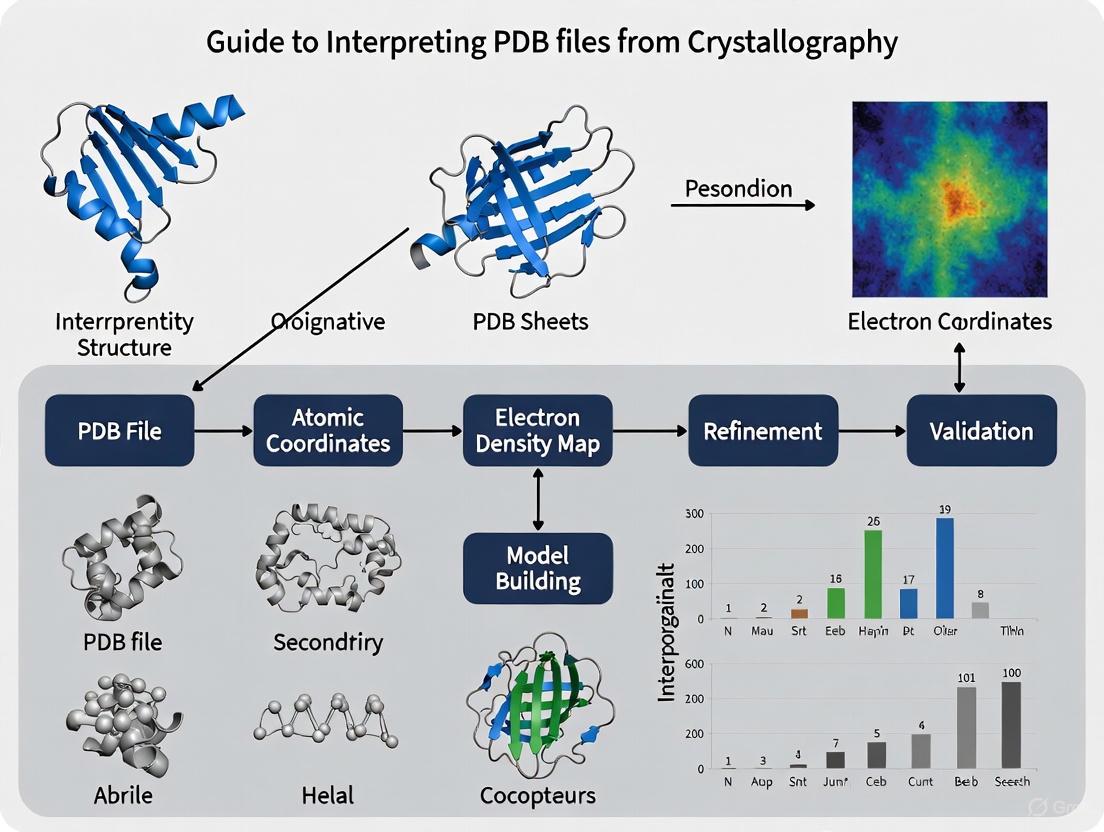
This guide provides researchers, scientists, and drug development professionals with a comprehensive framework for interpreting Protein Data Bank (PDB) files from crystallography.
Beyond the Coordinates: A Practical Guide to Interpreting, Validating, and Applying PDB Crystallography Data
Abstract
This guide provides researchers, scientists, and drug development professionals with a comprehensive framework for interpreting Protein Data Bank (PDB) files from crystallography. It moves beyond basic structure visualization to cover the foundational principles of PDB format, methodological approaches for systematic analysis using modern tools, strategies for troubleshooting common errors and data artifacts, and rigorous techniques for model validation and quality assessment. By integrating these skills, professionals can critically evaluate structural data to confidently inform drug design, functional analysis, and meta-studies, turning raw coordinates into reliable scientific insight.
Decoding the PDB File: A Primer on Format, Records, and Structural Metadata
The Protein Data Bank (PDB) format is a standard text file format for representing 3D structural data of biological macromolecules. It serves as the primary archive for experimentally determined structures of proteins, nucleic acids, and complex assemblies, with additional files available for computed structure models. For researchers in structural biology and drug development, understanding this format is crucial for interpreting, validating, and analyzing molecular structures. The format consists of lines of information called records, each designed to convey specific aspects of the structure, from atomic coordinates and connectivity to experimental metadata and secondary structure elements [1].
This guide focuses on the core record types essential for interpreting structural data from crystallography research, with particular emphasis on the distinction between standard and non-standard residues and the interpretation of key structural annotations.
Core Coordinate Records
ATOM and HETATM Records
The ATOM and HETATM records form the foundation of the 3D structural model in a PDB file, providing the Cartesian coordinates for each atom.
- ATOM records specify the 3D coordinates for atoms belonging to standard amino acids and nucleotides (i.e., the standard residues of the polymer chains) [2] [1].
- HETATM records specify the 3D coordinates for atoms that do not belong to standard polymers. This includes atoms of nonstandard residues, such as inhibitors, cofactors, ions, and solvent molecules (e.g., water) [1]. The key functional difference is that residues defined by HETATM records are, by default, not connected to other residues in the polymer chain [1].
The formal record format for ATOM and HETATM records, as defined by the wwPDB, is detailed in the table below [2] [1].
Table 1: Format of ATOM and HETATM Records
| Columns | Data Type | Field | Definition |
|---|---|---|---|
| 1 - 6 | Record name | "ATOM " or "HETATM" |
Identifies the record type. |
| 7 - 11* | Integer | serial |
Atom serial number. |
| 13 - 16 | Atom name | name |
Atom name. |
| 17 | Character | altLoc |
Alternate location indicator for disordered atoms. |
| 18 - 20 | Residue name | resName |
Residue name (3-letter code). |
| 22 | Character | chainID |
Chain identifier. |
| 23 - 26 | Integer | resSeq |
Residue sequence number. |
| 27 | Character | iCode |
Code for insertions of residues. |
| 31 - 38 | Real (8.3) | x |
Orthogonal coordinates for X in Angstroms. |
| 39 - 46 | Real (8.3) | y |
Orthogonal coordinates for Y in Angstroms. |
| 47 - 54 | Real (8.3) | z |
Orthogonal coordinates for Z in Angstroms. |
| 55 - 60 | Real (6.2) | occupancy |
Occupancy (default is 1.00). |
| 61 - 66 | Real (6.2) | tempFactor |
Temperature factor (B-factor). |
| 77 - 78 | LString(2) | element |
Element symbol, right-justified. |
| 79 - 80 | LString(2) | charge |
Charge on the atom. |
* Some non-standard files may use columns 6-11 for the atom serial number [1].
Example of Coordinate Records:
In this example, the first two lines are atoms of a Histidine residue, which is the first residue in chain A. The third line is a water molecule (HOH), which is a heteroatom and is numbered as residue 401 in the same chain [1].
TER Record
The TER record indicates the end of a polymer chain [1]. It is crucial for preventing visualization and modeling software from incorrectly connecting separate molecules that happen to be adjacent in the coordinate list. For example, a hemoglobin molecule with four separate subunit chains would require a TER record after the last atom of each chain [1].
Key Supporting Record Types
Beyond atomic coordinates, PDB files contain records that describe structural features and connectivity.
Table 2: Key Supporting Record Types in PDB Files
| Record Type | Data Provided by Record | Key Details |
|---|---|---|
| HELIX | Location and type of helices. | One record per helix. Specifies start/end residues and helix type (e.g., right-handed alpha, 3/10) [1]. |
| SHEET | Location and organization of beta-sheets. | One record per strand. Defines sense (parallel/antiparallel) and hydrogen-bonding registration [1]. |
| SSBOND | Defines disulfide bond linkages. | Specifies the pairs of cysteine residues involved in covalent disulfide bonds [1]. |
| MODEL / ENDMDL | Delineates multiple models in a single entry. | Used primarily for NMR ensembles, where multiple structurally similar models represent the solution structure [2]. |
Interpreting Key Data Fields
Occupancy and Alternate Locations (altLoc)
The occupancy value (columns 55-60) indicates the fraction of molecules in the crystal in which a given atom occupies the specified position. The default value is 1.00, meaning the position is fully occupied [3].
The alternate location indicator (altLoc, column 17) is used when an atom or group of atoms exists in more than one distinct conformation. A non-blank character (e.g., 'A', 'B') indicates an alternate conformation for that atom [2]. Within a residue, all atoms that are associated with each other in a given conformation are assigned the same alternate location indicator [2]. The occupancies of alternate conformations for the same atom should sum to 1.0 [3].
The Temperature Factor (B-factor)
The temperature factor, or B-factor (columns 61-66), is a measure of the vibrational or dynamic displacement of an atom from its average position. It is defined as B = 8π²〈x²〉, where 〈x²〉 is the mean square displacement of the atom [3].
- Interpretation: Higher B-factors indicate greater flexibility, disorder, or mobility of an atom or region. Lower B-factors indicate well-ordered, rigid parts of the structure.
- Typical Range: For well-refined protein structures, B-factors typically range from 15-30 Ų. The core of a molecule often has low B-factors, while flexible surface loops may have values exceeding 60-70 Ų [3].
- Visualization: Molecular graphics software often uses a color spectrum (e.g., blue for low B-factor, red for high B-factor) to allow rapid identification of flexible regions [3].
Experimental Data and Structure Quality
Interpreting a structure requires assessing its quality, which is closely tied to the experimental data. For crystallographic structures, key metrics include:
Table 3: Key Crystallographic Quality Metrics
| Metric | Definition | Interpretation |
|---|---|---|
| Resolution | A measure of the detail present in the experimental diffraction data [4] [5]. | Lower values indicate higher resolution and better quality. 1.8 Å (high) vs. 3.0 Å (low). At low resolution, only the basic chain contour is visible [4]. |
| R-factor (R-work) | Agreement between the experimental diffraction data and data simulated from the atomic model [4] [5]. | Lower is better. A value of ~0.20 (or 20%) is typical. A perfect (but unrealistic) fit would be 0.00 [4]. |
| R-free | An unbiased version of the R-factor calculated using a subset of experimental data not used in model refinement [4] [5]. | Prevents over-interpretation of data. Typically ~0.05 higher than the R-factor. A large discrepancy may indicate model errors [4]. |
Electron density maps are calculated using the experimental diffraction data (structure factors) and are the primary evidence used to build the atomic model [4]. A well-built atomic model will fit neatly within its electron density. Regions with poor or missing electron density often result in missing coordinates in the final PDB file, such as disordered loops or terminal regions [3].
The Scientist's Toolkit: Research Reagent Solutions
Table 4: Essential Reagents and Concepts in Macromolecular Crystallography
| Reagent / Concept | Function in Structure Determination |
|---|---|
| Heavy Atoms (e.g., Metal Ions) | Used in experimental phasing methods like MIR (Multiple Isomorphous Replacement). Their strong scattering power helps estimate the phases of X-ray reflections [4]. |
| Selenomethionine | A methionine analog where sulfur is replaced with selenium. Routinely incorporated into proteins for phasing via MAD (Multi-wavelength Anomalous Dispersion) [4]. |
| Cryo-protectants | Chemicals (e.g., glycerol, polyethylene glycol) used to protect flash-cooled crystals from forming ice, which can damage the crystal lattice during data collection. |
| Structure Factors | The primary experimental data from a crystallography experiment, containing the amplitudes and (estimated) phases needed to calculate an electron density map [4]. |
| Biological Assembly | The functional, native form of the molecule(s). The crystal's "Asymmetric Unit" may contain only a portion of the biological assembly, which is generated by applying crystallographic symmetry [6]. |
Logical Workflow for Interpreting a PDB Structure from Crystallography
The following diagram illustrates the logical relationship between key PDB record types and the process of building and interpreting a structural model from experimental data.
Figure 1: Logical workflow from experimental data to a full structural model, showing the roles of key PDB record types. The process begins with experimental data, which is used to calculate an electron density map. The model is built and refined into this map, resulting in ATOM and HETATM coordinate records. These primary records are annotated by secondary structure (HELIX, SHEET) and connectivity (SSBOND) records. The entire dataset undergoes quality validation before the functional biological assembly is generated.
The Structure Summary page on the RCSB PDB website serves as the primary entry point for accessing information about a experimentally determined biological macromolecular structure. For researchers, scientists, and drug development professionals, efficiently extracting and interpreting the essential metadata from this page is a critical skill. This metadata provides the necessary context about the experiment, allowing for an assessment of the model's quality and reliability, which is foundational for any subsequent analysis, from structure-based drug design to understanding mechanistic biology. This guide details the core metadata categories presented on the Structure Summary page, framed within the broader context of interpreting PDB files from crystallographic research [7] [8].
Core Crystallographic Metadata and Quality Indicators
The quality and interpretation of a structural model are underpinned by specific crystallographic metrics. These quantitative indicators, typically found under the Experiment tab, are essential for evaluating the reliability of the atomic coordinates [7].
Resolution
Resolution is a measure of the detail present in the diffraction data and the resulting electron density map. It is arguably the single most important indicator of structure quality [4].
- Definition: Resolution reflects how well the crystal diffracts X-rays. Highly ordered, perfect crystals yield high-resolution data with fine detail, while crystals with internal flexibility or disorder yield lower-resolution data showing only basic molecular contours [4].
- Interpretation: The numerical value (in Ångströms) represents the minimum distance between two distinguishable features in the electron density. Smaller values indicate higher resolution. The table below provides a practical guide for interpreting resolution values in protein crystallography:
Table 1: Interpretation of Resolution Ranges in Protein Crystallography
| Resolution Range (Å) | Quality Designation | Typical Level of Detail Visible | Confidence in Atomic Positions |
|---|---|---|---|
| ≤ 1.0 Å | Ultra-high resolution | Individual atoms; alternate side-chain conformations | Very High |
| 1.0 - 1.5 Å | High resolution | Most individual atoms; well-defined bond lengths and angles | High |
| 1.5 - 2.0 Å | Medium resolution | Clear backbone and side-chain density; ordered water molecules | Moderate to High |
| 2.0 - 2.5 Å | Medium-low resolution | General chain trace; bulky side-chain density | Moderate |
| 2.5 - 3.0 Å | Low resolution | Basic protein fold and secondary structure | Low |
| ≥ 3.0 Å | Very low resolution | Coarse molecular contours; atomic model is inferred | Low |
R-Value and R-Free
The R-value (also called R-work) and R-free are statistical measures that report on the agreement between the atomic model and the experimental diffraction data [4].
- R-value: This measures how well the simulated diffraction pattern, calculated from the atomic model, matches the experimentally observed diffraction pattern. A perfect fit would have an R-value of 0, while a random set of atoms has an R-value of about 0.63. For a well-refined structure, typical R-values are around 0.20 (or 20%) [4].
- R-free: This is a cross-validation metric designed to prevent overfitting or over-interpretation of the data during the refinement process. Before refinement begins, approximately 10% of the experimental diffraction data is set aside and not used. The R-free is then calculated by comparing this unused data to the model. An ideal, unbiased model will have an R-free value similar to, though typically slightly higher than, the R-value (often around 0.26). A large discrepancy between R-value and R-free can indicate that the model has been over-refined to fit the noise in the experimental data [4].
Structure Factors and Electron Density
The primary experimental data from a crystallographic experiment are the structure factors, which are used to calculate an electron density map [4].
- The Experiment: When a crystal is exposed to an X-ray beam, it produces a diffraction pattern consisting of a characteristic array of spots (reflections). Each reflection has an intensity (amplitude) and a phase angle [4].
- From Data to Map: The intensities are measured directly, but the phases must be estimated indirectly using methods such as molecular replacement (using a known similar structure), isomorphous replacement (adding heavy atoms), or anomalous scattering (using atoms like selenium). The combination of amplitudes and phases allows for the calculation of the electron density map, which is interpreted to build the atomic model [4].
- Data Availability: For many structures, the authors deposit the primary structure factor data. These files can be downloaded from the Structure Summary page and contain the h, k, l indices, amplitudes/intensities, and standard uncertainties for each reflection, enabling researchers to recalculate electron density maps [4].
Experimental Methodology and Workflow
Understanding the experimental pipeline is crucial for contextualizing the metadata. The following diagram and protocol outline the key steps from crystal to deposited structure.
Figure 1: The macromolecular crystallography structure determination workflow.
Detailed Crystallographic Protocol
- Crystallization and Data Collection: The purified macromolecule is crystallized. A single crystal is mounted and exposed to a narrow, intense beam of X-rays, and the resulting diffraction pattern is captured by a detector [4].
- Data Processing: Software (e.g., HKL-2000, XDS) indexes the diffraction spots and integrates their intensities. This step produces a list of structure factor amplitudes and their uncertainties. Key metrics like resolution and data completeness are determined here [4] [9].
- Phase Estimation (The "Phase Problem"): Since the phase information is lost in the diffraction experiment, it must be determined indirectly [4].
- Molecular Replacement (MR): Used when a similar structure is already known. The known model is placed and oriented within the unit cell of the unknown crystal to provide initial phase estimates [4].
- Isomorphous Replacement (MIR/SIR): Heavy atoms (e.g., Hg, Pt) are introduced into the crystal. Differences in diffraction intensities between native and heavy-atom derivative crystals are used to solve the phase problem [4].
- Anomalous Scattering (MAD/SAD): Atoms with anomalous scattering properties (e.g., Selenium in selenomethionine) are incorporated. Data collected at specific X-ray wavelengths allows for direct phasing [4].
- Electron Density Map Calculation and Model Building: The initial phases and measured amplitudes are used to compute an electron density map. Researchers then build an atomic model into this map using software like Coot, tracing the protein chain and placing side chains [4].
- Refinement and Validation: The initial model is refined against the diffraction data using programs like REFMAC or PHENIX. This iterative process adjusts atomic coordinates and temperature factors (B-factors) to improve the fit (lowering the R-value). The R-free value is monitored to guard against overfitting. The final model is validated using geometric and stereochemical checks before deposition [4].
The following tools and resources are essential for working with PDB data, both for extracting information and for preparing new depositions.
Table 2: Essential Research Tools and Resources for PDB Data
| Tool / Resource | Function | Relevance to Metadata Extraction/Deposition |
|---|---|---|
| RCSB PDB Structure Summary Page | Centralized web interface for accessing PDB entries. | The primary source for viewing and extracting core metadata, experimental details, and links to download data files [7]. |
| pdb_extract | A pre-deposition software tool. | Extracts and compiles metadata from the output files of various structure determination programs (e.g., data from Aimless, REFMAC) and generates a complete PDBx/mmCIF file ready for deposition [10] [9]. |
| PDBj CIF Editor | An online editor for PDBx/mmCIF files. | Allows depositors to create and edit a reusable metadata template file, ensuring all mandatory information is provided for efficient deposition via the OneDep system [10] [9]. |
| OneDep Deposition System | The unified wwPDB system for depositing structures. | Accepts the mmCIF files prepared by pdb_extract and the metadata templates from the CIF editor, and guides depositors through validation and submission [10]. |
| Structure Factor Files (e.g., MTZ format) | Files containing the primary diffraction data. | Can be downloaded for many entries, allowing researchers to recalculate electron density maps and perform their own analyses. OneDep accepts MTZ format for deposition [4] [9]. |
Advanced Metadata and the pdb_extract Tool
For depositors and advanced users, the pdb_extract tool is indispensable for handling the extensive metadata generated during structure determination. It automates the extraction of key details from the log files of data processing and refinement software, minimizing errors and saving time during deposition [10] [9]. The tool supports a wide array of software packages, ensuring that critical processing and refinement metadata is accurately captured. The following diagram illustrates the data flow during file preparation using pdb_extract.
Figure 2: Data flow for preparing a deposition using the pdb_extract tool.
The PDB Structure Summary page is a gateway to a rich array of metadata that is vital for interpreting, validating, and utilizing structural models. By systematically extracting and understanding key indicators like resolution, R-value, and R-free, and by appreciating the experimental workflow that generated them, researchers can make informed judgments about the suitability of a structure for their specific research needs. Furthermore, tools like pdb_extract and resources like the PDBj CIF Editor streamline the process of preparing and depositing new structures, ensuring the continued growth and quality of the structural archive. Mastery of this metadata is, therefore, not merely a technical exercise but a fundamental component of rigorous structural biology and drug development.
The Protein Data Bank (PDB) archive organizes three-dimensional structural data using a hierarchical framework that reflects the natural organization of biological macromolecules. This structure simplifies the complex process of searching, visualizing, and analyzing molecular structures. Understanding this hierarchy is fundamental for researchers, scientists, and drug development professionals to correctly interpret PDB files from crystallography research and other structural biology methods. Biomolecules exhibit inherent hierarchical organization; for instance, proteins are composed of linear amino acid chains that fold into subunits, which then may associate into higher-order functional complexes with other proteins, nucleic acids, small molecule ligands, and solvent molecules [11]. The PDB archive represents this biological reality through four primary levels of structural organization: Entry, Entity, Instance, and Assembly. This systematic organization enables precise querying and meaningful visualization of structural data, ensuring that researchers can access both the detailed atomic coordinates and the biologically functional forms of macromolecules.
Core Hierarchical Levels: Definitions and Relationships
The PDB data model is built upon four fundamental levels, each serving a distinct purpose in the structural description.
ENTRY: An ENTRY encompasses all data pertaining to a single structure deposited in the PDB. It is the top-level container identified by a unique PDB ID, which is currently a 4-character alphanumeric code (e.g., 2hbs for sickle cell hemoglobin) [11]. Future extensions will use eight-character codes prefixed by 'pdb' [12]. Every entry contains at least one polymer or branched entity.
ENTITY: An ENTITY defines a chemically unique molecule type within an entry. It distinguishes different molecular species, which can be polymeric (e.g., a specific protein chain or DNA strand), non-polymeric (e.g., a soluble ligand, ion, or drug molecule), or branched (e.g., oligosaccharides) [11] [12]. A single entry can contain multiple entities, such as different protein chains or ligand types. Entities are often linked to external database identifiers; for example, a protein entity might be mapped to a UniProt Accession Code [12].
INSTANCE: An INSTANCE represents a specific occurrence or copy of an entity within the crystallographic asymmetric unit or deposited model. An entry may contain multiple instances of a single entity. For example, a homodimeric protein would have one protein entity but two instances of that entity in the entry [11]. Each instance of a polymer is assigned a unique Chain ID (e.g., A, B, AA) for easy reference, selection, and display [11] [12].
ASSEMBLY: An ASSEMBLY describes a biologically relevant group of instances that form a stable functional complex. The assembly represents the functional form of the molecule, such as a hemoglobin tetramer that binds oxygen in the blood. Assemblies are generated by applying symmetry operations to the instances in the asymmetric unit or by selecting specific subsets of polymers and ligands [11] [13]. A structure may have multiple biological assemblies, each assigned a numerical Assembly ID [11].
Table 1: Core Hierarchical Levels in the PDB
| Level | Description | Identifier | Example |
|---|---|---|---|
| Entry | All data for a deposited structure | PDB ID (4-character) | 2hbs [11] |
| Entity | Chemically unique molecule | Entity ID | Protein alpha chain [11] |
| Instance | Specific occurrence of an entity | Chain ID | Chain A, Chain B [11] [12] |
| Assembly | Biologically functional complex | Assembly ID | Hemoglobin tetramer [11] |
The relationships between these levels are crucial for accurate data interpretation. The following diagram illustrates the logical flow from the deposited entry to the biologically relevant assembly:
Practical Application: The Case of Hemoglobin
The structure of hemoglobin (PDB ID: 2hbs) provides an excellent case study for understanding the practical application of the PDB hierarchy. This entry contains two complete sickle cell hemoglobin tetramers, which include heme cofactors and numerous water molecules [11].
- Entry Level: The PDB ID 2hbs represents the entire deposited dataset, including coordinates, experimental metadata, and annotations [11].
- Entity Level: The entry contains distinct chemical molecules. These include two polymeric entities (the alpha globin chain and the beta globin chain) and two non-polymeric entities (heme and water) [11].
- Instance Level: The entry contains multiple copies of these entities. Specifically, there are several instances of the alpha chain and beta chain entities, each assigned unique chain IDs. There are also eight instances of the heme entity (each bound to a protein chain) and several hundred instances of water [11].
- Assembly Level: Each hemoglobin tetramer is designated as a biological assembly. This assembly consists of a specific grouping of two instances of the alpha chain entity and two instances of the beta chain entity, along with their associated hemes and waters. This tetrameric form is the functional unit responsible for oxygen binding and delivery in the blood [11].
Table 2: Hierarchical Components in PDB Entry 2hbs (Hemoglobin)
| Hierarchy Level | Components in 2hbs | Count | Biological Role |
|---|---|---|---|
| Entry | Entire dataset for 2hbs | 1 Entry | Complete structural deposit |
| Polymer Entities | Alpha globin chain, Beta globin chain | 2 Entities | Genetically distinct polypeptides |
| Non-Polymer Entities | Heme (HEM), Water (HOH) | 2 Entities | Cofactor and solvent |
| Chain Instances | Alpha chain copies, Beta chain copies | Multiple Instances | Individual molecules in crystal |
| Heme Instances | Heme groups bound to chains | 8 Instances | Oxygen-binding sites |
| Biological Assemblies | Hemoglobin tetramers | 2 Assemblies | Functional oxygen carriers |
The Asymmetric Unit vs. The Biological Assembly
A critical distinction in crystallography is between the asymmetric unit and the biological assembly, which directly impacts the interpretation of PDB files.
Asymmetric Unit: The asymmetric unit is the smallest portion of the crystal structure to which symmetry operations can be applied to generate the complete unit cell, which is the repeating unit of the crystal [14]. The primary coordinate file deposited by researchers typically contains only the asymmetric unit, which may or may not correspond to the biological assembly. The content depends on the molecule's position and conformation within the crystal lattice [14]. The asymmetric unit may contain one biological assembly, a portion of an assembly, or multiple assemblies [14].
Biological Assembly: The biological assembly is the macromolecular structure believed to be the functional form of the molecule in vivo [14]. For example, the functional form of hemoglobin is a tetramer with four chains, even if the asymmetric unit contains only a portion of this complex. Generating the biological assembly requires applying crystallographic symmetry operations (rotations, translations, or screw axes) to the coordinates in the asymmetric unit, or selecting a specific subset of these coordinates [14].
The relationship between these units varies across structures, as demonstrated by different hemoglobin entries:
- In PDB 2hhb, the biological assembly is identical to the asymmetric unit, containing one complete hemoglobin tetramer [14].
- In PDB 1out, the asymmetric unit contains only half of the hemoglobin tetramer (two chains). The complete biological assembly is generated by applying a crystallographic two-fold symmetry operation to produce the other two chains [14].
- In PDB 1hv4, the asymmetric unit contains two complete hemoglobin molecules (eight chains). The biological assembly in this case is defined as one hemoglobin tetramer, which constitutes half of the asymmetric unit [14].
The following workflow diagram illustrates the process of determining the biological assembly from the deposited coordinates:
Experimental Protocols for Assembly Determination
Determining the correct biological assembly is a critical step in structural analysis. The process involves both experimental evidence and computational analysis, with protocols varying by structure determination method.
For X-ray Crystallography Structures
The biological assembly for crystal structures is determined through a multi-step process that combines author input with computational validation. The experimental protocol involves:
- Author Specification: During deposition, authors provide their hypothesized biological assembly based on biochemical, biophysical, or functional data. This constitutes the "author-provided" assembly [14].
- Computational Analysis: Software tools, most commonly PISA (Protein Interfaces, Surfaces, and Assemblies), automatically analyze the crystal structure [14]. The software calculates:
- Buried Surface Area: The surface area removed from contact with solvent when two molecular surfaces meet.
- Interaction Energies: The thermodynamic stability of interfaces between chains.
- Solvation Free Energy: The energy gain upon complex formation.
- Assembly Prediction: Based on these calculations, the software predicts probable quaternary structures and assigns a likelihood to each potential assembly [14].
- Consensus Determination: The final biological assemblies reported in the entry include a remark indicating their origin—"author provided," "software determined," or both. In cases of discrepancy, multiple assemblies may be presented. For example, in PDB entry 3fad (T4 lysozyme), both a monomeric (author- and software-determined) and a dimeric (software-determined only) assembly are provided [14].
For NMR and Computed Structure Models
The protocols differ for structures determined by nuclear magnetic resonance (NMR) spectroscopy and computed structure models (CSMs):
- NMR Structures: NMR commonly deposits an ensemble of structures. The best representative model is made available as the "Assembly" coordinates. In practice, the assembly for NMR structures is typically identical to its corresponding representative model [13].
- Computed Structure Models (CSMs): For predicted structures from resources like AlphaFold DB, the assembly coordinates are the same as the model (predicted structure) coordinates. The assembly is included primarily to enable structure-based query and analysis alongside experimental structures [13].
Successful navigation and interpretation of PDB hierarchies require familiarity with specific data resources, visualization tools, and analytical software.
Table 3: Essential Resources for PDB Data Interpretation
| Resource Name | Type | Primary Function | Relevance to Hierarchy |
|---|---|---|---|
| RCSB PDB Website | Database Portal | Main access point to PDB data [6] | Exploring entries, entities, instances, and assemblies via Structure Summary pages. |
| Mol* Viewer | Visualization Software | Interactive 3D structure visualization [13] | Visualizing different hierarchy levels; switching between Model and Assembly views. |
| PISA (Software) | Analytical Tool | Predicts biological assemblies from crystal data [14] | Determining probable quaternary structures based on interface properties. |
| Chemical Component Dictionary | Reference Database | Standardized chemical descriptions of small molecules [12] | Defining non-polymer entities and their atom names. |
| UniProt | Protein Sequence Database | Central repository of protein sequence/functional data [12] | Mapping polymer entities to external sequence and functional data. |
| EMDB (Electron Microscopy Data Bank) | Structural Database | Archive of 3DEM maps [12] | Connecting EM structures (entries) to their underlying density maps. |
Accessing and Visualizing Hierarchical Data
The RCSB PDB website and its integrated Mol* viewer provide powerful interfaces for accessing and visualizing the different levels of the structural hierarchy.
The Structure Summary page on the RCSB PDB website serves as the central hub for information about a specific entry. Key sections relevant to the hierarchy include:
- Snapshot of the Structure: Located at the top left, this box displays the biological assembly by default for X-ray and 3DEM structures, or the NMR ensemble for NMR structures [6]. The heading bar allows users to toggle between views of the asymmetric unit and different biological assemblies [6].
- Header Section: This area displays the PDB ID, structure title, classification, source organisms, and deposition information [6]. It also provides critical quality assessment tools, such as the wwPDB Validation slider for experimental structures and the Model Confidence metrics (pLDDT scores) for CSMs [6].
- Interactive Viewing Options: Hyperlinks below the snapshot offer specialized visualization pathways in Mol*, including "Structure" (general view), "Ligand Interaction" (zoomed on a specific ligand), and "Electron Density" (for X-ray structures) [6].
Visualization and Analysis in Mol*
The Mol* viewer offers precise control over the display of hierarchical components through its Components and Structure panels:
- Structure Panel: This panel allows users to select and display different forms of the structure. Options include "Model" (the deposited coordinates), "Assembly" (the biologically relevant form), "Unit Cell" (for X-ray entries), and "Super Cell" [13]. Preset views facilitate quick toggling between these representations [13].
- Components Panel: This panel enables manipulation and display of specific parts of the structure. Users can add representations for different components (polymers, ligands, waters) and apply various visual styles (cartoon, ball-and-stick, surface) [13]. Preset display options, such as "Polymer & Ligand" or "Atomic Detail," automatically configure appropriate representations for different hierarchy levels [13].
- Measurement Tools: The Measurements Panel allows users to make quantitative geometric analyses (distances, angles, dihedral angles) by selecting specific atoms from different instances and entities [13]. This is essential for validating molecular interactions within an assembly.
Correct interpretation of PDB data requires careful navigation of its intrinsic hierarchy. By understanding the distinctions between entries, entities, instances, and assemblies—and particularly the critical difference between the crystallographic asymmetric unit and the biological assembly—researchers can ensure they are analyzing the functionally relevant form of a macromolecule. The tools and resources outlined in this guide provide a robust framework for exploring this hierarchical data, ultimately supporting accurate structural analysis in basic research and drug development.
The Protein Data Bank (PDB) serves as a global archive for the three-dimensional structures of biological macromolecules, with the majority determined by X-ray crystallography [15]. As of 2024, the archive contains over 190,000 crystal structures, representing a foundational resource for millions of researchers worldwide [16] [15]. This technical guide examines how the crystallographic method fundamentally shapes the structural data contained within PDB files, providing researchers and drug development professionals with the critical framework needed to accurately interpret these essential resources. Understanding the intrinsic connection between experimental methodology and data representation is paramount, as the PDB's importance extends to training advanced structural prediction algorithms like AlphaFold, making the highest data quality essential for future scientific breakthroughs [16].
The process of crystallography involves several transformative steps—from growing a crystal to calculating an electron density map and building an atomic model. Each stage introduces specific constraints and potential artifacts that become permanently embedded in the final coordinates deposited to the PDB. This article provides an in-depth analysis of these methodological influences, offering detailed protocols for evaluating structural quality and practical frameworks for interpreting crystallographic data within the context of drug discovery and basic research.
Foundational Concepts: From Crystal to Electron Density
The Crystallographic Phase Problem
X-ray crystallography does not directly produce an atomic model. When X-rays strike a crystal, they diffract, producing a pattern of spots whose intensities can be measured. These intensities provide the amplitude information for the structure factors but crucially lack phase information—a limitation known as the "phase problem" that must be solved to calculate an interpretable electron density map. The experimental process involves multiple transformations of the data, each with specific implications for the final model:
- Crystal Growth: Macromolecular crystals are typically grown from aqueous solutions containing precipitants, resulting in crystals that are approximately 50% solvent by volume. This high solvent content often leads to dynamic disorder that impacts overall data quality and resolution.
- Data Collection: Diffraction patterns are collected, and intensities are integrated to produce structure factor amplitudes. Radiation damage during data collection can introduce decay in diffraction power, particularly in sensitive side chains.
- Phase Determination: Experimental methods (MAD, SAD, MIR) or molecular replacement (MR) are used to obtain initial phase estimates. MR, which uses a known homologous structure as a search model, can potentially bias the resulting model toward the template.
- Electron Density Calculation: The initial experimentally-determined phases are combined with the measured amplitudes to calculate the first electron density maps, which are then iteratively improved through refinement.
Resolution as a Quality Determinant
The resolution limit of a crystallographic experiment represents the smallest distance between two points that can be distinguished as separate features in the electron density map. This parameter fundamentally constrains what can be observed and modeled in a structure, with profound implications for biological interpretation, particularly in drug design where precise atomic interactions are critical.
Table 1: Interpretation of Crystallographic Resolution Ranges
| Resolution Range (Å) | Structural Features Discernible | Typical Applications & Limitations |
|---|---|---|
| <1.5 Š(Atomic/Ultra-high) | Individual atoms clearly resolved; alternative conformations visible; hydrogen atoms often detectable | Detailed mechanistic studies; accurate ligand geometry; reliable water networks; low B-factors typically <20 Ų |
| 1.5-2.2 Å (High) | Main-chain and side-chain features clear; some alternative conformations detectable; water molecules placed | Standard for publication; reliable protein-ligand interactions; backbone carbonyl oxygens visible |
| 2.2-3.0 Å (Medium) | Chain tracing reliable; bulky side chains distinguishable; small side chains may be ambiguous | Fold determination; identifying binding sites; caution needed for specific interactions; higher B-factors common |
| >3.0 Å (Low) | Polypeptide chain trace visible as continuous tube; side chains as undifferentiated bulk | Domain organization; large conformational changes; severe caution in interpreting atomic interactions |
Interpreting the PDB Format: A Crystallographic Perspective
Critical Data Fields and Their Structural Significance
The PDB file format encapsulates both the atomic model and essential metadata from the crystallographic experiment [1] [17]. Proper interpretation requires understanding how specific records reflect the experimental process and its limitations:
- ATOM/HETATM Records: Contain the orthogonal Ångström coordinates (X,Y,Z) for all modeled atoms [1]. The precision (3 decimal places) often exceeds the actual accuracy, which is determined by the resolution limit.
- Occupancy and Alternate Conformations: Due to local flexibility or static disorder, amino acid side chains may adopt multiple conformations [3]. These are represented with partial occupancy values (summing to 1.0 for all conformations at a given position) and distinguished by alternate location indicators [3].
- Temperature Factors (B-factors): Quantify atomic displacement or disorder, calculated as B=8π²⟨x²⟩, where ⟨x²⟩ represents the mean-square displacement from the average position [3]. Higher values indicate greater flexibility or uncertainty in atomic position.
Table 2: Key Crystallographic Parameters in PDB Files and Their Interpretation
| Parameter | Location in PDB File | Technical Significance | Interpretation Guidance |
|---|---|---|---|
| Resolution | HEADER or REMARK records | Minimum interplanar spacing measured during data collection | Lower values indicate higher detail; impacts model accuracy |
| R-factor/R-free | REMARK 3 | Measures agreement between model and experimental data | R-free >0.40 indicates serious problems; difference >0.05 between R-factor and R-free suggests overfitting |
| B-factors (Temperature Factors) | Columns 61-66 of ATOM/HETATM records [3] | Quantify atomic displacement or positional uncertainty | Core regions typically 15-30 Ų; values >60-70 Ų indicate high flexibility or potential errors |
| Occupancy | Columns 55-60 of ATOM/HETATM records | Fraction of molecules in crystal where atom occupies specified position | Values <1.0 indicate partial occupancy or multiple conformations; should sum to 1.0 for all conformations of an atom |
| Missing Residues/Atoms | Not present in coordinate section | Regions with poor or uninterpretable electron density | Common in flexible loops or surface regions; check REMARK 465 for specifically missing residues |
Validation Metrics and Error Detection
The PDB deposition process now includes extensive validation reports that provide crucial metrics for assessing model quality. The clashscore identifies steric overlaps between atoms, with values >20 potentially indicating packing problems. Ramachandran outliers identify energetically unfavorable backbone conformations, with >5% outliers suggesting possible model errors. Rotamer outliers flag unusual side-chain conformations, which may indicate incorrect modeling or genuine functional states. Real-space correlation coefficients (RSCC) measure how well the atomic model agrees with the experimental electron density locally, with values <0.8 indicating poor fit that warrants careful inspection.
Diagram 1: Crystallographic Structure Determination Workflow. The iterative process of model building and refinement (green and red nodes) demonstrates how initial phases are progressively improved to produce the final validated structure.
Advanced Considerations in Structure Interpretation
Biological Assemblies vs. Asymmetric Units
A critical distinction in PDB interpretation lies between the asymmetric unit (the minimal repeating unit of the crystal) and the biological assembly (the functional form of the molecule in vivo) [13]. Crystallographic symmetry operations (detailed in MTRIX and SMTRY records) must be applied to generate the biologically relevant oligomer. Visualization tools like Mol* provide toggles between these representations, allowing researchers to examine different biological assembly hypotheses [13]. For structures determined by X-ray crystallography, the assembly coordinates are generated by applying specific symmetry operations to the deposited coordinates, which may represent only a portion of the functional complex [13].
Detecting and Managing Duplicate Structures
Recent research has revealed that the PDB contains numerous pairs of protein structures with nearly identical main-chain coordinates [16]. These duplicates arise because the PDB lacks mechanisms to detect potentially duplicate submissions during deposition [16]. Some represent independent determinations of the same structure, while others may be modeling efforts of ligand binding that "masquerade as experimentally determined structures" [16]. Researchers should utilize tools like the Backbone Rigid Invariant (BRI) algorithm to identify such duplicates, particularly when conducting data mining or machine learning applications where duplicates can skew results [16]. Proposed solutions include obsoleting duplicate entries or marking them with clear 'CAVEAT' records to alert users [16].
Ligand Binding and Electron Density Interpretation
Small molecules (ligands, inhibitors, cofactors) are represented as HETATM records in PDB files [1]. Assessment of ligand geometry should include examination of the real-space correlation coefficient (RSCC) to evaluate how well the atomic model agrees with the experimental electron density. Additionally, omit maps (calculated after removing the ligand from the model) provide unbiased evidence for ligand binding. Drug development professionals should be particularly cautious of ligands with poor density, high B-factors, or unusual geometries that may indicate incorrect modeling or partial occupancy issues.
Diagram 2: Data Quality Relationships in Crystallography. The resolution limit (red) fundamentally constrains map quality, which directly determines atomic model precision and ultimately biological confidence.
Practical Protocols for Structure Evaluation
Step-by-Step Structure Validation Protocol
- Initial Quality Assessment: Check resolution, R-work, and R-free values from the PDB header. Verify that the R-free value is within 0.05 of the R-work value.
- Geometry Evaluation: Examine Ramachandran plot statistics, ensuring >90% of residues fall in favored regions and <1% are outliers unless justified by special structural features.
- B-factor Analysis: Visualize B-factor distribution along the protein chain using color coding (blue→red for low→high values). Identify regions with unusually high B-factors (>60-70 Ų) that may indicate flexibility or modeling errors [3].
- Ligand and Active Site Inspection: For structures with bound ligands, generate omit maps to verify ligand placement without model bias. Check ligand geometry and interactions with the protein.
- Comparison with Biological Knowledge: Evaluate whether the structural observations align with biochemical and functional data, investigating discrepancies that may indicate crystallization artifacts.
Visualization Tools and Techniques
Modern visualization software like Mol* provides powerful capabilities for examining crystallographic data [13] [18]. Key features include:
- Model vs. Assembly Toggle: Switch between asymmetric unit and biological assembly views [13].
- B-factor Coloring: Apply "temperature rainbow" coloring schemes to visualize flexibility and disorder [3].
- Validation Coloring: Color structures by validation metrics like geometry quality or density fit to identify potential problem areas [13].
- Measurement Tools: Precisely measure distances, angles, and dihedral angles for specific atomic interactions [13].
- Symmetry Display: Generate symmetry mates to examine crystal packing interfaces and potential biological interfaces [13].
Table 3: Essential Research Reagent Solutions for Crystallography
| Reagent/Category | Function in Crystallography | Technical Considerations |
|---|---|---|
| Crystallization Screening Kits | Initial identification of crystallization conditions | Commercial screens (e.g., Hampton Research) contain diverse precipitant combinations to sample chemical space |
| Cryoprotectants | Protect crystals during flash-cooling for data collection | Glycerol, ethylene glycol, or oils prevent ice formation that damages crystal order |
| Heavy Atom Compounds | Experimental phasing via MAD/SAD | Platinum, gold, mercury, or selenium compounds derivative native proteins for phase determination |
| Crystal Harvesting Tools | Manipulation of fragile crystals | Micromounts, loops, and magnetic caps enable precise crystal handling with minimal damage |
| Ligand Soaking Solutions | Introducing small molecules into pre-grown crystals | Optimization of concentration, soaking time, and solvent composition to maintain crystal integrity |
Crystallography provides an immensely powerful window into molecular structure, but the data it generates must be interpreted with a clear understanding of methodological constraints. Resolution limits, crystal packing effects, disorder, and the model-building process all leave distinct signatures in PDB files that influence biological interpretation. For drug development professionals, this critical perspective is essential when evaluating potential ligand-binding sites, assessing protein flexibility, or designing new compounds based on structural information. As structural biology continues to evolve, with new methods like the "Crystal Clear" approach enabling direct visualization of crystal interiors, our ability to connect methodological approach to structural interpretation will only grow in importance [19]. By maintaining rigorous standards for structure validation and developing increasingly sophisticated tools for detecting artifacts like duplicate entries, the structural biology community can ensure that the PDB remains a trustworthy foundation for scientific discovery and therapeutic innovation [16].
From Static Files to Dynamic Insights: Analytical Workflows for Drug Discovery
Leveraging RCSB PDB Tools for Automated Binding Site and Ligand Analysis
Within the Protein Data Bank (PDB), small molecules such as ions, cofactors, inhibitors, and drugs that interact with biological polymers (proteins and nucleic acids) are collectively termed ligands [20]. These molecules are crucial for understanding biomolecular function, as they often bind to specific pockets, cavities, or surfaces to facilitate structural stability or execute functional roles [20]. Over 70% of PDB structures contain at least one small-molecule ligand, excluding water molecules, highlighting their fundamental importance in structural biology [21]. For researchers focused on crystallography, accurately interpreting these ligand-binding site interactions is paramount, as the molecular details of these complexes provide insights into mechanisms of action, inform drug discovery efforts, and help elucidate the structural basis of diseases.
The RCSB PDB provides a sophisticated infrastructure for studying these interactions. Each unique small-molecule ligand is defined in the wwPDB Chemical Component Dictionary (CCD) with a distinct identifier (CCD ID) and a detailed chemical description [21]. Furthermore, the resource has implemented robust ligand validation tools that enable researchers to assess the quality and reliability of ligand structures, which is a critical first step before undertaking any detailed analysis [20] [21]. This guide details the methodologies for leveraging RCSB PDB tools to perform automated, rigorous analysis of binding sites and their resident ligands, with a focus on interpreting crystallographic data within the framework of a broader research thesis.
The RCSB PDB offers an integrated suite of tools and resources specifically designed for the interrogation of ligands and their binding sites. Familiarity with these core resources is a prerequisite for effective analysis.
- Chemical Component Dictionary (CCD): This is the authoritative repository for every unique small molecule and molecular subunit found in the PDB archive [22]. Each chemical component is assigned a unique three-letter code (e.g., "ATP" for adenosine triphosphate, "HEM" for heme) and is associated with detailed chemical information including stereochemistry, chemical descriptors (SMILES and InChI), systematic names, and idealized 3D coordinates [22]. The CCD is foundational for ensuring consistent chemical representation across the entire archive.
- Ligand Validation Tools: A critical step in any analysis is assessing the quality of the ligand structure itself. The RCSB PDB provides comprehensive validation reports for ligands in X-ray structures, which include metrics on the fit of the atomic model to the experimental electron density and the accuracy of its chemical geometry [20] [21]. These are presented via intuitive 1D sliders and 2D plots on the structure summary page and the dedicated "Ligands" tab, allowing researchers to quickly identify the best-instance of a ligand within a structure or across multiple structures [21].
- Programmatic Access (APIs): For automated, large-scale analysis, the RCSB PDB provides programmatic access via a GraphQL API and RESTful services [23]. This allows bioinformaticians and developers to programmatically search, retrieve, and analyze structural data, including specific ligand information and binding affinity data, integrating it into custom pipelines and workflows.
Table 1: Key RCSB PDB Resources for Ligand and Binding Site Analysis
| Resource Name | Type | Primary Function | Access Method |
|---|---|---|---|
| Chemical Component Dictionary (CCD) | Data Dictionary | Defines chemical identity and ideal coordinates for every unique small molecule. | Web Interface, API Download |
| Ligand Validation Report | Quality Assessment | Provides metrics on electron density fit (RSR, RSCC) and geometry (RMSZ-bonds/angles). | Structure Summary Page, "Ligands" Tab |
| BIRD (Biologically Interesting molecule Reference Dictionary) | Data Dictionary | Defines complex ligands (e.g., peptides, antibiotics) composed of several subcomponents. | Web Interface, API |
| Structure Summary Page | Web Portal | Central hub for all information related to a specific PDB entry, including ligand sliders. | Web Interface (RCSB.org) |
| GraphQL & REST APIs | Programmatic Interface | Enables automated querying and retrieval of structural and ligand data. | Programmatic Access |
Methodologies for Ligand Structure Quality Assessment
Before analyzing a ligand's interactions, it is essential to determine the reliability of its structural model. The RCSB PDB's ligand quality assessment is based on two principal composite indicators derived from validation data in the wwPDB validation report [21].
Core Validation Metrics
The validation of a ligand structure involves several key metrics that assess different aspects of model quality:
- Goodness of Fit to Experimental Data: This measures how well the atomic coordinates of the ligand agree with the experimental electron density map from X-ray crystallography. The primary metrics are the Real Space R-factor (RSR) and the Real Space Correlation Coefficient (RSCC) [21].
- Geometric Accuracy: This assesses the correctness of the ligand's internal chemical geometry, such as bond lengths and angles. The metrics used are the Root-Mean-Square-Deviation Z-scores for bond lengths (RMSZ-bond-length) and bond angles (RMSZ-bond-angle), which compare the ligand's geometry to high-quality small-molecule structures from the Cambridge Structural Database (CSD) [21].
Composite Ranking Scores and 2D Plots
To simplify interpretation, RCSB PDB uses Principal Component Analysis (PCA) to aggregate these correlated metrics into two unidimensional composite indicators [21]:
- PC1-fitting: A composite indicator for how well the ligand model fits the electron density, explaining 84% of the variance in RSR and RSCC.
- PC1-geometry: A composite indicator for geometric accuracy, explaining 82% of the variance in RMSZ-bond-length and RMSZ-bond-angle.
These indicators are then converted into composite ranking scores—percentile ranks that indicate the quality of a specific ligand instance relative to all other ligand instances in the PDB archive. A score of 100% represents the best quality, 0% the worst, and 50% the median [21]. These scores are visually presented in a 2D ligand quality plot (found in the "Ligands" tab), where the X-axis represents the PC1-fitting ranking and the Y-axis the PC1-geometry ranking. The best instance of a ligand in a structure is marked with a green diamond, enabling its rapid identification [20] [21].
Experimental Protocol: Accessing and Interpreting Ligand Quality
- Access the Structure: Navigate to the RCSB.org website and enter a PDB ID (e.g., 7lad) in the search box [20].
- Locate Quality Indicators: On the Structure Summary page, find the 1D slider for "Ligands of Interest." This slider shows the goodness-of-fit for the best instance of each functional ligand [21].
- Open Detailed Ligand View: Click on the vertical bar for a specific ligand or select the "Ligands" tab to access the detailed ligand analysis page.
- Interpret the 2D Plot: In the "Ligands" tab, the first 2D plot shows the quality of all instances of the ligand in the current structure. Select the instance represented by the green diamond for the best combination of data fit and geometry [20].
- Visualize in 3D: Clicking on the green diamond symbol opens the 3D view in Mol*, displaying the ligand with its experimentally determined electron density map, allowing for direct visual assessment of the model's fit to the data [21].
Quantitative Analysis of Ligand-Binding Interactions
Once a high-quality ligand structure is identified, the next step is a quantitative analysis of its binding interactions. This involves examining the ligand's properties, its binding affinity, and the specific atomic contacts it forms with the binding site.
Identifying Ligands of Interest (LOI)
Not all ligands in a structure are the primary subject of the research. The RCSB PDB designates certain ligands as Ligands of Interest (LOI), which are functional ligands considered the focus of the experiment. The criteria for this designation are: (1) a molecular weight greater than 150 Da, and (2) the ligand is not on an exclusion list of likely non-functional molecules (e.g., solvents, salts) [20] [22]. On the RCSB website, LOIs are prominently featured in the ligand quality slider and tabs, helping researchers quickly identify the most relevant small molecules in a structure.
Binding Affinity and Quantitative Bioactivity Data
For many PDB structures, particularly those relevant to drug discovery, experimental measurements of binding strength, such as dissociation constants (Kd), inhibition constants (Ki), or half-maximal inhibitory concentrations (IC50), are available. These data can be retrieved via the RCSB PDB interface or programmatically using tools like get_binding_affinity_by_pdb_id [24]. Integrating this quantitative bioactivity data with 3D structural information is powerful for establishing structure-activity relationships (SAR).
Table 2: Key Quantitative Metrics for Ligand and Binding Site Analysis
| Metric Category | Specific Metric | Interpretation and Significance |
|---|---|---|
| Binding Affinity | Kd, Ki, IC50 | Quantitative measures of ligand binding strength or inhibitory potency. Lower Kd/Ki/IC50 indicates tighter binding. |
| Ligand Quality (Fit) | Real Space R-factor (RSR) | Measures agreement between model and electron density. Lower is better (closer to 0). |
| Real Space Correlation Coefficient (RSCC) | Measures correlation between model and electron density. Closer to 1.0 is ideal. | |
| Ligand Quality (Geometry) | RMSZ-Bond-Length | Z-score of deviation from ideal bond lengths. Closer to 0 is ideal, >2 may indicate problems. |
| RMSZ-Bond-Angle | Z-score of deviation from ideal bond angles. Closer to 0 is ideal, >2 may indicate problems. | |
| Composite Scores | PC1-fitting / PC1-geometry Rank | Percentile rank (0-100%) of ligand's fitting and geometry quality compared to all PDB ligands. |
Experimental Protocol: Analyzing Binding Sites and Interactions
- Retrieve the Complex: From the Structure Summary page, open the 3D view of the macromolecular complex containing the validated ligand of interest.
- Isolate the Binding Site: Use the selection tools in the Mol* viewer to display only the ligand and the protein residues within a specific radius (e.g., 5 Å). This defines the binding pocket.
- Identify Non-Covalent Interactions: Leverage built-in analysis tools to detect and categorize specific interactions, such as:
- Hydrogen bonds: Between ligand donor/acceptors and protein side chains/backbone.
- Hydrophobic contacts: Between non-polar surfaces of the ligand and protein.
- Ionic interactions / Salt bridges: Between charged groups on the ligand and protein.
- Pi-Pi / Pi-cation stacking: Involving aromatic rings in the ligand or protein.
- Metal coordination: If the binding site contains metal ions.
- Document and Quantify: Measure distances and angles for key interactions to ensure they are within expected ranges (e.g., H-bond distances of 2.5-3.3 Å). This quantitative description forms the basis for understanding binding specificity and for structure-based drug design.
Successful analysis of PDB structures relies on a digital toolkit of defined reagents and resources. The following table details key "research reagents" available through the RCSB PDB that are essential for professional-level ligand and binding site analysis.
Table 3: Research Reagent Solutions for PDB Analysis
| Resource / Reagent | Function in Analysis | Key Features / Components |
|---|---|---|
| wwPDB Chemical Component Dictionary (CCD) | Defines the chemical identity and ideal 3D structure of every small molecule ligand. | Chemical descriptors (SMILES, InChI), systematic names, idealized coordinates, stereochemistry. |
| BIRD (Biologically Interesting molecule Reference Dictionary) | Defines complex ligands (e.g., peptides, antibiotics) composed of multiple subcomponents. | Polymer sequence, connectivity, functional classification, natural source, external references (e.g., UniProt). |
| wwPDB Validation Report | Provides a quality "assay" for the structural model, including the ligand and its fit to experimental data. | Ligand geometry Z-scores, electron density fit metrics (RSR, RSCC), clash scores. |
| Mol* 3D Viewer | The primary visualization engine for interactive exploration of the 3D structure, binding site, and electron density. | Selection tools, measurement tools, support for displaying electron density maps, high-performance rendering. |
| RCSB PDB GraphQL API | Enables automated, programmatic querying and retrieval of structural data and metadata for high-throughput analysis. | Flexible queries, integration of PDB data with >40 external biodata resources. |
The RCSB PDB has evolved from a simple structural archive into a sophisticated platform for integrated structural bioinformatics. Its tools for automated binding site and ligand analysis—centered on robust validation, intuitive visualization, and programmatic access—empower researchers to move from static structures to dynamic, quantitative insights. The rigorous assessment of ligand structure quality ensures that analyses are built upon a reliable foundation, which is especially critical for applications in rational drug design and mechanistic biology.
Looking forward, the continued growth of the PDB archive, which contained over 245,000 structures as of 2025 [25], and the integration of new data types like Computed Structure Models (CSM) from AlphaFold DB [26], will further expand the scope of these analyses. The ongoing remediation of metalloprotein annotations [26] and the development of new validation metrics promise to make these tools even more powerful. By mastering the methodologies outlined in this guide, researchers can confidently leverage the full power of the PDB to interpret crystallographic data and advance their scientific objectives.
Using Programmatic Access (Python API, GraphQL) for Bulk Data Analysis
The Protein Data Bank (PDB) represents a cornerstone resource in structural biology, containing over 199,000 experimentally determined structures as of 2025, with thousands more added annually [15]. While traditional manual access via the web interface serves casual browsing, large-scale analytical projects in crystallography research and drug development require efficient, programmatic data extraction methods. The RCSB PDB's comprehensive suite of application programming interfaces (APIs) provides researchers with direct computational access to the entire archive, enabling high-throughput analysis that would be impractical through manual approaches [27] [28].
These programmatic interfaces are particularly valuable for meta-analyses across multiple structures, such as investigating ligand-binding preferences, tracing evolutionary relationships through structural comparisons, or validating new computational methods against experimental data. By leveraging Python and GraphQL, scientists can extract precisely defined data subsets, transform them into analysis-ready formats, and integrate structural insights into automated research pipelines [28]. This technical guide explores the practical implementation of these tools for bulk data analysis within the context of crystallography research.
The RCSB PDB provides several specialized APIs that collectively enable comprehensive programmatic access to structural data and services. Understanding the distinct role of each interface is fundamental to designing efficient data acquisition strategies [27].
Core API Services
Table 1: Core RCSB PDB API Services for Programmatic Access
| API Service | Primary Function | Data Format | Use Case Examples |
|---|---|---|---|
| Data API | Retrieves detailed information when structure identifiers are known | JSON | Fetch coordinates, annotations, and experimental details for specific entries |
| Search API | Finds identifiers matching specific search criteria using a JSON-based query language | JSON | Identify structures by resolution, organism, ligand presence, or sequence similarity |
| GraphQL API | Enables flexible, hierarchical data retrieval across multiple related data types in a single query | JSON | Extract specific fields from entries, entities, and assemblies simultaneously |
| ModelServer API | Provides access to molecular coordinate data in BinaryCIF format | BinaryCIF | Retrieve structural models at different granularities (assembly, chain, ligand) |
| Sequence API | Delivers alignments between structural and sequence databases | JSON | Map protein positional features between PDB, UniProt, and RefSeq |
The Data API serves as the foundational service for retrieving detailed information about known structures, organized according to the structural hierarchy (entry, entity, instance, assembly) [27]. The accompanying Search API exposes the full query capability of the RCSB portal programmatically, supporting complex Boolean logic across all available data fields [27] [28]. For large-scale extraction projects, the GraphQL API offers particularly significant advantages by allowing researchers to specify exactly which data fields they need from any level of the structural hierarchy in a single request, minimizing both network overhead and client-side data processing [27] [28].
Accessing Crystallographic Software and Tools
While the RCSB APIs provide access to structural data, the interpretation of crystallographic information often requires specialized software tools. The structural biology community relies on applications such as COOT for model building and refinement, PHENIX for automated structure determination, and CCP4 for comprehensive crystallographic analysis [29]. Additionally, tools like MolSoft ICM provide capabilities for evaluating crystallographic symmetry, generating biological units, and analyzing electron density maps, which are essential for proper structural interpretation [30]. These resources complement programmatic data access by enabling detailed structural analysis once relevant datasets have been identified and retrieved.
Python API for Efficient Data Retrieval
The RCSB provides a dedicated Python package (rcsb-api) that greatly simplifies interaction with their web services, handling technical concerns such as rate limiting, pagination, and error management automatically [28].
Searching for Structures Programmatically
The search API, accessible through the rcsbapi.search module, enables programmatic execution of sophisticated queries against the PDB archive. The following example demonstrates a typical search scenario:
This query identifies all protein structures deposited since the beginning of 2025, returning a set of PDB entry IDs that can be used for subsequent data retrieval operations [28]. The search framework supports a wide range of criteria, including experimental method, resolution, source organism, and the presence of specific ligands or cofactors.
Accessing Structure Data via REST and GraphQL
Once relevant structures have been identified, the Data API provides two distinct interfaces for retrieving detailed information. The REST API offers a straightforward approach for accessing specific data endpoints, while the GraphQL API enables more sophisticated, hierarchical queries [27] [28].
For specialized requirements not supported by the GraphQL interface, such as accessing administrative data about withdrawn entries, the REST API provides specific endpoints:
For most analytical applications, however, the GraphQL interface provides superior efficiency and flexibility. The rcsb-api package simplifies GraphQL queries through its DataQuery class:
This approach retrieves only the specified data fields (in this case, polymer entity IDs and canonical sequences) for all identified structures, with the library automatically handling request batching and rate limiting to comply with API guidelines [28].
GraphQL for Flexible Data Extraction
GraphQL represents a powerful paradigm for API design that enables clients to request exactly the data they need in a single operation. Unlike traditional REST APIs with fixed response structures, GraphQL allows researchers to specify both the data fields and their relationships, making it particularly well-suited for extracting complex information from the hierarchically organized PDB [27] [31].
GraphQL Schema Best Practices
Effective use of the RCSB GraphQL API requires understanding general GraphQL best practices. The schema follows a strongly typed system that ensures data consistency and predictability, with a hierarchical structure that mirrors the organization of structural data [31]. When designing queries:
- Use descriptive names for fields and types that clearly indicate their content and purpose
- Implement pagination for large datasets to avoid overwhelming server resources
- Leverage fragments to reuse common field sets and reduce query complexity
- Use custom scalars and enums for domain-specific data types when appropriate [31]
These practices result in more maintainable, efficient queries that are easier for both humans and machines to interpret. The RCSB provides an interactive GraphiQL interface that includes auto-completion and syntax highlighting, enabling researchers to explore the schema and build queries interactively before implementing them in code [28].
Designing Effective GraphQL Queries
A well-designed GraphQL query can extract precisely the information needed for analysis while minimizing data transfer and processing overhead. Consider this example that retrieves key metadata for structural analysis:
This query demonstrates the power of GraphQL to retrieve related data across multiple hierarchy levels in a single request: entry-level experimental details and crystallographic information, polymer entity sequences, and non-polymer entity chemical descriptions [27]. The ability to navigate these relationships without multiple round trips to the server makes GraphQL particularly efficient for bulk data extraction.
Bulk Operations and Large-Scale Data Analysis
For large-scale analytical projects involving thousands of structures, efficient data handling becomes paramount. The RCSB PDB APIs implement several mechanisms to support bulk operations while maintaining system stability and fair access for all users.
Managing Rate Limits and Performance
The RCSB PDB APIs implement rate limiting to prevent resource exhaustion and ensure equitable access. When these limits are exceeded, the service returns a 429 HTTP status code, indicating the need to reduce request frequency [27]. Effective strategies for managing these limits include:
- Implementing exponential backoff algorithms that gradually increase wait times between retries after encountering rate limits
- Adding deliberate pauses between requests in high-volume applications
- Using the automatic batching and rate limiting features provided by the
rcsb-apiPython package [28]
Additionally, researchers should be aware that when operating from shared IP addresses (common in university networks or VPNs), rate limits may be encountered earlier due to aggregated usage [27].
Workflow for Large-Scale Analysis
A robust workflow for bulk data analysis integrates multiple API services in a coordinated pipeline. The following diagram illustrates a recommended approach for large-scale structural bioinformatics projects:
Diagram 1: Bulk Data Analysis Workflow
This workflow begins with a precisely defined research question, which informs the construction of targeted search queries. After retrieving initial candidate sets, researchers apply additional filters before using GraphQL to extract detailed information specifically relevant to the analysis. The subsequent processing, analysis, and visualization stages typically employ specialized scientific computing libraries in Python or R.
Data Processing and Integration
After retrieving structural data through the APIs, researchers typically need to process and integrate this information with other data sources for comprehensive analysis. The Python ecosystem offers powerful tools for this stage:
This approach transforms the nested JSON response from the GraphQL API into a tabular format suitable for statistical analysis, visualization, or integration with other biological datasets [28].
Practical Applications in Crystallography Research
The programmatic access methods described in this guide enable a wide range of practical applications in crystallography research and drug development.
Research Reagent Solutions
Table 2: Essential Computational Tools for Structural Bioinformatics
| Tool/Resource | Function | Application in Crystallography |
|---|---|---|
| RCSB PDB APIs | Programmatic data access | Bulk retrieval of structural data and annotations |
| BioPython | Biological computation | PDB file parsing and molecular analysis |
| COOT | Model building and validation | Electron density interpretation and structure refinement |
| PHENIX | Automated structure determination | X-ray crystallography structure solution |
| CCP4 Suite | Comprehensive crystallographic analysis | Data processing, structure solution, and refinement |
| MolSoft ICM | Crystallographic analysis | Symmetry operations and biological unit generation |
| Pandas | Data manipulation | Transformation and analysis of retrieved structural data |
| Matplotlib/Plotly | Data visualization | Creation of publication-quality figures and interactive plots |
These tools collectively support the entire workflow from structure determination to analysis and visualization. The programmatic access provided by the RCSB PDB APIs integrates with this ecosystem, enabling researchers to move seamlessly from data retrieval to specialized analysis [29] [30].
Example Research Applications
Programmatic access to the PDB enables several powerful research applications:
- Structural Genomics: Large-scale comparison of protein folds and families across entire organisms
- Drug Discovery: Analysis of ligand-binding sites across related protein targets to inform inhibitor design
- Method Validation: Benchmarking new computational methods against experimental structural data
- Evolutionary Studies: Tracing structural adaptations through comparison of homologous proteins
For example, a researcher investigating metalloprotein function could combine search operations to identify structures containing specific metal ions with GraphQL queries to retrieve coordination geometry and surrounding residue information, enabling statistical analysis of metal-binding environments across thousands of structures.
Programmatic access to the PDB via Python and GraphQL APIs represents a fundamental advancement in structural bioinformatics, enabling researchers to conduct large-scale analyses that were previously impractical or impossible. By leveraging these tools effectively, scientists can extract precisely defined data subsets, integrate information from multiple sources, and accelerate the pace of discovery in crystallography research and drug development.
The workflow presented in this guide—from targeted searching through efficient data retrieval to analytical processing—provides a robust framework for exploiting the rich structural data contained in the PDB archive. As structural biology continues to generate increasingly complex and voluminous data, mastery of these programmatic approaches will become ever more essential for researchers seeking to extract maximum scientific insight from the growing repository of macromolecular structures.
Identifying Structural Outliers and Conformational Changes in Related Structures
Proteins are not static entities; their functions are fundamentally governed by dynamic transitions between multiple conformational states [32]. These conformational changes, ranging from subtle fluctuations to large-scale rearrangements, enable crucial biological processes such as enzyme catalysis, signal transduction, and molecular transport across cell membranes [32]. Understanding these dynamic conformations is particularly important for drug discovery, as large conformational changes caused by small ligand modifications can reveal critical structure-activity relationships, potency cliffs, and cryptic binding pockets that inform lead optimization [33].
The Protein Data Bank (PDB) serves as the primary repository for experimentally determined macromolecular structures, with the majority coming from X-ray crystallography [34]. However, interpreting these structures requires understanding that they represent snapshots of a protein's conformational landscape, potentially missing biologically relevant states. This guide provides a comprehensive framework for identifying structural outliers and conformational changes within sets of related PDB structures, enabling researchers to extract meaningful biological insights from structural data.
Foundational Concepts in Protein Conformational Diversity
The Energy Landscape and Conformational Ensembles
Proteins exist as ensembles of conformations under thermodynamic equilibrium, sampling multiple states with different probabilities [32]. As illustrated in Figure 1, a protein's conformational landscape includes:
- Stable states: Lowest energy conformations that predominate under given conditions
- Metastable states: Higher energy conformations that are temporarily populated
- Transition states: High-energy intermediates between stable states
The distribution between these states is influenced by both intrinsic factors (such as disordered regions and inter-domain flexibility) and extrinsic factors (including ligand binding, temperature, pH, and mutations) [32]. This conceptual framework is essential for understanding that what might appear as an "outlier" in a structural dataset may represent a legitimate, functionally relevant conformational state.
Limitations of Static Structural Representations
While revolutionary for structural biology, methods like AlphaFold2 have limitations in capturing the full spectrum of biologically relevant states. Systematic evaluations reveal that AlphaFold2:
- Shows high accuracy for stable conformations but misses alternative states [35]
- Systematically underestimates ligand-binding pocket volumes by 8.4% on average [35]
- Misses functional asymmetry in homodimeric receptors where experimental structures show conformational diversity [35]
- Generates models with higher stereochemical quality but lacks functionally important Ramachandran outliers [35]
These limitations highlight the necessity of comparing computational predictions with experimental structures and of analyzing multiple related experimental structures to understand conformational diversity.
Methodologies for Identifying Structural Outliers
Quantitative Assessment of Structure Quality
Before analyzing conformational changes, it is crucial to assess the quality of individual structures to distinguish genuine biological variation from experimental artifacts. Key quality metrics vary by experimental method:
Table 1: Key Quality Metrics for Experimental Structure Determination Methods
| Method | Quality Metric | Interpretation | Optimal Range |
|---|---|---|---|
| X-ray Crystallography | Resolution | Level of detail in electron density map | <2.0 Å (high), 2.0-3.0 Å (medium), >3.0 Å (low) [4] [5] |
| R-factor/R-free | Agreement between model and experimental data | R-free ~0.20-0.25 (good), >0.30 (concerning) [4] [5] | |
| Real Space Correlation Coefficient (RSCC) | Local fit of model to electron density | >0.9 (excellent), <0.8 (poor) [5] | |
| NMR Spectroscopy | Restraint Violations | Deviations from experimental distance constraints | Few violations with large magnitude indicate problems [5] |
| Random Coil Index (RCI) | Identification of disordered regions | Higher values indicate disorder [5] | |
| Cryo-EM | Resolution (FSC) | Estimated resolution from Fourier Shell Correlation | <3.0 Å (high), 3.0-4.0 Å (medium) [5] |
| Q-score | Map-model fit at atom level | Higher values indicate better fit [5] |
Experimental Protocols for Conformational Analysis
Automated Analysis of Large Structural Datasets
With the exponential growth of structural data, automated approaches have become essential for identifying conformational outliers:
- Dataset Curation: Collect related structures (e.g., same protein with different ligands or mutations)
- Binding Site Classification: Automatically classify and align binding sites across structures
- Structural Superimposition: Superimpose protein backbones to identify structural variations
- Outlier Detection: Identify structures with significant deviations from the consensus
This approach proved crucial in analyzing a recent bulk release of SARS-CoV-2 NSP3 macrodomain crystal structures, where automated analysis revealed that a subtle chemical difference in a ligand triggered a dramatic protein loop flip—a discovery easily missed by traditional manual methods [33].
Integrating Experimental Data to Guide Conformational Sampling
Advanced methods now integrate experimental data to guide structure prediction toward alternative conformations:
DEERFold Protocol (Modified AlphaFold2 with DEER spectroscopy constraints) [36]:
- Experimental Data Collection: Obtain Double Electron-Electron Resonance (DEER) distance distributions between spin labels
- Network Fine-tuning: Fine-tune AlphaFold2 on structurally dissimilar proteins using OpenFold platform
- Constraint Integration: Explicitly model distance distributions between spin labels in network architecture
- Conformational Sampling: Generate ensembles consistent with experimental distance constraints
This method substantially reduces the number of required distance distributions needed to drive conformational selection, increasing experimental throughput while maintaining biological relevance [36].
Workflow Visualization: Structural Outlier Identification
The following diagram illustrates the integrated workflow for identifying structural outliers and conformational changes, combining both manual and automated approaches:
Diagram Title: Workflow for Identifying Structural Outliers
Case Study: SARS-CoV-2 NSP3 Macrodomain Analysis
A recent analysis of SARS-CoV-2 NSP3 macrodomain crystal structures demonstrates the power of automated outlier detection [33]. Within a bulk release of closely related structures, automated classification revealed:
- Structural outliers that would be easily missed by traditional manual methods
- A subtle chemical difference in a ligand that triggered a dramatic protein loop flip
- An activity cliff where a minimal ligand modification caused maximal conformational change
This discovery highlights how cryptic conformational changes can be uncovered through systematic comparison of related structures, providing critical insights for structure-based drug design.
Table 2: Key Research Resources for Structural Outlier Analysis
| Resource Category | Specific Tools/Databases | Function/Purpose |
|---|---|---|
| Structural Databases | PDB (RCSB) [8], ATLAS [32], GPCRmd [32] | Primary repositories for experimental and MD simulation structures |
| Specialized MD Databases | GPCRmd [32], SARS-CoV-2 MD [32], MemProtMD [32] | Access to molecular dynamics trajectories for specific protein families |
| Quality Assessment Tools | RCSB Validation Reports [5], MolProbity, PHENIX [34] | Evaluate structure quality and identify potential errors |
| Automated Analysis Platforms | Proasis [33], PyMOL plugins, ChimeraX | Streamlined analysis of large structural datasets |
| Conformational Sampling Tools | DEERFold [36], AlphaLink [36], Molecular Dynamics (GROMACS [32], AMBER [32]) | Generate and refine conformational ensembles |
Identifying structural outliers and conformational changes in related PDB structures is no longer a niche specialty but an essential skill for structural biologists and drug discovery researchers. The paradigm has shifted from analyzing single static structures to interpreting conformational ensembles that represent the dynamic reality of protein function [32].
Future advancements will likely focus on:
- Tighter integration of experimental data from multiple sources (spectroscopy, mass spectrometry, cryo-EM) to guide conformational sampling [36]
- Improved AI methods that can better predict alternative states beyond the most stable conformation [35]
- Standardized validation metrics for conformational ensembles rather than individual structures
- Automated analysis platforms that can handle the exponential growth of structural data [33]
By adopting the methodologies outlined in this guide, researchers can more effectively navigate the complexity of protein conformational landscapes, transforming structural outliers from curiosities into crucial insights for understanding biological function and designing better therapeutics.
Applying Structural Insights to Understand Structure-Activity Relationships and Potency Cliffs
Structure-Activity Relationships (SAR) form the cornerstone of modern medicinal chemistry, operating on the fundamental principle that structurally similar molecules typically exhibit similar biological activities. However, a significant challenge in drug discovery is the occurrence of activity cliffs (ACs). An activity cliff is formed by a pair of structurally similar compounds that display a large difference in potency, often greater than two orders of magnitude [37] [38]. These cliffs represent sharp discontinuities in the SAR landscape and, while problematic for predictive modeling, their study provides profound insights into protein-ligand interactions. Understanding the structural basis of activity cliffs is crucial for efficient lead optimization, as it helps explain how subtle chemical modifications can dramatically alter binding affinity [33] [37].
The global Protein Data Bank (PDB), a repository of experimentally determined three-dimensional (3D) structures of proteins and nucleic acids, serves as an invaluable resource for this investigation [33] [34]. The PDB releases hundreds of new structures monthly, creating a rapidly expanding resource for researchers [33]. By analyzing the atomic-level details of protein-ligand complexes provided by methods like X-ray crystallography, NMR spectroscopy, and electron microscopy, researchers can move beyond a ligand-centric view and rationalize activity cliffs by examining the intricate network of interactions within the binding site [37] [39]. This guide details how to leverage these structural insights, using rigorous experimental and computational protocols to interpret PDB data within the context of SAR and potency cliffs.
Fundamentals of PDB Data and Structure Quality
Key Structure Determination Methods
The atomic models in the PDB are derived primarily from three experimental techniques, each with its own strengths and limitations, which are critical to understand when assessing the reliability of a structure for SAR analysis.
- X-ray Crystallography: This is the most common method in the PDB. It involves purifying and crystallizing the protein, then subjecting the crystal to an intense X-ray beam. The resulting diffraction pattern is used to calculate an electron density map, which is then interpreted to build an atomic model [39] [34]. The quality of the final model is highly dependent on the resolution of the data. High-resolution structures (e.g., ~1.0 Å) provide clear atomic detail, while lower-resolution structures (e.g., 3.0 Å or higher) show only the basic contours of the protein chain [4].
- NMR Spectroscopy: This method analyzes proteins in solution, making it premier for studying flexible proteins and dynamics. It provides an ensemble of structures that are all consistent with experimental restraints, revealing flexible regions of the molecule [39].
- 3D Electron Microscopy (3DEM): Particularly powerful for studying large macromolecular complexes, 3DEM has seen dramatic advances in recent years, now often achieving resolutions that allow visualization of amino acid sidechains and bound ligands [39].
Critical Quality Metrics for Interpretation
When selecting a PDB structure for detailed SAR analysis, several quality metrics must be evaluated to gauge the confidence level of the atomic model.
- Resolution: This is a primary indicator of data quality. It reflects the level of detail present in the experimental electron density map [4]. The table below summarizes the interpretation of different resolution ranges.
Table 1: Interpreting Resolution in Crystallographic Structures
| Resolution Range | Data Quality | What Can Be Discerned |
|---|---|---|
| < 1.0 Å | Very High | Individual atoms; precise bond lengths and angles. |
| 1.0 - 1.5 Å | High | Well-defined atomic positions; accurate side-chain conformations. |
| 1.5 - 2.0 Å | Medium-High | Overall chain trace; most side-chain rotamers. |
| 2.0 - 2.5 Å | Medium | Protein backbone; planar side chains (e.g., Phe, Tyr). |
| 2.5 - 3.0 Å | Medium-Low | General fold of the protein chain; bulky side chains. |
| > 3.0 Å | Low | Basic contours of the chain; atomic structure must be inferred. |
- R-value and R-free: The R-value measures how well the atomic model fits the experimental diffraction data. The R-free value is calculated using a subset of data not used in refinement, making it a less biased measure of model quality. Typical R-values for high-quality structures are around 0.20, with R-free values slightly higher [4].
- Validation Reports: The wwPDB generates validation reports as part of its biocuration process, providing an assessment of structure quality against widely accepted standards. These reports are an essential executive summary for non-experts and experts alike [39].
A Structural Workflow for Identifying and Analyzing Activity Cliffs
The following workflow provides a systematic, structure-based approach to identify, rationalize, and validate activity cliffs.
Data Curation and Preparation
The first step is to build a robust dataset of related protein-ligand complexes. This can be done by querying the PDB for a specific target of interest (e.g., Thrombin, CDK2, HSP90) and gathering all available structures with small-molecule ligands. For each complex, relevant potency data (e.g., IC50, Ki) should be extracted from associated scientific literature or databases like ChEMBL and BindingDB [37]. Ligand similarity can then be assessed using both 2D similarity metrics (e.g., Tanimoto similarity) and 3D similarity of their binding modes [37]. A 3D activity cliff (3DAC) is typically defined when two ligands share high 3D similarity (e.g., >80%) but their potency differs by at least 100-fold [37].
Structural Superposition and Comparative Analysis
With a curated dataset, the next step is a detailed comparative analysis.
- Structurally Superpose Complexes: Use molecular visualization software (e.g., PyMOL, Chimera) to superimpose all protein-ligand complexes based on the protein backbone atoms of the binding site. This aligns all ligands in a common frame of reference.
- Identify Conformational Changes: Examine the superimposed structures for significant protein conformational changes, such as loop flips, side-chain rearrangements, or the opening/closing of cryptic pockets, that are triggered by different ligands [33].
- Analyze Interaction Networks: For each cliff-forming pair, meticulously catalog the specific interactions made by the high-potency and low-potency ligands. Key interactions to analyze include:
- Hydrogen bonds and ionic interactions.
- Lipophilic and aromatic interactions (e.g., pi-stacking).
- The role of explicit water molecules in the binding site.
- Subtle differences in ligand stereochemistry [37].
Figure 1: A workflow for the structural analysis of activity cliffs.
Case Study: SARS-CoV-2 NSP3 Macrodomain
A compelling example of this workflow in action comes from the analysis of a bulk release of SARS-CoV-2 NSP3 macrodomain structures. Automated analysis revealed a structural outlier where a subtle chemical difference in an otherwise similar ligand triggered a dramatic protein loop flip [33]. This large conformational change, induced by a minimal ligand modification, represents a classic activity cliff. For medicinal chemists, discovering such a dramatic effect provides a critical understanding of structure-activity relationships and can reveal cryptic binding pockets, directly informing the design of next-generation therapeutics [33].
Experimental and Computational Protocols
Structure-Based Docking and Virtual Screening
Advanced structure-based methods can be used to predict and rationalize activity cliffs. The protocol below, adapted from a study on 146 3DACs, simulates a realistic drug discovery scenario [37].
Table 2: Key Reagents and Computational Tools for Structure-Based Analysis
| Research Reagent / Tool | Type | Function in Analysis |
|---|---|---|
| Protein Structures (PDB entries) | Data | Provide the 3D atomic coordinates of the target and its ligand complexes. |
| Ligand Potency Data (e.g., from ChEMBL) | Data | Provides experimental activity measurements (IC50, Ki) for SAR analysis. |
| Molecular Docking Software (e.g., ICM) | Computational Tool | Predicts the binding pose and orientation of a small molecule in a protein's binding site. |
| Ensemble of Receptor Conformations | Data/Model | Multiple protein structures used in "ensemble docking" to account for flexibility. |
| Matched Molecular Pair (MMP) | Analytical Method | A pair of compounds that differ only at a single site, used to systematically identify cliffs. |
Protocol: Ensemble Docking for Activity Cliff Prediction
Receptor Preparation:
- Select an ensemble of receptor conformations from the PDB for your target. This ensemble should capture the natural flexibility of the binding site and can include structures bound to different ligands or apo forms.
- Prepare each protein structure by adding hydrogen atoms, assigning protonation states, and optimizing hydrogen bonds.
Ligand Preparation:
- Prepare the 2D structures of the cliff-forming ligand pair, generating likely 3D conformations.
- If the goal is virtual screening, prepare a library of compounds, including known actives and decoys.
Docking and Scoring:
- Dock each ligand into every receptor conformation in the ensemble using a suitable docking program (e.g., ICM, AutoDock, Glide).
- Use the docking scores from the most favorable receptor conformation for each ligand as the predicted binding affinity.
Analysis:
- Compare the predicted binding poses and scores for the cliff partners. A successful prediction will show the high-potency ligand forming more favorable interactions or inducing a more complementary binding site conformation than its less potent counterpart [37].
Interpretable Machine Learning with Matched Molecular Pairs
For ligand-based predictions, machine learning models can be constructed using Matched Molecular Pairs (MMPs). An MMP is a pair of compounds that share a common core and differ at a single site, making them ideal for systematically studying cliffs [38].
Protocol: Building an Interpretable MMP-Based Model
- MMP Cliff Definition: Define an MMP-cliff as a pair with a significant potency difference (generally >2 log units) [38].
- Fingerprint Generation: Create specialized MMP fingerprints that independently represent the features of the common core and the substituents. This allows the model to learn the contribution of each part.
- Model Training: Train a Support Vector Machine (SVM) model using an MMP kernel, which is a product of the Tanimoto kernel for the core and substituents, to predict whether a given MMP will form a cliff [38].
- Model Interpretation: Use a model-specific interpretation method to decompose the kernel and approximate it as a sum of feature weights. This maps contribution scores onto the atoms or groups of the core and substituents, highlighting which chemical features are responsible for the cliff formation. This approach has been shown to agree with binding knowledge from X-ray co-crystal structures [38].
The systematic application of structural insights from the PDB transforms the challenge of activity cliffs into an opportunity. By moving from simple ligand similarity to a detailed, 3D analysis of protein-ligand complexes, researchers can uncover the precise structural mechanisms—be it a displaced water molecule, a lost hydrogen bond, or a large-scale loop rearrangement—underlying dramatic changes in potency. The integrated workflow and protocols outlined in this guide, combining rigorous data curation, comparative structural biology, and advanced computational methods like ensemble docking and interpretable machine learning, provide a powerful framework for demystifying these discontinuities. Ultimately, mastering this structural approach is key to accelerating rational drug design and achieving more predictable lead optimization campaigns.
Identifying and Correcting Common Pitfalls in Crystallographic Models
Recognizing and Interpreting Regions of Missing Electron Density
In macromolecular X-ray crystallography, the atomic model is built into an experimentally derived electron density map. A common and often biologically significant challenge occurs when covalently bound parts of the molecule, known to be present, are not distinctly visible in the averaged electron density [40]. These "invisible" regions typically include protein chain termini, disordered side chains, surface loops, and even entire disordered domains [40]. This absence does not indicate that these regions are missing from the crystal; rather, it signifies that they exist as an ensemble of multiple conformations. The crystalline environment imposes restrictions on conformational freedom, and the resulting electron density represents a spatial and temporal average over all molecules in the crystal and all conformations sampled during data collection [40]. When a single conformation does not predominate, the averaged density can become weak, fragmented, or entirely uninterpretable. Recognizing and correctly interpreting these regions is critical because such molecular flexibility often plays a direct functional role in substrate binding, product release, and allosteric regulation [40].
Causes and Functional Significance of Missing Density
Molecular and Crystallographic Origins
The phenomenon of missing electron density primarily stems from conformational disorder. Unlike random static disorder, this often reflects genuine biological dynamics where flexible protein segments sample a landscape of energetically similar conformations. Key factors influencing this include:
- High B-factors (Atomic Displacement Parameters): Formally, the B-factor describes the probability of an atom being at its stated position. High B-factors indicate larger atomic displacements, whether from static disorder or dynamic motion, leading to smeared, low-intensity electron density [40].
- Crystal Packing Effects: The conformational space available for a given protein segment is heavily influenced by its local crystalline environment. Different crystal forms or non-crystallographic symmetry (NCS) related copies within the same crystal can show different degrees of disorder for the same loop, demonstrating how crystal contacts restrict mobility [40].
- Incomplete Occupancy: Atoms with occupancy less than 1.0 contribute less to the total electron density. While often used for alternative conformations, low occupancy can also result from partial disorder.
Biological Implications of Flexibility
Molecular flexibility is not an artifact but a fundamental property. Functionally important processes such as enzyme catalysis, ligand binding, and allosteric signaling often rely on precisely regulated protein dynamics [40]. For example, in the fungal methyltransferase PsiM, a key 32-residue substrate recognition loop (SRL) remains entirely invisible in electron density maps of certain crystal forms. This "invisibility" is not an experimental failure but a clue that the loop's dynamics are essential for its function in substrate binding and release [40]. Interpreting these regions is therefore not just about model completion, but about uncovering mechanistic insights.
Conventional and Suboptimal Modeling Approaches
When faced with missing density, model builders employ various strategies, many of which have significant drawbacks [40].
Table 1: Common Suboptimal Approaches to Modeling Invisible Regions
| Approach | Description | Key Limitations |
|---|---|---|
| Omission | Not modeling the invisible atoms at all. | Honest but unsatisfying; refinement programs backfill the void with disordered solvent, providing an incorrect description of the crystal structure [40]. |
| Residue Stubs | Using truncated side chains (e.g., ending at the Cβ atom). | Admits ignorance but presents a chemically impossible model for a side chain [40]. |
| Zero Occupancy | Modeling atoms and setting their occupancies to zero. | Prevents atoms from contributing to calculated structure factors; refinement programs do not refine their B-factors or apply restraints, and the solvent mask extends over them, generating a physically unrealistic model. Considered one of the worst options [40]. |
| High B-factors | Modeling a single conformation and allowing B-factors to refine to high values. | The most defensible suboptimal approach. However, visualization software may still display the model without clear warning of the high B-factors, misleading users about the confidence in the atomic positions [40]. |
Advanced Methods for Visualizing and Analyzing Flexibility
Advanced refinement methods that move beyond a single static model can provide a more realistic representation of conformational landscapes.
Ensemble Refinement (ER)
Ensemble Refinement (ER) combines molecular dynamics (MD) simulations with an X-ray restraint target, allowing simultaneous time-averaged refinement of multiple models [40]. The entire ensemble of models collectively describes the structural reality, and extracting any single model from the set is generally not meaningful [40]. ER is particularly powerful for visualizing the available conformational space of large, entirely invisible regions. When applied to the invisible SRL of PsiM, ER revealed the loop exploring a solvent void, providing direct insight into its dynamic role [40].
Typical ER Workflow using Phenix:
- Initial Model Preparation: Build missing residues (e.g., termini, loops) into available solvent space in an idealized conformation.
- Refinement Setup: Run ER with default parameters in Phenix, which uses MD potentials to sample local vibrations and a translation-libration-screw model for global disorder.
- Analysis: Analyze the entire ensemble to understand the range of conformations. The ensemble, not individual models, represents the result [40].
Multi-Conformer Refinement (MCR)
Multi-conformer refinement (MCR) takes a slightly different approach by representing the distribution of states with alternate location (altloc) identifiers in the ATOM records only where needed [40]. This method can more efficiently capture local conformational heterogeneity without generating a large ensemble of full-length models.
Leveraging Cryo-EM Data and Validation
Cryo-electron microscopy (cryo-EM) can offer insights into flexible regions, as it visualizes particles in a near-native state without crystallization. However, the low quality of cryo-EM density maps can also lead to regions of ambiguity and potential modeling errors [41]. Validation tools are crucial. The EM Validation Task Force (VTF) recommends assessing models both with and regard to their density maps [41]. Tools like the unsupervised histogram-based outlier score (HBOS) model, integrated into visualization platforms like UCSF Chimera, can help identify statistically unusual conformations in cryo-EM-derived models that may require further scrutiny [41].
A Practical Toolkit for the Researcher
Table 2: Essential Research Reagents and Software Solutions
| Tool / Reagent | Category | Primary Function |
|---|---|---|
| Phenix Suite | Software Suite | Includes tools for standard crystallographic refinement, as well as advanced methods like Ensemble Refinement [40]. |
| Coot | Model Building | Interactive molecular graphics tool for model building, fitting into density, and validation [42]. |
| CCP4 Suite | Software Suite | Provides foundational programs for crystallographic computation, including FFT for map generation [42]. |
| GEMMI | Library/Tool | A library for structural biology that can convert between file formats (e.g., CIF to MTZ) and generate map files [42]. |
| MolProbity | Validation Service | Provides comprehensive validation of stereochemical quality, rotamers, and clashes, integrated into the wwPDB OneDep system [41]. |
| UCSF Chimera | Visualization | An extensible platform for interactive visualization and analysis of molecular structures and density maps; supports third-party validation plugins [41] [42]. |
| PyMOL | Visualization | A widely used molecular visualization system capable of rendering structures and electron density maps [42]. |
| wwPDB Validation Reports | Validation Service | For X-ray structures, provides 2Fo-Fc and Fo-Fc map coefficient files and an analysis of model fit to experimental data [42]. |
The following workflow diagram illustrates the decision process for analyzing a structure with missing density, from initial assessment to advanced interpretation.
Regions of missing electron density are not mere gaps in a model but are windows into the dynamic nature of proteins. Correctly recognizing and interpreting them is fundamental to a true understanding of molecular function. While traditional methods of omission or high B-factor assignment are sometimes necessary stopgaps, techniques like Ensemble Refinement and Multi-Conformer Refinement offer powerful pathways to visualize and analyze the conformational landscapes of these "invisible" regions. By moving beyond a single, static model and embracing the ensemble nature of proteins, researchers can transform a structural ambiguity into a source of deep biological insight, ultimately enriching our understanding of mechanism, binding, and catalysis in drug development and basic research.
Assessing Ligand Fit and Occupancy in the Binding Site
Interpreting protein-ligand complexes from crystallographic data is a cornerstone of structural biology and drug discovery. Accurate assessment of how a ligand fits into its binding site and the interpretation of its occupancy are critical for validating interactions and guiding rational design. This guide details the core principles, quantitative metrics, and methodologies for evaluating these parameters within Protein Data Bank (PDB) files.
The electron density map, derived from X-ray diffraction data, provides the experimental evidence against which an atomic model is built. The quality of the ligand fit is gauged by how well the atomic coordinates of the ligand agree with this electron density. Occupancy is a structure factor that quantifies the fraction of molecules in the crystal in which a particular atom or ligand is present in a given position. By convention, occupancies are refined on a scale from 0 to 1, where 1 indicates the position is fully occupied in all unit cells of the crystal [43].
Challenges in interpretation are common. The local resolution of the map can vary, and the ligand itself may exhibit conformational heterogeneity—adopting multiple, distinct poses within the binding site—which can be obscured in a single-conformer model [44]. Advanced techniques like crystallographic fragment screening leverage high-resolution data and specialized analysis to identify even weak binding events, providing a powerful method for initial ligand discovery [45].
Quantitative Metrics for Assessment
Rigorous assessment relies on specific quantitative metrics stored in PDB files. The table below summarizes the key data fields and their interpretations for evaluating ligand models.
Table 1: Key Quantitative Metrics for Assessing Ligand Fit and Occupancy
| Metric | Data Field in PDB | Interpretation | Optimal Range/Value |
|---|---|---|---|
| Occupancy | occupancy [1] [43] |
Fraction of protein molecules with an atom in the specified position. | 1.0 (fully occupied); values <1.0 indicate disorder or multiple conformations. |
| B-factor (Temperature Factor) | B_iso_or_equiv or temperature factor [43] |
Measures atomic displacement/vibration. | Lower values indicate more rigid, well-ordered atoms. Comparable to surrounding protein atoms. |
| Real-Space Correlation Coefficient (RSCC) | Not in standard PDB file; often in validation reports | Measures correlation between model and experimental electron density. | 0.8 to 1.0 (good fit); lower values indicate poor fit [44]. |
| Resolution | Header section of PDB file | The limiting distance for which structural features can be discerned. | Higher resolution (e.g., <2.5 Å) provides clearer definition for small molecules [45]. |
These metrics are interdependent. For instance, a ligand with low occupancy might also have high B-factors, and a poor RSCC can indicate that the wrong chemical moiety was modeled into the density or that multiple conformations are present.
Experimental and Computational Protocols
Crystallographic Fragment Screening
The following workflow diagram outlines the key steps in a crystallographic fragment screening campaign, a powerful method for identifying initial ligand binding events.
Workflow: Crystallographic Fragment Screening
A. Protein Crystallization and Library Soaking: The first step involves growing high-quality, robust protein crystals. An ideal crystal form for screening has large solvent channels and a solvent-exposed binding pocket to allow fragment molecules to diffuse. For example, in a screen against the TRIM21 PRY-SPRY domain, researchers optimized crystals to a solvent content of 50%, a significant increase from the original 35%, which was critical for successful soaking [45]. The prepared crystals are then soaked in solutions containing a library of small molecule fragments. The DSi-Poised library used in the TRIM21 study, for instance, contained 768 compounds dissolved in ethylene glycol, with a final compound concentration of ~10 mM in the crystal drop [45].
B. Data Collection and Processing: Soaked crystals are screened using high-throughput X-ray diffraction. The TRIM21 project collected 768 datasets with an average resolution of 1.29 Å, a testament to the high data quality required [45]. The resulting diffraction data are processed to generate electron density maps. To detect weak fragment binding, the PanDDA (Pan-Dataset Density Analysis) method is often employed. PanDDA calculates a statistical background model of the electron density from all datasets, which is then subtracted from each dataset to generate a "difference" or "event" map that highlights density specifically attributable to the soaked fragment [45] [44].
C. Hit Identification and Refinement: Event maps are visually inspected for significant density in the binding site. In the TRIM21 study, 130 initial binding events were observed, of which 109 distinct fragments were confirmed after refinement, yielding a ~14% hit rate [45]. Confident interpretation requires that the fragment's electron density is clear and that the molecule fits the density chemically plausibly. The final model is refined, assigning an occupancy to each bound fragment. For low-occupancy binders, the occupancy is a critical parameter reflecting the fraction of protein molecules in the crystal that have the fragment bound.
Modeling Ligand Conformational Heterogeneity
The following diagram illustrates the process of modeling multiple ligand conformations using an automated computational approach.
Process: Modeling Ligand Conformational Heterogeneity
Objective: To identify a parsimonious ensemble of ligand conformations that best explains the experimental electron density, particularly when residual density suggests flexibility [44].
Protocol:
- Input: The algorithm requires the initial single-conformer ligand model in PDB format, the experimental data (structure factors or electron density map), and the ligand's SMILES string for correct chemistry.
- Conformer Generation: Unlike manual torsion scanning, modern tools like qFit-ligand use stochastic search methods. The RDKit ETKDG algorithm generates thousands of plausible, low-energy ligand conformations by sampling distances and torsional angles based on knowledge from the Cambridge Structural Database, while respecting the geometry of the binding site [44].
- Optimization: A mixed integer quadratic programming (MIQP) algorithm is used to select the optimal combination of conformers and their respective occupancies that best fits the experimental electron density without overfitting.
- Output: The result is a multiconformer model (typically a maximum of 3 conformations for X-ray data). This model often shows improved fit-to-density metrics like the Real-Space Correlation Coefficient (RSCC) and reduced ligand strain compared to the single-conformer model [44].
The Scientist's Toolkit
Table 2: Essential Research Reagent Solutions and Software Tools
| Tool/Reagent | Function/Benefit | Use Case Example |
|---|---|---|
| Poised Fragment Library | A chemically diverse set of small molecules designed for straightforward follow-up synthetic chemistry. | The DSi-Poised library of 768 fragments was used to identify starting points for TRIM21 inhibitor development [45]. |
| PanDDA (Pan-Dataset Density Analysis) | Software that identifies weak ligand density by subtracting a background model from crystallographic datasets. | Essential for detecting low-occupancy fragment hits in high-throughput crystallographic screens [45] [44]. |
| qFit-ligand | An automated algorithm for modeling multiple conformations of a ligand supported by electron density. | Used to analyze residual conformational heterogeneity in ligand-bound structures, improving model accuracy [44]. |
| RDKit ETKDG Conformer Generator | A stochastic method for generating chemically realistic small molecule conformations. | Integrated into qFit-ligand to enrich the sampling of low-energy ligand conformations for multiconformer modeling [44]. |
| fpocket | An open-source tool for detecting ligand-binding cavities in protein structures based on geometry. | Used in binding site comparison studies to objectively map potential binding sites across the structural proteome [46]. |
| RCSB PDB "View Pocket in Jmol" | An online visualization feature that displays binding site residues and a color-coded van der Waals surface. | Allows quick visual assessment of ligand contacts and pocket topology directly from the PDB Structure Summary page [47]. |
Mastering the assessment of ligand fit and occupancy is fundamental to extracting true biological and chemical insight from PDB structures. This process requires a critical eye for quantitative metrics like occupancy and B-factors, an understanding of the experimental methods used to generate the models, and awareness of advanced computational tools that can handle complexity like conformational heterogeneity. As structural methods advance, enabling the routine study of weaker binders and more flexible systems, the principles outlined in this guide will remain essential for researchers in structural biology and drug discovery.
Detecting Model Bias and Over-interpretation of Electron Density
Macromolecular crystal structures propel biochemistry and drug discovery by providing atomic-level insights into molecular function. However, these models are interpretations several steps removed from the actual experimental measurements—the electron density maps [48]. This fundamental distinction creates a critical challenge: the potential for model bias and over-interpretation, where regions of limited experimental evidence are presented with unwarranted confidence. For researchers and drug development professionals relying on Protein Data Bank (PDB) files, failing to identify these regions risks deriving incorrect biological mechanisms or pursuing flawed drug design strategies based on unreliable atomic coordinates.
The core of this issue lies in the crystallographic process. The initial electron density maps calculated from experimental data are often noisy and ill-defined [48]. During model building and refinement, crystallographers iteratively adjust an atomic model to achieve the best fit to this electron density. While global validation statistics provide an overall measure of model quality, they can mask local regions where the model is poorly supported by experimental evidence [48]. This technical guide provides methodologies and tools to detect these problematic areas, enabling critical assessment of structural models within the broader context of PDB file interpretation.
Fundamental Concepts: From Electron Density to Atomic Models
The Nature of Electron Density Maps
Electron density in a crystal represents a tri-periodic function that can be calculated using Fourier synthesis based on the measured structure factor amplitudes and estimated phases [49] [48]. The fundamental relationship is expressed as:
[ρ(xyz) = \frac{1}{V} \sum{h} \sum{k} \sum_{l} |F(hkl)| e^{-2πi(hx + ky + lz)}]
Where (ρ(xyz)) is the electron density at point (x,y,z), V is the unit cell volume, h,k,l are reflection indices, and F(hkl) are the structure factors containing both amplitude and phase information [49]. The critical phase problem of crystallography—that phases cannot be directly measured but must be estimated—introduces the first potential source of bias in the resulting electron density maps [48].
From Maps to Atomic Models: The Interpretation Step
The process of building an atomic model into an electron density map requires significant interpretation, particularly in regions where density is weak, discontinuous, or ambiguous. Key limitations include:
- Disorder and Mobility: Flexible regions, including active sites, surface residues, and especially ligands, often exhibit poorly defined electron density due to genuine structural disorder or multiple conformations [48].
- Model Bias: Initial phase estimates, whether from molecular replacement or experimental phasing, can bias the resulting electron density maps toward the starting model [48].
- Resolution Limits: The quality and interpretability of electron density maps are intrinsically limited by the crystal's diffraction resolution, affecting the confidence of atomic placements, especially for side chains and ligands.
Table 1: Fundamental Relationships Between Experimental Data and Model Parameters
| Experimental Measurement | Derived Information | Potential for Bias |
|---|---|---|
| Reflection intensities | Structure factor amplitudes (|F|) | Minimal; directly measured |
| Missing phase information | Estimated phases (α) | High; initial estimates bias map appearance |
| Electron density map (ρ(xyz)) | Atomic coordinates | Moderate to high; human interpretation required |
| Model and data agreement | B-factors (atomic displacement parameters) | Moderate; influenced by refinement protocols |
Quantitative Assessment of Model Quality
Global Validation Metrics
Global validation statistics provide an overall assessment of model and data quality. While insufficient for evaluating local features, they establish the foundational credibility of a structural model.
Table 2: Key Global Validation Statistics and Their Interpretation
| Metric | Calculation | Acceptable Range | Limitations for Local Assessment |
|---|---|---|---|
| Resolution | Spatial frequency limit of measurable diffraction | <3.0Å for detailed analysis | Does not indicate local variations in map quality |
| R-factor | (\frac{\sum | |Fobs| - |Fcalc| |}{\sum |Fobs|}) | <0.20 for well-determined structures | Global average; poor local fit can be masked |
| R-free | R-factor calculated against ~5% of reflections excluded from refinement | Within 0.05 of R-factor | Indicates overfitting but not its location |
| Clashscore | Number of serious steric clashes per 1000 atoms | <10 for high-quality structures | Identifies specific atomic overlaps but not areas of weak density |
| Ramachandran outliers | % of residues in disallowed regions of torsion angle space | <1% for well-built models | Identifies specific problematic residues |
Local Quality Indicators
To assess reliability in specific regions of interest, these local metrics provide more relevant information:
- Real-Space Correlation Coefficient (RSCC): Measures how well the atomic model agrees with the electron density map in real space, with values approaching 1.0 indicating strong agreement [48].
- Real-Space R-value (RSR): Quantifies the discrepancy between the calculated and observed density, with lower values (typically <0.20) indicating better fit.
- Atomic Displacement Parameters (B-factors): Describe the vibration or disorder of atoms around their mean positions, with higher values (>40-50Ų) indicating mobility or uncertainty in atomic positioning [48].
- Occupancy: Represents the fraction of molecules in the crystal in which a particular atom occupies the specified position, with values <1.0 indicating partial or alternative conformations [48].
Methodologies for Detecting Bias and Over-interpretation
Electron Density Map Examination Protocol
The most direct method for assessing local model quality involves visual inspection of the electron density maps in regions of interest. The following protocol ensures systematic evaluation:
Workflow for Electron Density Map Examination
Step 1: Data Retrieval Download both the coordinate file and structure factors from the PDB. Structure factors contain the experimental measurements necessary to calculate electron density maps [48].
Step 2: Map Calculation Generate both the 2mFo-DFc (observed) and mFo-DFc (difference) maps. The 2mFo-DFc map shows the electron density where the model has been built, while the mFo-DFc map reveals areas where the model does not match the density (positive density for missing atoms; negative density for atoms with no experimental support) [48].
Step 3: Map Visualization Load the atomic model and maps into molecular graphics software (Coot, PyMOL, or Chimera). Set appropriate contour levels—typically 1.0σ for 2mFo-DFc maps and ±3.0σ for mFo-DFc maps—to distinguish significant features from noise [48].
Step 4: Regional Assessment Systematically examine regions of biological interest (active sites, ligand-binding pockets, protein-protein interfaces). Assess both the continuity of the electron density and how well the atomic model fits within it [48].
Step 5: Documentation Capture multiple views of key regions, documenting both well-supported and ambiguous areas for reporting and future reference.
Detection of Over-interpreted Features
Specific scenarios warrant particular scrutiny for potential over-interpretation:
- Low-Resolution Structures: At resolutions worse than 3.0Å, side chain placements become increasingly ambiguous. Electron density for aromatic rings may appear as spherical blobs, and rotamer assignments may be speculative.
- Ligand-Binding Sites: Ligands often exhibit higher flexibility than the protein core, resulting in weaker, discontinuous density. Validate that the entire ligand has clear density support, not just portions that make specific interactions.
- Alternative Conformations: Assess whether multiple conformations are justified by the electron density. Look for elongated or bifurcated density that might indicate discrete alternative positions rather than a single conformation with high mobility.
- Solvent Structures: Water molecules should have spherical density at the appropriate contour level. Avoid over-interpretation of weak, non-spherical density as ordered water networks.
Table 3: Troubleshooting Guide for Common Over-interpretation Scenarios
| Scenario | Evidence of Over-interpretation | Recommended Action |
|---|---|---|
| Ligand modeling | mFo-DFc map shows positive density for parts of ligand; poor density for peripheral atoms | Refine occupancy or consider partial occupancy alternative conformations |
| Side chain placement | Spherical density for aromatic rings at medium resolution; unclear rotamer density | Simplify to spherical representation or model with higher B-factors |
| Water networks | Non-spherical, weak density for solvent molecules; improbable geometry | Remove questionable waters or model as lower occupancy |
| Flexible loops | Discontinuous density with model built as continuous chain; high B-factor mismatch | Model as disordered or with missing residues |
| Metal ions | Coordination geometry inconsistent with chemistry; spherical density in irregular site | Verify coordination geometry matches chemical expectations |
Critical assessment of crystallographic models requires specialized software tools and resources.
Table 4: Essential Software Tools for Model Validation
| Tool Name | Primary Function | Application in Bias Detection |
|---|---|---|
| Coot | Model building and map visualization | Interactive examination of model fit in electron density maps [48] |
| PyMOL | Molecular visualization | High-quality rendering of models and maps for presentation [48] |
| UCSF Chimera | Molecular visualization and analysis | Comprehensive analysis of model quality metrics and map visualization [48] |
| MolProbity | Structure validation | Identification of steric clashes, Ramachandran outliers, and rotamer issues [48] |
| PDB Validation Reports | Automated quality assessment | Access to global and local validation metrics provided by the PDB [48] |
| EDIA | Electron density analysis | Quantitative analysis of electron density around specific model regions |
Implementation Framework for Rigorous Assessment
Systematic Workflow for Structure Evaluation
Implementing a consistent workflow ensures comprehensive assessment of potential model bias across multiple structures.
Structure Evaluation Workflow
Documentation Standards for Reporting
When publishing results based on crystallographic models, transparent documentation of model quality in regions of interest is essential. Include:
- Figure Panels: Show the atomic model with both 2mFo-DFc and mFo-DFc maps for key regions, particularly ligand-binding sites and functional motifs.
- Quality Metrics: Report local quality indicators (RSCC, B-factors) for specific residues or ligands critical to the biological conclusions.
- Data Limitations: Explicitly acknowledge areas of weak density or ambiguity that might affect interpretation.
- Access Information: Provide PDB accession codes and reference the validation reports available from the wwPDB.
Structural models from X-ray crystallography provide powerful insights into molecular function but remain interpretations of experimental data. The potential for model bias and over-interpretation necessitates rigorous critical assessment, particularly as structural biology moves toward increasingly complex systems that often push the limits of resolution and interpretability. By implementing the methodologies outlined in this guide—systematic visual inspection of electron density, quantitative local validation, and transparent reporting—researchers and drug development professionals can more reliably distinguish well-supported structural features from speculative interpretations. This critical approach ensures that biological conclusions and drug design strategies rest on the firmest structural foundations, ultimately advancing the reliability and impact of structural biology in biomedical research.
Verifying Space Group Assignment and Non-Crystallographic Symmetry
In macromolecular crystallography, symmetry is a fundamental property that simplifies structure determination and reveals biologically significant assemblies. Two critical types of symmetry exist: crystallographic symmetry (space groups) and non-crystallographic symmetry (NCS). Crystallographic symmetry describes the precise, repeating arrangements of molecules throughout the crystal lattice, defined by the space group. Application of these symmetry operations generates the complete crystal from the asymmetric unit—the smallest portion of the crystal structure to which symmetry operations are applied to create the unit cell [14]. Non-crystallographic symmetry (NCS), present in approximately one-third of structures in the Protein Data Bank, refers to approximate symmetry relationships between identical molecules or complexes in the crystal that are not exact due to the crystallographic symmetry operations [50]. This guide provides technical methodologies for verifying both space group assignment and non-crystallographic symmetry, essential for accurate structure determination and interpretation within the broader context of PDB file analysis.
Space Group Assignment Verification
Fundamentals of Space Group Determination
Space group identification is a systematic process beginning with the determination of the unit cell's geometry, which narrows the 230 possible space groups down to a specific crystal system [51]. The subsequent analysis of systematic absences (reflection conditions) in the diffraction pattern further identifies the lattice centering and presence of symmetry elements like screw axes and glide planes.
Table 1: Crystal System Determination from Unit Cell Geometry
| Unit-Cell Geometry | Inferred Crystal System | Number of Space Groups |
|---|---|---|
| a ≠ b ≠ c and α ≠ β ≠ γ ≠ 90° | Triclinic | 2 |
| a ≠ b ≠ c and α = γ = 90° and β ≠ 90° | Monoclinic | 13 |
| a ≠ b ≠ c and α = β = γ = 90° | Orthorhombic | 59 |
| a = b ≠ c and α = β = γ = 90° | Tetragonal | 68 |
| a = b ≠ c and α = β = 90° and γ = 120° | Trigonal or Hexagonal | 45 |
| a = b = c and α = β = γ ≠ 90° | Trigonal (Rhombohedral) | 7 |
| a = b = c and α = β = γ = 90° | Cubic | 36 |
Analyzing Reflection Conditions
The presence of specific reflection conditions indicates certain symmetry elements. For example, in the monoclinic system, the observation of the condition "0k0: k=2n" signifies a 2₁ screw axis, limiting possible space groups to P2₁ or P2₁/m [51]. Similarly, "h0l: l=2n" indicates a c-glide plane. A unique set of reflection conditions, such as "h0l: l=2n and 0k0: k=2n," points uniquely to space group P2₁/c (number 14), the most frequently occurring space group [51].
Figure 1: Space group determination involves a systematic workflow from unit cell analysis to final verification.
Practical Considerations and Challenges
Several practical challenges complicate space group determination. Enantiomorphic space groups (e.g., P3₁ and P3₂, P4₁ and P4₃) present identical reflection conditions and cannot be distinguished from powder diffraction data alone due to the one-dimensional nature of the data [51]. Non-standard settings occur when unit cell axes are labeled in a way that does not align with the conventional crystallographic setting, resulting in different symbols (e.g., P2₁/a, P2₁/c, P2₁/n) for the same space group symmetry [51]. Conversion to standard settings facilitates comparison between structures. Additionally, some space group pairs (e.g., I222 and I2₁2₁2₁, I23 and I2₁3) possess identical symmetry elements but with different spatial arrangements, creating ambiguity in determination [51].
Non-Crystallographic Symmetry (NCS) Identification
Principles and Biological Significance of NCS
Non-crystallographic symmetry describes approximate symmetry relationships between identical molecular entities within the crystal asymmetric unit that are not related by crystallographic symmetry. These relationships are biologically significant as they often represent functional oligomeric states observed in solution. NCS is prevalent in macromolecular crystals and provides a powerful constraint that improves electron density map quality through density modification and structural refinement [50]. NCS can be proper (involving pure rotations) or improper (involving rotations and translations), and may be global (applying to the entire structure) or local (applying only to a portion of the structure) [52].
Methodologies for NCS Detection
Multiple computational approaches exist for identifying NCS, each with specific applications and limitations. The choice of method often depends on the stage of structure determination and available data.
Table 2: Methods for Identifying Non-Crystallographic Symmetry
| Method | Application Stage | Key Principle | Advantages/Limitations |
|---|---|---|---|
| Model Examination | After model building or molecular replacement | Identification of symmetry relationships in atomic models with multiple identical chains | Simple but requires an existing model [50] |
| Heavy-Atom Substructure Analysis | Early stage (SAD/MAD phasing) | Finding symmetry in heavy-atom or anomalously scattering atom positions | Useful early in structure determination but requires NCS in substructure [50] |
| Proper NCS Search | Intermediate (density modification) | Searching for local symmetry axes where related points have similar density | Effective for proper symmetry but limited to specific symmetry types [50] |
| Density Pattern Matching | Intermediate (map interpretation) | Direct search for similar density patterns in electron density maps | General approach requiring no existing model; uses FFT-based correlation [50] |
Automated Density-Based NCS Identification
The density pattern matching approach, as implemented in tools like phenix.find_ncs_from_density, provides a robust method for NCS identification [50]. This methodology involves three key stages:
Identifying a Molecular Region: The algorithm first locates regions within the electron density map likely to be inside the macromolecule by identifying grid points with high local variation in electron density (standard deviation within a sphere, typically 10Å radius) [50].
FFT-Based Correlation Search: A sphere of density (typically 10Å radius) centered at the identified molecular position is cut out of a lower-resolution version of the map (typically 4Å). Using an FFT-based convolution search, this spherical density is systematically rotated and compared to all other regions in the map to identify regions with high correlation (typically ≥75% of maximum) [50].
Operator Refinement and Validation: The rotation/translation pairs that yield high correlation are refined to maximize the correlation of density among NCS-related regions. The local region repeated by NCS (the NCS asymmetric unit) is identified, and operators are accepted if the final correlation of NCS-related density averages above a threshold (typically 0.4) [50].
Figure 2: Automated workflow for identifying non-crystallographic symmetry from electron density maps.
The Scientist's Toolkit: Research Reagent Solutions
Table 3: Essential Research Reagents and Computational Tools for Symmetry Analysis
| Reagent/Tool | Function in Symmetry Analysis | Technical Specifications |
|---|---|---|
| Heavy-Atom Derivatives (e.g., Selenomethionine, Brominated nucleotides) | Provide anomalous scattering for phase determination and identification of symmetry in substructures [4] | Selenium K-edge: ~12.66 keV; used in MAD phasing [4] |
| Molecular Replacement Search Models | Provide initial phases for identifying NCS from electron density maps [4] | Requires structurally homologous model (>30% sequence identity often sufficient) |
| Phenix Software Suite (phenix.findncsfrom_density) | Automated identification and refinement of NCS from electron density maps [50] | Uses FFT-based correlation; typical sphere radius: 10Å; resolution: 4Å [50] |
| PISA (Protein Interfaces, Surfaces and Assemblies) | Software for predicting biological assemblies from crystal symmetry [14] | Analyzes buried surface area and interaction energies to distinguish biological from crystallographic contacts [14] |
| Mol* Viewer | 3D visualization of symmetry elements and biological assemblies [53] [52] | Enables coloring by chain instance and display of symmetry operators [52] |
Technical Protocols for Symmetry Verification
Protocol 1: Electron Density-Based NCS Identification
This protocol details the automated procedure for identifying non-crystallographic symmetry directly from electron density maps, particularly useful in cases where the map quality is moderate to poor [50].
- Map Preparation: Generate an experimental electron density map (e.g., from MAD or SAD phasing) without density modification or inclusion of NCS constraints.
- Molecular Center Identification: Use tools like
phenix.guess_molecular_centersto locate regions with high local variation in electron density (calculating standard deviation within a 10Å sphere). Select the grid point with the highest variation as the initial search center [50]. - Density Extraction and Search: Truncate map resolution to 4Å. Extract a spherical density region (10Å radius) centered at the identified molecular center. Perform an FFT-based convolution search comparing this reference density to all other map regions, sampling rotations typically at 20° intervals [50].
- Candidate Identification: Collect all rotation/translation pairs yielding correlation values ≥75% of the maximum observed correlation as potential NCS operators [50].
- Operator Refinement: Refine the NCS operators to maximize correlation of density among NCS-related regions. Define the NCS asymmetric unit by sequentially adding points where local correlation of NCS-related density exceeds a threshold (typically 0.25) [50].
- Validation: Accept NCS operators if the final average correlation of NCS-related density is >0.4 (lower for very poor quality maps). Apply validated NCS operators in subsequent density modification and refinement cycles [50].
Protocol 2: Space Group Verification from Diffraction Data
This protocol outlines the systematic approach for space group determination from X-ray diffraction data, emphasizing the interpretation of systematic absences [51].
- Unit Cell Determination: Index the diffraction pattern to determine unit cell parameters (a, b, c, α, β, γ). Compare these parameters to identify the crystal system using Table 1 [51].
- Intensity Data Collection: Collect integrated intensity data for all reflections, including weak observations crucial for identifying systematic absences.
- Systematic Absence Analysis: Analyze the diffraction pattern for systematic absences (reflection conditions):
- Lattice Centering: Check for conditions like "hkl: h+k=2n" (C-centering), "hkl: h+k+l=2n" (I-centering), or "hkl: -h+k+l=3n" (R-centering) [51].
- Glide Planes: Identify absences in specific zones (e.g., "h0l: l=2n" for c-glide perpendicular to b).
- Screw Axes: Identify absences along specific axes (e.g., "00l: l=2n" for 2₁ screw axis along c).
- Space Group Assignment: Combine crystal system information with observed systematic absences to assign the most probable space group. Consult International Tables for Crystallography to match reflection conditions with specific space groups [51].
- Consistency Check: Verify the space group assignment by testing structure solution and refinement in the proposed space group and potentially in alternative space groups with similar symmetry.
Verifying space group assignment and identifying non-crystallographic symmetry are essential steps in macromolecular structure determination. Space group determination relies on systematic analysis of unit cell geometry and reflection conditions, while NCS identification employs sophisticated pattern-matching algorithms in electron density maps. Both processes require careful validation to ensure biologically meaningful results. The methodologies outlined in this guide provide researchers with robust protocols for these critical tasks, ultimately leading to more accurate structural models and deeper insights into biological function. As structural biology advances, these verification procedures remain foundational to the interpretation of crystallographic data within the PDB archive.
Ensuring Reliability: Quality Metrics, Comparative Analysis, and Model Confidence
The accurate determination of three-dimensional structures of biological macromolecules via X-ray crystallography is fundamental to modern structural biology and drug development. These structures provide critical insights into molecular function, mechanism, and interactions, serving as the foundation for structure-based drug design. However, the atomic models deposited in the Protein Data Bank (PDB) archive vary in quality and reliability, making it essential for researchers to critically assess structural models before utilizing them in research. Validation metrics provide the objective means to perform this assessment, quantifying how well a molecular model agrees with both the experimental data from which it was derived and with established chemical and geometric principles. For researchers relying on these structures, understanding key validation metrics—particularly resolution, various R-values, and the comprehensive wwPDB validation report—is crucial for selecting appropriate models and interpreting them with necessary caution. This guide provides an in-depth technical examination of these core validation concepts, empowering scientists to make informed decisions when utilizing structural data from the PDB.
Core Validation Metrics and Their Interpretation
Resolution and Data Quality
In X-ray crystallography, resolution is the single most important indicator of the detail a structure can reveal. It represents the smallest distance between crystal lattice planes that still produces a measurable diffraction signal, typically reported in Angstroms (Å). Higher resolution (numerically lower values) corresponds to finer detail and reduced uncertainty in atomic positions.
The quality of the experimental diffraction data underlying a structure is traditionally assessed by metrics that evaluate the agreement between multiple measurements. The most common of these is Rmerge, which measures the spread of independent measurements of a reflection's intensity around their average value [54]. A multiplicity-corrected version called Rmeas provides a more reliable report on measurement consistency, while Rpim reports on the expected precision of the averaged intensity [54]. For decades, crystallographers typically truncated data where Rmerge (or Rmeas) exceeded approximately 0.6-0.8 or where the signal-to-noise ratio (⟨I/σ(I)⟩) fell below 2.0 [54].
However, recent research has demonstrated that these traditional cutoffs are overly conservative. As Table 1 summarizes, the correlation coefficient CC₁/₂ and its derivative CC* provide more statistically reliable guides for determining the useful resolution limit of crystallographic data [54].
Table 1: Key Data Quality and Model Fit Metrics
| Metric | Formula/Definition | Interpretation | Optimal Range |
|---|---|---|---|
| Resolution | Smallest measurable interplanar spacing | Lower values show more atomic detail | <2.0 Å (Very high); 2.0-3.0 Å (Medium); >3.0 Å (Low) |
| Rmerge | ∑ₕₖₗ∑ᵢ|Iᵢ(hkl) - ⟨I(hkl)⟩| / ∑ₕₖₗ∑ᵢIᵢ(hkl) | Agreement between multiple intensity measurements | Lower is better; traditional cutoff ~0.6 may be too conservative [54] |
| CC₁/₂ | Correlation between two random halves of measurements | Estimates signal presence in data | >0.0 at high resolution indicates useful data [54] |
| CC* | √[2CC₁/₂/(1+CC₁/₂)] | Estimates correlation with underlying true signal | Directly comparable to model CC values [54] |
| Rwork | ∑|Fₒbₛ - F꜀ₐₗ꜀| / ∑Fₒbₛ | Model agreement with "working" reflection set | Lower is better; should be close to Rfree |
| Rfree | ∑|Fₒbₛ - F꜀ₐₗ꜀| / ∑Fₒbₛ (test set only) | Model agreement with unused reflection subset | Prevents overfitting; should be slightly higher than Rwork (by ~0.02-0.05) [55] |
The relationship between these metrics reveals why CC₁/₂ and CC* are more appropriate for determining useful resolution limits. While Rmerge values diverge toward infinity at high resolution (as the denominator approaches zero while the numerator remains constant), CC₁/₂ provides a stable measure of signal correlation [54]. The CC* statistic is particularly valuable as it estimates the correlation of the observed dataset with the underlying true signal, providing a statistically valid guide for deciding which data are useful [54].
R-Values and Model Quality Assessment
Once a molecular model is built and refined against diffraction data, its quality is primarily assessed through various R-values that measure the agreement between the observed data and data calculated from the model. The R-factor (or Rwork) quantifies the overall disagreement between observed structure factor amplitudes (Fobs) and those calculated from the atomic model (Fcalc) [55]. However, Rwork alone can be misleading because it can be artificially improved by overfitting—where a model is adjusted to match noise or minor fluctuations in the specific dataset rather than representing the true underlying structure.
To address this limitation, the free R-value (Rfree) was introduced as a cross-validation tool [54] [55]. Calculated using a small subset of reflections (typically 5-10%) that are excluded from refinement, Rfree measures how well the model predicts "new" data it hasn't been optimized against [55]. For a well-refined model without overfitting, Rfree values are typically slightly higher than Rwork (by approximately 0.02-0.05) [55]. A significant divergence between Rwork and Rfree suggests potential overfitting, where the model may contain features not supported by the experimental data.
Real-Space Validation Metrics
While Rwork and Rfree provide global measures of model quality, real-space validation metrics offer localized assessment of specific regions of the model. The Real-Space R-value (RSR) measures the fit between a specific part of an atomic model (such as a single residue) and the electron density map in that region [55]. The RSR Z-score (RSRZ) normalizes the RSR for residue type and resolution, with values greater than 2 indicating residues that fit the electron density poorly [55]. The global RSRZ outlier score reports the percentage of residues with poor fit to density, providing a key indicator of potential issues, particularly at lower resolutions where model building becomes more ambiguous [55].
For structures containing bound ligands, two specialized metrics are essential: the Real-Space Correlation Coefficient (RSCC) and the Real-Space R-value (RSR) for the ligand [55]. The RSCC quantifies the correlation between electron density calculated from the ligand model and the experimental electron density map around the ligand. Values closer to 1.0 indicate excellent fit, while values around or below 0.80 suggest the experimental data may not strongly support the ligand's placement [55]. The RSR measures the disagreement between observed and calculated electron densities for the ligand, with values approaching or above 0.4 typically indicating poor fit and/or low data resolution [55].
The wwPDB Validation Report: A Comprehensive Guide
The wwPDB validation report provides a standardized, comprehensive assessment of structure quality using widely accepted standards and criteria [56] [57]. Generated automatically during deposition and available for every entry in the PDB archive, these reports are provided as both PDF documents and machine-readable XML files [56] [57]. Journal editors and referees increasingly request these reports during manuscript review, with several prominent journals already requiring them as part of manuscript submission [57].
The PDF validation report includes a summary page with key global metrics and percentiles, followed by detailed sections for each validation category (geometry, fit to data, etc.), including lists and visualizations of outliers at the residue level [56]. The XML files contain the same data in a format usable by molecular visualization software (like Coot, PyMOL, or Chimera) to display validation information directly on the 3D structure [56]. Validation reports for released entries are accessible from the entry pages at all wwPDB partner sites (RCSB PDB, PDBe, and PDBj) [57]. Researchers can also generate reports for unpublished structures using the standalone wwPDB Validation Server [56].
Key Components and Their Interpretation
The validation report provides multiple assessment dimensions that together give a complete picture of structure quality. Global quality assessment is visualized through percentile sliders that compare the current structure against all structures in the PDB archive and against a resolution-matched subset [57] [58]. These sliders provide immediate visual context for how a structure compares to previously determined structures.
For cryo-electron microscopy (3DEM) structures, recent enhancements to the validation report include a Q-score percentile slider, the first metric to empower users to assess model-map quality at a glance relative to the EMDB/PDB archives [58]. This slider compares an entry's average Q-score against both the entire archive and a resolution-similar subset, helping reviewers check whether a reported global resolution is reasonable [58].
The report also provides detailed outlier analysis across multiple categories: Ramachandran outliers, side-chain rotamer outliers, clashscore, and RSRZ outliers. Each category includes specific listings of problematic residues, enabling targeted re-examination of potential issues in the structural model.
Diagram 1: wwPDB Report Interpretation Workflow (63 characters)
Experimental Protocols for Validation
Determining the High-Resolution Cutoff
Traditional protocols for determining the high-resolution cutoff of crystallographic data, based on Rmerge thresholds or signal-to-noise ratios, have been shown to discard useful data. A more statistically rigorous approach utilizes the correlation between half-datasets [54]. The following protocol, adapted from research published in Science, provides a robust method for establishing the useful resolution limit:
- Collect and process diffraction data to include all measurable reflections beyond apparent noise levels.
- Divide unmerged data randomly into two halves, each containing approximately half the measurements for each unique reflection.
- Calculate CC₁/₂, the Pearson correlation coefficient between the average intensities of the two half-datasets in resolution bins.
- Compute CC for each resolution bin using the formula CC = √[2CC₁/₂/(1+CC₁/₂)] [54].
- Include all resolution shells where CC₁/₂ is significantly greater than zero (P < 0.05 based on Student's t-test) [54].
- Compare CCwork and CCfree with CC* during refinement—when CCfree approaches CC*, data quality is limiting model improvement [54].
This protocol was validated using a cysteine-bound complex of cysteine dioxygenase (CDO), where including data beyond traditional cutoffs (to 1.42 Å resolution with Rmeas > 4.0 and ⟨I/σ(I)⟩ ≈ 0.3) improved the resulting model at every step [54]. Difference Fourier maps and geometric parameters both showed continuous improvement with added high-resolution data [54].
Model Refinement and Validation Protocol
Proper model refinement requires careful attention to both agreement with experimental data and reasonable geometry. The following standardized protocol ensures comprehensive validation:
- Initial refinement against the working set of reflections, monitoring both Rwork and Rfree.
- Geometry regularization using torsion angle, bond length, and angle restraints based on established libraries [59].
- Iterative model building and refinement, using σA-weighted 2Fₒ-F꜀ and Fₒ-F꜀ maps to guide adjustments.
- Validation checkpoints at each cycle:
- Ensure Rfree tracks with Rwork (difference typically <0.05)
- Identify and correct Ramachandran outliers using MolProbity [59]
- Reduce steric clashes (clashscore)
- Improve poor rotamer conformations
- Ligand validation: For each ligand, verify RSCC > 0.90 and RSR < 0.40 [55]
- Final analysis: Generate comprehensive wwPDB validation report and address significant outliers
This protocol emphasizes the importance of using both cross-validation (Rfree) and geometry validation throughout refinement to prevent overfitting and ensure chemical合理性.
Table 2: Validation Metrics Interpretation Guide
| Metric | Good/Favorable | Acceptable | Concerning | Requires Action |
|---|---|---|---|---|
| Resolution | <1.8 Å | 1.8-2.5 Å | 2.5-3.2 Å | >3.2 Å |
| Rwork/Rfree | <0.20/0.25 | 0.20-0.25/0.25-0.30 | >0.25/>0.30 | Difference >0.08 |
| Ramachandran Outliers | <0.2% | 0.2-1% | 1-2% | >2% |
| Clashscore | <5 | 5-10 | 10-20 | >20 |
| RSCC (Ligands) | >0.95 | 0.90-0.95 | 0.80-0.90 | <0.80 |
| RSRZ Outliers | <2% | 2-5% | 5-10% | >10% |
| Average Q-score (3DEM) | >0.8 | 0.7-0.8 | 0.5-0.7 | <0.5 |
Table 3: Key Research Reagent Solutions for Structure Validation
| Tool/Resource | Type | Primary Function | Access |
|---|---|---|---|
| wwPDB Validation Server | Web Service | Generate validation reports for unpublished structures | https://www.wwpdb.org/validation/validation-reports [57] |
| MolProbity | Software | All-atom structure validation for macromolecular crystallography | http://molprobity.biochem.duke.edu/ [59] |
| UCSF ChimeraX | Visualization | Molecular visualization with integrated validation display | https://www.cgl.ucsf.edu/chimerax/ [60] |
| CCP4 Suite | Software Suite | Programs for protein crystallography, including refinement | https://www.ccp4.ac.uk/ [59] |
| PDBx/mmCIF Tools | Utilities | Tools for working with modern PDB format files | https://pdbx-mmcf.wwpdb.org/ [61] |
| TEMPy | Library | Python library for assessment of 3D electron microscopy density fits | https://tempy.ismb.lon.ac.uk/ [60] |
Interpreting key validation metrics is an essential skill for researchers relying on macromolecular structures from the PDB archive. Resolution provides the fundamental limit of detail, while R-values (Rwork, Rfree) and correlation coefficients (CC₁/₂, CC*) offer complementary measures of model quality and data integrity. Real-space metrics like RSCC and RSRZ enable localized assessment of specific regions, particularly important for evaluating ligand binding sites. The comprehensive wwPDB validation report integrates these metrics with percentile-based comparisons to the entire PDB archive, providing both novice and expert users with the tools to critically evaluate structural models. As structural biology continues to evolve, with new methods like cryo-EM generating increasingly complex structures, these validation principles will remain fundamental to ensuring the reliability of structural models used in biological research and drug development. By applying the protocols and interpretation guidelines outlined in this technical guide, researchers can make informed decisions about which structures to utilize and how much confidence to place in specific structural features.
Using the Mol* Viewer for 3D Visualization of Electron Density and Model Fit
In macromolecular X-ray crystallography, an electron density map is the fundamental experimental observable that bridges the raw diffraction data and the final atomic model. The map represents the three-dimensional distribution of electrons within the crystal, providing a contour image into which researchers build and refine a molecular structure [42] [4]. The quality of this map, and the model's fit within it, is paramount for assessing the structure's reliability, especially for critical applications like drug design where precise atomic positioning influences downstream experiments.
Two types of electron density maps are essential for validation and model building [42]:
- 2Fo-Fc Map: This "observed" map is calculated using a combination of the observed structure factors (Fo) and those calculated from the model (Fc). It primarily shows where the model agrees with the experimental data and is used to visualize the structure itself.
- Fo-Fc Map: Known as the "difference" map, it is calculated from the difference between observed and calculated structure factors. This map highlights areas where the model does not account for all the observed electron density (positive density, often in green) or where the model has overfit and includes atoms not supported by the data (negative density, often in red).
The Mol* Viewer (molstar) is a modern, web-based open-source toolkit that integrates seamlessly with the RCSB PDB platform, allowing researchers to visualize these maps alongside their atomic coordinates interactively [62]. This guide provides a detailed protocol for accessing, visualizing, and interpreting electron density maps within Mol* to critically assess model fit.
Accessing Electron Density Data
For structures determined by X-ray crystallography, the primary data are stored as structure factors. The PDB archive provides two key types of files derived from this data [42]:
- Structure Factor Files: Contain the experimental intensities (or amplitudes) for each reflection in the diffraction pattern.
- Validation Map Coefficient Files: Provided by the wwPDB, these files contain weighted structure factor amplitudes and phases used to generate the 2Fo-Fc and Fo-Fc maps. They are available in PDBx/mmCIF format for download.
As of June 2024, the dedicated EDMAPS.rcsb.org service has been shut down. Consequently, the primary method for accessing map coefficients is now directly from the Structure Summary Page of a specific PDB entry on the RCSB website [42]. These coefficient files can be converted into formats suitable for visualization, such as CCP4 map files.
Table: Key File Types for Electron Density Visualization
| File Type | Description | Primary Use |
|---|---|---|
| Structure Factor File (mmCIF) | Contains experimental structure factor amplitudes (Fo) and other reflection data [42]. | Primary data for map calculation. |
| Validation Map Coefficients (mmCIF) | Contains weighted amplitudes (e.g., FWT, DELFWT) and phases (e.g., PHWT, PHDELWT) for 2Fo-Fc and Fo-Fc maps [42]. |
Direct conversion to electron density maps for validation. |
| CCP4 Map File | A binary volumetric data format representing the 3D electron density grid. | Direct visualization in Mol* and other molecular graphics software. |
Workflow: From PDB Entry to Visualization
The following diagram outlines the primary pathways for loading and visualizing electron density data in Mol*, starting from a PDB identifier.
Technical Guide: Visualization in Mol*
Loading Density Data
You can load electron density data into Mol* through two main approaches:
- Via the RCSB PDB Website: When viewing a structure on RCSB.org using the integrated Mol* viewer, electron density data from the PDBe or RCSB Volume Servers is often pre-fetched and available for visualization with a single click [62] [63].
- Via the Standalone Mol* Viewer: For more control or to use custom data, use the standalone Mol* viewer (available at molstar.org/viewer/). You can load your own coordinate files and corresponding CCP4-format map files directly [62].
The underlying code specification for programmatically adding volumetric data to a scene in Mol* involves downloading and parsing the data, then creating a volume representation [63]. The code snippet below illustrates this process for loading a map file from a URL.
Visualizing Maps and the Atomic Model
Once the data is loaded, create informative visualizations by adjusting the representation of both the model and the map.
- Representing the Atomic Model: Use
cartoonfor secondary structure,ball_and_stickfor ligands and specific residues, andsurfaceto analyze molecular interactions [64]. - Representing Electron Density: Use the
isosurfacerepresentation for electron density maps. Therelative_isovalueorabsolute_isovalueparameters control the contour level, determining which parts of the density are displayed [63]. A standard starting contour level for a 2Fo-Fc map is 1.0 σ (sigma), while for an Fo-Fc difference map, typical levels are +3.0 σ (for positive density) and -3.0 σ (for negative density).
The following code demonstrates how to create a view focused on a ligand, representing it in ball-and-stick and enriching the scene with 2Fo-Fc and Fo-Fc density from a volume server [63].
Interpreting Model Fit and Quality
A Guide to Map Interpretation
A critical assessment of the model involves simultaneously evaluating the 2Fo-Fc and Fo-Fc maps.
- Fit in the 2Fo-Fc Map: In a well-refined model, the atomic coordinates should align closely with the blue, mesh-like isosurface of the 2Fo-Fc map contoured at 1.0 σ. The protein backbone and side chains should be clearly contained within the density.
- Analyzing the Fo-Fc Difference Map: This map is crucial for identifying model errors.
- Positive Density (Green): Unexplained by the current model. This often indicates missing atoms (e.g., a water molecule, an alternative side chain conformation, or a bound ligand).
- Negative Density (Red): Indicates the model includes atoms that are not present in the experimental data. This is a sign of over-fitting.
Areas of poor electron density, often seen in long, flexible side chains, surface loops, or terminal regions, may indicate disorder or multiple conformations. In these cases, the model may have missing atoms or atoms refined with partial occupancy and/or high B-factors [42] [3].
Key Quality Metrics from the PDB
When interpreting the maps, it is essential to consult the global quality metrics provided in the PDB entry.
Table: Essential Crystallographic Quality Metrics
| Metric | Definition | Interpretation Guide |
|---|---|---|
| Resolution | The smallest distance between lattice planes that can be resolved, a measure of the detail in the diffraction data [4]. | < 1.5 Å: Atomic resolution.1.5 - 2.5 Å: High resolution.2.5 - 3.5 Å: Medium to low resolution.> 3.5 Å: Low resolution; chain tracing can be challenging. |
| R-value (R-work) | A measure of how well the calculated structure factors from the model match the experimental observations [4]. | A value of ~0.20 (20%) is typical. A random model would yield ~0.63. Lower values indicate better fit. |
| R-free | Calculated similarly to the R-value, but uses a subset of reflections (~5-10%) that were excluded from refinement [4]. | A key indicator of over-fitting. Should be close to (but usually slightly higher than) the R-value. A large gap suggests potential bias. |
| B-factor (Temperature Factor) | Represents the mean displacement of an atom from its average position due to thermal vibration or static disorder [3]. | Lower values indicate well-ordered atoms (e.g., in a protein core). Higher values indicate flexibility or disorder (e.g., in surface loops). |
The Scientist's Toolkit
This table details essential resources and software for working with electron density maps and molecular structures.
Table: Key Research Reagents and Software Solutions
| Tool / Resource | Type | Function and Relevance |
|---|---|---|
| RCSB PDB | Data Archive | Primary repository for accessing crystallographic structures, structure factors, and validation map coefficients [42] [26]. |
| Mol* Viewer | Visualization Software | The core tool discussed here for interactive 3D visualization of atomic models and electron density maps [62]. |
| wwPDB Validation Report | Validation Report | Provides a detailed analysis of model quality compared to experimental data, including the map coefficients used for visualization [42]. |
| GEMMI / cif2mtz | Data Conversion Tool | Command-line utilities to convert validation map coefficient files (.cif) into MTZ or CCP4 map files for use in other programs [42]. |
| Coot | Model Building Software | Specialized software for manual model building and refinement into electron density maps [42]. |
| 2Fo-Fc Map | Research Reagent (Data) | The primary electron density map used to validate the overall fit of the atomic model to the experimental data [42]. |
| Fo-Fc Map | Research Reagent (Data) | The difference map used to identify errors in the model, such as missing atoms or over-fitting [42]. |
Advanced Applications in Drug Development
For professionals in drug development, electron density validation is critical in several scenarios:
- Ligand Binding Site Validation: Before initiating structure-based drug design, confirm that the electron density (both 2Fo-Fc and Fo-Fc) unambiguously supports the presence and pose of a co-crystallized ligand, inhibitor, or drug candidate. The ligand should have clear density in the 2Fo-Fc map and no significant positive/negative difference density indicating a poor fit [42].
- Assessing Protein Conformational Changes: Carefully examine the Fo-Fc map around a binding site. Unexplained positive density might indicate a side chain or loop movement induced by ligand binding that is not fully captured in the model.
- Identifying Solvent Molecules and Ions: Well-ordered water molecules and ions appear as spherical features in the 2Fo-Fc map. Positive difference density can guide the placement of additional solvent molecules, which is crucial for understanding binding interactions and thermodynamics.
By systematically applying the visualization and interpretation techniques outlined in this guide, researchers can robustly validate atomic models, identify potential errors, and build a more reliable foundation for scientific discovery and drug development.
Conducting Comparative Analysis to Identify Representative Structures in a Dataset
Interpreting protein Data Bank (PDB) files requires not only understanding individual structures but also how they relate to each other within a dataset. Conducting a comparative analysis to identify representative structures is a fundamental step in extracting meaningful biological insights from structural data. This process enables researchers to understand conformational diversity, identify structural outliers, select optimal templates for modeling, and analyze ligand-induced changes. For researchers and drug development professionals, this analysis forms the cornerstone for understanding structure-function relationships and designing targeted therapeutic interventions.
The need for robust comparison methods arises from the inherent flexibility of biological macromolecules. The "one sequence – one structure" paradigm has been supplanted by the understanding that proteins possess significant inherent flexibility critical for their function [65]. Consequently, quantifying structural differences in a sensible way becomes essential for interpreting the wealth of data contained within the PDB archive. This guide provides a comprehensive technical framework for conducting such analyses, incorporating both established and emerging methodologies for structural comparison and quality assessment.
Foundational Concepts in Structure Quality Assessment
Before undertaking comparative analysis, it is crucial to assess the intrinsic quality of individual structures in your dataset. A representative structure must first be a reliable one, validated against both experimental data and established stereochemical principles.
Key Quality Metrics for Experimental Structures
Table 1: Key quality metrics for experimental structures determined by X-ray crystallography
| Quality Measure | Description | Interpretation Guidelines |
|---|---|---|
| Resolution | Measure of how well adjacent atoms can be distinguished [4] | Lower values are better: <1.5 Å (atomic), 1.5-2.5 Å (high), 2.5-3.5 Å (medium), >3.5 Å (low) [5] |
| R-factor | Agreement between experimental data and model-simulated data [4] | Lower is better; typical values ~0.20 (20%); perfect fit would be 0 [4] [5] |
| R-free | Agreement with experimental data not used in refinement [4] | Unbiased quality measure; typically ~0.05 higher than R-factor; large differences suggest over-fitting [4] [5] |
| Real Space R (RSR) | Local fit of each residue to experimental electron density [5] | Lower values indicate better local fitting; used to identify problematic regions [5] |
| Real-Space-Correlation-Coefficient (RSCC) | Agreement between atomic coordinates and experimental electron density [5] | Values range 0-1; higher is better; residues with RSCC in lowest 1% should not be trusted [5] |
The resolution of a structure is particularly informative as it determines the level of detail observable in the electron density map. High-resolution structures (1 Å or better) are highly ordered, allowing clear visualization of individual atoms, while lower-resolution structures (3 Å or higher) show only basic contours of the protein chain, requiring inference of atomic details [4]. The R-factor and R-free values provide complementary information about how well the atomic model explains the experimental data, with significant discrepancies between them potentially indicating model bias or over-refinement [4] [5].
Quality Assessment Workflow
Figure 1: Workflow for assessing quality of individual structures before comparative analysis
Methods for Protein Structure Comparison
Once quality assessment is complete, various computational methods can be employed to quantify structural similarities and differences. These methods generally fall into two broad categories: superimposition-based (distance-based) and superimposition-independent (contact-based) approaches [65].
Structural Alignment Algorithms
Table 2: Comparison of protein structure alignment algorithms and their applications
| Algorithm | Type | Key Features | Best Use Cases |
|---|---|---|---|
| jFATCAT-rigid [66] | Rigid-body alignment | Identifies largest structurally conserved core; maintains sequence order | Closely related proteins with similar shapes and minimal conformational changes |
| jFATCAT-flexible [66] | Flexible alignment | Introduces twists/hinges between rigid domains; accommodates conformational changes | Proteins with domain movements, different functional states, or crystallized under different conditions |
| jCE [66] | Rigid-body alignment | Combines local similar segments to maximize aligned residues while minimizing RMSD | Identifying optimal substructural similarities in generally similar structures |
| jCE-CP [66] | Flexible alignment with circular permutation | Accommodates different connectivity and circular permutations | Proteins with similar shapes but different loop topologies or circular permutations |
| TM-align [66] | Template modeling | Sequence-independent; sensitive to global topology using TM-score | Assessing global fold similarity regardless of sequence relationship |
| Smith-Waterman 3D [66] | Sequence-dependent alignment | Uses BLOSUM65 matrix; aligns based on sequence similarity | Close homologs with significant sequence similarity |
Quantitative Measures of Structural Similarity
When comparing structures, multiple quantitative measures should be considered to capture different aspects of structural similarity:
Root Mean Square Deviation (RMSD): The most commonly used measure, calculated as √(Σdᵢ²/n), where dᵢ is the distance between equivalent atoms in the superimposed structures [65]. A key limitation is that RMSD is dominated by the most significant errors or differences, potentially obscuring local similarities [65] [66].
TM-score (Template Modeling Score): Ranges between 0 and 1, with scores >0.5 indicating the same protein fold and scores <0.2 suggesting unrelated proteins [66]. This measure is less sensitive to local variations than RMSD.
Sequence Identity: The percentage of aligned residues that are identical, providing context for evolutionary relationships [66].
Equivalent Residues: The number of residue pairs identified as structurally equivalent in the alignment [66].
An ideal similarity measure should provide both a summary statistic and detailed underlying representation, distinguish well between related and unrelated structures, be robust against minor errors, and have intuitive interpretation [65]. In practice, using multiple complementary measures provides the most comprehensive assessment.
Experimental Protocols for Comparative Analysis
Protocol 1: Pairwise Structure Alignment Using RCSB PDB Tools
The RCSB PDB provides a web-accessible interface for performing structural superpositions with the following methodology [66]:
Structure Selection: Access the structure alignment tool from the "Analyze" section of the RCSB PDB menu. Select structures using one of several options: Entry ID (e.g., 1AOB), UniProt ID, AlphaFold DB identifier, ESMAtlas ID, or by uploading custom coordinate files.
Chain Specification: Input case-sensitive Chain IDs for the polymers to be compared. Chains must be at least 10 residues long and contain C-alpha backbone atoms. Optionally, specify residue ranges using
_label_seq_idvalues if only specific regions need comparison.Algorithm Selection: Choose an appropriate alignment algorithm based on the research question (refer to Table 2 for guidance). For most applications involving similar conformational states, jFATCAT-rigid or jCE provide robust results.
Result Interpretation: Examine the output metrics including RMSD, TM-score, sequence identity, and number of equivalent residues. Use the interactive Mol* viewer to visually inspect the superposition and identify regions of structural divergence.
Protocol 2: Identifying Representative Structures from an Ensemble
This protocol is particularly useful for analyzing NMR ensembles or multiple crystal structures of the same protein:
Quality Filtering: Apply the quality assessment workflow in Figure 1 to eliminate low-quality structures from consideration.
All-against-All Comparison: Perform pairwise structural alignments between all structures in the dataset using a consistent method (typically jFATCAT-rigid for global similarity).
Similarity Matrix Construction: Create a matrix of pairwise TM-scores or RMSD values between all structures.
Cluster Analysis: Apply clustering algorithms (e.g., hierarchical clustering) to the similarity matrix to identify groups of structures with high mutual similarity.
Representative Selection: From each cluster, select the structure with the highest overall quality scores (resolution, R-free, etc.) as the cluster representative.
Validation: Ensure selected representatives adequately cover the conformational diversity observed in the full dataset.
Table 3: Essential research reagents and computational tools for structural comparison analysis
| Resource Category | Specific Tools/Resources | Function and Application |
|---|---|---|
| Structure Alignment Software | jFATCAT (rigid & flexible) [66], jCE & jCE-CP [66], TM-align [66] | Perform various types of structural superpositions from rigid-body to flexible alignments |
| Quality Validation Tools | PDB Validation Reports [5], MolProbity, WHAT_CHECK | Assess geometric quality, steric clashes, and agreement with experimental data |
| Visualization Platforms | Mol* [66], PyMOL, ChimeraX | Visualize structural superpositions, electron density, and quality metrics |
| Specialized Datasets | GPCR Dock assessment data [65], CASP models [65], CSM predictions [5] | Provide benchmark datasets for method validation and comparison |
| Quantum Crystallography | Hirshfeld Atom Refinement (HAR) [67], X-ray constrained wavefunction fitting [67] | Enhance accuracy of hydrogen atom positioning and electron density analysis |
Advanced Considerations and Future Directions
As structural biology advances, several emerging technologies and methodologies are enhancing our ability to conduct more meaningful comparative analyses:
Quantum crystallography techniques like Hirshfeld Atom Refinement (HAR) and X-ray constrained wavefunction (XCW) fitting are pushing the boundaries of accuracy in X-ray structures, enabling more precise localization of hydrogen atoms and detailed electron density analysis [67]. These methods, once limited to ultra-high-resolution data, are becoming applicable to more routine crystallographic data [67].
The integration of computed structure models (CSMs) from AlphaFold2 and RoseTTAFold with experimental structures presents both opportunities and challenges for comparative analysis. While CSMs provide valuable structural hypotheses, they must be assessed using different confidence metrics, primarily the predicted Local Distance Difference Test (pLDDT) score, which estimates how well the prediction agrees with supporting sequence and structural data [5].
For drug development professionals, comparative analysis of ligand-binding sites across multiple structures provides crucial insights for structure-based drug design. The RSCC (Real-Space-Correlation-Coefficient) metric is particularly valuable for identifying residues with strong experimental support in binding pockets, guiding decisions about which structural features can be reliably targeted [5].
By applying the principles and protocols outlined in this technical guide, researchers can conduct rigorous comparative analyses to identify representative structures, ultimately enhancing the reliability and interpretability of structural insights gained from PDB data.
Applying Bayesian Reasoning to Judge Model Correctness Against Evidence and Prior Knowledge
The scientific process is inherently Bayesian. Researchers continuously update their understanding of the world by integrating new experimental evidence with existing knowledge. This Bayesian philosophy—of acknowledging preconceptions, using data to update knowledge, and repeating the process—forms the foundation of rigorous scientific inquiry [68]. In the context of structural biology and the interpretation of Protein Data Bank (PDB) files from crystallography research, this approach provides a formal framework for validating atomic models against experimental evidence while incorporating prior structural knowledge.
Where conventional frequentist statistics often tests null hypotheses in isolation, Bayesian methods allow researchers to incorporate valuable background knowledge from previous studies into their analyses [69]. This is particularly valuable in structural biology, where thousands of previously solved structures provide a rich repository of prior information about protein geometry, bonding patterns, and conformational preferences. This article presents a comprehensive technical framework for applying Bayesian reasoning to judge model correctness in structural biology, with specific application to crystallographic model validation.
Core Principles of Bayesian Inference
The Bayesian Framework
Bayesian statistical methods treat probability as a measure of the relative plausibility of an event or hypothesis, in contrast to the frequentist interpretation of probability as a long-run relative frequency [68]. This distinction is particularly important when dealing with one-time events, such as determining the correct structure of a specific protein, where the long-run frequency interpretation becomes awkward or unnatural.
Bayesian inference relies on three essential ingredients, first described by Thomas Bayes in 1774 [69]:
- Prior knowledge about the parameters of the model, captured in the prior distribution
- Information in the observed data, expressed through the likelihood function
- Posterior inference, which combines the first two ingredients via Bayes' theorem
Mathematically, this relationship is expressed as:
[ P(\theta|D) = \frac{P(D|\theta) \cdot P(\theta)}{P(D)} ]
Where (P(\theta|D)) is the posterior distribution of parameters (\theta) given data (D), (P(D|\theta)) is the likelihood of the data given the parameters, (P(\theta)) is the prior distribution of the parameters, and (P(D)) is the marginal likelihood of the data.
Bayesian vs. Frequentist Approaches
Table 1: Comparison of Frequentist and Bayesian Statistical Paradigms
| Aspect | Frequentist Statistics | Bayesian Statistics |
|---|---|---|
| Definition of Probability | Long-run frequency of repeatable events | Relative plausibility of an event or hypothesis |
| Nature of Parameters | Unknown but fixed | Unknown and therefore random variables |
| Representation of Uncertainty | Confidence intervals: Over infinite repetitions, X% of intervals contain the true value | Credibility intervals: X% probability that the parameter is within the interval |
| Incorporation of Prior Knowledge | Not directly possible | Explicitly incorporated via prior distributions |
| Large Samples Required? | Usually for normal theory-based methods | Not necessarily |
The Bayesian approach is particularly appealing for model validation because it naturally accommodates the sequential nature of scientific learning, where each experiment builds upon previous findings [69]. As one researcher noted, "it is not possible to think about learning from experience and acting on it without coming to terms with Bayes' theorem" [69].
Bayesian Principles in Crystallographic Model Validation
The Crystallographic Information Framework
In X-ray crystallography, researchers determine molecular structures by analyzing how crystals scatter X-rays, creating a characteristic diffraction pattern [4]. These diffraction patterns are used to calculate electron density maps, which are then interpreted to build atomic models. This process naturally aligns with Bayesian principles: prior knowledge about molecular geometry informs model building, while the experimental diffraction data provides the likelihood for evaluating model correctness.
The following diagram illustrates this continuous Bayesian learning cycle in structural biology:
Key Validation Metrics in Crystallography
Crystallographers use several quantitative metrics to assess model quality, each of which can be interpreted within a Bayesian framework:
Table 2: Key Crystallographic Validation Metrics and Their Bayesian Interpretation
| Metric | Definition | Traditional Interpretation | Bayesian Interpretation |
|---|---|---|---|
| Resolution | Measure of the detail present in the diffraction pattern [4] | Higher resolution (smaller Å value) provides more atomic detail | Precision of the likelihood function; influences posterior uncertainty |
| R-value | Measure of how well the simulated diffraction pattern matches the observed pattern [4] | Typical values ~0.20; perfect fit would be 0 | Measure of model fit to data; contributes to likelihood evaluation |
| R-free | Calculated using a subset of reflections not used in refinement [4] | Should be similar to R-value; typically ~0.26 | Posterior predictive check; assesses overfitting and model bias |
Resolution is particularly important as it determines the level of detail observable in the electron density map. High-resolution structures (e.g., 1.0 Å) show clear atomic features, while lower-resolution structures (e.g., 3.0 Å) reveal only basic chain contours [4]. In Bayesian terms, higher resolution data provides a more precise likelihood function, resulting in a posterior distribution with lower uncertainty.
The R-free value serves as an inherent Bayesian cross-validation metric. By withholding approximately 10% of the experimental data during refinement and using it solely for validation, crystallographers implement a form of posterior predictive checking [4]. When the R-free value is similar to the R-value, it suggests the model has not been overfit to the data—a key concern in Bayesian model validation.
A Systematic Workflow for Bayesian Model Validation
The Complete Validation Workflow
Validating a Bayesian model implementation requires a systematic approach that examines both the model's ability to generate data (simulator) and its performance in inference [70]. The following workflow outlines this comprehensive process:
Validation Protocols and Diagnostics
A rigorous Bayesian validation protocol includes both computational checks and model adequacy assessments [71]. The immediate challenge in implementing Bayesian inference is computational—determining how well the estimated posterior distribution approximates the true distribution. Only after establishing computational reliability can researchers properly assess modeling assumptions [71].
For Markov Chain Monte Carlo (MCMC) methods, which are commonly used to sample from posterior distributions in complex models, diagnostics must verify that the sampling algorithm produces chains that are:
- Irreducible (any combination of parameter values can be reached from any other state)
- Positive recurrent (finite expected time to return to a state)
- Aperiodic (every state has a period of 1) [70]
Validation tests should include both retrodictive checks (comparing the posterior to the data used to inform it) and predictive checks (comparing to held-out data) [71]. In crystallographic terms, the R-free validation exemplifies this approach by withholding a portion of the diffraction data during refinement.
Implementation in Crystallographic Software
Bayesian Software Tools for Crystallography
Several software packages commonly used in crystallography implement Bayesian principles, either explicitly or implicitly:
Table 3: Crystallography Software with Bayesian Capabilities
| Software | Primary Function | Bayesian Features | Application in Validation |
|---|---|---|---|
| BUSTER | Structure refinement | Explicit Bayesian statistical methods for refinement [29] | Bayesian inference of atomic parameters with prior knowledge |
| PHENIX | Automated structure determination | Integrated Bayesian model validation [29] | Comprehensive validation against prior structural knowledge |
| REFMAC | Macromolecular refinement | Bayesian refinement protocols [29] | Incorporation of stereochemical restraints as priors |
| ARP/wARP | Automated model building | Probability-based model building [29] | Statistical evaluation of model fit to electron density |
Table 4: Research Reagent Solutions for Bayesian Crystallographic Validation
| Resource Type | Specific Tools | Function in Bayesian Validation |
|---|---|---|
| Refinement Software | BUSTER, PHENIX, REFMAC [29] | Implement Bayesian refinement with explicit prior distributions |
| Model Validation Tools | MolProbity, PDB Validation Server | Provide independent assessment of model quality using empirical priors |
| Data Analysis Frameworks | R/Stan, Python/PyMC3 | Custom Bayesian model development and validation |
| Structure Visualization | Coot, Chimera, PyMOL [1] | Visual assessment of model fit to electron density |
| Benchmark Datasets | High-quality reference structures | Provide prior distributions and validation standards |
These tools enable researchers to implement the Bayesian validation workflow described in Section 4, from prior specification to posterior validation. Tools like BUSTER explicitly use Bayesian statistical methods for structure refinement, incorporating prior knowledge about chemical geometry while fitting the model to experimental data [29].
Case Study: Applying Bayesian Validation to a PDB Structure
Experimental Protocol for Model Validation
To illustrate the application of Bayesian validation principles, consider the analysis of a typical protein structure determined by X-ray crystallography (e.g., PDB entry 1gcn, glucagon [1]). The validation protocol would include:
Prior Specification: Establish prior distributions based on:
- Expected bond lengths and angles from small molecule structures
- Preferred rotamer distributions from high-resolution protein structures
- Expected Ramachandran plot distributions for different residue types
Likelihood Evaluation: Calculate the probability of the observed diffraction data given the atomic model and experimental uncertainties.
Posterior Sampling: Use MCMC or other algorithms to sample from the posterior distribution of atomic coordinates, B-factors, and occupancy parameters.
Model Checking:
- Verify that R-free is similar to R-value (within expected range)
- Confirm that bond lengths and angles fall within expected ranges based on prior knowledge
- Check that the model fits the electron density map appropriately for its resolution
Sensitivity Analysis: Assess how changes in prior distributions affect the posterior model, particularly for poorly-defined regions.
Quantitative Results Interpretation
A Bayesian analysis of a crystallographic structure provides not just a single "best" model, but a distribution of plausible models weighted by their posterior probability. This allows for proper quantification of uncertainty in atomic positions, particularly important in flexible regions or at lower resolutions.
For example, when examining tyrosine 103 in myoglobin at different resolutions (1.0 Å, 2.0 Å, and 2.7 Å) [4], a Bayesian approach would explicitly model the increasing uncertainty in atomic positions as resolution decreases. Rather than presenting a single model, the result would be an ensemble of structures with associated probabilities, providing a more honest representation of the structural uncertainty.
Bayesian reasoning provides a powerful, principled framework for judging model correctness in crystallography and structural biology. By explicitly incorporating prior knowledge—from chemical geometry to previously solved structures—and updating this knowledge with experimental evidence, researchers can develop more robust and reliable molecular models. The systematic validation workflow outlined in this guide, supported by appropriate software tools and validation metrics, enables researchers to properly quantify uncertainty and avoid overinterpretation of their structural models.
As structural biology continues to advance into more challenging targets, including flexible macromolecular complexes and dynamic systems, Bayesian approaches will become increasingly essential for honest representation of structural uncertainty. The framework described here provides both theoretical foundation and practical guidance for implementing these powerful methods in everyday structural biology research.
Conclusion
Proficiently interpreting PDB files requires a synthesis of foundational knowledge, practical methodology, critical troubleshooting, and rigorous validation. Mastering these aspects transforms raw coordinate data into a reliable foundation for impactful research. As structural biology advances with larger datasets and integrated modeling, these skills will become increasingly vital. The ability to critically assess structural models will directly fuel future breakthroughs in understanding disease mechanisms and in the structure-based design of next-generation therapeutics.
References
- 1. Introduction to Protein Data Bank Format [https://www.cgl.ucsf.edu/chimera/docs/UsersGuide/tutorials/pdbintro.html]
- 2. wwPDB Format version 3.3: Coordinate Section [https://www.wwpdb.org/documentation/file-format-content/format33/sect9.html]
- 3. PDB File Format, The B-Factor in Crystallography [https://www.proteinstructures.com/pdb-file-format/]
- 4. Learn: Guide to Understanding PDB Data: Crystallographic Data [https://pdb101.rcsb.org/learn/guide-to-understanding-pdb-data/crystallographic-data]
- 5. Assessing the Quality of 3D Structures [https://www.rcsb.org/docs/general-help/assessing-the-quality-of-3d-structures]
- 6. Structure Summary Page [https://www.rcsb.org/docs/exploring-a-3d-structure/structure-summary-page]
- 7. Experiment [https://www.rcsb.org/docs/exploring-a-3d-structure/experiment]
- 8. Learn: Guide to Understanding PDB Data: Introduction [https://pdb101.rcsb.org/learn/guide-to-understanding-pdb-data/introduction]
- 9. Prepare Depositions Using New pdb_extract Features [https://www.rcsb.org/news/644187c01d621d75127a7a1f]
- 10. pdb_extract [https://pdb-extract.wwpdb.org/]
- 11. Organization of 3D Structures in the Protein Data Bank [https://www.rcsb.org/docs/general-help/organization-of-3d-structures-in-the-protein-data-bank]
- 12. Identifiers in PDB [https://www.rcsb.org/docs/general-help/identifiers-in-pdb]
- 13. Managing the Display [https://www.rcsb.org/docs/3d-viewers/mol*/managing-the-display]
- 14. Introduction to Biological Assemblies and the PDB Archive [https://pdb101.rcsb.org/learn/guide-to-understanding-pdb-data/biological-assemblies]
- 15. Growth of Structures from X-ray Crystallography ... [https://www.rcsb.org/stats/growth/growth-xray]
- 16. Duplicate entries in the Protein Data Bank: how to detect and ... [https://journals.iucr.org/d/issues/2025/04/00/gm5112/]
- 17. wwPDB Format version 3.3: Introduction [https://www.wwpdb.org/documentation/file-format-content/format33/sect1.html]
- 18. FAQs/Scenarios [https://www.rcsb.org/docs/3d-viewers/mol*/faqs-scenarios]
- 19. New Technique to Visualize 3D Structure of Crystals [https://www.azom.com/news.aspx?newsID=63122]
- 20. Ligands [https://www.rcsb.org/docs/exploring-a-3d-structure/ligands]
- 21. Ligand Structure Quality in PDB Structures [https://www.rcsb.org/docs/general-help/ligand-structure-quality-in-pdb-structures]
- 22. Guide to Understanding PDB Data: Small Molecule Ligands [https://pdb101.rcsb.org/learn/guide-to-understanding-pdb-data/small-molecule-ligands]
- 23. RCSB Protein Data Bank: powerful new tools for exploring 3D ... [https://pmc.ncbi.nlm.nih.gov/articles/PMC7779003/]
- 24. Rcsb Pdb Tools - ToolUniverse Documentation [https://zitniklab.hms.harvard.edu/bioagent/tools/rcsb_pdb_tools.html]
- 25. Overall Growth of Released Structures Per Year [https://www.rcsb.org/stats/growth/growth-released-structures]
- 26. RCSB PDB: Homepage [https://www.rcsb.org/]
- 27. Web APIs Overview [https://www.rcsb.org/docs/programmatic-access/web-apis-overview]
- 28. Exploring the Protein Data Bank programmatically [https://www.blopig.com/blog/2025/09/exploring-the-protein-data-bank-programmatically/]
- 29. Crystallography Software [https://www.rcsb.org/docs/additional-resources/crystallography-software]
- 30. Crystallographic Analysis Tools [https://www.molsoft.com/crystallographic_analysis_tools.html]
- 31. GraphQL Schema Best Practices [https://www.meegle.com/en_us/topics/graphql/graphql-schema-best-practices]
- 32. Beyond static structures: protein dynamic conformations ... [https://pmc.ncbi.nlm.nih.gov/articles/PMC12262120/]
- 33. Discovering hidden outliers in PDB bulk releases with ... [https://www.desertsci.com/2025/08/30/discovering-hidden-outliers-in-pdb-bulk-releases-with-automated-analysis/]
- 34. The young person's guide to the PDB - PMC [https://pmc.ncbi.nlm.nih.gov/articles/PMC5610703/]
- 35. Bridging prediction and reality: Comprehensive analysis of ... [https://www.sciencedirect.com/science/article/pii/S2001037025001734]
- 36. Modeling protein conformational ensembles by guiding ... [https://www.nature.com/articles/s41467-025-62582-4]
- 37. Structure-Based Predictions of Activity Cliffs - PMC [https://pmc.ncbi.nlm.nih.gov/articles/PMC4553268/]
- 38. Interpretation of Ligand-Based Activity Cliff Prediction ... [https://www.mdpi.com/1420-3049/26/16/4916]
- 39. Methods for Determining Atomic Structures - PDB-101 [https://pdb101.rcsb.org/learn/guide-to-understanding-pdb-data/methods-for-determining-structure]
- 40. If you cannot see it, is it still there? - IUCr Journals [https://journals.iucr.org/j/issues/2025/02/00/gj5316/]
- 41. A Visualization Tool for Cryo-EM Protein Validation with an ... [https://pmc.ncbi.nlm.nih.gov/articles/PMC6789601/]
- 42. Electron Density Maps and Coefficient Files [https://www.rcsb.org/docs/general-help/electron-density-maps-and-coefficient-files]
- 43. Dealing with Coordinates - PDB-101 [https://pdb101.rcsb.org/learn/guide-to-understanding-pdb-data/dealing-with-coordinates]
- 44. Expanding automated multiconformer ligand modeling to ... [https://pmc.ncbi.nlm.nih.gov/articles/PMC12208665/]
- 45. Crystallographic fragment screening reveals ligand ... [https://www.nature.com/articles/s42004-025-01574-3]
- 46. Mapping the 3D structures of small molecule binding sites [https://jcheminf.biomedcentral.com/articles/10.1186/s13321-016-0180-0]
- 47. Binding Site Visualization [https://www.rcsb.org/news/5764422199cccf72e74ca367]
- 48. You are lost without a map: Navigating the sea of protein ... [https://pmc.ncbi.nlm.nih.gov/articles/PMC5051661/]
- 49. Electron density via Fourier series [https://xray.uky.edu/Tutorials/fourier/fourier.html]
- 50. Finding non-crystallographic symmetry in density maps of ... [https://pmc.ncbi.nlm.nih.gov/articles/PMC3757268/]
- 51. Space-Group Determination in Practice [http://pd.chem.ucl.ac.uk/pdnn/symm4/practice.htm]
- 52. Symmetry Resources in the PDB [https://www.rcsb.org/docs/general-help/symmetry-resources-in-the-pdb]
- 53. Maneuvering in Mol* [https://www.rcsb.org/docs/3d-viewers/mol*/maneuvering-in-mol*]
- 54. Linking crystallographic model and data quality - PMC [https://pmc.ncbi.nlm.nih.gov/articles/PMC3457925/]
- 55. For X-ray crystallography structures | Analysing and ... [https://www.ebi.ac.uk/training/online/courses/analysing-evaluating-macromolecular-models/global-quality-assessment/key-global-validation-metrics/metrics-based-on-experimental-data-fit/key-metrics-x-ray/]
- 56. The PDB Validation Report | Analysing and evaluating ... [https://www.ebi.ac.uk/training/online/courses/analysing-evaluating-macromolecular-models/global-quality-assessment/finding-global-metrics-in-the-pdb/the-pdb-validation-report/]
- 57. wwPDB: Validation Reports [https://www.wwpdb.org/validation/validation-reports]
- 58. wwPDB: 2025 News [https://www.wwpdb.org/news/news]
- 59. User guide to the wwPDB X-ray validation reports [https://www.wwpdb.org/validation/2017/XrayValidationReportHelp]
- 60. User guide to the wwPDB EM validation reports [http://www.wwpdb.org/validation/2017/EMValidationReportHelp]
- 61. wwPDB: Processing Procedures and Policies [https://www.wwpdb.org/documentation/procedure]
- 62. Learn to Use Mol* for 3D Visualization [https://www.rcsb.org/news/627c18149c3931864b072866]
- 63. Volumetric Data - MolViewSpec Documentation [https://molstar.org/mol-view-spec-docs/volumes/]
- 64. A Concise Review of Biomolecule Visualization - PMC [https://pmc.ncbi.nlm.nih.gov/articles/PMC10887528/]
- 65. Methods of protein structure comparison - PMC [https://pmc.ncbi.nlm.nih.gov/articles/PMC4321859/]
- 66. Pairwise Structure Alignment [https://www.rcsb.org/docs/tools/pairwise-structure-alignment]
- 67. A quantum crystallographic protocol for general use [https://www.nature.com/articles/s41598-025-96400-0]
- 68. Chapter 1 The Big (Bayesian) Picture [https://www.bayesrulesbook.com/chapter-1]
- 69. A Gentle Introduction to Bayesian Analysis - PubMed Central [https://pmc.ncbi.nlm.nih.gov/articles/PMC4158865/]
- 70. How to Validate a Bayesian Evolutionary Model - PMC [https://pmc.ncbi.nlm.nih.gov/articles/PMC11809579/]
- 71. Model Checking/Validating Best Practices - The Stan Forums [https://discourse.mc-stan.org/t/model-checking-validating-best-practices/29443]