CRISPR-Cas9 vs. ZFNs and TALENs: A Comprehensive Analysis of Efficiency and Clinical Trial Applications
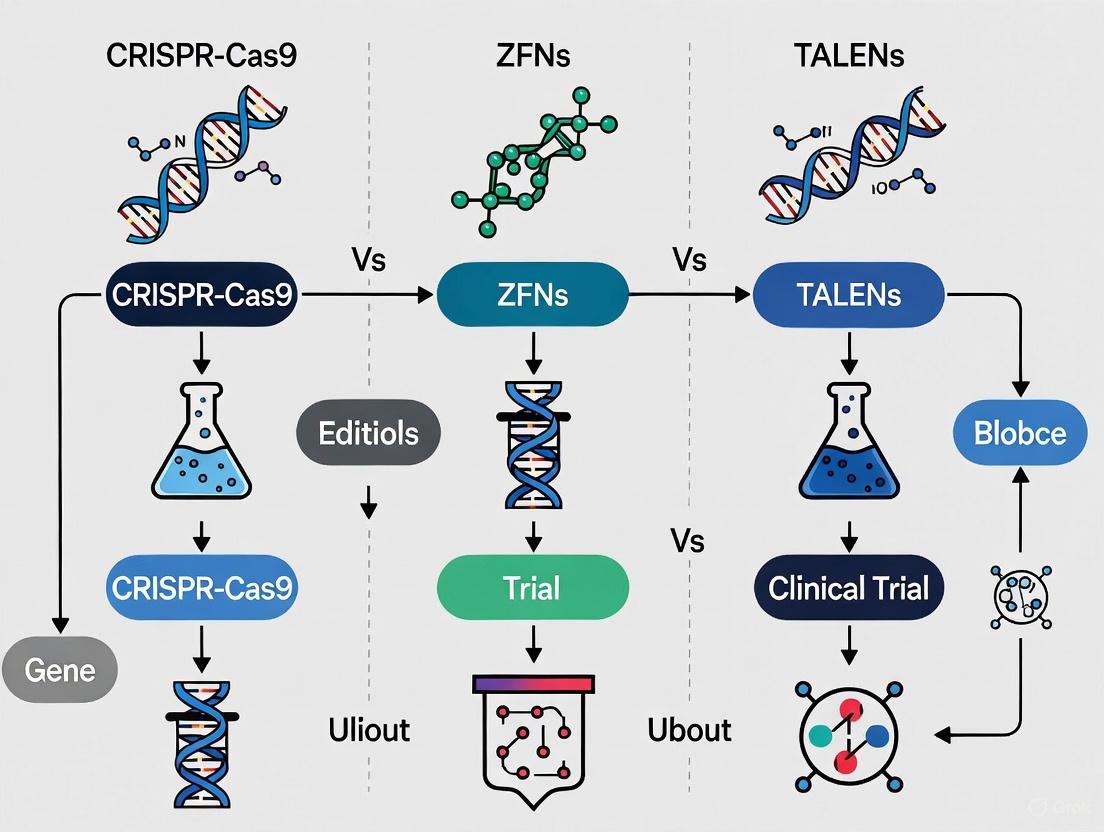
This article provides a systematic comparison of three major genome-editing technologies—CRISPR-Cas9, ZFNs, and TALENs—focusing on their efficiency, specificity, and clinical trial performance.
CRISPR-Cas9 vs. ZFNs and TALENs: A Comprehensive Analysis of Efficiency and Clinical Trial Applications
Abstract
This article provides a systematic comparison of three major genome-editing technologies—CRISPR-Cas9, ZFNs, and TALENs—focusing on their efficiency, specificity, and clinical trial performance. Drawing from recent 2025 clinical updates and parallel nuclease comparison studies, we examine foundational mechanisms, therapeutic applications across diverse diseases, and strategies for optimizing specificity and delivery. The analysis synthesizes quantitative efficiency data and off-target profiles to guide researchers and drug development professionals in platform selection for preclinical and clinical applications, while exploring future directions including base editing, prime editing, and delivery innovations.
The Evolution of Programmable Nucleases: From ZFNs to CRISPR-Cas Systems
Historical Development and Key Milestones in Gene Editing Technologies
The advent of gene-editing technologies has revolutionized molecular biology, providing researchers with the unprecedented ability to make precise modifications to genomic DNA across a wide range of organisms [1]. These technologies enable the addition, removal, or alteration of specific DNA sequences, facilitating applications from basic research to clinical therapies [1]. The field has evolved through three major generations of programmable nucleases: Zinc Finger Nucleases (ZFNs), Transcription Activator-Like Effector Nucleases (TALENs), and the CRISPR-Cas system, with the latter emerging as the most extensively employed platform due to its simplicity, cost-effectiveness, and efficiency [1] [2]. This review traces the historical development of these technologies, compares their functional mechanisms and performance metrics, and examines their relative efficiencies in clinical research contexts, with a particular focus on the ongoing comparison between CRISPR-Cas9 and earlier platforms (ZFNs and TALENs).
Historical Timeline of Gene Editing Technologies
Early Foundations and Meganucleases
The journey toward precision genome editing began with meganucleases, also known as homing endonucleases, which were among the first classes of programmable nucleases used for this purpose [1]. These naturally occurring enzymes recognize large DNA target sequences (14-40 base pairs) and induce site-specific double-strand breaks (DSBs) [1]. While meganucleases exhibited high specificity and relatively small size that facilitated delivery, their adoption was limited by the considerable difficulty in reprogramming their target specificity [1]. Recent engineering advances by companies like iECURE and Precision BioSciences have overcome some limitations, leading to new clinical applications, but the platform's complexity paved the way for more versatile systems [1].
Zinc Finger Nucleases (ZFNs): The First Generation
The first major breakthrough in programmable nucleases came with the development of ZFNs. The foundation was laid in 1985 with the identification of the first zinc-finger protein, transcription factor IIIA (TFIIIA), in Xenopus oocytes [1]. ZFNs are chimeric proteins comprising a zinc finger DNA-binding domain adapted from zinc finger-containing transcription factors, fused to the endonuclease domain of the bacterial FokI restriction enzyme [3]. Each zinc finger domain recognizes a 3-4 bp DNA sequence, and tandem arrays of these domains (typically 3-6 fingers) can be engineered to bind extended nucleotide sequences (9-18 bp) [1] [3]. ZFNs function as pairs, with each monomer binding to opposite DNA strands separated by a 5-6 bp spacer sequence; dimerization of the FokI nuclease domains across this spacer activates DNA cleavage [1]. While ZFNs demonstrated that targeted genome editing was feasible, they presented significant challenges: engineering zinc finger arrays with high affinity for desired sequences proved difficult, target site selection was limited, and concerns about off-target effects persisted [3].
TALENs: The Second Generation
The discovery of Transcription Activator-Like Effectors (TALEs) from the plant pathogen Xanthomonas led to the development of TALENs, which offered substantial improvements over ZFNs [1] [3]. Similar to ZFNs, TALENs consist of a DNA-binding domain fused to a FokI nuclease domain [1]. However, their DNA recognition mechanism is notably simpler: each TALE repeat comprising 33-35 amino acids recognizes a single nucleotide through two specific amino acid residues termed Repeat Variable Di-residues (RVDs) [1]. The RVD code is straightforward: NG recognizes 'T', NI recognizes 'A', HD recognizes 'C', and NN, HN, or NK recognize 'G' [1]. This one-to-one correspondence made TALENs significantly easier to design and engineer compared to ZFNs, with target site selection having fewer constraints [3]. Despite these advantages, TALENs remained challenging to scale due to labor-intensive assembly processes and delivery difficulties stemming from their large size [1] [4].
CRISPR-Cas: The Third Generation Revolution
The most transformative development in gene editing came with the adaptation of the CRISPR-Cas system, which originated as a bacterial immune defense mechanism [5] [2]. The history of CRISPR began in 1987 when unusual repetitive sequences were first observed in the E. coli genome [5] [2]. Francisco Mojica's pioneering work in the 1990s and early 2000s revealed that these Clustered Regularly Interspaced Short Palindromic Repeats (CRISPR), together with CRISPR-associated (cas) genes, functioned as an adaptive immune system in prokaryotes, providing protection against viruses and other mobile genetic elements [5]. A crucial breakthrough came in 2012 when Emmanuelle Charpentier and Jennifer Doudna, who would later receive the Nobel Prize in Chemistry in 2020, elucidated the molecular mechanism of the type II CRISPR-Cas9 system and demonstrated its programmability for genome editing [5] [2]. Unlike ZFNs and TALENs that rely on protein-DNA interactions for targeting, CRISPR-Cas9 uses a guide RNA (gRNA) molecule to direct the Cas9 nuclease to specific DNA sequences through complementary base pairing [1] [2]. This RNA-programmed approach made CRISPR-Cas9 dramatically simpler, more versatile, and more accessible than previous technologies [4].
Comparative Mechanisms of Action
Fundamental DNA Recognition and Cleavage
All three major gene-editing platforms (ZFNs, TALENs, and CRISPR-Cas9) operate through a common fundamental principle: creating targeted double-strand breaks (DSBs) in DNA, which subsequently engage the cell's endogenous repair mechanisms [1]. However, they differ significantly in their molecular architectures and targeting mechanisms.
ZFNs utilize a protein-based recognition system where engineered zinc finger arrays bind to specific DNA sequences, with each finger recognizing approximately 3 bp [1] [3]. The FokI nuclease domain must dimerize to become active, necessitating the design of ZFN pairs that bind opposite DNA strands with proper spacing and orientation [1].
TALENs similarly employ protein-based DNA recognition through TALE repeat arrays, but with a more straightforward code where each repeat recognizes a single nucleotide via its RVDs [1] [3]. Like ZFNs, TALENs require dimerization of FokI nuclease domains for DNA cleavage [1].
CRISPR-Cas9 represents a paradigm shift from protein-based to RNA-based recognition [1] [2]. The system combines the Cas9 nuclease with a synthetic guide RNA (gRNA) containing a ~20 nucleotide spacer sequence complementary to the target DNA [2]. Cas9 undergoes conformational changes upon gRNA binding and target recognition, activating its two nuclease domains (RuvC and HNH) that cut opposite DNA strands [2]. A critical requirement for Cas9 activity is the presence of a Protospacer Adjacent Motif (PAM), a short DNA sequence adjacent to the target site (5'-NGG-3' for the most commonly used Streptococcus pyogenes Cas9) [2].
DNA Repair Pathways and Editing Outcomes
After DSB formation, cellular repair pathways determine the editing outcome. The primary pathways are:
- Non-Homologous End Joining (NHEJ): An error-prone repair mechanism that often results in small insertions or deletions (indels) at the cleavage site, potentially disrupting gene function and enabling gene knockouts [1] [3].
- Homology-Directed Repair (HDR): A precise repair pathway that uses a homologous DNA template (either endogenous or exogenously supplied) to repair the break, allowing for specific nucleotide changes or insertion of new genetic material [1] [3].
Performance Comparison and Experimental Data
Design and Practical Implementation
The practical implementation of gene-editing technologies varies significantly in terms of design complexity, time requirements, and cost structure, as summarized in Table 1.
Table 1: Comparison of Design and Practical Implementation Parameters
| Parameter | ZFNs | TALENs | CRISPR-Cas9 |
|---|---|---|---|
| DNA Recognition Mechanism | Protein-based (zinc finger domains) | Protein-based (TALE repeats) | RNA-based (guide RNA) |
| Nuclease Component | FokI | FokI | Cas9 |
| Design Complexity | High (context-dependent effects) | Moderate (modular design) | Low (simple base pairing) |
| Development Timeline | ~1 month or longer [1] | ~1 month [1] | Within a week [1] |
| Relative Cost | High [1] [4] | Medium [1] | Low [1] [4] |
| Targeting Constraints | Limited targeting density (every 200 bp in random sequence) [3] | Fewer constraints, must begin with "T" [1] | Requires PAM sequence (NGG for SpCas9) [2] |
Efficiency and Specificity Data from Comparative Studies
Direct comparative studies provide valuable insights into the relative performance of ZFNs, TALENs, and CRISPR-Cas9. A landmark study using GUIDE-seq (Genome-wide Unbiased Identification of DSBs Enabled by Sequencing) to evaluate off-target activity in HPV-targeted gene therapy revealed substantial differences in specificity [6].
Table 2: Off-Target Activity Comparison by GUIDE-seq Analysis [6]
| Target Region | CRISPR-Cas9 Off-Targets | TALENs Off-Targets | ZFN Off-Targets |
|---|---|---|---|
| URR | 0 | 1 | 287 |
| E6 | 0 | 7 | Not reported |
| E7 | 4 | 36 | Not reported |
The GUIDE-seq analysis demonstrated that SpCas9 was more specific than both ZFNs and TALENs in these target regions, with ZFNs showing particularly high off-target activity in the URR region [6]. The study also found that ZFN specificity could be inversely correlated with the count of middle "G" in zinc finger proteins, and that TALEN designs with improved efficiency (using αN or NN modules) inevitably increased off-target effects [6].
Beyond specificity, CRISPR-Cas9 generally shows higher editing efficiency and greater versatility for multiplexing (simultaneously editing multiple genes) compared to traditional methods [4]. However, it's important to note that TALENs may outperform CRISPR-Cas9 in certain challenging genomic contexts, such as regions with high GC content or repetitive sequences [7].
Experimental Protocols for Efficiency Assessment
GUIDE-seq Methodology for Off-Target Detection
The GUIDE-seq method represents a comprehensive approach for identifying off-target effects of gene-editing nucleases. The detailed protocol involves:
Oligonucleotide Transfection: Co-deliver nuclease components (ZFN mRNA, TALEN mRNA, or CRISPR Cas9/sgRNA ribonucleoprotein complexes) with a blunt-ended, double-stranded oligodeoxynucleotide (dsODN) tag into susceptible cells using appropriate transfection methods [6].
Genomic DNA Extraction and Processing: Harvest cells 2-3 days post-transfection and extract genomic DNA. Fragment DNA using sonication or enzymatic methods and end-repair using T4 DNA polymerase, Klenow fragment, and T4 polynucleotide kinase [6].
Adapter Ligation and Amplification: Ligate sequencing adapters to the repaired DNA fragments. Perform PCR amplification using primers specific to the adapter sequences and the incorporated dsODN tag to enrich for tagged fragments [6].
High-Throughput Sequencing and Bioinformatics: Sequence the amplified libraries using high-throughput sequencing platforms. Process sequencing reads through a specialized bioinformatics pipeline to map dsODN integration sites and identify potential off-target sites across the genome [6].
Validation: Confirm identified off-target sites using independent methods such as targeted amplicon sequencing [6].
On-Target Efficiency Assessment
For comprehensive evaluation of editing technologies, on-target efficiency should be assessed through:
Surveyor or T7 Endonuclease I Assays: Detect insertion-deletion mutations (indels) at the target site through mismatch cleavage of heteroduplex DNA.
Next-Generation Sequencing: Perform targeted amplicon sequencing of the edited locus to precisely quantify editing efficiency and characterize the spectrum of induced mutations.
Flow Cytometry or Fluorescence-Based Reporter Systems: For studies involving gene correction or insertion, utilize fluorescent reporter systems to quantify HDR efficiency.
Functional Assays: Implement phenotypic or functional assays relevant to the specific target gene to confirm biological consequences of editing.
Research Reagent Solutions Toolkit
Table 3: Essential Research Reagents for Gene Editing Studies
| Reagent Category | Specific Examples | Function and Application |
|---|---|---|
| Nuclease Components | ZFN pairs, TALEN pairs, Cas9 protein, Cas9 mRNA | Core editing machinery for inducing targeted DNA breaks |
| Targeting Modules | Zinc finger arrays, TALE repeat arrays, sgRNA expression constructs | Determine target specificity of editing complexes |
| Delivery Systems | Electroporation systems, Lipid nanoparticles, AAV vectors, Lentiviral vectors | Facilitate intracellular delivery of editing components |
| Detection Assays | T7E1 surveyor assay, GUIDE-seq reagents, NGS libraries | Assess on-target efficiency and genome-wide off-target effects |
| Repair Templates | ssODNs, dsDNA donor vectors with homology arms | Enable precise editing through HDR pathway |
| Validation Tools | Antibodies for Western blot, PCR primers, Sanger sequencing | Confirm editing outcomes and protein expression |
| Cell Culture Resources | Appropriate cell lines, Culture media, Selection antibiotics | Maintain cellular systems for editing experiments |
The historical development of gene editing technologies reveals a clear trajectory toward increasing simplicity, accessibility, and versatility. While ZFNs and TALENs established the feasibility of targeted genome editing and continue to have value for specific applications where their particular characteristics are advantageous, CRISPR-Cas9 has emerged as the predominant platform due to its straightforward design, cost-effectiveness, and high efficiency [1] [4]. Direct comparative studies indicate that CRISPR-Cas9 generally offers favorable efficiency and specificity profiles compared to earlier technologies, though all platforms require careful optimization and validation [6].
The future of gene editing continues to evolve with the development of more advanced CRISPR-based technologies, including base editors that enable precise single-nucleotide changes without creating double-strand breaks, and prime editors that can implement all twelve possible base-to-base conversions as well as small insertions and deletions [8]. These innovations, along with ongoing improvements in delivery systems and specificity, promise to further expand the therapeutic applications of gene editing in clinical research [2] [8] [9]. As the field advances, the choice between platforms will continue to depend on the specific requirements of each application, with CRISPR-Cas9 currently representing the most versatile and accessible option for most research and therapeutic contexts.
The precision of gene-editing technologies hinges on the fundamental molecular mechanisms by which proteins and RNA molecules recognize and bind to specific DNA sequences. Programmable nucleases, including Zinc-Finger Nucleases (ZFNs), Transcription Activator-Like Effector Nucleases (TALENs), and the CRISPR-Cas9 system, represent three generations of these technologies, each employing distinct recognition systems [2] [10]. ZFNs and TALENs rely on protein-DNA recognition, where custom-designed protein domains bind to specific DNA sequences [11]. In contrast, the CRISPR-Cas9 system utilizes an RNA-DNA recognition mechanism, where a guide RNA (gRNA) molecule directs the Cas nuclease to its target via Watson-Crick base pairing [12] [10]. Understanding these core mechanisms is essential for evaluating their efficiency, specificity, and applicability in clinical research. This guide provides a structured comparison of these systems, supported by experimental data and detailed methodologies, to inform researchers and drug development professionals.
Comparative Analysis of Recognition Mechanisms
Protein-DNA Recognition Systems
Zinc-Finger Nucleases (ZFNs) are fusion proteins comprising a DNA-binding domain and a FokI endonuclease domain [11]. The DNA-binding domain is composed of multiple C2H2 zinc finger modules, each recognizing a 3-base pair (bp) DNA sequence [10]. By assembling an array of these modules (typically 3 to 6), ZFNs can target a unique 9 to 18 bp sequence [11]. A significant limitation is the context-dependent affinity between fingers, which can make the design of effective ZFNs complex and time-consuming [11]. A pair of ZFNs must bind opposite strands of the DNA, flanking the cleavage site, to allow the FokI domains to dimerize and create a double-strand break (DSB) [11].
Transcription Activator-Like Effector Nucleases (TALENs) also use the FokI nuclease domain but employ a different DNA-binding domain derived from Transcription Activator-Like Effectors (TALEs) from Xanthomonas bacteria [10]. The TALE domain consists of tandem 33-35 amino acid repeats, each repeat binding to a single DNA base pair [11]. Specificity is determined by two hypervariable amino acids at positions 12 and 13, known as the Repeat Variable Diresidue (RVD) [11]. The RVD code is simple and robust: for example, Asn-Ile (NI) recognizes adenine (A), His-Asp (HD) recognizes cytosine (C), Asn-Gly (NG) recognizes thymine (T), and Asn-Asn (NN) recognizes guanine (G) or adenine (A) [11]. This one-to-one correspondence makes TALENs easier to design and more predictable than ZFNs, though the highly repetitive nature of the TALE array presents cloning challenges [10].
RNA-DNA Recognition System (CRISPR-Cas9)
The CRISPR-Cas9 system is an adaptive immune system in bacteria and archaea that has been repurposed for genome editing [12] [2]. Its DNA-targeting complex consists of two key components: the Cas9 nuclease and a guide RNA (gRNA) [10]. The gRNA is a chimeric single guide RNA (sgRNA) that combines the functions of the endogenous CRISPR RNA (crRNA) and trans-activating crRNA (tracrRNA) [2]. The gRNA contains a ~20 nucleotide spacer sequence that is complementary to the target DNA site, facilitating recognition through RNA-DNA hybridization [12] [10]. This mechanism is fundamentally different from the protein-DNA recognition used by ZFNs and TALENs.
For the Cas9 nuclease to bind and cleave its target, the DNA sequence must be adjacent to a short Protospacer Adjacent Motif (PAM) [12] [10]. The canonical PAM for the most commonly used Streptococcus pyogenes Cas9 (SpCas9) is 5'-NGG-3', where 'N' is any nucleotide [2]. The PAM sequence is recognized directly by the Cas9 protein, not the gRNA. Upon binding, the Cas9 enzyme undergoes a conformational change, and its two nuclease domains (HNH and RuvC) create a double-strand break (DSB) three base pairs upstream of the PAM site [10].
Table 1: Fundamental Comparison of Recognition Mechanisms
| Feature | ZFN | TALEN | CRISPR-Cas9 |
|---|---|---|---|
| Recognition System | Protein-DNA | Protein-DNA | RNA-DNA |
| Recognition Molecule | Zinc Finger Protein (ZFP) | TALE Repeat Array | Guide RNA (gRNA) |
| Specificity Principle | Each zinc finger recognizes 3 bp | Each TALE repeat recognizes 1 bp | gRNA spacer binds via complementary base pairing |
| Target Sequence Length | 9-18 bp (for a pair) | 14-20 bp (for a pair) | ~20 nt (gRNA spacer) + PAM |
| Nuclease Domain | FokI | FokI | Cas9 (HNH & RuvC domains) |
| Key Constraint | Context-dependent finger affinity; complex design | Repetitive sequence cloning challenges | Requires a PAM sequence (e.g., NGG for SpCas9) |
The following diagram illustrates the fundamental differences in how these systems recognize and bind to DNA.
Quantitative Performance and Experimental Data
Efficiency and Specificity Data
Direct comparative studies provide valuable insights into the real-world performance of these technologies. A 2021 study using the GUIDE-seq method to assess off-target activity in targeting the Human Papillomavirus 16 (HPV16) genome offered a parallel comparison of ZFNs, TALENs, and SpCas9 [13].
Table 2: Experimental Performance Comparison in HPV16 Gene Therapy Study [13]
| Nuclease | Target Gene | On-Target Efficiency | Off-Target Count (GUIDE-seq) |
|---|---|---|---|
| ZFN | URR | High (by T7E1 assay) | 287 - 1,856 |
| TALEN | URR | High (by T7E1 assay) | 1 |
| TALEN | E6 | High (by T7E1 assay) | 7 |
| TALEN | E7 | High (by T7E1 assay) | 36 |
| SpCas9 | URR | High (by T7E1 assay) | 0 |
| SpCas9 | E6 | High (by T7E1 assay) | 0 |
| SpCas9 | E7 | High (by T7E1 assay) | 4 |
The data shows that SpCas9 demonstrated superior specificity, with zero off-targets detected in the URR and E6 genes and only 4 in the E7 gene, outperforming ZFNs and TALENs in this specific context [13]. ZFNs, in particular, showed a high number of off-target events (287 to 1,856), which was correlated with the count of middle "G" in the zinc finger proteins [13]. The study concluded that SpCas9 was both more efficient and specific than the ZFNs and TALENs tested for HPV gene therapy [13].
Key Experimental Protocols
To contextualize the data above, below are the core methodologies used in such comparative studies.
1. GUIDE-seq (Genome-wide Unbiased Identification of DSBs Enabled by Sequencing) This is a genome-wide method for profiling off-target nuclease activity [13].
- Procedure: Cells are transfected with the nuclease (e.g., ZFN, TALEN, or CRISPR-Cas9) along with a short, double-stranded oligodeoxynucleotide (dsODN) tag. When a double-strand break (DSB) occurs, this dsODN tag is integrated into the break site via the cell's repair machinery.
- Genomic DNA Extraction & Library Construction: Genomic DNA is harvested and sheared. Adaptor-ligated libraries are prepared for next-generation sequencing.
- Sequencing & Bioinformatics: High-throughput sequencing is performed. Specialized bioinformatics pipelines (e.g., those adapted for ZFNs and TALENs) are used to identify genomic locations where the dsODN tag has been integrated, which correspond to both on-target and off-target nuclease cleavage sites [13].
2. T7 Endonuclease I (T7E1) Cleavage Assay This is a common method for initial validation of nuclease activity and on-target efficiency [13].
- Procedure: The genomic region surrounding the target site is amplified by PCR from nuclease-treated cells.
- Heteroduplex Formation: The PCR product is denatured and reannealed. If non-homologous indels are present due to NHEJ repair, mismatched heteroduplexes will form.
- Digestion and Analysis: The T7E1 enzyme, which cleaves at mismatched sites, is used to digest the heteroduplexed PCR products. The cleavage fragments are visualized by gel electrophoresis, and the band intensity is used to estimate the mutation frequency.
The experimental workflow for evaluating these nucleases, from design to off-target assessment, is summarized below.
Clinical Trial Context and Applications
The transition of gene-editing technologies from bench to bedside is evidenced by their growing presence in clinical trials. As of a 2023 review, there were 13, 6, and 42 registered clinical trials related to ZFNs, TALENs, and CRISPRs, respectively, on ClinicalTrials.gov [13]. This distribution highlights the rapid adoption of CRISPR-Cas9 due to its ease of design and high efficiency.
- ZFN Trials: Early successes include phase I trials for HIV treatment, where ZFNs were used to disrupt the CCR5 gene in CD4+ T cells to confer resistance to the virus [13] [11].
- TALEN Trials: TALENs have been used to generate universal chimeric antigen receptor (CAR) T-cells. A prominent example is UCART19, which induced remission in a patient with B-cell acute lymphoblastic leukemia (B-ALL) [13].
- CRISPR Trials: CRISPR-Cas9 has the broadest clinical application. A landmark achievement was the FDA approval of Casgevy (exagamglogene autotemcel) for sickle cell disease (SCD) and transfusion-dependent beta-thalassaemia (TDT) [10]. This therapy involves ex vivo editing of the BCL11A gene in autologous hematopoietic stem cells using CRISPR-Cas9 [10]. Ongoing trials are exploring CRISPR for cancer, HIV, and other genetic disorders [12] [10].
The primary clinical advantage of CRISPR-Cas9 lies in its rapid programmability. Designing a new gRNA is significantly faster and less expensive than engineering novel ZFN or TALEN proteins, accelerating both basic research and therapeutic development [2] [11].
The Scientist's Toolkit: Key Research Reagents
Successful gene-editing experiments require a suite of specialized reagents and tools. The following table details essential materials and their functions.
Table 3: Essential Research Reagents for Gene Editing Studies
| Reagent / Tool | Function in Research |
|---|---|
| Programmable Nuclease | The core enzyme that performs the genetic modification (e.g., ZFN, TALEN, Cas9 protein or mRNA). |
| Guide RNA (gRNA) or DNA-binding Domain Plasmid | Encodes the targeting component (gRNA for CRISPR; ZF/TALE arrays for ZFNs/TALENs). |
| Delivery Vector (Viral/Non-Viral) | Facilitates the introduction of editing components into cells (e.g., AAV, Lentivirus, Lipid Nanoparticles (LNPs), Electroporation) [2] [14]. |
| dsODN Tag (for GUIDE-seq) | Short double-stranded oligodeoxynucleotide that integrates into DSB sites for unbiased off-target detection [13]. |
| T7 Endonuclease I (T7E1) | Enzyme used in the mismatch cleavage assay to quickly assess nuclease cutting efficiency [13]. |
| Next-Generation Sequencing (NGS) Library Prep Kit | For preparing sequencing libraries from genomic DNA to analyze editing outcomes (on-target and off-target). |
| Cell Culture Reagents | Media, sera, and supplements for maintaining the cellular models used in the experiments. |
| Bioinformatics Software Pipeline | Critical for analyzing GUIDE-seq and NGS data to map and quantify on-target and off-target events [13]. |
The molecular recognition mechanisms underpinning ZFNs, TALENs, and CRISPR-Cas9 fundamentally shape their application in research and clinical trials. Protein-DNA systems (ZFNs/TALENs) demonstrated the feasibility of targeted genome editing but faced challenges in design and scalability. The RNA-DNA system (CRISPR-Cas9), with its simple programmability and high efficiency, has rapidly become the dominant platform, reflected in its growing number of clinical trials and recent therapeutic approvals. Quantitative data from direct comparisons indicates that CRISPR-Cas9 can achieve superior specificity, though off-target effects remain a critical consideration for all platforms. The choice of system depends on the specific application, but the trend in clinical research strongly favors CRISPR-Cas9 and its derivatives due to their versatility and the continuous innovation in improving their precision and safety.
The advent of programmable genome editing technologies has redefined the boundaries of biological research and therapeutic development. Zinc-finger nucleases (ZFNs), transcription activator-like effector nucleases (TALENs), and the CRISPR-Cas system represent three generations of engineered nucleases that enable precise genetic modifications by inducing targeted DNA double-strand breaks (DSBs) [15] [11]. These tools have accelerated the development of novel disease models and targeted gene therapies, with an increasing number of candidates entering clinical trials [13] [10]. A critical factor influencing the efficacy, specificity, and clinical applicability of these technologies is the fundamental design principle underpinning their creation: modular assembly. This article provides a systematic comparison of the modular design principles of ZFNs, TALENs, and CRISPR guide RNAs, and examines how these principles impact their performance in preclinical and clinical research.
Comparative Design Principles of Engineered Nucleases
The core functionality of ZFNs, TALENs, and CRISPR-Cas systems relies on their ability to be programmed to recognize and cleave specific DNA sequences. However, the molecular architecture and the process for assembling their DNA-recognition modules differ significantly.
Zinc-Finger Nucleases (ZFNs): Triplet-Based Modular Assembly
ZFNs are fusion proteins comprising an array of engineered Cys2-His2 zinc-finger proteins attached to the cleavage domain of the FokI restriction enzyme [15] [11]. Each zinc-finger domain is approximately 30 amino acids arranged in a conserved ββα configuration and primarily recognizes a 3-base pair (bp) DNA triplet [15] [11].
- Design Principle: The modular assembly process involves linking multiple individual zinc-finger domains in tandem to recognize an extended nucleotide sequence (typically 9-18 bp) [15] [11]. The FokI domain requires dimerization to become active; therefore, a pair of ZFNs must be designed to bind opposite strands of DNA, with their cleavage domains facing each other. The spacer between the two binding sites is critical for efficient cleavage [11].
- Assembly Challenge: A significant technical hurdle is that the assembly of zinc-finger domains with high affinity is not always straightforward, as DNA recognition by individual fingers can be influenced by context-dependent interactions with their neighbors [15] [11]. This complexity has made it difficult for non-specialists to engineer ZFNs, though open-source libraries and commercial sources (e.g., CompoZr) have been developed to provide pre-validated components [15].
The following diagram illustrates the modular structure and assembly of a ZFN pair:
Transcription Activator-Like Effector Nucleases (TALENs): One-to-One Modular Assembly
TALENs share a similar chimeric structure with ZFNs, utilizing the FokI nuclease domain, but employ a different DNA-binding domain derived from Transcription Activator-Like Effectors (TALEs) from Xanthomonas bacteria [15] [11].
- Design Principle: The DNA-binding domain of TALENs consists of a series of 33-35 amino acid repeats. The key discovery was that each repeat recognizes a single base pair, and the specificity is determined by two hypervariable amino acids at positions 12 and 13, known as the Repeat-Variable Diresidues (RVDs) [15] [11]. Common RVDs include:
- Assembly Challenge: While the one-to-one code simplifies design, the assembly of TALE repeat arrays is technically challenging due to the high sequence similarity between repeats, which can lead to recombination during cloning. Methods like "Golden Gate" assembly and high-throughput solid-phase assembly have been developed to overcome this, but the process can remain labor-intensive and time-consuming [15].
The logical workflow for designing and assembling TALENs is shown below:
CRISPR-Cas Systems: RNA-Guided Programmability
The CRISPR-Cas system fundamentally differs from ZFNs and TALENs by utilizing a guide RNA (gRNA) for DNA recognition, rather than engineered proteins [11] [10].
- Design Principle: The system consists of two core components: the Cas9 nuclease and a synthetic single-guide RNA (sgRNA). The sgRNA is a chimeric RNA molecule that combines the functions of the natural crRNA (which confers sequence specificity through ~20 nucleotides of complementarity to the target DNA) and tracrRNA (which is essential for Cas9 maturation and binding) [10]. The only strict genomic requirement for Cas9 activity is the presence of a short Protospacer Adjacent Motif (PAM), which is 5'-NGG-3' for the commonly used Streptococcus pyogenes Cas9 (SpCas9) [10].
- Assembly Workflow: Designing a new CRISPR target is exceptionally rapid. It primarily involves synthesizing a ~20 nt gRNA sequence that is complementary to the target DNA, immediately adjacent to a PAM site. This simple process eliminates the need for complex protein engineering, which is a major bottleneck for ZFNs and TALENs [4].
The simplicity of the CRISPR-Cas9 design is captured in the following workflow:
Experimental Data: Efficiency and Specificity
The differences in design principles directly translate into variations in editing efficiency and specificity, which are critical for clinical applications. A direct comparison of these technologies in preclinical models provides compelling data.
Table 1: Comparison of Gene Knock-in Efficiencies in Bovine and Goat Fetal Fibroblasts
| Editing System | Target Gene | Knock-in Cargo | Knock-in Efficiency | P-value vs. CRISPR/Cas9 |
|---|---|---|---|---|
| ZFNs | Bovine MSTN | eGFP | 13.68% | P<0.01 [16] |
| ZFNs | Bovine MSTN | hFat-1 | 0% | P<0.01 [16] |
| CRISPR/Cas9 | Bovine MSTN | eGFP | 77.02% | - [16] |
| CRISPR/Cas9 | Bovine MSTN | hFat-1 | 79.01% | - [16] |
| TALENs | Goat CSN2 | eGFP | 32.35% | P<0.01 [16] |
| TALENs | Goat CSN2 | hFat-1 | 26.47% | P<0.01 [16] |
| CRISPR/Cas9 | Goat CSN2 | eGFP | 70.37% | - [16] |
| CRISPR/Cas9 | Goat CSN2 | hFat-1 | 74.29% | - [16] |
Table 2: Off-Target Profile Comparison in HPV16 Gene Therapy Context (GUIDE-seq Data)
| Editing System | Target Gene | Number of Off-Target Sites Identified |
|---|---|---|
| SpCas9 | URR | 0 [13] |
| TALEN | URR | 1 [13] |
| ZFN | URR | 287 [13] |
| SpCas9 | E6 | 0 [13] |
| TALEN | E6 | 7 [13] |
| SpCas9 | E7 | 4 [13] |
| TALEN | E7 | 36 [13] |
The data from these studies consistently demonstrates that CRISPR/Cas9 achieves significantly higher knock-in efficiencies than ZFNs and TALENs in mammalian cell lines [16]. Furthermore, in a direct comparison of off-target activity using a sensitive genome-wide method (GUIDE-seq), SpCas9 exhibited fewer off-target sites than TALENs and ZFNs when targeting the same HPV16 viral genes, suggesting it can be a more specific tool in certain therapeutic contexts [13].
Detailed Experimental Protocols
To ensure reproducibility and provide a clear technical reference, this section outlines the key methodologies used to generate the comparative data.
Protocol for Comparing Knock-in Efficiencies
This protocol is adapted from the study comparing ZFN, TALEN, and CRISPR/Cas9 knock-in efficiency in bovine and dairy goat fetal fibroblasts [16].
Nuclease and Donor Construction:
- Design and engineer ZFN, TALEN, or CRISPR/Cas9 plasmids to target a specific locus (e.g., bovine MSTN or goat CSN2).
- Construct a donor plasmid containing the cargo gene (e.g., eGFP or hFat-1) flanked by 5' and 3' homology arms corresponding to the nuclease target site.
Cell Transfection:
- Co-transfect the nuclease plasmids (ZFNs, TALENs, or CRISPR/Cas9) along with the donor plasmid into the target cells (e.g., bovine fetal fibroblasts) using electroporation.
Selection and Cloning:
- Apply antibiotic selection (e.g., G418) to eliminate non-transfected cells.
- Isolate single-cell clones using methods such as mouth pipetting, flow cytometry, or a cell shover.
Genotyping and Analysis:
- Screen for successful knock-in events by performing PCR across the homology arms of the donor plasmid.
- Confirm the PCR products by sequencing.
- Calculate the knock-in efficiency as the percentage of positive clones among the total number of selected clones.
Protocol for GUIDE-seq Off-Target Detection
This protocol is based on the study that applied GUIDE-seq to ZFNs, TALENs, and SpCas9 for an unbiased comparison of off-target effects [13].
dsODN Tag Transfection:
- Co-deliver the engineered nuclease (ZFN, TALEN, or SpCas9 with sgRNA) and a blunt, double-stranded oligodeoxynucleotide (dsODN) tag into the target cells (e.g., HEK293T cells harboring HPV16 genes).
Genomic DNA Extraction and Library Preparation:
- Harvest cells 72-96 hours post-transfection and extract genomic DNA.
- Fragment the DNA and construct sequencing libraries. Use primers specific to the dsODN tag to enrich for fragments that have been integrated at nuclease-induced DSB sites.
Sequencing and Bioinformatics Analysis:
- Perform high-throughput sequencing of the enriched libraries.
- Use specialized bioinformatics algorithms (as developed in the cited study) to map the sequencing reads to the reference genome and identify off-target sites where the dsODN has been integrated.
Validation:
- Validate potential off-target sites identified by GUIDE-seq using an independent method, such as targeted deep sequencing.
The Scientist's Toolkit: Essential Research Reagents
Successful implementation of these genome-editing technologies requires a suite of specific reagents and tools.
Table 3: Key Research Reagent Solutions for Modular Genome Editing
| Reagent / Solution | Function | Specific Examples & Notes |
|---|---|---|
| Pre-validated ZFN Modules | Provides functional, context-dependent zinc-finger arrays for target recognition. | Available via open-source platforms (e.g., Oligomerized Pool Engineering - OPEN) or commercially (e.g., Sigma-Aldrich CompoZr) [15] [11]. |
| TALE Repeat Kit (Golden Gate Assembly) | Enables efficient and ordered assembly of TALE repeat arrays using a standardized cloning strategy. | Kits often include pre-made RVD modules for each nucleotide (NI, HD, NN, NG) to streamline construction [15]. |
| Cas9 Nuclease (WT & HiFi) | The effector enzyme that creates DSBs. High-fidelity (HiFi) variants reduce off-target effects. | Wild-type SpCas9 is commonly used. Cas9-HF1 and eSpCas9 are engineered mutants with improved specificity [4] [10]. |
| sgRNA Synthesis Kit | For in vitro transcription or chemical synthesis of guide RNAs. | Commercial kits allow for rapid production of sgRNAs from a DNA template. Custom sgRNAs can also be ordered from synthesis companies [4]. |
| Delivery Vectors | Plasmid, viral, or mRNA-based systems to introduce editing components into cells. | Plasmids (common for all); Lentivirus/AAV (for CRISPR); mRNA/protein (can reduce off-targets and immune responses) [11] [4]. |
| dsODN Tag (for GUIDE-seq) | A short, double-stranded oligonucleotide that integrates into DSBs for genome-wide off-target detection. | This is the key reagent for the GUIDE-seq method, enabling unbiased identification of off-target sites for all three nuclease types [13]. |
| T7 Endonuclease I / Mismatch Detection Assay | A quick and accessible method to detect nuclease-induced indels at the target site. | Cheaper and faster than sequencing, but less comprehensive than genome-wide methods like GUIDE-seq [13]. |
The modularity of ZFNs, TALENs, and CRISPR guide RNAs is the foundational principle that determines their programmability, efficiency, and ultimate utility in research and therapy. While ZFNs and TALENs demonstrated the feasibility of targeted genome editing, their reliance on complex protein engineering presents a significant barrier to widespread and rapid adoption. In contrast, the RNA-guided simplicity of the CRISPR-Cas system, where targeting a new sequence requires only the synthesis of a short gRNA, has democratized genome editing [4].
Experimental data consistently shows that this design advantage translates into superior performance. CRISPR-Cas9 achieves significantly higher gene knock-in efficiencies and, in several direct comparisons, has demonstrated fewer off-target effects than ZFNs and TALENs targeting the same genomic loci [13] [16]. These factors—combined with lower cost and greater scalability—have positioned CRISPR-Cas9 as the leading platform for both basic research and clinical applications, as evidenced by the first FDA-approved CRISPR-based therapy, Casgevy [10]. As the field progresses, innovations like base editing and prime editing, which build upon the CRISPR framework, are further expanding the toolkit for precise genetic manipulation, ensuring that the principles of modular design will continue to drive the future of genetic medicine.
The clinical trial landscape for genome editing technologies has undergone a remarkable transformation over the past decade, moving from protein-engineered platforms to RNA-programmable systems. Zinc Finger Nucleases (ZFNs), the first generation of programmable nucleases, demonstrated the profound potential of targeted gene editing in clinical settings but faced significant challenges in design and accessibility [17]. Transcription Activator-Like Effector Nucleases (TALENs) emerged with a more straightforward design principle, while CRISPR-Cas9 represented a paradigm shift through its RNA-guided targeting mechanism [4]. This quantitative analysis examines the clinical trial registration patterns, efficiency metrics, and technological adoption rates across these three major genome editing platforms, providing researchers and drug development professionals with evidence-based comparisons to inform therapeutic development strategies.
The evolution of these technologies reflects a broader trend in clinical research toward precision medicine. As of March 2025, ClinicalTrials.gov contained 404,637 registered interventional clinical trials, with a significant peak of 27,802 trials initiated in 2021 during the COVID-19 pandemic [18]. Within this expansive landscape, genome editing therapies have carved out a rapidly growing niche, particularly for oncology applications, which represent the largest category of clinical trials by disease focus [18]. The quantitative comparison of ZFNs, TALENs, and CRISPR-Cas9 in this review encompasses trial volumes, efficiency data from direct comparative studies, and analysis of technical specifications that impact their clinical applicability.
Quantitative Clinical Trial Landscape
Registered Clinical Trials by Editing Platform
Table 1: Global Clinical Trial Registration Metrics by Genome Editing Technology
| Editing Platform | Registered Clinical Trials (as of 2025) | Therapeutic Applications | Notable Phase |
|---|---|---|---|
| ZFNs | 13 trials (as of Oct 2020) [13] | HIV resistance (CCR5 disruption), Hemophilia, MPS I/II [13] [17] | Phase 2 for HIV approach [13] |
| TALENs | 6 trials (as of Oct 2020) [13] | B-cell acute lymphoblastic leukemia (UCART19) [13] | Phase 1 for UCART19 [13] |
| CRISPR-Cas9 | 42 trials (as of Oct 2020) [13] | Cancer, viral infections, hereditary diseases, hematological disorders [13] [19] | Phase 3 for hATTR, SCD, and TBT [19] |
The distribution of clinical trials across editing platforms reveals a dramatic shift in research and development focus. While ZFNs and TALENs demonstrated proof-of-concept for gene editing therapies, their clinical footprint remains limited with only 13 and 6 registered trials respectively as of 2020 [13]. In contrast, CRISPR-Cas9 has experienced exponential growth with 42 registered trials by 2020, expanding to encompass diverse disease areas including cancer, viral infections, hereditary diseases, and hematological disorders [13]. The first quarter of 2025 alone saw 6,071 phase I-III interventional trials initiated across all therapeutic areas, with early-phase research accelerating significantly [20].
This transition reflects broader patterns in clinical research, where oncology continues to dominate therapeutic focus areas. In 2025, the top 10 therapeutic areas by trial volume were all in oncology, with thoracic cancer showing the highest growth rate at 25% [20]. Genome editing trials have followed this trend while also expanding into non-oncology indications, with 51% of newly initiated gene therapy trials in Q3 2024 targeting non-oncology conditions [21].
Technical Comparison of Major Genome Editing Platforms
Table 2: Technical Specifications and Design Considerations
| Feature | ZFNs | TALENs | CRISPR-Cas9 |
|---|---|---|---|
| Recognition System | Zinc-finger proteins [17] | RVD tandem repeat region of TALE protein [17] | Single-strand guide RNA [17] |
| Nuclease Domain | FokI [17] | FokI [17] | Cas9 [17] |
| Target Sequence Size | Typically 9–18 bp per ZFN monomer, 18–36 bp per ZFN pair [17] | Typically 14–20 bp per TALEN monomer, 28–40 bp per TALEN pair [17] | Typically 20 bp guide sequence + PAM sequence [17] |
| Targeting Limitations | Difficult to target non-G-rich sites [17] | 5ʹ targeted base must be a T for each TALEN monomer [17] | Targeted site must precede a PAM sequence [17] |
| Engineering Approach | Requiring substantial protein engineering [17] [4] | Requiring complex molecular cloning methods [17] [4] | Using standard cloning procedures and oligo synthesis [17] [4] |
| Delivery Challenges | Relatively easy as the small size of ZFN expression elements is suitable for a variety of viral vectors [17] | Difficult due to the large size of functional components [17] | Moderate as the commonly used SpCas9 is large and may cause packaging problems for viral vectors such as AAV [17] |
The technical specifications of each platform reveal fundamental differences that impact their clinical application. ZFNs employ zinc-finger proteins that typically recognize 3-bp DNA sequences per finger, with arrays of 3-6 fingers providing target specificity [17]. However, their clinical development has been constrained by the difficulty of targeting non-G-rich sites and the substantial protein engineering expertise required [17] [4]. TALENs improved targeting flexibility through TALE repeats that recognize single nucleotides, but their large size and complex molecular cloning present delivery challenges [17]. CRISPR-Cas9 significantly simplified the design process through standard cloning procedures and guide RNA synthesis, though the commonly used SpCas9 presents packaging challenges for viral vectors like AAV due to its size [17].
Direct Comparative Studies: Efficiency and Specificity
Experimental Protocol for GUIDE-seq Comparison
A landmark 2021 study provided the first direct parallel comparison of ZFNs, TALENs, and CRISPR-Cas9 using the GUIDE-seq (genome-wide unbiased identification of double-stranded breaks enabled by sequencing) method to evaluate on-target efficiencies and genome-wide off-target activities [13]. The experimental workflow targeted three critical genes of human papillomavirus 16 (HPV16): the non-coding upstream regulatory region (URR), E6, and E7.
The methodology encompassed several key stages:
Nuclease Design and Validation: Researchers designed ZFNs, TALENs, and CRISPR-Cas9 sgRNAs targeting identical regions of HPV16 URR, E6, and E7 genes. Initial screening using T7 endonuclease 1 (T7E1) and dsODN breakpoint PCR approaches identified efficient constructs for each platform [13].
GUIDE-seq Implementation: Double-stranded oligodeoxynucleotides (dsODNs) were integrated into nuclease-induced double-stranded breaks, serving as markers for sequencing-based identification of cleavage sites. This approach was adapted for all three nuclease platforms despite their different cleavage mechanisms [13].
Off-Target Analysis: Sequencing reads were aligned to the reference genome to identify off-target sites. Novel bioinformatics algorithms were developed to accommodate the different cutting patterns of ZFNs, TALENs, and SpCas9 [13].
Efficiency Quantification: On-target editing efficiency was measured using targeted sequencing, while specificity was assessed by the number and distribution of off-target sites identified through GUIDE-seq [13].
Figure 1: Experimental workflow for GUIDE-seq comparison of gene editing platforms
Quantitative Efficiency and Specificity Results
Table 3: Direct Comparison of Editing Efficiency and Specificity in HPV16 Study
| Editing Platform | Target Gene | On-Target Efficiency | Off-Target Sites Identified |
|---|---|---|---|
| ZFNs | URR | Variable across designs | 287-1,856 sites [13] |
| TALENs | URR | High with optimized designs | 1 site [13] |
| TALENs | E6 | High with optimized designs | 7 sites [13] |
| TALENs | E7 | High with optimized designs | 36 sites [13] |
| SpCas9 | URR | High efficiency | 0 sites [13] |
| SpCas9 | E6 | High efficiency | 0 sites [13] |
| SpCas9 | E7 | High efficiency | 4 sites [13] |
The comparative analysis revealed striking differences in both efficiency and specificity across platforms. ZFNs demonstrated substantial variability in off-target activity, with different designs generating between 287-1,856 off-target sites in the URR gene alone [13]. The study further identified that ZFN specificity inversely correlated with counts of middle "G" in zinc finger proteins, providing a design parameter for future optimization [13]. TALENs showed improved specificity over ZFNs but still generated 1-36 off-target sites depending on the target gene [13]. The research also noted that TALEN designs with improved efficiency (using αN or NN domains) inevitably increased off-target effects, highlighting a trade-off between activity and specificity [13].
Most significantly, SpCas9 outperformed both earlier platforms across all metrics, demonstrating high efficiency with zero off-target sites detected in URR and E6 genes, and only 4 off-target sites in the E7 gene [13]. This superior performance profile, combined with easier design and lower development costs, has accelerated the adoption of CRISPR-Cas9 in clinical trials despite the more established safety profiles of ZFNs and TALENs in human studies.
Clinical Trial Design and Therapeutic Applications
Phase Distribution and Enrollment Patterns
Clinical trials for genome editing technologies display distinct phase distribution patterns that reflect their developmental maturity. The overall clinical trial landscape is dominated by Phase 2 studies, which saw significant growth in 2025 with 2,278 trials initiated in the first half of the year alone [20]. Phase 1 activity also surged by 21% year-over-year, indicating a healthy pipeline of early-stage research [20]. For genome editing technologies specifically, CRISPR-Cas9 has advanced to Phase 3 trials for multiple indications, including hereditary transthyretin amyloidosis (hATTR), sickle cell disease (SCD), and transfusion-dependent beta thalassemia (TBT) [19]. These late-stage trials represent critical milestones in translating gene editing from research concepts to approved therapies.
Trial design has evolved substantially to address the unique challenges of genome editing therapies. Randomized controlled trials (RCTs) remain the dominant study design across clinical research, accounting for 66% of interventional trials [18]. For genome editing applications, parallel group designs are most common (59.9%), followed by single group assignment (27.4%) and crossover models (8.2%) [18]. The enrollment numbers for editing-based trials vary significantly by phase and platform, with Phase 3 trials generally having the largest median number of participants to ensure adequate statistical power for efficacy endpoints [18].
Therapeutic Area Focus and Delivery Methods
Table 4: Primary Therapeutic Applications by Editing Platform
| Editing Platform | Lead Therapeutic Areas | Notable Clinical Examples | Delivery Methods |
|---|---|---|---|
| ZFNs | Infectious disease, Metabolic disorders [13] [17] | CCR5-disrupted CD4+ T cells for HIV resistance [13] | Ex vivo delivery using viral vectors [17] |
| TALENs | Oncology [13] | UCART19 for B-cell acute lymphoblastic leukemia [13] | Ex vivo engineering of CAR-T cells [13] |
| CRISPR-Cas9 | Hematological disorders, Genetic diseases, Oncology, Liver-related conditions [13] [19] | Casgevy for SCD and TBT [19], hATTR therapy [19] | Lipid nanoparticles (LNPs) for in vivo delivery [19] |
The therapeutic focus of genome editing platforms has expanded from niche applications to broad disease categories. ZFNs pioneered clinical translation with an HIV therapy approach that disrupts the CCR5 co-receptor in CD4+ T cells, progressing to Phase 2 clinical trials [13]. TALENs found early success in oncology applications, particularly with universally compatible CAR-T cells (UCART19) that induced molecular remission in an infant with B-cell acute lymphoblastic leukemia [13]. CRISPR-Cas9 has diversified across multiple therapeutic areas, with notable success in hematological disorders like sickle cell disease and beta thalassemia, genetic conditions such as hereditary transthyretin amyloidosis, and various cancer types [13] [19].
Delivery methods have evolved significantly across platforms. Early ZFN and TALEN approaches relied predominantly on ex vivo modification of patient cells followed by reinfusion [13] [17]. CRISPR-Cas9 therapies have pioneered in vivo delivery using lipid nanoparticles (LNPs) that accumulate preferentially in the liver, enabling systemic administration for conditions like hATTR and hereditary angioedema [19]. The LNP delivery platform has additionally enabled multiple dosing regimens, as demonstrated by the personalized CRISPR treatment for CPS1 deficiency where an infant safely received three doses with improved outcomes following each administration [19].
Research Reagent Solutions and Experimental Toolkits
Table 5: Essential Research Reagents for Genome Editing Studies
| Research Reagent | Function | Platform Applications |
|---|---|---|
| GUIDE-seq dsODNs [13] | Marker integration for genome-wide off-target detection | Universal detection pipeline for ZFNs, TALENs, and SpCas9 [13] |
| T7 Endonuclease 1 (T7E1) [13] | Detection of nuclease-induced mutations via mismatch cleavage | Initial efficiency screening for all three nuclease platforms [13] |
| Gal4 Reporter System [22] | Yeast-based validation of nuclease activity via reporter gene restoration | Screening and validation of effective ZFNs [22] |
| Lipid Nanoparticles (LNPs) [19] | In vivo delivery of editing components with liver tropism | CRISPR-Cas9 delivery for hATTR, HAE, and other liver-targeted therapies [19] |
| Barbas Zinc Finger Modules [23] | Pre-characterized DNA-binding domains for ZFN construction | Modular assembly of ZFNs with expanded targeting range [23] |
The experimental toolkit for genome editing research has evolved to address the specific challenges of each platform. GUIDE-seq dsODNs have become a critical reagent for comprehensive off-target profiling, with adapted protocols now available for ZFNs, TALENs, and CRISPR systems [13]. The T7 Endonuclease 1 (T7E1) assay remains a widely accessible method for initial efficiency screening across all platforms, providing a rapid assessment of nuclease activity before more comprehensive analysis [13]. For ZFN development specifically, the Gal4 Reporter System in yeast enables simultaneous screening and validation of effective nucleases, addressing the historical challenge of high failure rates with modular assembly approaches [22].
Delivery reagents represent a crucial category, with Lipid Nanoparticles (LNPs) emerging as the leading platform for in vivo delivery of CRISPR-Cas9 components [19]. Their natural liver tropism has made them particularly suitable for therapies targeting proteins produced in the liver, such as transthyretin for hATTR and kallikrein for hereditary angioedema [19]. For ZFN development, pre-characterized Barbas Zinc Finger Modules facilitate modular assembly approaches, though success rates improve significantly with longer arrays (up to six fingers) that increase binding affinity [23].
The clinical trial landscape for genome editing technologies reveals a clear trajectory from protein-engineered platforms (ZFNs, TALENs) to RNA-programmable systems (CRISPR-Cas9). Quantitative data from clinical trial registries and direct comparative studies consistently demonstrate CRISPR-Cas9's advantages in design simplicity, efficiency, and specificity [13] [17]. The dramatic disparity in trial numbers—with CRISPR-based trials outpacing ZFNs and TALENs combined by more than 3-fold as of 2020—reflects these technical advantages and the consequent shift in research investment [13].
Despite the clear trend toward CRISPR-dominated research, earlier platforms maintain relevance for specific applications where their well-characterized safety profiles and high precision offer advantages [4]. The clinical trial ecosystem continues to evolve, with 2025 marking a significant recovery in early-phase research activity and a diversification into non-oncology indications [20] [21]. As genome editing technologies mature, successful translation will increasingly depend on addressing delivery challenges, optimizing specificity further, and navigating the evolving regulatory landscape for these transformative therapeutic modalities.
Therapeutic Applications and Clinical Translation of Gene Editing Platforms
The therapeutic application of gene-editing technologies, including Clustered Regularly Interspaced Short Palindromic Repeats (CRISPR)-Cas9, Zinc Finger Nucleases (ZFNs), and Transcription Activator-Like Effector Nucleases (TALENs), is critically dependent on the delivery system used to transport the editing machinery into target cells [24] [25]. The choice of delivery method directly impacts editing efficiency, specificity, safety, and ultimately, the success of clinical trials. This guide provides a comparative analysis of three primary delivery systems—viral vectors, lipid nanoparticles (LNPs), and electroporation—within the context of delivering modern CRISPR-Cas9 versus the more traditional ZFNs and TALENs platforms.
Gene editing involves making precise modifications to genomic DNA. While ZFNs and TALENs rely on engineered protein domains to recognize and cut specific DNA sequences, the CRISPR-Cas9 system uses a guide RNA (gRNA) for target recognition, simplifying design and reducing costs [24] [4]. A critical challenge for all these platforms is the safe and efficient delivery of their molecular components—whether they are proteins, mRNA, or plasmid DNA—into the nucleus of target cells [26] [27].
The efficacy of a delivery system is measured by its ability to achieve high transfection efficiency (the proportion of cells that take up the editing tools) while minimizing off-target effects (unintended edits at similar DNA sites) and cytotoxicity (cell death) [26]. The optimal delivery strategy often depends on the application, particularly whether the editing is performed ex vivo (on cells outside the body) or in vivo (inside the body).
Comparative Analysis of Delivery Systems
The table below summarizes the key performance characteristics of viral vectors, LNPs, and electroporation for delivering gene-editing reagents.
| Delivery System | Mechanism of Action | Typical Payload | Editing Efficiency | Off-Target Risk | Immunogenicity & Safety | Primary Application | Key Advantages | Key Limitations |
|---|---|---|---|---|---|---|---|---|
| Viral Vectors (e.g., AAV, Lentivirus) | Viral infection mediates cellular entry and gene delivery [28]. | DNA encoding editors [26]. | High [28]. | Sustained editor expression can increase risk [26]. | Moderate to High; pre-existing immunity and inflammatory responses are concerns [26] [28]. | In vivo therapy; ex vivo stem cell editing [28] [27]. | Long-term expression; High tropism for specific tissues [28]. | Limited packaging capacity; risk of insertional mutagenesis [26] [28]. |
| Lipid Nanoparticles (LNPs) | Endocytosis; lipids fuse with cell membrane to release payload [28]. | mRNA, RNP complexes [26]. | Moderate to High (especially in liver) [26]. | Transient activity lowers risk [26]. | Low; suitable for repeated dosing [28]. | In vivo therapy (e.g., mRNA vaccines); systemic delivery [26] [28]. | Rapid manufacturing; large payload capacity; low immunogenicity [26] [28]. | Primarily transient expression; challenge of targeting specific tissues beyond the liver [28]. |
| Electroporation | Electrical pulses create transient pores in cell membrane [27]. | RNP complexes, plasmid DNA [27]. | Very High (in ex vivo settings) [27]. | Low (especially with RNP delivery) [27]. | High cytotoxicity if parameters are not optimized [27]. | Ex vivo cell engineering (e.g., stem cells, T cells) [27]. | High efficiency for hard-to-transfect cells; direct delivery of RNPs minimizes off-targets [27]. | Not suitable for in vivo delivery; can cause significant cell death [27]. |
Experimental Protocols for Delivery and Evaluation
To illustrate how these delivery systems are evaluated in a research setting, below is a detailed protocol for a typical ex vivo gene-editing experiment using electroporation, a common method for clinical applications involving immune cells or stem cells.
Detailed Methodology: Ex Vivo Gene Editing of T Cells via Electroporation
This protocol outlines the steps for knocking out a gene in human primary T cells using the CRISPR-Cas9 system delivered as a Ribonucleoprotein (RNP) complex via electroporation [27].
1. Preparation of Gene-Editing Components
- CRISPR-Cas9 RNP Complex Formation: Synthesize and purify a single-guide RNA (sgRNA) targeting the gene of interest. Complex the sgRNA with recombinant Cas9 protein at a molar ratio of 1:1.2 (Cas9:gRNA) in a nuclease-free buffer. Incubate at room temperature for 10-20 minutes to allow RNP formation [27].
- Cell Isolation and Activation: Isolate peripheral blood mononuclear cells (PBMCs) from a donor blood sample using density gradient centrifugation. Isolate T cells using a negative selection kit. Activate the T cells by culturing them in a medium supplemented with anti-CD3/CD28 antibodies and IL-2 for 24-48 hours [27].
2. Electroporation Delivery
- Cell Preparation: Harvest activated T cells and resuspend them in an electroporation-compatible buffer at a concentration of 1-2 x 10^7 cells/mL.
- Electroporation Setup: Mix the cell suspension with the pre-formed RNP complex. Transfer the mixture to an electroporation cuvette.
- Electrical Parameters: Apply one or more electrical pulses using a square-wave electroporator. Optimal parameters for primary T cells are typically a voltage of 1500-2000 V, pulse width of 10-20 ms, and a single pulse [27].
- Post-Transfection Recovery: Immediately after pulsing, transfer the cells to pre-warmed culture medium and incubate at 37°C. Analyze cell viability 24 hours post-electroporation, expecting 50-80% viability with optimized protocols [27].
3. Assessment of Editing Outcomes
- Efficiency Analysis (48-72 hours post-editing): Harvest genomic DNA from a sample of edited cells. Use a mismatch detection assay (e.g., T7E1 or TIDE) to quantify the percentage of insertions/deletions (indels) at the target locus. For precise quantification, perform next-generation sequencing (NGS) of the amplified target region [27].
- Functional Validation (7-14 days post-editing): Evaluate the knockout efficiency at the protein level using flow cytometry (if targeting a surface receptor) or Western blot. Perform functional assays relevant to the target gene, such as cytokine release assays or target cell killing assays for engineered T cells [24].
- Safety Profiling: Perform whole-genome sequencing or dedicated off-target analysis methods (e.g., GUIDE-seq) on the edited cell population to identify and quantify any unintended genomic modifications [24] [27].
Diagram Title: Ex Vivo Gene Editing Workflow via Electroporation
The Scientist's Toolkit: Essential Reagents
Successful implementation of gene-editing delivery protocols requires specific reagents and materials. The table below lists key solutions for the electroporation protocol described above.
| Research Reagent Solution | Function | Example Use Case |
|---|---|---|
| Recombinant Cas9 Protein | The core nuclease enzyme that creates double-strand breaks in DNA [27]. | Forming the RNP complex for delivery via electroporation or LNPs to reduce off-target effects and duration of editor activity [27]. |
| In Vitro-Transcribed sgRNA | A synthetic RNA molecule that guides the Cas9 protein to the specific target DNA sequence [27]. | Programming the CRISPR-Cas9 system to edit a specific gene; can be easily designed and synthesized for new targets. |
| Electroporation Buffer & Kits | Specialized, low-conductivity solutions that maintain cell viability during electrical pulsing [27]. | Resuspending cells for electroporation to ensure efficient delivery of RNP, mRNA, or DNA with minimal cell death. |
| Anti-CD3/CD28 Activator | Magnetic beads or antibodies that simulate antigen presentation to activate T cells [27]. | Priming primary T cells for expansion and making them more receptive to electroporation and gene editing. |
| Cytokines (e.g., IL-2) | Signaling proteins that regulate immune cell growth and differentiation [27]. | Added to culture medium to support T-cell survival and proliferation after activation and the stress of electroporation. |
| Nuclease Detection Assay | Enzymatic kits (e.g., T7 Endonuclease I) that detect mismatches in heteroduplex DNA [27]. | Rapid, initial quantification of gene-editing efficiency at the target locus by measuring the rate of indels. |
The choice between viral vectors, LNPs, and electroporation is not one-size-fits-all and is deeply intertwined with the choice of gene-editing platform. The simplicity and versatility of CRISPR-Cas9 have synergized with advancements in LNP and RNP electroporation, enabling scalable and transient delivery that is well-suited for many clinical applications [26] [4]. In contrast, the complexity and cost of engineering ZFNs and TALENs have limited their delivery primarily to viral vectors or ex vivo electroporation, confining them to niche applications where their high specificity is paramount [4].
Future progress will focus on developing next-generation delivery systems with enhanced tissue targeting and reduced immunogenicity. Hybrid approaches, which combine the favorable attributes of different systems, are also emerging [28]. As delivery technologies continue to mature, they will undoubtedly unlock the full therapeutic potential of gene editing, enabling more effective and safer treatments for a wide range of genetic disorders.
Diagram Title: Delivery System Profiles and Best-Fit Applications
Ex vivo gene therapy represents a revolutionary approach in modern medicine, wherein cells are extracted from a patient, genetically modified outside the body, and then reinfused to treat disease. This field has rapidly evolved from a research concept to a clinical reality, particularly for hematological malignancies and genetic disorders. The core advantage of ex vivo manipulation lies in the controlled introduction of genetic modifications while avoiding the immune responses and delivery challenges associated with in vivo approaches. Current technological landscapes show that 79.78% of ex vivo gene therapies target neoplasms, with T cells as the primary cell type (75.26%) and chimeric antigen receptor (CAR) being the most common genetic modification (83.19%) [29]. While stem cells constitute a smaller proportion (2.41%), they have demonstrated significant clinical promise, especially hematopoietic stem cells (HSCs) for genetic blood disorders [29].
The emergence of precise genome editing tools has dramatically accelerated ex vivo therapy development. Three major generations of programmable nucleases have enabled targeted genetic modifications: Zinc Finger Nucleases (ZFNs), Transcription Activator-Like Effector Nucleases (TALENs), and CRISPR-associated systems (CRISPR-Cas9) [11]. Each platform offers distinct mechanisms for creating double-strand breaks in DNA, triggering cellular repair processes that can be harnessed for therapeutic gene editing. The choice among these platforms involves careful consideration of efficiency, specificity, cost, and ease of design – factors critically important for clinical applications where safety and efficacy are paramount.
Table 1: Overview of Major Genome Editing Platforms
| Feature | ZFNs | TALENs | CRISPR-Cas9 |
|---|---|---|---|
| DNA-binding mechanism | Protein-based (zinc finger domains) | Protein-based (TALE repeats) | RNA-based (guide RNA) |
| Target recognition | 3-4 bp per zinc finger domain | 1 bp per TALE repeat | 20 bp guide RNA sequence + PAM |
| Nuclease component | FokI dimer | FokI dimer | Cas9 single protein |
| Ease of design | Complex, requires specialized expertise | Moderate, modular but repetitive | Simple, requires only guide RNA design |
| Development timeline | 2000s | 2010s | 2012-present |
| Multiplexing capacity | Limited | Limited | High (multiple gRNAs) |
Genome Editing Platforms: Mechanisms and Evolution
Fundamental Mechanisms of Action
Each genome editing platform operates through distinct molecular mechanisms to achieve targeted DNA modification:
ZFNs are fusion proteins comprising an array of site-specific DNA-binding domains adapted from zinc finger-containing transcription factors, attached to the endonuclease domain of the bacterial FokI restriction enzyme. Each zinc finger domain recognizes a 3- to 4-bp DNA sequence, and tandem domains can bind extended nucleotide sequences (typically 9-18 bp). ZFNs function as pairs that recognize two sequences flanking the target site, one on each DNA strand. Upon binding, the FokI domains dimerize and cleave the DNA, generating a double-strand break (DSB) with 5' overhangs [11].
TALENs similarly fuse DNA-binding domains to FokI nuclease domains but use transcription activator-like effector (TALE) repeats derived from plant pathogens. Each TALE repeat is 33-35 amino acids long with two adjacent residues (repeat-variable di-residues or RVDs) conferring specificity for a single DNA base pair. This one-to-one correspondence between TALE repeats and DNA bases provides greater design flexibility than ZFNs. Like ZFNs, TALENs function as pairs binding opposite DNA strands, with FokI dimerization required for DSB formation [11].
CRISPR-Cas9 systems originated as adaptive immune mechanisms in bacteria and archaea. The most widely used CRISPR-Cas9 system employs a single Cas9 nuclease guided by a synthetic RNA molecule (guide RNA or gRNA) that combines tractRNA and crRNA functions. The gRNA directs Cas9 to complementary DNA sequences adjacent to a protospacer adjacent motif (PAM, typically 5'-NGG-3' for SpCas9). Cas9 then generates a blunt-ended DSB approximately 3-4 nucleotides upstream of the PAM site [13] [11].
All three platforms leverage cellular DNA repair mechanisms after creating DSBs: error-prone non-homologous end joining (NHEJ) often results in insertions or deletions (indels) that disrupt gene function, while homology-directed repair (HDR) can introduce precise genetic modifications using an exogenous DNA template [11].
Evolution of Editing Platforms
The development of genome editing technologies has progressed through distinct generations, each addressing limitations of its predecessors:
First-generation ZFNs faced challenges in design and validation, as assembling zinc finger domains to bind extended nucleotide sequences with high affinity proved difficult for nonspecialists. Open-source libraries and protocols eventually improved accessibility, but design constraints remained, with target sites limited to approximately every 200 bp in random DNA sequences using open-source components [11].
Second-generation TALENs emerged with a more straightforward design paradigm due to the modular one-repeat-to-one-base recognition code. While still requiring protein engineering, TALEN design became more accessible to nonspecialists. However, the highly repetitive nature of TALE arrays made cloning and delivery challenging, and the large size of TALEN constructs presented difficulties for viral vector packaging [11].
Third-generation CRISPR-Cas systems revolutionized the field through their simplicity and versatility. The RNA-guided approach eliminated the need for complex protein engineering – designing new targets requires only synthesis of a short gRNA sequence. This dramatically reduced costs, time requirements, and technical barriers. Additionally, CRISPR enabled facile multiplexing by introducing multiple gRNAs simultaneously, a capability severely limited in ZFN and TALEN platforms [13] [11].
Diagram Title: Evolution of Genome Editing Platforms
Comparative Performance Analysis in Ex Vivo Applications
Editing Efficiency and Specificity Data
Direct comparative studies provide valuable insights into the performance characteristics of different editing platforms. A comprehensive study targeting human papillomavirus 16 (HPV16) genes compared the efficiency and specificity of ZFNs, TALENs, and SpCas9 using genome-wide unbiased identification of double-stranded breaks enabled by sequencing (GUIDE-seq) [13].
Table 2: Editing Efficiency and Off-Target Profile Comparison in HPV16 Model
| Editing Platform | Target Gene | On-target Efficiency | Off-target Sites Identified | Notable Characteristics |
|---|---|---|---|---|
| ZFNs | URR | Variable across designs | 287-1,856 sites | Specificity correlated with "G" content in zinc fingers |
| TALENs | URR | High | 1 site | Design variations (αN/NN) increased efficiency but also off-targets |
| TALENs | E6 | High | 7 sites | - |
| TALENs | E7 | High | 36 sites | - |
| SpCas9 | URR | High | 0 sites | - |
| SpCas9 | E6 | High | 0 sites | - |
| SpCas9 | E7 | High | 4 sites | - |
The study demonstrated that SpCas9 generally exhibited higher efficiency and specificity compared to ZFNs and TALENs, with fewer off-target events across all target genes [13]. Specifically, in the URR gene, SpCas9 generated no detectable off-target sites, while ZFNs produced hundreds to thousands depending on the specific design. The variability in ZFN performance was particularly notable, with specificity reversely correlated with the count of middle "G" nucleotides in zinc finger proteins [13].
Applications in CAR-T Cell Engineering
CAR-T cell therapy has emerged as a breakthrough treatment for hematological malignancies, with six FDA-approved products for B-cell malignancies and multiple myeloma [30] [31]. The engineering of CAR-T cells exemplifies the application of genome editing technologies in ex vivo therapies.
CAR Structure and Generations: CARs are synthetic receptors consisting of three major domains: an extracellular antigen-recognition domain (typically a single-chain variable fragment or scFv), a transmembrane domain, and an intracellular signaling domain [30] [31]. CAR-T cells have evolved through multiple generations:
- First-generation: CD3ζ chain only, showed limited persistence and efficacy
- Second-generation: Added one costimulatory domain (CD28 or 4-1BB), significantly improved persistence and antitumor activity
- Third-generation: Combined multiple costimulatory domains (e.g., CD28 + 4-1BB)
- Fourth-generation ("TRUCKs"): Engineered to secrete cytokines or express additional proteins
- Fifth-generation: Incorporates additional membrane receptors like IL-2 receptor for JAK/STAT signaling [31]
Current FDA-approved CAR-T products are predominantly second-generation, with either CD28 or 4-1BB costimulatory domains [31]. The choice of costimulatory domain affects T-cell metabolism and persistence – CD28 domains promote effector memory phenotype and aerobic glycolysis, while 4-1BB domains favor central memory development and fatty acid metabolism, resulting in longer persistence [30].
Editing Platform Applications: Genome editing enhances CAR-T therapy through several approaches:
- Gene disruption: Knocking out endogenous T-cell receptors to prevent graft-versus-host disease in allogeneic approaches
- Insertion of CAR constructs: Targeted integration of CAR genes into specific genomic loci
- Modification of checkpoint molecules: Disrupting PD-1 or other inhibitory receptors to enhance antitumor activity
CRISPR-Cas9 has become the preferred platform for many of these applications due to its multiplexing capability and ease of design. For instance, simultaneously disrupting multiple checkpoint genes while inserting a CAR construct can be accomplished with a single CRISPR delivery [31]. Furthermore, CRISPR enables precise integration of CAR genes into specific loci like the TRAC (T cell receptor alpha constant) locus, which suppresses endogenous TCR expression while potentially enhancing CAR-T cell stability and function [31].
Applications in Hematopoietic Stem Cell Therapies
Ex vivo gene editing of hematopoietic stem cells (HSCs) holds promise for treating genetic blood disorders like sickle cell disease and β-thalassemia. Recent advances have addressed long-standing challenges in HSC manipulation:
Ex Vivo HSC Expansion: Traditional HSC culture systems resulted in substantial cell loss, limiting therapeutic applications. Recent research identified that this attrition is driven largely by ferroptosis, an iron-dependent form of cell death [32]. Inhibiting ferroptosis with liproxstatin-1 (Lip-1) or ferrostatin-1 (Fer-1) markedly enhanced the expansion of cord blood and adult HSCs across donors [32]. This approach increased long-term HSCs by approximately 4-fold in standard serum-free cultures and by ~50-fold in chemically defined cytokine-free conditions [32].
Gene Editing for Blood Disorders: The recent approval of Casgevy (exagamglogene autotemcel) for sickle cell disease and β-thalassemia represents a landmark for CRISPR-based therapies. This therapy utilizes CRISPR-Cas9 to disrupt an erythroid enhancer of the BCL11A gene, inducing fetal hemoglobin production to compensate for defective adult hemoglobin [33]. This approach employs the error-prone NHEJ repair pathway following DSBs, making it more straightforward than HDR-based strategies.
HDR-Based Editing Challenges: While HDR enables precise gene correction, its application in HSCs faces significant hurdles. LT-HSCs are typically quiescent, with low HDR activity, leading to preferential editing of more committed progenitors [33]. Additionally, the DNA damage response to DSBs, particularly p53 activation, can reduce the repopulation capacity of edited HSCs [33]. One clinical trial (NCT04819841) using CRISPR-Cas9 and AAV6 for HDR-mediated β-globin correction demonstrated poor engraftment, likely due to editing-related toxicity [33].
Table 3: Comparison of Editing Outcomes in HSC Therapies
| Parameter | NHEJ-Based Approaches (e.g., BCL11A disruption) | HDR-Based Approaches (e.g., gene correction) |
|---|---|---|
| Mechanism | Disruption of regulatory elements or genes | Precise insertion or correction of sequences |
| Efficiency in LT-HSCs | High | Low due to quiescence and low HDR activity |
| Cellular toxicity | Moderate | High (p53-mediated DNA damage response) |
| Clinical success | Approved (Casgevy) | Limited (e.g., NCT04819841 showed poor engraftment) |
| Therapeutic scope | Limited to diseases with validated targetable elements | Broad applicability to many monogenic disorders |
| Delivery method | Electroporation of RNP complexes | Electroporation + viral vectors (AAV6) or ssDNA |
Experimental Protocols and Methodologies
CAR-T Cell Engineering Workflow
A standard protocol for generating genome-edited CAR-T cells involves:
1. T Cell Isolation and Activation: Peripheral blood mononuclear cells (PBMCs) are isolated from patient or donor blood via density gradient centrifugation. T cells are then activated using anti-CD3/CD28 antibodies or magnetic beads, typically for 24-48 hours in cytokine-supplemented media (IL-2 commonly at 100-300 IU/mL) [31].
2. Delivery of Editing Components:
- For CRISPR-Cas9: Ribonucleoprotein (RNP) complexes formed by incubating purified Cas9 protein with synthetic gRNA are delivered via electroporation. Typical concentrations range 10-50 µg Cas9 and 10-50 pmol gRNA per 10^6 cells.
- For ZFNs/TALENs: mRNA encoding the nucleases is delivered via electroporation or viral vectors.
- CAR transgene delivery: Lentiviral vectors are most common (40.12% of products), with transduction typically performed 24-48 hours post-activation at MOI 5-20 [29]. CRISPR-based CAR insertion is emerging as an alternative (25.66% of products) [29].
3. Expansion and Formulation: Edited T cells are expanded for 7-14 days in G-Rex cell culture devices or similar platforms with IL-2 supplementation. Final products are formulated in infusion media after quality control testing [31].
Diagram Title: CAR-T Cell Engineering Workflow
Hematopoietic Stem Cell Editing Protocol
1. HSC Collection and Isolation: HSCs are collected from bone marrow, mobilized peripheral blood, or cord blood. CD34+ cell selection is performed using immunomagnetic beads (e.g., CliniMACS system) with typical yields of 0.5-5% CD34+ cells depending on source [32] [33].
2. Ex Vivo Expansion and Editing:
- Culture conditions: Serum-free media supplemented with stem cell factors (SCF), thrombopoietin (TPO), FMS-like tyrosine kinase 3 ligand (Flt3L), and IL-6. Recent chemically defined cytokine-free conditions also show efficacy [32].
- Ferroptosis inhibition: Addition of 10 µM liproxstatin-1 (Lip-1) or ferrostatin-1 (Fer-1) to significantly improve HSC maintenance and expansion [32].
- Editing delivery: For CRISPR-Cas9, electroporation of RNP complexes (20-40 µg Cas9 + 20-40 pmol gRNA per 10^5 cells) is most common. For HDR approaches, AAV6 vectors (10^4-10^5 vg/cell) or single-stranded DNA templates are co-delivered [33].
3. Transplantation and Engraftment: Edited HSCs are infused into conditioned patients (typically busulfan-based myeloablation). Engraftment monitoring occurs through chimerism analysis and functional assays [33].
Research Reagent Solutions
Table 4: Essential Research Reagents for Ex Vivo Gene Editing
| Reagent Category | Specific Examples | Function | Application Notes |
|---|---|---|---|
| Gene Editing Enzymes | SpCas9 nuclease, HiFi Cas9, FokI nuclease domain | DNA cleavage at target sites | SpCas9 most common; HiFi Cas9 reduces off-target effects |
| Delivery Systems | Neon Electroporation System, Lonza 4D-Nucleofector | Intracellular delivery of editing components | Optimization needed for different cell types |
| Viral Vectors | Lentiviral vectors (VSV-G pseudotyped), AAV6 serotype | Delivery of transgenes or repair templates | Lentivirus for CAR delivery; AAV6 for HDR in HSCs |
| Cell Culture Supplements | Recombinant human IL-2, SCF, TPO, Fit3L | Support cell growth and maintenance | Cytokine combinations vary by cell type |
| Cell Selection Kits | CD3 MicroBeads (T cells), CD34 MicroBeads (HSCs) | Isolation of target cell populations | Magnetic-activated cell sorting (MACS) standard |
| Ferroptosis Inhibitors | Liproxstatin-1 (Lip-1), Ferrostatin-1 (Fer-1) | Block iron-dependent cell death | 10 µM concentration effective for HSC expansion |
| HDR Enhancers | RS-1, SCR7 | Increase homology-directed repair | Can improve HDR efficiency but may have toxicity |
| Analytical Tools | GUIDE-seq, T7E1 assay, flow cytometry | Assess editing efficiency and specificity | GUIDE-seq provides genome-wide off-target profiling |
The ex vivo application of genome editing technologies has transformed the therapeutic landscape for hematological malignancies and genetic disorders. Each editing platform – ZFNs, TALENs, and CRISPR-Cas9 – offers distinct advantages and limitations that must be carefully considered for specific applications.
CRISPR-Cas9 has emerged as the predominant platform for most research and clinical applications due to its simplicity, cost-effectiveness, and multiplexing capability. Direct comparisons demonstrate its superior efficiency and reduced off-target effects compared to ZFNs and TALENs in many contexts [13]. However, ZFNs and TALENs maintain relevance for applications requiring extreme precision with well-validated targets, particularly where the protein-based targeting may offer specificity advantages.
In CAR-T cell engineering, CRISPR enables sophisticated multiplexed edits that enhance antitumor activity and persistence. The ability to simultaneously disrupt checkpoint genes while inserting CAR constructs into specific genomic loci represents a significant advancement over earlier approaches [31]. For HSC therapies, the recent approval of a CRISPR-based treatment for hemoglobinopathies marks a milestone, though challenges remain for HDR-based approaches that require precise gene correction [33].
Future directions include the development of more precise editing tools like base and prime editors that avoid DSBs, enhanced delivery methods such as lipid nanoparticles, and improved ex vivo culture systems that maintain stemness. As the field progresses, standardization of safety assessments and manufacturing processes will be crucial for broader clinical adoption [33]. The continued refinement of all editing platforms will undoubtedly expand the therapeutic potential of ex vivo gene therapies for an increasingly diverse range of diseases.
The liver plays a central role in metabolic and cardiovascular health, making it a prime therapeutic target for conditions ranging from metabolic dysfunction-associated steatotic liver disease (MASLD) to hereditary hypercholesterolemia. The emergence of programmable nucleases—zinc-finger nucleases (ZFNs), transcription activator-like effector nucleases (TALENs), and CRISPR-Cas systems—has revolutionized our approach to treating these conditions by enabling precise genomic modifications. These technologies allow researchers to disrupt disease-causing genes, correct pathogenic mutations, and modulate metabolic pathways directly in hepatic cells. The convergence of advanced genome editing tools with liver-targeted delivery systems, particularly lipid nanoparticles (LNPs), has created unprecedented opportunities for developing transformative therapies for prevalent metabolic and cardiovascular conditions that originate from hepatic dysfunction [34] [19].
The clinical relevance of liver-directed gene editing is particularly evident in the context of cardiovascular-liver-metabolic health, where MASLD has been identified as an independent risk factor for cardiovascular disease (CVD). This interconnectedness stems from shared pathophysiological processes including insulin resistance, systemic inflammation, and ectopic fat deposition, which can accelerate atherogenic dyslipidemia, atherogenesis, and cardiac dysfunction [35]. Targeting hepatic genes through precise genome editing thus offers a strategic approach to simultaneously address multiple facets of these intertwined disease processes, potentially disrupting the progression from metabolic dysfunction to overt cardiovascular pathology.
Technical Comparison of Major Genome Editing Platforms
Mechanism and Design
The three major genome editing platforms—ZFNs, TALENs, and CRISPR-Cas systems—employ fundamentally different mechanisms for DNA recognition and cleavage, leading to significant practical implications for their research and therapeutic applications.
Zinc-Finger Nucleases (ZFNs) represent the first generation of programmable nucleases and utilize a modular protein-based design. Each zinc finger domain recognizes a specific 3-base pair DNA sequence, and multiple domains are assembled to create a specific DNA-binding array. The FokI nuclease domain must dimerize to become active, necessitating pairs of ZFNs binding to opposite DNA strands with proper spacing and orientation. This requirement increases specificity but complicates design and validation. A significant limitation of ZFNs is context-dependent recognition, where the DNA-binding affinity of individual zinc fingers is influenced by neighboring fingers, making predictable assembly challenging [10] [4].
Transcription Activator-Like Effector Nucleases (TALENs) improved upon ZFNs by offering a more straightforward DNA recognition code. Each TALE repeat consists of 33-35 amino acids and recognizes a single DNA nucleotide through two hypervariable residues known as repeat variable diresidues (RVDs). The most common RVD modules are Asn-Ile for adenine, His-Asp for cytosine, Asn-Gly for thymine, and Asn-Asn for guanine. This one-to-one recognition code simplifies target site selection and engineering. Like ZFNs, TALENs utilize the FokI nuclease domain that requires dimerization for activity, increasing specificity but also design complexity. The main challenges with TALENs include their large size, which complicates delivery, and the repetitive nature of TALE arrays, which can cause recombination events during cloning [10] [4].
CRISPR-Cas Systems, particularly CRISPR-Cas9, represent a paradigm shift from protein-based to RNA-guided genome editing. The system consists of two key components: the Cas9 nuclease and a single-guide RNA (sgRNA) that combines the functions of CRISPR RNA (crRNA) and trans-activating CRISPR RNA (tracrRNA). The sgRNA, typically 20 nucleotides long, directs Cas9 to complementary DNA sequences adjacent to a protospacer adjacent motif (PAM). For the most commonly used Streptococcus pyogenes Cas9 (SpCas9), the PAM sequence is 5'-NGG-3'. DNA cleavage occurs through two distinct nuclease domains: HNH cleaves the complementary strand, while RuvC cleaves the non-complementary strand. The simplicity of reprogramming CRISPR-Cas9 by redesigning the sgRNA, without needing protein engineering, has democratized genome editing and accelerated its adoption [10] [4].
Comparative Efficiency and Specificity Data
Direct comparisons of editing efficiency and specificity across platforms provide critical insights for selecting appropriate tools for liver-targeted therapeutic applications. The data demonstrate clear advantages of CRISPR-Cas9 in most efficiency metrics, while all platforms continue to undergo optimization to improve specificity.
Table 1: Comparative Efficiency of Genome Editing Platforms in Mammalian Cells
| Platform | Knock-in Efficiency (Bovine Fetal Fibroblasts) | Knock-in Efficiency (Dairy Goat Fetal Fibroblasts) | Off-target Events (HPV16 URR Gene) | Key Advantages |
|---|---|---|---|---|
| ZFNs | eGFP: 13.68%\nhFat-1: 0% [16] | Not Tested | 287 off-targets [13] | High specificity with validated targets; smaller size than TALENs |
| TALENs | Not Tested | eGFP: 32.35%\nhFat-1: 26.47% [16] | 1 off-target [13] | Modular DNA recognition code; lower off-target rates than ZFNs |
| CRISPR-Cas9 | eGFP: 77.02%\nhFat-1: 79.01% [16] | eGFP: 70.37%\nhFat-1: 74.29% [16] | 0 off-targets [13] | Simplified design; high efficiency; multiplexing capability |
The efficiency advantage of CRISPR-Cas9 is particularly evident in gene knock-in experiments, where CRISPR-Cas9 achieved 5.6-fold higher eGFP knock-in efficiency compared to ZFNs in bovine fetal fibroblasts, and more than double the hFat-1 knock-in efficiency compared to TALENs in dairy goat fetal fibroblasts [16]. Importantly, the superior efficiency of CRISPR-Cas9 does not necessarily come at the cost of specificity. When targeting the human papillomavirus 16 (HPV16) upstream regulatory region (URR), CRISPR-Cas9 demonstrated zero off-target events, compared to 1 off-target for TALENs and 287 off-targets for ZFNs in the same genomic context [13].
Further analysis of specificity reveals that ZFNs can generate substantial off-target effects (287-1,856 sites depending on the specific construct), with specificity potentially correlated with the count of middle "G" nucleotides in zinc finger proteins [13]. Similarly, TALENs with optimized designs for improved efficiency (utilizing αN N-terminal domains or NN G-recognition modules) showed increased off-target activities, demonstrating the inevitable trade-off between efficiency and specificity in engineered nuclease platforms [13].
Liver-Targeted Delivery Methods and Experimental Workflows
Delivery Strategies for Hepatic Genome Editing
Effective delivery of genome editing components to hepatocytes remains a critical challenge for clinical translation. The emergence of lipid nanoparticles (LNPs) has significantly advanced the field by enabling efficient, non-viral delivery to liver tissues with favorable safety profiles.
Viral vectors, particularly adeno-associated viruses (AAVs), were among the first delivery systems explored for liver-directed gene editing. While AAVs provide efficient transduction of hepatocytes, they face significant limitations including limited packaging capacity (∼4.7 kb), potential immunogenicity, and persistence of viral DNA leading to prolonged nuclease expression and increased off-target risks [34]. Lipid nanoparticles (LNPs) have emerged as a superior alternative for hepatic delivery due to their natural tropism for the liver, favorable safety profile, and ability to package larger payloads. LNPs efficiently deliver mRNA encoding genome editing components, resulting in transient expression that reduces off-target risks while maintaining high editing efficiency [19] [36]. The clinical success of LNP-based COVID-19 vaccines has accelerated their adoption for therapeutic genome editing applications.
A significant advantage of LNP delivery is the possibility of redosing, which was previously challenging with viral vectors due to immune responses. Recent clinical trials have demonstrated that multiple doses of LNP-formulated CRISPR therapies can be safely administered to enhance editing efficiency. In a landmark case, an infant with CPS1 deficiency received three doses of personalized CRISPR therapy via LNP delivery, with each additional dose increasing therapeutic benefit without serious adverse effects [19]. Similarly, Intellia Therapeutics reported that participants in their phase I trial for hereditary transthyretin amyloidosis (hATTR) safely received second infusions at higher doses to improve efficacy [19].
mRNA delivery represents a particularly promising approach for genome editing applications. In vitro-transcribed (IVT) mRNA encoding ZFNs, TALENs, or Cas9 enables transient expression of nucleases with efficient in vivo and in vitro delivery, no genomic integration, low off-target rates, and high editing efficiency [36]. The transient nature of mRNA expression is especially valuable for nuclease-based therapies where sustained expression is undesirable.
Experimental Workflow for Assessing Genome Editing Efficacy
Robust assessment of editing efficiency and specificity is essential for developing therapeutic applications. The following workflow outlines key methodological approaches for comprehensive evaluation of genome editing outcomes in liver-directed therapies.
Table 2: Key Methodologies for Assessing Genome Editing Outcomes
| Method | Application | Key Outputs | Considerations |
|---|---|---|---|
| T7 Endonuclease I (T7E1) Assay | Initial screening of nuclease activity | Detection of indels at target site | Semi-quantitative; moderate sensitivity |
| GUIDE-seq | Genome-wide off-target detection | Comprehensive mapping of off-target sites | Unbiased identification; requires sequencing |
| dsODN Breakpoint PCR | Verification of dsODN integration | Quality control for GUIDE-seq | Confirms nuclease activity and tag integration |
| Next-generation Sequencing | Comprehensive on- and off-target analysis | Quantitative editing efficiency and specificity | Gold standard; requires bioinformatics |
| Western Blot / ELISA | Functional assessment of protein reduction | Quantification of target protein levels | Critical for therapies aiming to reduce pathogenic proteins |
The genome-wide unbiased identification of double-stranded breaks enabled by sequencing (GUIDE-seq) method has been adapted for all three nuclease platforms and provides comprehensive off-target profiling [13]. This method involves transfecting cells with genome editing components along with a double-stranded oligodeoxynucleotide (dsODN) tag that integrates into nuclease-induced double-strand breaks. Integration sites are then amplified and sequenced to genome-widely map off-target activities. This approach revealed distinct double-strand break patterns induced by the three nuclease generations, with ZFNs and TALENs showing higher variability in cleavage sites compared to CRISPR-Cas9 [13].
For therapeutic applications aimed at reducing pathogenic proteins (e.g., TTR for hATTR, kallikrein for HAE), functional validation through protein quantification is essential. Clinical trials have successfully utilized reduction in serum protein levels as primary efficacy endpoints, demonstrating the direct functional impact of genome editing on hepatic protein production [19].
Clinical Applications and Current Trial Landscape
Liver-Directed Genome Editing for Metabolic and Cardiovascular Diseases
Liver-targeted genome editing therapies have shown remarkable success in clinical trials for metabolic and cardiovascular diseases, with multiple programs demonstrating durable clinical benefits.
Hereditary Transthyretin Amyloidosis (hATTR): Intellia Therapeutics' phase I trial for hATTR represents a landmark achievement as the first clinical trial for a CRISPR-Cas9 therapy delivered systemically via lipid nanoparticles. This therapy targets the TTR gene in hepatocytes to reduce production of the misfolded transthyretin protein that causes amyloid deposits. Published results in the New England Journal of Medicine demonstrated rapid, deep, and sustained reductions in TTR protein levels, with participants showing an average of approximately 90% reduction that persisted throughout the trial duration [19]. Importantly, all 27 participants who reached two years of follow-up maintained this response without evidence of waning effect. Clinical assessments showed stabilization or improvement of disease-related symptoms, supporting the potential of this approach to alter disease progression [19].
Hereditary Angioedema (HAE): Intellia is also advancing a CRISPR-Cas9 therapy for HAE that targets the kallikrein B1 (KLKB1) gene to reduce production of the inflammatory protein kallikrein. Similar to the hATTR program, this approach utilizes LNP delivery for systemic administration. Phase I/II results demonstrated dose-dependent efficacy, with the higher dose group achieving an 86% reduction in kallikrein levels and a significant decrease in HAE attacks [19]. Eight of eleven participants in the high-dose group remained attack-free during the 16-week observation period, demonstrating the profound therapeutic potential of precisely disrupting disease-causing genes in hepatocytes [19].
Hypercholesterolemia and Atherosclerosis: Emerging approaches target genes regulating cholesterol metabolism, including PCSK9 and other key players in lipid homeostasis. While earlier programs focused on monoclonal antibodies to inhibit PCSK9, genome editing offers the potential for single-dose, permanent reduction of LDL cholesterol. CRISPR screening approaches have identified novel regulators of hepatic LDL receptor levels, including ABCC4, whose inhibition enhances cholesterol clearance through the cAMP-PCSK9 pathway [37]. Both genetic disruption and pharmacological inhibition of ABCC4 in mouse models elevated hepatic LDL receptor abundance and reduced plasma LDL cholesterol, presenting a promising therapeutic strategy for treating hypercholesterolemia and atherosclerosis [37].
Comparative Clinical Trial Status
The clinical trial landscape reflects the transition from earlier-generation platforms to CRISPR-based approaches, driven by advantages in efficiency, specificity, and manufacturing scalability.
Table 3: Clinical Trial Status of Genome Editing Platforms for Liver-Targeted Therapies
| Platform | Representative Clinical Programs | Development Phase | Key Outcomes |
|---|---|---|---|
| ZFNs | CCR5 disruption for HIV resistance | Phase I/II (Completed) | Safe and efficacious HIV DNA reduction [13] |
| TALENs | UCART19 for B-cell acute lymphoblastic leukemia | Phase I | Molecular remission in pediatric patient [13] |
| CRISPR-Cas9 | hATTR (Intellia), HAE (Intellia), SCD/TDT (Casgevy) | Phase III (hATTR, HAE) FDA Approved (Casgevy) | ~90% TTR reduction; ~86% kallikrein reduction; elimination of vaso-occlusive events [19] |
The robust clinical pipeline for CRISPR therapies includes over 25 companies developing more than 30 candidates across various clinical stages [37]. Recent milestones include FDA Fast Track designation for multiple programs and significant business acquisitions, such as Eli Lilly's acquisition of Verve Therapeutics for up to $1.3 billion, reflecting strong industry confidence in the therapeutic potential of genome editing for cardiovascular and metabolic diseases [37].
Research Reagent Solutions for Liver-Targeted Genome Editing
Table 4: Essential Research Reagents for Liver-Targeted Genome Editing Studies
| Reagent Category | Specific Examples | Research Applications | Key Considerations |
|---|---|---|---|
| Programmable Nucleases | SpCas9 mRNA, ZFN pairs, TALEN pairs | Targeted gene disruption in hepatocytes | Purity, integrity, and delivery efficiency critical |
| Guide RNAs | Synthetic sgRNAs, crRNA-tracrRNA complexes | Target site recognition for CRISPR systems | Chemical modifications enhance stability and reduce immunogenicity |
| Delivery Systems | Lipid nanoparticles (LNPs), AAV vectors | In vivo delivery to hepatocytes | LNP size, composition, and PEGylation affect tropism and efficiency |
| Detection Tools | T7E1 assay kits, GUIDE-seq reagents | Assessment of on-target and off-target editing | Sensitivity and specificity vary across detection methods |
| Cell Models | Primary hepatocytes, HepG2 cells, liver organoids | In vitro screening and validation | Primary cells maintain physiological relevance but have limited expansion capacity |
| Animal Models | HBV hydrodynamics mouse model, non-human primates | Preclinical efficacy and safety assessment | Species-specific differences in liver biology and immune responses |
The selection of appropriate research reagents is critical for successful liver-targeted genome editing experiments. For in vivo applications, the use of mRNA rather than plasmid DNA encoding nucleases has gained prominence due to transient expression characteristics that enhance safety profiles by reducing off-target risks [36]. Similarly, the development of sensitive detection methods like GUIDE-seq with improved bioinformatics pipelines enables comprehensive off-target profiling that meets regulatory requirements for therapeutic development [13] [37].
The field of liver-targeted genome editing is rapidly evolving beyond standard CRISPR-Cas9 systems toward more precise and versatile platforms. Base editing technologies enable direct, irreversible conversion of one DNA base into another without creating double-strand breaks, offering potentially safer therapeutic options for point mutation corrections [10]. Cytidine base editors (CBEs) facilitate C•G to T•A conversions, while adenine base editors (ABEs) enable A•T to G•C conversions, collectively addressing approximately 60% of known pathogenic single-nucleotide variants [10]. Recent applications include correcting a maple syrup urine disease mutation in patient-derived liver organoids using adenine base editing, which restored enzyme function and reduced accumulation of toxic amino acids [37].
Prime editing represents a further advancement that can mediate all 12 possible base-to-base conversions, as well as small insertions and deletions, without requiring double-strand breaks or donor DNA templates [10]. This search-and-replace genome editing approach significantly expands the therapeutic landscape for precision genetic medicine. Additionally, epigenetic editing platforms using catalytically dead Cas9 (dCas9) or TALEs fused to epigenetic modifiers enable long-term transcriptional regulation without permanent genomic changes. Recent optimized epigenetic regulators have achieved 98% efficiency in mice and over 90% long-lasting gene silencing in macaques, with a single LNP delivery of TALE-based EpiReg successfully reducing cholesterol by silencing PCSK9 for 343 days with minimal off-target effects [37].
In conclusion, CRISPR-Cas9 has demonstrated superior efficiency and comparable or better specificity compared to ZFNs and TALENs for liver-targeted therapeutic applications. The convergence of advanced editing platforms with improved delivery systems, particularly LNPs, has created unprecedented opportunities for developing one-time transformative treatments for metabolic and cardiovascular diseases with hepatic origins. As the field advances toward more precise editing technologies and expanded delivery capabilities, genome editing is poised to revolutionize the treatment landscape for numerous conditions that currently lack effective therapeutic options.
The field of therapeutic genome editing has progressed from theoretical concept to clinical reality at an unprecedented pace. At the core of this revolution are three foundational technologies: Zinc-Finger Nucleases (ZFNs), Transcription Activator-Like Effector Nucleases (TALENs), and the RNA-guided CRISPR-Cas system [10]. While ZFNs and TALENs pioneered targeted genetic modification, the discovery of CRISPR-Cas9 has dramatically accelerated clinical translation due to its simplicity, cost-effectiveness, and versatility [38] [4]. The recent period of 2024-2025 has yielded particularly significant clinical results, including the first FDA approvals of CRISPR-based therapies and promising late-stage trial data for in vivo treatments [19] [39]. This comparison guide objectively analyzes the performance of these three genome editing platforms within active clinical development, providing researchers with experimental data and methodological context to inform therapeutic development strategies.
Technology Comparison: Mechanisms and Clinical Performance
Fundamental Mechanisms and Editing Approaches
Each genome editing platform employs distinct molecular mechanisms to achieve DNA cleavage, with important implications for clinical application:
ZFNs are engineered proteins consisting of a DNA-binding zinc-finger protein (ZFP) domain fused to a FokI restriction enzyme-derived nuclease domain [10]. Each zinc finger recognizes a 3-base pair DNA sequence, with typically 3-6 fingers constructing an individual ZFN subunit capable of binding to 9-18 base pair sequences [10]. DNA cleavage requires dimerization of two ZFN monomers to create an active FokI nuclease [10].
TALENs similarly employ a modular DNA-binding domain derived from transcription activator-like effectors (TALEs) of Xanthomonas bacteria, fused to the FokI nuclease domain [10]. Each TALE repeat recognizes a single base pair through repeat variable diresidues (RVDs), with four common RVD modules (Asn-Asn, Asn-Ile, His-Asp, and Asn-Gly) corresponding to recognition of guanine, adenine, cytosine, and thymine, respectively [10].
CRISPR-Cas9 represents a paradigm shift from protein-based to RNA-guided targeting [10]. The system uses a guide RNA (gRNA) complementary to the target DNA sequence to direct the Cas9 nuclease to specific genomic locations [38]. Target recognition requires the presence of a Protospacer Adjacent Motif (PAM) adjacent to the target sequence [10]. Once bound, the Cas9 enzyme cleaves both DNA strands using its two nuclease domains, HNH and RuvC [10].
All three platforms induce double-strand breaks (DSBs) that trigger cellular DNA repair mechanisms, primarily non-homologous end joining (NHEJ) for gene disruption or homology-directed repair (HDR) for precise gene correction [10].
Figure 1: Comparative Mechanisms of Major Genome Editing Platforms. Each system employs distinct targeting strategies but converges on creating double-strand breaks that activate cellular repair pathways.
Clinical Trial Landscape and Approval Status
The clinical translation of these technologies reveals dramatically different adoption rates and maturity levels:
Table 1: Clinical Trial Landscape and Approval Status (2024-2025)
| Platform | Total Clinical Trials | Recent FDA Approvals | Therapeutic Areas | Notable 2024-2025 Developments |
|---|---|---|---|---|
| ZFNs | 13 trials (as of 2020) [13] | None | HIV, genetic disorders [13] | Limited recent trial initiations |
| TALENs | 6 trials (as of 2020) [13] | None | B-cell leukemia, universal CAR-T [13] | Ongoing niche applications in cell therapy |
| CRISPR-Cas9 | 42+ trials (as of 2020) [13] | Casgevy (exa-cel) for SCD & TDT [39] | Hematologic, liver, metabolic diseases [19] | First FDA approval (2024), multiple Phase III readouts |
Quantitative Comparison of Editing Efficiency and Specificity
Recent direct comparative studies provide objective performance data for these platforms. A 2021 GUIDE-seq study targeting human papillomavirus (HPV) genes offered particularly insightful head-to-head comparisons [13] [6]:
Table 2: Efficiency and Specificity Comparison in HPV-Targeted Therapy [13]
| Platform | Target Gene | Editing Efficiency | Off-Target Sites Detected | Therapeutic Context |
|---|---|---|---|---|
| ZFN | URR | Variable (design-dependent) | 287-1,856 sites | HPV gene therapy |
| TALEN | URR | High with optimized designs | 1 site | HPV gene therapy |
| TALEN | E6 | High | 7 sites | HPV gene therapy |
| TALEN | E7 | High | 36 sites | HPV gene therapy |
| SpCas9 | URR | High | 0 sites | HPV gene therapy |
| SpCas9 | E6 | High | 0 sites | HPV gene therapy |
| SpCas9 | E7 | High | 4 sites | HPV gene therapy |
The same study identified that ZFN specificity inversely correlated with counts of middle "G" in zinc finger proteins, while TALEN designs that improved efficiency (using αN or NN modules) inevitably increased off-target effects [13]. Overall, SpCas9 demonstrated superior efficiency and specificity compared to both ZFNs and TALENs across all tested targets [13].
Recent Clinical Breakthroughs: 2024-2025 Trial Results
Landmark FDA Approvals
Casgevy (exa-cel) for Sickle Cell Disease and Transfusion-Dependent Beta Thalassemia The FDA approved Casgevy in December 2023 (with clinical impact extending into 2024) as the first CRISPR-Cas9-based therapy [39]. This autologous cell therapy modifies CD34+ hematopoietic stem cells to produce fetal hemoglobin [39]. The approval was based on a single-arm, multi-center trial where 29 of 31 (93.5%) evaluable sickle cell patients achieved freedom from severe vaso-occlusive crises for at least 12 consecutive months during the 24-month follow-up [39]. All treated patients achieved successful engraftment with no graft failure or rejection [39].
Promising Late-Stage Clinical Trial Results
Intellia Therapeutics' hATTR Amyloidosis Program (NTLA-2001) In November 2024, Intellia reported Phase I results in the New England Journal of Medicine for their CRISPR-Cas9 therapy for hereditary transthyretin amyloidosis (hATTR) [19]. This represents the first systemically administered in vivo CRISPR therapy, delivered via lipid nanoparticles (LNPs) that accumulate in the liver [19]. The trial demonstrated rapid, deep, and durable reductions in serum TTR protein concentrations:
- Participants achieved approximately 90% reduction in TTR protein levels [19]
- All 27 participants who reached two years of follow-up maintained sustained response [19]
- Functional and quality-of-life assessments showed disease stability or improvement [19]
- Side effects were predominantly mild or moderate infusion-related events [19]
Based on these results, Intellia initiated global Phase III trials for both cardiomyopathy and neuropathy presentations in 2024 [19].
Intellia's Hereditary Angioedema (HAE) Program October 2024 results published in the New England Journal of Medicine demonstrated compelling efficacy for CRISPR-based HAE treatment [19]. The LNP-delivered therapy targets kallikrein production in the liver:
- 86% average reduction in kallikrein levels at higher doses [19]
- 8 of 11 participants in the high-dose group were attack-free during the 16-week observation period [19]
- Significant reduction in the number of inflammatory attacks [19]
Personalized CRISPR for CPS1 Deficiency A landmark case reported in May 2024 involved a completely personalized in vivo CRISPR therapy for an infant with CPS1 deficiency developed in just six months [19]. The treatment used LNP delivery and allowed multiple doses, with the patient showing improvement in symptoms, decreased medication dependence, and no serious side effects [19]. This case establishes a regulatory precedent for rapid development of bespoke gene therapies for ultrarare diseases [19].
Experimental Protocols and Methodologies
GUIDE-Seq Protocol for Off-Target Assessment
The comparative data presented in Table 2 was generated using genome-wide unbiased identification of double-stranded breaks enabled by sequencing (GUIDE-seq), a method adapted for all three nuclease platforms [13]. The experimental workflow involves:
- dsODN Tag Transfection: Co-deliver nuclease components (ZFNs, TALENs, or CRISPR-Cas9) with double-stranded oligodeoxynucleotides (dsODNs) into target cells.
- Tag Integration: During repair of nuclease-induced double-strand breaks, dsODN tags integrate into break sites.
- Genomic DNA Extraction: Harvest genomic DNA 72-96 hours post-transfection.
- Library Preparation and Sequencing: Amplify tag-integrated regions using specialized PCR protocols followed by next-generation sequencing.
- Bioinformatic Analysis: Map sequencing reads to reference genome to identify off-target sites with statistical significance.
This method revealed distinct DSB patterns: ZFNs and TALENs showed higher variability in cleavage positions compared to the more precise SpCas9 [13]. The dsODN integration sites for ZFNs clustered around the spacer region, while TALENs showed wider distribution patterns indicating larger deletions [13].
Clinical-Grade Genome Editing Workflows
Recent successful clinical trials share common methodological elements despite different target diseases:
Figure 2: Generalized Clinical Workflow for Approved Genome Therapies. Ex vivo approaches (e.g., Casgevy) involve cell collection, modification, and reinfusion, while in vivo approaches (e.g., hATTR therapy) directly administer editing components.
Ex Vivo Editing Protocol (e.g., Casgevy):
- HSC Collection: CD34+ hematopoietic stem cells collected via apheresis after mobilizations [39]
- CRISPR Editing: Cells transfected with CRISPR-Cas9 components targeting BCL11A erythroid enhancer [39]
- Myeloablative Conditioning: Busulfan conditioning to create bone marrow niche [39]
- Reinfusion: Modified cells infused back into patient [39]
- Engraftment Monitoring: Track hematopoietic recovery and fetal hemoglobin levels [39]
In Vivo Editing Protocol (e.g., hATTR Therapy):
- LNP Formulation: CRISPR-Cas9 mRNA and gRNA encapsulated in liver-tropic LNPs [19]
- Systemic Administration: Single intravenous infusion [19]
- Hepatic Uptake: LNPs preferentially accumulate in liver cells [19]
- Protein Reduction Monitoring: Serial measurement of serum TTR levels [19]
- Disease Impact Assessment: Evaluate neuropathy, cardiomyopathy, and quality-of-life metrics [19]
The Scientist's Toolkit: Essential Research Reagents
Successful implementation of genome editing technologies requires carefully selected reagents and components. The following table details essential materials used in the featured clinical trials and experimental studies:
Table 3: Essential Research Reagents for Genome Editing Applications
| Reagent Category | Specific Examples | Function | Clinical Validation |
|---|---|---|---|
| Nuclease Components | SpCas9 protein, mRNA [19] | DNA cleavage catalyst | FDA-approved (Casgevy) [39] |
| Guide RNAs | sgRNAs targeting BCL11A, TTR, kallikrein [19] [39] | Target sequence recognition | Phase III trials [19] |
| Delivery Systems | Lipid nanoparticles (LNPs) [19] | In vivo delivery to liver | Phase III for hATTR, HAE [19] |
| Delivery Systems | Viral vectors (lentivirus, AAV) | Ex vivo and in vivo delivery | Clinical-stage [38] |
| Stem Cell Media | CD34+ mobilization and culture reagents | Hematopoietic stem cell maintenance | FDA-approved process [39] |
| Selection Markers | Puromycin, neomycin resistance genes | Enrichment of modified cells | Preclinical development [4] |
| Analytical Tools | GUIDE-seq reagents [13] | Genome-wide off-target detection | Comparative studies [13] |
| Cell Culture Supplements | Cytokines, growth factors | Support cell growth and editing | Clinical manufacturing [39] |
The 2024-2025 period has yielded decisive clinical evidence establishing CRISPR-Cas9 as the dominant platform for therapeutic genome editing, marked by the first FDA approval and compelling late-stage trial results for in vivo applications [19] [39]. While ZFNs and TALENs remain valuable for specific applications requiring their particular attributes, CRISPR's simplicity, efficiency, and versatility have accelerated clinical translation across multiple disease areas [13] [4].
The experimental data clearly demonstrates CRISPR-Cas9's superior efficiency and reduced off-target effects compared to earlier platforms in direct comparative studies [13]. Clinical results further validate this advantage, with CRISPR-based therapies demonstrating >90% target protein reduction in systemic diseases and 93.5% efficacy in eliminating sickle cell crises [19] [39].
Future directions include continued refinement of delivery systems, particularly LNPs for tissue-specific targeting beyond the liver [19] [38], and the development of more precise editing tools like base and prime editors that avoid double-strand breaks altogether [10] [8]. The landmark personalized therapy for CPS1 deficiency additionally points toward a future of bespoke genetic medicines for ultrarare disorders [19]. As these technologies continue to evolve, CRISPR-based therapies are poised to address an expanding range of genetic disorders with unprecedented precision and efficacy.
Addressing Technical Challenges: Off-Target Effects and Delivery Optimization
The emergence of programmable nucleases has revolutionized biological research and therapeutic development, bringing the promise of precise genetic interventions. Three major generations of genome-editing tools—zinc-finger nucleases (ZFNs), transcription activator-like effector nucleases (TALENs), and CRISPR-associated Cas9 endonucleases—have transitioned from basic research tools to clinical applications. However, a critical concern in their therapeutic application remains the potential for off-target effects, where unintended genomic alterations occur at sites beyond the intended target. These off-target events can lead to unpredictable consequences, including disruption of normal gene function or potentially oncogenic transformations [40].
The clinical relevance of off-target assessment has gained prominence with recent regulatory approvals of CRISPR-based therapies. In the case of exa-cel (CASGEVY), the first FDA-approved CRISPR therapy for sickle cell disease, regulators emphasized comprehensive off-target analysis, noting concerns about whether the databases used adequately reflected the genetics of target populations [41]. This heightened regulatory scrutiny underscores the necessity for robust, unbiased methods to quantify and compare the specificity of different genome-editing platforms.
Among the various technologies developed to address this challenge, GUIDE-seq (Genome-wide Unbiased Identification of DSBs Enabled by Sequencing) has emerged as a powerful method for detecting double-strand breaks (DSBs) introduced by programmable nucleases in living cells [42]. This article provides a comprehensive comparison of ZFNs, TALENs, and CRISPR-Cas9 using GUIDE-seq data, offering critical insights for researchers and therapeutic developers in selecting appropriate genome-editing tools for clinical applications.
Understanding GUIDE-seq: Methodology and Workflow
Core Principles and Advantages
GUIDE-seq represents a significant advancement in off-target detection by enabling global identification of nuclease-induced DSBs directly in living cells. Unlike computational prediction tools that rely solely on sequence similarity, GUIDE-seq captures the influence of cellular context—including chromatin structure, DNA accessibility, and repair pathway dynamics—on editing outcomes [42] [41]. The method relies on the efficient capture of a blunt, double-stranded oligodeoxynucleotide (dsODN) into nuclease-induced breaks via the non-homologous end joining (NHEJ) pathway, tagging these breaks for subsequent amplification and sequencing [42].
A key advantage of GUIDE-seq is its exceptional sensitivity, capable of detecting off-target sites with frequencies as low as 0.1% of sequencing reads [43]. This sensitivity surpasses many earlier methods and enables comprehensive profiling of nuclease specificity across the entire genome. Additionally, because GUIDE-seq operates in living cells, it identifies biologically relevant off-target sites that are actually cleaved under physiological conditions, providing more clinically meaningful specificity profiles than in vitro methods [41].
Experimental Workflow
The GUIDE-seq methodology consists of two main stages, each critical for accurate off-target detection:
Stage I: dsODN Tag Integration
- Cells are co-transfected with plasmids encoding the nuclease components (ZFNs, TALENs, or CRISPR-Cas9) along with a specially designed dsODN tag featuring phosphorothioate modifications at both ends to enhance stability and integration efficiency [42].
- When nucleases introduce DSBs, the dsODN is integrated into these breakpoints via NHEJ, effectively tagging the cleavage sites.
Stage II: Tagged Fragment Amplification and Sequencing
- Genomic DNA is extracted and subjected to the Single-Tail Adapter/Tag (STAT)-PCR method, which uses one primer specific to the integrated dsODN and another that anneals to a sequencing adapter ligated to randomly sheared DNA [42].
- This approach enables unbiased amplification of sequences adjacent to dsODN integration sites without the background interference common in other methods.
- Incorporation of a random 8 bp molecular barcode during amplification allows for correction of PCR bias and accurate quantification of unique sequencing reads [42].
- High-throughput sequencing and specialized bioinformatics analysis then identify the precise genomic locations of DSBs.
Figure 1: GUIDE-seq Workflow. The method involves three main stages: (1) integration of double-stranded oligodeoxynucleotide (dsODN) tags into nuclease-induced breaks in living cells, (2) amplification and sequencing of tagged fragments using the Single-Tail Adapter/Tag (STAT)-PCR method with unique molecular identifiers (UMIs), and (3) bioinformatic analysis to identify and annotate off-target sites [42] [43].
Bioinformatics Analysis
The computational analysis of GUIDE-seq data presents unique challenges that require specialized bioinformatics tools. The GUIDEseq Bioconductor package, implemented in R, provides researchers with a flexible platform featuring more than 60 adjustable parameters to accommodate different nuclease platforms with varying guide RNA lengths, PAM recognition sequences, and cleavage positions [43].
Key steps in the bioinformatics pipeline include:
- Read preprocessing: Extraction of UMI sequences, binning of sequencing reads by library type, and removal of constant dsODN sequences.
- Sequence alignment: Mapping processed reads to the relevant reference genome.
- Peak calling: Identification of significant DSB sites using data from both forward and reverse libraries with user-defined thresholds.
- Off-target annotation: Integration with genomic features to identify whether off-target sites fall within functionally important regions like exons or regulatory elements [43].
This comprehensive approach enables researchers to tailor their analysis to specific experimental conditions and nuclease characteristics, improving the accuracy and relevance of off-target detection.
Comparative Performance: ZFNs, TALENs, and CRISPR-Cas9
Experimental Design for Direct Comparison
A landmark study directly compared the specificity of ZFNs, TALENs, and SpCas9 using GUIDE-seq in the context of human papillomavirus 16 (HPV16) gene therapy [13]. This systematic evaluation addressed a critical gap in the field, as previous comparisons had yielded inconsistent results due to different detection methods and thresholds. The researchers designed nucleases targeting three critical regions of HPV16: the upstream regulatory region (URR), E6, and E7 oncogenes [13].
The experimental approach enabled a universal pipeline for off-target detection across all three nuclease generations, eliminating methodological biases that had complicated previous comparisons. This standardized assessment provided unprecedented insights into the relative specificities of these technologies under consistent experimental conditions.
Quantitative Off-Target Profiles
The GUIDE-seq analysis revealed substantial differences in both the number and distribution of off-target sites across the three nuclease platforms:
Table 1: Off-Target Counts by Nuclease Type and Target Gene
| Nuclease Type | URR Target | E6 Target | E7 Target |
|---|---|---|---|
| ZFNs | 287 off-targets | Not tested | Not tested |
| TALENs | 1 off-target | 7 off-targets | 36 off-targets |
| CRISPR-SpCas9 | 0 off-targets | 0 off-targets | 4 off-targets |
Data derived from [13] demonstrating the superior specificity of SpCas9 compared to ZFNs and TALENs across multiple HPV16 target genes.
The data reveals that SpCas9 demonstrated superior specificity compared to both ZFNs and TALENs, with zero off-target sites detected in the URR and E6 genes, and only four off-target sites in the E7 gene [13]. In contrast, ZFNs showed particularly concerning off-target profiles, with one ZFN pair generating 287 off-target sites in the URR gene alone. The study further correlated ZFN specificity with the count of middle "G" nucleotides in zinc finger proteins, providing design principles to improve future ZFN specificity [13].
TALENs exhibited intermediate specificity, with off-target counts varying based on specific design parameters. Researchers observed that designs incorporating αN-terminal domains or NN G-recognition modules, while improving efficiency, inevitably increased off-target effects [13]. This highlights the delicate balance between efficiency and specificity in nuclease design.
Cleavage Patterns and DSB Distribution
Analysis of the distribution patterns of GUIDE-seq reads provided additional insights into the cleavage characteristics of each nuclease type. The start positions of GUIDE-seq reads, which indicate dsODN integration sites, revealed distinct patterns:
- ZFNs: Showed highly variable integration sites mainly around the spacer region, with the most frequent locations differing between 72-hour and 96-hour timepoints [13].
- TALENs: Exhibited even greater variability, with integration locations spanning a wider range surrounding the spacers and scattered distant sites, suggesting relatively larger deletions during the repair process [13].
- SpCas9: Demonstrated consistent and predictable cleavage patterns, with minimal variability in dsODN integration sites [13].
These findings indicate that SpCas9 not only produces fewer off-target effects but also creates more consistent and predictable cleavage patterns compared to ZFNs and TALENs.
Clinical Implications and Regulatory Considerations
Safety Assessment in Therapeutic Development
The comprehensive off-target data generated by GUIDE-seq and similar unbiased methods has become increasingly important in the regulatory assessment of genome-editing therapies. Regulatory agencies including the FDA and EMA now require thorough evaluation of both on-target and off-target effects, as well as structural genomic integrity [44]. This is particularly crucial given recent findings that CRISPR/Cas9 can induce large structural variations beyond simple indels, including chromosomal translocations and megabase-scale deletions [44].
The risk-benefit calculus for genome-editing therapies must consider the specific disease context. For serious conditions with limited treatment options, such as sickle cell disease or certain cancers, a higher tolerance for potential off-target effects may be appropriate. However, the field is moving toward increasingly stringent specificity requirements, driven by both regulatory concerns and the ongoing refinement of nuclease platforms.
Mitigation Strategies for Off-Target Effects
Several strategies have emerged to minimize off-target effects in therapeutic applications:
- High-fidelity Cas variants: Engineered Cas9 variants like HiFi Cas9 demonstrate significantly reduced off-target activity while maintaining robust on-target editing [44].
- Dual nickase systems: Using paired Cas9 nickases that introduce adjacent single-strand breaks instead of a DSB can improve specificity, though this approach doesn't eliminate all off-target events [44].
- sgRNA optimization: Truncated or modified guide RNAs with improved specificity profiles can reduce off-target cleavage while maintaining on-target activity [42].
- Delivery optimization: Controlling nuclease concentration and exposure time through transient delivery methods can limit off-target effects [40].
These strategies, combined with comprehensive off-target assessment using GUIDE-seq and related methods, are essential for advancing the safety profile of genome-editing therapies.
Research Toolkit: Essential Methods and Reagents
Table 2: Key Research Reagents and Methods for Off-Target Assessment
| Tool/Method | Type | Primary Function | Key Characteristics |
|---|---|---|---|
| GUIDE-seq | Cellular assay | Genome-wide DSB detection in living cells | Uses dsODN tag integration; reflects cellular context; sensitivity ~0.1% |
| CHANGE-seq | Biochemical assay | In vitro profiling of nuclease genome-wide activity | Tagmentation-based library prep; high sensitivity; reduced bias |
| CIRCLE-seq | Biochemical assay | In vitro screening for CRISPR off-targets | Circularized DNA with exonuclease enrichment; high sensitivity |
| Digenome-seq | Biochemical assay | Genome-wide profiling of off-target effects | Direct WGS of nuclease-digested DNA; requires deep sequencing |
| DISCOVER-seq | Cellular assay | In vivo identification of nuclease activity | Uses MRE11 recruitment to cleavage sites; works in various tissues |
| Cas-OFFinder | Computational tool | Prediction of potential off-target sites | Fast algorithm for searching potential off-target sites |
| CRISPOR | Computational tool | Guide RNA design and off-target prediction | Integrates multiple off-target scoring algorithms |
| AID-seq | Biochemical assay | Sensitive in vitro off-target detection | Adaptor-mediated identification; works with Cas9 and Cas12a |
Comparison of major off-target detection methods and tools, adapted from [41] [45].
The selection of appropriate off-target detection methods depends on the specific research or development phase. Biochemical methods like CHANGE-seq and CIRCLE-seq offer exceptional sensitivity and are ideal for early-stage sgRNA screening, as they can detect rare off-target sites that might be missed by cellular methods [41]. However, they may overestimate biologically relevant off-target activity due to the lack of cellular context.
Cellular methods like GUIDE-seq and DISCOVER-seq provide more physiologically relevant data by capturing the influence of chromatin structure, DNA repair pathways, and other cellular factors on editing outcomes [41]. These methods are particularly valuable in preclinical development when assessing the clinical relevance of off-target effects.
Computational tools such as Cas-OFFinder and CRISPOR offer rapid, inexpensive screening based on sequence similarity and are invaluable during initial guide RNA design [46]. However, they cannot capture all biologically relevant off-target sites, particularly those influenced by cellular context or structural variations.
The comprehensive comparison of ZFNs, TALENs, and CRISPR-Cas9 using GUIDE-seq technology reveals a clear progression in nuclease specificity, with SpCas9 demonstrating superior performance in both efficiency and reduced off-target effects [13]. This empirical data provides critical insights for researchers and therapeutic developers in selecting appropriate genome-editing platforms for specific applications.
GUIDE-seq has established itself as an essential tool in the genome-editing pipeline, offering unbiased, genome-wide detection of DSBs in biologically relevant contexts. Its application in comparative studies has not only illuminated the relative specificities of different nuclease platforms but has also driven improvements in nuclease design and optimization.
As genome-editing therapies continue to advance through clinical development, robust off-target assessment using GUIDE-seq and complementary methods will remain essential for ensuring therapeutic safety. The field is evolving toward increasingly sophisticated approaches that combine multiple detection methods, computational modeling, and consideration of individual genetic variation to comprehensively evaluate and mitigate off-target risks [46]. Through these rigorous approaches, the promise of precise and safe genome editing continues to move closer to widespread clinical reality.
In the rapidly evolving field of gene editing, the competition between contemporary CRISPR-Cas systems and traditional technologies like Zinc Finger Nucleases (ZFNs) and Transcription Activator-Like Effector Nucleases (TALENs) is intensifying, particularly in clinical research applications. Specificity—the ability to generate precise, on-target genetic modifications without unintended alterations—has emerged as the paramount determinant of therapeutic safety and efficacy. While CRISPR-Cas9 has gained widespread adoption due to its simplicity and cost-effectiveness, concerns regarding its off-target effects have prompted rigorous comparison with the potentially higher specificity profiles of protein-based editors like ZFNs and TALENs [1] [4] [7]. This guide objectively compares the efficiency of these platforms within a clinical trials context and provides a detailed examination of evidence-based strategies, particularly for CRISPR systems, to enhance editing precision through high-fidelity variants and sophisticated design optimization.
Technology Landscape: CRISPR-Cas9 vs. ZFNs vs. TALENs
The foundational differences between these gene-editing platforms directly influence their specificity, ease of use, and suitability for clinical applications.
Table 1: Comparative Analysis of Major Gene-Editing Platforms [1] [4] [7]
| Feature | CRISPR-Cas9 | TALENs | ZFNs |
|---|---|---|---|
| Target Recognition | RNA-guided (guide RNA) | Protein-based (TALE domains) | Protein-based (Zinc Finger domains) |
| Nuclease | Cas9 | FokI dimer | FokI dimer |
| Ease of Design | Very simple (within a week) | Complex (~1 month) | Complex (~1 month) |
| Cost | Low | Medium | High |
| Reported Off-Target Effect | High (with wild-type variants) | Lower than CRISPR-Cas9 | Lower than CRISPR-Cas9 |
| Key Clinical Advantage | Versatility, multiplexing | High precision for repetitive sequences | Proven precision in clinical-grade edits |
The core distinction lies in their targeting mechanisms. CRISPR-Cas9 uses a guide RNA (gRNA) for DNA recognition, making it highly programmable by simply redesigning the RNA sequence [4]. In contrast, both TALENs and ZFNs rely on custom-engineered proteins to bind DNA, a process that is more time-consuming and technically demanding but may offer more stringent specificity due to their protein-DNA interaction kinetics [7]. A significant functional difference is the nuclease requirement: CRISPR-Cas9 requires only a single Cas9 protein to create a double-strand break, whereas TALENs and ZFNs require the dimerization of two FokI nuclease domains to become active, a mechanism that inherently constrains off-target activity [1] [7]. Despite the historical perception of higher specificity for TALENs and ZFNs, advancements in CRISPR technology, particularly the development of high-fidelity Cas variants, are rapidly closing this gap.
Strategic Approach 1: High-Fidelity Cas Variants
A primary strategy to enhance CRISPR specificity is the engineering of high-fidelity Cas9 variants with reduced off-target activity while maintaining robust on-target editing. These variants are designed to have a more stable conformation that discourages binding to non-target sites, even when the gRNA is partially matched.
Table 2: Comparison of High-Fidelity Cas9 Variants for RNP Delivery [47]
| Variant | Key Mutation(s) | Editing Efficacy Relative to WT | Specificity (Reduction in Off-Targets) | Compatibility with RNP Delivery |
|---|---|---|---|---|
| rCas9HF | K526D | High | Significant heterogeneous efficacy and precision across genomic targets | Yes |
| HiFi Cas9 (R691A) | R691A | High (but may be context-dependent) | Significant, with a profile distinct from rCas9HF | Yes (one of the first available for RNP) |
| evoCas9 | Earlier high-fidelity variant | Lower than wild-type | High | Not fully compatible |
The development of rCas9HF and HiFi Cas9 represents a significant advance for clinical protocols, as they are functional when delivered as a ribonucleoprotein (RNP) complex [47]. RNP delivery, where pre-assembled Cas9-gRNA complexes are electroporated into cells, minimizes the time the nuclease is present in the cell, thereby reducing off-target effects and potential immune responses compared to long-term expression from plasmid DNA [47]. The comparative analysis reveals that these two high-fidelity variants exhibit different targeting capabilities throughout the genome, suggesting that having multiple high-fidelity options increases successful editing solutions for diverse targets [47].
Experimental Protocol: Assessing High-Fidelity Variant Performance
Objective: To compare the on-target efficacy and specificity of a high-fidelity Cas9 variant (e.g., rCas9HF) against wild-type SpCas9 and another high-fidelity variant (e.g., HiFi Cas9) in a clinically relevant cell model.
Methodology:
- Cell Line: Primary human T cells or hematopoietic stem cells (HSCs), due to their direct clinical relevance for therapies [47].
- Editing Delivery: Electroporation of pre-assembled RNP complexes to maximize precision and minimize immune stimulation [47].
- Experimental Groups: For each target genomic locus (a minimum of 3-5 should be tested), include:
- Wild-type SpCas9 RNP
- rCas9HF RNP
- HiFi Cas9 (R691A) RNP
- Analysis:
- On-target Efficiency: Measured by targeted deep sequencing of the edited locus 72 hours post-electroporation. Calculation: (Number of reads with indels / Total reads) * 100%.
- Off-target Activity: Evaluated using GUIDE-seq [47]. This method identifies potential off-target sites in an unbiased manner by integrating a double-stranded oligodeoxynucleotide tag into double-strand break sites during repair. These sites are then amplified and sequenced to create a comprehensive off-target profile for each nuclease.
Strategic Approach 2: Guide RNA (gRNA) Design Optimization
The design of the guide RNA is equally critical for specificity. Strategic gRNA design can achieve single-nucleotide resolution, distinguishing between wild-type and mutant alleles, which is crucial for clinical diagnostics and therapies.
Key gRNA Design Strategies for Enhanced Fidelity:
- Leveraging Mismatch-Sensitive Positions: Mismatches between the gRNA spacer and the target DNA are tolerated differently depending on their position. The "seed region" (PAM-proximal nucleotides) is most sensitive to mismatches [48]. Designing gRNAs to place the single-nucleotide variant (SNV) of interest within this seed region maximizes the energy penalty for off-target binding, thereby enhancing discrimination [48].
- Utilizing Synthetic Mismatches: Introducing an intentional secondary mismatch in the gRNA sequence, besides the one targeting the SNV, can further destabilize binding to off-target sites. This strategy, successfully used in SHERLOCK diagnostics, increases the penalty score for off-target binding, making it less likely to reach the cleavage activation threshold [48]. However, this approach is context-dependent and requires empirical optimization.
- Exploiting PAM (De)generation: For DNA-targeting Cas proteins, target recognition is initially gated by the presence of a short Protospacer Adjacent Motif (PAM). An SNV that disrupts a PAM sequence (PAM degeneration) can completely prevent Cas binding and cleavage at that site. Conversely, designing an assay where the mutant allele generates a PAM enables selective detection and editing of only the mutant sequence [48].
Experimental Protocol: gRNA Screening for Single-Nucleotide Specificity
Objective: To identify a gRNA that can specifically target a mutant allele without affecting the wild-type sequence.
Methodology:
- gRNA Design: Generate a panel of 3-4 gRNAs per target [49]. Designs should include:
- gRNAs positioning the SNV within the seed region.
- gRNAs incorporating synthetic mismatches at various positions relative to the SNV.
- Cell Model: A matched pair of cell lines—one homozygous for the wild-type allele and one heterozygous or homozygous for the mutant allele—is ideal.
- Transfection: Use RNP delivery for precision.
- Analysis:
- Specificity Assessment: Use deep sequencing to calculate the editing efficiency at both the on-target mutant allele and the off-target wild-type allele. The specificity index can be expressed as the ratio of mutant to wild-type editing efficiency.
- Functional Validation: In the case of gene knockouts, follow up with a functional assay (e.g., protein quantification via Western blot) to confirm the biological outcome.
The Scientist's Toolkit: Essential Reagents for Specificity Research
Table 3: Key Research Reagent Solutions for Enhancing Editing Specificity
| Reagent / Solution | Function in Specificity Research | Example/Note |
|---|---|---|
| High-Fidelity Cas9 Expression Plasmid | Provides the gene for a specificity-enhanced nuclease with reduced off-target effects. | Plasmids for HiFi Cas9 (R691A) or rCas9HF [47]. |
| Synthetic gRNA (chemically modified) | Increases stability and reduces immune response; essential for consistent RNP experiments. | Synthego's synthetic gRNAs can be used with modified bases for enhanced performance [49]. |
| Pre-complexed RNP Kits | Provides purified Cas9 protein and buffers for easy RNP complex formation, ideal for electroporation. | Sold by various biotechnology suppliers to facilitate the recommended delivery method [47]. |
| GUIDE-seq Kit | A comprehensive reagent set for genome-wide, unbiased identification of off-target sites. | Available from commercial vendors; critical for thorough specificity profiling [47]. |
| Optimized Electroporation Kit | Cell-type specific kits for primary cells and hard-to-transfect cell lines. | Essential for delivering RNPs into clinically relevant cells like T cells and HSCs [49]. |
Emerging Frontiers: AI and Computational Design
The future of specificity enhancement lies in the integration of artificial intelligence and deep learning. Large language models (LLMs) are now being trained on massive datasets of CRISPR operons to generate novel, highly functional gene editors that are not constrained by natural evolution [50]. For instance, AI-generated editors like OpenCRISPR-1 exhibit comparable or improved activity and specificity relative to SpCas9, despite being hundreds of mutations away in sequence [50]. Furthermore, machine learning models are increasingly being deployed to predict gRNA on-target and off-target activity by learning from complex sequence features, guiding researchers toward optimal designs before any wet-lab experiment is conducted [51]. These computational approaches represent a paradigm shift from optimizing existing systems to creating de novo editors with bespoke properties for ultimate specificity.
The transformative potential of gene-editing technologies—CRISPR-Cas9, Zinc Finger Nucleases (ZFNs), and Transcription Activator-Like Effector Nucleases (TALENs)—is fundamentally constrained by a common bottleneck: the efficient, safe, and targeted delivery of editing components to diseased cells in vivo. [2] While each platform varies in its design complexity and specificity, all require sophisticated delivery vectors to navigate biological barriers, protect their payload from degradation, and facilitate intracellular entry. [52] [2] Among current delivery strategies, lipid nanoparticles (LNPs) have emerged as a clinically validated frontrunner, particularly for nucleic acid delivery. [53] [54] This guide provides an objective comparison of LNP formulations and vector selection, evaluating their performance in delivering different gene-editing tools within the context of clinical translation.
Technology Comparison: CRISPR-Cas9 vs. ZFNs vs. TALENs
A foundational understanding of the core gene-editing technologies is essential for evaluating their respective delivery challenges and requirements.
Table 1: Core Characteristics of Major Gene-Editing Platforms
| Feature | CRISPR-Cas9 | TALENs | ZFNs |
|---|---|---|---|
| Target Recognition | Guide RNA (gRNA) via Watson-Crick base pairing [1] [55] | TALE Protein (1 repeat per nucleotide) [1] [55] | Zinc Finger Protein (1 domain per 3 nucleotides) [1] [55] |
| Nuclease | Cas9 protein [1] [4] | FokI dimer [1] [55] | FokI dimer [1] [55] |
| Design & Cloning | Simple (within a week); requires only gRNA design [1] [4] | Complex (~1 month); protein engineering required [1] [7] | Complex (~1 month); protein engineering required [1] [7] |
| Key Advantage | Simplicity, cost-efficiency, and multiplexing capability [4] [7] | High specificity; suitable for repetitive or high-GC regions [7] | High specificity; compact size for viral delivery [1] |
| Primary Delivery Challenge | Large payload size for SpCas9; potential immunogenicity [52] [2] | Large protein size; difficult to package into viral vectors [1] | Context-dependent off-target effects; complex design [1] |
The selection of an editing platform often involves a trade-off between simplicity and specificity. CRISPR-Cas9's RNA-guided mechanism makes it inherently easier to program than the protein-based targeting of ZFNs and TALENs. [4] [7] However, TALENs and ZFNs can sometimes offer superior specificity with lower off-target effects, though they require extensive protein engineering. [1] [7] These fundamental differences directly impact delivery vector selection, particularly concerning payload size and the need for viral versus non-viral delivery systems.
LNP Formulations: Composition and High-Throughput Optimization
Lipid nanoparticles are sophisticated, multi-component systems designed to encapsulate and protect fragile genetic payloads. Their composition is critical to their function and typically includes four key components [54]:
- Ionizable Lipid: Critical for endosomal escape; positively charged at acidic pH, facilitating membrane disruption and payload release into the cytoplasm. [54]
- Helper Lipid (e.g., DSPC): Enhances membrane integrity and fusion with cellular membranes. [54]
- Cholesterol: Stabilizes the LNP structure and improves circulation time. [54]
- PEG-lipid: Shields the LNP surface, reduces immune recognition, and improves stability and circulation half-life. [54]
Advanced, high-throughput strategies are transforming LNP development from an empirical, resource-intensive process into a streamlined, data-driven pipeline. [54] This integrated framework allows for the rapid screening of thousands of formulations to identify candidates with optimal properties.
Table 2: High-Throughput Strategies for LNP Development
| Development Stage | Technology/Method | Application & Benefit |
|---|---|---|
| Combinatorial Synthesis | Automated parallel synthesis of lipid libraries | Rapid generation of structurally diverse ionizable lipids to explore structure-activity relationships. [54] |
| Automated Formulation | Microfluidic chips in multi-well plates (e.g., 384-well) | High-throughput, consistent production of monodisperse LNP libraries with minimal reagent use. [54] |
| High-Throughput Characterization (HTC) | Multi-well plate DLS, spectroscopy, SAXS | Rapid, parallel profiling of physicochemical properties (size, PDI, encapsulation efficiency) across thousands of LNPs. [54] |
| High-Throughput Screening (HTS) | In vitro multiplexed assays; In vivo barcoding | Efficient assessment of biological outcomes (cellular uptake, transfection efficacy, biodistribution). [54] |
Diagram 1: High-throughput LNP development workflow.
Comparative Delivery Performance and Experimental Data
The efficacy of LNPs varies significantly based on the payload and the specific gene-editing modality they are designed to deliver. The formulation must be tailored to the physical and chemical characteristics of the payload, as demonstrated by the following experimental data.
Payload-Dependent Stability: siRNA vs. mRNA LNPs in Nebulization
A critical study investigating the stability of RNA-loaded LNPs during nebulization—a proposed method for pulmonary delivery—revealed a stark contrast between the resilience of different RNA modalities. [56]
Table 3: Stability of siRNA vs. mRNA LNPs During Nebulization Stress [56]
| LNP Type | Payload Integrity Post-Nebulization | Biological Function Post-Nebulization | Key Findings |
|---|---|---|---|
| siRNA LNPs | Protected from degradation | Preserved | Despite particle aggregation, the encapsulated siRNA remained intact and functional. |
| mRNA LNPs | Degraded | Diminished | The nebulization process led to cargo degradation and loss of biological activity. |
Experimental Protocol Summary [56]:
- Method: Vibrating mesh nebulization.
- Parameters Tested: Temperature, LNP concentration, buffer type, and RNA modality (siRNA vs. mRNA).
- Analysis: Particle size and distribution (dynamic light scattering), zeta potential (electrophoretic mobility), in vitro activity (cell-based assays), and RNA integrity (analytical methods like gel electrophoresis).
- Conclusion: The data emphasizes that LNP performance is cargo-dependent. siRNA LNPs demonstrated robustness, making them suitable for inhalation, while mRNA LNPs were highly sensitive to mechanical and thermal stress, necessitating further formulation optimization for this route.
Delivery of CRISPR-Cas9 Ribonucleoproteins (RNPs)
For CRISPR-Cas9, delivering pre-assembled Cas9 protein and gRNA as a ribonucleoprotein (RNP) complex offers advantages, including reduced off-target effects and rapid activity. However, the large size and membrane impermeability of Cas9 RNP pose a significant delivery challenge. [52] Nanoparticles, particularly LNPs, are a promising solution.
Key Experimental Approach for RNP Delivery [52]:
- Encapsulation: Cas9 RNPs are encapsulated within nanoparticles, mimicking the natural protection of microRNAs in exosomes, which shields them from enzymatic degradation by proteases and RNases.
- Targeted Internalization: Nanoparticles are coated with ligands (e.g., antibodies, peptides) that bind to receptors specifically expressed on target cells (e.g., αvβ3 integrin on cancer cells). This enables receptor-mediated endocytosis.
- Intracellular Release: Once internalized, the LNP must facilitate endosomal escape via mechanisms like the proton sponge effect to release the Cas9 RNP into the cytoplasm, from where it can travel to the nucleus to perform gene editing.
Diagram 2: Pathway for LNP-mediated Cas9 RNP delivery.
The Scientist's Toolkit: Key Research Reagents and Materials
Successful development and testing of LNP-based gene-editing delivery systems require a suite of specialized reagents and instruments.
Table 4: Essential Research Reagents and Materials
| Item | Function/Application | Specific Examples / Notes |
|---|---|---|
| Ionizable Lipids | Core functional component of LNPs for encapsulation and endosomal escape. | ALC-0315 (Comirnaty), SM-102 (Spikevax). Libraries can be generated via combinatorial chemistry. [54] |
| Microfluidic Mixer | High-throughput, reproducible synthesis of monodisperse LNPs. | Chip-based systems (e.g., NanoAssemblr) for rapid prototyping in multi-well plates. [54] |
| Dynamic Light Scattering (DLS) | Characterizing LNP size, polydispersity index (PDI), and zeta potential. | High-throughput DLS systems using 96- to 1536-well plates for rapid formulation screening. [54] |
| Cell Line Models | In vitro assessment of transfection efficiency, cytotoxicity, and editing efficacy. | Immortalized cell lines (HEK293, HeLa) and primary cells relevant to the disease target. |
| Guide RNA (gRNA) | Targets CRISPR-Cas9 to specific genomic loci. | Chemically synthesized sgRNA or in vitro transcribed gRNA for complexation with Cas9 protein or mRNA. |
| qPCR/RTPCR Assays | Quantifying mRNA payload expression and editing efficiency. | Used to measure functional delivery and transcriptional outcomes. |
| NGS Platforms | Comprehensive analysis of on-target editing efficiency and genome-wide off-target profiling. | Essential for validating the specificity of the gene-editing process. |
The choice of gene-editing technology and its corresponding delivery system is not a one-size-fits-all decision but a strategic balance of priorities. CRISPR-Cas9, with its simple programmability, is highly amenable to delivery via versatile LNP platforms, especially for larger payloads like mRNA or RNP. In contrast, while the high specificity of ZFNs and TALENs is advantageous, their delivery is often constrained by their larger size and complexity, making compact viral vectors a historical choice, albeit with limitations in cargo capacity and potential immunogenicity. [1] [2]
The future of overcoming delivery barriers lies in the continued refinement of LNP technology through integrated, high-throughput approaches. [54] By leveraging combinatorial chemistry, automated screening, and machine learning, researchers can systematically design LNPs that are precisely tuned for specific gene-editing tools, target tissues, and clinical applications, thereby fully unlocking the therapeutic potential of this revolutionary technology.
Managing Immune Responses and Redosing Strategies for In Vivo Therapies
The transition from ex vivo to in vivo gene editing represents a paradigm shift in therapeutic development, bringing unique challenges in managing host immune responses and enabling effective redosing strategies. Unlike ex vivo approaches where immune interactions can be controlled in laboratory settings, in vivo therapies directly encounter the host's immune system, making immunogenicity a critical determinant of both safety and efficacy [57]. The choice of gene-editing platform—whether CRISPR-Cas9, ZFNs, or TALENs—significantly influences these parameters through differences in molecular size, origin, and delivery vector compatibility [4] [1].
This comparison guide examines how these leading platforms perform against the dual challenges of immunogenicity and redosing capability, providing researchers with objective experimental data and methodologies to inform therapeutic development decisions. Understanding these factors is particularly crucial for chronic genetic disorders requiring sustained editing, where initial treatment may necessitate augmentation through subsequent administrations.
Comparative Analysis of Immune Responses Across Editing Platforms
Immune Recognition Profiles by Platform
Table 1: Comparative Immunogenicity of Gene Editing Platforms
| Platform | Molecular Origin | Immune Recognition Elements | Pre-Existing Immunity Concerns | Reported Adverse Immune Events |
|---|---|---|---|---|
| CRISPR-Cas9 | Bacterial-derived nucleases (primarily S. pyogenes) | Cas9 protein, guide RNA, delivery vector components | Significant pre-existing immunity in human populations [57] | Immune-mediated clearance of edited cells, infusion-related reactions, elevated liver enzymes [19] [58] [59] |
| ZFN | Engineered human zinc finger domains fused to FokI nuclease | FokI nuclease domain, synthetic zinc finger arrays | Minimal pre-existing immunity to engineered domains | Limited clinical reports; theoretically lower immunogenicity [4] [1] |
| TALEN | Bacterial-derived TALE domains (Xanthomonas) fused to FokI nuclease | FokI nuclease domain, TALE repeat arrays | Minimal pre-existing immunity to engineered domains | Limited clinical reports; theoretically lower immunogenicity [4] [1] |
The CRISPR-Cas9 system presents distinct immunogenic challenges due to the bacterial origin of its components. As noted in a recent review, "immune recognition of CRISPR-Cas9 components can trigger both innate and adaptive responses" [57]. The Cas9 protein, particularly from Streptococcus pyogenes (SpCas9), is recognized as foreign by the human immune system, potentially leading to both cellular and humoral responses that can clear edited cells or cause inflammatory adverse events [57]. Clinical observations support these concerns, with reports of infusion-related reactions in CRISPR trials [58].
In contrast, ZFNs and TALENs utilize the FokI nuclease domain which must dimerize for activity, but their DNA-binding domains are either engineered from human proteins (ZFNs) or derived from plant pathogens (TALENs) with presumably lower pre-existing immunity in human populations [4] [1]. While comprehensive clinical data is more limited for these platforms, their theoretical immunogenicity profile appears more favorable.
Experimental Data on Immune Responses
Recent clinical trials provide quantitative insights into immune-related adverse events. In a Phase 1 trial of CTX310, a CRISPR-based therapy for dyslipidemia, "infusion-related reactions occurred in three participants" out of 15 treated, though all were Grade 2 and resolved without treatment discontinuation [58]. One participant experienced elevated transaminases that resolved completely by Day 14 [58]. These findings demonstrate that while immune reactions occur with CRISPR therapies, they are often manageable.
Notably, the LNP delivery system itself may contribute to certain reactions, as "mild or moderate infusion-related events" were particularly common in the landmark hATTR trial using LNP-formulated CRISPR therapy [19]. This highlights the need to consider both the editing platform and delivery vector when evaluating immunogenicity.
Redosing Strategies Across Delivery Platforms
Redosing Capability by Delivery Vector
Table 2: Redosing Potential by Delivery Vector and Editing Platform
| Delivery Vector | Compatible Editing Platforms | Redosing Potential | Key Limitations for Repeated Administration | Clinical Evidence |
|---|---|---|---|---|
| Adeno-Associated Virus (AAV) | CRISPR (compact variants), ZFN | Limited due to neutralizing antibody development | Strong immune response prevents effective redosing [60] | Single administration only in most clinical trials [61] |
| Lipid Nanoparticles (LNP) | CRISPR, mRNA-encoded ZFN/TALEN | High potential for redosing | Minimal immune reaction to LNP itself enables repeated dosing [19] | Multiple doses successfully administered in clinical cases [19] |
| Lentivirus | CRISPR, ZFN, TALEN | Limited | Immune response to viral components | Primarily used for ex vivo applications |
| Virus-Like Particles (VLP) | CRISPR, ZFN, TALEN | Moderate potential | Evolving technology with limited clinical data | Preclinical stage development [61] |
The potential for effective redosing represents a critical distinction between delivery platforms. Viral vectors, particularly AAV, stimulate strong immune responses that generate neutralizing antibodies, effectively preventing successful readministration [60]. This limitation is significant for therapies that may require dose escalation or repeated administration to achieve therapeutic editing levels.
In contrast, lipid nanoparticles (LNPs) have demonstrated excellent redosing potential. As reported in clinical updates, "LNPs don't trigger the immune system like viruses do, opening up the possibility for redosing" [19]. This characteristic has been successfully leveraged in recent cases, including the landmark treatment of an infant with CPS1 deficiency where "doctors have been able to give KJ two additional doses to increase the percentage of his cells that have been edited" [19]. Similarly, Intellia Therapeutics reported that participants in their hATTR trial "opted to receive a second infusion of the treatment" without apparent immune complications [19].
Platform-Specific Redosing Considerations
The compact size of ZFNs and certain CRISPR variants (such as Cas12f) provides advantages for viral delivery, though this does not mitigate the anti-vector immune response that limits redosing [59] [1]. For therapies requiring widespread distribution or multiple administrations, LNP delivery currently offers the most practical redosing potential, though tissue targeting remains primarily hepatic with current formulations.
Emerging approaches to enable redosing with viral vectors include capsid switching and immunosuppressive regimens, but these strategies introduce additional complexity and potential safety concerns that must be carefully evaluated against the therapeutic benefits.
Experimental Models for Assessing Immunogenicity and Redosing
Methodologies for Immune Response Evaluation
Research Reagent Solutions for Immunogenicity Assessment
| Research Reagent | Function | Application Example |
|---|---|---|
| ELISpot Assays | Detect antigen-specific T-cell responses | Measure T-cell reactivity to Cas9, ZFN, or TALEN components [57] |
| Antibody Detection Arrays | Identify neutralizing antibodies | Assess pre-existing and treatment-induced immunity [57] |
| MHC Tetramers | Track antigen-specific CD4+ and CD8+ T cells | Monitor T-cell responses to editing components [57] |
| Cytokine Profiling | Quantify inflammatory mediators | Evaluate innate and adaptive immune activation [58] |
| Immunohistochemistry | Characterize immune cell infiltration | Assess local tissue immune responses in target organs |
Standardized experimental protocols for evaluating immune responses to gene editing platforms typically employ a multi-modal approach. For T-cell response assessment, ELISpot assays measuring interferon-γ production following stimulation with editing component peptides provide sensitivity for detecting low-frequency reactive T cells [57]. For humoral immunity, ELISA-based methods detect anti-Cas9, anti-ZFN, or anti-TALEN antibodies in serum samples, with neutralizing capacity assessed through cell-based inhibition assays [57].
In vivo models, particularly humanized mice with reconstituted immune systems, offer predictive platforms for evaluating both innate and adaptive immune responses to editing components before clinical translation. These models allow for detailed analysis of immune cell infiltration, cytokine release, and antigen presentation following administration of editing therapies.
Redosing Assessment Protocols
Experimental assessment of redosing potential typically employs sequential administration designs in animal models, with monitoring of editing efficiency and immune markers after each administration. Key parameters include:
- Serum antibody levels against both editing machinery and delivery vector
- Editing efficiency quantification in target tissues after each dose
- Assessment of inflammatory markers and tissue damage indicators
- Evaluation of potential loss of previously edited cells
The experimental workflow for these assessments can be visualized as follows:
Figure 1: Experimental Workflow for Assessing Redosing Potential
Mitigation Strategies and Future Directions
Approaches to Reduce Immunogenicity
Several strategies have emerged to mitigate immune responses to gene editing components:
CRISPR-Specific Mitigation:
- Epitope Engineering: Modifying immunodominant regions of Cas9 to reduce T-cell recognition while maintaining function [57]
- Cas Ortholog Selection: Using Cas proteins from bacteria with lower human exposure (e.g., C. jejuni) [1]
- Nucleic Acid Modifications: Incorporating chemically modified nucleotides in guide RNAs to reduce innate immune activation [57]
- Transient Delivery: Using mRNA or ribonucleoprotein complexes rather than DNA vectors to limit exposure duration [19]
Platform-Agnostic Strategies:
- Vector Selection: Choosing LNP over viral delivery when redosing potential is anticipated to be necessary [19]
- Immunosuppression: Short-term corticosteroid or other immunosuppressive regimens during initial administration [57]
- Target Tissue Selection: Prioritizing immunoprivileged sites when clinically relevant
Emerging Technologies and Future Outlook
The field is rapidly evolving with several promising approaches to simultaneously address immunogenicity and redosing challenges:
- Novel LNP Formulations: Tissue-specific LNPs that enable targeting beyond the liver while maintaining low immunogenicity [19]
- Compact Editing Systems: Miniaturized Cas variants (Cas12f, TnpB) that enable more versatile delivery options [59]
- Epigenetic Editing: CRISPR-based transcriptional regulators that modify gene expression without permanent DNA changes, potentially enabling titratable effects [37] [59]
- Human-Derived Enzymes: Engineering human DNA-binding proteins as alternative editing platforms with potentially lower immunogenicity [1]
The recent development of "dramatically improved versions of compact gene-editing enzymes called Cas12f1Super and TnpBSuper" illustrates progress in creating smaller, more efficient editors that facilitate delivery while potentially reducing immune recognition [59].
The optimal choice between CRISPR-Cas9, ZFNs, and TALENs for in vivo therapies depends significantly on the specific clinical context, particularly regarding anticipated immune challenges and redosing needs. CRISPR-Cas9 offers unparalleled ease of design and efficiency but presents greater immunogenicity concerns due to its bacterial origin. ZFNs and TALENs provide potentially lower immune recognition but with reduced design flexibility and efficiency.
For therapeutic applications where redosing is likely necessary—such as chronic conditions requiring dose titration or conditions where initial editing efficiency may be insufficient—LNP-delivered CRISPR systems currently offer the most practical approach. For single-administration therapies targeting immunologically sensitive patients, ZFNs or TALENs may provide advantages, though clinical data remains more limited.
As the field advances, the integration of engineered editing platforms with optimized delivery systems and immune mitigation strategies will likely blur the current distinctions between platforms, enabling a new generation of in vivo therapies with improved safety profiles and flexible dosing regimens.
Direct Comparative Analysis: Efficiency, Specificity, and Clinical Viability
The selection of a genome-editing platform is a critical decision that can determine the success of a research or therapeutic program. For applications requiring precise gene insertion—known as knock-in—researchers must weigh the efficiency, specificity, and practicality of the three major nuclease technologies: CRISPR-Cas9, Transcription Activator-Like Effector Nucleases (TALENs), and Zinc Finger Nucleases (ZFNs). While CRISPR-Cas9 is often celebrated for its simplicity, a rigorous, data-driven comparison of its actual performance metrics against these established protein-based systems provides invaluable insight for experimental design. This guide objectively compares the knock-in success rates and editing efficiencies of these platforms, synthesizing quantitative data from recent studies to inform selection for preclinical and clinical research.
Quantitative Efficiency Comparison of Editing Platforms
The tables below summarize key performance metrics and general characteristics of ZFNs, TALENs, and CRISPR-Cas9, compiled from comparative studies and technology reviews.
Table 1: Comparative Knock-in and Editing Efficiencies
| Editing Platform | Typical Knock-in Efficiency | Reported High-Efficiency Knock-in | Key Factors Influencing Efficiency |
|---|---|---|---|
| CRISPR-Cas9 | Highly variable (e.g., <0.05% to ~30% in initial experiments) [62] [63] | >90% in iPSCs with optimized protocol (p53 inhibition & pro-survival factors) [63] | gRNA design, delivery method, use of HDR enhancers, cell cycle stage, p53 status |
| TALENs | Data from direct comparative knock-in studies is limited; generally high specificity [64] | Not specifically quantified for knock-in in results | Binding specificity, FokI dimerization efficiency, target site accessibility |
| ZFNs | Data from direct comparative knock-in studies is limited [3] | Not specifically quantified for knock-in in results | Zinc finger assembly quality, FokI dimerization efficiency, cell toxicity |
Table 2: General Characteristics and Performance Metrics
| Feature | CRISPR-Cas9 | TALENs | ZFNs |
|---|---|---|---|
| Targeting Molecule | Guide RNA (gRNA) [4] [3] | Engineered TALE protein [3] [64] | Engineered Zinc Finger protein [3] |
| Ease of Design | Simple and rapid (gRNA design) [4] [65] | Moderate (protein engineering required) [65] | Complex and labor-intensive (protein engineering required) [4] [3] |
| Reported Off-Target Profile (from a comparative HPV study) | Minimal (0-4 off-target sites detected) [6] | Intermediate (1-36 off-target sites detected) [6] | High (287+ off-target sites detected) [6] |
| Key Advantage | Ease of use, multiplexing, high efficiency with optimization [4] [63] | High binding specificity, potentially fewer off-targets than ZFNs [64] [6] | First programmable nucleases; well-characterized for some targets [3] |
Experimental Protocols for High-Efficiency Knock-in
Achieving high knock-in efficiency, particularly with CRISPR-Cas9, requires optimized protocols that address the cellular response to DNA damage and the challenges of homology-directed repair (HDR).
Protocol for High-Efficiency Knock-in in iPSCs using CRISPR-Cas9
A 2024 Scientific Reports publication detailed a method achieving over 90% HDR efficiency in human induced pluripotent stem cells (iPSCs) [63]. The core methodology is outlined below.
Key Steps:
- gRNA and Repair Template Design: A guide RNA (gRNA) is designed to create a double-strand break as close as possible to the desired mutation site (optimally within 10 nucleotides). A single-stranded oligodeoxynucleotide (ssODN) is used as the repair template, incorporating the desired edit and a silent "blocking" mutation in the Protospacer Adjacent Motif (PAM) sequence to prevent re-cleavage of the successfully edited DNA [63].
- Ribonucleoprotein (RNP) Complex Formation: The Alt-R S.p. HiFi Cas9 V3 nuclease is complexed with the gRNA in vitro and incubated to form the RNP complex. This RNP delivery is favored for reducing off-target effects and improving editing efficiency [63].
- Cell Preparation and Transfection: iPSCs are cultured to 80-90% confluency. One hour before nucleofection, the culture medium is replaced with a specialized "cloning media" containing pro-survival supplements like Revitacell (1%) and CloneR (10%). Cells are then dissociated into a single-cell suspension using Accutase [63].
- Co-transfection with Efficiency Boosters: The RNP complex is co-transfected with the ssODN repair template and a plasmid encoding a p53-shRNA (e.g., pCXLE-hOCT3/4-shp53-F) via nucleofection. Transient p53 inhibition is a critical step that significantly enhances HDR efficiency by dampening the apoptotic response to DNA double-strand breaks [63].
- Post-Transfection Recovery: After nucleofection, cells are plated in the supplemented cloning media to support survival and colony formation. The use of ROCK inhibitor (e.g., in CloneR) further enhances cell viability post-transfection [63].
This protocol demonstrates that the primary bottleneck for precise editing is often not the nuclease's cutting efficiency, but the cell's innate DNA damage response. Overcoming this barrier is key to achieving high knock-in rates.
Detection and Validation of Low-Frequency Edits
For challenging edits where efficiency is inherently low, standard PCR and sequencing methods may fail to identify correctly modified clones. In cases of single base-pair changes with knock-in rates below 0.05%, digital droplet PCR (ddPCR) provides the necessary sensitivity [62].
ddPCR Workflow:
- The bulk-edited cell population is harvested, and genomic DNA is extracted.
- The DNA sample is partitioned into thousands of individual nanoliter-sized droplets.
- A PCR reaction specific to the knock-in event occurs within each droplet.
- Droplets are analyzed fluorometrically to count the number containing the successful edit, allowing for the precise quantification of very low knock-in efficiencies in a bulk population. This enables researchers to confidently screen a smaller number of clones to find the desired edit, saving significant time and resources [62].
The Scientist's Toolkit: Essential Reagents for Genome Editing
Table 3: Key Research Reagent Solutions
| Reagent / Solution | Function in Genome Editing |
|---|---|
| HiFi Cas9 Nuclease | A high-fidelity variant of the Cas9 nuclease engineered to reduce off-target cutting while maintaining strong on-target activity [63]. |
| ssODN (single-stranded oligodeoxynucleotide) | A short, single-stranded DNA template used for introducing point mutations or small inserts via HDR. Often designed with silent PAM-disrupting mutations [63]. |
| p53 shRNA Plasmid | A plasmid expressing short hairpin RNA (shRNA) to transiently knock down p53 expression. This inhibits the DNA damage response and apoptosis, dramatically improving HDR efficiency in many cell types [63]. |
| HDR Enhancers / Pro-survival Supplements | Chemical supplements like CloneR or Revitacell that contain ROCK inhibitors and other factors that improve cell survival after stressful processes like nucleofection or single-cell cloning [63]. |
| Digital Droplet PCR (ddPCR) | An ultra-sensitive detection technology used to quantify very low rates of editing efficiency in a bulk cell population, enabling efficient clone screening [62]. |
Visualizing the High-Efficiency Knock-in Workflow
The following diagram illustrates the critical steps in the optimized CRISPR-Cas9 knock-in protocol for iPSCs, highlighting how key reagents interact to boost efficiency.
Diagram 1: High-Efficiency CRISPR-Cas9 Knock-in Workflow. This protocol leverages pro-survival media and p53 inhibition to enhance the viability of cells undergoing precise genome editing, dramatically increasing HDR rates [63].
The data demonstrates that while CRISPR-Cas9, TALENs, and ZFNs are all capable of facilitating targeted knock-in, their performance profiles are distinct. TALENs offer high specificity due to their protein-based DNA recognition, while ZFNs, though historically important, show higher off-target activity in direct comparisons [6]. CRISPR-Cas9, however, stands out for its unique combination of user-friendly design and potential for achieving exceptionally high knock-in efficiencies—exceeding 90% in optimized systems in iPSCs [63]. This high efficiency is not automatic; it is contingent upon implementing refined protocols that manage cell health and DNA repair pathways. The choice for researchers ultimately hinges on the specific application: TALENs may be preferred for niche applications where maximal specificity is paramount, but for most projects, particularly those requiring high-throughput or the highest possible knock-in efficiency, CRISPR-Cas9, especially when coupled with the enhanced protocols and reagents described, presents the most effective and versatile platform.
The advent of programmable nucleases has revolutionized genetic engineering, offering unprecedented capabilities for precise genome modification. Zinc-finger nucleases (ZFNs, transcription activator-like effector nucleases (TALENs), and CRISPR-Cas9 represent three foundational generations of these technologies, each with distinct mechanisms and specificities [15] [66]. While all function by creating double-strand breaks in DNA to stimulate cellular repair mechanisms, their approaches to target recognition differ substantially: ZFNs and TALENs rely on protein-DNA interactions, whereas CRISPR-Cas9 utilizes RNA-DNA base pairing guided by a single guide RNA (sgRNA) [66].
A critical consideration in therapeutic genome editing is the off-target profile—the unintended cleavage at genomic sites with sequences similar to the intended target. These off-target effects can lead to detrimental consequences including chromosomal rearrangements, activation of oncogenes, and other unpredictable mutagenic events [40]. As genetic therapies progress toward clinical application, comprehensive understanding and comparison of these off-target profiles become paramount for evaluating therapeutic safety and efficacy.
This review provides a systematic, quantitative comparison of off-target activities across ZFNs, TALENs, and CRISPR-Cas9, drawing upon direct experimental evidence to inform clinical decision-making for researchers and drug development professionals.
Quantitative Comparison of Off-Target Effects
Direct Experimental Evidence from HPV16-Targeted Study
A landmark study employing GUIDE-seq (Genome-Wide Unbiased Identification of DSBs Enabled by Sequencing) to target human papillomavirus 16 (HPV16) genes provided the first parallel comparison of off-target effects across all three nuclease platforms [13] [6]. The results demonstrated striking differences in specificity:
Table 1: Off-Target Counts in HPV16 Genes Detected by GUIDE-seq
| Nuclease Platform | URR Target | E6 Target | E7 Target |
|---|---|---|---|
| SpCas9 | 0 | 0 | 4 |
| TALENs | 1 | 7 | 36 |
| ZFNs | 287 | - | - |
The data revealed that SpCas9 demonstrated superior specificity with minimal off-target events across all targeted regions [13] [6]. Notably, SpCas9 generated zero off-targets in the URR and E6 regions, with only 4 detected in the E7 region. In contrast, TALENs produced substantially more off-target effects (1-36 across targets), while ZFNs exhibited the most extensive off-target activity, with 287 off-target sites detected in the URR region alone [13] [6].
Factors Influencing Nuclease Specificity
The substantial differences in off-target profiles stem from fundamental variations in the molecular mechanisms of target recognition and cleavage:
ZFNs: Composed of zinc-finger proteins fused to FokI endonuclease domains, ZFNs recognize triplet nucleotide sequences. A significant challenge is context-dependent specificity, where individual zinc finger domains influence neighboring domain specificity, making accurate off-target prediction difficult [66]. The HPV16 study further identified that ZFN specificity inversely correlated with counts of middle "G" in zinc finger proteins [13].
TALENs: Utilize transcription activator-like effector domains fused to FokI nucleases, with each TALE domain recognizing a single nucleotide. This modular recognition system simplifies design compared to ZFNs [66]. However, TALEN efficiency improvements through specific N-terminal domains (αN) or G-recognition modules (NN) inevitably increase off-target effects [13].
CRISPR-Cas9: Depends on RNA-DNA complementarity via sgRNA, with Cas9 nuclease requiring a protospacer adjacent motif (PAM) adjacent to the target sequence [67] [40]. The standard SpCas9 recognizes a 5'-NGG-3' PAM sequence. Off-target effects primarily occur through sgRNA-DNA mismatches, particularly when mismatches occur in the PAM-distal region rather than the seed sequence adjacent to the PAM [40].
Table 2: Fundamental Characteristics of Genome Editing Nucleases
| Feature | ZFNs | TALENs | CRISPR-Cas9 |
|---|---|---|---|
| Recognition Mechanism | Protein-DNA | Protein-DNA | RNA-DNA |
| Recognition Length | 9-18 bp | 30-40 bp | 20 bp + PAM |
| Cleavage Mechanism | FokI dimer | FokI dimer | Cas9 nuclease |
| Design Complexity | Challenging | Moderate | Straightforward |
| Multiplexing Capacity | Limited | Limited | High |
| Primary Off-Target Cause | Context-dependent binding | Efficiency-optimized designs | sgRNA-DNA mismatches |
Experimental Methods for Off-Target Detection
Accurate assessment of off-target effects relies on specialized methodologies that can systematically identify nuclease-induced double-strand breaks across the genome. These approaches range from computational prediction to experimental validation in cellular and in vivo contexts.
Computational Prediction Methods
In silico tools provide initial off-target predictions based on sequence similarity and are categorized into two primary approaches:
Alignment-based models identify genomic sites with sequence similarity to the intended target. Representative tools include Cas-OFFinder, which allows adjustable parameters for sgRNA length, PAM type, and mismatch/bulge numbers [67], and FlashFry, which enables high-throughput analysis of potential off-target sites [67].
Scoring-based models employ more sophisticated algorithms to rank potential off-target sites. Examples include the MIT scoring system, which weights mismatch positions within the sgRNA [67], and CCTop, which considers mismatch distances from the PAM sequence [67]. DeepCRISPR incorporates both sequence and epigenetic features to improve prediction accuracy [67].
While computationally efficient, these methods primarily identify sgRNA-dependent off-targets and may overlook influences from cellular context, chromatin structure, and genetic variation [67].
Experimental Detection Approaches
Experimental methods provide more comprehensive, empirical detection of off-target effects through various molecular techniques:
GUIDE-seq: Utilizes integration of double-stranded oligodeoxynucleotides (dsODNs) into nuclease-induced double-strand breaks, followed by enrichment and sequencing of these tagged sites [13]. This method offers high sensitivity with low false-positive rates but depends on transfection efficiency [67].
CIRCLE-seq: Employs circularized sheared genomic DNA incubated with Cas9-sgRNA ribonucleoprotein complexes in vitro, with subsequent linearization and sequencing of cleaved fragments [67] [40]. This approach provides high sensitivity for genome-wide profiling without cellular constraints.
Digenome-seq: Conducts in vitro digestion of purified genomic DNA using Cas9-sgRNA complexes, followed by whole-genome sequencing to identify cleavage sites through bioinformatic analysis [40]. This method is highly sensitive but requires substantial sequencing depth [67].
BLESS/BLISS: Direct in situ methods that capture double-strand breaks using biotinylated adaptors (BLESS) or dsODNs with T7 promoters (BLISS) in fixed cells [67] [40]. These techniques enable snapshot detection of breaks at the time of fixation.
The following workflow illustrates the typical process for comprehensive off-target assessment:
Figure 1: Comprehensive Off-Target Assessment Workflow
The Scientist's Toolkit: Essential Reagents and Methods
Successful off-target profiling requires specialized reagents and methodologies. The following table catalogizes key solutions employed in nuclease specificity assessment:
Table 3: Research Reagent Solutions for Off-Target Assessment
| Tool/Method | Type | Primary Function | Key Features |
|---|---|---|---|
| GUIDE-seq | Experimental | Genome-wide DSB mapping | dsODN integration; Highly sensitive; Low false positive rate |
| CIRCLE-seq | Experimental | In vitro off-target profiling | Circularized DNA; Ultra-sensitive; No cellular constraints |
| Digenome-seq | Experimental | In vitro cleavage site detection | Cell-free; High sensitivity; Requires deep sequencing |
| BLISS | Experimental | In situ break labeling | Direct in situ capture; Low-input requirement |
| DISCOVER-seq | Experimental | In vivo off-target detection | Uses MRE11 repair protein; Works in living cells |
| Cas-OFFinder | Computational | Off-target site prediction | Adjustable parameters; Handles various PAMs |
| DeepCRISPR | Computational | AI-enhanced prediction | Incorporates epigenetic features; Deep learning |
| HypaCas9 | Nuclease | High-fidelity editing | Engineered Cas9 variant with reduced off-targets |
| dCas9-FokI | Nuclease | Enhanced specificity fusion | Requires dual recognition; FokI dimerization |
Clinical Implications and Risk Assessment
The translation of gene editing technologies to clinical applications necessitates careful evaluation of the balance between therapeutic efficacy and potential risks associated with off-target effects.
Clinical Trial Landscape
As of October 2020, clinicaltrials.gov registered 13 clinical trials involving ZFNs, 6 with TALENs, and 42 with CRISPR systems, reflecting the growing prominence of CRISPR-based approaches [13]. Recent advances include:
- The first FDA-approved CRISPR-based medicine, Casgevy, for sickle cell disease and transfusion-dependent beta thalassemia [19]
- Successful in vivo CRISPR therapies for hereditary transthyretin amyloidosis (hATTR) showing sustained protein reduction for up to two years [19]
- Personalized in vivo CRISPR treatment developed for an infant with CPS1 deficiency in just six months [19]
Risk Assessment Framework
Clinical safety evaluation requires contextualizing off-target risks within the therapeutic benefit-risk profile:
- Not all off-target edits are equal: The functional consequence depends on the genomic location, whether the edit occurs in coding versus non-coding regions, and potential disruption of essential genes or activation of oncogenes [46]
- Therapeutic context matters: The risk tolerance varies significantly between treating lethal diseases with no alternatives versus preventative therapies for less severe conditions [46]
- Delivery method influences risk profile: Lipid nanoparticle (LNP) delivery enables redosing potential and demonstrates different accumulation patterns compared to viral delivery methods [19]
Mitigation Strategies and Future Directions
Multiple approaches have been developed to minimize off-target effects while maintaining robust on-target activity:
CRISPR-Cas9 Engineering
- High-fidelity Cas9 variants: Engineered mutants including SpCas9-HF1, eSpCas9, and HypaCas9 feature reduced off-target activity while maintaining on-target efficiency through altered DNA binding interactions [40] [66]
- Cas9 nickases: Catalytically impaired Cas9 variants that create single-strand breaks rather than double-strand breaks, often used in pairs to enhance specificity [40] [66]
- dCas9-FokI fusions: Combine catalytically dead Cas9 with FokI nuclease, requiring dual recognition for cleavage activity and significantly improving specificity [66]
Guide RNA Optimization
- Truncated sgRNAs: Shorter guide sequences (17-18 nt instead of 20 nt) demonstrate reduced off-target effects while maintaining on-target activity by decreasing tolerance to mismatches [40]
- Chemical modifications: Incorporation of specific chemical modifications in sgRNA structure can enhance stability and specificity
Delivery Method Innovations
- Lipid nanoparticles (LNPs): Enable transient nuclease expression and preferential liver targeting, with demonstrated safety in clinical redosing [19]
- Viral vector engineering: Optimization of AAV delivery systems to control nuclease expression duration and magnitude
- Ribonucleoprotein (RNP) delivery: Direct delivery of preassembled Cas9-sgRNA complexes reduces off-target effects through rapid clearance compared to plasmid DNA delivery
The comprehensive comparison of off-target profiles across major genome editing platforms reveals distinct advantages of CRISPR-Cas9 systems in both specificity and efficiency. Quantitative data from parallel assessments demonstrate significantly lower off-target rates for SpCas9 compared to TALENs and ZFNs when targeting identical genomic loci [13] [6]. These findings, coupled with the simpler design and greater versatility of CRISPR systems, support their predominance in both basic research and clinical applications.
Continued refinement through high-fidelity variants, optimized delivery strategies, and improved detection methodologies will further enhance the specificity of genome editing tools. However, accurate risk-benefit assessment requires contextualizing off-target potential within the specific therapeutic application and patient population. As the field advances toward more sophisticated editing approaches, including base editing and prime editing, comprehensive off-target profiling remains essential for translating these powerful technologies into safe, effective human therapies.
The advent of programmable gene-editing technologies has revolutionized biomedical research and therapeutic development. Among these tools, CRISPR-Cas9, ZFNs (Zinc Finger Nucleases), and TALENs (Transcription Activator-Like Effector Nucleases) represent the most prominent platforms, each with distinct practical implications for research and clinical applications. While CRISPR has dominated recent scientific discourse, a nuanced understanding of cost, timeline, and accessibility factors across these platforms is essential for researchers and drug development professionals to select the appropriate tool for specific applications. This guide provides an objective comparison of these technologies, focusing on the practical considerations that influence their deployment from laboratory research to clinical trials.
The three primary gene-editing platforms—ZFNs, TALENs, and CRISPR-Cas9—share the common function of creating targeted double-strand breaks (DSBs) in DNA, but differ significantly in their molecular mechanisms and practical implementation.
ZFNs were among the first programmable nucleases, utilizing a zinc finger DNA-binding domain fused to a FokI nuclease domain. Each zinc finger recognizes a 3-base pair DNA sequence, typically requiring 3-6 fingers to target 9-18 base pairs. The FokI nuclease must dimerize to become active, necessitating two ZFN monomers binding to opposite DNA strands with a spacer sequence between them. [1] [10]
TALENs improved upon ZFNs by employing TALE (Transcription Activator-Like Effector) proteins from Xanthomonas bacteria. Each TALE repeat recognizes a single nucleotide, determined by Repeat Variable Diresidues (RVDs), providing greater design flexibility. Like ZFNs, TALENs use the FokI nuclease domain that requires dimerization for activity. [1] [10]
CRISPR-Cas9 operates through a fundamentally different mechanism, utilizing a guide RNA (gRNA) that base-pairs with complementary DNA sequences to direct the Cas9 nuclease to the target site. The system requires a Protospacer Adjacent Motif (PAM) sequence adjacent to the target site for recognition. CRISPR's RNA-based targeting eliminates the need for complex protein engineering. [1] [10]
Table 1: Fundamental Characteristics of Gene-Editing Platforms
| Characteristic | ZFNs | TALENs | CRISPR-Cas9 |
|---|---|---|---|
| Targeting Mechanism | Protein-DNA (Zinc fingers) | Protein-DNA (TALE repeats) | RNA-DNA (gRNA) |
| Recognition Unit | 3 bp per zinc finger | 1 bp per TALE repeat | ~20 bp gRNA sequence |
| Nuclease Component | FokI | FokI | Cas9 |
| Dimerization Required | Yes | Yes | No |
| PAM Requirement | No | No | Yes (Varies by Cas9 variant) |
| Primary Repair Pathways | NHEJ, HDR | NHEJ, HDR | NHEJ, HDR |
Quantitative Comparison: Cost, Timeline, and Efficiency
Practical implementation of gene-editing technologies requires careful consideration of development cost, timeline, and efficiency. The following table summarizes key comparative metrics based on current market data and experimental findings.
Table 2: Practical Implementation Metrics for Gene-Editing Platforms
| Parameter | ZFNs | TALENs | CRISPR-Cas9 |
|---|---|---|---|
| Development Cost | High ($5,000-$10,000 per target) [68] | Medium-High ($2,000-$5,000 per target) [68] | Low (<$100 per target) [4] [68] |
| Design & Development Timeline | Complex (1-6 months) [1] | Complex (~1 month) [1] | Very simple (within a week) [1] |
| Relative Cost per Reaction | 3-6x higher than CRISPR [68] | 3-6x higher than CRISPR [68] | 1x (reference) [68] |
| Editing Efficiency | Moderate to High | Moderate to High | High |
| Market Share (2024) | 5-10% [69] | 10-15% [69] | 50-60% [69] |
| Multiplexing Capacity | Limited | Limited | High (simultaneous editing of multiple genes) [4] |
| Scalability | Limited | Limited | High (ideal for high-throughput experiments) [4] |
The significant cost advantage of CRISPR stems from its simplified design process. While ZFNs and TALENs require custom protein engineering for each new target, CRISPR only requires synthesis of a new gRNA to target different sequences, dramatically reducing both cost and development time. [4] This accessibility has democratized gene editing, enabling more laboratories to incorporate these technologies into their research programs.
Experimental Protocols and Workflows
CRISPR-Cas9 Workflow for Gene Knockout
The following diagram illustrates a standard CRISPR-Cas9 experimental workflow for gene knockout applications:
Key Experimental Steps:
gRNA Design and Synthesis: Design 2-3 gRNAs targeting early exons of the gene of interest. Tools like CHOPCHOP or Benchling can predict efficiency and minimize off-target effects. Synthesize gRNAs as oligonucleotides for cloning or purchase as synthetic RNAs. [1]
Cas9 Selection: Choose appropriate Cas9 system (e.g., wild-type SpCas9 for knockouts, nickase for reduced off-target effects, or base editors for precise nucleotide changes). Delivery format options include plasmid DNA, mRNA, or ribonucleoprotein (RNP) complexes. [10]
Delivery System Preparation: Select optimal delivery method based on cell type:
Transfection/Treatment: Deliver CRISPR components to target cells at optimized concentrations. For clinical applications, this may involve IV infusion of LNP-formulated CRISPR components or ex vivo editing of patient cells followed by reinfusion. [19]
Editing Validation: Assess editing efficiency 48-72 hours post-treatment using:
- Sanger sequencing with TIDE or ICE analysis for indel quantification
- Next-generation sequencing for comprehensive on-target and off-target assessment
- Western blot or flow cytometry for protein-level confirmation [1]
Functional Assays: Perform cell-based or in vivo assays to validate phenotypic consequences of gene editing, tailored to the specific research or therapeutic context.
TALEN Workflow for Precise Gene Modification
The TALEN workflow shares similarities with CRISPR but involves distinct design and validation steps:
Key TALEN-Specific Steps:
Target Identification: Identify appropriate target sequences with 5'-T start requirement and spacer regions of 12-19 bp between TALEN binding sites. [1]
RVD Array Assembly: Assemble TALE repeats using modular cloning methods (e.g., Golden Gate assembly) with RVDs matching the target sequence: NI for A, HD for C, NN for G, and NG for T. [10]
FokI Domain Fusion: Clone assembled TALE arrays into vectors containing the FokI nuclease domain.
TALEN Pair Validation: Sequence verify both left and right TALEN constructs and test for proper dimerization and activity.
Research Reagent Solutions and Essential Materials
Successful implementation of gene-editing technologies requires access to specialized reagents and tools. The following table details essential research reagent solutions for each platform.
Table 3: Essential Research Reagents for Gene-Editing Platforms
| Reagent Category | Specific Examples | Function | Platform Compatibility |
|---|---|---|---|
| Nuclease Components | SpCas9, SaCas9, FokI variants | DNA cleavage activity | Platform-specific |
| Targeting Molecules | gRNAs, Zinc finger arrays, TALE repeats | Target sequence recognition | Platform-specific |
| Delivery Systems | Lipid Nanoparticles (LNPs), AAV vectors, Lentiviral vectors, Electroporation systems | Intracellular delivery of editing components | All platforms |
| Validation Tools | T7 Endonuclease I, Surveyor Assay, Sanger Sequencing, NGS platforms | Detection and quantification of editing events | All platforms |
| Cell Culture Reagents | Transfection reagents, Culture media, Selection antibiotics | Maintenance and manipulation of target cells | All platforms |
| Donor Templates | ssODNs, dsDNA donor vectors with homology arms | HDR-mediated precise editing | All platforms |
| Detection Antibodies | Anti-Cas9 antibodies, HA-tag antibodies for TALENs | Protein expression validation | Platform-specific |
Clinical Translation and Therapeutic Applications
The progression of gene-editing technologies from research tools to clinical therapeutics has highlighted both opportunities and challenges for each platform.
Clinical Trial Landscape
CRISPR-based therapies have demonstrated remarkable success in clinical trials, culminating in the first FDA-approved CRISPR medicine, Casgevy (exagamglogene autotemcel), for sickle cell disease and transfusion-dependent beta thalassemia. [19] [10] Additional promising clinical applications include:
- Hereditary Transthyretin Amyloidosis (hATTR): Intellia Therapeutics' CRISPR therapy delivered via LNPs achieved ~90% reduction in disease-related protein levels in Phase I trials. [19]
- Hereditary Angioedema (HAE): CRISPR-mediated reduction of kallikrein protein showed 86% reduction and eliminated attacks in most patients in early trials. [19]
- Cardiovascular Disease: Therapies targeting ANGPTL3, LPA, and AGT for cholesterol and blood pressure management are in early-stage clinical trials. [70]
TALEN-based therapies have shown success in more niche applications:
- UCART19: An allogeneic CAR-T therapy for acute lymphoblastic leukemia using TALENs for gene disruption.
- HIV Resistance: CCR5 knockout approaches for HIV treatment. [4]
ZFN applications in clinical development include:
- SB-913: An in vivo ZFN approach for MPS II (Hunter syndrome).
- Ex vivo approaches for HIV resistance and hemoglobinopathies. [4]
Safety Considerations in Clinical Translation
Safety profiles differ significantly across platforms and influence their clinical application:
- Off-Target Effects: CRISPR historically showed higher off-target effects than TALENs and ZFNs, though advanced Cas9 variants (e.g., HiFi Cas9) and base editors have substantially improved specificity. [4] [10]
- Immune Responses: Immune recognition of bacterial-derived Cas9 proteins poses challenges for in vivo applications, while TALENs and ZFNs, being human-based or modified proteins, may have different immunogenicity profiles. [4]
- Delivery Safety: Lipid nanoparticles (LNPs) have demonstrated favorable safety profiles enabling redosing in clinical trials, unlike viral vectors which may trigger stronger immune responses. [19]
Decision Framework for Technology Selection
Choosing the appropriate gene-editing platform requires consideration of multiple application-specific factors:
Table 4: Technology Selection Guide Based on Research or Clinical Objectives
| Application Scenario | Recommended Platform | Rationale | Key Considerations |
|---|---|---|---|
| High-Throughput Screening | CRISPR-Cas9 | Superior scalability and cost-effectiveness for large-scale studies [4] | gRNA library availability, screening readout methodology |
| Precise Gene Correction | Base Editing (CRISPR-derived) or TALENs | Reduced off-target effects, precise nucleotide changes [59] [10] | PAM sequence requirements, editing window constraints |
| Therapeutic Development with Large Inserts | CRISPR with recombinases or TALENs | Capability for larger DNA inserts [8] | Delivery constraints, immune considerations |
| Niche Targets with Complex Sequences | TALENs or ZFNs | Flexibility for challenging genomic contexts [4] | Development timeline, cost constraints |
| In Vivo Therapeutic Applications | CRISPR-Cas9 (LNP-delivered) | Established clinical success, redosing capability [19] | Tissue tropism, immunogenicity, manufacturing |
| Agricultural Applications | CRISPR-Cas9 | Cost-effectiveness for multiple trait integrations [71] | Regulatory environment, public acceptance |
The practical considerations of cost, timeline, and accessibility firmly position CRISPR-Cas9 as the dominant platform for most research and increasingly for clinical applications, particularly due to its simplified workflow, cost-effectiveness, and versatility. However, TALENs and ZFNs maintain important niches where their precision and proven track record justify their additional complexity and cost. The evolving landscape of gene editing, with the emergence of base editing, prime editing, and epigenetic modifications, continues to expand the toolkit available to researchers and clinicians. Selection of the optimal platform should be guided by specific project requirements, weighing factors such as precision needs, scalability, timeline constraints, and ultimate application—whether for basic research, preclinical development, or clinical therapeutics. As the field advances, continued innovation in delivery systems and editing precision will further enhance the translational potential of all gene-editing platforms.
A growing body of evidence establishes human papillomavirus (HPV) as a significant non-traditional risk factor for cardiovascular disease. Recent meta-analyses of nearly 250,000 patients reveal that HPV-positive individuals have a 40% higher likelihood of developing cardiovascular disease and twice the risk of developing coronary artery disease compared to HPV-negative patients [72]. These associations persist even after adjusting for conventional risk factors such as smoking, diabetes, and hypertension [73] [72].
The biological mechanisms linking HPV to cardiovascular pathogenesis involve multiple pathways. HPV has been detected in vascular endothelial cells, where it can disrupt normal function [73]. Specifically, the HPV oncoprotein E5 activates epidermal growth factor receptor (EGFR), leading to phosphorylation of Akt and ERK1/2 pathways, which subsequently enhances vascular endothelial growth factor (VEGF) expression [73]. This process contributes to endothelial dysfunction and promotes atherosclerotic development. Additionally, HPV infection induces systemic inflammation and disrupts host lipid metabolism, further exacerbating cardiovascular risk [73].
This established relationship between HPV and cardiovascular disease provides the foundation for exploring gene editing therapies that target HPV, with potential dual benefits for both oncologic and cardiovascular outcomes.
Gene Editing Platforms: Mechanism and Design
Three primary gene editing platforms have emerged as promising tools for therapeutic applications: ZFNs, TALENs, and CRISPR-Cas9. Each system employs distinct mechanisms for DNA recognition and cleavage.
Platform Architectures and Mechanisms
Zinc Finger Nucleases (ZFNs) are fusion proteins comprising a DNA-binding domain derived from zinc finger proteins and the FokI endonuclease cleavage domain [74] [75]. Each zinc finger domain recognizes approximately three base pairs, with arrays typically containing 3-6 fingers that collectively target 9-18 base pairs [75]. The FokI domain requires dimerization for activity, necessitating pairs of ZFNs binding to opposite DNA strands with proper spacing [74].
Transcription Activator-Like Effector Nucleases (TALENs) similarly fuse TALE DNA-binding domains to the FokI nuclease [74] [75]. Each TALE repeat recognizes a single nucleotide through repeat variable di-residues (RVDs), with specific RVDs (NI, NG, HD, NN) corresponding to recognition of A, T, C, and G nucleotides, respectively [75]. Like ZFNs, TALENs function as pairs binding opposing DNA strands with proper spacing.
CRISPR-Cas9 employs a fundamentally different mechanism based on RNA-DNA recognition [74]. The system consists of Cas9 nuclease guided by a single-guide RNA (sgRNA) that base-pairs with complementary DNA sequences [13] [74]. Cas9 cleavage requires the presence of a protospacer adjacent motif (PAM) adjacent to the target sequence (5'-NGG-3' for standard Streptococcus pyogenes Cas9) [74].
Table 1: Comparison of Gene Editing Platform Architectures
| Feature | ZFNs | TALENs | CRISPR-Cas9 |
|---|---|---|---|
| DNA Recognition | Protein-DNA interaction | Protein-DNA interaction | RNA-DNA base pairing |
| Recognition Length | 9-18 bp | 30-40 bp | 20 bp + PAM sequence |
| Cleavage Mechanism | FokI dimerization | FokI dimerization | Cas9 nuclease |
| Target Specificity | Moderate | High | High with proper design |
| Ease of Design | Challenging | Moderate | Straightforward |
| Multiplexing Capacity | Limited | Limited | High |
DNA Repair Mechanisms Following Editing
All three platforms initiate editing by creating double-strand breaks (DSBs) in target DNA, which activates endogenous cellular repair mechanisms [75]:
- Non-Homologous End Joining (NHEJ): An error-prone repair pathway that often results in small insertions or deletions (indels) at the break site, typically leading to gene disruption [75].
- Homology-Directed Repair (HDR): A precise repair mechanism that uses homologous DNA templates to accurately repair breaks, enabling specific genetic modifications when donor templates are provided [75].
The balance between these pathways depends on cell type, cell cycle stage, and the nature of the DSB, with important implications for therapeutic outcomes.
Experimental Comparison: HPV Gene Editing Efficiency and Specificity
HPV-Targeted Gene Editing Study
A comprehensive study directly compared the efficiency and specificity of ZFNs, TALENs, and CRISPR-Cas9 targeting HPV16 genes (URR, E6, and E7) using the GUIDE-seq method for unbiased off-target detection [13]. This approach provided the first parallel comparison of all three platforms against the same HPV targets.
Table 2: Editing Efficiency and Off-Target Effects in HPV16 Genes
| Platform | Target Sites | On-Target Efficiency | Off-Target Count |
|---|---|---|---|
| ZFNs | URR (3 sites) | Variable | 287-1,856 |
| TALENs | URR (1), E6 (2), E7 (1) | Moderate | URR: 1, E6: 7, E7: 36 |
| CRISPR-Cas9 | URR (1), E6 (1), E7 (1) | High | URR: 0, E6: 0, E7: 4 |
The study revealed several critical findings. ZFNs demonstrated substantial off-target activities, with specificity inversely correlated with the count of middle "G" in zinc finger proteins [13]. TALENs showed that designs incorporating αN domains or NN recognition modules improved efficiency but increased off-target effects [13]. Most notably, CRISPR-Cas9 outperformed both ZFNs and TALENs, achieving higher efficiency with minimal off-target effects across all HPV16 target genes [13].
Experimental Protocols for HPV Gene Editing
GUIDE-seq Methodology for Off-Target Detection
The GUIDE-seq protocol provides genome-wide unbiased identification of double-stranded breaks enabled by sequencing [13]. The methodology involves:
- dsODN Transfection: Cells are co-transfected with programmed nuclease components and double-stranded oligodeoxynucleotides (dsODNs) [13].
- Tag Integration: dsODN tags integrate into nuclease-induced double-strand break sites during repair [13].
- Library Construction & Sequencing: Genomic DNA is extracted, fragmented, and used to construct sequencing libraries [13].
- Bioinformatic Analysis: Sequencing reads are analyzed to identify off-target sites based on dsODN integration events [13].
This approach demonstrated distinct DSB patterns: ZFNs and TALENs showed higher variability in cleavage positions compared to CRISPR-Cas9, which exhibited more precise cutting [13].
T7 Endonuclease 1 (T7E1) Cleavage Assay
The T7E1 assay provides a rapid method for assessing nuclease activity:
- PCR Amplification: Target regions are amplified from genomic DNA [13].
- Heteroduplex Formation: PCR products are denatured and reannealed to form heteroduplexes in mismatched DNA [13].
- T7E1 Digestion: The T7 endonuclease cleaves mismatched DNA at cleavage sites [13].
- Gel Electrophoresis: Cleavage products are visualized and quantified to determine editing efficiency [13].
Cardiovascular Applications of Gene Editing
CRISPR-Cas9 for Lipid Management
Recent clinical advances demonstrate the potential of CRISPR-Cas9 for managing cardiovascular risk factors. A phase 1 trial of CTX310, a CRISPR-Cas9 therapy targeting angiopoietin-like protein 3 (ANGPTL3), showed promising results for lipid management [76] [58].
Table 3: CTX310 Phase 1 Trial Efficacy Outcomes (60-Day Follow-Up)
| Dose Group | ANGPTL3 Reduction | LDL Cholesterol Reduction | Triglyceride Reduction |
|---|---|---|---|
| 0.1 mg/kg | +9.6% | +4.2% | +46.7% |
| 0.3 mg/kg | +9.4% | +15.4% | +38.8% |
| 0.6 mg/kg | -32.7% | -39.2% | -62% |
| 0.7 mg/kg | -79.7% | -21% | -19.2% |
| 0.8 mg/kg | -73.2% | -48.9% | -55.2% |
The trial demonstrated that a single-course administration of CTX310 produced dose-dependent reductions in key lipid parameters, with the highest dose (0.8 mg/kg) achieving nearly 50% reduction in LDL cholesterol and 55% reduction in triglycerides [58]. These effects persisted through follow-up, suggesting durable editing of the ANGPTL3 gene in hepatocytes [58].
HPV Vaccination and Cardiovascular Risk Reduction
Emerging evidence suggests that HPV vaccination may confer cardiovascular benefits beyond cancer prevention. A recent retrospective cohort study of 59,423 vaccinated and unvaccinated individuals found that the vaccinated group demonstrated significantly lower incidence of cardiovascular diseases (HR=0.9), cerebrovascular diseases (HR=0.605), and heart dysfunction (HR=0.833) compared to the unvaccinated group [77]. These associations remained significant after propensity score matching and adjustment for demographic and health characteristics [77].
Research Reagent Solutions for Gene Editing Studies
Table 4: Essential Research Reagents for Gene Editing Experiments
| Reagent/Category | Function | Examples/Applications |
|---|---|---|
| Programmable Nucleases | Induce targeted DNA breaks | ZFNs, TALENs, CRISPR-Cas9 [74] |
| Delivery Systems | Introduce editing components into cells | Lipid nanoparticles (LNPs), viral vectors, electroporation [14] [58] |
| Detection Assays | Assess editing efficiency and specificity | GUIDE-seq, T7E1 assay, dsODN breakpoint PCR [13] |
| Cell Culture Models | Provide experimental systems for editing | HEK293T, HPV-positive cell lines, primary cells [13] |
| Sequencing Reagents | Characterize editing outcomes | NGS libraries, Sanger sequencing [13] |
The parallel comparison of ZFNs, TALENs, and CRISPR-Cas9 for HPV gene therapy reveals clear advantages of CRISPR-Cas9 in terms of efficiency and specificity [13]. These findings, combined with promising clinical results for cardiovascular-targeted gene editing [76] [58], support the continued development of CRISPR-based approaches for dual-purpose therapies addressing both HPV infection and associated cardiovascular risks.
Future research directions should focus on optimizing delivery systems, enhancing specificity through novel Cas variants, and conducting longer-term safety assessments in clinical trials. The convergence of gene editing technologies with cardiovascular medicine holds significant promise for addressing unconventional risk factors like HPV infection and developing transformative therapies for patients with refractory cardiovascular disease.
Conclusion
CRISPR-Cas9 has emerged as the dominant gene-editing platform in clinical trials, demonstrating superior efficiency, scalability, and versatility compared to ZFNs and TALENs. Recent 2025 clinical data confirms CRISPR's therapeutic potential across diverse applications, from rare genetic disorders to cardiovascular diseases. While CRISPR generally offers higher editing efficiency and easier design, the choice between platforms remains context-dependent—ZFNs and TALENs maintain value for applications requiring maximal specificity and validated precision. Future directions will focus on enhancing CRISPR specificity through novel Cas variants, improving delivery systems, and expanding clinical applications. The continued evolution of all three platforms will collectively advance personalized medicine, with CRISPR leading the transition toward more accessible, multiplexed, and sophisticated therapeutic genome editing.
References
- 1. Precision gene editing: The power of CRISPR-Cas in ... [https://pmc.ncbi.nlm.nih.gov/articles/PMC12590234/]
- 2. CRISPR/Cas9 therapeutics: progress and prospects [https://www.nature.com/articles/s41392-023-01309-7]
- 3. Expanding the genetic editing tool kit: ZFNs, TALENs, and ... [https://pmc.ncbi.nlm.nih.gov/articles/PMC4191047/]
- 4. Comparing Gene Editing Platforms: CRISPR vs. Traditional ... [https://blog.crownbio.com/comparing-gene-editing-platforms-crispr-vs-traditional-methods]
- 5. CRISPR–Cas9: A History of Its Discovery and Ethical ... [https://pmc.ncbi.nlm.nih.gov/articles/PMC9377665/]
- 6. The comparison of ZFNs, TALENs, and SpCas9 by GUIDE- ... [https://www.sciencedirect.com/science/article/pii/S216225312100202X]
- 7. CRISPR-Cas9 vs TALEN vs ZFN: Precision Gene Editing ... [https://synapse.patsnap.com/article/crispr-cas9-vs-talen-vs-zfn-precision-gene-editing-compared]
- 8. Recent advances in therapeutic gene-editing technologies [https://www.sciencedirect.com/science/article/pii/S152500162500200X]
- 9. Past, present, and future of CRISPR genome editing ... [https://www.sciencedirect.com/science/article/pii/S0092867424001119]
- 10. Advancing CRISPR genome editing into gene therapy clinical ... [https://pmc.ncbi.nlm.nih.gov/articles/PMC12094669/]
- 11. Expanding the genetic editing tool kit: ZFNs, TALENs, and ... [https://www.jci.org/articles/view/72992]
- 12. Current trends of clinical trials involving CRISPR/Cas ... [https://pmc.ncbi.nlm.nih.gov/articles/PMC10666174/]
- 13. The comparison of ZFNs, TALENs, and SpCas9 by GUIDE ... [https://pmc.ncbi.nlm.nih.gov/articles/PMC8655392/]
- 14. Advancing gene editing therapeutics: Clinical trials and ... [https://www.sciencedirect.com/science/article/pii/S2162253125002203]
- 15. ZFN, TALEN and CRISPR/Cas-based methods for genome ... [https://pmc.ncbi.nlm.nih.gov/articles/PMC3694601/]
- 16. Comparing successful gene knock-in efficiencies of ... [https://www.sciencedirect.com/science/article/pii/S2095311917617489]
- 17. Applications of genome editing technology in the targeted ... [https://pmc.ncbi.nlm.nih.gov/articles/PMC6946647/]
- 18. The Current Landscape of Clinical Trials - PMC [https://pmc.ncbi.nlm.nih.gov/articles/PMC11989625/]
- 19. CRISPR Clinical Trials: A 2025 Update [https://innovativegenomics.org/news/crispr-clinical-trials-2025/]
- 20. Mid-Year 2025 Clinical Trial Wrap – TA Scan Edition [https://www.anjusoftware.com/insights/data-science/mid-2025-clinical-trial-trends/]
- 21. Quarterly Industry Landscape Report [https://www.asgct.org/news-publications/landscape-report]
- 22. Simultaneous Screening and Validation of Effective Zinc ... [https://journals.plos.org/plosone/article?id=10.1371/journal.pone.0064687]
- 23. Highly active zinc-finger nucleases by extended modular ... [https://pmc.ncbi.nlm.nih.gov/articles/PMC3589541/]
- 24. CRISPR/Cas systems: Delivery and application in gene therapy [https://pmc.ncbi.nlm.nih.gov/articles/PMC9723151/]
- 25. Advanced delivery systems for gene editing [https://www.sciencedirect.com/science/article/pii/S2162253125000113]
- 26. Lipid-Nanoparticle-Based Delivery of CRISPR/Cas9 Genome ... [https://pmc.ncbi.nlm.nih.gov/articles/PMC9176214/]
- 27. Recent Advances in CRISPR/Cas9 Delivery Approaches for ... [https://pmc.ncbi.nlm.nih.gov/articles/PMC10661828/]
- 28. Lipid Nanoparticles vs. Viral Vectors: A Comparison for ... [https://www.helixbiotech.com/post/lipid-nanoparticles-vs-viral-vectors-a-comparison-for-gene-therapy]
- 29. Landscape of ex vivo gene therapies: Technological trends ... [https://www.sciencedirect.com/science/article/pii/S2329050125001755]
- 30. From ex vivo to in vivo chimeric antigen T cells ... [https://translational-medicine.biomedcentral.com/articles/10.1186/s12967-024-06052-3]
- 31. CAR-T cell therapy for cancer: current challenges and ... [https://www.nature.com/articles/s41392-025-02269-w]
- 32. Inhibiting ferroptosis enhances ex vivo expansion of ... [https://www.nature.com/articles/s41556-025-01814-7]
- 33. The future of ex vivo hematopoietic stem cell gene editing [https://pmc.ncbi.nlm.nih.gov/articles/PMC11951688/]
- 34. CRISPR/Cas9-related technologies in liver diseases [https://pmc.ncbi.nlm.nih.gov/articles/PMC7378651/]
- 35. Cardiovascular-Liver-Metabolic Health [https://pubmed.ncbi.nlm.nih.gov/39723980/]
- 36. Genome Editing with mRNA Encoding ZFN, TALEN, and ... [https://www.sciencedirect.com/science/article/pii/S1525001619300176]
- 37. CMN Weekly (3 October 2025) [https://crisprmedicinenews.com/news/cmn-weekly-3-october-2025-your-weekly-crispr-medicine-news/]
- 38. Advancements in CRISPR/Cas systems for disease treatment [https://pmc.ncbi.nlm.nih.gov/articles/PMC12254762/]
- 39. FDA Approves First Gene Therapies to Treat Patients with ... [https://www.fda.gov/news-events/press-announcements/fda-approves-first-gene-therapies-treat-patients-sickle-cell-disease]
- 40. Methods for detecting off-target effects of CRISPR/Cas9 [https://www.sciencedirect.com/science/article/abs/pii/S0734975025002368]
- 41. BLOG: Selecting the Right Gene Editing Off-Target Assay [https://seqwell.com/guide-to-selecting-right-gene-editing-off-target-assay/]
- 42. GUIDE-Seq enables genome-wide profiling of off-target ... [https://pmc.ncbi.nlm.nih.gov/articles/PMC4320685/]
- 43. GUIDEseq: a bioconductor package to analyze GUIDE-Seq ... [https://bmcgenomics.biomedcentral.com/articles/10.1186/s12864-017-3746-y]
- 44. The hidden risks of CRISPR/Cas: structural variations and ... [https://www.nature.com/articles/s41467-025-62606-z]
- 45. Massively parallel CRISPR off-target detection enables ... [https://www.sciencedirect.com/science/article/pii/S2666634023001630]
- 46. Measurement and clinical interpretation of CRISPR off- ... [https://www.nature.com/articles/s41588-025-02428-3]
- 47. An optimized SpCas9 high-fidelity variant for direct protein ... [https://www.sciencedirect.com/science/article/pii/S1525001623001284]
- 48. Recent advances in CRISPR-based single-nucleotide fidelity ... [https://pmc.ncbi.nlm.nih.gov/articles/PMC12219407/]
- 49. Optimize Your CRISPR Experiments Like a Pro [https://www.synthego.com/blog/crispr-optimization/]
- 50. Design of highly functional genome editors by modelling ... [https://www.nature.com/articles/s41586-025-09298-z]
- 51. Review Advancing CRISPR with deep learning [https://www.sciencedirect.com/science/article/pii/S2162253125002458]
- 52. Non-Invasive Delivery of CRISPR/Cas9 Ribonucleoproteins ... [https://pmc.ncbi.nlm.nih.gov/articles/PMC11859894/]
- 53. The game-changer in CRISPR-Cas9 genome editing [https://www.sciencedirect.com/science/article/pii/S2405844024006376]
- 54. High‐Throughput Strategies for Streamlining Lipid ... [https://pmc.ncbi.nlm.nih.gov/articles/PMC12622538/]
- 55. CRISPR-Cas9, TALENs and ZFNs - the battle in gene editing [https://www.ptglab.com/news/blog/crispr-cas9-talens-and-zfns-the-battle-in-gene-editing/?srsltid=AfmBOoqqy06mmmfryCaFb29S43ATJEpn-E94qz1-mESFlDzCPxUDBKB8]
- 56. Impact of Formulation and Process Parameters on the ... [https://www.sciencedirect.com/science/article/pii/S092809872500380X]
- 57. Peeling back the layers of immunogenicity in Cas9-based ... [https://www.sciencedirect.com/science/article/pii/S1525001625005350]
- 58. Press Release [https://ir.crisprtx.com/news-releases/news-release-details/crispr-therapeutics-announces-positive-phase-1-clinical-data]
- 59. CMN Weekly (31 October 2025) [https://crisprmedicinenews.com/news/cmn-weekly-31-october-2025-your-weekly-crispr-medicine-news/]
- 60. Challenges and Opportunities in the Application of CRISPR ... [https://pmc.ncbi.nlm.nih.gov/articles/PMC12503735/]
- 61. In vivo gene therapy: A strategy for mutations, degenerations ... [https://pmc.ncbi.nlm.nih.gov/articles/PMC12547764/]
- 62. How digital droplet PCR can improve CRISPR gene editing ... [https://www.reprocell.com/blog/how-digital-droplet-pcr-can-improve-crispr-gene-editing-with-case-studies]
- 63. A high efficiency precision genome editing method with ... [https://www.nature.com/articles/s41598-024-60766-4]
- 64. TALEN-Interceded Genome Editing in Plants - PubMed Central [https://pmc.ncbi.nlm.nih.gov/articles/PMC12526331/]
- 65. What Is a TALEN? Comparison with CRISPR-Cas9 and ZFN [https://synapse.patsnap.com/article/what-is-a-talen-comparison-with-crispr-cas9-and-zfn]
- 66. CRISPR-Cas9, TALENs and ZFNs - the battle in gene editing [https://www.ptglab.com/news/blog/crispr-cas9-talens-and-zfns-the-battle-in-gene-editing/?srsltid=AfmBOopgR1ihgogDHh6P0yjj7u5_t3i0wlik1Svp53QsbLN8CiDRFEoI]
- 67. Off-target effects in CRISPR/Cas9 gene editing - PMC [https://pmc.ncbi.nlm.nih.gov/articles/PMC10034092/]
- 68. Gene-Editing Could Modify and Cure Disease: CRISPR vs. ... [https://www.ark-invest.com/articles/analyst-research/crispr-vs-talens]
- 69. Gene Editing Kit Market Growth Outlook for 2024 [https://exactitudeconsultancy.com/reports/65919/gene-editing-kit-market]
- 70. Press Release [https://ir.crisprtx.com/news-releases/news-release-details/crispr-therapeutics-present-late-breaking-data-american-heart]
- 71. A Comparative Review of Genetic Modification Tools for ... [https://nhsjs.com/2025/a-comparative-review-of-genetic-modification-tools-for-crop-improvement-efficiency-scalability-and-usability/]
- 72. Growing Body of Evidence Links HPV with Heart Disease [https://www.acc.org/About-ACC/Press-Releases/2025/03/25/10/19/Growing-Body-of-Evidence-Links-HPV-with-Heart-Disease]
- 73. Unveiling HPV's hidden link: Cardiovascular diseases and ... [https://pmc.ncbi.nlm.nih.gov/articles/PMC10943540/]
- 74. CRISPR-Cas9, TALENs and ZFNs - the battle in gene editing [https://www.ptglab.com/news/blog/crispr-cas9-talens-and-zfns-the-battle-in-gene-editing/?srsltid=AfmBOooKniVIDy_mGxGACLuL61MZNIlGuvZUydIdly8PZYqvzoGT4Z5i]
- 75. Applications of genome editing technology in the targeted ... [https://www.nature.com/articles/s41392-019-0089-y]
- 76. Phase 1 Trial of CRISPR-Cas9 Gene Editing Targeting ... [https://www.acc.org/Latest-in-Cardiology/Clinical-Trials/2025/11/23/20/14/CRISPR-Cas9]
- 77. The association between HPV vaccination and new-onset ... [https://pmc.ncbi.nlm.nih.gov/articles/PMC12090540/]