Multi-Omics Integration: Revolutionizing Personalized Medicine from Discovery to Clinical Application
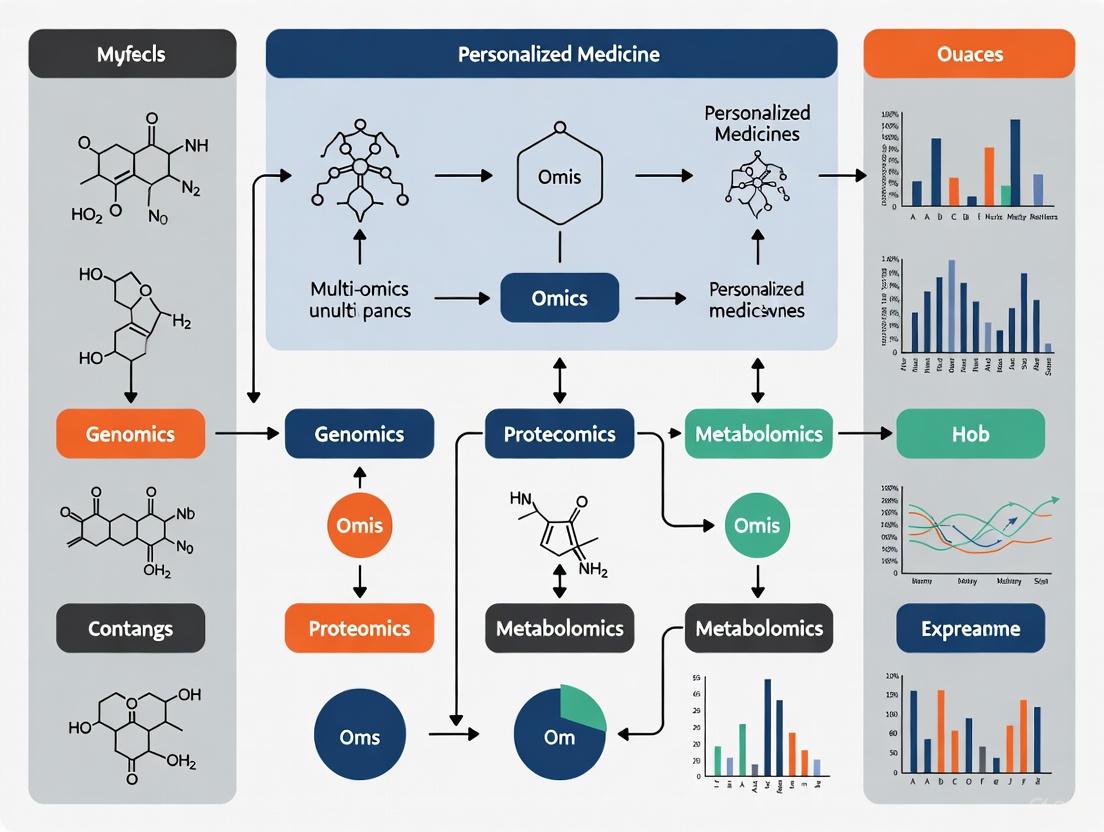
This article provides a comprehensive overview of how multi-omics approaches are transforming personalized medicine strategies for researchers, scientists, and drug development professionals.
Multi-Omics Integration: Revolutionizing Personalized Medicine from Discovery to Clinical Application
Abstract
This article provides a comprehensive overview of how multi-omics approaches are transforming personalized medicine strategies for researchers, scientists, and drug development professionals. It explores the foundational principles of integrating genomics, transcriptomics, proteomics, and metabolomics data to understand individual health profiles. The content examines advanced computational methodologies including machine learning and AI for data integration, addresses critical challenges in data complexity and standardization, and evaluates validation frameworks through case studies in oncology, cardiovascular, and neurological diseases. By synthesizing current research and emerging trends, this resource offers actionable insights for implementing multi-omics strategies across the therapeutic development pipeline.
The Multi-Omics Landscape: Building a Comprehensive Framework for Personalized Medicine
Multi-omics represents a paradigm shift in biomedical research, moving beyond the limitations of single-layer biological analysis to a holistic, systems-level approach. By integrating data from various molecular layers—such as the genome, epigenome, transcriptome, proteome, and metabolome—multi-omics provides an unprecedented, comprehensive view of the complex mechanisms underlying health and disease. This in-depth technical guide details the core components of multi-omics, the methodologies for data integration, and the advanced computational tools driving its application. Framed within the context of personalized medicine, this whitepaper underscores how multi-omics strategies are revolutionizing the discovery of biomarkers and therapeutic targets, enabling the development of precise, individualized diagnostic and treatment strategies.
Traditional biological research has often relied on a single-omics approach, studying one molecular layer in isolation (e.g., only genomics or only transcriptomics). While valuable, this method can only provide a partial and often disconnected view of a system's biology, as it fails to capture the complex, dynamic interactions between different molecular levels [1]. Multi-omics is the concerted approach in which the data from multiple "omes" are combined to study life in an integrated fashion [2]. This synergy is foundational to systems medicine, which views disease not as an aberration of a single gene or protein, but as a perturbation within a complex, interconnected biological network [3].
The central hypothesis of multi-omics is that by layering different types of molecular data, scientists can construct a coherent map of the geno-pheno-envirotype relationships, thereby identifying novel associations, pinpointing robust biomarkers, and understanding the functional mechanisms driving physiology and disease [2] [4]. This approach is particularly crucial for personalized medicine, where the goal is to tailor medical treatment to the individual characteristics of each patient by understanding their unique genetic, molecular, and biochemical profile [5] [3].
The Core Components of a Multi-Omics Approach
A multi-omics analysis leverages several high-throughput technologies to probe different levels of biological information. The primary omics layers are summarized in the table below.
Table 1: The Core Omes in Multi-Omics Analysis
| Omic Layer | Molecular Entity Analyzed | Key Technologies | Primary Insight Provided |
|---|---|---|---|
| Genomics | DNA sequence, structural variants | Next-Generation Sequencing (NGS), GWAS, Whole Genome Sequencing [3] [1] | Genetic blueprint, inherited variations, and mutations associated with disease susceptibility. |
| Epigenomics | Chemical modifications to DNA/histones (e.g., methylation) | Bisulfite Sequencing, ChIP-Seq, ATAC-Seq [6] [1] | Heritable regulation of gene expression activity without changing the DNA sequence. |
| Transcriptomics | All RNA transcripts (mRNA, non-coding RNA) | RNA-Seq, Single-Cell RNA-Seq (scRNA-seq) [6] [4] | Dynamic gene expression patterns and the bridge between the genome and the functional cellular state. |
| Proteomics | Proteins, their structures, modifications, and abundances | Mass Spectrometry (MS), Affinity Proteomics, Proximity Extension Assays (PEA) [6] [4] | Functional executors of cellular processes, including post-translational modifications critical for signaling. |
| Metabolomics | Small-molecule metabolites (e.g., sugars, lipids, amino acids) | Mass Spectrometry (MS), Nuclear Magnetic Resonance (NMR) [7] [4] | Downstream readout of cellular activity and the ultimate response to physiological and pathophysiological changes. |
More recent advancements have further refined the resolution of multi-omics studies:
- Single-Cell Multi-Omics: This branch allows for the analysis of multiple omic layers (e.g., genome and transcriptome, or transcriptome and epigenome) at the level of individual cells. This mitigates confounding factors from cell-to-cell variation and uncovers heterogeneous tissue architectures that are lost in bulk tissue analysis [2] [7].
- Spatial Multi-Omics: These technologies profile the molecular features of cells while preserving their spatial location within a tissue. This provides critical context about the local microenvironment, cell-cell interactions, and the architectural organization of tissues, which is vital for understanding diseases like cancer and neurodegenerative disorders [1] [7].
Methodologies for Multi-Omic Data Collection and Integration
Combined Multi-Omic Data Collection Workflows
A significant innovation in the field is the move towards simultaneous extraction and analysis of multiple molecular classes from a single sample. This reduces technical variation, processing time, and sample requirements compared to traditional methods that process samples separately [2]. Key technologies include:
- TRIzol-based Sequential Isolation: A reagent traditionally used for RNA isolation that can be adapted to sequentially extract DNA, RNA, proteins, and metabolites from a single sample [2].
- Multi-Omic Single-Shot Technology (MOST): Integrates proteome and lipidome analysis in a single liquid chromatography-mass spectrometry (LC-MS) run [2].
- Omni-MS: A proprietary multi-omic assay that simultaneously profiles proteins, lipids, electrolytes, and metabolites in a single preparation and single LC-MS analysis, which has been applied to biomarker discovery in conditions like COVID-19 and 22q11.2 deletion syndrome [2].
The following diagram illustrates a generalized workflow for a multi-omics study, from sample to insight.
Diagram 1: Generalized Multi-Omics Workflow.
Data Integration Strategies and Computational Tools
Data integration is the most critical and challenging step in multi-omics analysis, often requiring sophisticated computational and statistical methods [1] [4]. The integration strategy can be broadly categorized as follows:
- Horizontal Integration: Combines the same type of omics data from different studies or cohorts to increase statistical power.
- Vertical Integration: Combines different types of omics data (e.g., genomics, proteomics) from the same individuals to understand causal pathways across biological layers [8].
Machine learning (ML) and artificial intelligence (AI) are increasingly central to interpreting complex multi-omics data [2] [4]. Key applications include:
- Dimensionality Reduction: Techniques like Principal Component Analysis (PCA) and t-Distributed Stochastic Neighbor Embedding (t-SNE) are used to visualize high-dimensional data in lower dimensions [7].
- Biomarker Discovery: Multivariate methods like sparse Partial Least Squares (sPLS) and Regularized Generalized Canonical Correlation Analysis (RGCCA) can identify features (putative biomarkers) that are correlated across different omics datasets [2].
- Predictive Modeling: ML algorithms (e.g., random forests, support vector machines) and deep learning models are used to predict disease subtypes, patient prognosis, and treatment response based on integrated multi-omics profiles [8] [7].
Table 2: Key Software and Tools for Multi-Omic Analysis
| Tool/Package Name | Primary Function | Access/Platform |
|---|---|---|
| mixOmics [2] | Suite of multivariate methods for data integration (e.g., sPLS). | R/Bioconductor |
| RGCCA [2] | Flexible statistical framework for heterogeneous data integration. | R/CRAN |
| MultiAssayExperiment [2] | Bioconductor interface for managing and analyzing overlapping multi-omics samples. | R/Bioconductor |
| PaintOmics [2] | Web-based resource for visualization of multi-omics datasets. | Web application |
| Illumina Connected Multiomics [6] | Integrated software for multiomic data analysis and visualization. | Commercial Platform |
Multi-Omics in Personalized Medicine: Translating Data into Clinical Strategy
The integration of multi-omics is a cornerstone of modern precision medicine, enabling a move from a reactive "one-size-fits-all" approach to a proactive, personalized healthcare model [5] [3]. Its clinical applications are vast and impactful:
- Precision Diagnostics and Biomarker Discovery: Multi-omics allows for precise disease classification by identifying unique molecular signatures. For example, The Cancer Genome Atlas (TCGA) has used multi-omics to characterize over 11,000 cancer samples, leading to the discovery of new biomarkers and therapeutic targets [7]. Multi-omics strategies are also being used to improve the molecular classification of gliomas, enhancing diagnostic precision and prognostic accuracy [9].
- Targeted Therapies and Drug Development: By identifying specific molecular targets and understanding mechanisms of drug response, multi-omics informs the development of targeted therapies. This is evident in oncology with drugs like HER2 inhibitors for breast cancer and EGFR inhibitors for lung cancer, which are prescribed based on the tumor's genetic profile [5] [8].
- Predictive Modeling for Treatment Response: Machine learning models applied to multi-omics data can predict an individual patient's response to a specific treatment, optimizing therapeutic efficacy and minimizing adverse effects [5] [7]. This has been applied in systems vaccinology to understand the immune response to vaccines [2].
- Disease Prevention: Understanding the genetic and molecular basis of diseases through multi-omics allows for the development of preventive strategies tailored to an individual's unique risk profile [7].
The following diagram conceptualizes how multi-omics data informs the personalized medicine feedback loop.
Diagram 2: Multi-Omics in the Personalized Medicine Cycle.
The Scientist's Toolkit: Essential Reagents and Technologies
Successful multi-omics research relies on a suite of reliable reagents and platforms. The following table details key solutions used in featured experiments and workflows.
Table 3: Research Reagent Solutions for Multi-Omics Experiments
| Item/Technology | Function in Multi-Omics Workflow | Example Application |
|---|---|---|
| NovaSeq X Series Sequencer [6] | Production-scale sequencing platform for generating high-throughput genomic, transcriptomic, and epigenomic data. | Enables broad and deep coverage for comprehensive multi-omic profiling. |
| Illumina DNA Prep Kit [6] | Prepares sequencing-ready libraries from DNA samples. | Used in the genomics arm of a multi-omics workflow for variant discovery. |
| Single Cell 3' RNA Prep Kit [6] | Enables accessible and scalable single-cell RNA sequencing for transcriptomic analysis. | Used to profile gene expression and cellular heterogeneity at single-cell resolution. |
| ApoStream Technology [10] | Proprietary platform for isolating viable whole cells from liquid biopsies. | Preserves cellular morphology for downstream multi-omic analysis of circulating tumor cells. |
| Proximity Extension Assay (PEA) [2] | Technology using DNA-barcoded antibodies for highly multiplexed protein detection. | Allows for integration of proteomic and transcriptomic data, often at the single-cell level. |
| TRIzol Reagent [2] | Monophasic reagent for the simultaneous isolation of RNA, DNA, and proteins from a single sample. | Reduces sample requirement and technical variation in multi-omic studies. |
Challenges and Future Directions
Despite its transformative potential, the widespread adoption of multi-omics in clinical practice faces several hurdles:
- Data Complexity and Integration: Harmonizing vast, heterogeneous datasets from different omics platforms remains a significant computational challenge [7] [4].
- Cost and Accessibility: High-throughput multi-omics technologies can be expensive, limiting access for some research groups and healthcare systems [7].
- Standardization and Reproducibility: A lack of standardized protocols from sample collection to data analysis can affect reproducibility and hinder clinical translation [7] [10].
- Data Privacy and Ethical Considerations: The use of sensitive genetic and health information raises important questions about data privacy, security, and ethical usage [5].
- Clinical Implementation and Interpretation: Translating complex multi-omics findings into actionable clinical insights requires robust validation and training for clinicians [7].
The future of multi-omics lies in addressing these challenges through technological refinement, collaborative efforts, and the development of more user-friendly analytical tools. The continued evolution of single-cell and spatial multi-omics technologies, coupled with more powerful AI-driven integration algorithms, will further deepen our understanding of human biology and accelerate the realization of truly personalized systems medicine [8] [3] [4].
Precision medicine represents a transformative healthcare model that leverages an individual's genomic, environmental, and lifestyle data to deliver customized healthcare [3]. This approach has shifted medicine from a conventional, reactive disease control model toward proactive prevention and health preservation. The foundation of this transformation lies in the "omics" revolution—high-throughput technologies that enable comprehensive measurement of biological molecules at unprecedented scale and resolution [11].
Integrative multi-omics, the combination of multiple biological data layers, provides a more complete understanding of human health and disease than any single approach can offer separately [3]. By combining genomics, transcriptomics, proteomics, and metabolomics with advanced computational methods, researchers can now decipher the complex interactions between genes, proteins, and metabolites that drive health and disease states, enabling more precise diagnostic, prognostic, and therapeutic strategies [9] [11].
Core Omics Technologies: From Blueprint to Function
Genomics: The Biological Blueprint
Genomics involves the systematic study of an organism's complete set of DNA, including all of its genes and intergenic regions [12]. The primary goal of genomics is to identify the physiological functions of genes and their roles in disease susceptibility. Single nucleotide polymorphisms (SNPs) serve as the most commonly used markers for disease association studies [12]. Modern array-based genotyping techniques allow simultaneous assessment of up to one million SNPs per assay, enabling genome-wide association studies (GWAS) that scan the entire genome for disease-linked variants [12].
Table 1: Genomics Technologies and Applications
| Aspect | Description |
|---|---|
| Primary Focus | Analysis of DNA sequence, structure, and variation |
| Key Technology | Next-generation sequencing (NGS), Sanger sequencing |
| Common Parameters | SNPs, copy number variations (CNVs), structural variants |
| Applications | Identification of disease-associated genes, genetic risk assessment |
The Human Genome Project, completed in 2003, established the reference human genome sequence and revealed that humans possess only 20,000-25,000 protein-coding genes [3]. While the Sanger sequencing method used in this project provided excellent accuracy, newer NGS technologies enable massively parallel sequencing with dramatically increased throughput and reduced cost [3]. These advances have made large-scale genomic studies feasible and have provided the foundation for precision medicine approaches.
Transcriptomics: Dynamic Gene Expression
Transcriptomics provides a quantitative overview of the mRNA transcripts present in a biological sample at the time of collection, offering insights into which genes are actively being expressed [12]. Unlike the relatively static genome, the transcriptome is highly dynamic, changing in response to environmental conditions, developmental stages, and disease states [12]. Gene expression profiling studies typically compare expression patterns between groups with different phenotypes (e.g., disease state versus healthy controls) to identify differentially expressed genes [12].
Table 2: Transcriptomics Technologies and Applications
| Aspect | Description |
|---|---|
| Primary Focus | Analysis of complete set of RNA transcripts |
| Key Technology | RNA sequencing (RNA-seq), microarrays |
| Common Parameters | Gene expression levels, alternative splicing, non-coding RNA |
| Applications | Identification of differentially expressed genes, pathway activation |
The connection between transcriptomics and genomics is fundamental—while genomics reveals the potential of what might occur based on genetic code, transcriptomics reveals what is actually being executed from that code in specific contexts. This dynamic information is crucial for understanding how genetic variations manifest in different tissue types, disease states, and in response to treatments [13].
Proteomics: The Functional Effectors
Proteomics involves the large-scale study of proteins, including their expression levels, modifications, and interactions [12]. The proteome consists of all proteins present in specific cell types or tissues and is highly variable over time and in response to environmental changes [12]. While all proteins are correlated to mRNA, post-translational modifications (PTMs) and environmental interactions make it impossible to predict protein behavior from gene expression analysis alone [12]. Mass spectrometry (MS) represents the most common analytical platform for proteomic studies, though protein microarrays using capturing agents such as antibodies are also employed [12].
Table 3: Proteomics Technologies and Applications
| Aspect | Description |
|---|---|
| Primary Focus | Analysis of protein expression, structure, function, and interactions |
| Key Technology | Mass spectrometry, protein microarrays |
| Common Parameters | Protein abundance, post-translational modifications, protein-protein interactions |
| Applications | Biomarker discovery, drug target identification, signaling pathway analysis |
The proteome provides a more direct representation of cellular function than transcriptomic data, as proteins serve as the primary functional actors in biological systems. Proteomic analyses can identify not only which proteins are present but also how they are modified through processes like phosphorylation, acetylation, and glycosylation, which dramatically alter protein function [13].
Metabolomics: The Physiological Phenotype
Metabolomics focuses on the comprehensive analysis of small-molecule metabolites (typically <1 kDa) within a biological system [12]. The metabolome includes metabolic intermediates, hormones, signaling molecules, and other biochemical entities that represent the end products of cellular processes [14]. Metabolic phenotypes are the by-products of interactions between genetic, environmental, lifestyle, and other factors, making metabolomics the most direct readout of a system's physiological state [13]. The metabolome is highly variable and time-dependent, consisting of a wide range of chemical structures that present analytical challenges [12].
Table 4: Metabolomics Technologies and Applications
| Aspect | Description |
|---|---|
| Primary Focus | Analysis of complete set of small-molecule metabolites |
| Key Technology | Mass spectrometry (MS), nuclear magnetic resonance (NMR) |
| Common Parameters | Metabolite identification and quantification, metabolic pathway analysis |
| Applications | Biomarker discovery, toxicology studies, nutrient metabolism |
Metabolomics provides a unique window into the current physiological state of an organism, as metabolite concentrations can change rapidly in response to perturbations, treatments, or disease progression. This responsiveness makes metabolomics particularly valuable for monitoring treatment responses and disease dynamics in precision medicine applications [14].
Multi-Omics Integration Strategies and Methodologies
Data Integration Approaches
Integrating data across multiple omics layers presents significant computational and analytical challenges due to the heterogeneity, scale, and complexity of the datasets [11]. Three primary strategies have emerged for multi-omics integration:
Early integration combines all features from different omics datasets into one massive dataset before analysis. This approach preserves all raw information and can capture complex, unforeseen interactions between modalities but suffers from extremely high dimensionality and computational intensity [11].
Intermediate integration first transforms each omics dataset into a more manageable representation, then combines these representations. Network-based methods exemplify this approach, where each omics layer constructs a biological network (e.g., gene co-expression, protein-protein interactions) that are subsequently integrated to reveal functional relationships and modules driving disease [11].
Late integration builds separate predictive models for each omics type and combines their predictions at the end. This ensemble approach is robust, computationally efficient, and handles missing data well, but may miss subtle cross-omics interactions not strong enough to be captured by any single model [11].
Computational and AI-Based Integration Tools
Advanced computational methods are essential for effective multi-omics integration. Several software tools and platforms have been developed to support different integration approaches:
Table 5: Multi-Omics Integration Tools and Methods
| Tool/Method | Approach | Key Features | Applications |
|---|---|---|---|
| IMPALA | Pathway-based | Integrated pathway-level analysis from gene/protein expression and metabolomics data | Identification of additional pathways from combined datasets |
| iPEAP | Pathway-based | Pathway enrichment analysis integrating multiple omic platforms | Supports transcriptomics, proteomics, metabolomics, and GWAS data |
| MetaboAnalyst | Pathway-based | Comprehensive metabolomics data processing and functional enrichment analysis | Integrated pathway analysis from gene expression and metabolomics data |
| SAMNetWeb | Network-based | Generates biological networks representing changes in protein and gene expression | Integrated network and pathway enrichment analysis |
| MixOmics | Correlation-based | Multivariate analysis and visualization for comparing heterogeneous datasets | Dimensionality reduction, multilevel analysis |
| WGCNA | Correlation-based | Correlation and network topology analysis with hierarchical clustering | Gene co-expression network analysis |
Artificial intelligence and machine learning have become indispensable for multi-omics integration, with several state-of-the-art techniques showing particular promise [11]:
Autoencoders and Variational Autoencoders are unsupervised neural networks that compress high-dimensional omics data into lower-dimensional "latent spaces," making integration computationally feasible while preserving key biological patterns [11].
Graph Convolutional Networks are designed for network-structured data and can learn from biological networks where genes and proteins represent nodes and their interactions represent edges. These have proven effective for clinical outcome prediction by integrating multi-omics data onto biological networks [11].
Similarity Network Fusion creates patient-similarity networks from each omics layer and iteratively fuses them into a single comprehensive network, strengthening robust similarities and removing weak ones for more accurate disease subtyping [11].
Experimental Workflows and Methodologies
Integrated Multi-Omics Workflow
The following diagram illustrates a generalized workflow for integrated multi-omics studies, from sample collection through data integration and interpretation:
Detailed Methodologies for Core Omics Layers
Genomics Experimental Protocol: DNA extraction typically begins with cell lysis, followed by removal of proteins and RNA, and final DNA purification. For whole-genome sequencing, DNA is fragmented, adapters are ligated, and fragments are amplified and sequenced using NGS platforms like Illumina's NovaSeq technology, which can generate 20-52 billion reads per run with read lengths up to 2×250 base pairs [3]. Variant calling involves alignment to reference genomes (e.g., GRCh38) followed by identification of SNPs, indels, and structural variants using tools like GATK or DeepVariant [3].
Transcriptomics Experimental Protocol: RNA extraction must preserve RNA integrity, typically using guanidinium thiocyanate-phenol-chloroform extraction. RNA quality is assessed (RIN > 8), followed by library preparation including poly-A selection or rRNA depletion, cDNA synthesis, and adapter ligation. Sequencing is performed on platforms like Illumina, with subsequent analysis including quality control (FastQC), alignment (STAR, HISAT2), quantification (featureCounts), and differential expression analysis (DESeq2, edgeR) [12] [13].
Proteomics Experimental Protocol: Protein extraction involves cell lysis with detergent-based buffers, quantification, and digestion with trypsin. Liquid chromatography-tandem mass spectrometry (LC-MS/MS) separates peptides which are ionized and fragmented, with mass-to-charge ratios recorded. Data analysis includes peptide identification (MaxQuant, Proteome Discoverer), quantification (label-free or isobaric tagging), and statistical analysis to identify differentially expressed proteins [12] [13].
Metabolomics Experimental Protocol: Metabolite extraction uses methanol:acetonitrile:water mixtures to precipitate proteins while maintaining metabolite stability. Analysis employs either LC-MS (for broad coverage) or GC-MS (for volatile compounds), with NMR providing structural information. Data processing includes peak detection, alignment, and annotation using databases like HMDB, followed by statistical analysis to identify differential metabolites [12] [13].
The Scientist's Toolkit: Essential Research Reagents and Materials
Successful multi-omics research requires specialized reagents and materials for each analytical platform. The following table details essential components for integrated multi-omics studies:
Table 6: Essential Research Reagents and Materials for Multi-Omics Studies
| Reagent/Material | Omics Application | Function | Technical Notes |
|---|---|---|---|
| TriZol/RNA Later | Transcriptomics | RNA stabilization and preservation | Maintains RNA integrity during sample storage and processing; critical for accurate gene expression profiling |
| RIPA Buffer | Proteomics | Protein extraction and solubilization | Effective lysis while maintaining protein stability and preventing degradation |
| Methanol:Acetonitrile:Water | Metabolomics | Metabolite extraction | Precipitates proteins while maintaining metabolite stability and solubility |
| Trypsin | Proteomics | Protein digestion | Cleaves proteins at specific sites for mass spectrometry analysis |
| DNase/RNase-free Water | All omics | Molecular biology reactions | Prevents nucleic acid degradation during sample processing and analysis |
| Solid Phase Extraction Columns | Metabolomics | Sample cleanup | Removes interfering compounds and concentrates analytes prior to analysis |
| Isobaric Tags (TMT, iTRAQ) | Proteomics | Multiplexed protein quantification | Enables simultaneous analysis of multiple samples in a single MS run |
| Poly-A Selection Beads | Transcriptomics | mRNA enrichment | Isolates mRNA from total RNA for RNA-seq library preparation |
| Restriction Enzymes | Genomics | DNA fragmentation | Used in various genomic applications including library preparation |
| Library Preparation Kits | All sequencing | NGS library construction | Facilitates adapter ligation and amplification for sequencing platforms |
Applications in Precision Medicine and Health
Integrative multi-omics approaches have demonstrated significant impact across multiple areas of precision medicine:
Disease Subtyping and Classification: Multi-omics data enables refined molecular classification of diseases beyond traditional histopathological approaches. In neuroblastoma and other cancers, integrated omics profiles have identified novel subtypes with distinct clinical outcomes and therapeutic vulnerabilities [11]. Similar approaches are being applied to cardiovascular, neurological, and metabolic disorders to redefine disease classification systems based on molecular mechanisms rather than symptomatic presentation.
Biomarker Discovery: Multi-omics approaches accelerate the discovery of novel diagnostic, prognostic, and predictive biomarkers. By integrating genomics, transcriptomics, and proteomics, researchers can identify complex molecular signatures that serve as early warning signs for disease or indicators of treatment response [11]. For example, combining liquid biopsy data (circulating tumor DNA) with proteomic markers and clinical risk factors has improved early cancer detection accuracy from blood samples [11].
Therapeutic Target Identification: Integrated analyses reveal novel therapeutic targets by mapping complete biological pathways and identifying key regulatory nodes. In glioma research, multi-omics integration combining genetic features with transcriptomic, epigenomic, and proteomic data has identified potential therapeutic targets that would be missed by isolated genetic analyses [9]. Similar approaches are being applied to identify drug targets for complex diseases including metabolic disorders, autoimmune conditions, and neurodegenerative diseases.
Drug Development and Clinical Trials: Multi-omics data enhances clinical trial design through improved patient stratification. By identifying molecular subtypes most likely to respond to specific therapies, researchers can enrich trial populations and increase success rates [11]. Additionally, multi-omics biomarkers can serve as intermediate endpoints for monitoring treatment response and understanding mechanisms of drug action or resistance.
The continued advancement and integration of genomics, transcriptomics, proteomics, and metabolomics technologies promises to further transform precision medicine, enabling increasingly personalized approaches to disease prevention, diagnosis, and treatment tailored to an individual's unique molecular profile.
The completion of the Human Genome Project (HGP) in 2003 marked a transformative milestone in biological science, providing the first reference sequence of the human genome and launching a new era of genomic medicine [3] [15]. This monumental international collaboration, which involved 20 centers across six countries and cost approximately $3 billion, fundamentally reshaped research approaches to human biology, disease states, and their treatment [3] [16]. The project not only provided a fundamental reference map for future discovery but also established powerful precedents for international collaboration and open-source data sharing that would become critical enablers for subsequent scientific advances [17] [3].
Over the past two decades, this foundation has enabled a dramatic evolution from focusing on a single omics layer—genomics—toward increasingly sophisticated integrated multi-omics approaches that combine genomic, transcriptomic, proteomic, metabolomic, and epigenomic data [3] [18]. This paradigm shift has been driven by the recognition that while genomics provides invaluable insights into DNA sequences, it represents only one piece of the complex puzzle of biological systems [18]. The integration of multiple biological data layers has emerged as an essential strategy for obtaining a comprehensive understanding of health and disease, enabling researchers to link genetic information with molecular function and phenotypic outcomes [3] [18]. This technical guide examines the historical progression, methodological frameworks, and translational applications of this evolution, with particular emphasis on implications for personalized medicine strategies in research and drug development.
Historical Timeline: From Genome Sequencing to Multi-Omics Integration
The journey from the initial conception of the HGP to contemporary multi-omics frameworks has been characterized by continuous technological innovation, dramatically reduced sequencing costs, and increasingly sophisticated computational approaches. Table 1 summarizes key quantitative metrics that highlight this remarkable evolution.
Table 1: Evolution of Genomic and Multi-Omics Technologies: Key Quantitative Metrics
| Metric | Human Genome Project (2003) | Current State (2025) | Fold Improvement |
|---|---|---|---|
| Time to Sequence Human Genome | 13 years [17] | ~5 hours (record) [16] | ~23,000x |
| Cost per Human Genome | ~$2.7 billion [17] | ~$200-$500 [17] [16] | ~10 millionx |
| Sequencing Output (per run) | N/A (project total) | 6-16 Terabases (NovaSeq X) [18] | N/A |
| Primary Technology | Sanger sequencing [3] | Next-Generation Sequencing (NGS) [3] [18] | - |
| Data Integration Approach | Single-omics (Genomics) | Multi-omics (Genomics, Transcriptomics, Proteomics, Metabolomics, Epigenomics) [3] [18] | - |
The Human Genome Project: A Foundation for Future Discovery
The HGP was officially launched in 1990 with a 15-year timetable and substantial funding from the US National Institutes of Health and Department of Energy [3] [16]. The project utilized Sanger sequencing, known for its excellent accuracy in base calling but limited throughput, as it could only sequence small DNA fragments at a time [3]. A significant turning point came in 1998 with the emergence of Celera Genomics, a private company that promised to sequence the genome ahead of the public consortium and potentially lock the data behind paywalls or patents [17] [16]. This competition created urgency within the public project, leading to accelerated efforts and the eventual publication of the first draft sequence in 2000—five years ahead of the original schedule [17] [16]. On July 7, 2000, a team at the University of California, Santa Cruz, posted the first human genome sequence online, making it freely available to the global scientific community and establishing a powerful ethos of open-access science that would fuel subsequent innovation [16].
The project's final completion in 2003 revealed that the human genome contains only 20,000-25,000 protein-coding genes, far fewer than previously anticipated, highlighting the complexity of gene regulation and the importance of non-coding regions [3]. This fundamental discovery created the need to decipher complex interactions within the human body at both microscopic and macroscopic levels, establishing the importance of a systems biology approach in biomedical research [3].
The Rise of Next-Generation Sequencing and Multi-Omics Technologies
The period following the HGP witnessed rapid development of Next-Generation Sequencing (NGS) technologies that addressed the throughput limitations of Sanger sequencing [3] [18]. These massively parallel DNA sequencing platforms, including sequencing by synthesis, pyrosequencing, sequencing by ligation, and ion semiconductor sequencing, enabled simultaneous sequencing of millions of DNA fragments [3] [18]. This technological leap democratized genomic research, making large-scale DNA and RNA sequencing faster, cheaper, and more accessible than ever before [18]. Illumina's sequencing platforms exemplify this dramatic progress: while the HiSeq technology in 2014 had an output capacity of 1.6-1.8 Terabases with a maximum read length of 2×150 base pairs, current NovaSeq technology can deliver 6-16 Terabases with read lengths up to 2×250 base pairs [3].
The development of these high-throughput technologies enabled researchers to move beyond genomics alone and begin systematically integrating multiple molecular data layers. Multi-omics approaches emerged as a strategic framework for understanding biology across interconnected layers, combining genomics (DNA sequences), transcriptomics (RNA expression), proteomics (protein abundance and interactions), metabolomics (metabolic pathways and compounds), and epigenomics (epigenetic modifications) [3] [10] [18]. This integration provides a more comprehensive view of biological systems than any single omics layer can provide alone, enabling researchers to link genetic information with molecular function and phenotypic outcomes [18].
Technical Methodologies: Experimental Frameworks for Multi-Omics Integration
Multi-Omics Data Generation and Workflow Integration
The successful implementation of multi-omics studies requires careful experimental design and execution across multiple technical domains. Table 2 outlines essential research reagents and platforms critical for generating robust multi-omics datasets.
Table 2: Essential Research Reagents and Platforms for Multi-Omics Studies
| Category | Specific Technology/Reagent | Key Function | Application in Multi-Omics |
|---|---|---|---|
| Sequencing Platforms | Illumina NovaSeq X [18] | High-throughput DNA/RNA sequencing | Genomics, Transcriptomics |
| Oxford Nanopore Technologies [18] | Long-read, real-time sequencing | Structural variant detection, full-length transcript sequencing | |
| Proteomics Technologies | Mass Spectrometry [19] | Protein identification and quantification | Proteomics, Post-translational modifications |
| Spatial Technologies | Spatial Transcriptomics [16] [18] | Gene expression mapping in tissue context | Tissue heterogeneity, tumor microenvironment |
| Single-Cell Technologies | Single-Cell RNA Sequencing [8] [18] | Gene expression profiling at single-cell resolution | Cellular heterogeneity, rare cell populations |
| Bioinformatic Tools | AI/ML Platforms (e.g., DeepVariant) [3] [18] | Variant calling, pattern recognition | Data integration, biomarker discovery |
| Specialized Platforms | ApoStream [10] | Isolation of circulating tumor cells | Liquid biopsy, cancer monitoring |
The integration of multiple omics layers follows a structured workflow that begins with experimental design and proceeds through data generation, processing, integration, and interpretation. The following diagram illustrates this comprehensive multi-omics workflow, highlighting the interconnected nature of these processes and the role of artificial intelligence in extracting biologically meaningful insights.
Data Integration Strategies and Computational Frameworks
The integration of diverse omics datasets presents significant computational challenges due to data heterogeneity, varying scales, resolutions, and noise levels across different molecular layers [19]. Two primary strategies have emerged for addressing these challenges: horizontal integration and vertical integration [8]. Horizontal integration combines the same type of omics data across different samples or cohorts to identify patterns and associations, while vertical integration combines different types of omics data from the same samples to build a comprehensive view of biological systems [8].
Advanced computational tools, particularly artificial intelligence (AI) and machine learning (ML) algorithms, have become indispensable for analyzing these complex, high-dimensional datasets [8] [18]. Deep learning models such as convolutional neural networks and graph neural networks can detect hidden patterns, fill gaps in incomplete datasets, and enable in silico simulations of treatment responses [20]. Tools like Google's DeepVariant utilize deep learning to identify genetic variants with greater accuracy than traditional methods, while other AI models analyze polygenic risk scores to predict individual susceptibility to complex diseases [18]. The synergy of AI with multi-omics data has significantly enhanced predictive accuracy and mechanistic insights, revealing how gene-gene and gene-environment interactions shape therapeutic outcomes [20].
Cloud computing platforms such as Amazon Web Services (AWS) and Google Cloud Genomics have emerged as essential infrastructure for multi-omics research, providing scalable resources to store, process, and analyze the massive datasets generated by these approaches [18]. These platforms enable global collaboration, allowing researchers from different institutions to work on the same datasets in real-time while complying with regulatory frameworks such as HIPAA and GDPR that ensure the secure handling of sensitive genomic data [18].
Applications in Personalized Medicine and Drug Development
Biomarker Discovery and Patient Stratification
Multi-omics approaches have revolutionized biomarker discovery by enabling the identification of molecular signatures at multiple biological levels, facilitating more precise patient stratification for targeted interventions [8] [21]. In oncology, for example, multi-omics strategies have yielded promising biomarker panels at the single-molecule, multi-molecule, and cross-omics levels, supporting cancer diagnosis, prognosis, and therapeutic decision-making [8]. These approaches help dissect the tumor microenvironment, revealing interactions between cancer cells and their surroundings that would be invisible to single-omics approaches [18].
A key application of multi-omics in patient stratification is demonstrated in a 2025 study that performed a cross-sectional integrative analysis of genomics, urine metabolomics, and serum metabolomics/lipoproteomics on a cohort of 162 healthy individuals [21]. The research concluded that multi-omics integration provided optimal stratification capacity, identifying four distinct subgroups with different molecular profiles [21]. For a subset of 61 individuals with longitudinal data, the study evaluated the temporal stability of these molecular profiles, finding that certain clusters displayed classification consistency over time—a critical aspect for implementing effective prevention strategies [21]. This approach exemplifies how multi-omics profiling can serve as a framework for precision medicine aimed at early prevention strategies in apparently healthy populations.
Advancing Drug Discovery and Development
Multi-omics approaches are transforming drug discovery by breaking down traditional silos where genomic data alone was used to identify mutations associated with disease without integrating other datasets that inform downstream impacts on cellular functions [19]. By layering transcriptomics, translatomics (analysis of translated RNA), proteomics, and metabolomics, researchers can better understand biological pathways and distinguish causal mutations from inconsequential ones [19]. This multidimensional insight enables the discovery of functionally relevant drug targets that might otherwise be overlooked, enhancing the potential to deliver meaningful benefits to patients [19].
The integration of multi-omics with real-world data (RWD) and AI represents a particular powerful paradigm shift in drug development [19]. This combination allows researchers to move from static snapshots of biology to dynamic, predictive models of disease that can inform drug development in real-time [19]. By training AI models on RWD that includes wearable device outputs, imaging, and electronic health records, researchers can identify subgroups of patients most likely to benefit from particular treatments and monitor how multi-omics markers evolve over time in dynamic patient populations [19]. This approach improves the external validity of findings and enhances clinical relevance.
Pharmacogenomics has particularly benefited from multi-omics integration, as many drug response phenotypes are governed by intricate networks of genomic variants, epigenetic modifications, and metabolic pathways rather than single-gene effects [20]. Multi-omics approaches capture these complex data layers, offering a comprehensive view of patient-specific biology that enables more accurate prediction of individual responses to medications, helping to optimize dosage and minimize side effects [18] [20].
Future Perspectives and Challenges
As multi-omics approaches continue to evolve, several cutting-edge technologies are poised to expand their scope and impact. Single-cell multi-omics and spatial multi-omics technologies represent particularly promising frontiers, enabling researchers to map molecular activity at the level of individual cells within the spatial context of their native tissue environment [8] [19]. These approaches reveal cellular heterogeneity that bulk analyses cannot detect, providing critical insights for understanding complex diseases like cancer and autoimmune disorders [18] [19]. Additionally, the emerging human pangenome project—an inclusive set of reference genome sequences that captures global genomic diversity—is improving our ability to detect rare conditions and address historical biases in genomic research [16].
Despite these promising advances, significant challenges remain in the widespread implementation of multi-omics approaches. Data integration continues to present technical hurdles due to the heterogeneous nature of different omics datasets with varying scales, resolutions, and noise levels [19]. Infrastructure limitations also represent a bottleneck, as multi-omics approaches generate enormous volumes of data that require advanced storage, processing power, and cloud-based computational resources [19]. Additionally, ensuring equitable representation in genomic and multi-omics datasets remains a critical concern, as participants of European descent currently constitute approximately 86% of all genomic studies worldwide, potentially limiting the applicability of findings across diverse populations [3].
Looking ahead, the next five years are poised to see multi-omics approaches increasingly support in silico drug discovery through rapid screening of compounds, simulation of biological interactions, and prediction of off-target effects [19]. As AI models become more sophisticated and data-sharing practices expand, multi-omics integration will likely become standard practice in both basic research and clinical applications, ultimately fulfilling the promise of precision medicine that motivated the initial Human Genome Project over two decades ago [19]. Continued investment in technology, policy-making, and international collaboration will be essential to overcome current limitations and realize the full potential of integrated multi-omics approaches for improving human health.
The conventional "one-size-fits-all" approach to medicine has demonstrated limited efficacy in addressing the complex heterogeneity of human diseases [22]. Precision medicine represents a fundamental paradigm shift from this reactive disease control model to a proactive framework for disease prevention and health preservation [3]. This transformation utilizes a deep understanding of an individual's genomic makeup, environmental exposures, and lifestyle factors to deliver customized healthcare strategies for prevention, diagnosis, and treatment [3]. The emergence of large-scale biological datasets and sophisticated analytical technologies has enabled this transition, moving medical practice from population-wide averages to individualized strategies based on each patient's unique molecular profile [11] [3].
Multi-omics technologies form the cornerstone of this transformed approach, providing comprehensive insights into the complex biological networks governing health and disease states [4]. While single-omics approaches have yielded valuable insights, they cannot capture the intricate interactions between different biological layers that drive disease pathogenesis [4]. Multi-omics integration systematically combines diverse molecular datasets—including genomic, transcriptomic, proteomic, epigenomic, metabolomic, and microbiomic profiles—to construct a clinically relevant understanding of disease biology that reflects the true complexity of human physiological systems [4] [10]. The integration of these multidimensional datasets with clinical information from electronic health records (EHRs) creates unprecedented opportunities for understanding disease etiology, identifying novel biomarkers, and developing targeted therapeutic interventions [11] [23].
The Multi-Omics Technological Framework
Omics Technologies and Their Clinical Applications
The multi-omics framework encompasses several distinct but interconnected technological domains, each providing unique insights into different aspects of biological systems. The table below summarizes the key omics technologies and their clinical applications in precision medicine.
Table 1: Multi-Omics Technologies and Their Clinical Applications in Precision Medicine
| Omics Domain | Molecular Focus | Key Technologies | Primary Clinical Applications |
|---|---|---|---|
| Genomics | Entire DNA sequence, genetic variations | Next-generation sequencing (NGS), whole-genome sequencing, exome sequencing, genotyping arrays [4] [3] | Genetic risk assessment, variant discovery, pharmacogenomics, carrier screening [4] [3] |
| Transcriptomics | RNA expression patterns (coding and non-coding RNAs) | RNA-seq, single-cell RNA sequencing (scRNA-seq) [4] | Gene expression profiling, alternative splicing analysis, biomarker discovery, therapeutic target identification [4] |
| Proteomics | Protein expression, post-translational modifications | Mass spectrometry, affinity proteomics, protein microarrays [4] | Functional pathway analysis, signaling network mapping, therapeutic response monitoring [4] |
| Epigenomics | DNA methylation, histone modifications | Bisulfite sequencing, ChIP-seq [3] [23] | Environmental exposure assessment, gene regulation studies, developmental biology [3] |
| Metabolomics | Small molecule metabolites | Mass spectrometry, NMR spectroscopy [4] | Metabolic pathway analysis, nutritional interventions, toxicity assessment [4] |
| Microbiomics | Microbial communities | 16S rRNA sequencing, metagenomics [3] | Gut-brain axis studies, infectious disease profiling, microbiome therapeutics [3] |
Analytical Challenges in Multi-Omics Integration
The integration of multi-omics data presents significant computational and analytical challenges that must be addressed to derive clinically meaningful insights. Data heterogeneity arises from the fundamentally different nature of each biological layer, where each data type has distinct formats, scales, and technical characteristics that can obscure true biological signals [11]. Missing data is a common issue in biomedical research, where patients may have complete genomic data but lack proteomic measurements, potentially introducing bias if not handled with robust imputation methods such as k-nearest neighbors (k-NN) or matrix factorization [11]. The high-dimensionality problem emerges when dealing with far more features than samples, which can break traditional analytical methods and increase the risk of identifying spurious correlations [11].
Batch effects represent another critical challenge, where variations introduced by different technicians, reagents, sequencing machines, or processing times can create systematic noise that masks genuine biological variation [11]. These technical artifacts require careful experimental design and statistical correction methods like ComBat to ensure data quality and reproducibility [11]. Furthermore, the massive computational requirements for processing and storing multi-omics data often involve petabyte-scale datasets, demanding scalable infrastructure such as cloud-based solutions and distributed computing frameworks [11]. Finally, researchers must develop robust statistical models that can handle this complexity while producing biologically interpretable results, balancing computational sophistication with deep biological understanding [11].
Methodological Approaches to Multi-Omics Integration
Data Integration Strategies
The successful integration of multi-omics data requires sophisticated methodological approaches that can harmonize diverse datasets into a coherent analytical framework. Researchers typically employ three primary integration strategies, differentiated by the timing of integration in the analytical workflow.
Early integration (feature-level integration) merges all omics features into a single massive dataset before analysis [11]. This approach typically involves simple concatenation of data vectors from different omics layers, preserving all raw information and potentially capturing complex, unforeseen interactions between modalities [11]. However, early integration is computationally intensive and highly susceptible to the "curse of dimensionality," where the extremely high number of features relative to samples can lead to model overfitting and spurious correlations [11].
Intermediate integration involves transforming each omics dataset into a more manageable representation before combination [11]. Network-based methods exemplify this approach, where each omics layer is used to construct biological networks (e.g., gene co-expression, protein-protein interactions) that are subsequently integrated to reveal functional relationships and modules driving disease processes [11]. This strategy reduces complexity and incorporates valuable biological context but may lose some raw information and requires substantial domain knowledge to implement effectively [11].
Late integration (model-level integration) builds separate predictive models for each omics type and combines their predictions at the final stage [11]. This ensemble approach uses methods like weighted averaging or stacking, offering computational efficiency and robust handling of missing data [11]. However, late integration may miss subtle cross-omics interactions that are not strong enough to be captured by any single model, potentially overlooking important biological insights that emerge only from the integration of multiple data layers [11].
Table 2: Comparison of Multi-Omics Data Integration Strategies
| Integration Strategy | Timing of Integration | Advantages | Limitations | Common Algorithms |
|---|---|---|---|---|
| Early Integration | Before analysis | Captures all cross-omics interactions; preserves raw information | Extremely high dimensionality; computationally intensive | Simple concatenation, regularized regression |
| Intermediate Integration | During analysis | Reduces complexity; incorporates biological context through networks | Requires domain knowledge; may lose some raw information | Similarity Network Fusion (SNF), matrix factorization |
| Late Integration | After individual analysis | Handles missing data well; computationally efficient | May miss subtle cross-omics interactions | Stacking, weighted averaging, Bayesian models |
Artificial Intelligence and Machine Learning Approaches
Without advanced artificial intelligence (AI) and machine learning (ML) techniques, integrating multi-modal genomic and multi-omics data for precision medicine would be practically impossible due to the sheer volume and complexity of the data [11]. These computational approaches provide powerful pattern recognition capabilities that can detect subtle connections across millions of data points that remain invisible to conventional analytical methods [11].
Autoencoders (AEs) and Variational Autoencoders (VAEs) are unsupervised neural networks that compress high-dimensional omics data into dense, lower-dimensional "latent spaces" [11]. This dimensionality reduction makes integration computationally feasible while preserving key biological patterns, creating a unified representation where data from different omics layers can be effectively combined [11]. Graph Convolutional Networks (GCNs) are specifically designed for network-structured data, representing biological components (genes, proteins) as nodes and their interactions as edges [11]. GCNs learn from this structure by aggregating information from a node's neighbors to make predictions, proving particularly effective for clinical outcome prediction in complex conditions [11].
Similarity Network Fusion (SNF) creates patient-similarity networks from each omics layer and iteratively fuses them into a single comprehensive network [11]. This process strengthens robust similarities while removing weak associations, enabling more accurate disease subtyping and prognosis prediction [11]. Recurrent Neural Networks (RNNs), including Long Short-Term Memory (LSTM) and Gated Recurrent Unit (GRU) networks, excel at analyzing longitudinal data by capturing temporal dependencies [11]. This capability is crucial for modeling how biological systems evolve over time, enabling predictions of disease progression and treatment responses from time-series clinical and omics data [11].
More recently, Transformer architectures originally developed for natural language processing have been adapted for biological data analysis [11]. Their self-attention mechanisms dynamically weigh the importance of different features and data types, learning which modalities matter most for specific predictions and enabling identification of critical biomarkers from noisy, high-dimensional datasets [11].
Diagram 1: AI and Machine Learning Framework for Multi-Omics Data Integration. This workflow illustrates how different AI approaches process various omics data types to generate clinically actionable insights.
Experimental Protocols and Workflows
Multi-Omics Data Generation Pipeline
A standardized experimental workflow is essential for generating high-quality multi-omics data suitable for integration and analysis. The process begins with sample collection and preparation, where biospecimens (tissue, blood, etc.) are obtained and processed according to standardized protocols to maintain sample integrity [10]. For limited tissue scenarios, innovative technologies like ApoStream—a proprietary platform that captures viable whole cells from liquid biopsies—can be employed to enable downstream multi-omic analysis when traditional biopsies are not feasible [10].
The DNA sequencing phase utilizes next-generation sequencing (NGS) technologies, with sequencing by synthesis using polymerase chain reaction (PCR) being the most widely adopted method for genome and exome sequencing [3]. Modern NGS platforms like Illumina's NovaSeq technology can generate outputs of 6–16 terabytes with read lengths up to 2×250 base pairs, providing comprehensive genomic coverage [3]. For RNA sequencing, RNA-seq protocols capture both protein-coding mRNAs and non-coding RNAs, with single-cell RNA sequencing (scRNA-seq) enabling transcriptome profiling at cellular resolution to understand heterogeneity within tissues [4].
Proteomic profiling typically employs mass spectrometry-based methods, with stable isotope labeling approaches reducing detection time and minimizing batch effects between samples [4]. Advanced techniques combining immunoprecipitation with mass spectrometry enable the identification of protein-protein interactions and post-translational modifications that regulate protein activity [4]. Metabolomic analysis utilizes either untargeted or targeted mass spectrometry approaches to quantify small molecule metabolites, providing immediate insights into cellular physiological states and metabolic pathway activities [4].
Quality Control and Data Preprocessing
Rigorous quality control and standardized preprocessing are critical for ensuring data quality and comparability across different omics platforms. Data normalization and harmonization address the challenge of different labs and platforms generating data with unique technical characteristics that can mask true biological signals [11]. RNA-seq data requires normalization (e.g., TPM, FPKM) to enable cross-sample gene expression comparisons, while proteomics data needs intensity normalization to correct for technical variations [11].
Batch effect correction employs statistical methods like ComBat to remove systematic technical noise introduced by different processing dates, reagent batches, or personnel [11]. Missing data imputation uses algorithms such as k-nearest neighbors (k-NN) or matrix factorization to estimate missing values based on patterns in the existing data, preventing bias from incomplete datasets [11]. Finally, feature selection reduces dimensionality by identifying and retaining the most biologically informative variables, improving model performance and interpretability while mitigating the curse of dimensionality [11].
Diagram 2: Comprehensive Multi-Omics Experimental Workflow. This diagram outlines the complete pipeline from sample collection through data generation and processing to analytical applications.
Research Reagent Solutions for Multi-Omics Studies
Table 3: Essential Research Reagents and Platforms for Multi-Omics Investigations
| Reagent/Platform | Type | Primary Function | Application Context |
|---|---|---|---|
| Next-generation sequencers | Instrumentation | High-throughput DNA/RNA sequencing | Whole genome sequencing, transcriptome profiling, variant discovery [3] |
| Mass spectrometers | Instrumentation | Protein and metabolite identification and quantification | Proteomic and metabolomic profiling, post-translational modification analysis [4] |
| ApoStream technology | Platform | Isolation and profiling of circulating tumor cells from liquid biopsies | Cellular profiling when traditional biopsies are not feasible [10] |
| Spectral flow cytometry | Technology | High-parameter analysis of cellular phenotypes (60+ markers) | Immune cell profiling, tumor microenvironment characterization [10] |
| Single-cell RNA sequencing kits | Reagent | Transcriptome profiling at single-cell resolution | Cellular heterogeneity studies, tumor subpopulation identification [4] |
| Stable isotope labels | Reagent | Quantitative proteomics using mass spectrometry | Protein expression and turnover measurements [4] |
Applications in Precision Medicine
Biomarker Discovery and Diagnostics
One of the most impactful applications of integrated multi-omics is the discovery of novel biomarkers for early disease detection, diagnosis, and prognosis [11]. By combining genomics, transcriptomics, and proteomics, researchers can uncover complex molecular patterns associated with disease states long before clinical symptoms manifest [11]. Multi-modal approaches have shown particular promise in oncology, where combining liquid biopsy data (circulating tumor DNA) with proteomic markers and clinical risk factors significantly improves early cancer detection accuracy from minimal specimen requirements [11].
Integrated omics also enables the identification of prognostic markers that predict disease progression trajectories and predictive markers that forecast treatment responses [11]. For example, in cardiovascular medicine, researchers have investigated genes associated with heart failure, atrial fibrillation, and other conditions using machine learning to predict individual risk from integrated multi-omics profiles [11]. AI-powered pathology tools enhance these discoveries by extracting quantitative features from medical images and correlating them with molecular signatures, creating comprehensive diagnostic frameworks [11] [10].
Drug Target Discovery and Therapeutic Development
Multi-omics approaches are revolutionizing drug discovery by identifying novel therapeutic targets and enabling more efficient clinical trial designs [11] [10]. Integrative analysis can pinpoint key drivers of disease pathogenesis across multiple biological layers, highlighting potential intervention points that might be missed when examining single omics datasets in isolation [4]. This approach is particularly valuable for understanding complex diseases with heterogeneous etiologies, such as neurodegenerative disorders and autoimmune conditions, where multiple interconnected pathways contribute to disease progression [4].
Pharmacogenomics—the study of how an individual's genetic makeup influences their response to medications—exemplifies the clinical translation of multi-omics insights [10]. By integrating pharmacology and genomics, researchers can develop safer, more effective therapies tailored to each person's genetic profile [10]. Furthermore, multi-omics data enhances clinical trial efficiency through improved patient stratification, ensuring that participants most likely to respond to investigational therapies are enrolled, thereby increasing trial success rates while reducing costs and timelines [11] [10].
Clinical Implementation and Case Studies
The real-world implementation of multi-omics strategies is already demonstrating significant clinical impact across various therapeutic areas. In oncology, circulating tumor cell profiling using ApoStream technology in non-small cell lung cancer patients has enabled identification of Antibody Drug Conjugate (ADC) targets such as folate receptor alpha (FRA), supporting personalized treatment selection while meeting regulatory requirements [10]. AI-powered genomic analysis has improved diagnostic accuracy and reduced turnaround time by detecting subtle patterns across genetic variants and expression profiles that traditional bioinformatics approaches often miss [10].
In neurodegenerative diseases like Alzheimer's, multi-omics integration has helped unravel complex pathogenic mechanisms that cannot be explained by single-omics approaches alone [4]. Similarly, multi-omics profiling in cardiovascular diseases has provided insights into systems biology approaches for understanding disease pathogenesis and identifying novel therapeutic interventions [4]. The integration of single-cell transcriptomics with spatial transcriptomics has successfully resolved the spatial organization of immune-malignant cell networks in human colorectal cancer, providing insights into tumor microenvironment dynamics that inform immunotherapeutic strategies [4].
Future Perspectives and Challenges
Emerging Technologies and Approaches
The field of multi-omics integration continues to evolve rapidly, with several emerging technologies poised to enhance its capabilities further. Single-cell multi-omics represents a significant advancement, enabling simultaneous measurement of multiple molecular layers within individual cells [4] [23]. This approach provides unprecedented resolution for understanding cellular heterogeneity and identifying rare cell populations that may drive disease processes [4]. Spatial omics technologies add another dimension by preserving the architectural context of tissues, allowing researchers to correlate molecular profiles with spatial localization and cell-cell interactions [4].
Large-scale population biobanks are transforming multi-omics research by providing extensive, diverse datasets that combine multi-omics profiles with rich clinical and demographic information [23]. Initiatives such as the Integrated Personal 'Omics Project (IPOP) and various national biobanks incorporate heterogeneous phenotypic data derived from EHRs alongside conventional multi-omics data, enabling population-level analyses that capture the full spectrum of human diversity [23]. Longitudinal multi-omics represents another frontier, tracking molecular profiles over time to understand dynamic biological processes, disease progression trajectories, and response to interventions [23].
The emergence of large language models in artificial intelligence is anticipated to significantly influence multi-omics data integration approaches, potentially revolutionizing how researchers extract meaningful patterns from complex, high-dimensional datasets [23]. These models can incorporate prior biological knowledge and contextual relationships, enhancing interpretability and biological plausibility of findings [23].
Implementation Challenges and Ethical Considerations
Despite the tremendous promise of multi-omics approaches, significant challenges remain in their widespread clinical implementation. Data standardization across different platforms and institutions is essential for ensuring reproducibility and comparability of results [11]. Computational infrastructure requirements for storing and processing petabyte-scale datasets present substantial logistical and financial barriers, particularly for smaller healthcare institutions [11].
The issue of data diversity represents a critical challenge, as participants of European descent currently constitute approximately 86% of all genomic studies worldwide, limiting the generalizability of findings across diverse populations [3]. Addressing this disparity requires community-engaged research frameworks that build trust and ensure equitable representation in research cohorts [3]. Variant interpretation complexity also presents obstacles, with over 90,000 known variants of uncertain significance requiring functional characterization to determine their clinical relevance [3].
Ethical considerations surrounding data privacy, informed consent, and equitable access to precision medicine advancements must be carefully addressed [3]. The integration of multi-omics data with EHR systems raises important questions about data security, patient autonomy, and the potential for genetic discrimination [3]. Additionally, the regulatory framework for validating and approving multi-omics-based diagnostic and therapeutic approaches continues to evolve, requiring ongoing dialogue between researchers, clinicians, industry partners, and regulatory agencies [10].
The precision medicine paradigm, powered by integrated multi-omics approaches, represents a fundamental transformation in healthcare from reactive, population-wide interventions to proactive, individualized strategies. By comprehensively characterizing the complex interactions between genes, proteins, metabolites, and environmental factors, multi-omics integration provides unprecedented insights into disease mechanisms and therapeutic opportunities. While significant challenges remain in standardization, computational infrastructure, and equitable implementation, the rapid advancement of analytical technologies and AI methodologies continues to accelerate progress toward truly personalized healthcare. As multi-omics approaches become increasingly integrated into clinical practice, they hold the potential to redefine therapeutic strategies, improve patient outcomes, and ultimately transform the practice of medicine from a one-size-fits-all model to a precisely tailored, individualized approach.
The emergence of multi-omics technologies represents a transformative approach in biomedical research, enabling a comprehensive understanding of human health and disease by integrating data across multiple molecular layers. This integration allows researchers to move beyond single-dimensional analysis to capture the complex, systemic properties of biological systems and disease pathologies [24]. The foundational premise of multi-omics is that the combination of various 'omics' technologies—including genomics, transcriptomics, proteomics, metabolomics, epigenomics, and microbiomics—generates a more holistic molecular profile than any single approach can provide [24] [3]. This profile serves as a critical stepping stone for ambitious objectives in precision medicine, including detecting disease-associated molecular patterns, identifying disease subtypes, improving diagnosis and prognosis, predicting drug response, and understanding regulatory processes [24].
The shift toward multi-omics aligns with the broader vision of personalized or precision medicine, which aims to tailor medical decisions and treatments to individual patient characteristics [5]. Rather than creating therapies uniquely tailored to each patient, personalized medicine focuses on categorizing individuals into subpopulations based on their susceptibility to particular diseases or their response to specific treatments [5]. Multi-omics data provides the molecular foundation for this categorization, enabling preventive or therapeutic interventions to be concentrated on those who will benefit, thereby sparing expense and side effects for those who will not [5]. The integration of these complex datasets is made possible through phenomenal advancements in bioinformatics, data sciences, and artificial intelligence, which together help unravel the heterogeneous etiopathogenesis of complex diseases and create a framework for precision medicine approaches [3].
Revealing Disease Mechanisms Through Multi-Omics Integration
Elucidating Complex Pathomechanisms
Multi-omics integration has proven particularly valuable for elucidating molecular pathways in diseases with complex and poorly understood underlying mechanisms. Methylmalonic aciduria (MMA), an inherited metabolic disorder, serves as an illustrative example where multi-omics approaches have revealed previously unknown aspects of pathogenesis [25]. By integrating genomic, transcriptomic, proteomic, and metabolomic profiling with biochemical and clinical data from 210 patients, researchers identified glutathione metabolism as critically important in MMA pathogenesis—a finding substantiated by evidence across multiple molecular layers [25]. The integration of protein quantitative trait loci (pQTL) analysis with correlation networks of proteomics and metabolomics data further revealed that lysosomal function is compromised in MMA patients, which is critical for maintaining metabolic balance [25].
This systematic approach to multi-omics integration provides a framework for decoding disease mechanisms by accumulating evidence from multiple biological levels. The analysis demonstrated how genetic variation influences protein abundance through pQTL mapping, then connected these findings to metabolic disturbances through correlation network analysis [25]. This methodology represents a powerful paradigm for investigating complex disorders where single-omics approaches have provided incomplete understanding.
Understanding Regulatory Processes and Molecular Interactions
Multi-omics approaches enable researchers to understand regulatory processes and interactions between different molecular layers that would remain invisible when examining each layer in isolation. Biological processes are inherently complex and orchestrated by billions of molecules, with interactions and crosstalk between these biomolecules enabling the regulation of essential processes including cell division, gene expression, signal transduction, and metabolism [25]. In disease, these processes become dysregulated, leading to pathological conditions.
The integration of epigenomic and transcriptomic data is especially valuable for associating regulatory regions with changes in gene expression. For paired single-cell multi-omics data, joint dimensionality reduction of multiple molecular measurements can identify patterns of co-variation between genomic features, potentially revealing how chromatin accessibility in specific regions influences gene expression patterns [26]. Deep generative models like multiDGD provide a probabilistic framework to learn shared representations of transcriptome and chromatin accessibility, enabling detection of statistical associations between genes and regulatory regions conditioned on the learned representations [26].
Table 1: Multi-Omics Technologies and Their Contributions to Understanding Disease Mechanisms
| Omics Layer | Molecular Entities Measured | Biological Insight Provided | Contribution to Disease Mechanism |
|---|---|---|---|
| Genomics | DNA sequences, genetic variants | Genetic predisposition, mutation identification | Reveals inherited or acquired genetic variations that predispose to or cause disease |
| Transcriptomics | RNA expression levels | Gene activity, alternative splicing | Identifies dysregulated genes and pathways in disease states |
| Proteomics | Protein abundance, modifications | Functional effectors, signaling pathways | Reveals post-translational modifications and protein pathway alterations |
| Metabolomics | Metabolite concentrations | Biochemical activity, metabolic state | Provides direct reflection of biochemical activities and metabolic state in disease |
| Epigenomics | DNA methylation, histone modifications | Regulatory mechanisms without DNA sequence changes | Shows how environmental factors influence gene expression in disease development |
Analytical Frameworks for Multi-Omics Data
The complexity of multi-omics data requires sophisticated analytical frameworks to extract meaningful biological insights. Correlation network analyses help address this complexity by clustering biomolecules into modules based on global expression levels and correlation estimates [25]. These modules enable researchers to understand biomolecular interactions and predict potential functions, as biomolecules with similar roles often exhibit correlated expression patterns [25]. Several software packages have been developed for this purpose, including Weighted Gene Co-expression Network Analysis (WGCNA), Co-expression Modules Identification Tool (CEMiTool), and RNA-seq-based tools like coseq [25].
Quantitative trait loci (QTL) analysis across multidimensional omics data represents another powerful approach for examining the impacts of genetic variants across diverse omics modalities [25]. Protein quantitative trait locus (pQTL) analysis combines genome-wide genotyping data with quantitative proteomics measurements to map genetic loci that influence protein abundance levels [25]. This approach can reveal both cis-acting variants (located within 1 MB of the encoding gene) and trans-acting variants (located elsewhere in the genome) that affect protein levels, helping to bridge the connection between genes and phenotypic traits [25].
Multi-Omics Data Integration Workflow: This diagram illustrates the workflow from multi-omics data collection through integration and analysis to biological insights.
Patient Stratification Through Multi-Omics Profiling
Subtype Identification for Precision Medicine
A primary application of multi-omics data in translational medicine is the identification of disease subtypes that may correlate with different prognosis or treatment responses [24]. Patient stratification through multi-omics profiling enables the breaking down of overlapping disease spectrums into definitive subtypes based on integrative molecular signatures [3]. This approach is particularly valuable in complex diseases like cancer, where traditional classification systems often fail to capture the underlying molecular heterogeneity that drives variable clinical outcomes and treatment responses.
Multi-omics subtyping typically employs unsupervised methods to identify patient subgroups based on patterns across multiple molecular layers. These approaches can reveal subtypes that would be invisible when examining any single omics layer in isolation [24]. For example, in oncology, integrated analysis of genomic, epigenomic, transcriptomic, and proteomic data has enabled more accurate classification of cancers, leading to more precise diagnosis, prognosis, and anticipation of treatment response [5]. Targeted therapies, like HER2 inhibitors for breast cancer and EGFR inhibitors for lung cancer, are now routinely prescribed based on specific genetic mutations identified in cancers [5].
Analytical Approaches for Stratification
The computational methods for patient stratification from multi-omics data can be broadly categorized into intermediate integration approaches that learn joint representations of separate datasets for subsequent tasks [24]. These methods aim to identify patterns of co-varying features across multiple datasets, helping understand the implicated dysregulated mechanisms in disease sample sets [24]. Deep generative models like multiDGD provide a probabilistic framework to learn shared representations of transcriptome and chromatin accessibility, showing outstanding performance on data reconstruction and learning well-clustered joint representations [26].
The covariate model in multiDGD exemplifies how technical batch effects and sample covariates can be disentangled from unsupervised representations, enabling better biological interpretation [26]. By using Gaussian Mixture Models (GMMs) as distributions over latent space, these models naturally capture sub-populations in the data and provide unsupervised clustering capabilities [26]. This approach is particularly valuable for single-cell multi-omics data, where the goal is to identify cell states and patterns of co-variation between genomic features across different cell types or states [26].
Table 2: Multi-Omics Applications in Patient Stratification Across Diseases
| Disease Area | Stratification Approach | Clinical Utility | Reference Study |
|---|---|---|---|
| Cancer | Integrated molecular subtyping using genomic, transcriptomic, and proteomic data | Enables targeted therapy selection based on molecular profiles | The Cancer Genome Atlas (TCGA) [24] |
| Methylmalonic Aciduria | Severity-based stratification using multi-omics data | Elucidates molecular pathways for potential intervention | MMA multi-omics study [25] |
| Complex Pediatric Diseases | Integrative multi-omics with clinical data from EMR | Breaks down disease spectra into definitive subtypes for targeted therapy | Pediatric precision medicine approaches [3] |
Experimental Design and Methodologies
Multi-Omics Study Design Considerations
Designing effective multi-omics studies requires careful consideration of several factors, including the selection of omics types to include, sample collection procedures, and data integration methodologies [24]. The emerging high-throughput technologies have led to a shift in translational medicine projects toward collecting multi-omics patient samples and, consequently, their integrated analysis [24]. However, this complexity has triggered new questions regarding the appropriateness of available computational methods, and there is currently no clear consensus on the best combination of omics to include or the data integration methodologies required for their analysis [24].
When designing multi-omics studies, researchers must consider the scientific objectives that will benefit from multi-omics approaches. Based on an analysis of recent multi-omics studies, five key objectives have been identified in translational medicine applications: (i) detect disease-associated molecular patterns, (ii) subtype identification, (iii) diagnosis/prognosis, (iv) drug response prediction, and (v) understand regulatory processes [24]. Different combinations of omics types may be optimal for different objectives, and the choice of integration method should align with the specific scientific question being addressed [24].
Methodological Framework for Multi-Omics Integration
A comprehensive methodological framework for multi-omics integration involves multiple steps, from sample processing through data generation to integrated analysis. The MMA study provides an illustrative example of such a framework, combining genomic, transcriptomic, proteomic, and metabolomic profiling with biochemical and clinical data [25]. In this study, primary fibroblast samples from MMA patients and controls were cultured under standardized conditions, with frozen aliquots used for whole genome sequencing, RNA-seq, and data-independent acquisition mass spectrometry (DIA-MS) [25].
For genomic analysis, whole genome sequencing libraries were prepared with the TruSeq DNA PCR-Free Library Kit using 1 μg of genomic DNA, following the provided protocol [25]. The resulting genomic DNA libraries were quantified with the KAPA Library Quantification Complete Kit [25]. For proteomic analysis, samples were randomized in blocks of eight, taking into consideration a balance between disease types and control samples to keep variability between sample processing batches low [25]. A spectral library was generated and used for analysis [25].
Experimental Multi-Omics Analysis Pipeline: This diagram outlines the key steps in a multi-omics analysis pipeline from sample processing to biological insights.
Research Reagent Solutions for Multi-Omics Studies
Table 3: Essential Research Reagents and Platforms for Multi-Omics Studies
| Reagent/Platform | Specific Application | Function in Multi-Omics Workflow |
|---|---|---|
| TruSeq DNA PCR-Free Library Kit (Illumina) | Whole genome sequencing library preparation | Prepares high-quality sequencing libraries without PCR bias for genomic analysis |
| QIAamp DNA Mini Kit (QIAGEN) | Genomic DNA extraction | Extracts pure genomic DNA from various sample types for downstream sequencing |
| Dulbecco's Modified Eagle's Medium (DMEM) | Cell culture | Maintains primary fibroblast cultures for multi-omics analysis |
| Data-Independent Acquisition Mass Spectrometry (DIA-MS) | Proteomic analysis | Provides comprehensive, reproducible protein quantification across samples |
| KAPA Library Quantification Complete Kit (Roche) | Library quantification | Accurately quantifies sequencing libraries to ensure proper loading amounts |
| Retention time peptides (iRTs, Biognosys) | LC-MS performance monitoring | Checks for retention time shifts in proteomic analyses to ensure data quality |
| ApoStream Technology | Circulating tumor cell isolation | Captures viable whole cells from liquid biopsies for downstream multi-omic analysis |
Computational Tools and Data Integration Strategies
Advanced Computational Methods
The integration of multi-omics datasets requires sophisticated computational approaches that can handle the complexity and high dimensionality of these data. Deep generative models have emerged as powerful machine learning techniques that aim to learn the underlying function of how data is generated, which is especially valuable for unsupervised analysis of single-cell data where the goal is to interpret patterns of variation in high-dimensional and noisy data [26]. Models like multiDGD provide a probabilistic framework to learn shared representations of transcriptome and chromatin accessibility, using a Gaussian Mixture Model (GMM) as a more complex and powerful distribution over latent space compared to standard Gaussian distributions used in variational autoencoders [26].
These models enable several advanced analytical capabilities, including improved data reconstruction without feature selection, well-clustered joint representations, and the ability to detect statistical associations between genes and regulatory regions [26]. The removal of the encoder component in models like multiDGD increases data efficiency and makes the model applicable to not only large but also small datasets, which is particularly valuable for genome-wide chromatin accessibility data where feature selection is problematic and may not be desirable [26].
Integration Strategies and Their Applications
Multi-omics data integration strategies can be broadly categorized into different approaches based on how they combine information across omics layers. One approach looks at various analytes across different omics layers in the context of pathways and mechanisms, often using knowledge from different databases to put different components of disease pathology together [24]. This approach aims primarily to gain disease insights, identify key molecular players involved in disease pathogenesis, enable gene prioritization, and facilitate drug repurposing [24].
A second, more demanding approach is the integration of multi-omics datasets collected from the same set of patient samples (multi-view datasets) [24]. This type of analysis looks for correlations across multiple datasets to discover patterns of co-varying features and thus help understand the implicated dysregulated mechanisms in the disease sample set [24]. The integrative analysis of multi-omics data collected from the same samples can significantly facilitate patient-specific question answering and contribute to the personalized and precision medicine vision [24].
Several public resources provide access to multi-omics data, enabling researchers to validate findings and conduct integrative analyses. The Cancer Genome Atlas (TCGA) represents one of the most comprehensive multi-omics resources, containing genomics, epigenomics, transcriptomics, and proteomics data across multiple cancer types [24]. Other resources include Answer ALS, which provides whole-genome sequencing, RNA transcriptomics, ATAC-sequencing, proteomics, and deep clinical data [24]; Fibromine, containing transcriptomics and proteomics data [24]; DevOmics, with normalized gene expression, DNA methylation, histone modifications, chromatin accessibility and 3D chromatin architecture profiles of human and mouse early embryos [24]; and jMorp, providing genomics, methylomics, transcriptomics, and metabolomics data [24].
These resources are invaluable for the research community, providing reference datasets that can be used for method development, validation studies, and exploratory analyses. However, challenges remain regarding the diversity of available datasets, with participants of European descent constituting 86.3% of all genomic studies ever conducted worldwide, while participants of African, South Asian, and Hispanic descent together constitute less than 10% of studies [3]. Addressing this diversity gap is essential to achieve equity in genomic healthcare and bring the benefits of precision medicine to entire populations [3].
Multi-omics approaches represent a paradigm shift in biomedical research, enabling unprecedented insights into disease mechanisms and patient stratification that form the foundation of precision medicine. By integrating data across genomic, transcriptomic, proteomic, epigenomic, and metabolomic layers, researchers can capture the complex, systemic properties of biological systems and disease pathologies that remain invisible when examining single molecular layers in isolation [24] [3] [25]. The continued advancement of computational methods, including deep generative models and sophisticated integration algorithms, will further enhance our ability to extract meaningful biological and clinical insights from these complex datasets [26].
As multi-omics technologies continue to evolve and become more accessible, their implementation in clinical practice holds the promise of transforming healthcare from a conventional, reactive disease control approach to proactive disease prevention and health preservation [3]. However, realizing this potential will require addressing ongoing challenges related to data integration complexity, computational method development, data standardization, and ensuring diverse representation in genomic research [24] [5] [3]. Through collaborative efforts among researchers, clinicians, and industry stakeholders, multi-omics approaches will continue to drive advances in personalized medicine, ultimately enabling more precise diagnosis, prognosis, and treatment strategies tailored to individual patient characteristics.
Advanced Integration Methodologies and Translational Applications in Drug Development
The advent of high-throughput technologies has facilitated a refined molecular classification of complex diseases, moving healthcare toward a precision medicine model that utilizes an individual’s genomic, environmental, and lifestyle data to deliver customized healthcare [3]. Gliomas, for instance, are among the most malignant and aggressive tumors of the central nervous system, characterized by the absence of early diagnostic markers, poor prognosis, and a lack of effective treatments [9]. Diagnosis and clinical management based on isolated genetic data often fail to capture the full histological and molecular complexity of such diseases, posing significant challenges for effective treatment [9]. In the era of computational methodologies and artificial intelligence, the integration of multiple omics layers—genomics, transcriptomics, epigenomics, proteomics, metabolomics, radiomics, single-cell analysis, and spatial omics—into a comprehensive framework holds the potential to deepen our understanding of disease biology and enhance diagnostic precision, prognostic accuracy, and treatment efficacy [9] [11].
Integrative multi-omics, the combination of multiple 'omics' data layered over each other, including the interconnections and interactions between them, helps us understand human health and disease better than any single omics approach separately [3]. This integration is possible today with phenomenal advancements in bioinformatics, data sciences, and artificial intelligence [3]. The goal of integrating multi-modal and genomic and multi-omics data for precision medicine is to deliver tangible improvements in patient care by combining fragmented biological and clinical data to gain a holistic view of disease, enabling better patient stratification and more efficient clinical trials to improve health outcomes [11]. This technical guide provides a comprehensive overview of computational integration strategies, framing them within conceptual, statistical, and model-based approaches essential for advancing personalized medicine research.
Conceptual Frameworks for Data Integration
Foundational Integration Paradigms
The integration of multi-omics data can be conceptualized through several foundational paradigms based on the nature of the input data and the analytical approach. A principal distinction exists between matched (vertical) and unmatched (diagonal) integration strategies [27]. Matched integration, also called vertical integration, merges data from different omics technologies profiled from the same set of single cells or samples, using the biological unit itself as an anchor [27]. In contrast, unmatched or diagonal integration combines different omics data from different cells, different samples of the same tissue, or even different studies, requiring the creation of a co-embedded space to find commonality between cells [27].
From an analytical perspective, integration approaches are broadly categorized into multi-stage and multi-dimensional (multi-modal) frameworks [28] [29]. Multi-stage integration employs a stepwise approach where omics layers are analyzed separately before investigating statistical correlations between different biological features, initially emphasizing relationships within an omics layer and how they relate to the phenotype of interest [28] [29]. Multi-modal analytical approaches involve integrating multiple omics profiles simultaneously, treating all data types as interconnected dimensions of a unified analytical space [28] [29].
Temporal Integration Strategies
A crucial conceptual framework for understanding multi-omics integration involves the timing of when different data types are combined during the analytical process, categorized as early, intermediate, and late integration [30] [11].
Table: Multi-Omics Integration Strategies by Timing
| Integration Strategy | Timing of Integration | Key Advantages | Primary Challenges |
|---|---|---|---|
| Early Integration (Feature-level) | Before analysis | Captures all cross-omics interactions; preserves raw information | Extremely high dimensionality; computationally intensive |
| Intermediate Integration | During analysis | Reduces complexity; incorporates biological context through networks | Requires domain knowledge; may lose some raw information |
| Late Integration (Model-level) | After individual analysis | Handles missing data well; computationally efficient | May miss subtle cross-omics interactions |
Early integration (also called feature-level integration) merges all features from different omics layers into one massive dataset before analysis, typically through simple concatenation of data vectors [11]. This approach preserves all raw information and has the potential to capture complex, unforeseen interactions between modalities but is computationally expensive and susceptible to the "curse of dimensionality" due to the high feature-to-sample ratio [11].
Intermediate integration first transforms each omics dataset into a more manageable representation, then combines these representations [11]. Network-based methods are a prime example, where each omics layer is used to construct a biological network (e.g., gene co-expression, protein-protein interactions), which are then integrated to reveal functional relationships and modules that drive disease [11]. This approach reduces complexity and incorporates biological context but may lose some raw information during the transformation process [11].
Late integration (or model-level integration) builds separate predictive models for each omics type and combines their predictions at the end using ensemble methods like weighted averaging or stacking [11]. This approach is robust, computationally efficient, and handles missing data well, but may miss subtle cross-omics interactions that are not strong enough to be captured by any single model [11].
The following diagram illustrates the conceptual workflow and decision process for selecting an appropriate integration strategy:
Statistical and Correlation-Based Integration Methods
Foundational Correlation Approaches
Statistical and correlation-based methods form the foundation of multi-omics integration, providing straightforward approaches to assess relationships between different molecular layers [31]. These methods typically involve visualizing correlations and computing coefficients with statistical significance to identify consistent or divergent trends across omics datasets [31]. Common techniques include scatterplot visualization with quadrant analysis, Pearson's or Spearman's correlation analysis, and their multivariate generalizations such as the RV coefficient (the multivariate generalization of the squared Pearson correlation coefficient) [31]. These approaches have been employed to determine the extent and nature of interactions between sets of differentially expressed biomolecules, assess whether up-regulated proteins exhibit significant correlation with abundantly increased metabolites, identify molecular regulatory pathways of correlated genes and proteins, and evaluate transcription-protein correspondence [31].
In practice, researchers often compute correlation coefficients between differentially expressed features across omics layers. For example, in one study, Spearman's correlation coefficient was computed to integrate three omics datasets (transcriptomics, proteomics, and metabolomics) with a cutoff threshold defined on the correlation coefficient and p-value (0.9 and 0.05, respectively) on the pairwise correlations between differentially expressed proteins (DEPs) and differential metabolites, differentially expressed genes (DEGs) and differentially expressed miRNAs, and DEPs and DEGs [31]. This approach helped identify the major relationships between the three platforms by visualizing the first 100 correlations [31]. Another approach complemented Pearson's correlation analysis with Procrustes analysis, a form of statistical shape analysis that aligns datasets through scaling, rotation, and translation in a common coordinate space to assess their geometric similarity and correspondence [31].
Advanced Correlation Networks and Co-Expression Analysis
Beyond simple pairwise correlations, more sophisticated network-based correlation methods have been developed for multi-omics integration. Correlation networks extend basic correlation analysis by transforming pairwise associations into graphical representations where nodes represent individual biological entities and edges are constructed based on correlation thresholds (typically determined by R² or p-value) [31]. This framework facilitates visualization and analysis of complex relationships within and between datasets, enabling identification of highly interconnected components and their roles in biological processes [31].
Weighted Gene Correlation Network Analysis (WGCNA) is a particularly powerful method for identifying clusters of co-expressed, highly correlated genes, referred to as modules [31]. By constructing a scale-free network, WGCNA assigns weights to gene interactions, emphasizing strong correlations while reducing the impact of weaker or spurious connections [31]. These modules can be summarized by their eigenmodules (representative expression profiles for each module), which are frequently linked to clinically relevant traits, thereby facilitating identification of functional relationships [32] [31]. One integration strategy involves performing co-expression analysis on transcriptomics data to identify gene modules, then linking these modules to metabolites from metabolomics data to identify metabolic pathways that are co-regulated with the identified gene modules [32]. To further understand relationships between co-expressed genes and metabolites, researchers can calculate correlation between metabolite intensity patterns and the eigengenes of each co-expression module, identifying which metabolites are most strongly associated with each module [32].
Gene-metabolite networks provide visualization of interactions between genes and metabolites in a biological system, helping identify key regulatory nodes and pathways involved in metabolic processes [32]. These networks are generated by collecting gene expression and metabolite abundance data from the same biological samples, then integrating the data using Pearson correlation coefficient analysis or other statistical methods to identify co-regulated or co-expressed genes and metabolites [32]. The resulting networks can be visualized using software such as Cytoscape or igraph, with genes and metabolites represented as nodes and connections as edges representing the strength and direction of relationships [32].
Similarity Network Fusion (SNF) is another network-based approach that creates a patient-similarity network from each omics layer (e.g., one network based on gene expression, another on methylation) and then iteratively fuses them into a single comprehensive network [11]. This process strengthens strong similarities and removes weak ones, enabling more accurate disease subtyping and prognosis prediction [11].
Table: Statistical Integration Methods for Multi-Omics Data
| Method Category | Specific Methods | Applicable Omics Data | Primary Applications |
|---|---|---|---|
| Basic Correlation | Pearson's, Spearman's, scatterplots | Any quantitative omics data | Initial relationship assessment, trend identification |
| Correlation Networks | xMWAS, community detection | Transcriptomics, proteomics, metabolomics | Visualizing complex relationships, identifying hubs |
| Co-expression Analysis | WGCNA, module identification | Transcriptomics and metabolomics | Identifying co-regulated pathways, biomarker discovery |
| Similarity Networks | Similarity Network Fusion | All omics types | Disease subtyping, patient stratification |
Model-Based Integration Approaches
Machine Learning and Multimodal Integration
Machine learning (ML) provides a powerful framework for multi-omics integration by automatically learning models from large datasets and making accurate predictions while implementing network architectures to exploit interactions across different omics layers [28] [29]. Without AI and machine learning, integrating multi-modal and genomic and multi-omics data for precision medicine would be impossible due to the sheer volume and complexity of the data, which overwhelms traditional methods [11]. ML comprises mainly supervised and unsupervised learning methods, with supervised learning using labeled datasets to train models for desired outputs and emphasizing predictions by inferring discriminating rules from the data, while unsupervised learning uses unlabeled data to find latent structures or patterns [28] [29].
Multiview/multi-modal ML is an emerging method for multi-omics data integration that exploits information captured in each omics dataset and infers associations between different data types [28] [29]. Multi-view learning implements alignment-based frameworks (supervised setting for seeking pairwise alignment among different omics data) and factorization-based frameworks (unsupervised setting for seeking a common representation of features across different omics layers) [28] [29]. Deep learning methods, as an example of multiview/multi-modal learning, have become particularly promising for integration due to their ability to exploit graph neural network structures in both supervised and unsupervised settings with high sensitivity, specificity, and efficiency compared to classical ML methods [28] [29].
The architecture of deep learning models typically consists of input, hidden, and output layers, with most methods following a workflow of feature selection, transformation of high-dimensional multi-omics data into low-ranked latent variables, concatenation of multi-omics features into larger datasets, and analysis for desired tasks such as node ranking, link prediction, node classification, and clustering [28] [29]. The hierarchical feature processing in deep learning can capture complex nonlinear associations in a multi-layered manner, with deeper hidden layers capable of learning more complex patterns in the data [28] [29].
Specific Machine Learning Architectures for Multi-Omics
Several specialized machine learning architectures have been developed specifically for multi-omics integration:
Autoencoders (AEs) and Variational Autoencoders (VAEs) are unsupervised neural networks that compress high-dimensional omics data into a dense, lower-dimensional "latent space" [11]. This dimensionality reduction makes integration computationally feasible while preserving key biological patterns, providing a unified representation where data from different omics layers can be combined [11]. Tools like scMVAE (single-cell multimodal variational autoencoder) and DCCA (deep cross-omics cycle attention) implement this approach for integrating transcriptomics and epigenomics data [33].
Graph Convolutional Networks (GCNs) are designed for network-structured data, representing genes and proteins as nodes and their interactions as edges [11]. GCNs learn from this structure by aggregating information from a node's neighbors to make predictions, proving effective for clinical outcome prediction in conditions like neuroblastoma by integrating multi-omics data onto biological networks [11].
Recurrent Neural Networks (RNNs), including LSTMs and GRUs, excel at analyzing longitudinal data (repeated measurements over time) [11]. They capture temporal dependencies to model how biological systems change, which is crucial for understanding disease progression and predicting future health events from time-series clinical and omics data [11].
Transformers, originally from natural language processing, adapt effectively to biological data through their self-attention mechanisms that weigh the importance of different features and data types, learning which modalities matter most for specific predictions [11]. This allows them to identify critical biomarkers from a sea of noisy data [11].
The following diagram illustrates the workflow of a typical deep learning approach for multi-omics integration:
Network-Based and Matrix Factorization Methods
Beyond traditional machine learning, several specialized computational approaches have been developed for multi-omics integration:
Matrix factorization-based methods aim to describe each cell as the product between a vector that describes each omics element and a lower-dimensional representation [33]. Methods like MOFA+ (Multi-Omics Factor Analysis) use matrix factorization with automatic relevance determination to integrate transcriptomic and epigenetic data, providing scalability to millions of cells while capturing moderate non-linear relationships [33]. Similarly, scAI (single-cell aggregation and inference) employs matrix factorization for pseudotime reconstruction and manifold alignment of transcriptomic and epigenetic data, offering sensitivity to capture cell states even when only one mode of data is distinct across cell states [33].
Network-based diffusion/propagation methods detect the spread of biological information throughout molecular networks along edges, based on the hypothesis that node proximity within a network measures their relatedness and contribution to biological processes [28] [29]. These methods, including random walk, random walk with restart, insulated heat diffusion, and diffusion kernel networks, provide quantitative estimation of proximity between features associated with different data types by considering all possible paths beyond the shortest paths [28] [29]. Propagation methods are suitable for analysing patient-level molecular profiles for various applications including disease subtyping through label propagation [28] [29].
Causality- and network-based inference methods implement network architectures with statistical and mathematical models to infer causal relationships and directional influences between molecular features across different omics layers [28] [29]. These approaches are particularly valuable for identifying driver mutations, key regulatory elements, and hierarchical relationships in biological systems [28] [29].
Table: Model-Based Integration Tools and Applications
| Method Category | Representative Tools | Data Types Supported | Key Features |
|---|---|---|---|
| Matrix Factorization | MOFA+, scAI | Transcriptomics, epigenomics | Scalability, captures moderate non-linear relationships |
| Variational Autoencoders | scMVAE, totalVI, BABEL | Transcriptomics, proteomics, epigenomics | Flexible joint-learning, cross-modality prediction |
| Network-Based | citeFUSE, Seurat v4 | Transcriptomics, proteomics | Doublet detection, interpretable modality weights |
| Bayesian Methods | BREM-SC | Transcriptomics, proteomics | Quantifies clustering uncertainty, addresses between-modality correlation |
Experimental Protocols and Research Toolkit
Standardized Workflow for Multi-Omics Integration
A robust multi-omics integration workflow involves several critical stages, from experimental design to computational analysis and biological interpretation. The following protocol outlines a comprehensive approach suitable for most integration studies:
Stage 1: Experimental Design and Sample Preparation
- Define clear research questions and hypotheses guiding the integration approach
- Determine appropriate sample size and power considerations based on expected effect sizes
- Select matched or unmatched design based on technological and biological constraints
- Implement standardized protocols for sample collection, storage, and processing to minimize batch effects
- For single-cell studies, choose appropriate multi-omics technologies (CITE-seq, REAP-seq, SNARE-seq, SHARE-seq) based on targeted modalities [33]
Stage 2: Data Generation and Quality Control
- Process each omics dataset using established pipelines (e.g., Cell Ranger for single-cell RNA-seq, ENCODE ATAC-seq pipeline)
- Implement rigorous quality control measures for each data type:
- Genomics: Sequence coverage depth, mapping quality, variant calling accuracy
- Transcriptomics: Read distribution, gene detection, mitochondrial percentage
- Proteomics: Protein intensity distribution, missing value patterns
- Metabolomics: Peak identification, retention time stability, QC sample correlation
- Remove low-quality cells or samples using established thresholds for each modality
Stage 3: Data Preprocessing and Normalization
- Apply appropriate normalization methods for each data type:
- RNA-seq: TPM, FPKM, or SCTransform normalization
- ATAC-seq: Term frequency-inverse document frequency (TF-IDF) normalization
- Proteomics: Variance-stabilizing normalization, quantile normalization
- Metabolomics: Probabilistic quotient normalization, sample-specific dilution factors
- Correct for batch effects using methods such as ComBat, Harmony, or Seurat's integration [11]
- Address missing data using imputation methods (k-nearest neighbors, matrix factorization) appropriate for each data type [11]
Stage 4: Integration and Joint Analysis
- Select integration strategy (early, intermediate, late) based on data characteristics and research questions
- Choose specific integration tools aligned with data types:
- Perform dimensionality reduction (PCA, UMAP, t-SNE) on integrated space
- Identify clusters, trajectories, or other patterns in the integrated data
Stage 5: Biological Validation and Interpretation
- Annotate clusters using marker genes, proteins, or metabolites
- Perform functional enrichment analysis (GO, KEGG, Reactome) on associated features
- Validate key findings using orthogonal methods (spatial transcriptomics, immunohistochemistry, targeted assays)
- Build predictive models for clinical endpoints or experimental validation
Essential Research Reagents and Computational Tools
Table: Research Reagent Solutions for Multi-Omics Integration
| Category | Tool/Platform | Primary Function | Application Context |
|---|---|---|---|
| Single-cell Multi-omics Technologies | 10x Genomics Multiome | Simultaneous measurement of gene expression and chromatin accessibility | Matched integration of transcriptomics and epigenomics |
| Single-cell Multi-omics Technologies | CITE-seq/REAP-seq | Concurrent measurement of gene expression and surface proteins | Matched integration of transcriptomics and proteomics |
| Single-cell Multi-omics Technologies | SNARE-seq/SHARE-seq | Simultaneous profiling of chromatin accessibility and gene expression | Matched integration of epigenomics and transcriptomics |
| Computational Integration Platforms | Lifebit AI Platform | Federated data analysis and multi-omics integration | Large-scale multi-omics studies with privacy protection |
| Computational Integration Platforms | Seurat v4/v5 | Weighted nearest neighbor integration for multiple modalities | Single-cell multi-omics integration and analysis |
| Computational Integration Platforms | MOFA+ | Factor analysis for multi-omics integration | Identification of latent factors across omics layers |
| Network Analysis Environments | Cytoscape | Visualization and analysis of molecular interaction networks | Biological network construction and exploration |
| Network Analysis Environments | xMWAS | Correlation network analysis for multi-omics data | Statistical integration of multiple omics datasets |
The integration of multi-omics data through computational strategies represents a cornerstone of modern precision medicine research, enabling a holistic understanding of biological systems that cannot be achieved through single-omics approaches alone [9] [3]. As reviewed in this technical guide, conceptual frameworks provide the foundation for understanding integration paradigms, statistical methods offer robust approaches for identifying relationships across omics layers, and model-based approaches leverage advanced machine learning and network analysis to extract complex patterns from high-dimensional data [11] [31] [28].
The field continues to evolve rapidly, with emerging challenges including the need for improved reproducibility, handling of data heterogeneity, biological interpretability of results, and development of standards for data sharing and method benchmarking [28] [29]. Future directions likely include more sophisticated deep learning architectures specifically designed for multi-omics data, improved methods for temporal integration of longitudinal omics profiles, and approaches for integrating emerging omics modalities with clinical and environmental data [28] [29]. As these computational strategies mature, they will increasingly enable researchers to translate multi-omics data into actionable biological insights and clinical applications, ultimately advancing the goals of personalized medicine through comprehensive molecular characterization of health and disease [9] [3].
The transition from a one-size-fits-all medical model to precision healthcare is fundamentally powered by advances in artificial intelligence (AI) and machine learning (ML). The analysis of complex, high-dimensional multi-omics data—encompassing genomics, transcriptomics, proteomics, and metabolomics—requires sophisticated computational frameworks capable of identifying subtle patterns and interactions that elude conventional statistical methods [8]. These AI and ML frameworks have become indispensable for integrating diverse biological data layers, discovering novel biomarkers, and ultimately predicting individual patient responses to therapy [11]. This technical guide provides an in-depth examination of the core ML frameworks, from traditional ensemble methods to advanced deep learning architectures, that are enabling these breakthroughs in personalized medicine strategies. We will explore their theoretical foundations, practical applications in multi-omics analysis, and detailed experimental protocols, with a specific focus on their implementation in biomarker discovery and patient stratification for targeted therapeutics.
Core Machine Learning Frameworks: From Traditional to Deep Learning
The analytical workflow in multi-omics studies typically progresses through a suite of machine learning algorithms, each with distinct strengths for handling specific data types and analytical challenges. The following table summarizes the primary categories of algorithms and their representative models.
Table 1: Categories of Machine Learning Algorithms in Multi-Omics Analysis
| Algorithm Category | Representative Models | Primary Use Cases in Multi-Omics |
|---|---|---|
| Traditional Machine Learning | Random Forest, XGBoost, Support Vector Machine (SVM) [34] | Initial data exploration, feature selection, classification on structured omics data |
| Deep Learning | Recurrent Neural Networks (RNNs), Long Short-Term Memory (LSTM) networks [34], Graph Convolutional Networks (GCNs), Autoencoders (AEs) [11] | Modeling sequential data, integrating complex non-linear relationships, network biology |
| Ensemble & Integration Methods | Similarity Network Fusion (SNF) [11], LASSO + SuperPC [35] | Multi-omics data integration, robust prognostic model building |
Traditional Machine Learning Models
Traditional machine learning models remain highly relevant in multi-omics studies, particularly for datasets with high stationarity or when computational efficiency is a priority [34].
Random Forest (RF) is an ensemble learning method that constructs a multitude of decision trees at training time. Its key advantages for omics data include inherent feature importance ranking, which helps identify the most predictive genomic or molecular features, and robustness to outliers and non-normally distributed data, which is common in biological datasets.
eXtreme Gradient Boosting (XGBoost) is a highly optimized implementation of gradient boosted trees. It often outperforms other algorithms, including deep learning models, on tabular, structured omics data. For instance, in a comparative study on highly stationary time-series data, XGBooutperformed competing algorithms, including RNN-LSTM, particularly in terms of MAE (Mean Absolute Error) and MSE (Mean Squared Error) [34]. Its success is attributed to efficient handling of missing values, regularization which prevents overfitting, and superior performance on datasets with clear, learnable feature interactions.
Deep Learning Architectures
Deep learning models excel at capturing complex, non-linear relationships within and between omics datasets, making them ideal for large-scale integration tasks [11].
Recurrent Neural Networks (RNNs) and Long Short-Term Memory (LSTM) Networks are specialized for sequential data. While their application was noted in predicting vehicle traffic in a stationary dataset [34], their ability to model temporal dependencies is highly valuable in biomedicine for analyzing longitudinal patient data or time-series gene expression patterns.
Graph Convolutional Networks (GCNs) are designed for network-structured data. In biology, a graph can represent genes and proteins as nodes and their interactions as edges. GCNs learn from this structure, aggregating information from a node's neighbors to make predictions. They have proven effective for clinical outcome prediction by integrating multi-omics data onto biological networks [11].
Autoencoders (AEs) and Variational Autoencoders (VAEs) are unsupervised neural networks that compress high-dimensional omics data into a dense, lower-dimensional "latent space." This dimensionality reduction makes integration computationally feasible while preserving key biological patterns. The latent space provides a unified representation where data from different omics layers can be combined and analyzed [11].
Multi-Omics Integration Strategies: A Technical Workflow
Integrating data from disparate omics layers is a central challenge in personalized medicine. The strategy chosen for integration—dictated by the biological question and data characteristics—profoundly influences the analytical approach and results.
Table 2: Multi-Omics Data Integration Strategies
| Integration Strategy | Timing of Integration | Key Advantages | Inherent Challenges |
|---|---|---|---|
| Early Integration | Before analysis | Captures all potential cross-omics interactions; preserves raw information | Extremely high dimensionality; computationally intensive |
| Intermediate Integration | During analysis | Reduces complexity; incorporates biological context through networks | Requires domain knowledge; may lose some raw information |
| Late Integration | After individual analysis | Handles missing data well; computationally efficient | May miss subtle cross-omics interactions |
Detailed Experimental Protocol for Multi-Omics Subtyping
The following workflow, derived from a landmark glioma study [35], provides a reproducible protocol for multi-omics integration and patient stratification.
Phase 1: Data Acquisition and Preprocessing
- Cohort Definition: Collect multi-omics data from a well-defined patient cohort. Example: 575 TCGA diffuse-glioma patients (156 IDH-wild-type WHO-grade 4 glioblastomas and 419 IDH-mutant WHO-grade 2/3 diffuse gliomas) [35].
- Data Collection: Acquire data from public repositories (e.g., UCSC Xena, GEO) or institutional sources. Essential datatypes include:
- Transcriptomics: mRNA, lncRNA, and miRNA expression profiles.
- Epigenomics: DNA methylation array data (e.g., 450K array).
- Genomics: Somatic mutation data (e.g., from Mutect2 MAF files).
- Clinical Data: Overall survival, treatment history, and other relevant annotations.
- Data Curation and Batch Correction:
- Apply the ComBat function (from the R package
sva) to remove non-biological variance from different platforms or batches [35]. - Validate the effectiveness of batch correction using Principal Component Analysis (PCA).
- Apply the ComBat function (from the R package
Phase 2: Feature Selection and Integrative Clustering
- Feature Selection: For each omics layer, select the most variable and prognostically significant features.
- Use the
getElites()function (e.g., from the MOVICS R package) to select top features based on Median Absolute Deviation (MAD) [35]. Example: top 1,500 mRNAs, 1,500 lncRNAs, 200 miRNAs. - Apply univariate Cox proportional-hazards regression to identify prognostically significant variables (P < 0.05) for downstream clustering.
- Use the
- Determine Optimal Cluster Number: Use the
getClustNum()function, which incorporates Clustering Prediction Index, Gap Statistics, and Silhouette scores, to determine the optimal number of subtypes (k) [35]. - Integrative Consensus Clustering: Perform clustering with multiple algorithms (e.g., iClusterBayes, CIMLR, SNF, IntNMF) via the
getMOIC()function. Derive final, robust subtype labels using thegetConsensusMOIC()function [35].
Phase 3: Subtype Characterization and Biomarker Discovery
- Functional Characterization: Use Gene Set Variation Analysis (GSVA) to assess immune-related and therapy-relevant pathway activities across the identified subtypes [35].
- Tumor Microenvironment (TME) Analysis:
- Prognostic Modeling:
- Utilize a machine-learning framework (e.g., MIME) that integrates ten algorithms (including Lasso, Random Survival Forest, CoxBoost) to build a prognostic model [35].
- Benchmark algorithms using ten-fold cross-validation, evaluating performance with Harrell's concordance index (C-index) and time-dependent ROC curves.
- Select the optimal model (e.g., a Lasso + SuperPC ensemble) as the final prognostic signature [35].
Figure 1: Multi-Omics Integration Workflow. This diagram outlines the key phases and steps for a standard multi-omics analysis pipeline, from data acquisition to biomarker discovery.
Successful implementation of the frameworks and protocols described requires a suite of curated data, software, and computational resources.
Table 3: Essential Research Reagents and Computational Tools
| Resource Category | Specific Tool / Resource | Function / Application |
|---|---|---|
| Data Resources | The Cancer Genome Atlas (TCGA) [35] | Provides curated, multi-platform molecular data from thousands of tumor samples. |
| Chinese Glioma Genome Atlas (CGGA) [35] | A large RNA-seq dataset for validation of findings. | |
| Gene Expression Omnibus (GEO) [35] | A public repository for functional genomics data. | |
| Software & Packages | MOVICS R Package [35] | Provides a unified interface for multi-omics clustering and subtype analysis. |
| MIME Framework [35] | A flexible machine-learning framework for building prognostic models with high-dimensional omics data. | |
| CIBERSORT [35] | Deconvolutes immune cell fractions from bulk tissue gene expression profiles. | |
| ESTIMATE [35] | Infers stromal and immune scores in tumor tissues. | |
| Computational Infrastructure | Amazon SageMaker [36] | A cloud-based service for building, training, and deploying ML models. |
| High-Performance Computing (HPC) / Cloud (AWS) [11] | Provides the scalable computational power required for deep learning on large omics datasets. |
Performance Benchmarking and Quantitative Analysis
The selection of an appropriate ML framework should be guided by empirical evidence from benchmark studies comparing algorithm performance on specific data types.
Table 4: Performance Comparison of ML Models on a Stationary Dataset
| Model | Mean Absolute Error (MAE) | Mean Squared Error (MSE) | Key Characteristic |
|---|---|---|---|
| XGBoost | Lowest MAE [34] | Lowest MSE [34] | Best adaptation to highly stationary time series [34]. |
| Random Forest | Moderate | Moderate | Robust, good for feature selection. |
| Support Vector Machine (SVM) | Moderate | Moderate | Effective in high-dimensional spaces. |
| RNN-LSTM | Higher than XGBoost [34] | Higher than XGBoost [34] | Tends to develop smoother, less accurate predictions on highly stationary data [34]. |
In the context of multi-omics, a systematic benchmark of ten machine-learning algorithms within the MIME framework for glioma subtyping determined that a Lasso + SuperPC ensemble strategy yielded the highest predictive accuracy, producing an eight-gene prognostic signature (GloMICS) with a C-index of 0.74 in the TCGA cohort [35]. This highlights that the "best" model is often a problem-specific discovery, not a foregone conclusion.
Figure 2: AI/ML Framework for Precision Medicine. This diagram illustrates the logical flow from multi-omics data input through the AI/ML processing framework to key clinical applications.
The journey from traditional Random Forests to sophisticated deep learning architectures represents a paradigm shift in our ability to decipher the complexity of biological systems. No single algorithm is universally superior; the choice depends on the nature of the omics data, the specific biological or clinical question, and the available computational resources. The future of personalized medicine lies in the intelligent application and integration of these powerful frameworks, enabling the transition from correlative analysis to causal understanding and effective therapeutic intervention. As these tools continue to evolve, they will undoubtedly unlock deeper insights into disease mechanisms and accelerate the development of truly individualized patient care strategies.
The paradigm of modern healthcare is undergoing a transformative shift from traditional reactive disease management to proactive, personalized health strategies, with biomarker discovery serving as a cornerstone of this evolution. Biomarkers, defined as objectively measurable indicators of biological processes, pathological states, or pharmacological responses to therapeutic interventions, provide the critical molecular framework for precision medicine [37]. These molecular signatures enable granular patient stratification, early disease detection, accurate prognosis, and prediction of treatment response, thereby forming the essential bridge between multi-omics data and clinical decision-making [38]. The integration of multi-omics approaches—spanning genomics, transcriptomics, proteomics, metabolomics, epigenomics, and radiomics—has revolutionized biomarker discovery by providing comprehensive molecular profiles that capture the complex, interconnected biological networks underlying disease pathogenesis [8] [3].
The clinical utility of biomarkers is demonstrated through their distinct functional roles. Diagnostic biomarkers facilitate early disease detection by identifying specific molecular alterations associated with pathological states, often before clinical symptoms manifest [37]. Prognostic biomarkers provide insights into the likely course of disease progression, enabling stratification of patients based on anticipated disease aggressiveness or recurrence risk. Predictive biomarkers forecast response to specific therapeutic interventions, guiding treatment selection to maximize efficacy while minimizing adverse effects [39]. This functional classification provides a structured framework for developing targeted biomarker signatures aligned with specific clinical objectives in personalized medicine.
Recent technological advancements in high-throughput sequencing, mass spectrometry, and computational biology have accelerated the transition from single-marker approaches to multivariate biomarker signatures that offer superior diagnostic accuracy and clinical specificity [40]. These signature-based diagnostics utilize unique combinations of multiple biomarkers, effectively creating molecular "fingerprints" for specific disease states that capture the complex interplay of molecular pathways more comprehensively than individual markers [40]. Concurrently, the emergence of artificial intelligence (AI) and machine learning (ML) has introduced powerful computational tools capable of identifying complex, non-linear patterns within high-dimensional multi-omics datasets, thereby enabling the discovery of previously unrecognized biomarker associations [37] [38]. This systematic integration of advanced technologies with multi-omics data represents a pivotal advancement in biomarker science, offering unprecedented opportunities for refining personalized medicine strategies across diverse disease contexts, particularly in oncology, neurodegenerative disorders, and chronic diseases [37] [8] [9].
Biomarker Types and Their Clinical Applications in Personalized Medicine
Biomarkers serve distinct yet complementary functions in clinical decision-making, with their specific applications determined by the context of use and the nature of the biological information they provide. The fundamental categories of biomarkers—diagnostic, prognostic, and predictive—form the foundation for personalized treatment strategies, enabling healthcare providers to tailor interventions based on individual patient characteristics and disease manifestations [37] [38].
Table 1: Classification of Biomarker Types and Their Clinical Utility in Personalized Medicine
| Biomarker Type | Molecular Characteristics | Primary Clinical Function | Exemplary Applications |
|---|---|---|---|
| Diagnostic | Presence or level of specific molecules (DNA, RNA, proteins, metabolites) | Identify disease presence or subtype | Early cancer detection, Alzheimer's disease diagnosis, infectious disease identification |
| Prognostic | Molecular signatures indicating disease aggressiveness | Forecast disease progression and outcomes | Cancer recurrence risk, chronic disease progression, treatment outcome prediction |
| Predictive | Molecular features associated with drug response | Predict therapeutic efficacy and adverse effects | Targeted therapy selection, immunotherapy response, chemotherapy resistance |
| Risk | Genetic variants and environmental exposure markers | Assess predisposition to disease development | Genetic risk assessment, susceptibility screening, preventive intervention guidance |
| Pharmacodynamic | Molecular changes in response to therapeutic intervention | Monitor biological response to treatment | Drug target engagement, therapeutic monitoring, dose optimization |
Diagnostic biomarkers objectively confirm the presence or subtype of a disease, facilitating early detection and accurate classification. For instance, in oncology, circulating tumor DNA (ctDNA) mutations and DNA methylation patterns serve as sensitive diagnostic tools for detecting malignancies at early, more treatable stages [37] [41]. The integration of fragmentomic end motifs from plasma cell-free DNA with radiomic features has demonstrated remarkable diagnostic accuracy for lung cancer, achieving area-under-the-curve (AUC) values of 0.923 in multi-institutional validation studies [41]. Similarly, in neurodegenerative disorders, integrated multi-omics approaches combining proteomic and metabolomic profiles have improved early Alzheimer's disease diagnosis specificity by 32%, creating a crucial window for intervention [37].
Prognostic biomarkers provide insights into the likely disease course independent of therapeutic interventions, enabling stratification of patients based on anticipated outcomes. In glioma management, molecular classification integrating genomic, transcriptomic, and epigenomic features has refined prognostic accuracy beyond traditional histopathological grading, identifying distinct tumor subtypes with markedly different clinical trajectories [9]. These prognostic signatures facilitate appropriate treatment intensification or de-escalation based on individual risk profiles, thereby optimizing the therapeutic ratio. For example, the identification of IDH mutations and 1p/19q co-deletion in gliomas defines a patient subgroup with more favorable prognosis, potentially influencing treatment decisions and follow-up strategies [9].
Predictive biomarkers represent a cornerstone of precision oncology, forecasting response to specific therapeutic agents and guiding treatment selection. The MarkerPredict framework exemplifies a systematic approach to predictive biomarker discovery, integrating network motifs and protein disorder features with machine learning to identify proteins likely to function as predictive biomarkers for targeted cancer therapies [39]. This approach has classified 2,084 potential predictive biomarkers, with 426 receiving the highest confidence ranking across all computational models [39]. Notable examples include BRAF mutations predicting response to EGFR inhibitors in colon cancer and BRCA mutations indicating sensitivity to PARP inhibitors across multiple cancer types [39]. The clinical implementation of such predictive biomarkers spares patients with intrinsic or acquired therapy resistance from unnecessary side effects while ensuring that effective treatments are directed to those most likely to benefit.
Technical Frameworks for Biomarker Discovery
Multi-Omics Technologies and Data Generation
The foundation of modern biomarker discovery rests on comprehensive multi-omics profiling technologies that generate rich, multi-dimensional datasets capturing molecular information across different biological layers. Genomics technologies, including next-generation sequencing (NGS) and whole-genome sequencing, identify DNA sequence variants, structural variations, and mutational signatures associated with disease states [3]. Transcriptomics platforms such as RNA sequencing (RNA-seq) and microarrays quantify gene expression patterns, alternative splicing events, and non-coding RNA profiles, providing insights into active cellular pathways and regulatory mechanisms [37]. Proteomics approaches, particularly mass spectrometry and protein arrays, characterize protein expression levels, post-translational modifications, and functional states that most closely reflect cellular activities [37]. Metabolomics technologies, including liquid chromatography-tandem mass spectrometry (LC-MS/MS) and nuclear magnetic resonance (NMR), profile metabolite concentrations and metabolic pathway activities, capturing the functional output of cellular processes [37]. Emerging technologies such as single-cell multi-omics and spatial transcriptomics further resolve cellular heterogeneity and tissue context, providing unprecedented resolution for biomarker discovery [8] [9].
The integration of these diverse data types enables the construction of comprehensive molecular maps of disease processes, facilitating the identification of robust biomarker signatures that transcend individual molecular layers. For instance, in glioma research, the combination of genomic, transcriptomic, epigenomic, proteomic, and radiomic data has revealed previously unrecognized disease subtypes with distinct clinical behaviors and therapeutic vulnerabilities [9]. Similarly, in lung cancer diagnostics, the integration of fragmentomic features from cell-free DNA with radiomic patterns from CT imaging and clinical variables has demonstrated superior diagnostic performance compared to single-modality approaches [41]. This multi-omics integration strategy captures the complex interactions between different biological layers, enabling the identification of biomarker signatures with enhanced clinical utility for personalized medicine applications.
Computational and Machine Learning Approaches
The analysis of high-dimensional multi-omics data requires sophisticated computational approaches capable of identifying meaningful patterns amidst biological complexity and technical noise. Machine learning algorithms have emerged as powerful tools for biomarker discovery, with specific methodologies optimized for different data types and clinical questions [38]. Supervised learning approaches, including support vector machines (SVM), random forests, and gradient boosting algorithms (e.g., XGBoost), train predictive models on labeled datasets to classify disease status or predict clinical outcomes [39] [38]. Unsupervised learning methods, such as k-means clustering and hierarchical clustering, explore unlabeled datasets to discover inherent structures or novel disease subtypes without predefined outcomes [38]. Deep learning architectures, particularly convolutional neural networks (CNNs) and recurrent neural networks (RNNs), excel at analyzing complex biomedical data types, including imaging data, sequential omics data, and temporal patient records [38].
Table 2: Machine Learning Applications Across Multi-Omics Data Types for Biomarker Discovery
| Omics Data Type | Machine Learning Techniques | Typical Applications | Key Considerations |
|---|---|---|---|
| Genomics | Random Forest, XGBoost, DeepVariant | Variant classification, mutational signature identification | Handling class imbalance, addressing variant of unknown significance (VUS) |
| Transcriptomics | Feature selection (LASSO), SVM, Random Forest | Differential expression, gene signature identification, pathway analysis | Batch effect correction, normalization across platforms |
| Proteomics | CNN, PCA, PLS-DA | Protein quantification, post-translational modification analysis, biomarker panel development | Dynamic range limitations, sample preparation variability |
| Metabolomics | Random Forest, XGBoost, PCA | Metabolic pathway analysis, biomarker discovery, treatment response monitoring | Database completeness, spectral library matching |
| Radiomics | CNN, Transfer Learning, Autoencoders | Feature extraction from medical images, tumor characterization, prognosis prediction | Standardization of imaging protocols, reproducibility across scanners |
The MarkerPredict framework exemplifies the successful application of machine learning for predictive biomarker discovery in oncology [39]. This approach integrates network-based properties of proteins with structural features such as intrinsic disorder to identify potential predictive biomarkers for targeted cancer therapies. Using Random Forest and XGBoost algorithms trained on literature-curated positive and negative examples, MarkerPredict achieved leave-one-out-cross-validation (LOOCV) accuracies ranging from 0.7 to 0.96 across different signaling networks [39]. The framework employs a Biomarker Probability Score (BPS) as a normalized summative rank of model predictions, enabling systematic prioritization of candidate biomarkers for experimental validation [39]. Similarly, in lung cancer diagnostics, the integration of fragmentomic, radiomic, and clinical features within a multiomics model (clinic-RadmC) demonstrated superior diagnostic performance (AUC: 0.923) compared to single-omics approaches, highlighting the power of integrated computational analysis [41].
Experimental Workflows and Methodologies
The biomarker discovery pipeline encompasses a series of methodical steps from sample preparation to analytical validation, each requiring careful optimization to ensure reproducible and clinically relevant results. For signature-based diagnostics utilizing circulating biomarkers, the workflow typically begins with sample collection and processing, followed by biomarker isolation, multiplexed detection, data acquisition, and computational analysis [40]. Microfluidic and nano-technologies play an increasingly important role in this process, enabling highly parallelized analysis of multiple biomarkers from limited sample volumes with minimal reagent consumption [40]. These platforms leverage various separation modalities, including dielectrophoretic, acoustic, geometric, and immunomagnetic/immunoaffinity approaches, to isolate target biomarkers from complex biological fluids such as blood, urine, or cerebrospinal fluid [40].
For multi-omics biomarker discovery, the experimental workflow typically involves coordinated sample processing across multiple analytical platforms, followed by data integration and computational analysis. In the clinic-RadmC study for lung cancer diagnosis, the protocol integrated cfDNA fragmentomic analysis, CT-based radiomics, and clinical feature assessment [41]. The fragmentomic analysis component involved plasma isolation from blood samples, cfDNA extraction, 5-methylcytosine (5mC) and 5-hydroxymethylcytosine (5hmC) enrichment, library preparation, sequencing, and end-motif profiling [41]. The radiomic analysis included CT image acquisition, tumor segmentation, feature extraction using deep learning algorithms, and model development [41]. Clinical variables such as age, nodule size, and radiological characteristics were incorporated to create the final integrated diagnostic model [41]. This comprehensive approach demonstrates the sophisticated methodological integration required for robust multi-omics biomarker discovery.
Analytical Validation and Clinical Translation
Validation Frameworks and Regulatory Considerations
The transition of biomarker signatures from research discoveries to clinically applicable tools requires rigorous validation across multiple dimensions to ensure analytical robustness, clinical validity, and utility. Analytical validation establishes that the biomarker test accurately and reliably measures the intended analytes across the intended sample types, with demonstrated precision, accuracy, sensitivity, specificity, and reproducibility under defined operating conditions [37]. This process includes determining the limit of detection, limit of quantification, linear range, intra- and inter-assay precision, and sample stability [40]. For complex multi-omics signatures, analytical validation must address technical variability across multiple platforms and potential batch effects that could compromise result reproducibility [41].
Clinical validation demonstrates that the biomarker test reliably identifies or predicts the clinical condition or endpoint of interest in the intended use population [37]. This requires assessment in well-characterized, independent patient cohorts that represent the target population, with appropriate sample sizes to achieve statistical significance [41]. The clinic-RadmC model for lung cancer diagnosis exemplifies this approach, with validation across multiple independent sets totaling 2032 participants from different institutions, demonstrating consistent performance with AUC values of 0.923 on external testing [41]. Clinical utility establishes that using the biomarker test leads to improved patient outcomes, more efficient healthcare delivery, or other beneficial effects on clinical decision-making [37]. For predictive biomarkers, this typically requires evidence from prospective clinical trials demonstrating that biomarker-directed therapy selection improves clinical outcomes compared to standard approaches [39].
Regulatory approval pathways for biomarker tests vary by jurisdiction but generally require comprehensive evidence of analytical and clinical validity, with clinical utility increasingly important for reimbursement decisions. The U.S. Food and Drug Administration (FDA) and other regulatory bodies have established frameworks for evaluating biomarker tests, particularly those classified as companion diagnostics [38]. These regulatory processes assess not only the performance characteristics of the test but also the manufacturing quality systems, labeling, and instructions for use. The increasing complexity of multi-omics signatures and AI/ML-based algorithms presents novel regulatory challenges, particularly for "black box" models where the biological rationale for predictions may not be fully transparent [38]. Explainable AI approaches that provide insight into model decision-making are increasingly important for addressing these regulatory concerns and building clinical trust [38].
Implementation Challenges and Solutions
The clinical implementation of biomarker signatures faces several significant challenges that can hinder their widespread adoption and impact on patient care. Data heterogeneity represents a major obstacle, as multi-omics data often originate from diverse platforms with different technical standards, data formats, and processing protocols [37]. This heterogeneity can introduce technical artifacts and batch effects that obscure true biological signals and compromise the reproducibility of biomarker signatures across different healthcare settings. Standardization of sample collection, processing, and data generation protocols through standardized operating procedures and quality control metrics is essential to address this challenge [37] [41].
Limited generalizability across diverse patient populations represents another critical implementation challenge. Many biomarker signatures demonstrate excellent performance in the development cohorts but fail to maintain this performance when applied to different populations with varying genetic backgrounds, environmental exposures, or comorbidities [37]. This limitation is particularly problematic for genomic biomarkers, as approximately 86.3% of participants in genomic studies are of European descent, creating significant gaps in knowledge about biomarker performance in other populations [3]. Addressing this challenge requires intentional inclusion of diverse populations in biomarker development and validation studies, as well as the development of population-specific reference ranges when necessary [3].
High implementation costs and infrastructure requirements present practical barriers to the widespread adoption of complex multi-omics biomarker signatures, particularly in resource-limited settings [37]. The sophisticated instrumentation, computational resources, and specialized expertise required for multi-omics analysis may not be available outside major academic medical centers. Developing simplified versions of biomarker tests that maintain clinical utility while reducing complexity and cost represents an important strategy for expanding access [41]. Additionally, leveraging edge computing solutions and point-of-care testing technologies can help deploy biomarker capabilities in low-resource settings [37].
Interpretability and trust present unique challenges for machine learning-derived biomarker signatures, particularly those based on complex deep learning models [38]. The "black box" nature of these algorithms can hinder clinical adoption, as healthcare providers may be reluctant to base treatment decisions on predictions without understanding the biological rationale. Developing explainable AI approaches that provide insight into the features driving model predictions represents an active area of research aimed at addressing this challenge [38]. Visualization tools that highlight the contribution of different omics layers to final predictions can enhance clinical trust and facilitate appropriate use of complex biomarker signatures [41] [38].
Research Reagent Solutions and Essential Materials
The successful implementation of biomarker discovery workflows relies on a comprehensive suite of specialized reagents, technologies, and computational tools. These essential resources enable researchers to generate high-quality multi-omics data, perform robust analyses, and validate potential biomarker signatures across diverse sample types and experimental conditions.
Table 3: Essential Research Reagents and Platforms for Multi-Omics Biomarker Discovery
| Category | Specific Technologies/Reagents | Primary Function | Key Applications |
|---|---|---|---|
| Sample Preparation | ApoStream CTC isolation, cfDNA extraction kits, multiplex immunoassays | Biomarker enrichment and purification from complex biofluids | Circulating tumor cell isolation, cell-free DNA extraction, protein biomarker enrichment |
| Genomics | Next-generation sequencing (NGS) platforms, PCR reagents, SNP arrays, target enrichment panels | DNA variant detection, sequence analysis, mutation profiling | Whole genome sequencing, targeted gene panels, mutational signature identification |
| Transcriptomics | RNA sequencing platforms, microarray systems, real-time qPCR reagents | Gene expression profiling, alternative splicing analysis, non-coding RNA detection | Differential expression analysis, pathway activity assessment, gene signature validation |
| Proteomics | Mass spectrometry systems, protein arrays, ELISA kits, immunohistochemistry reagents | Protein quantification, post-translational modification analysis, protein-protein interactions | Protein biomarker verification, signaling pathway analysis, therapeutic target identification |
| Metabolomics | LC-MS/MS, GC-MS, NMR platforms, metabolite standards, extraction solvents | Metabolite identification and quantification, metabolic pathway mapping | Metabolic biomarker discovery, drug response monitoring, metabolic pathway analysis |
| Computational Tools | Machine learning libraries (scikit-learn, TensorFlow), bioinformatics pipelines, statistical packages | Data integration, pattern recognition, predictive modeling, visualization | Multi-omics data integration, biomarker signature development, clinical outcome prediction |
Sample preparation technologies form the critical foundation for reliable biomarker discovery, as the quality and integrity of isolated analytes directly impact downstream analytical performance. Platforms such as ApoStream enable viable isolation of circulating tumor cells (CTCs) from liquid biopsies, preserving cellular morphology and enabling downstream multi-omics analysis when traditional biopsies are not feasible [10]. Similarly, optimized cell-free DNA (cfDNA) extraction kits ensure high-quality nucleic acid recovery from plasma samples, minimizing fragmentation and contamination that could compromise fragmentomic analyses [41]. These sample preparation technologies must maintain analyte integrity while effectively removing interferents that could affect subsequent analytical steps.
Multi-omics profiling technologies generate the comprehensive molecular data required for biomarker signature discovery. Next-generation sequencing platforms form the cornerstone of genomic and transcriptomic analyses, enabling everything from whole-genome sequencing to targeted gene panel approaches [3]. Mass spectrometry-based platforms dominate proteomic and metabolomic applications, offering increasingly sensitive and high-throughput capabilities for protein and metabolite identification and quantification [37]. Emerging technologies such as spectral flow cytometry enable analysis of 60+ cellular markers simultaneously, theoretically allowing for 3,600 possible combinations of cellular phenotypes, though not all occur in vivo [10]. The strategic selection and integration of these profiling technologies should align with the specific therapeutic goals, disease mechanisms, and patient-specific biology under investigation [10].
Computational tools and bioinformatics platforms represent the essential infrastructure for transforming multi-omics data into clinically actionable biomarker signatures. Machine learning libraries such as scikit-learn, TensorFlow, and PyTorch provide the algorithmic foundation for developing predictive models from complex datasets [38]. Specialized bioinformatics pipelines process raw sequencing data, perform quality control, and generate standardized output formats for downstream analysis [3]. For biomarker signature identification, feature selection algorithms are particularly important for selecting the smallest sets of molecular quantities that predict clinical outcomes with maximal performance [42]. These computational tools must be complemented with appropriate statistical packages for rigorous validation and significance testing to ensure the robustness of identified biomarker signatures.
Future Directions and Emerging Technologies
The field of biomarker discovery is rapidly evolving, driven by technological innovations, computational advancements, and increasingly sophisticated approaches to biological complexity. Several emerging trends are poised to significantly enhance our ability to discover, validate, and implement biomarker signatures for personalized medicine applications. Single-cell multi-omics technologies represent a transformative advancement, enabling comprehensive molecular profiling at individual cell resolution to dissect cellular heterogeneity within tissues and tumors [8]. These approaches reveal previously obscured cell subpopulations, rare cell types, and transitional states that may serve as critical biomarkers for early disease detection, minimal residual disease monitoring, and therapy response assessment [8]. Similarly, spatial multi-omics technologies preserve the architectural context of cells within tissues, providing essential information about cellular neighborhoods, signaling gradients, and tumor-microenvironment interactions that influence disease progression and treatment response [8] [9].
Functional biomarkers represent another frontier in biomarker discovery, moving beyond correlative associations to capture dynamic biological activities and pathway functionalities. Biosynthetic gene clusters (BGCs), which encode enzymatic machinery for specialized metabolite production, represent promising functional biomarkers with direct relevance to antibiotic and anticancer drug discovery [38]. The application of machine learning to predict BGCs from genomic data directly links microbial genomic capabilities to functional outcomes, creating opportunities for novel therapeutic interventions [38]. Similarly, the integration of dynamic health indicators from wearable devices and continuous monitoring technologies introduces temporal dimensions to biomarker discovery, capturing physiological fluctuations and trend patterns that may provide early warning of disease exacerbations or treatment complications [37].
Longitudinal cohort studies with diverse population representation will be essential for advancing the next generation of biomarker discoveries [3]. These studies generate comprehensive molecular, clinical, and environmental data across extended timeframes, enabling the identification of biomarker trajectories that may provide more accurate predictive information than single timepoint measurements [37]. The strategic inclusion of underrepresented populations in these cohorts is critical for ensuring that biomarker signatures generalize across diverse genetic backgrounds, environmental exposures, and lifestyle factors [3]. International consortia and data-sharing initiatives will accelerate progress by aggregating sufficient sample sizes for robust biomarker discovery across different diseases and populations.
Artificial intelligence and machine learning will continue to play an increasingly central role in biomarker discovery, with particular advancements in explainable AI, transfer learning, and multimodal data integration [38]. Explainable AI approaches address the "black box" limitation of complex deep learning models by providing biological insights into the features driving predictions, thereby enhancing clinical trust and adoption [38]. Transfer learning techniques enable models trained on large public datasets to be adapted to smaller, disease-specific cohorts with limited labeled examples, addressing a common challenge in biomarker development for rare diseases [37]. The integration of multimodal data—including clinical notes, medical images, molecular measurements, and real-world evidence—within unified AI frameworks will enable more comprehensive patient representations and more accurate biomarker signatures [38] [10].
In conclusion, the field of biomarker discovery is advancing toward increasingly integrated, dynamic, and functional approaches that capture the complexity of human biology and disease. These advancements promise to enhance the precision, personalization, and effectiveness of healthcare interventions across diverse clinical contexts. By systematically addressing current challenges related to data heterogeneity, validation rigor, clinical implementation, and equity, the next generation of biomarker signatures will fundamentally transform our approach to disease prevention, diagnosis, and treatment, realizing the full potential of personalized medicine.
The drug discovery landscape is undergoing a transformative shift, moving from traditional single-omics approaches to integrated multi-omics strategies that provide a comprehensive view of biological systems. Traditional drug discovery approaches that rely on single-omics data, such as genomics or transcriptomics alone, often fall short in capturing the causal biological mechanisms underlying disease [19]. Multi-omics involves the integrated analysis of diverse biological datasets across genomics, transcriptomics, proteomics, metabolomics, and epigenomics to uncover intricate molecular interactions that are not readily apparent through single-omics approaches [19] [3] [7].
This integrated approach is particularly valuable for personalized medicine strategies, as it enables researchers to identify novel drug targets and predict therapeutic responses with greater precision [19] [3]. By embracing the complexity of biological systems rather than simplifying it, multi-omics provides a holistic understanding of disease mechanisms that is essential for developing targeted therapies [19]. The integration of these diverse data layers has demonstrated significant promise across various disease areas, including oncology, cardiovascular diseases, and neurological disorders [7].
Multi-Omics Technologies and Data Generation
The foundation of successful multi-omics analysis lies in generating high-quality, complementary data from various molecular layers. Each omics technology provides unique insights into different aspects of biological systems, creating a layered perspective when integrated.
Table 1: Core Multi-Omics Technologies for Target Identification
| Omics Layer | Technology Platforms | Biological Insights | Clinical Applications |
|---|---|---|---|
| Genomics | Whole Genome Sequencing (WGS), Whole Exome Sequencing (WES) | Genetic variations, SNPs, copy number variations | Identification of inherited risk factors, tumor mutational burden [43] |
| Transcriptomics | RNA-seq, Microarrays | Gene expression patterns, alternative splicing | Gene-expression signatures (Oncotype DX, MammaPrint) [43] |
| Proteomics | Mass spectrometry, LC-MS, RPPA | Protein abundance, post-translational modifications | Functional protein-based biomarkers, druggable vulnerabilities [43] |
| Epigenomics | WGBS, ChIP-seq | DNA methylation, histone modifications | MGMT promoter methylation in glioblastoma [43] |
| Metabolomics | LC-MS, GC-MS | Small molecule metabolites, metabolic pathways | IDH1/2-mutant gliomas with 2-HG oncometabolite [43] |
The power of multi-omics integration emerges from the ability to connect these complementary data layers. For instance, while genomics can identify disease-associated mutations, not all mutations lead to functional consequences. By integrating transcriptomics, proteomics, and metabolomics, researchers can distinguish causal mutations from inconsequential ones and understand their downstream impact on cellular functions [19]. This approach is particularly enhanced by recent technological advances including single-cell multi-omics and spatial multi-omics, which provide unprecedented resolution at the individual cell level while preserving tissue context [19] [7].
Computational Integration Strategies and Bioinformatics Pipelines
The integration of diverse omics datasets requires sophisticated computational approaches to extract biologically meaningful insights. Three primary strategies have emerged for multi-omics integration, each with distinct advantages and applications in target identification.
Integration Methodologies
Early integration (feature-level integration) merges all omics features into a single massive dataset before analysis. This approach preserves all raw information and can capture complex, unforeseen interactions between modalities but suffers from high dimensionality and computational intensity [11] [44]. Intermediate integration involves transforming each omics dataset into a more manageable representation before combination. Network-based methods exemplify this approach, where each omics layer constructs a biological network that is subsequently integrated to reveal functional relationships [11]. Late integration (model-level integration) builds separate predictive models for each omics type and combines their predictions. This ensemble approach handles missing data well and is computationally efficient but may miss subtle cross-omics interactions [11] [44].
Table 2: Multi-Omics Integration Strategies and Applications
| Integration Strategy | Key Algorithms/Methods | Advantages | Limitations | Use Cases |
|---|---|---|---|---|
| Early Integration | Simple concatenation, Matrix factorization | Captures all cross-omics interactions | High dimensionality, computationally intensive | Novel target discovery, hypothesis generation [11] |
| Intermediate Integration | Similarity Network Fusion (SNF), MOFA+ | Reduces complexity, incorporates biological context | May lose some raw information | Disease subtyping, patient stratification [11] [44] |
| Late Integration | Ensemble methods, Stacking | Handles missing data well, computationally efficient | May miss subtle cross-omics interactions | Clinical prediction, prognostic modeling [11] [44] |
Advanced Machine Learning Approaches
Artificial intelligence and machine learning have become indispensable for multi-omics integration, detecting patterns in high-dimensional datasets beyond human capability [19] [11]. Autoencoders and Variational Autoencoders are unsupervised neural networks that compress high-dimensional omics data into lower-dimensional "latent spaces," making integration computationally feasible while preserving biological patterns [11]. Graph Convolutional Networks are designed for network-structured data, representing genes and proteins as nodes and their interactions as edges, making them particularly effective for biological pathway analysis [11]. Similarity Network Fusion creates patient-similarity networks from each omics layer and iteratively fuses them into a single comprehensive network, enabling more accurate disease subtyping [11].
The MOVICS pipeline exemplifies a comprehensive multi-omics integration framework, incorporating ten advanced clustering algorithms (including SNF, CIMLR, PINSPlus, NEMO, and iClusterBayes) for robust molecular subtyping [45]. This approach enables characterization and comparison of identified subtypes from multiple perspectives, including somatic mutations and genomic alterations.
Experimental Validation Frameworks and Protocols
Computational predictions from multi-omics analyses require rigorous experimental validation to confirm biological relevance and therapeutic potential. The following protocols outline key methodologies for validating novel drug targets identified through multi-omics approaches.
In Vitro Validation Workflow
Gene Knockdown/Knockout Experiments: Utilizing siRNA, shRNA, or CRISPR-Cas9 systems to modulate target gene expression in disease-relevant cell lines. For example, CA9 knockdown in oral squamous cell carcinoma significantly inhibited cancer cell proliferation and migration, validating its potential as a therapeutic target [45]. Protocol: (1) Design and synthesize targeting constructs; (2) Transfect or transduce target cells; (3) Verify knockdown efficiency via qPCR and Western blot; (4) Assess functional consequences through proliferation, apoptosis, and migration assays.
High-Content Screening Approaches: Implement image-based high-content screening to evaluate phenotypic changes post-target modulation. Protocol: (1) Seed cells in multi-well plates; (2) Introduce targeting reagents; (3) Stain for relevant markers (nuclear, cytoskeletal, etc.); (4) Automated imaging and analysis of morphological features; (5) Statistical analysis of phenotypic changes.
Proteomics Validation: Confirm protein-level expression and modification changes using Western blot, ELISA, or mass spectrometry. Protocol: (1) Extract proteins from treated and control cells; (2) Separate proteins via SDS-PAGE; (3) Transfer to membranes and probe with target-specific antibodies; (4) Quantify band intensities; (5) For phosphoproteomics, use phospho-specific antibodies or enrichment strategies.
Functional Characterization
Pathway Activity Modulation: Assess downstream pathway consequences using reporter assays and pathway-specific inhibitors. Protocol: (1) Transfect pathway reporter constructs (e.g., luciferase-based); (2) Measure reporter activity post-target modulation; (3) Combine with selective pathway inhibitors; (4) Evaluate pathway crosstalk and compensatory mechanisms.
Drug Sensitivity Profiling: Evaluate therapeutic vulnerability using small molecule inhibitors or targeted therapeutics. Protocol: (1) Treat target-modulated cells with compound libraries; (2) Measure cell viability using MTT, CellTiter-Glo, or similar assays; (3) Calculate IC50 values; (4) Identify synergistic combinations with standard therapies.
Case Studies in Multi-Omics Target Validation
Oral Squamous Cell Carcinoma Subtyping
A comprehensive multi-omics analysis of OSCC identified three distinct molecular subtypes with unique genetic and immunological profiles [45]. Researchers analyzed multi-omics data from TCGA cohort including mRNA, lncRNA, miRNA expression, genomic mutations, and DNA methylation data from 294 patients. Using consensus clustering algorithms, they established a Multi-Omics Cancer Subtyping Signature model that demonstrated superior prognostic performance compared to existing models. High MSCC scores correlated with poor prognosis, reduced immune cell infiltration, and decreased likelihood of benefiting from immune checkpoint inhibitor therapy. Docetaxel and paclitaxel emerged as potential therapeutic candidates, while CA9 was experimentally validated as a promising therapeutic target through knockdown studies that significantly inhibited OSCC cell proliferation and migration [45].
Breast Cancer Survival Analysis
An adaptive multi-omics integration framework for breast cancer employed genetic programming to optimize feature selection from genomics, transcriptomics, and epigenomics data [44]. The approach evolved optimal combinations of molecular features associated with breast cancer outcomes, achieving a concordance index of 78.31 during cross-validation and 67.94 on the test set. This framework identified robust biomarkers for patient stratification and provided insights into the complex interplay between different molecular layers driving breast cancer progression. The integration method demonstrated how multi-omics data can reveal molecular signatures that impact patient survival more accurately than single-omics approaches [44].
Glioma Precision Medicine
Multi-omics integration has advanced precision medicine for gliomas, among the most malignant central nervous system tumors [9]. The integration of genomics, transcriptomics, epigenomics, proteomics, metabolomics, radiomics, single-cell analysis, and spatial omics has created a comprehensive framework that enhances diagnostic precision, prognostic accuracy, and treatment efficacy. This integrated approach has been particularly valuable for understanding glioma biology and developing personalized, targeted therapeutic interventions based on the molecular taxonomy of adult-type diffuse gliomas [9].
The Scientist's Toolkit: Essential Research Reagents and Databases
Table 3: Key Resources for Multi-Omics Target Validation
| Resource Category | Specific Tools/Databases | Key Features | Application in Target ID |
|---|---|---|---|
| Multi-Omics Databases | TCGA, CPTAC, DriverDBv4, GliomaDB | Integrated genomic, transcriptomic, proteomic data | Hypothesis generation, validation across cohorts [43] |
| Drug-Target Resources | HCDT 2.0, BindingDB, PharmGKB | Curated drug-gene, drug-RNA, drug-pathway interactions | Target druggability assessment, repurposing opportunities [46] |
| Analysis Platforms | MOVICS, MOFA+, DeepProg | Multi-omics integration algorithms | Subtype identification, prognostic model building [45] [44] |
| Experimental Reagents | CRISPR libraries, siRNA collections, Antibody panels | Target modulation, protein detection | Functional validation of candidate targets [45] |
| Pathway Resources | REACTOME, KEGG, MSigDB | Annotated biological pathways | Pathway enrichment, network analysis [43] |
Multi-omics approaches are revolutionizing therapeutic target identification by providing a comprehensive, multi-dimensional view of disease biology that transcends traditional single-omics limitations. The integration of genomics, transcriptomics, proteomics, and other molecular layers enables researchers to distinguish causal disease drivers from passive associations, leading to more target validation success [19]. As these technologies continue to evolve, several emerging trends are poised to further enhance their impact.
The maturation of single-cell multi-omics and spatial multi-omics technologies will enable mapping molecular activity at the level of individual cells within their tissue context, revealing cellular heterogeneity that bulk analyses cannot detect [19] [7]. This will be particularly valuable for understanding tumor microenvironments and therapy resistance mechanisms. Advances in AI and machine learning will continue to refine multi-omics integration, with transformer models and graph neural networks offering increasingly sophisticated pattern recognition across diverse datatypes [11]. The growing availability of real-world data from wearable devices, electronic health records, and longitudinal studies will provide clinical context for multi-omics findings, enhancing their translational potential [19].
For the drug discovery community, embracing multi-omics approaches requires investments in computational infrastructure, data standardization, and interdisciplinary collaboration. However, the potential returns are substantial: accelerated target validation, reduced clinical attrition rates, and more effective personalized therapies. As these methodologies become more accessible and integrated into standard workflows, multi-omics-driven target identification will increasingly become the cornerstone of precision medicine strategies [19] [3] [7].
The integration of multi-omics data represents a paradigm shift in clinical trial design, moving away from one-size-fits-all approaches toward precision medicine. Patient stratification, the process of classifying trial participants into subgroups based on their likelihood to respond to treatment, is increasingly critical for trial success. Traditional methods, which often rely on single biomarkers or clinical characteristics, frequently fail to capture the complex biological heterogeneity of diseases like cancer, Alzheimer's, and depression. This biological complexity contributes significantly to the high failure rates in Phase II and III trials, where unexpected resistance and suboptimal responses are common [47].
Multi-omics strategies—which comprehensively analyze genomic, transcriptomic, proteomic, epigenomic, and metabolomic layers—provide a transformative solution. These approaches enable researchers to move beyond static, single-dimensional biomarkers to dynamic, systems-level understanding of disease mechanisms and therapeutic responses [43]. The advent of artificial intelligence (AI) and machine learning (ML) has further accelerated this transformation, allowing for the integration and interpretation of complex, high-dimensional omics datasets to identify clinically relevant patient subgroups with unprecedented precision [48] [49]. This technical guide examines the core methodologies, computational frameworks, and practical implementations of multi-omics patient stratification and treatment response prediction, providing researchers and drug development professionals with evidence-based strategies for optimizing clinical trial design and execution.
Multi-Omics Technologies and Data Integration Strategies
Core Omics Technologies and Their Clinical Applications
Multi-omics encompasses diverse technologies that collectively provide a holistic view of biological systems. Each layer offers distinct insights into disease mechanisms and potential therapeutic targets.
Table 1: Core Multi-Omics Technologies and Their Clinical Applications in Patient Stratification
| Omics Layer | Key Technologies | Biomarker Examples | Clinical Utility in Stratification |
|---|---|---|---|
| Genomics | Whole Genome/Exome Sequencing (WGS/WES) | Tumor Mutational Burden (TMB), MSI-High [43] | FDA-approved for pembrolizumab selection; identifies driver mutations for targeted therapies |
| Transcriptomics | RNA-seq, Single-cell RNA-seq | Oncotype DX (21-gene), MammaPrint (70-gene) [43] | Guides adjuvant chemotherapy in breast cancer (TAILORx, MINDACT trials) |
| Proteomics | Mass Spectrometry, Reverse-Phase Protein Arrays | Phosphoprotein signatures, HER2/neu status [43] | Identifies functional subtypes and druggable vulnerabilities missed by genomics |
| Epigenomics | Whole Genome Bisulfite Sequencing, ChIP-seq | MGMT promoter methylation [43] | Predicts benefit from temozolomide in glioblastoma |
| Metabolomics | LC-MS, GC-MS | 2-hydroxyglutarate (2-HG) in IDH-mutant gliomas [43] | Serves as diagnostic and mechanistic biomarker for targeted therapies |
| Spatial Omics | Spatial Transcriptomics, Multiplex IHC/IF | B-cell subpopulations in gastric cancer [47] | Reveals tumor-immune interactions and microenvironment heterogeneity |
Data Integration Methodologies and Computational Frameworks
Effective integration of multi-omics data requires sophisticated computational strategies that can handle the volume, heterogeneity, and complexity of these datasets. Two primary integration approaches have emerged: horizontal and vertical integration.
Horizontal integration combines the same type of omics data from multiple studies or cohorts to increase statistical power and validate findings across populations. This approach requires careful batch effect correction and data harmonization to ensure comparability across different platforms and processing methods [43]. Successful examples include the Pan-Cancer Atlas and the Clinical Proteomic Tumor Analysis Consortium (CPTAC), which have aggregated genomic, transcriptomic, and proteomic data from thousands of patients to identify cross-cancer patterns and biomarkers [43].
Vertical integration combines different types of omics data from the same patients to build a comprehensive molecular profile of each individual. This approach enables researchers to connect genetic variations to their functional consequences through transcriptomic, proteomic, and metabolomic alterations [43]. Machine learning algorithms are particularly valuable for vertical integration, as they can identify complex, non-linear relationships across omics layers that would be missed by traditional statistical methods.
Table 2: Computational Tools for Multi-Omics Data Integration and Analysis
| Tool/Platform | Primary Function | Algorithmic Approach | Key Features |
|---|---|---|---|
| IntegrAO [47] | Integration of incomplete multi-omics datasets | Graph Neural Networks | Classifies new patient samples even with partial data |
| NMFProfiler [47] | Biomarker discovery and subgroup classification | Non-negative Matrix Factorization | Identifies biologically relevant signatures across omics layers |
| MarkerPredict [39] | Predictive biomarker identification | Random Forest, XGBoost | Uses network motifs and protein disorder to rank biomarker potential |
| DriverDBv4 [43] | Multi-omics driver characterization | Multiple integration algorithms | Analyzes ~24,000 patients across 70 cancer cohorts |
| GliomaDB [43] | Glioma-specific data integration | Cross-platform harmonization | Integrates 21,086 GBM samples from TCGA, GEO, CGGA, MSK-IMPACT |
Multi-Omics Data Integration and Analysis Workflow
AI and Machine Learning for Enhanced Stratification
Algorithmic Approaches for Predictive Modeling
Artificial intelligence, particularly machine learning and deep learning, has dramatically enhanced our ability to derive clinically actionable insights from complex multi-omics data. Several algorithmic approaches have demonstrated particular utility for patient stratification and treatment response prediction.
Supervised learning methods, including Random Forest and XGBoost, have proven effective for classification tasks such as distinguishing responders from non-responders. For example, the MarkerPredict framework employs these algorithms to classify target-neighbor protein pairs as potential predictive biomarkers, achieving cross-validation accuracy of 0.7-0.96 across different signaling networks [39]. The tool uses a Biomarker Probability Score (BPS) derived from network topological features and protein disorder characteristics to rank potential biomarkers.
Deep learning approaches, including convolutional neural networks (CNNs) and graph neural networks (GNNs), can model complex, non-linear relationships in high-dimensional omics data. IntegrAO utilizes graph neural networks to integrate incomplete multi-omics datasets and effectively classify new patient samples even when some data types are missing [47]. This is particularly valuable in clinical settings where complete multi-omics profiling may not be feasible for all patients.
Interpretable AI models are gaining prominence in clinical applications where understanding the biological rationale for stratification is as important as the prediction itself. Generalized Metric Learning Vector Quantization (GMLVQ), used in the Predictive Prognostic Model (PPM) for Alzheimer's disease, provides transparent decision-making by identifying the most discriminative features and their interactions [48]. In the AMARANTH trial re-analysis, PPM enabled researchers to understand that β-amyloid burden was the most discriminative feature, followed by medial temporal lobe gray matter density and APOE4 status, with specific interaction patterns between these features [48].
Validation Frameworks and Performance Metrics
Rigorous validation is essential for AI models intended for clinical application. Multiple validation strategies should be employed:
- Cross-validation: Leave-one-out-cross-validation (LOOCV) and k-fold cross-validation provide estimates of model performance on unseen data [39].
- External validation: Testing models on completely independent datasets from different institutions or populations assesses generalizability [48].
- Clinical validation: Demonstrating that model predictions correlate with actual clinical outcomes establishes real-world utility [50].
Performance metrics must be carefully selected based on clinical context. For stratification models, area under the curve (AUC), sensitivity, specificity, and F1-score provide comprehensive assessment of classification performance [39]. In the AMARANTH trial re-analysis, the PPM model achieved 91.1% classification accuracy with sensitivity of 87.5% and specificity of 94.2% for distinguishing clinically stable from declining individuals [48].
Experimental Protocols and Implementation
Protocol for AI-Guided Patient Stratification in Clinical Trials
Implementing AI-guided stratification requires methodical planning and execution. The following protocol outlines key steps for integrating these approaches into clinical trials:
Step 1: Biomarker Discovery and Model Training
- Collect multi-omics data from well-characterized cohort studies (e.g., ADNI for Alzheimer's, TCGA for cancer) [48] [43]
- Perform quality control, normalization, and batch effect correction on all omics datasets
- Implement feature selection to identify the most informative variables for stratification
- Train multiple machine learning models (e.g., Random Forest, XGBoost, neural networks) using cross-validation
- Select the best-performing model based on predefined metrics (AUC, accuracy, F1-score)
- Interpret model features to establish biological plausibility
Step 2: Clinical Validation and Regulatory Preparation
- Validate the model on independent datasets representing target population
- Establish standard operating procedures (SOPs) for sample collection, processing, and data generation
- Define acceptance criteria for analytical validation (sensitivity, specificity, reproducibility)
- Engage regulatory agencies early to align on validation requirements [51]
- Develop companion diagnostic assays if applicable
Step 3: Trial Implementation and Monitoring
- Integrate stratification algorithm into electronic data capture systems
- Train site personnel on sample collection and handling procedures [51]
- Implement quality control checks to ensure data integrity throughout trial
- Pre-specify statistical analysis plan for stratified subgroups
- Establish data monitoring committee to oversee trial conduct
Case Study: Re-stratification of the AMARANTH Alzheimer's Trial
The AMARANTH trial of lanabecestat, a BACE1 inhibitor for Alzheimer's disease, was terminated early due to futility, as treatment did not significantly change cognitive outcomes despite reducing β-amyloid [48]. Researchers subsequently applied an AI-guided Predictive Prognostic Model (PPM) to re-stratify patients post hoc using baseline data.
Experimental Protocol:
- Model Training: PPM was trained on ADNI data (n=256) using β-amyloid PET, APOE4 status, and medial temporal lobe gray matter density to discriminate clinically stable from declining patients [48]
- Feature Analysis: Interrogation of metric tensors identified β-amyloid burden as the most discriminative feature, with significant interactions between β-amyloid and APOE4 (positive) and between β-amyloid and MTL gray matter density (negative) [48]
- Prognostic Index: A PPM-derived prognostic index was calculated for each AMARANTH participant using baseline data
- Stratification: Patients were stratified into slow versus rapid progressors based on the prognostic index
- Outcome Re-analysis: Treatment effects were re-analyzed separately for each stratified subgroup
Results: The re-stratification revealed that slow progressors treated with lanabecestat 50mg showed 46% slowing of cognitive decline (CDR-SB) compared to placebo, while rapid progressors showed no significant benefit [48]. This demonstrates how AI-guided stratification can uncover treatment effects obscured by population heterogeneity.
The Scientist's Toolkit: Essential Research Reagents and Platforms
Table 3: Essential Research Reagents and Platforms for Multi-Omics Stratification
| Category | Specific Tools/Reagents | Function/Application | Key Considerations |
|---|---|---|---|
| Sequencing Platforms | Illumina NovaSeq, PacBio Revio, Oxford Nanopore | Whole genome, exome, transcriptome sequencing | Read length, accuracy, throughput, cost per sample [43] |
| Proteomics Platforms | Liquid Chromatography-Mass Spectrometry (LC-MS), Reverse-Phase Protein Arrays | Protein quantification, post-translational modification analysis | Sensitivity, dynamic range, multiplexing capability [43] |
| Spatial Biology Platforms | 10x Genomics Visium, Nanostring GeoMx, Akoya Biosciences CODEX | Spatially resolved transcriptomics and proteomics | Resolution, multiplexing capacity, tissue compatibility [47] |
| Bioinformatics Tools | GATK, DeepVariant, Cell Ranger, Seurat | Primary analysis of sequencing data, single-cell analysis | Pipeline standardization, reproducibility, benchmarking [3] |
| AI/ML Frameworks | TensorFlow, PyTorch, Scikit-learn, XGBoost | Model development, training, and deployment | Interpretability, computational requirements, regulatory compliance [39] [49] |
| Data Resources | TCGA, CPTAC, ADNI, UK Biobank, gnomAD | Reference datasets for model training and validation | Data quality, population diversity, accessibility [43] [3] |
| Biobanking Standards | PAXgene RNA tubes, temperature monitoring systems, barcoding | Sample integrity preservation, traceability | Stability, compatibility with downstream assays [51] |
Signaling Pathways and Biological Mechanisms
Understanding the biological mechanisms underlying successful patient stratification is crucial for developing clinically meaningful biomarkers. Several key pathways and processes have emerged as particularly informative for stratification across different diseases.
Cancer Signaling Networks: In oncology, proteins participating in interconnected network motifs—particularly three-nodal triangles—often show strong regulatory relationships that can inform stratification [39]. The MarkerPredict study found that intrinsically disordered proteins (IDPs) are significantly enriched in these network motifs and are more likely to function as predictive biomarkers, potentially due to their flexibility in establishing new connections in cancer signaling networks [39].
HPA Axis in Depression: In psychiatric conditions like major depressive disorder, stratification based on hypothalamic-pituitary-adrenal (HPA) axis dysfunction has proven effective. The TAMARIND study prospectively stratifies patients using a CRHR1 companion diagnostic test to identify individuals whose depression may be driven by HPA axis dysregulation [51]. This biological stratification ensures that patients most likely to respond to tildacerfont (a CRF1 receptor antagonist) are enrolled in the trial.
Tumor Microenvironment Interactions: Spatial multi-omics has revealed that cellular interactions within the tumor microenvironment are critical predictors of treatment response. In gastric cancer, integrated single-cell RNA and spatial transcriptomics analyses revealed B-cell subpopulations and tumor B-cell interactions as key modulators of the immune microenvironment [47]. Targeting CCL28 identified through this analysis enhanced CD8+ T cell activity in mouse models, demonstrating how understanding spatial relationships can inform both stratification and therapeutic strategy.
HPA Axis Stratification for Depression Treatment
Quantitative Outcomes and Efficacy Data
The implementation of multi-omics and AI-guided stratification has demonstrated measurable improvements in clinical trial efficiency and success rates across multiple therapeutic areas.
Table 4: Quantitative Outcomes of AI-Guided Stratification in Clinical Trials
| Therapeutic Area | Trial/Study | Stratification Method | Key Efficacy Outcomes |
|---|---|---|---|
| Alzheimer's Disease | AMARANTH Re-analysis [48] | PPM (β-amyloid, APOE4, MTL GM density) | 46% slowing of cognitive decline in slow progressors with lanabecestat 50mg vs placebo; No significant benefit in rapid progressors |
| Colorectal Cancer | AtezoTRIBE & AVETRIC [50] | AI analysis of whole-slide images | Biomarker-high patients: mPFS 13.3 vs 11.5 mo (atezolizumab + FOLFOXIRI/bevacizumab vs FOLFOXIRI/bevacizumab); mOS 46.9 vs 24.7 mo |
| Mesothelioma | NERO Trial [50] | ARTIMES (AI CT analysis) + Intratumour Heterogeneity | Patients with high ITH: PFS HR 0.19 (niraparib vs ASC); Pre-treatment tumor volume prognostic for OS (p=0.01) |
| NSCLC | AEGEAN Trial [50] | Radiomics + ctDNA status | Predicted pCR: AUC 0.82 (radiomics alone), AUC 0.84 (with ctDNA); Associated with event-free survival |
| ALK+ NSCLC | CROWN Study [50] | AI-derived early brain metastasis response | Low vs high-risk groups: mPFS 33.3 mo vs 7.8 mo (HR 0.34; p=0.0006) in patients with baseline brain metastases |
| Breast Cancer | Phase Ib/II Trial [52] | AI/radiomics biomarkers (liver volume, tumor heterogeneity) | 7 of 8 imaging biomarkers demonstrated significant predictive value for clinical benefit; AI model identified dominant predictors: changes in liver tumor volume and osteoblastic lesions |
| Clinical Operations | Industry-wide Analysis [49] | AI-powered recruitment and predictive analytics | 65% improvement in enrollment rates; 85% accuracy in trial outcome prediction; 30-50% acceleration in trial timelines; 40% cost reduction |
Future Directions and Implementation Challenges
Emerging Technologies and Methodologies
The field of patient stratification continues to evolve with several emerging technologies poised to further enhance precision:
Single-cell Multi-omics: Technologies enabling simultaneous measurement of genomic, transcriptomic, epigenomic, and proteomic features at single-cell resolution are revolutionizing our understanding of cellular heterogeneity in disease [43]. These approaches are particularly valuable for characterizing tumor microenvironments, immune cell populations, and rare cell types that may drive treatment resistance.
Digital Phenotyping and Wearable Sensors: The integration of continuous, real-world data from digital devices provides dynamic measures of disease progression and treatment response that complement molecular biomarkers [51]. In neurology and psychiatry, these digital biomarkers can capture subtle changes in motor function, sleep patterns, and behavior that may predict treatment efficacy earlier than traditional clinical assessments.
Spatial Multi-omics Advancements: Next-generation spatial transcriptomics and proteomics platforms are achieving subcellular resolution while expanding multiplexing capabilities [47] [43]. These technologies enable comprehensive characterization of cellular neighborhoods and communication networks within tissues, providing critical insights into the spatial organization of drug targets and resistance mechanisms.
Implementation Challenges and Mitigation Strategies
Despite the promising advances, several challenges remain in the widespread implementation of multi-omics stratification:
Data Harmonization and Interoperability: Multi-omics data from different platforms, institutions, and studies often exhibit technical variability that can confound analysis. Establishing standardized protocols, reference materials, and data processing pipelines is essential for ensuring reproducibility and comparability across studies [43].
Model Generalizability and Representation: AI models trained on specific populations may not perform equally well across diverse demographic groups, geographic regions, or healthcare settings [51]. Ensuring adequate representation in training data and implementing rigorous external validation across diverse populations is critical for equitable implementation.
Regulatory and Clinical Adoption: Regulatory frameworks for AI-based stratification and companion diagnostics are still evolving. Early engagement with regulatory agencies, transparent model documentation, and demonstration of clinical utility through well-designed trials are necessary for adoption [51] [49].
Explainability and Trust: The "black box" nature of some complex AI models can hinder clinical acceptance, particularly when stratification decisions have significant treatment implications. Developing interpretable AI approaches and providing biological rationale for stratification decisions is essential for building trust among clinicians, patients, and regulators [48] [51].
In conclusion, multi-omics patient stratification represents a fundamental advancement in clinical trial methodology that directly addresses the challenges of biological heterogeneity and treatment response variability. By integrating comprehensive molecular profiling with AI-driven analytics, researchers can design more efficient, informative, and ultimately successful clinical trials that deliver the right treatments to the right patients at the right time. As these technologies continue to mature and overcome implementation challenges, they will play an increasingly central role in realizing the promise of precision medicine across therapeutic areas.
Precision oncology is undergoing a transformative shift with the integration of single-cell multi-omics and spatial profiling technologies. These approaches have moved beyond traditional bulk sequencing, which averages signals across heterogeneous cell populations, to enable the detailed molecular characterization of individual cells within their native tissue architectural context [53]. This technological revolution provides unprecedented insights into the cellular ecosystem of tumors, revealing the complex interplay between cancer cells, immune populations, and stromal components that drive tumor heterogeneity, therapeutic resistance, and disease progression [53] [54]. The convergence of single-cell resolution with spatial context is creating a new paradigm for understanding cancer biology and developing personalized therapeutic strategies tailored to the unique molecular architecture of each patient's tumor.
The foundation of this approach lies in multi-omics integration, which encompasses combined analysis of genomic, transcriptomic, epigenomic, proteomic, and metabolomic data layers from the same biological sample [3] [55]. When applied at single-cell resolution and complemented by spatial information, this integrated framework enables researchers to dissect tumor heterogeneity with remarkable precision, identify rare but clinically relevant cell subpopulations, reconstruct evolutionary trajectories, and unravel the intricate cell-cell communication networks that define the tumor microenvironment (TME) [53] [54]. For drug development professionals and clinical researchers, these technologies offer powerful tools for biomarker discovery, therapeutic target identification, and understanding mechanisms of treatment response and resistance.
Technological Foundations: From Single-Cell Isolation to Multi-Omic Integration
Single-Cell Isolation and Sequencing Platforms
The initial critical step in single-cell analysis involves the efficient and accurate isolation of individual cells from complex tumor tissues. Several advanced methodologies have been developed to meet this technical challenge [53]:
- Microfluidic Technologies: Platforms like the 10x Genomics Chromium system use nanoliter-scale droplet encapsulation to achieve high-throughput single-cell partitioning with minimal technical noise and cellular stress [53] [56].
- Fluorescence-Activated Cell Sorting (FACS): This method utilizes antibody-conjugated fluorescent markers to sort specific cell populations from heterogeneous mixtures based on surface protein expression, enabling targeted analysis of predefined cell types [53].
- Laser Capture Microdissection (LCM): This technique employs laser beams to precisely excise specific cells or regions directly from fixed tissue sections, preserving crucial spatial context for downstream molecular analysis [53].
Following cell isolation, single-cell sequencing technologies interrogate distinct molecular layers. The following table summarizes the core methodologies in the single-cell multi-omics toolkit:
Table 1: Core Single-Cell Multi-Omics Technologies
| Omics Layer | Key Technologies | Primary Output | Clinical Applications |
|---|---|---|---|
| Genomics | scDNA-seq (G&T-seq, SIDR-seq) | Copy number variations, single nucleotide variants | Clonal architecture, tumor evolution [53] |
| Transcriptomics | scRNA-seq (Drop-seq, 10x Genomics) | Genome-wide gene expression profiles | Cellular states, developmental trajectories [53] |
| Epigenomics | scATAC-seq, scCUT&Tag | Chromatin accessibility, histone modifications | Regulatory mechanisms, cellular plasticity [53] |
| Proteomics | Mass cytometry, multiplexed imaging | Protein expression and post-translational modifications | Cell signaling, functional phenotypes [57] |
| Spatial Transcriptomics | 10x Visium, Slide-seq, MERFISH | Gene expression with preserved spatial localization | Cellular niches, tissue organization [57] |
Spatial Profiling Technologies
Spatial transcriptomic technologies preserve the architectural context of cells within tissues, bridging the gap between single-cell resolution and tissue morphology. These approaches can be broadly categorized into two classes [57]:
- Solid Phase-Based Capture Methods: Platforms including 10x Visium utilize positionally barcoded oligonucleotide arrays on glass slides. Tissue sections are mounted onto these arrays, enabling mRNA capture from specific spatial locations with spot diameters of 55μm, capturing approximately 1-10 cells per spot [57].
- Imaging-Based Approaches: Technologies such as MERFISH (Multiplexed Error-Robust Fluorescence In Situ Hybridization) and seqFISH use sequential hybridization and imaging of fluorescently labeled probes to detect hundreds to thousands of distinct transcripts directly in tissue sections at subcellular resolution [57].
The integration of single-cell multi-omics with spatial profiling creates a comprehensive analytical framework that captures both molecular heterogeneity and tissue organization. Computational methods such as tensor-based fusion and mosaic integration harmonize these multimodal datasets to reconstruct high-resolution maps of tumor ecosystems [58].
Clinical Applications in Precision Oncology: From Heterogeneity to Personalized Strategies
Deconstructing Tumor Heterogeneity and Evolution
Single-cell multi-omics has revealed that intratumoral heterogeneity (ITH) operates across multiple molecular dimensions and drives key clinical challenges in oncology, including therapeutic resistance and metastatic progression. A comprehensive study of hepatocellular carcinoma (HCC) leveraging single-cell RNA sequencing, spatial transcriptomics, and bulk multi-omics demonstrated that ITH primarily stems from diversity within HCC cell subpopulations, which consistently pervades the genome-transcriptome-proteome-metabolome network [54]. Individual HCC patients exhibited distinct HCC subclusters with specific markers, including novel oncogenes such as NPW and IFI27, highlighting the patient-specific nature of tumor heterogeneity [54].
Spatial profiling further enables the mapping of clonal evolution within tissue architecture. In a striking example, analysis of simultaneous cirrhotic and HCC lesions from a single patient revealed common cellular origins with parallel clonal evolution, driven by disparate immune reprogramming for environmental adaptation [54]. This finding demonstrates how spatial contexts shape evolutionary trajectories and ultimately influence pathological outcomes.
Illuminating the Tumor Microenvironment and Therapy Resistance
The tumor microenvironment represents a complex ecosystem where cancer cells interact with immune and stromal components to either suppress or promote tumor progression. Spatial profiling technologies have been instrumental in characterizing four key features of the tumor immune microenvironment (TIME) [57]:
- Spatial distribution and proportion of diversified immune cells
- Distances between immune cells and functional neighbors
- Spatial patterns of direct cell-cell interactions
- Activated or suppressed states of immune cells
A landmark study in esophageal squamous cell carcinoma (ESCC) leveraged single-cell multi-omics and spatial transcriptomics to characterize an immunosuppressive GPR116+ pericyte subset that promotes metastasis and immunotherapy resistance [59]. This study established a complete mechanistic pathway from cellular discovery to therapeutic intervention, demonstrating how PRRX1 transcriptionally regulates GPR116+ pericytes, which subsequently secrete EGFL6 to bind integrin β1 on cancer cells, activating the NF-κB pathway to facilitate metastasis [59]. Serum EGFL6 was identified as a noninvasive diagnostic and prognostic biomarker, while integrin β1 blockade suppressed metastasis and improved immunotherapy response in animal models, showcasing the clinical potential of target discovery through multi-omics approaches [59].
Table 2: Key Signaling Pathways Identified via Multi-Omics Approaches
| Pathway | Cancer Type | Cellular Context | Functional Role | Therapeutic Implication |
|---|---|---|---|---|
| EGFL6-integrin β1-NF-κB | Esophageal SCC | GPR116+ pericytes | Promotes metastasis | Blocking integrin β1 improves immunotherapy response [59] |
| Metabolic reprogramming | Hepatocellular carcinoma | M1-type TAMs | Impairs antigen presentation and immune killing | Targets for reversing immune suppression [54] |
| Parallel clone evolution | Hepatocellular carcinoma | Cirrhotic and HCC progenitor cells | Drives disparate immune reprogramming | Understanding environmental adaptation mechanisms [54] |
Advancing Immunotherapy and Biomarker Discovery
Cancer immunotherapy has been revolutionized by single-cell multi-omics approaches that dissect patient-specific immune responses and resistance mechanisms. These technologies have enabled high-resolution characterization of immune cell states within tumors, including exhausted CD8+ T cells marked by expression of CTLA4, LAG3, and PDCD1, and tumor-associated macrophages (TAMs) with distinct functional phenotypes [54]. In HCC ecosystems, researchers discovered that M1-type TAMs display disturbed metabolic pathways alongside impaired antigen presentation and immune killing capabilities, despite their numerical dominance in the TME [54]. This paradoxical phenotype highlights how tumors create immune-suppressive niches that undermine anti-tumor immunity, providing potential targets for combination immunotherapy strategies.
The discovery of predictive biomarkers represents another critical application of these technologies. Single-cell analyses can identify rare cell populations and dynamic cellular states associated with treatment response, enabling patient stratification for improved outcomes. Furthermore, multi-omics approaches are accelerating neoantigen discovery and minimal residual disease (MRD) monitoring, offering opportunities for early intervention and personalized therapeutic vaccines [53].
Experimental Design and Methodological Considerations
Integrated Workflow for Single Cell-Spatial-Bulk Multi-Omics Analysis
A comprehensive multi-omics study requires careful experimental design and methodological integration. Recent work in hepatocellular carcinoma provides an exemplary framework that combines single-cell RNA sequencing, spatial transcriptomics, and bulk multi-omics approaches [54]. The following workflow diagram illustrates this integrated approach:
Key Research Reagent Solutions and Platforms
Successful implementation of single-cell multi-omics and spatial profiling requires specialized reagents, instruments, and computational tools. The following table details essential components of the technology ecosystem:
Table 3: Essential Research Reagents and Platforms for Single-Cell Multi-Omics
| Category | Specific Tools/Platforms | Key Function | Application Notes |
|---|---|---|---|
| Cell Isolation | 10x Genomics Chromium, BD Rhapsody, MGI DNBelab C Series | Single-cell partitioning and barcoding | Microfluidic systems enable high-throughput processing [53] [56] |
| Spatial Transcriptomics | 10x Visium, Stereo-seq, MERFISH, Slide-seq | Gene expression with spatial context | Resolution varies from subcellular (MERFISH) to multi-cell spots (Visium) [57] [56] |
| Single-Cell Sequencing | scRNA-seq, scATAC-seq, scCUT&Tag | Multi-layered molecular profiling | Multimodal assays capture transcriptome and epigenome simultaneously [53] |
| Multi-omics Integration | scGPT, scPlantFormer, BioLLM, StabMap | Data harmonization and analysis | Foundation models enable cross-species annotation and perturbation modeling [58] |
| Protein Detection | Antibody-oligo conjugates, mass cytometry reagents | Protein quantification at single-cell level | Integrated with transcriptomics in CITE-seq approaches [57] |
Analytical Framework: Computational Challenges and AI Integration
The complexity and scale of single-cell multi-omics data present significant computational challenges that require advanced analytical frameworks. Traditional analytical pipelines are ill-equipped to handle the high dimensionality, technical noise, and multimodal nature of these datasets [58]. Foundation models, originally developed for natural language processing, are now transforming single-cell omics analysis through self-supervised pretraining objectives that capture hierarchical biological patterns [58].
Notable frameworks include scGPT, pretrained on over 33 million cells, which demonstrates exceptional cross-task generalization capabilities for zero-shot cell type annotation and perturbation response prediction [58]. Similarly, scPlantFormer integrates phylogenetic constraints into its attention mechanism, achieving 92% cross-species annotation accuracy, while Nicheformer employs graph transformers to model spatial cellular niches across 53 million spatially resolved cells [58]. These architectures represent a paradigm shift toward scalable, generalizable frameworks capable of unifying diverse biological contexts.
Multimodal integration approaches have become a cornerstone of next-generation single-cell analysis. Innovations such as PathOmCLIP align histology images with spatial transcriptomics via contrastive learning, while GIST combines histology with multi-omic profiles for 3D tissue modeling [58]. Methods like StabMap's mosaic integration enable the alignment of datasets with non-overlapping features by leveraging shared cell neighborhoods rather than strict feature overlaps [58]. The following diagram illustrates the computational framework for multi-omics data integration:
Single-cell multi-omics and spatial profiling technologies represent a transformative advancement in precision oncology, providing unprecedented resolution for deconstructing tumor heterogeneity and ecosystem dynamics. The integration of these approaches enables researchers and drug development professionals to move beyond population averages to understand the cellular and molecular foundations of cancer at patient-specific and subpopulation levels. As these technologies continue to evolve, they promise to accelerate biomarker discovery, target identification, and patient stratification strategies.
The full clinical translation of these technologies requires addressing several ongoing challenges, including standardization of analytical pipelines, reduction of technical variability, and development of clinically accessible platforms. Computational innovations, particularly in artificial intelligence and foundation models, are playing an increasingly crucial role in harnessing the complexity of multi-omics data [58] [20]. Furthermore, the establishment of large-scale collaborative initiatives such as the Human Cell Atlas and diverse longitudinal cohorts will be essential for capturing the full spectrum of tumor biology across patient populations [3].
As these technologies mature and become more accessible, they are poised to fundamentally reshape precision oncology by enabling truly personalized therapeutic interventions based on the comprehensive molecular and spatial architecture of individual patients' tumors. The integration of single-cell multi-omics and spatial profiling into clinical trial design and therapeutic development pipelines represents the next frontier in the ongoing evolution of cancer precision medicine.
Navigating Computational Challenges and Ethical Considerations in Multi-Omics Implementation
Precision medicine represents a paradigm shift from conventional, reactive healthcare to a proactive model focused on disease prevention and health preservation. This transformative approach leverages an individual’s genomic, environmental, and lifestyle information to deliver customized healthcare [3]. The foundation for realizing its promise lies in multi-omics technologies—including genomics, transcriptomics, proteomics, epigenomics, metabolomics, and microbiomics—which provide comprehensive molecular portraits of health and disease [3]. However, the integration of these diverse data layers presents significant computational and analytical challenges due to their inherent high-dimensionality, heterogeneity, and technical complexity [60] [61]. This technical guide examines the core data challenges in multi-omics integration and outlines sophisticated methodologies to overcome these hurdles within the context of personalized medicine strategies.
Core Data Challenges in Multi-Omics Integration
High-Dimensionality and Sample Size Limitations
Multi-omics datasets are characterized by an extreme asymmetry between variables and samples. In these high-dimension low sample size (HDLSS) scenarios, the number of molecular features (e.g., genes, proteins, metabolites) vastly exceeds the number of biological samples [60]. This presents substantial challenges for machine learning algorithms, which tend to overfit these datasets, thereby decreasing their generalizability to new data [60]. The dimensionality problem is further compounded when integrating multiple omics layers, creating feature spaces that can reach millions of variables while typically having sample sizes in the hundreds or thousands.
Data Heterogeneity and Distributional Disparities
The fundamental heterogeneity of multi-omics data originates from measuring fundamentally different biological entities with diverse technologies and data distributions [60] [61]. This heterogeneity manifests in multiple dimensions:
- Technical heterogeneity: Different laboratory techniques, platforms, and measurement scales across omics modalities
- Biological heterogeneity: Different molecular entities with distinct regulatory relationships and dynamics
- Structural heterogeneity: Variations in data formats, distributions, and statistical properties
This heterogeneity creates significant obstacles for integration algorithms that must reconcile these disparate data structures while preserving biologically meaningful signals [60].
Missing Data and Experimental Gaps
Incomplete datasets represent a pervasive challenge in multi-omics research. Missing values can arise from experimental limitations, data quality issues, or incomplete sampling across omics layers [61]. The problem is particularly pronounced in clinical settings where sample availability may limit comprehensive profiling. Missing data hamper downstream integrative analyses and require sophisticated imputation approaches that account for the complex relationships between omics modalities [60] [61].
Batch Effects and Technical Artifacts
Technical biases introduced through different experimental batches, processing dates, or platform variations can create confounding artifacts that obscure biological signals [61]. Batch effect correction must carefully attenuate these technical biases while preserving critical biological information relevant to disease mechanisms and treatment responses.
Methodological Frameworks for Data Integration
Integration Strategies for Multi-Omics Data
Multi-omics integration methods can be categorized into five distinct strategic approaches based on when and how different omics layers are combined during analysis [60] [62]. The following diagram illustrates these fundamental integration strategies:
Figure 1: Multi-omics data integration strategies
Comparative Analysis of Integration Methods
Table 1: Technical comparison of multi-omics integration approaches
| Integration Type | Mathematical Foundation | Key Advantages | Primary Limitations | Ideal Use Cases |
|---|---|---|---|---|
| Early Integration | Matrix concatenation | Simple implementation, preserves cross-omics correlations | Creates high-dimensional, noisy data; discounts distribution differences | Small-scale datasets with matched samples across all omics |
| Mixed Integration | Separate transformation + combination | Reduces noise and dimensionality; handles data heterogeneity | May lose some inter-omics relationships during transformation | Medium to large datasets with technical heterogeneity |
| Intermediate Integration | Joint dimensionality reduction | Captures shared and specific patterns; powerful for latent representation | Requires careful preprocessing; complex implementation | Knowledge discovery; biomarker identification |
| Late Integration | Separate analysis + prediction combining | Avoids direct data integration; utilizes specialized single-omics tools | Does not capture inter-omics interactions; suboptimal for small datasets | Ensemble modeling; when omics have complementary predictive power |
| Hierarchical Integration | Network-based with prior knowledge | Incorporates biological regulatory relationships | Limited generalizability; dependent on prior knowledge quality | Systems biology; mechanistic studies |
Classical Statistical and Machine Learning Approaches
Classical approaches to multi-omics integration include correlation-based methods, matrix factorization, and probabilistic modeling [61]:
Canonical Correlation Analysis (CCA) and its extensions explore relationships between two sets of variables by finding linear combinations that maximize cross-covariance [61]. Sparse and regularized generalizations (sGCCA/rGCCA) address high-dimensionality challenges common in omics data [61].
Matrix factorization methods, including Joint and Integrative Non-Negative Matrix Factorization (JIVE, intNMF), decompose multiple omics matrices into joint and individual components, enabling dimensional reduction and pattern discovery [61]. These approaches are particularly effective for identifying shared molecular patterns across omics layers.
Probabilistic methods such as iCluster incorporate uncertainty estimates and provide flexible regularization options for clustering analysis and latent variable discovery [61].
Advanced Computational Approaches
Deep Learning and Generative Models
Deep learning approaches have recently gained prominence for handling the complexity and non-linearity of multi-omics data [61] [63]. Variational autoencoders (VAEs) have emerged as particularly powerful tools for tasks including data imputation, denoising, and joint embedding creation [61] [63]. These models can learn complex nonlinear patterns and generate integrated representations that capture the essential biological signals while accommodating missing data and technical noise.
Advanced VAE architectures incorporate adversarial training, disentanglement techniques, and contrastive learning to enhance representation quality and biological interpretability [61] [63]. The flexibility of these architectures allows researchers to tailor models to specific multi-omics integration challenges, such as handling unpaired samples or integrating emerging data modalities.
Foundation Models and Emerging Paradigms
The field is rapidly evolving toward foundation models pre-trained on large-scale multi-omics datasets that can be fine-tuned for specific applications [61] [63]. These models leverage transfer learning to overcome sample size limitations and capture fundamental biological principles that generalize across diseases and populations.
Multimodal integration approaches are expanding beyond traditional omics layers to include clinical data, medical imaging, and real-world evidence [61] [10]. This creates more comprehensive patient representations but introduces additional complexity in reconciling fundamentally different data types and resolutions.
Experimental Workflows and Implementation
Comprehensive Multi-Omics Integration Pipeline
A robust experimental workflow for multi-omics integration must address data preprocessing, quality control, integration, and validation stages. The following diagram outlines a standardized pipeline for managing data complexity and heterogeneity:
Figure 2: Experimental workflow for multi-omics data integration
Table 2: Key research reagents and computational solutions for multi-omics integration
| Tool Category | Specific Solutions | Primary Function | Application Context |
|---|---|---|---|
| Data Visualization Frameworks | D3.js, Plotly, ggplot2, Matplotlib/Seaborn | Interactive visualization, exploratory data analysis | Custom dashboards, publication-quality figures, exploratory analysis |
| Business Intelligence Platforms | Tableau, Power BI, QlikView | Drag-and-drop visualization, business analytics | Executive dashboards, clinical reporting, business intelligence |
| Statistical Analysis Environments | R, Python with specialized packages | Statistical testing, specialized omics analysis | Differential expression, epigenetic analysis, metabolomic profiling |
| Multi-Omics Integration Algorithms | MOFA+, mixOmics, LIGER, DIABLO | Dimensionality reduction, data integration | Multi-omics factor analysis, cross-omics pattern recognition |
| Deep Learning Frameworks | PyTorch, TensorFlow with custom architectures | Deep generative modeling, neural networks | Variational autoencoders, multi-modal integration, transfer learning |
| Bioinformatics Databases | gnomAD, ClinVar, TCGA/ICGC | Reference data, variant interpretation, cohort data | Population genetics, clinical variant classification, comparative analysis |
Applications in Personalized Medicine and Drug Development
Clinical Translation and Biomarker Discovery
Integrated multi-omics approaches have demonstrated significant value in biomarker discovery and patient stratification for targeted therapies [3] [10]. For example, multi-omics profiling of circulating tumor cells (CTCs) via platforms like ApoStream enables identification of antibody-drug conjugate (ADC) targets, supporting personalized oncology strategies [10]. Similarly, AI-powered genomics pipelines enhance diagnostic accuracy by detecting subtle patterns across genetic variants and expression profiles that traditional bioinformatics might miss [10].
Pharmacogenomics and Treatment Optimization
The integration of multi-omics with artificial intelligence is transforming pharmacogenomics by enabling comprehensive analysis of how genomic variants, epigenetic modifications, and metabolic pathways collectively influence drug response [20]. Advanced AI models, including deep neural networks and graph neural networks, can detect hidden patterns in multi-omics data, fill gaps in incomplete datasets, and enable in silico simulations of treatment responses [20]. This approach moves beyond single-gene pharmacogenetics to model the complex networks governing therapeutic outcomes.
Clinical Trial Optimization and Precision Recruitment
Multi-omics strategies enhance clinical trial design through improved patient stratification and biomarker validation [10]. For instance, the integration of next-generation sequencing data with machine learning supports patient enrollment by identifying likely responders, refining trial inclusion criteria, and personalizing treatment strategies [10]. These approaches help overcome the limitations of traditional clinical demographics by incorporating molecular signatures that more accurately predict treatment response and disease progression.
Overcoming the challenges of high-dimensionality and heterogeneity in multi-omics data requires sophisticated computational strategies that span classical statistics and modern deep learning. The integration frameworks and methodologies outlined in this technical guide provide researchers with a roadmap for navigating these complexities while maximizing biological insight. As the field evolves toward foundation models and more comprehensive multimodal integration, these approaches will become increasingly vital for translating multi-omics data into clinically actionable knowledge for personalized medicine. Successful implementation will depend not only on algorithmic innovation but also on developing standardized workflows, robust validation frameworks, and interdisciplinary collaborations that bridge computational science and clinical application.
The advent of high-throughput technologies has enabled the comprehensive molecular profiling of biological systems, generating vast multi-omics datasets encompassing genomics, transcriptomics, proteomics, and metabolomics. Effectively analyzing these high-dimensional data presents significant computational and statistical challenges. Dimensionality reduction and feature selection techniques have emerged as critical computational frameworks for extracting biologically meaningful insights from these complex datasets. Within personalized medicine, these methods enable the identification of molecular patterns, biomarkers, and patient subgroups that inform tailored therapeutic strategies. This technical review provides an in-depth examination of core dimensionality reduction methodologies, their application to multi-omics integration, and experimental protocols for implementing these approaches in translational research settings aimed at advancing precision medicine.
High-dimensional multi-omics data are now standard in biological research, enabling unprecedented insights into molecular mechanisms underlying health and disease [64] [65]. Dimensionality reduction refers to the process of transforming data from a high-dimensional space into a lower-dimensional space while retaining its most meaningful properties [66]. In the context of multi-omics studies, these techniques are indispensable for addressing the "curse of dimensionality," where data sparsity increases exponentially with each additional dimension, leading to decreased model accuracy, increased computational burden, and heightened overfitting risk [66].
The fundamental distinction in dimensionality reduction approaches lies between feature selection and feature extraction. Feature selection identifies and retains the most relevant original features, preserving interpretability and reducing data collection costs. In contrast, feature extraction transforms original features into new, combined features that often better capture complex underlying biological relationships [66]. For personalized medicine applications, these techniques facilitate the stratification of patients into subgroups with distinct molecular profiles, enabling more targeted interventions and prediction of treatment responses [5] [21].
Multi-omics integration specifically aims to combine complementary knowledge from different molecular layers to obtain a more comprehensive understanding of biological systems [62]. The different omics technologies capture different aspects of cellular functioning, with each omics containing information not present in others [65]. Proper integration of these diverse data sources can reduce experimental and biological noise while providing a more holistic view of the biological system under study [65].
Core Dimensionality Reduction Techniques
Fundamental Methodologies
Dimensionality reduction techniques can be broadly categorized into linear and non-linear approaches, each with distinct strengths for handling different data structures.
Principal Component Analysis (PCA) stands as the most widely used linear dimensionality reduction technique. PCA identifies dominant patterns in data by creating linear combinations of original variables that capture maximum variance, transforming data into a new coordinate system where the first principal component captures the largest variance, followed by subsequent orthogonal components [67] [66]. The algorithm operates through several key steps: data standardization, computation of the covariance matrix, extraction of eigenvectors and eigenvalues, sorting components by importance, and projection of data onto the new lower-dimensional space [66].
t-Distributed Stochastic Neighbor Embedding (t-SNE) is a non-linear manifold learning technique primarily used for visualization. It converts high-dimensional pairwise distances into conditional probabilities representing similarities between points, then arranges points in lower-dimensional space so that similar points stay close together while dissimilar ones separate [67] [66]. t-SNE excels at preserving local structure and revealing clusters that other techniques might miss, though it is computationally expensive and does not preserve global distances well [67].
Autoencoders represent a neural network approach to non-linear dimensionality reduction through unsupervised learning. These networks consist of an encoder that compresses data into lower dimensions (bottleneck layer) and a decoder that reconstructs the original input from this compressed representation [67] [66]. The compressed representation at the bottleneck layer serves as the reduced-dimensional data, effectively performing feature extraction while capturing complex patterns that may elude linear methods [66].
Technical Comparison of Methods
Table 1: Comparison of Core Dimensionality Reduction Techniques
| Technique | Type | Key Characteristics | Optimal Use Cases | Limitations |
|---|---|---|---|---|
| Principal Component Analysis (PCA) | Linear, Unsupervised | Maximizes variance captured by orthogonal components; fast computation | Exploratory analysis, data compression, linearly separable data | Cannot capture complex non-linear relationships |
| t-Distributed Stochastic Neighbor Embedding (t-SNE) | Non-linear, Unsupervised | Preserves local structure; reveals clusters and local patterns | Data visualization, cluster identification | Computationally expensive; does not preserve global structure |
| Autoencoders | Non-linear, Unsupervised | Neural network-based; captures complex non-linear patterns | Complex data with non-linear relationships; deep learning pipelines | Requires large datasets; computationally intensive |
| Linear Discriminant Analysis (LDA) | Linear, Supervised | Maximizes class separability; uses label information | Classification tasks with labeled data; multi-class problems | Assumes normal data distribution and equal class covariances |
| Independent Component Analysis (ICA) | Linear, Unsupervised | Separates multivariate signals into statistically independent components | Blind source separation; signal processing | Assumes non-Gaussian, independent source signals |
Table 2: Specialized Dimension Reduction Techniques for Biological Data
| Technique | Application Context | Key Advantage | Reference |
|---|---|---|---|
| Multiple Co-inertia Analysis (MCIA) | Multi-omics integration | Effective across multiple analysis contexts; maximizes co-inertia | [64] [65] |
| Integrative Non-negative Matrix Factorization (intNMF) | Multi-omics clustering | Superior performance in sample clustering applications | [65] |
| Multi-Omics Factor Analysis (MOFA) | Multi-omics integration | Handles datasets with incomplete samples across omics | [65] |
| Pathway Activities | Drug response prediction | Utilizes known biological pathways for interpretability | [68] |
| Transcription Factor Activities | Drug response prediction | Quantifies regulatory influences from gene expression | [68] |
Multi-Omics Integration Strategies
Integration Frameworks
The integration of multiple omics datasets can be approached through distinct computational frameworks, each with particular strengths for different analytical objectives:
Early Integration concatenates all omics datasets into a single matrix upon which machine learning models are applied [62]. This approach considers all omics layers simultaneously but may be challenged by the different statistical properties and scales of each data type.
Intermediate Integration simultaneously transforms the original datasets into common and omics-specific representations [62]. Joint Dimensionality Reduction (jDR) methods fall into this category, aiming to reduce high-dimensional omics data into a lower-dimensional space that captures shared biological signals [65]. The rationale is that the state of a biological sample is determined by multiple concurrent biological factors, and jDR methods deconvolute this mixture to expose different biological signals [65].
Late Integration analyzes each omics separately and combines their final predictions [62]. This approach preserves the unique characteristics of each omics layer but may miss important cross-omics interactions.
Hierarchical Integration bases the integration of datasets on prior regulatory relationships between omics layers [62]. This approach incorporates existing biological knowledge to guide the integration process.
Joint Dimensionality Reduction Methods for Multi-Omics
Joint Dimensionality Reduction (jDR) approaches are particularly valuable for multi-omics integration. Consider P omics matrices Xi, i = 1,...,P of dimension ni × m with ni features and m samples. A jDR jointly decomposes the P omics matrices into the product of ni × k omics-specific weight/projection matrices (Ai) and a k × m factor matrix (F) [65]. The factor matrix (F) enables sample clustering, while the weight matrices (Ai) facilitate marker identification through top-ranked genes or pathway identification via preranked Gene Set Enrichment Analysis [65].
Different jDR algorithms employ distinct mathematical formulations and assumptions about factor distributions and across-omics constraints [65]. Methods like intNMF consider factors shared across all omics datasets, while approaches such as RGCCA and MCIA compute omics-specific factors while maximizing inter-omics relationships. Other methods including JIVE and MSFA implement mixed factors, decomposing omics data as the sum of shared and omics-specific factorizations [65].
Diagram 1: Multi-omics integration strategies for personalized medicine
Experimental Protocols for Multi-Omics Dimensionality Reduction
Protocol 1: Benchmarking Joint Dimensionality Reduction Methods
Objective: Systematically evaluate jDR approaches for cancer subtype identification from multi-omics data.
Dataset Preparation:
- Collect multi-omics data (e.g., mRNA expression, miRNA expression, DNA methylation, proteomics) from matched samples.
- Perform standard preprocessing: log-transformation for sequencing data, beta-value transformation for methylation data, and quantile normalization.
- Remove features with excessive missing values (>20%) and impute remaining missing values using k-nearest neighbors imputation.
- Standardize each feature to have zero mean and unit variance.
Method Application:
- Apply multiple jDR methods (intNMF, MCIA, MOFA, JIVE, RGCCA) using consistent dimensionality (k) for comparison.
- For intNMF: Use non-negative matrix factorization with integrated objective function across omics layers [65].
- For MCIA: Maximize co-inertia across omics datasets to find correlated components [64] [65].
- For MOFA: Train using stochastic variational inference, allowing for missing data in some omics layers [65].
Downstream Analysis:
- Apply clustering algorithms (k-means, hierarchical clustering) to the factor matrix (F) to identify sample subgroups.
- Evaluate clustering stability using internal validation measures (silhouette width, Dunn index).
- Assess association between identified clusters and clinical outcomes (survival, treatment response).
- Perform functional enrichment analysis on feature loadings to interpret biological processes.
Validation:
- Use simulated data with known cluster structure to assess method performance in controlled settings.
- Apply to benchmark datasets (e.g., TCGA multi-omics data) with known cancer subtypes.
- Evaluate method robustness through bootstrapping and cross-validation [65].
Protocol 2: Feature Reduction for Drug Response Prediction
Objective: Compare knowledge-based and data-driven feature reduction methods for predicting drug sensitivity from transcriptomic data.
Dataset Preparation:
- Obtain gene expression data and drug response measurements (e.g., AUC, IC50) from cell line screening studies (e.g., GDSC, CCLE, PRISM).
- Partition data into training (80%) and test (20%) sets, maintaining similar distribution of drug response values.
Feature Reduction Application:
- Implement knowledge-based feature selection:
- Implement data-driven feature selection:
- Principal components: Apply PCA and retain top components explaining >80% variance.
- Sparse PCA: Implement PCA with L1 regularization to obtain interpretable components [68].
- Autoencoders: Train neural network with bottleneck layer to learn compressed representation.
Model Training and Evaluation:
- Train ridge regression models on each reduced feature set using nested cross-validation for hyperparameter tuning.
- Evaluate models on test set using Pearson correlation coefficient between predicted and observed drug responses.
- Compare performance across feature reduction methods, assessing both prediction accuracy and model interpretability [68].
Diagram 2: Experimental workflow for multi-omics dimensionality reduction
Research Reagent Solutions
Table 3: Essential Computational Tools for Multi-Omics Dimensionality Reduction
| Tool/Resource | Type | Function | Application Context |
|---|---|---|---|
| multi-omics mix (momix) | Software Framework | Jupyter notebook for benchmarking jDR methods | Reproduction of jDR benchmarks; method comparison [65] |
| FactoMineR | R Package | Multivariate exploratory data analysis | PCA, correspondence analysis, multiple factor analysis [64] |
| mixOmics | R Package | Multivariate data integration | Multi-omics integration using PCA, PLS, CCA, and DIABLO [64] |
| MOFA+ | Python/R Package | Multi-omics factor analysis | Bayesian factor analysis for multi-omics integration [65] |
| VIPER | R Algorithm | Virtual Inference of Protein-activity by Enriched Regulon analysis | Transcription factor activity estimation from gene expression [68] |
| GDSC/CCLE/PRISM | Data Resources | Drug sensitivity and molecular profiling of cancer cell lines | Training data for drug response prediction models [69] [68] |
| TCGA | Data Resource | Multi-omics profiling of cancer tumors | Benchmarking multi-omics integration in clinical context [64] [65] |
Applications in Personalized Medicine
Patient Stratification and Biomarker Discovery
Dimensionality reduction techniques have demonstrated significant utility in stratifying patients into molecularly distinct subgroups that may benefit from tailored therapeutic approaches. In oncology, these methods have enabled the identification of novel cancer subtypes that transcend traditional histological classifications [64] [65]. For example, dimension reduction analysis across multiple cancers has identified pathways such as cell cycle, mitochondria, gender, interferon response, and immune response that are common among different cancers [64].
A recent study applying multi-omic integration to stratify healthy individuals identified four distinct subgroups, with one showing accumulation of risk factors associated with dyslipoproteinemias, suggesting targeted monitoring could reduce future cardiovascular risks [21]. This approach demonstrates the potential of dimensionality reduction in preventive medicine by identifying at-risk individuals before clinical manifestation of disease.
Drug Response Prediction
Feature reduction methods play a crucial role in developing interpretable models for predicting individual drug responses. Comparative studies have evaluated both knowledge-based and data-driven approaches for this task, with findings indicating that transcription factor activities outperform other methods in predicting drug responses for multiple compounds [68]. Importantly, models utilizing biologically-informed feature selection often maintain predictive performance while offering significantly improved interpretability compared to genome-wide approaches [69] [68].
For drugs targeting specific pathways, small feature sets selected using prior knowledge of drug targets and pathways have proven highly predictive of drug sensitivity [69]. This approach facilitates the development of interpretable models that provide actionable insights for therapy design, moving beyond black-box predictions to biologically grounded treatment recommendations.
Dimensionality reduction and feature selection techniques represent essential analytical frameworks for harnessing the complexity of multi-omics data in personalized medicine. These methods address fundamental challenges posed by high-dimensional biological data while enabling the extraction of clinically actionable insights. As multi-omics technologies continue to evolve and become more accessible, further refinement and benchmarking of these analytical approaches will be crucial for advancing precision medicine initiatives. The integration of biological knowledge with computational methodologies offers a promising path toward more interpretable and clinically applicable models, ultimately supporting the transition from population-wide to individually tailored therapeutic strategies.
The successful implementation of personalized medicine strategies hinges on the ability to generate reliable, reproducible insights from multi-omics data. The integration of genomic, transcriptomic, proteomic, and metabolomic data layers presents a formidable challenge in data harmonization, processing, and interpretation. Multi-omics research, defined as the simultaneous analysis of multiple biological layers, is poised to revolutionize our understanding of complex diseases by pinpointing biological dysregulation to single reactions and enabling the elucidation of actionable targets [70]. However, the analytical journey from raw data to clinical insight is fraught with technical variability, methodological inconsistencies, and computational bottlenecks that can compromise reproducibility.
The transition of multi-omics from a research tool to a clinical application demands rigorous standardization. In precision oncology, for example, molecular stratification now guides standard care, with specific mutations directing therapy selection in breast cancer and NSCLC [71]. The clinical application of these findings depends entirely on the robustness of the underlying analytical pipelines. This whitepaper outlines comprehensive strategies and best practices for establishing standardized, reproducible multi-omics pipelines tailored for researchers, scientists, and drug development professionals working to advance personalized medicine.
Foundational Principles for Multi-Omics Pipeline Design
Core Engineering Best Practices
Building robust data pipelines requires careful planning, design, testing, and monitoring to ensure data quality, reliability, scalability, and maintainability [72]. Several foundational principles should guide pipeline architecture:
Modular Architecture: Breaking down pipelines into modular components allows for easier maintenance, testing, and scalability. A well-defined data pipeline should comprise modular and reusable components that can be easily tested, debugged, and maintained [72] [73]. This approach facilitates the ability to add new features or data sources without affecting existing functionality, often achieved through data pipeline orchestration tools like Apache Airflow [72].
Idempotency and Error Handling: Pipeline operations should be designed to be idempotent, allowing for safe retries and reducing the risk of data duplication [73]. Comprehensive error handling and logging must be implemented to quickly identify and resolve issues, using structured logging to capture errors, warnings, and informational events throughout the processing lifecycle [73].
Data Validation and Quality Checks: Implementing data quality checks and validations throughout the pipeline is crucial for any data-driven decision-making [72]. These checks should verify schema conformity, apply business rules, and ensure the accuracy and completeness of output data. Key data quality dimensions to monitor include:
- Completeness: Checking if all required fields are present with valid data
- Accuracy: Verifying data correctness against expected values
- Consistency: Ensuring data values are consistent within and across datasets
- Timeliness: Confirming data is current and up-to-date [72]
Multi-Omics Specific Challenges
Multi-omics data integration faces unique computational and statistical challenges rooted in intrinsic data heterogeneity:
Dimensional Disparities: Data ranges from millions of genetic variants to thousands of metabolites, creating a "curse of dimensionality" that necessitates sophisticated feature reduction techniques [71].
Temporal Heterogeneity: Molecular processes operate at different timescales, where genomic alterations may precede proteomic changes by months, complicating cross-omic correlation analyses [71].
Analytical Platform Diversity: Different sequencing platforms, mass spectrometry configurations, and microarray technologies generate platform-specific artifacts and batch effects that can obscure biological signals [71].
Missing Data: Pervasive missing data arises from technical limitations (e.g., undetectable low-abundance proteins) and biological constraints, requiring advanced imputation strategies [71].
Table 1: Core Data Quality Checks for Multi-Omics Pipelines
| Quality Dimension | Implementation Stage | Validation Method | Acceptance Criteria |
|---|---|---|---|
| Completeness | Data Ingestion | Check for missing values in required fields | <5% missing values for critical molecular features |
| Accuracy | Post-Processing | Cross-verify with gold-standard datasets | >95% concordance with reference materials |
| Consistency | Integration | Assess correlation between technical replicates | Pearson R > 0.9 for replicate samples |
| Batch Effect Control | Normalization | PCA to detect batch-associated variation | No significant batch clustering (p>0.05) |
| Reproducibility | Overall Pipeline | Replicate analysis with different random seeds | <5% variation in key output metrics |
Methodological Framework for Multi-Omics Integration
Data Integration Approaches
The integration of multiple omics datasets can be achieved through several computational frameworks, each with distinct advantages for personalized medicine applications:
Network Integration: A key approach involves mapping multiple omics datasets onto shared biochemical networks to improve mechanistic understanding. In this method, analytes (genes, transcripts, proteins, and metabolites) are connected based on known interactions—for example, mapping transcription factors to the transcripts they regulate or metabolic enzymes to their associated metabolite substrates and products [70]. This approach starts with collecting multiple omics datasets on the same set of samples and then integrating data signals from each prior to processing, which improves statistical analyses when separating sample groups based on combinations of multiple analyte levels [70].
AI-Driven Integration: Artificial intelligence, particularly machine learning (ML) and deep learning (DL), has emerged as an essential scaffold bridging multi-omics data to clinical decisions. Unlike traditional statistics, AI excels at identifying non-linear patterns across high-dimensional spaces, making it uniquely suited for multi-omics integration [71]. Specific methodologies include:
- Multi-modal Transformers: These fuse diverse data types like MRI radiomics with transcriptomic data to predict disease progression [71].
- Graph Neural Networks (GNNs): These model biological networks (e.g., protein-protein interactions) perturbed by disease-associated mutations [71].
- Explainable AI (XAI): Techniques like SHapley Additive exPlanations (SHAP) interpret "black box" models, clarifying how different molecular features contribute to clinical predictions [71].
The transition from bulk to single-cell multi-omics represents another significant advancement, allowing investigators to correlate and study specific genomic, transcriptomic, and/or epigenomic changes within individual cells [70]. This single-cell resolution provides unprecedented insight into cellular heterogeneity, a critical factor in understanding treatment resistance and disease progression in personalized oncology.
Figure 1: Standardized Multi-Omics Analysis Workflow. This workflow depicts the sequential stages of a robust multi-omics pipeline, from sample collection to clinical validation, highlighting critical quality control steps.
Visualization and Interpretation Tools
Effective visualization is essential for interpreting complex multi-omics data. Specialized tools enable simultaneous visualization of multiple omics data types on organism-scale metabolic network diagrams:
Pathway Tools (PTools): This software enables visualization of up to four types of omics data simultaneously through different "visual channels" within its Cellular Overview interface. For example, transcriptomics data can be displayed by coloring reaction arrows, while proteomics data is represented as arrow thickness, and metabolomics data as metabolite node colors [74]. The tool provides semantic zooming that alters the amount of information displayed as users zoom in and out, and supports animation for time-series data [74].
Comparative Visualization Platforms: Several tools address multi-omics visualization with different capabilities. As shown in Table 2, tools vary in their diagram generation methods (manual vs. automated), support for full metabolic networks versus single pathways, and abilities to display multiple data types simultaneously with animation features [74].
Table 2: Multi-Omics Data Visualization Platforms Comparison
| Tool/Platform | Diagram Type | Network Scope | Multi-Omics Capacity | Animation Support | Semantic Zooming |
|---|---|---|---|---|---|
| PTools Cellular Overview | Pathway-specific Algorithm | Full metabolic network | 4 simultaneous datasets | YES | YES |
| KEGG Mapper | Manual | Full network & single pathways | Limited multi-omics | no | no |
| Escher | Manual | User-defined | Multiple datasets | no | no |
| PathView Web | Manual | Single pathways | Multi-omics | ? | no |
| PaintOmics 3 | Manual | Single pathways | Multi-omics | ? | no |
| iPath 2.0 | Manual | Full metabolic network | Single dataset | no | no |
Experimental Protocols and Methodologies
Standardized Analytical Workflows
Robust multi-omics pipelines require standardized protocols across the analytical lifecycle. The following methodologies represent best practices for generating clinically actionable insights:
Sample Processing and QC Protocol: For tissue samples, implement standardized extraction methods for each omics layer (e.g., DNA for genomics, RNA for transcriptomics, protein for proteomics). Establish quality thresholds for each data type: DNA/RNA integrity numbers (RIN > 7.0), protein concentration measurements, and metabolite extraction efficiency. Incorporate standard reference materials and control samples in each processing batch to monitor technical variability [24].
Data Preprocessing Workflow: Apply platform-specific preprocessing: for genomic data, implement adapter trimming, quality filtering, and alignment to reference genomes. For transcriptomics, employ standardized count normalization (e.g., TPM for RNA-seq). For proteomics, perform peak detection, alignment, and normalization in mass spectrometry data. Critically, apply batch effect correction methods such as ComBat or limma to remove technical artifacts while preserving biological signals [71] [24].
Integrated Analysis Implementation: Execute multi-omics integration through either supervised or unsupervised approaches. For unsupervised subtype identification, apply integrative clustering methods like iCluster or MOFA+ to discover molecular subtypes across omics layers. For supervised prediction tasks, implement ensemble methods or multi-kernel learning that weight contributions from different omics modalities based on their predictive power for specific clinical endpoints [24].
Figure 2: Multi-Omics Data Integration Methodologies. Three primary computational approaches for integrating multiple omics datasets, each with distinct applications in personalized medicine research.
Successful multi-omics studies require carefully selected reagents, computational tools, and data resources. The following table details essential components for establishing robust multi-omics pipelines:
Table 3: Essential Research Resources for Multi-Omics Pipelines
| Resource Category | Specific Tools/Reagents | Function and Application | Key Considerations |
|---|---|---|---|
| Reference Materials | Standard reference DNA/RNA, Pooled quality control samples, Certified reference metabolites | Technical variability monitoring, Cross-batch normalization, Protocol standardization | Stability, Matrix matching, Concentration range |
| Bioinformatics Tools | Genome analysis toolkit (GATK), DESeq2, OpenMS, MetaBoAnalyst | Platform-specific data processing, Quality control, Normalization | Pipeline versioning, Containerization, Documentation |
| Multi-Omics Databases | The Cancer Genome Atlas (TCGA), Clinical Proteomic Tumor Analysis Consortium (CPTAC), Omics Discovery Index | Reference datasets, Method validation, Normal population ranges | Data licensing, Privacy compliance, Metadata completeness |
| Integration Platforms | Pathway Tools, PaintOmics 3, Galaxy | Multi-omics visualization, Pathway analysis, Data interpretation | Interoperability, Computational requirements, Usability |
| Computational Frameworks | Apache Spark, Nextflow, Snakemake | Scalable data processing, Workflow orchestration, Pipeline reproducibility | Cloud compatibility, Resource optimization, Community support |
Quality Assurance and Validation Frameworks
Monitoring and Maintenance Protocols
Continuous monitoring and maintenance are essential for sustaining pipeline performance and reproducibility:
Performance Metrics Tracking: Implement robust monitoring systems to track key performance indicators including throughput (data volume processed per unit time), latency (time from data input to result output), error rates, and resource utilization (CPU, memory, storage) [72] [73]. Establish automated alerting systems to notify engineers when metrics deviate from baseline performance.
Periodic Recalibration: Schedule regular pipeline reassessment using standard reference datasets to detect performance drift. Update reference genomes, pathway databases, and analytical algorithms quarterly to incorporate community standards and improvements. Maintain version control for all pipeline components, reference databases, and analytical parameters to ensure full reproducibility [72].
Data Quality Surveillance: Implement automated quality metrics reporting for each dataset processed through the pipeline. For genomics data, include metrics for sequencing depth, coverage uniformity, and mapping quality. For proteomics, monitor peptide identification rates, mass accuracy, and quantitative precision. Establish threshold values for each quality metric that trigger manual review when exceeded [75].
Validation in Personalized Medicine Applications
Translating multi-omics pipelines to clinical applications requires rigorous validation:
Analytical Validation: Establish performance characteristics for each assay in the pipeline, including precision (reproducibility), accuracy, sensitivity, specificity, and limits of detection. Verify that integrated multi-omics models maintain performance across relevant biological and technical variables, including sample types, storage conditions, and operator differences [24].
Clinical Validation: Demonstrate that pipeline outputs correlate with clinically relevant endpoints across diverse patient populations. For oncology applications, this includes validating associations with treatment response, survival outcomes, or disease progression. Critically, ensure that molecular subtypes identified through integrated analysis show significant differences in clinical outcomes [71] [24].
Independent Verification: Where possible, participate in community benchmarking efforts and proficiency testing programs. Validate findings in independent cohorts to assess generalizability and avoid overfitting. For novel biomarkers, implement orthogonal validation using alternative technological platforms [75].
The establishment of robust, standardized multi-omics pipelines is a critical prerequisite for advancing personalized medicine from research to clinical practice. By implementing modular pipeline architectures, rigorous quality control measures, and comprehensive validation frameworks, researchers can generate the reproducible, biologically meaningful insights necessary for clinical decision-making. The integration of artificial intelligence and network-based analysis methods provides powerful approaches for extracting clinically actionable knowledge from these complex datasets. As multi-omics technologies continue to evolve, maintaining focus on standardization and reproducibility will ensure that these powerful approaches fulfill their potential to transform patient care through truly personalized medicine strategies.
The integration of multi-omics approaches—combining genomics, transcriptomics, proteomics, metabolomics, and epigenomics—is fundamental to advancing personalized medicine. This paradigm shift from analyzing biological systems in isolation to a holistic view generates unprecedented computational challenges. The core infrastructure for managing the resulting data volume, storage requirements, and processing demands has become a critical bottleneck, determining the pace at which new discoveries can translate into clinical applications [70] [76]. Research and clinical laboratories now face a fundamental infrastructure gap: while the demand for genomic testing grows at approximately 25% annually, laboratory and computational throughput increases at only about 8% per year [76]. This guide details the specific computational requirements of multi-omics research and provides a structured framework for building scalable, efficient, and future-proof infrastructure.
Quantifying Multi-Omics Data Scale and Projections
Effective infrastructure planning begins with understanding the sheer scale of multi-omics data. The data footprint varies significantly across omics layers, each with distinct characteristics and storage implications.
Table 1: Data Scale and Characteristics by Omics Modality
| Omics Modality | Typical Data Volume per Sample | Primary Data Characteristics | Key Storage Considerations |
|---|---|---|---|
| Genomics (WGS) | 100-200 GB [11] | Static, foundational blueprint; 3 billion base pairs with variants (SNPs, CNVs) | Long-term archival of raw sequences (FASTQ, BAM) and processed variant calls (VCF) |
| Transcriptomics (RNA-seq) | 10-50 GB [11] | Dynamic, context-specific gene expression profiles | Retention of normalized count matrices and differential expression results |
| Proteomics (Mass Spectrometry) | 5-20 GB [11] | Functional executors of biology; protein abundances and post-translational modifications | Storage of complex spectral data and peptide identification files |
| Metabolomics | 1-5 GB [11] | Real-time snapshot of physiological state; small-molecule metabolites | Management of peak lists and concentration matrices |
| Single-Cell Multi-Omics | 100+ GB [70] | High-resolution data from individual cells, creating massive feature-by-cell matrices | Specialized formats for sparse data; high I/O requirements for analysis |
| Spatial Transcriptomics | 100+ GB [7] | Combines gene expression with histological spatial context | Large image files coupled with spatial coordinate data |
The infrastructure challenge is not static. The multi-omics market is projected to grow from USD 2.76 billion in 2024 to USD 9.8 billion by 2033, reflecting a compound annual growth rate of 15.32% [77]. This growth directly translates into increased data generation. Furthermore, AI compute demand in biotech is surging exponentially, with Citigroup forecasting $2.8 trillion in AI-related infrastructure spending globally by 2029 [78]. Infrastructure must therefore be designed for scalability, anticipating that data volumes will continue to outpace Moore's Law for the foreseeable future.
Computational Frameworks for Multi-Omics Data Integration
The true power of multi-omics emerges from data integration, which presents distinct computational challenges. Data heterogeneity—where each omics layer has unique formats, scales, and biases—is a primary obstacle [11] [77]. Effective integration requires sophisticated strategies that determine when and how different data types are combined. The following workflow outlines the core stages of a multi-omics data integration pipeline, from raw data to biological insight.
Diagram 1: Multi-Omics Data Integration Workflow
Data Preprocessing and Harmonization
Before integration, data must be standardized and cleaned. This stage involves:
- Normalization: Adjusting for technical variations (e.g., using TPM/FPKM for RNA-seq, intensity normalization for proteomics) [11] [79].
- Batch Effect Correction: Using statistical methods like ComBat to remove systematic noise introduced by different technicians, reagents, or sequencing runs [11].
- Data Imputation: Estimating missing values using methods like k-nearest neighbors (k-NN) or matrix factorization, which is critical when a patient has genomic data but lacks proteomic measurements [11].
- Format Standardization: Converting diverse data types into a unified samples-by-feature matrix (e.g., n-by-k) compatible with machine learning algorithms [79].
Integration Strategy Selection
The timing of data integration shapes the analytical approach and computational load [11].
Table 2: Multi-Omics Data Integration Strategies
| Integration Strategy | Timing | Computational Advantages | Computational Challenges |
|---|---|---|---|
| Early Integration | Before analysis | Captures all cross-omics interactions; preserves raw information | Extremely high dimensionality; computationally intensive and prone to overfitting |
| Intermediate Integration | During analysis | Reduces complexity; incorporates biological context through networks | Requires significant domain knowledge; may lose some fine-grained raw information |
| Late Integration | After individual analysis | Handles missing data well; computationally efficient and robust | May miss subtle cross-omics interactions not captured by any single model |
Network Integration is a powerful intermediate approach where multiple omics datasets are mapped onto shared biochemical networks. This connects analytes (genes, proteins, metabolites) based on known interactions, such as transcription factors mapped to the transcripts they regulate, providing superior mechanistic understanding [70].
AI and Machine Learning for Scalable Multi-Omics Analysis
Artificial intelligence is not merely useful but essential for analyzing multi-omics data at scale. AI acts with superhuman pattern recognition, detecting subtle connections across millions of data points that are invisible to conventional analysis [11]. The specific AI architecture must be chosen to match the analytical goal and data structure.
Diagram 2: AI and Machine Learning Analytical Pipeline
Key AI-Powered Analytical Methods
- Autoencoders (AEs) and Variational Autoencoders (VAEs): Unsupervised neural networks that compress high-dimensional omics data into a dense, lower-dimensional "latent space," making integration computationally feasible while preserving key biological patterns [11]. They are particularly effective for noise reduction and imputing missing data in single-cell multi-omics [80].
- Graph Convolutional Networks (GCNs): Designed for network-structured data, GCNs represent genes and proteins as nodes and their interactions as edges. They learn from this structure by aggregating information from a node's neighbors, proving highly effective for clinical outcome prediction [11].
- Similarity Network Fusion (SNF): Creates a patient-similarity network from each omics layer and then iteratively fuses them into a single comprehensive network. This process strengthens robust similarities and removes weak ones, enabling more accurate disease subtyping [11].
- Transformers: Leveraging self-attention mechanisms, transformers weigh the importance of different features and data types, learning which modalities matter most for specific predictions. This allows them to identify critical biomarkers from a sea of noisy data [11].
The computational demand for training these models is massive. Training runs for projects like AlphaFold entailed "weeks of GPU computation for each prediction pipeline," amounting to thousands of GPU-years for training and retraining at scale [78]. This underscores the need for high-performance computing (HPC) infrastructure.
Infrastructure Solutions and Implementation Frameworks
Computational Hardware and Storage Architectures
Meeting multi-omics demands requires a tiered infrastructure approach:
- High-Performance Computing (HPC) Clusters: GPU-accelerated servers are essential. For context, the Isambard-AI supercomputer utilizes 5,448 Nvidia GH200 GPUs to deliver 21 exaflops of AI performance for tasks like drug discovery [78].
- Cloud and Hybrid Platforms: Cloud solutions provide elasticity for fluctuating workloads. Specialized GPU-cloud providers like CoreWeave have secured multibillion-dollar contracts to supply compute to AI companies, indicating the scale of demand [78].
- Federated Learning Systems: Enable analysis across institutions without sharing raw data, which is crucial for privacy and scaling collaborative research [11].
Data Management and Structuring
Novel data structuring approaches are critical for managing complexity:
- Knowledge Graphs with Graph RAG: A knowledge graph represents biological entities (genes, proteins, diseases) as nodes and their relationships as edges. When combined with Graph Retrieval-Augmented Generation (Graph RAG), it enables transparent reasoning chains, improves retrieval accuracy, and reduces AI hallucinations by anchoring outputs in verified knowledge [77]. This approach allows new omics datasets to be appended as new nodes and edges without retraining entire models [77].
The Scientist's Toolkit: Essential Research Reagent Solutions
Beyond computational infrastructure, specific analytical tools and platforms form the essential toolkit for modern multi-omics research.
Table 3: Key Analytical Tools and Platforms for Multi-Omics Research
| Tool Category | Representative Solutions | Primary Function | Application Context |
|---|---|---|---|
| Integration Software | mixOmics (R), INTEGRATE (Python) [79] | Provide statistical frameworks for multi-omics data integration | General multi-omics integration for diverse study designs |
| Variant Calling | DeepVariant (Google) [80], GATK [3] | Use AI to "clean" raw genomic reads and identify genetic variants with high accuracy | Critical for achieving clinical-grade accuracy from sequencing data |
| Workflow Management | Nextflow [11] | Orchestrate complex, reproducible bioinformatics pipelines across compute environments | Managing end-to-end analysis from raw data to processed output |
| Laboratory Orchestration | CellarioOS [76] | Integrate physical sample processing with real-time data analysis in automated labs | Bridging the gap between wet-lab operations and computational analysis |
| Structural Prediction | AlphaFold [78] [80] | Predict 3D protein structures from amino acid sequences | Understanding protein function and enabling structure-based drug design |
Building robust computational infrastructure for multi-omics is no longer optional but foundational for personalized medicine. The trajectory is clear: data volumes will continue growing exponentially, AI methodologies will become more sophisticated and computationally intensive, and the integration of diverse data types will yield the most profound insights. Success requires a strategic investment in scalable, modular, and interoperable systems that can evolve with the science. By adopting the frameworks and solutions outlined in this guide—from AI-powered analytical pipelines to knowledge graph-based data structures—research organizations can transform the computational bottleneck into a strategic accelerator, ultimately fulfilling the promise of personalized medicine through multi-omics integration.
The integration of multi-omics data—spanning genomics, transcriptomics, proteomics, metabolomics, and lipoproteomics—represents a transformative approach for precision medicine. While single-timepoint (cross-sectional) studies provide valuable snapshots of biological systems, longitudinal sampling captures the dynamic interactions and temporal patterns across these omics layers, offering unprecedented insights into disease progression and treatment responses. The fundamental goal of longitudinal multi-omics is to move beyond static characterization toward a temporal understanding of how biological systems function and dysregulate over time. This dynamic perspective is particularly crucial for personalized medicine strategies, as it enables researchers to identify early warning signatures of disease, track therapeutic efficacy, and understand the trajectory of health-to-disease transitions [21] [81].
Longitudinal designs are especially powerful for deciphering the complex, time-dependent relationships between different biological layers. For instance, genomic variations (the static blueprint) may predispose individuals to certain conditions, but their functional manifestations often appear through dynamic changes in transcriptomic, proteomic, and metabolomic profiles. These downstream omics layers respond to environmental cues, lifestyle factors, and therapeutic interventions, creating a temporal cascade of biological events that can only be captured through repeated measurements [81] [82]. The emerging field of metabologenomics, which integrates metabolomics with genomics and other omics data, exemplifies this approach by revealing critical molecular drivers involved in disease progression over time [81].
However, designing effective longitudinal omics studies presents unique methodological challenges. Researchers must strategically balance sampling frequency, duration, and multi-omic coverage against practical constraints including cost, participant burden, and computational complexity. This technical guide examines current evidence and best practices for optimizing these temporal data collection strategies to maximize biological insights while addressing practical limitations in personalized medicine research.
Foundational Principles of Longitudinal Study Design
Key Considerations for Temporal Sampling
Effective longitudinal omics studies require careful consideration of several interconnected design parameters that collectively determine the richness and utility of the resulting data. The sampling frequency must align with the biological timescales of the processes under investigation—transcriptomic changes may occur within hours, while proteomic and metabolomic profiles may shift over days or weeks [83]. The study duration should encompass biologically relevant transitions, such as disease progression cycles or complete treatment responses. Additionally, the selection of omics layers should reflect both the biological question and practical constraints, as not all layers may be equally informative for all research contexts [21] [31].
The temporal stability of molecular profiles is another critical consideration, particularly for prevention strategies. Research has demonstrated that certain omic signatures remain consistent over time, making them reliable candidates for risk stratification. For example, one study evaluating the temporal stability of molecular profiles found that multi-omic integration provided optimal stratification capacity, with identified subgroups maintaining classification consistency over multiple years [21]. This stability is essential for developing robust predictive models for clinical applications.
Addressing Analytical Challenges
Longitudinal omics data introduces specific analytical challenges that must be addressed during study design. Data imbalancedness occurs when samples are collected at irregular intervals or when participants drop out, creating datasets with varying timepoints across subjects. High-dimensionality remains a persistent issue, as the number of features (genes, proteins, metabolites) vastly exceeds sample size. Additionally, non-Gaussian distributions are common in omics data, requiring specialized statistical approaches [83].
The missing data problem is particularly pronounced in longitudinal multi-omics studies, where different omics layers may be missing for certain timepoints or participants. Advanced handling methods such as the JointAI package for multivariate imputation or the bild package for longitudinal data can address these gaps, though careful model specification remains essential [83]. Furthermore, time-varying covariates—clinical or demographic factors that change during the study—must be properly accounted for in analytical models to avoid distorted statistical inferences [83].
Quantitative Analytical Frameworks for Longitudinal Omics
Core Statistical Models for Temporal Analysis
The analysis of longitudinal omics data requires specialized statistical models that can appropriately handle correlated measurements collected over time. Linear Mixed Models (LMM) and their generalizations form the cornerstone of longitudinal omics analysis, effectively partitioning biological variation into fixed effects (systematic influences) and random effects (within-subject correlation) [83].
For a given omics feature, the LMM framework can be represented as:
𝐲ᵢ = 𝐗ᵢβ + 𝐙ᵢ𝐛ᵢ + 𝛆ᵢ
Where 𝐲ᵢ represents the measurements for the iᵗʰ subject across timepoints, 𝐗ᵢ is the design matrix for fixed effects, β represents fixed effect coefficients, 𝐙ᵢ is the design matrix for random effects, 𝐛ᵢ represents subject-specific random effects, and 𝛆ᵢ represents Gaussian noise [83]. This formulation effectively accounts for the intrinsic correlation structure of repeated measures within the same subject.
When omics data violates normality assumptions—common with abundance count data—Generalized Linear Mixed Models (GLMM) extend the LMM framework through nonlinear link functions:
E[𝐲ᵢ|𝐛ᵢ] = g⁻¹(𝐗ᵢβ + 𝐙ᵢ𝐛ᵢ)
Here, g⁻¹ represents the inverse link function that connects the linear predictor to the expected value of the response variable [83]. These models are particularly relevant for transcriptomic count data or microbiome relative abundances.
Advanced Modeling Approaches
For more complex temporal patterns, functional data analysis (FDA) approaches represent omics trajectories as continuous functions rather than discrete measurements. This framework naturally accommodates irregular sampling schedules and can capture nonlinear dynamics that might be missed by conventional models [83]. Spline-based extensions of LMM replace linear time terms with flexible spline bases, enabling the modeling of complex temporal trends without imposing parametric assumptions [83].
Network-based models offer another powerful approach for longitudinal multi-omics integration. Similarity Network Fusion (SNF) creates patient-similarity networks from each omics layer and iteratively fuses them into a comprehensive network that strengthens robust multimodal associations [11]. This approach has proven particularly effective for disease subtyping and prognosis prediction from temporal omics data.
Table 1: Comparison of Longitudinal Analytical Approaches
| Method | Primary Use Case | Key Advantages | Implementation Tools |
|---|---|---|---|
| Linear Mixed Models (LMM) | Continuous omics features with normal error distribution | Accounts for within-subject correlation; handles missing data | lme4 (R), nlme (R), PROC MIXED (SAS) |
| Generalized LMM (GLMM) | Non-Gaussian omics data (counts, proportions) | Flexible link functions accommodate various distributions | lme4 (R), glmmTMB (R) |
| Functional Data Analysis | Irregular sampling schedules; nonlinear trends | Models continuous trajectories; accommodates missing data | fdapace (R), fda (R) |
| Similarity Network Fusion | Multi-omics integration for patient stratification | Combines complementary information from multiple omics layers | SNFtool (R) |
| Graph Neural Networks | Integration with prior biological knowledge | Incorporates network structure; enables biomarker identification | PyTorch Geometric (Python) |
Experimental Protocols and Case Studies
Representative Study Designs
Several recent studies exemplify optimized longitudinal sampling strategies across different research contexts. A cross-sectional integrative study with longitudinal validation enrolled 162 healthy individuals for multi-omic profiling (genomics, urine metabolomics, serum metabolomics/lipoproteomics), with a subset of 61 participants providing additional samples at two follow-up timepoints [21]. The sampling intervals were strategically designed to assess both medium-term (approximately 2 years between first and second visit) and shorter-term (approximately 1 year between second and third visit) molecular stability, enabling researchers to evaluate the temporal consistency of identified molecular subgroups [21].
In obesity research, the FinnTwin12 cohort implemented a longitudinal design following 651 twins through adolescence into young adulthood, with BMI measurements collected at ages 12, 14, 17, and 22 years [82]. The final multi-omics profiling (proteomics, metabolomics, genotyping) occurred at the age 22 assessment, creating a powerful dataset linking longitudinal phenotypic trajectories to molecular signatures. This design captured a critical developmental period when BMI trajectories diverge, allowing researchers to identify proteomic associations with both current BMI and BMI changes over time [82].
Practical Implementation Framework
Successful implementation of longitudinal omics studies requires standardized protocols for sample collection, processing, and storage to maintain analytical consistency across timepoints. For multi-omic analyses, researchers should prioritize collection methods that enable diverse molecular profiling—typically blood (for plasma/serum), urine, and tissue samples when appropriate [21] [82]. Standardized processing protocols are essential; for example, immediate centrifugation of blood samples, aliquoting into appropriate stabilizing solutions, and storage at -80°C or in liquid nitrogen to preserve biomolecular integrity.
Temporal alignment of multi-omics data presents another practical challenge. Different omics layers exhibit varying temporal responsiveness—metabolomic changes may manifest within hours, while proteomic alterations may unfold over days or weeks. Strategic sampling should account for these differential response times, potentially incorporating more frequent sampling during critical transition periods (e.g., immediately after therapeutic intervention) and less frequent sampling during stable periods [83].
Table 2: Sampling Considerations Across Omics Layers
| Omics Layer | Recommended Biospecimen | Temporal Responsiveness | Key Stability Considerations |
|---|---|---|---|
| Genomics | Blood (buffy coat), saliva | Static (lifetime) | Stable at room temperature with preservatives |
| Transcriptomics | PAXgene tubes, RNAlater | Hours to days | Rapid degradation requires immediate stabilization |
| Proteomics | Serum, plasma (EDTA/heparin) | Days to weeks | Protease inhibitors; multiple freeze-thaw cycles degrade samples |
| Metabolomics | Plasma, urine, CSF | Minutes to hours | Sensitivity to temperature; requires immediate processing |
| Lipoproteomics | Serum, plasma | Days to weeks | Similar to proteomics; standardized fasting collection recommended |
Research Toolkit for Longitudinal Multi-Omics
Essential Analytical Tools and Platforms
The computational demands of longitudinal multi-omics analysis necessitate specialized software and processing tools. For core statistical analysis, R-based packages including lme4 and nlme provide robust implementations of mixed effects models, while specialized packages like SNFtool enable network-based integration of multiple omics datasets [83] [11]. The xMWAS platform offers an integrated environment for correlation and multivariate analyses specifically designed for multi-omics data, performing pairwise association analysis combining Partial Least Squares (PLS) components and regression coefficients to generate integrative network graphs [31].
For larger-scale analyses, cloud-based platforms such as Galaxy, DNAnexus, and Lifebit provide scalable computational infrastructure for processing petabyte-scale multi-omics datasets [71] [11]. These platforms typically incorporate workflow management systems that ensure analytical reproducibility across complex multi-step processing pipelines. The incorporation of version control systems like Git is strongly recommended for maintaining transparency and reproducibility in analytical code.
Experimental Reagents and Materials
Table 3: Essential Research Reagents for Multi-Omic Profiling
| Reagent/Material | Primary Function | Application Examples |
|---|---|---|
| PAXgene Blood RNA Tubes | Stabilizes intracellular RNA transcripts | Transcriptomic profiling from whole blood |
| EDTA/heparin blood collection tubes | Prevents coagulation; preserves protein integrity | Plasma proteomics and metabolomics |
| Urine preservative tubes | Stabilizes metabolomic profile | Urinary metabolomics |
| DNA extraction kits (e.g., QIAamp) | High-quality genomic DNA isolation | Whole exome/genome sequencing |
| Multiplex immunoassays | High-throughput protein quantification | Proteomic profiling |
| LC-MS grade solvents | High-purity mobile phases for mass spectrometry | Metabolomic and lipoproteomic analyses |
| Stable isotope-labeled standards | Quantitative reference for mass spectrometry | Absolute quantification of metabolites/proteins |
Integration with AI and Advanced Computational Methods
Machine Learning for Temporal Data Integration
Artificial intelligence approaches are increasingly essential for integrating longitudinal multi-omics data, with different strategies employed based on the timing of integration. Early integration merges raw features from all omics layers and timepoints into a single input matrix, potentially capturing complex cross-omics interactions but suffering from extreme dimensionality [11]. Intermediate integration first transforms each omics dataset into lower-dimensional representations before combination, balancing completeness with computational feasibility [11]. Late integration builds separate models for each omics type and combines their predictions, offering robustness to missing data but potentially missing subtle cross-omics interactions [11].
Graph Neural Networks (GNNs) have emerged as particularly powerful tools for multi-omics integration, especially when incorporating prior biological knowledge. Frameworks like GNNRAI use biological networks (e.g., protein-protein interactions) as graph structures, with omics measurements as node features [84]. This approach effectively reduces dimensionality by leveraging correlation structures among biologically related features, enabling analysis of thousands of genes across hundreds of samples [84]. The message-passing mechanism in GNNs naturally incorporates these biological relationships, often improving predictive performance over methods that rely solely on patient similarity networks.
Visualization and Interpretation
Effective visualization is crucial for interpreting complex longitudinal multi-omics data. The following diagram illustrates a representative workflow for integrated analysis:
Workflow for longitudinal multi-omics studies from design to application.
For biomarker identification from integrated models, explainable AI (XAI) techniques such as SHapley Additive exPlanations (SHAP) and integrated gradients illuminate how specific omics features contribute to predictions [71] [84]. These methods are particularly valuable in clinical contexts, where model interpretability is essential for trust and adoption. The integrated gradients approach, for instance, computes gradients of model predictions with respect to input features to estimate their relative importance, enabling identification of putative biomarkers from complex multi-omics models [84].
Optimizing longitudinal sampling strategies for multi-omics research requires careful consideration of biological, technical, and analytical factors. The most effective designs align sampling frequency with biological timescales, incorporate appropriate statistical models for temporal correlation, and leverage advanced computational methods for data integration. As the field progresses toward more personalized medicine applications, standardized protocols for longitudinal multi-omics data collection will become increasingly important for generating comparable, reproducible datasets across institutions and research consortia.
The integration of artificial intelligence with longitudinal multi-omics data holds particular promise for advancing personalized medicine. These approaches can identify subtle patterns across temporal omics profiles that predict disease progression or treatment response before clinical manifestation. Furthermore, the creation of digital twins—comprehensive computational models of individual patients—based on longitudinal multi-omics data represents an emerging frontier that could transform clinical decision-making and enable truly personalized therapeutic strategies [81].
The integration of multi-omics data—encompassing genomics, transcriptomics, proteomics, epigenomics, and metabolomics—into personalized medicine represents a paradigm shift in healthcare [3] [43]. This approach facilitates a comprehensive understanding of biological systems, enabling precise disease classification, targeted therapeutic interventions, and personalized risk assessment [7]. The 100,000 Genomes Project and initiatives like The Cancer Genome Atlas (TCGA) have demonstrated the profound potential of genomic and multi-omics data to revolutionize diagnosis and treatment, particularly in complex diseases such as glioma and various cancers [9] [85] [43].
However, the collection, storage, and analysis of sensitive human genomic information within multi-omics frameworks present significant ethical and regulatory challenges [86] [87]. Key concerns include the protection of individual data privacy, the process of obtaining meaningful informed consent, and the imperative to ensure equity in the distribution of benefits from genomic advances [86] [87]. The rapid evolution of technologies like single-cell multi-omics and spatial transcriptomics further outpaces the development of corresponding regulatory frameworks, creating urgent needs for clear guidelines [43] [7].
This technical guide examines the current ethical and regulatory landscape, providing researchers, scientists, and drug development professionals with a structured overview of core principles, quantitative metrics, and practical protocols for navigating this complex environment within the context of multi-omics research for personalized medicine strategies.
Core Ethical Principles and Regulatory Frameworks
Foundational Ethical Principles
The ethical application of genomic medicine is guided by several core principles. The World Health Organization (WHO) has established key guidelines emphasizing informed consent, privacy, equity, and international collaboration [87]. Fundamental to this is the concept of genomic equity, defined as the fair and equal application of genomic knowledge, ensuring everyone has access to services like testing and counselling, and that the implementation is impartial [86].
A human rights-based approach is increasingly seen as foundational, giving a universally applicable framework for the attainment of health equity [86]. This approach facilitates the analysis of policy from a range of diverse perspectives and underscores that equitable access to genomic medicine is a cornerstone of ethical research and clinical application.
Analysis of Global Policy Frameworks and Equity
A systematic review of international genomic health policies reveals significant gaps in how equity is addressed. The following table summarizes the coverage of Core Concepts (CCs) of equity across 17 selected international policies, as analyzed using the EquiFrame framework [86].
Table 1: Coverage of Core Concepts of Equity in Genomic Health Policies
| Core Concept (CC) | Coverage Level | Policy Examples & Notes |
|---|---|---|
| Access | High | Cited in most selected policies [86]. |
| Participation | Moderate | Addressed to a lesser degree [86]. |
| Quality | Moderate | Addressed to a lesser degree [86]. |
| Coordination of Services | Moderate | Addressed to a lesser degree [86]. |
| Cultural Responsiveness | Moderate | Addressed to a lesser degree [86]. |
| Non-discrimination | Moderate | Addressed to a lesser degree [86]. |
| Liberty | Not Addressed | Not covered in any of the selected policies [86]. |
| Entitlement | Not Addressed | Not covered in any of the selected policies [86]. |
The analysis indicates a relative dearth of policies focusing on clinical genetic services, highlighting a critical gap in policy and research translation. The coverage of vulnerable communities also varies significantly between countries, with Indigenous populations, racial and ethnic minorities, and rural residents consistently facing notable barriers to accessing genetics health services [86]. For instance, research shows a three-fold under-representation of Indigenous Australians in genomic health services despite clear demand [86].
Emerging Regulatory Legislation: The Texas Genomic Act
New legislation is emerging to address specific risks associated with genomic data. The Texas Genomic Act (Texas HB 130), effective September 1, 2025, introduces stringent restrictions to limit access by "foreign adversaries" [88]. Key provisions present significant implications for life sciences companies, research institutions, and diagnostics providers.
Table 2: Key Provisions of the Texas Genomic Act (HB 130)
| Provision | Key Requirement | Implication for Research Entities |
|---|---|---|
| Technology Prohibition | Prohibits use of genome sequencers or software produced by or on behalf of a "foreign adversary" (e.g., China, Russia) [88]. | Requires auditing of supply chains and instrumentation sources. |
| Data Storage | Prohibits storage of Texans' genome sequencing data "at a location within the borders of a foreign adversary" [88]. | Mandates verification of data storage geography and server locations. |
| Data Transfer | Bans the sale or transfer of genomic data in bankruptcy proceedings to entities tied to foreign adversaries [88]. | Impacts business continuity and asset planning. |
| Data Security | Requires "reasonable encryption methods, restriction on access, and other cybersecurity best practices" [88]. | Demands implementation of robust IT security frameworks. |
| Enforcement | Annual compliance certification to the Attorney General; Private right of action with statutory damages up to $5,000 per violation [88]. | Creates significant legal and administrative burden and financial risk. |
The Act's research exemption is notably limited, applying only to the storage requirements for data collected as part of a clinical trial conducted in accordance with the DOJ's Data Security Program, leaving other provisions in force [88]. This creates a complex compliance landscape for multi-institutional and international research collaborations.
Quantitative Measures for Genomic Data Management
Metrics for Annotation Management
The management and comparison of annotated genomes, a cornerstone of multi-omics repositories, requires quantitative measures beyond simple gene counts. Researchers have developed specific metrics to track the evolution and quality of genome annotations over time [89].
Table 3: Quantitative Measures for Genome Annotation Management
| Metric | Definition | Application in Multi-Omics |
|---|---|---|
| Annotation Turnover | Tracks the addition and deletion of gene annotations from release to release [89]. | Helps identify "resurrection events" and supplements traditional counts to understand dataset flux. |
| Annotation Edit Distance (AED) | Quantifies the changes to individual annotations (e.g., exon coordinates) between releases. Ranges from 0 (identical) to 1 (completely different) [89]. | Measures structural changes to an annotation, providing a means to quantify revision extent even when gene counts are stable. |
| Splice Complexity | Quantifies the complexity of alternative splicing patterns in a gene, independent of sequence homology [89]. | Enables global comparisons of alternate splicing across genomes and different organisms. |
Application of these metrics to five eukaryotic genomes (H. sapiens, M. musculus, D. melanogaster, A. gambiae, C. elegans) revealed that while the C. elegans genome has undergone significant revision (58% of annotations modified), changes to D. melanogaster annotations, though less frequent, were of greater magnitude (average AED of 0.092 vs. 0.058) [89]. These measures are vital for ensuring the integrity and reliability of the genomic data used in multi-omics integration.
Alignment-Free Sequence Comparison
For comparing sequences, particularly in the context of detecting large-scale rearrangements, alignment-free methods based on statistical distribution offer advantages over traditional, time-consuming alignment algorithms [90]. These methods are crucial for handling the volume of data in multi-omics studies.
- K-tuple Frequency Distance (DFR): This method involves counting the frequency of all possible short words (K-tuples) of length ℓ in a sequence. The distance between two sequences, X and Y, is then calculated using the Euclidean distance:
D(X,Y)=√[Σ(piX - piY)²], wherepiXandpiYare the relative frequencies of the i-th K-tuple in each sequence [90]. - Location-Based Distances: Unlike frequency-based methods, this approach incorporates the positional information of nucleotides or K-tuples within a sequence. It leverages the underlying statistical distribution of the data, which can provide more sensitive detection of certain types of variation [90].
These distance metrics can be used to construct dissimilarity matrices for numerous sequences, which in turn can be processed through hierarchical clustering algorithms to generate phylogenetic trees and explore natural classifications within datasets [90].
Experimental Protocols for Ethical Genomic Research
Protocol for Transparent Consent and Participant Engagement
The personal account of a clinician and parent involved in the 100,000 Genomes Project underscores the critical need for transparency and managed expectations during participant recruitment [85].
Objective: To obtain informed consent for genomic sequencing that is truly informed, manages participant expectations, and supports long-term engagement. Materials: Consent forms (multiple reading levels), visual aids, access to genetic counsellors, secure data storage system, re-contact protocol. Procedural Workflow:
- Pre-Consent Preparation: Develop study-specific materials that explicitly discuss the potential for a "no answers" outcome and the implications for wider family members [85].
- Initial Discussion: Conduct the consent conversation in a relaxed setting, potentially during scheduled home visits for therapeutic input or health checks, allowing individuals to be surrounded by family for support in decision-making [85].
- Ongoing Engagement & Re-consent:
- Implement a system for dynamic consent where possible, allowing participants to update their preferences over time.
- Establish a clear protocol for re-consenting participants when they reach adulthood or if there is a change in mental capacity [85].
- Utilize focus groups and advocacy workshops led by charities and community leaders to promote ongoing understanding and engagement [85].
- Data Governance: Ensure participant data is managed within a robust governance structure that allows for scrutiny of research applications and transparent information governance, potentially involving lay participant panels [85].
Protocol for Promoting Equity in Genomic Cohort Recruitment
Achieving equity requires proactive, targeted strategies to include underrepresented populations [86] [87].
Objective: To recruit a diverse and representative cohort for a multi-omics study, ensuring equitable access and benefit sharing. Materials: Community partnership agreements, culturally sensitive recruitment materials (multiple languages), funding for participant support (e.g., travel), diverse genomic reference databases (e.g., gnomAD). Procedural Workflow:
- Stakeholder Identification: Establish a diverse, cross-sector stakeholder team including community leaders, clinicians, researchers, and lay people with similar health conditions from the target populations [85] [86].
- Contextualized Recruitment: Identify research questions that are relevant and prioritized by the community. Employ innovative engagement methods, such as information sharing during scheduled home visits or community events, to reach groups perceived as "hard to reach" [85].
- Infrastructure and Support: Address practical barriers by providing support for travel, childcare, and offering flexible appointment times. Integrate recruitment into existing, trusted healthcare pathways [85] [86].
- Data and Benefit Sharing: Ensure that the resulting genomic data is included in shared resources like the National Genomics Research Library (NGRL) to benefit future research [85]. Commit to returning research findings and health benefits to the participating communities.
The Scientist's Toolkit: Essential Research Reagents and Solutions
Table 4: Key Research Reagent Solutions for Multi-Omics Studies
| Item / Technology | Function in Multi-Omics | Application Note |
|---|---|---|
| Next-Generation Sequencer | High-throughput platform for generating genomic, transcriptomic, and epigenomic (e.g., bisulfite sequencing) data [3] [43]. | Critical for WGS and WES. Compliance with regulations like the Texas Genomic Act requires auditing instrument provenance [88]. |
| Mass Spectrometer | Core instrument for proteomic (identifying protein abundance/modifications) and metabolomic (profiling small molecules) analyses [43]. | Technologies like LC-MS and GC-MS enable comprehensive profiling of proteins and metabolites, revealing functional biological states [43]. |
| Single-Cell Multi-Omics Platform | Allows for simultaneous analysis of multiple molecular layers (e.g., genome, transcriptome, proteome) from individual cells [43] [7]. | Crucial for deconvoluting cellular heterogeneity, identifying rare cell subtypes, and understanding tumor microenvironment in cancer research. |
| Spatial Transcriptomics Kit | Provides spatially resolved RNA expression data, mapping molecular features to specific locations within a tissue section [43] [7]. | Preserves architectural context, ideal for studying tissue organization, disease hotspots, and tumor-immune interactions. |
| Bioinformatics Pipelines | Computational workflows for processing, analyzing, and integrating diverse omics datasets (e.g., GATK for genomics, alignment-free tools for sequence comparison) [90] [3] [43]. | Essential for handling data volume and complexity. Includes tools for variant calling (DeepVariant), pathogenicity prediction (CADD, REVEL), and data integration. |
Visualizing Workflows and Relationships
Ethical Genomic Data Lifecycle Workflow
The following diagram illustrates the key stages and decision points in the ethical management of genomic data within a multi-omics study, incorporating principles of consent, privacy, and equity.
Multi-Omics Integration for Personalized Medicine
This diagram outlines the logical flow of integrating multiple layers of omics data to inform personalized clinical applications, which is the broader context for navigating the ethical landscape.
The ethical and regulatory landscape of genomic medicine is complex and rapidly evolving, directly impacting the field of multi-omics and personalized medicine. Successfully navigating this landscape requires a proactive and integrated approach. Researchers and institutions must implement robust technical and administrative safeguards for data privacy, develop transparent and engaging consent protocols that acknowledge potential uncertainties, and actively design inclusive recruitment and research strategies to advance equity.
Adherence to emerging regulations, such as the Texas Genomic Act, and alignment with global ethical principles, as outlined by the WHO, are not merely compliance issues but are fundamental to building public trust and ensuring the equitable realization of the promise of personalized medicine for all populations [88] [87]. As multi-omics technologies continue to advance, a commitment to rigorous ethical standards and adaptable regulatory frameworks will be the cornerstone of responsible and transformative scientific progress.
Clinical Validation, Case Studies, and Performance Benchmarking of Multi-Omics Tools
The successful translation of multi-omics discoveries into clinically actionable insights requires rigorous validation across multiple evidence tiers. As multi-omics technologies become increasingly integral to personalized medicine strategies, robust validation frameworks ensure that molecular biomarkers and signatures reliably inform clinical decision-making. These frameworks systematically progress from establishing technical reproducibility to demonstrating tangible clinical utility in patient care. The complex, high-dimensional nature of multi-omics data—encompassing genomics, transcriptomics, proteomics, metabolomics, and epigenomics—demands specialized validation approaches that address data heterogeneity, computational reproducibility, and biological context specificity [91]. This technical guide outlines a comprehensive validation framework for multi-omics research, providing methodologies and standards tailored for researchers, scientists, and drug development professionals working to advance precision medicine.
Current challenges in multi-omics validation include managing data volume and heterogeneity, ensuring analytical reproducibility across platforms, establishing clinical validity in diverse populations, and demonstrating utility in real-world settings [91]. The framework presented herein addresses these challenges through a structured approach encompassing analytical validation, biological validation, clinical validation, and ultimately, assessment of clinical utility. By adopting this comprehensive framework, researchers can enhance the translational potential of their multi-omics discoveries and contribute to the evolving landscape of personalized cancer care and other complex diseases.
Multi-Omics Validation Framework: Core Components
Hierarchical Validation Tiers
The validation of multi-omics biomarkers progresses through four hierarchical tiers, each with distinct objectives, methodologies, and success criteria. This structured approach ensures rigorous assessment at each stage of development before advancing to subsequent validation tiers.
Table 1: Core Components of Multi-Omics Validation Frameworks
| Validation Tier | Primary Objective | Key Methodologies | Success Criteria |
|---|---|---|---|
| Analytical Validation | Establish technical reliability | Replicate measurements, control samples, inter-laboratory studies | High precision (CV < 15%), accuracy (>90%), sensitivity, and specificity [91] |
| Biological Validation | Confirm biological relevance | Functional assays, independent cohorts, experimental models | Reproducible association with biological phenotype or pathway [92] |
| Clinical Validation | Verify clinical correlation | Retrospective cohorts, case-control studies, blinded validation | Statistical significance (p < 0.05), clinical sensitivity/specificity, prognostic/predictive value [91] [93] |
| Clinical Utility Assessment | Demonstrate patient benefit | Prospective trials, clinical implementation studies, health economic analyses | Improved clinical outcomes, changed physician decisions, cost-effectiveness [93] |
Analytical Validation Methodologies
Analytical validation establishes the technical performance characteristics of multi-omics assays through rigorous quality control measures. For sequencing-based genomic and transcriptomic assays, this includes evaluation of accuracy through comparison to gold standard references, precision via repeated measurements, sensitivity to detect low-abundance molecules, and specificity against off-target effects [91]. Key experimental protocols include:
Protocol 1: Analytical Validation of Multi-Omics Platforms
- Sample Requirements: Use reference standards with known characteristics and biological replicates across multiple preparation batches
- Precision Assessment: Calculate coefficients of variation (CV) for repeated measurements of quality control samples; acceptable CV typically <15% for proteomic and metabolomic assays
- Accuracy Evaluation: Compare results to certified reference materials or orthogonal methods using correlation analyses (Pearson's r > 0.9)
- Sensitivity Determination: Establish limit of detection (LOD) and limit of quantification (LOQ) through serial dilutions of target analytes
- Specificity Testing: Evaluate cross-reactivity or off-target detection using samples with known interfering substances or unrelated molecules
For mass spectrometry-based proteomics and metabolomics, additional validation parameters include retention time stability, mass accuracy, and ion suppression effects [91]. Analytical validation should be performed in the intended sample matrix (e.g., plasma, tissue, cell lines) to account for matrix-specific effects.
Biological Validation Approaches
Biological validation confirms that multi-omics signatures reflect biologically meaningful processes rather than technical artifacts or epiphenomena. The integration of functional assays with multi-omics data strengthens causal inference and mechanistic understanding.
Protocol 2: Biological Validation of Multi-Omics Discoveries
- Independent Cohort Verification: Validate initial findings in independent patient cohorts with similar characteristics; assess reproducibility of effect sizes and directions
- Experimental Manipulation: Modulate candidate biomarkers (e.g., via gene knockout/knockdown, pharmacological inhibition) and evaluate phenotypic consequences
- Pathway Enrichment Analysis: Test whether multi-omics signatures enrich in biologically relevant pathways using gene set enrichment analysis (GSEA) and similar methods
- Cross-Species Conservation: Assess conservation of findings across model organisms when applicable
- Functional Assays: Implement cell-based assays (proliferation, migration, invasion) and animal models to establish functional relevance [92]
For example, in colorectal cancer research, biological validation of SLC6A19 involved both in vitro functional assays (cell proliferation, migration, invasion using CCK-8, wound healing, and Transwell assays) and in vivo xenograft models to confirm tumor-suppressive roles [92]. This multi-modal approach strengthened the biological plausibility of the omics-derived findings.
Clinical Validation Standards
Clinical validation establishes statistically significant associations between multi-omics biomarkers and clinically relevant endpoints, including diagnosis, prognosis, and treatment response.
Protocol 3: Clinical Validation of Multi-Omics Biomarkers
- Study Design: Implement retrospective case-control or cohort designs with adequate power to detect clinically meaningful effects
- Endpoint Definition: Define primary clinical endpoints a priori (e.g., overall survival, progression-free survival, treatment response)
- Blinded Analysis: Conduct biomarker assessment blinded to clinical outcomes to minimize bias
- Multivariable Modeling: Adjust for established clinical covariates to demonstrate independent predictive value
- Performance Metrics: Calculate area under the curve (AUC), sensitivity, specificity, positive predictive value (PPV), and negative predictive value (NPV) with confidence intervals
In a validation study of SeekInCare, a multi-omics blood test for cancer detection, the retrospective analysis included 617 patients with cancer and 580 individuals without cancer, achieving 60.0% sensitivity at 98.3% specificity (AUC = 0.899) [93]. The test demonstrated stage-dependent sensitivity, with 37.7% for stage I, 50.4% for stage II, 66.7% for stage III, and 78.1% for stage IV cancers, establishing its clinical validity for multi-cancer early detection.
Clinical Utility Assessment
Clinical utility assessment determines whether using a multi-omics biomarker in clinical decision-making improves patient outcomes, changes physician behavior, or provides economic benefit compared to standard care.
Protocol 4: Assessing Clinical Utility of Multi-Omics Tests
- Prospective Clinical Trials: Design trials where clinical decisions are guided by multi-omics biomarkers versus standard approaches
- Clinical Endpoint Measurement: Assess hard endpoints (overall survival, quality of life) and intermediate endpoints (treatment decisions, diagnostic yield)
- Health Economic Analysis: Evaluate cost-effectiveness, resource utilization, and economic impact on healthcare systems
- Implementation Studies: Document real-world performance across diverse clinical settings and patient populations
- Decision Curve Analysis: Quantify net benefit across a range of clinical risk thresholds
The prospective validation of SeekInCare included 1,203 individuals with a median follow-up of 753 days, demonstrating 70.0% sensitivity at 95.2% specificity, supporting its potential clinical utility for cancer screening in high-risk populations [93].
Experimental Design and Workflows
Integrated Multi-Omics Validation Workflow
The validation of multi-omics biomarkers requires coordinated experimental and computational workflows that systematically address each validation tier. The following diagram illustrates the comprehensive validation pathway from discovery to clinical implementation:
Cross-Omics Integration and Causal Inference Workflow
Establishing causal relationships in multi-omics data requires specialized approaches that integrate genetic and functional evidence. Mendelian randomization and colocalization analyses provide powerful frameworks for causal inference:
Performance Metrics and Standards
Quantitative Performance Benchmarks
The performance of validated multi-omics biomarkers varies by application domain and technology platform. Systematic evaluation of AI/ML applications in hematological malignancies provides informative benchmarks for expected performance across different endpoints.
Table 2: Performance Metrics for Validated Multi-Omics Applications
| Application Domain | Sample Size Range | Performance Metrics | Validation Level | Reference Examples |
|---|---|---|---|---|
| Cancer Early Detection | 617 cases/580 controls [93] | Sensitivity: 60.0%, Specificity: 98.3%, AUC: 0.899 [93] | Clinical Validation | SeekInCare MCED test [93] |
| Hematological Malignancy Classification | 28-34 studies in review [94] | Median AUC: 0.87 (IQR: 0.81-0.94) [94] | Analytical/Biological Validation | Acute leukemia subtyping [94] |
| Drug Response Prediction | Varies by trial design | Deep Learning AUC: 0.91 [94] | Clinical Utility | AIML for therapy selection [20] |
| Prognostic Stratification | Multi-omics cohorts | C-index > 0.70, Hazard Ratios significant [91] | Clinical Validation | Oncotype DX, MammaPrint [91] |
Validation Standards Across Omics Layers
Different omics technologies require specialized validation approaches tailored to their specific technical characteristics and biological contexts.
Table 3: Technology-Specific Validation Requirements
| Omics Layer | Key Validation Parameters | Reference Standards | Acceptance Criteria |
|---|---|---|---|
| Genomics | Variant calling accuracy, coverage uniformity, sensitivity for low-frequency variants | GIAB benchmarks, positive controls | >99% sensitivity for SNVs, >95% for indels at 100x coverage [91] |
| Transcriptomics | Expression quantification, detection limits, technical variability | ERCC spike-ins, housekeeping genes | R² > 0.95 for technical replicates, CV < 15% for high-abundance transcripts [91] |
| Proteomics | Protein identification, quantification accuracy, modification detection | UPS2 standard, quality control pools | CV < 20% for label-free quantification, FDR < 1% for identifications [91] |
| Metabolomics | Compound identification, linear dynamic range, matrix effects | NIST SRM, pooled quality controls | CV < 15% for abundant metabolites, >80% compounds with CV < 30% [91] |
| Epigenomics | Methylation detection sensitivity, coverage bias, batch effects | Methylation controls, replicate concordance | >90% reproducibility for CpG sites, batch effect correction successful [91] |
Research Reagent Solutions
The successful implementation of multi-omics validation frameworks requires specific research reagents and platforms that ensure reproducibility and technical robustness.
Table 4: Essential Research Reagents for Multi-Omics Validation
| Reagent Category | Specific Examples | Primary Function | Validation Application |
|---|---|---|---|
| Reference Standards | Genome in a Bottle (GIAB), NIST Standard Reference Materials (SRMs) [91] | Analytical accuracy benchmarking | Analytical validation across platforms |
| Quality Control Materials | ERCC RNA spike-ins, UPS2 protein standard, pooled plasma samples [91] | Monitoring technical performance | Inter-batch and inter-laboratory reproducibility |
| Cell Isolation Technologies | ApoStream circulating tumor cell platform [10] | Rare cell population isolation | Biological validation in relevant cell types |
| Multiplex Assay Platforms | Spectral flow cytometry (60+ markers), Olink proteomics, spatial transcriptomics [10] | High-parameter molecular profiling | Cross-omics correlation and confirmation |
| Functional Assay Reagents | CCK-8 proliferation assay, Transwell migration plates, xenograft models [92] | Biological mechanism investigation | Biological validation of candidate biomarkers |
Implementation Considerations
Addressing Reproducibility Challenges
The complexity of multi-omics data presents significant reproducibility challenges that must be addressed throughout the validation framework. Only 31 of 89 studies (34.8%) in a systematic review of AI/ML in hematological malignancies performed external validation, highlighting a critical gap in validation practices [94]. Just 19 studies (21.3%) incorporated explainability methods, complicating biological interpretation and clinical adoption [94]. Recommended practices to enhance reproducibility include:
- Pre-registration of analysis plans to minimize analytical flexibility and selective reporting
- Independent cohort validation across diverse populations to assess generalizability
- Data and code sharing to enable independent verification of computational analyses
- Standardized reporting following domain-specific guidelines (e.g., MIAME, MIAPE)
- Blinded analysis to minimize confirmation bias during validation studies
Regulatory and Ethical Considerations
The translation of multi-omics biomarkers into clinical practice requires attention to regulatory standards and ethical implications. As multi-omics tests increasingly inform critical treatment decisions, compliance with regulatory frameworks (FDA, EMA) becomes essential. Key considerations include:
- Analytical validity demonstration following Clinical Laboratory Improvement Amendments (CLIA) standards
- Clinical validity establishment through appropriately powered studies with predefined endpoints
- Clinical utility assessment in representative patient populations with relevant comparators
- Ethical implementation addressing potential biases in algorithmic performance across diverse populations
- Data privacy protection for sensitive genomic and health information
The integration of real-world evidence from diverse patient populations can strengthen validation frameworks while addressing health disparities [20]. Additionally, ongoing monitoring of biomarker performance in clinical practice enables continuous refinement and validation.
Cancer's staggering molecular heterogeneity demands innovative approaches beyond traditional single-omics methods to enable personalized medicine strategies [71]. The integration of multi-omics data—spanning genomics, transcriptomics, epigenomics, proteomics, and metabolomics—provides a system-level perspective crucial for decoding the complex molecular architecture of cancer [8]. International collaborative projects like The Cancer Genome Atlas (TCGA) have been instrumental in this effort, generating comprehensive molecular profiles from over 11,000 patients across 33 cancer types [95]. This vast genomic resource, exceeding 2.5 petabytes of data, provides the foundational material for developing multi-omics integration strategies that can identify molecular subtypes with distinct clinical outcomes and therapeutic vulnerabilities [95] [96]. The transition from histopathology-centric classification to molecular stratification represents a paradigm shift in oncology, enabling biomarker-guided therapy selection and advancing the core mission of personalized cancer medicine [71].
TCGA Data Ecosystem: Access and Architecture
Data Types and Availability
The TCGA repository encompasses diverse data types structured in a multi-layered architecture. Clinical data includes demographic information, treatment history, survival data, and pathology images [95]. Molecular characterization data covers exome sequencing for variant analysis, single nucleotide polymorphism (SNP) data, DNA methylation profiles, transcriptome data for mRNA expression, microRNA (miRNA) expression, and proteomic data [95]. Access to TCGA data is tiered into two categories: Open Access data includes de-identified clinical data, gene expression, copy number alterations, and epigenetic data, available without restrictions beyond data use agreements [97]. Controlled Access data includes individual germline variants, primary sequence files (.bam), and clinical free text, requiring researcher certification through NIH's dbGaP authorized access system to protect participant privacy [97] [95].
Data Access Workflow
The primary hub for accessing TCGA data is the Genomic Data Commons (GDC) Data Portal, which contains harmonized data aligned to GRCh38 and processed using standardized pipelines [95]. The recommended workflow begins with cohort building using the GDC Cohort Builder, followed by data selection in the Repository, with files downloaded via the GDC Data Transfer Tool for large datasets [95]. Legacy data not aligned to GRCh38 is available through alternative resources including the Broad Institute's Firehose, cBioPortal, and UCSC Xena platforms [95]. For multi-omics subtyping research, critical associated files include clinical data (TSV/JSON format), biospecimen information, sample sheets with barcode information, and comprehensive metadata files [95].
Table 1: Essential TCGA Data Types for Multi-Omics Subtyping
| Data Category | Specific Data Types | Clinical/Research Utility | Access Tier |
|---|---|---|---|
| Genomics | Somatic mutations, Copy Number Variations (CNVs), Structural variants | Identify driver mutations, genomic instability | Controlled & Open |
| Transcriptomics | mRNA expression, miRNA expression, lncRNA | Gene regulatory networks, pathway activity | Open Access |
| Epigenomics | DNA methylation (450K/850K arrays) | Gene silencing, regulatory alterations | Open Access |
| Proteomics | Protein expression, post-translational modifications | Functional effector quantification | Open Access (via TCPA) |
| Clinical | Survival, pathology, treatment response | Phenotypic correlation, validation | Open & Controlled |
Multi-Omics Integration Methodologies for Cancer Subtyping
Computational Frameworks and Algorithms
Multi-omics data integration methods for cancer subtyping have been categorized into several computational frameworks based on their underlying approaches [98]. Network-based methods such as Similarity Network Fusion (SNF) and NEMO construct similarity networks for each omics data type then integrate them into a unified network for clustering [98] [99]. Statistics-based methods including iClusterBayes and LRAcluster use probabilistic models or low-rank approximations to identify shared patterns across omics layers [98]. Matrix factorization approaches like MultiNMF and jNMF perform joint decomposition of multiple omics matrices to reveal latent factors [98] [99]. Deep learning methods leverage neural networks to learn shared representations, with newer architectures like MOCSS incorporating contrastive learning to align representations across omics [99] [100].
A comprehensive benchmark evaluation of ten integration methods across multiple TCGA cancer types revealed that method performance varies significantly based on cancer type and omics combination, with no single method universally outperforming others [98]. This underscores the importance of method selection based on specific research contexts and data characteristics.
Method Selection Guidelines
Recent evidence-based guidelines for Multi-Omics Study Design (MOSD) provide critical parameters for robust analysis [101]. Key recommendations include maintaining at least 26 samples per class to ensure statistical power, selecting less than 10% of omics features to reduce dimensionality, maintaining class balance under a 3:1 ratio, and controlling noise levels below 30% [101]. Feature selection emerges as particularly crucial, improving clustering performance by up to 34% in benchmark tests [101]. The selection of omics combinations should be guided by biological relevance rather than simply maximizing data types, as incorporating more omics data does not always improve performance and can sometimes negatively impact results [98].
Table 2: Performance Characteristics of Multi-Omics Integration Methods
| Method Category | Representative Algorithms | Strengths | Limitations |
|---|---|---|---|
| Network-Based | SNF, NEMO, CIMLR | Handles non-linear relationships, robust to noise | Computational intensity, similarity measurement sensitivity |
| Statistics-Based | iClusterBayes, LRAcluster | Statistical rigor, handles missing data | Assumptions of distribution, limited to linear relationships |
| Matrix Factorization | MultiNMF, jNMF, IntNMF | Interpretable factors, flexible architecture | Risk of local optima, requires careful initialization |
| Deep Learning | Subtype-GAN, MOCSS, Flexynesis | Captures complex non-linear patterns, feature learning | "Black box" nature, extensive data requirements |
Experimental Protocols for Multi-Omics Subtyping
Data Preprocessing and Quality Control
Robust multi-omics subtyping requires meticulous data preprocessing. For gene expression data from RNA-Seq, log₂ transformation of TPM values followed by normalization is essential [35]. Feature selection should prioritize highly variable features using median absolute deviation (MAD) filtering, typically selecting the top 1,500-6,000 features per omics layer depending on sample size [99] [35]. DNA methylation data from 450K arrays should be restricted to promoter-associated CpG islands, with top variable loci retained [35]. Somatic mutation data requires binarization and filtering to retain genes with mutation frequency above a specific threshold (e.g., top 5%) [35]. Batch effects must be addressed using ComBat or similar correction methods, with effectiveness confirmed via Principal Component Analysis [35].
Integrative Clustering Workflow
The MOVICS pipeline provides a standardized framework for multi-omics clustering [35]. The protocol begins with determining the optimal cluster number using the getClustNum() function, which incorporates Clustering Prediction Index, Gap Statistics, and Silhouette scores [35]. Integrative consensus clustering then employs multiple algorithms simultaneously through the getMOIC() function, with final subtype labels derived using getConsensusMOIC() to ensure robustness [35]. For survival analysis, univariate Cox regression should be applied to each omics layer to identify prognostically significant features before clustering [35]. Subtype validation requires both internal validation (consensus clustering, NTP, PAM using Kappa statistics) and external validation on independent cohorts when possible [35].
Case Study: Glioma Subtyping Through Multi-Omics Integration
Experimental Design and Implementation
A recent comprehensive study on diffuse glioma exemplifies rigorous multi-omics subtyping methodology [35]. Researchers collected multi-omics data from 575 TCGA diffuse glioma patients, including 156 IDH-wildtype glioblastomas and 419 IDH-mutant diffuse gliomas, with validation in two external cohorts (CGGA, n=970; GEO, n=110) [35]. The analysis incorporated transcriptome profiles (mRNA, lncRNA, miRNA), DNA methylation data, somatic mutations, and clinical annotations [35]. For each omics layer, feature selection was performed: top 1,500 mRNAs, 1,500 lncRNAs, 200 miRNAs by median absolute deviation, top 1,500 variable methylation loci, and the top 5% most frequently mutated genes [35]. Ten machine-learning algorithms were benchmarked using the MIME framework, with Lasso + SuperPC combination selected for the final prognostic model [35].
Biological Insights and Clinical Implications
The analysis revealed three integrative molecular subtypes with distinct biological characteristics and clinical outcomes [35]. The CS1 (astrocyte-like) subtype demonstrated glial lineage features, immune-regulatory signaling, and relatively favorable prognosis [35]. The CS2 (basal-like/mesenchymal) subtype showed epithelial-mesenchymal transition, stromal activation, high immune infiltration including PD-L1 expression, and the worst overall survival [35]. The CS3 (proneural-like/IDH-mut metabolic) subtype exhibited metabolic reprogramming with OXPHOS and hypoxia signatures, an immunologically cold tumor microenvironment, and intermediate outcomes [35]. This subtyping nominated potential therapeutic strategies: dual checkpoint blockade for CS2 tumors, metabolic inhibitors for CS3, and established an eight-gene GloMICS prognostic score that outperformed 95 published models (C-index 0.74-0.66 across validation cohorts) [35].
Table 3: Essential Research Reagents and Computational Tools for Multi-Omics Subtyping
| Resource Category | Specific Tools/Platforms | Function/Purpose | Access Method |
|---|---|---|---|
| Data Portals | GDC Data Portal, UCSC Xena, cBioPortal | TCGA data access, visualization, preliminary analysis | Web browser, programmatic |
| Integration Toolkits | MOVICS, Flexynesis, MOCSS | Multi-omics clustering, subtype discovery | R/Python packages |
| Benchmarking Frameworks | MIME | Algorithm comparison, performance evaluation | R package |
| Visualization Platforms | GDC Analysis Tools, maftools | Data exploration, mutation visualization, survival plotting | Web-based, R packages |
| Validation Resources | CGGA, GEO | Independent cohort validation | Public repositories |
Multi-omics integration represents a transformative approach for cancer subtyping, moving beyond single-dimensional classification to capture the complex molecular architecture of cancer [71] [8]. TCGA data provides the foundational resource for these efforts, enabling the development of integrative models that correlate molecular features with clinical outcomes and therapeutic responses [35]. The field is advancing rapidly with emerging technologies including single-cell multi-omics, spatial transcriptomics, and AI-driven integration methods [71] [8]. Deep learning approaches like Flexynesis are increasing accessibility to complex multi-omics analysis through standardized pipelines that streamline data processing, feature selection, and hyperparameter tuning [100]. Future directions will focus on dynamic biomarker discovery, real-time monitoring of subtype evolution, and the integration of radiomics and digital pathology into multi-omics frameworks [71]. As these technologies mature, multi-omics subtyping will increasingly guide personalized therapeutic strategies, ultimately advancing the core mission of precision oncology to deliver the right treatment to the right patient at the right time.
Cardiovascular diseases (CVDs) remain the leading global cause of mortality, representing a significant and persistent challenge to healthcare systems worldwide [102] [103]. The conventional "one-size-fits-all" approach to CVD management has proven insufficient, as significant heterogeneity exists in disease presentation, underlying mechanisms, and treatment response among patients [103]. This variability stems from complex interactions between an individual's unique genomic background and environmental exposures [103].
Multi-omics technologies have emerged as powerful tools to decode this complexity by providing comprehensive molecular profiles across multiple biological layers [102]. The integration of genomics, transcriptomics, proteomics, metabolomics, and other omics data enables a systems-level understanding of cardiovascular pathophysiology, moving beyond the limitations of single-marker approaches [104] [105]. This technical guide examines current methodologies, computational frameworks, and clinical applications of multi-omics integration for advancing precision cardiology in risk prediction and treatment optimization.
Multi-Omics Components and Their Biological Significance
A multi-omics approach interrogates cardiovascular biology at multiple functional levels, with each layer providing distinct yet complementary insights into disease mechanisms.
Table 1: Omics Technologies in Cardiovascular Research
| Omics Layer | Biological Elements Analyzed | Cardiovascular Significance | Common Technologies |
|---|---|---|---|
| Genomics | DNA sequences, SNPs, structural variants | Inherited predisposition, disease risk loci | Whole genome sequencing, GWAS arrays |
| Epigenomics | DNA methylation, histone modifications, chromatin structure | Regulation of gene expression by environmental factors | Bisulfite sequencing, ChIP-seq, ATAC-seq |
| Transcriptomics | RNA expression levels (coding and non-coding) | Active cellular processes, regulatory networks | RNA sequencing, single-cell RNA-seq |
| Proteomics | Protein abundance, post-translational modifications | Functional effectors, signaling pathways, drug targets | Mass spectrometry, affinity-based arrays |
| Metabolomics | Small molecule metabolites, lipids | Metabolic flux, physiological state, energy metabolism | LC/MS, GC/MS, NMR spectroscopy |
| Microbiomics | Gut microbiome composition and function | Microbial metabolite production, systemic inflammation | 16S rRNA sequencing, metagenomics |
Each omics layer provides a different perspective on cardiovascular pathophysiology. Genomics establishes the foundational blueprint of inherited risk, identifying genetic loci associated with conditions like coronary artery disease through genome-wide association studies (GWAS) [105]. Epigenomics captures the dynamic interface between genetic predisposition and environmental influences, revealing how factors like diet, stress, and exercise regulate gene expression without altering DNA sequence [104]. For instance, exercise has been shown to decrease hypermethylation of genes involved in nitric oxide production, thereby improving vascular function [104].
Transcriptomics provides insights into active cellular processes by measuring RNA expression levels, identifying dysregulated pathways in conditions such as atherosclerosis and heart failure [104]. The proteome represents the functional effectors within cells and tissues, with proteins serving as both structural components and signaling molecules [102]. Cardiac troponins and natriuretic peptides are well-established protein biomarkers for diagnosing myocardial injury and heart failure [104]. Metabolomics offers the most immediate snapshot of physiological status by quantifying small molecule metabolites, providing a direct readout of cellular processes and metabolic fluxes [102]. Finally, the microbiome influences cardiovascular health through production of metabolites like trimethylamine N-oxide (TMAO), which has been implicated in atherosclerosis pathogenesis [104].
Methodological Framework for Multi-Omics Integration
The integration of diverse omics datasets presents significant computational challenges that require sophisticated analytical approaches and machine learning methods.
Data Generation and Preprocessing
High-quality multi-omics studies begin with rigorous experimental design and data processing. For genomic data, this involves DNA extraction, sequencing, variant calling, and annotation. Transcriptomics using RNA sequencing requires careful library preparation, normalization (e.g., TPM, FPKM), and batch effect correction [11]. Proteomics data generated via mass spectrometry or affinity-based platforms (e.g., Olink, Somalogic) requires intensity normalization and peptide-to-protein inference [102]. Metabolomics workflows involve metabolite extraction, chromatographic separation, mass spectrometry analysis, and compound identification [102].
A critical preprocessing step is data harmonization to address technical variability across platforms and batches. Methods like ComBat remove systematic noise introduced by different technicians, reagents, or instrumentation [11]. Missing data imputation using k-nearest neighbors (k-NN) or matrix factorization approaches is often necessary to handle incomplete datasets [11].
Machine Learning Integration Strategies
Machine learning provides powerful tools for integrating high-dimensional multi-omics data, with the choice of integration strategy significantly impacting the biological insights that can be derived.
Table 2: Machine Learning Strategies for Multi-Omics Integration
| Integration Strategy | Description | Advantages | Limitations | Representative Algorithms |
|---|---|---|---|---|
| Early Integration | Combines raw features from all omics layers into a single dataset before analysis | Captures all potential cross-omics interactions; preserves raw information | High dimensionality; prone to overfitting; computationally intensive | Support Vector Machines (SVM), Random Forests |
| Intermediate Integration | Transforms each omics dataset then identifies common latent structures | Reduces complexity; incorporates biological context; balances specificity and integration | May lose some raw information; requires careful tuning | Similarity Network Fusion (SNF), MOFA, Joint matrix factorization |
| Late Integration | Analyzes each omics layer separately then combines results or predictions | Robust to missing data; computationally efficient; leverages modality-specific patterns | May miss subtle cross-omics interactions; limited modeling of biological interplay | Stacking, weighted averaging, ensemble methods |
| Deep Learning Approaches | Uses neural networks to learn hierarchical representations from omics data | Handles non-linear relationships; automatic feature extraction; models complex interactions | Requires large sample sizes; computationally demanding; limited interpretability | Autoencoders, Graph Convolutional Networks (GCNs), Transformers |
Early integration (feature-level integration) merges all omics features into one massive dataset before analysis [102] [11]. While this approach preserves all raw information and can capture complex interactions, it creates extremely high-dimensional data spaces that often contain far more features than samples, increasing the risk of overfitting and spurious correlations [11].
Intermediate integration represents a balanced approach that first transforms each omics dataset into a more manageable form, then identifies common latent structures across modalities [102] [11]. Methods like Similarity Network Fusion (SNF) create patient-similarity networks from each omics layer and iteratively fuse them into a comprehensive network [11]. This approach strengthens robust similarities while removing noise, enabling more accurate disease subtyping.
Late integration (model-level integration) builds separate predictive models for each omics type and combines their predictions at the end [102] [11]. This ensemble approach is computationally efficient and handles missing data well, but may miss subtle cross-omics interactions that are not strong enough to be captured by any single model alone [11].
Deep learning methods have shown remarkable success in multi-omics integration. Autoencoders and Variational Autoencoders compress high-dimensional omics data into lower-dimensional "latent spaces" where integration becomes more computationally tractable [11]. Graph Convolutional Networks operate on biological network structures, making them particularly suited for integrating multi-omics data in the context of known molecular interactions [11]. Transformer models, adapted from natural language processing, use self-attention mechanisms to weigh the importance of different omics features, learning which modalities matter most for specific predictions [102].
Cardiovascular Risk Prediction Applications
Multi-omics approaches have demonstrated superior performance over traditional risk factors for predicting cardiovascular disease incidence and progression.
Enhanced Risk Stratification
Systematic analysis has revealed that models integrating genomic data with traditional clinical factors significantly outperform single-modality approaches [106]. Combined clinical-genomic models show improved discrimination and calibration across diverse populations [106]. The integration of additional omics layers, particularly proteomics and metabolomics, further refines risk prediction by capturing dynamic physiological processes that precede clinical manifestations [102].
For instance, a systematic review of multimodal machine learning models found that integration of approximately 58 genomic, 109 biomarker, and 125 biological data types significantly enhanced CVD risk prediction accuracy compared to conventional methods [106]. These advanced models effectively span from predicting risk in asymptomatic individuals for primary prevention to guiding prognosis in established patients for secondary prevention [106].
Biological Insights from Integrated Risk Models
Beyond improved prediction, multi-omics integration provides mechanistic insights into disease pathogenesis. Studies integrating genomics with transcriptomics through expression quantitative trait loci (eQTL) analysis have revealed that many CAD-associated genetic variants influence disease risk by regulating gene expression in relevant tissues [105]. For example, integrative analyses have identified FLYWCH1, PSORSIC3, and G3BP1 as master regulators of CAD across multiple tissues, with functional validation showing that knockdown of these genes affects cholesterol-ester accumulation in foam cells [105].
Proteomic profiling has identified novel protein biomarkers that improve risk stratification beyond established clinical markers. Multi-omics studies examining the temporal relationships between genetic variants, gene expression, and protein levels have revealed cascading molecular events that drive cardiovascular disease progression [102] [105].
Treatment Optimization and Personalized Interventions
Multi-omics approaches are revolutionizing cardiovascular therapeutics by enabling personalized treatment strategies based on individual molecular profiles.
Drug Discovery and Target Identification
Integrative multi-omics analyses have accelerated the identification of novel therapeutic targets for cardiovascular diseases. Network-based approaches that combine genomics, transcriptomics, and proteomics have revealed dysregulated modules and pathways amenable to pharmacological intervention [103]. For example, multi-omics studies have identified modules involved in extracellular matrix organization, blood coagulation, and platelet activation as particularly promising target areas, with many of these modules containing druggable proteins [105].
RNA therapeutics represent a particularly promising class of treatments emerging from multi-omics research [103]. By identifying key regulatory RNAs and their protein interactions, researchers can design targeted RNA-based interventions that address the limitations of conventional small-molecule drugs [103].
Cardiac Rehabilitation and Exercise Prescription
Multi-omics technologies offer unprecedented opportunities to personalize cardiac rehabilitation (CR) programs based on individual molecular profiles [104]. Traditional CR programs follow a "one-size-fits-all" approach, leading to suboptimal outcomes in approximately 23% of patients who show no improvement in cardiorespiratory fitness despite participation [104].
Genomic approaches can help design individualized exercise regimens by identifying genetic variations that influence exercise capacity and response [104]. Epigenomic analyses reveal how exercise modifies gene expression through DNA methylation and histone modifications, with documented effects on vascular function and mitochondrial biogenesis [104]. Transcriptomic profiling has identified molecular patterns associated with favorable responses to exercise, including upregulation of genes involved in oxidative metabolism and downregulation of inflammatory pathways [104]. Proteomic analyses demonstrate that exercise-based CR produces favorable shifts in circulating proteins, including reductions in oxidative stress markers and inflammatory cytokines [104]. Metabolomic profiling identifies circulating metabolites that predict exercise capacity and response to rehabilitation [104].
Experimental Protocols and Research Reagent Solutions
Successful multi-omics studies require carefully optimized laboratory protocols and specialized research reagents. The following section details essential methodologies and tools for cardiovascular multi-omics research.
Integrated Multi-Omics Experimental Workflow
A typical integrated multi-omics study for cardiovascular research involves these key methodological stages:
Sample Collection and Preparation: Obtain human biospecimens (blood, tissue, etc.) under standardized protocols. For cardiovascular transcriptomics studies, PAXgene Blood RNA tubes preserve RNA integrity. For single-cell analyses, immediate processing or cryopreservation with appropriate media (e.g., DMSO-containing freezing media) is critical [9] [105].
DNA Extraction and Sequencing: Use kits like Qiagen DNeasy Blood & Tissue Kit for genomic DNA extraction. For whole genome sequencing, employ library preparation kits (Illumina DNA Prep) and sequence on platforms such as Illumina NovaSeq with minimum 30x coverage [105].
RNA Extraction and Transcriptomics: Extract total RNA using TRIzol reagent or miRNeasy kits. For mRNA sequencing, employ poly-A selection and prepare libraries with kits like Illumina TruSeq Stranded mRNA. For single-cell RNA-seq, use 10x Genomics Chromium system for cell partitioning and barcoding [9] [105].
Epigenomic Profiling: For DNA methylation analysis, perform bisulfite conversion using EZ DNA Methylation kits followed by sequencing (Illumina Epic Array or bisulfite sequencing). For chromatin accessibility, use ATAC-seq with Illumina Nextera DNA Library Prep Kit [105].
Proteomic Analysis: For mass spectrometry-based proteomics, digest proteins with trypsin, desalt with C18 columns, and analyze on Orbitrap instruments. For high-throughput profiling, use proximity extension assay technology (Olink) or SOMAscan aptamer-based platform [102].
Metabolomic Profiling: Extract metabolites using methanol:acetonitrile:water, analyze with reversed-phase liquid chromatography (HILIC columns) coupled to high-resolution mass spectrometry (Q-Exactive Orbitrap) [102].
Data Integration and Analysis: Process sequencing data with appropriate pipelines (e.g., GATK for genomics, STAR for transcriptomics). Perform multi-omics integration using methods detailed in Section 3.2 [102] [11] [105].
Table 3: Essential Research Reagent Solutions for Cardiovascular Multi-Omics
| Reagent/Category | Specific Examples | Primary Function | Application Notes |
|---|---|---|---|
| Nucleic Acid Extraction | Qiagen DNeasy Blood & Tissue Kit, TRIzol Reagent, PAXgene Blood RNA Tubes | Isolation of high-quality DNA and RNA from cardiovascular specimens | PAXgene tubes stabilize RNA for transcriptomic studies of blood biomarkers |
| Library Preparation | Illumina DNA Prep, TruSeq Stranded mRNA, 10x Genomics Single Cell Kits | Preparation of sequencing libraries from nucleic acids | 10x Genomics enables single-cell transcriptomics of cardiac cell populations |
| Epigenomics Reagents | EZ DNA Methylation Kit, Illumina Infinium MethylationEPIC Kit, ATAC-seq Kit | Analysis of DNA methylation and chromatin accessibility | Critical for studying environmental influences on cardiovascular health |
| Proteomics Platforms | Olink Target panels, SOMAscan Platform, TMT/Isobaric Tags | Multiplexed protein quantification | Olink provides high-sensitivity measurement of cardiovascular-related proteins |
| Metabolomics Tools | Biocrates AbsoluteIDQ p400 HR Kit, Methanol:Acetonitrile extraction solvents | Comprehensive metabolomic profiling | Enables quantification of hundreds of metabolites for metabolic pathway analysis |
| Data Analysis Software | Pathway Tools, Cytoscape with Omics Visualizer, R/Bioconductor packages | Multi-omics data visualization and integration | Pathway Tools enables visualization of up to 4 omics datasets simultaneously on metabolic charts [107] |
Quality Control and Technical Validation
Rigorous quality control is essential at each experimental stage. For genomics, verify DNA quality (DNA Integrity Number >7.0) and quantity. For transcriptomics, ensure RNA Integrity Number (RIN) >8.0 for bulk sequencing. In single-cell RNA-seq, monitor cell viability (>90%), doublet rates, and gene detection per cell. For proteomics, include quality control samples and evaluate coefficient of variation (<15%) for quantitative assays [107] [11].
Technical validation should include replication of key findings across independent cohorts or using orthogonal methods. For example, transcriptomic findings can be validated by quantitative RT-PCR or RNAscope, while protein biomarkers should be verified by Western blot or immunohistochemistry [105].
Multi-omics integration represents a paradigm shift in cardiovascular medicine, moving beyond traditional risk factors to provide comprehensive molecular profiling for precise risk prediction and treatment optimization. The convergence of high-throughput technologies, advanced computational methods, and large-scale biobanks has created unprecedented opportunities to decode the complex pathophysiology of cardiovascular diseases.
While significant challenges remain in data integration, standardization, and clinical implementation, the field is progressing rapidly toward genuine precision cardiology. Future directions include the development of more sophisticated AI models capable of dynamic multi-omics integration, the establishment of standardized analytical frameworks, and the implementation of prospective clinical trials validating multi-omics-guided interventions. As these technologies mature, multi-omics approaches will increasingly enable cardiovascular care that is not only reactive but predictive, preventive, and precisely personalized to each individual's unique molecular profile.
The complexity of Alzheimer's disease (AD) and Parkinson's disease (PD) has long presented significant challenges to therapeutic development. Traditional single-modality approaches have provided only partial insights into their pathogenesis. The integration of multi-omics data—combining genomics, transcriptomics, proteomics, and other molecular layers—is now transforming our understanding of these neurodegenerative conditions. This approach enables researchers to construct comprehensive molecular networks that reveal shared and distinct pathological mechanisms across neurological disorders, advancing the potential for personalized medicine strategies [108].
Recent studies demonstrate that AD, PD, and other neurodegenerative diseases share convergent molecular mechanisms despite their clinical differences, including protein misfolding, mitochondrial dysfunction, oxidative stress, and neuroinflammatory responses [109]. Multi-omics analyses have been particularly valuable in identifying these shared pathways, providing not only insights into disease mechanisms but also revealing potential biomarkers for early detection and novel therapeutic targets for intervention [110] [108]. The emergence of large-scale consortia, such as the Global Neurodegeneration Proteomics Consortium (GNPC), which has established one of the world's largest harmonized proteomic datasets encompassing approximately 250 million unique protein measurements from over 35,000 biofluid samples, is accelerating this progress through collaborative science and data sharing [110].
Key Molecular Insights from Integrated Omics Studies
Shared Transcriptomic Signatures Across Neurodegenerative Disorders
Comparative transcriptomic analyses have revealed significant overlaps in gene expression patterns across AD, PD, and Huntington's disease (HD). A 2025 multi-omics study identified ten differentially expressed genes (DEGs) that overlap among these three disorders, demonstrating variable regulatory directions across diseases [109]. Functional enrichment analysis indicated these shared genes converge strongly on immune- and inflammation-related biological processes, suggesting neuroinflammatory signaling represents a fundamental molecular theme across multiple neurodegenerative conditions [109].
Protein-protein interaction network analysis from this study identified several key hub genes central to the shared pathology, including:
- MMP9 (Matrix Metalloproteinase 9)
- LCN2 (Lipocalin 2)
- CXCL2 (C-X-C Motif Chemokine Ligand 2)
- CCL2 (C-C Motif Chemokine Ligand 2)
- S100A8 and S100A9 (Calcium-Binding Proteins) [109]
These hub genes represent potential master regulators of shared pathological processes and promising targets for therapeutic intervention across multiple neurodegenerative diseases.
Proteomic Signatures and Organ Aging Patterns
Large-scale proteomic analyses have identified distinctive protein abundance patterns in neurodegenerative diseases. The GNPC has discovered a robust plasma proteomic signature of APOE ε4 carriership that is reproducible across AD, PD, frontotemporal dementia (FTD), and amyotrophic lateral sclerosis (ALS) [110]. This finding suggests a common biological mechanism through which this major genetic risk factor operates across multiple neurodegenerative conditions.
Additionally, the consortium has identified distinct patterns of organ aging across these conditions, providing new insights into how different organ systems contribute to disease-specific pathologies [110]. These proteomic signatures offer promise not only for diagnostic applications but also for tracking disease progression and therapeutic response.
Aging-Related Genes in Parkinson's Disease
A multi-omics analysis focused specifically on PD and aging identified ten intersecting aging differentially expressed genes (ADEGs) through integration of blood gene expression profiles, expression quantitative trait loci (eQTL), genome-wide association studies (GWAS), and predictive models [111]. enrichment analysis revealed that these genes participate in the classical Wnt signaling pathway, endoplasmic reticulum stress, and neuronal apoptosis [111].
Mendelian randomization analysis in this study demonstrated that the MAP3K5 gene significantly reduces PD risk, while multivariate regression identified MXD1, CREB1, and SIRT3 as key diagnostic genes [111]. The resulting predictive model showed significant clinical utility, validated through enzyme-linked immunosorbent assay experiments measuring expression levels in PD patient serum [111].
Table 1: Key Multi-Omics Studies in Alzheimer's and Parkinson's Diseases
| Study Focus | Data Types Integrated | Key Findings | Year |
|---|---|---|---|
| Cross-disorder comparison (AD, PD, HD) [109] | Transcriptomics, Protein-protein interactions | 10 shared DEGs; neuroinflammatory hub genes (MMP9, LCN2, CXCL2, CCL2, S100A8/S100A9) | 2025 |
| Large-scale proteomics (AD, PD, ALS, FTD) [110] | Proteomics (SomaScan, Olink, mass spectrometry), Clinical data | APOE ε4 proteomic signature across disorders; distinct organ aging patterns | 2025 |
| PD and aging relationship [111] | Transcriptomics, GWAS, eQTL, Predictive modeling | 10 aging-related DEGs; MAP3K5 reduces PD risk; diagnostic model with MXD1, CREB1, SIRT3 | 2024 |
| AD risk prediction [112] | Genomics, Transcriptomics, Proteomics, Machine learning | Integrative risk models outperformed polygenic scores (AUROC: 0.703) | 2025 |
Experimental Methodologies and Workflows
Comparative Transcriptomic Analysis Pipeline
The integrated workflow for cross-disorder transcriptomic analysis involves multiple standardized steps:
Data Acquisition: RNA-Seq datasets are obtained from public repositories such as the Gene Expression Omnibus (GEO). For optimal comparability, studies should select samples from consistent brain regions (e.g., Brodmann area 9 of the frontal cortex) to minimize regional variability [109].
Differential Expression Analysis: Differentially expressed genes (DEGs) are identified using appropriate statistical methods, typically with the 'limma' package in R, with significance thresholds set at p < 0.05 [111]. overlapping DEGs across disorders are identified through intersection analysis.
Functional Enrichment Analysis: Gene Ontology (GO) enrichment and pathway analysis are performed to identify biological processes and molecular functions significantly associated with the shared DEGs [109].
Network Construction: Protein-protein interaction (PPI) networks are generated using databases such as STRING and visualized in Cytoscape, with hub genes identified using algorithms like CytoHubba [109].
Validation: Findings are validated through independent cohorts or experimental methods such as enzyme-linked immunosorbent assays (ELISA) for protein-level confirmation [111].
Integrative Risk Model Development
For Alzheimer's disease risk prediction, advanced integrative approaches have demonstrated superior performance compared to traditional genetic scores:
Multi-Omics Association Studies: Conduct genome-wide, transcriptome-wide, and proteome-wide association studies (G/T/PWAS) on large cohorts such as the Alzheimer's Disease Sequencing Project R4 (ADSP) with 15,480 individuals [112].
Pathway Enrichment: Identify significantly enriched biological pathways from the association results, such as cholesterol metabolism and immune signaling pathways [112].
Model Construction: Develop integrative risk models (IRMs) using machine learning approaches such as:
- Elastic-net logistic regression for feature selection and regularization
- Random forest classifiers to capture non-linear relationships and interactions [112]
Model Validation: Evaluate performance using area under the receiver operating characteristic (AUROC) and area under the precision-recall curve (AUPRC), comparing against baseline models and polygenic scores [112].
The best-performing model in recent research achieved an AUROC of 0.703 and AUPRC of 0.622, significantly outperforming polygenic score models [112].
The Scientist's Toolkit: Essential Research Reagents and Platforms
Table 2: Key Research Reagents and Platforms for Multi-Omics Studies
| Category | Specific Tools/Platforms | Application in Neurodegeneration Research |
|---|---|---|
| Transcriptomics | Illumina HiSeq [109], Agilent Microarrays [111], Affymetrix Genome U133A Array [111] | Gene expression profiling from postmortem brain tissue and blood samples |
| Proteomics | SomaScan (v4.1, v4, v3) [110], Olink, Tandem Mass Tag Mass Spectrometry [110] | High-throughput protein measurement in biofluids; GNPC used SomaScan for ~7,000 protein targets |
| Spatial Technologies | Spatial Transcriptomics, Multiplexed Immunofluorescence [9] | Tissue context preservation for understanding regional vulnerability in neurodegeneration |
| Bioinformatic Tools | Cytoscape & CytoHubba [109], PrediXcan [112], METASCAPE [111], GeneMANIA [111] | Network analysis, TWAS, functional enrichment, and gene function prediction |
| Statistical Analysis | Limma R package [111], PLINK v2.0 [112], Mendelian Randomization [111] | Differential expression, GWAS, causal inference |
| Cell Isolation | ApoStream Technology [10] | Isolation of circulating tumor cells from liquid biopsies for downstream analysis |
Signaling Pathways Identified Through Multi-Omics Integration
Multi-omics approaches have elucidated several key pathways implicated in both Alzheimer's and Parkinson's diseases:
The integration of multi-omics data represents a transformative approach to understanding Alzheimer's and Parkinson's diseases, moving beyond singular pathological mechanisms to reveal interconnected molecular networks. The consistent identification of shared neuroinflammatory pathways across neurodegenerative disorders, along with disease-specific alterations in metabolic and stress response pathways, provides a more nuanced framework for developing targeted interventions [109] [110] [111].
Future research directions will likely focus on several key areas:
- Temporal dynamics of molecular changes throughout disease progression
- Single-cell and spatial multi-omics to resolve cellular heterogeneity in vulnerable brain regions
- Integration of digital health metrics with molecular profiling for comprehensive patient stratification
- Advanced AI and machine learning platforms to model complex interactions across biological layers [108] [113]
As these technologies mature and datasets expand, multi-omics approaches will increasingly enable the personalized medicine strategies essential for developing effective therapeutics for these complex neurodegenerative disorders. The emergence of large-scale collaborative efforts like the GNPC demonstrates the power of data sharing and harmonization in accelerating progress toward this goal [110].
The advancement of personalized medicine hinges on our ability to decipher complex biological systems, a task for which multi-omics data integration has become indispensable. By combining genomic, transcriptomic, epigenomic, proteomic, and metabolomic data, researchers can construct a comprehensive molecular portrait of an individual's health and disease status [3]. However, the high-dimensionality, heterogeneity, and noise inherent in these datasets present significant analytical challenges [114] [102].
The selection of appropriate computational methods stands as a critical determinant of success in extracting meaningful biological insights and clinically actionable patterns. The machine learning (ML) landscape is broadly divided between classical approaches—such as Random Forest and Support Vector Machines—and deep learning (DL) methods utilizing multi-layer neural networks [114] [115]. While DL has demonstrated remarkable capabilities in processing complex data, its superiority over classical ML is not universal and depends heavily on specific research contexts [100] [116].
This technical benchmarking guide provides an evidence-based comparison of classical ML versus DL performance in multi-omics data analysis for personalized medicine strategies. We synthesize findings from recent large-scale evaluations to offer researchers, scientists, and drug development professionals a framework for methodological selection, alongside detailed experimental protocols and practical implementation resources.
Performance Benchmarking in Multi-Omics Tasks
Comprehensive Performance Metrics Across Methods
Large-scale benchmarking studies reveal that no single method universally outperforms all others across diverse multi-omics tasks. Performance is highly context-dependent, varying by data types, sample size, and specific analytical objectives [116] [117].
Table 1: Comparative Performance of Multi-Omics Integration Methods
| Method | Type | Clustering Performance (Silhouette Score) | Clinical Relevance (Log-rank p-value) | Computational Efficiency (Execution Time) | Key Strengths |
|---|---|---|---|---|---|
| iClusterBayes | Classical ML | 0.89 | 0.76 | >300 sec | Strong clustering accuracy |
| Subtype-GAN | DL | 0.87 | 0.72 | 60 sec | Fastest execution |
| SNF | Classical ML | 0.86 | 0.75 | 100 sec | Balanced performance |
| NEMO | Classical ML | 0.84 | 0.79 | 80 sec | Highest clinical significance |
| PINS | Classical ML | 0.82 | 0.79 | 110 sec | High clinical relevance |
| LRAcluster | Classical ML | 0.81 | 0.74 | >250 sec | Most robust to noise |
Table 2: Deep Learning Model Performance in Specific Tasks
| DL Model | Task | Performance | Data Types | Key Innovation |
|---|---|---|---|---|
| moGAT | Classification | Best overall performance [117] | Multi-omics | Graph Attention Networks |
| efmmdVAE, efVAE, lfmmdVAE | Clustering | Most promising across contexts [117] | Multi-omics | Variational Autoencoders |
| Flexynesis | Multi-task learning | Handles regression, classification, survival simultaneously [100] | Bulk multi-omics | Flexible architecture supporting missing labels |
| NMDP | Drug response prediction | Superior performance in precision oncology [118] | Multi-omics | Interpretable semi-supervised module |
A critical insight from benchmarking is that more data does not always yield better outcomes. Combinations of two or three omics types frequently outperform configurations incorporating four or more due to introduced noise and redundancy [116]. Additionally, classical ML methods frequently compete with or surpass DL approaches, particularly in limited-sample scenarios [100] [102].
Data and Sample Size Considerations
The performance differential between classical ML and DL is significantly influenced by dataset size and dimensionality. DL models typically require large-scale datasets to surpass other methods, while classical ML can achieve strong performance with more moderate sample sizes [114] [115].
For multi-omics data, the curse of dimensionality is a prominent concern. Proteomics and metabolomics platforms now identify up to 5,000 analytes, creating computational challenges that necessitate sophisticated dimensionality reduction approaches [102]. In such high-dimensional settings, DL's automatic feature extraction capabilities provide advantages, but only when training data is sufficient [114].
Experimental Design and Methodologies
Standardized Benchmarking Workflow
To ensure fair and reproducible comparisons between classical ML and DL methods, researchers should implement a standardized benchmarking workflow encompassing data preprocessing, model training, validation, and evaluation phases.
Diagram 1: Standardized benchmarking workflow for multi-omics analysis (Width: 760px)
Data Integration Strategies
The strategy for integrating different omics data types significantly impacts model performance. Three primary integration approaches exist, each with distinct advantages and implementation considerations:
Diagram 2: Multi-omics data integration strategies (Width: 760px)
- Early Integration: Combines all omics data into a single input matrix before model training. This approach preserves potential inter-omics interactions but increases dimensionality and requires careful handling of missing data [114] [102].
- Intermediate Integration: Processes each omics type separately initially, then integrates them in a joint latent space. Methods include autoencoders and matrix factorization, which can capture non-linear relationships while managing dimensionality [117].
- Late Integration: Trains separate models for each omics type and combines their predictions. This approach accommodates modality-specific processing but may miss important cross-omics interactions [114].
Evaluation Metrics and Validation
Robust benchmarking requires multiple evaluation metrics aligned with specific analytical tasks:
- Classification Tasks: Accuracy, F1-score (macro and weighted), Area Under the Curve (AUC), and Matthews Correlation Coefficient (MCC) for binary and multi-class scenarios [117] [115].
- Clustering Performance: Jaccard index, C-index, Silhouette Score, and Davies-Bouldin score to assess cluster quality and separation [116] [117].
- Survival Analysis: Concordance Index (C-index), time-dependent AUC, and Integrated Brier Score (IBS) to evaluate time-to-event prediction accuracy [115].
- Clinical Relevance: Association with survival outcomes (log-rank p-values) and clinical annotations to ensure biological and medical significance [116] [117].
Proper validation requires strict separation of training, validation, and test sets, with k-fold cross-validation on the training data only to prevent data leakage and overoptimistic performance estimates [115].
Essential Research Reagents and Computational Tools
Research Reagent Solutions for Multi-Omics Analysis
Table 3: Essential Research Reagents and Computational Tools
| Resource Name | Type/Category | Function in Multi-Omics Research |
|---|---|---|
| The Cancer Genome Atlas (TCGA) | Data Resource | Provides comprehensive multi-omics data from cancer samples for model training and validation [100] [116] |
| Cancer Cell Line Encyclopedia (CCLE) | Data Resource | Offers molecular profiling of cancer cell lines for pre-clinical studies and drug response prediction [100] |
| Flexynesis | Computational Tool | Deep learning toolkit for bulk multi-omics integration supporting classification, regression, and survival tasks [100] |
| Random Forest | Classical ML Algorithm | Versatile ensemble method for classification, regression, and feature importance ranking [100] [102] |
| Autoencoders (AE, VAE) | Deep Learning Architecture | Neural networks for dimensionality reduction and feature learning from high-dimensional omics data [117] |
| Graph Neural Networks (GNN) | Deep Learning Architecture | Captures relational information in biological networks for patient stratification and classification [117] |
| Support Vector Machines (SVM) | Classical ML Algorithm | Effective for high-dimensional classification problems with clear margin separation [102] |
| XGBoost | Classical ML Algorithm | Gradient boosting framework with strong performance on structured data and competition benchmarks [100] |
Implementation and Deployment Considerations
Translating benchmarking insights into practical implementations requires attention to several critical factors:
- Computational Resources: DL models demand significant computational infrastructure, including high-performance GPUs and substantial storage capacity, whereas classical ML methods have more modest requirements [114].
- Model Interpretability: Classical ML methods generally offer greater transparency and easier interpretation of feature importance, while DL models often function as "black boxes" with limited inherent explainability [114] [20].
- Software Accessibility: Tools like Flexynesis address deployment challenges by providing packaged, modular frameworks for multi-omics integration, contrasting with many published approaches that exist only as unstructured scripts [100].
The benchmarking evidence presented in this technical guide demonstrates that both classical machine learning and deep learning methods have distinct roles in multi-omics analysis for personalized medicine. Classical methods, including Random Forest, XGBoost, and specialized integration approaches like iClusterBayes and NEMO, consistently demonstrate strong performance particularly in small-to-moderate sample sizes and when computational resources are constrained [100] [116]. Deep learning approaches excel in capturing complex non-linear relationships in large, high-dimensional datasets and enable sophisticated multi-task learning scenarios [100] [117].
Method selection should be guided by specific research objectives, dataset characteristics, and available computational resources rather than assumed superiority of either approach. Future methodological development should focus on enhancing model interpretability, improving efficiency for large-scale data, and creating flexible frameworks that accommodate the heterogeneous nature of multi-omics data in clinical and research settings. As the field evolves, the integration of these computational approaches with growing multi-omics datasets will continue to advance personalized medicine strategies, ultimately improving patient diagnosis, treatment selection, and clinical outcomes.
The integration of multi-omics data with real-world evidence (RWE) represents a paradigm shift in clinical research and precision medicine. This powerful combination moves beyond traditional siloed approaches to create a comprehensive understanding of human health and disease by systematically connecting molecular signatures to clinical outcomes in diverse patient populations. Where multi-omics technologies—genomics, transcriptomics, proteomics, metabolomics, epigenomics, and more—provide unprecedented depth into biological mechanisms, RWE derived from electronic health records (EHRs), medical claims, and clinical practice provides the essential context of real-world patient management [3] [11]. The fusion of these domains is transforming therapeutic development, clinical decision-making, and personalized treatment strategies by bridging the gap between molecular discoveries and patient care.
The fundamental challenge in modern biomedical research lies in translating fragmented molecular data into clinically actionable insights. Multi-omics data alone often remains difficult to interpret for direct clinical application, while traditional RWE may lack the molecular resolution needed for precision medicine [10]. The integration of these domains creates a synergistic relationship: multi-omics data reveals the underlying biological mechanisms of disease progression and treatment response, while RWE provides the clinical context and validation across diverse, real-world patient populations and practice settings [119] [11]. This whitepaper examines the methodologies, applications, and implementation frameworks for effectively translating multi-omics discoveries into clinical practice through the lens of RWE.
Multi-Omics Technologies and Data Integration Strategies
The Multi-Omics Technology Landscape
Multi-omics approaches systematically characterize multiple layers of biological organization, each providing unique insights into disease mechanisms:
Genomics investigates DNA-level alterations including single nucleotide polymorphisms (SNPs), copy number variations (CNVs), and mutations through whole exome sequencing (WES) and whole genome sequencing (WGS) [43]. Clinically, genomic biomarkers such as tumor mutational burden (TMB) have received FDA approval as predictive biomarkers for immunotherapy response [43].
Transcriptomics profiles RNA expression patterns using microarray and RNA sequencing technologies, revealing actively expressed genes and regulatory networks [43]. Clinically validated gene-expression signatures such as Oncotype DX (21-gene) and MammaPrint (70-gene) demonstrate the utility of transcriptomic biomarkers in tailoring adjuvant chemotherapy decisions in breast cancer [43].
Proteomics characterizes protein abundance, modifications, and interactions through mass spectrometry and reverse-phase protein arrays, reflecting the functional state of tissues [43]. The Clinical Proteomic Tumor Analysis Consortium (CPTAC) has shown that proteomics can identify functional subtypes and druggable vulnerabilities missed by genomics alone [43].
Epigenomics studies DNA and histone modifications including methylation and acetylation that regulate gene expression without altering DNA sequence [43]. MGMT promoter methylation status in glioblastoma represents a classic clinical epigenomic biomarker that predicts benefit from temozolomide chemotherapy [43].
Metabolomics analyzes small molecule metabolites that represent downstream outputs of cellular processes, providing a real-time snapshot of physiological state [43]. In IDH1/2-mutant gliomas, the oncometabolite 2-hydroxyglutarate (2-HG) serves as both a diagnostic and mechanistic biomarker [43].
Data Integration Methodologies and Computational Strategies
Integrating diverse multi-omics datasets with RWE presents significant computational challenges that require sophisticated artificial intelligence (AI) and machine learning (ML) approaches [11]. Three primary integration strategies have emerged, each with distinct advantages and applications:
Table 1: Multi-Omics Integration Strategies with RWE
| Integration Strategy | Timing of Integration | Advantages | Clinical Applications |
|---|---|---|---|
| Early Integration | Before analysis | Captures all cross-omics interactions; preserves raw information | Biomarker discovery; comprehensive patient profiling |
| Intermediate Integration | During analysis | Reduces complexity; incorporates biological context through networks | Disease subtyping; pathway analysis |
| Late Integration | After individual analysis | Handles missing data well; computationally efficient | Clinical outcome prediction; treatment response forecasting |
Early integration (feature-level integration) merges all features into one massive dataset before analysis. While computationally intensive and susceptible to the "curse of dimensionality," this approach preserves all raw information and can capture complex, unforeseen interactions between modalities [11].
Intermediate integration first transforms each omics dataset into a more manageable form, then combines these representations. Network-based methods exemplify this approach, where each omics layer constructs a biological network (e.g., gene co-expression, protein-protein interactions) that are then integrated to reveal functional relationships and modules driving disease [11].
Late integration (model-level integration) builds separate predictive models for each omics type and combines their predictions at the end. This ensemble approach using methods like weighted averaging or stacking is robust, computationally efficient, and handles missing data well, though it may miss subtle cross-omics interactions [11].
Advanced computational tools are emerging to address these integration challenges. Flexynesis, a recently developed deep learning toolkit, streamlines data processing, feature selection, hyperparameter tuning, and marker discovery for bulk multi-omics data integration [100]. This toolset makes deep-learning based multi-omics integration more accessible to researchers with or without deep learning experience, supporting regression, classification, and survival modeling tasks relevant to clinical research [100].
Analytical Frameworks and Experimental Protocols
Validated Workflows for Multi-Omics RWE Studies
Implementing robust analytical frameworks is essential for generating clinically actionable insights from multi-omics RWE. The following workflow outlines a validated approach for retrospective analysis of treatment resistance mechanisms, demonstrated in a recent study of CDK4/6 inhibitors in breast cancer [119]:
Stage 1: Cohort Definition and Sample Collection
- Define inclusion criteria for patients with specific disease characteristics and treatment history
- Collect pre-treatment and post-progression biospecimens (tissue or liquid biopsies)
- Obtain linked clinical data including treatment timelines, progression-free survival, and demographic information
- In the breast cancer CDK4/6 inhibitor study, this included 400 HR+/HER2- metastatic breast cancer patients with 200 pre-treatment and 227 post-progression samples [119]
Stage 2: Multi-Omics Profiling and Data Generation
- Perform targeted DNA sequencing to identify genomic alterations
- Conduct RNA sequencing to profile gene expression patterns
- Generate molecular features including genomic alteration frequencies, gene expression signatures, and analytically derived features (e.g., proliferative index, pathway activities) [119]
Stage 3: Data Integration and Analysis
- Compare molecular features between pre-treatment and post-progression groups using statistical tests (e.g., Fisher's Exact Test for genomic alterations)
- Identify features associated with clinical outcomes (e.g., progression-free survival) using survival analysis methods
- Apply integrative clustering analysis to identify molecular subgroups with distinct resistance mechanisms
- Perform trajectory inference analyses to model disease evolution and resistance development [119]
Stage 4: Clinical Translation and Validation
- Build machine learning models to predict therapeutic dependencies
- Validate predictions using experimental models
- Identify actionable biomarkers for patient stratification [119]
The Research Toolkit: Essential Solutions for Multi-Omics RWE
Table 2: Essential Research Reagents and Platforms for Multi-Omics RWE Studies
| Tool Category | Specific Solutions | Function and Application |
|---|---|---|
| Sequencing Platforms | Tempus xT and RS solid tumor assays | Targeted DNA sequencing and RNA-Seq for genomic and transcriptomic profiling [119] |
| Liquid Biopsy Technologies | ApoStream platform | Captures viable whole cells from liquid biopsies, preserving cellular morphology for downstream multi-omic analysis [10] |
| Computational Frameworks | Flexynesis deep learning toolkit | Streamlines data processing, feature selection, and model building for multi-omics integration [100] |
| AI-Powered Pathology | Digital pathology with machine learning algorithms | Enhances tissue-based clinical research and biomarker discovery through image analysis [10] |
| Data Harmonization Tools | Tanaguru Contrast-Finder | Proposes color alternatives for data visualization to ensure accessibility and compliance [120] |
RWE in Regulatory Decision-Making and Clinical Implementation
Frameworks for Regulatory and HTA Evaluation
As multi-omics RWE gains prominence in clinical research, regulatory agencies and health technology assessment (HTA) bodies are developing structured frameworks for evaluating its scientific validity. The FRAME (Framework for Real-World Evidence Assessment to Mitigate Evidence Uncertainties for Efficacy/Effectiveness) provides a comprehensive approach for assessing RWE submissions for labeling and coverage decision-making [121]. This framework addresses key considerations including:
- Data Quality and Relevance: Assessment of RWE source adequacy, patient population representativeness, and variable completeness
- Study Design Appropriateness: Evaluation of whether the design minimizes confounding and bias for the research question
- Analytical Robustness: Scrutiny of statistical methods for handling confounding, missing data, and multiple comparisons
- Clinical Interpretability: Assessment of whether effect sizes are clinically meaningful and consistent across subgroups [121]
Concurrently, the APPRAISE tool provides a systematic approach for appraising potential bias in RWE studies, helping researchers and regulators identify and quantify potential sources of systematic error [121]. These frameworks are increasingly important as regulatory agencies including the FDA, EMA, and PMDA, along with HTA bodies such as NICE and ICER, develop more standardized approaches for evaluating RWE submissions [121].
Clinical Implementation Case Studies
Breast Cancer: Understanding CDK4/6 Inhibitor Resistance Mechanisms A landmark multi-omics RWE study analyzed 400 HR+/HER2- metastatic breast cancer patients treated with CDK4/6 inhibitors plus endocrine therapy, integrating genomic and transcriptomic data from pre-treatment and post-progression samples [119]. Key findings included:
- Significant increases in ESR1 (15% to 41.9%) and RB1 (3% to 13.2%) alterations post-progression
- Identification of three distinct resistance subgroups: ER-driven, ER co-driven, and ER-independent
- Discovery that the ER-independent subgroup increased from 5% pre-treatment to 21% post-progression, characterized by down-regulated estrogen signaling and enrichment of TP53 mutations, CCNE1 overexpression, and Her2/Basal subtypes
- Bifurcated evolutionary trajectories for ER-independent versus ER-dependent resistance mechanisms
- Machine learning models predicting therapeutic dependencies: ESR1 and CDK4 dependencies in ER-dependent tumors versus CDK2 dependency in ER-independent tumors, subsequently validated experimentally [119]
Glioma: Molecular Classification and Treatment Personalization Multi-omics integration has refined the molecular taxonomy of adult-type diffuse gliomas, combining genomics, transcriptomics (including sex-dependent differential expression patterns), epigenomics, proteomics, metabolomics, radiomics, single-cell analysis, and spatial omics [9]. This comprehensive approach has:
- Enhanced diagnostic precision beyond histopathological classification alone
- Improved prognostic accuracy through integrated molecular signatures
- Identified targeted therapeutic interventions based on molecular subtypes
- Demonstrated how multi-omics RWE can inform personalized treatment strategies for complex central nervous system tumors [9]
Visualization of Multi-Omics RWE Workflows
The following diagram illustrates the integrated workflow for generating clinical insights from multi-omics real-world evidence:
Multi-Omics RWE Integration Workflow
The analytical process for multi-omics RWE studies involves multiple steps from raw data to clinical insights, as shown in the following methodology diagram:
Multi-Omics RWE Analytical Methodology
The integration of multi-omics data with real-world evidence represents a transformative approach in clinical research and precision medicine. By connecting comprehensive molecular profiling with clinical outcomes across diverse patient populations, this integrated paradigm enables deeper understanding of disease mechanisms, more precise patient stratification, and accelerated development of personalized therapeutic strategies. The methodologies, frameworks, and case studies presented in this whitepaper demonstrate the substantial potential of multi-omics RWE to bridge the gap between molecular discoveries and clinical implementation.
Looking forward, several emerging trends will shape the continued evolution of this field. Advanced computational methods including federated learning approaches will enable analysis of multi-omics RWE across institutions while addressing data privacy concerns [11]. The expansion of diverse, representative longitudinal cohorts will enhance the generalizability of findings across different populations [3]. Standardization of regulatory and HTA evaluation frameworks will provide clearer pathways for incorporating multi-omics RWE into regulatory decisions and clinical guidelines [121]. As these developments converge, multi-omics RWE will increasingly become the foundation for a new era of evidence-based precision medicine, ultimately delivering more targeted, effective, and personalized healthcare to patients.
Conclusion
Multi-omics integration represents a paradigm shift in personalized medicine, moving beyond single-layer biology to a comprehensive systems medicine approach. The convergence of advanced computational methods, particularly AI and machine learning, with multidimensional biological data has enabled unprecedented insights into disease mechanisms and individualized treatment strategies. While significant challenges remain in data integration, standardization, and clinical implementation, emerging technologies like single-cell and spatial omics offer promising pathways forward. Future success will depend on collaborative efforts across disciplines, development of robust analytical frameworks, and addressing ethical considerations to ensure equitable access. As validation studies continue to demonstrate clinical utility, multi-omics approaches are poised to fundamentally transform drug development, therapeutic optimization, and the delivery of precision healthcare, ultimately enabling more predictive, preventive, and personalized medical interventions across diverse patient populations.
References
- 1. A guide to multi-omics [https://frontlinegenomics.com/a-guide-to-multi-omics/]
- 2. Multiomics [https://en.wikipedia.org/wiki/Multiomics]
- 3. Genomics and multiomics in the age of precision medicine [https://www.nature.com/articles/s41390-025-04021-0]
- 4. Applications of multi‐omics analysis in human diseases - PMC [https://pmc.ncbi.nlm.nih.gov/articles/PMC10390758/]
- 5. Revolutionizing Personalized Medicine: Synergy with Multi ... [https://pmc.ncbi.nlm.nih.gov/articles/PMC11673561/]
- 6. Multiomics | A holistic view of human health [https://www.illumina.com/techniques/multiomics.html]
- 7. Multi-Omics and its Application in Personalised Medicine ... [https://www.quanticate.com/blog/multi-omics-personalised-medicine-studies]
- 8. Multi-omics strategies for biomarker discovery and ... [https://pubmed.ncbi.nlm.nih.gov/41269529/]
- 9. Multi-Omics Integration for Advancing Glioma Precision ... [https://pubmed.ncbi.nlm.nih.gov/41249878/?utm_source=FeedFetcher&utm_medium=rss&utm_campaign=None&utm_content=1-SjSZJSoHBGsnEXcLDjZZ8F-vz5YagNLIUYugSQFZXvZle9Rx&fc=None&ff=20251118210825&v=2.18.0.post22+67771e2]
- 10. Lost in Translation: Turning Multi-omic Chaos into Clinical ... [https://www.precisionformedicine.com/blog/lost-in-translation-turning-multi-omics-chaos-into-clinical-clarity]
- 11. Integrating Multi-Omics for Precision Medicine: 2025 Guide [https://lifebit.ai/blog/integrating-multi-modal-genomic-and-multi-omics-data-for-precision-medicine/]
- 12. Genomics, Transcriptomics, Proteomics, Metabolomics [https://www.slideshare.net/slideshow/genomics-transcriptomics-proteomics-metabolomics-basic-concepts-for-clinicians/86582966]
- 13. Transcriptomics + Proteomics + Metabolomics [https://www.metwarebio.com/transcriptomics-proteomics-metabolomics/]
- 14. Genomic, Proteomic, and Metabolomic Data Integration ... [https://pmc.ncbi.nlm.nih.gov/articles/PMC4562606/]
- 15. The Human Genome Project [https://www.genome.gov/human-genome-project]
- 16. Twenty-five years after the human genome project, a new era is dawning - News [https://news.ucsc.edu/2025/07/twenty-five-years-after-the-human-genome-project-a-new-era-is-dawning/]
- 17. How our beginning is shaping our future: 25 years on from the Human Genome Project - Wellcome Sanger Institute Blog [https://sangerinstitute.blog/2025/06/26/how-our-beginning-is-shaping-our-future-25-years-on-from-the-human-genome-project/]
- 18. 2025 and Beyond: The Future of Genomic Data Analysis ... [https://blog.crownbio.com/2025-and-beyond-the-future-of-genomic-data-analysis-and-innovations-in-genomics-services]
- 19. Advancing drug discovery through multiomics [https://www.ddw-online.com/advancing-drug-discovery-through-multiomics-37448-202510/]
- 20. Artificial Intelligence and Multi-Omics in Pharmacogenomics [https://www.sciencedirect.com/science/article/pii/S2949761225000537]
- 21. Multi-omic integration sets the path for early prevention ... [https://www.nature.com/articles/s41525-025-00491-7]
- 22. Multi-omics data integration and analysis pipeline for ... [https://pubmed.ncbi.nlm.nih.gov/39447405/]
- 23. Harnessing AI in Multi-Modal Omics Data Integration - PMC [https://pmc.ncbi.nlm.nih.gov/articles/PMC11972123/]
- 24. A guide to multi-omics data collection and integration for ... [https://pmc.ncbi.nlm.nih.gov/articles/PMC9747357/]
- 25. A Multi-Omics Framework for Decoding Disease Mechanisms [https://pmc.ncbi.nlm.nih.gov/articles/PMC12226375/]
- 26. multiDGD: A versatile deep generative model for multi- ... [https://www.nature.com/articles/s41467-024-53340-z]
- 27. A Guide to Multi-omics Integration Strategies [https://frontlinegenomics.com/a-guide-to-multi-omics-integration-strategies/]
- 28. Computational approaches for network-based integrative multi ... [https://pmc.ncbi.nlm.nih.gov/articles/PMC9703081/]
- 29. Computational approaches for network-based integrative ... [https://www.frontiersin.org/journals/molecular-biosciences/articles/10.3389/fmolb.2022.967205/full]
- 30. Computational strategies for single-cell multi-omics ... [https://www.sciencedirect.com/science/article/pii/S2001037021001720]
- 31. Algorithms and tools for data-driven omics integration to ... [https://translational-medicine.biomedcentral.com/articles/10.1186/s12967-025-06446-x]
- 32. Strategies for Comprehensive Multi-Omics Integrative Data ... [https://pmc.ncbi.nlm.nih.gov/articles/PMC11592251/]
- 33. Computational Methods for Single-cell Multi-omics ... [https://pmc.ncbi.nlm.nih.gov/articles/PMC10025765/]
- 34. A comparison between machine and deep learning models ... [https://www.nature.com/articles/s41598-024-70341-6]
- 35. Comprehensive multi-omics and machine learning ... [https://www.nature.com/articles/s41598-025-09742-0]
- 36. Architecting for AI excellence: AWS launches three Well- ... [https://aws.amazon.com/blogs/architecture/architecting-for-ai-excellence-aws-launches-three-well-architected-lenses-at-reinvent-2025/]
- 37. Applications and challenges of biomarker-based predictive ... [https://pmc.ncbi.nlm.nih.gov/articles/PMC12399543/]
- 38. Machine Learning in Biomarker Discovery for Precision ... [https://esmed.org/machine-learning-in-biomarker-discovery-for-precision-medicine/]
- 39. MarkerPredict: predicting clinically relevant ... [https://www.nature.com/articles/s41540-025-00603-0]
- 40. Scalable signature-based molecular diagnostics through ... [https://pmc.ncbi.nlm.nih.gov/articles/PMC7785517/]
- 41. Integrated multiomics signatures to optimize the accurate ... [https://www.nature.com/articles/s41467-024-55594-z]
- 42. BIOMARKER SIGNATURE IDENTIFICATION IN “OMICS” ... [https://www.sciencedirect.com/science/article/pii/S2001037014601136]
- 43. Multi-omics strategies for biomarker discovery and ... [https://link.springer.com/article/10.1186/s43556-025-00340-0]
- 44. Adaptive multi-omics integration framework for breast ... [https://www.nature.com/articles/s41598-025-22202-z]
- 45. Integrative multi-omics analysis and experimental validation ... [https://pmc.ncbi.nlm.nih.gov/articles/PMC12283686/]
- 46. HCDT 2.0: A Highly Confident Drug-Target Database for ... [https://www.nature.com/articles/s41597-025-04981-2]
- 47. The Future of Clinical Trials: Incorporating 'Omics for ... [https://blog.crownbio.com/the-future-of-clinical-trials-incorporating-omics-for-enhanced-stratification]
- 48. AI-guided patient stratification improves outcomes and ... [https://www.nature.com/articles/s41467-025-61355-3]
- 49. Artificial intelligence in clinical trials: A comprehensive ... [https://www.sciencedirect.com/science/article/pii/S1386505625003582]
- 50. New AI-based biomarkers offer insight into treatment ... [https://dailyreporter.esmo.org/esmo-congress-2025/ai-digital-oncology/new-artificial-intelligence-based-biomarkers-offer-early-insight-into-treatment-response]
- 51. How AI Is Transforming Patient Stratification [https://www.clinicalleader.com/doc/how-ai-is-transforming-patient-stratification-0001]
- 52. Artificial intelligence and radiomics biomarkers for ... [https://pubmed.ncbi.nlm.nih.gov/40974664/]
- 53. Single-cell multi-omics in cancer immunotherapy: from tumor ... [https://molecular-cancer.biomedcentral.com/articles/10.1186/s12943-025-02426-3]
- 54. Single cell-spatial transcriptomics and bulk multi-omics ... [https://www.nature.com/articles/s41698-024-00752-1]
- 55. From multi-omics approaches to personalized medicine in ... [https://pmc.ncbi.nlm.nih.gov/articles/PMC10642346/]
- 56. Simultaneous Multi-Omics in Single Cells [https://www.insideprecisionmedicine.com/topics/precision-medicine/simultaneous-multi-omics-in-single-cells/]
- 57. A review of spatial profiling technologies for characterizing the ... [https://pmc.ncbi.nlm.nih.gov/articles/PMC9659855/]
- 58. Transformative advances in single-cell omics - PubMed Central [https://pmc.ncbi.nlm.nih.gov/articles/PMC12560279/]
- 59. Single-cell multi-omic and spatial profiling of esophageal ... [https://pubmed.ncbi.nlm.nih.gov/41073785/]
- 60. Challenges in multi-omics data integration [https://www.mindwalkai.com/blog/challenges-in-multi-omics-data-integration]
- 61. A technical review of multi-omics data integration methods [https://pmc.ncbi.nlm.nih.gov/articles/PMC12315550/]
- 62. Integration strategies of multi-omics data for machine ... [https://www.sciencedirect.com/science/article/pii/S2001037021002683]
- 63. A technical review of multi-omics data integration methods [https://arxiv.org/abs/2501.17729]
- 64. Dimension reduction techniques for the integrative analysis of ... [https://pmc.ncbi.nlm.nih.gov/articles/PMC4945831/]
- 65. Benchmarking joint multi-omics dimensionality reduction ... [https://www.nature.com/articles/s41467-020-20430-7]
- 66. Dimensionality Reduction in Machine Learning for ... [https://www.guvi.in/blog/dimensionality-reduction-in-machine-learning/]
- 67. Dimensionality Reduction Techniques [https://www.geeksforgeeks.org/data-science/dimensionality-reduction-techniques/]
- 68. Comparative evaluation of feature reduction methods for ... [https://www.nature.com/articles/s41598-024-81866-1]
- 69. Feature selection strategies for drug sensitivity prediction [https://pmc.ncbi.nlm.nih.gov/articles/PMC7287073/]
- 70. 2025 Trends: Multiomics [https://www.genengnews.com/topics/omics/2025-trends-multiomics/]
- 71. AI-driven multi-omics integration in precision oncology [https://pmc.ncbi.nlm.nih.gov/articles/PMC12634751/]
- 72. Six best practices for building robust data pipelines [https://medium.com/@raj.busint/six-best-practices-for-building-robust-data-pipelines-4e5b18741378]
- 73. Best Practices for Robust Data Pipeline Design [https://www.linkedin.com/pulse/best-practices-robust-data-pipeline-design-jhon-jairo-murillo-giraldo-olkbf]
- 74. Visual analysis of multi-omics data [https://www.frontiersin.org/journals/bioinformatics/articles/10.3389/fbinf.2024.1395981/full]
- 75. Multi-omics Data Integration, Interpretation, and Its Application [https://pmc.ncbi.nlm.nih.gov/articles/PMC7003173/]
- 76. Building the Precision Medicine Infrastructure of Tomorrow [https://highresbio.com/blog/building-the-precision-medicine-infrastructure-of-tomorrow-a-meta-analysis-of-current-state-and-future-trajectory]
- 77. How to Structure Your Multi-Omics Data: Knowledge Graph + ... [https://blackthorn.ai/blog/how-to-structure-your-multi-omics-data/]
- 78. AI Compute Demand in Biotech: 2025 Report & Statistics [https://intuitionlabs.ai/articles/ai-compute-demand-biotech]
- 79. Ten quick tips for avoiding pitfalls in multi-omics data ... [https://pmc.ncbi.nlm.nih.gov/articles/PMC10325053/]
- 80. Data-Driven Biotechnology: How Multi-Omics Analytics Are ... [https://lumagroup.com/data-driven-biotechnology-how-multi-omics-analytics-are-shaping-the-future-of-medicine/]
- 81. Longitudinal big biological data in the AI era - PubMed Central [https://pmc.ncbi.nlm.nih.gov/articles/PMC12405541/]
- 82. Longitudinal multi-omics study reveals common etiology ... [https://pmc.ncbi.nlm.nih.gov/articles/PMC10740308/]
- 83. Longitudinal Omics Data Analysis: A Review on Models, ... [https://arxiv.org/html/2506.11161v1]
- 84. Effective integration of multi-omics with prior knowledge to ... [https://www.nature.com/articles/s41540-025-00519-9]
- 85. Equitable access to genomic medicine-letter series our ... [https://pmc.ncbi.nlm.nih.gov/articles/PMC12056949/]
- 86. “Equity” in genomic health policies: a review of ... [https://www.frontiersin.org/journals/public-health/articles/10.3389/fpubh.2024.1464701/full]
- 87. WHO releases new principles for ethical human genomic ... [https://www.eppermed.eu/news-events/news/who-releases-new-principles-for-ethical-human-genomic-data-collection-and-sharing/]
- 88. Texas Genomic Act: A New Era of Genetic Privacy Legislation [https://www.faegredrinker.com/en/insights/publications/2025/6/texas-genomic-act-a-new-era-of-genetic-privacy-legislation]
- 89. Quantitative measures for the management and comparison of ... [https://bmcbioinformatics.biomedcentral.com/articles/10.1186/1471-2105-10-67]
- 90. Comparison of genomic data via statistical distribution - PMC [https://pmc.ncbi.nlm.nih.gov/articles/PMC5361063/]
- 91. Multi-omics strategies for biomarker discovery and application ... [https://pmc.ncbi.nlm.nih.gov/articles/PMC12638490/]
- 92. Integrative multi-omics identification and functional validation ... [https://pmc.ncbi.nlm.nih.gov/articles/PMC12450685/]
- 93. Clinical Validation of a Noninvasive Multi-Omics Method for ... [https://www.sciencedirect.com/science/article/pii/S1525157825001060]
- 94. Machine Learning for Multi-Omics Characterization of Blood ... [https://pmc.ncbi.nlm.nih.gov/articles/PMC12427946/]
- 95. Accessing and Downloading TCGA Data - BTEP Coding Club [https://bioinformatics.ccr.cancer.gov/docs/btep-coding-club/CC2024/TCGA/TCGA_download/]
- 96. Using TCGA Data, Resources, and Materials [https://www.cancer.gov/ccg/research/genome-sequencing/tcga/using-tcga-data]
- 97. Accessing TCGA data [https://www.cancergenomicscloud.org/controlled-access-data]
- 98. Evaluation and comparison of multi-omics data integration ... [https://pmc.ncbi.nlm.nih.gov/articles/PMC8384175/]
- 99. MOCSS: Multi-omics data clustering and cancer subtyping ... [https://pmc.ncbi.nlm.nih.gov/articles/PMC10407241/]
- 100. Flexynesis: A deep learning toolkit for bulk multi-omics data ... [https://www.nature.com/articles/s41467-025-63688-5]
- 101. A review on multi-omics integration for aiding study design of large scale TCGA cancer datasets | BMC Genomics | Full Text [https://bmcgenomics.biomedcentral.com/articles/10.1186/s12864-025-11925-y]
- 102. Machine learning and multi-omics integration [https://translational-medicine.biomedcentral.com/articles/10.1186/s12967-025-06425-2]
- 103. Precision cardiovascular medicine: shifting the innovation ... [https://www.frontiersin.org/journals/science/articles/10.3389/fsci.2025.1474469/full]
- 104. Integrating omics to optimize precision cardiac rehabilitation [https://www.oaepublish.com/articles/mtod.2025.01]
- 105. Relevance of Multi-Omics Studies in Cardiovascular ... [https://pmc.ncbi.nlm.nih.gov/articles/PMC6656333/]
- 106. Advancing cardiovascular disease risk prediction beyond ... [https://www.medrxiv.org/content/10.1101/2025.10.07.25337473v1]
- 107. Visual analysis of multi-omics data - PMC [https://pmc.ncbi.nlm.nih.gov/articles/PMC11420163/]
- 108. Advancements in multi-omics research to address challenges ... [https://pmc.ncbi.nlm.nih.gov/articles/PMC12325291/]
- 109. Comparative Multi-Omics Analysis Identifies Shared Transcriptomic Signatures and Therapeutic Targets in Alzheimer’s, Parkinson’s, and Huntington’s Diseases [https://www.mdpi.com/1467-3045/47/12/976]
- 110. The Global Neurodegeneration Proteomics Consortium [https://www.nature.com/articles/s41591-025-03834-0]
- 111. Multi-omics analysis reveals the genetic aging landscape ... [https://www.nature.com/articles/s41598-024-82470-z]
- 112. Integrative multi‐omics approaches identify molecular ... [https://pmc.ncbi.nlm.nih.gov/articles/PMC12614089/]
- 113. Tailoring chronic disease treatment with multi-omics [https://www.astrazeneca.com/content/astraz/what-science-can-do/topics/next-generation-therapeutics/advancing-beyond-the-genome.html]
- 114. Deep learning–driven multi-omics analysis: enhancing cancer ... [https://pmc.ncbi.nlm.nih.gov/articles/PMC12392270/]
- 115. A Comprehensive Review of Deep Learning Applications ... [https://pmc.ncbi.nlm.nih.gov/articles/PMC12191839/]
- 116. Benchmarking Machine Learning Methods for Multi-Omics ... [https://www.sciencedirect.com/science/article/pii/S1877050925016199]
- 117. A benchmark study of deep learning-based multi-omics data ... [https://genomebiology.biomedcentral.com/articles/10.1186/s13059-022-02739-2]
- 118. Editorial: The Application of Multi-omics Analysis in ... [https://www.frontiersin.org/journals/medicine/articles/10.3389/fmed.2025.1744814/full]
- 119. Real-world clinical multi-omics analyses reveal bifurcation ... [https://www.nature.com/articles/s41467-025-55914-x]
- 120. Tips to Create an Accessible and Contrasted Color Palette [https://stephaniewalter.design/blog/tips-create-accessible-color-palette/]
- 121. Regulatory and Payer Evaluation of Real-World Evidence [https://www.drugepi.org/dope/rwe-roundtable-2025]