Nested PCR vs. Hot-Start PCR: A Strategic Guide to Maximizing Specificity and Sensitivity
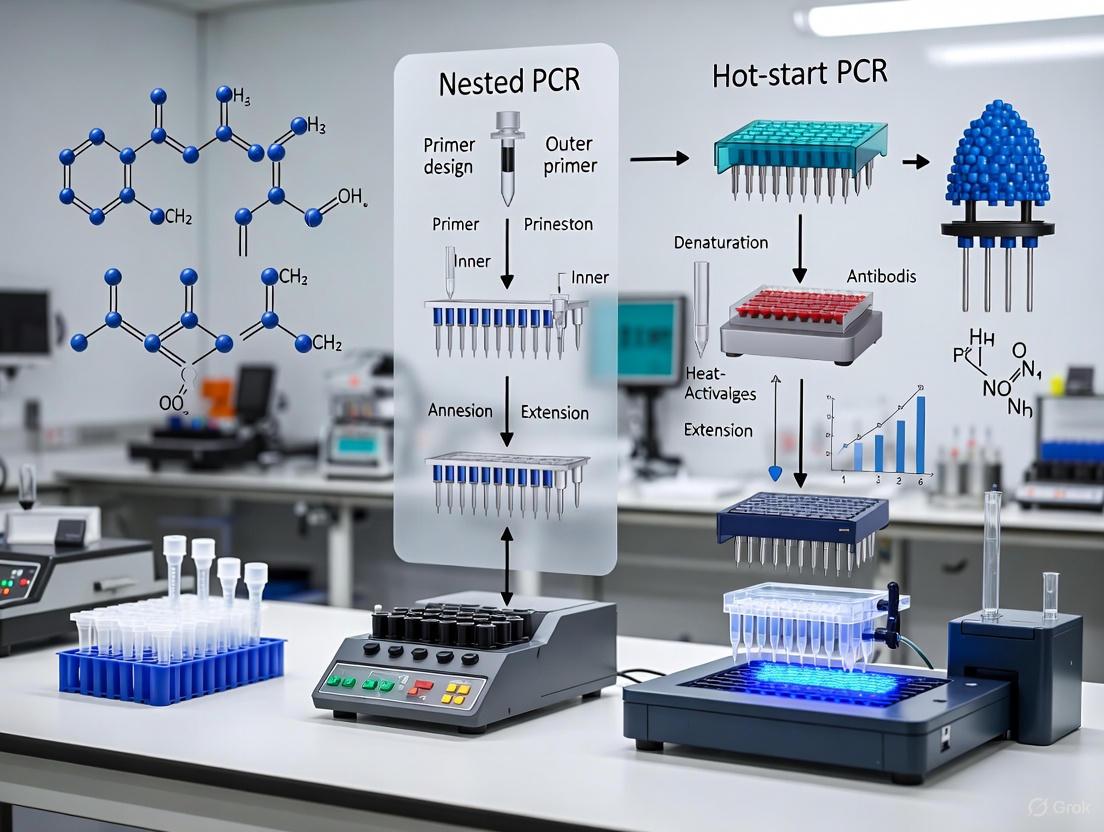
This article provides a comprehensive comparison of nested PCR and hot-start PCR, two fundamental techniques for enhancing amplification specificity in molecular biology and diagnostic applications.
Nested PCR vs. Hot-Start PCR: A Strategic Guide to Maximizing Specificity and Sensitivity
Abstract
This article provides a comprehensive comparison of nested PCR and hot-start PCR, two fundamental techniques for enhancing amplification specificity in molecular biology and diagnostic applications. Tailored for researchers, scientists, and drug development professionals, it explores the foundational principles, distinct mechanisms, and optimal application scenarios for each method. The scope ranges from practical protocol setup and troubleshooting to a rigorous validation of their performance in sensitivity, specificity, and suitability for challenging samples like those with low pathogen load or high inhibitor content. The objective is to deliver a decisive guide for selecting the appropriate technique to overcome nonspecific amplification and improve assay reliability in both research and clinical settings.
Core Principles: How Nested and Hot-Start PCR Tackle Specificity
In molecular biology, the polymerase chain reaction (PCR) is a foundational technique for amplifying specific DNA sequences. However, conventional PCR is frequently plagued by a significant challenge: nonspecific amplification. This issue manifests as unintended DNA products, such as primer-dimers and amplification of non-target sequences, which compete for precious reagents and can compromise the sensitivity, accuracy, and reliability of downstream applications [1] [2]. For researchers, scientists, and drug development professionals, navigating and mitigating these artifacts is crucial for generating robust, reproducible data. This guide objectively compares two principal strategies—nested PCR and hot-start PCR—developed to overcome this fundamental limitation, providing a detailed analysis of their mechanisms, experimental protocols, and performance data.
The Roots of the Problem: Understanding Nonspecific Amplification
Nonspecific amplification in conventional PCR primarily stems from the activity of DNA polymerases at non-optimal, low temperatures. When a PCR reaction mixture is assembled at room temperature, the following events can occur:
- Mispriming: The DNA polymerase retains some enzymatic activity at ambient temperatures. This allows primers to anneal to template sequences with low homology, and the polymerase can extend these misprimed sequences, initiating the synthesis of unintended products [2] [3].
- Primer-Dimer Formation: At lower temperatures, PCR primers can anneal to each other via short regions of complementarity. The DNA polymerase can then extend these annealed primers, producing short, artifactual "primer-dimer" products [4] [5]. These dimers compete with the target DNA for dNTPs, primers, and enzyme activity, drastically reducing the yield and sensitivity of the desired amplification [2].
The following diagram illustrates the logical relationship between the setup conditions of conventional PCR and the resulting specific versus nonspecific outcomes.
Comparative Strategies to Enhance Specificity
To combat nonspecific amplification, two major methodological adaptations were developed: nested PCR and hot-start PCR. Each employs a distinct mechanism to ensure that amplification is predominantly restricted to the intended target.
Strategy 1: Nested PCR
Nested PCR enhances specificity through a two-stage amplification process using two sets of primers [4] [6]. The first round of PCR uses an outer primer pair that flanks the target region. An aliquot of this first-round product is then used as the template for a second round of PCR with an inner primer pair (or nested primers) that bind within the first amplicon [7]. This two-step process ensures that even if the first round produces nonspecific products, it is highly improbable that the same nonspecific region would be recognized and amplified by the second, internal set of primers [4] [6].
Strategy 2: Hot-Start PCR
Hot-start PCR addresses the root cause of nonspecificity by inhibiting DNA polymerase activity during reaction setup. This is achieved by modifying the polymerase with an antibody, affibody, aptamer, or chemical group that blocks its active site at room temperature [4] [5] [3]. The polymerase is only activated during the initial high-temperature denaturation step in the thermal cycler (typically >90°C), which releases the inhibitor. By this time, the reaction temperature is too high for nonspecific primer binding, thereby preventing the extension of misprimed sequences and primer-dimers [5] [3].
The workflow below contrasts the procedural steps of conventional PCR with the two specificity-enhancing strategies.
Direct Comparison: Nested PCR vs. Hot-Start PCR
The following table provides a structured, objective comparison of these two techniques across critical parameters relevant to experimental design and execution.
| Feature | Nested PCR | Hot-Start PCR |
|---|---|---|
| Core Principle | Two consecutive amplification rounds with two primer sets [4] [6] | Single amplification round with a thermally activated polymerase [5] [3] |
| Primary Mechanism for Specificity | Selectively re-amplifying the correct first-round product with internal primers [7] [6] | Preventing polymerase activity during reaction setup to block initiation of nonspecific products [4] [5] |
| Key Advantage | Extremely high specificity and sensitivity; can amplify low-abundance targets [7] [6] | High specificity; simple, one-tube workflow; reduced contamination risk [5] [3] |
| Major Disadvantage | High contamination risk from tube opening; more time-consuming and costly [6] | May be less effective than nested PCR for extremely challenging templates (e.g., very low copy number) [4] |
| Typical Workflow Duration | Longer (2 sequential PCR runs and transfer step) [6] | Shorter (equivalent to a single standard PCR run) [4] |
| Best Suited For | Detecting low-copy-number targets (e.g., latent viruses), validating specific amplicons from complex backgrounds [6] | Routine high-specificity amplification, high-throughput applications, multiplex PCR [4] [5] |
Experimental Protocols and Supporting Data
Detailed Protocol: Nested PCR
The following step-by-step protocol is adapted from established methodologies [6].
Materials and Reagents:
- Template DNA
- First-round primers (outer primers)
- Second-round primers (inner/nested primers)
- Thermostable DNA Polymerase (e.g., Taq DNA polymerase)
- dNTP Mixture
- 10x PCR Buffer
- MgCl₂ Solution
- Sterile Ultra-Pure Water
- PCR Tubes and Thermal Cycler
Methodology:
- First-Round PCR Amplification:
- Prepare a 25 µL reaction mixture containing:
- 1-2 µL Template DNA
- 0.5 µL of each outer primer (final concentration 0.2 µM)
- 0.5 µL dNTP mixture (final concentration 200 µM each)
- 2.5 µL 10x PCR Buffer
- 1.5 µL MgCl₂ (final concentration 1.5-2.0 mM)
- 0.25 µL Taq DNA Polymerase (1.25 U)
- Sterile water to 25 µL.
- Run the following thermal cycler program:
- Initial Denaturation: 94°C for 2 minutes.
- 30-35 cycles of:
- Denaturation: 94°C for 30 seconds.
- Annealing: 45-60°C (based on primer Tm) for 30 seconds.
- Extension: 72°C for 1 minute (adjust based on amplicon length).
- Final Extension: 72°C for 5 minutes.
- Hold at 4°C.
- Prepare a 25 µL reaction mixture containing:
Second-Round PCR Amplification:
- Dilute the first-round PCR product (e.g., 1:10).
- Prepare a new 25 µL reaction mixture identical to the first round, but using 1-2 µL of the diluted first-round product as the template and the inner primers.
- Run the same thermal cycler program as the first round.
Analysis:
- Analyze both the first- and second-round products using agarose gel electrophoresis. The second round should show a clear, specific band of the expected size with a significant reduction in nonspecific background [6].
Detailed Protocol: Hot-Start PCR
Hot-start PCR simplifies the workflow by integrating specificity into the reaction chemistry.
Materials and Reagents:
- All standard PCR components.
- Hot-Start DNA Polymerase (e.g., antibody-inactivated, chemical-modified, or aptamer-based) [5].
Methodology:
- Reaction Assembly:
- Prepare the PCR master mix on the benchtop using the hot-start enzyme. The polymerase remains inactive.
- Thermal Cycling:
- The critical difference is the initial denaturation step. This step must be extended to ensure complete activation of the hot-start polymerase. For example:
- Initial Denaturation: 95°C for 2-5 minutes (follow manufacturer's guidelines) [3].
- This high temperature both activates the enzyme and denatures the template.
- Proceed with standard cycling steps (denaturation, annealing, extension) for 25-40 cycles.
- The critical difference is the initial denaturation step. This step must be extended to ensure complete activation of the hot-start polymerase. For example:
- Analysis:
- Analyze the PCR product by gel electrophoresis. The result should show a strong band of the desired product with little to no primer-dimer or nonspecific amplification [5].
The Scientist's Toolkit: Essential Research Reagents
The following table details key reagents and their critical functions in achieving high-specificity PCR.
| Research Reagent | Function & Importance in Specificity |
|---|---|
| Hot-Start DNA Polymerase | The core reagent for hot-start PCR; its inhibited state at low temperatures prevents primer-dimer formation and mispriming, directly boosting specificity and yield [4] [5]. |
| Sequence-Specific Primers | Short, single-stranded DNA oligonucleotides that define the start and end of the target amplicon. Optimal design (length, Tm, specificity) is fundamental to all PCR success [1] [8]. |
| dNTP Mixture | The building blocks (dATP, dCTP, dGTP, dTTP) for DNA synthesis. Balanced concentrations are crucial for efficient and accurate polymerization by the DNA polymerase [8]. |
| Magnesium Chloride (MgCl₂) | A critical cofactor for DNA polymerase activity. Its concentration can significantly impact primer annealing, enzyme fidelity, and product specificity, and often requires optimization [8]. |
| Optimized PCR Buffer | Provides the optimal chemical environment (pH, ionic strength) for polymerase activity and stability throughout the thermal cycling process [8]. |
| PCR Additives (e.g., DMSO) | Used for amplifying difficult templates like GC-rich sequences; helps denature secondary structures that can hinder polymerase progress and cause nonspecific binding [4]. |
Nonspecific amplification remains a central challenge in conventional PCR, but strategic methodological choices provide powerful solutions. Nested PCR offers an exceptionally high level of specificity and sensitivity through its two-stage, two-primer-set architecture, making it ideal for detecting scarce targets, though at the cost of a more laborious workflow and higher contamination risk. In contrast, hot-start PCR incorporates specificity directly into the enzyme chemistry, providing a robust, convenient, and efficient one-tube solution that is perfectly suited for routine applications and high-throughput workflows. The choice between these techniques is not a matter of which is universally superior, but rather which is most appropriate for the specific experimental context, weighing the imperative for ultimate sensitivity against the practical constraints of time, cost, and contamination management.
Polymersse Chain Reaction (PCR) is a foundational technique in molecular biology, yet its efficacy is often compromised by a fundamental issue: the formation of nonspecific amplification products during reaction setup. Conventional PCR is vulnerable to off-target amplification because DNA polymerases possess residual activity at room temperature and lower [9] [10]. During the period when reaction components are mixed and before the thermal cycler reaches the initial denaturation temperature, this activity allows primers to bind non-specifically to DNA templates with low homology (mispriming) or to each other (primer-dimer formation) [4] [5]. These spurious products are then efficiently amplified in subsequent cycles, competing with the target amplicon for reagents, thereby reducing yield, sensitivity, and assay reliability [11].
Hot-Start PCR was developed specifically to overcome this limitation. It is a modified form of PCR designed to block DNA polymerase extension at lower temperatures, thereby preventing any enzymatic activity until the first high-temperature denaturation step begins [9]. The core principle is to keep the polymerase in an inactive state during reaction setup, only activating it after the reaction mixture has reached a temperature stringent enough to prevent non-specific primer binding [10]. This simple yet powerful concept has made Hot-Start PCR an indispensable tool for applications demanding high specificity and sensitivity, such as clinical diagnostics, forensics, and next-generation sequencing library preparation [11].
Core Mechanism: Principles of Polymerase Inhibition at Low Temperatures
The effectiveness of Hot-Start PCR hinges on a straightforward thermodynamic principle: the stability of nucleic acid hybrids is temperature-dependent. At lower temperatures (e.g., during setup on a benchtop), primers can form stable hybrids with template DNA even with partial complementarity. As the temperature increases, these imperfect hybrids dissociate, while perfectly matched primer-template hybrids remain stable up to a higher, more specific annealing temperature [4]. Hot-Start mechanisms exploit this by imposing a physical or chemical barrier between the polymerase and its substrates, ensuring no primer extension can occur until the reaction is heated to a point where only specific primer binding is stable.
The initial thermal cycle itself is critical for activating the polymerase. A typical protocol involves a prolonged initial denaturation step at 95°C for 2-5 minutes [5]. This extended high-temperature incubation serves two purposes: it fully denatures the complex template DNA and, crucially, inactivates or releases the inhibitory agent (antibody, chemical modifier, etc.) that was blocking the polymerase. Once this step is complete, the thermal cycling proceeds as in conventional PCR, but with a polymerase that is now fully active and operating in a milieu where non-specific priming has been vastly reduced [4] [10]. This results in a significant increase in the specificity and yield of the desired amplicon, which is especially critical when amplifying low-copy-number targets or in complex multiplex reactions [11].
A Comparative Analysis of Hot-Start Technologies
The fundamental goal of inhibiting polymerase activity at room temperature has been achieved through several distinct biochemical strategies. The most common methods involve the use of antibody-based inhibitors, chemical modification, affibody/aptamer binding, and physical separation.
Table 1: Comparison of Primary Hot-Start PCR Technologies
| Technology | Mechanism of Inhibition | Activation | Key Benefits | Common Examples |
|---|---|---|---|---|
| Antibody-Based [4] [5] | An antibody binds the polymerase's active site, sterically blocking it. | Short initial denaturation (e.g., 95°C for 2 min) denatures the antibody. | Fast activation; full enzyme activity restored; high specificity. | Platinum Taq, DreamTaq Hot Start [5] |
| Chemical Modification [5] [4] | Polymerase is covalently modified with thermolabile groups to block activity. | Longer initial heat step required to cleave the chemical modifiers. | Very stringent inhibition; animal-origin-free. | AmpliTaq Gold [5] |
| Affibody-Based [5] | A small, engineered protein (Affibody) binds and inhibits the polymerase. | Short initial denaturation releases the Affibody. | Less exogenous protein than antibodies; animal-origin-free. | Phire Hot Start II [5] |
| Aptamer-Based [9] [10] | A short, specific oligonucleotide binds to the polymerase. | Heat denaturation dissociates the aptamer. | Short activation time; animal-origin-free. | OneTaq Hot Start [10] |
| Physical Barrier [12] [9] | Components are physically separated by a wax barrier until heating. | Wax melts during initial denaturation, mixing components. | Simple principle; no enzyme modification required. | AmpliWax beads [10] |
| Primer-Based [11] | Primers are synthesized with thermolabile groups (e.g., OXP) at the 3' end. | Heat cleaves the groups, generating a extendable 3'-OH. | Inhibition is part of the primer; highly specific. | OXP-modified primers [11] |
| E. coli Separation [13] | Taq polymerase is physically sequestered inside E. coli cells. | Initial denaturation lyses the cells, releasing active polymerase. | Cost-effective; no enzyme purification needed. | EcoliTaq [13] |
The following diagram illustrates the general workflow of a Hot-Start PCR reaction, highlighting the critical inhibition and activation steps that differentiate it from conventional PCR.
Experimental Protocols for Assessing Hot-Start Performance
Protocol: Evaluating Specificity via Endpoint PCR
This protocol is designed to directly compare the performance of a hot-start polymerase with a non-hot-start counterpart, using gel electrophoresis to visualize the specificity and yield of amplification [4] [13].
- Reaction Setup: Prepare two identical master mixes containing 1X PCR buffer, 200 µM of each dNTP, 0.2 µM of forward and reverse primers, and 10-50 ng of genomic DNA template.
- Polymerase Addition: Aliquot the master mix into two tubes. To the first tube, add a standard Taq DNA polymerase. To the second tube, add an antibody-based hot-start Taq DNA polymerase (e.g., Platinum Taq) at the same unit concentration [5] [13].
- Thermal Cycling: Place both tubes in a thermal cycler and run the following program:
- Initial Denaturation/Activation: 95°C for 2 minutes (This activates the hot-start enzyme).
- 35 Cycles of:
- Denaturation: 95°C for 30 seconds
- Annealing: 55-60°C for 30 seconds
- Extension: 72°C for 1 minute per kb
- Final Extension: 72°C for 5 minutes.
- Analysis: Analyze 5-10 µL of each PCR product by agarose gel electrophoresis (e.g., 1.5% gel). Stain with ethidium bromide or SYBR Safe and visualize under UV light.
- Expected Outcome: The reaction with the standard polymerase may show multiple non-specific bands and/or primer-dimer smears near the well. The reaction with the hot-start polymerase should display a single, sharp band corresponding to the target amplicon with little to no background [13].
Protocol: Quantifying Sensitivity with Real-Time PCR
This protocol uses real-time PCR (qPCR) to measure the improvement in sensitivity and efficiency gained by hot-start technology, particularly for low-abundance targets [11].
- Template Dilution: Prepare a serial dilution of the target DNA template (e.g., 10^6, 10^5, 10^4, 10^3, and 10^2 copies per reaction).
- Reaction Setup: For each dilution, set up qPCR reactions using a hot-start DNA polymerase master mix (e.g., Platinum SYBR Green qPCR SuperMix) and an equivalent non-hot-start master mix. Include a no-template control (NTC) for both.
- Thermal Cycling: Run the reactions in a real-time PCR instrument with standard cycling conditions (e.g., 50°C for 2 min, 95°C for 2 min, followed by 40 cycles of 95°C for 15 sec and 60°C for 30 sec with fluorescence acquisition).
- Data Analysis:
- Compare the Ct (Threshold Cycle) values for each dilution. A lower Ct in the hot-start reactions indicates higher sensitivity.
- Assess the amplification efficiency from the standard curve. Hot-start reactions typically yield efficiencies closer to 100%.
- Examine the NTC. The hot-start reaction should show a significantly delayed or absent signal in the NTC, indicating effective suppression of primer-dimer amplification [11] [10].
Performance Data: Specificity, Yield, and Sensitivity
The theoretical advantages of Hot-Start PCR are consistently borne out in experimental data. The following table summarizes quantitative and qualitative performance metrics from key studies.
Table 2: Experimental Performance Data of Hot-Start PCR
| Performance Metric | Standard PCR | Hot-Start PCR | Experimental Context & Citation |
|---|---|---|---|
| Non-Specific Amplification | Significant primer-dimer and mispriming products observed on gel [13] | Drastic reduction or elimination of spurious bands; single, clean target band [13] | Multiplex PCR amplification of lambda DNA using EcoliTaq [13] |
| Amplicon Yield | Reduced yield due to competition from non-specific products | >50% increase in target product yield | Endpoint PCR analysis of a specific genomic target [5] |
| Detection Sensitivity | Lower sensitivity; may fail to detect low-copy targets | Successful detection from <200 CFU/mL in direct PCR from blood | Direct pathogen detection from whole blood using optimized EcoliTaq [13] |
| Real-Time PCR NTC Ct | Low Ct in No-Template Control due to primer-dimer | >5 cycle delay in NTC Ct, indicating superior suppression | SYBR Green qPCR assay with OXP-modified primers [11] |
| Assay Robustness | Highly susceptible to inhibitors in complex samples (e.g., blood) | Effective amplification from crude samples (whole blood) with inhibitor-tolerant enzymes | Direct PCR from whole blood using a specialized buffer with EcoliTaq [13] |
The Scientist's Toolkit: Essential Reagents for Hot-Start PCR
Successful implementation of Hot-Start PCR relies on a set of key reagents, each serving a specific function to ensure inhibition, activation, and efficient amplification.
Table 3: Essential Research Reagents for Hot-Start PCR
| Reagent / Solution | Function / Role in Hot-Start PCR | Example & Notes |
|---|---|---|
| Hot-Start DNA Polymerase | The core enzyme, inhibited at low temperatures and activated by heat. | Platinum II Taq (Antibody-based): Fast activation, high specificity [5]. AmpliTaq Gold (Chemical): Stringent inhibition, requires longer activation [5]. |
| Thermostable Buffer | Provides optimal ionic and pH conditions for polymerase activity after activation. | Often supplied as a 10X concentrate with MgCl₂. May require optimization for specific templates [13]. |
| Magnesium Chloride (MgCl₂) | Essential co-factor for DNA polymerase. Its concentration can affect specificity and yield. | Typically supplied with the buffer. Note: Some physical methods involve withholding Mg²⁺ until activation [9]. |
| Modified Primers | For primer-based hot-start methods, these contain thermolabile groups that block extension. | OXP-modified primers: Thermolabile 4-oxo-1-pentyl group at the 3' end is cleaved by heat to allow extension [11]. |
| PCR Enhancers / Additives | Compounds that help amplify difficult templates (e.g., GC-rich) which may be used alongside hot-start. | DMSO, Betaine, Trehalose: Help denature secondary structures and counteract inhibitors [13] [14]. |
| Direct PCR Buffer | A specialized buffer for amplifying targets directly from crude samples without DNA purification. | Often contains additives like Tween 20 and trehalose to neutralize inhibitors in blood or cells, used with robust hot-start enzymes [13]. |
Hot-Start PCR represents a critical refinement of the standard PCR technique, directly addressing the fundamental problem of non-specific amplification at low temperatures. By employing mechanisms such as antibody inhibition, chemical modification, or novel primer engineering, Hot-Start methods effectively imprison polymerase activity until the first high-temperature denaturation step. The resulting improvement in specificity, sensitivity, and overall assay robustness is not merely incremental; it is often the decisive factor enabling successful amplification in demanding applications like molecular diagnostics, multiplex PCR, and low-copy-number target detection. As PCR continues to be a cornerstone of genetic analysis, the Hot-Start mechanism remains an essential, proven strategy for ensuring data quality and reliability.
In the realm of molecular biology, achieving impeccable specificity and sensitivity in polymerase chain reaction (PCR) amplification remains a paramount objective, particularly in demanding applications such as diagnostic assay development and low-abundance target detection. Among the various techniques devised to enhance PCR performance, Nested PCR and Hot-Start PCR represent two fundamental strategies aimed at optimizing amplification fidelity. While Hot-Start PCR employs a sophisticated mechanism to suppress non-specific amplification during reaction setup, Nested PCR utilizes a rigorous two-round amplification process with dual primer sets to confer exceptional specificity and sensitivity [4] [2]. This guide provides a detailed comparative analysis of these methodologies, examining their underlying mechanisms, experimental protocols, and performance characteristics to inform strategic selection for research and development applications.
Mechanism and Workflow: A Comparative Visual Guide
The core distinction between Nested PCR and Hot-Start PCR lies in their fundamental approach to enhancing specificity. The following diagrams illustrate the operational workflow for each technique.
Nested PCR Mechanism
Nested PCR achieves ultra-high specificity through a sequential two-round amplification process using two sets of primers. The first round employs an outer primer pair to amplify a larger target region. This initial product then serves as the template for a second amplification round using inner primers (nested primers) that bind within the first amplicon, ensuring that only the specific target is exponentially amplified [4] [15] [16].
Hot-Start PCR Mechanism
Hot-Start PCR enhances specificity by preventing enzymatic activity during reaction setup at room temperature. This is typically achieved by using polymerases complexed with antibodies, aptamers, or chemical modifiers that inhibit activity until an initial high-temperature denaturation step releases the active enzyme, thereby minimizing primer-dimer formation and mispriming [4] [2] [17].
Performance Comparison: Quantitative Data Analysis
The strategic differences in these mechanisms translate to distinct performance profiles, as evidenced by experimental data from methodological studies.
Table 1: Comparative Performance of Nested PCR vs. Hot-Start PCR
| Performance Parameter | Nested PCR | Hot-Start PCR | Experimental Context |
|---|---|---|---|
| Detection Sensitivity | 3.1 fg/μL genomic DNA [18] | Not quantitatively specified | Detection of Fusarium tricinctum using CYP51C gene target [18] |
| Specificity Enhancement | Dramatically increases specificity by requiring two independent primer binding events; effectively eliminates spurious amplification [15] [16] | Reduces nonspecific amplification and primer-dimer formation by preventing polymerase activity at low temperatures [4] [2] | General methodological characterization across multiple applications |
| Optimal Use Cases | Ideal for samples with low target concentration or high background DNA (e.g., host-associated microbiota) [19] | Recommended for high-throughput setups at room temperature and multiplex PCR applications [4] | Pathogen detection in complex matrices [19] [18] |
| Relative Process Complexity | High (two successive reactions with tube transfer) [15] [16] | Low (single reaction with modified polymerase) [4] [2] | Standard laboratory workflow assessment |
| Contamination Risk | Elevated due to transfer of first-round products [15] [16] | Minimal (single closed-tube reaction) [4] | Laboratory practice observations |
Table 2: Application-Based Method Selection Guide
| Application Scenario | Recommended Method | Rationale |
|---|---|---|
| Low-Abundance Targets | Nested PCR | Two amplification rounds significantly enhance detection sensitivity for rare targets [19] [18] |
| High-Throughput Screening | Hot-Start PCR | Simplified workflow with room temperature setup capability enables processing efficiency [4] |
| Complex Background Matrices | Nested PCR | Second amplification with internal primers ensures target specificity amidst competing DNA [19] [16] |
| Multiplex Amplification | Hot-Start PCR | Suppression of primer-dimer formation improves multiplex reaction efficiency [4] |
| Field Applications | Modified Nested PCR (one-tube) | Single-tube approaches balance sensitivity with reduced contamination risk [15] |
Experimental Protocols and Research Reagent Solutions
Implementation of these PCR enhancement strategies requires specific experimental protocols and specialized reagents. The following section outlines core methodologies and key research solutions.
Detailed Nested PCR Protocol
The following protocol adapts established nested PCR methodologies for detection of specific targets [15] [18]:
First-Round Amplification
- Reaction Assembly: Combine template DNA (1-2 μL), outer primers (0.5 μL each, final concentration 0.2 μM), dNTP mixture (0.5 μL, 200 μM each), 10× PCR buffer (2.5 μL), MgCl₂ (1.5 μL, 1.5-2.0 mM), Taq DNA polymerase (0.25 μL, 1.25 U), and sterile ultrapure water to 25 μL total volume [15].
- Thermal Cycling:
- Initial Denaturation: 94°C for 2 minutes
- 30-35 Cycles of:
- Denaturation: 94°C for 30 seconds
- Annealing: 45-60°C (primer-specific) for 30 seconds
- Extension: 72°C for 1 minute per 1 kb of amplicon
- Final Extension: 72°C for 5 minutes [15]
Second-Round Amplification
- Template Dilution: Dilute the first-round PCR product (typically 1:10 to 1:100) to minimize carryover of primers and reagents [15].
- Reaction Assembly: Combine diluted first-round product (1-2 μL) with inner primers (0.5 μL each) and other components as in the first round for a 25 μL total volume [15].
- Thermal Cycling: Use identical parameters to the first round [15].
- Product Analysis: Verify amplification specificity by agarose gel electrophoresis, observing enhanced specificity and yield in the second round [15].
Hot-Start PCR Protocol
Hot-Start PCR implementation is more straightforward, primarily requiring specialized polymerase formulations [4] [2]:
- Reaction Assembly: Combine template DNA, primers, dNTPs, reaction buffer, and Hot-Start DNA polymerase (e.g., antibody-inhibited formulations such as Platinum II Taq or GoTaq G2 Hot Start Polymerase) [4] [2].
- Thermal Cycling:
Essential Research Reagent Solutions
Table 3: Key Reagents for High-Fidelity PCR Methods
| Reagent / Solution | Function in Protocol | Specific Examples / Formulations |
|---|---|---|
| Hot-Start DNA Polymerase | Core enzyme with inhibited activity at room temperature; critical for Hot-Start PCR specificity | Antibody-bound Taq polymerase (Platinum II Taq, GoTaq G2 Hot Start) [4] [2] |
| Proofreading Polymerase Blends | Enable long-range amplification with reduced error rates; often used in first round of nested PCR | Blends of Taq (rapid extension) and high-fidelity enzymes (e.g., Pfu) for accurate long-fragment amplification [2] |
| Specific Primer Sets | Outer and inner primers designed for sequential binding in nested PCR; critical for specificity | Primers designed with 15-30 bp length, 40-60% GC content, and Tm within 5°C; 3'-end GC clamp recommended [20] [15] |
| PCR Additives/Enhancers | Disrupt secondary structures in GC-rich templates; improve amplification efficiency | DMSO (1-10%), formamide (1.25-10%), betaine (0.5-2.5 M), and glycerol [20] [17] |
| dNTP Mixture | Building blocks for DNA synthesis; balanced concentration critical for fidelity | 200 μM of each dNTP (dATP, dCTP, dGTP, dTTP) in standard reactions [20] [15] |
Methodological Variations and Advanced Applications
Beyond standard implementations, both Nested PCR and Hot-Start PCR have evolved to address specific research challenges through methodological adaptations.
Nested PCR Modifications
- Semi-Nested PCR: Utilizes three primers total—one primer from the first amplification is reused with one new internal primer in the second round, simplifying design while maintaining enhanced sensitivity [15] [16].
- Single-Tube Nested PCR: Both amplification rounds occur in the same tube using primers with distinct annealing temperatures (outer primers: higher Tm; inner primers: lower Tm), significantly reducing contamination risk [15].
- Reverse Transcriptase Nested PCR (RT-Nested PCR): Combines reverse transcription of RNA with nested PCR amplification, enabling highly sensitive detection of low-copy RNA transcripts such as viral pathogens [15].
- Consensus Nested PCR: Employs degenerate primers targeting conserved sequences across related species or strains, enabling detection of unknown variants within a genus [15].
Hot-Start PCR in Multiplex Applications
Hot-Start PCR is particularly valuable in multiplex PCR applications where multiple primer pairs amplify distinct targets simultaneously. The inhibition of nonspecific amplification at low temperatures prevents cross-primer interactions and primer-dimer formation, enabling efficient co-amplification of multiple targets in a single reaction [4].
The strategic selection between Nested PCR and Hot-Start PCR hinges on specific experimental requirements and sample characteristics. Hot-Start PCR offers a streamlined approach to enhancing specificity in standard amplification contexts, particularly benefiting high-throughput workflows and multiplex applications where convenience and contamination control are priorities. Conversely, Nested PCR provides an uncompromising solution for challenging scenarios involving minimal template concentration, complex background DNA, or demanding specificity requirements, albeit with increased procedural complexity. Recent advances in molecular diagnostics continue to leverage both technologies, with studies demonstrating the exceptional sensitivity of nested protocols detecting down to 3.1 fg/μL of target DNA [18], while Hot-Start formulations enable robust room-temperature setup for field-deployable applications. Understanding these complementary mechanisms empowers researchers to implement optimal amplification strategies for their specific fidelity requirements in drug development and diagnostic applications.
In molecular biology, achieving high specificity in the Polymerase Chain Reaction (PCR) is paramount for accurate results across research, diagnostic, and drug development applications. Non-specific amplification, such as primer-dimers or misprimed products, can compromise data integrity, leading to false positives and reduced assay sensitivity. These challenges are particularly pronounced when amplifying rare targets, complex genomes, or in multiplex reactions where multiple targets are co-amplified. Two principal methodologies have been developed to address these critical issues: nested PCR and hot-start PCR. Each technique employs a distinct mechanistic approach to enhance the fidelity of DNA amplification. This guide provides a objective, data-driven comparison of these two foundational strategies, focusing on their operational workflows, specificity enhancement mechanisms, and optimal applications within scientific and drug development pipelines.
Fundamental Principles and Workflows
Core Principle of Hot-Start PCR
Hot-start PCR is a technique designed to suppress non-specific amplification during the initial setup stages of the PCR reaction. Its core principle relies on the reversible inhibition of the DNA polymerase enzyme until a high-temperature activation step is reached. By keeping the polymerase inactive during reaction assembly at room temperature, this method prevents the enzyme from extending primers that have bound to non-target sequences or to each other (primer-dimer formation) [4] [21]. The activation of the DNA polymerase is triggered by an initial high-temperature incubation step (usually >90°C), which dissociates the inhibitory antibody, aptamer, or chemical modifier, thereby releasing the enzyme's full activity only after the reaction components have been exposed to stringent denaturing conditions [4] [10].
Core Principle of Nested PCR
Nested PCR enhances specificity through a two-stage amplification process that employs two distinct sets of primers. The first round of PCR uses an outer set of primers to amplify a primary target from the original DNA template. The product of this first reaction is then used as the template for a second round of amplification with an inner set of primers that bind within the first PCR product [22] [23]. This sequential priming strategy drastically increases specificity because it is statistically unlikely that any non-specific products generated in the first round would contain binding sites for the second, internally-targeted primer set. Consequently, only the intended amplicon undergoes exponential amplification in the second round [4] [22].
Visualizing the Workflows
Hot-Start PCR Workflow
Diagram 1: Hot-Start PCR Workflow. The process begins with the setup of the reaction mixture containing a thermally activated DNA polymerase. An initial high-temperature step activates the enzyme, after which standard PCR cycling proceeds. The specificity gain is achieved by preventing polymerase activity during reaction setup.
Nested PCR Workflow
Diagram 2: Nested PCR Workflow. This two-stage process involves an initial amplification with outer primers. An aliquot of this product is transferred to a new reaction mixture containing primers that bind internally to the first product. This sequential priming drastically reduces non-specific products.
Comparative Experimental Data
Quantitative Performance Comparison
Table 1: Direct comparison of key performance metrics for nested PCR and hot-start PCR.
| Performance Metric | Nested PCR | Hot-Start PCR |
|---|---|---|
| Specificity Mechanism | Two sequential amplifications with internal primers [22] [23] | Chemical inhibition of polymerase until high-temperature activation [4] [21] |
| Theoretical Sensitivity | Very High (can detect single copy genes) [22] | High (up to 10⁴ copy detection) [21] |
| Primary Advantage | Overcomes amplification plateau; greatly enhanced specificity and sensitivity [22] | Suppresses primer-dimer and mispriming; suitable for high-throughput setups [4] |
| Key Limitation | High contamination risk from tube opening [22] | Less effective for extremely low-copy targets in complex backgrounds |
| Typical Hands-on Time | High (requires reaction transfer) | Low (single-tube reaction) |
| Optimal Use Case | Amplification of very low abundance targets; detection of pathogens with low viral loads [24] [22] | Standard and multiplex PCRs; high-throughput applications; complex templates (e.g., genomic DNA) [4] [21] |
Specificity Enhancement Data
Experimental data from the literature underscores the distinct strengths of each method. In one application, a high-sensitivity nested PCR was successfully developed for the detection of Leishmania parasites in samples with extremely low parasite loads, a scenario where standard PCR methods often fail [22]. The two-stage amplification process allows the first round to overcome the limitations of a low template concentration, while the second round ensures that the final detected product is specific.
In contrast, hot-start PCR demonstrates its primary benefit in suppressing nonspecific amplification at the outset. Research indicates that the use of hot-start DNA polymerase is a critical success factor for multiplex PCR assays, where multiple primer pairs are present in a single tube and the potential for primer-dimer formation is significantly elevated [4] [24]. This is quantitatively observed in gel electrophoresis results, where reactions using hot-start polymerases show clean, specific bands with a marked reduction in low molecular weight smearing indicative of nonspecific products [4].
Detailed Experimental Protocols
Hot-Start PCR Protocol
Materials & Reagents:
- Hot-Start DNA Polymerase (e.g., antibody-modified, aptamer-based)
- PCR Buffer (usually supplied with enzyme)
- MgCl₂ (1.5-2.5 mM final concentration)
- dNTP Mix (200 µM of each dNTP)
- Forward and Reverse Primers (0.1-1 µM each)
- Template DNA (10-100 ng)
- Nuclease-free Water
Methodology:
- Reaction Assembly: On ice or at room temperature, prepare a master mix containing all reaction components. The hot-start polymerase remains inactive at this stage [21].
- Initial Denaturation/Activation: Place tubes in a thermal cycler and program an extended initial denaturation step (95°C for 2-10 minutes). This step simultaneously activates the polymerase by denaturing the inhibitory antibody/aptamer and denatures the template DNA [21] [10].
- Thermocycling: Perform 25-35 cycles of:
- Denaturation: 95°C for 15-30 seconds.
- Annealing: 50-65°C for 30 seconds (temperature must be optimized for primer pair).
- Extension: 72°C for 30-60 seconds per kb of amplicon [21].
- Final Extension: A single cycle at 72°C for 5-10 minutes to ensure all amplicons are fully extended [21].
- Hold: 4°C or 10°C indefinitely.
Nested PCR Protocol
Materials & Reagents:
- Standard DNA Polymerase (e.g., Taq polymerase)
- PCR Buffer
- MgCl₂ (1.5-2.0 mM)
- dNTP Mix (200 µM of each)
- Outer Forward and Reverse Primers
- Inner (Nested) Forward and Reverse Primers
- Template DNA
- Nuclease-free Water
- Two separate sets of PCR tubes
Methodology:
- First Round PCR (Outer Amplification):
- Assemble a 25 µL reaction mixture containing the template DNA and the outer primer pair.
- Run 15-30 cycles of standard PCR with an annealing temperature optimized for the outer primers [22].
- Product Transfer: After the first round, dilute the PCR product (e.g., 1:10 to 1:1000). Transfer 1-2 µL of the diluted product to a new tube. Critical Note: This open-tube step is a primary source of potential contamination and requires careful technique [22].
- Second Round PCR (Nested Amplification):
- Prepare a fresh 25 µL reaction mixture containing the inner primer pair.
- Use the transferred diluted product from the first round as the template.
- Run another 15-30 cycles of standard PCR with an annealing temperature optimized for the inner primers [22].
- Analysis: Analyze the final product from the second round via agarose gel electrophoresis. A single, clean band of the expected size confirms successful specific amplification [22].
The Scientist's Toolkit: Essential Research Reagents
Table 2: Key reagents and their functions in nested and hot-start PCR protocols.
| Reagent / Solution | Critical Function | Considerations for Specificity |
|---|---|---|
| Hot-Start DNA Polymerase | Catalyzes DNA synthesis; inactive until heat-activated to prevent mispriming [4] [21]. | The choice of inhibition method (antibody, aptamer, chemical) can impact activation kinetics and specificity stringency [21]. |
| Proofreading Polymerase (e.g., Pfu) | High-fidelity DNA synthesis with 3'→5' exonuclease activity to correct nucleotide misincorporation [8]. | Reduces error rate in the final amplicon sequence, crucial for downstream cloning and sequencing [8]. |
| dNTP Mixture | Provides the essential nucleotides (dATP, dCTP, dGTP, dTTP) for DNA strand synthesis [8]. | Imbalanced concentrations can promote misincorporation by the polymerase, reducing yield and specificity. |
| Primers (Outer & Inner) | Short, single-stranded DNA sequences that define the start and end of the target amplicon [22] [25]. | For nested PCR, inner primers must bind within the outer amplicon. For both, Tm matching is critical [25]. |
| PCR Additives (DMSO, BSA, Betaine) | Co-solvents that help denature GC-rich templates and disrupt secondary structures [4] [17]. | Can be essential for amplifying difficult templates but often require re-optimization of annealing temperatures [4]. |
| MgCl₂ Solution | Essential cofactor for DNA polymerase activity; influences primer annealing and template denaturation [8]. | Concentration is a key optimization parameter; too much can reduce specificity, too little can reduce yield. |
The selection between nested PCR and hot-start PCR is not a matter of which technique is universally superior, but rather which is optimal for a specific experimental context. Hot-start PCR provides a robust, single-tube solution that significantly improves specificity for routine and high-throughput applications, especially those prone to primer-dimer artifacts like multiplex PCR. Its simplicity and compatibility with automation make it the first choice for many diagnostic and quality control workflows. Nested PCR, despite its more labor-intensive and open-tube nature, remains a powerful tool for pushing the limits of detection sensitivity. Its two-stage amplification process makes it indispensable for applications like detecting low-abundance pathogens [22], identifying rare genetic variants, or working with heavily degraded samples.
A prevailing trend in molecular biology is the strategic combination of these techniques. Many researchers now employ hot-start polymerases within nested PCR protocols to gain a dual layer of specificity control: the hot-start mechanism suppresses early mispriming in both the first and second rounds of amplification, while the nested primer strategy ensures ultimate target specificity. This synergistic approach, supported by the reagent toolkit outlined, empowers researchers and drug developers to achieve the highest possible specificity and sensitivity, thereby generating reliable and reproducible data.
Protocols in Practice: Implementing Hot-Start and Nested PCR in the Lab
In the pursuit of reliable genetic analysis, the comparison of specificity between nested PCR and hot-start PCR remains a central focus in molecular biology research. While nested PCR enhances specificity and yield by using two successive primer sets, its requirement for reaction tube transfer between amplification rounds increases contamination risks and procedural complexity [4]. In contrast, hot-start PCR addresses the fundamental challenge of non-specific amplification at the source by employing sophisticated reagent modifications that maintain polymerase inactivity until optimal cycling temperatures are reached [9]. This methodological approach prevents the formation of primer-dimers and mis-primed products that commonly occur during reaction setup at lower temperatures, offering a streamlined, single-tube solution for applications demanding high specificity [11].
This guide provides an objective comparison of hot-start PCR methodologies, presents supporting experimental data, and details a standardized one-tube protocol suitable for research and diagnostic applications where specificity, sensitivity, and efficiency are paramount.
Hot-Start PCR Mechanism and Reagent Solutions
Core Principle of Hot-Start PCR
The fundamental principle of hot-start PCR involves the reversible inhibition of DNA polymerase activity during reaction setup and the initial heating phase. By employing specialized biochemical modifications, the method prevents enzymatic activity at room temperature, thereby eliminating opportunities for non-specific priming events that compromise conventional PCR specificity [4]. The activation of polymerase function occurs only during the initial high-temperature denaturation step (typically >90°C), ensuring that primer extension begins under conditions of stringent hybridization [9].
Key Reagent Solutions for Hot-Start PCR
Multiple biochemical approaches have been developed to implement the hot-start principle, each with distinct mechanisms and performance characteristics. The table below summarizes the primary technologies available:
Table 1: Comparison of Hot-Start PCR Reagent Technologies
| Technology Type | Mechanism of Action | Activation Requirements | Key Advantages | Potential Limitations |
|---|---|---|---|---|
| Antibody-Based [4] [9] | Antibodies bind to and inhibit DNA polymerase | High temperature (>90°C) degrades antibodies | Rapid activation, high specificity | Potential residual antibody interference |
| Chemical Modification [26] | Heat-labile groups block enzyme active sites | Temperature-dependent removal | Room temperature setup flexibility | Longer activation time may be required |
| Primer-Based [11] | Thermolabile modifications at 3' primer end | Heat converts modifications to natural form | Use with standard Taq polymerase | Requires specialized primer synthesis |
| Wax Barrier [9] | Physical separation of reaction components | Wax melts at high temperature | Compatibility with various enzymes | Additional preparation step required |
| Aptamer-Based [9] | Oligonucleotides bind and inhibit polymerase | High temperature disrupts binding | Highly specific inhibition | May require optimization |
The following diagram illustrates the operational workflow and mechanism of antibody-based hot-start PCR, one of the most widely implemented approaches:
Comparative Performance Analysis
Specificity and Sensitivity Metrics
To quantitatively evaluate the performance of hot-start PCR against conventional approaches, we analyzed experimental data from multiple studies focusing on specificity and sensitivity parameters. The following table summarizes key performance metrics:
Table 2: Performance Comparison of Hot-Start PCR vs. Conventional Methods
| Performance Parameter | Conventional PCR | Antibody-Mediated Hot-Start | Chemical Modification Hot-Start | Primer-Based Hot-Start |
|---|---|---|---|---|
| Non-Specific Amplification | High (Baseline) | 70-90% Reduction [4] | 60-85% Reduction [26] | 50-80% Reduction [11] |
| Primer-Dimer Formation | Significant | Minimal [11] | Minimal to Moderate | Moderate Reduction |
| Detection Sensitivity | 1×10³ copies | 1-10 copies [11] | 10-100 copies | 10-100 copies |
| Amplification Efficiency | Variable | High (>90%) [4] | High (85-95%) | Moderate to High |
| Inhibition Tolerance | Low | Moderate to High [4] | Moderate | Moderate |
Research by D. Brown et al. demonstrated that primer-based hot-start methods utilizing 4-oxo-1-pentyl (OXP) modifications at the 3'-terminal region resulted in significant improvements in amplification specificity, particularly for low-copy number targets (≤10 copies) in complex genomic backgrounds [11]. Similarly, antibody-based systems such as Platinum Taq DNA Polymerase have shown consistent performance in multiplex PCR applications where multiple primer sets compete for reaction components [4].
Application-Specific Performance
The performance advantages of hot-start PCR vary significantly across different applications. The following experimental data highlights these application-specific benefits:
Table 3: Application-Specific Performance of Hot-Start PCR Methods
| Application Type | Optimal Hot-Start Method | Key Performance Improvement | Experimental Findings |
|---|---|---|---|
| Multiplex PCR [4] [27] | Antibody-Based | 3-5x more targets amplified simultaneously | Enables co-amplification of up to 15 targets in single reaction |
| GC-Rich Amplification [4] | Chemical Modification | 70-80% success rate with difficult templates | Successful amplification of templates with >80% GC content |
| Fast Cycling PCR [4] | Antibody-Based | 50-60% reduction in cycling time | Maintains specificity with 15-30 second extension steps |
| Direct PCR [4] | High Processivity Enzymes | Bypasses DNA purification step | Effective amplification from crude samples (cells, tissue) |
| Reverse Transcription PCR [11] | Primer-Based | Compatible with one-step RT-PCR | Maintains stringency despite low RT temperature requirements |
Standardized One-Tube Hot-Start PCR Protocol
Reagent Preparation and Experimental Workflow
The following standardized protocol utilizes antibody-mediated hot-start polymerase for optimal specificity and reproducibility. The entire procedure is completed in a single tube, minimizing contamination risk while maximizing experimental consistency.
Table 4: Master Mix Formulation for Standardized Hot-Start PCR
| Component | Final Concentration | Volume per 25μL Reaction | Quality Control Notes |
|---|---|---|---|
| Hot-Start PCR Buffer (10X) | 1X | 2.5 μL | Include MgCl₂ at optimal 1.5-2.5mM |
| Antibody-Mediated Hot-Start Polymerase | 0.5-1.25 U/reaction | 0.5 μL | Verify complete inhibition at room temperature |
| dNTP Mix | 200 μM each | 0.5 μL | Use purified, pH-balanced nucleotides |
| Forward Primer | 0.1-0.5 μM | 0.5-2.5 μL | HPLC-purified, resuspended in TE buffer |
| Reverse Primer | 0.1-0.5 μM | 0.5-2.5 μL | HPLC-purified, resuspended in TE buffer |
| Template DNA | 1pg-100ng | 1-5 μL | Volume varies by concentration |
| Nuclease-Free Water | - | To 25 μL | Certified PCR-grade, sterile filtered |
The following diagram illustrates the complete experimental workflow from reagent preparation through analysis:
Cycling Conditions and Optimization Guidelines
The thermal cycling profile represents a standardized framework that requires minimal optimization for most applications:
Initial Activation/Denaturation: 95°C for 2 minutes
- Critical for full polymerase activation in antibody-based systems
Amplification Cycling (30-40 cycles):
- Denaturation: 95°C for 15-30 seconds
- Annealing: 45-68°C (primer-specific) for 15-30 seconds
- Extension: 68-72°C for 15-60 seconds/kb
Final Extension: 72°C for 5-10 minutes
For targets with high GC content (>65%), the initial denaturation temperature may be increased to 98°C, and the inclusion of PCR enhancers such as DMSO (3-10%) or betaine (1-1.5M) is recommended [4]. When transitioning to fast cycling protocols, extension times can be reduced by 50% or more when using highly processive polymerases capable of synthesizing DNA at rates exceeding 100 nucleotides per second [4].
Discussion: Implications for Research and Diagnostic Applications
The implementation of hot-start PCR technology represents a significant advancement over traditional nested PCR for applications requiring high specificity. While nested PCR provides exceptional specificity through sequential amplification, its open-tube format introduces substantial contamination risks that can compromise results in sensitive diagnostic applications [4]. Hot-start PCR maintains the convenience of a single-tube reaction while achieving comparable specificity through biochemical inhibition mechanisms.
The choice between hot-start methods should be guided by application requirements. Antibody-based systems offer rapid activation and are ideal for multiplex applications and fast cycling protocols [4]. Chemical modification approaches provide flexibility for room temperature setup and are particularly effective for GC-rich templates [26]. Primer-based methods enable hot-start capability with standard polymerase enzymes, offering a cost-effective alternative without sacrificing performance [11].
For research and drug development professionals, the standardized protocol presented here provides a robust foundation for genetic analysis, with particular utility in low-copy number detection, multiplex assay development, and diagnostic test formulation where reproducibility and specificity are critical. As PCR technologies continue to evolve, the principles of hot-start activation remain fundamental to achieving reliable amplification across diverse experimental contexts.
In the realm of molecular biology, achieving high specificity in polymerase chain reaction (PCR) is paramount for accurate genetic analysis. While conventional PCR utilizes a single pair of primers to amplify target DNA, it often suffers from non-specific amplification due to primers binding to non-target sequences with low homology, a phenomenon known as mispriming [4]. To overcome this limitation, researchers have developed refined techniques including nested PCR and hot-start PCR, each employing distinct mechanisms to enhance amplification specificity [4] [12]. This guide provides a comprehensive comparison of these methodologies, with detailed protocols and experimental data to inform researchers and drug development professionals in selecting the appropriate technique for their specific applications.
Nested PCR significantly enhances detection specificity and sensitivity through a two-stage amplification process utilizing two sets of primers [28] [29]. This method is particularly valuable for detecting low-abundance targets in complex samples, such as pathogen detection in clinical and environmental samples [18] [30]. In contrast, hot-start PCR employs modified DNA polymerases that remain inactive until elevated temperatures are reached, thereby preventing non-specific amplification during reaction setup [4] [10]. Understanding the relative strengths, optimal applications, and practical implementation of these techniques is crucial for experimental success in genetic diagnostics, pharmaceutical research, and molecular biology.
Principles and Mechanisms of Action
The Two-Stage Amplification of Nested PCR
Nested PCR operates on the principle of sequential amplification to enhance specificity. The process utilizes two pairs of primers: outer primers that flank the target region in the initial amplification round, and internal (nested) primers that bind within the first amplicon during the second round [28] [29]. This architectural strategy significantly reduces non-specific products because it is statistically unlikely that non-specific amplicons generated in the first round would contain binding sites for the second primer set [4]. The method substantially improves sensitivity, enabling detection of rare targets present in minute quantities—as low as 3.1 fg/μL in optimized systems [18].
The fundamental advantage of this approach lies in its verification mechanism. Even if the outer primers generate non-specific products due to mispriming, these incorrect amplicons will not be recognized and amplified by the inner primers in the second round [28]. This two-tiered recognition system ensures that only the intended target undergoes exponential amplification in both stages, resulting in significantly enhanced specificity compared to conventional PCR [29]. The dilution step between amplification rounds further reduces carryover of primers and potential inhibitors, contributing to the technique's robust performance across diverse sample types [28].
The Temperature-Activated Control of Hot-Start PCR
Hot-start PCR addresses the specificity challenge through biochemical inhibition of DNA polymerase activity at lower temperatures. Standard PCR reactions assembled at room temperature can exhibit non-specific priming and primer-dimer formation because most thermostable DNA polymerases retain partial activity even at ambient conditions [10]. As reaction temperatures ramp up to the initial denaturation temperature (typically 94-95°C), they pass through the primer elongation range (72°C), allowing any transient primer-template associations to extend into spurious products [10].
Hot-start PCR eliminates this problem by employing modified DNA polymerases that remain inactive until a specific activation temperature is reached. Common inhibition strategies include antibody-based neutralization, aptamer binding, or chemical modification of the enzyme [4] [12]. These inhibitory elements denature at high temperatures (usually above 90°C), releasing fully active polymerase only after the reaction mixture has reached stringency conditions that discourage non-specific priming [4]. This approach effectively suppresses primer-dimer formation and mispriming artifacts without requiring additional manual intervention or reaction setup modifications [12].
Figure 1: Comparative workflows of nested PCR and hot-start PCR approaches to enhance amplification specificity
Step-by-Step Experimental Protocols
Nested PCR Protocol: Primer Design and Reaction Setup
Primer Design Specifications
Successful nested PCR requires careful design of two primer pairs according to specific criteria:
Outer Primers: Design primers 15-30 nucleotides in length with optimal GC content between 40-60% [20]. The melting temperatures (Tm) should range between 52-65°C, with both primers within 5°C of each other [31] [20]. Avoid complementary sequences at 3' ends to prevent primer-dimer formation [20].
Inner Primers: Design nested primers to bind completely within the region flanked by the outer primers [31] [28]. The amplified fragment in the second round should be shorter than the first round product [28]. Ensure a minimum difference in melting temperature between inner and outer primer pairs to facilitate different annealing temperatures in each amplification round [31].
Positioning Requirements: The forward primer region must be located upstream of the forward inner primer region, which must be upstream of the reverse inner primer region, followed by the reverse primer region [31]. Online tools like NCBI Primer-BLAST or Primer3 are recommended for verifying primer specificity [20].
Reaction Setup and Thermal Cycling
First Round Amplification [28]:
- Prepare a 25μL reaction mixture containing:
- 1-2μL template DNA
- 0.5μL each outer primer (final concentration 0.2μM)
- 0.5μL dNTP mixture (final concentration 200μM each dNTP)
- 2.5μL 10× PCR buffer
- 1.5μL MgCl₂ (final concentration 1.5-2.0mM)
- 0.25μL Taq DNA polymerase (1.25U)
- Sterile ultrapure water to 25μL
- Thermal cycling conditions:
- Initial denaturation: 94°C for 2 minutes
- 30-35 cycles of:
- Denaturation: 94°C for 30 seconds
- Annealing: 45-60°C for 30 seconds (based on primer Tm)
- Extension: 72°C for 1 minute per 1kb of amplicon
- Final elongation: 72°C for 5 minutes
- Hold at 4°C
Second Round Amplification [28]:
- Dilute the first-round PCR product (typically 1:10 to 1:1000)
- Prepare a fresh 25μL reaction mixture with the same components as the first round, but replacing outer primers with inner primers and using diluted first-round product as template
- Use identical thermal cycling conditions as the first round
- Analyze both rounds of PCR products using agarose gel electrophoresis
Hot-Start PCR Protocol
Reaction Setup with Modified Polymerase
Hot-start PCR simplifies reaction setup while maintaining high specificity [4]:
Prepare a standard PCR master mix containing:
- 1X PCR buffer (usually supplied with the enzyme)
- 200μM dNTPs
- 20-50pmol of each primer
- 1.5mM Mg²⁺ (adjust if not present in buffer)
- 10²-10⁷ molecules of DNA template
- 0.5-2.5 units of hot-start DNA polymerase
- Sterile water to final volume
Commercial hot-start polymerases include:
- Antibody-inactivated enzymes (e.g., Platinum series)
- Aptamer-based inhibition systems
- Chemically modified enzymes
Thermal cycling conditions [4]:
- Initial activation/denaturation: 94-95°C for 2-10 minutes (polymerase-specific)
- 25-40 cycles of:
- Denaturation: 94-95°C for 15-30 seconds
- Annealing: Primer-specific temperature for 15-60 seconds
- Extension: 72°C for 1 minute per 1kb
- Final extension: 72°C for 5-10 minutes
- Hold at 4°C
The key advantage is the single-tube, uninterrupted reaction format that prevents contamination while ensuring specificity through biochemical control rather than procedural complexity [12] [10].
Comparative Performance Data
Sensitivity and Specificity Analysis
Table 1: Quantitative comparison of nested PCR performance across experimental applications
| Target Application | Detection Sensitivity | Specificity Validation | Reference Method Comparison |
|---|---|---|---|
| Metschnikowia bicuspidata (Eriocheir sinensis pathogen) | 6.10 × 10¹ copies/μL [30] | No cross-reaction with S. aureus, E. hepatopenaei, H. eriocheir, or various microsporidia [30] | 100x more sensitive than LSU rRNA PCR (6.03 × 10⁴ copies/μL); 1000x more sensitive than ITS rDNA PCR (6.74 × 10⁵ copies/μL) [30] |
| Areca palm phytoplasmas (16SrI and 16SrII groups) | 7.5 × 10⁻⁷ ng/μL for 16SrI; 4 × 10⁻⁷ ng/μL for 16SrII [32] | Specific detection of target phytoplasma groups; eliminated false positives from chloroplast and bacterial DNA [32] | Superior to universal primer sets (P1/P7 and R16mF2/R16mR1) which produced non-specific amplification in 36 of 50 positive samples [32] |
| Fusarium tricinctum (Zanthoxylum bungeanum pathogen) | 31 fg/μL genomic DNA [18] | High specificity for F. tricinctum compared to related Fusarium species [18] | Tenfold lower sensitivity than qPCR but with exceptional stability and reliability [18] |
Table 2: Practical implementation comparison between nested PCR and hot-start PCR
| Parameter | Nested PCR | Hot-Start PCR |
|---|---|---|
| Specificity Mechanism | Two sequential amplifications with different primer sets [28] [29] | Temperature-activated polymerase prevents non-specific initiation [4] [10] |
| Hands-on Time | High (requires reaction transfer and re-setup) [29] | Low (single-tube format) [12] |
| Contamination Risk | High (tube opening between rounds) [28] [29] | Low (closed-tube system) [10] |
| Sensitivity | Extremely high (can detect single-copy genes) [29] [30] | Standard PCR sensitivity [4] |
| Primer Design Complexity | High (requires two optimized primer pairs) [31] [28] | Standard (single primer pair) [20] |
| Optimal Application | Low-abundance targets, difficult templates, pathogen detection [18] [30] | Routine amplification, high-throughput applications, multiplex PCR [4] |
Experimental Evidence and Case Studies
Recent studies demonstrate the exceptional performance of nested PCR in challenging detection scenarios. In mycological diagnostics, nested PCR targeting the CYP51C gene enabled specific detection of Fusarium tricinctum with sensitivity approximately tenfold lower than qPCR but with superior stability and reliability for field applications [18]. This balance of sensitivity and robustness makes nested PCR particularly valuable for diagnostic laboratories with limited equipment resources.
In aquatic pathogen detection, a nested PCR system targeting the hyphally regulated cell wall protein (HYR) gene achieved a 71.1% positivity rate for Metschnikowia bicuspidata in crab samples, dramatically outperforming conventional LSU rRNA (16.7%) and ITS rDNA (24.4%) PCR methods [30]. The two-stage amplification process effectively eliminated false positives from related species while detecting extremely low pathogen concentrations (61 copies/μL) that would evade conventional detection methods.
Phytoplasma diagnostics further illustrate the specificity advantages of nested PCR. A novel primer set (HNP-1F/HNP-1R and HNP-2F/HNP-2R) developed for areca palm yellow leaf disease detection achieved sensitivity of 7.5 × 10⁻⁷ ng/μL while eliminating non-specific amplification from chloroplast and bacterial DNA that plagued universal phytoplasma primers [32]. The optimized system provided reliable detection of both 16SrI and 16SrII group phytoplasmas in a single assay, demonstrating the flexibility of nested PCR for multiple target detection.
Research Reagent Solutions
Table 3: Essential reagents and materials for implementing nested PCR and hot-start PCR
| Reagent/Material | Function | Implementation Considerations |
|---|---|---|
| Hot-Start DNA Polymerase | Catalyzes DNA synthesis only at elevated temperatures; reduces non-specific amplification [4] [10] | Available in antibody-based, aptamer-based, or chemically modified formats; selection depends on application requirements [12] |
| dNTP Mixture | Building blocks for DNA synthesis | Standard concentration 200μM of each dNTP; cleanAMP dNTPs available for enhanced hot-start applications [10] |
| MgCl₂ Solution | Cofactor for DNA polymerase activity | Typically 1.5-2.0mM final concentration; requires optimization for different templates and primer systems [28] [20] |
| PCR Buffer | Maintains optimal pH and salt conditions for amplification | Often supplied with polymerase; may contain Mg²⁺ or require separate addition [20] |
| Outer and Inner Primers | Sequence-specific amplification in two stages | Must follow design rules for nested PCR; minimal difference in Tm between inner and outer pairs recommended [31] [28] |
| Template DNA | Target nucleic acid for amplification | 1-1000ng genomic DNA; dilution of first-round product (1:10 to 1:1000) for second round [28] [20] |
| PCR Additives | Enhance amplification efficiency | DMSO, formamide, BSA, or betaine may be required for GC-rich targets or difficult templates [4] [20] |
Technical Considerations and Troubleshooting
Addressing Contamination in Nested PCR
The primary technical challenge in nested PCR is contamination control, as the requirement to transfer first-round amplification products to second-round reactions creates significant contamination risk [28] [29]. Implement strict physical separation of pre- and post-amplification areas, use aerosol-resistant pipette tips, and dedicate equipment for each stage of the process. Incorporate negative controls at both amplification stages to monitor contamination. Consider one-tube nested PCR systems where both primer sets are included in the initial reaction but with different annealing temperatures activated in sequential cycling phases [28].
Optimization Strategies for Enhanced Specificity
Both nested and hot-start PCR may require optimization for challenging templates:
Annealing Temperature Optimization: Perform temperature gradient PCR for both primer sets to identify optimal stringency conditions [20]. For nested PCR, the outer primers typically require higher annealing temperatures than inner primers [31].
Cycle Number Determination: Use the minimum number of cycles necessary for detectable amplification to reduce non-specific products. Typically 25-30 cycles for the first round and 20-25 cycles for the second round of nested PCR [28].
Magnesium Concentration Titration: Adjust Mg²⁺ concentration in 0.5mM increments from 1.0-4.0mM to optimize specificity and yield [20].
Additive Incorporation: For GC-rich templates or difficult secondary structures, include additives such as DMSO (1-10%), formamide (1.25-10%), or betaine (0.5-2.5M) to improve amplification efficiency [4] [20].
Nested PCR remains an indispensable tool for applications demanding extreme sensitivity and specificity, particularly when amplifying low-abundance targets from complex sample backgrounds. The two-stage amplification process provides verification of target identity that surpasses single-round amplification methods, making it particularly valuable for diagnostic applications, pathogen detection, and analysis of difficult templates [18] [32] [30]. However, this enhanced performance comes at the cost of increased hands-on time, greater contamination risk, and more complex experimental design [29].
Hot-start PCR offers a balanced solution for routine applications where specificity enhancements are needed without procedural complexity. The closed-tube format minimizes contamination concerns while providing substantial improvements in amplification specificity through biochemical control of polymerase activity [4] [10]. For high-throughput applications, multiplex assays, and standard molecular biology procedures, hot-start PCR provides the optimal balance of performance and practicality [4].
Researchers should select based on their specific application requirements: nested PCR for maximal sensitivity and verification in challenging detection scenarios, and hot-start PCR for streamlined specificity enhancement in routine applications. As molecular diagnostics continue to advance, both techniques will maintain important positions in the methodological arsenal of research scientists and drug development professionals pursuing genetic analysis with uncompromised accuracy and reliability.
In the evolving landscape of molecular biology, the demand for PCR techniques that deliver both high specificity and rapid results has intensified, particularly in diagnostic and drug development applications. This pursuit of precision frames a critical methodological comparison: while nested PCR significantly enhances detection sensitivity through a two-round amplification process, it inherently increases contamination risk and procedural complexity [4] [33]. In contrast, hot-start PCR employs sophisticated enzyme modification strategies that inhibit polymerase activity until high temperatures are reached, thereby preventing non-specific amplification during reaction setup—a fundamental advantage for multiplexing and fast-cycling applications where multiple targets and truncated timelines amplify the potential for primer-dimer formation and mispriming [4].
This guide objectively compares the performance of modern hot-start PCR systems against traditional alternatives and nested approaches, providing experimental data and protocols to empower researchers in selecting optimal methodologies for their specific applications in pharmaceutical development and clinical research.
Technical Foundations: How Hot-Start Mechanisms Enable Complex Applications
Hot-start PCR employs biochemical modifications to DNA polymerase that maintain enzyme inactivity during reaction setup at room temperature. This inhibition is crucial because it prevents non-specific primer extension that occurs when primers bind to non-target sequences with low homology or to each other (forming primer-dimers) before thermal cycling begins [4]. The activation of hot-start polymerases occurs during an initial high-temperature step (usually above 90°C), where enzyme modifiers such as antibodies, affibodies, aptamers, or chemical groups are released, restoring full polymerase activity [4].
This controlled activation mechanism provides significant advantages for complex applications:
- Multiplexing Enhancement: In reactions containing multiple primer pairs, the risk of nonspecific amplification increases exponentially. Hot-start technology ensures all primers remain unextended until the precise thermal profile is established, dramatically improving specificity for multiple concurrent amplifications [4].
- Fast-Cycling Optimization: Rapid PCR protocols benefit from hot-start mechanisms because shortened incubation times at suboptimal temperatures provide less opportunity for non-specific products to form, ensuring cleaner results despite accelerated timelines [34] [4].
- Workflow Flexibility: The temperature-controlled activation enables room-temperature setup of multiple reactions without sacrificing specificity, facilitating high-throughput experimentation [4].
Table 1: Hot-Start Activation Mechanisms and Their Characteristics
| Mechanism Type | Inhibition Method | Activation Requirements | Advantages |
|---|---|---|---|
| Antibody-based | Antibody binds polymerase active site | High temperature (≥90°C) denatures antibody | Rapid activation, no chemical remnants |
| Affibody-based | Protein scaffold inhibits activity | Initial denaturation step releases affibody | High stability, precise control |
| Chemical modification | Covalent modification blocks activity | Extended activation at high temperature | Stable at room temperature |
| Aptamer-based | Nucleic acid-based inhibition | Temperature-dependent structure change | Highly specific binding |
Performance Comparison: Hot-Start PCR vs. Alternative Methods
Speed and Efficiency in Fast-Cycling Applications
Advanced hot-start polymerases demonstrate superior performance in fast-cycling protocols due to their high processivity—the ability to incorporate more nucleotides per binding event. Experimental data with Phire Hot Start II DNA Polymerase shows an extension time of just 10-15 seconds per kilobase, requiring no separate activation step and enabling complete PCR protocols up to four times faster than standard hot-start Taq DNA polymerases [34].
In a direct comparison amplifying a 600 bp fragment from human genomic DNA, protocols with Phire Hot Start II DNA Polymerase were completed in significantly less time than with Taq DNA polymerases utilizing chemical or antibody-based hot-start technologies [34]. This acceleration stems from the fusion of a dsDNA-binding domain that increases the enzyme's processivity, allowing shorter extension times while maintaining or improving yields compared to standard hot-start Taq [34].
Table 2: Fast-Cycling Performance Comparison of DNA Polymerases
| Polymerase Type | Extension Time/kb | Activation Step Required | Relative Protocol Time | Yield Comparison |
|---|---|---|---|---|
| Standard Taq | 30-60 seconds | No | 1x (baseline) | Baseline |
| Chemical Hot-Start Taq | 30-60 seconds | Yes (additional 2-10 min) | 1.2x | Similar to baseline |
| Phire Hot Start II | 10-15 seconds | No | 0.25x | Higher yields |
| Next-Generation High-Fidelity | 15-30 seconds | Varies | 0.5x | Similar to baseline |
Specificity and Yield in Multiplexing Applications
Multiplex PCR presents unique challenges with multiple primer pairs competing in a single reaction, increasing the potential for nonspecific amplification and reduced efficiency. Hot-start technology specifically addresses these challenges by preventing primer-dimer formation and mispriming during reaction setup [4].
Experimental data demonstrates that hot-start DNA polymerases specifically formulated for multiplexing provide significantly cleaner results with multiple targets. In a comparison of PCR master mixes, Phire Green Hot Start II PCR Master Mix delivered high yields of specific product in 41 minutes for a 2 kb fragment of the human β-globin gene, whereas other master mixes provided lower yields and required lengthier protocols [34]. The specificity enhancement is particularly evident in complex multiplex reactions, where hot-start polymerases prevent cross-reactivity among multiple primer sets [4].
Sensitivity Comparison: Hot-Start vs. Nested PCR
While nested PCR is renowned for its high sensitivity, hot-start methods offer a compelling balance of sensitivity and practicality. Traditional nested PCR achieves approximately 1,000-fold sensitivity enhancement over conventional single-step PCR but carries a high contamination risk from tube opening between amplification rounds [35].
Modified nested approaches like balanced heminested PCR (B-HN) demonstrate improved sensitivity while reducing contamination concerns. In testing for Mycobacterium tuberculosis detection, B-HN showed 75% sensitivity in smear-negative, culture-positive samples compared to 60% for standard heminested PCR while maintaining 100% specificity [35]. Modern hot-start systems approach these sensitivity levels while offering greater workflow efficiency and reduced contamination risk.
Experimental Protocols and Methodologies
Fast-Cycling PCR Protocol with Hot-Start Polymerase
Application: Rapid amplification of target DNA fragments (up to 7.5 kb from gDNA, 20 kb from phage DNA) Reagents: Phire Hot Start II DNA Polymerase (stand-alone or master mix format), 5x reaction buffer, template DNA, primers, nuclease-free water [34]
Methodology:
- Reaction Setup:
- 0.5-50 ng genomic DNA or 1 pg-10 ng plasmid DNA
- 0.5 µM each forward and reverse primer
- 1x Phire Hot Start II Reaction Buffer
- 0.5 µL Phire Hot Start II DNA Polymerase per 25 µL reaction
- Nuclease-free water to final volume
Thermal Cycling Conditions (for 1-2 kb amplicon):
- Initial denaturation: 98°C for 30 seconds
- 35 cycles of:
- Denaturation: 98°C for 5-10 seconds
- Annealing: appropriate Tm for primers, 5-10 seconds
- Extension: 72°C at 10-15 seconds/kb
- Final extension: 72°C for 1 minute
- Hold: 4°C
Analysis: Direct loading of PCR products onto agarose gels when using Green Reaction Buffer formats [34]
Hot-Start Fast PCR Workflow
Multiplex PCR Protocol with Hot-Start Optimization
Application: Simultaneous amplification of multiple targets in a single reaction Reagents: Hot-start DNA polymerase formulated for multiplexing, specially formulated PCR buffer, multiple primer pairs, template DNA [4]
Methodology:
- Primer Design Considerations:
- Primer sequences should be as unique to their target as possible
- Tms of all primers should be within 5°C of each other
- Amplicons should be of distinct sizes resolvable by gel electrophoresis
- Validate each primer set in singleplex reactions first [4]
Reaction Setup:
- Use hot-start DNA polymerase with multiplex-formulated buffer
- Balance primer concentrations (typically 0.1-0.5 µM each)
- Include 3-5 mM MgCl₂ (optimize concentration)
- 1-100 ng template DNA depending on complexity
Thermal Cycling Conditions:
- Initial activation/denaturation: 95°C for 2-5 minutes
- 35-40 cycles of:
- Denaturation: 95°C for 20-30 seconds
- Annealing: 55-60°C (gradient optimization recommended) for 30-45 seconds
- Extension: 72°C for 30-60 seconds/kb (based on longest amplicon)
- Final extension: 72°C for 5-10 minutes [4]
Analysis: Agarose gel electrophoresis with appropriate molecular weight markers for distinguishing amplicon sizes [4]
Research Reagent Solutions for Hot-Start PCR Applications
Selecting appropriate reagents is crucial for success in demanding PCR applications. The following table details essential solutions for implementing hot-start PCR in multiplexing and fast-cycling setups.
Table 3: Essential Research Reagents for Advanced Hot-Start PCR Applications
| Reagent Category | Specific Examples | Function & Application Notes |
|---|---|---|
| Hot-Start DNA Polymerases | Phire Hot Start II DNA Polymerase, Platinum II Taq Hot-Start DNA Polymerase | Provides high processivity for fast cycling; inhibitor tolerance for complex samples; affibody-mediated hot start for specific multiplexing [34] [4] |
| Specialized Master Mixes | Phire Green Hot Start II PCR Master Mix, Platinum Multiplex PCR Master Mix | Pre-optimized formulations for specific applications; includes tracking dyes for direct gel loading; balanced buffer systems for multiple primer pairs [34] [4] |
| Reaction Buffers | 5x Phire Green Reaction Buffer, Multiplex PCR Buffer | Contains density reagents and tracking dyes; optimized salt concentrations; may include additives for GC-rich targets [34] |
| Enhancement Additives | GC Enhancers, PCR Additives (DMSO, betaine) | Improves amplification efficiency for difficult templates; helps denature secondary structures; reduces base composition bias [4] |
| Nucleic Acid Templates | gDNA, plasmid DNA, cDNA | Quality and purity critical for multiplex efficiency; recommended quantification and quality assessment prior to use |
| Primer Sets | Target-specific oligonucleotides | HPLC-purified recommended for multiplexing; minimal self-complementarity; similar Tms across all primer pairs in multiplex reactions [4] |
Comparative Data Analysis: Quantitative Performance Metrics
Amplification Length and Yield Comparisons
Hot-start polymerases demonstrate superior performance in amplifying longer fragments compared to standard systems. Experimental data shows that Phire Hot Start II DNA Polymerase successfully amplified all five tested genomic DNA fragments ranging from 0.6 kb to 7.5 kb with high yields, while other hot-start Taq DNA polymerases produced significantly lower yields and failed to amplify the 7.5 kb fragment [34].
In master mix comparisons, Phire Green Hot Start II PCR Master Mix produced all five amplicons (0.47 kb, 1.1 kb, 1.7 kb, 3.5 kb, and 7.5 kb) with high yields, while other hot-start PCR master mixes produced lower or no yields, with some also amplifying nonspecific products [34]. This demonstrates the value of advanced hot-start systems for applications requiring long amplicon generation.
Sensitivity and Detection Limits
While traditional nested PCR remains the gold standard for sensitivity, modern hot-start systems offer progressively improving detection limits with substantially reduced contamination risk. In tuberculosis detection research, balanced heminested PCR achieved 75% sensitivity in challenging smear-negative, culture-positive samples compared to 60% for standard heminested PCR [35]. This approach maintained 100% specificity while reducing contamination risk through single-tube methodology.
Advanced detection systems combining hot-start PCR with machine learning analysis demonstrate further improvements, with one study reporting 99.6% accuracy in classifying carbapenemase-resistant genes using real-time digital PCR with integrated amplification and melting curve analysis (AMCA) [36].
Nested vs. Hot-Start PCR Characteristic Comparison
The experimental data and performance comparisons presented demonstrate that modern hot-start PCR systems provide compelling advantages for multiplexing and fast-cycling applications. While nested PCR remains valuable for maximum sensitivity in challenging detection scenarios, hot-start methodologies offer superior workflow efficiency, reduced contamination risk, and excellent performance in complex amplification environments.
For research and diagnostic applications requiring simultaneous detection of multiple targets or rapid turnaround times, advanced hot-start polymerases like Phire Hot Start II provide the processivity, inhibitor tolerance, and specificity necessary for reliable results. The continued evolution of hot-start technologies, including integration with machine learning classification and digital PCR platforms, promises even greater capabilities for future molecular diagnostics and drug development applications [36].
Researchers should select hot-start systems based on their specific application requirements: high-processivity enzymes for fast-cycling protocols, specially formulated master mixes for multiplexing applications, and enhanced fidelity polymerases for cloning and sequencing workflows. As the data demonstrates, strategic implementation of advanced hot-start technologies can significantly enhance experimental outcomes while maintaining efficiency in complex research and diagnostic pipelines.
The detection of trace genetic material is a cornerstone of modern molecular ecology and clinical diagnostics. Nested PCR and hot-start PCR represent two pivotal techniques developed to enhance the sensitivity and specificity of traditional polymerase chain reaction (PCR) methods, especially when target DNA is scarce or difficult to amplify. This guide provides an objective comparison of these techniques, focusing on their performance in two critical applications: pathogen detection and environmental DNA (eDNA) analysis.
Core Technology Comparison
Nested PCR and hot-start PCR address the challenge of non-specific amplification through fundamentally different mechanisms.
Nested PCR is a two-stage amplification process. The first round of PCR uses an outer primer set to amplify a target region, followed by a second round using an inner primer set that binds within the first amplicon. This two-step process significantly increases both sensitivity and specificity by exponentially amplifying the target and reducing off-target products [37].
Hot-start PCR is a single-reaction modification that prevents non-specific amplification at room temperature by keeping the DNA polymerase inactive until the first high-temperature denaturation step. This is achieved through various methods, including antibody-mediated inhibition, chemical modification, or physical separation of reaction components [5] [38].
Table 1: Core Characteristics of Nested PCR and Hot-Start PCR
| Feature | Nested PCR | Hot-Start PCR |
|---|---|---|
| Principle | Two sequential amplification rounds with two primer sets [37] | Single reaction with polymerase activated only at high temperature [5] |
| Primary Advantage | Extremely high sensitivity and specificity from dual amplification [39] [40] | Suppression of non-specific amplification and primer-dimer formation during setup [5] [9] |
| Throughput | Lower; requires tube opening and reagent transfer, increasing contamination risk [37] | Higher; closed-tube single reaction reduces contamination risk |
| Best Suited For | Detecting very low-quantity targets (e.g., chronic infections, rare eDNA) [39] [41] [40] | Routine PCR requiring high specificity without complex handling |
Experimental Protocols in Practice
Nested PCR for Detecting Peste des Petits Ruminants (PPR) Virus
A 2021 study developed a nested RT-PCR assay for sensitive detection and sequencing of the PPR virus, crucial for its global eradication program [40].
- Sample Preparation: Viral RNA was extracted from infected cell cultures, field samples, and experimentally infected animals encompassing all four PPRV lineages.
- First-Round PCR: The outer primer pair (N1197F/N1658R) was used in a reverse transcription PCR (RT-PCR) to generate a primary amplicon.
- Second-Round PCR: A 1:100 dilution of the first-round product was used as a template for the nested PCR with the inner primer pair. This step enhanced sensitivity and produced a clean, sequence-ready product [40].
- Comparison: The new nested PCR was benchmarked against a widely used conventional RT-PCR (NP3/NP4 primers). Results showed the nested method successfully generated strong, sequenceable amplicons from samples where the conventional method failed or produced weak bands, especially with degraded or low-quality RNA [40].
Nested PCR for Eastern Hellbender eDNA Detection
A 2025 study developed a nested PCR assay to detect the endangered Eastern hellbender salamander (Cryptobranchus alleganiensis) from water samples [39].
- Primer Design: The assay targeted the mitochondrial D-loop control region. The first round used outer primers (HB503), and the second round used highly specific inner primers (HB196).
- Specificity Challenge: The primers were rigorously tested against DNA from other local amphibians, including the common mudpuppy (Necturus maculosus) and the Northern dusky salamander (Desmognathus fuscus). DNA sequencing confirmed the assay only amplified the intended hellbender target [39].
- Performance: This nested approach offered an order of magnitude improvement in the limit of detection for animal DNA in the field compared to previous methods. It was also compatible with qPCR and ddPCR for quantification [39].
Hot-Start PCR in Malaria Diagnosis
A 2025 study on malaria diagnostics utilized a hot-start Taq polymerase in a High-Resolution Melting (HRM) analysis assay to differentiate Plasmodium species [41].
- Protocol: The reaction mixture was set up on ice and used a hot-start DNA polymerase to prevent non-specific amplification during preparation.
- Activation: The polymerase was activated during the initial 5-minute denaturation at 95°C. This was critical for ensuring clean amplification and accurate species identification based on melting temperature (Tm) differences in the resulting amplicons [41].
Experimental data from cited studies demonstrate the quantitative performance of nested PCR in demanding low-target scenarios.
Table 2: Summary of Experimental Performance Data for Nested PCR
| Application / Study | Target | Reported Sensitivity / Performance | Comparison Baseline |
|---|---|---|---|
| PPR Virus Detection [40] | PPR Virus RNA | Successfully generated sequenceable DNA from 11/22 samples where conventional RT-PCR failed or was weak. | Conventional RT-PCR (NP3/NP4 primers) |
| Eastern Hellbender eDNA [39] | C. alleganiensis mtDNA | Order of magnitude improvement in limit of detection. | Previous qPCR method (CytB104 primers) |
| Areca Palm Phytoplasma [32] | 16SrI & 16SrII groups | Sensitivity of 7.5×10⁻⁷ ng/μL (16SrI) and 4×10⁻⁷ ng/μL (16SrII). | Conventional universal nested PCR primers |
| Plasmodium spp. Detection [41] | P. falciparum & P. vivax | Nested PCR identified 3% P. falciparum, 6.66% P. vivax; more sensitive than HRM for P. vivax in this study. | HRM analysis (5% P. falciparum, 4.66% P. vivax) |
Workflow and Signaling Pathways
The following diagram illustrates the key procedural differences between the nested PCR and hot-start PCR workflows, highlighting the additional steps and increased hands-on time required for the nested method.
The Scientist's Toolkit
Successful implementation of these techniques relies on specific reagents and materials. The following table details key solutions used in the featured studies.
Table 3: Essential Research Reagent Solutions for Nested and Hot-Start PCR
| Reagent / Material | Function / Description | Example Applications |
|---|---|---|
| Hot-Start DNA Polymerase | Enzyme chemically modified or bound by an antibody to remain inactive until a high-temperature activation step, reducing primer-dimer formation [5]. | Malaria species ID by HRM analysis [41]; general specific amplification. |
| Species-Specific Primer Pairs (Inner & Outer) | Two sets of oligonucleotides designed to bind upstream/downstream (outer) and internally (inner) to the target locus for sequential amplification [39] [40]. | Hellbender eDNA detection [39]; PPR virus detection [40]. |
| DNAzol / Commercial Kits | Reagents for the isolation of high-quality genomic DNA or eDNA from complex samples like water, tissue, or degraded field samples [42]. | Yellow mud turtle eDNA extraction from water [42]. |
| Nucleic Acid Extraction Kits | Standardized kits for reliable purification of DNA/RNA, critical for consistent PCR results from clinical samples [41] [40]. | DNA extraction from blood for malaria Dx [41]; RNA from viral samples [40]. |
The choice between nested PCR and hot-start PCR is application-dependent. Nested PCR is unparalleled for detecting minimal target material, making it indispensable for diagnosing low-level chronic infections, identifying emerging pathogens, and monitoring endangered species via eDNA. Its superior sensitivity comes at the cost of higher contamination risk and more complex workflow. Hot-start PCR offers a robust balance of specificity and convenience for routine applications where sample quality and target concentration are less limiting. Ultimately, the selection should be guided by the required detection limit, sample quality, and available laboratory resources.
Overcoming Pitfalls: Optimization Strategies for Both Techniques
In the realm of molecular biology, achieving precise amplification remains a cornerstone of reliable results. The ongoing pursuit of specificity has catalyzed the development of various PCR enhancements, with hot-start PCR and nested PCR representing two pivotal strategies. While nested PCR employs a two-stage amplification with two primer sets to enhance specificity [4] [43], hot-start PCR utilizes modified DNA polymerases that remain inactive until heated, preventing nonspecific amplification during reaction setup [44] [5]. This guide objectively compares these approaches, with particular focus on optimizing hot-start PCR through activation time adjustments and inhibitor management—critical factors influencing performance across diverse experimental conditions.
The fundamental principle of hot-start PCR addresses a common laboratory frustration: the formation of primer-dimers and nonspecific products when reactions are assembled at room temperature [44] [45]. Conventional DNA polymerases exhibit residual activity at lower temperatures, allowing primers to bind non-specifically before cycling begins. Hot-start technologies solve this by inhibiting polymerase activity until an initial high-temperature activation step, thus ensuring amplification initiates only under stringent conditions [5]. This technical advancement provides significant benefits for researchers requiring high specificity, particularly when working with complex templates or in high-throughput settings where reaction setup occurs at ambient temperature [4].
Hot-Start PCR Mechanisms: A Comparative Technical Analysis
Hot-start PCR employs several distinct inhibition mechanisms, each with unique operational characteristics and performance trade-offs. Understanding these mechanisms is essential for selecting the appropriate technology for specific experimental needs and optimization requirements.
Table 1: Comparison of Hot-Start PCR Inhibition Methods
| Inhibition Method | Mechanism of Action | Activation Requirements | Advantages | Limitations |
|---|---|---|---|---|
| Chemical Modification [44] [5] | Covalent linkage of chemical groups to block enzyme activity | High temperature (≥95°C) for >10 minutes | Stringent inhibition; gradual enzyme activation; animal-origin free | Longer activation time; potential incomplete activation; not ideal for >3kb fragments |
| Antibody-Based [44] [4] [5] | Monoclonal antibody binds active site | Initial denaturation (95°C, 1-3 minutes) | Rapid activation; full enzyme activity restored; similar to native enzyme | Animal-origin components; higher exogenous protein content |
| Aptamer-Based [44] [5] | Oligonucleotides bind active site | Short activation (30 seconds at high temperature) | Fast activation; animal-origin free | Potentially less stringent; possible reversible activation; stability concerns |
| Affibody-Based [5] | Alpha-helical peptides bind active site | Short activation at high temperature | Less protein than antibody method; rapid activation | Potentially less stringent than antibody; benchtop stability limitations |
The selection of hot-start method directly impacts experimental outcomes through activation time requirements and inhibition efficiency. Chemical modification offers stringent inhibition but requires extended activation times, which may compromise DNA integrity for longer templates [44]. Antibody-based methods provide rapid activation with complete restoration of enzyme activity, making them suitable for applications requiring full polymerase functionality [5]. Aptamer and Affibody technologies offer animal-origin-free alternatives but may exhibit reduced inhibition stringency, potentially resulting in nonspecific amplification in challenging applications [44] [5].
Experimental Data: Performance Comparison Across Platforms
Specificity and Yield Enhancements
Hot-start PCR demonstrates measurable improvements in amplification specificity and yield compared to conventional methods. Experimental data reveals significant reduction in primer-dimer formation and nonspecific amplification when using hot-start modifications [44] [5]. This enhancement is particularly evident in complex applications such as multiplex PCR, where multiple primer pairs increase the potential for mispriming [4].
The mechanism behind this improvement stems from the suppression of polymerase activity during reaction setup. At room temperature, standard DNA polymerases can extend misprimed sequences, amplifying non-target products that compete with the desired amplicon for reagents [45]. Hot-start modifications prevent this premature activation, ensuring that amplification initiates synchronously under the stringent conditions of the initial denaturation step, typically above 90°C [4] [5]. This synchronized initiation translates directly to increased target yield and reduced background interference.
Activation Time Optimization Experiments
Activation parameters significantly influence hot-start PCR performance, with different technologies requiring specific optimization approaches. Experimental data comparing chemical versus antibody-based hot-start methods reveals substantial variance in optimal activation conditions:
Table 2: Activation Time Optimization for Different Hot-Start Methods
| Hot-Start Method | Minimum Activation Time | Optimal Activation Temperature | Impact on Long Amplicons | Effect on Yield |
|---|---|---|---|---|
| Chemical Modification [44] [5] | >10 minutes | 95°C | Reduced efficiency for >3kb | Gradual activation increases yield in later cycles |
| Antibody-Based [44] [5] | 1-3 minutes | 95°C | Minimal impact | Full yield potential after activation |
| Aptamer-Based [44] [5] | ~30 seconds | 95°C | Varies by system | Rapid activation enables fast cycling |
Chemical hot-start methods typically require extended activation times (often exceeding 10 minutes) to release the inhibitory chemical groups [44]. This prolonged high-temperature exposure can damage DNA templates, particularly affecting amplification of longer fragments (>3kb) [44] [5]. In contrast, antibody-based systems achieve complete activation during standard initial denaturation steps (1-3 minutes at 95°C), better preserving template integrity while offering convenience in protocol design [5]. Aptamer-based technologies provide the most rapid activation (approximately 30 seconds), enabling faster cycling parameters but with potential trade-offs in inhibition stringency [44].
Inhibitor Tolerance and Robustness
Hot-start polymerases exhibit variable tolerance to PCR inhibitors present in complex sample matrices. Experimental comparisons demonstrate that certain hot-start formulations maintain activity in conditions that typically compromise conventional PCR. Inhibitors such as heparin, hemoglobin, and immunoglobulin G can disrupt polymerase activity through various mechanisms including enzyme binding or magnesium chelation [4].
The structural modifications in chemically inhibited hot-start polymerases may provide enhanced resistance to some inhibitor classes compared to antibody-based methods. However, highly processive DNA polymerases used in many modern hot-start formulations demonstrate superior performance with inhibitor-containing samples, regardless of inhibition mechanism [4]. This characteristic makes them particularly valuable for direct PCR applications, where samples are amplified without prior nucleic acid purification [4].
Hot-Start PCR Versus Nested PCR: Specificity Comparison
While both hot-start and nested PCR aim to enhance amplification specificity, they employ fundamentally different approaches with distinct operational considerations. Understanding their relative advantages and limitations informs appropriate technique selection for specific experimental requirements.
Table 3: Specificity Comparison: Hot-Start PCR vs. Nested PCR
| Parameter | Hot-Start PCR | Nested PCR |
|---|---|---|
| Specificity Mechanism | Inhibits polymerase during setup [44] [5] | Two sequential amplifications with inner primers [4] [43] |
| Hands-on Time | Minimal (single reaction) | Extensive (reaction setup and transfer) [43] |
| Contamination Risk | Low | High (amplicon transfer required) [43] |
| Optimal Application | Routine high-specificity amplification | Low-template samples; problematic amplifications [4] [43] |
| Throughput Compatibility | Excellent (automation friendly) | Limited (manual transfer required) |
| Primer Requirements | Single primer pair | Two primer pairs (outer and inner) [4] |
Hot-start PCR achieves specificity through biochemical control of polymerase activity, preventing nonspecific initiation during reaction assembly [44] [45]. This approach maintains procedural simplicity while significantly enhancing specificity compared to conventional PCR. In contrast, nested PCR employs a two-stage amplification process where products from a first PCR round serve as templates for a second amplification with internally binding ("nested") primers [4]. This sequential verification provides exceptional specificity but substantially increases contamination risk through amplicon transfer between reactions [43].
The workflow differences between these approaches have practical implications for laboratory implementation. Hot-start PCR integrates seamlessly into standard workflows without additional steps, making it particularly suitable for high-throughput applications and automated platforms [4] [5]. Nested PCR, while powerful for challenging templates, requires meticulous laboratory practices to prevent cross-contamination and is less amenable to automation [43].
Diagram 1: Specificity Enhancement Workflow Comparison (Hot-Start vs. Nested PCR)
Essential Reagents and Research Solutions
Successful implementation of optimized hot-start PCR requires careful selection of reagents and materials. The following essential components form the foundation of reliable, high-specificity amplification:
Table 4: Research Reagent Solutions for Hot-Start PCR Optimization
| Reagent Category | Specific Examples | Function in Optimization | Usage Considerations |
|---|---|---|---|
| Hot-Start DNA Polymerase | Antibody-modified (Platinum II Taq, DreamTaq Hot Start) [5]; Chemically modified (AmpliTaq Gold) [5]; Aptamer-based | Specificity enhancement through room-temperature inhibition | Match activation time to template length; consider inhibitor tolerance |
| Specialized PCR Master Mixes | Hieff Ultra-Rapid II HotStart PCR Master Mix [46]; SolisFAST products [45] | Integrated hot-start with optimized buffer formulations | Enables fast cycling; improved handling of complex templates |
| PCR Additives | DMSO; GC enhancers; Betaine [4] [43] | Destabilize secondary structures; improve amplification efficiency | Adjust annealing temperature when using; titrate concentration |
| Primer Design Tools | BLAST search; Electronic PCR simulation [43] | In silico specificity verification before experimental validation | Essential for multiplex applications; reduces empirical optimization |
| Inhibition Resistance Additives | BSA; T4 gene 32 protein [4] | Counteract inhibitors in complex samples | Particularly valuable for direct PCR from crude samples |
The selection of appropriate hot-start polymerase should align with experimental priorities. Antibody-based systems offer rapid activation for standard amplicons, while chemically modified enzymes may provide superior inhibition stringency for challenging primer pairs [44] [5]. Modern master mixes integrate hot-start polymerases with optimized buffer systems containing proprietary additives that enhance performance with difficult templates, including those with high GC content or secondary structures [46]. These integrated solutions often provide more reproducible results than component-based system optimization.
Methodologies: Detailed Experimental Protocols
Standard Hot-Start PCR Protocol
The following protocol outlines the core methodology for hot-start PCR implementation, with emphasis on activation parameter optimization:
Reaction Assembly:
- Combine template DNA (10-100 ng genomic DNA or 1-10 ng cDNA), forward and reverse primers (0.4-0.5 µM each), 2× hot-start PCR master mix, and nuclease-free water to final volume [46].
- Assemble reactions at room temperature—hot-start modification prevents nonspecific amplification during setup [5] [45].
Activation and Denaturation:
Amplification Cycling:
- Denature: 95°C for 15-30 seconds
- Anneal: Primer-specific temperature (typically 50-65°C) for 15-30 seconds
- Extend: 68-72°C (15-60 seconds/kb depending on polymerase processivity)
- Repeat for 30-40 cycles [46]
Final Extension: 68-72°C for 5-10 minutes
Hold: 4-10°C indefinitely
For problematic templates, a touchdown protocol can be integrated: start annealing temperature 3-5°C above calculated Tm, decreasing 0.5-1°C per cycle for 10-15 cycles before continuing at the optimal temperature [4].
Activation Time Optimization Protocol
Systematic optimization of activation conditions ensures maximum hot-start polymerase performance:
Prepare master mix containing all reaction components except template.
Aliquot equal volumes into multiple PCR tubes.
Program thermal cycler with varying activation times (e.g., 0, 1, 2, 3, 5, 7, 10, 15 minutes) at constant activation temperature (95°C).
Continue with identical cycling parameters for all samples.
Analyze results by gel electrophoresis or capillary electrophoresis:
This empirical approach identifies the minimal activation required for full polymerase activity, preserving template integrity and reducing thermal cycler time.
Inhibitor Tolerance Assessment Protocol
Evaluating hot-start polymerase performance with challenging samples:
Sample Preparation:
- Spike purified target DNA into known inhibitor-containing solutions (e.g., heparin, hemoglobin, IgG, or complex matrices)
- Use direct PCR protocols with crude samples (cells, blood, tissue lysates) [4]
Comparative Amplification:
- Perform parallel reactions with hot-start versus standard polymerase
- Include inhibitor-free positive controls and no-template negative controls
Quantitative Assessment:
- Compare amplification efficiency by endpoint yield (gel densitometry) or real-time PCR efficiency
- Calculate inhibition resistance as percentage of performance maintained relative to inhibitor-free controls [4]
This protocol identifies optimal polymerase formulations for specific sample types and guides appropriate dilution or purification strategies when necessary.
Hot-start PCR technology represents a significant advancement in amplification specificity, offering robust solutions to the persistent challenge of nonspecific amplification. Through controlled polymerase activation, these systems prevent primer-dimer formation and mispriming during reaction setup, delivering enhanced yield and reliability across diverse applications [44] [5]. The comparative data presented in this guide demonstrates that activation time optimization and inhibitor management are pivotal parameters influencing performance, with different hot-start mechanisms exhibiting distinct operational characteristics.
When positioned against nested PCR, hot-start methods provide complementary rather than competing specificity enhancement. Hot-start PCR delivers substantial specificity improvements within streamlined workflows, while nested PCR offers exceptional verification for the most challenging applications [43]. Selection between these approaches should be guided by template complexity, throughput requirements, and contamination control capabilities. As molecular diagnostics continues advancing, optimized hot-start PCR remains an indispensable tool for researchers demanding precision, efficiency, and reproducibility in nucleic acid amplification.
Within molecular biology research and diagnostic assay development, the pursuit of extreme detection sensitivity must be carefully balanced with rigorous contamination control. This comparison guide examines two powerful PCR techniques—nested PCR and hot-start PCR—that address the critical challenge of achieving specific amplification from limited template, particularly in demanding applications like pathogen detection from environmental samples or low-abundance targets in drug development pipelines.
Nested PCR significantly enhances detection specificity and sensitivity through a two-stage amplification process using two sets of primers [47] [4]. This method first amplifies a larger outer target region, then uses those products as template for a second amplification with internal primers that bind within the initial amplicon [47]. This sequential verification mechanism reduces false positives from non-specific amplification but introduces inherent contamination risks when transferring first-round products to second-round reactions [47].
By comparison, hot-start PCR employs modified DNA polymerases that remain inactive until elevated temperatures are reached, thereby preventing primer-dimer formation and non-specific amplification during reaction setup [4]. While this method effectively enhances specificity in single-round amplification, it operates through a fundamentally different mechanism that may not achieve the same ultra-sensitive detection limits as nested approaches.
This guide provides an objective comparison of these techniques through experimental data, detailed protocols, and practical implementation strategies to inform selection and optimization for specific research applications.
Technical Comparison: Nested PCR vs. Hot-Start PCR
Table 1: Core Characteristics of Nested PCR and Hot-Start PCR
| Parameter | Nested PCR | Hot-Start PCR |
|---|---|---|
| Fundamental Principle | Two consecutive amplification rounds with outer then inner primers [47] | Single amplification round with temperature-activated enzyme [4] |
| Primary Mechanism | Spatial verification through sequential primer binding [47] [4] | Chemical modification inhibiting polymerase at room temperature [4] |
| Key Specificity Feature | Second primer set unlikely to bind same non-specific region as first set [4] | Prevents mispriming and primer-dimer formation during reaction setup [4] |
| Typical Sensitivity Gain | Up to 1000-fold improvement over conventional PCR [47] | Moderate improvement through reduced non-specific amplification [4] |
| Major Contamination Risk | Amplicon carryover during tube transfer between rounds [47] | Lower risk due to single closed-tube reaction [4] |
| Best Applications | Ultra-sensitive detection from limited templates (eDNA, pathogens) [48] [49] | Routine amplification where specificity is paramount [4] |
Table 2: Experimental Performance Comparison in Pathogen Detection
| Detection Method | Target Organism | Limit of Detection | False Positive Rate | Reference |
|---|---|---|---|---|
| Standard PCR | Mycobacterium tuberculosis | ~1000 genome copies | Variable, often high without optimization | [47] |
| Nested PCR | Mycobacterium tuberculosis | 1-10 genome copies | <1% with proper controls [47] | [47] |
| Hot-Start PCR | General pathogen detection | ~100 genome copies | Minimal primer-dimer related false positives | [4] |
| Nested PCR | Cryptobranchus alleganiensis (eDNA) | 1 copy/reaction | 0% with contamination controls [48] | [48] |
| qPCR | Cryptobranchus alleganiensis (eDNA) | 10 copies/reaction | 5-10% without contamination controls [48] | [48] |
Contamination Control Strategies
In nested PCR, the primary contamination concern is carryover contamination from amplified products of the first reaction into the second round [47]. These amplicons can contaminate laboratory equipment, surfaces, and even ventilation systems, creating persistent contamination sources that compromise future experiments [50]. Even minimal carryover can cause false positives due to PCR's exponential amplification nature [51].
Practical Contamination Prevention
Physical separation is the most effective strategy for preventing carryover contamination. The World Health Organization recommends using separate dedicated rooms or workstations for pre- and post-PCR activities [50]. This physical segregation should extend to equipment, supplies, and laboratory coats, with a strict unidirectional workflow moving from clean pre-PCR areas to post-PCR areas [50].
Laboratory workflow optimization includes using dedicated equipment and supplies for each PCR stage, including separate pipettes, tube racks, and reagents [50]. Implementing unidirectional workflow practices where technicians move only from clean to potentially contaminated areas prevents backtracking contamination [50].
Chemical and enzymatic controls such as the dUTP/UNG (Uracil DNA Glycosylase) system can effectively degrade carryover contamination from previous amplifications [51] [52]. This method incorporates dUTP instead of dTTP during amplification, allowing UNG enzyme treatment in subsequent reactions to selectively degrade uracil-containing contaminants before amplification begins [51]. However, this system is not compatible with nested PCR as it would degrade the first-round products needed for the second amplification [51].
Experimental Protocols
Standard Nested PCR Protocol
First Round Amplification [47]:
- Prepare 25μL reaction mixture containing:
- 1-2μL template DNA (1-1000 ng)
- 0.5μL each external primer (final concentration 0.2μM)
- 0.5μL dNTP mixture (final concentration 200μM each dNTP)
- 2.5μL 10× PCR buffer
- 1.5μL MgCl₂ (final concentration 1.5-2.0 mM)
- 0.25μL Taq DNA polymerase (1.25 U)
- Sterile ultrapure water to 25μL
- Thermal cycling conditions:
- Initial denaturation: 94°C for 2 minutes
- 30-35 cycles of:
- Denaturation: 94°C for 30 seconds
- Annealing: 45-60°C for 30 seconds (based on primer Tm)
- Extension: 72°C for 1 minute per 1000bp
- Final elongation: 72°C for 5 minutes
- Hold at 4°C
Second Round Amplification [47]:
- Dilute first-round PCR product (typically 1:10 to 1:1000)
- Prepare 25μL reaction mixture containing:
- 1-2μL diluted first-round product
- 0.5μL each internal primer (final concentration 0.2μM)
- Other components identical to first round
- Use identical thermal cycling conditions as first round
- Analyze both rounds' products using agarose gel electrophoresis
One-Tube Nested PCR Modification
To address contamination concerns in standard nested PCR, one-tube nested PCR modifies the approach by designing outer primers with higher annealing temperatures (∼68°C) and longer lengths (25bp), while inner primers have lower annealing temperatures (∼46°C) and shorter lengths (17bp) [47]. The reaction begins with 20-30 cycles using the high annealing temperature for outer primer amplification, followed by additional cycles at the lower annealing temperature for inner primer amplification—all within the same sealed tube [47].
Inner Primer Validation Protocol
Specificity Verification:
- Test inner primers against known positive and negative control templates
- Confirm amplification occurs only with target sequences
- Verify no amplification with non-target but related sequences
- Use DNA sequencing to confirm amplified product identity [48]
Efficiency Optimization:
- Perform temperature gradient PCR (45-65°C) to determine optimal annealing temperature
- Test MgCl₂ concentration gradients (1.0-3.0 mM)
- Validate with template dilution series to ensure linear detection over desired range
- Ensure no primer-dimer formation in no-template controls
The Scientist's Toolkit: Essential Research Reagents
Table 3: Key Reagents for Nested PCR Optimization
| Reagent/Category | Function/Purpose | Optimization Notes |
|---|---|---|
| DNA Polymerase | Catalyzes DNA synthesis | Hot-start versions recommended to reduce early mispriming [4] |
| dNTP Mixture | Building blocks for DNA synthesis | Standard 200μM each dNTP; avoid freeze-thaw cycles [47] |
| Primer Pairs (Outer & Inner) | Target sequence recognition | Design with non-complementary 3' ends; Tm difference <5°C [20] |
| MgCl₂ Solution | Cofactor for polymerase activity | Titrate from 1.5-5.0 mM; significantly impacts specificity [20] |
| PCR Buffer | Maintains optimal reaction conditions | May contain Mg²⁺; check composition before supplemental addition [20] |
| UNG Enzyme | Degrades carryover contamination | Not compatible with nested PCR as it degrades first-round products [51] |
| Laminar Flow Hood | Provides sterile workspace | ISO Class 5 cleanroom environment for reagent preparation [50] |
Nested PCR remains an exceptionally powerful technique for achieving ultra-sensitive detection in research and diagnostic applications, particularly when target template is limited or environmental inhibitors challenge amplification efficiency. However, this sensitivity comes with significant responsibility for implementing robust contamination controls throughout the experimental workflow.
The methodological comparison presented in this guide demonstrates that while hot-start PCR provides valuable specificity benefits for routine applications through its simple, single-tube format, nested PCR delivers unparalleled detection sensitivity when properly optimized and controlled. Recent innovations in one-tube nested PCR protocols and physically separated workstation layouts effectively address the historical contamination concerns associated with this method.
For researchers pursuing drug development or diagnostic applications requiring maximal detection capability, nested PCR—implemented with the contamination control strategies detailed herein—provides an indispensable tool that continues to offer unique advantages over alternative amplification approaches.
Primer design forms the critical foundation of successful polymerase chain reaction (PCR) experiments, determining the specificity, sensitivity, and efficiency of nucleic acid amplification. For researchers, scientists, and drug development professionals, mastering primer design is particularly crucial when implementing advanced techniques like nested PCR and hot-start PCR to address challenging experimental scenarios. These methodologies employ distinct mechanisms to enhance amplification specificity and yield, each with unique advantages in experimental workflows. This guide provides a comprehensive comparison of these approaches, supported by experimental data and detailed protocols, to empower molecular biologists in selecting optimal strategies for preventing common amplification artifacts like primer-dimers and secondary structures that compromise assay integrity.
Understanding Primer-Dimers and Secondary Structures
Primer-Dimer Formation Mechanisms
Primer-dimers are small, unintended DNA fragments that form when primers anneal to each other instead of to the target DNA template [53]. Two primary formation mechanisms exist:
- Self-dimerization: Occurs when a single primer contains regions complementary to itself, enabling intramolecular hybridization that creates a free 3' end extendable by DNA polymerase [53].
- Cross-dimerization: Happens when forward and reverse primers feature complementary regions, allowing inter-primer annealing that DNA polymerase can extend in both directions, generating an undesired product [53] [54].
These aberrant structures typically appear below 100 base pairs on electrophoretic gels with a characteristic smeary appearance rather than defined bands [53].
Secondary Structure Complications
Secondary structures include hairpins, self-dimers, and heterodimers that form through intramolecular interactions within individual primers [55] [56]. Hairpins occur when two regions of three or more nucleotides within the same primer are complementary, causing the molecule to fold back on itself [56]. These structures:
- Compete with template binding during annealing phases
- Reduce amplification efficiency by blocking polymerase extension
- Generate non-specific amplicons or complete amplification failure [56]
- Are stabilized by GC-rich regions that form stronger hydrogen bonds [55]
Fundamental Rules for Optimal Primer Design
Core Design Parameters
Adherence to established primer design parameters significantly reduces amplification artifacts. The following table summarizes critical design criteria:
Table 1: Fundamental Primer Design Specifications
| Parameter | Optimal Range | Rationale | Key Considerations |
|---|---|---|---|
| Length | 18-30 nucleotides [55] [57] | Balances specificity with efficient hybridization | Longer primers (>30 bp) hybridize slower; shorter primers risk reduced specificity [56] |
| Melting Temperature (Tm) | 60-65°C [57]; primers within 2°C [57] [56] | Ensures simultaneous primer binding | Calculated using nearest-neighbor method; buffer composition affects actual Tm [57] |
| GC Content | 40-60% [55] [57] | Prevents overly stable or unstable binding | GC clamps (G or C at 3' end) enhance binding but avoid >3 consecutive G/C residues [55] [56] |
| Secondary Structure | ΔG > -9.0 kcal/mol [57] [58] | Minimizes self-annealing and primer-dimer formation | Analyze hairpins, self-dimers, and cross-dimers using tools like OligoAnalyzer [58] |
| 3'-End Complementarity | Avoid complementarity between primers [58] | Prevents primer-dimer extension | Especially critical for the last 5 bases [56] |
Advanced Design Considerations
Beyond basic parameters, several advanced considerations enhance primer performance:
- Sequence Composition: Avoid di-nucleotide repeats (e.g., GCGCGC) or single-base runs (e.g., AAAAAA) exceeding 4 bases, which promote slipping and mispriming [20].
- 3'-End Stability: Incorporate a G or C at the 3' terminus to prevent "breathing" (fraying of ends) while avoiding stretches of ≥3 G/C residues that promote nonspecific binding [56] [20].
- Specificity Verification: Conduct BLAST analysis to ensure primer uniqueness to the target sequence, minimizing off-target amplification [57].
Comparative Analysis: Nested PCR vs. Hot-Start PCR
Methodology and Mechanism
Nested PCR and hot-start PCR employ fundamentally different approaches to enhance amplification specificity:
Table 2: Mechanism and Application Comparison
| Characteristic | Nested PCR | Hot-Start PCR |
|---|---|---|
| Fundamental Principle | Two successive amplification rounds with primer sets targeting nested sequences [4] [59] | Single amplification round with thermally activated polymerase [4] |
| Primary Specificity Mechanism | Second primer set binds within first amplicon, verifying target identity [59] | Polymerase inhibition during setup prevents nonspecific initiation [4] |
| Typical Workflow | Initial PCR with outer primers → Second PCR with inner primers using first product as template [4] | Standard PCR protocol with initial high-temperature activation step [4] |
| Handling of Primer-Dimers | Unlikely second primer set will recognize primer-dimer sequences from first round [4] | Prevents primer-dimer formation during reaction setup at lower temperatures [4] [53] |
| Risk of Contamination | Higher due to transfer between reactions [59] | Lower - single closed-tube reaction |
| Hands-on Time | Increased (two setups) | Minimal (standard setup) |
| Optimal Application Scope | Suboptimal templates (FFPE, low copy number) [59], rare targets | Routine applications, high-throughput setups, multiplex assays [4] |
Experimental Performance Data
The following table summarizes experimental performance characteristics based on published applications:
Table 3: Experimental Performance Comparison
| Performance Metric | Nested PCR | Hot-Start PCR |
|---|---|---|
| Specificity Enhancement | Significant reduction in nonspecific products [59] | Effective reduction in primer-dimer formation [4] |
| Sensitivity | Can detect low-copy targets in complex backgrounds [59] | Improved over conventional PCR but less than nested |
| Template Flexibility | Effective with degraded/inhibited samples [59] | Requires relatively pure template |
| Multiplexing Compatibility | Low (complex workflow) | High [4] |
| False Positive Rate | Low (second amplification verifies target) | Low when optimized |
| Typical Yield | High after second round | Variable, often high with optimization |
Experimental Protocols and Methodologies
Nested PCR Implementation Protocol
Principle: Nested PCR significantly enhances sensitivity and specificity through two successive amplification rounds [59]. The initial reaction uses outer primers flanking the target region, while the second reaction employs inner primers binding within the first amplicon [4].
Reagents and Equipment:
- Two sets of specific primers (outer and inner)
- DNA polymerase with appropriate buffer
- dNTP mixture
- Template DNA
- Thermal cycler
- Separate workstations for pre- and post-amplification steps
Step-by-Step Procedure:
First Round PCR Setup:
- Prepare 25μL reaction containing:
- 1X PCR buffer
- 1.5mM MgCl₂ (optimize concentration if needed)
- 200μM each dNTP
- 0.2μM each outer primer
- 0.5-1.25U DNA polymerase
- 10²-10⁵ copies template DNA
- Nuclease-free water to volume
- Thermal cycling conditions:
- Initial denaturation: 95°C for 2-5 minutes
- 25-30 cycles of:
- Denaturation: 95°C for 20-30 seconds
- Annealing: 50-60°C (optimize based on outer primer Tm) for 20-30 seconds
- Extension: 72°C for 1 minute per kb
- Final extension: 72°C for 5-7 minutes
- Hold at 4°C
- Prepare 25μL reaction containing:
Second Round PCR Setup:
- Prepare 50μL reaction containing:
- 1X PCR buffer
- 1.5mM MgCl₂
- 200μM each dNTP
- 0.2μM each inner primer
- 1-2μL first-round PCR product (typically 1:10-1:100 dilution)
- 0.5-1.25U DNA polymerase
- Nuclease-free water to volume
- Thermal cycling conditions:
- Initial denaturation: 95°C for 2-5 minutes
- 30-35 cycles of:
- Denaturation: 95°C for 20-30 seconds
- Annealing: 55-65°C (optimize based on inner primer Tm) for 20-30 seconds
- Extension: 72°C for 1 minute per kb
- Final extension: 72°C for 5-7 minutes
- Hold at 4°C
- Prepare 50μL reaction containing:
Critical Considerations:
- Physically separate first- and second-round setups to prevent amplicon contamination [59]
- Optimize primer concentrations and annealing temperatures for both rounds
- Include negative controls (no template) for each round
- Use dilution of first-round product to prevent carryover inhibition
Hot-Start PCR Implementation Protocol
Principle: Hot-start PCR employs antibody-mediated, affibody, aptamer, or chemically modified polymerases that remain inactive until a high-temperature activation step, preventing nonspecific amplification during reaction setup [4].
Reagents and Equipment:
- Hot-start DNA polymerase with proprietary buffer
- Primers (designed according to Table 1 specifications)
- dNTP mixture
- Template DNA
- Thermal cycler
Step-by-Step Procedure:
Reaction Setup:
- Prepare 25-50μL reaction containing:
- 1X specific PCR buffer (provided with enzyme)
- 1.5-2.5mM MgCl₂ (concentration may vary with system)
- 200μM each dNTP
- 0.1-0.5μM each primer
- 10²-10⁶ copies template DNA
- 0.5-1.25U hot-start DNA polymerase
- Nuclease-free water to volume
- Prepare 25-50μL reaction containing:
Thermal Cycling Conditions:
- Initial activation/denaturation: 95°C for 2-10 minutes (varies by enzyme system)
- 30-40 cycles of:
- Denaturation: 95°C for 15-30 seconds
- Annealing: 55-68°C (optimize based on primer Tm) for 15-30 seconds
- Extension: 72°C for 1 minute per kb
- Final extension: 72°C for 5-10 minutes
- Hold at 4°C
Critical Considerations:
- Follow manufacturer-specific activation requirements
- Primer design remains critical despite specificity enhancement
- Optimize Mg²⁺ concentration which affects enzyme activation
- Can be combined with touchdown protocols for enhanced specificity
Visualization of Experimental Workflows
Diagram 1: Comparative Workflows of Specificity-Enhancing PCR Methods. Both nested and hot-start PCR incorporate mechanisms to reduce amplification artifacts, though through fundamentally different approaches.
Research Reagent Solutions
The following table details essential reagents and their optimal implementation for preventing primer-dimers and secondary structures:
Table 4: Key Research Reagents for Optimal Primer Implementation
| Reagent Category | Specific Examples | Optimal Implementation | Function in Artifact Prevention |
|---|---|---|---|
| Hot-Start DNA Polymerases | Antibody-modified Taq, Affibody-based polymerases, Chemically modified enzymes [4] | Use according to manufacturer-specified activation conditions | Inhibits polymerase activity during setup, preventing primer-dimer formation at low temperatures [4] [53] |
| PCR Enhancers/Additives | DMSO (1-10%), Formamide (1.25-10%), Betaine (0.5-2.5 M), BSA (10-100 μg/ml) [4] [20] | Titrate concentration for specific template; may require annealing temperature adjustment | Disrupts secondary structures, especially in GC-rich templates; improves specificity [4] |
| Primer Design Tools | IDT OligoAnalyzer, NCBI Primer-BLAST, Primer3 [57] [58] [20] | Analyze ΔG values for dimers/hairpins; ensure <-9 kcal/mol; verify specificity | Identifies potential self-complementarity and primer-dimer formation risks before synthesis [57] [58] |
| Nested Primer Sets | Custom-designed outer and inner primers with minimal complementarity [59] | Design inner primers to bind within first amplicon with similar Tm | Second primer set unlikely to recognize primer-dimers from first round, verifying true target [4] [59] |
| Magnesium Optimization | MgCl₂ solutions (0.5-5.0 mM final concentration) [20] | Titrate for each primer-template system; excess Mg²⁰ increases nonspecific binding | Optimal concentration enhances specificity; reduces mispriming and primer-dimer extension [20] |
Mastering primer design requires meticulous attention to multiple parameters including length, melting temperature, GC content, and secondary structure potential. Both nested PCR and hot-start PCR offer effective strategies for enhancing amplification specificity, though through fundamentally different mechanisms. Nested PCR provides exceptional sensitivity and verification for challenging templates, while hot-start PCR offers convenience and robust prevention of primer-dimer formation in routine applications. The selection between these approaches should be guided by experimental requirements, template quality, and throughput considerations. By implementing the design rules, experimental protocols, and reagent strategies outlined in this guide, researchers can significantly improve PCR specificity and reliability across diverse molecular applications.
The pursuit of specificity in polymerase chain reaction (PCR) is a fundamental challenge in molecular biology, particularly when analyzing complex genetic material or samples laden with inhibitors. Within the broader thesis comparing the specificity of nested PCR versus hot-start PCR methodologies, the strategic use of reaction enhancers emerges as a critical factor for success. While nested PCR achieves high specificity through a two-stage amplification process with two primer sets, and hot-start PCR minimizes non-specific amplification by limiting polymerase activity until high temperatures, both approaches can be significantly enhanced by chemical additives [48] [33]. This guide objectively compares three pivotal additives—Dimethyl sulfoxide (DMSO), betaine, and bovine serum albumin (BSA)—detailing their mechanisms, optimal applications, and experimental data to inform researchers and drug development professionals.
Comparative Analysis of DMSO, Betaine, and BSA
The table below summarizes the core characteristics and optimal usage of DMSO, betaine, and BSA in nucleic acid amplification, synthesizing data from recent research.
Table 1: Comprehensive Comparison of PCR Enhancers DMSO, Betaine, and BSA
| Additive | Primary Mechanism of Action | Optimal Concentration Range | Best Suited For | Key Performance Findings |
|---|---|---|---|---|
| DMSO | Disrupts base pairing, reduces DNA secondary structure and melting temperature (Tm) [60] | 1-10% [60] | Amplification of GC-rich templates (>60%) [60] | A combination of betaine, DMSO, and 7-deaza GTP was essential for amplifying an extremely GC-rich human promoter region [61]. |
| Betaine | Equalizes Tm by neutralizing base composition bias; destabilizes secondary structures [60] | 0.5 M - 2.5 M [62] [60] | GC-rich templates, long-range PCR, multiplex assays [62] [60] | Eliminated non-specific amplification in a multiplex RPA-LF assay, achieving a limit of detection of 1 fM for SARS-CoV-2 variants [62]. |
| BSA | Binds and neutralizes PCR inhibitors (e.g., humic acids); stabilizes polymerase [63] [64] | 0.2-0.4 μg/μL (ddPCR) [64]; 10-40 μg/mL (EXPAR) [63] | Inhibitor-laden samples (soil, blood, plant tissue); digital PCR (ddPCR) [63] [64] | Mitigated soil inhibitor effects in ddPCR, restoring quantification accuracy for nematode detection [64]. Enhanced specificity in isothermal EXPAR [63]. |
Experimental Protocols and Workflow
To provide a practical framework for evaluating these enhancers, this section outlines a generalized experimental protocol and a specific methodology demonstrating betaine's efficacy.
Generalized Experimental Workflow for Testing Additives
The following diagram illustrates a standard workflow for comparing the performance of different PCR enhancers, adaptable for either nested or hot-start PCR setups.
Protocol Steps:
- Template Characterization: Begin by identifying the primary challenge, such as a GC-rich template or the presence of inhibitors from soil or blood [60] [64].
- Select PCR Method: Choose between a nested PCR approach for ultra-high specificity or a hot-start PCR to prevent primer-dimer formation and non-specific amplification at setup [33].
- Formulate Strategy: Based on the challenge, select one or more additives. For GC-rich regions, DMSO or betaine are primary candidates. For inhibitor-laden samples, BSA is highly effective. Consider additive cocktails for complex challenges [60] [61].
- Setup Reactions: Prepare a control master mix without enhancers and test master mixes with the selected additives at their optimal concentrations. Using a hot-start polymerase is recommended for all reactions to establish a baseline of high specificity [33].
- Amplification: Run the PCR or isothermal amplification protocol with cycling conditions optimized for the specific template and polymerase.
- Analysis: Evaluate success through gel electrophoresis (specificity and yield), qPCR efficiency curves, or digital PCR quantification [62] [48] [64].
Detailed Protocol: Betaine-Assisted Multiplex RPA
The following experiment demonstrates the use of betaine to enhance a complex, probe-free multiplex recombinase polymerase amplification (RPA) coupled with lateral flow (LF) detection [62].
- Objective: To simultaneously detect and type SARS-CoV-2 variants without non-specific amplification.
- Materials:
- Template: Synthetic SARS-CoV-2 reference and delta variant targets.
- Primers: Specific primers for the reference strain (biotin- and FITC-modified) and delta variant (FITC- and digoxin-modified).
- Core Kit: TwistAmp Basic lyophilized RPA kit (TwistDx, UK).
- Enhancer: Betaine (Sigma-Aldrich, USA).
- Detection: Commercial lateral flow strips (Kestrelbioscience, Thailand).
- Methodology:
- Reaction Setup: Resuspend the lyophilized RPA pellet in a reaction mixture containing primer sets for both targets, magnesium acetate (MgOAc), and the template.
- Betaine Addition: Include betaine at an optimized concentration of 0.5 M in the test reactions.
- Amplification: Incubate the reactions at 39°C for 30 minutes.
- Detection: Apply the RPA amplicons to the lateral flow strip for visual detection of test and control lines.
- Key Results: The inclusion of 0.5 M betaine was critical for eliminating non-specific amplification and cross-reactivity between primer sets in the multiplex system. The betaine-assisted assay achieved a limit of detection as low as 1 fM and showed high specificity when validated against 120 clinical samples, with results comparable to standard RT-qPCR [62].
Mechanistic Insights and Research Reagents
Understanding how these additives work at the molecular level is key to deploying them effectively. The following diagram and table summarize their mechanisms and applications.
Mechanisms of Action
Essential Research Reagent Solutions
The table below lists key reagents and their functions for implementing the enhancer strategies discussed in this guide.
Table 2: Research Reagent Solutions for Enhanced Amplification
| Reagent / Material | Primary Function | Example Application Context |
|---|---|---|
| Betaine (Sigma-Aldrich) | Destabilizes DNA secondary structures; reduces non-specific amplification in multiplex reactions [62] [60]. | Multiplex RPA/LFA for viral variant detection [62]. |
| DMSO (Sigma-Aldrich) | Reduces melting temperature (Tm) of DNA; aids in denaturation of GC-rich templates [60]. | Amplification of extremely GC-rich human promoter regions [61]. |
| Molecular Biology-Grade BSA | Binds to and neutralizes common PCR inhibitors found in complex samples [63] [64]. | ddPCR quantification of nematodes directly from soil extracts [64]. |
| Hot-Start DNA Polymerase | Chemically modified or antibody-bound to remain inactive at room temperature, preventing non-specific priming prior to PCR [33]. | Essential baseline for high-specificity PCR in both research and diagnostics [33]. |
| Commercial Soil DNA Kit (e.g., DNeasy PowerSoil Pro) | Efficiently extracts and purifies DNA from inhibitor-rich environmental samples [64]. | Preparation of template DNA from soil for downstream ddPCR [64]. |
Within the context of optimizing nested and hot-start PCR for maximum specificity, DMSO, betaine, and BSA serve as powerful tools to overcome distinct amplification challenges. The experimental data confirms that betaine is exceptionally effective for complex multiplex and GC-rich applications, BSA is indispensable for working with inhibitor-laden samples, and DMSO remains a classic choice for resolving secondary structures. The choice of enhancer is template- and application-dependent. Researchers are encouraged to systematically test these additives and their combinations, using the provided protocols and workflow, to achieve robust, specific, and sensitive amplification results in their molecular assays.
Head-to-Head Validation: Sensitivity, Specificity, and Operational Analysis
Accurate determination of the Limit of Detection (LOD) is fundamental for evaluating the performance of molecular diagnostic assays across clinical and environmental settings. The LOD represents the lowest analyte concentration that can be reliably distinguished from blank samples and is a critical parameter for assessing assay sensitivity [65] [66]. This comparison guide objectively evaluates the sensitivity of various PCR-based methodologies, with particular focus on the contextual application of nested PCR and hot-start PCR techniques. As molecular diagnostics expand into public health surveillance, environmental monitoring, and clinical pathogen detection, understanding the relative performance characteristics of these methods becomes essential for researchers, scientists, and drug development professionals selecting appropriate platforms for specific applications.
Theoretical Framework: Defining Detection and Quantitation Limits
Key Analytical Parameters
The Limit of Blank (LOB), Limit of Detection (LOD), and Limit of Quantitation (LOQ) are distinct but interrelated parameters that characterize an assay's performance at low analyte concentrations [65]. The LOB describes the highest apparent analyte concentration expected when replicates of a blank sample are tested, representing the assay's background noise level [65] [67]. The LOD is the lowest analyte concentration that can be reliably distinguished from the LOB, while the LOQ is the lowest concentration at which the analyte can be quantitatively determined with acceptable precision and accuracy [65] [66].
These parameters are mathematically defined using statistical approaches. The LOB is calculated as the mean blank response plus 1.645 times its standard deviation (covering 95% of blank observations in a Gaussian distribution), while the LOD equals the LOB plus 1.645 times the standard deviation of a low concentration sample [65]. For quantitative applications, the LOQ is typically set at 10 times the standard deviation of the blank response divided by the calibration curve slope, ensuring sufficient precision for reliable quantification [66] [67].
Methodological Approaches for Determination
Multiple approaches exist for determining these limits, each suited to different assay formats. For instrumental methods with baseline noise, signal-to-noise ratios of 3:1 for LOD and 10:1 for LOQ are generally accepted [66] [67]. Visual determination is appropriate for non-instrumental methods, while statistical approaches using standard deviation and calibration curve slope provide robust determination for quantitative assays [67].
Comparative LOD Performance of Molecular Assays
Candida auris Detection Assays
A comprehensive 2025 evaluation compared five real-time PCR assays for detecting Candida auris, demonstrating significant variability in analytical sensitivity [68]. The EMC laboratory-developed assay (LDA) exhibited the highest sensitivity with an LOD of 8 conidia/reaction, followed by the CDC LDA (16 conidia/reaction). The AurisID and FungiXpert commercial assays showed LODs of 19 conidia/reaction, while the Fungiplex assay demonstrated substantially lower sensitivity with an LOD of 596 conidia/reaction [68].
Table 1: Performance Comparison of Candida auris Detection Assays
| Assay Name | Assay Type | Target Gene | LOD (conidia/reaction) | Clinical Sensitivity | Cross-reactivity |
|---|---|---|---|---|---|
| EMC LDA | Laboratory-developed | ITS | 8 | 100% | None observed |
| CDC LDA | Laboratory-developed | ITS2 | 16 | Not specified | C. pseudohaemulonii (high concentrations) |
| AurisID | Commercial (CE IVD) | Not publicly available | 19 | Not specified | C. pseudohaemulonii (high concentrations) |
| FungiXpert | Commercial (CE IVD) | ITS2 | 19 | Not specified | None observed |
| Fungiplex | Commercial (RUO) | Not publicly available | 596 | 71% | None observed |
Specificity testing revealed that the CDC LDA and AurisID assays cross-reacted with C. pseudohaemulonii at high conidia levels, while no cross-reactivity was observed in the other assays [68]. The EMC LDA showed perfect clinical sensitivity (100%) in identifying C. auris colonization from patient samples, whereas Fungiplex had the lowest positivity rate (71%) [68].
SARS-CoV-2 Detection Platforms
A recent study developed a droplet digital RT-PCR (RT-ddPCR) assay for SARS-CoV-2 variant detection in clinical and wastewater samples, demonstrating superior sensitivity compared to conventional RT-qPCR [69]. The RT-ddPCR assay achieved LODs between 3.87-6.12 copies/reaction across different SARS-CoV-2 variants, with a coefficient of variation of less than 10% across a wide dynamic range [69].
Table 2: LOD Comparison of SARS-CoV-2 Detection Methods
| Detection Platform | Target Genes | LOD Range (copies/reaction) | Sample Type | Quantification Capability |
|---|---|---|---|---|
| RT-ddPCR | N and S genes | 3.87-6.12 | Clinical, wastewater | Absolute quantification |
| RT-qPCR | N and S genes | Significantly higher than RT-ddPCR | Clinical, wastewater | Relative quantification (requires standard curve) |
| Variant | N gene LOD (copies/reaction) | S gene LOD (copies/reaction) | 95% Confidence Interval | |
| Original strain | 4.26 | 3.87 | 3.12-9.89 (N), 2.77-7.75 (S) | |
| Delta | 4.65 | 6.12 | 3.28-9.64 (N), 4.33-15.59 (S) | |
| Omicron | 4.07 | 4.58 | 3.11-6.26 (N), 3.43-7.40 (S) |
In comparative testing with 50 wastewater samples containing low viral loads, the RT-ddPCR assay detected both N and S genes in all 50 samples, while RT-qPCR showed concurrent positivity for both targets in only 21 samples, with 25 samples showing detection of only the S gene and 4 samples negative for both targets [69].
Methodological Approaches and Their Impact on Sensitivity
Nested PCR Methodology
Nested PCR employs two sets of amplification primers to enhance specificity and sensitivity [4]. The initial amplification uses outer primers that flank the target region, followed by a second amplification using inner (nested) primers that bind within the first amplicon [4]. This approach significantly reduces nonspecific amplification and increases overall sensitivity by allowing a greater number of amplification cycles without excessive background.
A comparative study of human papillomavirus (HPV) detection in cervical biopsies evaluated two consensus primer systems (GP5+/GP6+ and MY09/MY11) with hot-start PCR and nested PCR approaches [70]. The standalone consensus primer systems with hot-start PCR achieved high sensitivity (94-95% positivity) in cervical intraepithelial neoplasia samples, with nested PCR providing minimal additional benefit in this context [70].
Hot-Start PCR Mechanism
Hot-start PCR employs specialized enzyme modifiers (antibodies, affibodies, aptamers, or chemical modifications) that inhibit DNA polymerase activity at room temperature [4]. This prevention of enzymatic activity during reaction setup eliminates nonspecific amplification resulting from mispriming or primer-dimer formation [4]. The DNA polymerase is activated during an initial high-temperature denaturation step (typically >90°C), releasing the inhibitory modifier and restoring full enzymatic activity [4].
The hot-start mechanism is particularly valuable in complex applications such as multiplex PCR, where multiple primer pairs increase the potential for nonspecific interactions [4]. By maintaining polymerase inhibition until the first high-temperature step, hot-start methods ensure that all primers initiate amplification simultaneously under stringent conditions, significantly improving assay specificity and sensitivity [4].
Experimental Protocols for Sensitivity Determination
LOD Determination Using Statistical Methods
The Clinical and Laboratory Standards Institute (CLSI) EP17 guideline provides standardized protocols for determining LOD and LOQ [65]. For LOB determination, a minimum of 20 replicate blank samples (60 for manufacturer establishment) should be tested to calculate the mean and standard deviation [65]. The LOB is then determined using the formula: LOB = mean~blank~ + 1.645(SD~blank~) [65].
For LOD determination, replicates of samples with low analyte concentrations are tested alongside the established LOB [65]. The LOD is calculated as LOD = LOB + 1.645(SD~low concentration sample~) [65]. This approach ensures that 95% of low concentration sample measurements will exceed the LOB, with no more than 5% false negatives [65].
Probit Analysis for LOD Determination
The Candida auris detection study utilized Probit analysis to determine LOD, a statistical method that models the relationship between analyte concentration and detection probability [68]. This approach involves testing multiple replicates across a range of concentrations and fitting a probit model to the binary detection outcomes [68]. The LOD is typically defined as the concentration at which 95% of replicates test positive, providing a robust statistical basis for sensitivity claims [68].
Standardized-Competitive RT-PCR (StaRT PCR)
StaRT PCR incorporates competitive templates (CT) in precisely standardized quantities alongside native templates (NT) in the PCR reaction [71]. Transcript quantification is achieved by comparing NT and CT band intensities after PCR amplification, with results expressed as copies per million transcripts of a reference gene [71]. This method demonstrates high sensitivity, with the ability to detect variations as low as 7-10% in transcript quantity, and shows excellent correlation with TaqMan real-time PCR [71]. The coefficient of variation is minimal (<3.8%) when NT/CT ratios are maintained near 1:1 [71].
Research Reagent Solutions for Sensitivity Optimization
Table 3: Essential Research Reagents for Sensitivity-Optimized PCR
| Reagent Category | Specific Examples | Function in Sensitivity Optimization |
|---|---|---|
| Hot-Start DNA Polymerases | Platinum II Taq Hot-Start, Q5 Hot-Start | Inhibits nonspecific amplification during reaction setup, improving specificity and yield [4] |
| PCR Additives for GC-Rich Targets | DMSO, GC Enhancers | Facilitates denaturation of difficult templates, enabling amplification of GC-rich sequences [4] |
| Nucleic Acid Extraction Kits | MagNA Pure 96, QiaAmp DNA Mini, EZ1 DSP Virus Kit | High-quality DNA/RNA purification critical for achieving low LOD; impacts yield and purity [68] [69] |
| Competitive Templates | StaRT PCR CTs | Internal standards for precise quantification in competitive PCR formats [71] |
| Digital PCR Reagents | One-Step RT-ddPCR Advanced Kit | Enables absolute quantification without standard curves, superior for low concentration targets [69] |
| Multiplex PCR Master Mixes | Platinum Multiplex PCR Master Mix | Optimized buffer systems for simultaneous amplification of multiple targets without sensitivity loss [4] |
Sensitivity benchmarking across clinical and environmental applications reveals substantial variability in LOD performance between different PCR platforms and methodologies. Laboratory-developed assays may achieve superior sensitivity for specific applications, as demonstrated by the EMC LDA for Candida auris detection with an LOD of 8 conidia/reaction [68]. However, commercial assays provide standardized alternatives with more consistent performance. Emerging technologies like ddPCR demonstrate exceptional sensitivity for viral detection in challenging matrices like wastewater, with LODs as low as 3.87 copies/reaction [69].
The choice between nested PCR and hot-start PCR depends on the specific application requirements. Nested PCR provides maximal sensitivity through sequential amplification but increases contamination risk [4] [70]. Hot-start PCR offers a balance of sensitivity and specificity while maintaining single-tube workflow integrity [4] [70]. Understanding these performance characteristics and methodological trade-offs enables researchers to select optimal detection strategies for their specific sensitivity requirements in both clinical and environmental contexts.
In molecular biology, achieving high specificity in the Polymerase Chain Reaction (PCR) is paramount, especially when the target sequence is present among a complex background of non-target DNA or closely related species. Non-specific amplification can lead to false positives, reduced yield of the desired product, and compromised data integrity. Such challenges are frequently encountered in applications like pathogen detection, genetic testing, and microbial community analysis, where distinguishing between highly similar sequences is critical. Among the various strategies developed to enhance PCR fidelity, hot-start PCR and nested PCR represent two fundamental approaches with distinct mechanisms. Hot-start PCR employs biochemical modifications to prevent DNA polymerase activity until high temperatures are reached, thereby suppressing non-specific priming events during reaction setup. In contrast, nested PCR utilizes two successive rounds of amplification with two sets of primers to double-check the identity of the target, significantly enhancing specificity through a confirmatory amplification step. This guide provides a detailed comparison of these two techniques, evaluating their performance, limitations, and ideal applications to help researchers select the most appropriate method for their specific specificity challenges.
Fundamental Principles and Mechanisms
Hot-Start PCR: Principle of Operation
Hot-start PCR is a powerful technique designed to suppress non-specific amplification during the critical stages of reaction setup and initial thermal cycling. The core principle involves inhibiting the DNA polymerase activity at lower temperatures, which are prevalent during reaction preparation. This inhibition is achieved through various biochemical mechanisms, including antibody-based inhibition, aptamer binding, or chemical modification of the enzyme or essential reaction components. For instance, a DNA polymerase may be complexed with a neutralizing antibody that blocks its active site at room temperature. During the initial high-temperature denaturation step of the PCR cycle (typically >90°C), the inhibitory modifier is irreversibly denatured or released, thereby activating the polymerase only after the reaction mixture has reached stringency conditions that favor specific primer annealing.
This delayed activation mechanism is crucial for preventing mispriming and primer-dimer formation. Mispriming occurs when primers bind to template sequences with partial complementarity under the low-stringency conditions present before the thermal cycling begins. Similarly, primer-dimers form when primers anneal to each other due to complementary sequences. Both phenomena consume reaction reagents and amplify non-target products, thereby reducing the efficiency and specificity of the amplification of the intended target. By maintaining the polymerase in an inactive state until the first high-temperature denaturation step, hot-start PCR ensures that the enzyme only becomes active when the temperature is sufficiently high to prevent these non-specific interactions, dramatically improving amplification specificity and yield.
Nested PCR: Principle of Operation
Nested PCR enhances specificity through a two-stage amplification process that employs two distinct sets of primers. The first round of PCR (primary amplification) uses an outer primer pair that flanks the region of interest, generating a primary amplicon that includes the target sequence along with extended flanking regions. A small aliquot of this first-round product is then transferred to a second reaction tube for the subsequent amplification round. The second PCR uses an inner primer pair (nested primers) that binds to sequences within the primary amplicon, effectively re-amplifying a smaller, internal fragment.
This sequential verification mechanism is key to its high specificity. If the primary amplification accidentally produces a non-specific product due to mispriming by the outer primers, it is highly improbable that this non-specific product will also contain the correct binding sites for the second, internal set of primers. Therefore, only the true target sequence is efficiently amplified in the second round. This dual-check system significantly reduces background noise and false positives. Furthermore, because the product of the first reaction serves as a concentrated template for the second, nested PCR is exceptionally sensitive and can detect very low abundance targets, making it particularly valuable for applications like pathogen detection from paucibacillary samples, such as in the diagnosis of pleural tuberculosis.
Experimental Comparison and Performance Data
Direct Comparison of Specificity and Sensitivity
The fundamental differences in the mechanisms of hot-start and nested PCR lead to distinct performance profiles in terms of specificity, sensitivity, and robustness. The following table summarizes a direct comparison based on experimental data and established protocols.
Table 1: Performance Comparison of Hot-Start PCR vs. Nested PCR
| Performance Metric | Hot-Start PCR | Nested PCR |
|---|---|---|
| Primary Mechanism | Biochemical inhibition of polymerase at low temperatures [4] [10] | Two successive rounds of amplification with internal primers [4] [16] |
| Specificity | High; reduces mispriming and primer-dimer formation [4] | Very High; requires two independent primer binding events for final product [72] [16] |
| Sensitivity | Good; suitable for standard template concentrations | Excellent; capable of detecting very low-copy targets, ideal for paucibacillary samples [72] [73] |
| Risk of Contamination | Low; single closed-tube reaction | High; requires transfer of first-round amplicon to a second tube [16] [73] |
| Hands-on Time & Workflow | Fast and simple; comparable to standard PCR | Lengthy and complex; requires optimization and execution of two PCRs [16] |
| Optimal Use Cases | Routine applications requiring high specificity, high-throughput screening, qPCR [4] | Detection of low-abundance targets, difficult templates (e.g., complex microbial communities), and clinical diagnostics with stringent specificity needs [72] [73] |
A pivotal study on the diagnosis of pleural tuberculosis demonstrated the exceptional sensitivity of nested PCR. When compared to culture (the gold standard, which had a sensitivity of 10%), nested PCR achieved a sensitivity of 100%, successfully identifying Mycobacterium tuberculosis DNA in 29 out of 50 clinical samples where conventional methods often fail due to low bacterial load [72]. This underscores nested PCR's power in challenging, low-target scenarios.
However, this high sensitivity can come at a cost. Research on 16S rRNA sequencing to interpret microbial community structure has revealed that nested PCR can introduce significant biases, particularly in samples with high microbial diversity like stool. These biases disproportionately affect the detection of operational taxonomic units (OTUs) with low relative abundance, potentially skewing the perceived community structure [73].
Detailed Experimental Protocols
To ensure reproducibility and provide a clear framework for benchmarking, detailed protocols for both techniques are outlined below.
Hot-Start PCR Protocol
This protocol utilizes a commercially available hot-start DNA polymerase, such as Platinum Taq or an antibody-based system.
Reaction Setup:
- Prepare a master mix on ice containing:
- PCR-grade water: To final volume.
- 10X Reaction Buffer: 1X final concentration.
- MgCl₂: 1.5 - 2.5 mM final concentration (optimize as needed).
- dNTP mix: 200 µM of each dNTP.
- Forward and Reverse Primers: 0.2 - 1.0 µM each.
- Hot-start DNA Polymerase: 0.5 - 2.5 units per reaction.
- Aliquot the master mix into PCR tubes.
- Add template DNA (10 - 100 ng genomic DNA).
- Gently mix and briefly centrifuge.
- Prepare a master mix on ice containing:
Thermal Cycling Conditions:
- Initial Activation/Denaturation: 95°C for 2 - 5 minutes. This step is critical to inactivate the inhibitory antibody or release the enzyme.
- Amplification (30-40 cycles):
- Denaturation: 95°C for 15 - 30 seconds.
- Annealing: 50 - 65°C for 15 - 30 seconds. Temperature is primer-specific.
- Extension: 72°C for 1 minute per kb.
- Final Extension: 72°C for 5 - 10 minutes.
- Hold: 4°C ∞.
Analysis:
- Analyze PCR products by standard agarose gel electrophoresis.
Nested PCR Protocol
This protocol involves two consecutive PCR runs and requires two pairs of validated primers.
Primary PCR Reaction:
- Setup a standard PCR master mix as above, but using a non-hot-start polymerase is not recommended; using a hot-start enzyme is advisable to maintain specificity in the first round.
- Use the outer primer pair.
- Use standard thermal cycling conditions (e.g., 25-30 cycles).
Secondary PCR Reaction:
- Prepare a fresh PCR master mix, ideally with a hot-start DNA polymerase.
- Use the inner (nested) primer pair.
- Use the primary PCR product as the template. A dilution of 1:50 to 1:100 of the first-round product is typically used to minimize carryover of primers and reagents.
- Use standard thermal cycling conditions (e.g., 20-30 cycles).
Analysis:
- Analyze the final product from the secondary PCR by agarose gel electrophoresis. The nested amplicon should be smaller than the product of the primary PCR.
Research Reagent Solutions
Successful implementation of these PCR techniques, particularly in demanding applications, relies on the use of high-quality, specialized reagents. The following table lists key solutions and their critical functions.
Table 2: Essential Reagents for High-Specificity PCR
| Reagent / Solution | Function | Considerations for Specificity |
|---|---|---|
| Hot-Start DNA Polymerase | Catalyzes DNA synthesis; inactive at room temperature. | The cornerstone of hot-start PCR. Antibody-based, aptamer-based, and chemically modified variants offer different performance profiles in terms of activation time and suppression of primer-dimer formation [4] [10]. |
| High-Purity dNTPs | Building blocks for new DNA strands. | Contaminants in dNTPs can inhibit polymerization. Consistent quality is vital for reliable amplification in both standard and nested protocols. |
| Optimized Buffer Systems | Provides optimal pH, ionic strength, and co-factors for polymerase activity. | Specialized buffers for GC-rich targets or multiplexing often include additives like DMSO or betaine, which help denature difficult templates and improve primer binding specificity [4]. |
| Nested Primer Pairs (Outer & Inner) | Specifically anneal to flanking and internal target sequences. | Meticulous design is non-negotiable. Inner primers must be completely internal to the outer amplicon. All primers should have matched melting temperatures to ensure efficient and specific amplification in both rounds [16]. |
| PCR Clean-Up Kits | Purify first-round amplicon before the second round of nested PCR. | Reduces carryover of outer primers that could compete with or misprime in the second reaction, thereby enhancing the specificity of the nested amplification [73]. |
The choice between hot-start PCR and nested PCR is not a matter of one being universally superior, but rather of selecting the right tool for the specific research question and experimental constraints.
For routine applications, high-throughput workflows, and quantitative real-time PCR (qPCR), hot-start PCR is the unequivocal recommended choice. Its excellent specificity, combined with a simple, single-tube, closed-tube protocol, minimizes contamination risk and hands-on time. It provides a robust balance of performance and efficiency for most molecular biology applications.
Reserve nested PCR for the most challenging scenarios where its exceptional sensitivity and verification power are absolutely necessary. This includes the detection of trace amounts of pathogen DNA in clinical samples (e.g., latent viral infections or paucibacillary tuberculosis), the amplification of targets from heavily contaminated or inhibitor-rich samples, and situations where the utmost specificity is required to distinguish between highly homologous sequences. Researchers must be acutely aware of and mitigate the primary drawback: a high risk of aerosol contamination during the transfer of the first-round product.
A prudent and increasingly common strategy is to combine these techniques. Using a hot-start DNA polymerase in both rounds of a nested PCR protocol can maximize specificity and yield by suppressing non-specific amplification in the primary reaction, thereby providing a cleaner template for the highly specific secondary amplification. This hybrid approach leverages the strengths of both methods to achieve the highest possible fidelity in the most demanding research and diagnostic contexts.
In molecular biology, achieving high specificity in the polymerase chain reaction (PCR) is paramount for accurate results. Two primary strategies to enhance specificity are nested PCR and hot-start PCR. While both methods aim to reduce nonspecific amplification, they operate on different principles and involve distinct operational trade-offs concerning cost, hands-on time, and contamination risk. This guide provides an objective comparison of these techniques, framing them within a broader thesis on specificity research to aid researchers, scientists, and drug development professionals in selecting the appropriate method for their applications.
Core Principle and Specificity Mechanism
Nested PCR
Nested PCR is a two-round amplification technique designed to dramatically increase the sensitivity and specificity of a PCR assay [16]. The process involves two sets of primers:
- First Round: An initial amplification of the target DNA using a pair of "outer" primers. These primers flank the region of interest, producing a larger amplicon that may include nonspecific products.
- Second Round: A subsequent amplification using a set of "nested" primers that bind internally to the first amplicon. This second round almost always eliminates any spurious nonspecific amplification products generated in the first round, resulting in a highly specific final product [16] [4].
Hot-Start PCR
Hot-start PCR is a single-round amplification method that enhances specificity by inhibiting DNA polymerase activity during the reaction setup at room temperature [44] [10]. This prevents primers from binding nonspecifically to sequences with low homology or to each other, which can lead to primer-dimer formation and spurious amplification. The polymerase is only activated after an initial high-temperature "hot start" denaturation step. Common inhibition techniques include:
- Antibody Inhibition: A monoclonal antibody binds the active site of the enzyme until it is heat-denatured. [44] [10]
- Chemical Modification: The enzyme is covalently linked to chemical groups that block activity until released by heat. [44]
- Aptamer Inhibition: Specific oligonucleotides bind the polymerase and are released at high temperature. [44] [10]
The following workflow contrasts the operational steps and inherent risks of the two methods:
Direct Comparison of Operational Trade-offs
The choice between nested and hot-start PCR involves balancing multiple practical factors that impact laboratory workflow, budget, and data reliability.
Table 1: Operational Trade-offs: Nested PCR vs. Hot-Start PCR
| Characteristic | Nested PCR | Hot-Start PCR |
|---|---|---|
| Specificity Mechanism | Two rounds of amplification with internal primers [16] [4] | Chemical inhibition of polymerase until initial denaturation [44] [10] |
| Hands-on Time | High (requires tube transfer between rounds) [74] [75] | Low (single-tube reaction) [4] |
| Contamination Risk | High (from amplicon carryover during transfer) [75] [16] | Low (minimal tube handling) [4] |
| Reagent Cost | Higher (two sets of primers, two reactions) [76] | Lower (one set of primers, one reaction) |
| Assay Time | Longer (two full PCR cycles) [76] | Shorter (single PCR cycle) |
| Sensitivity | Very High (effective for low-copy targets) [76] [16] | High (improved over conventional PCR) |
| Best Suited For | Samples with very low target concentration or highly complex backgrounds [76] | Routine specificity enhancement; high-throughput applications [4] |
Experimental Data and Performance Comparison
Supporting experimental data highlights the performance characteristics of these methods in practical scenarios.
Sensitivity and Detection
A study comparing diagnostic methods for Cryptosporidium in AIDS patients demonstrated the superior sensitivity of nested PCR. When taking nested PCR as the gold standard, conventional microscopy (modified ZN staining) had a sensitivity of only 37.8%, while a commercial antigen detection ELISA had a sensitivity of 86.6% [76]. This shows nested PCR's power to detect targets missed by other methods, albeit at a higher cost and with more hands-on time per sample [76].
Automation Potential
The labor-intensive and error-prone nature of manual nested PCR has driven efforts toward automation. Research has successfully developed a self-contained centrifugal microfluidic disk segment that automates a nested real-time PCR assay for forensic animal identification [74] [75]. This system pre-stores reagents and automates all liquid handling, reducing hands-on time and virtually eliminating the contamination risk associated with manual transfer between amplification rounds [75]. This demonstrates that while nested PCR is inherently complex, technological solutions can mitigate its primary operational drawbacks.
Detailed Experimental Protocols
To ensure reproducibility, below are generalized protocols for both methods, summarizing key methodologies from cited research.
Protocol 1: Nested PCR for Pathogen Detection
This protocol is adapted from a study detecting Cryptosporidium parvum in stool specimens [76].
- DNA Extraction: Extract genomic DNA from clinical samples (e.g., stool) using a commercial DNA extraction kit (e.g., QIAmp DNA stool mini-kit).
- First-Round PCR (Primary Amplification):
- Primers: Use outer primers (e.g., BB-1 and BB-2 for C. parvum).
- Reaction Mix: Prepare a master mix containing PCR buffer, dNTPs, outer primers, and a thermostable DNA polymerase.
- Cycling Conditions: Perform amplification for 35 cycles with denaturation at 94°C, annealing at a primer-specific temperature (e.g., 55°C), and extension at 72°C.
- Second-Round PCR (Nested Amplification):
- Template: Use a small aliquot (1-5 µL) of the first-round PCR product.
- Primers: Use internal nested primers (e.g., BB-3 and BB-4 for C. parvum).
- Reaction Mix: Prepare a fresh master mix similar to the first round, but with the nested primers.
- Cycling Conditions: Perform a second round of amplification for 35 cycles with similar or optimized temperatures.
- Product Analysis: Visualize the final amplification product by electrophoresis on an ethidium bromide-stained agarose gel. A band of the expected size (e.g., 194 bp for C. parvum) confirms a positive result [76].
Protocol 2: Hot-Start PCR with Antibody-Modified Polymerase
This protocol is based on standard practices using antibody-based hot-start enzymes [44] [10].
- Reaction Setup:
- Polymerase: Use a commercial hot-start DNA polymerase where the enzyme is inhibited by an antibody (e.g., Anti-Taq antibody formulations).
- Master Mix: Combine PCR buffer, dNTPs, forward and reverse primers, template DNA, and the antibody-modified hot-start polymerase on ice or at room temperature. The enzyme remains inactive during setup.
- Initial Denaturation/Activation:
- Place the reaction tube in a thermal cycler.
- Begin with an extended denaturation step at 95°C for 3-5 minutes. This high temperature simultaneously denatures the antibody (activating the polymerase) and the template DNA.
- Amplification Cycling:
- Perform 30-40 cycles of standard PCR:
- Denature: 95°C for 15-30 seconds.
- Anneal: Primer-specific temperature (e.g., 60°C) for 15-30 seconds.
- Extend: 72°C for 1 minute per kb of amplicon.
- Perform 30-40 cycles of standard PCR:
- Final Extension: A single final extension at 72°C for 5-10 minutes may be included.
- Product Analysis: Analyze the PCR product by gel electrophoresis.
The Scientist's Toolkit: Key Research Reagent Solutions
The successful implementation of these PCR techniques relies on specific reagents and materials.
Table 2: Essential Reagents and Materials for Specificity-Enhanced PCR
| Item | Function/Benefit | Example Use Case |
|---|---|---|
| Hot-Start DNA Polymerase | Inhibits enzyme activity at low temps to prevent mispriming and primer-dimer formation, enhancing specificity in single-tube reactions [44] [4]. | Ideal for routine PCR, multiplex assays, and high-throughput applications where speed and low contamination risk are priorities. |
| Nested Primer Sets (Outer & Inner) | Enables two-stage amplification; the inner primers bind specifically to the primary product, drastically increasing final reaction specificity and sensitivity [76] [16]. | Crucial for detecting low-abundance targets in complex samples (e.g., pathogens in clinical specimens, degraded DNA in forensics). |
| PCR Additives (e.g., DMSO, Trehalose) | Co-solvents that help destabilize secondary structures in GC-rich templates or protect the polymerase from inhibitors present in direct PCR applications [24] [77]. | Essential for amplifying difficult templates (high GC%) or for direct PCR from crude samples (e.g., whole blood) without DNA purification [77]. |
| Microfluidic Automation Systems | Integrated platforms that automate liquid handling and thermal cycling for complex protocols like nested PCR, reducing hands-on time and contamination risk [75]. | Used to automate nested PCR workflows, making them feasible for labs processing large sample batches. |
| Lyophilized PCR Reagents | Pre-mixed, stable reagents that enhance assay robustness and are suitable for pre-storage in automated or ready-to-use diagnostic kits [75]. | Facilitates the development of stable, easy-to-use kits for standardized testing in clinical or field settings. |
Nested PCR and hot-start PCR are both powerful tools for enhancing amplification specificity, yet they cater to different needs and constraints. The decision matrix below synthesizes the core trade-offs to guide method selection:
Nested PCR remains the undisputed choice for achieving the highest levels of sensitivity and specificity, particularly when working with challenging samples such as low-copy pathogens or degraded forensic materials [76]. However, this comes at the cost of increased hands-on time, higher reagent consumption, and a significant risk of amplicon contamination.
Hot-start PCR offers a more streamlined and robust solution for routine molecular biology applications [4]. It effectively suppresses nonspecific amplification at its source, reducing hands-on time and contamination risk, making it more suitable for high-throughput settings and diagnostic assays where efficiency and workflow integration are critical.
Future advancements in microfluidic automation and stable reagent formulations are poised to mitigate the traditional drawbacks of nested PCR, while innovations in polymerase inhibition chemistry will continue to refine the performance of hot-start methods [77] [75]. Researchers must therefore weigh the specific demands of their experimental context against these operational trade-offs to make an informed choice.
Polymerase chain reaction (PCR) is a foundational technique in molecular biology, but its utility can be compromised by specificity challenges including nonspecific amplification, primer-dimer formation, and false-positive results. Two principal strategies have been developed to address these issues: nested PCR and hot-start PCR. While both aim to enhance amplification specificity, they employ fundamentally different mechanisms and are optimized for distinct application scenarios. Nested PCR enhances specificity and sensitivity through two successive amplification rounds using two primer sets [37], whereas hot-start PCR prevents premature amplification by keeping the DNA polymerase inactive until high temperatures are reached [4] [10]. This guide provides an objective comparison of these techniques, supported by experimental data, to help researchers select the optimal approach based on their specific sample type and application goals.
Technical Mechanisms and Methodologies
How Hot-Start PCR Works
Hot-start PCR employs a modified DNA polymerase that remains inactive during reaction setup at room temperature. The enzyme is only activated after an initial high-temperature denaturation step, typically above 90°C [4]. This temporary inhibition prevents enzymatic activity during the non-stringent conditions of reaction preparation, thereby minimizing nonspecific amplification and primer-dimer formation [10]. Several activation strategies are employed:
- Antibody-Based Inhibition: An antibody binds to and inhibits the DNA polymerase until high-temperature denaturation releases it [4].
- Chemical Modification: The polymerase is chemically modified to block activity until thermally activated [4].
- Aptamer Binding: Short nucleic acid molecules (aptamers) bind to the polymerase and inhibit it in a temperature-dependent manner [10].
- Thermolabile Primers: Primers contain 4-oxo-1-pentyl (OXP) phosphotriester modifications at their 3'-end that block extension until thermally converted to natural phosphodiesters [11].
The following diagram illustrates the fundamental mechanism of hot-start PCR:
How Nested PCR Works
Nested PCR enhances specificity through a two-round amplification approach. The first round uses an outer set of primers to amplify a larger DNA region. The product from this initial amplification then serves as the template for a second round of PCR using an inner set of primers that bind within the first amplicon [37]. This sequential priming strategy significantly reduces false positives because it's highly improbable that nonspecific products from the first round would contain binding sites for the second primer set [4]. The workflow can be performed in separate tubes or, in advanced formats, combined into a single tube to reduce contamination risk [78].
The following diagram illustrates the sequential amplification process of nested PCR:
Direct Performance Comparison and Experimental Data
Sensitivity and Detection Limits
Multiple studies have quantitatively compared the detection limits of nested PCR against conventional methods. In a study screening for Porcine Cytomegalovirus (PCMV), researchers tested 127 clinical samples and documented striking differences in detection rates:
Table 1: Detection Rates for Porcine Cytomegalovirus Across PCR Methods (n=127 samples)
| Method | Detection Rate | Positive Samples | Relative Sensitivity |
|---|---|---|---|
| One-Tube Nested Real-Time PCR | 38.6% | 49/127 | 100% |
| Traditional Nested PCR | 23.6% | 30/127 | 61.2% |
| Conventional PCR | 12.6% | 16/127 | 32.7% |
All samples positive by conventional or traditional nested PCR were also detected by the one-tube nested real-time PCR format, confirming its superior sensitivity [78]. The one-tube nested real-time PCR method completed amplification in approximately 1.5 hours, demonstrating both high sensitivity and rapid processing [78].
In a separate study on SARS-CoV-2 detection in animal samples with low viral loads (Ct values 27-33), nested PCR successfully identified positive samples that conventional methods missed, proving particularly valuable for detecting low-level infections [79].
Specificity and Contamination Risk
While both techniques enhance specificity, their mechanisms introduce different contamination risks:
Table 2: Specificity Mechanisms and Contamination Risks
| Method | Specificity Mechanism | Contamination Risks | Specificity Applications |
|---|---|---|---|
| Hot-Start PCR | Prevents nonspecific initiation during reaction setup | Low: Single closed-tube reaction | Ideal for high-throughput setups and routine applications [4] |
| Nested PCR | Two sequential primer binding events | Higher: Tube transfer between rounds (mitigated by one-tube systems) [37] [78] | Essential for low-copy targets and complex templates [37] |
A comparative study of Aspergillus detection found that converting a nested PCR to a nested qualitative real-time format significantly reduced contamination risk while maintaining sensitivity, as the closed-tube design eliminated the need for post-amplification handling [80].
Application-Based Selection Guide
Decision Matrix by Application Goal
The choice between nested PCR and hot-start PCR should be guided by specific application requirements, template characteristics, and experimental constraints:
Table 3: Technique Selection Based on Application Requirements
| Application Scenario | Recommended Technique | Rationale | Experimental Considerations |
|---|---|---|---|
| High Sensitivity Detection (e.g., low viral loads, single-copy genes) | Nested PCR | Dual amplification rounds significantly enhance detection limits [78] [79] | Use one-tube formats to minimize contamination [78] |
| Routine Amplification (e.g., genotyping, cloning) | Hot-Start PCR | Sufficient specificity with simpler workflow and lower contamination risk [4] | Compatible with high-throughput setups [4] |
| Problematic Templates (e.g., GC-rich sequences, complex genomes) | Combined Approach | Hot-start prevents early misfiring; nested enhances specificity [4] [37] | Optimize primer design for both rounds |
| Rapid Results (e.g., clinical diagnostics) | Hot-Start PCR | Faster turnaround with single amplification round [4] | Can be combined with fast cycling protocols |
| Maximum Specificity (e.g., pathogen detection in complex samples) | Nested PCR | Two sequential primer binding events ensure high specificity [37] | Requires validation of both primer sets |
Decision Matrix by Sample Type
Sample characteristics significantly influence technique selection and performance:
Table 4: Technique Selection Based on Sample Type
| Sample Type | Recommended Technique | Rationale | Protocol Modifications |
|---|---|---|---|
| Low Template Concentration (e.g., single cells, forensic samples) | Nested PCR | Exponential sensitivity enables detection of rare targets [37] | Increase cycle numbers in first round; use high-fidelity polymerase |
| Inhibitor-Rich Samples (e.g., direct blood, soil, plant extracts) | Hot-Start PCR with highly processive enzymes | Processive polymerases tolerate inhibitors better [4] | Use specialized buffers; may require dilution |
| High GC Content | Hot-Start PCR with additives | Higher denaturation temperatures facilitate strand separation [4] | Add co-solvents (DMSO, glycerol); adjust annealing temperatures |
| Mixed Templates (e.g., microbial communities, metagenomics) | Nested PCR | Secondary amplification ensures target-specific detection [37] | Design highly specific nested primers; validate specificity |
Research Reagent Solutions
Successful implementation of either technique requires careful selection of reagents and optimization. The following table details essential materials and their functions:
Table 5: Essential Research Reagents for Nested and Hot-Start PCR
| Reagent Category | Specific Examples | Function | Technique Application |
|---|---|---|---|
| Hot-Start DNA Polymerases | Platinum II Taq Hot-Start, AmpliTaq Gold, DyNAzyme II Hot Start | Temperature-activated enzymes; inhibit nonspecific amplification [4] [10] | Hot-Start PCR |
| High-Fidelity Polymerases | Pfu polymerase | Proofreading activity for error-free amplification [8] | Nested PCR (second round) |
| Specialized Buffers | GC-Rich buffers, multiplex PCR master mixes | Enhance specificity in challenging amplifications [4] | Both techniques |
| PCR Additives | DMSO, betaine, GC enhancers | Disrupt secondary structures, improve strand separation [4] | Both techniques (especially GC-rich) |
| Nested Primer Sets | Custom-designed outer and inner primers | Sequential binding for enhanced specificity [37] [78] | Nested PCR |
| Modified dNTPs | CleanAmp dNTPs (thermolabile) | Hot-start activation at nucleotide level [10] | Hot-Start PCR |
| One-Tube Nested Systems | Opti PCMV-qPCR kits | Integrated systems minimizing contamination [78] | Nested PCR |
Experimental Protocols
Hot-Start PCR Protocol
The following protocol is adapted from established methodologies for hot-start PCR [4] [81]:
Reaction Setup:
- Combine PCR components (buffer, dNTPs, primers, template) on ice
- Add hot-start DNA polymerase (antibody-inhibited, aptamer-bound, or chemically modified)
- Final reaction volume: 20-50 μL
Initial Activation:
- Heat to 95°C for 2-5 minutes to activate polymerase
- This step simultaneously denatures template DNA
Amplification Cycling (30-40 cycles):
- Denaturation: 95°C for 15-30 seconds
- Annealing: Temperature optimized for primers (45-68°C) for 30 seconds
- Extension: 72°C for 1 minute per kb of amplicon
Final Extension:
- 72°C for 5-10 minutes to complete all strands
Hold:
- 4°C for short-term or 10°C for overnight storage
A study demonstrating direct hot-start PCR using Escherichia coli-expressing Taq polymerase showed this method effectively minimized nonspecific amplification while simplifying preparation by eliminating purification steps [81].
Nested PCR Protocol
The following protocol outlines both conventional and one-tube nested PCR approaches [80] [78]:
Conventional Two-Tube Method:
First Round Amplification:
- Reaction mix: 1X PCR buffer, 1.5-2.5 mM MgCl₂, 200 μM dNTPs, 0.2-1.0 μM outer primers, 0.5-2.5 U DNA polymerase, template DNA
- Cycling parameters: Initial denaturation 94°C for 2-5 minutes; 20-30 cycles of 94°C for 20-30s, annealing (primer-specific) for 30s, 72°C for 30-60s/kb; final extension 72°C for 5-10 minutes
Second Round Amplification:
- Transfer 1-5 μL of first-round product to fresh tube with inner primer set
- Use identical or slightly modified cycling conditions for 25-35 cycles
One-Tube Nested Real-Time PCR (adapted from PCMV detection study [78]):
- Reaction mix: 2X qPCR master mix, outer and inner primers, TaqMan probe, template DNA
- Two-phase cycling: 10 cycles with higher annealing temperature (60°C) for outer primers, followed by 40 cycles with lower annealing temperature (55°C) for inner primers
- Continuous fluorescence monitoring throughout amplification
A study on Aspergillus detection demonstrated that converting a conventional nested PCR to a nested real-time format reduced processing time from 5.5 hours to under 3 hours while maintaining equivalent sensitivity [80].
The selection between nested PCR and hot-start PCR represents a strategic decision balancing sensitivity, specificity, and practical workflow considerations. Hot-start PCR provides a robust solution for routine applications where minimizing nonspecific amplification in a single-tube format is prioritized. In contrast, nested PCR offers superior sensitivity and specificity for challenging applications involving low-copy targets, complex templates, or demanding detection scenarios. Modern implementations that combine these approaches with real-time detection technologies offer researchers powerful tools to address even the most challenging amplification needs while streamlining workflows and reducing contamination risks.
Conclusion
The choice between nested PCR and hot-start PCR is not a matter of one being universally superior, but rather hinges on the specific demands of the experiment. Hot-start PCR offers a robust, single-tube solution that significantly improves specificity and is ideal for routine applications, multiplexing, and high-throughput workflows where contamination risk must be minimized. In contrast, nested PCR provides an unparalleled level of sensitivity and specificity for challenging scenarios, such as detecting low-abundance targets in clinical samples or environmental DNA, albeit with increased hands-on time and a higher risk of amplicon contamination. The future of these techniques lies in their integration with novel molecular diagnostics and point-of-care testing. Hot-start chemistries will continue to be fundamental in rapid, streamlined assays, while the principles of nested PCR may be adapted into closed-tube systems to harness its power safely. For researchers and drug developers, a clear understanding of this strategic dichotomy is essential for developing reliable, reproducible, and impactful molecular assays.
References
- 1. Polymerase Chain Reaction (PCR) - StatPearls - NCBI - NIH [https://www.ncbi.nlm.nih.gov/books/NBK589663/]
- 2. PCR Amplification | An Introduction to PCR Methods [https://www.promega.com/resources/guides/nucleic-acid-analysis/pcr-amplification/]
- 3. How does HotStart PCR help minimize nonspecific ... [https://www.qiagen.com/us/resources/faq/2676]
- 4. PCR Methods - Top Ten Strategies [https://www.thermofisher.com/us/en/home/life-science/cloning/cloning-learning-center/invitrogen-school-of-molecular-biology/pcr-education/pcr-reagents-enzymes/pcr-methods.html]
- 5. How is Hot-Start Technology Beneficial For Your PCR [https://www.thermofisher.com/us/en/home/brands/thermo-scientific/molecular-biology/molecular-biology-learning-center/molecular-biology-resource-library/spotlight-articles/hot-start-technology-benefits-PCR.html]
- 6. Nested PCR: Principle, Protocol and Application [https://www.bocsci.com/resources/nested-pcr-principle-protocol-and-applications.html?srsltid=AfmBOoo1JsQaxrSVweIZUCcteIR0CyewQrofUvtY2G4EBnupUxP5qZRT]
- 7. What are the advantages of nested PCR? [https://www.aatbio.com/resources/faq-frequently-asked-questions/what-are-the-advantages-of-nested-pcr]
- 8. How does PCR work and what are its 3 steps? | INTEGRA [https://www.integra-biosciences.com/united-states/en/blog/article/how-does-pcr-work]
- 9. Hot start PCR [https://en.wikipedia.org/wiki/Hot_start_PCR]
- 10. Hot Start PCR - an overview [https://www.sciencedirect.com/topics/biochemistry-genetics-and-molecular-biology/hot-start-pcr]
- 11. Hot Start PCR with heat-activatable primers [https://pmc.ncbi.nlm.nih.gov/articles/PMC2582603/]
- 12. Comparing Hot Start vs. Standard PCR [https://www.aatbio.com/resources/application-notes/comparing-hot-start-vs-standard-pcr]
- 13. Development of a Simple Direct and Hot-Start PCR Using ... [https://www.mdpi.com/1422-0067/24/14/11405]
- 14. A Comprehensive Guide to Understanding Influences on ... [https://www.sbsgenetech.com/blog/a-comprehensive-guide-to-understanding-influences-on-pcr-reactions?srsltid=AfmBOoq3D5iMShIF7rQ8T4pkPTbXFi9woYir9yl8-lfc9ECRlAfy4kZ1]
- 15. Nested PCR: Principle, Protocol and Application [https://www.bocsci.com/resources/nested-pcr-principle-protocol-and-applications.html?srsltid=AfmBOopa3RorxWMEevrdzVqDCbUpQNRWz_ktdCBvvOnrROFVwGEnIlpW]
- 16. Nested Polymerase Chain Reaction - an overview [https://www.sciencedirect.com/topics/agricultural-and-biological-sciences/nested-polymerase-chain-reaction]
- 17. What are the differences between PCR, RT-PCR, qPCR ... [https://www.enzo.com/note/what-are-the-differences-between-pcr-rt-pcr-qpcr-and-rt-qpcr/]
- 18. Development and comparative evaluation of LAMP, nested ... [https://pmc.ncbi.nlm.nih.gov/articles/PMC12398972/]
- 19. Nested PCR to optimize rpoB metabarcoding for low- ... [https://pmc.ncbi.nlm.nih.gov/articles/PMC12403564/]
- 20. Polymerase Chain Reaction: Basic Protocol Plus ... [https://pmc.ncbi.nlm.nih.gov/articles/PMC4846334/]
- 21. Hot Start PCR: Definition, Protocol and Application [https://www.bocsci.com/resources/hot-start-pcr-definition-protocol-and-application.html?srsltid=AfmBOorxSBm-0GxIEO3x6V3e1fKLLAL1leonMSK6Q_562U6dXDSrEvNY]
- 22. Nested PCR: Principle, Protocol and Application [https://www.bocsci.com/resources/nested-pcr-principle-protocol-and-applications.html?srsltid=AfmBOoqAkDjM5MqPPP8VgIA2O7QKx5uydMYhL1LEczCR7jQMBq3X4KDw]
- 23. Nested polymerase chain reaction [https://en.wikipedia.org/wiki/Nested_polymerase_chain_reaction]
- 24. Multiplex PCR: Optimization and Application in Diagnostic ... [https://pmc.ncbi.nlm.nih.gov/articles/PMC88949/]
- 25. Nested PCR [https://resources.qiagenbioinformatics.com/manuals/clcgenomicsworkbench/2106/index.php?manual=Nested_PCR.html]
- 26. Hot Start PCR & RT-PCR Reagents [https://www.trilinkbiotech.com/products-services/hot-start-pcr-rt-pcr-reagents.html]
- 27. Types of PCR [https://www.qiagen.com/us/knowledge-and-support/knowledge-hub/bench-guide/pcr/introduction/types-of-pcr]
- 28. Nested PCR: Principle, Protocol and Application [https://www.bocsci.com/resources/nested-pcr-principle-protocol-and-applications.html?srsltid=AfmBOooIVHb_cB-faEMcFAM85K9PqHxUoKNp1flB9m_aky9f30AWRW0q]
- 29. Nested PCR [https://www.creative-biolabs.com/gene-therapy/nested-pcr.htm]
- 30. Development of a nested PCR assay for specific detection ... [https://www.frontiersin.org/journals/cellular-and-infection-microbiology/articles/10.3389/fcimb.2022.930585/full]
- 31. Primer design for nested PCR thus ... [https://resources.qiagenbioinformatics.com/manuals/clcgenomicsworkbench/650/Nested_PCR.html]
- 32. Specific Nested PCR for the Detection of 16SrI and 16SrII ... [https://www.mdpi.com/2223-7747/14/14/2144]
- 33. Mastering PCR: A Comprehensive Guide to Polymerase ... [https://www.labx.com/resources/mastering-pcr-a-comprehensive-guide-to-polymerase-chain-reaction-techniques-optimizatio/89]
- 34. Phire Hot Start II DNA Polymerase for Fast PCR [https://www.thermofisher.com/us/en/home/brands/thermo-scientific/molecular-biology/thermo-scientific-pcr/fast-cycling-pcr-master-mixes-thermo-scientific.html]
- 35. Single-Tube Balanced Heminested PCR for Detecting ... [https://pmc.ncbi.nlm.nih.gov/articles/PMC86365/]
- 36. Coupling Machine Learning and High Throughput ... [https://pmc.ncbi.nlm.nih.gov/articles/PMC8650054/]
- 37. Nested Polymerase Chain Reaction - an overview [https://www.sciencedirect.com/topics/biochemistry-genetics-and-molecular-biology/nested-polymerase-chain-reaction]
- 38. What is Hot Start PCR? [https://www.sigmaaldrich.com/US/en/technical-documents/technical-article/genomics/pcr/what-is-hot-start-pcr?srsltid=AfmBOooh7BqvUTwEpkkc6HdnDNkCUl_P_QAYZ-uj-pVrf8oAFjK8_Tbo]
- 39. Nested PCR amplification of the mitochondrial hypervariable ... [https://pmc.ncbi.nlm.nih.gov/articles/PMC12286349/]
- 40. Development and Evaluation of a Nested PCR for Improved ... [https://pmc.ncbi.nlm.nih.gov/articles/PMC8614562/]
- 41. Optimization of the real-time PCR platform method using ... [https://www.nature.com/articles/s41598-025-16972-9]
- 42. Development and validation of rapid eDNA detection ... [https://www.frontiersin.org/journals/conservation-science/articles/10.3389/fcosc.2025.1431348/full]
- 43. Time to Instigate Nested PCR [https://bitesizebio.com/24592/time-to-instigate-nested-pcr/]
- 44. Hot-Start PCR: Higher specificity, higher yield, ... [https://www.genaxxon.com/shop/en/blog/hot-start-pcr-higher-specificity-higher-yield-higher-sensitivity]
- 45. Why hot start is so hot? [https://solisbiodyne.com/EN/why-hot-start-is-so-hot/]
- 46. Free Guide: Top 5 PCR Optimization Tips - Yeasen [https://www.yeasenbio.com/blogs/molecular-biology/free-guide-top-5-pcr-optimization-tips]
- 47. Nested PCR: Principle, Protocol and Application [https://www.bocsci.com/resources/nested-pcr-principle-protocol-and-applications.html?srsltid=AfmBOorNvJ92ScjvDoVu5dQe6P8zk1JAtrFhPlzl7TJp4B9Y6GkD5itu]
- 48. Nested PCR amplification of the mitochondrial hypervariable ... [https://journals.plos.org/plosone/article?id=10.1371/journal.pone.0328633]
- 49. Application of PCR and PCR-derived technologies for the ... [https://www.sciencedirect.com/science/article/abs/pii/S0885576525000281]
- 50. Help Prevent PCR Contamination with Laminar Flow Hoods [https://www.sentryair.com/blog/industry-applications/laboratories/help-prevent-pcr-contamination-with-laminar-flow-hoods/]
- 51. What is UNG/UDG? [https://www.thermofisher.com/us/en/home/life-science/pcr/real-time-pcr/real-time-pcr-learning-center/real-time-pcr-basics/what-is-ung-udg.html]
- 52. Carryover Contamination-Controlled Amplicon Sequencing ... [https://pmc.ncbi.nlm.nih.gov/articles/PMC10269707/]
- 53. Troubleshooting primer dimer in PCR [https://www.minipcr.com/primer-dimer-pcr/]
- 54. Primer Dimer - an overview [https://www.sciencedirect.com/topics/biochemistry-genetics-and-molecular-biology/primer-dimer]
- 55. Proven tips for PCR primer design [https://www.neb.com/en/nebinspired-blog/proven-tips-for-pcr-primer-design?srsltid=AfmBOookIZZizVxlWJ207uGNMP4Mx1BrEgZMIfUMSDCeBgY0Kk08GyK9]
- 56. Primer design guide - 5 tips for best PCR results [https://the-dna-universe.com/2022/09/05/primer-design-guide-the-top-5-factors-to-consider-for-optimum-performance/]
- 57. Rules and Tips for PCR & qPCR Primer Design | IDT [https://www.idtdna.com/page/support-and-education/decoded-plus/how-to-design-primers-and-probes-for-pcr-and-qpcr/]
- 58. How to check PCR primers for primer design issues | IDT [https://www.idtdna.com/pages/support/faqs/how-can-i-check-my-pcr-primers-using-the-oligoanalyzer-program-to-ensure-there-are-no-significant-primer-design-issues-]
- 59. Nested Polymerase Chain Reaction - an overview [https://www.sciencedirect.com/topics/immunology-and-microbiology/nested-polymerase-chain-reaction]
- 60. Types, mechanisms, and applications in long-range PCR [https://www.sciencedirect.com/science/article/abs/pii/S0300908422000499]
- 61. Types, mechanisms, and applications in long-range PCR. [https://www.semanticscholar.org/paper/PCR-enhancers%3A-Types%2C-mechanisms%2C-and-applications-Karunanathie-Kee/34603bf960309408ef61f7e371af8b6c2299acf9]
- 62. Betaine-assisted multiplex recombinase polymerase ... [https://www.sciencedirect.com/science/article/abs/pii/S0925400525015187]
- 63. Comprehensive evaluation of molecular enhancers of the ... [https://www.nature.com/articles/srep37837]
- 64. Assessment of Common Factors Associated with Droplet ... [https://www.mdpi.com/1422-0067/25/6/3104]
- 65. Limit of Blank, Limit of Detection and Limit of Quantitation [https://pmc.ncbi.nlm.nih.gov/articles/PMC2556583/]
- 66. What is meant by the limit of detection and quantification (LOD ... [https://mpl.loesungsfabrik.de/en/english-blog/method-validation/limit-of-detection-quantifcation]
- 67. Method Validation Essentials, Limit of Blank ... [https://www.biopharminternational.com/view/method-validation-essentials-limit-blank-limit-detection-and-limit-quantitation]
- 68. Performance Evaluation of Five Real‐Time PCR Assays ... [https://pmc.ncbi.nlm.nih.gov/articles/PMC12048891/]
- 69. Droplet digital RT-PCR method for SARS-CoV-2 variants ... [https://www.frontiersin.org/journals/microbiology/articles/10.3389/fmicb.2025.1635733/full]
- 70. Two consensus primer systems and nested polymerase ... [https://pubmed.ncbi.nlm.nih.gov/8760015/]
- 71. Sensitivity and reproducibility of standardized-competitive RT ... [https://pmc.ncbi.nlm.nih.gov/articles/PMC344741/]
- 72. Evaluation of Nested Polymerase Chain Reaction for ... [https://pmc.ncbi.nlm.nih.gov/articles/PMC3879890/]
- 73. Nested PCR Biases in Interpreting Microbial Community ... [https://journals.plos.org/plosone/article?id=10.1371/journal.pone.0132253]
- 74. Automated Forensic Animal Family Identification by Nested ... [https://pubmed.ncbi.nlm.nih.gov/26147196/]
- 75. Automated Forensic Animal Family Identification by Nested ... [https://journals.plos.org/plosone/article?id=10.1371/journal.pone.0131845]
- 76. A Comparison of Nested PCR Assay with Conventional ... - PMC [https://pmc.ncbi.nlm.nih.gov/articles/PMC3913498/]
- 77. Development of a Simple Direct and Hot-Start PCR Using ... [https://pmc.ncbi.nlm.nih.gov/articles/PMC10379934/]
- 78. One-Tube Nested Real-Time PCR Assay for Rapid ... [https://www.frontiersin.org/journals/veterinary-science/articles/10.3389/fvets.2020.586045/full]
- 79. Nested PCR effective to detect low viral loads of SARS ... [https://www.sciencedirect.com/science/article/abs/pii/S0167587724001892]
- 80. Development of a Nested Qualitative Real-Time PCR ... [https://pmc.ncbi.nlm.nih.gov/articles/PMC1248492/]
- 81. Development of a Simple Direct and Hot-Start PCR Using ... [https://pubmed.ncbi.nlm.nih.gov/37511160/]