Optimizing Weak Protein-Small Molecule Interactions: Strategies for Challenges, Methods, and Clinical Translation
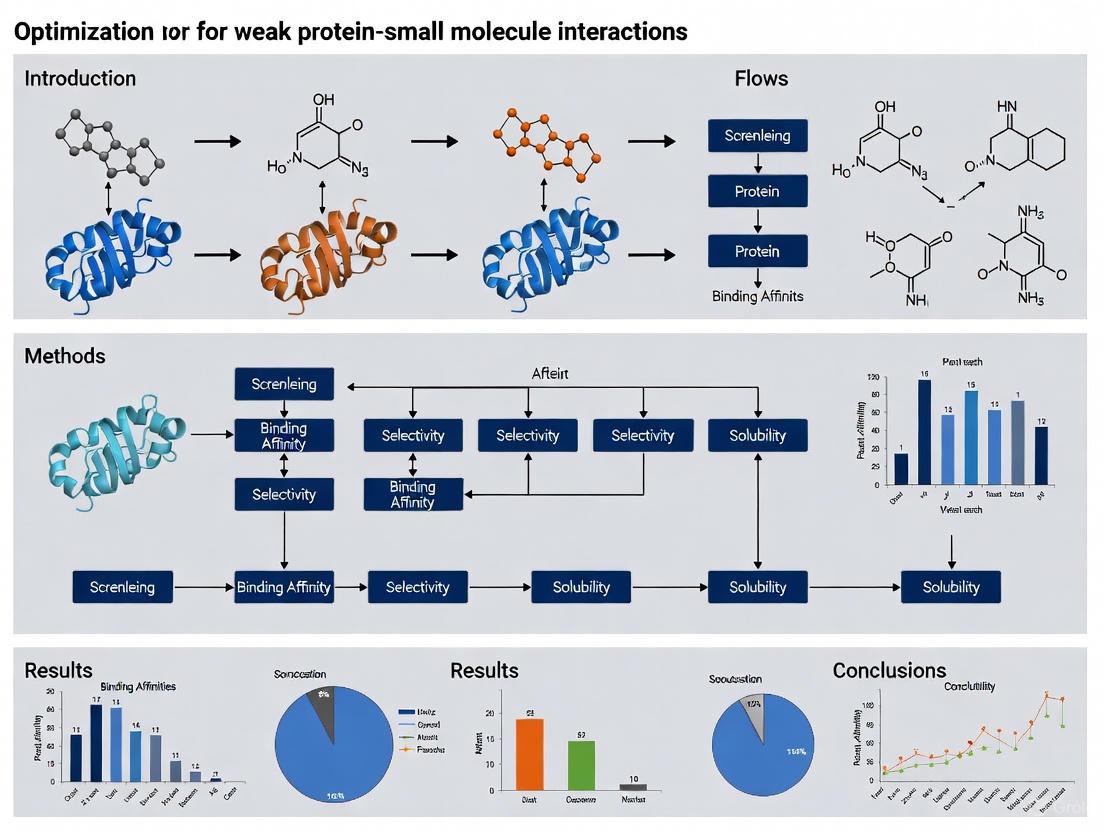
Weak protein-small molecule interactions (KD > 10⁻⁴ M) are increasingly recognized as crucial regulators of biochemical pathways, allosteric regulation, and signaling cascades, yet they present significant challenges for characterization and...
Optimizing Weak Protein-Small Molecule Interactions: Strategies for Challenges, Methods, and Clinical Translation
Abstract
Weak protein-small molecule interactions (KD > 10⁻⁴ M) are increasingly recognized as crucial regulators of biochemical pathways, allosteric regulation, and signaling cascades, yet they present significant challenges for characterization and optimization in drug discovery. This article provides a comprehensive exploration of this domain, covering the foundational principles of weak interactions and their biological significance. It delves into advanced methodological approaches, including explicit solvent alchemical free-energy calculations, affinity selection mass spectrometry (AS-MS), and integrative computational frameworks for predicting binding affinity. The content further addresses troubleshooting and optimization strategies, such as charge optimization and entropy-enthalpy compensation, and concludes with a comparative analysis of validation techniques. Aimed at researchers and drug development professionals, this review synthesizes current knowledge and emerging trends to equip scientists with the strategies needed to transform these challenging interactions into therapeutic opportunities.
Understanding Weak Protein-Ligand Interactions: Biological Significance and Fundamental Challenges
Frequently Asked Questions
1. What defines a weak or transient protein-protein interaction (PPI)?
Weak and transient PPIs are characterized by their low binding affinity and short lifespan. They typically have dissociation constants (KD) in the micromolar (μM) range (e.g., >1 μM) and lifetimes of seconds or less [1]. Despite their fleeting nature, they are evolutionarily conserved and crucial for processes like signal transduction, protein trafficking, and pathogen-host interactions [2] [1].
2. Why are these interactions so challenging to study with conventional methods?
Traditional methods like co-immunoprecipitation (Co-IP) or tandem affinity purification-mass spectrometry (TAP-MS) involve washing steps that dissociate weak complexes [3] [1]. This leads to a significant loss of transient interactors, creating a bias towards stable, high-affinity complexes in the data [1].
3. What are the key methodological strategies for capturing weak/transient interactions?
The main strategies involve stabilizing the interaction to prevent dissociation during analysis. This can be achieved through:
- Proximity Labeling (PL): Using enzymes like PafA to covalently tag neighboring proteins, allowing for subsequent stringent purification [3].
- Crosslinking: Chemically "freezing" the interaction, though this can disrupt the native protein state and prevents kinetic studies [1].
- Single-Molecule Analysis: Using tools like Depixus MAGNA One to observe individual interactions in real-time without purification, thus capturing their dynamic nature [1].
4. Can you provide a quantitative overview of affinity ranges?
The table below summarizes the binding affinities from a model system used to benchmark the APPLE-MS method, illustrating what constitutes a weak interaction [3].
Table 1: Experimentally Determined Affinity Ranges for a Model Protein-Peptide Interaction [3]
| Peptide | Equilibrium Dissociation Constant (KD) | Interaction Classification |
|---|---|---|
| Peptide 1 | 3.7 μM | Medium-to-Weak |
| Peptide 2 | 76 μM | Weak |
| Peptide 3 | >1,000 μM | Very Weak / Non-detectable by some methods |
Troubleshooting Guides
Problem: Failure to detect known weak interactors in an AP-MS experiment.
This is a common issue where labile complexes fall apart during the experimental workflow.
- Potential Cause 1: Overly Stringent Washes. Stringent washing, while reducing non-specific binding, can also remove genuine weak interactors [3].
- Solution: Optimize wash buffer stringency (e.g., salt concentration, detergent). Consider switching to a method that covalently captures interactions, like proximity labeling (e.g., APPLE-MS) [3].
- Potential Cause 2: Detergent-Induced Dissociation. Using harsh detergents for membrane protein extraction can dissociate a large percentage of interacting partners [3].
- Solution: Screen for milder detergents or alternative solubilizing agents to better preserve native complexes [3].
Problem: Inconsistent results between operators in AP-MS.
Small variations in protocol execution can significantly impact outcomes, especially for dynamic interactions [3].
- Solution: Implement a highly standardized and, if possible, automated protocol to minimize operator-dependent variables [4] [3].
Problem: Method only provides a static snapshot and lacks kinetic data.
Techniques like crosslinking or standard PL-MS confirm an interaction occurred but not its dynamics [1].
- Solution: Employ real-time, single-molecule analysis platforms (e.g., Depixus MAGNA One) to measure binding kinetics (on/off rates) and interaction durations directly [1].
Experimental Protocols
This section details a modern protocol designed to overcome the limitations of traditional AP-MS for weak and transient complexes.
Protocol: APPLE-MS (Affinity Purification Coupled Proximity Labeling-Mass Spectrometry)
APPLE-MS combines the specificity of affinity purification with the covalent capture capability of proximity labeling to map weak and transient PPIs in native contexts [3].
1. Key Research Reagent Solutions
Table 2: Essential Reagents for the APPLE-MS Protocol [3]
| Reagent | Function in the Protocol |
|---|---|
| Twin-Strep Tag | A high-affinity epitope tag fused to the bait protein, enabling efficient capture by streptavidin. |
| PafA Enzyme | A bacterial enzyme that catalyzes the ATP-dependent covalent attachment of PupE to lysine residues on proximal proteins. |
| SA-PupE (Streptavidin-PupE) | A fusion protein that serves as the substrate for PafA. The PupE moiety is ligated to nearby proteins, and the streptavidin moiety allows for purification. |
| Streptavidin Beads | Used to purify the bait protein (via Twin-Strep tag) and any prey proteins covalently labeled with SA-PupE. |
2. Detailed Workflow
The following diagram illustrates the integrated APPLE-MS workflow for capturing stable and transient interactions.
Step-by-Step Explanation:
- Express the Bait Protein: Genetically fuse a Twin-Strep tag to your protein of interest (bait) and express it in the relevant cellular system (e.g., HEK293T cells) [3].
- Form Native Complexes: Allow the bait protein to interact with its native binding partners (prey proteins) within the cell. This includes both stable and transient complexes [3].
- Initiate Proximity Labeling: Add the PafA enzyme and the SA-PupE substrate to the cells. PafA uses ATP to covalently attach the PupE part of SA-PupE to lysine side chains on proteins that are in close proximity to the bait. This step "marks" the interactors, however transient [3].
- Cell Lysis and Purification: Lyse the cells and perform affinity purification using streptavidin beads. The beads capture: a) the bait protein directly via its Twin-Strep tag, and b) any prey proteins that were covalently labeled with SA-PupE. Stringent washing can now be applied to remove non-specific binders without losing the covalently tagged interactors [3].
- Mass Spectrometry Analysis: Elute and process the purified proteins for analysis by mass spectrometry to identify the high-confidence interactors of the bait protein [3].
Method Comparison & Selection Guide
Choosing the right method depends on the biological question and the nature of the interaction. The diagram below outlines the logical decision process for method selection.
Key Takeaways:
- Know Your Method's Limits: Standard AP-MS is effective for stable complexes but fails for many biologically critical transient interactions [1].
- Embrace Integrated Methods: Techniques like APPLE-MS demonstrate that combining purification with covalent capture (proximity labeling) significantly improves sensitivity for weak interactors [3].
- Aim for Dynamics: For a complete understanding, especially in drug discovery, moving beyond simple identification to measuring interaction kinetics is essential [1].
FAQs: Understanding Weak Protein Interactions
FAQ 1: What exactly constitutes a "weak" protein interaction, and why are they important?
Weak protein interactions are generally defined as complexes with dissociation constants (KD) in the micromolar range ( >1μM) or those with fast kinetic off-rates (half-lives <0.1 s) [5]. Despite being transient, they are biologically essential. Their sensitivity to environmental changes allows them to fine-tune critical processes such as receptor signal transduction, immune discrimination, enzyme turnover, and stress adaptation mechanisms [5]. Their transient nature is a feature, not a bug, enabling rapid response to cellular cues.
FAQ 2: What are the major technical challenges in studying these weak complexes?
The primary challenge is reconstituting and maintaining stable complexes for structural analysis [5]. Specific difficulties vary by technique:
- X-ray Crystallography: Harsh crystallization conditions (e.g., high salt, acidic pH) can further diminish already weak affinity. One binding partner may dissociate and crystallize alone [5].
- Cryo-Electron Microscopy (cryo-EM): Samples are diluted to low concentrations for grid preparation, which can cause low-affinity complexes to dissociate before they are frozen [5].
- General Pitfalls: Weak interactions are highly susceptible to being masked by non-specific, spurious interactions that can be stronger than the physiologically relevant one. Furthermore, they can be dependent on molecular crowding effects that are difficult to reproduce in vitro [6].
FAQ 3: A crystal structure shows a weak interaction between two protein domains. How can I be sure it's biologically relevant and not a crystallization artifact?
This is a critical consideration. A few key steps for validation are:
- Mutational Analysis: Introduce point mutations at the putative interface and test whether they disrupt the interaction in vitro and the biological function in vivo.
- Biophysical Corroboration: Use solution-based techniques like NMR or FRET to confirm the interaction occurs independently of crystal packing forces.
- Conservation Analysis: Check if the interacting residues are evolutionarily conserved, which suggests functional importance [6]. Always interpret crystal structures of weak complexes with caution, as the crystal lattice can sometimes stabilize irrelevant protein-protein contacts [6].
Troubleshooting Guides for Experimental Challenges
Problem: Complex Dissociates During Structural Biology Sample Preparation
Potential Causes and Solutions:
Cause 1: Low local concentration and fast off-rate.
- Solution: Employ single-chain fusion constructs. Genetically fuse your two protein partners with a flexible linker (e.g., a (GGGGS)3 sequence). This drastically increases the local concentration of the binding partners, favoring complex formation [5].
- Protocol:
- Genetically fuse the genes for Protein A and Protein B into a single open reading frame, connected by a flexible linker.
- Optimize linker length and attachment points (N- or C-terminus) based on any available structural information.
- Express the single-chain protein and purify the complex.
- Considerations: Without prior knowledge of the binding mode, optimizing linker length and position may require trial and error. The linker could potentially sterically block functionally important sites [5].
Cause 2: Lack of a covalent tether to trap the transient complex.
- Solution: Implement site-specific crosslinking, such as disulfide trapping [5].
- Protocol:
- Analyze the binding interface to identify pairs of residues that are spatially close (often using computational modeling).
- Mutate these residues to cysteines, one on each binding partner.
- Co-incubate the cysteine mutants under oxidizing conditions to promote the formation of a stabilizing intermolecular disulfide bond.
- Purify the covalently stabilized complex for structural studies.
- Considerations: This method works best for extracellular proteins or engineered systems without free cysteines that could form non-specific crosslinks. Screening multiple cysteine pairs is often necessary to find one that efficiently forms the crosslink without distorting the native binding geometry [5].
Problem: Inconsistent or No Binding Detected in Solution-Based Assays
Potential Causes and Solutions:
Cause 1: The weak interaction is masked by a stronger, non-specific interaction.
- Solution: Be vigilant for promiscuous binding regions. A common example is polybasic sequences that can bind non-specifically to other proteins in the absence of their native targets, such as membranes [6].
- Protocol:
- Identify and characterize potential promiscuous domains (e.g., by sequence analysis).
- Perform binding experiments in the presence of the native binding partner (e.g., including lipids or membrane mimics if the protein normally interacts with a membrane).
- Use control proteins or peptides to account for non-specific electrostatic or hydrophobic interactions.
Cause 2: The assay conditions do not reflect the native environment.
- Solution: Include crucial co-factors or membranes. Weak binding between soluble protein domains can be significantly strengthened by cooperativity with protein-lipid interactions or by the confined space between two membranes [6].
- Protocol: Reconstitute the experiment in a more physiologically relevant context. This could involve using lipid nanodiscs, supported lipid bilayers, or full vesicle fusion assays to provide the native environment that stabilizes the metastable intermediate state.
Cause 3: General experimental error or improper storage.
- Solution: Meticulously check your experiment setup [7].
- Protocol:
- Analyze all elements: Check reagents and supplies for expiration or degradation. Confirm equipment is properly calibrated.
- Re-run with new supplies: If budget allows, repeat the experiment with fresh, quality-controlled reagents.
- Consult colleagues: Review your experimental design and data with peers to identify potential oversights [7].
Experimental Strategy & Methodology Table
The table below summarizes the core molecular engineering strategies for stabilizing weak protein complexes, detailing their applications and key methodological points.
| Strategy | Core Principle | Ideal Application | Key Methodological Consideration |
|---|---|---|---|
| Single-Chain Fusions [5] | Genetically link partners to enforce proximity and high local concentration. | Stabilizing complexes for crystallography, cryo-EM, or NMR [5]. | Linker length and attachment point (N-/C-terminus) are critical and may require optimization. |
| Disulfide Trapping [5] | Introduce covalent disulfide bonds at the binding interface via engineered cysteines. | Studying extracellular protein complexes, receptor-ligand interactions (e.g., GPCRs) [5]. | Requires screening of multiple cysteine pairs; works best in environments without interfering free cysteines. |
| Evolution-Guided Stabilization [8] | Use natural sequence diversity to guide mutations that improve stability without compromising function. | Optimizing protein stability for higher expression yields or therapeutic development [8]. | Relies on the availability of multiple sequence alignments for the protein family of interest. |
The Scientist's Toolkit: Research Reagent Solutions
| Item | Function in Experiment |
|---|---|
| Flexible (GGGGS)n Linker | The canonical linker for constructing single-chain fusion proteins. Provides flexibility and solubility to connected domains, allowing them to adopt native binding modes [5]. |
| Oxidizing Buffers (e.g., CuSO4, Glutathione) | Used in disulfide trapping experiments to promote the formation of covalent disulfide bonds between engineered cysteine residues [5]. |
| Membrane Mimetics (Nanodiscs, Liposomes) | Crucial for reconstituting weak protein interactions that depend on a lipid bilayer for stability, providing a more native environment than solution-based assays [6]. |
| Stability-Design Software (e.g., Rosetta) | Computational tools that can suggest mutations to increase protein stability, which is often a prerequisite for studying weak interactions, as it prevents misfolding and increases functional protein yield [8]. |
Experimental Workflow Visualization
The following diagram illustrates a logical workflow for selecting the appropriate stabilization strategy based on your experimental system and goals.
Troubleshooting Data Interpretation
The final diagram maps common experimental symptoms to their potential root causes and direct solutions, providing a quick-reference guide for troubleshooting.
Core Concepts: Understanding the Systems
1.1 What is the fundamental definition of allosteric regulation? Allosteric regulation is a widespread mechanism of control where an effector binds to a site on an enzyme or receptor distinct from the active site (the orthosteric site), resulting in a conformational change that alters the protein's activity [9] [10]. Effectors that enhance activity are allosteric activators, while those that decrease it are allosteric inhibitors [9].
1.2 How does allosteric regulation differ from competitive inhibition? The key difference lies in the binding site and mechanism [9].
- Orthosteric (Competitive) Inhibitors: Bind directly to the enzyme's active site, physically blocking the substrate. Their effect can be overcome by increasing substrate concentration [9].
- Allosteric Inhibitors: Bind to a separate allosteric site, inducing a conformational change that reduces the enzyme's affinity for its substrate or its catalytic efficiency. This is often non-competitive inhibition, meaning their effect is not reversed by high substrate concentration [9].
1.3 What are the primary models describing allosteric regulation? Three key models are:
- Concerted (MWC) Model: Postulates that protein subunits are connected and must all exist in the same conformation, either tensed (T) or relaxed (R). Effectors shift the equilibrium between these states [9].
- Sequential (KNF) Model: Suggests that subunit conformation changes are sequential and not necessarily identical. Substrate binding induces a conformational change in one subunit that makes adjacent subunits more receptive to substrate [9].
- Morpheein Model: A dissociative model where functionally different, alternate homo-oligomeric structures can interconvert via oligomer dissociation, conformational change, and reassembly [9].
1.4 How are signaling cascades and multi-enzyme complexes related to allostery? Long-range allostery is especially important in cell signaling [9]. Multi-enzyme complexes, such as those in metabolic pathways, often use allosteric regulation for efficient feedback control, where the end-product of a pathway acts as an allosteric inhibitor of an enzyme at the pathway's beginning [9] [10].
Troubleshooting Common Experimental Challenges
2.1 My Co-IP/pulldown experiment shows no interaction. What could be wrong?
- Cause: The tagged bait protein may have been degraded.
- Solution: Ensure protease inhibitors are included in the lysis buffer [11].
- Cause: The fusion protein was improperly cloned.
- Solution: Confirm the proper cloning of the fusion protein into the expression vector [11].
- Cause: The interaction is transient or weak.
- Solution: Use more lysate for the pulldown or employ a more sensitive detection system [11]. Consider adding crosslinkers to "freeze" transient interactions [11].
2.2 I am getting a high background or false positives in my Yeast Two-Hybrid (Y2H) screen.
- Cause: The bait protein self-activates the reporter gene.
- Solution: Subclone segments of the bait to identify a construct that does not self-activate and retest. Titrate the system using 3-AT (3-amino-1,2,4-triazole) to suppress background growth [11].
- Cause: Inadequate replica cleaning during the screening process.
- Solution: Replica clean immediately after replica plating and again after 24 hours of incubation. Ensure the plate contains no remaining visible cells after cleaning [11].
2.3 My allosteric effector does not produce the expected effect in a kinetic assay.
- Cause: The system may not follow a simple two-state model.
- Solution: Consider characterizing the system as a K-type (changes in ligand affinity) or V-type (changes in catalytic rate) allosteric system. Perform titrations of the effector over a range of substrate concentrations to quantify the allosteric coupling constant [12].
- Cause: The protein ensemble or dynamics are not favorable for the allosteric mechanism under your experimental conditions.
- Solution: Investigate the impact of solution conditions like pH, temperature, or buffer composition on the allosteric response [12].
2.4 How can I confirm a protein-small molecule interaction is direct and allosteric?
- Solution: Use a combination of techniques. Isothermal Titration Calorimetry (ITC) can label-freely measure the heat of binding, providing thermodynamic parameters [13]. Structural techniques like Small-Angle X-Ray Scattering (SAXS) can detect large conformational changes upon binding at nanometer resolution [13]. A confirmed allosteric interaction will show binding at a site distinct from the active site and induce a functional or conformational change [9] [12].
Essential Methodologies & Protocols
Probing Allosteric Binding and Conformational Change
Protocol: Detecting Allosteric Modulation via Fluorescence Polarization (FP)
- Principle: FP measures the change in rotational speed of a small fluorescently-labeled molecule when bound to a larger protein. An allosteric effector that alters the protein's affinity for the labeled ligand will cause a change in polarization.
- Workflow:
- Labeling: Tag a substrate or orthosteric ligand with a fluorophore.
- Equilibration: Incubate the labeled ligand with your target protein.
- Effector Titration: Titrate in the unlabeled allosteric effector.
- Measurement: Read polarization (in mP units) after each addition. A change indicates the effector is modulating ligand binding.
- Applications: Ideal for high-throughput screening of allosteric modulators and studying binding affinity (K-type allostery) [13].
- Limitations: Requires a fluorescent label, which might alter ligand properties [13].
Protocol: Characterizing Allosteric Thermodynamics via Isothermal Titration Calorimetry (ITC)
- Principle: ITC directly measures the heat released or absorbed during a binding event, providing a label-free measurement of binding affinity (K~d~), stoichiometry (n), enthalpy (ΔH), and entropy (ΔS).
- Workflow:
- Preparation: Load the protein solution into the sample cell and the ligand/effector solution into the syringe.
- Titration: Inject the ligand/effector into the protein solution in a series of injections.
- Data Analysis: Integrate the heat from each injection and fit the data to a binding model. To study allostery, perform experiments in the absence and presence of a saturating concentration of a second ligand [12].
- Applications: Definitive method for quantifying the thermodynamic driving forces of allosteric coupling [13].
- Limitations: Requires a significant heat change upon binding and consumes relatively large amounts of protein [13].
Quantitative Data on Allosteric Systems
Table 1: Key Allosteric Proteins and Their Regulatory Characteristics
| Protein | Allosteric Regulator | Type of Regulation | Biological Role |
|---|---|---|---|
| Hemoglobin | O~2~, CO~2~, 2,3-BPG | K-type (Homotropic & Heterotropic) | Oxygen Transport [9] [12] |
| Phosphofructokinase (PFK) | ATP (Inhibitor), ADP/AMP (Activators) | K-type (Heterotropic) | Glycolysis [9] [12] |
| Pyruvate Kinase | Fructose-1,6-bisphosphate (Activator) | V-type & K-type | Glycolysis [12] |
| c-Myc/Max | Small-molecule inhibitors (e.g., 10074-G5) | Protein-Protein Interaction Inhibitor | Transcription & Cancer [13] |
| Calmodulin | Ca^2+^ | K-type (Activator) | Calcium Signaling [12] |
Table 2: Techniques for Probing Weak Protein-Small Molecule Interactions
| Technique | Applicability | Throughput | Key Limitations |
|---|---|---|---|
| Fluorescence Polarization (FP) | Modulators of protein-protein/ligand interactions | High | Requires fluorescent labels [13] |
| Isothermal Titration Calorimetry (ITC) | Label-free measurement of binding thermodynamics | Medium-Low | High protein consumption; requires significant heat change [13] |
| Surface Plasmon Resonance (SPR) | Real-time detection of binding kinetics and affinity | Medium | Surface immobilization can cause non-specific binding [13] |
| Small-Angle X-Ray Scattering (SAXS) | Detection of large conformational changes | Variable | Low resolution [13] |
| Yeast Two-Hybrid (Y2H) | Detection of modulators of protein-protein interactions | High | Indirectly quantitative; potential for false positives [11] [13] |
Visualization of Concepts and Workflows
Allosteric Regulation Models
Allosteric Inhibitor Screening Workflow
Signaling Cascade with Allosteric Node
The Scientist's Toolkit: Research Reagent Solutions
Table 3: Essential Reagents for Studying Allosteric Regulation
| Reagent / Tool | Function / Application | Example Use Case |
|---|---|---|
| Crosslinkers (e.g., DSS, BS3) | "Freeze" transient protein-protein interactions inside (DSS) or outside (BS3) the cell for Co-IP or pulldown assays [11]. | Capturing weak or transient complexes in allosteric multi-enzyme complexes [11]. |
| 3-Amino-1,2,4-triazole (3-AT) | Competitive inhibitor of the HIS3 gene product used to suppress bait autoactivation in Yeast Two-Hybrid screens [11]. | Titrating the stringency of a Y2H screen to identify true allosteric protein-protein interaction disruptors [11]. |
| Protease Inhibitor Cocktails | Prevent degradation of the target protein and its interaction partners during cell lysis and purification [11]. | Essential for maintaining protein integrity in Co-IP, pulldown, and enzyme activity assays [11]. |
| Fluorescent Dyes & Substrates | Enable detection and quantification in assays like Fluorescence Polarization (FP) and FRET [13]. | Labeling substrates or ligands to monitor allosteric modulation of binding affinity [13]. |
| Tag-Specific Affinity Resins | Immobilize bait proteins for pulldown assays (e.g., GST-, His-, or antibody-conjugated beads) [11]. | Isolating multi-enzyme complexes or protein-ligand complexes for downstream analysis [11]. |
FAQs: Understanding the Core Concepts
Q1: What is the "Local Concentration Effect" and why is it critical for cellular function?
The Local Concentration Effect describes how the confinement of proteins and other molecules within specific subcellular compartments drastically increases their effective local concentration. This compartmentalization is essential because it creates unique microenvironments with distinct molecular compositions, chemical properties, and physical attributes. These niches drive discrete biological processes by ensuring that the right proteins and ligands are in the right place at the right time to interact. For instance, signaling, growth, proliferation, motility, and programmed cell death all require dynamic protein movements between cell compartments. This organization is not static; proteins can localize to multiple locations, reflecting "moonlighting" activities, and their distribution can change in response to cellular conditions [14]. Aberrant protein localization is linked to a wide range of diseases, including neurodegenerative diseases, cancer, and metabolic disorders, underscoring the functional importance of this effect [14].
Q2: How can improper protein localization disrupt weak protein-small molecule interactions?
Improper protein localization can severely disrupt weak interactions by physically separating the protein from its intended small molecule partner. A study on engineered mutant ribose-binding proteins (RbsB) in E. coli provides a clear example. These mutants, designed to bind a new ligand (1,3-cyclohexanediol), exhibited defects in their translocation to the periplasm. Instead of localizing correctly, they showed mislocalization, autoaggregation, and high cell-to-cell variability. This incorrect positioning meant the proteins were not in the proper cellular context to interact effectively with membrane receptors, leading to poor sensing performance. This demonstrates that computational design of a ligand-binding pocket is insufficient; the protein must also be correctly localized to function [15].
Q3: What are the major technical challenges in studying weak protein-small molecule interactions within subcellular compartments?
Studying these weak interactions (often with dissociation constants, Kd > 10 μM) presents several specific challenges [6]:
- Membrane-Dependent Complexes: The release machinery is often assembled between two membranes, making it difficult to reconstitute and study in vitro.
- Technical Promiscuity: Highly charged protein sequences (e.g., polybasic regions) can mediate strong but biologically irrelevant interactions with other proteins in solution if their native membrane targets are absent.
- Crystallography Limitations: Weak interactions that help form a crystal lattice can be mistaken for biologically relevant complexes.
- Characterization Difficulties: Techniques like isothermal titration calorimetry (ITC) can be confounded by heat contributions from non-specific interactions, leading to misinterpretation of data.
- Dynamic Nature: These interactions are highly dynamic and may depend on molecular crowding effects within the cell, which are difficult to reproduce in a test tube.
Troubleshooting Common Experimental Issues
Q4: My experiment shows a weak or absent signal for a protein-small molecule interaction. What should I check?
Use the following flowchart to systematically diagnose the issue.
Q5: How can I validate that an observed weak interaction is biologically relevant and not an experimental artifact?
To ensure biological relevance, consider these strategies [6]:
- Include Membranes: Since many weak interactions are stabilized by co-localization on membranes, perform assays in the presence of relevant lipid bilayers rather than solely in solution.
- Mutational Analysis: Introduce point mutations into the suspected binding pocket. If the interaction is specific, these mutations should diminish or abolish binding.
- Competition Experiments: Use unlabeled ligands or known inhibitors to compete for binding, which should reduce the signal.
- Correlate with Function: Link the interaction to a functional output. If perturbing the interaction disrupts the expected cellular function, it is more likely to be relevant.
- Orthogonal Methods: Confirm the interaction using a different, unrelated technical approach (e.g., combine ITC with fluorescence resonance energy transfer (FRET) or nuclear magnetic resonance (NMR)).
Key Experimental Protocols & Workflows
Protocol: Subcellular Fractionation for Organellar Proteomics
This protocol outlines a method to isolate subcellular compartments, allowing for the study of protein localization and organelle-specific interactions [14].
Principle: Cellular fractionation exploits differences in the physical properties of organelles (size, mass, density) to separate them from a crude cell lysate, typically using centrifugation techniques.
Workflow Overview:
Detailed Steps:
- Cell Lysis and Homogenization: Gently disrupt cells using a method appropriate for your sample. For cultured mammalian cells, a Dounce homogenizer is often suitable. This step aims to release intact organelles while minimizing their breakage [14].
- Differential Centrifugation: Subject the homogenate to a series of centrifugations at increasing speeds. This will pellet out different organelle fractions based on their size and density (e.g., nuclei at low speed, mitochondria at intermediate speed) [14].
- Density Gradient Centrifugation: For higher purity, resuspend the crude pellet and layer it onto a density gradient medium (e.g., Sucrose, Percoll, or Iodixanol). During ultracentrifugation, organelles will migrate to the point in the gradient that matches their own buoyant density [14].
- Fraction Collection: Carefully collect the distinct bands from the gradient, which correspond to enriched organelle fractions.
- Validation and Analysis: Validate the purity of your fractions using Western blotting with antibodies against known organelle markers (e.g., LAMP1 for lysosomes, COX IV for mitochondria). The proteins in each fraction can then be identified and quantified using mass spectrometry (MS) to generate a subcellular proteome map [14].
Protocol: Determining Subcellular Localization of Protein Interactions
This protocol uses fluorescent protein fusions and pulse-chase labeling to visualize protein localization and measure turnover in live cells [16].
Principle: A protein of interest is fused to a self-labeling tag (e.g., SNAP-tag). A fluorescent substrate is then used in a "pulse" to label the protein pool synthesized within a specific time window. Its localization and disappearance ("chase") are tracked over time to determine both location and stability.
Workflow Overview:
Detailed Steps:
- Cell Transfection: Transfect cells (e.g., HeLa) with a plasmid encoding your protein of interest fused to the SNAP-tag. A GFP plasmid can be co-transfected to identify successfully transfected cells [16].
- Blocking: To synchronize the protein population, incubate cells with SNAP-Cell Block. This blocks all SNAP-tag molecules produced before this step, ensuring a clean baseline [16].
- Pulse-labeling: Replace the block with a medium containing a fluorescent SNAP-substrate (e.g., SNAP-Cell TMR-Star). This will label all SNAP-tag molecules synthesized during this pulse period [16].
- Chase and Imaging: Remove the pulse medium and "chase" the cells in a medium containing SNAP-Cell Block to prevent new labeling. Image the cells at multiple time points after the pulse (e.g., 0 h, 4 h, 8 h, 24 h) to track the loss of fluorescence as the labeled proteins are degraded [16].
- Data Analysis: Quantify the fluorescence intensity at each time point. The protein's half-life can be calculated by fitting the fluorescence decay curve to an exponential function. Simultaneously, the subcellular localization is directly visualized throughout the experiment [16].
The Scientist's Toolkit: Essential Research Reagents
Table 1: Key Reagents for Studying Compartmentalized Interactions
| Reagent / Tool | Function / Description | Application Example |
|---|---|---|
| SNAP-tag [16] | A self-labeling protein tag that covalently binds to fluorescent O6-benzylguanine (BG) derivatives. | Pulse-chase imaging to measure protein turnover and visualize subcellular localization in live cells. |
| Density Gradient Media (Sucrose, Iodixanol, Percoll) [14] | Inert materials used to create density gradients for separating organelles based on their buoyant density during centrifugation. | Purification of specific organelles (e.g., mitochondria, lysosomes) for subsequent proteomic or interaction studies. |
| Proximity Labeling Enzymes (e.g., BioID, APEX) [14] | Enzymes that, upon activation, biotinylate proteins in their immediate vicinity. | Identifying the proteome of a specific organelle or protein neighborhood, even for weak or transient interactions. |
| Chemically Induced Dimerization (CID) Systems (e.g., FKBP/FRB with Rapamycin) [17] | A tool that uses a small molecule (e.g., Rapamycin) to rapidly and reversibly bring two engineered proteins together. | Acute manipulation of protein localization to test the effect of local concentration on activity, as shown for PKA-R. |
| Computational Prediction Tools (e.g., LABind) [18] | A structure-based method using machine learning to predict protein binding sites for small molecules and ions in a ligand-aware manner. | Predicting binding sites for novel ligands and prioritizing residues for mutational analysis to test interaction hypotheses. |
Advanced Techniques: Computational & Functional Analysis
Using Computational Tools to Predict Binding Sites
The LABind method represents a recent advancement in predicting protein-ligand binding sites. It is particularly useful because it can generalize to "unseen" ligands not present in its training data. LABind works by [18]:
- Input: Taking the protein's structure and the ligand's SMILES string (a text-based representation of a molecule's structure).
- Processing: Using a graph transformer to capture the protein's structural context and a cross-attention mechanism to learn the specific binding characteristics between the protein and the ligand.
- Output: Predicting which protein residues are part of the binding site for that specific ligand. This tool can be used to guide experimental work, such as designing mutants or optimizing molecular docking tasks [18].
Case Study: How Localization Modulates Protein Kinase A (PKA) Activity
Research using the FKBP/FRB translocation system revealed a paradoxical role for the PKA Regulatory subunit (PKA-R). Artificially recruiting PKA-R to the plasma membrane did not simply inhibit the kinase, as its traditional role would suggest. Instead, it had a dual effect: at lower translocation levels, it enhanced membrane kinase activity, while at higher levels, it was inhibitory. This demonstrates that the localization of a regulatory subunit can act as a concentration-dependent linker, capable of both coupling and decoupling signaling processes. This complex effect can explain seemingly contradictory roles of PKA in processes like cell migration [17].
Frequently Asked Questions
FAQ 1: What makes weak, transient protein-protein interactions (PPIs) so difficult to study compared to stable complexes? Weak, transient PPIs are characterized by low binding affinities (often with micromolar dissociation constants) and short lifetimes (seconds or less). Their dynamic and context-dependent nature means they are easily disrupted during standard laboratory techniques like washing steps in co-immunoprecipitation, making them elusive targets for detection and characterization [1].
FAQ 2: My high-throughput screening (HTS) for a PPI modulator failed to identify good leads. What alternative approaches should I consider? Traditional HTS can struggle with the flat, featureless binding interfaces common in PPIs [19]. Consider shifting to:
- Fragment-Based Drug Discovery (FBDD): Uses smaller, low molecular weight fragments that are better at binding to the discontinuous "hot spots" on a PPI interface [19].
- Virtual Screening: Leverages computational models to screen large compound libraries in silico before laboratory testing. This can be structure-based (using protein structure) or ligand-based (using known inhibitor data) [19].
FAQ 3: How can I improve the predictive accuracy of my computational models for protein-ligand interactions? Integrate multiple data types into your model. A recent study on METTL3 inhibitors showed that combining conventional chemical features with Docking-based Protein-Ligand Interaction Features (DPLIFE) significantly improved bioactivity prediction. This method encodes interaction profiles (e.g., hydrophobic contacts, hydrogen bonds) for key protein residues, seamlessly marrying machine learning prediction with structural biology insights [20].
FAQ 4: What are the main limitations of current experimental methods for detecting transient PPIs? The table below summarizes the core limitations of common techniques [1]:
| Method | Can Detect Transient PPIs? | Provides Dynamic Info? | Key Limitations |
|---|---|---|---|
| Co-immunoprecipitation | Partially | No | Biased toward stable interactions; false positives/negatives [1]. |
| Mass Spectrometry (e.g., TAP-MS) | Sometimes | No | Requires stabilization; can miss weak/short-lived complexes [1]. |
| X-ray Crystallography / Cryo-EM | Rarely | No | High resolution but unsuitable for weak, dynamic complexes; limited throughput [1]. |
| Cross-linking MS | Yes | No | Captures interaction snapshots but disrupts the native state [1]. |
FAQ 5: Are there emerging technologies that can overcome the challenge of studying interaction dynamics? Yes. New technologies like Magnetic Force Spectroscopy (MFS) platforms (e.g., Depixus MAGNA One) are designed for this purpose. They enable real-time, single-molecule analysis, allowing researchers to monitor thousands of individual protein interactions simultaneously. This provides direct measurements of binding kinetics and interaction durations for even short-lived events, moving beyond the static snapshots provided by other methods [1].
Troubleshooting Guides
Guide 1: Troubleshooting Lead Discovery for PPI Targets
Problem: Inability to identify viable chemical starting points for modulating a difficult PPI.
| Issue | Possible Cause | Recommended Solution |
|---|---|---|
| Flat binding interface | Lack of deep pockets for small molecules to bind [19]. | Shift from HTS to FBDD. Screen low molecular weight fragments that can bind to discrete hot spots, then chemically link or expand them [19]. |
| Low hit rate in virtual screening | Over-reliance on a single computational approach [19]. | Combine structure-based and ligand-based virtual screening. Use ensemble docking or integrate pharmacophore models to improve hit enrichment [19]. |
| Difficulty optimizing stabilizers | Complex thermodynamics and lack of obvious binding sites for enhancers [19]. | Employ allosteric targeting strategies. Use HDX-MS or NMR to identify dynamic allosteric sites that, when bound, stabilize the protein complex [19]. |
Guide 2: Addressing Limitations in Characterizing Weak Interactions
Problem: Inability to reliably detect or measure the kinetics of weak protein-small molecule or transient protein-protein interactions.
Solution: Integrate complementary methods to create a more complete picture.
- Computational Prediction: Use homology-based or template-free machine learning methods (e.g., Support Vector Machines) to predict potential interaction interfaces and key residues [19].
- Targeted Experimental Validation: Employ a technique capable of capturing dynamic interactions. While Surface Plasmon Resonance (SPR) is an option, emerging tools like Magnetic Force Spectroscopy (MFS) offer advantages by providing single-molecule resolution and the ability to detect rare events and heterogeneous binding behaviors that ensemble methods average out [1].
- Data Integration: Combine the kinetic parameters (e.g., binding constants from MFS) with structural data from X-ray crystallography or Cryo-EM to rationally design improved modulators.
The workflow below illustrates a robust strategy that combines computational and experimental biology to overcome characterization hurdles.
The Scientist's Toolkit: Key Research Reagent Solutions
The following table details essential materials and their functions for studying weak interactions, as featured in recent research [20].
| Research Reagent | Function & Application |
|---|---|
| AutoDock Vina | An open-source tool for molecular docking, used to predict how a small molecule (ligand) binds to a protein target and to calculate binding affinities [20]. |
| RDKit | An open-source cheminformatics toolkit used to handle chemical data, generate 3D ligand structures, and compute molecular descriptors for machine learning [20]. |
| Protein-Ligand Interaction Profiler (PLIP) | A tool to automatically detect and characterize non-covalent interactions (e.g., hydrogen bonds, hydrophobic contacts) in a 3D protein-ligand complex [20]. |
| DPLIFE Feature | A custom feature encoding method that translates PLIP interaction results into numerical data, enabling machine learning models to learn from structural interaction patterns [20]. |
| AutoGluon | An automated machine learning (AutoML) library used to build and stack multiple ML models for robust predictive tasks like bioactivity (pIC50) prediction [20]. |
Advanced Application: A Machine Learning-Enhanced Workflow for METTL3 Inhibitor Discovery
A novel study on METTL3 inhibitors provides a successful blueprint for integrating machine learning with structural biology. The following diagram details the experimental and computational workflow designed to overcome dataset limitations and build an accurate predictive model [20].
This integrated workflow successfully identified 8 key residues critical for ligand binding to METTL3, providing a structural rationale for the model's predictions and a clear path for the rational design of next-generation inhibitors [20].
Advanced Techniques for Detecting and Characterizing Weak Interactions
The study of weak, transient interactions between proteins and small molecules is fundamental to understanding biological signaling and for successful drug discovery. Such interactions, particularly those involving intrinsically disordered proteins (IDPs), present unique challenges due to their low binding affinity and rapid kinetics [21]. This technical resource center provides optimized strategies and troubleshooting guides for four key biophysical techniques—Nuclear Magnetic Resonance (NMR), Isothermal Titration Calorimetry (ITC), Surface Plasmon Resonance (SPR), and Analytical Ultracentrifugation (AUC)—to help researchers obtain reliable data for these challenging systems. A multi-method approach, combining the strengths of these complementary techniques, is often the most robust path to validating interactions and deriving accurate thermodynamic and kinetic parameters [22].
Technique Comparison Table
The following table summarizes the key capabilities and requirements of each technique to help guide experimental design.
| Technique | Key Measured Parameters | Affinity Range (K_D) | Sample Consumption | Throughput | Key Strengths |
|---|---|---|---|---|---|
| NMR | Binding affinity, binding site mapping, residual structure | µM - mM [23] | Low to moderate (mg) | Low | Atomic-level resolution; ideal for disordered proteins [24] |
| ITC | Binding affinity (K_D), enthalpy (ΔH), entropy (ΔS), stoichiometry (N) | nM - µM [25] | High (mg) | Low | Direct measurement of full thermodynamics; no labeling required [25] |
| SPR | Association rate (kon), dissociation rate (koff), affinity (K_D) | pM - mM [22] [25] | Low (µg) | High | Real-time, label-free kinetics; low sample requirement [26] [25] |
| AUC | Stoichiometry, binding affinity, hydrodynamic properties, complex shape | pM - mM [22] | Moderate (mg) | Low | First-principles method; analyzes samples in solution under native conditions [22] |
Troubleshooting FAQs and Guides
Surface Plasmon Resonance (SPR)
Q: What should I do if I observe no significant signal change upon analyte injection?
- Verify analyte concentration: Ensure the concentration is appropriate for the expected affinity. For weak binders, high concentrations may be needed [27].
- Check ligand immobilization: The immobilization level might be too low. Optimize coupling chemistry and density [27].
- Confirm ligand functionality: Ensure the immobilized ligand is stable and functionally active. A loss of activity post-immobilization can cause weak or no binding [27].
- Assess solvent compatibility: Running buffer must be compatible with both interaction partners. For small molecules with poor aqueous solubility, including 1-5% DMSO in the running buffer can help maintain solubility without disrupting the interaction [28].
Q: How can I address high non-specific binding (NSB) on the sensor surface?
- Implement blocking: After ligand immobilization, block the sensor surface with an inert protein like BSA or ethanolamine [27].
- Optimize regeneration: Develop a robust regeneration step to completely remove bound analyte without damaging the ligand. This may involve testing different pH, ionic strength, or additives [27].
- Use a different immobilization strategy: Switch to site-directed immobilization (e.g., via His-tag/Ni-NTA) to better orient the ligand and reduce exposed surface area for NSB [26] [28].
- Modify running buffer: Increase ionic strength or add a mild detergent to the running buffer to reduce electrostatic or hydrophobic non-specific interactions [27].
Q: My baseline is unstable or drifting. How can I fix it?
- Degas buffers: Always degas the running buffer thoroughly before use to eliminate micro-bubbles [27].
- Check for leaks: Inspect the fluidic system for leaks that could introduce air or cause flow instability [27].
- Ensure thermal equilibrium: Allow the instrument and samples sufficient time to equilibrate to the set temperature before starting the experiment [27].
- Use fresh buffer: Prepare fresh, filtered running buffer to avoid chemical degradation or microbial contamination [27].
Isothermal Titration Calorimetry (ITC)
Q: I am not observing a significant heat change upon titration. What could be wrong?
- Check concentration and stoichiometry: The concentration in the cell must be high enough to generate a measurable heat signal upon binding. The concentration in the syringe should typically be 10-20 times higher than the expected K_D to ensure sufficient saturation during the titration [25].
- Verify sample integrity: Ensure both the protein and small molecule are stable and active under the experimental conditions (pH, temperature, buffer).
- Consider heat of dilution: Always perform a control experiment by titrating the ligand into the buffer alone and subtract this background signal from your binding data.
Q: The data fitting is poor or the measured affinity seems inaccurate.
- Optimize the "c-value": For reliable fitting, the unitless c-value, where c = N * [M]cell * KA, should ideally be between 10 and 100. Adjust the concentrations in the cell and syringe to achieve this [25].
- Use an appropriate binding model: Do not automatically default to a single-site model. If the stoichiometry appears fractional, a two-site or other complex model may be more appropriate.
- Global fitting: For complex systems, perform global analysis by fitting multiple ITC experiments conducted at different temperatures or concentrations simultaneously using software like SEDPHAT to improve parameter precision [22].
Nuclear Magnetic Resonance (NMR)
Q: How can I optimize the production of an Intrinsically Disordered Protein (IDP) for NMR studies?
- Choose the right expression host: Select an expression system that minimizes proteolytic degradation, a common issue with IDPs [24].
- Utilize denaturing purification: IDPs can often be purified under denaturing conditions (e.g., with urea) without the need for refolding, which can simplify handling and improve yield [24].
- Select appropriate chromatography: Use reverse-phase or ion-exchange chromatography, which can be better suited for IDPs than size-exclusion chromatography due to their extended conformations [24].
- Employ optimal NMR experiments: For IDPs, the CON experiment series (e.g., CON-IPAP) is often superior to the standard ^15^N-HSQC experiment because it avoids problems associated with poor amide proton chemical shift dispersion [24].
Q: What NMR experiments are best for detecting weak binding to a protein?
- Chemical Shift Perturbation (CSP): Monitor changes in the ^1^H and ^15^N chemical shifts of the protein in a ^15^N-HSQC spectrum upon addition of the small molecule. This can identify binding sites and provide affinity estimates [21].
- Line Broadening: Weak, transient binding can cause measurable line broadening of NMR signals due to intermediate exchange on the NMR timescale [23].
- Saturation Transfer Difference (STD): This ligand-observed technique is highly effective for detecting the binding of small molecules, even with weak affinity, by selectively saturating the protein and observing the transfer of magnetization to the bound ligand [23].
Analytical Ultracentrifugation (AUC)
Q: When studying a protein-small molecule interaction, which method—Sedimentation Velocity (SV) or Sedimentation Equilibrium (SE)—should I use?
- Use Sedimentation Velocity (SV): SV is generally preferred for interaction studies. It provides high hydrodynamic resolution to detect the number and size of coexisting complexes and can determine binding constants across a wide affinity range (pM to mM) [22]. It is also highly sensitive to changes in shape and size upon binding.
Q: How can I improve the resolution of my SV experiment for a multi-component system?
- Employ multi-signal sedimentation velocity (MSSV): By globally analyzing data from multiple detection systems (e.g., absorbance and interference), MSSV can determine the number of sedimenting species and their precise composition, which is invaluable for deconvoluting complex mixtures [22].
- Use fluorescence detection (FDS): The fluorescence detection system greatly expands the dynamic range and sensitivity of AUC, allowing studies at low nanomolar concentrations and in complex buffers, which is ideal for detecting weak interactions [22].
Experimental Protocol for a Multi-Method Analysis
Objective: To comprehensively characterize a weak interaction between a small molecule and an intrinsically disordered protein (IDP).
Rationale: No single technique can provide a complete picture of a weak, dynamic interaction. This protocol uses SPR for kinetics and low-consumption screening, ITC for thermodynamics, NMR for residue-level information, and AUC to confirm stoichiometry and complex size in solution [22] [21].
Step 1: Initial Screening and Kinetics with SPR
- Immobilize: Capture the His-tagged IDP onto a Ni-NTA sensor chip [28].
- Inject Analytes: Perform a single-cycle kinetics experiment, injecting a series of increasing concentrations of the small molecule over the captured protein surface [28].
- Control: Include a reference flow cell with no immobilized protein to correct for bulk refractive index changes and non-specific binding.
- Analyze: Fit the resulting sensorgrams to a 1:1 binding model to obtain the association (kon) and dissociation (koff) rate constants, and calculate the equilibrium dissociation constant (KD = koff / k_on).
Step 2: Thermodynamic Profiling with ITC
- Prepare Samples: Dialyze the IDP and the small molecule into an identical, degassed buffer.
- Load the Instrument: Place the IDP solution in the sample cell and the small molecule solution in the syringe.
- Titrate: Program a series of injections (typically 15-20) of the small molecule into the protein solution while continuously measuring the heat change.
- Analyze: Integrate the heat peaks, subtract the heat of dilution, and fit the data to an appropriate binding model to obtain K_D, stoichiometry (N), enthalpy (ΔH), and entropy (ΔS).
Step 3: Binding Site Mapping with NMR
- Prepare Sample: Produce ^15^N-isotopically labeled IDP. Concentrate the protein in a suitable NMR buffer [24].
- Collect Reference Spectrum: Acquire a ^15^N-HSQC or CON spectrum of the free IDP [24].
- Titrate Ligand: Add small aliquots of the small molecule to the protein sample and collect a new ^15^N-HSQC/CON spectrum after each addition.
- Analyze: Track chemical shift perturbations (CSPs) or line broadening for each residue. Residues with significant changes are likely involved in the binding interface [21].
Step 4: Solution State Validation with AUC (SV)
- Prepare Samples: Create a solution containing the IDP and small molecule at a concentration near the expected K_D.
- Run Experiment: Load the sample into a centrifuge and run at high speed (e.g., 50,000 rpm). Use absorbance or fluorescence optics to monitor the sedimentation of the species.
- Analyze: Model the sedimentation data with software like SEDPHAT. The c(s) distribution will reveal the sedimentation coefficients of the free IDP and the protein-small molecule complex, confirming complex formation and providing information about its hydrodynamic properties [22].
Research Reagent Solutions
The table below lists essential materials and their functions for the experiments described in this guide.
| Reagent/Material | Function/Application |
|---|---|
| NTA Sensor Chip | For immobilizing His-tagged proteins on SPR instruments without covalent chemistry [26] [28]. |
| Dextran Sensor Chip | A hydrogel surface for covalent immobilization (e.g., amine coupling) of proteins for SPR [28]. |
| SYPRO Orange Dye | An environmentally sensitive dye used in Differential Scanning Fluorimetry (DSF) to monitor protein thermal unfolding [23]. |
| ^15^N-labeled NH₄Cl | Nitrogen source for bacterial growth media to produce ^15^N-isotopically labeled proteins for NMR spectroscopy [24]. |
| DMSO-d₆ | Deuterated solvent for preparing NMR samples and for locking/fielding in NMR spectroscopy. |
Workflow and Relationship Diagrams
Decision Workflow for Technique Selection
Global Multi-Method Analysis (GMMA) Concept
This technical support center is designed to assist researchers in overcoming common experimental challenges in mass spectrometry-based studies of weak protein-small molecule interactions. The guides and FAQs below are framed within the broader thesis that robust method optimization is crucial for obtaining reliable data in this analytically demanding field.
Hydrogen-Deuterium Exchange Mass Spectrometry (HDX-MS)
Frequently Asked Questions (FAQ)
Q1: Our HDX-MS data shows high deuterium back-exchange, compromising data quality. How can we minimize this?
A: High back-exchange is often related to suboptimal quenching or sample handling. Implement these solutions:
- Optimized Quenching: Ensure your quenching buffer is at pH 2.5 and temperature is as low as possible (<0°C). The use of a chilled aqueous solution of 0.1% formic acid is common [29].
- Reduce Processing Time: Minimize the time between quenching and MS analysis. Automated systems like the TRAJAN CHRONECT can standardize and accelerate this process [30].
- Sub-zero Chromatography: Employ LC systems with temperature zones at 0°C and -30 °C to dramatically decelerate back-exchange [29].
Q2: We are getting poor peptide sequence coverage for our protein. What steps can we take to improve it?
A: Inadequate coverage prevents regional structural analysis. Troubleshoot using the following:
- Digestion Optimization: Use immobilized pepsin columns instead of in-solution digestion for more consistent and efficient cleavage [30]. Consider testing other acidic proteases.
- Peptide Identification: Prior to HDX experiments, perform a thorough protein identification run using multiple fragmentation techniques (CID, HCD, ETD) to maximize the number of overlapping peptides [30].
- LC Performance: Ensure your nano-LC system (e.g., Vanquish Neo UHPLC) and columns (e.g., Hypersil GOLD) are delivering optimal peak separation and shape [30].
Q3: How can we distinguish between EX1 and EX2 exchange kinetics from our HDX-MS data?
A: The kinetic regime is identified by analyzing the isotopic envelopes in your mass spectra:
- EX2 Kinetics: Observed as a gradual, single shift of the isotopic distribution to higher mass. This is the most common regime for native proteins and reports on the local stability and solvent accessibility [29].
- EX1 Kinetics: Manifests as a bimodal isotopic pattern, where the population of un-exchanged molecules decreases while the fully exchanged population increases over time. This indicates cooperative unfolding events [29].
HDX-MS Experimental Protocol
Below is a detailed workflow for a standard bottom-up HDX-MS experiment.
Diagram: HDX-MS Workflow
Step-by-Step Protocol:
- Sample Preparation: Buffer exchange the protein into the desired labeling buffer (e.g., 20 mM phosphate, 50 mM NaCl, pH 7.0). Ensure the protein is pure and stable.
- Deuterium Labeling:
- Dilute the protein sample into D₂O-based buffer (e.g., 10- to 15-fold dilution) [29].
- Incubate for multiple time points (e.g., 10 s, 1 min, 10 min, 1 h, 4 h) at a constant temperature (e.g., 25 °C) to measure exchange kinetics.
- Include a zero-time point by adding the protein to a pre-mixed buffer containing quench solution.
- Quenching:
- Proteolytic Digestion:
- Immediately pass the quenched sample over an immobilized pepsin column (e.g., at 20 °C) to digest the protein into peptides [30].
- LC-MS Analysis:
- Desalt and separate the peptides on a trap column followed by a reverse-phase UHPLC column (e.g., Hypersil GOLD) held at 0°C [30].
- Inject onto a high-resolution mass spectrometer (e.g., Orbitrap Eclipse Tribrid). For peptide-level resolution, acquire data in full-scan MS mode. For single-residue resolution, use data-dependent ETD fragmentation to minimize deuterium scrambling [30].
- Data Analysis:
- Process data using specialized software (e.g., BioPharma Finder). Identify peptides from the undeuterated control. Measure the centroid mass of each peptide's isotopic envelope at each time point.
- Calculate deuterium uptake and plot versus time to generate uptake curves for analysis.
HDX-MS Research Reagent Solutions
Table 1: Key reagents and materials for HDX-MS experiments.
| Item | Function / Explanation | Example Product / Composition |
|---|---|---|
| D₂O Buffer | Creates the deuterium labeling environment; backbone amide hydrogens exchange with deuterons. | 90-98% D₂O, 20 mM phosphate, 50 mM NaCl, pD 7.0 (pHread 6.6) [29] |
| Quench Buffer | Lowers pH and temperature to drastically slow exchange (minimizes back-exchange). | 100 mM Phosphate, 2 M Gu-HCl, pH 2.5, held at <0°C [29] [30] |
| Immobilized Pepsin | Acidic protease for consistent digestion under quenching conditions (pH 2.5). | TRAJAN CHRONECT system with pepsin column [30] |
| C18 LC Column | Desalting and separation of peptides prior to MS analysis. | Thermo Scientific Hypersil GOLD column [30] |
| High-Res Mass Spectrometer | Provides the high mass accuracy and resolution needed to detect small mass shifts from deuteration. | Orbitrap Exploris 480 or Orbitrap Eclipse Tribrid [30] |
Affinity Selection Mass Spectrometry (AS-MS) / Native MS
Frequently Asked Questions (FAQ)
Q1: Our native MS spectra show high charge states and dissociation of weak protein-ligand complexes. How can we stabilize them?
A: High charge states can destabilize non-covalent complexes in the gas phase.
- Use Charge-Reducing Agents: Add chemical additives to your spray solution that reduce the charge of protein-ligand complexes, thereby increasing their kinetic stability in the gas phase. Recent research explores agents for both positive and negative mode MS [31].
- Optimize MS Parameters: Use softer desolvation and ionization conditions (lower source fragmentation, lower collision energies in the interface). "Native mode" instrument settings are designed for this purpose.
- Employ Buffer Exchange: Use buffer exchange into volatile ammonium acetate solutions (e.g., 100-200 mM) to remove non-volatile salts while maintaining near-physiological conditions.
Q2: Can we use Native MS to screen complex mixtures, like natural extracts, for binders?
A: Yes, this is a key application. Native MS can resolve multiple protein-ligand complexes in a single spectrum, allowing direct identification of binders from complex mixtures [31].
- Protocol: Incubate the target protein with the natural extract. Then, use buffer exchange or size-exclusion chromatography to remove unbound small molecules.
- Analysis: Introduce the purified protein-ligand mixture via nano-electrospray ionization. Observe mass shifts in the protein spectrum corresponding to the bound ligands. This approach has been used to identify novel ligands from extracts containing >5,000 compounds [31].
Q3: How does Native MS compare to other techniques for measuring weak interactions?
A: Native MS has unique advantages and limitations, as summarized in the table below.
Table 2: Comparison of Techniques for Studying Weak Protein-Ligand Interactions.
| Technique | Key Principle | Affinity Range (Typical) | Key Advantage | Key Limitation |
|---|---|---|---|---|
| Native AS-MS | Direct measurement of mass shift upon non-covalent binding. | Medium to Weak (µM-mM) | Can resolve multiple ligands and stoichiometries simultaneously [31]. | Requires careful gas-phase stabilization; complex data analysis for heterogeneous mixtures. |
| HDX-MS | Measures deuterium uptake into backbone amides as a proxy for solvent accessibility. | All affinities (if binding alters dynamics) | Probes binding interface and allosteric effects; no size limit [29] [30]. | Does not directly measure affinity; requires significant method optimization. |
| Bio-Layer Interferometry (BLI) | Measures interference pattern shift on a biosensor tip upon binding. | High to Weak (pM-µM) | Label-free; provides direct kinetics (kon, koff); handles crude samples [26]. | Requires immobilization; high sample volume (~400 µL) [26]. |
| Surface Plasmon Resonance (SPR) | Measures refractive index change on a sensor chip upon binding. | High to Weak (pM-µM) | Label-free; high-throughput capabilities; provides direct kinetics [26]. | Requires immobilization; microfluidic systems can limit association phase measurement [26]. |
Native MS Experimental Protocol for Ligand Binding
This protocol outlines the steps for detecting small molecule binding to a protein using native mass spectrometry.
Diagram: Native MS Binding Workflow
Step-by-Step Protocol:
- Sample Preparation:
- Protein: Purify the target protein and buffer exchange it into a volatile ammonium acetate solution (e.g., 100-200 mM, pH 6-8) suitable for native MS.
- Ligand: Prepare a stock solution of the small molecule in a compatible solvent (e.g., DMSO, ensuring final concentration is <5%).
- Complex Formation:
- Mix the protein and ligand at desired molar ratios. Typical protein concentration is 5-20 µM. Use ligand in excess (e.g., 10-50x) to drive binding, especially for weak interactions.
- Incubate the mixture at a relevant temperature (e.g., room temperature or 4°C) for 15-30 minutes to reach equilibrium.
- Native MS Analysis:
- Load the sample into a gold-coated nano-ESI capillary.
- Introduce the sample into a mass spectrometer capable of high mass range and resolution (e.g., Orbitrap-based instrument or Q-TOF).
- Critical: Use instrument parameters optimized for "native MS": low declustering/cone voltage, low collision energy in the source region, and elevated pressure in the first vacuum stages to preserve non-covalent interactions.
- Data Processing and Interpretation:
- Acquire mass spectra in the appropriate m/z range to observe the charge state distribution of the protein.
- Deconvolute the raw spectrum to a zero-charge mass spectrum using the instrument's software.
- Identify the peak for the apo-protein and look for new peaks at higher masses corresponding to the protein with one or more ligands bound (Protein + n*Ligand). The mass difference reveals the ligand's mass and the peak intensity can be used for semi-quantitative analysis.
Native AS-MS Research Reagent Solutions
Table 3: Key reagents and materials for Native AS-MS experiments.
| Item | Function / Explanation | Example Product / Composition |
|---|---|---|
| Ammonium Acetate | A volatile salt for buffer exchange; maintains protein structure without interfering with MS analysis. | 100-200 mM Ammonium Acetate, pH adjusted with NH₄OH or acetic acid |
| Charge-Reducing Agents | Chemical additives that reduce protein charge states, stabilizing weak complexes in the gas phase. | Triethylammonium acetate (TEAA) or other novel agents for negative/positive mode [31] |
| Nano-ESI Capillaries | For introducing the sample into the mass spectrometer with high efficiency and low flow rates. | Gold-coated silica capillaries |
| High-Mass Range MS | Mass spectrometer capable of detecting high m/z ions with high resolution and mass accuracy. | Q-TOF or Orbitrap-based mass spectrometer |
Structural Insights from Small-Angle X-Ray Scattering (SAXS) and Cryo-EM
Frequently Asked Questions (FAQs)
Q1: My cryo-EM reconstruction is at a high resolution, but I am concerned that the blotting and vitrification process may have altered the protein's conformation. How can I validate that my structure represents the solution state? A1: You can validate your cryo-EM map using solution-based Small-Angle X-Ray Scattering (SAXS). This method compares the cryo-EM map directly to SAXS data collected from proteins in a near-physiological solution. A novel, automated software package called AUSAXS is designed for this purpose. It generates a series of dummy-atom models from your EM map and calculates the expected SAXS curve for each, identifying the model that best fits the experimental SAXS data. This provides an independent check for potential conformational changes induced during cryo-EM sample preparation [32].
Q2: I am studying a flexible multi-specific antibody, and its flexibility is preventing high-resolution structure determination by cryo-EM. What strategies can I use to overcome this? A2: Intrinsic flexibility is a common challenge. A successful strategy is to use a partner protein or antibody fragment that binds to a different epitope on your target antigen. This binding can stabilize the flexible complex, reduce conformational heterogeneity, and facilitate particle alignment during image processing. This approach was used to determine the structure of a flexible CODV antibody in complex with IL13 by binding a second, reference antibody (RefAbFab) to a distinct IL13 epitope, which provided the necessary rigidity for a 4.2 Å resolution reconstruction [33].
Q3: My protein is relatively small (<100 kDa) and exhibits preferred orientation on cryo-EM grids. What are my options for achieving a high-resolution structure? A3: For small proteins or those with preferred orientation, consider these approaches:
- Increase Alignable Mass: Fuse your target protein to a stable, larger scaffold protein like aldolase, or bind fiducial markers such as Fabs (antibody fragments). This increases the particle's molecular weight and provides a more distinct shape for alignment [34].
- Optimize Ice Thickness: Very thin ice is required to visualize small particles with sufficient contrast. Extensive optimization of freezing conditions is often necessary [34].
- Use a Fiducial Marker: Technologies like Bio-Layer Interferometry (BLI) can be used to analyze binding kinetics and confirm interactions, which is helpful for validating constructs before moving to cryo-EM [26].
Q4: My protein contains large, intrinsically disordered regions that are missing from my high-resolution models. How can I obtain structural information about these flexible regions? A4: SAXS is exceptionally well-suited for studying flexible systems. It can provide low-resolution information about the overall shape and dimensions of the entire particle, including disordered regions. The data can be used to model the protein as an ensemble of multiple conformations in solution, providing insights into the dynamic behavior of the flexible domains that are often inaccessible to high-resolution methods like cryo-EM or X-ray crystallography [35] [36].
Q5: How can SAXS data complement and improve modern protein structure predictions from tools like AlphaFold? A5: SAXS data is a powerful tool for validating and refining computational protein structure predictions. You can:
- Validate Predictions: Calculate the theoretical SAXS curve from an AlphaFold2 or AlphaFold3 predicted model and compare it to your experimental SAXS data. A good match supports the model's accuracy [36] [37].
- Identify Discrepancies: Differences between the predicted and experimental curves can indicate that the solution structure differs from the prediction, potentially due to oligomerization, conformational flexibility, or the influence of the crystalline environment on training data [36].
- Guide Model Improvement: Computational servers can alter the predicted model (e.g., by changing the oligomerization state or sampling flexible regions) to generate an ensemble of models that collectively provide a better fit to the SAXS data, yielding a more biologically relevant solution structure [36].
Troubleshooting Guides
Troubleshooting Cryo-EM Sample Preparation and Grid Screening
Table 1: Common Cryo-EM Sample Preparation Issues and Solutions
| Problem | Potential Cause | Solution |
|---|---|---|
| Empty grids or uneven ice | Inconsistent blotting; inappropriate sample concentration | Optimize blotting time and force; screen a range of sample concentrations (e.g., 0.5-3 mg/mL) [34]. |
| Preferred orientation | Strong interaction between particles and air-water interface | Alter grid surface chemistry (e.g., use graphene oxide or functionalized grids); add detergents or use detergents below CMC [34]. |
| Sample aggregation or denaturation | Buffer incompatibility; purification impurities | Use SEC-MALS to ensure monodispersity; optimize buffer conditions (pH, salt); include stabilizing additives [34] [36]. |
| Particle heterogeneity | Conformational flexibility; complex dissociation | Employ classification strategies; use a binding partner to stabilize a specific conformation [34] [33]. |
Troubleshooting SAXS Data Collection and Analysis
Table 2: Common SAXS Experimental Challenges and Remedies
| Problem | Potential Cause | Solution |
|---|---|---|
| Aggregation at high concentration | Sample instability; non-physiological conditions | Use SEC-SAXS to separate aggregates and analyze only the monodisperse peak [36] [33]. |
| Concentration dependence in scattering data | Interparticle interactions or oligomerization | Collect data at multiple concentrations and extrapolate to infinite dilution [36]. |
| Poor fit between atomic model and SAXS data | Incorrect oligomeric state; solution flexibility | Test different oligomerization states in fitting algorithms; use ensemble methods to model flexibility [36]. |
| Radiation damage | High X-ray flux on sensitive samples | Use a flow-cell or capillary setup; reduce exposure time [36]. |
Experimental Protocols
Protocol: Integrated SEC-MALS-SAXS Data Collection
Purpose: To obtain high-quality SAXS data from a monodisperse protein sample while simultaneously determining its absolute molecular weight and oligomeric state.
- Sample Preparation: Purify the protein to >90% homogeneity using standard biochemical methods, with a final polishing step of size-exclusion chromatography (SEC) [34] [36].
- Sample Concentration: Concentrate the protein to 5-20 mg/mL [36].
- Equipment Setup: Connect an HPLC system to a size-exclusion column, which is connected in-line to a multi-angle light scattering (MALS) detector, a differential refractometer, and finally a SAXS flow cell [36].
- Data Collection:
- Inject 50-100 µL of the concentrated protein sample onto the SEC column.
- As the protein elutes from the column, the MALS detector measures the absolute molecular weight, the refractometer measures concentration, and the SAXS instrument continuously collects scattering data.
- The scattering from the buffer (before the protein peak) is used for background subtraction [36].
- Data Analysis:
Protocol: Using SAXS to Validate a Cryo-EM Map with AUSAXS
Purpose: To ensure that a cryo-EM map represents the native solution conformation of the biomolecule.
- Prerequisites: Obtain a cryo-EM map (in .mrc or similar format) and a corresponding experimental SAXS profile from the same protein in solution [32].
- Software Input: Provide the EM map and SAXS data to the AUSAXS software package [32].
- Model Generation: The software automatically generates a series of dummy-atom models from the EM map by scanning through different density threshold cutoff values. A hydration shell is simulated around each model [32].
- Scattering Calculation: The theoretical SAXS curve is calculated for each dummy-atom model using the Debye equation [32].
- Model Selection: The software compares each theoretical curve to the experimental SAXS data using the χ² statistic. The model with the best fit (lowest χ²) is selected as the one that best represents the solution structure [32].
- Interpretation: A good fit validates the cryo-EM map. A poor fit suggests that the vitrification process may have induced conformational changes in the protein [32].
The Scientist's Toolkit: Research Reagent Solutions
Table 3: Essential Reagents and Materials for SAXS and Cryo-EM Studies
| Item | Function/Benefit | Application Context |
|---|---|---|
| Size-Exclusion Chromatography (SEC) Columns | Purifies samples and separates monodisperse protein from aggregates. | Final sample polishing before both SAXS and cryo-EM [34] [36]. |
| Bio-Layer Interferometry (BLI) Tips | Immobilizes a ligand to measure binding kinetics (Kon, Koff, Kd) of an analyte in real-time, label-free. | Validating protein-small molecule or protein-protein interactions before cryo-EM studies [26]. |
| Partner Antibody/Fab Fragment | Binds to a distinct epitope on a target antigen to stabilize flexible complexes and reduce heterogeneity. | cryo-EM structure determination of flexible targets like multi-specific antibodies [33]. |
| Aldolase Fusion Scaffold | Serves as a large, stable fiducial marker to increase the alignable mass of small proteins. | cryo-EM of proteins below 100 kDa [34]. |
| SEC-MALS-SAXS Hybrid System | Provides simultaneous data on molecular weight (MALS) and solution structure (SAXS) from a monodisperse sample. | Characterizing oligomeric state and overall structure while eliminating aggregation artifacts [36] [33]. |
Workflow and Pathway Visualizations
SAXS-Guided Protein Structure Prediction Workflow
Cryo-EM Map Validation via SAXS
Strategy for Flexible Target Structure Determination
Computational Docking and Scoring for Weak Complexes
Frequently Asked Questions (FAQs)
FAQ 1: What defines a 'weak' protein-small molecule complex in computational docking? A weak complex is characterized by a high dissociation constant (Koff) and a low binding affinity, resulting in a less stable association. This is quantified by the Gibbs free energy change (ΔGbind) upon binding, which is a small positive or slightly negative value. The binding is primarily driven by weak non-covalent interactions such as Van der Waals forces (approximately 1 kcal/mol) and hydrophobic interactions, as opposed to strong ionic or hydrogen bonds [38].
FAQ 2: Why are standard docking scoring functions often inaccurate for weak complexes? Traditional scoring functions face several challenges with weak complexes:
- Energy Term Dominance: Strong interactions like hydrogen bonds are often over-represented in the scoring algorithms, causing the subtle yet critical contributions from weaker forces like Van der Waals and hydrophobic effects to be overshadowed [38] [39].
- Entropy Estimation: Weak binding can involve significant conformational entropy changes and solvent effects, which are notoriously difficult to calculate accurately in most classical scoring functions [38].
- Insufficient Training Data: Many knowledge-based and machine-learning scoring functions are trained on datasets rich in high-affinity complexes, leading to poor generalization to weak interactions [39].
FAQ 3: What are the key non-covalent interactions involved in weak binding, and how can I visualize them? The primary weak non-covalent interactions are Van der Waals forces and hydrophobic interactions. Hydrogen bonds and ionic bonds, while stronger, also play a role in specific recognition. Tools like SAMSON's Interaction Designer and GSP4PDB can be invaluable for visualization. They allow researchers to automatically generate and analyze 2D interaction diagrams that are synchronized with the 3D molecular model, clearly highlighting these specific contact types [40] [41].
FAQ 4: Which scoring function should I select for analyzing weak protein-small molecule complexes? The choice depends on the specific goal. The table below summarizes the performance of various scoring function types, helping you select an appropriate one. For weak complexes, knowledge-based and machine learning methods that balance speed and accuracy are often a good starting point [39].
Table 1: Comparison of Scoring Function Categories for Docking
| Category | Description | Strengths | Weaknesses | Example Tools |
|---|---|---|---|---|
| Physics-Based | Calculates binding energy based on force fields (e.g., Van der Waals, electrostatics). | High theoretical accuracy; detailed energy description. | Computationally expensive; slow for large-scale screening. | RosettaDock, HADDOCK [39] |
| Empirical-Based | Sums weighted energy terms derived from known complex structures. | Faster than physics-based; simpler computation. | Accuracy depends on training data; may not generalize well. | FireDock, ZRANK2 [39] |
| Knowledge-Based | Uses statistical potentials from pairwise atom/residue distances in known structures. | Good balance of accuracy and speed. | Limited by the completeness and quality of the structural database. | AP-PISA, SIPPER [39] |
| Machine/Deep Learning | Learns complex scoring functions from data using feature combinations. | Can model complex patterns; high potential accuracy. | Requires large datasets; risk of overfitting; "black box" nature. | (Various emerging tools) [39] |
Troubleshooting Guides
Issue 1: Poor Correlation Between Docking Scores and Experimental Binding Affinities
Problem: The computed docking scores for a series of ligands do not match the trend observed in experimental assays (e.g., IC50, Ki).
Solution:
- Re-evaluate Scoring Function Selection: Do not rely on a single scoring function. Re-score your docking poses with multiple functions from different categories (see Table 1). Use tools like the CCharPPI server to systematically evaluate different scorers independent of the docking process [39].
- Incorporate Solvent and Entropy Effects: Many classical functions have simplified treatments of water and entropy. Consider using functions or post-processing methods that explicitly account for solvation energy and entropy-enthalpy compensation, which are critical for weak complexes [38].
- Validate with a Control: Dock a set of known binders and non-binders to your target. If the scoring function cannot distinguish these, it is unsuitable for your target and you should try an alternative.
Issue 2: Failure to Identify the Correct Binding Pose for Weak Binders
Problem: The top-ranked docking pose for a weak ligand is clearly incorrect when compared to a known crystal structure or is energetically unreasonable.
Solution:
- Adjust Sampling Parameters: Increase the number of generated poses. Weak binders often have flatter energy landscapes, meaning more conformational sampling is required to find the true global minimum.
- Apply Structural Water Molecules: If crystallographic data is available, include key structural water molecules in the receptor file. These waters can form crucial bridging hydrogen bonds between the protein and weak ligands.
- Utilize a Multi-Phase Strategy: Adopt an optimization strategy like the Multiphase Optimization Strategy (MOST). First, use a fast scoring function to screen millions of poses. Then, take the top few hundred poses and re-score them with a more sophisticated, computationally intensive function that better handles weak interactions [42].
Issue 3: Inefficient or Slow Assembly Simulations for Ring-like Complexes
Problem: Simulations of ring-shaped protein complexes (a common motif) get stuck in a "deadlocked" state, failing to assemble efficiently or taking an impractically long time.
Solution: This is a known issue in assembly dynamics. The system becomes trapped with intermediates that cannot productively interact.
- Optimize Interaction Affinities: The assembly efficiency is maximized at intermediate interaction affinities. If the interactions are too strong, the system gets kinetically trapped; if too weak, intermediates are unstable. Adjust the affinity parameters (Kd) in your model [43].
- Introduce Strategic Weak Links: For heteromeric rings (rings made of different subunits), incorporate at least one interaction that is significantly weaker than the others. This provides an "escape route" from the deadlocked state and dramatically improves assembly yield and speed [43].
Table 2: Research Reagent Solutions for Computational Docking
| Reagent / Resource | Type | Primary Function in Research |
|---|---|---|
| Protein Data Bank (PDB) | Database | Provides experimentally-determined 3D structures of proteins and complexes, essential for receptor preparation and method validation [38] [41]. |
| CCharPPI Server | Web Tool | Allows for the evaluation and benchmarking of scoring functions independent of the docking process itself [39]. |
| GSP4PDB | Web Tool | Enables graph-based search and visualization of protein-ligand structural patterns across the entire PDB, aiding in binding site analysis [41]. |
| SAMSON with Interaction Designer | Software | Provides an integrated environment to visualize, create, and edit synchronized 2D and 3D representations of protein-ligand interactions [40]. |
| PyRosetta | Software Library | A Python-based implementation of Rosetta, used for sophisticated structure prediction and design, including docking and scoring [39]. |
Workflow and Strategy Diagrams
Workflow for Optimizing Docking of Weak Complexes
Optimization Strategy Overview
## Frequently Asked Questions (FAQs)
1. My docking results show high-energy poses even with a crystallographic ligand. What might be wrong? This often stems from improper coordinate preparation. Ensure your receptor and ligand files include polar hydrogens and correct atom typing. Docking programs like AutoDock require files in the PDBQT format, which specifies atom types, charges, and torsional degrees of freedom. Incorrect protonation states or missing charges on metal ions can also cause this issue. Manually check and add charges for metal ions if necessary [44].
2. How can I account for protein flexibility during docking, given that my receptor is rigid in most software? You have several options to handle receptor flexibility:
- Use multiple receptor structures: Dock against an ensemble of receptor conformations from different experimental structures or molecular dynamics simulations [44].
- Flexible sidechains: Use advanced docking features that allow specified side chains to be flexible. For example, AutoDock and GOLD support flexible protein side-chains during the docking process [44] [45].
- Soft potentials: Some docking suites allow the use of "soft" potentials that permit slight clashes, mimicking limited flexibility [45].
3. The sparse experimental data I have (like PCS or PRE) seems to conflict with my computational models. How should I proceed? First, reassess how the experimental restraints are incorporated. For paramagnetic data like PREs, ensure you are performing ensemble averaging to account for the flexibility of the spin-label, rather than relying on a single static conformation [46]. Conflicts can also arise from improper weighting of different restraint types in the scoring function. Systematically adjust the weights of the conflicting restraints and analyze the resulting models for consistency. Such conflicts sometimes reveal genuine protein dynamics or errors in initial data interpretation [47].
4. What should I do if my molecular modeling software cannot open my structure file? This is typically a file format issue. Ensure you are using a supported format (like PDB, PDBQT, or CIF) and that the file is correctly formatted. Use dedicated importers or graphical tools provided by the software platform (e.g., AutoDockTools for AutoDock, or specialized Importers in platforms like SAMSON) to convert your files into the required format. These tools handle the necessary steps like adding polar hydrogens and assigning atom types [48] [44].
5. How do I choose a scoring function for virtual screening? No single scoring function is universally best. Consider these strategies:
- Consensus Scoring: Use multiple scoring functions (e.g., ChemPLP, ChemScore, GoldScore, ASP in GOLD) and look for consensus among the top-ranked compounds [45].
- Machine Learning Scoring Functions: Newer machine learning-based scoring functions, such as those employing a Δ-machine learning strategy (e.g., ΔVinaRF20), can offer improved performance by correcting classical scoring function errors [49].
- System-Specific Validation: Always validate your chosen scoring function and protocol by re-docking known active compounds and decoys for your specific target [44].
6. My virtual screening yielded hundreds of hits. How can I prioritize compounds for experimental testing? Beyond docking scores, filter hits based on:
- Interaction Patterns: Check if the poses form key interactions (e.g., hydrogen bonds, hydrophobic contacts) with functionally important residues [44].
- Chemical Properties: Apply filters for drug-likeness (e.g., Lipinski's Rule of Five), synthetic accessibility, and the presence of undesirable chemical groups [50].
- ADME/T Predictions: Use computational tools to predict absorption, distribution, metabolism, excretion, and toxicity (ADME/T) properties to flag compounds with poor pharmacokinetic profiles early [49].
## Troubleshooting Guides
### Problem 1: Inaccurate Pose Prediction in Rigid-Receptor Docking
Issue: Docking predicts ligand poses that are known to be incorrect from experimental data, or results are inconsistent.
Solution:
- Check and Prepare Coordinates: This is the most critical step. Use tools like AutoDockTools to ensure your receptor file includes polar hydrogens, has correct atom types (e.g., aromatic carbons), and uses appropriate atomic charges. For ligands, define rotatable bonds correctly [44].
- Validate Your Protocol: Perform a control docking of a known ligand (e.g., from a crystal structure) back into its original receptor. If the protocol cannot reproduce the native pose, the issue likely lies in the preparation or parameter settings [44].
- Consider Explicit Flexibility: If a key side chain moves upon ligand binding, use your software's flexible sidechain docking feature. Identify these residues from comparative structural analysis or experimental data [44] [45].
- Explore Explicit Hydration: If a structural water molecule mediates binding, use advanced docking methods that allow specific water molecules to be included and displaced during docking [44] [45].
### Problem 2: Integrating Sparse or Ambiguous Experimental Data
Issue: How to effectively use limited experimental data (e.g., from paramagnetic NMR or EPR) that provides long-range restraints but not atomic-level detail.
Solution:
- Implement a Unified Scoring Framework: Utilize modeling platforms like RosettaNMR or IMP that are designed for integrative modeling. These allow you to combine different data types (PCS, PRE, RDC, CS, NOE) into a single scoring function, letting them synergistically guide the modeling [46] [51].
- Account for Probe Flexibility: For distance restraints from PRE (EPR) or FRET, do not model the spin/fluorophore label as a fixed point. Represent it as an ensemble of conformations and calculate the experimental observable (e.g., PRE rate) as a population-weighted average over this ensemble. This prevents introducing artificial strain into the model [46] [47].
- Use a Sparse Data-Guided Sampling Strategy:
- Translate Data to Restraints: Convert experimental measurements into spatial restraints on your model (e.g., distance bounds, orientation constraints) [51].
- Sample Broadly: Use Monte Carlo or genetic algorithm-based sampling to generate a large ensemble of models that satisfy these restraints [46] [44].
- Analyze the Ensemble: Do not seek a single "correct" model. Instead, analyze the ensemble to identify consensus features and quantify uncertainty. A well-converged cluster of models indicates a confident prediction, while high diversity may suggest underlying dynamics or conflicting data [51].
### Problem 3: Handling Large Virtual Screens and Managing Computational Workload
Issue: Virtual screening of ultra-large libraries (billions of molecules) is computationally prohibitive with standard docking tools.
Solution:
- Employ Iterative Screening Workflows: Do not dock every compound. Use multi-step workflows that first filter libraries with fast, lower-fidelity methods like 2D similarity or pharmacophore searches, followed by more accurate docking for a reduced subset [50].
- Leverage Advanced Sampling and Machine Learning: Newer approaches use active learning. A small subset of the library is docked, and a machine learning model is trained to predict the docking scores of the remaining compounds, iteratively focusing on the most promising regions of chemical space [50].
- Utilize High-Performance Computing (HPC) and Cloud Resources: Software like GOLD and AutoDock Vina can be parallelized. Run virtual screens on HPC clusters or cloud computing platforms to drastically reduce wall-clock time [45].
## The Scientist's Toolkit: Research Reagent Solutions
The following table details key resources for conducting integrative modeling with sparse data and computational docking.
| Reagent / Resource | Function / Application | Key Considerations |
|---|---|---|
| RosettaNMR [46] | Software suite for integrating diverse NMR data (PCS, PRE, RDC, CS, NOE) with computational modeling for structure prediction and docking. | Ideal for combining long-range paramagnetic restraints with traditional NMR data. Can be used with various Rosetta protocols (Abinitio, Dock, Symmetry). |
| AutoDock Suite [44] | A widely used, open-source software suite for computational docking and virtual screening (includes AutoDock, AutoDock Vina, AutoDockTools). | AutoDock Vina is a fast "turnkey" option. AutoDock allows more advanced features like flexible sidechains and explicit hydration. |
| GOLD [45] | Protein-ligand docking software based on a genetic algorithm, known for high accuracy and handling flexibility. | Offers multiple scoring functions, covalent docking, explicit water handling, and side-chain flexibility using a knowledge-based database. |
| IMP (Integrative Modeling Platform) [51] | A flexible platform for building structural models based on a variety of experimental and theoretical data sources. | Useful when integrating heterogeneous data (e.g., EM maps, XL-MS, SAXS) beyond just docking and NMR/EPR. |
| Paramagnetic Tags [46] | Chemical tags (e.g., lanthanide-binding tags) attached to proteins to generate paramagnetic NMR restraints (PCS, PRE). | Provide long-range (up to 40 Å) structural information. Choice of tag and attachment site is critical for data quality. |
| Spin Labels [47] | Stable radicals (e.g., nitroxides) introduced via site-directed mutagenesis for EPR spectroscopy, generating distance restraints (DEER/PELDOR). | The flexibility of the label must be accounted for in modeling. Used to study conformational dynamics and sparse structural states. |
| AlphaSpace [49] | A computational tool for analyzing protein surfaces and protein-protein interfaces to identify targetable pockets. | Useful for pocket-guided rational design, especially when working with shallow binding sites or protein-protein interactions. |
## Experimental Protocols & Data Presentation
### Key Method: Integrative Structure Modeling with Sparse Data
This protocol outlines the general workflow for determining a protein-ligand complex structure using sparse experimental data and computational docking, as implemented in platforms like RosettaNMR and IMP [46] [51].
1. Data Collection and Preparation:
- Gather all available experimental data: Paramagnetic NMR restraints (PCS, PRE, RDCs), chemical shifts, NOEs, or EPR-derived distances.
- Prepare the initial structural coordinates for the receptor and ligand. For the receptor, this may involve selecting a single structure or an ensemble. For the ligand, generate 3D coordinates and assign correct bond orders and protonation states.
2. Define System Representation and Restraints:
- Choose an appropriate molecular representation (e.g., all-atom, coarse-grained).
- Translate each experimental data point into a spatial restraint. For example:
- A PCS restraint is implemented as a score penalty based on the squared difference between experimental and back-calculated PCS from the model's Δχ-tensor [46].
- A PRE-derived distance is converted into a flat-well potential, penalizing models where the average spin-label-to-nucleus distance deviates from the experimental value [46].
- Docking scores (e.g., from AutoDock Vina) are used directly as energetic restraints.
3. Sampling and Model Generation:
- Construct a global scoring function that is the weighted sum of all spatial restraints.
- Use stochastic optimization methods (Monte Carlo, genetic algorithms) to sample the conformational space and generate a large ensemble of models (thousands to millions) that minimize the scoring function.
4. Analysis and Validation:
- Cluster the resulting models based on structural similarity.
- Analyze the ensemble to generate a consensus model and assess precision. The spread of models within a cluster indicates the uncertainty defined by the data.
- Check the satisfaction of individual restraints to identify potential conflicts or systematic errors.
### Quantitative Comparison of Sparse Data Types for Integrative Modeling
The table below summarizes the characteristics and applications of different sparse experimental data types used in integrative modeling.
| Data Type | Structural Information Provided | Effective Range | Key Applications in Modeling |
|---|---|---|---|
| Pseudocontact Shifts (PCS) [46] | Combined distance and angular information relative to a paramagnetic metal. | Long-range (up to 40 Å) | Defining the global orientation of protein domains or ligands. Highly informative for docking. |
| Paramagnetic Relaxation Enhancements (PRE) [46] | Long-range distance restraints between a spin label and a nucleus. | Up to ~25-30 Å | Detecting transient encounters, validating docking poses, and characterizing flexible regions. |
| Residual Dipolar Couplings (RDC) [46] | Orientational restraints for internuclear vectors relative to a global alignment tensor. | Molecular scale | Defining the relative orientation of molecular domains in a complex. |
| DEER/PELDOR (EPR) [47] | Distance distribution between two spin labels. | 15-80 Å | Measuring conformational changes and validating overall architecture of models in solution. |
| Chemical Shifts (CS) [46] | Secondary structure and torsional angle information. | Local (1-2 residues) | Guiding de novo structure prediction and assessing model quality. |
## Workflow and Pathway Visualizations
### Integrative Modeling Workflow
### Docking Scoring Function Concepts
Strategies for Enhancing Affinity and Overcoming Experimental Pitfalls
Ligand Charge Optimization Using Explicit Solvent Alchemical Free-Energy Methods
Troubleshooting Guides and FAQs
Frequently Asked Questions
Q1: What is the primary advantage of using explicit solvent models over implicit models for charge optimization? Explicit solvent models atomistically represent water molecules, allowing for a more realistic capture of specific water-mediated interactions, such as hydrogen bonding networks and bridging water molecules, which are critical for accurate binding affinity predictions [52]. However, they are computationally demanding and can introduce sampling challenges due to slow water dynamics [53].
Q2: My calculations for a charged ligand show significant numerical artifacts. How can I address this? Changes in net charge during the decoupling process in methods like Double Decoupling can cause severe numerical artifacts [54]. To mitigate this, consider using the Simultaneous Decoupling and Recoupling (SDR) method. SDR recouples the ligand to bulk solvent at a distance while decoupling it from the binding site, keeping the system's net charge constant and avoiding the associated artifacts [54].
Q3: Why is conformational sampling a major challenge in these calculations, and how can I improve it? Explicit solvents introduce a large number of degrees of freedom and cause friction that slows conformational changes [53]. You can improve sampling by employing enhanced sampling methods. Temperature Replica Exchange MD (TREMD) is particularly effective with implicit solvents [53], while for explicit solvents, methods like adaptive force bias or metadynamics may be used, though they require careful selection of collective variables [53].
Q4: How can I determine if my optimized partial charges are chemically realistic? The optimized charges should be interpreted as "effective" charges for binding. It is crucial to validate them by using the principles to design real chemical modifications (e.g., adding fluorine, changing a heteroatom) and then testing these new molecules with independent free-energy perturbation (FEP) calculations [55]. If the designed changes improve binding affinity, it supports the validity of the optimized charges.
Q5: What are some experimental techniques to validate the binding modes predicted by my charge optimization workflow? Solution-state Nuclear Magnetic Resonance (NMR) spectroscopy is a powerful technique for validation. It can provide atomistic information on hydrogen bonding (via 1H chemical shifts) and characterize the dynamic behavior of protein-ligand complexes in a solution state, which can be compared to the computational predictions [52].
Common Error Messages and Solutions
| Error / Symptom | Potential Cause | Solution |
|---|---|---|
| Large energy spikes or simulation crashes during decoupling. | Steric clashes or "end-point catastrophes" due to van der Waals (VDW) atoms being brought too close together as interactions are turned off [53]. | Implement a soft-core potential for VDW interactions, which prevents atoms from overlapping and maintains numerical stability [53]. |
| Poor convergence of free energy estimates; large statistical errors. | Inadequate sampling of the bound and/or unbound states, or slow dynamics of water molecules in the binding pocket [53]. | Extend simulation time; use enhanced sampling methods (e.g., REMD) for the end-states; ensure proper equilibration [53]. |
| Systematic errors for specific functional groups (e.g., ammonium, carboxylates). | Limitations of the force field or implicit solvent model in accurately describing the electrostatics and solvation of these groups [53]. | Apply a linear correction based on the functional groups present; consider using a more advanced force field or solvation model [53]. |
| Incorrect binding pose is sampled, leading to inaccurate free energy. | The initial pose from docking was incorrect, and the simulation was unable to overcome the high energy barrier to find the correct pose [54]. | Run absolute binding free energy (ABFE) calculations on multiple plausible docking poses and select the one with the most favorable energy [54]. |
| Charge optimization suggests chemically impossible groups. | The optimization algorithm is not constrained by chemical reality. | The optimized charges should be used to identify design principles (e.g., "increase electronegativity here") rather than taken as literal atomic charges. Use them to guide feasible chemical mutations [55]. |
Experimental Protocols & Workflows
Protocol 1: Standard Double Decoupling Method (DDM) with Explicit Solvent
This protocol outlines the steps for calculating the absolute binding free energy of a ligand using the rigorous DDM approach [53] [54].
System Preparation:
- Obtain coordinates for the protein-ligand complex from a crystal structure or docking.
- Protonate the protein and ligand appropriately for the simulation pH using a tool like
OpenBabel[54]. - Assign force field parameters (e.g., from AMBER, CHARMM) using tools like
AMBERTOOLS[54]. - Solvate the complex in a pre-equilibrated water box (e.g., TIP3P). Add ions to neutralize the system and achieve the desired physiological ionic strength.
Equilibration and Restraint Setup:
- Perform energy minimization to remove bad contacts.
- Carry out a short MD simulation with positional restraints on the protein and ligand to equilibrate the solvent.
- Define and apply Boresch-style orientational restraints (e.g., 1 distance, 2 angles, 3 dihedrals) between the protein and ligand. These restraints maintain the ligand in the binding site during decoupling [53] [54].
Alchemical Transformation:
- The transformation involves several intermediate states (λ windows) where the ligand's interactions are progressively turned off.
- State A (Fully Coupled): The ligand fully interacts with the protein and solvent in the binding site.
- Decouple from Protein: Over a series of λ windows, scale down the ligand's electrostatic and then VDW interactions with the protein to zero. The ligand still interacts with the solvent.
- Decouple from Solvent: In a separate series of λ windows, scale down the ligand's electrostatic and VDW interactions with the solvent to zero. The ligand is now a non-interacting "ghost" in the binding site.
- Use a soft-core potential for VDW decoupling to avoid singularities [53].
Free Energy Calculation:
- Use a method like Free Energy Perturbation (FEP) or Thermodynamic Integration (TI) to calculate the free energy change (ΔGdecouple) for the alchemical transformation in the protein environment.
- Repeat the same decoupling process for the ligand in bulk solvent to obtain ΔGsolvate.
Result Analysis:
The following workflow diagram illustrates the double decoupling process:
Protocol 2: Ligand Charge Optimization via Alchemical Free-Energy Method
This protocol describes a method for optimizing a ligand's partial atomic charges to maximize binding affinity with a protein target [55].
Initial Structure and Baseline Calculation:
- Start with a known protein-ligand complex structure.
- Perform a standard absolute binding free energy calculation (e.g., using Protocol 1) to establish a baseline affinity (ΔGbind_initial).
Charge Optimization Loop:
- An alchemical free-energy method is used to determine an optimized set of ligand partial atomic charges. This involves computationally varying the charges to find the set that minimizes the binding free energy.
- The optimization is performed in explicit solvent to capture the critical role of water molecules in binding [55].
Interpretation and Chemical Design:
- Analyze the optimized charge distribution. The goal is not to use these exact charges in simulations, but to identify design principles.
- Look for regions where the optimization suggests increased or decreased electron density. Translate these into feasible chemical modifications.
- Examples of chemical changes derived from charge optimization principles include [55]:
- Pyridinations: Replacing a carbon atom in a ring with nitrogen.
- Fluorinations: Adding fluorine atoms to withdraw electron density.
- Oxygen to Sulphur mutations: Changing a heteroatom to alter bond lengths and charge distribution.
Validation of Designed Compounds:
- Design new ligand structures based on the principles from step 3.
- Synthesize these new compounds or model them computationally.
- Test the binding affinity of the new ligands using independent FEP calculations or experimental techniques like NMR or Microscale Thermophoresis (MST) [55] [56]. A successful prediction will show improved binding affinity.
The logical relationship of the charge optimization protocol is summarized below:
Data Presentation
Performance of Implicit vs. Explicit Solvent Models
The following table summarizes key characteristics of implicit and explicit solvent models as they pertain to binding free energy calculations, based on data from the search results [53].
| Feature | Implicit Solvent (Generalized Born) | Explicit Solvent (TIP3P, SPC, etc.) |
|---|---|---|
| Computational Speed | Fast; more efficient conformational sampling [53]. | Slow; requires simulating all water atoms [53]. |
| Sampling Efficiency | High; fewer degrees of freedom allow for better use of TREMD [53]. | Low; water friction slows conformational change [53]. |
| Treatment of Water | Approximate dielectric continuum; misses specific interactions [53]. | Atomistic; captures specific water-mediated H-bonds and bridging [52]. |
| Net Charge Artifacts | Less problematic in the workflow described [53]. | Requires corrections for finite size and periodicity [53] [54]. |
| Typical RMSE (vs. Exp.) | Can be >6 kcal/mol for charged groups without correction [53]. | Generally more accurate when fully converged, but costly [53]. |
| Best Use Case | Rapid screening or systems where ligands share similar functional groups [53]. | High-accuracy calculations for final candidates; charge optimization [55]. |
The Scientist's Toolkit: Research Reagent Solutions
This table details key software and computational tools essential for setting up and running ligand charge optimization and binding free energy calculations.
| Tool / Reagent | Function & Application | Reference |
|---|---|---|
| AMBER / pmemd.cuda | A widely used suite of biomolecular simulation programs. The pmemd.cuda module enables high-speed molecular dynamics on GPU hardware, drastically reducing computation time [54]. |
[54] |
| Gaussian 09 | A software package for performing quantum mechanical calculations. It is used for the geometric optimization of ligands and for computing electronic properties like HOMO-LUMO orbitals, which inform about stability and reactivity [57]. | [57] |
| BAT.py | An automated Python package that invokes AMBER to perform Absolute Binding Free Energy calculations using methods like DD, APR, and SDR. It streamlines the workflow from structure preparation to result analysis [54]. | [54] |
| OpenBabel | A chemical toolbox designed to speak the many languages of chemical data. It is used for format conversion and, crucially, for assigning physiologically correct protonation states to ligands [54]. | [54] |
| VMD | A molecular visualization and analysis program. It is used to prepare and analyze simulation systems, including adding missing atoms, solvation, and structure alignment [54]. | [54] |
| CHARMM-GUI | A web-based graphical interface that simplifies the creation of input files for complex molecular dynamics simulations, including those for binding free energy calculations [54]. | [54] |
Exploiting Enthalpy-Entropy Compensation for Binding Optimization
FAQs & Troubleshooting Guides
FAQ 1: What is enthalpy-entropy compensation and why is it critical for optimizing weak protein-small molecule interactions?
Enthalpy-entropy compensation is a widespread phenomenon in which the enthalpy change (ΔH) and entropy change (ΔS) for a binding process are individually large but produce only a small change in the overall Gibbs free energy (ΔG), governed by the fundamental relationship ΔG = ΔH - TΔS [58] [59]. A simple explanation is that the strengthening of energetic interactions (leading to a more favorable, negative ΔH) often results in a loss of degrees of freedom for the system (leading to a less favorable, negative ΔS) [59]. This compensation is particularly pronounced in aqueous solutions and for processes involving biological macromolecules [59]. For researchers, this is critical because it can lead to significant frustration: extensive medicinal chemistry efforts to improve a ligand's binding affinity by making enthalpically favorable interactions can be thwarted by a concomitant, offsetting loss of entropy [58].
FAQ 2: My binding affinity improvements have plateaued despite optimizing ligand chemistry. Is compensation the cause, and how can I confirm it?
A plateau in affinity improvements despite chemical optimization is a classic symptom of encountering enthalpy-entropy compensation. To confirm this, you need independent measurements of ΔG and ΔH, from which ΔS is derived. Isothermal Titration Calorimetry (ITC) is the gold-standard technique for this, as it directly measures the heat changes associated with binding, providing simultaneous determination of ΔG, ΔH, and the stoichiometry (n) in a single experiment [13]. If you observe a strong linear correlation between ΔH and ΔS for your series of ligand analogs, you are likely experiencing compensation. You should apply the statistical test proposed by Krug et al. to determine if the correlation is significant or a potential artifact of experimental error [58].
FAQ 3: Are there specific structural or chemical features in ligands or proteins that predispose them to strong compensation effects?
Yes, compensation is strongly linked to the role of water. A key physical condition for its occurrence is that the energetic strength of the solute-water attraction is weak compared to that of water-water hydrogen bonds [59]. When a ligand binds, it must displace water molecules from the protein's binding site. If the ligand forms strong, specific interactions with the protein (e.g., hydrogen bonds) that are much more favorable than the water-protein interactions they replace, the process is enthalpically driven. However, this often immobilizes the ligand and the protein interface, resulting in a large entropic penalty. Furthermore, hydrophobic interactions are a classic example: the release of ordered water molecules from a hydrophobic surface upon binding provides a large entropic gain, but the resultant van der Waals interactions may not be as enthalpically favorable as other interaction types [59].
FAQ 4: What experimental strategies can help me overcome or exploit compensation to achieve better drug candidates?
To overcome compensation, you need strategies that break the compensatory link. Consider these approaches:
- Target Solvent Reorganization: Focus on ligands that efficiently displace water molecules from key hydrophobic "hot spots" on the protein surface, maximizing the entropic benefit of water release while maintaining good enthalpic contacts [59] [19].
- Allosteric Modulation: Instead of targeting the primary, often flat and featureless, protein-protein interaction (PPI) interface, seek allosteric sites. Modulating binding at these secondary sites can induce conformational changes that inhibit the PPI with a different thermodynamic signature [19].
- Probe Conformational Flexibility: Use techniques like Hydrogen-Deuterium Exchange Mass Spectrometry (HDX-MS) or single-molecule FRET to understand the conformational dynamics of your target protein. Designing ligands that restrict unfavorable protein dynamics can yield entropic gains [13].
Quantitative Data on Enthalpy-Entropy Compensation
Table 1: Experimental Data Sets Demonstrating S-H Compensation Analysis
| System Studied | Correlation Coefficient (R²) | Compensation Temperature, Tc (K) | Experimental Temperature, T (K) | Statistically Significant? (per Krug test) | Reference |
|---|---|---|---|---|---|
| Calcium Binding to Proteins | 0.960 | 250 - 310 | 298 | No | [58] |
| Small Globular Protein Unfolding | 0.983 | 263 - 311 | 298 | No | [58] |
| Hydrogen Exchange in Cytochrome c | 0.970 | 251 - 283 | 293 | Yes (Barely) | [58] |
| Linear Alkane Vaporization | 0.966 | 157 - 169 | 298 | Yes | [58] |
Table 2: WCAG Color Contrast Ratios for Experimental Data Visualization
| Content Type | Minimum Ratio (AA) | Enhanced Ratio (AAA) | Application in Diagrams |
|---|---|---|---|
| Body Text | 4.5 : 1 | 7 : 1 | All node text, key labels |
| Large Text (18pt+ or 14pt+ Bold) | 3 : 1 | 4.5 : 1 | Main titles, large axis labels |
| User Interface Components | 3 : 1 | Not defined | Buttons, graph elements, icons |
Experimental Protocols
Protocol 1: Isothermal Titration Calorimetry (ITC) for Direct Thermodynamic Profiling
Purpose: To directly measure the enthalpy change (ΔH), binding constant (Kb), stoichiometry (n), and thus the full thermodynamic profile (ΔG, ΔS) of a protein-ligand interaction in a single experiment [13].
Procedure:
- Sample Preparation: Precisely dialyze the protein and ligand into an identical, degassed buffer to avoid heat effects from buffer mismatch. Centrifuge samples to remove any precipitate.
- Instrument Setup: Load the protein solution into the sample cell and the ligand solution into the syringe. Set the reference cell with dialysate buffer. Set the stirring speed to a constant value (e.g., 750 rpm).
- Titration Programming: Define the experimental parameters: temperature (typically 25°C or 37°C), number of injections (e.g., 19), injection volume (e.g., 2 μL first injection, 1-10 μL subsequent), duration between injections (e.g., 120-180 seconds), and feedback mode (high).
- Data Acquisition: Run the titration. The instrument will inject ligand into the protein solution and measure the heat released or absorbed with each injection.
- Data Analysis: Integrate the raw heat peaks to obtain a plot of heat per mole of injectant versus the molar ratio. Fit this binding isotherm to an appropriate model (e.g., one-set-of-sites) using the instrument's software to extract n, Kb, and ΔH. Calculate ΔG = -RTlnKb and ΔS = (ΔH - ΔG)/T.
Troubleshooting:
- No Heat Signal: Check concentrations. The product c = n[Mt]Kb should be between 1 and 100 for reliable fitting. Increase concentrations if possible.
- S-Shaped Curve Poorly Defined: The concentration of ligand in the syringe should be 10-20 times that of the protein in the cell. Re-adjust concentrations.
- Heats of Dilution are Large: Always perform a control experiment by injecting ligand into buffer alone and subtract this data from the main experiment.
Protocol 2: Surface Plasmon Resonance (SPR) for Kinetic and Affinity Analysis
Purpose: To measure the binding kinetics (association rate, kₐ, and dissociation rate, kḍ) and affinity (KD) of an interaction in real-time without labels [13].
Procedure:
- Ligand Immobilization: Activate the dextran matrix of a CM5 sensor chip using a standard EDC/NHS amine-coupling kit. Dilute the protein (ligand) in a low-salt, pH 4.0-5.0 sodium acetate buffer and inject it over the activated surface to achieve a desired immobilization level (e.g., 50-100 Response Units for small molecules). Deactivate the surface with ethanolamine.
- Analyte Binding: Dilute a series of concentrations of the small molecule (analyte) in running buffer (HBS-EP+ is common). Inject the analytes over the ligand and reference surfaces using a multi-cycle kinetics program. Include a buffer blank for double-referencing.
- Regeneration: After each analyte injection, inject a regeneration solution (e.g., 10-50 mM NaOH, or low pH glycine) to dissociate the bound analyte and regenerate the ligand surface without damaging it.
- Data Analysis: Align and double-reference the sensorgrams. Fit the concentration series of binding curves to a suitable kinetic model (e.g., 1:1 Langmuir binding) to extract kₐ, kḍ, and KD (where KD = kḍ/kₐ).
Troubleshooting:
- Non-Specific Binding: Include a non-ionic surfactant like Tween-20 (0.005%) in the running buffer. Use a reference flow cell coated with an irrelevant protein or a deactivated blank surface.
- Mass Transport Limitation: If the binding curves are distorted, try immobilizing the ligand at a lower density, increasing the flow rate, or using a higher salt concentration in the buffer.
- Poor Regeneration: Test a scouting panel of regeneration solutions (varying pH, ionic strength, or additives) on a separate flow cell to find a condition that fully removes the analyte without damaging the ligand.
Experimental Workflows and Pathway Diagrams
The Scientist's Toolkit: Research Reagent Solutions
Table 3: Essential Reagents and Materials for Thermodynamic Binding Studies
| Reagent / Material | Function / Application | Key Considerations |
|---|---|---|
| Isothermal Titration Calorimeter (e.g., Malvern PEAQ-ITC) | Label-free measurement of binding thermodynamics (ΔH, Kb, n, ΔG, ΔS) in a single experiment [13]. | Requires careful buffer matching and relatively high protein concentrations (e.g., 10-100 μM). |
| Surface Plasmon Resonance Instrument (e.g., Cytiva Biacore) | Real-time, label-free analysis of binding kinetics (kₐ, kḍ) and affinity (KD) [13]. | Sensitive to non-specific binding; requires optimization of immobilization and regeneration conditions. |
| High-Purity Dialysis Buffer | To ensure perfect chemical matching between protein, ligand, and reference solutions, critical for ITC accuracy. | Use a volatile buffer if the sample needs to be lyophilized post-dialysis. Always degas before ITC use. |
| Sensor Chips (e.g., CM5, NTA, SA) | Functionalized surfaces for immobilizing the protein (ligand) in SPR assays [13]. | Chip choice depends on protein properties (e.g., His-tag, biotin tag, or direct amine coupling). |
| Fragment Library | A collection of low molecular weight compounds (<300 Da) for Fragment-Based Drug Discovery (FBDD), useful for mapping hot spots on challenging PPI interfaces [19]. | Libraries should have high chemical diversity and be designed for good solubility. |
| Amine-Coupling Kit (EDC/NHS) | Standard chemistry for covalently immobilizing proteins via primary amines onto carboxymethylated dextran SPR chips [13]. | Over-immobilization can lead to mass transport limitations; aim for low response units (RU). |
Algorithm Selection in Molecular Docking for Improved Pose Prediction
Frequently Asked Questions (FAQs)
Q1: Why is selecting the correct docking algorithm so important, and why is there no single best solution?
The importance of algorithm selection stems from the No Free Lunch Theorem, which states that no single algorithm performs best across all possible problem instances [60]. Each docking algorithm has unique strengths and weaknesses, making its performance highly dependent on the specific characteristics of the protein-ligand system being studied. Molecular docking is fundamentally a search and optimization problem where you must find the best match between two molecules [38]. The correct algorithm choice directly impacts the accuracy of predicting the native binding conformation (pose), which is crucial for obtaining meaningful results in drug discovery [61] [60].
Q2: What are the key parameters in the Lamarckian Genetic Algorithm (LGA) that significantly affect docking performance?
In AutoDock 4.2, the Lamarckian Genetic Algorithm (LGA) has several critical parameters that influence docking performance. A comprehensive study that created 28 distinct LGA variants identified these key parameters [60]:
- Population size: Number of individuals in each generation
- Number of evaluations: Maximum number of energy evaluations
- Number of generations: Maximum number of generations
- Crossover rate: Frequency of genetic crossover operations
- Mutation rate: Frequency of genetic mutation operations The optimal configuration of these parameters varies significantly depending on the specific protein-ligand pairing, highlighting the need for tailored algorithm selection.
Q3: How can machine learning help with algorithm selection in molecular docking?
Machine learning can automate algorithm selection through approaches like ALORS, a recommender system-based method [60]. This system uses molecular descriptors and substructure fingerprints to characterize each protein-ligand docking instance. Based on these features, it automatically selects the most suitable algorithm from a pool of candidates without requiring expert intervention. This data-driven approach has demonstrated performance superior to using any single algorithm configuration across diverse test cases.
Q4: What is the difference between rigid-body and flexible docking approaches?
The evolution of docking methodologies reflects increasing complexity in handling molecular flexibility [38]:
- Lock-and-key model (Rigid-body): Treats both ligand and receptor as rigid structures, searching only in six-dimensional rotational and translational space
- Induced-fit model (Flexible): Accounts for conformational changes in the receptor to accommodate the ligand
- Conformational selection model: Ligands selectively bind to the most suitable conformational state from an ensemble of protein conformations Modern docking programs like AutoDock4 can model ligands with complete flexibility and offer some capability to handle receptor flexibility by shifting side chains [60].
Q5: When should I consider using multiple ligand simultaneous docking?
Multiple ligand simultaneous docking is valuable in several specific scenarios [62]:
- Fragment-based drug design where multiple small molecule fragments are docked concurrently
- Studying enzymatic mechanisms and substrate inhibition
- Investigating synergistic or competitive binding of different ligands
- Predicting synergistic drug combinations for enhanced therapeutic efficacy
- Identifying allosteric modulators that influence binding behavior of primary ligands Tools like Moldina extend AutoDock Vina with Particle Swarm Optimization to handle these complex multi-ligand scenarios efficiently [62].
Troubleshooting Guides
Poor Pose Prediction Accuracy
Problem: Docking simulations consistently produce incorrect binding poses with high RMSD values compared to experimental structures.
Solution:
- Algorithm Selection: Implement a machine learning-based algorithm selector like ALORS that chooses from multiple LGA variants based on molecular descriptors [60]
- Enhanced Sampling: For multiple ligands, consider Particle Swarm Optimization (PSO) as implemented in Moldina, which shows improved performance over standard Monte Carlo methods [62]
- Pose Selection: Apply deep learning-based pose selectors that extract relevant information directly from protein-ligand structures, overcoming limitations of traditional scoring functions [61]
Validation Protocol:
- Run docking with multiple algorithm configurations
- Compare RMSD values of top predictions against known crystal structures
- Use consensus scoring from multiple approaches
- Apply advanced visualization like amIGM method to analyze weak interactions in dynamic environments [63]
Inadequate Handling of Weak Interactions
Problem: Scoring functions fail to properly account for weak non-covalent interactions critical for binding.
Solution:
- Interaction Analysis: Use the amIGM method for visual analysis of weak interactions in molecular dynamics trajectories [63]. This method clearly reveals various interactions between specific fragments with low computational cost
- Advanced Scoring: Consider knowledge-based scoring functions that use statistical mechanics of interacting atom pairs, including pairwise additive desolvation terms [60]
- Free Energy Calculations: For critical predictions, employ Free Energy Perturbation (FEP+) methods that can achieve accuracy matching experimental methods (approximately 1 kcal/mol) [64] [65]
Experimental Workflow:
High Computational Cost for Large-Scale Screening
Problem: Docking of large compound libraries or multiple ligands becomes computationally prohibitive.
Solution:
- Algorithm Optimization: Use Moldina for multiple ligand docking, which incorporates Particle Swarm Optimization and can reduce computational time by several hundred times compared to standard approaches [62]
- Active Learning: Implement active learning FEP workflows that train machine learning models on project-specific FEP+ data to process millions of compounds efficiently [64]
- Feature Reduction: Use molecular descriptors and substructure fingerprints to pre-screen compounds and identify promising candidates for full docking [60]
Optimization Strategy:
Quantitative Performance Data
Algorithm Selection Performance Comparison
Table 1: Performance comparison of standalone algorithms versus algorithm selection approach on ACE protein with 1428 ligands
| Method | Success Rate (%) | Average RMSD (Å) | Computational Efficiency |
|---|---|---|---|
| Standard LGA (Default) | 72.4 | 1.85 | Baseline |
| Best Individual LGA Variant | 76.1 | 1.72 | -15% to +40% |
| Algorithm Selection (ALORS) | 82.3 | 1.54 | +25% average improvement |
Data derived from comprehensive testing on Human Angiotensin-Converting Enzyme (ACE) with 1428 ligands [60]
Multiple Ligand Docking Performance
Table 2: Performance comparison of Moldina versus AutoDock Vina 1.2 for multiple ligand docking
| Software | Accuracy (RMSD) | Computational Time | Success Rate Multiple Ligands |
|---|---|---|---|
| AutoDock Vina 1.2 | 1.98 Å | Baseline | 68% |
| Moldina (PSO) | 1.76 Å | Up to several hundred times faster | 84% |
Performance metrics from benchmark testing across ten crystallographic structures [62]
Research Reagent Solutions
Software Tools for Molecular Docking
Table 3: Essential software tools for advanced molecular docking studies
| Tool Name | Type | Key Features | Application Context |
|---|---|---|---|
| AutoDock 4.2 | Docking Suite | LGA implementation, side-chain flexibility | General protein-ligand docking, algorithm selection studies [60] |
| Moldina | Multiple Ligand Docking | Particle Swarm Optimization, simultaneous docking | Fragment-based drug design, synergistic binding studies [62] |
| Schrödinger FEP+ | Free Energy Calculator | Physics-based binding affinity prediction | High-accuracy binding affinity prediction, lead optimization [64] [65] |
| Multiwfn (with mIGM/amIGM) | Interaction Analysis | Weak interaction visualization in dynamic environments | Analyzing non-covalent interactions in docking poses [63] |
| ALORS Framework | Algorithm Selector | Machine learning-based algorithm recommendation | Optimal algorithm selection for specific docking problems [60] |
Table 4: Key resources for experimental validation of docking results
| Resource | Description | Utility in Docking Validation |
|---|---|---|
| Protein Data Bank (PDB) | Repository of 3D protein structures | Source of experimental structures for benchmarking [38] |
| PDBbind Database | Curated protein-ligand complexes with binding data | Validation set for scoring function accuracy [65] |
| ChEMBL Database | Bioactivity database for drug-like molecules | Experimental binding data for validation [65] |
| SARS-CoV-2 Protease Benchmark | Specialized benchmark set | Standardized testing for docking accuracy [62] |
Addressing Solvent Effects and Conformational Flexibility
Troubleshooting Guides
Guide 1: Addressing Inconsistent Binding Affinity Measurements in Different Solvent Conditions
Problem: Measured binding affinity for a protein-small molecule complex changes unpredictably when buffer conditions are altered, such as with the addition of cosolvents like glycerol or sucrose.
Diagnosis: This inconsistency often stems from unaccounted-for preferential interactions between the cosolvent and the protein. A preferentially excluded cosolvent (e.g., sucrose, trehalose, TMAO) will typically stabilize the protein and strengthen interactions, while a preferentially binding cosolvent (e.g., denaturants) can destabilize them [66]. The net effect depends on the difference in preferential interactions between the free and associated protein states [67].
Solution:
- Identify Preferential Interactions: Use dialysis equilibrium experiments or consult literature to determine if your cosolvent is preferentially excluded from or binding to your protein system [66].
- Quantify the Effect: For a quantitative prediction, the change in the association constant (K~A~) with cosolvent activity (a~x~) is given by: ∂lnK~A~/∂lna~x~ = - (Γ~associated~ - Γ~free~) where Γ is the preferential interaction coefficient of the protein state [67]. A negative (Γ~associated~ - Γ~free~) value indicates cosolvent addition weakens binding.
- Select Appropriate Cosolvents: For stabilization, use known excluded cosolvents (osmolytes) like sorbitol, trehalose, or TMAO [66].
Guide 2: Resolving Poor Correlation Between Computational Binding Affinity Predictions and Experimental Data
Problem: Computed binding free energies from docking or molecular dynamics do not agree with experimental values, especially for flexible proteins or charged ligands.
Diagnosis: Standard force fields often use fixed atomic charges that do not account for electronic polarization effects in the protein binding site. Furthermore, inadequate sampling of protein conformational states during simulation leads to inaccurate free energy estimates [68] [69] [70].
Solution:
- Incorporate Polarization: Implement a QM/MM protocol where the ligand's atomic charges are derived from quantum mechanical calculations within the context of the classical protein environment. This improves electrostatic interaction estimates [69] [71].
- Enhance Conformational Sampling: For rigorous binding free energy calculation, use advanced sampling methods like dPaCS-MD (dissociation Parallel Cascade Selection Molecular Dynamics). This method generates multiple dissociation pathways and, when combined with a Markov state model (MSM), provides accurate standard binding free energies [72].
- Adopt a Multi-Conformer Approach: Use methods like QM/MM on multi-conformers (Qcharge-MC-FEPr) that consider several low-energy conformations for free energy processing, leading to better correlation with experiment [69].
Guide 3: Managing Protein Aggregation During Storage or Purification
Problem: The protein of interest aggregates during storage or in purification steps, leading to loss of sample and activity.
Diagnosis: Aggregation occurs due to weak, non-specific protein-protein interactions. Under certain conditions, the native state is not sufficiently stable, leading to partially unfolded states that are prone to aggregation.
Solution: Introduce preferentially excluded co-solvents.
- For Storage: Add sugars (sucrose, trehalose) or polyols (sorbitol, mannitol) at high concentrations. These are excluded from the protein surface, increasing the solvent's effective surface tension and stabilizing the native, folded state [66].
- For Purification: Utilize Steric Exclusion Chromatography (SXC). This method uses high molecular weight polymers like Polyethylene Glycol (PEG) which are excluded from the protein and resin surfaces. This exclusion effect drives proteins to accumulate on the surface, with larger aggregates binding more strongly, enabling effective separation [66].
Guide 4: Accounting for the Role of Protein Flexibility in Drug-Target Residence Time
Problem: A drug candidate shows high binding affinity in equilibrium assays but low efficacy in cellular or physiological contexts.
Diagnosis: The compound's target residence time (τ = 1/k~off~) may be too short. Long residence time is often a better predictor of in vivo efficacy than binding affinity (K~D~) alone. Protein conformational flexibility plays a critical role in determining residence time [68].
Solution:
- Characterize Binding Kinetics: Determine the association (k~on~) and dissociation (k~off~) rates, not just the equilibrium K~D~.
- Obtain Structural Insights: Use crystallography or NMR to identify if the ligand binds to a rare, high-energy protein conformation (conformational selection) or induces a fit (induced fit) [68] [70].
- Leverage Flexibility: Design ligands that bind to and stabilize a more flexible protein conformation in the bound state. This can lead to slower dissociation rates and a predominantly entropically driven binding mechanism, which is associated with long residence times [68].
Frequently Asked Questions (FAQs)
FAQ 1: What is the fundamental mechanism by which cosolvents like sucrose stabilize proteins? Sucrose, trehalose, and similar osmolytes are preferentially excluded from the protein-solvent interface. This means the protein is preferentially hydrated. The system minimizes this thermodynamically unfavorable exclusion by reducing the protein's solvent-accessible surface area (SASA), favoring the more compact native state over the unfolded or associated state, thereby increasing stability and suppressing aggregation [66].
FAQ 2: Why does the same cosolvent (e.g., glycerol) strengthen protein-protein interactions in some cases but weaken them in others? The effect depends on the change in preferential interactions at the protein-protein interface upon association. If association buries a surface that strongly excludes the cosolvent, binding is strengthened. However, if association buries a surface that had weak exclusion or even preferential binding of the cosolvent, the overall effect can be weakening. This is determined by the specific chemical nature of the interface and any conformational changes that alter peripheral solvent interactions [67].
FAQ 3: How can computational methods accurately capture the entropic contribution of protein flexibility to binding? Advanced molecular dynamics methods like dPaCS-MD/MSM can simulate the complete dissociation pathway of a ligand. By constructing a Markov state model from these trajectories, the method can identify metastable states and their populations, effectively capturing the configurational entropy changes associated with binding and providing accurate standard binding free energies [72].
FAQ 4: What is the practical difference between the "induced-fit" and "conformational selection" models in drug design? The model has implications for binding kinetics. In induced-fit, the ligand binds first and then the protein changes shape; this can sometimes lead to faster on-rates. In conformational selection, the ligand selectively binds to a rare, pre-existing protein conformation, which often results in slower on-rates but can also lead to very slow off-rates (long residence time). Understanding which mechanism is at play can guide optimization strategies for drug kinetics [68] [70].
FAQ 5: When should I use a QM/MM method over a standard molecular mechanics force field for binding energy calculations? QM/MM is particularly valuable when:
- The binding involves significant charge transfer or polarization.
- You are studying chemical reactions or covalent binding in the active site.
- High accuracy for a diverse set of ligands is required, and standard force fields with fixed charges are insufficient [69] [71]. For large-scale screening, MM methods are more feasible, but their charges can be refined with QM/MM-derived parameters for better accuracy [69].
Data Summaries
Table 1: Characteristics of Common Preferentially Excluded Cosolvents
| Cosolvent | Primary Use | Example Application | Key Mechanism |
|---|---|---|---|
| Sucrose/Trehalose | Stabilization, Cryopreservation | Formulation of protein therapeutics [66] | Preferential exclusion, preferential hydration |
| Glycerol | Stabilization, Cryopreservation | Reducing freezing damage to proteins [66] | Preferential exclusion, compatible osmolyte |
| Polyethylene Glycol (PEG) | Purification | Steric Exclusion Chromatography (SXC) [66] | Steric exclusion, volume exclusion |
| Trimethylamine N-oxide (TMAO) | Stabilization | Used by organisms in salty environments [66] | Preferential exclusion, osmoprotection |
Table 2: Comparison of Computational Methods for Binding Free Energy Calculation
| Method | Key Principle | Best For | Reported Performance (MAE/R) |
|---|---|---|---|
| Qcharge-MC-FEPr [69] | QM/MM charges on multiple conformers from mining minima | High accuracy across diverse targets | MAE: 0.60 kcal/mol, R: 0.81 |
| dPaCS-MD/MSM [72] | Enhanced sampling of dissociation paths & Markov modeling | Unbinding pathways & absolute binding free energy | Matches exp. for Trypsin, FKBP, A~2A~R |
| Classical MM-VM2 [69] | Classical force field with mining minima method | Fast initial screening | Lower accuracy than QM/MM methods |
| Alchemical FEP/FEP+ [69] | Alchemical transformation between ligands | Relative binding affinities of similar ligands | MAE: ~0.8-1.2 kcal/mol |
Experimental Protocols
Objective: To compute the standard binding free energy of a protein-ligand complex by simulating its dissociation pathway.
Workflow:
Key Reagents and Setup:
- Initial Structure: A high-resolution crystal structure of the protein-ligand complex (e.g., from PDB).
- Software: An MD engine like AMBER or GROMACS, plus tools for MSM construction (e.g., PyEMMA, MSMBuilder).
- System Setup: The complex is solvated in a water box (e.g., ~140,000 atoms for trypsin/benzamidine) with ions to neutralize the system and achieve physiological concentration (e.g., 150 mM KCl) [72].
- dPaCS-MD Parameters: Typically, each cycle involves 10-100 parallel MD runs of about 0.1 ns. Structures with a longer protein-ligand distance are selected for the next cycle. This is repeated for 10-100 cycles to generate full dissociation pathways.
- MSM Analysis: Thousands of snapshots from dPaCS-MD are clustered based on a relevant reaction coordinate (e.g., protein-ligand distance). A Markov model is built to extract thermodynamics and kinetics.
Objective: To accurately predict binding free energies by accounting for multiple protein-ligand conformations and electronic polarization.
Workflow:
Key Reagents and Setup:
- Software: Requires software capable of mining minima calculations (e.g., VeraChem VM2) and a QM/MM package.
- Conformer Selection: The protocol begins with a classical conformational search to find multiple local energy minima (conformers) of the protein-ligand complex. The top several conformers that collectively represent a high probability (e.g., >80%) are selected for further refinement [69].
- QM/MM Calculation: For each selected conformer, a quantum mechanical calculation is performed on the ligand, while the protein is treated with molecular mechanics. This generates a new set of electrostatic potential (ESP) charges for the ligand that are polarized by the protein environment.
- Free Energy Processing: The final binding free energy is calculated using these new, more physically accurate charges, and the results from multiple conformers are combined to yield a robust prediction.
The Scientist's Toolkit: Research Reagent Solutions
Table 3: Essential Reagents for Studying Solvent Effects and Flexibility
| Reagent / Material | Function in Experiment | Key Consideration |
|---|---|---|
| Sucrose & Trehalose | Preferentially excluded cosolvents for stabilizing proteins against denaturation and aggregation [66]. | Use at high concentrations (e.g., 0.2-1.0 M). Effective in cryopreservation. |
| Glycerol | A polyol cosolvent used for protein stabilization and as a cryoprotectant [66] [67]. | Can have opposite effects on different protein complexes; requires empirical testing [67]. |
| Polyethylene Glycol (PEG) | A polymer used in Steric Exclusion Chromatography (SXC) and to induce crystallization by volume exclusion [66]. | Higher molecular weight PEG (e.g., PEG 6000) is more effective for SXC. |
| Trimethylamine N-oxide (TMAO) | A potent stabilizing osmolyte that is strongly excluded from protein surfaces [66]. | Used in studies of osmotic stress and extreme condition adaptation. |
| QM/MM Software (e.g., BOSS, AMBER) | Enables hybrid quantum-mechanical/molecular-mechanical simulations for accurate charge derivation and reaction modeling [69] [71]. | Computationally demanding; requires careful definition of the QM region. |
| Molecular Dynamics Engines (e.g., GROMACS, AMBER) | Software for running MD, PaCS-MD, and related simulations to study dynamics and conformational sampling [72] [73]. | GPU acceleration is often essential for practical simulation timescales. |
Navigating Competitive Binding and Ligand Dissociation Kinetics in Assays
Troubleshooting Guides
FAQ: Addressing Common Challenges in Binding Kinetics Assays
1. What are the primary causes of a weak or absent signal in a competitive binding assay?
A weak or absent signal often stems from issues with assay configuration, reagent quality, or incubation conditions. Key causes include the target concentration being below the detection limit, insufficient incubation time, improper antigen coating, or an incorrectly configured assay. To resolve this, consider decreasing the sample dilution factor to concentrate the target, extending incubation times (even overnight at 4°C), and ensuring the antigen is coated properly by using longer coating times or different buffers. Always review the protocol and include a positive control to verify the assay is set up correctly [74].
2. Why might I observe high background signal, and how can I reduce it?
High background is frequently caused by insufficient washing, which leaves unbound reagents in the wells, or by non-specific binding of antibodies. Contaminated wash buffers or an ineffective blocking buffer can also be culprits. To reduce background, ensure you are following the recommended washing procedure meticulously, increasing the number and duration of washes if necessary. Use a suitable and fresh blocking buffer, and consider adding blocking reagent to the wash buffer. Prepare fresh wash buffers for each experiment to avoid contamination [74] [75] [76].
3. What leads to high variation between replicate wells?
Poor replicate data, indicated by a large coefficient of variation (CV), is commonly due to inconsistent pipetting, insufficient or uneven washing of wells, or bubbles in the wells prior to reading the plate. Inconsistent sample preparation or storage can also contribute. To improve reproducibility, use calibrated pipettes and proper pipetting technique. Ensure wells are washed equally and thoroughly, and check that all ports of an automatic plate washer are unobstructed. Before reading, check for and remove any bubbles, and ensure all reagents are mixed thoroughly before use [74] [76].
4. How can I improve the low sensitivity of my binding assay?
Low sensitivity can arise from insufficient target, an insensitive assay format, or suboptimal reagent concentrations. The detection system itself may not be sensitive enough for your application. To enhance sensitivity, concentrate your sample or reduce its dilution factor. Consider switching to a more sensitive detection system, such as moving from colorimetry to chemiluminescence or fluorescence. Lengthening incubation times or increasing the temperature can also help, as can ensuring you are using an active detection reagent and that the plate reader is configured for the correct wavelength [74].
5. My assay shows poor reproducibility from one experiment to the next. What should I check?
Assay-to-assay inconsistency often results from variations in reagent preparation, incubation conditions, or the biological samples themselves. To achieve better consistency, prepare fresh solutions for each experiment. Use the same experimental treatment and ELISA buffers for samples, and limit freeze-thaw cycles. Strictly adhere to the recommended incubation temperatures and times, as environmental fluctuations can significantly impact results. Also, ensure that standard curves are calculated and prepared correctly each time [74] [76].
Troubleshooting Quantitative Kinetic Data Analysis
Researchers often face challenges when analyzing data from kinetic binding experiments. The table below summarizes common issues and their solutions.
| Problem | Potential Cause | Recommended Solution |
|---|---|---|
| Poor Standard Curve | Improper standard dilution or degradation; improper curve fitting [74]. | Confirm dilution calculations; prepare fresh standard; try different curve fitting (e.g., log-log, 5-parameter logistic) [74]. |
| Inconsistent Dissociation Rate Constant (koff) | Analyte rebinding to ligand; heterogeneous ligand populations [77]. | Use a double exponential decay model for fitting; ensure long dissociation times for high-affinity interactions to observe sufficient curve decay [77]. |
| Low Signal-to-Noise Ratio | Matrix effects from sample components (e.g., plasma, serum) [74]. | Dilute sample 2- to 5-fold using the same diluent as the standard curve; use sample diluents designed to reduce matrix interference [74] [78]. |
| Inaccurate Affinity (KD) Calculation | Incorrect assumptions about binding mechanism; not reaching equilibrium [79]. | Use nonlinear regression to fit integrated rate equations; for competition kinetics, use analysis methods specific for quantifying tracer and compound kinetics [79]. |
| Edge Effects (Well-to-Well Variation) | Uneven temperature across the plate; evaporation [74] [75]. | Do not stack plates; use plate sealers during all incubations; ensure all reagents are at room temperature before use [74] [75]. |
Key Reagent Solutions for Robust Assays
The quality and appropriateness of reagents are fundamental to the success of binding kinetics studies. The following table lists essential materials and their functions.
| Research Reagent | Function in Binding & Kinetic Assays |
|---|---|
| Protein Stabilizers & Blockers | Minimizes non-specific binding (NSB) to assay surfaces, stabilizes dried capture proteins, and reduces false positives [78]. |
| Sample/Assay Diluents | Reduces matrix interferences from biological samples (e.g., from plasma or serum) and ensures consistent sample preparation [78] [76]. |
| TMB Substrate | A chromogenic substrate for Horseradish Peroxidase (HRP) enzyme used in colorimetric detection. A clear, colorless solution before use indicates good quality [78] [76]. |
| Plate Sealer | Prevents evaporation during incubations, which is critical for maintaining consistent reagent concentrations and avoiding edge effects [74] [76]. |
| Wash Buffer with Detergent | Removes unbound reagents and sample components during washing steps. Detergents like Tween-20 help reduce non-specific binding [75]. |
Experimental Protocols
Workflow for a Competitive Binding Kinetics Assay
The following diagram illustrates the general workflow for a competitive binding kinetics assay, where an unlabeled test compound competes with a labeled tracer for binding to the target.
Protocol Steps:
- Plate Coating: Dilute the target protein (e.g., receptor) in a suitable coating buffer (e.g., PBS). Add a consistent volume to each well of an ELISA-approved microplate. Seal the plate and incubate overnight at 4°C [74] [75].
- Blocking: Remove the coating solution and wash the plate 2-3 times with wash buffer (e.g., PBS with 0.05% Tween-20). Add a blocking buffer containing a protein blocker (e.g., BSA, casein, or a commercial stabilizer) to all wells. Incubate for 1-2 hours at room temperature to cover any remaining protein-binding sites [75].
- Competitive Binding:
- Prepare serial dilutions of the unlabeled test compound.
- Add a constant concentration of the labeled tracer ligand to each well containing the test compound or control.
- Seal the plate and incubate for a defined period (or multiple time points for kinetic analysis) at the recommended temperature to allow the system to reach or approach equilibrium [79].
- Washing: At the end of the incubation, thoroughly wash the plate (at least 4 times) to remove all unbound labeled tracer and test compound. Invert the plate and tap it forcefully on absorbent tissue to remove residual fluid [74] [76].
- Signal Detection and Measurement:
- If the tracer is directly labeled (e.g., with HRP), proceed to the next step. If not, add a detection reagent (e.g., streptavidin-HRP for a biotinylated tracer) and incubate.
- Add the appropriate substrate solution (e.g., TMB for HRP) immediately after preparation. Incubate in the dark for a optimized duration.
- Stop the reaction with a stop solution (e.g., acid) and read the plate immediately on a plate reader at the correct wavelength [74] [78].
Protocol for Determining Dissociation Rate Constant (koff)
This protocol outlines a method for directly measuring the dissociation rate constant, a key parameter defining complex stability.
Detailed Methodology:
- Form Target-Ligand Complexes: Incubate the target with a saturating or known concentration of the labeled ligand for a sufficient time to form complexes. Use conditions that maximize binding [79] [77].
- Remove Unbound Ligand: Rapidly remove the excess, unbound labeled ligand from the solution. This can be achieved through techniques like buffer exchange, dilution, or washing if the target is immobilized [77].
- Initiate Dissociation: The dissociation process is initiated by suddenly dropping the free ligand concentration to zero. This is typically done by diluting the pre-formed complex mixture into a large volume of buffer. A more effective method is to dilute the mixture into a buffer containing a very high concentration (e.g., 100x KD) of an unlabeled competitor ligand. This unlabeled ligand binds to the target as soon as the labeled ligand dissociates, effectively preventing the labeled ligand from rebinding (a common source of artifact in koff measurements) [79] [77].
- Monitor Signal: The decay of the target-ligand complex is monitored over time by measuring the remaining signal from the bound labeled ligand. Take multiple time points to adequately define the dissociation curve, ensuring you capture the initial rapid phase and the approach to a new baseline [79].
- Data Analysis: Plot the signal (bound complex) versus time. The dissociation data is fit to a single-exponential decay model using nonlinear regression analysis:
Y = (Y0 - Plateau) * exp(-K * X) + Plateau, where K is the dissociation rate constant (koff). The half-life (t½) of the complex can be calculated from koff using the formula:t<sub>½</sub> = ln(2) / k<sub>off</sub>[79] [77].
Validating and Benchmarking Weak Interaction Optimizations
Free Energy Perturbation (FEP) vs. Single-Step Perturbation (SSP) for Affinity Prediction
This guide provides technical support for researchers using Free Energy Perturbation (FEP) and Single-Step Free Energy Perturbation (SSFEP) to predict protein-small molecule binding affinities. These physics-based computational methods are crucial for optimizing weak interactions in rational drug design, enabling efficient evaluation of compound variants with accuracy approaching experimental methods [80] [81] [82].
Key Concept Comparisons
| Feature | Free Energy Perturbation (FEP) | Single-Step FEP (SSFEP) |
|---|---|---|
| Theoretical Basis | Zwanzig equation; Alchemical transformations via intermediate states [80] [82] | Same as FEP, but utilizes pre-computed ensembles [81] |
| Sampling Approach | Multi-step λ windows connecting initial and final states [80] [83] | Single step between end states using pre-equilibrated ensembles [81] |
| Computational Cost | High (requires simulation of all intermediate states) [81] [82] | Low (~1/1000th of FEP after pre-computation) [81] |
| Accuracy | High (approaching 1.0 kcal/mol error) [80] [64] | Competitive with or better than standard FEP in some studies [81] |
| Best Use Cases | Lead optimization, selectivity profiling, high-accuracy affinity prediction [82] [64] | Rapid screening of large ligand libraries, early-stage design [81] |
| Required Expertise | High (careful setup and analysis needed) [83] | Moderate (relies on quality of pre-computed ensemble) [81] |
Method Selection Workflow
Troubleshooting Guides
Common Simulation Problems and Solutions
Problem: Poor Convergence and Large Statistical Errors
- Symptoms: Large uncertainty in predicted ΔΔG (> 2.0 kcal/mol), inconsistent results between replicate runs.
- Solutions:
Problem: Particle Collapse or Simulation Instability
- Symptoms: Simulation crashes, abnormal bond lengths, energy explosions.
- Solutions:
- Adjust softcore parameters: Prevent singularities when atoms disappear/appear during alchemical transformations [82].
- Check solvation: Ensure ligand is properly solvated before running binding free energy calculations [83].
- Verify force field compatibility: Ensure all residues and ligands have appropriate parameters [80].
Problem: Incorrect Binding Pose Prediction
- Symptoms: Calculated affinities contradict known structure-activity relationships.
- Solutions:
Problem: SSFEP Results Not Matching Experimental Trends
- Symptoms: Systematic errors in predictions despite good pre-computed ensembles.
- Solutions:
- Verify ensemble quality: Ensure pre-computed ensemble adequately samples relevant conformational space [81].
- Check transformation size: SSFEP works best for small perturbations (1-2 non-hydrogen atom changes) [81].
- Validate reference state: Ensure the pre-computed ensemble is appropriate for the new ligands being evaluated.
Accuracy Validation and Best Practices
Best Practices for Reliable Results
- Experimental Validation: Always include known experimental data for validation during method setup [80] [83].
- Error Analysis: Implement robust statistical uncertainty estimation, incorporating multiple error sources [83].
- Force Field Selection: Use modern force fields (OPLS4, CHARMm, AMBER) with validated ligand parameters [80].
- System Preparation: Pay careful attention to protonation states, missing residues, and crystallographic waters near binding site.
When to Trust Your Results
- Statistical error < 0.5 kcal/mol
- Multiple independent replicates show consistent trends
- Predictions for known compounds match experimental values within 1.0 kcal/mol
- Results are insensitive to reasonable variations in simulation parameters
Frequently Asked Questions (FAQs)
Q: For what types of chemical modifications is FEP most accurate? A: FEP achieves highest accuracy for charge-conserving mutations and small functional group changes when key system states are well-defined structurally and chemically [80]. Performance decreases for large conformational changes or charge modifications.
Q: Can FEP predict both binding affinity and protein stability? A: Yes, FEP can predict both binding affinity changes (ΔΔG°binding) and conformational stability changes (ΔΔG°stability) through different thermodynamic cycles, as demonstrated in antibody design studies [83].
Q: What is the main practical advantage of SSFEP over standard FEP? A: SSFEP provides approximately 1000-fold computational savings for calculating relative affinities of ligand modifications once pre-computations are complete, enabling rapid screening of large compound libraries [81].
Q: How do MM/PBSA and MM/GBSA compare to FEP and SSFEP? A: MM/PB(GB)SA offers faster computation but lower accuracy, serving as an intermediate option between docking and rigorous FEP methods. These methods calculate binding free energy from molecular dynamics trajectories but with simplified treatments of solvation and entropy [82].
Q: What system preparation steps are most critical for successful FEP calculations? A: Key steps include: proper protonation states of ionizable residues, appropriate solvation with counterions, careful assignment of ligand force field parameters, and validation of starting binding pose through docking or short MD simulations [80] [83].
Experimental Protocols
Standard FEP Protocol for Protein-Ligand Systems
System Setup
- Initial Structure Preparation
- Obtain protein-ligand complex from crystal structure or homology modeling
- Add missing residues and side chains
- Determine appropriate protonation states at physiological pH
- Assign charges and force field parameters (OPLS3/4, CHARMm, or AMBER) [80]
- Solvation and Equilibration
- Solvate system in explicit water model (TIP3P)
- Add ions to neutralize system and achieve physiological concentration
- Minimize energy to remove steric clashes
- Equilibrate with restrained protein and ligand (100 ps)
- Equilibrate without restraints (100 ps)
FEP Simulation
- λ Window Setup
- Define 12-24 intermediate λ states between initial and final ligand
- Use softcore potentials for van der Waals and electrostatic interactions
- Set up Hamiltonian replica exchange between adjacent λ windows
Production Simulation
- Run 5-20 ns per λ window depending on system complexity
- Employ hydrogen mass repartitioning to enable 4-fs timestep
- Save coordinates every 1.2 ps for analysis
Analysis and Error Estimation
- Calculate ΔG using Bennett Acceptance Ratio (BAR) method
- Estimate statistical errors using bootstrapping or block averaging
- Perform hysteresis analysis (forward vs backward transformations)
SSFEP Protocol Using Pre-Computed Ensembles
Ensemble Generation (Pre-Computation)
- System Preparation
- Prepare protein system with binding site defined
- Use site-identification by ligand competitive saturation (SILCS) or similar approach [81]
- Run extensive MD simulations (100+ ns) with various probe molecules
- Grid Generation
- Calculate ligand grid free energy (LGFE) maps from ensemble
- Store distributions for different interaction types
Ligand Evaluation
- Pose Generation
- Dock candidate ligands into binding site
- Generate multiple reasonable binding poses
- Free Energy Calculation
- Map ligand atoms to pre-computed free energy grids
- Calculate ΔΔG directly using single-step perturbation
- Compare multiple poses and select lowest free energy conformation
Research Reagent Solutions
| Tool/Resource | Function | Application Notes |
|---|---|---|
| AMBER | MD simulation and FEP | Supports automated large-scale FEP with Hamiltonian replica exchange [83] |
| Schrödinger FEP+ | Commercial FEP implementation | Industry-standard with automated workflows and validation [64] |
| CHARMM/OpenMM | MD simulation with FEP | Open-source alternative with GPU acceleration [80] |
| OPLS4 Force Field | Molecular mechanics parameters | Modern force field with improved protein-ligand accuracy [80] [64] |
| GAUSSIAN | Quantum chemistry calculations | Parameterization of novel ligand chemistries [84] |
| SILCS | Site identification and SSFEP | Framework for pre-computing ensembles for SSFEP [81] |
Computational Workflow Comparison
Frequently Asked Questions (FAQs)
FAQ 1: What is the fundamental difference between docking-based and docking-free affinity prediction?
Docking-based methods explicitly predict the three-dimensional (3D) binding structure (pose) of a protein-ligand complex and then use this structural information to estimate the binding affinity. These methods consider atom-level interactions, offering more interpretability [85]. In contrast, docking-free methods bypass the pose prediction step. They typically use machine learning models that take the protein's amino acid sequence and the ligand's SMILES string or molecular graph as input to directly predict affinity, functioning without explicit 3D binding structure information [85].
FAQ 2: When should I prefer a docking-based approach over a docking-free one?
A docking-based approach is preferable when your research goal requires understanding the binding mode or the key interactions (e.g., hydrogen bonds, hydrophobic contacts) between the protein and ligand. It is also advantageous when working with new protein targets that have little or no existing affinity data for training machine learning models, as it relies on physical principles rather than historical data [85] [86]. Docking-free methods are typically faster and can be more effective when you have access to large, high-quality affinity datasets for proteins similar to your target, especially for rapid screening [85].
FAQ 3: Why might a docking-based prediction be inaccurate even with a correct binding pose?
A major reason is the limitation of scoring functions. Many docking programs generate a pose successfully but fail to rank it highest due to inaccurate scoring functions that do not perfectly correlate with real binding energies [86]. Additionally, the neglect of ligand strain energy—the energy required for a ligand to adopt its bound conformation—can lead to overestimation of binding affinity for poses that are unrealistic for the isolated ligand [86]. Standard docking also often treats the protein as rigid, overlooking critical induced-fit conformational changes upon binding [87] [38].
FAQ 4: What are the most critical factors for ensuring a fair benchmarking comparison?
A fair benchmark must use standardized, high-quality datasets with reliable experimental affinity measurements, such as PDBbind, DUD-E, or specific kinase sets like DAVIS and KIBA [85] [88]. It is crucial to evaluate performance across different validation splits, including "new-drug" (unseen ligands), "new-protein" (unseen targets), and "both-new" scenarios to rigorously test generalizability, as performance can vary significantly [85]. Finally, using multiple complementary metrics (e.g., Pearson's R for scoring power, AUC for enrichment, RMSD for pose accuracy) is essential, as no single metric gives a complete picture [89] [90] [88].
Troubleshooting Common Experimental Issues
Problem: Poor correlation between docking scores and experimental binding affinities.
- Possible Cause 1: Inadequate consideration of ligand strain. The docking algorithm may have generated poses that are energetically unfavorable for the ligand in its free state.
- Solution: Implement a post-docking strain correction. Calculate the strain energy as the difference between the ligand's energy in the bound pose and its global minimum energy conformation using more advanced methods like neural network potentials (NNPs) or DFT. Filter out poses with unrealistically high strain energies (e.g., > 5 kcal/mol) [86].
- Possible Cause 2: Poor scoring function performance for your specific protein-ligand system.
- Solution: Use a consensus scoring approach, where multiple scoring functions are combined to rank poses, which can improve reliability [91]. Alternatively, re-score the top docking poses with more computationally intensive but accurate methods like MM-GBSA, MM-PBSA, or free energy perturbation (FEP) [86] [92].
- Possible Cause 3: The receptor structure used is in an inappropriate conformational state (e.g., using an apo structure for a system that undergoes induced fit).
Problem: Docking-free model performs well during training but generalizes poorly to new data.
- Possible Cause 1: Data leakage or overfitting to the training set, particularly in a random train-test split.
- Solution: Use a more rigorous data splitting strategy. Instead of a random split, use a sequence-identity split for proteins (ensuring no two proteins in train and test sets are too similar) or a scaffold-based split for ligands. This better simulates real-world prediction of novel targets and compounds [85].
- Possible Cause 2: The model has learned biases specific to the training data that are not fundamental to protein-ligand binding.
- Solution: Incorporate features that more directly reflect the physical chemistry of binding. For docking-free models, this can be challenging, but using 3D structural information from predicted complexes (a hybrid approach) can enhance generalizability, as shown by the FDA framework [85].
Problem: Failure to reproduce the native binding pose from a crystal structure (high RMSD).
- Possible Cause 1: Inaccurate preparation of the protein and ligand structures.
- Possible Cause 2: The search algorithm is trapped in a local minimum and cannot find the global energy minimum.
- Solution: Increase the exhaustiveness of the conformational search. In tools like AutoDock Vina, increase the
exhaustivenessparameter. For other software, generate a larger number of poses for evaluation. Using a different search algorithm (e.g., genetic algorithm, Monte Carlo) can also help [91].
- Solution: Increase the exhaustiveness of the conformational search. In tools like AutoDock Vina, increase the
Performance Benchmarking Data
The table below summarizes a quantitative benchmark comparing the docking-based FDA framework and leading docking-free methods on kinase-specific datasets [85].
Table 1: Performance Comparison of Docking-Based and Docking-Free Methods on KIBA and DAVIS Datasets (Pearson Correlation Coefficient, Rp)
| Method Category | Method Name | DAVIS (Both-New Split) | KIBA (Both-New Split) | DAVIS (New-Protein Split) | KIBA (New-Protein Split) |
|---|---|---|---|---|---|
| Docking-Based | FDA Framework | 0.29 | 0.51 | ~0.41* | ~0.46* |
| Docking-Free | MGraphDTA | 0.24 | 0.49 | ~0.31* | ~0.51* |
| Docking-Free | DGraphDTA | 0.22 | 0.47 | ~0.33* | ~0.47* |
| Kinase-Specific (Reference) | KDBNet | 0.42 | 0.59 | N/A | N/A |
Note: Values for "New-Protein Split" are approximated from graphical data in the source material [85]. KDBNet is a specialized model that uses predefined kinase pocket features and serves as a performance reference.
The table below shows the profound impact of input structure quality on the performance of a docking-based affinity predictor, highlighting the importance of each step in the pipeline [85].
Table 2: Ablation Study on the Impact of Folding and Docking on Affinity Prediction (Test on DAVIS-53)
| Protein Structure Source | Ligand Pose Source | Pearson's R (Rp) | Key Implication |
|---|---|---|---|
| Crystal Structure (Holo) | Crystal Structure | 0.78 | Represents the upper-bound performance with perfect experimental structures. |
| Crystal Structure (Holo) | DiffDock (Docking) | 0.62 | Shows the performance loss introduced by the docking step alone. |
| ColabFold (Predicted, Apo) | DiffDock (Docking) | 0.58 | Shows the combined performance loss from both protein structure prediction and docking. |
Experimental Protocols
Protocol 1: Implementing the Folding-Docking-Affinity (FDA) Framework
This protocol outlines the steps for a modern, docking-based affinity prediction pipeline when a high-resolution experimental structure of the protein-ligand complex is unavailable [85].
- Input: Protein amino acid sequence and ligand SMILES string.
- Folding Module: Generate the 3D structure of the protein from its sequence using a protein folding tool like ColabFold (based on AlphaFold2) [85].
- Docking Module: Predict the binding pose of the ligand within the generated protein structure using a deep learning-based docking tool like DiffDock [85].
- Troubleshooting Tip: If the predicted protein structure is of low confidence in the binding site region, consider using a related holo crystal structure from the PDB instead.
- Affinity Prediction Module: Input the predicted 3D protein-ligand binding structure into a structure-based affinity prediction model (e.g., GIGN) [85] to obtain the final binding affinity estimate.
- Troubleshooting Tip: The framework is modular. You can substitute any of the components (folding, docking, or affinity prediction) with alternative state-of-the-art tools as they emerge.
The following diagram illustrates the workflow and logical relationships of the FDA framework:
Protocol 2: Structure Preparation for Reliable Molecular Docking
A critical pre-docking step to ensure accurate results [87] [89] [92].
- Source Your Structure: Obtain the 3D structure of your target protein from the PDB. Prefer a high-resolution structure co-crystallized with a ligand (holo form).
- Prepare the Protein:
- Remove Redundant Molecules: Delete all non-essential molecules from the PDB file, including water molecules, original ligands, ions, and salts.
- Add Hydrogens: Use a preparation tool (e.g., Protein Preparation Wizard in Schrödinger, AutoDockTools) to add hydrogen atoms.
- Assign Protonation States: Determine the correct protonation states for key residues like His, Asp, and Glu at the intended pH (often 7.4). Correct any flipped side-chain amide groups (Asn, Gln).
- Optimize and Minimize: Perform a limited energy minimization of the added hydrogen atoms while restraining the heavy atoms to relieve steric clashes.
- Prepare the Ligand:
- Sketch and Generate 3D Conformers: Draw the ligand or extract it from a database, then generate a 3D structure.
- Assign Correct Tautomers and Protonation: Ensure the ligand is in its most probable protonation state at physiological pH.
- Minimize Ligand Geometry: Perform a geometry optimization using molecular mechanics or semi-empirical methods.
The Scientist's Toolkit: Research Reagent Solutions
Table 3: Essential Software and Databases for Affinity Prediction Research
| Tool Name | Type/Category | Primary Function in Research | Key Application in Context |
|---|---|---|---|
| AlphaFold/ColabFold [87] [85] | Protein Structure Prediction | Generates 3D protein structures from amino acid sequences. | Provides reliable protein models for docking when experimental structures are unavailable. |
| DiffDock [85] | Molecular Docking | Predicts the binding pose of a small molecule ligand in a protein binding site. | Core component of modern docking-based frameworks like FDA; provides ligand poses for affinity prediction. |
| AutoDock Vina [90] [91] | Molecular Docking | Widely-used tool for flexible ligand docking and virtual screening. | A standard, accessible tool for generating binding poses and initial affinity scores. |
| Glide [92] | Molecular Docking | High-accuracy docking software with various sampling and scoring modes (HTVS, SP, XP). | Used for rigorous pose prediction and virtual screening in structure-based drug design. |
| PDBbind [88] | Curated Database | A comprehensive collection of protein-ligand complex structures with binding affinity data. | The primary benchmark dataset for training and validating both docking-based and docking-free affinity predictors. |
| DUD-E [88] | Benchmarking Dataset | Contains annotated actives and decoys for many targets, designed for virtual screening benchmarking. | Used to evaluate a method's "screening power"—its ability to enrich true binders in a virtual screen. |
| MoveableType [93] | Binding Affinity Prediction | A free energy-based method that uses ensemble sampling for absolute binding affinity prediction. | An example of an advanced method that can use docking poses or MD snapshots for more accurate affinity prediction. |
This technical support guide addresses common challenges researchers face when selecting and using scoring functions in protein-ligand docking experiments, framed within the broader thesis of optimizing research on weak protein-small molecule interactions.
Frequently Asked Questions
Q1: My docking runs successfully, but the predicted binding affinities show poor correlation with my experimental data. What is the most likely cause?
- A: This is a common limitation. Classical scoring functions often use simplified models and can struggle with accurate absolute binding affinity prediction, which is a more complex task than pose prediction [94] [95]. We recommend:
- Verify Pose Prediction: First, confirm that the scoring function can correctly identify the native-like binding pose. A function that fails at pose prediction will also fail at affinity prediction [94].
- Use Consensus Scoring: Apply multiple scoring functions from different categories (e.g., one force-field and one knowledge-based). If multiple functions agree on the ranking, confidence in the result is higher [96].
- Consider Advanced Functions: For affinity prediction, explore modern machine-learning (ML) or deep-learning (DL) based scoring functions, which have shown higher correlation with experimental data in benchmark studies [97] [98] [95].
- A: This is a common limitation. Classical scoring functions often use simplified models and can struggle with accurate absolute binding affinity prediction, which is a more complex task than pose prediction [94] [95]. We recommend:
Q2: My project involves a specific target class (e.g., proteases or protein-protein interactions). Should I use a general or target-specific scoring function?
- A: Evidence suggests that target-specific scoring functions can achieve better performance [98]. The performance of general scoring functions can be heterogeneous across different target classes [98]. For well-established target classes like proteases or PPIs, using a function trained specifically on relevant complexes (e.g., DockTScore for proteases or iPPIs) can provide more reliable results by capturing unique interaction patterns specific to that target [98].
Q3: I am dealing with a metal-binding protein. Which scoring function should I consider?
- A: Standard scoring functions may not adequately handle metal-coordination chemistry. Seek out functions that include specific terms for metal-ligand interactions. For example, the Lin_F9 scoring function incorporates a unified metal bond term to describe these interactions explicitly, improving performance for such targets [99].
Q4: My virtual screening produces too many false positives. How can I improve the enrichment of true actives?
- A: This often occurs when the scoring function overemphasizes a single interaction type (e.g., electrostatic), leading to "frequent hitters" [100].
- Incorporate Solvation and Entropy: Use a scoring function that explicitly accounts for solvation/desolvation penalties and ligand entropy loss, which are critical for specificity [98] [100]. Functions like MedusaScore and DockTScore integrate these terms [96] [98].
- Consensus Screening: Implement a two-step protocol: use a fast scoring function for initial pose generation and a more sophisticated, potentially slower, function for the final ranking of top poses [94].
- Post-Processing: Apply filters like the number of rotatable bonds (entropy penalty) or desolvation energy after the primary docking run.
- A: This often occurs when the scoring function overemphasizes a single interaction type (e.g., electrostatic), leading to "frequent hitters" [100].
Comparative Analysis: Structured Data on Scoring Functions
The table below summarizes the fundamental principles, strengths, and weaknesses of the three classical scoring function types.
Table 1: Core Characteristics of Classical Scoring Function Types
| Characteristic | Force-Field-Based | Empirical | Knowledge-Based |
|---|---|---|---|
| Fundamental Principle | Sum of physical energy terms from molecular mechanics force fields [95] [100]. | Linear or non-linear regression to fit weighted energy terms to experimental affinity data [94] [98]. | Statistical potentials derived from observed atom-pair frequencies in structural databases [94] [97]. |
| Typical Energy Terms | Van der Waals (Lennard-Jones), Electrostatics (Coulomb), sometimes explicit H-bond and solvation terms [96] [95] [100]. | Hydrogen bonding, hydrophobic contact, rotatable bond penalty (entropy), metal binding [94] [99]. | Pairwise atom-atom potential functions [97]. |
| Key Strengths | Clear physical interpretation; theoretically transferable [96] [100]. | Fast calculation; optimized for specific tasks like pose prediction [94]. | Good balance of speed and accuracy; implicitly includes solvation/entropy effects [97] [39]. |
| Common Weaknesses | High computational cost for explicit solvation; often requires empirical weighting of terms [96] [100]. | Risk of over-fitting to training set; limited transferability [96]. | Dependent on quality/size of reference database; physical interpretation is less direct [96]. |
| Example Programs/Functions | DOCK, AutoDock, MedusaScore [94] [96] [100]. | GlideScore, ChemScore, Lin_F9 [94] [99]. | PMF, DrugScore, ITScore [94] [97] [100]. |
Table 2: Quantitative Performance Comparison of Select Scoring Functions
This table summarizes example performance metrics from benchmark studies to illustrate typical performance variations. R is the Pearson correlation coefficient between predicted and experimental binding affinities. Note that performance is highly dependent on the test dataset and target.
| Scoring Function | Type | Key Features | Reported Performance (R) | Test Set |
|---|---|---|---|---|
| Lin_F9 [99] | Empirical (Linear) | Nine terms, including unified metal bond. | 0.687 | CASF-2016 Core Set |
| MedusaScore [96] | Force-Field | Physical model without protein-ligand data training. | 0.61 | PDBBind 2005 Refined Set |
| DockTScore (RF) [98] | ML-Empirical Hybrid | Physics-based terms with Random Forest regression. | Competitive with top functions | DUD-E Datasets |
| ML-PMF [97] | ML-Knowledge-Based Hybrid | PMF score enhanced with ligand and protein fingerprints. | 0.79 | Author's Test Set |
| Vina [99] | Empirical | Widely used baseline function. | Lower than Lin_F9 | CASF-2016 Core Set |
Experimental Protocols & Methodologies
Protocol: Development of a New Linear Empirical Scoring Function
This protocol is based on the methodology used to develop the Lin_F9 function [99].
- Objective: To parameterize a linear empirical scoring function for accurate binding affinity prediction.
- Workflow Overview:
- Descriptor Selection: Choose a set of empirical descriptors (e.g., hydrogen bond counts, hydrophobic contact surface area, metal-ligand interaction terms, rotatable bond count) that are physically relevant to binding.
- Training Set Curation: Assemble a large, high-quality dataset of protein-ligand complexes with experimentally determined 3D structures and binding affinity data (e.g., from the PDBbind database) [98] [99].
- Structure Preparation: Prepare all protein-ligand complexes using a standardized protocol. This includes adding hydrogen atoms, assigning protonation states, and optimizing hydrogen bonding networks, often with tools like the Protein Preparation Wizard in Maestro [98].
- Multistage Fitting: Perform a regression analysis to fit the coefficients (weights) of each descriptor to the experimental binding affinity data. This can be done using Multiple Linear Regression (MLR). Advanced protocols may use water-included structures for more accurate fitting [99].
- Validation: Test the fitted function on an independent benchmark dataset (e.g., the PDBbind core set or CASF benchmark) that was not used in training. Evaluate performance using metrics like Pearson's R (scoring power) and Spearman's ρ (ranking power) [99] [100].
Protocol: Implementing a Target-Specific Scoring Function
This protocol outlines the process for creating a scoring function optimized for a specific protein class, such as proteases [98].
- Objective: To improve binding affinity prediction for a specific target class by training a model on relevant complexes.
- Workflow Overview:
- Data Subsetting: Extract a subset of complexes from a general database (e.g., PDBbind) based on target class (e.g., using Enzyme Commission numbers for proteases) or assemble a custom dataset from the PDB [98].
- Data Curation: Manually inspect and curate the subset. Remove low-resolution structures, covalently bound ligands, and complexes lacking reliable affinity data. This step is crucial for small datasets [98].
- Feature Engineering: Compute physics-based interaction terms (e.g., MMFF94S force field energy, solvation energy, lipophilic interaction terms) for each complex in the dataset [98].
- Model Training: Use the curated dataset and selected features to train a model. This can range from a Multiple Linear Regression (MLR) model for interpretability to more complex non-linear models like Support Vector Machines (SVM) or Random Forest (RF) for potentially higher accuracy [98].
- Target-Specific Validation: Rigorously test the model on a hold-out test set composed solely of the target class of interest. Compare its performance against general-purpose scoring functions to quantify the improvement [98].
Table 3: Key Databases and Software for Scoring Function Development and Validation
| Resource Name | Type | Function in Experimentation |
|---|---|---|
| PDBbind [98] [100] | Database | A comprehensive, manually curated database of protein-ligand complexes with binding affinity data. Serves as the primary source for training and benchmarking scoring functions. |
| CASF Benchmark [99] | Benchmark Set | A standardized benchmark set (often derived from PDBbind) designed for the fair comparison of scoring power, ranking power, docking power, and screening power of different functions. |
| DUD-E [98] | Benchmark Set | Directory of Useful Decoys: Enhanced. Used for validating the ability of scoring functions to distinguish active ligands from non-binding decoys (virtual screening). |
| CCharPPI [39] | Web Server | A server for community-wide assessment of scoring functions, allowing evaluation independent of the docking process. |
| Protein Preparation Wizard [98] | Software Tool | Used for the critical step of preparing protein structures before scoring: adding hydrogens, assigning protonation states, and optimizing H-bonding networks. |
| Smina [99] | Software | A fork of AutoDock Vina that is highly customizable and often used as a platform for implementing and testing new scoring functions. |
The Folding-Docking-Affinity (FDA) Framework for Generalizable Predictions
The Folding-Docking-Affinity (FDA) framework is an end-to-end computational approach designed to predict protein-ligand binding affinity by explicitly generating and utilizing three-dimensional (3D) binding structures [85] [101]. This framework addresses a significant challenge in drug discovery: accurately predicting how strongly a small molecule (ligand) binds to a target protein, especially when high-resolution experimental structures of the complex are unavailable [85].
Most existing deep learning methods for binding affinity prediction are "docking-free," meaning they do not model the physical binding pose. They typically use protein amino acid sequences and ligand SMILES strings or molecular graphs, functioning as black-box models that lack structural context and detailed insight into molecular interactions [85]. The FDA framework bridges this gap by leveraging recent breakthroughs in deep learning-based protein structure prediction and molecular docking to create a structure-aware pipeline [85] [101].
The following diagram illustrates the core workflow of the FDA framework, showing the sequential flow from input data to final affinity prediction.
The FDA framework is notable for its modular and replaceable design. Each component—folding, docking, and affinity prediction—can be substituted with alternative models, allowing the framework to adapt to the rapid development of new methods in these areas [85].
Core Components and Research Reagent Solutions
The FDA framework integrates several specialized computational tools into a cohesive pipeline. The table below details the key "research reagents"—the software components and their functions—used in a typical implementation of the framework.
Table 1: Key Research Reagent Solutions for the FDA Framework
| Component | Example Tool | Primary Function | Relevance to Weak Interactions |
|---|---|---|---|
| Folding | ColabFold [85] | Generates 3D protein structures from amino acid sequences. | Provides the apo protein structure, which forms the scaffold for identifying hydrophobic cavities and interaction hotspots crucial for weak interaction analysis. |
| Docking | DiffDock [85] | Predicts the bound conformation (pose) of the ligand within the protein's binding site. | Explicitly models atom-level interactions (e.g., van der Waals, hydrogen bonds, π-π stacking) that are essential for quantifying weak binding forces. |
| Affinity Prediction | GIGN (Interaction Graph Neural Network) [85] | Predicts binding affinity from the computed 3D protein-ligand binding structure. | Directly learns from the structural complex to infer how combinations of weak interactions contribute to the final binding energy. |
Experimental Protocols and Methodologies
Protocol 1: Standard FDA Affinity Prediction Pipeline
This protocol describes the step-by-step procedure for implementing the core FDA pipeline to predict binding affinity for a novel protein-ligand pair [85].
Input Preparation:
- Protein Input: Obtain the amino acid sequence of the target protein.
- Ligand Input: Obtain the simplified molecular-input line-entry system (SMILES) string or a 2D/3D structure file of the small molecule ligand.
Folding Module Execution:
- Utilize a protein structure prediction tool like ColabFold (which leverages the AlphaFold2 architecture) [85].
- Input: Protein amino acid sequence.
- Process: The model generates a predicted 3D protein structure (apo form) without the ligand bound. This is often represented as a protein data bank (PDB) file.
- Output: Predicted tertiary structure of the protein.
Docking Module Execution:
- Utilize a deep learning-based docking tool like DiffDock [85].
- Input: The predicted protein structure from Step 2 and the ligand information from Step 1.
- Process: The model predicts the most probable binding pose of the ligand within a specified binding pocket of the protein.
- Output: A 3D coordinate file (e.g., PDB file) of the protein-ligand binding complex.
Affinity Prediction Module Execution:
- Utilize a structure-based affinity prediction model like GIGN (Graph Interaction Graph Network) [85].
- Input: The predicted protein-ligand binding complex from Step 3.
- Process: The GNN analyzes the 3D structure, extracting features related to atom-level interactions (e.g., distances, angles, chemical types) to compute a binding affinity score.
- Output: A predicted binding affinity value (e.g., pKd, pKi, or KIBA score).
Protocol 2: Performance Benchmarking and Validation
This protocol outlines the methodology for benchmarking the FDA framework's performance against state-of-the-art methods and validating its generalizability, as detailed in the original research [85].
Dataset Curation:
- Use established public benchmark datasets for kinase-drug binding affinity prediction, such as:
- To test generalizability, split the data into several challenging scenarios:
- Both-new split: Test set contains proteins and ligands not seen during training.
- New-protein split: Test set contains new proteins with known ligands.
- New-drug split: Test set contains new drugs with known protein targets.
- Sequence-identity split: Cluster proteins by sequence similarity and ensure no cluster overlap between train and test sets.
Model Training and Evaluation:
- Train the affinity prediction model (e.g., GIGN) on the training split of the chosen dataset using the FDA-predicted structures.
- For comparison, train docking-free baseline models (e.g., DeepDTA, GraphDTA, MGraphDTA) on the same data splits using only sequence and SMILES information [85].
- Evaluate model performance on the test splits using standard metrics:
- Pearson Correlation Coefficient (Rp): Measures the linear correlation between predicted and true affinity values.
- Mean Squared Error (MSE): Measures the average squared difference between predictions and true values.
Ablation Study for Structural Inputs:
- To isolate the impact of predicted structures, conduct an ablation study with three distinct settings [85]:
- Crystal-Crystal: Use experimentally determined crystal structures for both the protein and the binding pose.
- Crystal-DiffDock: Use a crystal protein structure and a DiffDock-predicted ligand pose.
- ColabFold-DiffDock (Full FDA): Use a ColabFold-predicted apo protein structure and a DiffDock-predicted ligand pose.
- Train separate affinity prediction models on a large structural dataset (e.g., PDBBind) under these three settings and evaluate them on a consistent test set to quantify performance changes due to folding and docking deviations.
- To isolate the impact of predicted structures, conduct an ablation study with three distinct settings [85]:
Performance Benchmarking and Data Presentation
The performance of the FDA framework has been rigorously evaluated on standard datasets and against modern docking-free methods. The quantitative results from these benchmarks provide insights into the framework's accuracy and generalizability.
Table 2: FDA Framework Performance on DAVIS and KIBA Datasets (Pearson Rp) [85]
| Test Scenario | Dataset | FDA Framework | MGraphDTA | DGraphDTA | KDBNet (Kinase-Specific) |
|---|---|---|---|---|---|
| Both-new | DAVIS | 0.29 | 0.25 | 0.23 | 0.47 |
| KIBA | 0.51 | 0.48 | 0.46 | 0.66 | |
| New-drug | DAVIS | 0.34 | 0.34 | 0.33 | 0.55 |
| KIBA | 0.54 | 0.52 | 0.52 | 0.68 | |
| New-protein | DAVIS | 0.31 | 0.28 | 0.27 | 0.49 |
| KIBA | 0.54 | 0.56 | 0.53 | 0.71 |
Table 3: Ablation Study on the Impact of Structural Inputs (Tested on DAVIS-53) [85]
| Training Data | Test Data | Description | Pearson Rp (Performance) |
|---|---|---|---|
| Crystal-Crystal | Crystal-Crystal | Ideal scenario using experimental structures | Baseline (Highest expected performance) |
| Crystal-DiffDock | Crystal-DiffDock | Real protein structure, docked pose | Lower than Crystal-Crystal baseline |
| ColabFold-DiffDock | ColabFold-DiffDock | Full FDA (Predicted protein & pose) | Surprisingly higher than Crystal-DiffDock |
Troubleshooting Guides and FAQs
Frequently Asked Questions (FAQs)
Q1: The FDA framework performs comparably to, but does not always surpass, docking-free methods. Why should I use it? A1: While raw performance metrics may be similar on some benchmarks, the key advantage of the FDA framework is its enhanced generalizability and interpretability. It explicitly models physical atom-level interactions, which makes its predictions more trustworthy and provides structural insights that black-box docking-free models cannot. This is particularly valuable for "both-new" and "new-protein" split scenarios, where FDA often shows an advantage [85].
Q2: Why does using fully AI-predicted structures (ColabFold + DiffDock) sometimes lead to better affinity prediction than using crystal structures in the ablation study? A2: This counter-intuitive result is attributed to the noise introduced during the folding and docking steps acting as a form of data augmentation. This noise may prevent the affinity prediction model from overfitting to idealized, perfect crystal structures and instead learn a smoother, more robust "landscape" of how structural features relate to affinity, improving its ability to handle imperfect, real-world data [85] [101].
Q3: How can I improve the prediction accuracy of my FDA pipeline? A3: A strategy validated by the framework's authors is binding pose data augmentation. Instead of using a single predicted binding pose per protein-ligand pair, generate multiple slightly different poses (e.g., by sampling different outputs from DiffDock). Training the affinity predictor on this ensemble of poses has been shown to improve performance beyond state-of-the-art docking-free methods [85] [101].
Q4: My protein of interest is not a kinase. Is the FDA framework still applicable? A4: Yes. The framework is designed to be versatile and applicable to any protein-ligand pair. The initial benchmarking on kinase-specific datasets (DAVIS, KIBA) is common in the field due to data availability, but the underlying components (ColabFold, DiffDock, GIGN) are general-purpose and not restricted to kinases [85].
Troubleshooting Guide
Problem: Poor docking results or unrealistic ligand poses.
- Cause 1: The binding pocket was incorrectly defined or is occluded in the predicted protein structure.
- Solution: Visually inspect the folded protein structure using a molecular viewer (e.g., PyMOL, Chimera). Verify the proposed binding pocket is solvent-accessible. If using a known binding site, consider providing coordinates to guide the docking tool.
- Cause 2: The ligand's protonation state or 3D conformation was improperly prepared.
- Solution: Use chemical toolkits (e.g., RDKit, Open Babel) to ensure the ligand is in a biologically relevant protonation state and has a reasonable 3D geometry before docking.
Problem: The affinity prediction model fails to train or shows high error.
- Cause 1: Inconsistency between the training data for the affinity predictor and the outputs of the folding/docking modules.
- Solution: Ensure that the feature extraction and representation (e.g., atom featurization, graph construction) used by the affinity predictor (e.g., GIGN) are compatible with the format of your generated PDB files.
- Cause 2: The model is overfitting to the training data.
- Solution: Implement the pose data augmentation strategy. Incorporate standard regularization techniques such as dropout, weight decay, and early stopping during the training of the affinity prediction model.
Problem: The pipeline is computationally expensive and slow.
- Cause: Protein folding and molecular docking are inherently computationally intensive tasks.
- Solution:
- For folding, consider using the lighter-weight ColabFold which offers a good balance of speed and accuracy.
- For docking, DiffDock is relatively fast compared to traditional physics-based docking methods.
- Consider running the different modules on hardware with accelerators (GPUs) for significant speed-ups. The modular nature of FDA allows you to cache and reuse folded protein structures for docking multiple ligands.
- Solution:
This technical support resource addresses common experimental challenges in optimizing weak protein-small molecule interactions, a central theme in modern drug discovery. The following FAQs, protocols, and data summaries are framed within a broader thesis on strategic optimization, drawing from recent successful case studies. The content is designed to help researchers troubleshoot specific issues and implement proven methodologies in their own work.
FAQ: Troubleshooting Optimization Experiments
Q1: My lead compound shows good binding affinity in initial assays but poor cellular activity. What are the primary factors I should investigate?
A: This common issue often stems from poor compound solubility, insufficient cellular permeability, or off-target effects. Focus on optimizing physicochemical properties. For instance, in the development of p38 MAPK inhibitors, early leads like SB-242235 required meticulous optimization of the pyridinylimidazole core to improve metabolic stability and membrane permeability, which were critical for translating biochemical affinity into cellular efficacy [102].
Q2: When targeting intrinsically disordered protein domains, like transcription factor activation domains, how can I rationally design or optimize inhibitors?
A: Intrinsically disordered regions (IDRs) are traditionally considered "undruggable." A successful strategy involves understanding the molecular basis of their function. For the androgen receptor (AR) activation domain, researchers found that aromatic residues, particularly tyrosines, are critical for its capacity to undergo phase separation and form transcriptional condensates [103]. Optimization of an initial hit, EPI-001, was based on this structural insight. By designing compounds that better mimic the interactions of these aromatic residues, they developed inhibitors with higher affinity that could disrupt condensate formation and show antitumor effects in models of castration-resistant prostate cancer [103].
Q3: What computational methods are most effective for predicting the binding affinity of optimized small molecules, and are they transferable to larger biologics?
A: Physics-based scoring functions that explicitly account for solvation are highly effective. The Solvated Interaction Energy (SIE) method is one such broadly applicable function. It was initially calibrated on small-molecule ligands but proved transferable for predicting antibody-antigen relative binding affinities without retraining. SIE has been successfully integrated into platforms like ADAPT (Assisted Design of Antibody and Protein Therapeutics) to guide the affinity maturation of antibodies, resulting in 10-to-100-fold affinity improvements [104].
Q4: How can I experimentally validate that my compound is engaging the intended target and pathway in a cellular model?
A: A multi-disciplinary validation approach is recommended. As demonstrated in the study of Mentha's active compound diosmetin against liver cancer, you can use:
- Western Blotting/Immunofluorescence: To detect changes in phosphorylation status of pathway components (e.g., increased p-p38) and expression of downstream targets (e.g., pro-apoptotic proteins) [105].
- Functional Phenotypic Assays: To confirm the biological outcome, such as TUNEL assays for apoptosis confirmation or Transwell assays for migration inhibition [105].
- Gene Expression Analysis: To track the regulation of target genes via qPCR or RNA-Seq.
Experimental Protocols & Workflows
Protocol 1: Validating p38 MAPK Pathway Inhibition and Apoptosis Induction
This protocol is adapted from mechanistic studies on natural compounds targeting liver cancer [105].
1. Cell Treatment and Protein Extraction
- Seed human liver cancer cells (e.g., HepG2, HuH-7) in appropriate plates and grow to 70-80% confluence.
- Treat cells with your p38-targeting compound at various concentrations (e.g., 0, 10, 20, 50 µM) for a predetermined time (e.g., 24-48 hours). Include a DMSO vehicle control.
- Lyse cells using RIPA buffer supplemented with protease and phosphatase inhibitors.
- Centrifuge lysates and quantify protein concentration using a BCA assay.
2. Western Blot Analysis
- Separate equal amounts of protein by SDS-PAGE and transfer to a PVDF membrane.
- Block membrane with 5% non-fat milk and probe with primary antibodies overnight at 4°C.
- Target Engagement: Phospho-p38 (Thr180/Tyr182) and total p38.
- Apoptosis Markers: Cleaved Caspase-3, Bax, Bcl-2, p53.
- Loading Control: GAPDH or β-Tubulin.
- Incubate with HRP-conjugated secondary antibodies and visualize using enhanced chemiluminescence.
3. Functional Apoptosis Assay (TUNEL)
- Seed cells on glass coverslips and treat with your compound as in step 1.
- Fix cells with 4% paraformaldehyde and permeabilize with 0.1% Triton X-100.
- Perform the TUNEL reaction per manufacturer's instructions to label DNA strand breaks.
- Counterstain nuclei with DAPI and visualize under a fluorescence microscope. Apoptotic cells will show positive TUNEL staining.
Protocol 2: Molecular Dynamics (MD) Simulation for Binding Mode Analysis
This protocol outlines the use of MD to supplement static docking, as employed in the study of diosmetin [105] and the SIE method [104].
1. System Preparation
- Obtain the protein-ligand complex structure from docking.
- Use software like GROMACS to set up the simulation system. Assign a suitable force field (e.g., AMBER99sb-ildn for the protein, GAFF for the ligand).
- Place the complex in a cubic box, solvate with water molecules (e.g., TIP3P model), and add ions (e.g., Na+/Cl-) to neutralize the system's charge.
2. Simulation Run
- Energy-minimize the system using the steepest descent method.
- Equilibrate the system in two phases: first under NVT (constant number of particles, volume, and temperature) for 100 ps, then under NPT (constant number of particles, pressure, and temperature) for 100 ps.
- Run a production MD simulation for a sufficient duration (e.g., 100 ns) to observe stable binding.
3. Trajectory Analysis
- Analyze the simulation trajectory to calculate:
- Root-mean-square deviation (RMSD): Measures the stability of the protein-ligand complex over time.
- Root-mean-square fluctuation (RMSF): Identifies flexible regions in the protein.
- Protein-ligand interactions: Hydrogen bonds and hydrophobic contacts across the simulation.
- Binding Free Energy: Use methods like MM/GBSA or the SIE function [104] to compute the binding affinity from the simulation snapshots.
The following diagram illustrates the key steps and decision points in the optimization workflow for a p38 MAPK inhibitor, integrating both computational and experimental approaches.
Optimization Workflow for p38 Inhibitors
Table 1: Optimization of Select p38 MAPK Inhibitors in Clinical Development
This table summarizes the progression of key p38 inhibitors, highlighting how structural changes addressed specific development challenges [102].
| Inhibitor Name | Chemical Class | Key Optimization Features | Targeted Improvements | Clinical Status / Notes |
|---|---|---|---|---|
| SB-242235 | Pyridinylimidazole | 4-(pyridin-4-yl)-5-phenyl-imidazole core | Improved selectivity & metabolic stability over earlier leads (e.g., SB-203580) | Preclinical/Early Clinical; validated efficacy in RA models. |
| BIRB-796 | Diaryl Urea | Binds allosterically to DFG-out conformation | High potency, inhibits all p38 isoforms; but development halted due to liver toxicity. | Clinical trials halted |
| PH-797804 | Pyridinone | Diaryl pyridinone core; optimized hinge binding | High selectivity for p38α/β; improved pharmacokinetic profile. | Phase II (RA, COPD) |
| Losmapimod | Pyridinylimidazole | Second-generation compound | Favorable efficacy and tolerability profile; extensive clinical investigation. | Phase III (ACS, FSMD) |
Table 2: Research Reagent Solutions for Key Experiments
This table lists essential reagents and their functions for conducting optimization experiments discussed in this guide.
| Reagent / Assay | Function / Application | Example from Literature |
|---|---|---|
| CCK-8 Assay | Measures cell viability and proliferation. | Used to demonstrate Mentha and diosmetin suppressed liver cancer cell viability [105]. |
| Transwell Migration Assay | Quantifies cell invasion and metastatic potential. | Validated the anti-migratory effects of diosmetin in HepG2/HuH-7 cells [105]. |
| Phospho-p38 Antibody | Detects activated (phosphorylated) p38 MAPK; confirms target engagement. | Key for showing diosmetin's activation of the p38/MAPK apoptosis pathway [105]. |
| TUNEL Assay Kit | Labels DNA fragmentation, a hallmark of apoptosis. | Used to confirm diosmetin-induced apoptosis in liver cancer cells (P < 0.01) [105]. |
| SIE (Sietraj) Software | Physics-based scoring function for predicting binding affinities. | Applied to optimize antibody-antigen interactions and small-molecule binding [104]. |
| GROMACS Software | Molecular dynamics simulation package for analyzing protein-ligand stability. | Used for 100 ns simulations in the mechanistic study of diosmetin [105]. |
The following diagram maps the core p38 MAPK signaling pathway, showing key activation steps and downstream effects relevant to inflammatory disease and cancer. This visual can aid in understanding the mechanism of action for inhibitors discussed in the tables.
p38 MAPK Signaling Pathway
Conclusion
The systematic optimization of weak protein-small molecule interactions is transitioning from a neglected challenge to a frontier of opportunity in drug discovery. By integrating foundational knowledge of their biological significance with advanced biophysical detection methods, sophisticated computational optimization strategies, and rigorous validation frameworks, researchers can now effectively target these elusive interactions. Future progress will be driven by the increased integration of artificial intelligence, the development of more accurate force fields and scoring functions for explicit solvent simulations, and the broader application of hybrid experimental-computational pipelines. These advances promise to unlock new therapeutic avenues, particularly for targeting intrinsically disordered proteins and allosteric sites, ultimately expanding the druggable genome and paving the way for more precise and effective medicines.
References
- 1. Challenges In Studying Transient Protein-protein Interactions [https://depixus.com/challenges-in-studying-transient-protein-protein-interactions-for-drug-development-and-how-to-overcome-them/]
- 2. Transient protein-protein interactions [https://pubmed.ncbi.nlm.nih.gov/21676899/]
- 3. Sensitive and specific affinity purification-mass spectrometry ... [https://pmc.ncbi.nlm.nih.gov/articles/PMC12539243/]
- 4. Breaking the boundaries of affinity selection-mass ... [https://www.sciencedirect.com/science/article/pii/S2095177925001960]
- 5. Molecular engineering strategies for visualizing low-affinity ... [https://pmc.ncbi.nlm.nih.gov/articles/PMC6920673/]
- 6. On the difficulties of characterizing weak protein interactions ... [https://pmc.ncbi.nlm.nih.gov/articles/PMC9623538/]
- 7. How to Troubleshoot Experiments that Just Aren't Working [https://go.zageno.com/blog/how-to-troubleshoot-experiments-that-just-arent-working]
- 8. Opportunities and challenges in design and optimization of ... [https://pmc.ncbi.nlm.nih.gov/articles/PMC7616297/]
- 9. Allosteric regulation [https://en.wikipedia.org/wiki/Allosteric_regulation]
- 10. Allosteric Regulation - an overview [https://www.sciencedirect.com/topics/biochemistry-genetics-and-molecular-biology/allosteric-regulation]
- 11. Protein-Protein Interactions Support—Troubleshooting [https://www.thermofisher.com/my/en/home/technical-resources/technical-reference-library/protein-assays-analysis-support-center/protein-protein-interactions-support/protein-protein-interactions-support-troubleshooting.html]
- 12. What is allosteric regulation? Exploring the exceptions that ... [https://pmc.ncbi.nlm.nih.gov/articles/PMC10897898/]
- 13. Methods of probing the interactions between small molecules ... [https://pmc.ncbi.nlm.nih.gov/articles/PMC5533867/]
- 14. Recent Advancements in Subcellular Proteomics [https://pmc.ncbi.nlm.nih.gov/articles/PMC11296931/]
- 15. Subcellular Localization Defects Characterize Ribose ... [https://pubmed.ncbi.nlm.nih.gov/34757821/]
- 16. Influence of Subcellular Localization and Functional State on ... [https://pmc.ncbi.nlm.nih.gov/articles/PMC8306977/]
- 17. Complex effects of kinase localization revealed by ... [https://elifesciences.org/articles/66869]
- 18. LABind: identifying protein binding ligand-aware sites via ... [https://www.nature.com/articles/s41467-025-62899-0]
- 19. New insights into protein–protein interaction modulators in ... [https://www.nature.com/articles/s41392-024-02036-3]
- 20. Integrating machine learning and protein–ligand ... [https://www.nature.com/articles/s41598-025-20634-1]
- 21. Methods of probing the interactions between small ... [https://link.springer.com/article/10.1007/s00018-017-2563-4]
- 22. Combining biophysical methods for the analysis of protein ... [https://pmc.ncbi.nlm.nih.gov/articles/PMC4304681/]
- 23. Biophysical Screening for the Discovery of Small-Molecule ... [https://pmc.ncbi.nlm.nih.gov/articles/PMC4441727/]
- 24. Troubleshooting Guide to Expressing Intrinsically ... [https://pubmed.ncbi.nlm.nih.gov/30713842/]
- 25. Isothermal titration calorimetry and surface plasmon ... [https://www.sciencedirect.com/science/article/abs/pii/S1046202324000707]
- 26. Measuring Interactions Between Proteins and Small ... [https://pmc.ncbi.nlm.nih.gov/articles/PMC11335060/]
- 27. Surface Plasmon Resonance (SPR) Troubleshooting Guide [https://knowledge.kactusbio.com/trouble-shooting-guide-for-surface-plasmon-resonance-spr]
- 28. Protein-Small Molecule Biomolecular Interactions [https://www.reichertspr.com/insights/white-papers/protein-small-molecule-biomolecular-interactions---a-retrospective---white-paper]
- 29. Hydrogen-Deuterium Exchange Mass Spectrometry [https://pmc.ncbi.nlm.nih.gov/articles/PMC7696067/]
- 30. Hydrogen Deuterium Exchange (HDX) mass spectrometry [https://www.thermofisher.com/us/en/home/industrial/mass-spectrometry/proteomics-mass-spectrometry/protein-structure-analysis-mass-spectrometry/hydrogen-deuterium-exchange-hdx-protein-structure-ms.html]
- 31. Probing protein–small molecule interactions using native ... [https://unsworks.unsw.edu.au/handle/1959.4/100591]
- 32. Validation of electron-microscopy maps using solution ... [https://journals.iucr.org/paper?wan5003]
- 33. Structural insights into the bi-specific cross-over dual ... [https://www.nature.com/articles/s41598-023-35678-4]
- 34. What Could Go Wrong? A Practical Guide To Single- ... [https://pmc.ncbi.nlm.nih.gov/articles/PMC7253330/]
- 35. Structural Insights into Plant Viruses Revealed by Small-Angle ... [https://pmc.ncbi.nlm.nih.gov/articles/PMC10975137/]
- 36. Applying Small Angle X-Ray Scattering (SAXS) To Protein ... [https://pmc.ncbi.nlm.nih.gov/articles/PMC10132260/]
- 37. PLIP 2025: introducing protein-protein interactions to the ... [https://pubmed.ncbi.nlm.nih.gov/40347107/]
- 38. Docking strategies for predicting protein-ligand interactions ... [https://pmc.ncbi.nlm.nih.gov/articles/PMC11583305/]
- 39. A comprehensive survey of scoring functions for protein ... [https://bmcbioinformatics.biomedcentral.com/articles/10.1186/s12859-024-05991-4]
- 40. Visualizing Protein-Ligand Interactions in 2D and 3D at Once [https://blog.samson-connect.net/visualizing-protein-ligand-interactions-in-2d-and-3d-at-once]
- 41. GSP4PDB: a web tool to visualize, search and explore protein ... [https://bmcbioinformatics.biomedcentral.com/articles/10.1186/s12859-020-3352-x]
- 42. Applying the Multiphase Optimization Strategy for ... [https://www.sciencedirect.com/science/article/pii/S0885392420308861]
- 43. Optimizing ring assembly reveals the strength of weak ... [https://pmc.ncbi.nlm.nih.gov/articles/PMC3289332/]
- 44. Computational protein-ligand docking and virtual drug ... [https://pmc.ncbi.nlm.nih.gov/articles/PMC4868550/]
- 45. Protein–Ligand Docking with GOLD [https://www.ccdc.cam.ac.uk/solutions/software/gold/]
- 46. Integrative protein modeling in RosettaNMR from sparse ... [https://pmc.ncbi.nlm.nih.gov/articles/PMC6834914/]
- 47. Exploring protein structural ensembles: Integration of ... [https://elifesciences.org/articles/99770]
- 48. Why Your Molecular Files Might Not Open — And What You Can Do ... [https://blog.samson-connect.net/why-your-molecular-files-might-not-open-and-what-you-can-do-about-it]
- 49. Integrated Molecular Modeling and Machine Learning for ... [https://portal.valencelabs.com/blogs/post/integrated-molecular-modeling-and-machine-learning-for-drug-design-CBaVdDffGJ2Xjyu]
- 50. Computational approaches streamlining drug discovery [https://www.nature.com/articles/s41586-023-05905-z]
- 51. IMP Manual: Introduction to integrative modeling [https://integrativemodeling.org/2.23.0/doc/manual/intro.html]
- 52. NMR-driven structure-based drug discovery by unveiling ... [https://www.nature.com/articles/s42004-025-01542-x]
- 53. Automated Workflow for Absolute Binding Free Energy ... [https://arxiv.org/html/2509.21808v1]
- 54. Automation of absolute protein-ligand binding free energy ... [https://www.nature.com/articles/s41598-020-80769-1]
- 55. Optimization of Protein-Ligand Electrostatic Interactions ... [https://chemrxiv.org/engage/chemrxiv/article-details/60c742e94c89190773ad2541]
- 56. Editorial: Weak interactions in molecular machinery volume II [https://pmc.ncbi.nlm.nih.gov/articles/PMC10542395/]
- 57. The role of weak interactions in evaluation of inhibitory ... [https://www.sciencedirect.com/science/article/abs/pii/S0010482525000253]
- 58. Entropy—enthalpy compensation: Fact or artifact? - PMC [https://pmc.ncbi.nlm.nih.gov/articles/PMC2374136/]
- 59. On Enthalpy–Entropy Compensation Characterizing ... [https://www.mdpi.com/1099-4300/27/7/716]
- 60. Algorithm selection for protein–ligand docking: strategies ... [https://www.nature.com/articles/s41598-023-35132-5]
- 61. Addressing docking pose selection with structure-based ... [https://www.sciencedirect.com/science/article/pii/S2001037024001727]
- 62. Moldina: a fast and accurate search algorithm for ... [https://jcheminf.biomedcentral.com/articles/10.1186/s13321-025-01005-4]
- 63. Graphically revealing weak interactions in dynamic ... [https://chemrxiv.org/engage/chemrxiv/article-details/67aedbc1fa469535b941fee8]
- 64. FEP+ - Schrödinger [https://www.schrodinger.com/platform/products/fep/]
- 65. The maximal and current accuracy of rigorous protein ... [https://www.nature.com/articles/s42004-023-01019-9]
- 66. Protein–solvent interaction - PMC [https://pmc.ncbi.nlm.nih.gov/articles/PMC5899700/]
- 67. Quantifying the Molecular Origins of Opposite Solvent Effects ... [https://journals.plos.org/ploscompbiol/article?id=10.1371/journal.pcbi.1003072]
- 68. Protein conformational flexibility modulates kinetics and ... [https://www.nature.com/articles/s41467-017-02258-w]
- 69. Accurate protein-ligand binding free energy estimation ... [https://www.nature.com/articles/s42004-024-01328-7]
- 70. Efficient incorporation of protein flexibility and dynamics into ... [https://pmc.ncbi.nlm.nih.gov/articles/PMC3172316/]
- 71. Chapter 14 Solvent Effects on Organic Reactions from QM/ ... [https://www.sciencedirect.com/science/article/abs/pii/S1574140006020147]
- 72. Binding free energy of protein/ligand complexes calculated ... [https://pmc.ncbi.nlm.nih.gov/articles/PMC8694779/]
- 73. 15.2 Explicit solvent models and QM/MM approaches [https://fiveable.me/computational-chemistry/unit-15/explicit-solvent-models-qmmm-approaches/study-guide/qTX1EJuvhy64u3Me]
- 74. Troubleshooting of Competition (Inhibition) ELISA [https://www.antibody-creativebiolabs.com/troubleshooting-of-competition-inhibition-elisa.htm]
- 75. ELISA Troubleshooting Guide [https://www.bio-techne.com/resources/protocols-troubleshooting/elisa-troubleshooting]
- 76. Troubleshooting Guide: ELISA [https://www.rndsystems.com/resources/troubleshooting-guide-elisa-development]
- 77. Dissociation [https://www.sprpages.nl/kinetics/dissociation]
- 78. What are Some Potential Errors that can Occur in an ELISA? [https://shop.surmodics.com/elisa-test-results-troubleshooting]
- 79. Analyzing Kinetic Binding Data - Assay Guidance Manual - NCBI [https://www.ncbi.nlm.nih.gov/books/NBK569501/]
- 80. Free Energy Perturbation Calculations of the ... [https://www.sciencedirect.com/science/article/abs/pii/S0022283617301067]
- 81. Estimation of relative free of binding using pre-computed... energies [https://pubmed.ncbi.nlm.nih.gov/27782307/]
- 82. Understanding the impact of binding free energy and kinetics ... [https://pmc.ncbi.nlm.nih.gov/articles/PMC11108734/]
- 83. Large-scale application of free calculations for... energy perturbation [https://www.nature.com/articles/s41598-022-14443-z?error=cookies_not_supported&code=0701d7da-fcc0-4cab-bdd1-7fa0ab4a5c07]
- 84. Application of Computational Biology and Artificial ... [https://pmc.ncbi.nlm.nih.gov/articles/PMC9658956/]
- 85. A Folding-Docking-Affinity framework for protein-ligand ... [https://www.nature.com/articles/s42004-025-01506-1]
- 86. Protein–Ligand Docking - Rowan Newsletter [https://rowansci.substack.com/p/proteinligand-docking]
- 87. Fundamentals of Molecular Docking and Comparative ... [https://www.intechopen.com/chapters/82586]
- 88. Binding Affinity Prediction: From Conventional to Machine ... [https://arxiv.org/html/2410.00709v2]
- 89. Comparison of current docking tools for the simulation of ... [https://pmc.ncbi.nlm.nih.gov/articles/PMC2885586/]
- 90. Benchmarking of different molecular docking methods for ... [https://bmcbioinformatics.biomedcentral.com/articles/10.1186/s12859-018-2449-y]
- 91. Molecular docking as a tool for the discovery ... [https://www.nature.com/articles/s41598-023-40160-2]
- 92. Docking and scoring - Schrödinger [https://www.schrodinger.com/life-science/learn/white-papers/docking-and-scoring/]
- 93. How MoveableType solves three challenges in binding ... [https://www.quantumbioinc.com/how-moveabletype-solves-three-challenges-in-predicting-drug-discovery-binding-affinity/]
- 94. Empirical Scoring Functions for Structure-Based Virtual ... [https://pmc.ncbi.nlm.nih.gov/articles/PMC6165880/]
- 95. Scoring Functions for Protein-Ligand Binding Affinity ... [https://www.frontiersin.org/journals/bioinformatics/articles/10.3389/fbinf.2022.885983/full]
- 96. MedusaScore: An Accurate Force-Field Based Scoring ... [https://pmc.ncbi.nlm.nih.gov/articles/PMC2665000/]
- 97. Machine-Learning- and Knowledge-Based Scoring Functions ... [https://pmc.ncbi.nlm.nih.gov/articles/PMC9178954/]
- 98. New machine learning and physics-based scoring ... [https://www.nature.com/articles/s41598-021-82410-1]
- 99. A Linear Empirical Scoring Function for Protein-Ligand Docking [https://pubmed.ncbi.nlm.nih.gov/34469692/]
- 100. Scoring functions and their evaluation methods for protein- ... [https://pmc.ncbi.nlm.nih.gov/articles/PMC11103779/]
- 101. How AI-Generated Binding Conformations Could Improve ... [https://communities.springernature.com/posts/how-ai-generated-binding-conformations-could-improve-drug-protein-binding-affinity-predictions-meet-the-folding-docking-affinity-framework]
- 102. The journey of p38 MAP kinase inhibitors [https://www.sciencedirect.com/science/article/abs/pii/S0223523424008316]
- 103. Rational optimization of a transcription factor activation ... [https://www.nature.com/articles/s41594-023-01159-5]
- 104. Solvated interaction energy: from small-molecule to ... [https://www.frontiersin.org/journals/molecular-biosciences/articles/10.3389/fmolb.2023.1210576/full]
- 105. Targeting the p38/MAPK pathway to induce apoptosis [https://www.nature.com/articles/s41598-025-23009-8]