Orthosteric vs. Allosteric Inhibitors: Mechanisms, Therapeutic Applications, and Future Directions in Drug Discovery
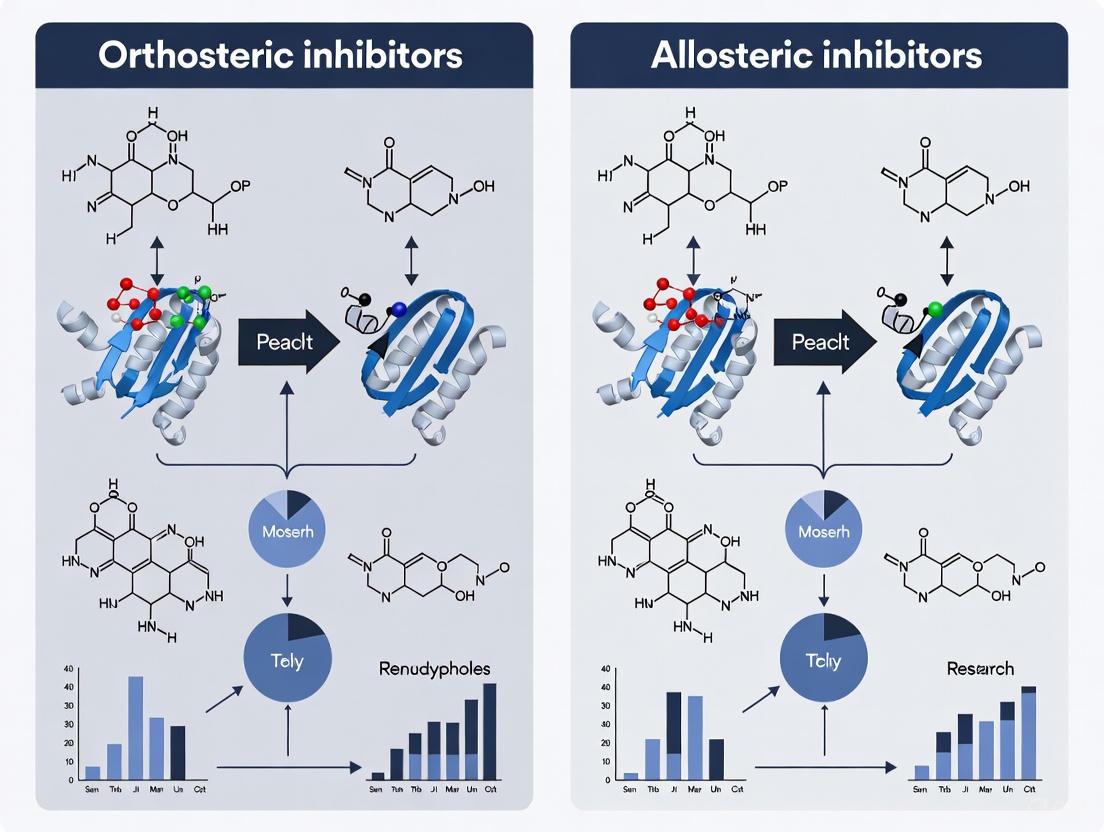
This article provides a comprehensive comparison of orthosteric and allosteric inhibitor mechanisms for researchers and drug development professionals.
Orthosteric vs. Allosteric Inhibitors: Mechanisms, Therapeutic Applications, and Future Directions in Drug Discovery
Abstract
This article provides a comprehensive comparison of orthosteric and allosteric inhibitor mechanisms for researchers and drug development professionals. It explores the foundational principles of both inhibition strategies, detailing how orthosteric drugs compete with endogenous ligands at the active site, while allosteric modulators bind at distal sites to induce conformational changes. The content covers advanced computational and experimental methodologies for inhibitor discovery, addresses key challenges including drug resistance and selectivity, and presents validation strategies through case studies across target classes like GPCRs and kinases. By synthesizing recent advances and comparative analyses, this review aims to guide the rational selection and design of next-generation therapeutic inhibitors.
Fundamental Principles: How Orthosteric and Allosteric Inhibitors Mechanistically Differ
In the realm of biochemistry and pharmacology, controlling protein function is a fundamental goal for both basic research and therapeutic intervention. Two primary strategies have emerged for modulating the activity of enzymes and receptors: orthosteric inhibition, which involves direct competition with the native substrate at the active site, and allosteric modulation, which entails binding at a topographically distinct site to remotely control protein function [1]. The choice between these strategies profoundly influences the selectivity, efficacy, and safety profile of potential therapeutics. This guide provides a comparative analysis of these distinct mechanisms, underpinned by experimental data and methodological protocols, to inform researchers and drug development professionals in their experimental design and therapeutic targeting.
Fundamental Mechanisms and Key Differences
Orthosteric inhibitors operate on a straightforward principle of spatial competition. They bind directly to the enzyme's active site or receptor's endogenous ligand-binding site, physically blocking substrate access [1] [2]. This mechanism is typically competitive, meaning its effectiveness can be overcome by sufficiently high substrate concentrations.
Allosteric inhibitors, in contrast, bind to a separate, regulatory site on the protein—the allosteric site. This binding induces a conformational change or alters protein dynamics that is transmitted through the protein structure to the active site, thereby modulating its activity [3] [1]. This mechanism is often non-competitive or uncompetitive, meaning the inhibitor's effect is not solely dependent on substrate concentration [2].
The table below summarizes the core characteristics of each mechanism.
Table 1: Fundamental Characteristics of Orthosteric and Allosteric Inhibitors
| Feature | Orthosteric Inhibitors | Allosteric Inhibitors |
|---|---|---|
| Binding Site | Active site (orthosteric site) [1] | Distinct, regulatory (allosteric) site [1] |
| Mechanism of Action | Direct steric blockade of substrate binding [1] | Indirect induction of conformational change [3] [1] |
| Relationship to Substrate | Typically competitive [1] | Typically non-competitive or uncompetitive [2] |
| Effect on Substrate Affinity | Reduces apparent affinity by competition | Can decrease or increase affinity of the active site for its substrate [1] |
| Saturability of Effect | Effect is not saturable; depends on [substrate]/[inhibitor] | Effect has a "ceiling"; saturable once allosteric sites are occupied [2] [4] |
The following diagram illustrates the fundamental mechanistic differences between orthosteric and allosteric inhibition.
Comparative Analysis: Therapeutic and Experimental Implications
The mechanistic differences between orthosteric and allosteric modulators translate into distinct advantages and challenges in a therapeutic context.
Table 2: Therapeutic and Experimental Implications of Orthosteric vs. Allosteric Modulation
| Aspect | Orthosteric Modulators | Allosteric Modulators |
|---|---|---|
| Selectivity | Challenging due to high conservation of active sites across protein families [2] | Higher potential; allosteric sites are less evolutionarily conserved [5] [2] [4] |
| Safety & Toxicity | Higher risk of off-target effects due to conserved sites; can completely shut down protein function [6] [4] | Lower risk; ceiling effect prevents total inhibition; preserves temporal/spatial signaling of endogenous ligand [2] [6] |
| Physiological Effect | "Blunt" intervention; overrides natural rhythm of endogenous signaling [6] | "Tuning knob"; fine-tunes tissue response to the endogenous agonist [5] [6] |
| Resistance | More prone to resistance (e.g., via elevated substrate/substrate mutations) [4] | Less prone; can be used in combination with orthosterics to minimize resistance [4] |
| Chemical Tractability | Can be limited by highly polar/charged active sites [2] | Often improved physicochemical properties [2] |
A key advantage of allosteric modulators is their ability to achieve unprecedented selectivity. For example, in kinase targeting, orthosteric inhibitors often target the highly conserved ATP-binding site, leading to off-target effects and toxicity. In contrast, allosteric kinase inhibitors bind to less conserved sites, affording greater kinome selectivity and improved safety [3] [2]. Furthermore, allosteric modulators can impart functional selectivity or biased signaling, whereby they stabilize receptor conformations that preferentially activate a subset of downstream signaling pathways [2] [7]. This allows for more precise pharmacological control.
Experimental Approaches and Data Interpretation
Distinguishing between orthosteric and allosteric mechanisms requires specific experimental designs and careful interpretation of the resulting data.
Key Methodologies and Protocols
- Radioligand Binding Assays: Used to identify ligand-receptor interactions.
- Protocol for Competition Binding: Incubate the receptor with a fixed concentration of a radiolabeled orthosteric ligand and varying concentrations of the unlabeled test compound. A competitive (orthosteric) inhibitor will produce a concentration-response curve where the radioligand binding is fully inhibited. A compound that fails to fully displace the radioligand may be binding to an allosteric site [2].
- Functional Assays (e.g., TRUPATH BRET, TGFα Shedding): Measure downstream signaling outputs (e.g., cAMP, calcium mobilization, β-arrestin recruitment) [7].
- Protocol for Schild Regression Analysis: Perform concentration-response curves for the endogenous agonist in the absence and presence of increasing concentrations of the test inhibitor. A parallel rightward shift of the curve with no suppression of the maximal response is characteristic of competitive (orthosteric) antagonism. A depression of the maximal response is indicative of a non-competitive (often allosteric) mechanism [6].
- Kinetic and Saturation Binding Studies:
- Protocol: Assess the association and dissociation rates of a radiolabeled orthosteric ligand in the presence of the test compound. An allosteric modulator will typically alter the dissociation rate of the orthosteric ligand, a phenomenon known as a "probe-dependence" effect, whereas an orthosteric competitor will not [2].
Interpretation of Functional Data
The following diagram outlines the logical workflow for interpreting functional assay data to characterize an inhibitor's mechanism of action, based on the modulation of an agonist's concentration-response curve (CRC).
Case Studies and Supporting Experimental Data
Case Study 1: Targeting the A2B Adenosine Receptor (GPCR)
Research on the A2B adenosine receptor (A2B AR) highlights the therapeutic rationale for pursuing allosteric modulators. The orthosteric site of ARs is highly conserved across its four subtypes (A1, A2A, A2B, A3), making the development of selective orthosteric agonists challenging [5]. Positive Allosteric Modulators (PAMs) of the A2B AR have been developed to fine-tune the receptor's response to endogenous adenosine, offering potential for treating conditions like chronic obstructive pulmonary disease, ischemic injury, and osteoporosis with greater spatial and temporal selectivity than orthosteric ligands [5].
Table 3: Experimental Data on A2B AR Ligands in Pre-Clinical Models
| Ligand Name | Type | Key Experimental Findings | In Vivo Model / Assay |
|---|---|---|---|
| BAY-60-6583 | Orthosteric Agonist | Attenuates pulmonary edema, diminishes lung inflammation [5]. | Murine model of acute lung injury [5] |
| Unnamed PAMs/NAMs | Allosteric Modulators (PAMs & NAMs) | Proposed to fine-tune tissue responses to endogenous adenosine, potentially offering superior management of pathological conditions [5]. | In vitro signaling studies; pre-clinical models of COPD, fibrosis [5] |
Case Study 2: Targeting CCR2 for Idiopathic Pulmonary Fibrosis (IPF)
A 2025 study employed structure-based design to develop both orthosteric and allosteric inhibitors for the CCR2 receptor as a potential IPF therapy [8]. Using integrated computational and experimental approaches, researchers identified:
- Compound 17: An orthosteric inhibitor with a binding free energy of -30.91 kcal/mol.
- Compound 67: An allosteric inhibitor with a binding free energy of -26.11 kcal/mol.
Experimental Validation: Surface Plasmon Resonance (SPR) confirmed compound 17's direct binding to murine CCR2 (KD = 3.46 μM). Crucially, co-administration of the allosteric compound 67 synergistically enhanced the binding affinity of the orthosteric compound, demonstrating the potential of dual-pocket targeting strategies [8]. In a TGF-β-induced pulmonary fibrosis cell model, both compounds significantly reduced hydroxyproline and COL1A1 levels (fibrosis markers), with the orthosteric compound 17 showing comparable efficacy to the positive control nintedanib [8].
The Scientist's Toolkit: Essential Research Reagents
Table 4: Key Reagents for Investigating Orthosteric and Allosteric Mechanisms
| Reagent / Tool | Function in Research | Relevant Context |
|---|---|---|
| TRUPATH BRET Sensors | Measures ligand-induced activation of specific Gα protein subtypes in live cells [7]. | GPCR signaling bias and selectivity profiling. |
| Recombinant Proteins (e.g., ACE, α-glucosidase) | Purified enzyme targets for in vitro inhibition assays and binding studies [9] [10]. | Enzyme inhibition kinetics and mechanism studies. |
| SBI-553 | Intracellularly-binding allosteric modulator of Neurotensin Receptor 1 (NTSR1) [7]. | Prototypical compound for studying allosteric switching of G protein selectivity. |
| Surface Plasmon Resonance (SPR) | Label-free technique for real-time analysis of binding kinetics (KD, kon, koff) [8]. | Direct measurement of ligand-target binding and cooperative effects. |
| Molecular Dynamics (MD) Simulations | Computational method to simulate and analyze protein-ligand interactions and conformational changes over time [8] [4]. | Predicting binding stability and elucidating allosteric communication pathways. |
The choice between orthosteric and allosteric strategies defines a critical battlefield in modern drug discovery. Orthosteric inhibitors, with their direct mechanism, remain a powerful tool but often lack selectivity. Allosteric modulators offer a sophisticated means of "remote control" with inherent advantages in selectivity, safety, and the ability to fine-tune physiological responses. The future of the field lies in leveraging advanced experimental and computational tools to identify and characterize allosteric sites, and in developing intelligent combination therapies that exploit the synergistic potential of both mechanisms, as demonstrated in the CCR2 case study. This comparative guide provides a framework for researchers to navigate this complex landscape and design more effective and targeted therapeutic interventions.
In the realm of molecular pharmacology and drug discovery, two distinct mechanisms dominate the strategic inhibition of protein function: orthosteric inhibition, which involves direct physical blockade of the active site, and allosteric inhibition, which modulates function through conformational changes induced at sites distant from the active region [11] [1]. This distinction represents more than merely different binding locations; it encompasses fundamentally divergent approaches to controlling biological activity with profound implications for drug specificity, efficacy, and therapeutic application.
The evolutionary conservation of active sites across protein families presents significant challenges for orthosteric drug development, whereas the typically lower evolutionary pressure on allosteric sites offers enhanced opportunities for selective targeting [12] [11]. This comparative analysis examines the molecular mechanisms, experimental characterization, and therapeutic applications of these two inhibitory strategies, providing researchers with a framework for selecting appropriate intervention strategies in drug development campaigns.
Orthosteric Inhibition: Direct Active Site Competition
Fundamental Mechanism
Orthosteric inhibitors function through a direct competitive mechanism by binding reversibly or irreversibly to the enzyme's active site, physically preventing substrate access and thereby blocking catalytic activity [11] [1]. This approach represents the most straightforward inhibitory strategy, characterized by its occupancy-driven mechanism where inhibition efficacy primarily depends on the inhibitor's concentration and binding affinity relative to the natural substrate.
The binding site for orthosteric inhibitors is identical to the substrate binding site, typically characterized by deep, well-defined pockets with conserved structural features across protein families [11]. This evolutionary conservation, while functionally necessary, presents the primary challenge for orthosteric drug development: achieving selectivity among related proteins with similar active site architectures.
Experimental Characterization and Validation
Table 1: Key Experimental Approaches for Characterizing Orthosteric Inhibition
| Method | Experimental Readout | Information Obtained | Key Considerations |
|---|---|---|---|
| Competitive Binding Assays | IC50 shift with increasing substrate concentration | Binding competition with native ligand | Classic diagnostic for orthosteric mechanism |
| X-ray Crystallography | Electron density at active site | Atomic-level binding mode confirmation | Requires high-resolution crystals |
| Surface Plasmon Resonance (SPR) | Direct binding affinity (KD) | Binding kinetics without competition | Measures binding independent of function |
| Enzyme Activity Assays | Dose-response curves (IC50) | Functional inhibition potency | Does not directly prove binding site |
Case Study: CCR2 Orthosteric Inhibition - In recent work on idiopathic pulmonary fibrosis, researchers identified compound 17 as a potent orthosteric inhibitor of CCR2. Molecular dynamics simulations confirmed stable binding at the orthosteric site with a free energy of -30.91 kcal/mol, while surface plasmon resonance directly demonstrated binding to murine CCR2 with KD = 3.46 μM [13]. This comprehensive approach exemplifies the multi-faceted methodology required to unequivocally establish orthosteric inhibition.
Allosteric Inhibition: Indirect Modulation Through Conformational Control
Fundamental Mechanism
Allosteric inhibitors operate through a more sophisticated mechanism, binding to regulatory sites distinct from the active site and inducing conformational or dynamic changes that propagate through the protein structure to alter active site functionality [1] [4]. This paradigm represents a fundamental shift from occupancy-driven to ensemble-based pharmacology, where the inhibitor's effect emerges from its ability to perturb the protein's conformational landscape and shift the equilibrium toward inactive states [12] [11].
The theoretical framework for understanding allosteric regulation has evolved significantly beyond early models like Monod-Wyman-Changeux (MWC) and Koshland-Nemethy-Filmer (KNF) [12] [1]. The contemporary Ensemble Allosteric Model (EAM) interprets allostery through the lens of thermodynamic ensembles of microstates, where populations of each microstate are governed by Boltzmann distributions dictated by free energies of conformational change and inter-domain interactions [12]. This framework successfully explains phenomena such as allosteric partial agonism and pluripotency, which challenge classical models.
Emerging Mechanistic Insights
Recent studies on signaling enzymes including PKA, PKG, and EPAC reveal a common theme in allosteric inhibition: the stabilization of distinct "mixed" conformational states that exhibit characteristics of both active and inactive states in different protein regions [12] [14]. For example, in human cGMP-dependent protein kinase (hPKG), cAMP acts as a partial agonist by sampling a three-state equilibrium where the orientation of N-terminal helices and phosphate-binding cassette resembles the active state, while C-terminal helices remain disengaged and dynamic similar to the inactive state [12].
Case Study: USP7 Allosteric Inhibition - Research on ubiquitin-specific protease 7 (USP7) demonstrates how allosteric inhibitor binding increases flexibility in the fingers and palm domains, simultaneously restraining dynamics at the C-terminal ubiquitin binding site and disrupting proper alignment of the catalytic triad (Cys223-His464-Asp481) [15]. This dynamic perturbation effectively disrupts catalytic activity without direct competition with ubiquitin binding.
Comparative Analysis: Orthosteric versus Allosteric Mechanisms
Table 2: Strategic Comparison of Orthosteric and Allosteric Inhibition Mechanisms
| Characteristic | Orthosteric Inhibition | Allosteric Inhibition |
|---|---|---|
| Binding Site | Active site (highly conserved) | Allosteric site (less conserved) |
| Mechanism | Direct physical blockade | Conformational/dynamic change |
| Specificity Challenges | High (due to active site conservation) | Lower (targets less conserved regions) |
| Theoretical Model | Occupancy-driven | Ensemble-based (EAM) |
| Pharmacological Effect | Complete activity blockade | Tunable modulation (partial to complete) |
| Native Ligand Interference | Competitive | Non-competitive or uncompetitive |
| Resistance Development | Higher susceptibility | Lower susceptibility |
| Therapeutic Finesse | Binary on/off effect | Fine-tuned modulation |
Selectivity and Specificity Considerations
The specificity mechanisms differ fundamentally between these approaches. For orthosteric drugs, specificity depends critically on achieving high binding affinity to allow low dosage administration that selectively targets only proteins with the highest complementary binding sites [11]. In contrast, allosteric drug specificity derives from targeting less-conserved surface regions and optimizing interaction networks that propagate effects specifically to the intended active site [11] [4].
This distinction has profound implications for drug discovery. Orthosteric inhibitors require exquisite optimization for selective affinity, while allosteric inhibitors demand consideration of the protein conformational ensemble and preferred propagation states to elicit specific functional outcomes [11].
Therapeutic Applications and Clinical Validation
The clinical success of allosteric inhibitors is particularly evident in targeting previously "undruggable" proteins. KRAS G12C inhibitors represent a landmark achievement, where compounds like sotorasib and adagrasib target a specific allosteric pocket near the mutant cysteine residue, covalently trapping KRAS in its inactive GDP-bound conformation [16] [4]. These inhibitors demonstrate remarkable selectivity, exhibiting 215-fold greater potency against mutant KRAS compared to the wild-type protein [4].
In direct comparative clinical studies, allosteric modulators have demonstrated significant efficacy advantages. In chronic myeloid leukemia treatment, the allosteric modulator asciminib achieved a 25.5% major molecular response rate compared to 13.2% for the orthosteric inhibitor bosutinib [4]. Similarly, the allosteric MEK inhibitor trametinib achieved superior target inhibition with substantially lower concentration requirements compared to orthosteric alternatives [4].
Experimental Methodologies for Mechanism Elucidation
Core Technical Approaches
Table 3: Essential Methodologies for Inhibitor Mechanism Characterization
| Technique | Orthosteric Application | Allosteric Application | Key Limitations |
|---|---|---|---|
| Nuclear Magnetic Resonance (NMR) | Limited | Mapping free energy landscapes and dynamics | Sensitivity and protein size constraints |
| Molecular Dynamics (MD) Simulations | Binding pose validation | Capturing allosteric propagation and ensemble shifts | Computational cost and timescale limitations |
| X-ray Crystallography | Atomic-resolution active site binding | Identification of cryptic allosteric pockets | Static picture of dynamic processes |
| Cryo-Electron Microscopy | Limited for small molecules | Visualizing large-scale conformational changes | Resolution limitations for small ligands |
| Mutational Analysis | Active site residue mapping | Pathway residue identification | May disrupt overall folding |
Integrated Workflow for Allosteric Inhibitor Characterization
A comprehensive approach to allosteric mechanism elucidation combines NMR, MD simulations, and Ensemble Allosteric Modeling (EAM) [12] [14]. NMR provides experimental observation of conformational equilibria and dynamics, MD simulations offer atomic-level details of allosteric propagation and ensemble sampling, while EAM integrates these data into a quantitative thermodynamic framework that predicts functional response [12].
For example, in studying USP7 allosteric inhibition, researchers employed multi-replica MD simulations of apo, ubiquitin-bound, and inhibitor-bound states, followed by dynamic cross-correlation matrix analysis and community network analysis to reveal state-specific dynamic signatures and communication pathways [15].
Table 4: Key Research Reagent Solutions for Inhibitor Mechanism Studies
| Reagent/Resource | Primary Function | Application Examples | Technical Considerations |
|---|---|---|---|
| 15N-labeled Proteins | NMR spectroscopy dynamics studies | Mapping allosteric conformational changes | Requires specialized expression systems |
| Covalent Fragment Libraries | Tethering to identify allosteric sites | KRAS G12C inhibitor discovery | Requires cysteine-tethering compatible libraries |
| Structure-Based Pharmacophore Models | Virtual screening for site-selective inhibitors | CCR2 orthosteric/allosteric inhibitor identification | Dependent on quality of structural data |
| Engineered Cell Lines | Pathway-specific reporter assays | Monitoring intracellular signaling modulation | Requires careful validation of specificity |
| Surface Plasmon Resonance Chips | Direct binding kinetics measurement | Orthosteric vs allosteric binding characterization | Immobilization must not affect binding sites |
Visualizing Mechanistic Pathways
Orthosteric Competitive Inhibition
Allosteric Conformational Modulation
The comparative analysis of orthosteric and allosteric inhibition mechanisms reveals complementary strengths that can be strategically leveraged in drug development. Orthosteric inhibitors provide potent, complete blockade ideal for scenarios requiring absolute pathway interruption, while allosteric modulators offer finer pharmacological control with enhanced selectivity, particularly valuable for previously intractable targets.
The emerging paradigm emphasizes not exclusive selection of one approach over the other, but rather strategic integration. This is exemplified by the development of dual-pocket targeting strategies as demonstrated in CCR2 inhibition, where orthosteric and allosteric compounds can be co-administered for synergistic effects [13]. Furthermore, combination therapies pairing allosteric modulators with orthosteric drugs present promising avenues to overcome drug resistance—a significant limitation of single-mechanism approaches [4].
As structural biology and computational methodologies continue to advance, enabling more precise mapping of allosteric landscapes and communication networks, the rational design of both orthosteric and allosteric inhibitors will become increasingly sophisticated. The future of therapeutic inhibition lies in harnessing the unique advantages of both mechanisms, often in combination, to achieve unprecedented specificity and efficacy in targeting challenging disease mechanisms.
In the landscape of modern drug discovery, the strategic inhibition of pathological proteins is paramount. Two fundamental mechanisms—orthosteric and allosteric inhibition—offer distinct approaches with complementary advantages and limitations. Orthosteric inhibitors bind directly to a protein's active site, competing with and typically blocking the natural substrate. In contrast, allosteric inhibitors bind to a topographically distinct site, inducing conformational or dynamic changes that indirectly modulate activity at the active site [4] [11]. This review provides a comparative analysis of these mechanisms, focusing on their specificity, tunability, and therapeutic applications, to inform strategic decisions in preclinical research and development.
Mechanistic and Pharmacological Comparison
The fundamental difference in binding location between orthosteric and allosteric inhibitors leads to divergent pharmacological profiles. The table below summarizes their core characteristics.
Table 1: Fundamental Characteristics of Orthosteric vs. Allosteric Inhibitors
| Feature | Orthosteric Inhibitors | Allosteric Inhibitors |
|---|---|---|
| Binding Site | Active site (orthosteric site) [11] | Distal, regulatory site [4] [17] |
| Mechanism of Action | Direct competition with endogenous substrate [11] | Indirect modulation via conformational/dynamic change [4] [17] |
| Effect on Activity | Typically complete blockade | Fine-tuning; can be inhibitory or enhancing [18] |
| Evolutionary Conservation | High (across protein families) [11] | Low (more unique to specific proteins) [17] [11] |
| Saturation Effect | Not applicable | "Ceiling effect" common [4] |
The following diagram illustrates the conceptual mechanistic differences and the experimental workflow for evaluating these inhibitors.
Quantitative Comparison of Key Pharmacological Parameters
The theoretical advantages of allosteric modulators are borne out in experimental data. The following table compiles key quantitative findings from recent studies, demonstrating differences in affinity, selectivity, and efficacy.
Table 2: Experimental Data from Preclinical and Clinical Studies
| Inhibitor Type / Example | Key Quantitative Finding | Experimental Model | Reference / Context |
|---|---|---|---|
| Allosteric: Trametinib (MEK inhibitor) | >14x more potent (lower nM concentration) and 7.2x higher pMEK/uMEK ratio vs. orthosteric selumetinib [4] | Targeted cancer therapy | [4] |
| Allosteric: Asciminib (CML treatment) | Higher major molecular response rate (25.5% vs. 13.2%) vs. orthosteric bosutunib [4] | Chronic Myeloid Leukemia (CML) clinical trial | [4] |
| Allosteric: KRAS G12C inhibitors | 215-fold more potent against mutant KRAS than wild-type [4] | Cancer model | [4] |
| Orthosteric: Compound 17 (CCR2) | Binding free energy: -30.91 kcal mol⁻¹; KD (SPR): 3.46 μM [8] | Murine CCR2, pulmonary fibrosis model | [8] |
| Allosteric: Compound 67 (CCR2) | Binding free energy: -26.11 kcal mol⁻¹; synergistically enhanced orthosteric binding [8] | Murine CCR2, pulmonary fibrosis model | [8] |
| Dual Therapy (Ortho + Allo) | Synergistic reduction of hydroxyproline & COL1A1; upregulation of ELN [8] | TGF-β-induced pulmonary fibrosis cell model | [8] |
Detailed Experimental Protocols for Key Assays
To facilitate replication and further research, this section outlines core methodologies used to generate the comparative data.
Molecular Dynamics (MD) Simulations and Free Energy Calculations
Purpose: To characterize the stability of inhibitor binding and calculate binding free energies, which are critical for understanding allosteric mechanisms [8] [17].
- Procedure:
- System Preparation: Obtain a 3D structure of the target protein (e.g., CCR2). Dock the candidate inhibitor into the putative orthosteric or allosteric site. Embed the protein-ligand complex in a solvated lipid bilayer for membrane proteins or in a water box for soluble proteins. Add ions to neutralize the system.
- Energy Minimization: Use steepest descent or conjugate gradient algorithms to relieve steric clashes.
- Equilibration: Run short simulations with positional restraints on the protein and ligand, gradually releasing the restraints to allow the system to relax.
- Production MD Simulation: Run an unrestrained simulation for hundreds of nanoseconds to microseconds, integrating Newton's equations of motion to track atomic movements [17].
- Free Energy Calculation: Apply the Molecular Mechanics/Poisson-Boltzmann Surface Area (MM/PBSA) method to snapshots from the MD trajectory to compute binding free energy (ΔG_bind) [8].
- Enhanced Sampling (Optional): For probing rare events, use techniques like umbrella sampling to compute the potential of mean force along a defined reaction coordinate, or metadynamics to explore conformational space and identify cryptic allosteric sites [17].
Surface Plasmon Resonance (SPR) Binding Kinetics
Purpose: To experimentally measure the binding affinity (KD) and kinetic parameters (kon, koff) of an inhibitor for its target protein in real-time, without labels [8].
- Procedure:
- Immobilization: Covalently immobilize the purified target protein on a dextran-coated gold sensor chip.
- Ligand Injection: Inject a series of concentrations of the inhibitor analyte over the chip surface in a continuous flow of buffer.
- Data Collection: Monitor the change in the SPR signal (Response Units, RU) as a function of time during the association (injection) and dissociation (buffer flow) phases.
- Data Analysis: Fit the resulting sensorgrams to a suitable binding model (e.g., 1:1 Langmuir) to determine the association rate (kon), dissociation rate (koff), and calculate the equilibrium dissociation constant (KD = koff/kon) [8].
Functional Cell-Based Assay (CCK-8 for Fibrosis)
Purpose: To evaluate the functional, phenotypic efficacy of inhibitors in a disease-relevant cellular model.
- Procedure:
- Cell Culture and Model Induction: Culture relevant cells (e.g., pulmonary fibroblasts). Induce a fibrotic phenotype by treatment with TGF-β [8].
- Compound Treatment: Treat cells with a concentration gradient of the test inhibitor (e.g., orthosteric Compound 17, allosteric Compound 67) and a positive control (e.g., nintedanib).
- Viability/Inhibition Assessment: Add CCK-8 reagent. Metabolically active cells reduce WST-8 in CCK-8 to an orange-colored formazan product. Measure the absorbance at 450 nm to quantify cell viability and the inhibitory effect of the compounds [8].
- Biomarker Analysis: Quantify fibrosis biomarkers like hydroxyproline content (colorimetric assay) and COL1A1/ELN expression levels (e.g., by RT-qPCR or Western Blot) to confirm anti-fibrotic activity [8].
The Scientist's Toolkit: Essential Research Reagents and Solutions
Table 3: Key Reagents for Orthosteric and Allosteric Inhibitor Research
| Reagent / Solution | Function in Research | Specific Application Example |
|---|---|---|
| Purified Target Protein | Essential for structural studies, in vitro binding assays (SPR), and biochemical activity assays. | Immobilizing CCR2 for SPR kinetics [8]. |
| Crystallography or Cryo-EM Kits | To determine high-resolution 3D structures of protein-inhibitor complexes, revealing binding modes. | Identifying novel allosteric pockets and confirming ligand placement [4] [17]. |
| Molecular Dynamics Software | Simulates dynamic behavior of proteins, identifies transient pockets, and calculates binding energies. | Characterizing allosteric communication pathways and cryptic sites [17] [19]. |
| Cell-Based Disease Models | Provides a physiologically relevant context for testing inhibitor efficacy and toxicity. | TGF-β-induced pulmonary fibrosis model for anti-fibrotic drug screening [8]. |
| Allosteric Site Prediction Tools | Computational identification of potential allosteric sites from protein sequence/structure. | Tools like PASSer and AlloReverse for rational drug design [17] [20]. |
The choice between orthosteric and allosteric strategies is not a simple binary but a strategic decision based on therapeutic goals. Orthosteric inhibitors remain a powerful tool when complete, potent inhibition of a target is required. However, their application can be limited by toxicity from off-target effects due to conserved active sites. Allosteric inhibitors offer a sophisticated means to achieve fine-tuning, high selectivity, and the targeting of previously "undruggable" proteins like mutant KRAS [4] [18].
The future lies in leveraging the strengths of both modalities. As demonstrated with CCR2, combination therapy or the development of bitopic inhibitors (single molecules engaging both orthosteric and allosteric sites) presents a promising path to enhance efficacy, overcome resistance, and deliver more precise and durable therapeutics [8] [21]. The continued advancement of computational methods, particularly MD simulations and machine learning for allosteric site prediction, will be the engine for the next generation of allosteric drug discovery [17] [19] [22].
In the realm of drug discovery and therapeutic intervention, two fundamental mechanisms—orthosteric inhibition and allosteric modulation—dictate cellular outcomes with profound implications for efficacy and safety. Orthosteric drugs bind directly to the active site of a protein, competing with the native substrate to completely halt protein activity [11]. In contrast, allosteric drugs bind at topographically distinct sites, inducing conformational changes that fine-tune protein function rather than abolishing it entirely [11] [23]. This distinction represents more than just binding location; it fundamentally alters the cellular consequences, selectivity profiles, and therapeutic potential of pharmacological interventions. Understanding these differential outcomes is crucial for researchers and drug development professionals seeking to design targeted therapies with optimal benefit-risk profiles.
Mechanistic Foundations and Key Concepts
Orthosteric Inhibition: Complete Functional Blockade
Orthosteric inhibitors operate through direct competition with endogenous ligands or substrates for the evolutionarily conserved active site of target proteins [11]. This mechanism results in complete inhibition of protein function when sufficient drug concentration is achieved. The active sites of proteins within the same family are often highly conserved, creating significant challenges for achieving selectivity and increasing the potential for off-target effects [11]. As one research group noted, "If the concentration of the drug is high, it will bind to the target protein as well as to other similar binding sites in homologous members of the protein family" [11]. This fundamental limitation underscores the importance of achieving high affinity in orthosteric drug design to enable target-selective binding at low dosages.
Allosteric Modulation: Fine-Tuned Functional Adjustment
Allosteric modulators bind to regions distinct from the orthosteric site, inducing conformational changes that propagate through the protein structure to indirectly influence activity at the active site [11] [23]. This mechanism enables fine-tuned modulation of protein function, allowing for either enhancement (positive allosteric modulation) or reduction (negative allosteric modulation) of activity without completely abolishing it [23]. Allosteric sites are typically less conserved than orthosteric sites across protein families, offering inherent advantages for achieving selectivity [11] [5]. The binding of allosteric modulators "perturbs the protein surface atoms, and the perturbation propagates like waves, finally reaching the binding site" [11], shifting the free energy landscape of the protein and altering the population distribution of its conformational states.
Allosteric Modulator Classification
- Positive Allosteric Modulators (PAMs): Enhance protein activity; include full agonists and partial agonists [23]
- Negative Allosteric Modulators (NAMs): Reduce protein activity; include inverse agonists, neutral antagonists, and partial antagonists [23]
Table 1: Fundamental Characteristics of Orthosteric versus Allosteric Targeting
| Characteristic | Orthosteric Inhibitors | Allosteric Modulators |
|---|---|---|
| Binding Site | Active/catalytic site | Topographically distinct site |
| Mechanism | Direct competition with native ligand | Conformational change propagation |
| Effect on Activity | Complete inhibition | Fine-tuned modulation (up or down) |
| Selectivity Potential | Lower (active sites conserved) | Higher (allosteric sites less conserved) |
| Functional Outcome | Binary (on/off) | Gradual (rheostatic) |
| Therapeutic Disruption | High | Context-dependent |
Comparative Experimental Data and Signaling Outcomes
Quantitative Binding and Functional Data
Recent research on C-C chemokine receptor type 2 (CCR2) inhibitors for idiopathic pulmonary fibrosis provides direct comparative data between orthosteric and allosteric approaches [8]. Through integrated computational and experimental methods, researchers demonstrated that compound 17 (orthosteric) and compound 67 (allosteric) achieved high site selectivity with distinct binding characteristics and functional outcomes.
Table 2: Experimental Comparison of Orthosteric and Allosteric CCR2 Inhibitors
| Parameter | Orthosteric Inhibitor (Compound 17) | Allosteric Inhibitor (Compound 67) |
|---|---|---|
| Binding Site | CCR2 orthosteric site | CCR2 allosteric site |
| Binding Free Energy | -30.91 kcal/mol | -26.11 kcal/mol |
| Binding Affinity (K_D) | 3.46 μM | Not reported |
| Synergistic Effect | None observed | Enhanced orthosteric binding when co-administered |
| Antifibrotic Efficacy | Comparable to positive control nintedanib | Significant reduction in hydroxyproline and COL1A1 |
| Experimental Validation | Surface plasmon resonance (SPR) | Molecular dynamics simulations |
Cellular Signaling Consequences
The functional outcomes of orthosteric versus allosteric targeting extend to fundamental differences in cellular signaling pathways. Allosteric modulators can achieve unprecedented selectivity in G protein-coupled receptor (GPCR) signaling, as demonstrated by recent work with the neurotensin receptor 1 (NTSR1) [7]. The intracellular allosteric modulator SBI-553 was shown to "switch the G protein preference of NTSR1 through direct intermolecular interactions," effectively biasing signaling toward specific G protein subtypes while antagonizing others [7]. This biased signaling enables selective pathway modulation that is impossible to achieve with orthosteric inhibitors.
In contrast, orthosteric targeting typically affects all downstream signaling pathways equally. For example, the orthosteric antagonist SR142948A "produced a uniform, concentration-dependent blockade of NT-induced β-arrestin recruitment and G protein activation, regardless of the Gα subtype" [7]. This blanket inhibition can lead to both therapeutic effects and on-target side effects, as beneficial and deleterious signaling pathways are simultaneously disrupted.
Diagram 1: Signaling consequences of orthosteric versus allosteric targeting
Methodologies for Experimental Characterization
Integrated Computational-Experimental Workflow
The characterization of orthosteric and allosteric mechanisms requires sophisticated multidisciplinary approaches. A recent study on CCR2 inhibitors exemplifies this integrated methodology [8]:
- Structure-Based Pharmacophore Modeling: Identification of critical chemical features for target binding
- 3D Quantitative Structure-Activity Relationship (3D-QSAR): Correlation of molecular structure with biological activity
- Large-Scale Virtual Screening: Evaluation of 152,406 molecules for potential binding
- Molecular Dynamics (MD) Simulations: Assessment of binding stability and conformational changes
- Principal Component Analysis (PCA) and Potential Energy Surface Analysis: Characterization of molecular motions and energy landscapes
- Molecular Mechanics/Poisson-Boltzmann Surface Area (MM/PBSA) Calculations: Quantification of binding free energies
- Surface Plasmon Resonance (SPR): Experimental validation of binding affinity and kinetics
- Functional Cellular Assays: Assessment of antifibrotic effects in TGF-β-induced models
Specialized Techniques for Allosteric Mechanism Elucidation
Allosteric modulation requires additional specialized methodologies to characterize its distinct mechanisms:
- Free Energy Landscape Analysis: "Drug binding shifts the free energy landscape: conformations that were sparsely populated before can become more populated, and vice versa" [11]
- Bioluminescence Resonance Energy Transfer (BRET) Assays: Enable real-time monitoring of specific transducer activation pathways (e.g., TRUPATH BRET2 sensors for G protein subtype selectivity) [7]
- Transforming Growth Factor-α (TGFα) Shedding Assay: Assesses G protein activation through engineered sensors with swapped C-terminal amino acids to confer subtype specificity [7]
- Umbrella Sampling: Provides potential energy surface analysis for binding confirmation [8]
Diagram 2: Integrated workflow for inhibitor characterization
The Scientist's Toolkit: Essential Research Reagents and Solutions
Table 3: Essential Research Reagents for Orthosteric and Allosteric Studies
| Reagent/Solution | Function/Application | Specific Examples |
|---|---|---|
| TRUPATH BRET2 Sensors | Profiling G protein subtype activation selectivity | Simultaneous assessment of 14 Gα proteins [7] |
| SPR Chips & Buffers | Label-free binding kinetics analysis | Direct binding affinity measurement (e.g., KD determination) [8] |
| TGFα Shedding Assay System | G protein activation profiling | Chimeric G proteins with swapped C-termini [7] |
| Molecular Dynamics Software | Simulating protein-ligand interactions & conformational changes | Binding stability assessment and energy calculations [8] |
| 3D-QSAR Modeling Tools | Structure-activity relationship analysis | Correlation of molecular features with biological activity [8] |
| Virtual Screening Libraries | High-throughput identification of candidate compounds | Screening of >150,000 molecules for hit identification [8] |
| MM/PBSA Computational Methods | Binding free energy calculations | Quantitative comparison of inhibitor affinities [8] |
Biological Implications and Therapeutic Applications
Functional Fine-Tuning in Physiological Systems
The cellular consequences of allosteric modulation extend to precise functional fine-tuning that maintains physiological homeostasis. This is particularly evident in modular proteins and signaling systems where "allosteric modulators can fine-tune the tissue responses to the endogenous agonist" [5]. For example, in G-protein coupled receptors (GPCRs), allosteric modulators "can exert their influence even if an endogenous ligand is bound to another site on the same target at the same time" [11], enabling context-dependent modulation rather than blanket inhibition.
The multi-lock autoinhibition mechanisms in HECT family E3 ubiquitin ligases exemplify how natural systems employ allosteric principles for functional fine-tuning [24]. WWP1 maintains autoinhibition through a "headset architecture" where "WW2 and WW4 domains act as the 'right ear' and 'left ear,' respectively, when binding to bilateral sites of the N-lobe, whereas L functions as the 'headband' of the headset" [24]. Cancer-associated mutations disrupting this allosteric regulation result in constitutive activation, demonstrating the pathological consequences of failed fine-tuning mechanisms.
Therapeutic Advantages and Clinical Translation
The cellular consequences of complete inhibition versus fine-tuned modulation directly impact therapeutic outcomes:
- Side Effect Profiles: Allosteric modulators generally demonstrate "fewer side effects" due to their saturable effect (ceiling effect) and greater selectivity [11]
- Physiological Compatibility: Allosteric modulators "can fine-tune the tissue responses to the endogenous agonist" [5], working with rather than against physiological systems
- Therapeutic Context: Orthosteric inhibitors may be preferable when complete pathway blockade is required, while allosteric modulators excel when "less disruptive" influence of pathway functioning is desired [11]
- Combination Potential: Allosteric and orthosteric approaches can be synergistic, as demonstrated by the finding that "co-administration with compound 67 synergistically enhanced binding affinity" of an orthosteric inhibitor [8]
The cellular consequences of complete inhibition through orthosteric targeting versus fine-tuned modulation via allosteric mechanisms represent a fundamental dichotomy in therapeutic intervention. Orthosteric inhibitors provide powerful tools for complete pathway blockade when necessary, but suffer from selectivity challenges and binary functional outcomes. Allosteric modulators offer sophisticated control over protein function, enabling pathway-selective effects and maintenance of physiological signaling context. The choice between these approaches must be guided by therapeutic goals, pathological context, and the desired balance between efficacy and selectivity. As drug discovery advances, the integration of both strategies, supported by the sophisticated methodological toolkit outlined here, promises more targeted and effective therapeutic interventions with optimized cellular outcomes.
In the field of drug discovery, understanding the fundamental distinctions between orthosteric and allosteric regulatory mechanisms is paramount. Orthosteric sites are the traditional binding pockets where endogenous substrates or competitive inhibitors bind, typically representing the active site in enzymes or the primary ligand-binding site in receptors. In contrast, allosteric sites are regulatory binding locations distinct from the orthosteric site, where effector molecules bind to modulate protein activity through induced conformational changes or dynamic adjustments [4] [6]. This comparison guide examines the evolutionary conservation patterns between these site types, providing researchers with objective data and methodological approaches to inform target selection and therapeutic design.
The distinction between these mechanisms carries profound implications for pharmacological intervention. Orthosteric drugs typically compete with natural ligands for binding, often requiring high affinity to achieve efficacy and potentially disrupting normal physiological signaling. Allosteric modulators, however, offer a more nuanced approach by fine-tuning protein activity without completely activating or inhibiting function, potentially preserving physiological rhythms and reducing side effects [6] [25]. This guide systematically compares the evolutionary conservation, experimental characterization, and therapeutic implications of these distinct binding regions to assist researchers in making evidence-based decisions for inhibitor development.
Comparative Analysis of Evolutionary Conservation Patterns
Quantitative Conservation Metrics
Table 1: Evolutionary Conservation Metrics for Protein Functional Sites
| Feature | Active/Orthosteric Sites | Allosteric Sites |
|---|---|---|
| Sequence Conservation | Highly conserved across species [26] [27] | Poorly conserved; show evolutionary diversity [28] [25] |
| Structural Conservation | High structural conservation within protein families [29] | Moderate structural conservation despite sequence divergence [29] |
| Evolutionary Pressure | Strong purifying selection [26] | Relaxed constraints; more tolerant to variation [28] |
| Conservation Gradient | Steep conservation gradient with distance (up to 27.5Å) [26] | Weak or no consistent distance-based conservation pattern |
| Functional Role | Direct involvement in catalytic activity or primary function [30] [27] | Regulatory modulation of protein activity [30] [17] |
Structural and Functional Constraints
The differential evolutionary pressures on orthosteric versus allosteric sites reflect their distinct functional roles within protein architectures. Research demonstrates that catalytic residues induce long-range evolutionary constraints encompassing approximately 80% of enzyme structures, with conservation decreasing approximately linearly with increasing distance from the active site [26]. This conservation gradient extends up to 27.5Å from catalytic residues, highlighting the pervasive influence of functional sites on protein evolution.
In contrast, allosteric sites display remarkable evolutionary plasticity. Systematic mutagenesis studies of the tetracycline repressor (TetR) revealed that residues critical for allosteric signaling are surprisingly poorly conserved, while those required for structural integrity remain highly conserved [28]. This suggests evolution selects for protein fold preservation over maintenance of specific allosteric pathways, with multiple mutational solutions capable of satisfying the thermodynamic conditions required for cooperativity [28].
Experimental Methodologies for Site Characterization
Deep Mutational Scanning for Allosteric Plasticity Assessment
Table 2: Key Experimental Protocols for Functional Site Analysis
| Method | Application | Key Output Metrics |
|---|---|---|
| Deep Mutational Scanning | High-throughput mapping of allosteric functional landscapes [28] | Fold induction, allosteric switchability, rescue efficiency |
| Function-Centric "Disrupt-and-Restore" | Elucidating allosteric compensation mechanisms [28] | Identification of compensatory mutations, functional plasticity indices |
| Machine Learning Classification | Distinguishing stability vs. function-related variants [27] | SBI (stable but inactive) variant classification, functional residue prediction |
| Conservation Gradient Analysis | Quantifying long-range evolutionary constraints [26] | Distance-based conservation slopes, shell-specific evolutionary rates |
| Structural Conservation Mapping | Identifying putative allosteric pockets across protein families [29] | Pocket coverage metrics, structural conservation scores |
Protocol 1: Deep Mutational Scanning of Allosteric Signaling
The function-centric "disrupt-and-restore" strategy provides a powerful approach for mapping allosteric functional landscapes [28]. This methodology involves:
Library Construction: Using chip oligonucleotides to encode a comprehensive library of point mutants through single-site saturation mutagenesis (approximately 3,900 variants for a 207-residue protein).
Disruption Phase: Screening for "dead" variants that have lost allosteric switchability but retain structural integrity and DNA-binding capability, confirmed through clonal validation.
Restoration Phase: Constructing secondary protein-wide single-site saturation mutant libraries on dead variant backgrounds and sorting for functionally "rescued" variants that restore allosteric inducibility.
Functional Quantification: Calculating fold induction (ratio of expression with/without inducer) for individual clones, with wild-type TetR typically showing 47-fold induction and dead variants approximately 1.0-fold induction.
This approach demonstrated that allosteric signaling exhibits high functional plasticity and redundancy, with compensatory mutations occurring both locally (10-20Å) and distally (40-50Å) from inactivation sites [28].
Protocol 2: Machine Learning Identification of Functional Residues
A robust computational methodology combines evolutionary information with biophysical models to distinguish functional residues from those important for stability [27]:
Feature Selection:
- Predicted change in thermodynamic stability (ΔΔG) using Rosetta
- Evolutionary sequence information scores (ΔΔE) using GEMME
- Residue hydrophobicity
- Weighted contact number
Model Training: Utilizing gradient boosting classifiers trained on multiplexed assay of variant effects (MAVEs) data that simultaneously probe cellular abundance and functional effects.
Variant Classification: Categorizing variants into wild-type-like, total loss, stable but inactive (SBI), and low abundance with high activity classes.
Residue-Level Analysis: Assigning functional residue status when ≥50% of substitutions at a position are SBI variants, indicating direct functional roles independent of stability effects.
This approach successfully identifies catalytic sites, substrate interaction regions, and potential allosteric interfaces while differentiating from stability-constrained residues [27].
Research Reagent Solutions
Table 3: Essential Research Materials for Functional Site Characterization
| Reagent/Resource | Function/Application | Key Features |
|---|---|---|
| Chip Oligonucleotides (Twist Biosciences) | Saturation mutagenesis library generation [28] | Pre-specified single mutations; comprehensive coverage |
| AR-Pred Software | Prediction of active and allosteric site residues [30] | Integrates dynamics, evolutionary, and physicochemical features |
| PASSer Platform | Allosteric site prediction [17] | Combines deep learning and molecular dynamics |
| AlloReverse Tool | Allosteric communication analysis [17] | Identifies allosteric pathways and residues |
| GEMME Algorithm | Evolutionary analysis and conservation scoring [27] | Provides evolutionary information scores (ΔΔE) |
Visualization of Concepts and Workflows
Evolutionary Conservation Gradient
Evolutionary Conservation Gradient Diagram
Disrupt-and-Restore Experimental Workflow
Disrupt-and-Restore Experimental Workflow
Therapeutic Implications and Drug Discovery Applications
The evolutionary divergence between orthosteric and allosteric sites carries profound implications for therapeutic development. The high conservation of orthosteric sites across protein families presents challenges for achieving selectivity, particularly when targeting closely related proteins with similar active sites. In contrast, the evolutionary diversity of allosteric sites enables the development of highly specific modulators that can distinguish between even closely related protein subtypes [4] [25].
This selectivity advantage is demonstrated by several clinical successes. In chronic myeloid leukemia treatment, the allosteric modulator asciminib demonstrated a major molecular response rate of 25.5% compared to 13.2% for the orthosteric inhibitor bosutinib [4]. Similarly, the allosteric MEK inhibitor trametinib achieved superior potency with 7.2 times the pMEK/uMEK ratio at more than 14 times lower concentration compared to the orthosteric inhibitor selumetinib [4]. These examples underscore the therapeutic potential of targeting evolutionarily diverse allosteric sites.
The functional plasticity of allosteric networks also provides strategic advantages for combating drug resistance. While orthosteric site mutations frequently confer resistance through direct interference with drug binding, allosteric networks offer multiple compensatory pathways. Research demonstrates that allosteric dysfunction can be rescued through myriad mutational combinations, suggesting that resistance development against allosteric drugs may be less probable or require more complex mutational patterns [28] [25].
The comparative analysis of evolutionary conservation between active orthosteric sites and diverse allosteric sites reveals fundamental principles governing protein evolution and function. Orthosteric sites display strong evolutionary conservation driven by direct functional requirements, while allosteric sites exhibit remarkable evolutionary plasticity with compensatory mutational networks. These distinctions directly inform drug discovery strategies, with orthosteric targeting offering broad inhibition and allosteric modulation providing enhanced specificity and potential resistance management.
The experimental methodologies outlined—including deep mutational scanning, function-centric disrupt-and-restore approaches, and integrated machine learning models—provide researchers with robust tools for characterizing functional sites and their evolutionary constraints. As structural biology and computational prediction methods continue advancing, systematic exploitation of allosteric site diversity represents a promising frontier for developing next-generation therapeutics with optimized selectivity and safety profiles.
Discovery Tools and Therapeutic Implementation: From Computational Design to Clinical Applications
Allosteric regulation is a fundamental mechanism in biology where ligand binding at a site distal from the active site (the orthosteric site) modulates protein function through conformational changes or dynamic adjustments [17]. The therapeutic interest in allosteric drugs has surged due to their distinct advantages over traditional orthosteric drugs, including enhanced specificity, reduced off-target effects, and the ability to fine-tune protein activity rather than completely inhibit it [11] [31] [5]. From a drug discovery perspective, allosteric sites are often less conserved across protein families than highly conserved orthosteric sites, offering a path to develop highly selective modulators for specific protein subtypes [31] [5]. This is particularly valuable for challenging drug targets like GPCRs and kinases, where achieving subtype selectivity with orthosteric compounds has proven difficult [31].
The core challenge, however, lies in identifying these often "cryptic" allosteric sites, which may only become apparent in specific conformational states of the protein [32] [33]. Unlike orthosteric sites, which can frequently be identified from static structures, allosteric sites require an understanding of protein dynamics and conformational landscapes [11] [34]. This has driven the development and application of sophisticated computational methodologies—notably Molecular Dynamics (MD) simulations, enhanced sampling techniques, and Machine Learning (ML)—to detect and characterize allosteric sites, thereby accelerating allosteric drug discovery [32] [31] [17].
Comparative Analysis of Computational Methodologies
The identification of allosteric sites relies on computational approaches that can capture protein dynamics and decode complex allosteric communication networks. The table below provides a systematic comparison of the three primary methodological families.
Table 1: Comparison of Computational Approaches for Allosteric Site Detection
| Methodology | Key Principle | Advantages | Limitations | Representative Tools/Techniques |
|---|---|---|---|---|
| Molecular Dynamics (MD) Simulations | Solves Newton's equations of motion to simulate atomic-level protein movements over time [32]. | Provides high-resolution, time-resolved dynamics; Captures transient states and cryptic pockets; No prior knowledge of allosteric sites required [32] [17]. | Computationally expensive; Sampling limited by timescale barriers (nanoseconds to microseconds); Analysis of massive datasets can be complex [31] [33]. | AMBER, GROMACS, NAMD, GA-MD [34] [33] |
| Enhanced Sampling Methods | Applies bias potentials to accelerate exploration of conformational space and overcome energy barriers [32] [17]. | Enables observation of rare events and barrier crossings; Reveals hidden allosteric sites; More efficient than conventional MD [32] [35]. | Performance depends on choice of Collective Variables (CVs); Identifying optimal CVs is challenging; Can be technically complex to set up [35]. | Metadynamics, Umbrella Sampling, aMD, REMD [32] [17] |
| Machine Learning (ML) | Uses algorithms to learn patterns from large datasets of protein structures, sequences, and dynamics [31] [34]. | Can integrate diverse data types (sequence, structure, dynamics); High prediction speed once trained; Identifies non-obvious, complex patterns [31] [33]. | Dependent on quality and quantity of training data; Model interpretability can be low; Risk of poor generalizability if training data is biased [31]. | PASSer, AlloReverse, RHML framework, Graph Neural Networks [31] [34] [33] |
Experimental Protocols and Workflows
A significant trend in modern allosteric research is the integration of the above methodologies into cohesive pipelines that leverage their complementary strengths.
An Integrated ML-MD Workflow for GPCR Allostery
A pioneering study on the β2-adrenergic receptor (β2AR) demonstrated a robust pipeline combining enhanced sampling MD and an interpretable Machine Learning model to discover a novel allosteric site [33]. The following diagram outlines this integrative workflow:
Figure 1: Integrative ML-MD workflow for allosteric site discovery in β2AR [33].
Detailed Protocol:
- System Setup and Enhanced Sampling: The protocol begins with an atomic model of the target protein (e.g., from crystallography or AlphaFold). Extensive Gaussian accelerated MD (GaMD) simulations are performed (e.g., multiple replicates totaling microseconds) to enhance conformational sampling and construct a broad conformational landscape [33].
- Conformational Clustering with ML: The massive MD trajectory is analyzed using a Residue-intuitive Hybrid Machine Learning (RHML) framework. This involves:
- Unsupervised Clustering (k-means): Automatically groups structurally similar conformations from the trajectory without predefined labels.
- Interpretable Supervised Learning (CNN): A Convolutional Neural Network is trained on the clusters to create a multi-classifier. Model interpretation techniques, like LIME, identify which specific residues contribute most to classifying the distinct conformational states [33].
- Allosteric Site Identification: The conformational state predicted to have an open allosteric pocket is selected. Computational solvent mapping (FTMap) and the residue importance list from the ML model are used to pinpoint the precise location and residues constituting the cryptic allosteric site [33].
- Virtual Screening and Mechanistic Analysis: The predicted site is used to screen compound libraries for potential allosteric modulators. The binding mode and allosteric mechanism of hit compounds are then probed using conventional MD (cMD), binding free energy calculations (MM/GBSA), and protein structure network (PSN) analysis to understand the communication pathway between the allosteric and orthosteric sites [33].
- Experimental Validation: Finally, the predicted allosteric site and modulators are validated through cell-based functional assays (e.g., cAMP accumulation) and site-directed mutagenesis of the identified allosteric residues, closing the loop between computation and experiment [33].
Advanced Sampling with True Reaction Coordinates
Another protocol focuses on the critical challenge of sampling rare conformational transitions. A novel method uses True Reaction Coordinates (tRCs) to guide enhanced sampling [35].
Detailed Protocol:
- Identification of True Reaction Coordinates (tRCs): Instead of relying on intuition, tRCs are computed from energy relaxation simulations starting from a single protein structure. The Generalized Work Functional (GWF) method is used to generate an orthonormal coordinate system that disentangles the few essential tRCs—which control both conformational change and energy relaxation—from other non-essential coordinates [35].
- Biased Sampling along tRCs: A bias potential (e.g., in metadynamics) is applied specifically to the identified tRCs. This focuses energy input into the degrees of freedom that actually drive the functional conformational change, leading to highly efficient and physiologically relevant barrier crossing [35].
- Generation of Natural Reactive Trajectories (NRTs): Biasing the tRCs generates trajectories that follow natural transition pathways. These can be used to harvest unbiased NRTs via Transition Path Sampling (TPS), providing atomic-level insight into the transition mechanism, such as allosteric communication during ligand dissociation [35].
The Scientist's Toolkit: Essential Research Reagents and Solutions
Successful application of these computational protocols relies on a suite of software tools and databases. The following table details key resources.
Table 2: Key Research Reagents and Computational Tools for Allosteric Research
| Reagent/Solution | Type | Primary Function in Allostery Research | Reference |
|---|---|---|---|
| GROMACS/AMBER | MD Simulation Software | Provides the force fields and engines to run high-performance MD simulations, generating the primary trajectory data for analysis. | [32] |
| Plumed | Enhanced Sampling Plugin | Integrated with MD codes to implement advanced sampling algorithms like metadynamics and umbrella sampling by defining collective variables. | [17] |
| AlloSteric Database (ASD) | Knowledgebase | A curated repository of known allosteric proteins, modulators, and sites, used for training machine learning models and benchmarking predictions. | [31] |
| PASSer | Machine Learning Tool | A predictive platform for de novo prediction of allosteric sites using sequence and structural information. | [31] [17] |
| AlphaFold2 | Structure Prediction | Provides highly accurate protein structure predictions, which can serve as starting points for MD simulations when experimental structures are unavailable. | [31] |
| FTMap | Mapping Software | Identifies hot spots for ligand binding on protein surfaces by computationally mapping small molecular probes, helping to validate predicted allosteric pockets. | [33] |
| GPCRmd | Database & Toolbox | A specialized database for GPCR MD simulations and analysis tools, crucial for studying allostery in this pharmaceutically important target family. | [31] |
Signaling Pathways and Allosteric Mechanisms
Allosteric modulators exert their effects by altering the conformational energy landscape of a protein. The following diagram illustrates the fundamental mechanism of allosteric regulation from a dynamic and thermodynamic perspective.
Figure 2: The thermodynamic and dynamic mechanism of allosteric regulation. An allosteric modulator binds to and stabilizes a specific, low-population conformation within the protein's native ensemble. This binding event creates strain energy that propagates through the protein structure, ultimately shifting the conformational landscape at the orthosteric site and modulating its activity [11] [34] [17].
Mechanistic Insight: This model moves beyond rigid structural changes. The propagation of dynamic changes can occur through networks of correlated motions, often analyzed using methods like Dynamic Cross-Correlation (DCC) or Mutual Information (MI) from MD trajectories [36]. Allosteric drugs work not necessarily by inducing a single new structure, but by shifting the population of pre-existing conformational states, making techniques that capture these ensembles, like MD, essential for their discovery [11] [34].
The field of structural biology has undergone a revolutionary transformation with the simultaneous advancement of two powerful technologies: artificial intelligence-driven protein structure prediction, exemplified by AlphaFold, and high-resolution experimental determination through cryo-electron microscopy (cryo-EM). These complementary approaches have dramatically expanded the structural universe available to drug discovery scientists, enabling structure-based drug design (SBDD) against targets previously considered intractable. For both orthosteric inhibitors that compete with native substrates at active sites and allosteric inhibitors that modulate protein function through distal sites, the availability of accurate protein structures has become a critical enabler. Where orthosteric drugs physically block active sites to completely inhibit protein function, allosteric drugs exploit natural regulatory mechanisms by binding to topographically distinct sites, offering advantages in specificity and the ability to fine-tune protein activity [37] [38]. This comparison guide objectively evaluates how AlphaFold-predicted and cryo-EM-determined structures perform across key metrics relevant to modern drug discovery, providing scientists with practical insights for selecting the appropriate structural platform for their specific research needs.
Technical Comparison: AlphaFold vs. Cryo-EM in Drug Discovery
Performance Characteristics and Limitations
Table 1: Technical comparison of AlphaFold and cryo-EM for structure-based drug design
| Parameter | AlphaFold | Cryo-EM |
|---|---|---|
| Typical Resolution | Not applicable (computational model) | 1.2 Å - 4.0 Å (experimental resolution) [39] |
| Throughput | High (minutes to hours per structure) | Low (days to weeks per structure) [39] |
| Sample Requirements | None (requires only amino acid sequence) | 0.1-1.0 mg/mL protein concentration [39] |
| Hardware Requirements | High-performance computing clusters | $2-5 million microscope + supporting infrastructure |
| Structure Flexibility | Single, rigid conformational snapshot [37] [40] | Can capture multiple conformational states [39] |
| Ligand Binding Information | No inherent ligand information; pockets may be inaccurate [37] [40] | Can resolve bound ligands, substrates, and drugs natively |
| Best Applications | Target assessment, homology analysis, initial model generation | Ligand-bound complexes, membrane proteins, large complexes [41] [39] |
| Key Limitations | Poor performance on flexible regions and binding pockets [37] | Resolution limitations for small proteins (<100 kDa) [39] |
The comparative analysis reveals complementary strengths and limitations. AlphaFold provides unprecedented access to protein structures with minimal investment, generating models for the entire human proteome and numerous pathogen proteomes [42]. However, these models represent single conformational states without the inherent flexibility crucial for understanding drug binding. As noted by researchers, "AlphaFold is intrinsically unable to scan the vast landscape" of protein conformational ensembles [37]. This limitation particularly impacts binding site accuracy, as drug pockets often involve flexible loops and side-chain rearrangements upon ligand binding.
Cryo-EM delivers experimental structures closer to physiological conditions, with recent technical advances achieving resolutions as high as 1.2 Å [39]. The technique excels particularly for membrane proteins like G-protein coupled receptors (GPCRs) and large complexes that challenge crystallization approaches [41] [39]. However, cryo-EM requires substantial resources, specialized expertise, and remains challenging for proteins smaller than 100 kDa, though emerging techniques are gradually pushing this boundary downward [39].
Performance in Orthosteric vs. Allosteric Drug Discovery
Table 2: Application-specific performance metrics for orthosteric and allosteric inhibitor design
| Performance Metric | AlphaFold (Orthosteric) | AlphaFold (Allosteric) | Cryo-EM (Orthosteric) | Cryo-EM (Allosteric) |
|---|---|---|---|---|
| Binding Site Accuracy | Moderate (requires refinement) [40] | Low (cryptic sites often missed) [38] | High (experimentally determined) | High (can identify cryptic sites) |
| Virtual Screening Utility | Limited without refinement [40] | Limited without refinement | Excellent for rigid docking | Excellent with conformational diversity |
| Structure Refinement Requirements | Mandatory (MD simulations, induced-fit docking) [40] | Extensive (ensemble generation, pathway analysis) | Minimal for high-resolution structures | Moderate (may require multiple states) |
| Success in Prospective Design | Demonstrated with refinement [40] | Limited reported success | Well-established [39] | Emerging (e.g., GPCR biased signaling) |
| Throughput for Large-scale Screening | High after initial refinement | Moderate after extensive processing | Low due to experimental burden | Low due to experimental burden |
The application-specific comparison reveals critical differences for orthosteric versus allosteric drug discovery. For orthosteric targeting, both platforms can provide valuable starting points, but cryo-EM structures generally offer more reliable binding sites without requiring extensive refinement. Industry assessments indicate that AlphaFold models used "out of the box" for virtual screening misclassify many active hits as decoys, though this can be improved through molecular dynamics-based induced fit docking [40].
For allosteric drug discovery, both platforms face inherent challenges. Allosteric sites are often cryptic—not visible in static structures—and emerge only during conformational transitions [38]. AlphaFold's single-conformation prediction frequently misses these transient pockets, while cryo-EM can potentially capture multiple states but requires substantial resources to do so systematically. Successful allosteric design typically requires ensemble representations of protein dynamics, which neither technique provides directly [37] [38].
Experimental Applications and Validation
Case Study: Integrated Approach for CCR2 Inhibitor Design
A recent study demonstrates how computational and experimental approaches can be integrated for allosteric and orthosteric drug discovery. Researchers targeting CCR2 for idiopathic pulmonary fibrosis employed a hybrid methodology combining structure-based pharmacophore modeling, 3D-QSAR, and large-scale virtual screening of over 150,000 molecules [8]. The workflow identified two selective small-molecule inhibitors: compound 17 targeting the orthosteric site with binding free energy of -30.91 kcal mol⁻¹, and compound 67 binding an allosteric site with -26.11 kcal mol⁻¹ free energy [8].
Validation experiments confirmed the computational predictions through multiple orthogonal methods. Surface plasmon resonance (SPR) measured compound 17's direct binding to murine CCR2 (K_D = 3.46 μM), while molecular dynamics simulations, principal component analysis, and umbrella sampling confirmed stable binding conformations [8]. In cellular models, both compounds significantly reduced hydroxyproline and COL1A1 levels while upregulating ELN expression, with compound 17 showing comparable antifibrotic efficacy to the positive control nintedanib [8]. This case study exemplifies a robust experimental framework for validating computationally-predicted protein-ligand interactions.
Emerging Hybrid Methodologies
The distinction between computational and experimental structural biology is increasingly blurring with emerging hybrid approaches. The MICA (Multimodal Integration of Cryo-EM and AlphaFold) platform demonstrates how deep learning can integrate both data types, using cryo-EM density maps and AlphaFold3-predicted structures as input to build more accurate protein models than either method alone [43]. This integration compensates for limitations in each individual modality—low-resolution or missing regions in cryo-EM maps and incorrectly predicted regions in AlphaFold structures [43].
In performance evaluations, MICA achieved an average TM-score of 0.93 on high-resolution cryo-EM maps, significantly outperforming single-modality approaches [43]. Such integrated methodologies represent the future of structural biology, leveraging the complementary strengths of both experimental and computational approaches.
Research Reagents and Computational Tools
Table 3: Key research reagents and computational tools for structure-based drug design
| Resource Category | Specific Tools/Databases | Key Functionality | Access Information |
|---|---|---|---|
| Structure Databases | AlphaFold Database [42] [38] | >200 million predicted structures | https://alphafold.ebi.ac.uk/ |
| Protein Data Bank (PDB) [39] | Experimental structures | https://www.rcsb.org/ | |
| Allosteric Resources | Allosteric Database (ASD) [38] | Allosteric modulators, sites, pathways | http://allostery.net/ASD/ |
| AlloMAPS [38] | Allosteric communication energetics | https://allomaps.bii.a-star.edu.sg/ | |
| Site Prediction | AlloSite [38] | Machine learning-based allosteric site prediction | https://mdl.shsmu.edu.cn/AST/ |
| P2Rank/PrankWeb [38] | General binding site identification | https://prankweb.cz/ | |
| Simulation & Docking | Molecular Dynamics (MD) [8] [38] | Binding stability and conformational sampling | GROMACS, AMBER, NAMD |
| Free Energy Perturbation (FEP) [42] [40] | Binding affinity predictions | Schrödinger, OpenMM | |
| Experimental Validation | Surface Plasmon Resonance (SPR) [8] | Binding kinetics and affinity measurement | Biacore, Nicoya Life Sciences |
| Cryo-EM Processing [39] [43] | Single-particle analysis and reconstruction | RELION, cryoSPARC, Phenix |
The listed resources represent essential infrastructure for modern structure-based drug design. The AlphaFold Database has democratized access to protein structural information, while specialized allosteric databases like ASD provide curated information on allosteric mechanisms [42] [38]. Computational tools span the entire workflow from initial structure processing (Molecular Dynamics) to binding assessment (Free Energy Perturbation) and experimental validation (Surface Plasmon Resonance). Successful drug discovery programs typically employ multiple tools in an integrated workflow, as demonstrated in the CCR2 case study where computational predictions were validated through SPR and functional assays [8].
The integration of AlphaFold and cryo-EM technologies has created a powerful synergistic ecosystem for structure-based drug design. While each approach has distinct strengths and limitations, their combined application enables drug discovery against previously challenging targets. AlphaFold provides unprecedented structural coverage of proteomes with excellent accuracy for well-folded domains, making it invaluable for target assessment and preliminary modeling. Cryo-EM delivers experimental structures of complex macromolecular assemblies and membrane proteins, often in multiple functional states crucial for understanding allosteric mechanisms.
For orthosteric drug discovery, both platforms can generate useful starting models, though experimental structures generally provide more reliable binding sites for direct docking campaigns. For allosteric drug discovery, both face significant challenges in capturing the conformational heterogeneity central to allosteric mechanisms, requiring additional computational and experimental approaches to map dynamic landscapes. The emerging hybrid methodologies that integrate computational predictions with experimental data represent the most promising direction, leveraging the complementary strengths of both approaches while mitigating their individual limitations.
As both technologies continue to evolve—with AlphaFold incorporating structural flexibility and cryo-EM pushing toward higher throughput and resolution—their impact on drug discovery will undoubtedly expand. The future of structure-based drug design lies not in choosing between these platforms, but in strategically integrating them to accelerate the development of both orthosteric and allosteric therapeutics for challenging disease targets.
Targeted drug discovery has traditionally focused on orthosteric inhibitors, which bind directly to a protein's active site, competing with endogenous substrates like ATP or natural ligands. While successful, this approach often faces challenges due to the high conservation of orthosteric sites across protein families, leading to potential off-target effects and dose-limiting toxicities [11]. Allosteric inhibitors represent a paradigm shift in therapeutic development. They bind to topographically distinct allosteric sites, inducing conformational changes that modulate protein activity from a distance [44]. This mechanism offers several distinct advantages: higher selectivity for specific protein subtypes, the ability to fine-tune activity rather than completely inhibit it, and the potential to overcome resistance mutations that arise in orthosteric sites [45] [46]. This review provides a comparative analysis of successful FDA-approved allosteric drugs, with a focus on oncology, and details the experimental frameworks used to validate their efficacy and mechanisms of action.
Approved Allosteric Drugs Across Therapeutic Areas
The validation of allosteric modulation as a powerful drug discovery strategy is evidenced by multiple FDA-approved drugs across various disease areas. The table below summarizes key allosteric drugs, their targets, and their primary indications.
Table 1: FDA-Approved Allosteric Drugs in Oncology and Beyond
| Drug Name (Brand) | Therapeutic Area | Molecular Target | Primary Indication | Key Advantage |
|---|---|---|---|---|
| Asciminib (Scemblix) [47] | Oncology | BCR-ABL1 (Allosteric) | Chronic Myelogenous Leukemia (CML) | Targets myristoyl pocket, effective against resistance mutations to orthosteric TKIs [45]. |
| Enasidenib (Idhifa) [45] | Oncology | Isocitrate Dehydrogenase 2 (IDH2) | Relapsed/Refractory Acute Myeloid Leukemia (AML) | Blocks the production of the oncometabolite R-2-hydroxyglutarate (2-HG). |
| Ivosidenib (Tibsovo) [45] | Oncology | Isocitrate Dehydrogenase 1 (IDH1) | Relapsed/Refractory AML with an IDH1 mutation | Similar to enasidenib, inhibits mutant IDH1 and 2-HG production. |
| Cobimetinib (Cotellic) [45] | Oncology | MEK1/2 | Unresectable/Metastatic Melanoma with BRAF mutation | Allosterically inhibits MEK in the MAPK pathway, used in combination. |
| Trametinib (Mekinist) [47] | Oncology | MEK1/2 | Melanoma, NSCLC, Thyroid Cancer | Allosteric MEK inhibitor, a cornerstone of therapy for BRAF-mutant cancers. |
| Maraviroc (Selzentry) [45] | Virology | CCR5 (GPCR) | HIV-1 Infection | Negative allosteric modulator that alters CCR5 conformation to prevent viral entry. |
| Cinacalcet (Sensipar) [45] | Endocrinology | Calcium-Sensing Receptor (GPCR) | Secondary Hyperparathyroidism | Positive allosteric modulator that sensitizes the receptor to extracellular calcium. |
| Brexanolone (Zulresso) [45] | Neurology | GABAA Receptor | Postpartum Depression (PPD) | Positive allosteric modulator that potentiates GABA-activated currents. |
The following diagram illustrates the fundamental mechanistic differences between orthosteric and allosteric inhibition, which underpin the unique properties of the drugs listed above.
Detailed Oncology Case Studies: Mechanisms and Clinical Validation
Asciminib (Scemblix) in Chronic Myelogenous Leukemia (CML)
Background: CML is driven by the BCR-ABL1 fusion oncoprotein. Orthosteric ATP-competitive tyrosine kinase inhibitors (TKIs) like imatinib are first-line treatments, but resistance due to mutations in the kinase domain is a major challenge [45].
Mechanistic Insight: Asciminib is a first-in-class STAC (Specifically Targeting the ABL Myristoyl Pocket) inhibitor. It allosterically binds to the myristoyl pocket of BCR-ABL1, forcing the kinase into an inactive conformation [45]. This mechanism is distinct from and complementary to orthosteric inhibition.
Supporting Clinical Data: The efficacy of asciminib was established in a pivotal Phase 3 trial (NCT03106779) comparing it to the orthosteric TKI bosutinib in patients with CML previously treated with ≥2 TKIs. The major molecular response (MMR) rate at 24 weeks was significantly higher with asciminib (25.5%) than with bosutinib (13.2%). Furthermore, treatment discontinuation due to adverse events was lower in the asciminib group (7%) compared to the bosutinib group (17%), underscoring its improved tolerability profile [45].
Allosteric PI3Kα Inhibitors in Breast Cancer
Background: The PIK3CA gene, encoding the p110α subunit of PI3Kα, is mutated in approximately 40% of ER-positive, HER2-negative breast cancers. The orthosteric PI3Kα inhibitor alpelisib is approved but causes significant on-target toxicities like hyperglycemia and rash due to concurrent inhibition of the wild-type PI3Kα enzyme [47].
Mechanistic Insight: Novel allosteric inhibitors like STX-478 and RLY-2608 are designed to be mutant-selective. They bind to a pocket specific to the mutant form of PI3Kα, sparing the wild-type enzyme and thereby minimizing mechanism-based toxicities [47].
Supporting Clinical Data:
- STX-478: In a first-in-human phase 1/2 trial (NCT05768139), STX-478 demonstrated a 21% objective response rate (ORR) as a monotherapy in patients with various PIK3CA-mutated solid tumors. Notably, no grade 3 or higher hyperglycemia—a common dose-limiting toxicity with alpelisib—was observed. The disease control rate was 67% [47].
- RLY-2608: Interim data from the phase 1 ReDiscover trial (NCT05216432) showed a 33% ORR in patients with PIK3CA-mutated, HR-positive, HER2-negative metastatic breast cancer treated at the recommended Phase 2 dose. The median progression-free survival was 9.2 months, demonstrating promising clinical activity [47].
Table 2: Quantitative Comparison of PI3Kα Inhibitors in Breast Cancer
| Parameter | Orthosteric Inhibitor (Alpelisib) | Allosteric Inhibitor (STX-478) | Allosteric Inhibitor (RLY-2608) |
|---|---|---|---|
| Target Engagement | Mutant & Wild-Type PI3Kα | Mutant-Selective PI3Kα | Mutant-Selective PI3Kα |
| Monotherapy ORR | ~4-6% (in approved setting) | 21% (Phase 1/2) | 33% (Phase 1, RP2D) |
| Key Toxicity | High-grade hyperglycemia (~33%) | No high-grade hyperglycemia reported (Phase 1) | Improved tolerability profile vs. orthosteric |
| Therapeutic Index | Narrowed by wild-type toxicity | Potentially Wider | Potentially Wider |
Experimental Protocols for Validating Allosteric Inhibitors
The development of allosteric drugs requires specialized experimental protocols to confirm their mechanism of action and functional consequences.
Protocol 1: Differentiating Allosteric from Orthoster Mechanisms
Objective: To demonstrate that a candidate compound binds to an allosteric site and modulates protein function non-competitively.
Methodology:
- Saturation Binding Assay with Radiolabeled Orthosteric Ligand: Incubate the target protein (e.g., a purified kinase or GPCR) with a fixed concentration of a radiolabeled orthosteric ligand (e.g., [³H]-ATP for a kinase) in the presence of increasing concentrations of the candidate allosteric compound [48].
- Enzymatic Activity Assays: Perform kinetic assays (e.g., using fluorescence or luminescence readouts) to measure the protein's catalytic activity. Test the effect of the candidate compound across a range of orthosteric substrate concentrations [44].
- Data Analysis:
- Binding Assay: An allosteric modulator will alter the dissociation constant (Kd) and/or the maximum number of binding sites (Bmax) of the orthosteric ligand, but will not fully displace it, indicating a non-competitive interaction [44] [48].
- Activity Assay: A non-competitive inhibition pattern, where the inhibitor reduces the Vmax but does not significantly alter the Km, is characteristic of allosteric modulation [44].
Protocol 2: Assessing Target Engagement and Downstream Pathway Modulation in Cells
Objective: To confirm that the allosteric inhibitor engages its target in a cellular context and modulates the intended signaling pathway.
Methodology:
- Cell-Based Treatment: Use cancer cell lines harboring the specific mutation targeted by the allosteric drug (e.g., a PIK3CA-mutant breast cancer line for STX-478). Treat cells with a dose-response range of the inhibitor for a defined period (e.g., 2-24 hours) [47].
- Western Blot Analysis: Lyse cells and perform Western blotting to detect key nodes in the signaling pathway.
- For PI3Kα inhibitors: Analyze phosphorylation of AKT (p-AKT, Ser473) and S6 ribosomal protein (p-S6, Ser235/236) as markers of pathway inhibition [47].
- Include total protein levels as loading controls.
- Data Analysis: Quantify band intensities. Effective allosteric inhibition will show a dose-dependent decrease in pathway phosphorylation without affecting the total levels of the proteins, confirming on-target engagement and pathway suppression.
The Scientist's Toolkit: Key Reagents and Solutions
The following table lists essential reagents and tools required for the experimental investigation of allosteric inhibitors.
Table 3: Essential Research Reagents for Allosteric Drug Investigation
| Reagent / Solution | Function and Application in Research |
|---|---|
| Recombinant Target Proteins | Wild-type and mutant forms of the protein (e.g., mutant PI3Kα, BCR-ABL1) are essential for in vitro binding and enzymatic assays to determine compound affinity and selectivity [47]. |
| Cryo-Electron Microscopy (Cryo-EM) | Enables high-resolution visualization of protein-allosteric drug complexes, revealing the precise binding site and induced conformational changes, as demonstrated for GPCRs [48]. |
| Molecular Dynamics Simulation Software | Used to model the dynamic effects of allosteric drug binding on protein conformation and energy landscapes over time, providing insights into the mechanism of action [48] [11]. |
| Genetically Engineered Cell Lines | Isogenic cell pairs (wild-type vs. mutant) or patient-derived cell lines with specific driver mutations are critical for validating mutant-selectivity and functional efficacy in a physiological context [47]. |
| Phospho-Specific Antibodies | Key reagents for Western blot and other immunoassays to monitor the inhibition of downstream signaling pathways (e.g., p-AKT, p-ERK) upon target engagement [47]. |
The following diagram maps the typical workflow from initial discovery to clinical validation of an allosteric anticancer drug, integrating the tools and methods described.
The successful approval and clinical application of allosteric drugs like asciminib in CML and the promising development of mutant-selective PI3Kα inhibitors in breast cancer validate allostery as a powerful strategy in oncology. The primary differentiator from orthosteric drugs is their ability to achieve superior selectivity and a wider therapeutic index by targeting less-conserved regions and modulating rather than blocking function. This leads to enhanced efficacy against resistant mutations and reduced on-target toxicities. As structural biology and screening technologies advance, the rational design of allosteric modulators is poised to expand, offering new therapeutic solutions for some of the most challenging targets in cancer and beyond.
The pursuit of drugs that are both highly potent and exquisitely selective is a central challenge in modern pharmacology, particularly for target classes with highly conserved active sites, such as G Protein-Coupled Receptors (GPCRs) and kinases. While orthosteric drugs target the native ligand's binding site and allosteric modulators bind to distinct, often less conserved sites, each strategy has inherent limitations. Orthosteric drugs frequently struggle with subtype selectivity, and allosteric modulators can suffer from reduced potency [49]. The emerging strategy of dualsteric or bitopic ligand design represents a hybrid approach that synergistically combines both philosophies within a single molecule. These ligands are single chemical entities engineered to simultaneously engage both the orthosteric site and an allosteric site on the same receptor [50] [51]. This paradigm aims to harness the high potency of orthosteric binding while achieving unprecedented selectivity through the less conserved allosteric pocket, offering a promising route to overcome drug resistance and create biased signaling profiles for safer therapeutics [49] [52].
Table 1: Core Concepts in Receptor Targeting Strategies
| Targeting Strategy | Definition | Key Advantages | Inherent Challenges |
|---|---|---|---|
| Orthosteric | Binds to the endogenous ligand's active site [49]. | High potency; well-established design principles. | Poor subtype selectivity; competition with endogenous ligand [49]. |
| Allosteric | Binds to a topographically distinct site, modulating receptor function [50]. | Greater subtype selectivity; safer profile (probe dependence) [50] [49]. | Often reduced intrinsic potency; complex pharmacology [49]. |
| Dualsteric/Bitopic | A hybrid ligand that binds to both orthosteric and allosteric sites simultaneously [50] [49]. | Potential for "double win": high potency + high selectivity; can overcome mutation-based resistance; enables functional selectivity [49] [52]. | Complex design (linker optimization); larger molecular size may affect bioavailability [50] [53]. |
Molecular Mechanisms and Direct Comparative Advantages
The therapeutic potential of dualsteric modulators is rooted in their unique mechanism of action, which provides tangible advantages over conventional single-site targeting.
Enhanced Selectivity for Closely Related Receptor Subtypes
A major hurdle in drug development, especially for aminergic GPCRs, is distinguishing between receptor subtypes with nearly identical orthosteric sites. For example, the dopamine D2 and D3 receptors (D2R and D3R) share 100% sequence identity in their orthosteric binding pockets, making selective targeting with orthosteric drugs extremely difficult [54]. A cryo-EM structure of a bitopic agonist (FOB02-04A) bound to D3R revealed how this challenge is overcome: while its primary pharmacophore occupies the orthosteric site, its secondary pharmacophore extends into a secondary binding pocket (SBP) formed by TM2-ECL1-TM1. This region exhibits higher sequence and structural variability, serving as a "selectivity site" that allows the bitopic ligand to discriminate between D3R and the closely related D2R [54].
Promoting Biased Signaling to Minimize Side Effects
Dualsteric ligands can stabilize specific receptor conformations that preferentially activate certain signaling pathways while diminishing others, a phenomenon known as biased agonism or functional selectivity [50]. This is a key advantage for improving therapeutic safety. Promising CB2R bitopic ligands like FD-22a and JR64a have demonstrated a clear signaling bias, showing a strong preference for inhibiting cAMP production over recruiting β-arrestin2 [50] [53] [55]. This specific bias is highly desirable, as it can separate the therapeutic anti-inflammatory effects from potential off-target signaling that causes unwanted side effects [50].
Overcoming Mutation-Induced Drug Resistance
In diseases like cancer, single-point mutations in the target protein can render orthosteric drugs ineffective. Dualsteric modulators present a robust strategy against this by engaging two distinct sites. The probability of a single mutation simultaneously disrupting binding at both the orthosteric and allosteric sites is significantly lower, thereby reducing the risk of drug resistance [49] [52]. This approach is being actively explored for kinases like EGFR, where resistance to first-generation orthosteric inhibitors is a major clinical problem [49].
The following diagram illustrates the core concept of dualsteric binding and its contrast with orthosteric and allosteric strategies.
Experimental Data and Validation: A Focus on CB2R
The theoretical advantages of dualsteric modulators are being validated through rigorous experimental studies, with significant recent progress demonstrated for the Cannabinoid Receptor Type 2 (CB2R), a promising target for treating neuroinflammation and neuropathic pain without psychoactive side effects [50].
Key Experimental Findings and Functional Outcomes
Research groups have successfully designed, synthesized, and characterized novel CB2R bitopic ligands. The experimental data summarized in the table below highlight their enhanced pharmacological profiles.
Table 2: Experimental Profile of Selected CB2R Bitopic Ligands
| Ligand Name | Key Experimental Findings | Signaling Bias (cAMP vs. βarr2) | In Vitro / In Vivo Activity | Source |
|---|---|---|---|---|
| FD-22a | First-in-class heterobivalent CB2R bitopic ligand; computational studies confirm binding mode. | Yes (Favors cAMP) | Anti-inflammatory in human microglial cells; antinociceptive in mouse neuropathic pain model. | [50] [56] |
| JR22a | Identified as a true bitopic ligand via functional assays and computational studies. | Confirmed via cAMP assays. | Prevents inflammation in LPS/TNFα-stimulated human microglial (HMC3) cells. | [53] |
| JR64a | Shows high affinity for CB2R and a signaling bias. | Yes (Favors cAMP) | Effectively prevents inflammation in human microglial (HMC3) cells. | [55] |
Experimental Protocols for Validating Bitopic Pharmacology
Confirming the dualsteric nature of a new ligand requires a multi-faceted experimental approach. Key methodologies include:
- Functional cAMP Accumulation Assays: This is a standard method to measure G protein-dependent signaling (specifically Gαi/o) upon receptor activation. Cells (e.g., HEK293 or microglial) expressing the target receptor are stimulated with forskolin to elevate cAMP levels. The ability of the test ligand to inhibit this forskolin-stimulated cAMP production is measured using HTRF, ELISA, or other kits. To probe for allosteric interactions, the ligand is co-administered with a known Positive Allosteric Modulator (PAM); a change in the concentration-response curve (e.g., in efficacy or potency) confirms allosteric engagement [53].
- β-Arrestin Recruitment Assays: To quantify functional bias, β-arrestin recruitment is measured in parallel with cAMP inhibition. Technologies like bioluminescence resonance energy transfer (BRET) or enzyme complementation assays (e.g., PathHunter) are commonly used. A ligand is defined as biased if it preferentially activates one pathway over the other relative to a reference agonist [50] [54].
- Computational Studies and Docking: Molecular docking and molecular dynamics simulations are used to propose and validate a bitopic binding mode. Researchers build a computational model of the ligand-receptor complex, demonstrating how the ligand can plausibly occupy both the orthosteric and allosteric sites simultaneously. This provides a structural rationale for the experimental data [50] [53].
- Co-administration/Competition Experiments: The ligand's activity is tested in the presence of orthosteric antagonists or allosteric modulators. For instance, if the bitopic ligand's effect is blocked by an orthosteric antagonist and also modulated by a PAM, it supports engagement with both sites [53].
The workflow for the design and experimental validation of a dualsteric ligand is methodical and iterative, as shown below.
Advancing research in dualsteric modulators requires a specific set of reagents and tools. The following table details key solutions for researchers in this field.
Table 3: Essential Research Reagent Solutions for Dualsteric Ligand Development
| Research Reagent / Tool | Function and Application | Specific Examples from Literature |
|---|---|---|
| Stable Cell Lines | Engineered cells (e.g., HEK293, CHO) consistently expressing the target GPCR or kinase, essential for reproducible functional and binding assays. | Used in CB2R studies for cAMP and β-arrestin recruitment assays [53] [55]. |
| cAMP Assay Kits | Measure intracellular cAMP levels as a direct readout of Gαi/o (inhibition) or Gαs (activation) protein coupling. A cornerstone for functional screening. | Key for demonstrating Gαi/o-mediated signaling bias of CB2R ligands FD-22a and JR64a [50] [55]. |
| β-Arrestin Recruitment Assays | Quantify ligand-induced β-arrestin engagement, crucial for identifying signaling bias and profiling functional selectivity. | BRET-based assays used to confirm bias of CB2R bitopic ligands against β-arrestin2 recruitment [50] [54]. |
| Validated Orthosteric & Allosteric Ligands | Well-characterized agonists, antagonists, PAMs, and NAMs are critical as control compounds, for co-administration studies, and for competition experiments. | SR144528 (CB2R antagonist) and EC-21a (CB2R PAM) were used to validate the bitopic mechanism of FD-22a and JR22a [50] [53]. |
| Molecular Modeling & Docking Software | Computational tools to model receptor-ligand interactions, predict binding modes, and rationally design linkers and pharmacophores. | Docking studies and MD simulations clarified the bitopic binding mode of FD-22a and JR22a inside CB2R [50] [53]. |
Dualsteric and bitopic ligand design has moved from a theoretical concept to a validated and highly promising strategy in drug discovery. By simultaneously targeting orthosteric and allosteric sites, these innovative molecules offer a powerful method to achieve a "double win" of high potency and exceptional selectivity [49] [52]. The successful application of this approach to challenging targets like the CB2R and dopamine receptors, resulting in ligands with biased signaling and demonstrable efficacy in disease models, underscores its therapeutic potential [50] [54]. Future progress will be fueled by an increasing number of high-resolution structures of bitopic ligand-receptor complexes, which will enable more rational linker design and a deeper understanding of the structural basis for selectivity and bias. As this field matures, dualsteric modulators are poised to deliver a new generation of safer, more effective, and precision-targeted therapeutics for a wide range of diseases, from neurological disorders to cancer.
Combination therapies that concurrently target orthosteric and allosteric sites on protein targets represent a transformative strategy in modern drug discovery. This approach harnesses the distinct mechanisms of two inhibitor classes to achieve therapeutic outcomes unattainable with either modality alone. Orthosteric drugs bind at the evolutionarily conserved active site where endogenous substrates (e.g., ATP for kinases) normally interact, directly competing with natural ligands [37]. In contrast, allosteric drugs bind at topographically distinct sites, inducing conformational changes or altering protein dynamics that modulate activity at the orthosteric site [17] [4]. The synergistic potential of this combination strategy is particularly valuable for overcoming drug resistance, enhancing specificity, and achieving precise control over pathological signaling pathways [57] [58].
Table 1: Fundamental Characteristics of Orthosteric and Allosteric Inhibitors
| Feature | Orthosteric Inhibitors | Allosteric Inhibitors |
|---|---|---|
| Binding Site | Active site (conserved) [37] | Topographically distinct site (less conserved) [17] [4] |
| Mechanism | Directly competes with native substrate [37] | Modulates protein conformation/dynamics [17] |
| Specificity | Often lower due to conserved sites [4] | Often higher due to divergent sites [4] |
| Effect Ceiling | Complete blockade possible | Can have a maximal effect ceiling [4] |
| Native Function | Blocks | Can tune or modulate [37] |
Mechanistic Basis for Synergy
The synergistic effect of orthosteric-allosteric combinations arises from the fundamental allosteric principle that a protein exists as an ensemble of interconverting conformations [37]. Allosteric modulators reshape this free energy landscape, altering the population distribution of active and inactive states [37] [17]. When an allosteric inhibitor binds, it can stabilize an inactive conformation that possesses reduced affinity for orthosteric ligands, including both native substrates and orthosteric drugs. This conformational shift can synergistically enhance the binding and efficacy of an orthosteric inhibitor, a phenomenon quantitatively demonstrated in several disease models.
In the case of BCR-ABL1 with the T315I "gatekeeper" mutation, molecular dynamics (MD) simulations revealed that the allosteric inhibitor ABL001 (Asciminib) shifts the conformational landscape of the kinase from an active towards an inactive state [58]. This allosterically-induced change enhances the binding affinity of the orthosteric drug nilotinib (NIL), effectively overcoming the mutation-induced resistance [58]. Similarly, for CCR2, a target in idiopathic pulmonary fibrosis, co-administration of allosteric compound 67 (free energy -26.11 kcal/mol) was found to synergistically enhance the binding affinity of orthosteric compound 17 (KD = 3.46 μM) to the receptor [13]. This demonstrates that the combined regimen can achieve superior target inhibition compared to monotherapies.
Diagram 1: Mechanism of synergy overcoming drug resistance.
Quantitative Comparison of Key Combination Therapies
Recent preclinical and clinical studies across diverse therapeutic areas provide compelling data supporting the superior efficacy of orthosteric-allosteric combinations, particularly in overcoming drug resistance. The quantitative data from these studies, summarized in the table below, highlight the synergistic potential of this approach.
Table 2: Experimental Data from Orthosteric-Allosteric Combination Studies
| Disease / Target | Orthosteric Drug | Allosteric Drug | Key Experimental Findings | Reference |
|---|---|---|---|---|
| Chronic Myeloid Leukemia (CML)Target: BCR-ABL1 (T315I mutant) | Nilotinib (NIL) | Asciminib (ABL001) | MD Simulation/Binding: ABL001 increases NIL's binding affinity to resistant T315I mutant. In Vivo: Dual targeting eradicated CML xenograft tumors. | [58] |
| Idiopathic Pulmonary Fibrosis (IPF)Target: CCR2 | Compound 17(Orthosteric binder) | Compound 67(Allosteric binder) | Binding Energy: Compound 17 ΔG = -30.91 kcal/mol; Compound 67 ΔG = -26.11 kcal/mol. SPR: Compound 17 KD = 3.46 μM; affinity enhanced with Compound 67. Cell Model: Significantly reduced hydroxyproline and COL1A1. | [13] |
| MalariaTarget: PfHT1 | Carbohydrate derivatives (Orthosteric) | Carbohydrate derivatives (Allosteric) | Computational Assessment: MD simulations and binding free energy analysis confirmed the molecular determinants for effective dual inhibition to overcome resistance. | [59] |
| Oncology (General)Various Kinases | Traditional TKIs (e.g., Imatinib) | Allosteric Modulators (e.g., GNF-2) | Clinical Evidence: Allosteric modulator Asciminib showed higher major molecular response (25.5%) vs. orthosteric bosutinib (13.2%) in CML. Allosteric Trametinib was >14x more potent than orthosteric Selumetinib. | [4] |
Detailed Experimental Protocols for Validation
To empirically validate the synergistic effects of orthosteric-allosteric drug combinations, researchers employ a multi-faceted workflow integrating computational, biophysical, and functional assays.
Computational Assessment via Molecular Dynamics (MD)
Objective: To simulate and analyze the conformational changes and binding dynamics of the target protein (e.g., BCR-ABL1, CCR2, PfHT1) in the presence of orthosteric and allosteric ligands, both individually and in combination [13] [58] [59].
Methodology:
- System Preparation: Construct the initial atomic model of the protein-ligand complex based on crystal structures or homology models. For mutant systems (e.g., T315I BCR-ABL1), introduce the mutation in silico.
- Simulation Setup: Solvate the system in a water box (e.g., TIP3P model) and add ions to neutralize the system's charge. Employ appropriate force fields (e.g., CHARMM, AMBER) for proteins and small molecules.
- Energy Minimization and Equilibration: Minimize the system's energy to remove steric clashes. Gradually heat the system to the target temperature (e.g., 310 K) and equilibrate under constant pressure (NPT ensemble).
- Production Run: Perform extensive, large-scale MD simulations (hundreds of nanoseconds to microseconds) for multiple systems: Apo protein, orthosteric-drug-bound, allosteric-drug-bound, and dual-drug-bound complexes [58].
- Analysis:
- Principal Component Analysis (PCA): Identify the major collective motions of the protein [13].
- MM/PBSA Calculations: Estimate the binding free energy of the ligands in different complex states [13] [58].
- Community Network Analysis: Map the allosteric signaling pathways to understand how the allosteric signal propagates to the orthosteric site [58].
In Vitro Binding and Synergy Assays
Objective: To experimentally confirm direct binding and measure the binding affinity and kinetics, and to test for synergistic enhancement.
Methodology:
- Surface Plasmon Resonance (SPR):
- Immobilize the purified target protein (e.g., murine CCR2) on a sensor chip [13].
- Inject a concentration series of the orthosteric ligand (e.g., compound 17) alone and in co-administration with a fixed concentration of the allosteric ligand (e.g., compound 67) [13].
- Analyze the sensorgrams to determine the equilibrium dissociation constant (KD) and observe changes in binding response or kinetics in the presence of the allosteric partner.
- Cell-Based Functional Assays:
- Pulmonary Fibrosis Model: Use a TGF-β-induced pulmonary fibrosis cell model. Treat cells with compounds alone and in combination. Quantify fibrosis markers like hydroxyproline content, COL1A1 (downregulated), and ELN (upregulated) using techniques like RT-qPCR or Western Blot [13].
- Viability/Inhibition Assays: Perform dose-response studies (e.g., CCK-8 assay) to generate curves and calculate combination indices (e.g., using Chou-Talalay method) to formally quantify synergy [13].
Diagram 2: Workflow for experimental synergy validation.
The Scientist's Toolkit: Essential Research Reagents and Solutions
The following table catalogues key reagents and methodologies critical for researching orthosteric-allosteric combination therapies.
Table 3: Essential Research Reagents and Solutions
| Category / Reagent | Specification / Example | Primary Function in Research |
|---|---|---|
| Computational Tools | Molecular Dynamics (MD) Software (e.g., GROMACS, AMBER) | Simulates atomic-level dynamics of protein-drug complexes to uncover mechanisms of synergy and allostery [58] [17]. |
| Enhanced Sampling Algorithms | Metadynamics, Umbrella Sampling | Accelerates exploration of conformational landscapes and calculates free energy changes associated with drug binding [17]. |
| Bioinformatics Platforms | AlloReverse, PASSer | Identifies and characterizes potential allosteric sites on protein targets [17]. |
| Target Proteins | Purified Wild-Type and Mutant Proteins (e.g., BCR-ABL1 T315I, CCR2) | Used in biophysical binding assays (SPR) and structural studies to compare drug binding directly [13] [58]. |
| Biophysical Assay Systems | Surface Plasmon Resonance (SPR) Systems (e.g., Biacore) | Quantifies binding kinetics (KD, kon, koff) and detects affinity modulation in combination therapies [13]. |
| Cell-Based Assay Kits | CCK-8 Cell Viability Kits, RT-qPCR Kits for markers (e.g., COL1A1, ELN) | Measures the functional cellular consequences and inhibitory effects of drug combinations [13]. |
| Disease Models | TGF-β-induced Fibrosis Model, CML Xenograft Models | Provides physiologically relevant in vitro and in vivo contexts for validating therapeutic efficacy and synergy [13] [58]. |
The strategic combination of orthosteric and allosteric drugs represents a powerful and evolving paradigm in precision medicine. As evidenced by quantitative data from diverse fields, this approach successfully overcomes the persistent challenge of drug resistance by harnessing fundamental allosteric principles. The integration of advanced computational simulations with rigorous experimental validation provides a robust framework for developing these sophisticated combination regimens. Future efforts will likely focus on expanding this strategy to new targets, optimizing combination dosing, and further elucidating the dynamic structural mechanisms that underpin this potent therapeutic synergy.
Addressing Discovery Challenges: Selectivity, Resistance, and Optimization Strategies
Overcoming Selectivity Hurdles in Conserved Orthosteric Pockets
A primary objective in modern drug discovery is the achievement of high selectivity—the ability of a drug to modulate a specific target without affecting related biological pathways, thereby minimizing off-target effects and associated toxicities [60]. This challenge is particularly acute when targeting orthosteric pockets, the conserved regions where endogenous ligands naturally bind. For many protein families, such as G protein-coupled receptors (GPCRs) and kinases, these orthosteric sites are evolutionarily conserved across subtypes and family members, making the development of selective inhibitors exceptionally difficult [61] [11]. Consequently, orthosteric drugs designed for these sites often face significant hurdles in achieving subtype specificity, which can lead to dose-limiting side effects and narrow therapeutic windows [61] [6].
In response to these challenges, allosteric modulation has emerged as a powerful alternative and complementary strategy. Allosteric modulators bind to sites topographically distinct from the orthosteric pocket, inducing conformational changes that fine-tune receptor activity [61] [1]. Because allosteric sites are typically less conserved than orthosteric pockets, they offer a promising path to overcoming the selectivity hurdles that plague traditional orthosteric drugs [11] [4]. This guide provides a comprehensive comparison of orthosteric and allosteric targeting strategies, supported by experimental data and methodologies, to inform rational drug design in conserved protein families.
Fundamental Mechanisms: Orthosteric vs. Allosteric Inhibition
Core Definitions and Mechanisms
Orthosteric Inhibitors: These compounds bind directly to the active site of a protein, competing with the endogenous substrate or ligand [11] [1]. By occupying this site, they physically block natural signaling, effectively acting as a "stop" signal for protein activity. Most traditional drugs operate through this mechanism [11].
Allosteric Inhibitors: These modulators bind to a site distinct from the orthosteric pocket, known as an allosteric site [61] [1]. Their binding induces conformational changes or alters protein dynamics that propagate through the protein structure, ultimately modulating the activity at the orthosteric site. Allosteric inhibitors act as "dimmer switches" that fine-tune protein function rather than completely blocking it [6] [1].
Table 1: Fundamental Characteristics of Orthosteric and Allosteric Inhibitors
| Characteristic | Orthosteric Inhibitors | Allosteric Inhibitors |
|---|---|---|
| Binding Site | Active/orthosteric site [1] | Topographically distinct allosteric site [61] [1] |
| Mechanism | Direct competition with endogenous ligand [11] [1] | Indirect modulation via conformational changes [11] [4] |
| Effect on Activity | Typically complete blockade | Tunable modulation (enhancement or reduction) [6] |
| Dependence on Substrate Concentration | Effectiveness reduced at high substrate concentrations (competitive) [1] | Often independent of substrate concentration (non-competitive) [1] |
| Conservation of Target Site | High across protein families [61] [11] | Generally low, offering greater selectivity potential [11] [4] |
Structural and Energetic Basis of Selectivity
The different mechanisms of orthosteric and allosteric drugs necessitate different considerations in drug design. For orthosteric drugs, the primary challenge lies in achieving high affinity for a specific target despite the conservation of the binding site across homologous proteins. Success typically requires designing compounds with very high affinity, allowing for lower dosages that selectively target only proteins with the highest binding affinity [11].
Allosteric drugs operate by shifting the free energy landscape of proteins [11]. When an allosteric modulator binds, it creates strain energy that propagates through the protein structure like waves, eventually reaching the orthosteric site and altering its conformation and dynamics [11]. This mechanism means that effective allosteric drug design should focus not only on affinity but also on how the compound interacts with key protein atoms to optimally propagate these changes toward the orthosteric site [11].
The diagram below illustrates the fundamental mechanisms of orthosteric versus allosteric inhibition and their differential effects on protein function.
Comparative Advantages and Limitations
Key Advantages of Allosteric Modulators
Allosteric modulators offer several distinct pharmacological advantages over traditional orthosteric drugs:
Enhanced Selectivity: Since allosteric sites are less evolutionarily conserved than orthosteric sites, allosteric modulators can achieve remarkable subtype selectivity, even within highly conserved protein families [11] [4]. For example, the KRAS G12C inhibitor exhibits 215-fold greater potency against the mutant form compared to the wild-type protein [4].
Reduced Risk of Complete Pathway Shutdown: Allosteric modulators fine-tune receptor activity rather than completely blocking it, preserving some basal signaling and potentially leading to safer therapeutic profiles [6]. This "ceiling effect" inherent to many allosteric modulators provides a built-in safety mechanism against overdosing [4].
Ability to Overcome Drug Resistance: The combination of allosteric and orthosteric inhibitors has emerged as a powerful strategy to combat drug resistance. This approach has shown particular success in treating chronic myeloid leukemia (CML) with BCR-ABL kinase inhibitors and in managing cystic fibrosis with CFTR modulators [57].
Table 2: Comparative Advantages of Orthosteric and Allosteric Targeting Strategies
| Parameter | Orthosteric Drugs | Allosteric Drugs |
|---|---|---|
| Selectivity Potential | Limited by conserved binding sites [61] [11] | High due to less conserved sites [11] [4] |
| Safety Profile | Risk of complete pathway blockade [6] | Ceiling effect provides built-in safety [4] |
| Therapeutic Window | Often narrow due to off-target effects | Potentially wider due to greater specificity [6] [4] |
| Resistance Development | Common with single-target orthosteric drugs | Reduced risk, especially in combination therapies [57] |
| Natural Signaling Preservation | Disrupts endogenous signaling | Can preserve physiological signaling patterns [6] |
Clinical Evidence and Case Studies
Recent clinical studies provide compelling evidence for the advantages of allosteric modulation. In the treatment of chronic myeloid leukemia (CML), the allosteric modulator asciminib demonstrated superior efficacy compared to the orthosteric inhibitor bosutinib, with 25.5% of patients achieving a major molecular response versus 13.2% on bosutinib [4]. Similarly, in targeted cancer therapy, the allosteric inhibitor trametinib proved far more potent than the orthosteric inhibitor selumetinib, achieving 7.2 times the pMEK/uMEK ratio with more than 14 times lower concentration [4].
Experimental Approaches and Methodologies
Structural Biology Techniques
Advances in structural biology have been instrumental in characterizing both orthosteric and allosteric binding sites, enabling rational drug design:
X-ray Crystallography: This technique provided the initial breakthrough in understanding GPCR structures, with the first ligand-activated β2 adrenergic receptor structure solved in 2007 [61]. Engineering approaches with fusion proteins, antibody fragments, and thermostabilizing mutations have facilitated the determination of numerous antagonist- and agonist-bound GPCR structures [61].
Cryo-Electron Microscopy (Cryo-EM): Cryo-EM has revolutionized structural biology of membrane proteins by enabling visualization of detergent- or nanodisc-solubilized proteins without crystallization [61]. This technique has been particularly valuable for determining structures of fully active GPCR states and larger protein complexes, including GPCR-G protein complexes [61]. For example, cryo-EM structures of P2X7 receptors in complex with pyridoxal phosphate derivatives revealed key insights into orthosteric inhibition mechanisms [62].
Advanced X-ray Free Electron Lasers (XFELs): XFELs overcome radiation damage limitations through extreme brilliance and femtosecond pulses, allowing determination of GPCR structures with atomic-level information at femtosecond timescales [61].
Biophysical and Computational Methods
Nuclear Magnetic Resonance (NMR) Spectroscopy: NMR detects dynamic features of proteins in liquid environments by monitoring changes in stable-isotope "probes" incorporated into receptors [61].
Resonance Energy Transfer Techniques: Both fluorescence resonance energy transfer (FRET) and double electron-electron resonance (DEER) spectroscopy function as "atomic rulers" to detect proximity between labeled sites, providing data about conformational states and their relative populations [61].
Molecular Dynamics (MD) Simulations: MD simulations offer comprehensive, time-resolved views of complete protein structures, capturing intermediate states along transition pathways and providing insights into allosteric mechanisms [61]. For example, MD simulations complemented cryo-EM studies of P2X receptor inhibition [62].
Pocket Detection Algorithms: Computational approaches like PocketVec enable systematic identification and characterization of druggable pockets across proteomes by generating binding site descriptors through inverse virtual screening [63]. This method has identified over 32,000 binding sites across 20,000 human protein domains [63].
The following diagram illustrates a comprehensive workflow for identifying and characterizing allosteric pockets, integrating multiple experimental and computational approaches.
Research Reagent Solutions Toolkit
Table 3: Essential Research Reagents and Their Applications in Orthosteric/Allosteric Drug Discovery
| Reagent/Technology | Primary Function | Application Context |
|---|---|---|
| Thermostabilizing Mutations | Enhances protein stability for structural studies [61] | Enables crystallization of challenging targets like GPCRs |
| Nanodiscs | Membrane mimetic for solubilizing membrane proteins [61] | Cryo-EM studies of membrane proteins in near-native environments |
| Conformation-Specific Nanobodies | Stabilizes specific receptor conformations [61] | Trapping active states for structural characterization |
| Fragment Libraries | Collection of low molecular weight compounds for screening [63] | Identifying initial hits for allosteric site development |
| Lead-like Molecule Sets | Medium molecular weight compounds (200-450 g·mol⁻¹) [63] | Structure-based screening for pocket characterization |
| SPR Biosensors | Measures biomolecular interactions in real-time | Characterization of binding kinetics for allosteric modulators |
| TR-FRET Assays | Time-resolved fluorescence resonance energy transfer | Detection of conformational changes in high-throughput screening |
The strategic integration of allosteric targeting approaches presents a powerful path to overcoming the selectivity hurdles inherent in conserved orthosteric pockets. While orthosteric inhibitors remain valuable therapeutic tools, their limitations in achieving subtype selectivity can be effectively addressed through allosteric modulation, which offers enhanced specificity, improved safety profiles, and novel mechanisms to combat drug resistance. The continued advancement of structural biology techniques, computational prediction methods, and biophysical characterization tools will further accelerate the discovery and optimization of allosteric modulators. As our understanding of allosteric mechanisms deepens, the rational design of drugs that combine orthosteric and allosteric elements represents the future of targeted therapeutic development for complex diseases.
Identifying and Validating Cryptic Allosteric Sites
The pursuit of novel therapeutic targets has driven significant interest in cryptic allosteric sites—transient binding pockets that are absent in ligand-free protein structures but form upon ligand binding or through conformational changes [64] [32]. These sites represent a promising frontier for drug development, particularly for targets previously considered "undruggable" through orthodox orthosteric approaches [20]. Cryptic allosteric sites enable fine-tuned modulation of protein function with potential for enhanced specificity and reduced off-target effects compared to orthosteric inhibitors that target conserved active sites [11] [5].
This guide provides a comprehensive comparison of methodologies for identifying and validating cryptic allosteric sites, contextualized within the broader framework of orthosteric versus allosteric inhibitor mechanisms. We present experimental protocols, computational tools, and validation strategies to equip researchers with practical resources for advancing allosteric drug discovery programs.
Orthosteric vs. Allosteric Inhibition: A Comparative Framework
Fundamental Mechanistic Differences
Orthosteric inhibitors bind directly to the active site of a protein, competing with endogenous substrates or ligands. Their primary mechanism involves blocking natural binding events, effectively shutting down protein activity. While this approach can be highly effective, it often faces challenges with specificity due to the high conservation of active sites across protein families [11].
Allosteric inhibitors, including those targeting cryptic sites, bind to regions topographically distinct from the active site. They modulate protein function indirectly through propagation of conformational changes that alter the active site geometry or dynamics [11]. This mechanism allows for more nuanced modulation—either positive or negative—of protein function without complete inhibition.
Table 1: Comparative Analysis of Orthosteric vs. Allosteric Inhibitor Properties
| Property | Orthosteric Inhibitors | Allosteric Inhibitors |
|---|---|---|
| Binding Site | Conserved active site | Less conserved regulatory sites |
| Specificity | Lower (due to conserved sites) | Higher (targeting divergent regions) |
| Mechanism | Direct competition with substrate | Indirect modulation via conformational changes |
| Effect | Typically complete inhibition | Tunable modulation (positive/negative) |
| Druggable Targets | Limited to proteins with suitable active sites | Expanded repertoire including cryptic sites |
| Therapeutic Window | Often narrower | Potentially wider due to specificity |
| Resistance Development | More common | Less common (especially with combination therapies) |
Advantages of Cryptic Allosteric Sites in Drug Discovery
Cryptic allosteric sites offer several distinctive advantages that make them particularly valuable for modern drug discovery:
Expanded Target Space: Many biologically relevant drug targets lack appropriately sized pockets in their unbound structures to support strong binding of drug-sized ligands. Cryptic sites can provide previously undescribed pockets, potentially enabling targeting of proteins that would otherwise be considered undruggable [64].
Enhanced Specificity: Cryptic allosteric sites are often less conserved across protein families than orthosteric sites, allowing ligands to specifically target certain isoforms or conformations while sparing related proteins [31] [5]. This minimizes off-target effects and improves therapeutic windows.
Functional Modulation: Unlike orthosteric drugs that typically completely inhibit protein activity, allosteric modulators can fine-tune protein function, preserving baseline signaling and reducing toxicity associated with complete inhibition or overactivation [31] [5].
Synergistic Potential: Allosteric modulators can act synergistically with orthosteric agents to enhance treatment efficacy, as demonstrated by the combination of GNF-2 and imatinib in chronic myelogenous leukemia [32].
Computational Methodologies for Cryptic Allosteric Site Prediction
Molecular Dynamics Simulations
Molecular dynamics (MD) simulations have emerged as a powerful approach for investigating enzyme allosteric regulation, offering dynamic insights beyond the limitations of static structural analyses [32]. MD simulations numerically solve Newton's equations of motion for systems comprising thousands to millions of atoms across timescales ranging from nanoseconds to milliseconds, capturing thermal fluctuations and collective motions that underlie functional protein dynamics and allosteric communication pathways [31].
Key Application: In studies of branched-chain α-ketoacid dehydrogenase kinase (BCKDK), static X-ray crystallography failed to reveal certain allosteric sites, whereas MD simulations successfully captured their conformational changes [32]. Similarly, MD simulations identified cryptic allosteric sites in thrombin by analyzing the conformational impact of the antagonist hirugen [32].
Figure 1: Molecular Dynamics Workflow for Cryptic Site Detection
Enhanced Sampling Techniques
Enhanced sampling techniques overcome the limitations of conventional MD by accelerating the exploration of conformational space, revealing hidden allosteric sites that remain inaccessible through conventional MD alone [32].
Table 2: Enhanced Sampling Methods for Cryptic Site Identification
| Method | Mechanism | Applications | Key Advantages |
|---|---|---|---|
| Metadynamics | Introduces bias potentials along collective variables | Free energy surface reconstruction | Reveals cryptic sites in high-energy states |
| Accelerated MD (aMD) | Modifies potential energy surface with boost potential | Millisecond-scale events in nanosecond simulations | Captures transient allosteric pockets |
| Replica Exchange MD (REMD) | Simulates multiple replicas at different temperatures | Conformational transitions | Overcomes energy barriers effectively |
| Umbrella Sampling | Applies harmonic potentials along reaction coordinates | Free energy calculations | Quantifies thermodynamic stability of pockets |
Machine Learning Approaches
Machine learning (ML) has revolutionized allosteric site prediction through data-driven approaches that integrate multiple features and patterns [31] [65]. ML models trained on structural and evolutionary information can predict cryptic allosteric sites with increasing accuracy.
STINGAllo Platform: This residue-centric ML model uses 54 optimized internal protein nanoenvironment descriptors to predict allosteric site-forming residues at single-residue resolution [65]. By integrating hydrophobic interaction networks, local density, graph connectivity, and a unique "sponge effect" metric, STINGAllo detects allosteric sites independently of surface geometry, achieving a 78% success rate on benchmark datasets [65].
ProDomino: This machine learning pipeline rationalizes domain recombination by predicting domain insertion sites in proteins of biotechnological relevance [66]. Trained on a semisynthetic protein sequence dataset derived from naturally occurring intradomain insertion events, ProDomino robustly identifies domain insertion sites, enabling engineering of allosteric protein switches [66].
Comparative Performance of Computational Methods
Table 3: Performance Comparison of Cryptic Allosteric Site Prediction Methods
| Method | Detection Principle | Success Rate | Limitations | Computational Cost |
|---|---|---|---|---|
| Molecular Dynamics | Conformational sampling & dynamics | Varies by system & simulation time | Limited by timescale gaps | Very High |
| Metadynamics | Enhanced sampling along CVs | Higher for defined transitions | Requires prior knowledge of CVs | High |
| Machine Learning (STINGAllo) | Nanoenvironment descriptor analysis | 78% (benchmark datasets) | Dependent on training data quality | Low (after training) |
| Pocket Geometry Detection | Static structure cavity analysis | 21-24% (for cryptic sites) | Misses 18% of confirmed sites | Low |
| Network Models | Residue communication centrality | Moderate to high | May miss hydrophobic pockets | Moderate |
Experimental Validation of Cryptic Allosteric Sites
Biochemical and Biophysical Approaches
Computational predictions of cryptic allosteric sites require rigorous experimental validation to confirm functional relevance and therapeutic potential.
Surface Plasmon Resonance (SPR): This technique measures binding kinetics and affinity between putative allosteric modulators and target proteins. For cryptic sites, SPR can detect weak interactions that might be missed in traditional assays, providing evidence for transient binding events [64].
NMR Spectroscopy: Nuclear magnetic resonance methods are particularly valuable for studying allosteric regulation because they can detect conformational changes and dynamics across multiple timescales [11]. Chemical shift perturbations, relaxation dispersion experiments, and paramagnetic relaxation enhancement can identify and characterize cryptic allosteric sites even in the absence of high-resolution structures.
X-ray Crystallography: Determining crystal structures of protein-ligand complexes remains the gold standard for validating cryptic site predictions. The emergence of electron density in previously unoccupied regions confirms pocket formation [64]. Notable examples include TEM β-lactamase, where an elongated cryptic site was discovered serendipitously when crystals revealed two small molecules from the crystallization buffer bound between helices 11 and 12 [64].
Functional Assays for Allosteric Modulation
Validating the functional consequences of cryptic allosteric site binding is essential for establishing therapeutic relevance.
Enzyme Activity Assays: These measure how putative allosteric modulators affect catalytic efficiency (V-type allostery) or substrate binding affinity (K-type allostery) [32]. For example, in protein tyrosine phosphatase 1B (PTP1B), a flexible helix occludes a distal pocket in the ligand-free structure, making the allosteric site invisible to standard pocket-detection algorithms until the helix moves [65].
Cell-Based Signaling Assays: These assess the functional impact of allosteric modulators in more physiologically relevant contexts. For G-protein coupled receptors (GPCRs), assays measuring cAMP accumulation, calcium mobilization, or β-arrestin recruitment can distinguish allosteric from orthosteric mechanisms [5].
Integrated Workflows for Cryptic Allosteric Drug Discovery
Successful identification and validation of cryptic allosteric sites typically requires integrated approaches that combine multiple computational and experimental methods.
Figure 2: Integrated Workflow for Cryptic Allosteric Site Discovery
Research Reagent Solutions for Allosteric Studies
Table 4: Essential Research Reagents for Cryptic Allosteric Site Investigation
| Reagent/Category | Specific Examples | Research Application | Key Function |
|---|---|---|---|
| MD Software | GROMACS, AMBER, NAMD | Molecular dynamics simulations | Captures protein dynamics & transient pockets |
| Allosteric Prediction Servers | STINGAllo, AlloReverse | Computational site prediction | Identifies potential allosteric sites from structure |
| Fragment Libraries | Diverse small molecule fragments (MW < 250 Da) | Experimental screening | Probes for transient binding sites |
| SPR Instruments | Biacore systems | Binding kinetics | Measures weak interactions at cryptic sites |
| NMR Isotopes | 15N, 13C-labeled proteins | NMR spectroscopy | Characterizes conformational changes & dynamics |
| X-ray Crystallography Reagents | Crystallization screens with fragment additives | Structural biology | Validates cryptic site formation |
| Allosteric Protein Constructs | Engineered domain insertion variants (ProDomino) | Switchable protein engineering | Creates allosterically regulated proteins |
The systematic identification and validation of cryptic allosteric sites represents a paradigm shift in drug discovery, offering solutions for targeting proteins previously considered undruggable. While computational methods like molecular dynamics simulations and machine learning approaches have significantly advanced our ability to predict these elusive sites, integrated workflows combining computational predictions with experimental validation remain essential for success.
The comparative analysis presented in this guide demonstrates that allosteric inhibitors targeting cryptic sites offer distinct advantages over traditional orthosteric approaches, including enhanced specificity, reduced side effects, and the ability to fine-tune protein function rather than completely inhibit it. As computational methodologies continue to evolve and integrate with high-throughput experimental techniques, the systematic discovery of cryptic allosteric sites will undoubtedly expand the therapeutic landscape across diverse disease areas.
Managing Mutation-Induced Drug Resistance Mechanisms
The emergence of drug-resistant mutations represents a formidable challenge in targeted cancer therapy and the treatment of chronic diseases. Understanding the distinct mechanisms of orthosteric and allosteric inhibitors is crucial for developing strategies to overcome this resistance. Orthosteric inhibitors bind directly to the enzyme's active site, competing with the native substrate and blocking catalytic activity. [1] In contrast, allosteric inhibitors bind to a topographically distinct site, inducing conformational changes that indirectly modulate protein function. [11] [1] This fundamental difference in binding mechanism and site location translates to distinct pharmacological properties, resistance profiles, and therapeutic applications.
The free energy landscape theory provides a framework for understanding allosteric modulation. Proteins exist as conformational ensembles, and allosteric drug binding shifts this landscape, stabilizing inactive conformations or making active states less accessible. [11] This contrasts with orthosteric inhibition, which relies on direct steric blockade of the active site. The different mechanisms suggest complementary strengths: orthosteric drugs can completely abrogate protein activity, while allosteric modulators offer finer control and potentially greater specificity due to the lower evolutionary conservation of allosteric sites compared to active sites. [11] [4]
Comparative Analysis of Resistance Mechanisms
Fundamental Differences in Specificity and Side Effects
The mechanisms through which orthosteric and allosteric drugs achieve specificity differ significantly, with direct implications for their resistance profiles and side effect potential.
- Orthosteric Inhibitors: Their binding sites are often highly conserved across protein families. This conservation means that an orthosteric drug designed for one target may bind to homologous proteins, leading to off-target effects. [11] Achieving specificity often requires very high affinity, allowing for lower dosages that minimize binding to secondary targets. [11]
- Allosteric Inhibitors: They bind to less conserved surface regions, which inherently promotes greater selectivity and reduces the risk of cross-reactivity with related proteins. [11] [4] Their specificity arises not just from affinity, but from their ability to optimally perturb the protein's allosteric network and shift the conformational ensemble. [11]
Experimentally Observed Resistance Profiles
Resistance mutations can undermine the efficacy of both inhibitor types, though through distinct mechanisms. The following table summarizes key resistance characteristics and the superior performance observed with combination strategies.
Table 1: Comparative Resistance Profiles of Orthosteric and Allosteric Inhibitors
| Feature | Orthosteric Inhibitors | Allosteric Inhibitors | Combination Therapy |
|---|---|---|---|
| Common Resistance Mutations | Gatekeeper mutations (e.g., T315I in BCR-ABL1), active site mutations that sterically hinder drug binding. [58] | Mutations at the allosteric site or along allosteric pathways that disrupt communication or drug affinity. [67] [21] | Dual mutations required to evade both inhibitors simultaneously, a higher evolutionary barrier. [67] [58] |
| Impact on Drug Binding | Directly reduces inhibitor affinity by altering the binding pocket chemistry or geometry. [58] | Disrupts the propagation of allosteric signals or induces conformational states less susceptible to modulation. [67] | Synergistic stabilization of the target; allosteric binder can restore orthosteric drug affinity. [58] |
| Reported Efficacy in Resistant Models | Fails against specific mutations (e.g., T315I confers resistance to imatinib, nilotinib). [58] | Effective against some orthosteric-resistant mutants (e.g., Asciminib effective in T315I CML). [58] | Superior efficacy; e.g., Asciminib + Nilotinib eradicated CML xenograft tumors with T315I mutation. [58] |
| Quantitative Binding Energy Change | Not explicitly quantified in results. | Not explicitly quantified in results. | MM/PBSA calculations show stable binding; orthosteric ΔG = -30.91 kcal mol⁻¹, allosteric ΔG = -26.11 kcal mol⁻¹ in CCR2 dual-pocket inhibition. [8] |
Detailed Experimental Protocols and Methodologies
Molecular Dynamics (MD) Simulations for Mechanistic Studies
Objective: To characterize the conformational landscapes and allosteric regulation within target proteins (e.g., BCR-ABL1, CCR2) upon binding orthosteric and/or allosteric inhibitors, particularly in resistant mutant forms. [8] [58]
Protocol:
- System Preparation: Construct molecular models of the wild-type and mutant (e.g., T315I BCR-ABL1) target proteins. Prepare structures of orthosteric (e.g., Nilotinib), allosteric (e.g., Asciminib/ABL001), and combination complexes. [58]
- Simulation Setup: Solvate the protein-ligand systems in an explicit water box (e.g., TIP3P water model) and add ions to neutralize the system's charge. Employ suitable force fields (e.g., CHARMM, AMBER) for proteins, lipids, and small molecules. [58]
- Energy Minimization and Equilibration: Minimize the system energy to remove steric clashes. Gradually heat the system to the target temperature (e.g., 310 K) and equilibrate under constant pressure (NPT ensemble) to achieve stable density. [58]
- Production Run: Perform extensive, large-scale MD simulations (e.g., hundreds of nanoseconds to microseconds) for all systems (WT, WT-drug, mutant, mutant-drug complexes). [58]
- Trajectory Analysis:
- Principal Component Analysis (PCA): Identify essential collective motions and major conformational shifts upon drug binding. [8]
- Community Network Analysis: Map the allosteric signaling pathways and identify key residue communities and their interactions. [58]
- MM/PBSA Calculations: Estimate the binding free energies of inhibitors to their respective sites. [8]
- Markov State Model (MSM): Model the kinetics and populations of discrete conformational states sampled during simulations. [58]
In Vitro Validation of Antifibrotic Efficacy
Objective: To experimentally validate the anti-fibrotic effects of novel orthosteric and allosteric CCR2 inhibitors (e.g., Compound 17 and Compound 67) in cellular models of Idiopathic Pulmonary Fibrosis (IPF). [8]
Protocol:
- Cell Model Establishment: Utilize a TGF-β-induced pulmonary fibrosis cell model to mimic the disease pathology in vitro. [8]
- Compound Treatment: Treat the fibrotic model with the candidate compounds (17 and 67), a positive control (e.g., nintedanib), and a vehicle control. Use a range of concentrations to assess dose-dependency. [8]
- Viability Assay (CCK-8): Measure cell viability and compound toxicity using the Cell Counting Kit-8 (CCK-8) assay, which utilizes a water-soluble tetrazolium salt to indicate metabolic activity. [8]
- Biomarker Quantification:
- Hydroxyproline Assay: Quantify hydroxyproline content, a major component of collagen, as a direct measure of collagen deposition and fibrosis. [8]
- Gene Expression Analysis: Extract total RNA and perform RT-qPCR to measure mRNA levels of fibrosis markers such as collagen type I alpha 1 chain (COL1A1) and elastin (ELN). GAPDH is used as an endogenous control. [8]
- Binding Affinity Measurement (SPR): Confirm direct binding to the target using Surface Plasmon Resonance (SPR). Immobilize the receptor (e.g., murine CCR2) on a sensor chip and flow compounds over the surface to determine the dissociation constant (K_D). [8]
Research Reagent Solutions
Table 2: Essential Materials and Reagents for Resistance Mechanism Studies
| Reagent / Solution | Function / Application | Example from Literature |
|---|---|---|
| Bleomycin (BLM) | Chemical agent for inducing pulmonary fibrosis in murine in vivo models. [8] | Administered intratracheally (5 mg kg⁻¹) to C57BL/6J mice. [8] |
| TGF-β (Transforming Growth Factor-Beta) | Cytokine used to establish in vitro fibrotic cell models by inducing collagen production and myofibroblast differentiation. [8] | Used to stimulate cells for anti-fibrotic drug testing. [8] |
| CCK-8 Assay Kit | Colorimetric assay for quantifying cell viability and proliferation, used for cytotoxicity screening of drug candidates. [8] | Used to confirm concentration-dependent inhibitory effects of Compounds 17 and 67. [8] |
| Surface Plasmon Resonance (SPR) Instrumentation | Label-free technique for real-time analysis of biomolecular interactions, used to determine binding kinetics (K_D) and affinity. [8] | Confirmed direct binding of Compound 17 to murine CCR2 (K_D = 3.46 μM). [8] |
| TRUPATH BRET Sensors | Bioluminescence Resonance Energy Transfer (BRET) platform for profiling compound-induced G protein activation in live cells, crucial for GPCR drug discovery. [7] | Used to characterize the G protein subtype selectivity of allosteric modulators like SBI-553 for NTSR1. [7] |
| Nintedanib | Approved orthosteric kinase inhibitor used as a positive control in anti-fibrotic efficacy studies. [8] | Benchmark for comparing the efficacy of novel CCR2 inhibitors (Compound 17 showed comparable efficacy). [8] |
Signaling Pathways and Experimental Workflows
Overcoming BCR-ABL1 T315I Resistance via Dual Inhibition
Diagram 1: Dual inhibition overcomes T315I resistance.
Integrated Workflow for Allosteric Drug Discovery & Validation
Diagram 2: Allosteric drug discovery workflow.
The strategic combination of orthosteric and allosteric inhibitors represents a paradigm shift in managing mutation-induced drug resistance. This approach leverages the distinct mechanisms and binding sites of each inhibitor type to create a higher genetic barrier for resistance. [67] [58] Experimental data from studies on BCR-ABL1 in CML and CCR2 in IPF demonstrate that this strategy can not only restore drug sensitivity in resistant mutants but also produce synergistic effects, enhancing the affinity and efficacy of the orthosteric agent. [8] [58] As structural biology and computational methods continue to advance, the rational design of bitopic (single-molecule hybrid) inhibitors and optimized co-administration regimens will be crucial for developing more resilient and effective therapies against evolving drug-resistant pathologies.
Balancing Affinity and Efficacy in Allosteric Modulator Design
The design of therapeutic compounds has traditionally focused on orthosteric drugs that bind directly to a protein's primary active site, competing with endogenous ligands for occupancy. While successful, this approach often faces challenges with specificity due to evolutionary conservation of orthosteric sites across protein families, leading to potential off-target effects [68]. In contrast, allosteric modulators represent a paradigm shift in drug discovery by binding to topographically distinct, often less-conserved sites, enabling fine-tuning of protein function rather than complete activation or inhibition [38] [68].
Allosteric modulators exert their effects by inducing conformational changes or altering protein dynamics that transmit through the protein structure to influence the orthosteric site remotely. These compounds are categorized based on their functional effects: Positive Allosteric Modulators (PAMs) enhance agonist affinity and/or efficacy, Negative Allosteric Modulators (NAMAs) reduce agonist effects, and Silent Allosteric Modulators (SAMs) occupy allosteric sites without functional effect but can block access for other modulators [69]. The clinical success of allosteric drugs like cinacalcet (a GPCR PAM) and benzodiazepines (GABA-A receptor PAMs) underscores the therapeutic potential of this approach [69].
This guide provides a comprehensive comparison of orthosteric versus allosteric targeting strategies, with particular focus on the unique challenge in allosteric drug design: balancing the intrinsic affinity (binding strength to the allosteric site) with efficacy (ability to modulate orthosteric function). Unlike orthosteric drugs where affinity and efficacy directly correlate, these properties can be independently optimized in allosteric modulators, creating both opportunities and complexities in drug discovery [70] [71].
Comparative Analysis: Orthosteric vs. Allosteric Targeting Strategies
Table 1: Fundamental Characteristics of Orthosteric and Allosteric Targeting Approaches
| Characteristic | Orthosteric Approach | Allosteric Approach |
|---|---|---|
| Binding Site | Evolutionary conserved active site | Topographically distinct, less-conserved regions |
| Selectivity | Often lower due to conserved sites across protein families | Higher potential for subtype selectivity |
| Mode of Action | Direct activation/inhibition (on/off switch) | Fine-tuning of native function (dimmer switch) |
| Temporal Control | Disrupts physiological signaling patterns | Preserves spatiotemporal pattern of endogenous signaling |
| Cooperative Effects | Not applicable | Can display binding or functional cooperativity with orthosteric ligands |
| Therapeutic Ceiling | Risk of complete pathway inhibition/activation | Built-in "effect ceiling" for enhanced safety |
| Chemical Space | Limited to sites accommodating endogenous ligands | Expanded to diverse, often cryptic binding pockets |
The fundamental distinction between these approaches lies in their binding location and resultant biological effects. Orthosteric drugs compete with endogenous ligands at evolutionarily conserved sites, potentially disrupting physiological signaling patterns completely. In contrast, allosteric modulators bind to structurally diverse allosteric sites, allowing them to modulate receptor function with greater subtype selectivity while preserving the natural rhythm of endogenous signaling [68] [5].
From a therapeutic perspective, allosteric modulators offer several advantages. Their effects are saturable due to cooperative binding with orthosteric ligands, creating a natural "ceiling effect" that may enhance safety profiles compared to orthosteric drugs [69]. Additionally, allosteric modulators can target previously "undruggable" proteins that lack suitable orthosteric pockets or have highly conserved orthosteric sites across protein families [38].
Quantitative Comparison of Orthosteric and Allosteric Compounds
Table 2: Experimentally Determined Binding and Functional Parameters
| Target & Compound | Type | Binding Affinity (Kd/Ki) / Cooperativity (α/β) | Functional Effect | Experimental Method |
|---|---|---|---|---|
| CCR2: Compound 17 | Orthosteric inhibitor | ΔG = -30.91 kcal/mol | Direct receptor inhibition | MM/PBSA, SPR (KD = 3.46 μM) [8] |
| CCR2: Compound 67 | Allosteric inhibitor | ΔG = -26.11 kcal/mol | Synergistic enhancement with orthosteric compound | MM/PBSA [8] |
| mGlu2: Glutamate | Orthosteric agonist | Partial stabilization of active state | Partial receptor activation | smFRET [71] |
| mGlu2: Glutamate + BINA | Orthosteric agonist + PAM | Full stabilization of active state (β > 1) | Full receptor activation with increased efficacy | smFRET [71] |
| A2B AR: BAY-60-6583 | Orthosteric agonist | Low nanomolar range | Therapeutic effects in acute lung injury, ischemia | Preclinical models [5] |
| Various GPCR AMs | Allosteric modulators | Wide range of α and β values | PAMs: Increased agonist potency and efficacy (β > 1); NAMs: Decreased efficacy (β < 1) | Operational model analysis [70] |
Quantitative analysis reveals that allosteric modulators achieve their effects through distinct mechanisms compared to orthosteric ligands. While orthosteric compounds typically exhibit direct, concentration-dependent effects, allosteric modulators demonstrate cooperative binding with orthosteric ligands, quantified by cooperativity factors (α for binding, β for efficacy) [70]. This cooperativity enables more subtle modulation of receptor function.
The mechanistic basis for efficacy enhancement by PAMs was elucidated through single-molecule FRET studies on mGlu2 receptors, which demonstrated that while the orthosteric agonist glutamate only partially stabilized the active state, the addition of PAM BINA resulted in full stabilization of the active conformation [71]. This illustrates how allosteric modulators can enhance agonist efficacy by increasing the residence time of the receptor in the active state, providing a structural basis for the observed functional cooperativity [71].
Methodologies for Allosteric Modulator Characterization
Computational Prediction and Analysis
Computational approaches have become indispensable for identifying allosteric sites and designing modulators. The following tools and methods are commonly employed:
- Allosteric Site Prediction: Tools like AlloSite, PASSer, and AlloPred combine static structural features with molecular dynamics to identify potential allosteric pockets, including cryptic sites not visible in static structures [38] [20].
- Binding Characterization: The Molecular Complex Characterizing System (MCCS) algorithm quantifies residue energy contributions to binding, enabling detailed analysis of protein-ligand interactions [69].
- Structure Prediction: AlphaFold2, RoseTTAFold, and ESMFold provide reliable protein structures when experimental data is unavailable [38].
- Binding Affinity Prediction: Emerging AI tools like Boltz-2 approach the accuracy of free-energy perturbation methods while being ~1000x more computationally efficient [72].
Recent studies applying these computational methods have demonstrated that allosteric modulator binding typically causes minimal structural perturbation to both orthosteric and allosteric pockets, suggesting that virtual screening approaches can reliably identify allosteric modulators without accounting for major conformational changes [69].
Experimental Validation Techniques
Experimental characterization of allosteric modulators requires integrated approaches to fully understand their mechanisms:
- Binding Affinity Measurements: Surface Plasmon Resonance (SPR) provides direct binding affinity measurements (KD values) and kinetic parameters [8].
- Functional Characterization: Dose-response curves analyzed through the Operational Model of Allosterically-Modulated Agonism (OMAM) quantify cooperativity factors (α, β) and affinity (KB) [70].
- Conformational Dynamics: Single-molecule FRET (smFRET) reveals how allosteric modulators influence protein conformational distributions and dynamics at sub-millisecond timescales [71].
- Binding Free Energy Calculations: MM/PBSA methods based on molecular dynamics trajectories provide estimated binding free energies that correlate with experimental measurements [8].
- Cellular Assays: CCK-8 assays and gene expression analysis (e.g., hydroxyproline, COL1A1, ELN) determine functional outcomes in physiological contexts [8].
Diagram 1: Experimental workflow for characterizing allosteric modulators, integrating computational and experimental approaches.
The Scientist's Toolkit: Essential Research Reagents and Methods
Table 3: Key Reagents and Methods for Allosteric Modulator Research
| Tool Category | Specific Tools/Methods | Application and Function |
|---|---|---|
| Computational Tools | Boltz-2, AlphaFold2, AlloSite, P2Rank, MCCS | Predict binding affinity, protein structures, allosteric sites, and residue energy contributions [72] [38] [69] |
| Biophysical Assays | Surface Plasmon Resonance (SPR), smFRET, LRET | Measure binding kinetics and conformational changes in real-time [8] [71] |
| Theoretical Frameworks | Operational Model of Allosteric Modulation (OMAM), Cubic Ternary Complex Model | Quantify cooperativity factors and mechanism of action [70] |
| Cell-Based Assays | CCK-8 viability assays, RT-qPCR, reporter gene systems | Evaluate functional outcomes in physiological contexts [8] |
| Structural Biology | Cryo-EM, X-ray crystallography, NMR | Determine high-resolution structures of protein-ligand complexes [38] [69] |
| Database Resources | Allosteric Database (ASD), AlloMAPS, ASBench | Access curated information on known allosteric proteins and modulators [38] |
Successful investigation of allosteric modulators requires specialized tools and methodologies. The computational tools listed enable prediction of allosteric sites and modulator properties, while biophysical techniques like SPR and smFRET provide experimental validation of binding and conformational changes [8] [71]. The Operational Model of Allosterically-Modulated Agonism (OMAM) provides a critical theoretical framework for quantifying cooperativity parameters from functional data [70].
Recent advances in AI-based structural modeling, particularly tools like Boltz-2, have significantly accelerated the prediction of binding affinities with near-FEP accuracy but greatly reduced computational cost [72]. These tools are complemented by specialized databases like the Allosteric Database (ASD), which contains information on over 100,000 allosteric modulators and nearly 2,500 co-crystal structures [38].
Diagram 2: Mechanism of allosteric modulation showing how PAMs enhance agonist efficacy by stabilizing the active state.
The strategic balance between affinity and efficacy represents both a challenge and opportunity in allosteric modulator design. Unlike orthosteric drugs where these parameters are often linked, allosteric modulators enable independent optimization of binding strength and functional effect through the cooperative factors α and β [70]. This provides medicinal chemists with additional degrees of freedom for fine-tuning therapeutic properties.
The future of allosteric drug discovery lies in integrated methodologies that combine computational predictions with sophisticated experimental validation. AI-based affinity prediction tools like Boltz-2, combined with structural insights from cryo-EM and functional characterization through OMAM analysis, provide a powerful toolkit for rational design of allosteric modulators with optimized therapeutic profiles [72] [70] [69]. As our understanding of allosteric mechanisms deepens, these approaches will increasingly enable the development of selective, effective, and safe therapeutics targeting previously intractable protein targets.
Optimizing Pharmacological Properties for Clinical Development
In the landscape of drug discovery, the strategic choice between orthosteric and allosteric inhibition mechanisms is pivotal for optimizing the clinical development of new therapeutics. Orthosteric inhibitors bind directly to a protein's active site, competing with the native substrate to block its function. In contrast, allosteric inhibitors bind to a topographically distinct site, inducing conformational changes that indirectly modulate protein activity [73]. This fundamental distinction in binding mechanism translates to significant differences in pharmacological properties, therapeutic applications, and clinical potential.
The growing interest in allosteric targeting reflects an evolution in drug discovery paradigms. While orthosteric targeting has yielded numerous successful drugs, allosteric modulators offer distinct advantages for addressing challenges such as selectivity, resistance, and undruggable targets [4] [18]. This comparison guide examines the mechanistic foundations, experimental evidence, and clinical considerations for both approaches to inform strategic decision-making in therapeutic development.
Comparative Analysis of Mechanisms and Properties
Table 1: Fundamental Characteristics of Orthosteric vs. Allosteric Inhibitors
| Property | Orthosteric Inhibitors | Allosteric Inhibitors |
|---|---|---|
| Binding Site | Active site (highly conserved) [73] | Distant regulatory site (less conserved) [4] [73] |
| Mechanism of Action | Direct competition with endogenous substrate [73] | Conformational change modulating protein activity [73] |
| Selectivity | Often lower across protein families [49] | Typically higher due to less conserved sites [4] [73] |
| Pharmacological Effect | Complete blockade of function | Fine-tuned modulation (inhibition or enhancement) [18] |
| Risk of Resistance | Higher (single mutation at active site can confer resistance) [49] | Lower, but can occur [67] |
| Therapeutic Ceiling | Effect proportional to dose and occupancy | Ceiling effect limits maximum modulation [4] |
Strategic Advantages and Limitations
Orthosteric Inhibitors typically exhibit higher binding affinity and potency because they directly compete with high-concentration endogenous ligands [49]. However, this approach faces significant challenges: the conserved nature of active sites across protein families often compromises selectivity, leading to potential off-target effects [73]. Furthermore, orthosteric sites are frequently inaccessible or undruggable for certain target classes, such as Ras oncoproteins [49].
Allosteric Inhibitors provide superior subtype selectivity by targeting evolutionarily divergent allosteric sites, reducing off-target toxicity [4] [73]. Their modulatory rather than blocking action preserves some physiological function, potentially enhancing therapeutic safety windows. Allosteric modulators can also target previously "undruggable" proteins and overcome resistance to orthosteric drugs through combination therapies [18]. However, they may demonstrate lower potency compared to orthosteric ligands and can still encounter resistance mutations that disrupt allosteric communication pathways [67] [49].
Quantitative Comparison: Experimental Data from CCR2 Inhibitor Development
A recent integrated computational-experimental study on idiopathic pulmonary fibrosis (IPF) therapy provides compelling comparative data for both inhibition strategies. Researchers developed CCR2 inhibitors targeting both orthosteric and allosteric sites, enabling direct comparison within the same biological context [8] [13].
Table 2: Experimental Data for Orthosteric (Compound 17) and Allosteric (Compound 67) CCR2 Inhibitors
| Parameter | Orthosteric (Compound 17) | Allosteric (Compound 67) |
|---|---|---|
| Binding Free Energy (MM/PBSA) | -30.91 kcal mol⁻¹ [8] [13] | -26.11 kcal mol⁻¹ [8] [13] |
| Binding Affinity (KD) | 3.46 μM (SPR) [8] [13] | Not specified |
| Synergistic Effect | Enhanced binding when co-administered with Compound 67 [8] [13] | Enhanced orthosteric binding when co-administered [8] [13] |
| Antifibrotic Efficacy | Comparable to positive control nintedanib [8] [13] | Significant reduction in hydroxyproline and COL1A1 [8] [13] |
| Hydroxyproline Reduction | Significant reduction in TGF-β-induced model [8] [13] | Significant reduction in TGF-β-induced model [8] [13] |
| COL1A1 Levels | Significantly reduced [8] [13] | Significantly reduced [8] [13] |
| ELN Expression | Significantly upregulated [8] [13] | Significantly upregulated [8] [13] |
The data demonstrates that the orthosteric inhibitor Compound 17 achieved greater binding free energy and direct affinity to CCR2, while the allosteric inhibitor Compound 67 provided significant therapeutic effects with potential synergistic benefits when combined with orthosteric targeting [8] [13].
Experimental Protocols for Inhibitor Characterization
Binding Characterization Using Surface Plasmon Resonance (SPR)
Objective: Quantify binding affinity and kinetics between inhibitors and target receptors.
Methodology:
- Immobilize the target protein (e.g., murine CCR2) on a sensor chip surface.
- Flow inhibitors at varying concentrations over the immobilized protein.
- Monitor association and dissociation phases in real-time to determine kinetic parameters.
- Calculate equilibrium dissociation constant (KD) using steady-state affinity or kinetic analysis [8] [13].
Application: Confirmed direct binding of orthosteric Compound 17 to CCR2 (KD = 3.46 μM) and demonstrated synergistic enhancement when co-administered with allosteric Compound 67 [8] [13].
Efficacy Assessment in Disease Models
In Vitro TGF-β-Induced Pulmonary Fibrosis Model:
- Treat pulmonary fibrosis cell models with TGF-β to induce fibrotic phenotype.
- Administer compounds at varying concentrations.
- Measure biomarkers including hydroxyproline (collagen deposition), COL1A1 (collagen type I), and ELN (elastin) expression.
- Compare results to positive controls (nintedanib) and vehicle controls [8] [13].
In Vivo Bleomycin-Induced Pulmonary Fibrosis Model:
- Administer bleomycin (5 mg kg⁻¹) intratracheally to C57BL/6J mice to induce pulmonary fibrosis.
- Randomize animals into control and treatment groups (n=6).
- Administer test compounds over study period.
- Collect lung tissues for H&E staining (histopathology) and Masson's trichrome staining (collagen deposition).
- Quantify collagen area percentage using image analysis software [8] [13].
Computational Binding Analysis
Molecular Dynamics (MD) Simulations and MM/PBSA Calculations:
- Perform molecular dynamics simulations to assess inhibitor binding stability.
- Conduct principal component analysis and potential energy surface analyses.
- Calculate binding free energies using Molecular Mechanics/Poisson-Boltzmann Surface Area (MM/PBSA) method.
- Confirm stable binding conformations and quantify interaction energies [8] [13].
Research Reagent Solutions Toolkit
Table 3: Essential Research Reagents for Inhibitor Characterization
| Reagent/Category | Specific Examples | Research Application |
|---|---|---|
| Cell-Based Assay Systems | TGF-β-induced pulmonary fibrosis cell model [8] [13] | In vitro efficacy screening |
| Animal Disease Models | Bleomycin-induced pulmonary fibrosis in C57BL/6J mice [8] [13] | In vivo therapeutic validation |
| Binding Kinetics Instruments | Surface Plasmon Resonance (SPR) systems [8] [13] | Binding affinity and kinetics measurement |
| Computational Tools | Molecular dynamics simulations, MM/PBSA, pharmacophore modeling [8] [13] [17] | Binding site characterization and energy calculations |
| Pathology Stains | Hematoxylin and Eosin (H&E), Masson's trichrome [8] [13] | Histopathological assessment and collagen visualization |
| Biomarker Assays | Hydroxyproline measurement, COL1A1 and ELN expression (RT-qPCR) [8] [13] | Efficacy biomarker quantification |
| Protein Analysis | Western Blot, BCA protein assay [13] | Protein expression and modification detection |
Emerging Paradigms: Integrated Approaches
Dualsteric and Bitopic Modulators
Dualsteric modulators represent an innovative approach that combines orthosteric and allosteric pharmacophores within a single molecule connected by a linker. This strategy simultaneously engages both binding sites, potentially delivering enhanced therapeutic effects through superadditivity while reducing the probability of resistance mutations developing at both sites [49]. The design requires careful optimization of linker length and flexibility to ensure proper engagement with both sites without compromising binding efficiency.
Covalent-Allosteric Inhibitors (CAIs)
Covalent-allosteric inhibitors merge the sustained target engagement of covalent drugs with the subtype selectivity of allosteric modulators. These compounds initially bind reversibly to allosteric sites before forming covalent bonds with non-catalytic residues, potentially enhancing potency, duration of action, and specificity [74]. The two-step mechanism involves reversible binding (described by kₒₙ and kₒff) followed by covalent bond formation (characterized by kᵢₙₐcₜ), with efficacy best described by the second-order rate constant kᵢₙₐcₜ/KI [74].
Diagram 1: Orthosteric vs. Allosteric Inhibition Mechanisms
Diagram 2: Emerging Inhibitor Design Strategies
The choice between orthosteric and allosteric inhibition strategies presents a fundamental trade-off between potency and selectivity. Orthosteric inhibitors typically offer higher binding affinity and direct mechanism of action but face challenges with selectivity and resistance. Allosteric inhibitors provide superior specificity, safety profiles, and potential for fine-tuned modulation but may exhibit lower potency and face unique resistance mechanisms [67].
The emerging experimental data suggests that combination approaches and hybrid molecules (dualsteric, bitopic, or covalent-allosteric) may offer the most promising path forward for challenging therapeutic targets. The synergistic enhancement observed between orthosteric Compound 17 and allosteric Compound 67 in CCR2 inhibition demonstrates the therapeutic potential of simultaneously targeting multiple sites [8] [13]. As computational methods for allosteric site identification advance [17], the rational design of next-generation allosteric and integrated inhibitors will continue to expand the druggable genome and optimize pharmacological properties for successful clinical development.
Experimental Validation and Comparative Analysis: Assessing Inhibitor Efficacy and Specificity
In drug discovery, molecular interactions between a compound and its protein target are fundamentally characterized by two mechanisms: orthosteric and allosteric inhibition. Orthosteric inhibitors bind directly to the protein's active site, competing with the native substrate and directly blocking its function. In contrast, allosteric inhibitors bind to a topographically distinct site, inducing conformational or dynamic changes that indirectly modulate protein activity at the orthosteric site [4]. This distinction is critical for drug development, as allosteric modulators often provide greater specificity, reduced risk of off-target effects, and the ability to fine-tune pharmacological control without completely abolishing protein function [4]. Advancing research on these mechanisms requires a toolkit of sophisticated techniques for binding validation (confirming a direct physical interaction) and functional validation (confirming the biological consequence of that interaction). This guide compares core methodologies—Surface Plasmon Resonance (SPR) for binding kinetics and cellular assays for functional output—within this conceptual framework.
Technique Comparison: SPR, SPRi, and Cellular Assays
The following table summarizes the primary techniques used for binding and functional validation.
Table 1: Comparison of Techniques for Binding and Functional Validation
| Technique | Measured Parameters | Throughput | Key Applications | Key Advantages | Key Limitations |
|---|---|---|---|---|---|
| SPR (Surface Plasmon Resonance) | Binding affinity (KD), association rate (kon), dissociation rate (koff) [75] [76] | Medium | Kinetic analysis of protein-ligand interactions [75], mechanism of action studies [77] | Label-free, real-time monitoring, high sensitivity, provides full kinetic parameters [75] | Limited throughput compared to imaging, requires immobilization, can be sensitive to bulk effects [78] |
| SPRi (SPR Imaging) | Relative binding response, affinity ranking [78] | High | High-throughput interaction screening, whole-cell binding studies [78] | Can study hundreds of interactions simultaneously, suitable for cell-based binding [78] | Lower sensitivity than traditional SPR, provides less detailed kinetics [78] |
| Cellular Assays (e.g., FLIPR) | Changes in membrane potential, intracellular ion concentration (e.g., Ca2+), cell viability [79] | High | Functional validation of ion channel modulators, receptor signaling, phenotypic screening [80] [79] | Measures functional response in a live-cell, physiologically relevant context [79] | Does not directly measure binding; signal can be influenced by downstream cellular events |
Experimental Protocols and Data Interpretation
Surface Plasmon Resonance (SPR) for Binding Kinetics
SPR is a label-free technique that detects molecular interactions in real-time by measuring changes in the refractive index on a sensor surface [75].
Typical Protocol for Receptor-Ligand Binding [75]:
- Ligand Immobilization: The target protein (e.g., CB1 receptor) is immobilized onto a sensor chip (e.g., CM5) via amine coupling. The surface is first activated with a mixture of NHS/EDC. The protein is then injected, leading to a covalent bond formation, and remaining reactive groups are blocked with ethanolamine [75].
- Analyte Binding: Increasing concentrations of the analyte (e.g., synthetic cannabinoid) are flowed over the chip surface in a running buffer.
- Real-Time Monitoring: The SPR response (in Resonance Units, RU) is monitored throughout the association (binding) and dissociation (unbinding) phases.
- Data Analysis: The resulting sensorgrams are fitted to a binding model (e.g., 1:1 Langmuir) using software (e.g., Biacore Evaluation Software) to calculate the kinetic rate constants (kon, koff) and the equilibrium dissociation constant (KD) [75].
Key Experimental Data: A study on synthetic cannabinoids reported KD values for CB1 receptor binding, showing that indazole-based SCs (e.g., FUB-AKB-48, KD = 1.571 × 10⁻⁶ M) had higher affinity than indole-based SCs (e.g., JWH-018, KD = 4.346 × 10⁻⁵ M), validating SPR's ability to differentiate structurally similar analogs [75]. Another study confirmed the direct binding of a small molecule (compound 17) to murine CCR2 with a KD of 3.46 μM [8].
Table 2: Example SPR Data for Synthetic Cannabinoid Binding to CB1 Receptor [75]
| Synthetic Cannabinoid | Core Structure | KD (M) | Inference |
|---|---|---|---|
| FUB-AKB-48 | Indazole | 1.571 × 10⁻⁶ | Highest affinity in the test set |
| 5F-AKB-48 | Indazole | 8.287 × 10⁻⁶ | ~5x lower affinity than FUB-AKB-48 |
| STS-135 | Indole | 1.770 × 10⁻⁵ | ~50% lower affinity than indazole analog |
| JWH-018 | Indole | 4.346 × 10⁻⁵ | Lowest affinity in the test set |
The following diagram illustrates a generalized workflow for an SPR experiment to characterize inhibitors.
FLIPR Membrane Potential Assay for Functional Validation
The FLIPR (Fluorometric Imaging Plate Reader) Membrane Potential Assay is a high-throughput functional assay used to study ion channel activity and GPCR signaling in live cells [79].
Typical Protocol [79]:
- Cell Seeding: Cells expressing the target ion channel or receptor are seeded into microplates to form a uniform, confluent monolayer.
- Dye Loading: On the day of the assay, cells are loaded with a membrane-potential sensitive fluorescent dye. The dye partitions across the plasma membrane, and its fluorescence intensity changes with membrane potential.
- Baseline Measurement: The plate is transferred to the FLIPR instrument, and a baseline fluorescence signal is established.
- Compound Addition: Test compounds are automatically added to the cell plate while the fluorescence signal is continuously monitored.
- Data Analysis: Fluorescence changes are recorded. Depolarization increases fluorescence, while hyperpolarization decreases it. Data is analyzed to determine EC₅₀/IC₅₀ values and efficacy.
Data Interpretation: This assay provides a functional readout of compound activity. For example, it can distinguish between opening and closing of ion channels and shows good correlation with patch-clamp data, the gold standard for electrophysiology [79]. It is ideal for confirming that a binder identified by SPR also has a functional effect in a cellular context.
Research Reagent Solutions
Successful execution of these techniques relies on specific reagents and tools.
Table 3: Essential Research Reagents and Materials
| Reagent / Material | Function / Application | Example Use Case |
|---|---|---|
| CM5 Sensor Chip | A carboxymethylated dextran matrix on a gold surface for ligand immobilization. | Immobilization of CB1 receptor proteins for SPR binding studies with synthetic cannabinoids [75]. |
| FLIPR Membrane Potential Assay Kit | A proprietary, bis-oxonol dye whose fluorescence changes with membrane potential. | High-throughput functional screening of compounds modulating ion channels or GPCRs [79]. |
| Biacore T200 Evaluation Software | Software for the analysis of SPR sensorgram data to extract kinetic and affinity constants. | Global fitting of binding data to a 1:1 model to determine KD, kon, and koff for receptor-ligand interactions [75]. |
| Poly-D-Lysine Coated Plates | Tissue culture plates with a coated surface to enhance cell adherence. | Used in FLIPR assays to prevent cells from detaching during rapid compound addition [79]. |
Distinguishing Allosteric from Orthosteric Mechanisms
A critical step after identifying a hit compound is to determine its mechanism of action. The following workflow integrates SPR and cellular assays to distinguish allosteric from orthosteric inhibitors.
Key experimental approaches for mechanistic triage include:
- Kinetic Analysis with SPR: While SPR can confirm binding, additional experiments are needed to pinpoint the site. A true orthosteric inhibitor would completely block the natural ligand's binding.
- Functional Assays with Substrate Titration: This is a definitive method for classification. The effect of the inhibitor on enzyme kinetics is measured across a range of substrate concentrations [77].
- Orthosteric (Competitive) Signature: Apparent Km increases; Vmax is unchanged.
- Allosteric Signatures: Noncompetitive: Vmax decreases, Km is unchanged. Uncompetitive: Both Vmax and Km decrease. Mixed: Both Vmax and Km are altered [77].
- Orthogonal Validation:
- Mutagenesis: Introducing mutations at predicted allosteric sites can abrogate inhibitor binding without affecting catalytic activity, supporting an allosteric mechanism [77].
- Biophysical Techniques: NMR or DSF can detect ligand-induced conformational changes, while X-ray crystallography can directly visualize the binding site [77].
A powerful example is the allosteric inhibitor asciminib, which treats chronic myeloid leukemia. It binds to the myristoyl pocket of BCR-ABL1, unlike orthosteric inhibitors. This allosteric mechanism resulted in a higher major molecular response rate (25.5%) compared to the orthosteric inhibitor bosutunib (13.2%) in a clinical trial, highlighting the therapeutic potential of allosteric drugs [4].
The most robust drug discovery campaigns integrate multiple techniques. A typical integrated workflow begins with SPR to confirm direct binding and quantify affinity/kinetics. Promising binders then advance to biochemical activity assays with substrate titration to classify the mechanism as orthosteric or allosteric. Confirmed hits undergo cellular functional assays (e.g., FLIPR, reporter gene assays) to verify activity in a physiologically relevant system. Finally, orthogonal biophysical and structural methods validate the binding site and mechanism.
In conclusion, both SPR and functional cellular assays are indispensable, complementary tools in the modern drug developer's toolkit. SPR excels at providing detailed binding kinetics to understand the "how fast" and "how tight" of an interaction, while cellular assays reveal the resulting biological activity. For research focused on the nuanced differences between orthosteric and allosteric mechanisms, the combination of SPR-based binding data with functional kinetic profiling and structural validation provides the definitive evidence required to guide the optimization of novel, selective, and effective therapeutic agents.
In the field of drug discovery, inhibitors are fundamentally categorized by their binding sites on target proteins: orthosteric inhibitors bind at the evolutionarily conserved active site, directly competing with the native substrate, while allosteric inhibitors bind at topographically distinct sites, modulating protein activity through conformational changes [11]. This mechanistic distinction dictates divergent approaches for evaluating their efficacy and selectivity. Orthosteric inhibitors typically aim for complete activity blockade and require high affinity to overcome competition from endogenous ligands, whereas allosteric inhibitors offer nuanced modulation, often with greater potential for selectivity due to lower conservation of allosteric sites across protein families [11] [81]. Direct comparative studies between these mechanisms provide critical insights for rational drug design, particularly for challenging targets where orthosteric inhibition proves problematic. The following sections present experimental frameworks for head-to-head comparison of these inhibitor classes, incorporating quantitative binding data, functional efficacy measurements, and methodological protocols to guide researchers in systematic evaluation.
Quantitative Comparison of Inhibitor Properties
Table 1: Comparative Analysis of Orthosteric vs. Allosteric Inhibitor Properties
| Property | Orthosteric Inhibitors | Allosteric Inhibitors |
|---|---|---|
| Binding Site | Active/catalytic site [11] | Topographically distinct site from active site [11] |
| Mechanism of Action | Direct competition with native substrate [11] | Conformational modulation of active site [11] |
| Selectivity Basis | High affinity for conserved active site [11] | Targeting less conserved allosteric sites [11] |
| Pharmacological Effect | Typically complete inhibition [11] | Modulatory (can be partial or biased) [11] [82] |
| Representative Binding Free Energy | -30.91 kcal/mol (Compound 17 to CCR2) [8] | -26.11 kcal/mol (Compound 67 to CCR2) [8] |
| Synergistic Potential | Limited with other orthosteric inhibitors | High (can work with orthosteric drugs) [8] [81] |
| Key Experimental Validation Methods | Surface Plasmon Resonance (KD), IC50 determination, functional assays [8] | Cryo-EM, molecular dynamics simulations, functional modulation assays [81] |
Table 2: Experimental Data from Direct Comparative Study on CCR2 Inhibitors
| Parameter | Orthosteric Inhibitor (Compound 17) | Allosteric Inhibitor (Compound 67) | Synergistic Combination |
|---|---|---|---|
| Binding Free Energy (MM/PBSA) | -30.91 kcal/mol [8] | -26.11 kcal/mol [8] | Not quantified |
| Direct Binding (SPR KD) | 3.46 μM [8] | Not detected alone | Enhanced affinity in co-administration [8] |
| Inhibition of Hydroxyproline | Significant reduction (comparable to nintedanib) [8] | Significant reduction [8] | Not reported |
| Effect on COL1A1 Levels | Significant reduction [8] | Significant reduction [8] | Not reported |
| Structural Validation Method | Molecular dynamics simulations [8] | Molecular dynamics simulations, umbrella sampling [8] | Not applicable |
Experimental Protocols for Comparative Studies
Structure-Based Drug Design and Virtual Screening
The identification of both orthosteric and allosteric inhibitors begins with comprehensive structural analysis and large-scale screening. The protocol implemented in the CCR2 study exemplifies this approach [8]:
Target Identification and Validation: Confirm target relevance through bioinformatics analysis of clinical datasets (e.g., GEO database GSE70866) and experimental models (e.g., bleomycin-induced pulmonary fibrosis in mice) [8].
Structure Determination: Obtain high-resolution structures of the target protein through cryo-EM (as demonstrated for HCAR2 [81]) or X-ray crystallography. Multiple conformational states should be resolved when possible.
Binding Site Characterization: Identify orthosteric and potential allosteric pockets through structural analysis and computational mapping. For CCR2, this involved defining both orthosteric and extended binding pockets [8].
Pharmacophore Modeling: Develop separate structure-based pharmacophore models for orthosteric and allosteric sites based on structural features and known ligand interactions.
Virtual Screening: Screen large compound libraries (e.g., 152,406 molecules in the CCR2 study) against both pharmacophore models using molecular docking approaches [8].
Candidate Selection: Prioritize compounds based on docking scores, binding mode analysis, and site selectivity. In the CCR2 study, this process identified compound 17 (orthosteric) and compound 67 (allosteric) as candidates [8].
Binding and Affinity Measurement Protocols
Surface Plasmon Resonance (SPR) for Direct Binding Assessment
SPR provides quantitative data on binding affinity and kinetics [8]:
Immobilization: Covalently immobilize the purified target protein (e.g., murine CCR2) on a CMS sensor chip using amine coupling chemistry.
Running Buffer Preparation: Prepare HBS-EP buffer (10 mM HEPES, 150 mM NaCl, 3 mM EDTA, 0.005% surfactant P20, pH 7.4).
Liquid Handling: Inject serial dilutions of compounds (orthosteric and allosteric) over the immobilized protein surface at a flow rate of 30 μL/min.
Binding Measurement: Monitor association for 120 seconds and dissociation for 300 seconds to obtain kinetic parameters.
Data Analysis: Fit sensorgram data to a 1:1 binding model using evaluation software to determine equilibrium dissociation constant (KD), association rate (ka), and dissociation rate (kd). For CCR2, this confirmed compound 17 binding with KD = 3.46 μM [8].
Molecular Dynamics for Binding Stability Assessment
MD simulations validate binding stability and mechanisms [8] [59]:
System Preparation: Construct the protein-ligand complex in a solvated lipid bilayer for membrane proteins or in explicit water for soluble proteins.
Energy Minimization: Perform steepest descent minimization to remove steric clashes.
Equilibration: Conduct gradual equilibration in NVT and NPT ensembles to stabilize temperature and pressure.
Production Run: Execute extended MD simulations (typically 100 ns to 1 μs) using packages like GROMACS or AMBER.
Trajectory Analysis: Calculate root-mean-square deviation (RMSD), binding free energies via MM/PBSA, and perform principal component analysis (PCA) to characterize binding stability and conformational changes.
Functional Efficacy Assessment in Disease Models
Cell-Based Functional Assays
For the CCR2 inhibitors, functional efficacy was evaluated in TGF-β-induced pulmonary fibrosis cell models [8]:
Cell Culture: Maintain appropriate cell lines (e.g., pulmonary fibroblasts) in standard culture conditions.
Fibrosis Induction: Treat cells with TGF-β (typically 5-10 ng/mL for 48 hours) to induce fibrotic phenotype.
Compound Treatment: Apply orthosteric inhibitor, allosteric inhibitor, positive control (nintedanib), and vehicle control in concentration-dependent manner.
Endpoint Measurements:
- Hydroxyproline Assay: Quantify hydroxyproline content as marker of collagen deposition using colorimetric methods.
- COL1A1 Measurement: Assess collagen type I alpha 1 chain levels via ELISA or Western blot.
- ELN Expression: Evaluate elastin expression changes via qRT-PCR.
Viability Assessment: Perform CCK-8 assays to ensure anti-fibrotic effects are not due to cytotoxicity.
Animal Model Validation
The in vitro findings were validated in bleomycin-induced pulmonary fibrosis models [8]:
Model Establishment: Anesthetize C57BL/6J mice (6-8 weeks) and administer bleomycin (5 mg/kg) intratracheally; use saline-treated mice as controls.
Compound Administration: Treat animals with orthosteric compound, allosteric compound, combination, or vehicle control via appropriate route.
Tissue Collection: Sacrifice mice after predetermined period (e.g., 4 weeks), collect lung tissues for analysis.
Histopathological Evaluation:
- H&E Staining: Assess alveolar congestion, hemorrhage, and infiltration using standardized scoring (0: Normal to 4: Extremely serious).
- Masson's Trichrome Staining: Quantify collagen deposition using image analysis software (e.g., Image-Pro Plus) to calculate collagen area percentage.
Visualization of Signaling Pathways and Experimental Workflows
Orthosteric vs. Allosteric Inhibition Mechanisms
Integrated Drug Discovery Workflow
Research Reagent Solutions Toolkit
Table 3: Essential Research Reagents for Comparative Inhibitor Studies
| Reagent/Category | Specific Examples | Function/Application |
|---|---|---|
| Structural Biology Tools | Cryo-EM [81], X-ray Crystallography | High-resolution structure determination of protein-inhibitor complexes |
| Computational Screening Software | Molecular Docking Programs, Pharmacophore Modeling | Virtual screening of compound libraries against orthosteric and allosteric sites |
| Binding Affinity Assays | Surface Plasmon Resonance (SPR) [8], ITC | Quantitative measurement of binding constants (KD, ka, kd) |
| Molecular Dynamics Packages | GROMACS, AMBER, NAMD [8] [59] | Assessment of binding stability and conformational changes |
| Cell-Based Assay Systems | TGF-β-induced fibrosis model [8], CCK-8 viability assay | Functional evaluation of inhibitor efficacy in disease-relevant contexts |
| Animal Disease Models | Bleomycin-induced pulmonary fibrosis [8] | In vivo validation of therapeutic efficacy and safety |
| Specialized Detergents | LMNG-CHS-GDN mixture [82] | Maintenance of membrane protein integrity for biophysical studies |
| Pathway Analysis Tools | smFRET [82], LRET [82] | Monitoring conformational changes and allosteric communication |
Direct comparative studies between orthosteric and allosteric inhibitors reveal complementary strengths that can be leveraged for improved therapeutic outcomes. Orthosteric inhibitors generally provide more complete target inhibition with higher binding energies, as evidenced by Compound 17's -30.91 kcal/mol binding free energy to CCR2 compared to -26.11 kcal/mol for the allosteric Compound 67 [8]. However, allosteric inhibitors offer superior potential for selectivity due to lower evolutionary conservation of allosteric sites and enable nuanced modulation of protein function rather than complete inhibition [11]. The most promising therapeutic strategy emerging from these comparative studies involves rational combination approaches, where allosteric modulators can enhance the affinity or efficacy of orthosteric drugs, as demonstrated by the synergistic enhancement of CCR2 binding when Compounds 17 and 67 were co-administered [8]. Future research should focus on expanding structural databases of allosteric binding sites, developing standardized protocols for quantifying allosteric modulation, and exploring polypharmacological approaches that simultaneously target multiple allosteric and orthosteric sites on clinically relevant targets.
G protein-coupled receptors (GPCRs) and kinases represent two of the most therapeutically significant protein families in the human genome. GPCRs, with their characteristic seven-transmembrane (7TM) helix topology, mediate cellular responses to diverse extracellular stimuli including hormones, neurotransmitters, and photons [83]. These receptors regulate vast numbers of eukaryotic physiological processes and represent approximately 4% of human genes [84]. Notably, 34% of US FDA-approved drugs target GPCRs, highlighting their exceptional pharmaceutical importance [83] [84]. Kinases, particularly protein kinases, constitute another vital drug target family responsible for controlling complex cellular processes through phosphorylation-mediated signaling cascades [85]. The human genome encodes approximately 500-600 protein kinases, with around 160 considered "dark kinases" whose functions remain poorly understood [85].
The drug discovery landscape for these target families continues to evolve beyond traditional orthosteric targeting. Orthosteric drugs bind at the native active site, competing directly with endogenous ligands, while allosteric drugs bind at topographically distinct sites to modulate protein activity through conformational changes [11] [5]. This review provides a comprehensive comparison of GPCRs and kinases as drug targets, with particular emphasis on the mechanistic distinctions and therapeutic applications of orthosteric versus allosteric modulation.
Structural Biology and Activation Mechanisms
GPCR Architecture and Signaling
GPCRs share a conserved core architecture wherein the extracellular N-terminus is followed by seven transmembrane helices connected by three intracellular loops (ICLs) and three extracellular loops (ECLs), with a short amphipathic helix (H8) and cytoplasmic C-terminus completing the structure [86] [83]. Upon agonist binding, GPCRs undergo conformational changes characterized by outward movement of TM5 and TM6 at their cytoplasmic ends, forming a cleft that accommodates intracellular transducers [86]. This activation mechanism enables GPCRs to primarily signal through heterotrimeric G proteins (Gs, Gi/o, Gq/11, and G12/13 families) and β-arrestins, initiating downstream signaling cascades [83].
The activated GPCR catalyzes GDP/GTP exchange on the Gα subunit, leading to dissociation of Gα from the Gβγ dimer [83]. Both components then regulate effector proteins to generate second messengers. To prevent sustained signaling, GPCR kinases (GRKs) phosphorylate activated GPCRs, promoting β-arrestin binding which sterically hinders G protein coupling and initiates receptor internalization [86] [83].
Kinase Architecture and Regulation
Kinases share a conserved catalytic domain that binds ATP and transfers the γ-phosphate to protein substrates. Their activity is tightly regulated through various mechanisms including phosphorylation, subcellular localization, and protein-protein interactions. While structural details of specific kinases are beyond the scope of this review, the Dark Kinase Knowledge Base provides specialized resources for exploring understudied kinases and their functions [85].
Orthosteric vs. Allosteric Modulation: Mechanisms and Case Studies
Fundamental Mechanistic Differences
Orthosteric drugs operate through competitive inhibition at the evolutionarily conserved active site, directly preventing native ligand binding [11] [5]. This approach typically results in complete pathway inhibition but may lack selectivity between related family members. In contrast, allosteric modulators bind at less conserved surface regions, inducing conformational changes that propagate through the protein structure to indirectly affect the active site [11]. Allosteric modulation offers several advantages: it preserves temporal and spatial aspects of native signaling, enables finer control over receptor activity (including biased signaling), and generally provides greater subtype selectivity due to lower conservation of allosteric sites [11] [83] [5].
GPCR Case Studies
Adenosine Receptor Targeting
The A2B adenosine receptor (AR) exemplifies the therapeutic distinctions between orthosteric and allosteric targeting. All four AR subtypes share a highly conserved orthosteric site for endogenous adenosine, making selective orthosteric targeting challenging [5]. The non-selective orthosteric agonist BAY-60-6583 has demonstrated utility in preclinical models of acute lung injury and cardiovascular diseases but may activate other AR subtypes [5]. Allosteric A2B AR modulators represent an attractive alternative, binding to less conserved regions to fine-tune receptor activity with greater subtype selectivity [5]. These compounds potentially offer improved therapeutic profiles for conditions including chronic obstructive pulmonary disease, ischemic injury, and bone formation disorders where A2B AR activation proves beneficial [5].
Structural Insights into Allosteric GPCR Modulation
Recent structural biology advances have identified multiple allosteric sites on GPCRs. These sites cluster in three primary locations: the extracellular vestibule, transmembrane domain, and intracellular surface [83]. Bitopic ligands that simultaneously engage both orthosteric and allosteric sites represent an emerging strategy with advantages including improved affinity, enhanced selectivity, and the ability to promote pathway-specific biased signaling [83].
Table 1: Comparison of Orthosteric vs. Allosteric GPCR Drugs
| Feature | Orthosteric Drugs | Allosteric Drugs |
|---|---|---|
| Binding Site | Native active site | Topographically distinct sites |
| Conservation | High across family members | Lower, less conserved |
| Selectivity | Often limited between subtypes | Generally higher subtype selectivity |
| Effect | Complete activation or inhibition | Fine-tuning of natural signaling |
| Signaling Bias | Typically balanced signaling | Can promote pathway-specific bias |
| Therapeutic Examples | BAY-60-6583 (A2B AR agonist) | A2B AR PAMs/NAMs (preclinical) |
Kinase Case Studies
GPCR Kinases (GRKs) as Drug Targets
GPCR kinases (GRKs) represent a specialized kinase subfamily that phosphorylates activated GPCRs to initiate desensitization [86]. The seven human GRKs are divided into three subfamilies with distinct membrane localization mechanisms: GRK1 subfamily (GRK1/7) with C-terminal lipid modifications; GRK4 subfamily (GRK4/5/6) containing N- and C-terminal lipid-binding domains; and GRK2 subfamily (GRK2/3) with C-terminal pleckstrin homology domains that bind Gβγ subunits and phospholipids [86]. Despite structural insights from crystal structures of five GRKs, their activation mechanism remains incompletely understood because key regions (N-terminus and active site tether) are often disordered in available structures [86]. The recent structure of GRK5 bound to Ca2+·calmodulin provides clues about active configurations [86].
Dark Kinases and Allosteric Targeting
The approximately 160 understudied "dark" kinases represent promising targets for allosteric drug discovery [85]. Resources like the Dark Kinase Knowledge Base and Protein Kinase Ontology Browser facilitate exploration of these kinases [85]. Mapping protein interaction networks surrounding dark kinases helps connect them to better-understood signaling pathways, potentially revealing novel allosteric sites for selective modulation [85].
Experimental Approaches and Research Tools
Methodologies for Studying Drug-Target Interactions
Structural Biology Techniques
X-ray crystallography enabled the first GPCR structures but often requires protein engineering and stabilization [83]. Cryo-electron microscopy (cryo-EM) has revolutionized structural biology of GPCR-transducer complexes, with 523 of 554 GPCR complex structures determined by cryo-EM as of November 2023 [83]. Advanced X-ray free-electron lasers (XFELs) overcome radiation damage limitations, enabling femtosecond-timescale structural studies [83]. NMR spectroscopy and biophysical techniques (DEER, FRET) provide complementary information about conformational dynamics in solution [83].
Computational Prediction Methods
The DTIAM framework represents a unified computational approach for predicting drug-target interactions, binding affinities, and mechanisms of action (activation/inhibition) [87]. This method uses self-supervised learning on molecular graphs of compounds and primary sequences of proteins to extract substructure and contextual information, demonstrating strong performance even in cold-start scenarios with new drugs or targets [87].
Table 2: Key Research Tools and Databases for GPCR and Kinase Research
| Resource Name | Type | Function | Availability |
|---|---|---|---|
| GPCRdb | Database | Reference data, analysis, visualization for GPCRs | https://gpcrdb.org |
| Pharos | Online Portal | Data on understudied drug targets from IDG program | https://pharos.nih.gov |
| TRUPATH | Research Kit | Investigate G proteins downstream of GPCRs | Addgene |
| PRESTO-Tango GPCR Kit | Research Kit | Identify GPCR-binding small molecules | Addgene |
| Dark Kinase Knowledge Base | Database | Tools for exploring understudied kinases | Online |
| GproteinDb | Database | Specialized resources for G proteins | Online |
| FoldSeek | Tool | Fast structure similarity search | Integrated in GPCRdb |
Quantitative Comparison and Therapeutic Applications
Druggability Landscape
A comprehensive analysis of molecular drug targets indicates that 667 human-genome-derived proteins are targeted by FDA-approved drugs for human disease [88]. GPCRs and kinases continue to dominate as privileged target families, though novel first-in-class mechanisms are increasingly emerging, particularly in oncology [88]. The Illuminating the Druggable Genome (IDG) program has systematically investigated understudied proteins within these families, generating resources to de-risk exploration of previously neglected targets [85].
Clinical and Preclinical Applications
GPCR-Targeted Therapeutics
GPCR-targeted drugs show efficacy across diverse therapeutic areas. Recent advances include drugs that exploit biased signaling to activate beneficial pathways while avoiding adverse effects [83]. Allosteric modulators are particularly valuable for receptors where orthosteric targeting proves challenging, such as the A2B AR [5]. The NIH IDG program has supported structure determination of orphan GPCRs, enabling new drug discovery campaigns [85].
Kinase-Targeted Therapeutics
Kinase inhibitors represent mainstays of cancer treatment, with growing applications in inflammatory and autoimmune diseases. The ability to target allosteric sites has addressed selectivity challenges associated with the conserved ATP-binding pocket. Research on dark kinases continues to reveal new therapeutic opportunities as their functions in disease become elucidated [85].
Table 3: Comparative Analysis of GPCRs and Kinases as Drug Targets
| Parameter | GPCRs | Kinases |
|---|---|---|
| Number in Human Genome | ~800 [86] | ~500-600 [85] |
| FDA-Approved Drug Percentage | 34% [83] [84] | Not specified in sources |
| Conserved Binding Site | Orthosteric site for endogenous ligands | ATP-binding pocket |
| Allosteric Site Diversity | Multiple locations identified [83] | Various regulatory sites |
| Key Regulatory Proteins | G proteins, GRKs, arrestins [86] [83] | Regulatory subunits, phosphatases |
| Research Resources | GPCRdb, TRUPATH, PRESTO-Tango [85] [84] | Dark Kinase Knowledge Base [85] |
The future of targeting GPCRs and kinases will be shaped by several emerging trends. Bitopic ligands that engage both orthosteric and allosteric sites offer enhanced selectivity and the ability to fine-tune signaling outcomes [83]. Computational approaches like DTIAM will accelerate identification of novel drug-target interactions and mechanism prediction [87]. Structural biology resources such as GPCRdb's expanded structure models (including odorant receptors and physiological ligand complexes) provide unprecedented insights for structure-based drug design [84]. Continued investigation of understudied family members through initiatives like IDG will likely yield novel therapeutic targets with favorable disease associations [85].
In conclusion, GPCRs and kinases represent two of the most productive drug target families with distinct yet complementary features. The strategic application of both orthosteric and allosteric targeting approaches enables researchers to address diverse therapeutic needs, from complete pathway blockade to subtle modulation of specific signaling outcomes. As structural and mechanistic understanding of these protein families deepens, so too does the potential for developing increasingly selective and effective therapeutics across a broad spectrum of human diseases.
Biomarker Development and Target Engagement Assessment
The development of therapeutic inhibitors is a cornerstone of modern pharmacology, with two primary mechanistic paradigms emerging: orthosteric and allosteric inhibition. Orthosteric inhibitors compete with the native substrate by binding directly to the active site of a protein target, whereas allosteric inhibitors bind at topographically distinct sites, inducing conformational or dynamic changes that modulate protein activity [4]. This distinction is not merely anatomical but carries profound implications for drug specificity, safety profiles, and therapeutic applications. For drug development professionals, understanding these mechanisms is crucial for rational inhibitor design, particularly for targets traditionally classified as "undruggable" [89].
The assessment of target engagement—the direct measurement of a drug binding to its intended target—provides critical validation in early discovery pipelines. Coupled with biomarker development, which offers objective measures of biological processes and pharmacological responses, these approaches enable researchers to bridge the gap between cellular efficacy and clinical outcomes [90] [91]. This guide systematically compares experimental approaches for characterizing orthosteric and allosteric inhibitors, providing a framework for selecting appropriate methodologies based on research objectives and target biology.
Comparative Mechanisms of Action
Fundamental Binding and Functional Differences
Orthosteric inhibition follows a competitive paradigm where the inhibitor directly occupies the native ligand's binding site, physically blocking substrate access. This approach is particularly effective when the active site possesses well-defined, deep pockets amenable to high-affinity small molecule binding [4]. The therapeutic effect is typically proportional to the inhibitor's occupancy of the active site and its ability to outcompete endogenous ligands.
Allosteric inhibition operates through a fundamentally different mechanism. By binding to regions distinct from the active site, allosteric modulators induce conformational changes or alter protein dynamics that transmit through the protein structure to modulate activity at the distant orthosteric site [20] [4]. This indirect regulation offers several pharmacological advantages, including greater specificity for targeting evolutionarily less conserved regions and the ability to fine-tune protein function without completely ablating its activity.
Table 1: Fundamental Characteristics of Orthosteric vs. Allosteric Inhibitors
| Characteristic | Orthosteric Inhibitors | Allosteric Inhibitors |
|---|---|---|
| Binding Site | Active/catalytic site | Topographically distinct site |
| Mechanism | Direct competition with native ligand | Indirect modulation via conformational changes |
| Specificity | Challenging for conserved active sites | Higher potential due to less conserved sites |
| Regulatory Effect | Typically complete inhibition | Tunable modulation (partial inhibition/activation) |
| Saturation Effect | No ceiling effect | "Ceiling effect" limits maximal response [4] |
| Therapeutic Applications | Traditional enzyme/receptor inhibition | Targeting "undruggable" proteins, fine-tuned regulation |
Structural and Pharmacological Implications
The structural considerations for these inhibitor classes differ significantly. Orthosteric sites often exhibit deep, well-defined pockets optimized by evolution for natural ligand binding, making them more predictable for rational drug design but often highly conserved across protein families [89]. Allosteric sites, in contrast, are frequently more superficial and structurally diverse, presenting both challenges for identification and opportunities for achieving greater selectivity [20].
Pharmacologically, allosteric modulators exhibit a "ceiling effect" where their activity reaches a maximum regardless of concentration, providing inherent safety advantages over orthosteric compounds that may completely abolish protein function [4]. This property is particularly valuable for targets where balanced modulation rather than complete inhibition is therapeutically desirable.
Diagram 1: Orthosteric vs. allosteric binding mechanisms. Orthosteric inhibitors (yellow) bind the active site, while allosteric inhibitors (green) bind remote sites, both potentially inducing conformational changes that affect protein function (blue).
Experimental Approaches for Target Engagement Assessment
Binding Affinity and Kinetics Measurement
Quantifying the binding interaction between an inhibitor and its target provides the most direct evidence of target engagement. Multiple biophysical techniques offer complementary insights into binding parameters.
Surface Plasmon Resonance (SPR) enables real-time monitoring of molecular interactions without labeling requirements. In recent CCR2 inhibitor development, SPR confirmed compound 17's direct binding to murine CCR2 with a dissociation constant (KD) of 3.46 μM, while co-administration with the allosteric compound 67 synergistically enhanced binding affinity [8] [13]. This demonstrates SPR's utility in characterizing both orthosteric binding and allosteric cooperativity.
Chemical Protein Stability Assay (CPSA) represents an innovative approach to measuring target engagement in cellular contexts. This plate-based assay exposes cells or lysates to compounds of interest, then treats the protein target with a chemical denaturant. When a compound has bound to the target, the protein demonstrates increased stability and resistance to denaturation, observed as a shift in the denaturant concentration response curve compared to controls [91]. CPSA has demonstrated significant correlation (r = 0.79, p<0.0001) with thermal denaturation assays while offering advantages in cost-effectiveness, scalability to high-throughput formats (384 and 1536-well), and compatibility with automation [91].
Table 2: Comparison of Target Engagement Assessment Methods
| Method | Measured Parameters | Throughput | Key Applications | Orthosteric/Allosteric Differentiation |
|---|---|---|---|---|
| Surface Plasmon Resonance (SPR) | KD, kon, koff | Medium | Binding kinetics, cooperative effects | Requires known binding sites |
| CPSA | Folded vs. denatured protein ratio | High | Cellular target engagement, stability | No inherent differentiation |
| Thermal Shift Assay | ΔTm | Medium-high | Stabilization upon binding | No inherent differentiation |
| MM/PBSA | Binding free energy (in silico) | Computational | Binding affinity prediction | Can differentiate via site analysis |
Computational Binding Analysis
Molecular Dynamics (MD) Simulations and MM/PBSA Calculations provide computational approaches to complement experimental binding data. In CCR2 inhibitor studies, MD simulations confirmed that both orthosteric (compound 17) and allosteric (compound 67) candidates attained stable binding conformations at their respective target sites [8] [13]. The Molecular Mechanics/Poisson-Boltzmann Surface Area (MM/PBSA) calculations quantified binding free energies, revealing that compound 17 bound at the orthosteric site with a free energy of -30.91 kcal mol-1, while compound 67 bound at the allosteric site with -26.11 kcal mol-1 [8] [13]. These computational approaches enable researchers to visualize binding modes and quantify interactions at atomic resolution before conducting costly synthetic and experimental work.
Diagram 2: Computational workflow for binding assessment. Virtual screening identifies candidates, followed by molecular dynamics simulations and MM/PBSA analysis to predict binding energy before experimental validation.
Biomarker Development for Inhibitor Characterization
Biomarker Classification and Applications
Biomarkers serve as quantifiable indicators of biological processes, pathogenic states, or pharmacological responses to therapeutic interventions [90]. In inhibitor development, they provide crucial bridges between target engagement and functional outcomes.
Prognostic biomarkers, measured at baseline, identify the likelihood of clinical events, disease recurrence, or progression independently of treatment. For example, in IPF research, bioinformatics analysis revealed that higher CCR2 expression correlates with poorer patient prognosis, establishing its prognostic value [8] [13].
Predictive biomarkers, also measured at baseline, identify individuals more likely to experience favorable or unfavorable effects from a specific treatment. In immunotherapy development, PD-L1 expression serves as a predictive biomarker for checkpoint inhibitor response in certain tumor types [90].
Pharmacodynamic biomarkers measured during treatment indicate the biological activity of a drug, often linked to its mechanism of action. In pulmonary fibrosis models, reductions in hydroxyproline and COL1A1 levels coupled with increased ELN expression provided pharmacodynamic evidence of anti-fibrotic activity for both orthosteric and allosteric CCR2 inhibitors [8] [13].
Table 3: Biomarker Types and Their Applications in Inhibitor Development
| Biomarker Type | Measurement Timing | Primary Function | Example in IPF/CCR2 Research |
|---|---|---|---|
| Prognostic | Baseline | Stratify patients by disease outcome probability | High CCR2 expression → Poorer prognosis [8] [13] |
| Predictive | Baseline | Identify treatment responders | Not specifically reported for CCR2 inhibitors |
| Pharmacodynamic | Baseline + On-treatment | Demonstrate biological drug activity | Reduced hydroxyproline/COL1A1; Increased ELN [8] [13] |
| Safety | Baseline + On-treatment | Predict/monitor adverse effects | Not specifically reported for CCR2 inhibitors |
Functional and Phenotypic Assays
Beyond molecular biomarkers, functional and phenotypic assays provide critical evidence of inhibitor efficacy in disease-relevant models.
Cell Viability and Fibrosis Assays offer quantitative measures of therapeutic effects. In CCR2 inhibitor development, CCK-8 assays demonstrated that both compound 17 (orthosteric) and compound 67 (allosteric) exhibited concentration-dependent increases in their inhibitory effects on pulmonary fibrosis, with compound 17 showing comparable anti-fibrotic efficacy to the positive control nintedanib [8] [13].
Gene and Protein Expression Analysis through RT-qPCR and Western blotting validated target modulation in disease models. In bleomycin-induced pulmonary fibrosis in mice, CCR2 expression was significantly upregulated at both mRNA and protein levels, establishing a foundation for target validation [8] [13]. Following inhibitor treatment, reduced expression of fibrosis markers (COL1A1) and increased expression of functional markers (ELN) provided evidence of pathway modulation.
Research Reagent Solutions Toolkit
Table 4: Essential Research Reagents for Inhibitor Characterization
| Reagent/Category | Specific Examples | Application Function |
|---|---|---|
| Cell-based Assay Systems | TGF-β-induced pulmonary fibrosis cell model; Bleomycin-induced mouse model | Disease phenotype generation for efficacy testing |
| Target Engagement Technologies | SPR; CPSA; Thermal shift assays | Direct measurement of compound-target binding |
| Computational Tools | Structure-based pharmacophore modeling; 3D-QSAR; Molecular docking | In silico prediction of binding interactions |
| Gene Expression Analysis | RT-qPCR primers (CCR2, COL1A1, ELN, GAPDH); SYBR Green method | Quantification of mRNA expression changes |
| Protein Detection | CCR2 antibody (Proteintech); BCA protein assay; SDS-PAGE | Protein level quantification and validation |
| Histological Stains | Hematoxylin & Eosin (H&E); Masson's trichrome staining | Tissue morphology and collagen deposition visualization |
Integrated Workflow for Comprehensive Inhibitor Assessment
A robust assessment of orthosteric versus allosteric inhibitors requires an integrated approach combining computational predictions, experimental binding data, and functional phenotypic outcomes.
Diagram 3: Integrated inhibitor assessment workflow. The process begins with computational screening and binding assessment (yellow), progresses through biomarker analysis and functional assays (green), and culminates in comprehensive inhibitor characterization (red).
This integrated workflow demonstrates how orthogonal methodologies converge to provide compelling evidence for inhibitor mechanism and efficacy. Beginning with computational predictions, moving through experimental binding validation, and culminating in functional assessment through biomarker modulation and phenotypic assays, this approach ensures comprehensive characterization of both orthosteric and allosteric inhibitors. The synergistic application of these techniques enables researchers to make informed decisions in the development of targeted therapies, particularly for challenging targets in diseases such as idiopathic pulmonary fibrosis, cancer, and other conditions with high unmet medical need.
The therapeutic efficacy and safety of a drug are fundamentally guided by its mechanism of action at the molecular level. In targeted therapy, two primary mechanisms prevail: orthosteric inhibition, where a drug binds directly to the enzyme's active site, and allosteric inhibition, where a drug binds to a distinct, regulatory site on the protein to indirectly modulate its activity [11] [68] [1]. Orthosteric drugs, which include many early kinase inhibitors, compete with the native substrate (e.g., ATP) and can achieve complete inhibition of the target [11] [58]. However, a key challenge is that active sites are often highly conserved across protein families, which can lead to off-target effects and subsequent safety issues [11] [4]. In contrast, allosteric inhibitors bind to less-conserved regions, inducing a conformational change that alters the protein's activity [11] [1]. This often results in superior target specificity, a more favorable safety profile, and the potential for fine-tuned, modular inhibition rather than a complete "on-off" switch [68] [4]. This article will compare clinical outcomes, therapeutic indices, and safety profiles of these two drug classes, using recent trial data to illustrate their distinct clinical implications.
Comparative Clinical and Pharmacological Data
The theoretical advantages of allosteric inhibitors are being borne out in recent clinical trials and pharmacological characterizations. The data below compare representative allosteric and orthosteric agents across multiple therapeutic areas.
Table 1: Clinical and Preclinical Outcomes of Select Allosteric and Orthosteric Agents
| Drug (Mechanism) | Target | Indication | Key Efficacy Outcome | Key Safety & Selectivity Findings |
|---|---|---|---|---|
| ESK-001 (Allosteric) [92] | TYK2 | Plaque Psoriasis | • 60% achieved PASI 90 at week 52• 38.8% achieved sPGA of 0 at week 52 | No new safety findings at 52 weeks; favorable clinical profile |
| Zasocitinib (Allosteric) [93] | TYK2 | Psoriasis & Psoriatic Arthritis | • 33% achieved PASI 100 at 12 weeks (30 mg dose)• 24-hour sustained target engagement | No measurable inhibition of JAK1/2/3; >1 million-fold selectivity for TYK2 over JAK1 |
| Asciminib (Allosteric) [4] | BCR-ABL1 (T315I mutant) | Chronic Myeloid Leukemia (CML) | 25.5% major molecular response vs 13.2% with bosutinib (orthosteric) | Targets undruggable T315I mutation; avoids off-target effects of broader TKIs |
| Trametinib (Allosteric) [4] | MEK | Cancer | 7.2x pMEK/uMEK ratio with >14x lower concentration than selumetinib | Superior potency and efficacy profile compared to orthosteric alternative |
| Orthosteric JAK Inhibitors (e.g., Tofacitinib) [93] | JAK1/2/3 | Immune-Mediated Diseases | Effective, but... | Associated with serious infections, cardiovascular events, and hematologic abnormalities |
Table 2: Pharmacological Characterization of TYK2 Inhibitors
| Parameter | Zasocitinib (Allosteric) [93] | Deucravacitinib (Allosteric) [93] | Orthosteric JAK Inhibitors (e.g., Baricitinib) [93] |
|---|---|---|---|
| Biochemical Binding Affinity (Ki) | 0.0087 nM for TYK2 JH2 | Not Specified | Varies, but typically nM affinity for JAKs |
| Selectivity vs. JAK1 | >1,000,000-fold | 87-fold | Minimal (designed to target multiple JAKs) |
| Cellular IC₅₀ (TYK2 pathways) | 21.6 - 57.0 nM | Not Specified | Not Applicable |
| Plasma Concentration at IC₉₀ | >24 hours | ~4.8 hours for IL-23 pathway | Cannot achieve 24-hour TYK2 coverage without inhibiting JAK1/2/3 |
| Clinical PASI 100 Response (12 weeks) | 33% (30 mg QD) | Published data available | Comparative data available |
The data in Table 1 demonstrate that allosteric inhibitors can achieve high efficacy, as seen with the PASI responses for ESK-001 and zasocitinib in psoriasis, while maintaining a clean safety profile [92] [93]. The superior response rate of asciminib in CML highlights another key advantage: the ability to overcome resistance mutations that render orthosteric drugs ineffective [4] [58]. Table 2 provides a deeper pharmacological comparison, revealing the molecular basis for the improved safety profiles of allosteric drugs. Zasocitinib's exceptionally high selectivity for TYK2 over other JAK family members is a direct result of its allosteric mechanism, as the regulatory sites are less conserved than the active sites [11] [93]. This translates to sustained target coverage without the off-target activity that drives the adverse events associated with broader JAK inhibitors [93].
Detailed Experimental Protocols for Differentiating Mechanisms
To generate the comparative data discussed, specific experimental protocols are employed to elucidate drug mechanisms and profiles.
Biochemical Binding and Selectivity Assays
The profound selectivity of allosteric inhibitors like zasocitinib is quantified through rigorous binding assays. Experiments report an inhibitory constant (Ki) of 0.0087 nM for zasocitinib binding to the TYK2 JH2 domain, demonstrating picomolar affinity [93]. To establish selectivity, this binding affinity is measured against homologous proteins—in this case, JAK1, JAK2, and JAK3. The million-fold selectivity for TYK2 is a key differentiator from orthosteric inhibitors, which typically show much lower selectivity due to the high conservation of the ATP-binding site across the kinome [11] [93].
Cellular Signaling and Whole Blood Assays
Functional selectivity is confirmed in cellular systems. Human whole blood signaling assays are used to measure the half-maximal inhibitory concentration (IC₅₀) of a drug for specific pathways. For zasocitinib, IC₅₀ values for TYK2-dependent pathways (IL-23-pSTAT3, type I IFN-pSTAT3, IL-12-pSTAT4) range from 21.6 to 57.0 nM [93]. Crucially, even at very high concentrations (up to 30,000 nM), no inhibition of JAK1/2/3-dependent signaling is detected, providing functional evidence of its clean off-target profile [93]. This contrasts with orthosteric inhibitors, which typically show activity against multiple kinases within a similar concentration range.
Pharmacokinetic/Pharmacodynamic (PK/PD) Modeling
Clinical relevance is established by linking plasma drug levels to target engagement. Pharmacokinetic simulations model drug concentration over time after a standard clinical dose (e.g., 30 mg once daily for zasocitinib). The output shows that plasma concentrations remain above the level required for 90% target inhibition (IC₉₀) for a full 24-hour dosing interval [93]. This sustained coverage is a key determinant of efficacy. For comparison, deucravacitinib at its approved dose was shown to provide only transient IC₅₀-level coverage, underscoring how allosteric inhibitors can have distinct pharmacological profiles even within the same class [93].
Molecular Dynamics (MD) Simulations for Combination Therapy
To understand how allosteric and orthosteric drugs can cooperate to overcome resistance, researchers use large-scale molecular dynamics (MD) simulations [58]. For the BCR-ABL1 T315I mutation, simulations of the ternary complex (mutant kinase, orthosteric drug nilotinib, and allosteric drug asciminib) revealed that the allosteric binder shifts the conformational landscape of the kinase from an active to an inactive state. This change enhances the binding affinity of the orthosteric drug, effectively overcoming the resistance mutation [58]. This powerful computational method provides an atomistic view of the mechanistic synergy observed in clinical trials.
Visualizing Signaling Pathways and Experimental Workflows
The Scientist's Toolkit: Key Research Reagent Solutions
Table 3: Essential Reagents and Assays for Inhibitor Profiling
| Tool/Reagent | Primary Function | Application in Profiling |
|---|---|---|
| Universal Product-Coupled Assays [94] | Homogeneous, mix-and-read detection of enzyme turnover (e.g., ADP-Glo, phosphate sensors). | Primary screening at subsaturating substrate concentration to allow detection of both orthosteric and allosteric modulators. |
| TRUPATH BRET Sensors [7] | Bioluminescence resonance energy transfer (BRET)-based system to monitor G protein activation. | Profiling ligand-induced activation of specific Gα protein subtypes in live cells to determine signaling bias. |
| Surface Plasmon Resonance (SPR) [8] [94] | Label-free technique to study biomolecular interactions in real-time (kinetics: kon, koff, KD). | Confirming direct binding of a compound to its target and determining if binding is altered by the presence of substrate. |
| Cryo-Electron Microscopy (Cryo-EM) [4] | High-resolution structural biology technique for visualizing protein-ligand complexes. | Identifying novel allosteric binding pockets and elucidating the structural basis of inhibition. |
| Molecular Dynamics (MD) Simulations [58] | Computational method to simulate physical movements of atoms and molecules over time. | Modeling allosteric communication networks and understanding how drug binding shifts protein conformational ensembles. |
Discussion and Future Directions
The collective clinical and preclinical evidence strongly supports the thesis that allosteric inhibitors can offer a superior therapeutic index compared to orthosteric drugs. The primary drivers are enhanced specificity, leading to a cleaner safety profile, and the ability to overcome resistance mutations [4] [58]. A powerful emerging strategy is combination therapy, where an allosteric and an orthosteric drug are co-administered to exploit synergistic effects. This approach has shown remarkable success in pre-clinical models of CML, leading to complete disease control and eradication of xenograft tumors [58]. This paradigm is applicable beyond oncology, offering a generalizable strategy to combat the pervasive challenge of drug resistance.
Future research will focus on leveraging advanced computational tools, like machine learning and evolutionary coupling analysis, to predict and validate novel allosteric sites, thereby accelerating the discovery of next-generation therapeutics [4]. As the structural understanding of allostery deepens, the rational design of drugs that can precisely "rewire" signaling networks will become increasingly feasible, ultimately delivering more effective and safer targeted therapies for patients.
Conclusion
The comparative analysis of orthosteric and allosteric inhibitors reveals a complementary rather than competitive relationship in modern drug discovery. Orthosteric inhibitors remain crucial for complete pathway blockade, while allosteric modulators offer unprecedented specificity and the ability to fine-tune biological responses. The integration of advanced computational methods with experimental validation is rapidly overcoming historical challenges in allosteric drug discovery. Future directions will focus on developing dualsteric modulators, exploiting cryptic allosteric sites, and creating personalized therapeutic strategies that leverage the unique advantages of both mechanisms. This synergistic approach promises to expand the druggable genome, particularly for targets previously considered 'undruggable,' ultimately leading to more effective and safer therapeutics across diverse disease areas including cancer, neurodegenerative disorders, and fibrotic diseases.
References
- 1. Allosteric regulation [https://en.wikipedia.org/wiki/Allosteric_regulation]
- 2. Drugs for Allosteric Sites on Receptors - PMC - PubMed Central [https://pmc.ncbi.nlm.nih.gov/articles/PMC4063350/]
- 3. Allosteric sites: remote control in regulation of protein activity [https://www.sciencedirect.com/science/article/abs/pii/S0959440X15001517]
- 4. Rewiring enzyme regulation: Allosteric drugs and ... [https://www.sciencedirect.com/science/article/abs/pii/S0959440X25001770]
- 5. Allosterism vs. Orthosterism: Recent Findings and Future ... [https://www.frontiersin.org/journals/pharmacology/articles/10.3389/fphar.2021.652121/full]
- 6. Orthosteric vs. Allosteric Interactions: The Silent Decider of ... [https://www.ecosystem.drgpcr.com/post/orthosteric-vs-allosteric-the-silent-decider-of-safety-and-success]
- 7. Designing allosteric modulators to change GPCR G protein ... [https://www.nature.com/articles/s41586-025-09643-2]
- 8. Structure-based design of orthosteric and allosteric CCR2 ... [https://pubs.rsc.org/en/content/articlehtml/2025/ra/d5ra05026j]
- 9. Comparative study of inhibition mechanisms of structurally ... [https://pubmed.ncbi.nlm.nih.gov/33476922/]
- 10. Structure-activity relationship and molecular interaction ... [https://www.sciencedirect.com/science/article/abs/pii/S0045206825007850]
- 11. The Different Ways through Which Specificity Works in ... [https://pmc.ncbi.nlm.nih.gov/articles/PMC7458136/]
- 12. Allosteric inhibition explained through conformational ... [https://pmc.ncbi.nlm.nih.gov/articles/PMC7720024/]
- 13. Structure-based design of orthosteric and allosteric CCR2 ... [https://pmc.ncbi.nlm.nih.gov/articles/PMC12570389/]
- 14. Allosteric inhibition explained through conformational ... [https://www.sciencedirect.com/science/article/pii/S2001037020304487]
- 15. Mechanistic Insights into the Mechanism of Allosteric ... [https://www.mdpi.com/2218-273X/15/6/749]
- 16. Evolution of direct RAS inhibitors: from undruggable target to ... [https://pmc.ncbi.nlm.nih.gov/articles/PMC12462266/]
- 17. Decoding allosteric landscapes: computational methodologies ... [https://pubs.rsc.org/en/content/articlehtml/2025/cb/d4cb00282b]
- 18. Allosteric drugs: A differentiated small molecule approach [https://www.drugdiscoverytrends.com/allosteric-drugs-a-differentiated-small-molecule-approach/]
- 19. Recent applications of computational methods to allosteric ... [https://www.frontiersin.org/journals/molecular-biosciences/articles/10.3389/fmolb.2022.1070328/full]
- 20. Sequence and Structure-based Prediction of Allosteric Sites [https://www.sciencedirect.com/science/article/abs/pii/S0022283625003717]
- 21. Resistance to Allosteric Inhibitors - PubMed - NIH [https://pubmed.ncbi.nlm.nih.gov/40216016/]
- 22. The Power of Supercomputing: Novel Allosteric Drug ... [https://gaintherapeutics.com/perspectives/the-power-of-supercomputing-novel-allosteric-drug-discovery/]
- 23. Allosteric crosstalk in modular proteins: Function fine-tuning ... [https://pmc.ncbi.nlm.nih.gov/articles/PMC10589753/]
- 24. A multi-lock inhibitory mechanism for fine-tuning enzyme ... [https://www.nature.com/articles/s41467-019-11224-7]
- 25. Allosteric solution to the problems of undruggable targets, ... [https://www.sciencedirect.com/science/article/pii/S0959440X25001903]
- 26. Functional Sites Induce Long-Range Evolutionary Constraints ... [https://journals.plos.org/plosbiology/article?id=10.1371/journal.pbio.1002452]
- 27. Discovering functionally important sites in proteins [https://www.nature.com/articles/s41467-023-39909-0]
- 28. Functional plasticity and evolutionary adaptation of allosteric ... [https://pmc.ncbi.nlm.nih.gov/articles/PMC7568325/]
- 29. Assessing the structural conservation of protein pockets to ... [https://bmcstructbiol.biomedcentral.com/articles/10.1186/1472-6807-10-9]
- 30. Coupling Dynamics and Evolutionary Information with ... [https://pmc.ncbi.nlm.nih.gov/articles/PMC6718341/]
- 31. Recent advances in computational strategies for allosteric ... [https://www.sciencedirect.com/science/article/abs/pii/S1359644625001795]
- 32. Decoding allosteric landscapes: computational methodologies ... [https://pmc.ncbi.nlm.nih.gov/articles/PMC11836628/]
- 33. Integrative residue-intuitive machine learning and MD ... [https://www.nature.com/articles/s41467-024-52399-y]
- 34. Machine learning and protein allostery - PMC - PubMed Central [https://pmc.ncbi.nlm.nih.gov/articles/PMC10023316/]
- 35. Enhanced sampling of protein conformational changes via ... [https://www.nature.com/articles/s41467-025-55983-y]
- 36. Detecting Allosteric Networks Using Molecular Dynamics ... [https://pmc.ncbi.nlm.nih.gov/articles/PMC5492730/]
- 37. AlphaFold, allosteric, and orthosteric drug discovery [https://pmc.ncbi.nlm.nih.gov/articles/PMC10238671/]
- 38. A Structure-Based Allosteric Modulator Design Paradigm - PMC [https://pmc.ncbi.nlm.nih.gov/articles/PMC10904074/]
- 39. Applications and prospects of cryo-EM in drug discovery [https://mmrjournal.biomedcentral.com/articles/10.1186/s40779-023-00446-y]
- 40. Can AlphaFold Models be Used for Structure-Based Drug ... [https://extrapolations.com/can-alphafold-models-be-used-for-structure-based-drug-design-a-perspective-two-years-in/]
- 41. Cryo-EM: The Resolution Revolution and Drug Discovery [https://pubmed.ncbi.nlm.nih.gov/33016175/]
- 42. Alphafold2 protein structure prediction : Implications for ... [https://pmc.ncbi.nlm.nih.gov/articles/PMC7614146/]
- 43. Multimodal deep learning integration of cryo-EM and ... [https://www.nature.com/articles/s42004-025-01718-5]
- 44. What is allosteric regulation? Exploring the exceptions that ... [https://pmc.ncbi.nlm.nih.gov/articles/PMC10897898/]
- 45. Impact of Allosteric Modulation in Drug Discovery: Innovation ... [https://pmc.ncbi.nlm.nih.gov/articles/PMC7549105/]
- 46. Allosteric inhibitors for the treatment of cancers (2021-) [https://www.sciencedirect.com/science/article/abs/pii/S0022286025016588]
- 47. Allosteric Inhibitors Targeting PIK3CA May Reduce ... [https://www.onclive.com/view/allosteric-inhibitors-targeting-pik3ca-may-reduce-treatment-toxicities-in-breast-cancer]
- 48. Drug Discovery: Decoding the mechanisms of allostery [https://elifesciences.org/articles/88749]
- 49. Designed dualsteric modulators: A novel route for drug ... [https://www.sciencedirect.com/science/article/abs/pii/S1359644624002666]
- 50. from Orthosteric and Allosteric Modulators to Dualsteric/Bitopic ... [https://pmc.ncbi.nlm.nih.gov/articles/PMC10168668/]
- 51. Bitopic ligands: all-in-one orthosteric and allosteric [https://pmc.ncbi.nlm.nih.gov/articles/PMC2948289/]
- 52. Designing drugs and chemical probes with the dualsteric ... [https://pubs.rsc.org/en/content/articlelanding/2023/cs/d3cs00650f]
- 53. New Insights into Bitopic Orthosteric/Allosteric Ligands of ... [https://www.mdpi.com/1422-0067/24/3/2135]
- 54. A bitopic agonist bound to the dopamine 3 receptor reveals ... [https://www.nature.com/articles/s41467-024-51993-4]
- 55. Design, synthesis and biological evaluation of novel ... [https://www.frontiersin.org/journals/chemistry/articles/10.3389/fchem.2022.984069/full]
- 56. Design, Synthesis, and Biological Activity of New CB2 ... [https://pubmed.ncbi.nlm.nih.gov/35849804/]
- 57. Combining Allosteric and Orthosteric Drugs to Overcome ... [https://www.sciencedirect.com/science/article/abs/pii/S0165614720300389]
- 58. Mechanistic Insights Into Co-Administration of Allosteric ... [https://www.frontiersin.org/journals/pharmacology/articles/10.3389/fphar.2022.862504/full]
- 59. Molecular Determinants of Orthosteric-allosteric Dual ... [https://arxiv.org/abs/2504.18559]
- 60. Rational Approaches to Improving Selectivity in Drug Design [https://pmc.ncbi.nlm.nih.gov/articles/PMC3285144/]
- 61. G protein-coupled receptors (GPCRs): advances in structures ... [https://pmc.ncbi.nlm.nih.gov/articles/PMC11004190/]
- 62. Structural insights into the orthosteric inhibition of P2X ... [https://elifesciences.org/articles/92829]
- 63. Comprehensive detection and characterization of human ... [https://www.nature.com/articles/s41467-024-52146-3]
- 64. Cryptic binding sites on proteins: definition, detection, and ... [https://pmc.ncbi.nlm.nih.gov/articles/PMC6088748/]
- 65. STINGAllo: a web server for high-throughput prediction of ... [https://pmc.ncbi.nlm.nih.gov/articles/PMC12368853/]
- 66. Rational engineering of allosteric protein switches by in ... [https://www.nature.com/articles/s41592-025-02741-z]
- 67. Resistance to Allosteric Inhibitors [https://www.sciencedirect.com/science/article/abs/pii/S0022283625001998]
- 68. Allosteric Modulators: An Emerging Concept in Drug ... [https://pmc.ncbi.nlm.nih.gov/articles/PMC4329591/]
- 69. How Do Modulators Affect the Orthosteric and Allosteric ... [https://pmc.ncbi.nlm.nih.gov/articles/PMC10496248/]
- 70. The operational model of allosteric modulation of ... [https://pmc.ncbi.nlm.nih.gov/articles/PMC7468285/]
- 71. Allosteric modulators enhance agonist efficacy by ... [https://www.nature.com/articles/s41467-021-25620-5]
- 72. Boltz-2: Towards Accurate and Efficient Binding Affinity ... [https://pmc.ncbi.nlm.nih.gov/articles/PMC12262699/]
- 73. Opportunities for Allosteric Therapeutics in Oncology [https://gaintherapeutics.com/perspectives/opportunities-for-allosteric-therapeutics-in-oncology/]
- 74. Covalent-Allosteric Inhibitors: Do We Get the Best of Both ... [https://pmc.ncbi.nlm.nih.gov/articles/PMC12207613/]
- 75. Surface Plasmon Resonance (SPR) for the Binding ... [https://www.mdpi.com/1422-0067/26/8/3692]
- 76. SPR is a fast and straightforward method to estimate the ... [https://www.sciencedirect.com/science/article/pii/S0301462225000043]
- 77. Biochemical Approaches to Finding and Validating ... [https://bellbrooklabs.com/biochemical-approaches-to-finding-allosteric-inhibitors/?srsltid=AfmBOoqPzDSz1bdBFXklXKZkhkRXD0WMWGuFe4fQcvBfpfQSDaJG_3Yf]
- 78. Comparison: Surface Plasmon Resonance (SPR) vs. ... [https://nicoyalife.com/comparison-study/surface-plasmon-resonance-imaging/]
- 79. Measuring Membrane Potential using the FLIPR ® Membrane Potential... [https://www.moleculardevices.com/en/assets/app-note/reagents/measuring-membrane-potential-using-flipr-membrane-potential-assay-kit-on-flipr]
- 80. Discovery of an allosteric 14-3-3 inhibitor for suppressing ... [https://pubs.rsc.org/en/content/articlehtml/2025/sc/d5sc04324g]
- 81. Orthosteric ligand selectivity and allosteric probe ... [https://www.nature.com/articles/s41392-023-01625-y]
- 82. Allosteric modulators enhance agonist efficacy by increasing ... [https://pmc.ncbi.nlm.nih.gov/articles/PMC8440590/]
- 83. G protein-coupled receptors (GPCRs): advances in ... [https://www.nature.com/articles/s41392-024-01803-6]
- 84. GPCRdb in 2025: adding odorant receptors, data mapper ... [https://pmc.ncbi.nlm.nih.gov/articles/PMC11701689/]
- 85. A Decade-Long Program Investigating Understudied Proteins ... [http://ncats.nih.gov/news-events/news/a-decade-long-program-investigating-understudied-proteins-builds-a-foundation-for-the-future]
- 86. The Open Question of How GPCRs Interact with GPCR ... [https://pmc.ncbi.nlm.nih.gov/articles/PMC8002388/]
- 87. DTIAM: a unified framework for predicting drug-target ... [https://www.nature.com/articles/s41467-025-57828-0]
- 88. A comprehensive map of molecular drug targets - PMC [https://pmc.ncbi.nlm.nih.gov/articles/PMC6314433/]
- 89. Recent advances in targeting the “undruggable” proteins [https://www.nature.com/articles/s41392-023-01589-z]
- 90. An overview of statistical methods for biomarkers relevant ... [https://pmc.ncbi.nlm.nih.gov/articles/PMC11371698/]
- 91. Redefining target engagement in drug discovery [https://www.news-medical.net/health/Redefining-target-engagement-with-new-strategies-in-drug-discovery.aspx]
- 92. Late-Breaking ESK-001 Data from the OLE STRIDE Trial Presented at AAD 2025 | Dermatology Times [https://www.dermatologytimes.com/view/late-breaking-esk-001-data-from-the-ole-stride-trial-presented-at-aad-2025]
- 93. Targeted TYK2 Blockade for PsO Without JAK1/2/3 Impact [https://www.dermatologytimes.com/view/targeted-tyk2-blockade-for-pso-without-jak1-2-3-impact]
- 94. Biochemical Approaches to Finding and Validating ... [https://bellbrooklabs.com/biochemical-approaches-to-finding-allosteric-inhibitors/?srsltid=AfmBOopAPNYCuMTEU14Exdp396uazjqjVS621SSz_uot6mZpUu6fMBft]