Orthosteric vs. Allosteric Modulators: A Mechanistic Guide for Drug Discovery
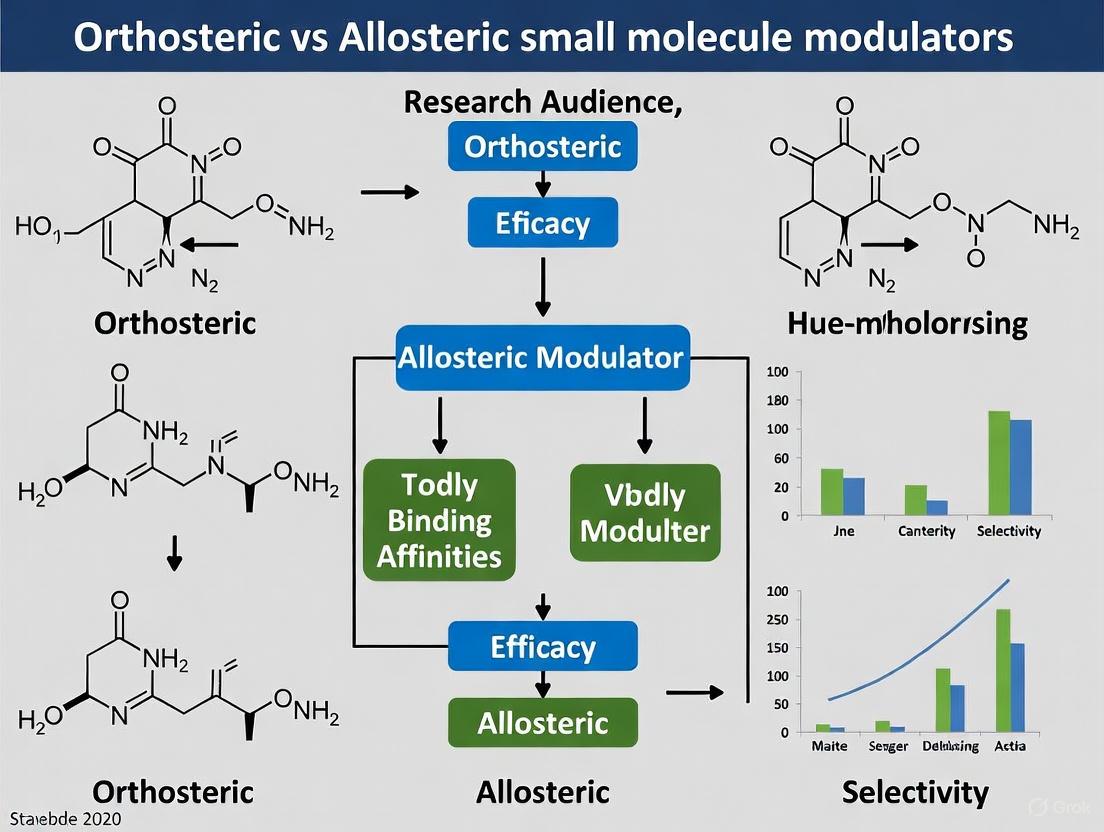
This article provides a comprehensive analysis of the mechanisms, applications, and strategic considerations of orthosteric and allosteric small molecule modulators for researchers and drug development professionals.
Orthosteric vs. Allosteric Modulators: A Mechanistic Guide for Drug Discovery
Abstract
This article provides a comprehensive analysis of the mechanisms, applications, and strategic considerations of orthosteric and allosteric small molecule modulators for researchers and drug development professionals. It explores the foundational principles of binding sites and receptor dynamics, examines methodological approaches for modulator discovery and optimization, addresses key challenges in achieving selectivity and overcoming drug resistance, and validates concepts through comparative analysis and case studies. By synthesizing current research and clinical evidence, this resource aims to equip scientists with the knowledge to make informed decisions in modulator selection and design, ultimately accelerating the development of safer and more effective therapeutics.
Core Principles: Defining Orthosteric and Allosteric Mechanisms
The fundamental distinction between orthosteric and allosteric binding sites represents a cornerstone principle in molecular pharmacology and drug discovery. Orthosteric modulators act by directly competing with endogenous ligands at their native binding site, while allosteric modulators bind at topographically distinct sites to indirectly fine-tune receptor function [1] [2]. This whitepaper provides an in-depth technical analysis of these mechanisms, framed within the context of advancing research into small molecule modulators. We examine the structural basis, functional consequences, quantitative assessment methodologies, and therapeutic implications of these divergent regulatory strategies, providing researchers with a comprehensive framework for their experimental approaches. The growing emphasis on allosteric modulation reflects a paradigm shift in drug discovery toward agents that offer superior selectivity and nuanced control of physiological signaling [3] [4] [2].
Orthosteric regulation describes the binding of a ligand—whether endogenous agonist, synthetic agonist, or competitive antagonist—to the evolutionarily conserved site where the native physiological ligand binds [1] [2]. This site typically exhibits high conservation across protein families, presenting significant challenges for achieving selective modulation of specific receptor subtypes. Orthosteric antagonists operate through direct occupancy of this site, physically preventing the natural ligand from binding and thus blocking receptor activation entirely.
In contrast, allosteric regulation involves binding at a spatially distinct site that is separate from the orthosteric pocket [1] [5]. The term "allosteric" derives from the Greek allos (other) and stereos (solid or object), literally meaning "other site" [1] [6]. Allosteric modulators function indirectly by inducing conformational changes in the receptor that either enhance (positive allosteric modulators, PAMs) or diminish (negative allosteric modulators, NAMs) the receptor's response to orthosteric ligands [3] [1]. This mechanism allows for fine-tuning of physiological signaling rather than complete activation or blockade, potentially preserving the spatial and temporal patterns of native signaling [3].
The conceptual framework for understanding allosteric regulation has evolved through several key models. The Monod-Wyman-Changeux (MWC) concerted model posits that protein subunits exist in a equilibrium between tense (T) and relaxed (R) states, with all subunits necessarily existing in the same conformation [1]. The Koshland-Némethy-Filmer (KNF) sequential model suggests that ligand binding induces conformational changes that may not be uniformly propagated to all subunits [1]. More recently, the energy landscape model conceptualizes proteins as existing in conformational ensembles, with allosteric effectors stabilizing particular states within this ensemble [2] [6].
Mechanistic Comparison and Therapeutic Implications
Structural and Functional Distinctions
The structural topography of binding sites dictates fundamentally different mechanisms of action between orthosteric and allosteric modulators. Orthosteric sites are typically deeply buried, evolutionarily conserved pockets that directly participate in the receptor's activation mechanism [2]. Their high degree of conservation across protein families means that drugs targeting these sites often face significant selectivity challenges, potentially leading to off-target effects [2].
Allosteric sites, in contrast, are generally more structurally diverse and less conserved, even among closely related receptor subtypes [2]. This structural diversity provides a molecular basis for the enhanced selectivity often observed with allosteric modulators [3] [2]. Rather than directly activating or blocking the receptor, allosteric modulators work by altering the receptor's conformational landscape, shifting the equilibrium between active and inactive states [2] [6]. This mechanism enables more nuanced control over receptor function, including the potential for biased modulation of specific signaling pathways [4].
Table 1: Fundamental Characteristics of Orthosteric vs. Allosteric Modulators
| Characteristic | Orthosteric Modulators | Allosteric Modulators |
|---|---|---|
| Binding Site | Active/functional site of endogenous ligand [1] [2] | Topographically distinct regulatory site [1] [5] |
| Mechanism | Direct competition with endogenous ligand [1] [2] | Conformational change modulating receptor function [1] [2] |
| Conservation | High across protein families [2] | Lower, offering greater selectivity potential [2] |
| Effect Saturation | Complete blockade or full activation possible [2] | Effects typically saturable (ceiling effect) [3] |
| Signal Modulation | Binary (on/off) or full agonist effects [2] | Fine-tuning of endogenous signaling [3] [4] |
| Therapeutic Window | Often narrower due to target conservation [2] | Potentially wider due to greater selectivity [4] [2] |
| Probe Dependence | Effects independent of endogenous ligand identity | Effects may vary with different orthosteric ligands [7] |
Quantitative Analysis of Cooperativity
The interaction between allosteric modulators and orthosteric ligands can be quantitatively described using cooperativity factors, which provide a mathematical framework for understanding allosteric effects. The binding cooperativity factor (α) quantifies how the binding of an allosteric modulator affects the affinity of the orthosteric ligand, with α > 1 indicating positive cooperativity (enhanced affinity), α < 1 indicating negative cooperativity (reduced affinity), and α = 1 indicating neutral cooperativity (no effect on affinity) [8].
The efficacy cooperativity factor (β) describes how allosteric binding influences the signaling efficacy of the orthosteric ligand, with β > 1 indicating positive modulation and β < 1 indicating negative modulation [8]. The net allosteric effect is determined by the product αβ, representing the combined effect on both affinity and efficacy [8]. This quantitative framework allows researchers to precisely characterize allosteric compounds and their mechanisms of action.
Table 2: Quantitative Parameters for Characterizing Allosteric Modulators
| Parameter | Description | Interpretation | Experimental Assessment |
|---|---|---|---|
| Binding Cooperativity (α) | Measure of how allosteric modulator affects orthosteric ligand affinity [8] | α > 1: Positive cooperativity; α < 1: Negative cooperativity; α = 1: Neutral [8] | Radioligand binding or affinity-based assays [8] |
| Efficacy Cooperativity (β) | Measure of how allosteric modulator affects orthosteric ligand efficacy [8] | β > 1: Positive modulation; β < 1: Negative modulation [8] | Functional assays (cAMP, Ca²⁺, IP1 accumulation) [8] |
| Net Cooperativity (αβ) | Combined effect on affinity and efficacy [8] | Determines overall functional activity of the modulator [8] | Derived from combined binding and functional data [8] |
| pIC₅₀/pEC₅₀ | Negative log of IC₅₀/EC₅₀ | Measure of potency [7] | Concentration-response curves in functional assays [7] |
| pKᵢ | Negative log of inhibition constant | Measure of binding affinity [7] | Competitive binding assays [7] |
Diagram 1: Orthosteric competition versus allosteric conformational modulation. Orthosteric drugs directly compete with endogenous ligands, while allosteric modulators induce conformational changes that fine-tune receptor response.
Experimental Methodologies for Characterizing Modulators
Binding Assays and Affinity Determination
Radioligand binding assays remain a cornerstone technique for quantifying ligand-receptor interactions and distinguishing orthosteric from allosteric mechanisms. In competitive binding experiments, orthosteric compounds typically display monophasic inhibition curves that follow the law of mass action, completely displacing the reference radioligand [7]. In contrast, allosteric modulators may exhibit incomplete displacement or biphasic inhibition curves, particularly when the reference ligand binds to an orthosteric site [7].
Surface plasmon resonance (SPR) has emerged as a powerful label-free method for studying allosteric interactions, providing real-time kinetic data on binding events [7]. SPR can directly demonstrate binding to distinct sites and quantify the cooperativity between orthosteric and allosteric ligands. For allosteric modulators, binding experiments conducted in the presence and absence of orthosteric ligands can directly measure the binding cooperativity factor (α) [8] [6].
Functional Assays and Efficacy Assessment
Functional assays are essential for characterizing the biological consequences of receptor modulation and quantifying efficacy cooperativity (β). Second messenger assays—including cAMP accumulation, inositol phosphate (IP1) accumulation, and calcium mobilization—provide robust quantitative measures of receptor activity [8] [7]. For Gq-coupled receptors like the metabotropic glutamate receptor 5 (mGlu5) and protease-activated receptor 2 (PAR2), calcium flux assays offer high temporal resolution and sensitivity for detecting allosteric modulation [8] [7].
More complex functional readouts include β-arrestin recruitment and phosphorylation of downstream effectors like ERK1/2, which can reveal biased signaling where ligands preferentially activate specific pathways [7]. For allosteric modulators, functional assays are typically performed with a fixed concentration of orthosteric agonist (often at its EC₂₀) to quantify the modulator's ability to potentiate or inhibit the agonist response [8].
Diagram 2: Experimental workflow for characterizing orthosteric and allosteric modulators. The process integrates binding and functional assessments to comprehensively classify modulator mechanisms.
Case Study: PAR2 Ligand Characterization
A comprehensive study of protease-activated receptor-2 (PAR2) ligands provides an exemplary demonstration of experimental approaches for distinguishing orthosteric and allosteric mechanisms [7]. In this work, researchers characterized two novel antagonists: AZ8838 (orthosteric) and AZ3451 (allosteric). Both compounds inhibited PAR2 signaling but exhibited fundamentally different behaviors in binding and functional assays.
AZ8838 displayed monophasic inhibition of both peptide-induced and trypsin-induced PAR2 activation, consistent with competitive orthosteric inhibition [7]. In contrast, AZ3451 showed monophasic inhibition of peptide-induced activation but biphasic inhibition of trypsin-induced activation, indicative of an allosteric mechanism with probe dependence [7]. The allosteric modulator demonstrated greater inhibition against peptide activation compared to protease activation, highlighting how allosteric effects can vary depending on the nature of the orthosteric activator.
The Scientist's Toolkit: Essential Research Reagents and Solutions
Table 3: Key Research Reagents for Orthosteric and Allosteric Modulator Studies
| Reagent Category | Specific Examples | Research Application | Technical Considerations |
|---|---|---|---|
| Radioligands | ³H-MPEP, ³H-acetylated-GB110, europium-tagged 2f-LIGRLO-NH2 [8] [7] | Quantitative binding affinity (Kᵢ) and competition studies [8] [7] | Requires specialized facilities; provides direct affinity measurements |
| Fluorescent Probes | Fura-2 AM (Ca²⁺ indicator) [8] | Real-time monitoring of intracellular calcium mobilization [8] | Enables kinetic studies of receptor activation and modulation |
| Orthosteric Agonists | NECA (adenosine receptors), DHPG (mGluR), SLIGRL-NH2 (PAR2) [3] [8] [7] | Reference agonists for functional characterization of modulators [8] [7] | Essential for determining cooperativity factors (α, β) |
| Cell Lines | CHO-hPAR2, 1321N1-hPAR2, U2OS-hPAR2 [7] | Recombinant expression systems with consistent receptor density [7] | Enables standardized comparison across laboratories and compounds |
| Detection Kits | IP1 HTRF, cAMP HTRF, Phospho-ERK HTRF [7] | Quantification of second messengers and phosphorylation events [7] | Homogeneous assays suitable for high-throughput screening |
| Allosteric Modulator Standards | DFB, CDPPB (mGlu5 PAMs); MPEP, M-5MPEP (mGlu5 NAMs) [8] | Reference compounds for validating assay systems [8] | Important positive controls for pharmacological characterization |
Therapeutic Applications and Future Directions
The strategic advantages of allosteric modulators are being exploited across multiple therapeutic areas. In neuroscience, mGlu5 receptor PAMs have demonstrated therapeutic potential for schizophrenia, while NAMs show promise for fragile X syndrome and anxiety disorders [8]. In immunology and inflammation, A₂B adenosine receptor modulators are being investigated for chronic obstructive pulmonary disease, ischemic injury, and bone healing [3]. The PAR2 antagonists AZ8838 and AZ3451 have shown efficacy in animal models of acute paw inflammation, inhibiting mast cell and neutrophil activation [7].
Future directions in orthosteric versus allosteric modulator research include the development of bitopic ligands that incorporate both orthosteric and allosteric pharmacophores, potentially offering enhanced selectivity and unique pharmacological profiles [4]. There is also growing interest in ago-allosteric modulators that possess intrinsic efficacy while simultaneously modulating the effects of endogenous ligands [4]. Advances in structural biology, particularly cryo-electron microscopy, are providing unprecedented insights into the conformational changes associated with allosteric modulation, enabling more rational drug design [3].
The continued elucidation of allosteric mechanisms across diverse protein families underscores the importance of binding site topography in determining pharmacological outcomes. As our understanding of allosteric regulation deepens, the strategic integration of both orthosteric and allosteric approaches will undoubtedly yield novel therapeutics with enhanced selectivity and improved clinical profiles.
In pharmacological research, small molecule modulators are classified based on their binding sites and mechanisms of action. Orthosteric ligands bind at the evolutionarily conserved active site (the orthosteric site) of a receptor, directly competing with the native endogenous ligand for occupancy [2]. In contrast, allosteric modulators bind at topographically distinct sites, inducing conformational changes that indirectly modulate receptor function [2] [9]. This distinction is not merely structural but fundamentally alters how researchers approach drug discovery. The core mechanism of orthosteric ligands is one of direct competition: they preempt natural signaling by outcompeting the endogenous agonist for the receptor's binding pocket, thereby either mimicking (agonists) or blocking (antagonists) the native physiological signal [4] [2]. This review delves into the molecular mechanisms by which orthosteric ligands achieve this preemption, frames this understanding within the broader context of orthosteric versus allosteric modulator research, and provides a technical guide for investigators studying these phenomena.
Core Mechanistic Principles of Orthosteric Ligand Action
The Thermodynamic and Kinetic Basis of Preemption
Orthosteric preemption operates on principles of competitive binding. The orthosteric site is a zero-sum environment where the ligand with the highest affinity and concentration typically prevails [4]. When an orthosteric ligand occupies the binding pocket, it physically excludes the native substrate, preventing it from binding and initiating its natural signaling cascade.
The binding event can be described by the law of mass action: The fraction of receptors occupied by the orthosteric ligand is determined by its concentration and affinity (Kd), which directly influences the extent to which natural signaling is preempted.
This relationship is quantified in functional assays, such as inhibition curves, where increasing concentrations of an orthosteric antagonist progressively block the response to a fixed concentration of agonist.
Conformational Sequestration and Signaling Outcome
Beyond simple occupancy, orthosteric ligands preempt signaling by stabilizing specific receptor conformations. Receptors exist in an ensemble of conformations. An orthosteric agonist, like the endogenous ligand, stabilizes active state conformations, leading to signal transduction. Conversely, an orthosteric antagonist often acts as an inverse agonist by stabilizing the inactive state, thereby resetting the receptor's basal activity and further suppressing signaling [4] [10]. This "locking" of the receptor into a specific state effectively preempts the natural, dynamic fluctuation of the receptor ensemble.
Table 1: Key Quantitative Parameters for Characterizing Orthosteric Ligand Action
| Parameter | Definition | Experimental Method | Interpretation in Preemption |
|---|---|---|---|
| Affinity (Ki/Kd) | Equilibrium dissociation constant; measure of binding strength. | Radioligand binding, Surface Plasmon Resonance (SPR). | High-affinity ligands preempt signaling at lower concentrations. |
| Potency (EC50/IC50) | Concentration producing 50% of maximal effect or inhibition. | Functional dose-response assays (cAMP, Ca²⁺, IP1). | Lower IC50 indicates greater potency in preempting a native agonist's response. |
| Efficacy (Emax) | Maximum possible effect a ligand can produce. | Functional dose-response assays relative to a full agonist. | For antagonists, efficacy is minimal; they preempt the agonist's effect. |
| pA2 | Negative logarithm of the molar concentration of an antagonist that requires a 2-fold increase in agonist concentration to produce the original effect. | Schild regression analysis. | Quantifies the potency of a competitive antagonist in preempting the agonist response. |
Orthosteric vs. Allosteric Modulators: A Comparative Framework
The choice between orthosteric and allosteric mechanisms has profound implications for drug discovery, affecting selectivity, safety, and the nature of the pharmacological effect.
Fundamental Mechanistic Differences
Orthosteric and allosteric modulators employ fundamentally distinct strategies to influence receptor output.
The diagram above illustrates the core distinction: orthosteric ligands act through a single, linear pathway by directly competing for the endogenous agonist's binding site. In contrast, allosteric modulators bind at a separate site and exert their effects through conformational changes that are transmitted through the protein structure, modulating the receptor's response to the orthosteric ligand [2] [9].
Strategic Implications for Drug Discovery
The mechanistic differences translate directly into strategic advantages and disadvantages for each approach in a research and development context.
Table 2: Strategic Comparison: Orthosteric vs. Allosteric Modulators in Drug Discovery
| Characteristic | Orthosteric Modulators | Allosteric Modulators |
|---|---|---|
| Binding Site | Evolutionarily conserved active site [2]. | Topographically distinct, less conserved regions [2] [9]. |
| Mode of Action | Direct competition with endogenous ligand; "take over" receptor physiology [4]. | Modulation of receptor function in partnership with the endogenous system; "tuning knobs" [4]. |
| Selectivity | Challenging to achieve within protein families due to conserved active sites [2]. | Potentially higher subtype selectivity due to less conserved binding sites [2] [9]. |
| Pharmacological Control | "Blunt" and binary; can completely activate or inhibit signaling [4]. | "Nuanced"; can fine-tune signaling, preserve physiological rhythms, and exhibit a "ceiling effect" for safer modulation [4] [9]. |
| Therapeutic Window | Risk of over- or under-dosing due to complete pathway saturation or blockade [4]. | Potentially wider therapeutic window due to saturable effect (ceiling) and preservation of basal tone [9]. |
| Probe Dependence | Effects are primarily dependent on ligand concentration and affinity. | Effects are dependent on the specific orthosteric agonist present (probe dependence) [11]. |
Experimental Methodologies for Investigating Orthosteric Mechanisms
A multi-faceted approach is required to definitively characterize the action of an orthosteric ligand and its preemption of natural signaling.
Binding Assays to Determine Direct Competition
Objective: To quantify the affinity of a ligand for the orthosteric site and demonstrate direct competition with the native agonist.
Protocol 1: Radioligand Binding Competition Assay This is a foundational experiment for confirming orthosteric binding and determining affinity (Ki) [8].
- Membrane Preparation: Isolate cell membranes expressing the target receptor.
- Incubation: Incubate membranes with a fixed concentration of a radioactively labeled orthosteric ligand (the "radioligand") and varying concentrations of the unlabeled test compound.
- Separation and Quantification: Separate bound from free radioligand by rapid filtration through glass fiber filters. Measure the bound radioactivity using a scintillation counter.
- Data Analysis: Plot the percentage of specific radioligand binding versus the logarithm of the test compound concentration. The IC50 (concentration that inhibits 50% of specific binding) is determined by nonlinear regression analysis. The inhibition binding constant (Ki) is calculated using the Cheng-Prusoff equation: Ki = IC50 / (1 + [L]/Kd), where [L] is the concentration of radioligand and Kd is its dissociation constant.
Interpretation: A competitive binding curve that fits a one-site competition model is classic for an orthosteric ligand. The resulting Ki value quantifies the ligand's affinity for the orthosteric site.
Functional Assays to Quantify Preemption of Signaling
Objective: To measure the functional consequence of orthosteric binding and its ability to preempt the natural agonist's effect in a cellular context.
Protocol 2: Schild Regression for Quantifying Competitive Antagonism This gold-standard method pharmacologically confirms the orthosteric mechanism of an antagonist and quantifies its potency (pA2/pKB) [8].
- Agonist Dose-Response Curves: Generate a control dose-response curve for the endogenous agonist (e.g., measuring second messenger production like cAMP or IP1).
- Antagonist Challenge: Repeat the agonist dose-response curve in the presence of several fixed, increasing concentrations of the orthosteric antagonist.
- Data Analysis:
- Observe a parallel rightward shift of the agonist curve with no suppression of the maximal response, indicative of pure competition.
- For each antagonist concentration [B], calculate the Dose-Ratio (DR): DR = (EC50 of agonist in presence of antagonist) / (EC50 of agonist alone).
- Plot log(DR - 1) versus log[B]. This is the Schild plot.
- A linear Schild plot with a slope not significantly different from 1 confirms simple competitive antagonism. The x-intercept is the pA2 value (the negative log of the antagonist concentration that causes a 2-fold rightward shift of the agonist curve), which equals the pKB, the functional affinity of the antagonist.
Interpretation: A Schild plot consistent with competitive antagonism provides robust functional evidence that the test ligand is preempting signaling by binding to the orthosteric site.
The Scientist's Toolkit: Essential Reagents and Methodologies
This section details key reagents and tools employed in the featured experiments for studying orthosteric and allosteric mechanisms.
Table 3: Research Reagent Solutions for Orthosteric and Allosteric Mechanistic Studies
| Reagent / Tool | Function / Role | Example Application |
|---|---|---|
| Cell Lines Expressing Target Receptor | Provides a consistent, recombinant system for studying human receptor pharmacology. | HEK293 or CHO cells stably expressing the GPCR or enzyme of interest [8] [11]. |
| Radioactive Orthosteric Ligands (e.g., [³H]-labeled) | High-sensitivity tracer for direct binding studies to quantify affinity and binding kinetics. | [³H]MPEP for binding to mGlu5 receptor [8]. |
| Fluorescent Dyes for Second Messengers | Enable real-time or endpoint measurement of functional signaling output in live cells. | Fura-2 AM for intracellular Ca²⁺ imaging [8]; FLIPR dyes for plate-based assays. |
| Cryo-Electron Microscopy (Cryo-EM) | High-resolution structural biology technique to visualize ligand-receptor complexes. | Determining structure of MK-6892-bound HCAR2-Gi complex to elucidate binding mode [11]. |
| Positive/Negative Allosteric Modulators (PAMs/NAMs) | Pharmacological tools to probe for allosteric sites and study probe dependence. | DFB, CDPPB (mGlu5 PAMs); MPEP (mGlu5 NAM) [8]. Compound 9n (HCAR2 PAM) [11]. |
| G Protein Toxins (e.g., Pertussis Toxin, PTX) | Selectively uncouples receptors from Gi/o proteins to delineate G protein signaling pathways. | Validating G protein coupling specificity downstream of receptor activation [12]. |
Orthosteric ligands preempt natural signaling through the fundamental mechanism of direct competition at the conserved orthosteric site, effectively seizing control of the receptor's functional output. This "blunt instrument" approach stands in stark contrast to the nuanced, cooperative fine-tuning offered by allosteric modulators. The strategic choice between these mechanisms is pivotal in modern drug discovery. While orthosteric targeting remains a validated path, the advantages of allosteric modulators—particularly their potential for superior subtype selectivity and a safer, saturable pharmacological profile—are driving a paradigm shift. A deep understanding of the molecular principles outlined in this guide, coupled with the rigorous application of the described experimental methodologies, is essential for researchers aiming to develop the next generation of targeted therapeutics with optimized efficacy and safety.
Allosteric modulation represents a fundamental mechanism by which proteins, particularly receptors, regulate their activity in response to environmental signals. The term "allosteric," derived from the Greek allos (other) and stereos (solid or space), describes the process where ligand binding at one site influences protein function at a distant, topographically distinct site [13]. This phenomenon stands in contrast to orthosteric regulation, where ligands bind directly to the active site, competing with endogenous substrates [2]. In the context of receptor pharmacology, allosteric modulators fine-tune receptor responses rather than merely activating or blocking them, offering unprecedented opportunities for therapeutic intervention with enhanced selectivity and reduced side effects [14] [4].
The biological significance of allostery extends across all major receptor families, including ligand- and voltage-gated ion channels, G-protein-coupled receptors (GPCRs), nuclear hormone receptors, and receptor tyrosine kinases [13]. These diverse protein classes share a common allosteric nature, functioning as conformational sensors that carry multiple, spatially distinct yet conformationally linked ligand-binding sites. Recent advances in structural biology and biophysics have revealed common mechanisms governing allosteric transitions, including the impact of oligomerization, pre-existing conformational ensembles, intrinsically disordered regions, and the strategic distribution of allosteric modulatory sites throughout protein structures [13]. This whitepaper examines the core principles of allosteric modulation through the dual lenses of receptor conformation and energy landscapes, framing this discussion within the broader context of orthosteric versus allosteric small molecule modulator research.
Fundamental Mechanisms: Orthosteric versus Allosteric Modulation
Distinct Binding Topographies and Functional Outcomes
Orthosteric and allosteric ligands employ fundamentally different strategies for modulating receptor function. Orthosteric drugs bind at the evolutionarily conserved active site, directly competing with endogenous ligands and substrates [2]. This direct competition means orthosteric modulators typically exhibit an inverse relationship between dosage and specificity—at high concentrations, they may bind to multiple homologous proteins sharing similar active sites, leading to potential side effects [2]. The therapeutic effect of orthosteric drugs generally involves complete activation or inhibition of receptor activity, making them powerful but potentially blunt instruments for pharmacological intervention.
In contrast, allosteric modulators bind at topographically distinct sites that are typically less conserved across protein families [2]. This binding location confers several unique advantages: allosteric modulators can fine-tune receptor function without competing with endogenous ligands, exhibit greater subtype selectivity due to lower conservation of allosteric sites, and preserve physiological signaling patterns by modulating rather than overriding natural receptor activation [14] [4]. Critically, allosteric modulators can exert their effects even when endogenous ligands are simultaneously bound to the orthosteric site, enabling more nuanced pharmacological control [2].
Table 1: Comparative Analysis of Orthosteric versus Allosteric Modulation Strategies
| Characteristic | Orthosteric Modulation | Allosteric Modulation |
|---|---|---|
| Binding Site | Evolutionarily conserved active site | Topographically distinct, less conserved sites |
| Competition with Endogenous Ligands | Direct competition | Non-competitive; can co-bind with orthosteric ligands |
| Specificity Concerns | High at low concentrations due to conserved active sites | Generally higher due to less conserved allosteric sites |
| Effect on Receptor Activity | Typically complete activation or inhibition | Fine-tuning of receptor response (positive, negative, or neutral modulation) |
| Therapeutic Window | Can be narrow due to on-target side effects | Potentially wider due to spatial and temporal selectivity |
| Dosage Considerations | High specificity requires high affinity and low dosage | Design must consider effect on conformational ensemble and propagation pathways |
The Energy Landscape Perspective on Allosteric Mechanisms
The functional differences between orthosteric and allosteric modulation strategies originate from their distinct impacts on protein energy landscapes. From a statistical mechanics perspective, proteins exist not as single rigid structures but as conformational ensembles—collections of interconverting substates around their native states [2] [15]. These substates populate shallow energy wells separated by low barriers, creating a dynamic energy landscape that responds to perturbations.
Orthosteric ligands operate primarily through conformational selection, where the ligand selectively binds to pre-existing complementary conformations from the ensemble, subsequently shifting the equilibrium toward these bound states [15]. This population shift model contrasts with the historical induced-fit hypothesis and better explains molecular recognition at physiological concentrations [15].
Allosteric modulation, however, involves more complex perturbations to the energy landscape. When an allosteric modulator binds, it creates strain energy that propagates through the protein structure "like waves," ultimately reaching and altering the conformation and dynamics of the orthosteric site [2]. This propagation occurs through multiple pathways of dynamic atomic contacts, effectively redistributing the conformational ensemble and changing the relative populations of functionally distinct states [15]. The resulting modulation can range from purely enthalpic (with significant conformational changes) to purely entropic (affecting primarily molecular vibrations), with many intermediate scenarios [16].
Diagram 1: Allosteric modulation induces population shifts in conformational ensembles. The binding of an allosteric modulator stabilizes specific conformations, altering their population distribution within the energy landscape.
Quantitative Analysis of Allosteric Systems
Cooperativity Factors and Modulation Efficacy
The efficacy of allosteric modulators can be quantitatively described using cooperativity factors that measure the interaction between orthosteric and allosteric binding sites. Two key parameters govern this relationship: the affinity cooperativity factor (α) and the efficacy cooperativity factor (β) [8]. These factors determine whether a compound functions as a positive allosteric modulator (PAM, α>1, β>1), negative allosteric modulator (NAM, α<1, β<1), or neutral allosteric ligand (NAL, α=1, β=1).
Research on metabotropic glutamate receptor 5 (mGlu5) illustrates how different allosteric modulators employ distinct cooperativity strategies. For instance, 3,3'-difluorobenzaldazine (DFB) and 3-cyano-N-(1,3-diphenyl-1H-pyrazol-5-yl)benzamide (CDPPB) primarily modulate orthosteric agonist affinity, while ADX47273 exerts its effects mainly through efficacy-driven modulation [8]. Similarly, negative allosteric modulators like MPEP and M-5MPEP exhibit different functional profiles depending on the signaling endpoint measured, demonstrating pathway-specific modulation capabilities [8].
Table 2: Quantitative Parameters for Allosteric Modulator Characterization
| Parameter | Definition | Experimental Determination | Therapeutic Implications |
|---|---|---|---|
| Affinity Cooperativity (α) | Magnitude of effect on orthosteric ligand binding affinity | Radioligand binding assays in presence/absence of orthosteric agonist | Determines potency of modulator effect; influences dosage requirements |
| Efficacy Cooperativity (β) | Magnitude of effect on orthosteric ligand efficacy | Functional assays measuring downstream signaling responses | Determines maximal effect size; critical for pathway-specific modulation |
| Binding Affinity (Kd) | Dissociation constant for allosteric site binding | Saturation binding with labeled allosteric probe | Influences duration of action and potential off-target effects |
| Modulation Range | Ratio of maximal to minimal activity achievable | Dose-response curves in presence of fixed modulator concentration | Defines therapeutic window and dosing flexibility |
Allosteric Communication Pathways and Residue-Level Analysis
Advanced computational and experimental approaches have enabled detailed mapping of allosteric communication pathways within receptor structures. Bond-to-bond propensity analysis and similar graph-theoretic methods can identify key residues involved in allosteric signaling, providing insights for rational drug design [17]. These approaches recognize that allosteric communication often follows specific pathways through the protein structure, with certain residues acting as critical nodes for signal transmission.
Studies on the M2 muscarinic acetylcholine receptor illustrate how allosteric modulators can alter vibrational energy transfer between functional regions without inducing major conformational changes [16]. In this Type II allosteric modulation, the PAM LY211960 enhances energy flow between clusters of residues crucial for orthosteric and allosteric binding, facilitating communication between these topographically distinct sites [16]. This energy-based perspective complements traditional conformational models and may explain allosteric phenomena where structural changes are minimal.
Experimental Approaches for Studying Allosteric Mechanisms
Methodologies for Characterizing Allosteric Modulation
Comprehensive characterization of allosteric modulators requires integrated experimental approaches spanning structural, biophysical, and functional techniques. The following protocols represent state-of-the-art methodologies for elucidating allosteric mechanisms.
Protocol 1: NMR Spectroscopy for Detecting Conformational Dynamics and Allosteric Pathways
Nuclear Magnetic Resonance (NMR) spectroscopy provides unparalleled insights into protein dynamics and allosteric mechanisms at atomic resolution [18]. This technique is particularly valuable for characterizing flexible regions and transient states that are crucial for allosteric regulation but often invisible in crystal structures.
- Sample Preparation: Prepare uniformly (^{15}\mathrm{N}), (^{13}\mathrm{C})-labeled protein (e.g., chorismate mutase) at 0.1-0.5 mM concentration in appropriate buffer. For paramagnetic relaxation enhancement (PRE) studies, introduce cysteine mutations at strategic positions and label with paramagnetic probes such as MTSL [(1-oxyl-2,2,5,5-tetramethyl-Δ3-pyrroline-3-methyl) methanethiosulfonate] [18].
- Data Acquisition:
- Record (^{1}\mathrm{H})-(^{15}\mathrm{N}) HSQC spectra of apo, orthosteric ligand-bound, and allosteric modulator-bound states.
- For PRE measurements, collect HSQC spectra in paramagnetic (oxidized) and diamagnetic (reduced) states.
- Perform relaxation dispersion experiments to probe conformational exchange on μs-ms timescales.
- Utilize (^{19}\mathrm{F})-NMR for specific probes of environmental changes at key positions [19].
- Data Analysis:
- Identify chemical shift perturbations (CSPs) between states to map allosteric networks.
- Calculate PRE ratios ((I{para}/I{dia})) to identify transient long-range contacts.
- Analyze peak broadening or disappearance as indicators of conformational dynamics in flexible regions (e.g., loop 11-12 in chorismate mutase) [18].
- Determine conformational exchange parameters from relaxation dispersion data.
Protocol 2: Computational Analysis of Vibrational Energy Transfer in Allosteric Proteins
Molecular dynamics simulations combined with network analysis can model allosteric communication as energy transfer processes, particularly for Type II allostery with minimal conformational changes [16].
- System Preparation:
- Obtain high-resolution structures of target receptor (e.g., M2 muscarinic receptor, PDB IDs: 4MQT for binary complex, 4MQH for ternary complex with LY211960).
- Employ molecular dynamics (MD) simulations (≥100 ns) for both binary (receptor+orthosteric agonist) and ternary (receptor+orthosteric agonist+allosteric modulator) complexes using packages like GROMACS or AMBER.
- Transition Network Construction:
- Calculate characteristic times (τij) for vibrational energy exchange between residue pairs using covariance matrix of atomic fluctuations [16].
- Construct transition frequency matrix L with elements (L{ij} = 1/τ{ij}) for i≠j and (L{ii} = -Σ{k≠i} 1/τ_{ik}).
- Build Markov state model with residues as nodes and Lij values as transition probabilities.
- Network Analysis:
- Apply PCCA+ algorithm to identify metastable clusters of residues based on "grades of membership" (cutoff ≥0.7) [16].
- Use Transition Path Theory (TPT) to calculate energy current (F) between identified clusters.
- Compare energy currents between binary (Fag) and ternary (Fall) complexes to quantify allosteric modulation effect.
Protocol 3: Functional Characterization of Allosteric Modulators in Cellular Systems
Comprehensive pharmacological profiling in native cellular contexts provides critical information about modulator efficacy, cooperativity, and pathway-specific effects.
- Cell Culture and Preparation:
- Culture native cells (e.g., rat cortical astrocytes) or recombinant systems expressing target receptor.
- For calcium oscillation studies, seed cells on coverslips and load with Fura-2 AM (2-5 μM) for 30-45 minutes at 37°C [8].
- Binding Studies:
- Conduct competition binding assays with tritiated allosteric probe (e.g., [³H]MPEP for mGlu5 receptor) in presence/absence of orthosteric agonist.
- Determine affinity cooperativity factors (α) from shifts in allosteric modulator IC50 values.
- Functional Assays:
- Measure second messenger production (e.g., [³H]inositol phosphate accumulation) in response to orthosteric agonist EC20 concentration with varying allosteric modulator concentrations.
- Calculate net affinity/efficacy cooperativity (αβ) from potentiation curves.
- Image intracellular Ca²⁺ oscillations in single cells; analyze frequency and amplitude changes in response to allosteric modulators [8].
- Data Analysis:
- Quantify PAM/NAM effects on oscillation frequency, a parameter often insensitive to orthosteric agonist concentration changes but highly sensitive to allosteric modulation [8].
- Determine pathway-specific modulation by comparing effects on different functional endpoints (e.g., Ca²⁺ oscillations vs. inositol phosphate accumulation).
Diagram 2: Integrated experimental workflow for elucidating allosteric mechanisms, combining structural, computational, and functional approaches.
The Scientist's Toolkit: Essential Reagents and Methodologies
Table 3: Key Research Reagents and Methodologies for Allosteric Studies
| Reagent/Methodology | Function in Allosteric Research | Key Applications | Technical Considerations |
|---|---|---|---|
| Isotopically Labeled Proteins ((^{15}\mathrm{N}), (^{13}\mathrm{C}), (^{2}\mathrm{H})) | Enables NMR detection of backbone and sidechain dynamics | Mapping allosteric pathways, detecting transient states, characterizing conformational exchange | Requires optimized expression systems; signal assignment can be challenging for large proteins |
| Paramagnetic Probes (MTSL) | Measures long-range distances (<20 Å) via paramagnetic relaxation enhancement (PRE) | Identifying transient conformational states, mapping long-range interactions | Requires strategic cysteine incorporation; may perturb native structure and function |
| Tritiated Allosteric Probes (e.g., [³H]MPEP) | Quantifies allosteric ligand binding parameters | Determining binding affinity, occupancy, and affinity cooperativity factors | Requires specific activity optimization; may not reflect functional cooperativity |
| Genetically Encoded Biosensors (e.g., Ca²⁺ indicators) | Monitors intracellular signaling dynamics in live cells | Measuring pathway-specific modulation, kinetic parameters, and oscillation patterns | Potential buffering of native signals; requires optimization of expression levels |
| Transition Network Analysis | Models allosteric communication as energy transfer between residues | Identifying key residues in allosteric pathways, predicting mutation effects | Dependent on quality of MD simulations; validated with experimental data |
Case Studies in Allosteric Receptor Modulation
Chorismate Mutase: Flexible Loops as Allosteric Regulators
Chorismate mutase (CM) provides a compelling example of how flexible, distal structural elements can mediate allosteric regulation. This homodimeric enzyme, critical for aromatic amino acid biosynthesis, is regulated by tryptophan (activator) and tyrosine (inhibitor) binding at a site over 25 Å from the active site [18]. Despite nearly identical NMR spectra for TrpCM and TyrCM complexes, they exhibit markedly different activity profiles, suggesting alternative allosteric mechanisms beyond classical conformational changes.
Research has revealed that loop 11-12, a highly flexible region distant from both the active and allosteric sites, plays a crucial role in CM regulation. This loop undergoes effector-dependent transient excursions toward the active site, with distinctive reorientation observed only when the activator tryptophan is bound [18]. Mutational studies demonstrate that a single point mutation (D215A) within this loop dramatically alters CM's activity landscape and introduces cooperative effects, despite causing no major conformational rearrangements [18]. This case illustrates how flexible, distal loops can orchestrate allosteric communication through dynamic and electrostatic mechanisms rather than gross structural changes.
GPCR Allosteric Modulation: M2 Muscarinic and A2B Adenosine Receptors
G Protein-Coupled Receptors (GPCRs) represent a major frontier in allosteric drug discovery, with numerous examples illustrating the therapeutic potential of allosteric modulators.
The M2 muscarinic acetylcholine receptor exemplifies Type II allostery, where modulation occurs primarily through changes in vibrational energy transfer rather than major conformational shifts [16]. Studies comparing binary (receptor+iperoxo agonist) and ternary (receptor+iperoxo+LY211960 PAM) complexes revealed that the allosteric modulator enhances energy flow between functionally relevant residue clusters without significantly altering the receptor's conformational ensemble [16]. This energy-based mechanism enables fine-tuning of receptor activity while preserving physiological signaling patterns.
The A2B adenosine receptor illustrates the therapeutic advantages of allosteric versus orthosteric targeting strategies. This receptor subtype has emerged as a potential target for conditions including chronic obstructive pulmonary disease, ischemic injury, metabolic disorders, and bone defects [14]. However, developing selective orthosteric ligands has proven challenging due to the high conservation of the adenosine binding site across AR subtypes. Allosteric modulators of the A2B AR offer spatial and temporal selectivity, modulating receptor activity only in tissues and times where endogenous adenosine levels are elevated [14]. This case highlights how allosteric modulators can achieve therapeutic effects while preserving physiological signaling patterns that would be disrupted by orthosteric ligands.
The study of allosteric modulation has evolved from a specialized concept to a central paradigm in receptor pharmacology and drug discovery. The energy landscape perspective provides a unifying framework for understanding how allosteric modulators influence receptor function through population shifts in conformational ensembles, vibrational energy transfer, and dynamic allosteric pathways. This mechanistic understanding reveals why allosteric modulators often offer superior selectivity, safety profiles, and therapeutic windows compared to orthosteric ligands.
Future advances in allosteric research will likely focus on integrating genomic and proteomic data with free energy landscape concepts to identify novel allosteric targets and mechanisms [15]. Computational methods for predicting allosteric sites and communication pathways are becoming increasingly sophisticated, with bond-to-bond propensity analysis and similar approaches offering insights for rational drug design [17]. Additionally, the recognition that many disease-related mutations lie on major allosteric pathways suggests new strategies for therapeutic intervention targeting allosteric rescue of protein function [2] [15].
As these tools and concepts mature, allosteric modulators will play an expanding role in therapeutics, enabling precise control of receptor activity with unprecedented specificity and minimal disruption of physiological processes. The continued elucidation of allosteric mechanisms will not only advance drug discovery but also deepen our fundamental understanding of how proteins function as dynamic, regulated molecular machines.
The evolution of receptor pharmacology has transitioned from traditional orthosteric ligands that compete with endogenous agonists for the primary binding site to sophisticated allosteric modulators that fine-tune receptor function through topographically distinct sites. This paradigm shift represents a fundamental advancement in drug discovery, enabling unprecedented precision in modulating physiological responses. Orthosteric ligands impose binary blockade or activation, while allosteric modulators function as molecular rheostats, preserving the spatial and temporal fidelity of endogenous signaling. This technical review examines the mechanistic foundations, experimental methodologies, and therapeutic applications of these distinct modulation strategies, highlighting how allosteric mechanisms enable selective targeting of pathway-specific responses within complex physiological systems. The emerging capability to design biased allosteric modulators that selectively activate specific G protein subtypes represents a transformative approach for separating therapeutic efficacy from adverse effects.
G-protein-coupled receptors (GPCRs) and other receptor families mediate cellular responses to extracellular stimuli and represent primary targets for therapeutic intervention. The molecular mechanisms through which small molecules modulate receptor activity fall into two distinct categories: orthosteric and allosteric. Orthosteric binding occurs at the evolutionarily conserved site recognized by the endogenous agonist, leading to direct competition with natural ligands. In contrast, allosteric binding takes place at topographically distinct sites, enabling modulation of receptor function through conformational changes that alter the receptor's response to orthosteric ligands [3] [20].
This mechanistic distinction carries profound implications for receptor physiology. Orthosteric ligands typically impose a binary pharmacological outcome—complete activation or blockade—that overrides physiological signaling patterns. Allosteric modulators, however, function as molecular rheostats that fine-tune receptor responses to endogenous agonists, preserving the spatial and temporal dynamics of natural signaling while offering superior subtype selectivity [4]. The clinical success of allosteric modulators across diverse target classes, including GPCRs, kinases, and protein-protein interactions, underscores the therapeutic value of this approach [21].
Table 1: Fundamental Characteristics of Orthosteric and Allosteric Ligands
| Characteristic | Orthosteric Ligands | Allosteric Modulators |
|---|---|---|
| Binding Site | Evolutionarily conserved active site | Topographically distinct, less conserved site |
| Effect on Endogenous Signaling | Competes with and displaces natural ligands | Modulates response to natural ligands |
| Pharmacological Profile | Binary activation or blockade | Gradual modulation (positive, negative, or neutral) |
| Subtype Selectivity | Often limited due to conserved active sites | Typically higher due to divergent allosteric sites |
| Therapeutic Window | Often narrower due to on-target side effects | Potentially wider due to spatial/temporal preservation |
| Signal Bias | Limited capacity for pathway selection | Can be designed for specific pathway bias |
Orthosteric Mechanisms: Binary Pharmacology
Molecular Basis of Orthosteric Interactions
Orthosteric ligands bind directly to the receptor's endogenous agonist recognition site, employing competitive binding to either activate (agonists) or block (antagonists) receptor function. This "lock and key" mechanism stems from structural complementarity between the ligand and the evolutionarily conserved orthosteric pocket. The high conservation of orthosteric sites across receptor subtypes presents a fundamental challenge for achieving selective modulation, as compounds targeting these sites frequently exhibit cross-reactivity with related receptors [2].
From a thermodynamic perspective, orthosteric ligand binding stabilizes specific receptor conformations associated with either active or inactive states. Full agonists stabilize the active conformation, partial agonists stabilize intermediate states, and inverse agonists preferentially stabilize inactive conformations. The binding is typically competitive and follows mass-action principles, where ligand affinity and concentration determine occupancy and resultant physiological effects [4].
Physiological and Therapeutic Implications
The binary nature of orthosteric modulation creates inherent limitations in therapeutic applications. By competing with endogenous ligands, orthosteric drugs disrupt physiological signaling patterns, often leading to all-or-none responses that lack subtlety. This approach can produce undesirable effects including receptor desensitization, internalization, or downregulation with prolonged use [21].
Furthermore, achieving subtype selectivity with orthosteric ligands is challenging due to the high conservation of orthosteric sites across receptor families. For example, developing selective orthosteric drugs for adenosine receptor subtypes (A1, A2A, A2B, A3) has proven difficult because all four subtypes share a highly conserved orthosteric binding site for their endogenous ligand, adenosine [3]. This limitation often necessitates higher dosing to achieve therapeutic effects, increasing the risk of off-target activity and adverse effects [2].
Allosteric Mechanisms: Fine-Tuned Modulation
Thermodynamic Principles of Allosteric Regulation
Allosteric modulation operates through fundamentally different principles than orthosteric binding. Rather than competing for the endogenous ligand site, allosteric modulators bind to topographically distinct sites and alter receptor function through propagation of conformational changes. This process can be understood through the framework of free energy landscapes, where proteins exist as ensembles of interconverting conformations with similar energies separated by low barriers [2].
Allosteric ligand binding perturbs this equilibrium by stabilizing specific conformational states, effectively shifting the energy landscape toward populations with distinct functional properties. The binding creates strain energy at the modulator interface that propagates through the protein structure like waves, ultimately reaching and altering the orthosteric site's conformation and dynamics [2]. This mechanism enables fine-tuning of receptor responses to orthosteric agonists without overriding physiological signaling patterns.
Classes of Allosteric Modulators
Allosteric modulators exhibit diverse pharmacological profiles based on their effects on agonist potency and efficacy:
Positive Allosteric Modulators (PAMs) enhance agonist-mediated responses, potentially by increasing agonist affinity, efficacy, or both. For example, PAMs of the A1 adenosine receptor have been investigated for pain management, while A3 receptor PAMs show promise for inflammatory conditions [3].
Negative Allosteric Modulators (NAMs) noncompetitively reduce agonist efficacy, functioning as allosteric inhibitors that diminish but may not completely abolish receptor activity. NAMs can preferentially stabilize inactive conformational states [20].
Neutral Allosteric Ligands (NALs) or silent allosteric modulators (SAMs) occupy allosteric sites without intrinsically affecting orthosteric agonist activity, yet can block the effects of PAMs or NAMs [21].
Bitopic Ligands represent an emerging class that incorporates both orthosteric and allosteric pharmacophores within a single molecule, enabling hybrid pharmacology that combines direct receptor activation with allosteric modulation [22].
Table 2: Quantitative Profiling of Allosteric Modulator Effects
| Receptor System | Modulator Type | Example Compound | Potency/Activity (EC50/IC50) | Experimental System |
|---|---|---|---|---|
| A2B Adenosine Receptor | PAM | Compound 6a | EC50 = 427 nM | cAMP accumulation in CHO cells |
| A2B Adenosine Receptor | PAM | Compound 7a | EC50 = 249 nM | cAMP accumulation in CHO cells |
| A2B Adenosine Receptor | NAM | Compound 7b | IC50H = 0.4 nM; IC50L = 1,550 nM | cAMP accumulation in CHO cells |
| A2B Adenosine Receptor | NAM | Compound 8a | IC50H = 0.2 nM; IC50L = 1,050 nM | cAMP accumulation in CHO cells |
| mGlu5 Receptor | PAM | DFB | Primarily affinity-driven modulation | Rat cortical astrocytes |
| mGlu5 Receptor | PAM | ADX47273 | Primarily efficacy-driven modulation | Rat cortical astrocytes |
Allosteric Modulator Selectivity and Biased Signaling
The structural diversity of allosteric sites across receptor subtypes provides a molecular basis for the enhanced selectivity often observed with allosteric modulators. Unlike conserved orthosteric pockets, allosteric sites evolve under different constraints and exhibit greater structural variation, enabling development of highly subtype-selective compounds [21].
Recent advances have demonstrated that allosteric modulators can engender biased signaling (functional selectivity), preferentially activating specific downstream pathways while sparing others. A groundbreaking example comes from the neurotensin receptor 1 (NTSR1), where the intracellular allosteric modulator SBI-553 switches G protein subtype preference. SBI-553 fully antagonizes Gq and G11 signaling while permitting or enhancing signaling through G12, G13, and specific Gi/o family members [22]. This demonstrates that allosteric modulators can function as "molecular bumpers" that sterically hinder interactions with specific G proteins while acting as "molecular glues" that stabilize interactions with others, enabling rational design of pathway-selective therapeutics.
Diagram 1: Orthosteric vs Allosteric Receptor Modulation
Experimental Approaches and Methodologies
Quantitative Pharmacological Assays
Characterizing allosteric interactions requires specialized experimental approaches that differ from classical orthosteric ligand assessments. The allosteric ternary complex model provides a framework for quantifying modulator effects through two key parameters: binding cooperativity (α) and effect cooperativity (β). Binding cooperativity reflects how allosteric modulator binding affects orthosteric ligand affinity, while effect cooperativity describes how the modulator influences orthosteric ligand efficacy [8].
Critical experimental considerations include:
Functional Assay Selection: Second messenger assays (cAMP, IP1 accumulation) and pathway-specific reporters enable quantification of modulator effects on signaling efficacy. For example, mGlu5 receptor PAMs exhibit distinct profiles in [3H]inositol phosphate accumulation assays in rat cortical astrocytes, with compounds like DFB and CDPPB primarily affecting orthosteric agonist affinity, while ADX47273 acts through efficacy-driven modulation [8].
Binding Studies: Allosteric modulator effects on orthosteric ligand binding affinity can be quantified through radioligand competition binding experiments performed in the absence and presence of the allosteric compound. This approach enables calculation of cooperativity factors that define the nature and magnitude of allosteric interactions [8].
Calcium Oscillation Monitoring: For receptors that initiate oscillatory Ca2+ signaling (e.g., mGlu5 receptors), allosteric modulators demonstrate unique capabilities to "retune" oscillation frequency in a concentration-dependent manner, an effect beyond the pharmacological repertoire of orthosteric ligands [8].
Advanced Imaging Techniques for Allosteric Modulation Studies
Advanced imaging methodologies provide critical insights into the spatiotemporal dynamics of allosteric modulation:
Total Internal Reflection Fluorescence (TIRF) Microscopy: Enables high-contrast imaging of membrane proximal events with ~100 nm axial resolution, ideal for visualizing receptor redistribution and clustering in response to allosteric modulation [23].
Lattice Light-Sheet Microscopy (LLSM): Combines high spatial resolution (150-370 nm) with minimal phototoxicity, enabling long-term 3D visualization of dynamic processes such as immune synapse formation and membrane topography changes during allosteric modulation [23].
Structured Illumination Microscopy (SIM): Provides doubled resolution in all dimensions compared to conventional microscopy, allowing visualization of nanoscale receptor reorganization in response to allosteric ligands [23].
Table 3: Research Reagent Solutions for Allosteric Modulator Studies
| Reagent/Assay System | Function/Application | Example Implementation |
|---|---|---|
| TRUPATH BRET Sensors | Multiplexed G protein activation profiling | Characterizing SBI-553-mediated G protein subtype switching at NTSR1 [22] |
| TGFα Shedding Assay | G protein subtype-specific signaling | Confirming SBI-553 selectivity through C-terminal Gα chimeras [22] |
| cAMP Accumulation Assay | Second messenger quantification for Gs-coupled receptors | Profiling A2B adenosine receptor PAMs and NAMs in CHO cells [3] |
| [3H]Inositol Phosphate Accumulation | Measuring Gq-coupled receptor activity | Assessing mGlu5 receptor modulation in rat cortical astrocytes [8] |
| BRET-Based β-Arrestin Recruitment | Quantifying arrestin pathway activation | Evaluating biased signaling at NTSR1 [22] |
| Supported Lipid Bilayers (SLBs) | Reconstituting membrane receptor signaling | Imaging immune synapse formation with TIRF microscopy [23] |
Diagram 2: Experimental Workflow for Modulator Characterization
Therapeutic Applications and Clinical Translation
Preclinical to Clinical Advancement
The therapeutic potential of allosteric modulators spans diverse disease areas, with multiple candidates achieving clinical validation:
Neurological and Psychiatric Disorders: GABA(A) receptor PAMs represent one of the earliest classes of allosteric drugs, with benzodiazepines (e.g., diazepam) approved in the 1960s. More recently, brexanolone (a GABA(A) PAM) received FDA approval for postpartum depression, while SAGE-217 advances through Phase 3 trials for major depressive disorder [21].
Metabolic and Inflammatory Conditions: A2B adenosine receptor modulators show promise for chronic obstructive pulmonary disease, ischemic injury protection, and bone healing. Positive allosteric modulators of the A1 adenosine receptor have been proposed for pain management, while A3 PAMs may benefit inflammatory processes [3].
Oncology: Allosteric inhibitors of isocitrate dehydrogenase mutations (enasidenib for IDH2, ivosidenib for IDH1) represent breakthrough therapies for acute myeloid leukemia. Additionally, cobimetinib, an allosteric MEK1/2 inhibitor, was approved for BRAF-mutant melanoma [21].
Emerging Opportunities and Future Directions
Recent advances in structural biology and computational methods are accelerating allosteric drug discovery. Cryo-EM structures of GPCR-transducer complexes reveal precise interaction interfaces that can be targeted by intracellular allosteric modulators [22]. The successful design of NTSR1 modulators that selectively bias signaling toward specific G protein subtypes demonstrates the potential for creating "precision therapeutics" that activate beneficial pathways while avoiding those associated with adverse effects [22].
Furthermore, allosteric modulators of protein-protein interactions represent an expanding frontier. Compounds such as BMS-688521, which allosterically disrupts LFA-1/ICAM-1 interactions, demonstrate the potential for targeting previously "undruggable" interfaces through allosteric mechanisms [21]. As our understanding of allosteric networks deepens, the rational design of modulators with customized signaling profiles will enable unprecedented precision in therapeutic intervention.
The evolution from orthosteric blockade to allosteric modulation represents a paradigm shift in receptor pharmacology, transitioning from binary intervention to nuanced physiological fine-tuning. Allosteric modulators offer distinct advantages including enhanced subtype selectivity, preservation of spatial and temporal signaling patterns, and the ability to engender biased signaling for pathway-specific effects. The rational design of compounds that selectively modulate specific G protein subtypes, as demonstrated with NTSR1, heralds a new era of precision medicine where therapeutic effects can be separated from mechanism-based adverse events. As structural insights deepen and screening technologies advance, allosteric modulation will continue to expand the druggable genome and enable increasingly sophisticated therapeutic interventions across diverse disease areas.
The action of a small molecule drug is fundamentally a thermodynamic process. The interplay between binding affinity, functional efficacy, and protein conformational change constitutes the essential framework for understanding how modulators influence biological systems. This relationship is elegantly described by the Gibbs free energy equation, ΔG° = ΔH° - TΔS°, where the binding free energy (ΔG°) dictates the spontaneity of a ligand-receptor interaction and is directly related to the dissociation constant (KD) through ΔG° = RT ln KD [24]. Within the context of drug discovery, two primary mechanistic categories exist: orthosteric modulators, which compete with the endogenous ligand for binding at the evolutionary conserved primary site, and allosteric modulators, which bind at topographically distinct sites to fine-tune receptor function [3]. This whitepaper explores the thermodynamic and biophysical principles that connect molecular recognition to biological effect, providing a foundational guide for researchers navigating the complex landscape of orthosteric versus allosteric modulator development.
Core Principles: Thermodynamics and Conformational Landscapes
The Conformational Selection Paradigm
The classical "lock-and-key" model is largely insufficient for describing protein-ligand interactions. Instead, the conformational selection model provides a more accurate framework. This model posits that proteins exist in a dynamic equilibrium of multiple conformational states [25]. A ligand does not "induce" a new structure but rather selectively stabilizes and enriches pre-existing conformational states from this ensemble for which it has higher affinity [26] [25]. This selective stabilization provides the Gibbs energy required for the redistribution of conformational populations, shifting the equilibrium toward particular states [25]. This scenario aligns with the broad definition of allostery: the modulation of a protein's conformational equilibrium by ligand binding [25].
The simplest allosteric system can be modeled as a protein (P) populating two conformational states, A and B, with only state A capable of binding the ligand (L) with intrinsic association constant KA. The conformational equilibrium constant is Kconf = [B]/[A]. The binding polynomial is Z = 1 + Kconf + KA[L], and the apparent association constant is Kapp = KA / (1 + Kconf) [25]. This reveals an important energetic penalty: if Kconf > 1 (significant population of the non-binding state B), the apparent affinity is reduced. The Gibbs energy penalty is +RT ln(1 + K_conf), representing the average excess conformational energy required to shift the equilibrium toward the binding-competent state A [25].
Thermodynamic Signatures of Binding
Isothermal Titration Calorimetry (ITC) is a pivotal technique for characterizing the thermodynamic parameters of binding interactions. ITC simultaneously determines the association equilibrium constant (KA), binding enthalpy (ΔH°), and binding stoichiometry (n). The change in heat capacity (ΔCP) is a critical parameter, as it is the main responsible for the temperature dependence of the binding enthalpy and entropy, and it is largely determined by changes in solvent-accessible surface area upon binding and conformational changes [25].
Table 1: Key Thermodynamic Parameters and Their Significance
| Parameter | Symbol | Determination Method | Structural and Functional Interpretation |
|---|---|---|---|
| Gibbs Free Energy | ΔG° | ΔG° = -RT ln K_A | Overall spontaneity of binding; relates directly to affinity. |
| Enthalpy | ΔH° | Directly measured by ITC | Energy from formation/breakage of non-covalent bonds (H-bonds, van der Waals). |
| Entropy | TΔS° | Calculated (TΔS° = ΔH° - ΔG°) | Changes in system disorder (solvation, rotational/translational freedom, conformational flexibility). |
| Heat Capacity | ΔC_P | Slope of ΔH° vs. T (ITC) | Burial of hydrophobic surface area; coupled conformational changes. |
A temperature-independent binding heat capacity is often misinterpreted as evidence for the absence of conformational changes. However, conformational changes can be associated with either temperature-dependent or independent binding heat capacity changes. A general model reconciles this by considering that the observed binding heat capacity (ΔC_P,app) is a combined property of the conformational and ligand binding equilibria [25].
Orthosteric vs. Allosteric Modulation: Mechanisms and Energetics
Distinct Binding Topographies and Selectivity Challenges
The four adenosine receptor (AR) subtypes (A1, A2A, A2B, and A3) exemplify the challenge of orthosteric drug design. Their orthosteric sites are highly conserved, making the development of subtype-selective agonists exceptionally difficult [3]. Allosteric modulators circumvent this challenge by binding to less conserved, topographically distinct sites, offering a pathway to greater subtype selectivity [3] [27]. Positive Allosteric Modulators (PAMs) and Negative Allosteric Modulators (NAMs) do not typically activate or silence the receptor on their own but act as "molecular fine-tuners" of the endogenous agonist's effect, preserving the spatial and temporal pattern of native signaling [3].
Efficacy Through Conformational Stabilization
A pivotal distinction between orthosteric and allosteric mechanisms lies in how they generate efficacy. Single-molecule FRET (smFRET) studies on the metabotropic glutamate receptor 2 (mGlu2) have revealed that the endogenous agonist glutamate only partially stabilizes the extracellular domains in the active state. The receptor continues to oscillate rapidly between active and inactive states. The mGlu2 PAM BINA dramatically enhances agonist efficacy by increasing the residence time of the receptor in the active state, effectively shifting the entire receptor population to the active conformation [28]. This demonstrates that a key mechanism of PAM action is the kinetic stabilization of an active conformation that is otherwise only transiently populated.
This principle of ensemble modulation extends beyond GPCRs. In P-cadherin, a cell adhesion protein, the small molecule inhibitor PhHit1 binds to a cavity in the X-dimer and inhibits homodimerization not by direct orthosteric blockade, but by altering the conformational ensemble of the protein. Molecular dynamics simulations showed that PhHit1 binding modifies the dihedral angle between the EC1 and EC2 domains, shifting the equilibrium away from the functional dimeric state [26]. This illustrates a general strategy for inhibiting protein-protein interactions by modulating the conformational ensemble rather than competing for a large surface area [26].
Table 2: Comparative Analysis of Orthosteric vs. Allosteric Ligands
| Characteristic | Orthosteric Ligand | Allosteric Modulator (PAM/NAM) |
|---|---|---|
| Binding Site | Evolutionary conserved active site | Topographically distinct, less conserved site |
| Subtype Selectivity | Often low due to high conservation | Potentially high |
| Temporal Selectivity | Overrides physiological rhythm | Fine-tunes response to endogenous agonist |
| Effect Ceiling | Full agonist/antagonist effect | Ceiling effect; safer pharmacological profile |
| Therapeutic Examples | Conventional agonists/antagonists | Cinacalcet (CaSR PAM), Benzodiazepines (GABA-A PAMs) [27] |
Experimental Methodologies for Probing Energetics and Conformation
Protocol 1: Isothermal Titration Calorimetry (ITC) for Thermodynamic Profiling
Objective: To directly measure the enthalpy change (ΔH°), binding constant (K_A), stoichiometry (n), and calculate the free energy (ΔG°) and entropy (TΔS°) of a ligand-receptor interaction.
Procedure:
- Sample Preparation: Precisely dialyze the purified protein and ligand into identical buffer solutions to minimize heats of dilution. Degas all solutions to prevent bubble formation in the calorimeter cell.
- Instrument Setup: Load the protein solution into the sample cell and the ligand solution into the syringe. Set the reference cell with dialysate or water. Set the stirring speed (typically 250-1000 rpm) and the experimental temperature.
- Titration Program: Program a series of sequential injections of the ligand into the protein solution. The initial injection is often smaller (e.g., 0.5 µL) and discarded from data analysis to account for diffusion across the needle tip. Subsequent injections are typically 2-10 µL each with 120-300 second intervals between injections to allow the signal to return to baseline.
- Data Collection: The instrument measures the heat flow (µcal/sec) required to maintain a constant temperature difference (or power compensation) between the sample and reference cells after each injection.
- Data Analysis: Integrate the peak areas for each injection to obtain the total heat per mole of injectant. Fit the normalized heat data to a suitable binding model (e.g., "One Set of Sites") using non-linear least squares regression to extract n, K_A, and ΔH°. The software then calculates ΔG° and TΔS° using the fundamental equations [25].
Key Consideration: To determine the binding heat capacity change (ΔCP), perform a series of ITC experiments at different temperatures (e.g., 15, 20, 25, 30°C). The slope of the plot of ΔH° versus temperature provides the estimate for ΔCP [25].
Protocol 2: Single-Molecule FRET (smFRET) to Resolve Conformational Dynamics
Objective: To observe and quantify the sub-millisecond conformational dynamics and populations of a receptor in its apo and ligand-bound states.
Procedure (as applied to mGlu2) [28]:
- Receptor Engineering and Labeling: Fuse a SNAP-tag to the N-terminus of the receptor. Express the construct in HEK293T cells and label cell-surface receptors using cell-impermeable SNAP-substrate conjugated to donor (e.g., Tb-chelate for LRET) and acceptor (e.g., D2) fluorophores.
- Functional Solubilization: Solubilize receptors from membranes using an optimized detergent mixture (e.g., 0.005% LMNG, 0.0004% CHS, 0.005% GDN) to maintain the allosteric link between domains and receptor functionality for over 24 hours [28].
- smFRET Data Acquisition: Dilute the labeled, solubilized receptors to a sub-nanomolar concentration to ensure only one molecule is in the observation volume at a time. Use a confocal microscope or TIRF setup to excite the donor fluorophore and collect emission spectra from both donor and acceptor channels with sub-millisecond time resolution.
- Data Analysis: Calculate FRET efficiency (E) for each molecule over time. Construct FRET efficiency histograms to identify distinct conformational states. For dynamic molecules, perform hidden Markov modeling or burst analysis to determine the rates of transition between low-FRET (inactive) and high-FRET (active) states and the population of each state under different conditions (apo, agonist, agonist + PAM).
Key Finding: This methodology revealed that the mGlu2 PAM BINA enhances agonist efficacy by shifting the entire conformational ensemble of the receptor to the active state, thereby increasing its residence time in that state [28].
Visualization of Concepts and Pathways
Conformational Selection and Allosteric Modulation
Thermodynamic Cycle of Conformational Selection
The Scientist's Toolkit: Essential Research Reagents and Solutions
Table 3: Key Reagent Solutions for Biophysical and Functional Studies
| Reagent / Solution | Function / Application | Example / Specification |
|---|---|---|
| Optimized Detergent Mixes | Solubilize full-length GPCRs while preserving allosteric coupling between domains for in vitro studies. | LMNG (0.005% w/v) + CHS (0.0004% w/v) + GDN (0.005% w/v) for mGlu2 [28] |
| SNAP-tag Labeling System | Site-specific fluorescent labeling of protein targets for FRET/LRET and smFRET studies. | Cell-impermeable SNAP-substrate (e.g., conjugated to Tb-chelate or organic dyes) for selective cell-surface receptor labeling [28] |
| smFRET Microscopy Setup | Resolving conformational dynamics and populations of individual biomolecules at sub-millisecond timescales. | Confocal or TIRF microscope with pulsed interleaved excitation (PIE) and high-sensitivity detectors (e.g., SPAD arrays) [28] |
| Isothermal Titration Calorimeter | Direct measurement of binding thermodynamics (KA, ΔH°, n, ΔCP). | Instrument with high sensitivity (<0.1 µcal) and automated titration system; requires matched buffer dialysis [24] [25] |
| Allosteric Modulator Libraries | Screening for selective PAMs/NAMs targeting diverse allosteric sites. | Structurally diverse compound sets for virtual or high-throughput screening against targets like AA2AR, mGluRs, etc. [3] [27] |
A deep understanding of the thermodynamic principles linking affinity, efficacy, and conformational change is indispensable for modern drug discovery. The paradigm has shifted from a static view of lock-and-key binding to a dynamic perspective of conformational selection and ensemble modulation. Allosteric modulators, by exploiting less conserved sites and stabilizing specific conformational states, offer a powerful strategy for achieving subtype selectivity and fine-tuning physiological signaling with an inherent safety profile. The experimental methodologies outlined—from ITC for detailed thermodynamic profiling to smFRET for resolving conformational dynamics—provide the essential toolkit for characterizing these interactions. As these biophysical approaches continue to evolve and integrate with computational modeling, they will undoubtedly accelerate the rational design of next-generation orthosteric and allosteric therapeutics.
Discovery and Design: Strategies for Modulator Development
In the realm of small-molecule drug discovery, the strategic choice between orthosteric and allosteric modulation is foundational. Orthosteric drugs bind to the active site of a protein, directly competing with the endogenous substrate (e.g., ATP for kinases, neurotransmitters for GPCRs) [2] [29]. In contrast, allosteric drugs bind to a topographically distinct site, inducing conformational changes that indirectly modulate the protein's activity at the orthosteric site [29] [30]. This distinction is not merely anatomical; it dictates the mechanism of action, the potential for selectivity, the nature of side effects, and the overall therapeutic strategy [2] [4]. Within the broader thesis on small molecule modulators, understanding this dichotomy is crucial for target identification and the rational design of novel therapeutics. Allosteric modulators are further categorized as Positive Allosteric Modulators (PAMs), which enhance receptor response, or Negative Allosteric Modulators (NAMs), which diminish it [29]. This technical guide provides a structured comparison of these approaches to inform the decision-making process for researchers and drug development professionals.
Comparative Analysis: Mechanisms, Advantages, and Challenges
Core Mechanistic Differences
The fundamental difference between these approaches lies in how they influence the protein's energy landscape. Orthosteric inhibitors act as competitive antagonists, physically blocking the active site and fully suppressing protein function [2]. Their action is often binary—the target activity is either on or off.
Allosteric modulators, however, function by shifting the conformational ensemble of the protein [2] [31]. By binding to a less-conserved region, they transmit a perturbation through the protein structure, altering the dynamics and shape of the orthosteric site. This allows for a more nuanced, fine-tuning of protein activity rather than complete inhibition or activation [32] [4]. This mechanism is described by the free energy landscape model, where the binding of an allosteric drug stabilizes certain conformational states over others, thereby changing the population distribution of active and inactive forms [2] [31].
Structured Comparison of Key Characteristics
The following table summarizes the critical attributes of each approach, providing a clear framework for comparison.
Table 1: Key Characteristics of Orthosteric and Allosteric Modulation Approaches
| Characteristic | Orthosteric Approach | Allosteric Approach |
|---|---|---|
| Binding Site | Endogenous active site (e.g., ATP pocket) [2] [29] | Topographically distinct, often less conserved site [2] [30] |
| Mechanism of Action | Direct competition with native substrate; "block and lock" [2] | Indirect modulation via conformational change; "tune and modulate" [32] [4] |
| Effect on Activity | Typically complete inhibition or full activation [2] | Graded modulation (can be positive or negative); preserves spatial/temporal signaling [29] [4] |
| Selectivity Potential | Lower, due to high conservation of active sites within protein families [2] [33] | Higher, due to greater sequence and structural diversity of allosteric sites [32] [30] |
| Risk of Side Effects | Higher potential for off-target toxicity across homologous proteins [2] | Generally lower risk due to higher selectivity [32] |
| Overdose Risk | Can be higher due to complete pathway shutdown [29] | Often lower, as effect is contingent on presence of endogenous agonist [29] |
| Therapeutic Applicability | Well-suited for contexts requiring complete pathway blockade | Ideal for fine-tuning pathways, targeting "undruggable" proteins, and combating resistance [32] [33] |
| Key Challenge | Achieving selectivity; overcoming mutation-induced resistance [33] | Identifying and validating cryptic allosteric sites; rational design is complex [30] |
Strategic Decision Framework: Orthosteric vs. Allosteric
The choice between orthosteric and allosteric strategies should be guided by the target's biology, the desired therapeutic outcome, and practical drug discovery considerations. The following diagram outlines a structured decision pathway.
Decision Pathway for Orthosteric vs. Allosteric Approach Selection
Key Decision Factors Elaborated
Pursue an Orthosteric Strategy When: The therapeutic goal necessitates complete inhibition of a pathway, such as in oncology to halt proliferative signaling [34]. This approach is also preferred when the orthosteric site itself offers sufficient selectivity across a protein family, or when a target is well-established with known, druggable active site inhibitors [2].
Pursue an Allosteric Strategy When: The goal is fine-tuning biological activity rather than complete ablation, which is often desirable for central nervous system (CNS) targets to avoid catastrophic pathway shutdown [29] [4]. This approach is paramount for targets deemed "undruggable" at their orthosteric site (e.g., Ras oncoproteins) or when high selectivity is required across a protein family with conserved active sites, such as GPCRs or kinases [32] [33]. It is also a powerful strategy to overcome resistance to orthosteric drugs, as mutations in the active site may not affect distant allosteric sites [32].
Consider a Dualsteric or Bitopic Approach: An emerging strategy involves designing molecules that simultaneously engage both the orthosteric and an allosteric site. These "dualsteric" modulators can offer superior selectivity and potency, and can be particularly effective against targets where single-site modulation has failed, especially in GPCR and kinase drug discovery [33].
Experimental and Computational Methodologies
Core Techniques for Identification and Validation
A multi-faceted approach, leveraging both experimental and computational tools, is essential for characterizing orthosteric and allosteric mechanisms.
Table 2: Key Methodologies for Orthosteric and Allosteric Research
| Method Category | Specific Technique | Application and Function |
|---|---|---|
| Biophysical Analysis | X-ray Crystallography / Cryo-EM [34] [31] | Provides high-resolution structures of drug-target complexes to visually confirm binding site location (orthosteric vs. allosteric). |
| Hydrogen-Deuterium Exchange Mass Spectrometry (HDX-MS) [30] | Probes protein dynamics and conformational changes induced by ligand binding, crucial for understanding allosteric mechanisms. | |
| Functional & Binding Assays | Radioligand Binding Assays [29] | Quantifies ligand affinity (Kd) and identifies competition with orthosteric probes, defining mechanism of action. |
| Functional Dose-Response Curves (e.g., IC50, EC50) [29] | Measures compound potency and efficacy; hallmark allosteric effects include altering agonist efficacy or affinity non-competitively. | |
| Computational Modeling | Molecular Dynamics (MD) Simulations [30] [31] | Models the dynamic ensemble of protein conformations and traces the propagation of allosteric signals through the protein structure. |
| In Silico Docking & Virtual Screening [35] [30] | Rapidly screens large compound libraries for potential binders to known or predicted allosteric pockets. | |
| Allosteric Site Prediction Tools [35] [30] | Uses sequence and structure-based algorithms to identify cryptic or latent allosteric sites for novel drug targeting. |
Workflow for Differentiating Mechanisms
The following diagram illustrates a generalized experimental workflow to elucidate the mechanism of action of a novel small molecule modulator.
Experimental Workflow for Mechanism Elucidation
The Scientist's Toolkit: Essential Reagents and Materials
Table 3: Key Research Reagent Solutions for Modulation Studies
| Research Reagent / Tool | Function in Experimental Design |
|---|---|
| Recombinant Target Protein | Purified protein for biophysical (SPR, ITC) and biochemical assays, enabling precise binding and kinetic studies without cellular complexity [34]. |
| Cell Lines with Reporter Genes | Engineered cells (e.g., CHO, HEK293) expressing the target of interest for high-throughput functional screening of compound efficacy and potency [29]. |
| Radioactive or Fluorescent Orthosteric Ligands | Tracer molecules (e.g., [³H]-labeled agonists/antagonists) used in competitive binding experiments to determine if a novel compound binds to the orthosteric site [29]. |
| Stabilized Protein Constructs | Engineered proteins (e.g., with thermostabilizing mutations) that facilitate the formation of crystals for X-ray crystallography, crucial for obtaining atomic-level structural data [30]. |
| Positive Allosteric Modulator (PAM) / Negative Allosteric Modulator (NAM) Controls | Known reference compounds used as controls in assays to validate experimental setup and for head-to-head comparison with new chemical entities [29]. |
The field of allosteric drug discovery is rapidly evolving, propelled by advanced computational methods. Tools like AlphaFold are providing high-quality structural models, though their application requires caution due to the inherent flexibility of allosteric sites and the dynamic nature of allostery itself [30] [31]. The integration of machine learning with molecular dynamics simulations is enhancing our ability to predict cryptic allosteric sites and design effective modulators [35] [30]. Furthermore, the emergence of dualsteric or bitopic ligands represents a sophisticated next-generation approach, merging the potency of orthosteric binding with the selectivity of allosteric modulation to create functionally selective therapeutics [33].
In conclusion, the decision to pursue an orthosteric or allosteric strategy is a pivotal one in the drug discovery pipeline. The orthosteric approach remains a powerful tool for complete pathway inhibition where selectivity allows, while the allosteric approach offers a path to nuanced modulation, superior selectivity, and the targeting of previously intractable proteins. A deep understanding of the target biology, the therapeutic context, and the available toolset is essential for making an informed strategic choice, ultimately increasing the likelihood of developing safer and more effective medicines.
The fundamental distinction between orthosteric and allosteric binding sites dictates the mechanism, selectivity, and therapeutic application of small molecule modulators. An orthosteric drug binds at the active site of a protein, directly competing with the native substrate or endogenous ligand. In contrast, an allosteric drug binds at a topographically distinct regulatory site, inducing a conformational change that indirectly modulates the protein's activity at the orthosteric site [2] [29]. This mechanistic difference necessitates distinct screening strategies for identifying orthosteric versus allosteric hits.
Allosteric modulators offer several key advantages. Because active sites are often highly conserved across protein families, orthosteric drugs can suffer from off-target side effects. Allosteric sites, however, are typically less conserved, offering the potential for greater selectivity and a lower risk of off-target effects [2] [29]. Furthermore, allosteric modulators do not compete directly with the native ligand and often act as fine-tuners of receptor function, preserving the spatial and temporal patterns of native signaling, which can result in a safer therapeutic profile and a lower risk of overdose [29].
The core screening methodologies—High-Throughput Screening (HTS), Fragment-Based Drug Discovery (FBDD), and Virtual Screening (VS)—each possess unique strengths and are differentially suited to the challenges of probing orthosteric versus allosteric sites. This guide provides an in-depth technical comparison of these methods, framed within the context of modern drug discovery for orthosteric and allosteric small molecule modulators.
Core Screening Methodologies
High-Throughput Screening (HTS)
HTS is a well-established approach that involves the experimental screening of vast libraries of drug-like compounds (typically hundreds of thousands to millions) against a biological target to identify initial hits [36]. HTS is often described as a "needle in a haystack" approach, where large, complex molecules are screened with the goal of finding a few that bind to the target protein [37].
- Typical Workflow: A purified target protein or cellular assay is exposed to a large library of compounds. Binding or functional activity is measured, often using biochemical assays. Compounds that show a desired effect above a certain threshold are identified as "hits" for further validation.
- Key Considerations: While HTS can directly identify potent (nanomolar to low micromolar affinity) hits, it requires expensive equipment and facilities. Its success is highly dependent on the size and diversity of the compound library, and hit rates can be low [36]. The complex molecules screened also have a greater chance of forming sub-optimal interactions or clashes with the target [38].
Fragment-Based Drug Discovery (FBDD)
FBDD is a powerful alternative that screens smaller, less complex molecular fragments. A fragment is typically defined as a small organic molecule (≤ 20 heavy atoms) following a "Rule of Three" (molecular weight ≤ 300, H-bond donors ≤ 3, H-bond acceptors ≤ 3, cLogP ≤ 3) [38] [39]. These fragments are more likely to form high-quality, "atom-efficient" interactions with the target [38].
- Typical Workflow: A library of a few hundred to a few thousand fragments is screened using sensitive biophysical methods. Initial fragment hits typically have weak affinity (micromolar to millimolar) but high ligand efficiency. These hits are then evolved into lead compounds through iterative structural-guided optimization, often by growing or linking fragments [38] [37].
- Key Considerations: FBDD libraries, though small, sample a much larger chemical space than HTS libraries [39]. This approach is particularly valuable for targeting difficult sites, such as allosteric pockets or protein-protein interaction interfaces, as evidenced by drugs like venetoclax and sotorasib [38]. The weak affinities of initial hits require sophisticated detection techniques like NMR, SPR, or X-ray crystallography [38].
Virtual Screening (VS)
Virtual Screening is a computational technique that prioritizes compounds from large libraries for experimental testing by predicting their likelihood of binding to a target. It is divided into two main categories [36]:
- Structure-Based Virtual Screening (SBVS): This method requires the 3D structure of the target protein (from X-ray crystallography or homology modeling). Compounds are docked into the binding site of interest, and their predicted binding affinity or complementarity is scored. The top-ranked compounds are selected for experimental validation [36].
- Ligand-Based Virtual Screening (LBVS): Used when the 3D structure of the target is unavailable, LBVS relies on known active or inactive compounds. Methods include similarity searching, pharmacophore mapping, and machine learning models to identify other potentially active molecules [36].
- Key Considerations: VS is highly cost-effective and can rapidly screen millions to tens of millions of compounds in silico, significantly reducing the number of compounds that need to be tested experimentally [36].
Table 1: Comparative Overview of Core Screening Methodologies
| Feature | High-Throughput Screening (HTS) | Fragment-Based Drug Discovery (FBDD) | Virtual Screening (VS) |
|---|---|---|---|
| Library Size | ~10^5 - 10^6 compounds [36] | ~1,000 - 20,000 fragments [38] [39] | 10^6 - 10^7+ compounds [36] |
| Typical Hit Affinity | nM - low μM [38] | μM - mM [38] | Varies (depends on method and goal) |
| Key Screening Methods | Biochemical assays [38] | NMR, SPR, X-ray crystallography [38] | Molecular docking, pharmacophore mapping [36] |
| Advantages | Directly identifies potent, drug-like hits | High hit rate; atom-efficient binding; good for "undruggable" targets [38] [39] | Very fast and inexpensive; massive chemical space coverage [36] |
| Challenges | High cost; low hit rate; complex molecules [36] [37] | Weak initial hits require optimization; needs sensitive biophysics [38] | Accuracy depends on model/structure; requires experimental validation [36] |
Application to Orthosteric vs. Allosteric Site Screening
The choice of screening strategy is profoundly influenced by the nature of the target site.
Screening for Orthosteric Modulators
Orthosteric sites are typically well-defined, deep pockets with conserved features across protein families. This makes them amenable to several screening approaches:
- HTS is highly effective as drug-like libraries are designed to complement such sites. The goal is to find a high-affinity competitor.
- SBVS excels here because the high-resolution structures of orthosteric sites are often available, allowing for accurate docking and scoring of compounds that mimic the native substrate [36].
- FBDD can also be successful, with fragments often binding to key sub-pockets within the larger orthosteric site, providing an efficient starting point for optimization [37].
The primary challenge for orthosteric drugs is selectivity. Since these sites are conserved, achieving target-specific binding is difficult. A key design principle is that a very high-affinity orthosteric drug allows for a low dosage, which can improve selectivity by minimizing binding to homologous proteins with similar active sites [2].
Screening for Allosteric Modulators
Allosteric sites are often more challenging. They can be shallow, less conserved, and sometimes only form upon protein dynamics. This makes FBDD and VS particularly powerful.
- FBDD is a premier choice for allosteric site discovery. Small fragments can bind to and reveal cryptic "hot spots" on the protein surface that larger, more complex HTS molecules might miss [38]. Their efficient binding provides an ideal starting point for building selective allosteric modulators.
- SBVS can be used if a structure of the allosteric site is known or can be predicted. However, predicting allosteric conformational changes remains a significant challenge.
- HTS can identify allosteric modulators, but the hit rate is often lower, and the complex molecules may not optimally fit the novel geometry of an allosteric pocket.
The mechanism of allosteric modulators is rooted in the free energy landscape of the protein. Proteins exist as ensembles of conformations. A successful allosteric drug binding to the protein surface perturbs the protein's energy landscape, stabilizing an inactive or active conformation and propagating this change through the protein structure to the orthosteric site [2]. Therefore, the design of allosteric drugs should consider not just affinity, but also the protein's conformational ensemble and the propagation of the allosteric signal [2].
Table 2: Strategic Alignment of Screening Methods with Site Pharmacology
| Screening Method | Primary Application to Orthosteric Sites | Primary Application to Allosteric Sites |
|---|---|---|
| HTS | Excellent. Libraries are optimized for drug-like properties fitting canonical active sites. | Moderate. Hit rates can be lower; molecules may be too large for nascent pockets. |
| FBDD | Strong. Fragments can efficiently bind key sub-pockets of the orthosteric site [37]. | Excellent. Ideal for mapping cryptic, shallow surface sites; high success for PPI targets [38] [39]. |
| VS (SBVS) | Excellent. Accurate docking is possible with well-defined, conserved site structures [36]. | Moderate to Strong. Highly dependent on a known or accurately predicted allosteric site structure. |
| VS (LBVS) | Strong. If active orthosteric compounds are known, similarity searches are highly effective. | Challenging. May be limited by a lack of known, diverse allosteric chemotypes for model training. |
Experimental Protocols and Workflows
Detailed Protocol: Fragment Screening via Surface Plasmon Resonance (SPR)
SPR is a powerful label-free technique for detecting fragment binding and quantifying weak affinities.
- Target Immobilization: The purified protein target is covalently immobilized on a dextran-coated sensor chip (e.g., CM5 chip).
- Library Preparation: The fragment library is prepared in a running buffer (e.g., PBS with 1-5% DMSO) at a single concentration (e.g., 200-500 µM) for primary screening.
- Primary Screening: Fragments are flowed over the immobilized protein surface and a reference surface. The binding response (Resonance Units, RU) is measured in real-time.
- Hit Validation: Primary hits are re-screened in a dose-response manner (e.g., 8 concentrations in a 2- or 3-fold dilution series) to determine the dissociation constant (K_D).
- Specificity Controls: Include a non-related protein or a blocked active site to confirm binding specificity. Compounds showing significant binding to the reference surface are discarded.
Detailed Protocol: Structure-Based Virtual Screening (SBVS)
A typical SBVS workflow for identifying orthosteric or allosteric inhibitors is as follows:
- Target Preparation: The 3D protein structure (PDB) is prepared by adding hydrogen atoms, correcting residue protonation states, and optimizing side-chain orientations.
- Binding Site Definition: For orthosteric sites, the site is defined by the crystallographic ligand. For allosteric sites, it may be defined by a known modulator or via computational pocket detection algorithms.
- Library Preparation: A database of small molecules (e.g., ZINC, Enamine, or corporate collections) is prepared by generating 3D conformers and assigning correct tautomeric and protonation states.
- Molecular Docking: Each compound is docked into the defined binding site using programs like AutoDock Vina or Glide. Multiple poses are generated per compound.
- Scoring and Ranking: Each pose is scored using a scoring function to predict binding affinity. Compounds are ranked based on their best score.
- Post-Screening Analysis: The top 100-1000 ranked compounds are visually inspected for key interactions (e.g., hydrogen bonds, hydrophobic contacts). The final selection is sent for experimental testing.
Visualization of Screening Workflows and Allosteric Mechanisms
The following diagrams, generated with Graphviz, illustrate the logical flow of a hybrid screening strategy and the fundamental mechanism of allosteric modulation.
Diagram 1: Integrated Screening Workflow. This flowchart outlines a synergistic strategy combining virtual and fragment-based screening for identifying allosteric modulators, leading to an iterative lead optimization cycle.
Diagram 2: Allosteric Mechanism via Energy Landscape. This diagram illustrates how a positive allosteric modulator (PAM) binds to a regulatory site, shifting the protein's conformational equilibrium toward the active state and enhancing the effect of the endogenous agonist [2].
Table 3: Key Reagents and Databases for Screening Campaigns
| Resource Category | Example(s) | Function and Application |
|---|---|---|
| Fragment Libraries | MCE Fragment Library (23,354 compounds) [36]; Ro3-compliant commercial sets [38] | Curated collections of small, soluble fragments for FBDD screens against orthosteric or allosteric sites. |
| Virtual Screening Databases | MCE Virtual Screening Compound Library (10 million compounds); ZINC; ChEMBL [36] | Large, often purchasable, compound collections for in silico screening and hit identification. |
| Specialized Libraries | Protein-Protein Interaction Modulators Library [36]; Covalent Inhibitors Library [36] | Targeted sets for specific challenging target classes, including many allosteric sites. |
| Graph Databases | Fragment Graph Database (FGDB) [39] | Enables query of fragment-protein interaction data from the PDB to inform library design and SAR. |
| Biophysical Instruments | NMR Spectrometer, SPR Instrument (e.g., Biacore), X-ray Crystallography Rig [38] | Essential equipment for detecting and characterizing the weak binding interactions of fragments. |
Computational and Physics-Based Approaches for Allosteric Site Prediction
The regulation of protein activity through ligand binding is a cornerstone of biological function and pharmacological intervention. Traditionally, most drugs have been orthosteric, designed to bind at a protein's active site, directly competing with the endogenous substrate for occupancy [2]. While this approach has proven successful, it faces significant challenges, including poor selectivity among homologous proteins that share conserved active sites and the emergence of drug resistance through mutations at the orthosteric site [33] [2]. In contrast, allosteric modulators bind at topographically distinct sites, often less conserved, and influence protein function indirectly by altering conformational dynamics [3] [2]. This mechanism offers several therapeutic advantages, including greater selectivity, the ability to fine-tune rather than completely inhibit protein activity, and reduced potential for side effects [3] [2] [40].
The discovery of allosteric sites is therefore crucial for modern drug development. However, identifying these sites experimentally is laborious and often serendipitous. This has driven the development of computational and physics-based approaches that can predict allosteric sites from protein structure and sequence, accelerating the discovery of novel therapeutic targets. This review examines the core methodologies in allosteric site prediction, detailing their underlying principles, protocols, and applications within drug discovery.
Fundamental Mechanisms of Allostery
The Energy Landscape Theory of Allostery
From a statistical mechanics perspective, proteins exist as ensembles of interconverting conformations around their native state [2]. Allosteric drugs function by shifting this free energy landscape. The binding of an allosteric effector to the protein surface displaces water molecules and optimizes interactions with specific protein atoms. This creates a strain energy that propagates through the protein structure "like waves," ultimately reaching and altering the conformation and dynamics of the orthosteric site [2]. Consequently, conformations that were sparsely populated may become more accessible, modulating the protein's activity without directly competing with the native ligand.
Key Differences Driving Computational Design
The fundamental differences between orthosteric and allosteric mechanisms dictate distinct considerations for computational drug design. For orthosteric drugs, the primary goal is to achieve high affinity to enable target selectivity at low dosages [2]. For allosteric drugs, while affinity is important, the design must prioritize the propagation pathways through which the modulator influences the orthosteric site. Effective allosteric drugs establish contacts with 'right' protein atoms to elicit waves that optimally reach the target binding site [2]. This necessitates computational methods that can accurately model protein dynamics and allosteric communication.
Computational Methodologies for Allosteric Site Prediction
Computational approaches for identifying allosteric sites can be broadly categorized into geometry-based pocket detection, dynamics-based methods, and machine learning (ML) approaches that often integrate features from the first two.
Table 1: Comparison of Major Allosteric Site Prediction Tools
| Program | Year | Core Methodology | Pocket Detection | Availability |
|---|---|---|---|---|
| PASSer 2.0 | 2022 | Automated Machine Learning (AutoML) | FPocket | Web Server & Code [40] |
| APOP | 2023 | Normal Mode Analysis (NMA) | FPocket | Web Server & Code [41] |
| Ohm | 2019 | Perturbation analysis of atomic density | N/A | Web Server & Code [41] [42] |
| ALLO | 2018 | Naïve Bayes Classifier & Artificial Neural Network | DoGSiteScorer 2.0 | Code [41] |
| SILCS | 2024 | Cosolute MD & Machine Learning | SILCS Hotspots | Commercial [43] |
| AllositePro | 2016 | NMA & Logistic Regression | FPocket | Web Server [41] |
| AlloPred | 2015 | NMA & Support Vector Machine (SVM) | FPocket | Code [41] |
Physics and Dynamics-Based Methods
A. Site Identification by Ligand Competitive Saturation (SILCS)
SILCS is a sophisticated cosolute molecular dynamics (MD) approach that accounts for full protein flexibility to identify cryptic allosteric sites [43].
Detailed Protocol:
- System Setup: The target protein is solvated in an aqueous solution containing various small molecule solutes (e.g., benzene, propane, methanol, imidazole, formamide, acetaldehyde, acetate, and methylammonium) at high concentrations (e.g., 0.25 M each) [43].
- Grand Canonical Monte Carlo/Molecular Dynamics (GCMC/MD): The system undergoes simulation using an oscillating chemical potential GCMC/MD scheme. This technique dramatically accelerates the penetration of solutes and water into buried hydrophobic pockets and cavities [43].
- Map Generation: After extensive sampling (typically ~1 μs), the spatial occupancy of solute molecules and water is converted to functional group-specific 3D affinity maps, known as FragMaps [43].
- Hotspot Identification & ML Classification: A comprehensive set of fragment binding sites, or "Hotspots," is identified from the FragMaps. A machine learning model is then employed to rank these Hotspots based on their likelihood of constituting a druggable site for drug-like molecules (MW > 200 Da). The model is trained on features that include whether Hotspots are within 12 Å of an adjacent Hotspot and within 5 Å of a crystallographically-defined drug-like ligand [43].
B. Normal Mode Analysis (NMA) and Perturbation Methods
These methods analyze protein dynamics to infer allosteric sites.
- NMA-Based Tools (APOP, AlloPred, AllositePro): These tools use normal mode analysis, which calculates collective, large-amplitude motions of proteins around a local energy minimum. They identify allosteric sites as surface regions that can mediate or propagate allosteric signals through these low-frequency global modes [41] [40].
- Ohm: This algorithm operates on the principle that energy flows through regions of high atomic density. It performs a perturbation analysis by identifying areas of density in the protein structure to predict allosteric pathways and sites, effectively mapping the "internal wiring" that controls protein function [41] [42].
Machine Learning and Automated Workflows
Machine learning models have become powerful tools for classifying allosteric pockets based on curated features.
PASSer2.0: Automated Machine Learning for Allosteric Site Prediction
PASSer2.0 exemplifies the modern ML approach, utilizing the AutoGluon AutoML framework to automate the model development pipeline [40].
Detailed Protocol:
- Data Curation: Proteins with known allosteric sites are collected from databases like the Allosteric Database (ASD) and ASBench. The dataset is filtered for quality (e.g., resolution < 3 Å, removal of redundant sequences) [40].
- Pocket Detection and Feature Extraction: The FPocket algorithm scans the protein surface to detect potential pockets. For each pocket, 19 geometric and chemical-physical descriptors are calculated, including hydrophobicity, polarity, volume, and depth [40].
- Labeling: A pocket is labeled as allosteric (positive) if it contains residues known to bind an allosteric modulator or if its centroid is closest to that of a known modulator [40].
- Model Training with AutoML: The AutoGluon framework automates the process of model selection, hyperparameter tuning, and multi-layer stacking. It leverages multiple base models (e.g., Random Forest, XGBoost, Neural Networks) and combines them through ensemble methods to boost performance [40].
- Validation: The trained model achieves high performance, with 82.7% of known allosteric sites ranked among the top three predicted positions on the test set [40].
Table 2: Key Resources for Allosteric Site Prediction Research
| Resource Name | Type | Primary Function | Relevance |
|---|---|---|---|
| Allosteric Database (ASD) | Data Repository | Curated database of known allosteric proteins and modulators. | Essential benchmark for training and validating prediction models [41] [40]. |
| FPocket | Software Tool | Geometry-based algorithm for rapid detection of protein pockets. | Generates candidate pockets and calculates feature descriptors for ML models [40]. |
| AlloBench | Data Pipeline | Automated pipeline for creating high-quality, up-to-date allosteric data sets. | Provides standardized datasets for tool development and benchmarking [41]. |
| GROMACS | Software Tool | High-performance molecular dynamics package. | Executes the MD simulations in physics-based methods like SILCS [43]. |
| AutoGluon | Software Library | Automated machine learning framework. | Automates the ML pipeline, from feature processing to model ensemble, as used in PASSer2.0 [40]. |
Performance Benchmarking and Future Directions
A large-scale independent benchmarking study using the AlloBench pipeline on a subset of 100 proteins revealed significant room for improvement in prediction tools. The reported accuracy for all programs was well below 60%, with PASSer (Ensemble) outperforming others [41]. This highlights the inherent challenge of allosteric site prediction.
Future advancements will likely come from deeper integration of AI with physics-based methods. For instance, while AI-powered structure prediction tools like AlphaFold2 have revolutionized access to accurate protein models, they often represent a single, average conformation and struggle to model the distinct inactive and active states crucial for understanding allostery in proteins like GPCRs [44]. Extensions like AlphaFold-MultiState are being developed to generate state-specific models, which would greatly enhance the relevance of structures used for allosteric site prediction [44]. Combining these dynamic structural ensembles with advanced cosolute MD and next-generation ML models represents the cutting edge of this field.
Structure-Activity Relationship (SAR) Considerations for Both Modulator Types
In pharmaceutical research, the fundamental distinction between orthosteric and allosteric modulation represents a critical strategic decision point for drug discovery programs. Orthosteric ligands act by binding directly to the endogenous ligand's active site, often functioning as competitive inhibitors or agonists that "take over" receptor physiology [4]. In contrast, allosteric modulators bind to topographically distinct sites, inducing conformational or dynamic changes that fine-tune receptor activity rather than completely activating or inhibiting it [9] [27]. This mechanistic difference profoundly impacts the structure-activity relationship (SAR) strategies employed for optimizing each modulator type, influencing everything from initial screening approaches to lead optimization tactics and eventual clinical translation.
The strategic importance of this distinction cannot be overstated. Orthosteric modulators typically demonstrate higher potency but often suffer from selectivity challenges due to conserved orthosteric sites across protein subfamilies [33]. Allosteric modulators generally offer superior selectivity and a "ceiling effect" that preserves physiological signaling patterns, but may face challenges in achieving sufficient potency [9] [27]. For research teams navigating safety margins, biased signaling, and combination therapy design, understanding which approach you're taking is mission-critical, as this decision shapes binding site selection, receptor state shifts, signaling outcomes, and ultimately efficacy profiles [4].
Fundamental SAR Principles for Modulator Types
Orthosteric Modulator SAR
The structure-activity relationship for orthosteric modulators is typically characterized by a direct competition with endogenous ligands for the same binding pocket. This creates a zero-sum binding environment where highest affinity or concentration generally wins [4]. The SAR development for orthosteric compounds focuses on optimizing molecular features that enhance complementarity with the evolutionarily conserved orthosteric site.
Key considerations for orthosteric modulator SAR include:
- Affinity optimization: Structural modifications aim to maximize binding energy through complementary electrostatic, hydrophobic, and hydrogen-bonding interactions with the orthosteric pocket [45].
- Structural mimicry: Successful orthosteric agonists often incorporate molecular scaffolds that mimic elements of the endogenous ligand's structure.
- Limited selectivity challenges: Due to high conservation of orthosteric sites across receptor subfamilies, achieving subtype selectivity often requires exploiting minor structural variations in binding pocket residues [33].
The SAR interpretation for orthosteric compounds is typically linear and direct, with structural changes producing predictable changes in binding affinity and efficacy. However, this approach often hits limitations with "undruggable" targets where orthosteric sites are difficult to target effectively, such as the GDP/GTP nucleotide binding site in Ras oncoproteins [33].
Allosteric Modulator SAR
Allosteric modulator SAR is inherently more complex due to the indirect nature of receptor modulation and the presence of multiple interacting binding sites. Allosteric modulators work through conformational selection or induction, stabilizing specific receptor states that either enhance or diminish the activity of orthosteric ligands [9]. The SAR profile consequently depends not only on modulator-receptor interactions but also on the cooperative effects with the orthosteric ligand.
Critical SAR considerations for allosteric modulators include:
- Cooperativity factors: The magnitude and direction of allosteric effects are quantified by cooperativity factors (α, β) that describe how the modulator affects orthosteric ligand affinity and efficacy [4] [46].
- Probe dependence: Allosteric modulators can exhibit differential effects depending on the specific orthosteric ligand present, meaning SAR must be evaluated in the context of relevant physiological agonists [27].
- Signaling bias: Structural modifications can preferentially stabilize specific receptor conformations that activate desirable signaling pathways while avoiding detrimental ones.
Unlike orthosteric SAR, allosteric SAR often displays non-linear relationships and ceiling effects, where increasing modulator concentration produces diminishing returns due to the saturable nature of allosteric regulation [9] [27].
Table 1: Comparative SAR Profiles of Orthosteric vs. Allosteric Modulators
| SAR Characteristic | Orthosteric Modulators | Allosteric Modulators |
|---|---|---|
| Binding Site | Evolutionarily conserved active site | Less conserved, structurally diverse sites |
| Selectivity Potential | Limited by conservation across subfamilies | Higher due to sequence diversity at allosteric sites |
| SAR Complexity | Linear, direct relationships | Non-linear, probe-dependent relationships |
| Efficacy Range | Full agonism to complete inhibition | Subtler modulation with ceiling effects |
| Structural Optimization | Focused on affinity enhancement | Balanced approach considering cooperativity |
| Therapeutic Window | Often narrower due to complete pathway activation/inhibition | Potentially wider due to contextual activity |
Quantitative Analysis and SAR Interpretation
Experimental Design for SAR Elucidation
Proper experimental design is paramount for accurate SAR determination for both modulator types. For allosteric modulators specifically, the recommended approach involves dose matrix studies where both orthosteric and allosteric ligand concentrations are systematically varied [46]. This design enables quantification of key parameters including modulator affinity, cooperativity factors, and efficacy.
Recommended practices for SAR studies include:
- Global curve fitting: Analyzing complete datasets simultaneously to reliably yield system- and modulator-specific parameters for SAR ranking [46].
- Multiple readout assessment: Evaluating modulator effects across different signaling pathways to identify potential biased signaling.
- Binding and functional assays: Combining radioligand binding studies with functional assays to distinguish affinity versus efficacy contributions.
The uncertainty in maximal system response has been shown to have insignificant impact on SAR ranking, allowing researchers to focus on other critical parameters during early SAR development [46].
Advanced SAR Modeling Approaches
Modern SAR analysis employs sophisticated computational methods to capture complex structure-activity relationships. These approaches range from traditional quantitative SAR (QSAR) based on statistical models to more advanced machine learning techniques [47].
Key methodological considerations include:
- Descriptor selection: Choosing molecular descriptors that adequately capture structural features relevant to allosteric versus orthosteric modulation.
- Model interpretability: Prioritizing models that provide mechanistic insights over black-box predictors, especially during lead optimization.
- Applicability domain definition: Establishing the structural boundaries within which model predictions remain reliable [47].
For allosteric modulators specifically, molecular dynamics simulations have proven invaluable for understanding how structural modifications impact allosteric communication networks and conformational equilibria [9].
Emerging Paradigms: Dualsteric Modulators
A novel approach that bridges orthosteric and allosteric strategies involves the development of dualsteric modulators – single molecules incorporating two pharmacophores connected by a linker, enabling simultaneous binding to both orthosteric and allosteric sites [33]. This approach represents the next frontier in SAR optimization, combining benefits of both modulator types.
SAR considerations for dualsteric modulators include:
- Linker optimization: The length, flexibility, and composition of the connecting linker critically impact molecular geometry and functional outcomes.
- Pharmacophore balance: Structural modifications must optimize interactions at both binding sites without creating steric clashes.
- Synergistic effects: The therapeutic effect of this strategy is often better than single-agent therapy due to potential superadditivity [33].
Dualsteric modulators targeting GPCRs and protein kinases have demonstrated enhanced therapeutic effects while achieving an optimal balance of potency and selectivity, addressing key limitations of pure orthosteric or allosteric approaches [33].
Table 2: Research Reagent Solutions for SAR Studies
| Reagent/Category | Specific Examples | Function in SAR Studies |
|---|---|---|
| Structural Biology Tools | X-ray crystallography, Cryo-EM | Elucidate precise binding modes and conformational changes |
| Computational Platforms | Molecular dynamics simulations, MCCS algorithm | Quantify residue energy contributions and binding patterns |
| Allosteric Database | Allosteric Database (ASD) | Access curated allosteric molecules and modulation data |
| SAR Analysis Software | CDD Vault, SNAP | Visualize SAR tables and identify structural trends |
| Cell-Based Assay Systems | CHO cells stably transfected with target receptors | Standardized functional profiling (e.g., cAMP accumulation) |
Experimental Protocols for SAR Characterization
Protocol 1: Dose-Response Matrix for Allosteric Modulator SAR
Purpose: To quantitatively characterize the SAR of allosteric modulators by determining affinity, cooperativity, and efficacy parameters.
Materials:
- Cell line stably expressing target receptor (e.g., CHO cells transfected with hA2B AR)
- Reference orthosteric agonist (e.g., NECA for adenosine receptors)
- Test allosteric modulator compounds
- Assay kit for functional readout (e.g., cAMP detection for Gs-coupled receptors)
Procedure:
- Prepare a 96-well plate with cells at appropriate density (e.g., 20,000 cells/well)
- Create an 8x8 dose matrix with serial dilutions of orthosteric agonist (rows) and allosteric modulator (columns)
- Incubate cells with compound combinations for appropriate time (typically 30-60 minutes)
- Measure functional response (e.g., cAMP accumulation) using detection kit
- Include controls: basal response (vehicle), maximal response (saturating orthosteric agonist)
- Perform experiment in triplicate to ensure statistical reliability
Data Analysis:
- Fit data globally to allosteric operational model using software such as GraphPad Prism
- Extract system-independent parameters: modulator affinity (KB), cooperativity factors (α, β)
- Compare parameters across compound series to establish SAR trends [46] [27]
Protocol 2: Binding Kinetics for Orthosteric Modulator SAR
Purpose: To determine association and dissociation rates for orthosteric modulators, providing kinetic SAR insights beyond equilibrium affinity.
Materials:
- Membrane preparation expressing target receptor
- Radiolabeled orthosteric ligand (e.g., [3H]-NMS for muscarinic receptors)
- Test orthosteric modulator compounds
- Filtration apparatus for radioligand binding assays
Procedure:
- For association kinetics: incubate membranes with fixed radioligand concentration and varying time points
- For dissociation kinetics: pre-incubate membranes with radioligand to equilibrium, then add excess unlabeled competitor and measure remaining bound radioligand over time
- Include test compounds at multiple concentrations to assess their effects on orthosteric ligand kinetics
- Terminate reactions by rapid filtration through GF/B filters
- Quantify bound radioligand using scintillation counting
Data Analysis:
- Fit association data to: B = Bmax(1-e^(-kobt)) where kob = kon*[L] + koff
- Fit dissociation data to: B = B0e^(-kofft)
- Compare kinetic parameters (kon, koff) across compound series to establish kinetic SAR [46]
Visualization of SAR Concepts and Experimental Frameworks
SAR Strategy Selection
Allosteric SAR Determinants
The structure-activity relationship considerations for orthosteric versus allosteric modulators represent distinct yet complementary approaches in modern drug discovery. Orthosteric modulator SAR follows more traditional, linear optimization pathways focused primarily on enhancing binding affinity at conserved active sites. In contrast, allosteric modulator SAR navigates a more complex parameter space involving cooperativity, probe dependence, and pathway-specific bias. The emerging dualsteric approach combines principles from both strategies, offering potential solutions to challenges faced by either approach individually.
As drug discovery advances, integrated strategies that leverage the unique SAR advantages of both orthosteric and allosteric modulation will likely dominate future therapeutic development. The key to success lies in selecting the appropriate modulation strategy based on target biology, therapeutic context, and the desired level of pharmacological control, then applying the specific SAR principles and experimental frameworks best suited to that approach.
The strategic choice between orthosteric and allosteric targeting represents a fundamental paradigm in modern drug discovery, with significant implications for therapeutic efficacy, safety, and specificity. Orthosteric drugs bind to the native active site of a protein, directly competing with endogenous ligands for occupancy. While this approach can be powerful, it often represents a "blunt instrument" that can completely shut down or override natural physiological signaling, potentially leading to off-target effects and limited selectivity among related protein subtypes [4]. In contrast, allosteric modulators bind to topographically distinct sites, inducing conformational or dynamic changes that fine-tune protein activity. This mechanism offers a more nuanced "dial-like" control, preserving temporal and spatial aspects of native signaling and often enabling greater specificity by targeting less-conserved regions [9] [3].
This whitepaper explores the therapeutic applications and clinical outcomes of these distinct mechanisms through three specialized domains: oncology, neurology, and cystic fibrosis transmembrane conductance regulator (CFTR) modulators. By examining detailed case studies and experimental approaches, we provide a framework for researchers to strategically select between orthosteric and allosteric targeting based on specific therapeutic objectives and target biology.
Core Mechanistic Principles and Comparative Advantages
Fundamental Thermodynamic and Pharmacological Differences
The distinction between orthosteric and allosteric mechanisms extends beyond simple binding location to fundamental differences in how proteins are regulated:
- Orthosteric Regulation: Operates on a principle of direct competition, where affinity and concentration determine occupancy of a single site. This creates a zero-sum game where the highest affinity or concentration ligand dominates receptor behavior [4].
- Allosteric Regulation: Functions through conformational selection or induced fit, where ligand binding at one site transmits energy changes through the protein structure to remotely influence activity at the orthosteric site. This allows for complex behaviors including cooperativity, where binding of one ligand influences the binding or efficacy of another [9].
A key thermodynamic insight is that affinity and efficacy are not independent variables but are thermodynamically linked. By stabilizing certain receptor states over others, ligands effectively remodel the protein's energy landscape, which explains why two compounds with similar affinities can produce dramatically different clinical profiles [4].
Therapeutic Advantages of Allosteric Modulators
Allosteric modulators offer several distinct pharmacological advantages:
- Enhanced Specificity: By targeting evolutionarily less-conserved sites compared to highly conserved orthosteric pockets, allosteric modulators minimize cross-reactivity with related proteins [9].
- Saturable Effect ("Ceiling Effect"): Many allosteric modulators exhibit a maximal effect level, reducing the risk of overdose and providing inherent safety boundaries [3].
- Pathway-Selective Modulation: Allosteric modulators can demonstrate biased signaling, preferentially modulating specific downstream pathways without affecting others [4].
- Preservation of Physiological Rhythm: Unlike orthosteric drugs that can override natural cycles, allosteric modulators work cooperatively with endogenous ligands, maintaining the temporal and spatial patterns of native signaling [4].
Table 1: Comparative Analysis of Orthosteric vs. Allosteric Therapeutic Approaches
| Characteristic | Orthosteric Drugs | Allosteric Modulators |
|---|---|---|
| Binding Site | Native active site | Topographically distinct site |
| Mechanism | Direct competition with endogenous ligands | Conformational change or dynamic modulation |
| Specificity | Often lower due to conserved active sites | Typically higher due to less conserved regions |
| Safety Profile | Narrower therapeutic windows possible | Ceiling effects may provide inherent safety |
| Physiological Effect | Can override natural signaling patterns | Works with natural signaling rhythms |
| Combination Potential | Limited due to competition | Can be combined with orthosteric drugs |
| Dosing | Often requires higher concentrations | Effective at lower concentrations |
Oncology Case Studies: Targeted Therapies and Immunomodulation
Allosteric Kinase Inhibition in Chronic Myeloid Leukemia
The development of BCR-ABL inhibitors for chronic myeloid leukemia (CML) provides a compelling case study in the evolution from orthosteric to allosteric targeting:
- Orthosteric Approach: Early tyrosine kinase inhibitors (TKIs) like imatinib target the ATP-binding (orthosteric) site of BCR-ABL, directly competing with ATP and preventing phosphorylation of downstream substrates. While transformative for CML treatment, orthosteric inhibitors face challenges with resistance mutations and off-target effects due to the high conservation of ATP-binding pockets across kinases [48].
- Allosteric Advancement: Asciminib represents a breakthrough as the first FDA-approved allosteric BCR-ABL inhibitor. It binds to the myristoyl pocket of BCR-ABL, inducing a conformational change that locks the kinase in an inactive state without competing with ATP. This mechanism translates to superior clinical outcomes: in a phase 3 trial, asciminib demonstrated a 25.5% major molecular response rate compared to 13.2% with bosutinib (an orthosteric inhibitor), alongside improved specificity and tolerability [9].
KRAS G12C Inhibition: Targeting "Undruggable" Oncogenes
The successful targeting of KRAS G12C mutants exemplifies how allosteric mechanisms can address previously intractable targets:
- Mechanistic Insight: KRAS G12C inhibitors exploit a novel allosteric mechanism, binding to a pocket adjacent to the nucleotide-binding site and selectively trapping the GTPase in its inactive GDP-bound state. This approach achieves remarkable selectivity, with demonstrated 215-fold greater potency against mutant KRAS G12C compared to wild-type KRAS [9].
- Therapeutic Impact: This allosteric strategy successfully targeted a protein previously considered "undruggable" due to its smooth surface and picomolar affinity for GTP, opening new avenues for addressing challenging oncogenic drivers.
Experimental Protocol: Assessing Allosteric vs. Orthosteric Inhibition
Objective: Compare efficacy of allosteric vs. orthosteric MEK inhibitors in BRAF-mutant melanoma cells [9].
Methodology:
- Culture BRAF-mutant melanoma cell lines with increasing concentrations of allosteric (trametinib) or orthosteric (selumetinib) MEK inhibitors
- Measure phosphorylation status of MEK and ERK via Western blot at 2, 4, 8, and 24-hour timepoints
- Quantify cellular proliferation using MTT assay over 72 hours
- Analyze apoptosis via Annexin V/propidium iodide staining with flow cytometry at 48 hours
Key Reagents:
- Allosteric MEK inhibitor: Trametinib
- Orthosteric MEK inhibitor: Selumetinib
- Phospho-specific antibodies: p-MEK, p-ERK
- Detection: ECL Western blotting substrate
- Cell viability assay: MTT reagent
- Apoptosis detection: Annexin V-FITC/PI kit
Expected Outcomes: The allosteric inhibitor trametinib achieves 7.2 times higher pMEK/uMEK ratio at >14 times lower concentration compared to selumetinib, demonstrating superior potency and efficiency [9].
Diagram 1: MEK Inhibition Pathways in Melanoma
Neurology Case Studies: GPCR Modulation and Novel Therapeutic Paradigms
A2B Adenosine Receptor Allosteric Modulation
The A2B adenosine receptor represents an exemplary case where allosteric modulation provides superior specificity over orthosteric targeting:
- Orthosteric Challenge: The adenosine binding site is highly conserved across all four adenosine receptor subtypes (A1, A2A, A2B, A3), making selective orthosteric targeting extremely challenging. This conservation results in dose-limiting off-target effects [3].
- Allosteric Solution: Allosteric modulators target less-conserved regions, enabling subtype-specific regulation. Positive allosteric modulators (PAMs) of the A2B receptor enhance receptor activation only in the presence of endogenous adenosine, preserving spatial and temporal signaling patterns. This approach is being investigated for conditions including acute lung injury, ischemic protection, and metabolic disorders [3].
Bryostatin-1 and Protein Kinase C Modulation in Multiple Sclerosis
A phase 1 trial investigating bryostatin-1 for cognitive impairment in multiple sclerosis demonstrates innovative allosteric intervention:
- Mechanism: Bryostatin-1 acts as a potent allosteric modulator of protein kinase C (PKC), a key signaling enzyme in neuronal plasticity, neuroprotection, and synaptogenesis. Unlike orthosteric PKC inhibitors that completely ablate activity, bryostatin-1 fine-tunes PKC signaling to promote beneficial pathways while minimizing disruption of essential functions [49].
- Trial Design: The study exemplifies sophisticated allosteric drug development, featuring:
- Primary endpoints: Safety and tolerability of intravenous bryostatin-1
- Exploratory efficacy measures: Advanced cognitive testing and 7T MRI biomarkers
- Novel imaging protocols: Assessment of default mode network connectivity, axon density, and myelination [49]
Experimental Protocol: Evaluating Allosteric GPCR Modulators
Objective: Characterize positive allosteric modulators (PAMs) for the A2B adenosine receptor [3].
Methodology:
- Transfect CHO cells with human A2B AR plasmid using lipofectamine method
- Seed cells in 96-well plates at 20,000 cells/well and culture for 24 hours
- Stimulate with fixed EC50 concentration of NECA (100 nM) in presence of increasing concentrations of test allosteric compound (0.1 nM - 10 μM)
- Measure intracellular cAMP accumulation using HTRF cAMP assay kit after 30-minute incubation
- Determine EC50 values for cAMP promotion using 4-parameter logistic curve fitting
- Perform Schild regression analysis to confirm allosteric mechanism
Key Reagents:
- Cell line: CHO cells stably transfected with hA2B AR
- Orthosteric agonist: NECA (5'-N-ethylcarboxamidoadenosine)
- Detection: HTRF cAMP dynamic assay kit
- Reference compounds: BAY-60-6583 (orthosteric agonist), CVT-6883 (orthosteric antagonist)
Validation: Confirm allosteric mechanism through insurmountable antagonism in Schild analysis and probe-dependence testing [3].
Table 2: Quantitative Comparison of A2B Adenosine Receptor Ligands
| Compound | Mechanism | Affinity/EC50 | Selectivity Profile | Therapeutic Application |
|---|---|---|---|---|
| BAY-60-6583 | Orthosteric Agonist | EC50 = 3 nM | A2B selective | Acute lung injury, ischemic protection |
| CVT-6883 | Orthosteric Antagonist | Ki = 8.3 nM | A2B selective | Metabolic disorders, fibrosis |
| CGS-15493 | Orthosteric Antagonist | Ki = 16.4 nM (A2B) | Non-selective | Research tool only |
| Compound 6a | Positive Allosteric Modulator | EC50 = 427 nM | A2B selective | Inflammatory conditions |
| Compound 7b | Negative Allosteric Modulator | IC50 = 0.4 nM | A2B selective | Hyperimmune conditions |
CFTR Modulators: Restoring Function Through Allosteric Correction
Trikafta: A Masterclass in Allosteric Combination Therapy
The development of elexacaftor/tezacaftor/ivacaftor (ETI/Trikafta) represents a landmark achievement in allosteric medicine, transforming cystic fibrosis treatment:
Multi-Mechanism Approach: ETI combines two correctors (elexacaftor, tezacaftor) with one potentiator (ivacaftor) to address different aspects of CFTR dysfunction through complementary allosteric mechanisms:
Clinical Impact: In clinical trials, ETI demonstrated dramatic improvements:
- 14-15% increase in ppFEV1 (lung function)
- Sweat chloride reduction below diagnostic threshold (<60 mmol/L)
- Substantial improvements in body mass index and quality of life [51]
Posttranslational Rescue Through Domain-Domain Coupling
Research reveals that CFTR correctors function through sophisticated allosteric networks:
- Mechanistic Insight: Using molecular dynamics simulations and hydrogen-deuterium exchange approaches, researchers demonstrated that CFTR correctors rewire inter-domain allosteric networks rather than simply stabilizing individual domains. The correctors VX-809 and VX-445 enable cooperative folding by facilitating proper coupling between NBD1 and TMD1/2 interfaces, which is compromised by CF-causing mutations [50].
- Temporal Specificity: Pulse-chase experiments demonstrated that correctors primarily act on posttranslational folding intermediates rather than co-translational folding. When added only during the chase period, correctors restored ΔF508-CFTR folding efficiency to ~32%, compared to ~8-9% when added only during pulse-labeling [50].
Experimental Protocol: Pulse-Chase Analysis of CFTR Corrector Mechanisms
Objective: Determine whether CFTR correctors act on co-translational or posttranslational folding intermediates [50].
Methodology:
- Culture stably transfected BHK-21 cells expressing ΔF508-CFTR or L206W-CFTR mutants
- Deplete methionine/cysteine for 30 minutes in DMEM lacking Met/Cys
- Pulse-label with 35S-Met/35S-Cys for 10 minutes
- Chase with excess unlabeled Met/Cys for 0-180 minutes
- Experimental conditions:
- Condition A: Add correctors (VX-809 ± VX-445) during depletion and pulse only
- Condition B: Add correctors during chase only
- Condition C: Add correctors throughout depletion, pulse, and chase
- Lyse cells and immunoprecipitate CFTR using specific antibodies
- Resolve proteins by SDS-PAGE and visualize by phosphorimaging
- Quantify band intensity for core-glycosylated (Band B) and complex-glycosylated (Band C) CFTR
Key Reagents:
- Cell lines: BHK-21 stably expressing ΔF508-CFTR or L206W-CFTR
- Radiolabels: 35S-Methionine, 35S-Cysteine
- Correctors: VX-809 (lumacaftor), VX-445 (elexacaftor)
- Lysis buffer: RIPA buffer with protease inhibitors
- Antibodies: CFTR-specific monoclonal antibodies
Interpretation: Higher maturation efficiency when correctors are present during chase indicates primary action on posttranslational folding [50].
Diagram 2: Allosteric CFTR Correction Mechanism
The Scientist's Toolkit: Essential Research Reagents and Methodologies
Table 3: Essential Research Reagents for Orthosteric/Allosteric Drug Discovery
| Reagent/Category | Specific Examples | Research Application | Key Function in Experimental Design |
|---|---|---|---|
| Cell-Based Assay Systems | CHO cells stably transfected with target GPCRs; HEK-293T for transient expression | Receptor pharmacology studies | Provide consistent expression of target protein for compound screening |
| Second Messenger Detection | HTRF cAMP assay; IP1 accumulation assay; Calcium flux dyes | Functional characterization of modulators | Quantify intracellular signaling downstream of receptor activation |
| Binding Assay Reagents | Radioactive ligands ([3H]-NECA); Fluorescent tags (BODIPY-conjugates) | Binding affinity and competition studies | Direct measurement of ligand-receptor interactions and displacement |
| Allosteric Probe Compounds | NECA (adenosine receptor agonist); BAY-60-6583 (A2B selective agonist) | Mechanism validation and assay controls | Reference compounds for establishing assay windows and validating mechanisms |
| Protein Structure Tools | Cryo-EM instrumentation; Hydrogen-deuterium exchange mass spectrometry | Structural mechanism elucidation | Determine conformational changes induced by allosteric modulators |
| Computational Resources | Molecular dynamics software (GROMACS); AlphaFold2 for structure prediction | In silico binding site identification and validation | Predict allosteric sites and model ligand-receptor interactions |
The case studies presented demonstrate that the strategic selection between orthosteric and allosteric targeting mechanisms represents a critical determinant of therapeutic success across diverse disease domains. Key principles emerge:
- Context-Dependent Advantage: Allosteric modulators demonstrate particular value when fine-tuned modulation is required, when orthosteric sites are highly conserved, or when complete pathway blockade produces unacceptable toxicity [9] [3].
- Combination Potential: Allosteric modulators can be effectively combined with orthosteric drugs, as exemplified by CFTR corrector-potentiator combinations, to address complex disease mechanisms through complementary pathways [50] [51].
- Technical Requirements: Advanced methodologies in structural biology, molecular dynamics, and mechanistic pharmacology are essential for identifying and characterizing allosteric sites and their therapeutic potential [50] [9].
Future directions will likely see increased targeting of allosteric networks in challenging disease contexts, including neurodegenerative disorders and oncology resistance mechanisms. The continued development of sophisticated screening platforms and computational prediction tools will accelerate the identification and optimization of allosteric modulators, expanding the druggable proteome and enabling more precise therapeutic interventions across the spectrum of human disease.
Overcoming Challenges: Selectivity, Resistance, and Optimization
A fundamental challenge in modern drug discovery, particularly for target classes such as G-protein-coupled receptors (GPCRs), protein kinases, and ion channels, is the high degree of evolutionary conservation at orthosteric sites [52] [53]. These sites, which bind endogenous ligands like neurotransmitters, nucleotides, or ions, are often structurally similar across protein subtypes due to their conserved physiological function. This conservation severely hinders the development of subtype-selective orthosteric drugs, leading to potential off-target effects and reduced therapeutic windows [9] [32].
In contrast, allosteric sites, which are topographically distinct from the orthosteric pocket, offer a powerful strategy to overcome this limitation. These sites are typically less conserved, as they have evolved for fine-tuning protein activity rather than for fundamental catalytic or binding functions [52] [9]. Targeting allosteric sites enables the design of modulators that can achieve exquisite selectivity for specific protein subtypes, thereby minimizing off-target effects and potential toxicity [52] [32]. This guide provides a technical roadmap for researchers aiming to exploit allosteric mechanisms to achieve high specificity where orthosteric targeting has failed.
Core Principles: Orthosteric versus Allosteric Modulation
Allosteric modulators function by binding to a site remote from the orthosteric pocket, inducing conformational or dynamic changes that propagate through the protein structure to modulate orthosteric site affinity and/or efficacy [52] [54]. This mechanism differs fundamentally from orthosteric inhibition, as outlined in the table below.
Table 1: Key Characteristics of Orthosteric and Allosteric Modulators
| Characteristic | Orthosteric Modulators | Allosteric Modulators |
|---|---|---|
| Binding Site | Active/functional site (highly conserved) [9] | Topographically distinct regulatory site (less conserved) [52] [9] |
| Mechanism | Direct competition with endogenous ligand [9] | Indirect modulation via conformational changes [52] [54] |
| Selectivity | Often low across protein subtypes [9] [32] | Potentially high due to lower site conservation [52] [32] |
| Pharmacological Effect | Full agonism/antagonism [32] | Fine-tuned modulation (positive/negative/neutral) [52] [32] |
| Ceiling Effect | Not applicable | Often present, limiting effect magnitude and potentially enhancing safety [9] |
Allosteric modulators are categorized based on their functional outcomes: Positive Allosteric Modulators (PAMs) enhance the response of an orthosteric agonist, Negative Allosteric Modulators (NAMs) reduce it, and Neutral Allosteric Ligands (NALs) bind without affecting orthosteric ligand function but can block the binding of other allosteric modulators [52] [54].
Diagram 1: Allosteric Signal Propagation.
Mechanisms of Allosteric Specificity: Structural Insights
Recent high-resolution structural studies, particularly using cryo-electron microscopy (cryo-EM), have illuminated how allosteric modulators achieve subtype selectivity.
Case Study: M5 Muscarinic Acetylcholine Receptor (M5 mAChR)
The orthosteric site of mAChRs is highly conserved, making subtype-selective drug design exceptionally difficult. However, an integrated approach combining mutagenesis, pharmacological assays, and cryo-EM revealed a novel extrahelical allosteric pocket at the interface between transmembrane domains 3 and 4 of the M5 mAChR, which binds the selective PAM ML380 [53]. This site is formed by non-conserved residues that differ from those in other mAChR subtypes, providing a structural basis for selectivity. Mutagenesis studies confirmed that residues like Q211 and R218 in TM5 are critical for ML380's binding and function, and converting these to their M2 mAChR equivalents abolished activity [53].
Case Study: G Protein-Coupled Receptor 3 (GPR3)
Cryo-EM structures of the orphan GPCR GPR3 bound to the negative allosteric modulator AF64394 revealed a unique mechanism of action. AF64394 binds symmetrically at the transmembrane dimer interface, a site constituted by TMs 3 and 4 of one protomer and TM5 of the other [55]. This dimer-specific inhibition mechanism is unprecedented in Family A GPCRs. Mutagenesis of key binding residues (e.g., Q211, R218, L136, M156) significantly reduced AF64394's potency, validating the allosteric site and highlighting the role of specific, non-conserved interactions in achieving selective modulation [55].
Table 2: Experimental Validation of Allosteric Sites via Mutagenesis
| Target Protein | Allosteric Ligand | Key Validating Mutations | Observed Effect on Potency |
|---|---|---|---|
| M5 mAChR [53] | PAM ML380 | Q211A, R218A, L136A, M156A | 10-fold to complete abolition of activity |
| GPR3 [55] | NAM AF64394 | Q211A, R218A, L136A, M156A | 5-fold to 77-fold reduction; complete abolition |
Computational and Experimental Toolkit for Allosteric Site Discovery
Identifying and validating allosteric sites requires a multi-faceted approach, as these sites can be transient, cryptic, and not readily apparent in static structures.
Computational Prediction Strategies
Computational methods are indispensable for mapping potential allosteric sites. The performance of various tools, as benchmarked on the AlloBench dataset, is summarized below [41].
Table 3: Benchmarking of Allosteric Site Prediction Tools
| Program | Year | Core Methodology | Reported Performance |
|---|---|---|---|
| STINGAllo [56] | 2024 | Residue-centric machine learning (CatBoost) on 54 nanoenvironment descriptors | 78% success rate (DCC) on benchmark set |
| PASSer (Ensemble) [41] | 2021 | Ensemble of XGBoost & Graph Convolution Network | Outperformed others on common test set |
| APOP [41] | 2023 | Normal Mode Analysis | Accuracy well below 60% for all tools |
| Ohm [41] | 2019 | Perturbation analysis | Accuracy well below 60% for all tools |
| ALLO [41] | 2018 | Naïve Bayes Classifier + Artificial Neural Network | Accuracy well below 60% for all tools |
STINGAllo represents a significant advance by using a residue-centric machine learning model. It analyzes the Internal Protein Nanoenvironment (IPN) of each residue using descriptors like hydrophobic interaction networks, local density, graph connectivity, and a unique "sponge effect" metric, which describes how a residue's environment absorbs structural perturbations [56]. This allows it to detect allosteric sites independent of surface geometry, including cryptic pockets.
Key Experimental and Reagent Solutions
Experimental validation is crucial. The following table details essential reagents and methods used in the featured studies.
Table 4: Research Reagent Solutions for Allosteric Investigations
| Reagent / Method | Function in Allosteric Research | Example Application |
|---|---|---|
| Cryo-Electron Microscopy (Cryo-EM) | High-resolution structure determination of protein-allosteric ligand complexes [53] [55] | Determining structure of M5 mAChR with PAM bound (2.1 Å) [53] |
| Site-Directed Mutagenesis | Validates computational predictions and identifies key residues for ligand binding and function [53] [55] | Alanine scanning of putative allosteric pocket in GPR3 [55] |
| IP1 Accumulation Assay | Functional pharmacological assay to measure GPCR activity (e.g., via Gαq signaling) [53] | Profiling potency (pKB), efficacy (log τ), and cooperativity (log αβ) of M5 PAMs [53] |
| cAMP GloSensor Assay | Functional cell-based signaling assay to measure GPCR activity (e.g., via Gαs signaling) [55] | Confirming inverse agonist activity of AF64394 on GPR3 [55] |
| Molecular Dynamics (MD) Simulations | Captures conformational dynamics, reveals transient pockets, and elucidates allosteric pathways [52] | Simulating drug binding to proteins undergoing large conformational changes at microsecond scale [52] |
Diagram 2: Allosteric Site Discovery Workflow.
Advanced Concepts and Future Directions
Targeting the Protein-Lipid Interface
The protein-lipid bilayer interface presents a unique and underexploited space for allosteric drug discovery. Ligands binding to these sites exhibit distinct chemical properties, such as higher lipophilicity (clogP), molecular weight, and a greater number of halogen atoms, compared to ligands targeting soluble proteins [57]. The lipid bilayer influences ligand binding thermodynamics by affecting ligand partitioning, positioning, and conformation, which can be leveraged to design highly selective modulators, as seen with certain cannabinoid receptor ligands [57].
Covalent-Allosteric Inhibitors (CAIs)
CAIs represent an emerging strategy that combines the prolonged target engagement and high potency of covalent drugs with the superior specificity of allosteric modulators [58]. These inhibitors first bind reversibly to an allosteric site, then form a covalent bond with a nearby non-catalytic residue (e.g., Cys121 in PTP1B). This two-step mechanism can achieve exceptional selectivity and is being actively explored for targets like protein kinases, phosphatases, and GTPases such as KRAS G12C [58].
The high conservation of orthosteric sites is a major impediment in drug discovery, but it is a challenge that can be overcome by strategically targeting allosteric pockets. As demonstrated by recent structural and mechanistic studies, allosteric sites offer a path to unprecedented subtype selectivity. Success in this endeavor depends on the integrated use of advanced computational prediction tools, high-resolution structural biology, and rigorous functional validation. By adopting this multi-pronged approach, researchers can systematically identify and characterize allosteric sites, paving the way for a new generation of safer, more precise therapeutics that modulate protein function with fine-tuned control.
The emergence of drug resistance represents a fundamental challenge in modern therapeutics, particularly for diseases such as cancer and infectious diseases where mutations in target proteins rapidly undermine treatment efficacy. While traditional orthosteric drugs that target conserved active sites often succumb to resistance mutations, allosteric targeting—modulating protein function through sites topographically distinct from the active site—offers a powerful alternative strategy. This whitepaper delineates the mechanistic underpinnings of the allosteric advantage in evading resistance, grounded in the principles of conformational ensembles and free energy landscapes. We detail how the structural and evolutionary attributes of allosteric sites, including their lower conservation and ability to fine-tune function, render them less susceptible to resistance mutations. Furthermore, we present experimental methodologies for validating allosteric drug targets and profiling allosteric inhibitors, complete with key research reagents. Finally, we explore innovative allosteric modalities, such as allosteric PROTACs and molecular glues, which represent the vanguard of drug discovery aimed at overcoming the persistent problem of drug resistance.
The majority of marketed drugs are orthosteric by nature; they function by binding directly to the active site of a target protein, competing with the native substrate or ligand [2]. This approach, while effective, faces a significant vulnerability: the active site is often highly conserved across protein families and is a prime target for mutations that confer drug resistance. In oncology, for example, driver mutations in kinases can shift the conformational equilibrium toward active states, reducing the efficacy of orthosteric inhibitors like imatinib [59]. In infectious diseases, mutations in the active sites of viral or bacterial enzymes can directly disrupt drug binding without compromising the protein's native function, leading to treatment failure.
Allosteric regulation, in contrast, involves the binding of a regulatory molecule at a site distinct from the active site, inducing conformational changes that propagate through the protein structure to modulate activity at the distant orthosteric site [60] [1]. This fundamental mechanism, central to physiological control and feedback inhibition, provides a compelling framework for drug design. Allosteric drugs, which act as positive (PAMs) or negative (NAMs) allosteric modulators, exploit this natural principle [61]. The core thesis of this work is that the biophysical and evolutionary properties of allosteric sites provide a distinct and multi-faceted advantage in circumventing the mutation-driven resistance that plagues orthosteric drugs. The following sections will dissect this advantage from mechanistic, experimental, and technological perspectives.
Mechanistic Foundations of the Allosteric Advantage
The resilience of allosteric modulators against resistance mutations is not serendipitous but is rooted in fundamental principles of protein structure, dynamics, and evolution.
Non-Conservation and Selectivity of Allosteric Sites
Orthosteric sites, essential for the protein's primary biochemical function, are under strong evolutionary pressure to remain conserved across protein families. An orthosteric drug designed for one protein can therefore inadvertently bind to the similar active sites of homologous proteins, leading to off-target toxicity [2]. Furthermore, a single mutation within this conserved pocket can confer cross-resistance to an entire class of orthosteric drugs.
Allosteric sites, however, are typically less conserved because they have evolved for the specific regulatory needs of a particular protein within its cellular context [62] [63]. This lower evolutionary pressure results in greater structural diversity among family members. Consequently, allosteric drugs can be engineered for high selectivity toward a single protein target, minimizing off-target effects and, crucially, raising the barrier for resistance. A mutation that alters a poorly conserved allosteric pocket is less likely to occur without compromising protein stability or function, as it does not reside in the critically conserved functional core.
Modulation vs. Ablation of Function
Orthosteric drugs typically act as antagonists that completely block protein function, creating a strong selective pressure for any mutation that restores activity. Allosteric modulators, however, function as "dimmer switches" rather than "on/off switches" [4]. They fine-tune protein activity, either enhancing or dampening the response to the natural orthosteric ligand. This modulatory action preserves some baseline function and generates a lower selective pressure for resistance mutations compared to the absolute functional blockade imposed by orthosteric inhibitors [61]. The ceiling effect of allosteric modulators—where their effect saturates at a maximum level—further reduces the risk of overdose-related toxicity and may also attenuate the drive for resistance emergence [64].
Energetic and Conformational Landscapes
From a biophysical perspective, proteins exist as ensembles of interconverting conformations on a complex free energy landscape [2] [63]. Orthosteric inhibitors often act by sterically occluding the active site. In contrast, allosteric drugs work by shifting the conformational equilibrium of the protein, stabilizing specific functional states (e.g., inactive or active) [2]. This is exemplified by the mechanism of allosteric inhibition in signaling enzymes like PKA and PKG, where inhibitors stabilize novel "mixed" conformational states that differ from both fully active and fully inactive states [63].
Resistance to an orthosteric drug often arises from a single active site mutation that directly disrupts a key binding interaction. For an allosteric drug, however, its effect is transmitted through a network of interacting residues—an allosteric pathway [2] [65]. Disrupting this propagated signal is more difficult, as it may require multiple mutations or a highly specific mutation at a critical hub within the allosteric network. This makes the evolution of resistance against allosteric modulators a less probable event.
Table 1: Comparative Analysis of Orthosteric vs. Allosteric Drug Mechanisms in the Context of Resistance
| Feature | Orthosteric Drugs | Allosteric Drugs |
|---|---|---|
| Binding Site | Conserved active site [2] | Less conserved, topographically distinct regulatory site [62] [63] |
| Mechanism of Action | Direct competition with native substrate; functional blockade [2] | Indirect modulation via conformational change; fine-tuning of function [61] |
| Selectivity | Lower, due to conserved active sites across families [2] | Higher, due to diversity of allosteric sites [62] |
| Selective Pressure | High, due to complete ablation of function | Lower, due to modulatory nature and preserved basal activity [61] [64] |
| Resistance Vulnerability | High; single active site mutation can confer resistance | Lower; resistance may require disruption of propagation pathways [2] [65] |
Experimental Validation: Profiling Allosteric Inhibitors and Resistance Landscapes
Validating allosteric drug targets and characterizing the mechanisms of allosteric inhibitors requires a multidisciplinary approach that captures the dynamic nature of allostery.
Key Methodologies for Characterizing Allostery
1. Nuclear Magnetic Resonance (NMR) Spectroscopy: NMR is a powerful technique for probing allostery as it can monitor conformational changes and dynamics at atomic resolution and in real-time. Chemical shift perturbation analysis (CHESPA) can reveal the existence of mixed conformational states and population shifts in the free energy landscape upon allosteric ligand binding [63]. Relaxation dispersion measurements can quantify dynamics on micro- to millisecond timescales, which are often critical for allosteric function.
2. Molecular Dynamics (MD) Simulations: MD simulations provide complementary, high-resolution insights into the time-dependent conformational fluctuations of proteins. They can be used to identify allosteric pathways and map the propagation of binding signals from the allosteric site to the active site. Methods like dynamic residue network (DRN) analysis and perturbation response scanning can identify critical hub residues in allosteric communication, which are potential hotspots for resistance mutations [59] [65].
3. Ensemble Allosteric Model (EAM): The EAM is a computational framework that quantifies allostery by modeling the protein as a thermodynamic ensemble of microstates. It predicts functional observables (e.g., affinity, efficacy) based on the populations of these states, which are derived from experimental data (e.g., NMR) or simulations [63]. This model is particularly useful for explaining partial agonism and allosteric pluripotency, where the same ligand can have different effects in different protein contexts.
4. Mutational Mimics of Allosteric Effectors: A powerful genetic approach to validate allosteric drug targets in vivo involves engineering point mutations that mimic the effect of an allosteric drug. For instance, in human liver pyruvate kinase (hLPYK), one can introduce mutations that mimic constitutive activation (e.g., by preventing inhibitor binding) or inhibition (e.g., by mimicking inhibitor binding) [64]. Expressing such mutant proteins in cell or animal models tests whether the intended allosteric regulation can effectively modulate the disease phenotype, thereby de-risking subsequent drug discovery efforts.
The Scientist's Toolkit: Key Research Reagents and Solutions
Table 2: Essential Reagents for Allosteric Drug Discovery Research
| Reagent / Method | Function in Allosteric Research |
|---|---|
| Recombinant Allosteric Protein Targets | Purified proteins (wild-type and mutant) for in vitro binding and activity assays. Expression in systems like E. coli (e.g., FF50 strain for hLPYK [64]) is common. |
| Isotopically Labeled Proteins (^15^N, ^13^C) | Essential for NMR spectroscopy studies to assign resonances and monitor structural/dynamic changes upon ligand binding [63]. |
| Allosteric Ligand Libraries | Diverse small molecules designed to target predicted or known allosteric sites for high-throughput screening (HTS). |
| Coupled Enzyme Activity Assays | To measure the kinetic parameters (K~m~, k~cat~) and allosteric modulation of enzyme activity (e.g., LDH-coupled assay for hLPYK [64]). |
| Cellular Models with Engineered Mutations | Cell lines expressing wild-type vs. mutant targets (e.g., allosteric driver mutations in PI3Kα [59]) to study pathway modulation and resistance. |
| Transgenic Animal Models | In vivo models (e.g., mice with engineered hLPYK [64]) to validate the therapeutic potential and safety of targeting a specific allosteric pathway. |
Advanced Allosteric Modalities to Counter Resistance
Beyond simple inhibitors and activators, novel therapeutic modalities are emerging that leverage allostery to achieve unprecedented mechanisms of action.
Allosteric PROTACs: Proteolysis-Targeting Chimeras (PROTACs) are heterobifunctional molecules that recruit an E3 ubiquitin ligase to a target protein, leading to its degradation. Allosteric ligands can be used as the target-binding warhead in PROTACs [59]. This approach is particularly valuable for targets where catalytic inhibition is insufficient, or where allosteric sites offer superior selectivity. An allosteric Bcr-Abl1 inhibitor (GNF-5) has been successfully linked to a PROTAC, degrading the oncoprotein and potentially overcoming resistance mutations that impair orthosteric drug binding [59].
Bitopic Ligands: These hybrid molecules covalently link an orthosteric ligand to an allosteric ligand. This design increases the local concentration and productive orientation of the ligands, resulting in high affinity and specificity. It can also rescue the activity of an orthosteric drug against a resistant target by providing an additional anchoring point via the allosteric moiety [59].
Molecular Glues: These monovalent small molecules stabilize protein-protein interactions. Many function allosterically by inducing conformational changes in one or both proteins to create a new interaction surface. They can be used to stabilize interactions between a target protein and an effector, such as an E3 ligase, leading to targeted degradation, similar to PROTACs [59].
The following diagram illustrates the logical workflow for the discovery and validation of allosteric drugs, integrating the methodologies and concepts discussed above.
Diagram 1: A logical workflow for discovering and validating allosteric drugs aimed at overcoming resistance, from target identification to advanced therapeutic modality development.
The signaling pathways affected by allosteric drugs, such as the Ras/Raf/MAPK pathway often targeted in cancer, involve complex protein networks. Key allosteric driver mutations (e.g., in PI3Kα or Raf) can relieve autoinhibition and lead to constitutive activation [59]. The following diagram outlines the allosteric regulation within such a pathway and the points of therapeutic intervention.
Diagram 2: Simplified signaling pathway showing allosteric regulation and drug target sites. Allosteric driver mutations in proteins like PI3Kα and Raf relieve autoinhibitory interactions (dashed blue lines), leading to constitutive pathway activation and oncogenesis.
The escalating challenge of drug resistance demands a paradigm shift in therapeutic strategy. Allostery, as a fundamental mechanism of biological control, provides a robust and multi-pronged solution. The allosteric advantage is clear: by targeting less conserved sites, modulating rather than ablating function, and exerting influence through complex energetic landscapes, allosteric drugs present a significantly higher barrier to the evolution of resistance. When combined with cutting-edge experimental validation techniques and innovative modalities like PROTACs and molecular glues, allosteric targeting moves beyond mere inhibition to offer a new philosophy for drug discovery—one that is inherently more adaptive, selective, and durable. Integrating allosteric principles systematically into drug discovery pipelines is no longer a niche pursuit but an essential component of a future-proof strategy against drug resistance.
Optimizing Cooperativity and Probe Dependence in Allosteric Modulators
The paradigm of small molecule drug discovery is increasingly shifting from traditional orthosteric targeting to the sophisticated modulation of allosteric sites. Unlike orthosteric drugs that compete with endogenous ligands for the active site, allosteric modulators bind at topographically distinct sites to fine-tune protein function indirectly [2] [66]. This mechanism offers unique advantages, including greater target selectivity due to lower evolutionary conservation of allosteric sites, the ability to modulate rather than block physiological signaling, and reduced risk of on-target side effects due to a "ceiling effect" on modulation [2] [32] [66]. Within this framework, two fundamental pharmacological concepts—cooperativity and probe dependence—have emerged as critical determinants of allosteric modulator efficacy and selectivity. Cooperativity quantifies how allosteric modulators influence orthosteric ligand binding and efficacy, while probe dependence reveals that these effects can vary dramatically depending on the specific orthosteric ligand involved [67] [68]. This technical guide examines the optimization strategies for these key parameters within the broader context of orthosteric versus allosteric small molecule research, providing researchers with quantitative frameworks, experimental methodologies, and computational approaches to advance allosteric drug discovery.
Thermodynamic and Quantitative Foundations of Cooperativity
Fundamental Concepts and the Cooperativity Framework
Allosteric regulation operates through the fundamental principle that ligand binding at one site influences protein activity at a distant functional site via propagation of conformational changes [69] [70]. The cooperativity factor (α) serves as the central quantitative parameter describing this phenomenon, representing the reciprocal effects of ligand and coregulator binding on their respective affinities in the formation of ternary complexes [71]. From a thermodynamic perspective, allosteric modulators function by shifting the free energy landscape of proteins, altering the equilibrium between active and inactive states by preferentially stabilizing one conformation over others [2] [69]. This shift occurs through perturbation of protein surface atoms upon modulator binding, creating strain energy that propagates through the protein structure like waves, ultimately reaching and altering the conformation and dynamics of the orthosteric binding site [2].
The thermodynamic cycle for allosteric modulation reveals that the binding of an orthosteric agonist (A) and allosteric modulator (B) to a receptor (R) is governed by intrinsic dissociation constants (K for the receptor-ligand complexes) and the cooperativity factor (α) [71] [68]. Positive cooperativity (α > 1) enhances binding affinity between the receptor and orthosteric ligand, while negative cooperativity (α < 1) diminishes it. The law of microscopic reversibility dictates that the effect is reciprocal—the modulator affects orthosteric ligand binding to the same extent that the orthosteric ligand affects modulator binding [71] [68].
Table 1: Classification of Allosteric Modulator Types Based on Cooperativity Parameters
| Modulator Type | Binding Cooperativity (α) | Efficacy Cooperativity (β) | Functional Outcome |
|---|---|---|---|
| Positive Allosteric Modulator (PAM) | α > 1 | β > 1 | Enhances agonist affinity and/or efficacy |
| Negative Allosteric Modulator (NAM) | α < 1 | β < 1 | Reduces agonist affinity and/or efficacy |
| Neutral Allosteric Ligand | α = 1 | β = 1 | Binds without affecting orthosteric ligand |
| Allosteric Agonist | Variable | τB > 0 | Activates receptor independently |
Quantitative Parameters for Cooperativity Optimization
The operational model of allosterically-modulated agonism (OMAM) provides a robust mathematical framework for quantifying cooperativity parameters from experimental data [68]. This model extends the Black-Leff operational model of agonism by incorporating modulator-specific parameters, describing the functional response (Response) to an orthosteric agonist in the presence of an allosteric modulator according to the equation:
$$ Response = \frac{{E{MAX} \tau{A} [ A ] ( K{B} + \alpha \beta [ B ] )}}{{[ A ] K{B} + K{A} K{B} + [ B ] K{A} + \alpha [ A ] [ B ] + \tau{A} [ A ] ( K_{B} + \alpha \beta [ B ] )}} $$
where [A] and [B] are agonist and modulator concentrations, KA and KB are their dissociation constants, τA is the operational efficacy of the agonist, EMAX is the system's maximal response, α is the binding cooperativity, and β is the efficacy cooperativity [68].
The OMAM reveals five inter-dependent parameters (EMAX, KA, τA, KB, and β), necessitating careful experimental design to achieve reliable parameter estimation. A recommended workflow involves first determining the apparent maximal response (E'MAX) and half-efficient concentration (EC50) from concentration-response curves, then determining the system EMAX and KA by fitting the relationship E'MAX = EMAX - (EMAX × EC50/KA), and finally fitting the operational model to concentration-response curves with fixed EMAX and KA values to determine τA, KB, and β [68].
Table 2: Experimentally Determined Cooperativity Parameters for Selected Allosteric Modulators
| Receptor | Allosteric Modulator | Binding Cooperativity (α) | Efficacy Cooperativity (β) | Primary Mechanism |
|---|---|---|---|---|
| PPARγ | Rosiglitazone | - | 35 | Efficacy-driven modulation [71] |
| mGlu5 | DFB | >1 | ~1 | Affinity-driven modulation [8] |
| mGlu5 | CDPPB | >1 | ~1 | Affinity-driven modulation [8] |
| mGlu5 | ADX47273 | ~1 | >1 | Efficacy-driven modulation [8] |
| mGlu5 | MPEP | ~1 | <1 | Efficacy-driven negative modulation [8] |
| mGlu5 | M-5MPEP | ~1 | <1 | Efficacy-driven negative modulation [8] |
Experimental Characterization of Allosteric Modulators
2D Fluorescence Anisotropy for Deconvoluting Cooperative Binding
The 2D fluorescence anisotropy (2D-FA) titration approach provides a powerful method for deconvoluting the synergistic interplay between ligand and coregulator binding to nuclear receptors, using PPARγ as a model system [71]. This methodology involves titrating the receptor against a fixed concentration of fluorescently-labeled coregulator peptide across a range of allosteric modulator concentrations.
Protocol Details:
- Labeling: Prepare FAM-labeled MED1 coregulator peptide at 10 nM working concentration.
- Titration Setup: Titrate PPARγ-LBD against the fixed MED1 concentration while maintaining constant ligand (e.g., rosiglitazone) concentrations across separate titrations (0-200 μM range).
- Data Collection: Measure fluorescence anisotropy to determine the influence of ligand concentration on receptor-coregulator interaction.
- Data Analysis: Fit the 2D interaction profile using a semi-numerical thermodynamic model based on mass-action laws and mass-balance equations to extract α and KIID values [71].
In the PPARγ case study, without rosiglitazone, the EC50 of PPARγ to MED1 was approximately 1 μM, while in the presence of 200 μM rosiglitazone, the EC50 shifted to 16 nM—representing a 22-fold enhancement. Analysis of the complete 2D data profile yielded an intrinsic affinity (KIID) of 1 μM for rosiglitazone to the apo receptor and a cooperativity factor (α) of approximately 35 [71].
Functional Assays for Efficacy Cooperativity
Multiple functional assay platforms enable quantification of efficacy cooperativity (β) for allosteric modulators across different receptor systems:
Bioluminescence Resonance Energy Transfer (BRET) Assays:
- TRUPATH-BRET2 Sensors: Enable comprehensive profiling of ligand-induced activation across 14 Gα proteins in HEK293T cells [22].
- β-Arrestin Recruitment BRET1: Characterizes ligand-induced recruitment of β-arrestins 1 and 2 to receptors like NTSR1 [22].
Calcium Oscillation Assays:
- mGlu5 Receptor Application: In rat cortical astrocytes, mGlu5 receptor activation initiates Ca2+ oscillations via dynamic uncoupling mechanism [8].
- Protocol: Seed astrocytes on coverslips, load with Fura-2 AM, and measure ligand-induced Ca2+ oscillation frequency changes in response to allosteric modulators [8].
- Data Interpretation: PAMs concentration-dependently increase orthosteric agonist-initiated Ca2+ oscillation frequency, while NAMs decrease it [8].
Transforming Growth Factor-α (TGFα) Shedding Assay:
- Principle: Utilizes G protein sensors based on the same Gq backbone with G protein subtype specificity conferred by substitution of the six C-terminal amino acids [22].
- Application: Enables detection of G-protein-subtype-specific effects of allosteric modulators like SBI-553 at NTSR1 [22].
Figure 1: Experimental workflow for comprehensive allosteric modulator characterization, integrating binding and functional assays with operational model analysis.
Probe Dependence: Mechanisms and Experimental Implications
Fundamental Principles and Molecular Basis
Probe dependence represents a critical phenomenon in allosteric pharmacology wherein the nature and magnitude of allosteric modulation varies depending on the specific orthosteric ligand used in the assay [67]. This contrasts with competitive orthosteric antagonists, which typically exhibit uniform antagonism across different agonists. The molecular basis of probe dependence stems from the capacity of different orthosteric ligands to stabilize distinct receptor conformations, which in turn display varying degrees of cooperativity with allosteric modulators [67] [68].
A definitive example comes from studies with the M4 mAChR allosteric modulator LY2033298, which demonstrated strikingly different cooperativity patterns depending on the orthosteric ligand:
- Robust positive modulation with acetylcholine and oxotremorine
- Weak positive modulation with xanomeline
- Neutral cooperativity with the antagonist [³H]quinuclidinyl benzylate (QNB)
- Weak negative cooperativity with the antagonist [³H]N-methylscopolamine (NMS) [67]
This probe dependence has substantial implications for allosteric drug discovery, as the therapeutic potential of a candidate modulator must be evaluated in the context of its interaction with the endogenous agonist(s) at the target receptor, rather than synthetic tool compounds [67].
Structural Mechanisms and Optimization Strategies
At the molecular level, allosteric drugs exert their effects through specific atomic interactions classified as driver and anchor atoms [69]. Driver atoms are primarily responsible for allosteric efficacy through specific interactions that preferentially stabilize active or inactive receptor states, while anchor atoms mainly contribute to binding affinity and proper positioning of driver elements [69]. This framework explains how similar compounds binding at the same allosteric site can produce opposite functional outcomes (agonism versus antagonism).
Structural analyses reveal that effective allosteric agonists typically feature:
- Pulling drivers: Atoms that form specific attractive interactions with the protein to stabilize active conformations
- Pushing drivers: Atoms that create repulsive interactions to destabilize inactive conformations
- Optimal anchor systems: That precisely position drivers while providing sufficient binding affinity [69]
Optimization strategies should therefore focus not merely on increasing binding affinity, but on engineering optimal driver-anchor relationships that maximize cooperativity with therapeutically relevant orthosteric ligands while minimizing probe-dependent variability.
Table 3: Research Reagent Solutions for Allosteric Modulator Characterization
| Reagent/Assay System | Specific Example | Research Application | Key Features |
|---|---|---|---|
| TRUPATH BRET Sensors | Gα protein activation profiling | Comprehensive G protein coupling selectivity | Simultaneous assessment of 14 Gα proteins [22] |
| Fluorescent Coregulator Peptides | FAM-labeled MED1 | Nuclear receptor coregulator interaction studies | Enables 2D-FA cooperativity analysis [71] |
| Engineered Cell Lines | HEK293T with NTSR1 | Controlled receptor expression | Optimized for BRET/FRET assays [22] |
| Allosteric Database | AlloSteric Database (ASD) | Target identification & chemical informatics | 336 allosteric proteins, 8095 modulators [66] |
| Computational Platforms | SeeSAR, Molecular Dynamics | Allosteric site identification & compound optimization | Structure-based allosteric drug design [32] |
Computational and Structure-Based Design Approaches
In Silico Evolution and Elastic Network Models
Recent advances in computational modeling have enabled systematic exploration of architectural principles optimizing allosteric cooperativity. In silico evolution schemes using elastic network models have revealed that materials optimized for cooperativity differ qualitatively from those designed merely to propagate strain [70]. These studies demonstrate that optimal cooperative architectures share fundamental properties regardless of their specific design (shear, hinge, or twist):
- Extended soft modes: Optimal cooperative designs display a mechanism with an extended soft mode whose frequency decreases with system size as L-d/2, where d is the spatial dimension [70]
- Logarithmic cooperativity decay: In two-dimensional systems, cooperativity decays only logarithmically with distance, while in three dimensions it doesn't decay at all—a marked advantage over normal elastic media where cooperativity decays as L-d [70]
- Stiff structures with soft mechanisms: Optimal designs incorporate stiff structures embedded in softer elastic matrices with single, very soft extended elastic modes [70]
These principles provide a natural explanation for the observed diversity of allosteric protein architectures and suggest that allosteric proteins may lie near optimality for cooperativity.
Structure-Based Design Paradigms
Structure-based design of allosteric modulators benefits from several strategic advantages over orthosteric drug discovery:
- Exploitation of less-conserved sites: Allosteric sites typically show greater sequence variation across protein families, enabling higher subtype selectivity [2] [32]
- Focus on conformational ensembles: Successful design requires consideration of the protein's conformational ensemble and preferred propagation states rather than just binding affinity [2]
- Driver-anchor optimization: Computational identification of driver atoms responsible for efficacy and anchor atoms controlling affinity enables rational optimization of cooperativity [69]
Figure 2: Comparative workflow highlighting fundamental differences between orthosteric and allosteric small molecule design paradigms.
The optimization of cooperativity and management of probe dependence represent fundamental challenges and opportunities in allosteric drug discovery. The quantitative frameworks, experimental methodologies, and computational approaches outlined in this guide provide researchers with sophisticated tools to advance allosteric modulator development beyond the limitations of orthosteric targeting. Key principles emerging from recent research include:
- Cooperativity factors (α and β) provide more meaningful optimization parameters than simple binding affinity for allosteric modulators
- Probe dependence necessitates evaluation of candidate modulators with physiologically relevant orthosteric ligands
- Structural coupling between allosteric and orthosteric sites can be exploited through driver-anchor relationships to fine-tune modulator efficacy
- Experimental design must accommodate the parameter interdependencies inherent in allosteric systems, particularly when applying operational models
As the field advances, the next generation of allosteric modulators will likely move beyond simple positive and negative modulation to include more sophisticated actions such as pathway-selective bias, protein stabilization/destabilization, and targeted degradation [32]. These advances promise to expand the druggable genome and deliver therapeutics with unprecedented selectivity and therapeutic windows. The integration of high-resolution structural data, computational modeling, and quantitative pharmacological frameworks positions allosteric drug discovery as a cornerstone of 21st-century therapeutics development.
Dosage and Therapeutic Window Considerations for Clinical Translation
The strategic choice between orthosteric and allosteric modulation is a pivotal determinant in the clinical translation of small molecule therapeutics, directly influencing dosage strategy, safety margins, and ultimately, therapeutic success. Orthosteric drugs bind at the endogenous ligand's active site, acting as competitive inhibitors or activators that directly take over receptor physiology [2] [4]. In contrast, allosteric modulators bind at topographically distinct, less conserved sites to fine-tune receptor activity indirectly, working in partnership with the body's natural signaling systems [3] [2]. This fundamental mechanistic difference dictates distinct approaches to defining dosage and therapeutic windows. Allosteric modulators offer significant clinical advantages, including higher selectivity for receptor subtypes, a ceiling effect that may enhance safety, and the ability to preserve physiological signaling patterns, which can result in fewer on-target side effects and a broader therapeutic window compared to orthosteric ligands [3] [33] [2]. This guide provides a technical framework for researchers to navigate the critical dosage and therapeutic window considerations specific to each mechanism from early discovery through clinical development.
Core Mechanistic Principles Influencing Dosage and Safety
The Orthosteric Paradigm: Direct Competition and Its Consequences
Orthosteric ligands operate on a principle of direct competition with the endogenous agonist for the conserved active site [2]. Their action is typically binary—either fully antagonizing or fully agonizing the receptor pathway. This mechanism presents two primary challenges for dosage and safety:
- High Affinity Requirement: Because orthosteric sites are highly conserved across protein families, achieving selectivity is challenging [2]. To minimize off-target binding and side effects, orthosteric drugs must be administered at dosages that yield sufficient free drug concentration to saturate the intended target without significantly binding to homologous sites. This often necessitates very high affinity for the target, allowing for lower dosages and improved specificity [2].
- Concentration-Dependent Toxicity: At high concentrations, an orthosteric drug will bind not only to its intended target but also to other structurally similar sites, leading to dose-limiting toxicities [2]. The therapeutic window is therefore tightly linked to the affinity differential between the target and off-target proteins.
The Allosteric Paradigm: Fine-Tuning and Cooperative Effects
Allosteric modulators function by altering the protein's conformational energy landscape [2]. Upon binding at a less-conserved allosteric site, the ligand induces a strain that propagates through the protein structure, ultimately modulating the affinity and/or efficacy of the orthosteric site [2]. This mechanism offers distinct advantages for dosage and safety:
- Probe Dependence and Pathway Bias: Allosteric effects are often "probe-dependent," meaning they can differentially modulate the signaling of different endogenous agonists or bias signaling toward specific downstream pathways (e.g., G protein vs. β-arrestin) [22] [4]. This allows for nuanced control over specific therapeutic pathways.
- Ceiling Effects and Built-in Safety: Positive Allosteric Modulators (PAMs) enhance the effect of the endogenous ligand, and their activity is governed by a cooperativity factor (α/β). This cooperation with the native ligand often leads to a ceiling effect, where the modulator's effect reaches a plateau regardless of dosage, potentially offering a wider safety margin than orthosteric agonists that can fully over-activate a system [3] [4].
- Spatio-Temporal Selectivity: Allosteric modulators tune receptor activity only in the presence of the endogenous ligand and only in tissues where it is produced, offering a layer of spatial and temporal selectivity unattainable with orthosteric drugs [3].
Table 1: Comparative Analysis of Orthosteric vs. Allosteric Modulators
| Parameter | Orthosteric Modulators | Allosteric Modulators |
|---|---|---|
| Binding Site | Endogenous ligand's active site [2] | Topographically distinct, less conserved site [3] [2] |
| Mechanism | Direct competition and receptor takeover [4] | Conformational shift of the free energy landscape [2] |
| Selectivity | Often low due to conserved active sites [33] [2] | High due to less conserved allosteric sites [33] [2] |
| Effect on Signaling | Binary (full activation/inhibition) [2] | Tunable modulation (fine-tuning) [3] [4] |
| Dosage-Response | Linear, concentration-dependent saturation [2] | Cooperative, often with a ceiling effect [4] |
| Therapeutic Window | Can be narrow due to off-target binding [2] | Often wider due to selectivity and ceiling effects [3] [4] |
Visualizing the Mechanistic and Translational Workflow
The following diagram illustrates the core mechanistic differences and their impact on the downstream translational pathway for orthosteric and allosteric modulators.
Quantitative Profiling: Key Assays and Data Interpretation
Accurate determination of pharmacological parameters is essential for predicting clinical dosage and therapeutic windows. The assays below form the cornerstone of this quantitative profiling.
Core Experimental Protocols for Characterizing Modulators
1. Binding Assays (e.g., Radioligand Displacement)
- Objective: To determine affinity (Ki for orthosteric ligands) or binding cooperativity (α for allosteric ligands) [3].
- Protocol:
- Incubate membranes/cells expressing the target receptor with a fixed concentration of a radiolabeled orthosteric ligand.
- Add increasing concentrations of the unlabeled test modulator.
- For orthosteric compounds, the resulting competition curve is analyzed to derive the inhibition constant (Ki).
- For allosteric modulators, the inability of the test compound to fully displace the radioligand is a hallmark sign. The data is fitted to an allosteric ternary complex model to derive the binding cooperativity factor (α), where α > 1 indicates positive cooperativity and α < 1 indicates negative cooperativity [4].
2. Functional Dose-Response Assays (e.g., cAMP Accumulation)
- Objective: To measure modulator potency (EC50/IC50) and efficacy in a signaling pathway [3] [22].
- Protocol:
- Use cells stably transfected with the human target receptor (e.g., hA2B AR) [3].
- To characterize a PAM: Stimulate cells with a fixed, sub-maximal concentration of an orthosteric agonist (e.g., EC20 of NECA) in the presence of increasing concentrations of the PAM. Measure the resulting cAMP accumulation [3].
- To characterize a NAM: Stimulate cells with a fixed, efficacious concentration of an agonist (e.g., EC80 of NECA) in the presence of increasing concentrations of the NAM.
- The data provides the modulator's EC50 or IC50 and reveals any ceiling effect (for PAMs) or probe dependence.
3. TRUPATH BRET or TGFα Shedding Assay for G Protein Bias
- Objective: To quantify ligand bias by profiling activation of multiple G protein subtypes and β-arrestin recruitment [22].
- Protocol:
- Transfert cells with the receptor of interest and a specific BRET-based G protein or β-arrestin sensor (e.g., from the TRUPATH library) [22].
- Treat cells with a concentration range of the test ligand and measure BRET signals.
- Generate concentration-response curves for each transducer pathway.
- Calculate the Transduction Coefficient (ΔΔLog(τ/KA)) to quantitatively compare the bias of the test ligand relative to a reference ligand (often the endogenous agonist) across different pathways [22].
Quantitative Data from Prototypical Systems
The table below summarizes representative quantitative data for orthosteric and allosteric modulators, illustrating key pharmacological differences.
Table 2: Exemplar Pharmacological Profiles of A2B Adenosine Receptor Modulators [3]
| Compound | Class | Target | Key Metric | Value | Experimental Context |
|---|---|---|---|---|---|
| BAY-60-6583 | Orthosteric Agonist | A2B AR | EC50 (cAMP) | 3 nM | CHO cells stably transfected with hA2B AR. |
| CVT-6883 | Orthosteric Antagonist | A2B AR | Ki | 8.3 nM | Binding affinity at the hA2B AR. |
| 6a | Positive Allosteric Modulator (PAM) | A2B AR | EC50 (cAMP) | 427 nM | CHO-hA2B cells treated with fixed EC50 NECA (100 nM). |
| 7b | Negative Allosteric Modulator (NAM) | A2B AR | IC50 (High) | 0.4 nM | CHO-hA2B cells treated with fixed EC50 NECA (100 nM). |
| 8a | Negative Allosteric Modulator (NAM) | A2B AR | IC50 (High) | 0.2 nM | CHO-hA2B cells treated with fixed EC50 NECA (100 nM). |
Successful translation requires a carefully selected toolkit of reagents and technologies. The following table details key resources for profiling modulator pharmacology.
Table 3: Research Reagent Solutions for Profiling Modulators
| Reagent / Resource | Function | Application in Dosage/Therapeutic Window Studies |
|---|---|---|
| Stable Cell Lines (e.g., CHO-hA2B) [3] | Provides a consistent, high-expression system for the target receptor. | Essential for generating reproducible concentration-response data to determine EC50/IC50 and efficacy. |
| TRUPATH BRET Sensors [22] | A validated library of BRET-based biosensors for specific Gα proteins and β-arrestins. | Critical for quantifying biased signaling and identifying compounds with tailored signaling profiles, which can impact therapeutic index. |
| Allosteric Database (ASD) [41] | A curated database of known allosteric sites, modulators, and mechanisms. | Informs target selection and helps identify potential selectivity challenges by comparing allosteric sites across protein families. |
| High-Quality Biobanked Tissues [72] [73] | Well-annotated human tissue samples from healthy and diseased donors. | Allows for ex vivo validation of target engagement and functional effects in a clinically relevant human context, bridging the in vitro-in vivo gap. |
| TGFα Shedding Assay System [22] | A platform where G protein specificity is conferred by the C-terminal tail, allowing profiling of G protein subtype coupling. | Confirms and extends findings from TRUPATH on G protein selectivity, a key determinant of efficacy and side effects. |
Integrated Translational Strategy: From Bench to Bedside
Translating preclinical findings to the clinic requires an integrated strategy that acknowledges the mechanistic differences between modulator types. Key considerations include:
- Dosage Regimen Prediction: For orthosteric drugs, predict the clinical dosage based on target occupancy models derived from Ki/IC50 values. For allosteric modulators, models must incorporate the cooperativity factor (α) and the estimated endogenous agonist concentration, which is often unknown and variable, adding complexity but also flexibility [4].
- Biomarker Strategy: Develop robust Pharmacodynamic (PD) biomarkers that can demonstrate target engagement and functional modulation in early-phase trials. For allosteric modulators, this is crucial to confirm the predicted ceiling effect and lack of pathway over-activation [72].
- Safety Pharmacology: Design safety pharmacology studies that are informed by the target expression profile and the known or potential biased signaling of the candidate molecule. The improved selectivity of allosteric modulators can lead to cleaner safety profiles, but off-target effects must still be rigorously excluded [73] [4].
The following diagram outlines an integrated workflow for the translational development of allosteric modulators, highlighting key decision points.
The distinction between orthosteric and allosteric mechanisms is a critical silent decider in the clinical translation of small molecule therapeutics. Orthosteric modulators, while potent, often face challenges related to selectivity and a narrow therapeutic window, demanding a clinical strategy centered on precise target occupancy. In contrast, allosteric modulators provide a powerful means to achieve nuanced, context-dependent modulation of physiological signaling, which can translate into a wider therapeutic window and improved safety profiles. Their development, however, requires more sophisticated pharmacological characterization and clinical trial designs that focus on demonstrating target modulation rather than simple occupancy. As drug discovery continues to evolve, embracing an integrated translational strategy that is deeply rooted in the fundamental pharmacology of the modulator mechanism will be essential for maximizing the probability of clinical success.
Navigating Flat and Featureless PPI Interfaces with Novel Modulators
Protein-protein interactions (PPIs) represent a frontier in drug discovery, with an estimated 650,000 interactions in the human interactome [74] [75]. Historically considered "undruggable" due to their extensive, flat, and featureless interfaces, PPIs have gained renewed interest as therapeutic targets through the development of innovative allosteric modulation strategies [76]. Unlike traditional orthosteric drugs that compete with natural substrates at conserved active sites, allosteric modulators bind at distant locations on the protein surface, inducing conformational changes that fine-tune protein function [32] [2]. This approach offers unprecedented opportunities for targeting diseases historically regarded as untreatable through conventional small-molecule interventions, particularly in oncology, neurodegenerative disorders, and infectious diseases [32] [74].
The fundamental distinction between these mechanisms extends beyond mere binding location. Orthosteric drugs completely inhibit protein activity by blocking the active site, whereas allosteric modulators can achieve graded activation or inhibition, stabilize specific conformations, or even promote protein degradation [32] [2]. This nuanced control is particularly valuable for PPIs, where complete inhibition may cause undesirable systemic effects while subtle modulation can restore physiological balance with greater precision.
Orthosteric vs. Allosteric Modulators: Fundamental Mechanistic Differences
Comparative Analysis of Mechanisms
Table 1: Key Characteristics of Orthosteric vs. Allosteric PPI Modulators
| Characteristic | Orthosteric Modulators | Allosteric Modulators |
|---|---|---|
| Binding Site | Active site/endogenous ligand binding site [2] | Distant, topologically distinct site from active site [32] [2] |
| Mode of Action | Direct competition with native substrate [2] | Indirect modulation via conformational change [2] |
| Effect on Protein Function | Typically complete inhibition [2] | Tunable modulation (inhibition, enhancement, stabilization) [32] |
| Selectivity Challenges | High due to conserved active sites across protein families [2] | Higher due to less conserved allosteric sites [32] [2] |
| Typical Properties | Follows Lipinski's Rule of 5 [76] | Often follows "Rule of 4" (MW >400, logP >4, >4 rings, >4 H-bond acceptors) [75] |
| Resistance Management | Single mutations in binding site confer resistance [32] | Potential for combination with orthosteric drugs to prevent resistance [32] |
Structural and Energetic Basis for Allosteric Modulation
The free energy landscape theory provides a framework for understanding allosteric modulation. Proteins exist as conformational ensembles with similar energies separated by low barriers [2]. Allosteric drug binding perturbs surface atoms, displacing water molecules and creating strain energy that propagates through the protein structure like waves [2]. This propagation ultimately reaches distant functional sites, shifting the conformational equilibrium toward states with altered activity [2].
Diagram 1: Mechanism of Allosteric Modulation via Free Energy Landscape. Allosteric modulators bind to protein surfaces, initiating strain propagation that causes conformational changes at distant active sites, ultimately shifting the free energy landscape and altering protein function.
This mechanism enables diverse pharmacological outcomes beyond simple inhibition. Positive allosteric modulators (PAMs) enhance protein function, while negative allosteric modulators (NAMs) inhibit it [32]. Beyond these classical categories, next-generation allosteric modulators can stabilize specific conformations, promote protein-protein interactions, or trigger protein degradation, vastly expanding the therapeutic potential for PPIs [32].
The Unique Challenge of PPI Interfaces
Structural and Physicochemical Properties
PPI interfaces present distinctive challenges that differentiate them from traditional drug targets:
- Large Interface Areas: PPI interfaces span 1500-3000 Ų, substantially larger than typical protein-ligand interaction sites (300-1000 Ų) [76].
- Flat and Featureless Topography: Unlike deep enzymatic pockets, PPI interfaces are typically shallow and缺乏明确的结合袋 [76] [75].
- Discontinuous Binding Epitopes: Critical interaction points ("hot spots") are often distributed across discontinuous regions rather than forming contiguous binding pockets [74].
- High Flexibility: PPI interfaces frequently exhibit significant conformational flexibility and may involve intrinsically disordered regions that only fold upon binding [76].
- Strong Binding Affinities: The residues contributing to PPI interfaces often create strong binding affinities (Kd ranging from μM to pM), making competition challenging for small molecules [76].
Hot Spots as Druggable Sites
Despite these challenges, PPIs contain "hot spots" - specific residues that contribute disproportionately to binding energy, with alanine substitutions causing significant binding free energy changes (ΔΔG ≥ 2 kcal/mol) [74]. These hot spots are typically characterized by clustered hydrophobic residues and specific hydrogen bond donors/acceptors, creating localized regions amenable to small-molecule binding [74]. Successful PPI modulators often target these hot spots or allosteric sites that influence them.
Computational Strategies for Targeting Flat PPI Interfaces
Methodological Approaches
Table 2: Computational Methods for PPI Modulator Discovery
| Method Category | Specific Techniques | Application in PPI Modulation | Key Advantages |
|---|---|---|---|
| Structure-Based Virtual Screening | Molecular docking, binding site prediction [74] [76] | Identification of potential modulators from compound libraries | Leverages 3D structural information; can identify novel chemotypes |
| Ligand-Based Approaches | Pharmacophore modeling, QSAR [74] | Screening when known active compounds exist | Does not require protein structure; fast screening of large libraries |
| Fragment-Based Drug Discovery | X-ray crystallography, NMR, surface plasmon resonance [74] | Identifying low molecular weight binders to discontinuous epitopes | Suitable for finding binders to flat surfaces; easier to achieve high ligand efficiency |
| Machine Learning Methods | Support Vector Machines, Random Forests, Large Language Models [74] | PPI prediction, compound activity classification, | Can integrate diverse data types; improves with more data |
| Molecular Dynamics | Enhanced sampling, free energy calculations [76] | Understanding allosteric pathways and binding mechanisms | Captures protein flexibility and dynamic effects |
| Specialized PPI Tools | PPI-Surfer, MAPPIS, iAlign [75] | Comparing and classifying PPI interfaces | Designed specifically for PPI characteristics |
Advanced Surface Analysis with PPI-Surfer
PPI-Surfer represents a novel alignment-free method for comparing PPI interfaces using three-dimensional Zernike descriptors (3DZD) [75]. This approach segments PPI surfaces into overlapping patches, representing each patch mathematically based on shape and physicochemical properties. The method enables rapid comparison of different PPI interfaces to identify similar binding regions that may respond to similar modulator strategies, facilitating drug repurposing and identifying novel druggable sites on seemingly undruggable interfaces [75].
Diagram 2: PPI-Surfer Workflow for Interface Comparison. This alignment-free method mathematically characterizes local surface patches to identify similar binding regions across different PPI interfaces, enabling drug repurposing and novel binding site identification.
Experimental Protocols for PPI Modulator Validation
High-Throughput Screening (HTS) Protocol for PPI Modulators
Objective: Identify initial hit compounds that disrupt or stabilize a target PPI.
Methodology:
- Assay Development: Implement a robust assay system sensitive to PPI modulation:
- Bioluminescence Resonance Energy Transfer (BRET) or FRET-based systems
- Protein-fragment complementation assays (e.g., Split-Luciferase)
- Yeast-two-hybrid systems adapted for HTS
- Surface plasmon resonance (SPR) for label-free detection
Library Design: Curate specialized libraries enriched for PPI-active compounds:
- Increased molecular weight (350-600 Da)
- Higher aromatic ring count
- Enhanced three-dimensional character
- Natural product extracts known for PPI modulation
Primary Screening: Screen 100,000-1,000,000 compounds at 10-50 μM concentration
- Implement duplicate testing to minimize false positives
- Include appropriate controls (DMSO, known inhibitors/stabilizers)
Hit Validation: Confirm primary hits through orthogonal assays:
- Co-immunoprecipitation in cellular contexts
- Thermal shift assays to detect binding-induced stabilization
- NMR for direct binding confirmation
- X-ray crystallography for structural characterization when possible
This approach has successfully identified PPI modulators for targets including MDM2/p53, Bcl-2/Bax, and others now in clinical development [74] [76].
Fragment-Based Drug Discovery (FBDD) Protocol
Objective: Identify low molecular weight fragments binding to PPI hot spots.
Methodology:
- Fragment Library Curation: Assemble 500-2,000 compounds with:
- Molecular weight <300 Da
- Minimal complexity (limited rotatable bonds)
- High solubility for concentration-intensive assays
- Diverse chemotypes covering known PPI-privileged structures
Primary Screening using biophysical methods:
- X-ray crystallography with soaks or co-crystallization
- NMR (chemical shift perturbation, saturation transfer difference)
- Surface plasmon resonance (SPR)
- Thermal shift assays
Hit Validation through dose-response measurements
- Determine binding affinity (Kd)
- Assess ligand efficiency (LE >0.3 kcal/mol/heavy atom)
- Evaluate specificity against related PPIs
Fragment Optimization:
- Structure-guided linking or growing of fragments
- Maintenance of favorable physicochemical properties
- Monitoring of binding affinity improvements
FBDD has proven particularly valuable for PPIs because smaller fragments can access discontinuous hot spots that larger compounds cannot, providing starting points for developing more potent modulators [74].
Case Studies: Successfully Targeted PPIs
MDM2/p53 Interaction
The interaction between p53 tumor suppressor and MDM2 represents a paradigm for successful PPI modulation. MDM2 negatively regulates p53 by targeting it for degradation; in many cancers, this interaction is enhanced, suppressing p53's antitumor activity [76] [75]. Nutlins (cis-imidazoline analogs) were identified as potent small-molecule inhibitors that bind to MDM2's p53-binding pocket, disrupting the interaction and reactivating p53 function [75]. These compounds demonstrated that well-designed small molecules could effectively target PPIs, with several MDM2/p53 inhibitors advancing to clinical trials for various cancers [76].
Bcl-2/Bax and Venetoclax Development
The Bcl-2/Bax PPI regulates apoptosis, with overexpression of anti-apoptotic Bcl-2 family proteins contributing to cancer cell survival. Venetoclax (ABT-199) is a selective Bcl-2 inhibitor that binds with high affinity (Ki <0.01 nM) to the hydrophobic groove of Bcl-2, displacing pro-apoptotic proteins like Bax to restore apoptosis [76]. This FDA-approved drug for chronic lymphocytic leukemia demonstrates the therapeutic potential of selective PPI modulation and represents a success story for structure-based drug design against challenging PPI targets.
Allosteric Modulation in Neurodegenerative Disease
GT-02287, an allosteric modulator currently in development for GBA-associated Parkinson's disease, exemplifies next-generation allosteric approaches [32]. This compound binds to glucocerebrosidase (GCase) at an allosteric site, preventing misfolding caused by GBA-1 mutations and restoring lysosomal function. In preclinical models, GT-02287 reduced alpha-synuclein aggregation and neuronal death, demonstrating disease-modifying potential [32]. This case illustrates how allosteric modulators can address protein misfolding and dysfunction beyond simple inhibition or activation.
The Scientist's Toolkit: Essential Research Reagents
Table 3: Key Research Reagents for PPI Modulator Development
| Reagent/Category | Specific Examples | Function/Application |
|---|---|---|
| PPI Assay Systems | BRET/FRET pairs, Split-protein systems [74] | High-throughput screening for PPI modulators |
| Structural Biology Tools | X-ray crystallography, Cryo-EM, NMR [74] | Determining atomic-level structures of PPI complexes |
| Computational Platforms | PPI-Surfer, PL-PatchSurfer, iAlign [75] | Comparing PPI interfaces and predicting modulator binding |
| Fragment Libraries | Various commercial and custom collections [74] | Identifying initial weak binders for optimization |
| Live-Cell Imaging Probes | FP-tagged reader domains, CRISPR/dCas9 [77] | Visualizing PPIs and chromatin modifications in living cells |
| Protein Production Systems | Recombinant expression in E. coli, insect, mammalian cells [76] | Generating purified PPI components for biophysical studies |
| Allosteric Site Mapping | NMR, hydrogen-deuterium exchange mass spectrometry [2] | Identifying and characterizing allosteric binding sites |
The field of PPI modulation is rapidly evolving, with several emerging trends shaping its future. Computational methods are increasingly integrating machine learning and artificial intelligence to predict PPI interfaces, allosteric sites, and potential modulators with greater accuracy [74]. The availability of protein structure prediction tools like AlphaFold and RosettaFold has significantly accelerated target identification and characterization [74]. Additionally, the understanding of allosteric mechanisms is becoming more sophisticated, moving beyond simple PAM/NAM classifications to include stabilizers, destabilizers, and molecular glues that offer unprecedented control over protein function [32].
The distinction between orthosteric and allosteric strategies continues to blur as researchers develop modulators that exploit both mechanisms simultaneously. Combination therapies using orthosteric and allosteric drugs targeting the same PPI are being explored to overcome resistance mechanisms, particularly in oncology and infectious diseases [32] [2]. Furthermore, the successful targeting of PPIs once considered undruggable has expanded the "druggable genome" by up to 90%, opening vast new territories for therapeutic intervention [32].
In conclusion, navigating flat and featureless PPI interfaces requires integrated approaches combining computational prediction, sophisticated screening methodologies, and structural characterization. Allosteric modulators represent a particularly promising strategy, offering greater selectivity and nuanced control compared to traditional orthosteric approaches. As our understanding of protein allostery and PPI dynamics deepens, these innovative modulation strategies will continue to transform drug discovery, enabling targeting of previously intractable pathways across a broad spectrum of diseases.
Strategic Validation: Comparative Analysis and Combination Therapies
In the landscape of drug discovery, the interaction between a small molecule and its protein target is fundamentally governed by the location and nature of the binding event. Orthosteric modulators bind at the endogenous ligand's active site, directly competing with natural substrates or signaling molecules for occupancy. In contrast, allosteric modulators bind at topographically distinct sites, inducing conformational changes that indirectly influence the protein's activity [29]. This mechanistic distinction is not merely academic; it is the silent decider of a drug candidate's safety and success, influencing everything from target selectivity and physiological response to therapeutic index and clinical trial outcomes [4].
The therapeutic rationale for choosing one approach over the other hinges on the desired pharmacological outcome. Orthosteric drugs, typically agonists or antagonists, are powerful for completely activating or suppressing a target and are often effective when a system requires profound intervention. Allosteric modulators, however, act more like tuning knobs—they work with the body's own signaling system to fine-tune physiological processes, offering a nuanced control that can preserve the spatial and temporal pattern of native signaling [4] [3]. This review provides a head-to-head comparison of these two classes, focusing on their efficacy, safety, and selectivity profiles to guide researchers in making informed decisions in their drug discovery campaigns.
Efficacy Profiles: Maximal Response and Signal Modulation
Efficacy refers to the ability of a ligand to activate or inhibit a receptor and generate a downstream biological response. The efficacy profiles of orthosteric and allosteric ligands differ significantly in their maximal effects and their dependence on the endogenous system.
Orthosteric Efficacy: Direct Activation or Blockade
Orthosteric ligands preempt natural signaling and "take over" receptor behavior, forcing physiology to follow their lead [4]. Their efficacy is intrinsic and independent of the endogenous ligand.
- Full Agonists: These compounds fully activate the receptor, producing a maximal response (Emax) comparable to or exceeding that of the endogenous agonist. Their effect is constitutive and does not require the presence of the native ligand.
- Antagonists: These compounds bind the orthosteric site without activating the receptor, effectively blocking the binding and action of the endogenous agonist. Their efficacy is zero, and their primary effect is a rightward shift in the concentration-response curve of the agonist.
- Inverse Agonists: In receptors with constitutive (basal) activity, these compounds produce a response opposite to that of the agonist, suppressing the baseline activity.
Allosteric Efficacy: Modulated and Context-Dependent Responses
Allosteric modulators influence receptor function indirectly. Their efficacy is often conditional and can manifest in several ways [29]:
- Positive Allosteric Modulators (PAMs): Enhance the response of the orthosteric ligand. They can increase the agonist's affinity (leftward shift of the curve), its efficacy (increase in Emax), or both. For example, the A1 receptor PAMs MIPS521 and its analogs demonstrated negligible agonism on their own but potentiated the response to the endogenous agonist, preserving the receptor's temporal signaling [78].
- Negative Allosteric Modulators (NAMs): Reduce the response of the orthosteric ligand by decreasing its affinity and/or efficacy.
- Allosteric Agonists: Also known as ago-PAMs, these molecules can activate the receptor on their own while simultaneously modulating the effect of the orthosteric ligand [29].
A key advanced concept is biased allosteric modulation, where a compound preferentially stabilizes receptor conformations that activate a subset of downstream signaling pathways. A seminal example is SBI-553, an allosteric modulator of the neurotensin receptor 1 (NTSR1). SBI-553 binds to the intracellular receptor-transducer interface, acting as a "molecular bumper" to sterically hinder Gq protein coupling while promoting β-arrestin recruitment or signaling through other G proteins like G12/13 [22]. This allows for the rewiring of receptor signaling, potentially separating therapeutic effects from side effects.
Table 1: Comparative Efficacy Profiles of Orthosteric and Allosteric Modulators
| Parameter | Orthosteric Agonist | Positive Allosteric Modulator (PAM) | Allosteric Agonist (ago-PAM) |
|---|---|---|---|
| Maximal Efficacy (Emax) | Intrinsic, direct, and full | Conditional; enhances native ligand's effect | Intrinsic direct effect + modulation |
| Dependence on Endogenous Ligand | Independent (can act alone) | Dependent (requires native ligand for context) | Can act alone, but modulates native ligand |
| Signal Bias | Possible, but often hard to rationally design | High potential for rational design of bias (e.g., SBI-553) [22] | Can confer bias through combined action |
| Temporal Signaling | Disrupts natural rhythm | Preserves spatiotemporal pattern of native signaling [3] | Can alter or override natural rhythm |
Safety and Therapeutic Index: The Ceiling Effect and Overdose Risk
The therapeutic index (the ratio between the toxic dose and the therapeutic dose) is a critical determinant of a drug's safety profile, and allosteric modulators often possess inherent advantages in this domain.
Allosteric Ceiling Effects
A defining safety feature of many allosteric modulators is the ceiling effect [9]. Due to their saturability and cooperative mechanism, the modulatory effect of a PAM or NAM reaches a plateau. This means that even at very high doses, the modulation does not completely abolish or maximally overdrive the system, unlike an orthosteric antagonist or agonist which can lead to full system shutdown or overactivation. This ceiling effect can translate to a wider safety margin and a reduced risk of fatal overdose [9] [29].
Preservation of Physiological Signaling
Orthosteric agonists can activate a receptor indiscriminately across all tissues where it is expressed, irrespective of the physiological need. In contrast, PAMs amplify signaling only in the presence of the endogenous ligand, which is often released in a spatially and temporally controlled manner. This means that an A1R PAM would primarily potentiate adenosine signaling in tissues experiencing stress or injury where adenosine levels are elevated, such as in neuropathic pain or ischemia-reperfusion injury, thereby offering a superior side effect profile [3] [78]. This has been demonstrated experimentally, where A1R PAMs showed efficacy in preclinical pain models without inducing the bradycardia (slow heart rate) associated with orthosteric A1R agonists [78].
Table 2: Comparative Safety Profiles and Clinical Implications
| Safety Aspect | Orthosteric Modulators | Allosteric Modulators |
|---|---|---|
| Therapeutic Index | Often narrower due to on-target toxicity from complete pathway activation/blockade | Generally wider due to ceiling effect and temporal specificity [9] |
| Overdose Risk | Higher risk of severe toxicity (e.g., full receptor blockade/activation) | Lower risk; effects saturate, preserving basal function [29] |
| On-Target Side Effects | More common (e.g., A1R agonist causing bradycardia) [78] | Less common; action is context-dependent on endogenous ligand presence [78] |
| Clinical Evidence | Orthosteric AT1R blockers are standard of care but can cause side effects like hypotension. | Preclinical data shows A1R PAMs (e.g., MIPS521) avoid bradycardia [78]. AT1R allosteric antibodies show promise but remain in development [79]. |
Selectivity Profiles: Exploiting Structural Diversity
Achieving subtype selectivity is a monumental challenge in drug discovery, particularly within protein families with highly conserved orthosteric sites, such as GPCRs and kinases.
The Orthosteric Selectivity Challenge
The orthosteric site, which recognizes the endogenous ligand, is often under high evolutionary pressure and remains highly conserved across receptor subtypes [79]. For example, the endogenous agonist adenosine binds to all four adenosine receptor subtypes (A1, A2A, A2B, A3) through a highly similar orthosteric pocket. Designing an orthosteric drug that can discriminate between them has proven extremely difficult, leading to off-target effects and dose-limiting toxicities [3].
Allosteric Selectivity Advantage
Allosteric sites are typically less conserved than orthosteric sites because they are not directly constrained by the need to bind a common endogenous ligand [9] [29]. This structural diversity allows allosteric modulators to achieve exceptional subtype selectivity. The development of subtype-selective PAMs for the A1 receptor showcases this advantage, where molecules were designed to bind an extrahelical pocket with minimal sequence homology to other adenosine receptors, thereby avoiding off-target activation [78]. Similarly, in kinases, allosteric inhibitors (Type III and IV) that bind outside the conserved ATP-binding pocket offer a path to overcome the selectivity issues that plague orthosteric (Type I and II) kinase inhibitors [34].
Experimental Protocols for Differentiating Modulators
Distinguishing between orthosteric and alloster mechanisms requires carefully designed experiments. Below are key methodologies used in the field.
Binding Assays to Measure Affinity and Cooperativity
Objective: To determine if a modulator competes with the orthosteric ligand or binds allosterically to modulate its binding.
Detailed Protocol:
- Membrane Preparation: Prepare cell membranes expressing the target receptor.
- Radioligand Binding: Incubate membranes with a fixed concentration of a radiolabeled orthosteric ligand (e.g., [3H]-NECA for adenosine receptors) and varying concentrations of the test modulator.
- Schild Analysis (for Orthosteric): If the test compound is orthosteric, it will compete directly with the radioligand, producing a concentration-dependent decrease in specific binding. Schild analysis will yield a linear plot with a slope of 1, indicating simple competition.
- Allosteric Ternary Complex Model (for Allosteric): An allosteric modulator will typically cause a change in the affinity (KD) of the radioligand without completely suppressing binding. The data is fitted to an allosteric ternary complex model to calculate the cooperativity factor (α), where α > 1 denotes positive cooperativity (enhanced binding), α < 1 denotes negative cooperativity (inhibited binding), and α = 1 denotes neutral binding [29].
- Detection: Use scintillation counting to measure bound radioligand.
This method was used to characterize the allosteric modulator LY298, which showed a 400-fold increase in the binding affinity of acetylcholine to the M4 muscarinic receptor, a hallmark of positive allosteric modulation [80].
Functional Assays to Measure Signaling Bias and Probe Dependence
Objective: To assess the functional consequences of modulation across different signaling pathways and with different orthosteric agonists.
Detailed Protocol:
- Pathway Selection: Utilize engineered cell lines (e.g., HEK293T) to measure activation of specific pathways. Common assays include:
- TRUPATH BRET Sensors: To quantify activation of specific Gα protein subtypes (Gi, Gs, Gq, G12/13) [22].
- β-arrestin Recruitment BRET Assays: To measure receptor engagement with β-arrestin 1/2 [22].
- Second Messenger Assays: Measure cAMP accumulation (for Gs/Gi), IP1 accumulation (for Gq), or ERK phosphorylation.
- Concentration-Response Curves (CRCs): Generate CRCs for an orthosteric agonist in the absence and presence of a fixed concentration of the test allosteric modulator.
- Data Analysis:
- Probe Dependence: Test the modulator with different orthosteric agonists (e.g., acetylcholine vs. iperoxo on M4 receptor). A modulator that has a stronger effect with one agonist over another is "probe-dependent," a key feature of allosterism [80].
- Bias Calculation: Analyze the CRCs to determine the modulator's effect on agonist potency (EC50) and efficacy (Emax) in each pathway. Calculate a bias factor to determine if the modulator preferentially biases signaling toward one pathway over another [22].
This approach was critical in discovering that SBI-553 fully antagonizes NT-induced Gq activation while being permissive or even enhancing NT-induced G12/13 activation, demonstrating a clear switch in G protein subtype preference [22].
Diagram 1: Experimental workflow for mechanistic differentiation.
The Scientist's Toolkit: Key Research Reagents and Solutions
The following table details essential tools and reagents for investigating orthosteric and allosteric mechanisms, as featured in the cited research.
Table 3: Research Reagent Solutions for Modulator Characterization
| Reagent / Tool | Function / Assay Type | Key Utility in Differentiation | Example from Literature |
|---|---|---|---|
| TRUPATH BRET System [22] | Bioluminescence Resonance Energy Transfer (BRET) platform to monitor specific G protein activation. | Profiles ligand effects on 14+ Gα subtypes simultaneously; essential for detecting G protein subtype switching by allosteric modulators. | Used to show SBI-553 switches NTSR1 preference from Gq to G12/13 [22]. |
| Cryo-EM Structures | High-resolution structural biology. | Reveals precise location of allosteric pockets and conformational changes induced by modulators. | Used to solve structure of A1R with Gi2, adenosine, and allosteric modulator MIPS521, revealing an extrahelical binding pocket [78]. |
| Molecular Dynamics (MD) Simulations | Computational simulation of protein-ligand dynamics. | Models plasticity of allosteric sites and predicts the effect of mutations on modulator binding and cooperativity. | Used to understand probe dependence in M4 AChR by simulating receptor dynamics with different orthosteric ligands [80]. |
| ZINC Compound Library [78] | Commercially available virtual library of compounds for screening. | Source for structure-based virtual screening against defined allosteric pockets to discover novel chemical starting points. | A virtual screen of 160 million ZINC compounds against the A1R allosteric pocket identified novel PAM hits [78]. |
| Property-Matched Decoys | Computational tool for benchmarking docking performance. | Generates chemically similar but inactive molecules to rigorously test the ability of a virtual screening method to enrich true allosteric modulators. | Used to validate the docking protocol for the A1R extrahelical pocket, achieving a high LogAUC value [78]. |
The choice between orthosteric and allosteric strategies is a foundational decision in modern drug discovery. Orthosteric modulators remain indispensable tools for achieving potent and complete pathway activation or inhibition. However, the advent of allosteric modulators offers a sophisticated and often superior pharmacological profile, characterized by high selectivity, a built-in ceiling effect for safety, and the ability to fine-tune endogenous signaling with temporal precision. The ongoing resolution of complex protein structures, coupled with advanced functional screening and computational methods, is rapidly accelerating the rational design of allosteric drugs. As our understanding of allosteric networks deepens, targeting these "other shapes" will undoubtedly unlock new therapeutic opportunities for previously intractable targets, reshaping the future of precision medicine.
The fundamental distinction between orthosteric and allosteric binding sites defines two divergent approaches to therapeutic intervention. The orthosteric site is the native location where the endogenous agonist or substrate binds to a protein, receptor, or enzyme [81]. Drugs targeting this site typically act as competitive inhibitors or agonists, directly competing with the natural ligand. In contrast, allosteric drugs bind at topographically distinct sites, modulating protein activity indirectly by inducing conformational changes that propagate through the protein structure to the active site [2] [9]. This mechanistic difference carries profound implications for drug selectivity, safety profiles, and clinical application.
The clinical relevance of this distinction is substantial. Misjudging orthosteric versus allosteric behavior can derail dose selection, lead to false negatives in early screens, or mask toxicities, whereas correctly distinguishing these mechanisms helps refine therapeutic index calculations and prioritize safer leads [4]. This whitepaper examines the clinical evidence for both drug classes, providing a comparative analysis for researchers and drug development professionals.
Comparative Analysis of Approved Drugs and Clinical Evidence
Clinical Advantages and Evidence for Allosteric Drugs
Allosteric modulators offer several pharmacological advantages that are increasingly being validated in clinical settings. A key benefit is their ability to provide a ceiling effect, where modulation reaches a plateau, potentially enhancing safety by preventing complete pathway inhibition or over-activation [9]. Furthermore, allosteric sites are typically less conserved across protein families compared to orthosteric sites, granting allosteric drugs enhanced selectivity and reduced off-target effects [2] [9] [30].
Table 1: Clinical Evidence for Selected FDA-Approved Allosteric Drugs
| Drug Name | Target | Indication | Key Clinical Evidence / Advantage | Reference |
|---|---|---|---|---|
| Asciminib | BCR-ABL (CML) | Chronic Myeloid Leukemia | Higher major molecular response rate (25.5%) vs. orthosteric inhibitor bosutinib (13.2%) | [9] |
| Trametinib | MEK | Cancer | 7.2x higher pMEK/uMEK ratio with >14x lower concentration vs. orthosteric inhibitor selumetinib | [9] |
| KRAS G12C Inhibitors | KRAS (G12C mutant) | Cancer | 215-fold more potent against mutant vs. wild-type protein; targets previously "undruggable" protein | [9] |
| Maraviroc | CCR5 | HIV/AIDS | Allosterically inhibits HIV co-receptor; prevents viral entry | [82] |
| Cinacalcet | CaSR | Hyperparathyroidism | Positive allosteric modulator of calcium-sensing receptor | [82] |
Clinical evidence demonstrates that allosteric drugs can achieve substantial efficacy, particularly in cases where orthosteric approaches have failed. For example, KRAS G12C inhibitors exemplify how allosteric targeting can address previously "undruggable" targets, achieving remarkable selectivity for mutant over wild-type proteins [9]. The success of these agents highlights the potential of allosteric drugs to expand the druggable genome.
Status and Challenges of Orthosteric Drugs
Most currently available drugs are orthosteric [2] [31]. These agents work by physically occupying the active site, preventing natural substrate binding. While powerful, this mechanism presents inherent challenges. Orthosteric sites are often highly conserved across protein families, leading to potential off-target effects when drugs bind to homologous proteins with similar active sites [2] [33]. Additionally, for enzymes with highly abundant or high-affinity natural substrates (e.g., ATP in kinases), achieving sufficient dosing to outcompete the endogenous ligand can lead to dose-limiting toxicity [31].
Table 2: Comparison of Orthosteric vs. Allosteric Drug Properties
| Property | Orthosteric Drugs | Allosteric Drugs |
|---|---|---|
| Binding Site | Active site | Topographically distinct site |
| Conservation | High across protein families | Low, more variable |
| Mechanism | Direct competition with native ligand | Modulation via conformational change |
| Effect Type | Typically on/switch | Tunable modulation ("dimmer switch") |
| Specificity | Often lower, more off-target effects | Potentially higher |
| Dosing | Often higher to outcompete native ligand | Can be lower due to non-competitive mechanism |
| Therapeutic Window | Can be narrow due to toxicity | Often wider due to ceiling effect and selectivity |
| Resistance | Common via active site mutations | May retain efficacy against orthosteric resistance mutations |
Experimental Protocols for Investigating Drug Mechanisms
Orthosteric vs. Allosteric Binding Assays
Objective: To distinguish between orthosteric and allosteric binding modes and characterize compound effects. Background: Orthosteric ligands compete with native substrates, while allosteric ligands bind elsewhere, modulating activity through conformational changes [2] [9].
Method Details:
- Radioligand Binding Assays (Saturation and Competition):
- Use a known radioactive orthosteric ligand.
- Saturation Binding: Determine receptor density (B~max~) and affinity (K~d~) of the radioactive ligand.
- Competition Binding: Incubate receptors with the radioactive ligand and increasing concentrations of the test compound.
- Data Analysis: Orthosteric compounds will typically produce a complete displacement curve. Allosteric modulators may only partially displace the radioligand and can alter its dissociation kinetics [83].
Functional Assays (Dose-Response and Modulation):
- Assess functional response (e.g., calcium flux, cAMP production, phosphorylation) to the endogenous agonist.
- For PAMs/NAMs: Generate an agonist dose-response curve in the absence and presence of fixed concentrations of the test compound. A PAM will left-shift the curve (increase agonist potency), while a NAM will right-shift it (decrease agonist potency) [9].
- For Ago-PAMs: The compound may also display intrinsic efficacy, activating the receptor on its own.
Schild Regression Analysis:
- Traditionally used for orthosteric antagonists, where a linear regression with a slope of 1 indicates simple competition.
- Allosteric modulators often deviate from this model, providing mechanistic clues.
Key Reagents:
- Cell line expressing the target receptor/enzyme.
- Known orthosteric agonist/antagonist and radioligand.
- Test allosteric compound.
- Assay kits for relevant second messengers (e.g., HTRF cAMP, Ca²⁺-sensitive dyes).
Identifying and Validating Allosteric Sites
Objective: To discover and characterize novel allosteric binding pockets. Background: Allosteric sites can be cryptic (only visible in certain conformations) and are less conserved, making them challenging to identify [9] [30].
Method Details:
- Computational Prediction:
- Structure-based Methods: Use molecular dynamics (MD) simulations to observe protein flexibility and identify potential pockets. Analyse residue co-evolution to detect potential allosteric sectors [9] [30].
- Machine Learning: Apply deep learning tools trained on known allosteric sites to predict novel ones on target proteins of interest.
- Experimental Validation:
- X-ray Crystallography/Cryo-EM: Solve the structure of the target protein in complex with the bound allosteric modulator to visualize the binding site.
- Site-Directed Mutagenesis: Mutate residues lining the predicted allosteric site. A functional impact on modulator efficacy (without affecting orthosteric ligand binding) confirms the site's role [83].
- NMR Spectroscopy: Detect conformational changes and dynamics upon allosteric ligand binding, providing evidence of long-range propagation to the active site [2].
Key Reagents:
- Purified target protein.
- Crystallization or cryo-EM supplies.
- Site-directed mutagenesis kit.
- NMR infrastructure.
Visualizing Signaling Pathways and Experimental Workflows
Orthosteric vs. Allosteric Drug Mechanisms
Experimental Workflow for Characterizing Novel Modulators
The Scientist's Toolkit: Essential Research Reagents
Table 3: Key Reagent Solutions for Orthosteric and Allosteric Drug Research
| Reagent / Solution | Function in Research | Application Context |
|---|---|---|
| Stable Cell Lines | Engineered to consistently express the target human receptor or enzyme. | Fundamental for all functional assays (binding, signaling). |
| Radioactive Ligands | High-affinity, labeled compounds for direct binding measurement. | Critical for saturation and competition binding assays to determine K~d~, B~max~, and K~i~. |
| FRET/HTRF Assay Kits | Detect second messengers (cAMP, IP₁, Ca²⁺) via fluorescence resonance energy transfer. | Functional profiling of modulators in live or lysed cells. |
| Site-Directed Mutagenesis Kits | Introduce specific point mutations into the target protein gene. | Validating allosteric sites and probing residue functions. |
| Cryo-EM Reagents | Vitrify protein samples for structural analysis via cryo-electron microscopy. | Visualizing protein-allosteric drug complexes, especially for large targets. |
| NMR Isotope Labels | ¹⁵N, ¹³C-labeled proteins for nuclear magnetic resonance spectroscopy. | Studying protein dynamics and conformational changes upon modulator binding. |
The future of drug discovery increasingly incorporates allosteric mechanisms, with emerging strategies including dualsteric modulators that combine orthosteric and allosteric pharmacophores in a single molecule to leverage superadditive effects and reduce the likelihood of drug resistance [33]. Furthermore, the concept of "allo-network drugs" proposes extending allosteric principles beyond single proteins to target interconnected cellular networks, potentially achieving unprecedented specificity and systems-level control [82].
Computational approaches are revolutionizing allosteric drug discovery. While tools like AlphaFold provide highly accurate structural predictions, their application is challenged by the intrinsic flexibility of allosteric sites and the reality that proteins exist as conformational ensembles [31]. Integrating these models with molecular dynamics simulations and machine learning is crucial for identifying cryptic allosteric pockets and designing effective modulators [30] [32].
In conclusion, clinical evidence firmly establishes that both orthosteric and allosteric drugs have definitive roles in modern therapeutics. The choice between these mechanisms is not merely academic but represents a fundamental strategic decision with profound implications for a drug's safety, efficacy, and developmental success [4]. As our understanding of protein allostery deepens and technologies advance, the deliberate and rational design of allosteric and dualsteric drugs is poised to significantly expand the druggable genome, offering new hope for treating previously intractable diseases.
Drug resistance represents a fundamental challenge across therapeutic areas, from oncology and infectious diseases to chronic inflammatory conditions. It is the primary cause of treatment failure in advanced cancers, contributing to approximately 90% of chemotherapy failures [84]. Similarly, antimicrobial resistance directly caused 1.27 million deaths globally in 2019, making it a leading worldwide health concern [85]. Combination therapy has emerged as a strategic response to this challenge, employing multiple therapeutic agents to create synergistic effects that enhance efficacy and counter resistance evolution. The strategic deployment of combination therapies is fundamentally informed by the mechanistic distinction between orthosteric and allosteric drug modalities. Orthosteric drugs bind to the endogenous ligand's active site, while allosteric modulators bind to topographically distinct sites, enabling fine-tuned control over protein function [32] [14]. This review examines how rational combination strategies, leveraging both orthosteric and allosteric mechanisms, can overcome drug resistance through synergistic interactions.
Fundamental Mechanisms of Drug Resistance
Clinical Categorization of Resistance
Drug resistance manifests through two primary paradigms that dictate therapeutic strategy:
- Intrinsic Resistance: Pre-existing insensitivity to initial treatment due to genetic, epigenetic, or microenvironmental factors present before therapy initiation [84].
- Acquired Resistance: Developed during or after treatment, where an initial therapeutic response is followed by the emergence of resistance mechanisms, leading to therapeutic escape [84].
Molecular and Microenvironmental Mechanisms
Resistance emerges through diverse adaptive mechanisms at multiple biological levels:
- Genetic Alterations: Mutations in drug targets (e.g., T790M and C797S mutations in EGFR conferring resistance to tyrosine kinase inhibitors in NSCLC) or activation of bypass signaling pathways [84].
- Cellular Adaptations: Upregulation of drug efflux pumps, epigenetic reprogramming, and the emergence of drug-tolerant persister cell populations [85] [84].
- Microenvironmental Protection: Physical barriers such as dense extracellular matrix in pancreatic cancer impairing drug delivery [84], and immunosuppressive cellular components including M2-like tumor-associated macrophages (TAMs), myeloid-derived suppressor cells (MDSCs), and regulatory T cells (Tregs) [86].
Table 1: Key Resistance Mechanisms Across Therapeutic Modalities
| Therapeutic Modality | Primary Resistance Mechanisms | Clinical Impact |
|---|---|---|
| Chemotherapy | Drug efflux pumps, target mutations, enhanced DNA repair, reduced drug activation | Up to 90% of treatment failures in advanced cancers [84] |
| Targeted Therapy | On-target mutations, alternative pathway activation, phenotypic plasticity | >50% of treatment failures; often develops within 9-14 months [84] |
| Immunotherapy | Insufficient T-cell infiltration, lack of neoantigens, immunosuppressive microenvironment, upregulation of alternative checkpoints | 60-80% of patients non-responsive to initial immune checkpoint inhibition [87] [86] |
| Antibiotic Therapy | Enzymatic inactivation, target modification, reduced permeability, efflux pumps, collateral resistance | 1.27 million deaths annually attributable to antimicrobial resistance [85] |
Orthosteric versus Allosteric Modulation: A Mechanistic Framework for Combination Therapy
The strategic integration of orthosteric and allosteric compounds provides a powerful approach for overcoming resistance through complementary mechanisms of action.
Orthosteric Ligands: Primary Agonists and Antagonists
Orthosteric drugs compete with endogenous ligands for binding at the evolutionarily conserved primary active site. While this approach forms the basis of most conventional therapies, it presents inherent limitations for combating resistance:
- High Conservation: Orthosteric sites are often highly conserved across protein families, challenging the development of selective compounds [14].
- Binary Action: Traditional orthosteric ligands typically exhibit an "on-or-off" effect, limiting capacity for fine-tuned modulation [32].
- Susceptibility to Mutations: Single-point mutations in the orthosteric binding pocket can confer broad resistance to entire drug classes [32].
Allosteric Modulators: Precision Therapeutic Instruments
Allosteric modulators bind to topographically distinct sites, enabling more sophisticated control over protein function:
- Contextual Activity: Allosteric modulators exert effects primarily in the presence of the endogenous orthosteric ligand, preserving physiological signaling patterns [14].
- Subtype Selectivity: Allosteric sites are typically less conserved than orthosteric sites, enabling exquisite selectivity even among closely related protein subtypes [32] [14].
- Probe Dependence: Their effects can vary based on the nature of the orthosteric ligand, offering pathway-selective bias [22].
- Multi-modal Action: Beyond simple activation or inhibition, next-generation allosteric modulators can stabilize, destabilize, or degrade target proteins, dramatically expanding therapeutic possibilities [32].
Allosteric Modulators as Resistance-Breaking Agents
The unique properties of allosteric modulators make them particularly valuable in overcoming resistance:
- Bypassing Orthosteric Mutations: Resistance-conferring mutations in the orthosteric site often do not affect allosteric modulator binding or function [32].
- Pathway Biasing: Compounds like SBI-553 can fundamentally reprogram receptor signaling by binding to intracellular GPCR-transducer interfaces, switching G protein subtype preference and creating entirely new therapeutic profiles [22].
- Molecular Glue and Bumper Functions: Intracellular allosteric modulators can simultaneously serve as "molecular bumpers" (sterically preventing protein-protein interactions) and "molecular glues" (stabilizing specific interactions) to redirect signaling [22].
Diagram 1: Orthosteric versus allosteric modulation mechanisms. Allosteric modulators bind to topographically distinct sites, enabling fine-tuned control over receptor signaling and the ability to overcome orthosteric resistance mechanisms.
Strategic Combination Approaches Across Disease Domains
Cancer Immunotherapy Combinations
Immune checkpoint inhibitors (ICIs) have revolutionized oncology, but 60-80% of patients exhibit primary or acquired resistance [87]. Combination strategies effectively overcome resistance through complementary mechanisms:
- ICI-Chemotherapy Combinations: Chemotherapeutic agents remodel the tumor microenvironment by inducing immunogenic cell death, reducing immunosuppressive cells, and enhancing T-cell infiltration. The combination of pembrolizumab with carboplatin and pemetrexed demonstrated enhanced response rates and progression-free survival in NSCLC, leading to FDA approval as first-line treatment [87].
- Dual Checkpoint Blockade: Concurrent blockade of PD-1 and CTLA-4 addresses compensatory upregulation of alternative checkpoints, approved for mesothelioma and NSCLC [86].
- ICI-Targeted Therapy Combinations: EGFR tyrosine kinase inhibitors regulate the tumor microenvironment and promote antigen presentation, activating potent antitumor immunity when combined with PD-1 inhibitors [86].
Antimicrobial Combination Strategies
Antibiotic combinations exploit evolutionary constraints to counter resistance:
- Collateral Sensitivity Cycling: This approach exploits the phenomenon where resistance to one antibiotic increases sensitivity to another. Robust bidirectional collateral sensitivity partners can constrain evolutionary trajectories and delay resistance emergence [85].
- Synergistic Pair Selection: While synergistic combinations enhance immediate efficacy, they may accelerate resistance emergence by increasing the fitness benefit of resisting a single drug. Strategic balancing of efficacy and resistance risk is essential [88].
- Resistance Mechanism Targeting: Combinations can target highly conserved, horizontally spreading resistance mechanisms. β-lactamase expression produces robust collateral sensitivity to colistin and azithromycin in Escherichia coli, enabling effective combinations against plasmid-mediated resistance [85].
Allosteric-Orthosteric Combination Paradigms
Integrating allosteric and orthosteric modalities creates powerful resistance-overcoming strategies:
- Spatial Complementarity: Simultaneous binding to orthosteric and allosteric sites creates dual targeting that dramatically reduces the probability of single-mutation resistance [32].
- Signaling Reprogramming: Intracellular allosteric modulators like SBI-553 can fundamentally reprogram receptor signaling bias when combined with orthosteric ligands, switching G protein subtype preference and creating new therapeutic profiles [22].
- Probe-Dependent Effects: Allosteric modulators exhibit context-dependent activity, enabling customized effects based on the specific orthosteric ligand present in the combination [22] [14].
Table 2: Experimentally Validated Combination Therapies Overcoming Resistance
| Combination Strategy | Molecular Mechanism | Experimental/Clinical Evidence |
|---|---|---|
| SBI-553 + Neurotensin (NTSR1) | Intracellular allosteric modulator switches G protein coupling preference from Gq to G12/13 and β-arrestin pathways | Structure-guided design; in vivo efficacy in addiction and pain models without hypothermia side effects [22] |
| Pembrolizumab + Chemotherapy (Carboplatin/Pemetrexed) | Chemotherapy induces immunogenic cell death and reduces MDSCs; ICIs reverse T-cell exhaustion | KEYNOTE-021 trial: enhanced response rate and PFS in NSCLC; FDA approval as first-line treatment [87] |
| BAY-60-6583 (A2B AR agonist) in bone injury | Allosteric activation promotes MSC osteoblast differentiation via Runx2 and ALP expression | Preclinical: Attenuates bone loss in ovariectomized mice; potential for osteoporosis treatment [14] |
| Collateral Sensitivity Antibiotic Cycling | Resistance to Drug A increases susceptibility to Drug B through evolutionary trade-offs | Staphylococcus aureus: CIP-NEO alternating treatment slowed CIP resistance development [85] |
| Anti-PD-1 + Anti-CTLA-4 | Dual checkpoint blockade prevents compensatory upregulation of alternative immune checkpoints | Clinical approval for multiple cancers including mesothelioma and NSCLC [86] |
Experimental Approaches and Research Methodologies
Core Experimental Protocols for Evaluating Combination Therapies
TRUPATH BRET Assay for GPCR Signaling Bias
Purpose: Quantify ligand-induced activation of specific Gα protein subtypes to characterize signaling bias [22].
Detailed Methodology:
- Cell Preparation: Co-transfect HEK293T cells with NTSR1, Gα-RLuc8, Gβ3, Gγ9-GFP2, and GRK3 for 24-48 hours.
- Compound Treatment: Seed cells in white-walled plates, treat with serial dilutions of orthosteric ligand (neurotensin), allosteric modulator (SBI-553), or combination.
- BRET Measurement: Add coelenterazine 400a substrate (5μM final concentration), measure emission signals at 400-475nm (RLuc8) and 500-575nm (GFP2) using compatible plate reader.
- Data Analysis: Calculate BRET ratio (GFP2/RLuc8), normalize to basal and maximum neurotensin response, fit curves using three-parameter nonlinear regression to determine EC50 and Emax values.
- Bias Calculation: Compute ΔΔLog(τ/KA) values relative to reference ligand to quantify pathway bias [22].
Checkerboard Synergy Assay for Antimicrobial Combinations
Purpose: Systematically evaluate interaction patterns between two antimicrobial agents [85].
Detailed Methodology:
- Preparation: Create 2-fold serial dilutions of both antibiotics in Mueller-Hinton broth across 96-well plates.
- Inoculation: Add bacterial suspension at 5×10^5 CFU/mL final concentration.
- Incubation: incubate at 35±2°C for 16-20 hours.
- Analysis: Measure optical density at 600nm, calculate fractional inhibitory concentration index (FICi) using formula: FICi = (MICdrug A combination/MICdrug A alone) + (MICdrug B combination/MICdrug B alone).
- Interpretation: Classify interactions as synergistic (FICi≤0.5), additive (0.5
Live-Cell Imaging for Resistance Evolution Monitoring
Purpose: Track emergence of resistant subpopulations in cancer cells during combination treatment [88].
Detailed Methodology:
- Cell Preparation: Seed AML cell lines in 96-well imaging plates, allow adherence.
- Treatment: Apply single agents or combinations at predetermined ratios.
- Imaging: Acquire phase-contrast images every 4-6 hours using IncuCyte or similar system for 7-14 days.
- Analysis: Quantify confluency, cell death markers (if stained), and emergence of proliferative foci despite treatment.
- Modeling: Calculate resistance probability using Poisson distribution models based on initial population size and resistant colony count [88].
Diagram 2: Integrated experimental workflow for developing resistance-overcoming combination therapies. The approach progresses from initial screening through resistance mechanism analysis to translational validation, with continuous feedback informing study design.
The Scientist's Toolkit: Essential Research Reagents and Platforms
Table 3: Key Research Reagent Solutions for Combination Therapy Development
| Research Tool | Specific Application | Function and Utility |
|---|---|---|
| TRUPATH BRET System | GPCR signaling bias quantification | Measures ligand-induced activation of specific Gα protein subtypes; enables characterization of allosteric modulator effects on signaling bias [22] |
| TGFα Shedding Assay | G protein activation profiling | Assesses G protein subtype specificity using chimeric G proteins with swapped C-terminal; confirms allosteric modulator subtype selectivity [22] |
| Live-Cell Imaging Systems (IncuCyte) | Resistance evolution tracking | Monitors emergence of resistant subpopulations in real-time during combination treatment; quantifies evolutionary dynamics [88] |
| Checkboard Microdilution Assay | Antimicrobial synergy screening | Systematically evaluates interaction patterns between two antimicrobial agents; classifies effects as synergistic, additive, or antagonistic [85] |
| Computational Allosteric Site Prediction (e.g., Gain Therapeutics) | Allosteric drug discovery | Identifies novel allosteric binding pockets using structure-based algorithms; enables rational design of allosteric modulators [32] |
| Collateral Sensitivity Networks | Antibiotic cycling strategy design | Maps evolutionary trade-offs where resistance to one drug increases sensitivity to another; informs rational combination sequences [85] |
The strategic integration of combination therapies represents a paradigm shift in overcoming drug resistance. The deliberate pairing of orthosteric and allosteric modalities offers particularly promising avenues for creating resistance-resistant treatments. Future progress will depend on advanced computational methods for predicting allosteric binding sites, sophisticated evolutionary models for anticipating resistance trajectories, and biomarker-driven clinical trial designs that personalize combination approaches based on individual resistance mechanisms. The systematic application of these principles will enable researchers to transform combination therapy from an empirical art to a predictive science, ultimately delivering more durable and effective treatments across therapeutic domains.
Biomarkers and Assays for Validating Modulator Mechanism of Action
In pharmacological research, the fundamental distinction between orthosteric and allosteric modulators lies in their binding sites on target receptors and their consequent biological effects. Orthosteric ligands bind to the same site as the endogenous agonist (the orthosteric site), directly competing with natural signaling molecules [89] [90]. In contrast, allosteric modulators bind to topographically distinct sites, inducing conformational changes that fine-tune receptor activity by modulating how the receptor responds to the orthosteric ligand [9] [29]. This mechanistic difference is not merely academic; it is a critical strategic consideration that determines the success of drug discovery programs, influencing target validation, pharmacology profiles, and translational potential [4].
The clinical advantages of allosteric modulators are driving their increased investigation. They typically offer greater selectivity for receptor subtypes because allosteric sites are evolutionarily less conserved than orthosteric sites [9] [29]. Furthermore, they act as molecular "dimmer switches," preserving physiological signaling patterns in time and space rather than completely blocking or maximally activating receptors, which can lead to fewer off-target effects and a wider therapeutic window [89] [14]. For these reasons, developing robust biomarkers and assays to unequivocally validate a compound's mechanism of action (MoA) is paramount for selecting and advancing the best therapeutic candidates.
Core Mechanistic Differences and Their Functional Consequences
Understanding the distinct theoretical frameworks of orthosteric and allosteric interactions is a prerequisite for designing appropriate validation assays. The table below summarizes the core characteristics that assays must be designed to detect.
Table 1: Fundamental Characteristics of Orthosteric vs. Allosteric Modulators
| Characteristic | Orthosteric Modulators | Allosteric Modulators |
|---|---|---|
| Binding Site | The endogenous agonist's site (highly conserved) [89] [90] | A topographically distinct site (less conserved) [9] [29] |
| Effect on Endogenous Agonist | Direct competition; displacement [4] | Modulation (cooperative binding); can be simultaneous [89] [90] |
| Maximal Efficacy | Can be full agonists or antagonists [4] | Often have a "ceiling effect," limiting over-modulation [9] |
| Pharmacological Profile | Can be blunt, "taking over" receptor physiology [4] | Subtler, "tuning" the system's existing signaling [4] [89] |
| Therapeutic Specificity | Often lower due to conserved orthosteric sites [9] | Typically higher, targeting diverse allosteric sites [29] [14] |
These mechanistic differences manifest in specific, measurable functional consequences. Orthosteric antagonists follow a simple competitive binding model, where the highest affinity or concentration wins the orthosteric site [4]. Allosteric modulation, however, is described by more complex models involving the formation of ternary complexes (receptor-orthosteric ligand-allosteric modulator) and parameters such as binding cooperativity (α) and modulation cooperativity [90]. A key experimental observation is probe dependence, where an allosteric modulator can differentially affect the signaling of different orthosteric agonists binding to the same receptor, a phenomenon impossible for pure orthosteric ligands [11].
A Biomarker and Assay Framework for MoA Validation
A multi-faceted approach, leveraging biochemical, biophysical, and cellular readouts, is required to conclusively validate a modulator's MoA. The following biomarker strategies and assays form a core framework for this investigation.
Orthosteric MoA Validation
The primary goal for orthosteric MoA validation is to demonstrate direct competition with the native ligand for the same binding pocket.
- Direct Binding and Displacement Assays: The cornerstone of orthosteric validation is the radioligand or fluorescent ligand binding assay. A test compound will dose-dependently displace a labeled orthosteric tracer (e.g., the endogenous agonist or a known orthosteric antagonist). The resulting binding curve should fit a one-site competitive binding model [90]. Failure to displace suggests a non-orthosteric, potentially allosteric, binding site.
- Saturation Binding Analysis: To confirm direct competition, saturation binding is performed with a labeled orthosteric ligand in the absence and presence of a fixed concentration of the test modulator. An orthosteric competitor will increase the apparent dissociation constant (Kd) of the labeled ligand without changing the maximal number of binding sites (Bmax), characteristic of competitive inhibition [90].
- Mutagenesis of Orthosteric Site Residues: A powerful structural validation involves mutating key residues in the orthosteric binding pocket that are known to interact with the native ligand. If the compound's potency or binding is significantly diminished by these mutations, it provides strong evidence for an orthosteric binding mode [11].
Allosteric MoA Validation
Validating an allosteric mechanism requires demonstrating effects that are inconsistent with simple competition, primarily the formation of a ternary complex and saturable modulation.
- Binding Cooperativity Assays: In these experiments, the effect of the allosteric modulator on the binding kinetics of an orthosteric tracer is measured. A hallmark of allosterism is that the modulator alters the dissociation rate of the orthosteric ligand. For example, a negative allosteric modulator (NAM) will accelerate the tracer's dissociation rate, a phenomenon not possible with competitive inhibitors [90] [29]. The data is analyzed to quantify the cooperativity factor (α), where α ≠ 1 indicates allosteric modulation [90].
- Functional Probe Dependence Assays: This is a critical test for allosterism. The modulatory activity of the compound is tested against a panel of different orthosteric agonists (probes) for the same receptor. A true allosteric modulator will often exhibit probe dependence, meaning the magnitude or direction of its effect (PAM vs. NAM) can change depending on the orthosteric agonist used [11]. For instance, a modulator may potentiate the effect of one agonist but inhibit the effect of another.
- Schild Regression Analysis: In functional assays, an orthosteric antagonist will produce a parallel rightward shift of the agonist's dose-response curve, with the shift magnitude (dose ratio) increasing linearly with antagonist concentration. In contrast, an allosteric modulator often produces non-parallel shifts and a saturable effect (a "ceiling" to the rightward shift), which deviates from the classic Schild model for orthosteric antagonism [29].
Table 2: Key Experimental Assays for Differentiating Modulator MoA
| Assay Type | Experimental Readout | Interpretation: Orthosteric | Interpretation: Allosteric |
|---|---|---|---|
| Tracer Displacement | IC₅₀ of test compound vs. orthosteric tracer | Full displacement; fits competitive model | Incomplete displacement or curve fit suggests allosteric model [90] |
| Saturation Binding | Kd and Bmax of labeled orthosteric ligand | Increased Kd, unchanged Bmax | May alter both Kd and Bmax [90] |
| Dissociation Kinetics | Off-rate (kₒff) of pre-bound tracer | No change in kₒff | Altered kₒff (e.g., increased by a NAM) [90] [29] |
| Functional Potency | Agonist dose-response curve shift | Parallel rightward shift (no ceiling) | Non-parallel shift with saturable effect ("ceiling") [29] |
| Probe Dependence | Modulator effect with different agonists | Consistent inhibitory/potentiating effect | Effect type (PAM/NAM) or potency depends on the agonist [11] |
Detailed Experimental Protocols
This section provides detailed methodologies for two cornerstone experiments in MoA validation.
Protocol: Equilibrium Binding to Assess Cooperativity
This protocol quantifies the binding cooperativity between an orthosteric tracer and an allosteric modulator, a key parameter for allosteric MoA validation [90].
- Reagent Preparation: Prepare a membrane fraction expressing the target receptor. Dilute a radio- or fluorophore-labeled orthosteric tracer at a concentration near its Kd. Prepare a serial dilution of the unlabeled test modulator and a reference orthosteric ligand.
- Assay Setup: In a binding plate, combine:
- Constant concentration of receptor preparation.
- Constant concentration of the labeled orthosteric tracer.
- Increasing concentrations of the test modulator (typically 11 concentrations in duplicate for a full curve).
- Include control wells for total binding (tracer + receptor) and nonspecific binding (tracer + receptor + excess unlabeled orthosteric ligand).
- Incubation: Incubate the reaction to equilibrium (determined empirically, often 60-90 minutes at a defined temperature, e.g., 25°C).
- Separation and Quantification: Terminate the reaction by rapid filtration through glass-fiber filters to separate bound from free tracer. Wash filters, and quantify bound radioactivity or fluorescence.
- Data Analysis:
- Calculate specific binding for each point.
- Fit the data to an allosteric ternary complex model [90]:
Y'/Y = ([X] + K_X) / ([X] + K'_X)whereK'_X = K_X * (K_A + [A]) / (K_A + [A]/α) - The fitted parameter α is the binding cooperativity factor. |α| > 1 indicates negative cooperativity, |α| < 1 indicates positive cooperativity, and α = 1 indicates neutral binding.
Protocol: Molecular Dynamics (MD) Simulation of Complexes
Computational MD simulations provide atomic-level insights into modulator binding and its effects on receptor conformation, complementing wet-lab experiments [89].
- System Setup:
- Structure Preparation: Obtain a high-resolution structure of the target receptor (e.g., from X-ray crystallography or cryo-EM). If a structure with the modulator is unavailable, dock the modulator into a putative allosteric site. Prepare structures for the receptor alone, receptor-orthosteric ligand, and receptor-orthosteric ligand-allosteric modulator complexes.
- Solvation and Ionization: Embed each protein-ligand system in a phospholipid bilayer (for membrane proteins) and solvate with explicit water molecules. Add ions to neutralize the system and achieve a physiological salt concentration.
- Simulation Run:
- Energy Minimization: Perform steepest descent and conjugate gradient minimization to remove steric clashes.
- Equilibration: Run a series of short simulations, first with positional restraints on the protein and ligands (to equilibrate solvent/ions), and then gradually releasing the restraints.
- Production MD: Run unrestrained, long-timescale MD simulations (now often 100 ns to 1 µs) under constant temperature and pressure (NPT ensemble). Perform multiple independent replicates for robustness.
- Trajectory Analysis:
- Root-Mean-Square Deviation (RMSD): Calculate the RMSD of the protein backbone and ligand to assess system stability.
- Binding Free Energy: Use methods like Molecular Mechanics/Generalized Born Surface Area (MM/GBSA) to estimate ligand binding affinity.
- Dynamic Interactions: Analyze the persistence and energy of interactions (hydrogen bonds, hydrophobic contacts, salt bridges) in the orthosteric and allosteric pockets.
- Conformational Changes: Measure key structural parameters, such as the outward movement of Transmembrane Helix 6 (TM6) in GPCRs (a hallmark of activation), which can be subtly influenced by allosteric modulators compared to orthosteric ligands [89].
The Scientist's Toolkit: Key Research Reagents and Solutions
Successful MoA validation relies on a specific toolkit of high-quality reagents and sophisticated computational resources.
Table 3: Essential Reagents and Tools for MoA Validation
| Tool / Reagent | Function in MoA Validation | Key Considerations |
|---|---|---|
| Stable Cell Line | Expresses the target receptor at a consistent, physiologically relevant level for binding and functional assays. | Ensure proper membrane localization and coupling to downstream signaling effectors (e.g., G proteins, β-arrestin). |
| Labeled Orthosteric Tracer | A high-affinity, radio- or fluorescently-labeled orthosteric ligand used to monitor binding to the orthosteric site. | Select a tracer with high specific-to-nonspecific binding ratio. The choice of tracer can influence allosteric modulator effects [90]. |
| Reference Agonist Panel | A set of structurally diverse orthosteric agonists for the target receptor. | Used in functional assays to test for probe dependence, a key signature of allosterism [11]. |
| Cryo-EM or X-ray Crystallography | Provides high-resolution structural snapshots of receptor-ligand complexes. | Directly visualizes the binding site. Can be used to solve structures of ternary complexes (receptor-orthosteric ligand-allosteric modulator) [89] [11]. |
| MD Simulation Software | Models the dynamic behavior of receptor-ligand complexes at an atomic level over time. | Identifies stable binding pockets and conformational changes induced by allosteric modulators that are not visible in static structures [89] [9]. |
Distinguishing between orthosteric and alloster mechanisms of action is a critical, non-negotiable step in modern drug discovery. The framework presented here—combining rigorous binding kinetics, functional pharmacology with diverse probes, and advanced computational and structural biology—provides a conclusive path to MoA validation. By applying this multi-pronged biomarker and assay strategy, researchers can de-risk drug development pipelines, select optimal clinical candidates with the desired safety and efficacy profiles, and ultimately deliver more sophisticated and successful targeted therapeutics to patients.
The therapeutic modulation of protein function has long been dominated by orthosteric compounds that target active sites. While effective, this approach often faces challenges in selectivity and an inability to fine-tune biological signaling. Allosteric modulators, which bind to topographically distinct sites, offer a powerful alternative with potential for greater subtype selectivity and preserved spatiotemporal signaling [3] [69]. The field is now advancing beyond simple positive or negative modulation toward a new generation of molecules capable of precisely steering complex protein functions. This next wave includes allosteric stabilizers, destabilizers, and molecular glues that can control protein conformation, interaction, and degradation, thereby addressing previously "undruggable" targets [32].
This evolution is particularly evident in G protein-coupled receptor (GPCR) research, where allosteric modulators can direct signaling bias toward specific G protein subtypes or β-arrestin pathways, separating therapeutic effects from side effects [22]. The following sections explore the mechanistic foundations, computational and experimental advances, and emerging therapeutic applications defining the future of allosteric intervention.
Mechanistic Foundations and Novel Mechanisms of Action
Beyond Simple Modulation: Switching and Steering Functions
Traditional allosteric modulators are classified as Positive (PAMs) or Negative (NAMs) based on their amplification or dampening of orthosteric ligand effects. Next-generation compounds exhibit more sophisticated behaviors:
- G Protein Subtype Switching: The intracellular allosteric modulator SBI-553 binding to neurotensin receptor 1 (NTSR1) acts as a "molecular bumper" and "molecular glue," sterically hindering engagement of some G proteins (e.g., Gq/11) while promoting coupling to others (e.g., G12/13) [22]. This switches the receptor's preferred G protein and its downstream signaling profile.
- Conformational Stabilization: In Parkinson's disease, the allosteric modulator GT-02287 binds to the misfolded lysosomal enzyme glucocerebrosidase (GCase), stabilizing its correct conformation, restoring function, and preventing pathogenic alpha-synuclein accumulation [32].
- Biased Allosteric Modulation: A single allosteric scaffold can generate ligands with distinct G protein selectivity profiles, enabling tailored signaling outcomes [22].
The Driver-Anchor Model and Allosteric Efficacy
A structural framework explains how similar compounds in the same pocket can have opposite effects. The driver-anchor model posits:
- Anchor atoms primarily determine binding affinity and potency by forming key interactions with the protein.
- Driver atoms are responsible for allosteric efficacy—whether a compound acts as an agonist, antagonist, or inverse agonist. They exert "pulling" or "pushing" actions on micro-switches within the protein's allosteric network [69].
This model provides a rational basis for designing compounds with tailored efficacy and affinity.
Computational and Structure-Guided Discovery
The rational design of next-generation modulators relies on advanced computational methods that account for protein dynamics and membrane environments.
Integrating Machine Learning and Molecular Dynamics
Table 1: Computational Approaches for Allosteric Drug Discovery
| Method | Core Function | Application in Next-Gen Modulator Discovery | Key Advancement |
|---|---|---|---|
| Machine Learning (ML) | Predicts allosteric sites and ligand binding using trained models on structural/sequence data [52]. | Identifies cryptic allosteric sites not apparent in static structures. | Integration with AlphaFold2-predicted structures to explore allosteric mechanisms [52]. |
| Molecular Dynamics (MD) | Captures microsecond-scale conformational changes and transient pocket formation [52]. | Reveals allosteric communication pathways and druggable conformational states. | GPCRmd database provides shared simulation trajectories for community analysis [52]. |
| Network Analysis | Maps residue interaction networks and communication pathways within proteins [52]. | Pinpoints critical residues for allosteric signaling; identifies key "driver" residues. | Evolution from rigid structural models to dynamic, network-driven allosteric paradigms [52]. |
| Ensemble Docking | Docks compound libraries into an ensemble of protein conformations from MD simulations [78]. | Accounts for pocket flexibility and membrane interaction in extrahelical sites. | Explicit membrane representation in docking dramatically improves hit rates for GPCR allosteric sites [78]. |
Workflow for Targeting Extrahelical Pockets
A recent study on the A1 adenosine receptor (A1R) exemplifies a modern workflow. The extrahelical allosteric pocket is shallow, open, and exposed to the lipid membrane, making it a challenging target. The successful strategy involved:
- Explicit Membrane Modeling: Using MD-derived lipid bilayer snapshots to create a docking ensemble that accurately represents the membrane environment [78].
- Virtual Screening: Docking 160 million compounds against the ensemble, achieving superior enrichment over single-structure docking [78].
- Hit Validation: Identifying A1R PAMs that demonstrated efficacy in neuronal models without the cardiac side effects typical of orthosteric agonists [78].
Figure 1: Computational Workflow for Allosteric Modulator Discovery. This diagram illustrates the structure-based pipeline for identifying allosteric modulators, particularly for extrahelical GPCR pockets, integrating molecular dynamics and ensemble docking [78].
Advanced Experimental Characterization
Validating the mechanism and efficacy of novel modulators requires sophisticated biochemical and biophysical assays.
Quantifying Signaling Bias and Kinetics
Table 2: Key Assays for Profiling Next-Generation Allosteric Modulators
| Assay Type | Measured Parameters | Insight Gained | Example in Action |
|---|---|---|---|
| TRUPATH BRET [22] | Activation of 14 different Gα protein subtypes. | Defines G protein subtype selectivity and switching capability. | Revealed SBI-553 inhibits NTSR1 coupling to Gq but permits/activates G12/13 [22]. |
| TGFα Shedding Assay [22] | G protein activation using chimeric Gq proteins with swapped C-terminal. | Confirms that G protein specificity is conferred by the C-terminal amino acids. | Corroborated that SBI-553 is a weak agonist for Gi/o and G12/13 family members [22]. |
| Live-Cell Kinetic Binding [91] | Association (k~on~) and dissociation (k~off~) rate constants of a fluorescent ligand. | Quantifies allosteric effects on agonist binding kinetics in a physiological context. | Showed PD81,723 slows agonist dissociation (k~off~) at A1R, a hallmark of allosteric enhancement [91]. |
| Conformational FRET Sensors [92] | Distance changes between labeled protein domains over time. | Tracks the spatiotemporal progression of allosteric signals through a protein. | Mapped the sequential steps of allosteric signal transmission in Hsp70 chaperones [92]. |
The Scientist's Toolkit: Essential Research Reagents
Table 3: Key Research Reagent Solutions
| Reagent / Tool | Function in Allosteric Research |
|---|---|
| TRUPATH BRET Biosensors [22] | A comprehensive set of validated BRET-based sensors for deconvoluting activation of specific G protein subtypes in live cells. |
| Fluorescent Orthosteric Probes (e.g., ABA-X-BY630) [91] | Allows direct visualization and quantification of orthosteric ligand binding and dissociation kinetics in live cells in the presence of allosteric modulators. |
| Double-Cysteine Protein Variants & Fluorophores [92] | Engineered proteins and distance-sensitive fluorescent dyes for constructing intramolecular FRET sensors to track protein conformational changes. |
| Stopped-Flow Instrumentation | A rapid-mixing device coupled with fluorescence detection for measuring very fast binding and conformational changes on the millisecond timescale. |
| GPCRmd Database [52] | A publicly available repository of MD simulations for GPCRs, providing pre-run trajectories for community analysis and comparison. |
Visualizing Allosteric Signal Propagation
The mechanism of allosteric modulators can be conceptualized as a wave of perturbation across the protein's free energy landscape [2].
Figure 2: Allosteric Mechanism via Energy Landscape Remodeling. This diagram shows how an allosteric modulator binding at one site propagates strain through the protein, ultimately shifting the conformational equilibrium and modulating function at a distant site [2].
Emerging Therapeutic Applications and Differentiated Profiles
The translational potential of next-generation allosteric modulators is being realized in several disease areas.
- Neuropsychiatric Disorders and Pain: SBI-553, a β-arrestin-biased allosteric ligand of NTSR1, attenuates addiction-associated behaviors and reduces pain in animal models without the hypothermia induced by balanced orthosteric agonists [22]. This demonstrates a separation of therapeutic effect from on-target side effects.
- Neurodegenerative Diseases: Allosteric stabilizers like GT-02287 for GBA-Parkinson's disease address the root cause of protein misfolding, showcasing a disease-modifying potential beyond symptomatic relief [32].
- Metabolic and Inflammatory Diseases: A2B adenosine receptor PAMs are being explored for acute lung injury, ischemic injury, and metabolic disorders. Their action is spatially and temporally constrained by endogenous adenosine release during tissue stress, potentially offering a superior safety profile [3].
The next generation of allosteric modulators and stabilizers represents a paradigm shift in drug discovery. By moving beyond simple inhibition or activation, these compounds allow for unprecedented precision in modulating disease-relevant protein functions while sparing normal physiology. The convergence of advanced computational modeling, a deeper mechanistic understanding of allosteric communication, and sophisticated experimental profiling techniques is paving the way for a new class of therapeutics that can finally tackle a broad range of previously intractable diseases.
Conclusion
The strategic choice between orthosteric and allosteric modulation is a pivotal decision in modern drug discovery, fundamentally shaping a therapeutic's efficacy, safety, and developmental trajectory. Orthosteric modulators offer potent inhibition but face challenges in selectivity due to conserved active sites, while allosteric modulators provide nuanced control, greater selectivity, and novel ways to target previously 'undruggable' proteins. The future lies in leveraging the unique advantages of each approach—through intelligent single-agent design or rational combination therapies—to overcome persistent challenges like drug resistance. As computational methods, structural biology, and our understanding of protein dynamics advance, the next generation of modulators will offer unprecedented precision, expanding the druggable genome and paving the way for transformative treatments across oncology, neurology, and beyond.
References
- 1. Allosteric regulation [https://en.wikipedia.org/wiki/Allosteric_regulation]
- 2. The Different Ways through Which Specificity Works in ... [https://pmc.ncbi.nlm.nih.gov/articles/PMC7458136/]
- 3. Allosterism vs. Orthosterism: Recent Findings and Future ... [https://pmc.ncbi.nlm.nih.gov/articles/PMC8024542/]
- 4. Orthosteric vs. Allosteric Interactions: The Silent Decider of ... [https://www.ecosystem.drgpcr.com/post/orthosteric-vs-allosteric-the-silent-decider-of-safety-and-success]
- 5. Allosteric Site [https://pharmacologycanada.org/Allosteric-site]
- 6. What is allosteric regulation? Exploring the exceptions that ... [https://pmc.ncbi.nlm.nih.gov/articles/PMC10897898/]
- 7. Protease-activated receptor-2 ligands reveal orthosteric and allosteric... [https://www.nature.com/articles/s42003-020-01504-0?error=cookies_not_supported&code=635ff666-f153-4a0a-b045-e912abef0103]
- 8. Quantitative Analysis Reveals Multiple Mechanisms ... [https://pmc.ncbi.nlm.nih.gov/articles/PMC3082933/]
- 9. Rewiring enzyme regulation: Allosteric drugs and ... [https://www.sciencedirect.com/science/article/abs/pii/S0959440X25001770]
- 10. Allosteric Regulation of G-Protein-Coupled Receptors: From Diversity of Molecular Mechanisms to Multiple Allosteric Sites and Their Ligands - PMC [https://pmc.ncbi.nlm.nih.gov/articles/PMC10094638/]
- 11. Orthosteric ligand selectivity and allosteric probe ... [https://www.nature.com/articles/s41392-023-01625-y]
- 12. Orthosteric- and allosteric-induced ligand-directed ... [https://pmc.ncbi.nlm.nih.gov/articles/PMC3821179/]
- 13. Allosteric Modulation as a Unifying Mechanism for ... [https://www.sciencedirect.com/science/article/pii/S0092867416310649]
- 14. Allosterism vs. Orthosterism: Recent Findings and Future ... [https://www.frontiersin.org/journals/pharmacology/articles/10.3389/fphar.2021.652121/full]
- 15. Allostery and population shift in drug discovery - PMC [https://pmc.ncbi.nlm.nih.gov/articles/PMC7316380/]
- 16. Modeling the allosteric modulation on a G-Protein Coupled ... [https://www.nature.com/articles/s41598-020-59289-5]
- 17. Prediction of allosteric sites and signaling: Insights from ... [https://www.sciencedirect.com/science/article/pii/S2666389921002828]
- 18. A flexible, allosteric loop regulates protein activity and rewires ... [https://pmc.ncbi.nlm.nih.gov/articles/PMC12459221/]
- 19. ALLOSTERIC REGULATION OF PROSTAGLANDIN ... [https://www.sciencedirect.com/science/article/pii/S0021925825027796]
- 20. Allosteric crosstalk in modular proteins: Function fine-tuning ... [https://pmc.ncbi.nlm.nih.gov/articles/PMC10589753/]
- 21. Impact of Allosteric Modulation in Drug Discovery: Innovation ... [https://pmc.ncbi.nlm.nih.gov/articles/PMC7549105/]
- 22. Designing allosteric modulators to change GPCR G protein ... [https://www.nature.com/articles/s41586-025-09643-2]
- 23. Understanding immune signaling using advanced imaging ... [https://pmc.ncbi.nlm.nih.gov/articles/PMC9162467/]
- 24. Thermodynamics of Binding [https://biosensorcore.com/typical-procedures/thermodynamics-of-binding/]
- 25. On the link between conformational changes, ligand ... [https://www.sciencedirect.com/science/article/abs/pii/S0304416515002743]
- 26. Modulation of a conformational ensemble by a small molecule ... [https://pmc.ncbi.nlm.nih.gov/articles/PMC10443342/]
- 27. How Do Modulators Affect the Orthosteric and Allosteric ... [https://pmc.ncbi.nlm.nih.gov/articles/PMC10496248/]
- 28. Allosteric modulators enhance agonist efficacy by ... [https://www.nature.com/articles/s41467-021-25620-5]
- 29. - Wikipedia Allosteric modulator [https://en.wikipedia.org/wiki/Allosteric_modulator]
- 30. Recent applications of computational methods to allosteric ... [https://www.frontiersin.org/journals/molecular-biosciences/articles/10.3389/fmolb.2022.1070328/full]
- 31. AlphaFold, allosteric, and orthosteric drug discovery [https://pmc.ncbi.nlm.nih.gov/articles/PMC10238671/]
- 32. Allosteric drugs: A differentiated small molecule approach [https://www.drugdiscoverytrends.com/allosteric-drugs-a-differentiated-small-molecule-approach/]
- 33. Designed dualsteric modulators: A novel route for drug ... [https://www.sciencedirect.com/science/article/abs/pii/S1359644624002666]
- 34. and Orthosteric of human kinases... allosteric modulation [https://www.imrpress.com/journal/FBL/25/8/10.2741/4864/htm]
- 35. Sequence and Structure-based Prediction of Allosteric Sites [https://www.sciencedirect.com/science/article/abs/pii/S0022283625003717]
- 36. Virtual Screening [https://www.medchemexpress.com/virtual-screening.html?srsltid=AfmBOooFY-sPspg9uxCy2pXhibnJpZ7oN5j9z5h-Ykxzt0ricC0Kf2V_]
- 37. How Fragment-Based Drug Screening Is Like the 'Tetris' of ... [https://www.pfizer.com/news/articles/how-fragment-based-drug-screening-%E2%80%98tetris%E2%80%99-drug-design]
- 38. Fragment‐based drug discovery—the importance of high ... [https://pmc.ncbi.nlm.nih.gov/articles/PMC9627785/]
- 39. FGDB: a comprehensive graph database of ligand fragments ... [https://pmc.ncbi.nlm.nih.gov/articles/PMC9239314/]
- 40. PASSer2.0: Accurate Prediction of Protein Allosteric Sites ... [https://www.frontiersin.org/journals/molecular-biosciences/articles/10.3389/fmolb.2022.879251/full]
- 41. AlloBench: A Data Set Pipeline for the Development and ... [https://pmc.ncbi.nlm.nih.gov/articles/PMC12059942/]
- 42. New computational tool allows researchers to predict key ... [https://pennstatehealthnews.org/2020/09/new-computational-tool-allows-researchers-to-predict-key-functional-sites-in-proteins-based-on-structure/]
- 43. Combined physics- and machine-learning-based method to ... [https://pmc.ncbi.nlm.nih.gov/articles/PMC11473228/]
- 44. AI meets physics in computational structure-based drug ... [https://www.nature.com/articles/s44386-025-00019-0]
- 45. SAR | Structure Activity Relationships [https://www.collaborativedrug.com/cdd-blog/what-is-sar]
- 46. Quantitative analysis of receptor allosterism and its ... [https://pubmed.ncbi.nlm.nih.gov/25927503/]
- 47. On Exploring Structure Activity Relationships - PMC [https://pmc.ncbi.nlm.nih.gov/articles/PMC4852705/]
- 48. Therapeutic breakthroughs in oncology: Enhancing treatment ... [https://pmc.ncbi.nlm.nih.gov/articles/PMC12379890/]
- 49. A Case Study in Neurotherapeutic Clinical Trial Design [https://consultqd.clevelandclinic.org/a-case-study-in-neurotherapeutic-clinical-trial-design-and-conduct]
- 50. Folding correctors can restore CFTR posttranslational ... [https://www.nature.com/articles/s41467-023-42586-8]
- 51. Future therapies for cystic fibrosis [https://www.nature.com/articles/s41467-023-36244-2]
- 52. Recent advances in computational strategies for allosteric ... [https://www.sciencedirect.com/science/article/abs/pii/S1359644625001795]
- 53. Cryo-EM reveals an extrahelical allosteric binding site at the ... [https://pmc.ncbi.nlm.nih.gov/articles/PMC12314052/]
- 54. Allosteric drugs: New principles and design approaches [https://www.sciencedirect.com/science/article/abs/pii/S0959440X23002324]
- 55. Mechanism and function of GPR3 regulated by a negative ... [https://www.nature.com/articles/s41467-025-63422-1]
- 56. STINGAllo: a web server for high-throughput prediction of ... [https://pmc.ncbi.nlm.nih.gov/articles/PMC12368853/]
- 57. A quantitative analysis of ligand binding at the protein-lipid ... [https://www.nature.com/articles/s42004-025-01472-8]
- 58. Covalent-Allosteric Inhibitors: Do We Get the Best of Both ... [https://pmc.ncbi.nlm.nih.gov/articles/PMC12207613/]
- 59. Allostery: Allosteric Cancer Drivers and Innovative ... [https://pmc.ncbi.nlm.nih.gov/articles/PMC9398924/]
- 60. Allosteric Inhibition: Mechanism, Cooperativity, Examples [https://microbenotes.com/allosteric-inhibition/]
- 61. sciencedirect.com/topics/medicine-and-dentistry/ allosteric - modulator [https://www.sciencedirect.com/topics/medicine-and-dentistry/allosteric-modulator]
- 62. Allosteric solution to the problems of undruggable targets, ... [https://pubmed.ncbi.nlm.nih.gov/41135227/]
- 63. Allosteric inhibition explained through conformational ... [https://pmc.ncbi.nlm.nih.gov/articles/PMC7720024/]
- 64. Mutational mimics of allosteric effectors: a genome editing ... [https://www.nature.com/articles/s41598-019-45202-2]
- 65. Allostery and Missense Mutations as Intermittently Linked ... [https://www.sciencedirect.com/science/article/pii/S0022283622001905]
- 66. ASD: a comprehensive database of allosteric proteins and ... [https://pmc.ncbi.nlm.nih.gov/articles/PMC3013650/]
- 67. Probe Dependence in the Allosteric Modulation of a G ... [https://www.sciencedirect.com/science/article/abs/pii/S0026895X2403373X]
- 68. The operational model of allosteric of pharmacological... modulation [https://www.nature.com/articles/s41598-020-71228-y?error=cookies_not_supported]
- 69. Unraveling structural mechanisms of allosteric drug action [https://www.sciencedirect.com/science/article/abs/pii/S0165614714000509]
- 70. Principles for Optimal Cooperativity in Allosteric Materials - PMC [https://pmc.ncbi.nlm.nih.gov/articles/PMC6026448/]
- 71. Cooperativity as quantification and optimization paradigm ... [https://pmc.ncbi.nlm.nih.gov/articles/PMC8890100/]
- 72. Integrating translational and clinical research to advance ... [https://www.ddw-online.com/how-integrating-translational-and-clinical-research-can-advance-drug-development-37444-202510/]
- 73. Bridging the gap between preclinical and clinical research [https://pmc.ncbi.nlm.nih.gov/articles/PMC10043823/]
- 74. New insights into protein–protein interaction modulators in ... [https://www.nature.com/articles/s41392-024-02036-3]
- 75. Quantitative comparison of protein-protein interaction ... [https://pmc.ncbi.nlm.nih.gov/articles/PMC9939524/]
- 76. Computational approaches for the design of modulators ... [https://pmc.ncbi.nlm.nih.gov/articles/PMC10149343/]
- 77. Live-cell imaging probes to track chromatin modification ... [https://pmc.ncbi.nlm.nih.gov/articles/PMC8491620/]
- 78. Structure-based discovery of positive allosteric modulators ... [https://pmc.ncbi.nlm.nih.gov/articles/PMC12280925/]
- 79. Advances in the allostery of angiotensin II type 1 receptor [https://cellandbioscience.biomedcentral.com/articles/10.1186/s13578-023-01063-x]
- 80. Drug Discovery: Decoding the mechanisms of allostery [https://elifesciences.org/articles/88749]
- 81. Orthosteric Site [https://pharmacologycanada.org/Orthosteric-site]
- 82. Allo-network drugs: harnessing allostery in cellular networks [https://pmc.ncbi.nlm.nih.gov/articles/PMC7380718/]
- 83. Identification of Orthosteric and Allosteric Site Mutations in ... [https://www.sciencedirect.com/science/article/pii/S0021925819587336]
- 84. Drug resistance in cancer: molecular mechanisms and ... [https://link.springer.com/article/10.1186/s43556-025-00352-w]
- 85. Drug combinations targeting antibiotic resistance [https://www.nature.com/articles/s44259-024-00047-2]
- 86. Mechanisms, combination therapy, and biomarkers in cancer ... [https://biosignaling.biomedcentral.com/articles/10.1186/s12964-024-01711-w]
- 87. Combinational therapeutic strategies to overcome ... [https://www.frontiersin.org/journals/immunology/articles/10.3389/fimmu.2025.1546717/full]
- 88. Synergistic Drug Combinations Promote the Development of ... [https://pubmed.ncbi.nlm.nih.gov/38232314/]
- 89. Molecular Modeling Study of a Receptor–Orthosteric Ligand ... [https://pmc.ncbi.nlm.nih.gov/articles/PMC10032570/]
- 90. Analysis of equilibrium binding of an orthosteric tracer and two... [https://pmc.ncbi.nlm.nih.gov/articles/PMC6436737/]
- 91. The Effect of Allosteric Modulators on the Kinetics ... [https://pmc.ncbi.nlm.nih.gov/articles/PMC2939483/]
- 92. A dynamic structural framework for the allosteric regulation of ... [https://pmc.ncbi.nlm.nih.gov/articles/PMC12406271/]