Overcoming Protein-Ligand Crystallization Challenges: A Strategic Guide for Structure-Based Drug Discovery
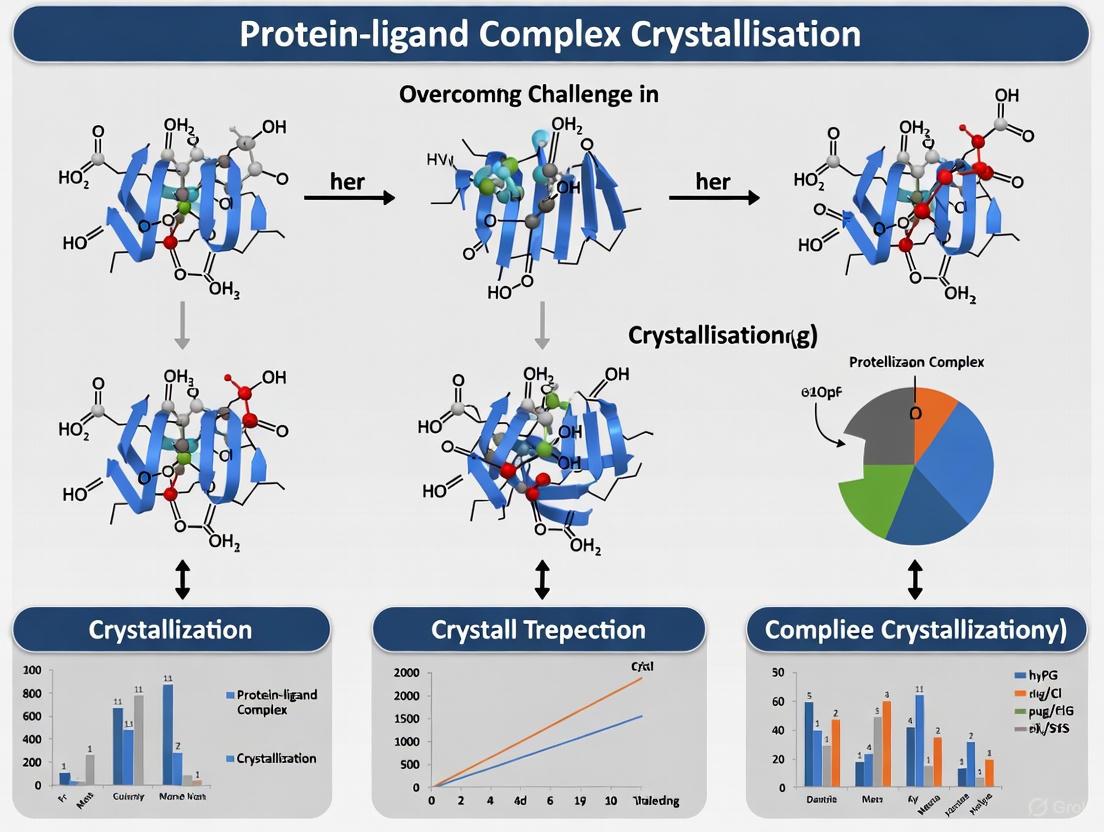
Obtaining high-quality crystals of protein-ligand complexes is a critical yet often limiting step in structural biology and rational drug design.
Overcoming Protein-Ligand Crystallization Challenges: A Strategic Guide for Structure-Based Drug Discovery
Abstract
Obtaining high-quality crystals of protein-ligand complexes is a critical yet often limiting step in structural biology and rational drug design. This article provides a comprehensive guide for researchers and drug development professionals, detailing strategies to overcome this bottleneck. It explores the foundational principles of protein-ligand interactions, compares core methodologies like co-crystallization and soaking, and presents advanced troubleshooting and optimization techniques. Furthermore, it examines validation protocols and emerging technologies, including AI and machine learning, that are shaping the future of structural biology. By synthesizing current best practices and innovative approaches, this resource aims to equip scientists with the knowledge to reliably determine complex structures and accelerate drug discovery pipelines.
Understanding the Bottleneck: Why Protein-Ligand Crystallization is a Foundational Challenge in Structural Biology
The Critical Role of Complex Structures in Rational Drug Design
Troubleshooting Guides
FAQ 1: Why are my protein-ligand co-crystallization experiments failing to produce crystals?
Several factors can prevent crystal formation, often related to sample quality and biochemical properties.
- Insufficient Protein Purity or Homogeneity: The starting protein sample must be highly pure (>95%) and monodisperse. Impurities or aggregates disrupt ordered lattice formation [1] [2] [3]. Optimize your purification workflow with multi-step chromatography and use dynamic light scattering (DLS) to monitor monodispersity [2].
- Protein Conformational Flexibility: Proteins with flexible regions (loops, charged residues) often fail to form stable crystal lattices [2]. Consider Surface Entropy Reduction (SER) by replacing high-entropy residues (Lys, Glu) with Ala or Thr to promote crystal contacts [2].
- Suboptimal Biochemical Conditions: The sample buffer should maintain protein stability. Keep buffer components below ~25 mM and salt below 200 mM. Avoid phosphate buffers, which can form insoluble salts [3]. Use differential scanning fluorimetry to identify optimal buffer, pH, and stabilizing conditions [3].
- Incorrect Protein Concentration: Both overly diluted and overly concentrated samples can prevent crystallization. A pre-crystallization test using the sparse-matrix approach can help determine the productive concentration range [3].
FAQ 2: My crystals formed, but they diffract poorly. What are the main causes and solutions?
Poor diffraction quality can stem from internal crystal disorder or external handling factors.
- Internal Crystal Disorder: Flexible protein regions can lead to a disordered crystal lattice [2]. Post-crystallization treatments can improve order. Controlled dehydration can contract the crystal lattice, enhancing resolution [2]. Soaking with stabilizing small molecules (e.g., inhibitors) can fill lattice voids and reduce disorder [2].
- Radiation Damage: X-ray exposure during data collection breaks chemical bonds, particularly disulfide bonds and acidic residues, degrading diffraction quality [2]. Always cryo-cool crystals using suitable cryoprotectants (e.g., glycerol, MPD, or high-molecular-weight PEGs present in the condition) to mitigate damage [3].
- Crystal Twinning or Lattice Defects: Twinning, where two crystal lattices grow from the same point, complicates data analysis [1]. If noticeable favored refraction occurs, collect data along the direction with the highest resolution [1].
FAQ 3: How can I tell if a ligand is properly bound in my crystal structure, and what can I do if occupancy is low?
Proper ligand binding is crucial for meaningful structural insights in drug design.
- Signs of Poor Ligand Binding: In the electron density map, you may observe weak or fragmented density for the ligand, or a binding mode that contradicts known Structure-Activity Relationship (SAR) data [4]. Low occupancy is a common issue [4].
- Strategies to Improve Occupancy:
- Optimize Soaking Conditions: For crystal soaking, increase the ligand concentration and/or extend the soaking time [4].
- Switch to Co-crystallization: If soaking fails, try co-crystallization. Pre-incubate the protein with a higher molar excess of the compound [4].
- Check Ligand Solubility & Affinity: Ensure the ligand is sufficiently soluble in the crystallization buffer and has adequate binding affinity (typically at least micromolar) [4]. For low-solubility compounds, reducing the protein concentration during incubation may help [4].
- Address Crystal Packing: Inspect the structure for crystal-packing contacts that might sterically block the ligand-binding site. If present, generate a new crystal form by changing crystallization conditions or using an alternative protein construct [4].
FAQ 4: What are the best strategies for dealing with membrane proteins or intrinsically disordered proteins (IDPs)?
These challenging but pharmacologically relevant proteins require specialized approaches.
- Membrane Proteins: Their hydrophobic regions require stabilization. Use Lipidic Cubic Phase (LCP) or bicelles to mimic the native membrane environment [2]. Employ fusion strategies with hydrophilic proteins (e.g., T4 lysozyme) to enhance solubility and facilitate crystal packing [2].
- Intrinsically Disordered Proteins (IDPs): IDPs lack well-defined binding pockets and often bind ligands with low affinity [5]. A combination of experimental and computational approaches is necessary to understand how ligands influence their conformational ensembles [5]. Techniques like Small-Angle X-Ray Scattering (SAXS) can provide solution-state structural information without the need for crystallization [2].
Troubleshooting Quick Reference Tables
Table 1: Common Crystallization Problems and Solutions
| Problem | Possible Causes | Recommended Solutions |
|---|---|---|
| No crystals form | • Sample impurities or aggregation• Protein conformational flexibility• Unstable biochemical conditions | • Improve purity (>95%) with multi-step chromatography [2] [3]• Implement Surface Entropy Reduction (SER) [2]• Optimize buffer, pH, and additives using stability assays [3] |
| Poor diffraction quality | • Internal crystal disorder• Radiation damage• Lattice defects or twinning | • Apply post-crystallization dehydration [2]• Use proper cryoprotection [3]• Collect data along the highest-resolution axis [1] |
| Low ligand occupancy | • Low ligand affinity or solubility• Crystal packing conflicts• Suboptimal soaking conditions | • Increase ligand concentration/soaking time [4]• Switch to co-crystallization [4]• Engineer a new crystal form [4] |
| Rapid crystallization (precipitation) | • Too high supersaturation• Shallow solvent pool in large flask | • Add extra solvent to slow growth [6]• Transfer solution to a smaller flask [6] |
Table 2: Key Reagents for Protein-Ligand Complex Crystallization
| Reagent Category | Example Components | Function in Crystallization |
|---|---|---|
| Precipitants | Polyethylene Glycol (PEG), Ammonium Sulfate, MPD | Induce macromolecular crowding and reduce protein solubility, driving phase separation into a crystalline state [3]. |
| Buffers | HEPES, Tris, MES | Control pH of the crystallization condition, ideally within 1-2 pH units of the protein's pI to promote intermolecular interactions [3]. |
| Additives & Stabilizers | • Substrates/Co-factors• Reducing Agents (TCEP, DTT)• Detergents (for membrane proteins) | • Enhance stability and order flexible regions [3].• Prevent cysteine oxidation; TCEP is preferred for long-lived experiments due to its extended half-life [3].• Solubilize and stabilize membrane proteins [2] [3]. |
| Cryoprotectants | Glycerol, Ethylene Glycol, Low-Molecular-Weight PEGs | Replace water in crystal lattice to prevent ice formation during cryo-cooling for data collection [3]. |
Experimental Protocols
Protocol 1: Optimizing Protein Construct for Crystallization
A well-designed protein construct is a critical first step.
- Identify Ligand-Binding Domain: It is often unnecessary to use the full-length protein. Identify the minimal domain that contains the functional ligand-binding site using literature or bioinformatics [4].
- Design Multiple Constructs: Test multiple constructs with different N- and C-terminal boundaries. Analysis by structural genomics consortia suggests designing 10-20 different constructs per novel target is optimal [4]. Use prediction tools like AlphaFold3 to guide the elimination of flexible regions [3].
- Incorporate Affinity Tags: Include an N- or C-terminal His-tag or other affinity tags (e.g., GST) to aid purification. These tags can sometimes also act as crystallization chaperones [4] [3].
- Express and Purify: Express constructs in a suitable system (e.g., E. coli, insect cells). Purify using affinity chromatography followed by size-exclusion chromatography (SEC) to ensure monodispersity [4] [3].
- Screen for Crystallization: Test all purified constructs in a few initial 96-well crystallization screens. Screening many constructs in a few conditions is generally more successful than screening one construct in thousands of conditions [4].
Protocol 2: Ligand Soaking vs. Co-crystallization
Choosing how to introduce the ligand is a key strategic decision.
Ligand Soaking
- Grow Native Crystals: First, crystallize the protein without the ligand.
- Prepare Soaking Solution: Dilute the ligand in the crystal's mother liquor or a stabilizing solution. Ensure the ligand is soluble and the solvent concentration is low to avoid crystal damage.
- Soak Crystals: Transfer a crystal into the soaking solution. Soaking times can range from minutes to days, and ligand concentration is typically in the millimolar range [4].
- Cryo-cool and Collect Data: After soaking, cryo-cool the crystal rapidly for X-ray data collection. > Best for: Established crystal systems and ligands with high solubility [4].
Co-crystallization
- Form Protein-Ligand Complex: Pre-incubate the purified protein with a molar excess of the ligand (e.g., 2-5x) for a period (e.g., 1 hour on ice) before setting up crystallization trials [4].
- Set Up Crystallization Trials: Use the protein-ligand complex solution in the same way as the apo-protein for crystallization screening.
- Optimize Conditions: Crystallization conditions that worked for the apo-protein may need re-optimization, as ligand binding can alter the protein's surface and packing preferences. > Best for: Difficult soaks, ligands that induce conformational changes, or when working with a new protein construct [4].
The following workflow summarizes the decision-making process for generating a protein-ligand complex structure.
Key Databases and Software for Structure-Based Drug Design
| Resource Name | Type | Key Function in Rational Drug Design |
|---|---|---|
| Protein Data Bank (PDB) | Database | Repository for 3D structures of proteins and protein-ligand complexes; essential for finding homologous structures for Molecular Replacement and analyzing binding sites [5]. |
| AlphaFold 3 & RosettaFold All-Atom | Software (AI) | Deep learning models that predict the 3D structure of biomolecular assemblies, including protein-ligand complexes, from primary sequence [5]. |
| BindingDB, ChEMBL | Database | Curate experimental binding data (e.g., affinity constants, Ki) for protein-ligand systems; crucial for validating computational predictions and understanding SAR [5]. |
| Molecular Docking Software | Software | Predict the binding pose and orientation of a small molecule within a protein's binding site [5] [7]. |
| Molecular Dynamics (MD) Simulations | Software | Simulate the dynamic behavior of protein-ligand complexes over time, providing insights into binding stability, conformational changes, and allosteric mechanisms [5] [7]. |
| Covalent Docking Tools | Software | Specialized docking methods for covalent inhibitors, which must account for the reaction pathway forming a covalent bond with the target protein [8]. |
Troubleshooting Guides
Handling Conformational Changes During Crystallization
Problem: My protein undergoes ligand-induced conformational changes, preventing the growth of well-diffracting crystals.
Solutions:
- Use Co-crystallization: Crystallize the protein in the presence of the ligand from the beginning. This allows the protein-ligand complex to form in solution and often yields crystals that accurately represent the bound conformation [9].
- Optimize with Microseeding: Use microseeding to accelerate the co-crystallization process. This technique bypasses the nucleation phase, directly promoting crystal growth in the metastable zone, and reduces the required sample amount [9].
- Explore Soaking Conditions Carefully: If using ligand soaking, where a ligand is introduced into pre-formed crystals, meticulously optimize the soaking conditions. Control the ligand concentration, soaking time, and stabilize the crystal with additives to minimize crystal cracking due to conformational rearrangement [9].
Improving Complex Solubility and Preventing Aggregation
Problem: My protein-ligand complex has poor solubility or aggregates during purification and crystallization.
Solutions:
- Ensure Sample Purity and Monodispersity: Prior to crystallization, purify the protein using techniques like Size Exclusion Chromatography (SEC). Characterize the sample using Dynamic Light Scattering (DLS) or Differential Scanning Fluorimetry (DSF) to confirm it is homogeneous and monodisperse [9].
- Optimize Buffer Conditions: Use simple buffers with appropriate ionic strength and additives (e.g., DTT, salts) to maintain protein stability, solubility, and activity. Remove excess salts or stabilizers that might inhibit crystallization through buffer exchange [9].
- Concentrate judiciously: Concentrate the protein to its maximum stable concentration (e.g., 5–25 mg·mL⁻¹) and always centrifuge or filter the sample immediately before crystallization setup to remove any aggregates or precipitates [9].
Overcoming Challenges in Detecting Conformational Changes
Problem: It is challenging to detect and characterize the structural changes my ligand induces in the protein.
Solutions:
- Employ Complementary Biosensors: Utilize biosensor technologies with different detection principles. Surface Plasmon Resonance (SPR) can suggest conformational changes through complex binding sensorgrams, while techniques like Second Harmonic Generation (SHG) and Surface Acoustic Wave (SAW) can confirm these changes and reveal whether they lead to a compaction or expansion of the protein structure [10].
- Combine with Crystallography: Use biosensors to triage ligands that cause complex changes, then focus crystallography efforts on these. Be aware that crystals may not form for ligands inducing very large structural changes [10].
Frequently Asked Questions (FAQs)
Q1: What is the fundamental difference between co-crystallization and ligand soaking? A1: Co-crystallization involves crystallizing the protein in the presence of the ligand, resulting in protein-ligand complex crystals. Ligand soaking introduces the ligand into pre-formed crystals of the protein alone (apo-protein). Soaking is simpler and faster, but co-crystallization is often more accurate for determining the correct ligand-binding position and can be necessary when binding induces significant conformational changes [9].
Q2: How much ligand is needed for successful co-crystallization? A2: To ensure the binding site is saturated, it is essential to use a significant molar excess of the ligand relative to the protein. A general guideline is to use a concentration that is 10 to 1000-fold greater than the ligand's equilibrium dissociation constant (Kd) [9].
Q3: My crystals crack or dissolve during ligand soaking. What could be the cause? A3: This is often a sign of significant ligand-induced conformational changes in the protein. The rearrangement of the protein structure can stress and break the existing crystal lattice. To mitigate this, you can try using stabilization buffers, additives, controlling the soaking time more precisely, or switching to a co-crystallization approach [9].
Q4: Are there computational tools that can help anticipate conformational changes before experiments? A4: Yes, molecular docking strategies can be used that take protein flexibility into account. Some methods generate multiple models of the active site by considering allowed side-chain rotamer conformations. Docking ligands to these multiple models can help predict binding modes and affinities when conformational changes are expected [11]. However, be aware that advanced deep-learning co-folding models, while accurate in many cases, may sometimes overfit and not always generalize well to novel ligands or binding sites, potentially missing drastic conformational changes [12].
Data Presentation
Table 1: Key Experimental Parameters for Crystallization Methods
| Parameter | Co-crystallization | Ligand Soaking |
|---|---|---|
| Ligand Concentration | 10-1000x Kd [9] | Sufficient to saturate binding site during diffusion [9] |
| Typical Timeframe | Days to weeks (requires nucleation & growth) [9] | Seconds to days (diffusion into pre-formed crystal) [9] |
| Best for Conformational Changes? | Excellent for accommodating changes during crystal formation [9] | Risk of crystal damage with large changes; may require optimized conditions [9] |
| Primary Advantage | More accurate determination of ligand-binding position [9] | Simplicity and speed; uses existing apo-crystal conditions [9] |
| Primary Challenge | Time-consuming; may require re-optimization for each ligand [9] | Controlling conditions to ensure successful ligand integration without crystal damage [9] |
Table 2: Troubleshooting Common Obstacles in Protein-Ligand Crystallization
| Obstacle | Possible Cause | Recommended Solution |
|---|---|---|
| No Crystals | Protein aggregation, impure sample, incorrect conditions | Improve purification (SEC), check monodispersity (DLS), use seeding [9] |
| Crystals Crack During Soaking | Ligand-induced conformational change | Use stabilization buffers, control soaking time, or switch to co-crystallization [9] |
| Poor Diffraction Quality | Crystal disorder, high solvent content, incomplete ligand binding | Optimize cryoprotection, use microseeding, ensure ligand saturation (use excess) [9] |
| Weak or No Electron Density for Ligand | Low ligand occupancy, low affinity (high Kd) | Increase ligand concentration during soaking/co-crystallization, confirm binding affinity [9] |
Experimental Protocols
Detailed Protocol: Co-crystallization with Microseeding
This protocol accelerates the co-crystallization process and reduces sample consumption [9].
Protein Preparation:
- Purify the protein to high homogeneity (>95%) using Size Exclusion Chromatography (SEC).
- Confirm protein stability, monodispersity, and activity using DLS or DSF.
- Concentrate the protein to its maximum stable concentration (e.g., 5–25 mg/mL) in a suitable buffer.
- Centrifuge at high speed (e.g., 15,000-20,000 r.c.f.) for 10-15 minutes at 4°C to remove aggregates.
Complex Formation:
- Mix the purified protein with the ligand. Use a ligand concentration that is a 10-1000 fold molar excess over its Kd value.
- Incubate the mixture on ice or at a relevant temperature to allow the complex to form.
Microseed Stock Preparation:
- Crush existing crystals (of the apo-protein or a similar complex) using a crystal crusher or seed beads to create a stock of microseeds.
- Perform a series of dilutions in the crystallization buffer or a stabilizing solution to create a range of seed concentrations.
Crystallization Setup:
- Use an automated crystallization robot or manual vapor diffusion methods.
- For sitting drops, mix the protein-ligand complex solution with the reservoir solution containing a precipitant.
- Add a small volume of the diluted microseed stock to the drop. The seeds will bypass nucleation and directly promote the growth of co-crystals.
- Seal the plates and incubate at the appropriate temperature (e.g., 4°C or 20°C).
Detailed Protocol: Ligand Soaking
This is the preferred method for its simplicity when working with existing crystals [9].
Apo-protein Crystal Growth:
- Grow well-diffracting crystals of the protein without the ligand (apo-protein) using standard vapor diffusion techniques.
Ligand Solution Preparation:
- Dissolve the ligand in an appropriate solvent (e.g., DMSO, water, or crystallization buffer). The solution should be prepared at a concentration high enough to ensure saturation of the binding site during diffusion.
Soaking Process:
- Transfer a single crystal into a drop containing the ligand solution. This can be done by:
- Adding a small volume of concentrated ligand stock directly to the crystal drop.
- Transferring the crystal to a new drop pre-made with reservoir solution and ligand.
- Control the soaking time precisely—from seconds to days—depending on the crystal size and ligand diffusion rate. Monitor the crystal for signs of cracking or degradation.
- Transfer a single crystal into a drop containing the ligand solution. This can be done by:
Harvesting:
- After soaking, briefly transfer the crystal to a cryoprotectant solution.
- Flash-cool the crystal in liquid nitrogen for data collection.
Experimental Workflow and Pathway Diagrams
Diagram 1: Decision workflow for co-crystallization versus ligand soaking.
Diagram 2: Workflow for sample validation and detecting ligand-induced conformational changes.
The Scientist's Toolkit: Research Reagent Solutions
Table 3: Essential Materials for Protein-Ligand Crystallization
| Item | Function | Example Product/Chemical |
|---|---|---|
| Size Exclusion Chromatography (SEC) Column | High-resolution purification of the protein-ligand complex to ensure homogeneity. | Superdex 75 Increase 10/300 GL [9] |
| Concentrator | Concentrates the protein sample to the high levels required for crystallization. | Amicon Ultra Centrifugal Filter Units (e.g., 10 kDa MWCO) [9] |
| Crystallization Plates | Platform for setting up nanoliter-to-microliter scale crystallization trials. | 96-well sitting-drop plates (e.g., MRC 2 Lens Crystallisation Plate) [9] |
| Commercial Crystallization Screens | Pre-formulated solutions of precipitants, buffers, and salts to rapidly screen for initial crystallization conditions. | SG1, Morpheus II, PACT premier [9] |
| Microseed Kit | Contains tools for crushing crystals and creating serial dilutions of microseeds to aid in crystal growth. | Seed Bead Kits, Micro-Tools Set [9] |
| Crystal Dye | Helps visualize crystals, especially small or clear ones, under microscope. | IZIT dye, JBS Rainbow [9] |
| Ligand Solubilizers | To dissolve hydrophobic ligands and maintain their solubility in aqueous crystallization buffers. | DMSO, surfactants, cyclodextrins [9] |
Why Does the Timing of Ligand Addition Matter?
In the crystallization of protein-ligand complexes, the question of when to add the ligand is not merely a matter of procedural preference but a critical strategic decision. The choice influences protein stability, solubility, and conformational homogeneity, which are fundamental to forming a diffraction-quality crystal [13] [14]. A well-timed ligand addition can stabilize a flexible protein, displace competing proteins, or induce a specific conformational state that is more amenable to forming an ordered crystal lattice [13]. The four principal strategies are: co-expression, addition during purification, co-crystallization, and soaking into pre-formed crystals [13] [15]. The optimal path is often protein- and ligand-dependent and must be determined empirically through systematic testing [13].
The following diagram outlines the key decision-making workflow for selecting a ligand introduction strategy.
Comparison of Ligand Addition Strategies
The table below summarizes the core characteristics, applications, and requirements of the four primary strategies to help you make an informed choice.
| Strategy | Typical Application | Key Advantage | Key Challenge | Ligand Property Requirement |
|---|---|---|---|---|
| Co-expression [13] | Recalcitrant, insoluble proteins (e.g., nuclear receptors) | Increases soluble protein yield; stabilizes conformation during synthesis. | Requires ligand to be cell-permeable and non-toxic. | High affinity; bio-compatible. |
| Purification [13] | Proteins that aggregate or co-purify with other biomolecules (e.g., HSP90) | Stabilizes protein, prevents aggregation, and displaces competitor proteins during purification. | Ligand must be available in large quantities for entire process. | High affinity and stability. |
| Co-crystallization [13] [14] | Insoluble ligands; proteins that undergo conformational change on binding. | Facilitates complex formation with low-solubility ligands at low concentrations. | May require re-optimization of crystallization conditions. | Can accommodate lower solubility. |
| Soaking [15] [14] | High-throughput studies; robust, pre-existing apo crystal systems. | Protein-efficient and fast; allows screening of many ligands. | Crystal must tolerate ligand/DMSO without cracking; no major conformational shifts. | High solubility (for 10x excess); high affinity. |
Detailed Experimental Protocols
Protocol 1: Ligand Soaking into Pre-Formed Crystals
Soaking is a high-throughput method where the ligand is introduced into an existing apo protein crystal [14].
Key Considerations:
- Crystal Robustness: The crystal system must be physically robust enough to withstand transfer into a soaking solution and tolerate the presence of 1-5% DMSO without cracking or dissolving [14].
- Ligand Concentration and Affinity: For potent compounds (Kd << protein concentration), a molar equivalent of ligand may suffice. For ligands with higher Kd, a 10-fold molar excess over the protein concentration in the crystal is recommended to drive occupancy [14].
- Soaking Time: Can vary from minutes to several days and must be determined empirically [14].
Step-by-Step Methodology:
- Prepare Soaking Solution: Add ligand from a 100 mM DMSO stock solution to the crystallization reservoir solution. The final DMSO concentration should typically be 1-5% [14].
- Transfer Crystal: Carefully harvest a single apo crystal and transfer it into the soaking solution.
- Incubate: Monitor the crystal microscopically over time for signs of degradation or cracking.
- Cryo-Cooling: After soaking, transfer the crystal to a cryoprotectant solution (e.g., reservoir solution with 20-25% glycerol) that also contains the ligand at the same concentration to prevent the ligand from soaking out [14].
- Flash-Cool: Flash-cool the crystal in liquid nitrogen for data collection.
Protocol 2: Co-crystallization of a Pre-formed Protein-Ligand Complex
Co-crystallization involves incubating the purified protein with the ligand prior to crystallization trials [13] [14].
Key Considerations:
- Complex Formation: The protein and ligand must be incubated for a sufficient period (30 minutes to several hours) to form a stable complex [13].
- Handling Insoluble Ligands: For ligands with low solubility, form the complex at a low protein concentration (e.g., 1 mg/mL) to keep the ligand in solution, then concentrate the entire mixture for crystallization. In some cases, even including ligand precipitate in the drop can be effective, as it acts as a reservoir [13] [14].
- Temperature: Incubation temperature can affect complex formation. For some proteins, room temperature incubation (30-60 min) is superior to incubation on ice [13].
Step-by-Step Methodology:
- Prepare Protein-Ligand Mixture: Incubate purified protein with a 2.5 to 10-fold molar excess of ligand for 30 minutes to several hours on ice or at room temperature [13] [16].
- Set Up Crystallization: Use the protein-ligand complex solution directly in crystallization screens (e.g., hanging drop vapor diffusion).
- Optimize: Crystallization conditions from the apo form may work, but be prepared to screen new conditions, as the ligand can alter the crystal packing [15].
Protocol 3: Using Ligands During Protein Purification
Adding a high-affinity ligand during the early stages of purification can stabilize the protein and improve homogeneity [13].
Key Considerations:
- This method is ideal for proteins that are prone to aggregation or that co-purify with other proteins (e.g., chaperones like HSP90) [13].
- The ligand must be present in all buffers from cell lysis through the final concentration step.
Step-by-Step Methodology:
- Lysis: Include a specific, high-affinity inhibitor or ligand in the cell lysis buffer [13].
- Chromatography: Add the same ligand to all chromatography buffers (e.g., IMAC, SEC) during purification [13].
- Concentration: Maintain the ligand in the final protein buffer before concentrating the protein for crystallization trials.
Troubleshooting FAQs
Q1: My crystals shatter or dissolve during soaking. What should I do?
- A: This indicates that the crystal cannot tolerate the soaking conditions. First, try reducing the concentration of DMSO in the soaking solution. If the problem persists, the ligand may be inducing a significant conformational change that the crystal lattice cannot accommodate. In this case, switch to a co-crystallization approach [14].
Q2: I see electron density for the ligand, but the occupancy is poor. How can I improve this?
- A: Poor occupancy typically suggests insufficient ligand concentration or affinity [15]. Increase the ligand concentration in the soaking or co-crystallization solution (aim for a higher molar excess). For soaking, extending the soaking time may also help. For co-crystallization, ensure the protein is incubated with the ligand prior to setting up drops [15].
Q3: My protein is unstable without a ligand. Which strategy should I try first?
- A: For unstable proteins, the best strategies are co-expression or addition during purification. Co-expression is powerful if the ligand can be taken up by the expression host, as it can dramatically increase the yield of soluble, properly folded protein [13]. If co-expression is not feasible, adding a high-affinity ligand during the cell lysis and throughout the entire purification process can stabilize the protein and prevent aggregation [13].
Q4: I am working with a membrane protein. Are there any special considerations?
- A: Yes, membrane proteins are notoriously difficult to crystallize. The use of stabilizing ligands is often essential. A highly successful approach has been the in meso or lipid cubic phase method, where the protein is crystallized within a lipidic matrix, often in the presence of a ligand [17].
The Scientist's Toolkit: Essential Research Reagents
The following table lists key reagents commonly used in the formation and crystallization of protein-ligand complexes.
| Reagent / Material | Function / Application |
|---|---|
| Cibacron Blue F3GA Dye Resin [16] | An affinity chromatography resin used to identify nucleotide-binding proteins and their potential ligands, which can then be used for co-crystallization. |
| Hexahistidine (His6) Tag [15] | The most common affinity tag for protein purification via Immobilized Metal Affinity Chromatography (IMAC). |
| Size-Exclusion Chromatography (SEC) Media [13] | Used to purify proteins based on size, often as a final polishing step to obtain a monodisperse, homogeneous sample ideal for crystallization. |
| Triazine Dyes (e.g., Cibacron Blue) [16] | Used in dye-ligand affinity chromatography to identify protein-ligand interactions for a wide range of enzymes. |
| Polyethylene Glycol (PEG) [18] | A common precipitant in crystallization screens that acts via macromolecular crowding, reducing protein solubility and promoting crystal formation. |
| 2-methyl-2,4-pentanediol (MPD) [18] | An additive and precipitant that binds to hydrophobic protein regions and affects the hydration shell of the biomolecule. |
| Tris(2-carboxyethyl)phosphine (TCEP) [18] | A stable, odorless reducing agent with a long half-life across a wide pH range, used to prevent cysteine oxidation in protein samples. |
| Maltose-Binding Protein (MBP) Tag [15] | A large fusion tag that can significantly improve the solubility and expression of its fusion partner. |
The Impact of Ligand Binding on Protein Stability and Crystallization
For researchers in structural biology and drug discovery, obtaining high-resolution structures of protein-ligand complexes is a critical step for understanding biological function and guiding therapeutic development. This process, however, presents significant technical challenges. The binding of a ligand to its target protein can profoundly influence the protein's stability and conformational dynamics, which in turn directly impacts its crystallizability. This technical support center provides targeted troubleshooting guides and FAQs to help you overcome the most common experimental hurdles in crystallizing protein-ligand complexes, framed within the context of advancing structural research.
FAQs: Core Concepts and Troubleshooting
How does ligand binding actually improve protein crystallization?
Ligand binding enhances crystallization through two primary mechanisms:
- Stabilization of a Specific Conformation: Proteins in solution exist as a dynamic ensemble of conformers. A ligand, particularly one with high affinity, can select and stabilize a single, uniform conformation from this ensemble. This reduction in structural heterogeneity is a key factor in promoting the formation of a regular crystal lattice [19].
- Modulation of Protein-Surface Interactions: The ligand can alter the protein's surface properties and electrostatics, potentially creating new, favorable intermolecular contacts (crystal-packing interfaces) that were not present in the apo protein [20]. In some cases, bi-functional ligands can directly mediate dimerization or higher-order oligomerization by bridging two protein molecules, effectively dictating a specific packing arrangement [20].
What is the fundamental difference between co-crystallization and ligand soaking?
The choice between these two methods is one of the most critical decisions in your experimental design. The table below summarizes their key characteristics.
| Feature | Co-crystallization | Ligand Soaking |
|---|---|---|
| Process | Protein and ligand are mixed in solution before crystallization is initiated [9]. | Ligand is introduced into a pre-formed apo protein crystal [9]. |
| Advantages | Often more accurate for determining correct ligand-binding position; can accommodate large conformational changes [9]. | Faster and uses less protein and ligand; leverages existing, well-diffracting crystal conditions [9]. |
| Disadvantages | Can be time-consuming and require re-optimization of crystallization conditions for each new ligand [9]. | Binding site must be accessible via solvent channels; can cause crystal cracking if conformational changes are too large [9]. |
| Best For | Ligands that induce large conformational changes, or when initial crystal conditions are not known [9]. | Rapid screening of multiple ligands against a single, robust crystal form [9]. |
My crystals crack or dissolve during soaking. What can I do?
Crystal cracking during soaking typically indicates that the ligand is inducing a conformational change that the crystal lattice cannot accommodate. Here are several strategies to troubleshoot this issue:
- Optimize Soaking Conditions: Systematically vary the soaking time (from seconds to days) and ligand concentration. Using a stabilization buffer or adding cryoprotectants during soaking can also help preserve crystal integrity [9].
- Switch to Co-crystallization: If soaking consistently fails, co-crystallization is the recommended path, as it allows the crystal lattice to form around the ligand-bound conformation [9].
- Consider the Ligand Properties: Ensure the ligand is soluble and that the solvent (e.g., DMSO) concentration in the soak is kept low (<5%) to avoid damaging the crystal [9].
Why won't my protein-ligand complex crystallize, even though the apo protein does?
This common frustration can have several causes:
- Sample Heterogeneity: The complex may not be homogeneous. Use techniques like Size Exclusion Chromatography (SEC) coupled with Multi-Angle Light Scattering (SEC-MALS) to confirm a monodisperse sample. Ensure the ligand is present in a sufficient excess (e.g., 10–1000-fold over its Kd) to fully saturate the binding site [9].
- Insufficient Stability: The ligand might not be stabilizing the protein enough. Use Differential Scanning Fluorimetry (DSF) or Differential Static Light Scattering (DSLS) to confirm a ligand-induced thermal stability shift. DSLS is particularly useful for membrane proteins, as it is not sensitive to detergents [21].
- Stoichiometric Issues (for bi-functional ligands): If using a ligand designed to bridge two protein molecules, an incorrect protein-to-ligand ratio can lead to a mixture of species (e.g., 1:1 and 2:2 complexes), creating heterogeneity that inhibits crystallization [20].
Experimental Protocols
Protocol 1: Co-crystallization of a Protein-Ligand Complex
This protocol outlines the steps for forming a complex via co-crystallization, which can be accelerated using microseeding [9].
Workflow: Co-crystallization with Microseeding
Materials:
- Purified, monodisperse protein (>95% pure) [9].
- Ligand (dissolved in appropriate solvent like DMSO).
- Crystallization screens (commercial or homemade).
- Crystallization plates (e.g., 96-well sitting drop plates).
- Seed Bead kit and crystal crusher [9].
Method:
- Protein Preparation: Purify the protein using Size Exclusion Chromatography (SEC) to achieve high homogeneity [9]. Concentrate the protein to its maximum stable concentration (e.g., 5–25 mg/mL) and centrifuge to remove aggregates.
- Complex Formation: Incubate the protein with a molar excess of ligand (concentration should be 10–1000-fold over its Kd) on ice for 30-60 minutes [9].
- Initial Crystallization Screening: Set up initial crystallization trials using the vapor diffusion method (sitting or hanging drop) with a robot or manually.
- Microseed Stock Preparation: If the initial trials yield microcrystals, spherulites, or heavy precipitate, prepare a microseed stock. Transfer the material to a microtube with a seed bead and vortex rigorously to crush the crystals [9].
- Seeded Crystallization: Serially dilute the microseed stock. Set up new crystallization trials and introduce the diluted microseeds into the new protein-ligand solution drops. The seeds will bypass the stochastic nucleation phase and promote growth directly in the metastable zone, often yielding larger, single crystals [9].
Protocol 2: Ligand Soaking for Complex Formation
This protocol is for introducing a ligand into existing apo protein crystals [9].
Workflow: Ligand Soaking
Materials:
- Well-diffracting apo protein crystals.
- Ligand solution (stabilized in crystallization buffer + cryoprotectant).
- Cryo-loops and liquid nitrogen.
Method:
- Crystal Growth: Grow robust, well-diffracting crystals of the apo protein.
- Soaking Solution: Prepare a solution containing the ligand (at a high concentration), crystallization buffer, and cryoprotectant (e.g., glycerol, PEG). The solvent (e.g., DMSO) concentration should be minimized.
- Soaking: Carefully transfer a single crystal from the crystallization drop to the soaking solution. Soaking times can vary dramatically, from a few seconds to several days, and must be determined empirically [9].
- Monitoring: Observe the crystal under a microscope for signs of cracking or degradation. If cracking occurs, try shorter soak times or the addition of stabilizing additives.
- Harvesting: After the soak, retrieve the crystal and flash-cool it in liquid nitrogen for data collection.
Data Presentation: Ligand-Induced Stability Changes
The following table summarizes quantitative data from a classic study on Bovine Serum Albumin (BSA) bound to different ANS derivatives, illustrating how different ligands can have dramatically different effects on protein stability, as measured by Differential Scanning Calorimetry (DSC) [19].
Table: Effect of Ligand Binding on Bovine Serum Albumin (BSA) Stability
| Ligand (at saturating 50:1 ratio) | Midpoint Denaturation Temperature (Tm) | ΔTm (vs. Apo) | Calorimetric Enthalpy (ΔHcal) | Observation |
|---|---|---|---|---|
| Apo BSA | 59.0 °C | - | 134 kcal•mole-1 | Two-state unfolding [19]. |
| 1,8-ANS | 79.8 °C | +20.8 °C | 259 kcal•mole-1 | Maximal stabilization; two-state unfolding [19]. |
| 2,6-ANS | 73.2 °C | +14.2 °C | 169 kcal•mole-1 | Moderate stabilization; two-state unfolding [19]. |
| bis-ANS (5:1 ratio) | 73.6 °C | +14.6 °C | 173 kcal•mole-1 | Stabilization at low concentration [19]. |
| bis-ANS (50:1 ratio) | Not detected | - | Not detected | Loss of cooperative unfolding; induces molten globule-like state [19]. |
This table demonstrates a clear correlation between the type of ligand bound and the resulting protein thermostability, which is a key predictor of crystallizability.
The Scientist's Toolkit: Essential Reagents and Materials
Table: Key Research Reagent Solutions for Protein-Ligand Crystallography
| Item | Function / Purpose | Example |
|---|---|---|
| Size Exclusion Chromatography (SEC) Columns | To obtain a highly pure, homogenous, and monodisperse protein sample, which is critical for crystallization [9]. | Superdex 75 Increase 10/300 GL [9]. |
| Concentration Devices | To concentrate the protein to the high, stable levels required for crystallization trials [9]. | Amicon Ultra Centrifugal Filter Units (with appropriate MWCO) [9]. |
| Crystallization Plates & Sealing Tools | To set up nanoliter-to-microliter scale crystallization trials using vapor diffusion [9]. | 96-well sitting-drop plates (e.g., MRC plates); Crystal clear sealing tape [9]. |
| Commercial Crystallization Screens | Pre-formulated solutions to efficiently screen a wide range of conditions (precipitants, pH, salts) for initial crystal hits [9]. | SG1, Morpheus II, PACT premier [9]. |
| Microseeding Tools | To transfer microscopic crystal seeds to new drops, promoting growth and improving crystal quality [9]. | Seed Bead Kits; Micro-Tools Set; Crystal crusher [9]. |
| Stability Assay Kits | To identify ligands that stabilize the protein, which correlates with higher crystallization success. DSF dyes for soluble proteins; DSLS for membrane proteins [21]. | Differential Static Light Scattering (DSLS) instruments [21]. |
Core Techniques in Practice: Mastering Co-crystallization and Ligand Soaking Methods
FAQs: Core Concepts and Strategic Planning
Q1: What is the fundamental difference between co-crystallization and soaking? Co-crystallization involves incubating the protein with the ligand in solution to form a complex before crystallization trials begin. In contrast, soaking introduces a ligand solution into pre-formed protein crystals [9]. Co-crystallization is often more accurate for determining the correct ligand-binding position, as crystal packing tends to favor the ligand bound to the active site [9].
Q2: When should I choose co-crystallization over soaking? Co-crystallization is the preferred method when the protein is only stable when complexed with a ligand, when the ligand induces significant conformational changes, or when working with ligands of low solubility that require complex formation at low protein concentrations [13] [14]. Soaking is generally simpler and higher throughput if the apo (ligand-free) protein crystals are robust and readily available [14].
Q3: How do I determine the right ligand concentration for complex formation? A significant excess of ligand over the protein concentration is required. It is essential to establish the ligand's affinity (Kd) and use a concentration that is a 10- to 1000-fold excess over this value [9]. For potent compounds with a Kd much lower than the protein concentration, the ligand can be present at a molar equivalent. For weaker binders, at least a 10-fold excess is recommended [14].
Q4: My protein is unstable in its apo form. Can co-crystallization still work? Yes. In many cases, the ligand stabilizes the protein. Strategies include co-expressing the protein with the ligand in the host cell or adding the ligand during the protein purification process. This was critical for obtaining soluble protein and subsequent crystals for several nuclear receptors [13].
Troubleshooting Guide: Common Experimental Issues
Q1: The protein precipitates upon adding the ligand. This is often due to the ligand's insolubility or the use of high protein concentrations.
- Solution A: Dilute the protein to 1 mg mL⁻¹ or lower before adding the ligand, then concentrate the stable complex [13].
- Solution B: Homogenize the ligand powder, or use different solvents like PEG400 or alcohols instead of, or in combination with, DMSO to improve ligand solubility [14].
- Solution C: Incubate the protein-ligand mixture at room temperature instead of on ice, as this can sometimes facilitate complex formation without precipitation [13].
Q2: The protein-ligand complex does not crystallize, even though the apo protein does. The ligand may have induced a conformational change that requires new crystallization conditions.
- Solution A: Perform ab initio crystallization screening with the new complex, as a completely new crystal form may be needed [13].
- Solution B: Employ cross-seeding, where microseeds from apo protein crystals are used to nucleate crystallization of the complex [13].
- Solution C: Use microseeding more broadly. Microseeds from microcrystalline precipitate or other crystalline forms can bypass the nucleation zone and accelerate crystal growth of the complex in the metastable zone [9].
Q3: The obtained crystals show poor or no electron density for the ligand. This indicates low occupancy of the ligand in the binding site.
- Solution A: Ensure the ligand is present in a sufficient molar excess during complex formation, especially for lower-affinity ligands [9] [14].
- Solution B: Include a low concentration of the ligand in the cryoprotectant solution to prevent it from being diluted and "soaked out" of the crystal during freezing [14].
- Solution C: For complexes formed with a low-affinity ligand, try a "replacement soaking" method where a pre-formed co-crystal is soaked in a solution containing a higher-affinity ligand of interest [13].
Q4: The protein already has a natural ligand bound. How can I replace it? If the protein is purified with a natural ligand or cofactor, a ligand exchange is necessary.
- Solution: During cell lysis and the entire protein purification process, include a high-affinity ligand of interest in molar excess. This can displace the natural ligand and has been the only successful method for obtaining crystals with certain target ligands [13].
Experimental Protocols
Protocol 1: Standard Co-crystallization of a Protein-Ligand Complex
This protocol details the steps for forming a protein-ligand complex and setting up crystallization trials via the vapor diffusion method [9].
Workflow Overview
Materials
- Purified Protein: Highly pure (>95%), stable, and monodisperse protein in a suitable buffer [9].
- Ligand Stock: A concentrated solution of the ligand (e.g., 100 mM in DMSO) [14].
- Crystallization Screens: Commercial sparse matrix screens (e.g., SG1, Morpheus II, PACT premier) [9].
- Equipment: Amicon centrifugal filters, 96-well sitting-drop crystallization plates, sealing tape, incubators [9].
Step-by-Step Method
- Protein Preparation: Concentrate the purified protein to its maximum stable concentration (typically 5-25 mg mL⁻¹). Centrifuge at ~15,000-20,000 g for 10-15 minutes at 4°C to remove any aggregates [9].
- Complex Formation: Add the ligand stock to the diluted or concentrated protein sample. A typical starting point is a 1-3 molar ratio of protein to ligand, aiming for a 10-1000-fold excess over the Kd [13] [9].
- Incubation: Incubate the mixture to allow the complex to form. This can range from 30 minutes at room temperature to several hours or even days on ice [13] [14].
- Final Preparation: If the complex was formed at a dilute concentration, concentrate it using an appropriate centrifugal filter unit. Centrifuge the final complex solution again before setting up crystallization trials to ensure it is free of precipitate [9].
- Crystallization: Set up crystallization trials using a vapor diffusion method (sitting or hanging drop). Mix equal volumes (e.g., 0.1-0.2 µL) of the protein-ligand complex solution and the reservoir solution [9].
Protocol 2: Advanced Co-crystallization Using Microseeding
This protocol uses microseeding to accelerate the crystallization process and reduce sample consumption, which is particularly useful for difficult-to-crystallize complexes [9].
Workflow Overview
Materials
- Seed Stock: Crystals of the apo protein or a related protein-ligand complex.
- Seed Bead Kit: For convenient crushing and storage of seeds [9].
- Stabilization Buffer: A solution compatible with the protein and seeds, often the crystallization reservoir solution.
Step-by-Step Method
- Prepare Seeds: Transfer a single crystal or a few crystals to a microcentrifuge tube containing ~50 µL of stabilization buffer and a seed bead. Crush the crystals thoroughly using the seed bead and a vortex mixer [9].
- Dilute Seeds: Perform a serial dilution of the seed stock (e.g., 1:10, 1:100, 1:1000, 1:10000) in the stabilization buffer to find the optimal seeding concentration [9].
- Set Up Seeding Experiment: For each crystallization drop, first mix the protein-ligand complex with the reservoir solution. Then, add a small volume (e.g., 0.1-0.5 µL) of the diluted seed stock, and mix gently [9].
Data Presentation
Table 1: Key Parameters for Protein-Ligand Complex Formation
This table summarizes critical variables to optimize during the incubation and complex formation stage [13] [9] [14].
| Parameter | Typical Range | Considerations & Troubleshooting Tips |
|---|---|---|
| Incubation Temperature | 277 K (4°C) to Room Temperature | If the ligand is insoluble, a higher incubation temperature may facilitate binding. For unstable proteins, keep on ice. |
| Incubation Time | 30 minutes to several hours or days | A time-course study may be needed to find the minimum time required for complete complex formation. |
| Protein Concentration | 1 mg mL⁻¹ to >25 mg mL⁻¹ | For insoluble ligands, complex formation may need to be done at low protein concentrations (e.g., 1 mg mL⁻¹) to avoid precipitation, followed by concentration of the stable complex. |
| Ligand:Protein Ratio | 1:1 to 10:1 (or higher) | Use a molar excess of ligand. The required excess depends on ligand affinity (Kd). For weak binders (high Kd), a larger excess (e.g., 10-1000x) is necessary. |
| Additives | 0.1% detergents (e.g., β-octylglucoside), DTT, EDTA | Additives can improve protein homogeneity and ligand binding. Detergents can help with protein stability and crystal quality. |
Table 2: Research Reagent Solutions for Co-crystallization
A list of essential materials and reagents used in the co-crystallization of protein-ligand complexes [9] [14].
| Item | Function/Application in Co-crystallization |
|---|---|
| Size Exclusion Chromatography (SEC) | Final purification step to obtain a homogenous, monodisperse protein sample, crucial for crystallization [9]. |
| Amicon Centrifugal Filters | For buffer exchange (to remove excess salts) and concentration of the protein or protein-ligand complex [9]. |
| DMSO | A common solvent for preparing high-concentration stock solutions of ligands [14]. |
| Crystallization Screens (e.g., SG1, Morpheus II) | Pre-formulated solutions containing various precipitants, salts, and buffers to empirically identify initial crystallization conditions [9]. |
| Seed Bead Kit | Provides a standardized method for crushing crystals to create a homogeneous microseed stock for seeding experiments [9]. |
| IZIT dye / JBS Rainbow | Dyes used to help visualize crystals in the drop or to confirm that a crystal is proteinaceous [9]. |
Ligand soaking is a fundamental technique in structural biology for determining the three-dimensional structure of a protein with a bound small molecule (ligand). Unlike co-crystallization, which involves crystallizing the protein in the presence of the ligand, soaking introduces the ligand directly into pre-formed, ligand-free (apo) protein crystals [9]. This method is often preferred due to its simplicity and efficiency, as it bypasses the need to optimize crystallization conditions for each new ligand [22]. The ligand diffuses through the solvent channels of the crystal to occupy its functional binding site, and the resulting complex is then studied via X-ray diffraction to reveal atomic-level interactions critical for understanding biological function and advancing drug discovery [9] [14].
Troubleshooting Guides
Common Soaking Challenges and Solutions
| Problem | Possible Causes | Recommended Solutions |
|---|---|---|
| Crystal cracking or dissolution [9] [14] | - Large conformational change upon binding- Soaking solution too harsh (e.g., high DMSO)- Osmotic shock | - Optimize soaking time and ligand concentration [9]- Use stabilization buffers or additive screens [9]- Employ gentle, incremental cryoprotection methods [23] |
| Weak or no electron density for ligand | - Low ligand affinity (high Kd)- Low ligand solubility or concentration- Binding site blocked by crystal contacts | - Use ligand concentration 10-1000x over its Kd [9]- Increase soaking time [9]- Try co-crystallization if soaking repeatedly fails [4] |
| Crystal does not tolerate cryoprotection | - Cryoprotectant solution causes damage- Rapid transfer leading to stress | - Screen alternative cryoprotectants (e.g., glycerol, glucose, sucrose) [23]- Use the "No-Fail" incremental cryoprotection method [23] |
| Poor ligand solubility | - Hydrophobic ligand in aqueous buffer- Precipitated ligand in soak | - Use solubilizing agents (e.g., DMSO, cyclodextrins, surfactants) [9]- Consider mixed cryoprotectant-solubilizer solutions [24] |
Guide to Ligand Concentration and Soaking Time
The table below summarizes key quantitative parameters to ensure successful ligand occupancy.
| Parameter | Typical Range | Considerations |
|---|---|---|
| Ligand Concentration | 10 to 1000-fold excess over Kd [9] | For a typical protein concentration of 0.2-0.5 mM, a 100 mM DMSO stock of the ligand is a common starting point [14]. |
| Soaking Time | Few seconds to several days [9] | Time depends on ligand size, affinity, and diffusion rate. Monitor crystals microscopically for stability [14]. |
| DMSO Concentration | A "few %" [14] | High DMSO can damage crystals; ensure the crystal can tolerate the final DMSO concentration. |
Frequently Asked Questions (FAQs)
Q1: When should I choose ligand soaking over co-crystallization? Soaking is the preferred method when you have a robust, reproducibly grown apo crystal form that is physically stable and can tolerate transfer into a soaking solution containing ligand and often a low percentage of DMSO [14]. It is particularly advantageous for high-throughput scenarios with many ligands, as it consumes less protein [9] [25]. Co-crystallization should be considered if the ligand induces large conformational changes, if the binding site is occluded by crystal packing, or if the ligand has very low solubility [4] [14].
Q2: My crystal shatters during soaking. What could be wrong? Crystal shattering often indicates that the ligand binding is causing a significant conformational change in the protein that the crystal lattice cannot accommodate [14]. This can also happen if the soaking solution's composition (e.g., precipitant concentration, pH) is too different from the mother liquor, causing osmotic shock. To troubleshoot, try shortening the soaking time, reducing the ligand concentration, or adding the ligand incrementally. If the problem persists, co-crystallization may be the only viable option [9] [4].
Q3: Why is there no electron density for my ligand after soaking? The most common reasons are insufficient occupancy of the ligand in its binding site or degradation of the crystal order. To ensure high occupancy, confirm that the ligand is highly soluble in the soaking buffer and that you are using a sufficient concentration (typically a large molar excess over the protein concentration and significantly higher than its Kd) [9] [14]. Also, verify that the ligand-binding site is accessible and not blocked by crystal contacts in your specific crystal form [4].
Q4: How do I introduce a cryoprotectant without damaging my crystal? The standard method is to transfer the crystal directly from the mother liquor into a cryoprotectant solution (e.g., 20-30% glycerol, ethylene glycol, or sucrose) for a few seconds before flash-freezing [23]. For sensitive crystals, use a gentler, incremental approach. The "No-Fail" method involves sequentially adding small volumes of a concentrated cryoprotectant solution (at 125% of the desired final concentration) directly to the crystallization drop, allowing time for equilibration between each addition, before mounting and freezing the crystal [23].
Q5: Can I soak a ligand from a DMSO stock? Yes, DMSO is a very common solvent for ligand stocks. However, the final concentration of DMSO in the soaking solution must be carefully controlled, as most protein crystals can only tolerate "a few percent" DMSO [14]. Always test the crystal's tolerance to the planned DMSO concentration beforehand with a control soak.
Experimental Protocols
Standard Soaking Protocol for Protein-Ligand Complex Formation
This protocol outlines the key steps for introducing a ligand into a pre-formed apo protein crystal using the soaking method [9] [23].
- Prepare the Soaking Solution: Create the soaking solution by adding the ligand to the artificial mother liquor (a solution matching the crystal's reservoir solution) or directly to the reservoir solution itself. The ligand is typically added from a concentrated stock solution (e.g., 100 mM in DMSO). Ensure the final concentration of DMSO is tolerated by the crystals (often < 5%) [14].
- Transfer the Crystal: Carefully remove the crystal from its growth drop using a mounting loop or micro-tool.
- Soak the Crystal: Immerse the crystal in the prepared soaking solution. The soaking duration can range from seconds to days, depending on the ligand's diffusion rate and affinity [9].
- Monitor the Crystal: Observe the crystal under a microscope during the soak. Look for signs of damage like cracking, dissolution, or clouding.
- Cryoprotect and Freeze: After soaking, briefly transfer the crystal to a cryoprotectant solution (if not already included in the soak). Then, swiftly plunge the crystal in a mounting loop into liquid nitrogen for flash-freezing and subsequent X-ray data collection [23].
Workflow for Soaking Experiment Setup and Troubleshooting
The Scientist's Toolkit
Essential Research Reagent Solutions
| Item | Function / Purpose | Key Considerations |
|---|---|---|
| Artificial Mother Liquor | Matches the crystal's reservoir solution for stable soaking conditions. | Precisely replicate the composition of the reservoir solution to avoid osmotic shock [23]. |
| Ligand Stock Solution | A concentrated source of the compound to be soaked (e.g., 100 mM in DMSO). | Ensure ligand purity and solubility. Final DMSO concentration must be crystal-tolerant [14]. |
| Cryoprotectant Solutions | Prevents ice crystal formation during flash-freezing, preserving crystal quality. | Common agents: glycerol, ethylene glycol, sucrose (20-30%). Must be compatible with crystal and mother liquor [23]. |
| Mixed Cryoprotectant-Solubilizer Mixes | Dual-purpose solutions that cryoprotect while enhancing solubility of hydrophobic ligands. | Specifically useful for low-solubility lead compounds. May contain mixes of precipitants and solubilizers [24]. |
| Stabilization Buffers / Additives | Maintains protein stability and may enhance ligand binding during soaking. | Can include salts, reducing agents (e.g., DTT), or other small molecules identified via screening [9]. |
Troubleshooting Guides
Guide to Resolving Poor-Quality Protein-Ligand Crystals
Problem: Crystals of the protein-ligand complex do not diffract to a high resolution, or no crystals form at all.
| Observed Symptom | Potential Causes | Troubleshooting Steps | How to Prevent the Issue |
|---|---|---|---|
| No crystal formation | • Ligand-induced protein instability• Incompatible precipitant or buffer• Ligand solubility issues | 1. Verify protein stability via thermal shift assay with and without ligand.2. Switch to a co-crystallization approach if soaking fails.3. Use microseeding to promote nucleation [22]. | • Optimize ligand:protein molar ratio during co-crystallization.• Perform pre-crystallization screening to check for aggregation. |
| Weak or no electron density for the ligand | • Low ligand occupancy• Partial hydrolysis or degradation of ligand in crystallization drop• Multiple ligand binding modes | 1. Increase ligand concentration and incubation time for soaking [22].2. Analyze mother liquor for ligand degradation products (e.g., via LC-MS).3. Check for alternative, weaker electron density near the binding site. | • Confirm ligand purity and stability under crystallization conditions.• Use shorter soaking times and cryo-protectants that stabilize the complex [22]. |
| Crystals crack or dissolve during soaking | • Osmotic shock due to ligand solvent• Significant ligand-induced conformational change | 1. Use serial transfer of crystals through cryoprotectant solutions containing low ligand concentrations.2. Switch to co-crystallization to avoid crystal damage. | • Use the smallest possible volume of highly concentrated ligand stock.• Always include matching concentrations of the ligand solvent in the cryo-solution. |
Guide for Validating a Protein-Ligand Crystal Structure
Problem: The atomic model derived from the X-ray crystal structure contains potential errors that could mislead drug design efforts [26].
| Observed Symptom | Potential Causes | Troubleshooting Steps | How to Prevent the Issue |
|---|---|---|---|
| Unrealistic ligand geometry or strain | • Incorrect fitting of the ligand into poor/ambiguous electron density• Crystallographer bias during model building | 1. Always check the mFo-DFc difference map (omit map) for the ligand.2. Validate the structure using resources like the PDB Validation Server.3. Cross-validate ligand pose with computational docking or NMR data [27]. |
• Demand high-resolution data (<2.5 Å) for reliable modeling.• Ensure crystallographers are provided with accurate, pure ligand chemical diagrams. |
| The protein structure seems incorrect or conflicts with biochemical data | • Errors in sequence or sidechain registration• Low resolution of the diffraction data• Radiation damage | 1. Verify the protein sequence in the PDB file matches the expressed construct.2. Check the real-space correlation coefficient (RSCC) for individual residues.3. Consult the validation reports and the original experimental electron density maps. | • Use even more stringent validation checks before depositing a structure with the PDB [28].• Be highly skeptical of structures determined at low resolution (>3.0 Å). |
| Unexplained positive/negative density in the binding site | • Missing water molecules or ions• Bound component of the buffer/precipitant• Partial occupancy of alternate ligand conformations | 1. Model well-ordered water molecules into positive mFo-DFc density.2. Check the chemical composition of all crystallization solutions for potential binders.3. Refine the ligand with alternate conformations if supported by density. |
• Use simple, well-defined crystallization buffers when possible.• Document all components of the crystallization experiment thoroughly. |
Frequently Asked Questions (FAQs)
General Methodology
Q1: What are the fundamental assumptions we make when using a protein-ligand crystal structure for drug design, and when can they fail?
It is commonly assumed that the protein and ligand structures in the crystal are correct, complete, and relevant for drug design. However, these assumptions can fail in several key ways [26]:
- The protein structure may be incorrect: An X-ray crystal structure is a subjective interpretation of an electron density map and can contain errors in the protein sequence, sidechain conformations, or even the overall fold, especially at lower resolutions [26].
- The ligand model may be wrong: The chemical identity, placement, or conformation of the ligand may be incorrectly interpreted from ambiguous density.
- The structure may not be physiologically relevant: The crystalline state may stabilize a conformation that is not dominant in solution, or crystal packing forces may occlude a biologically relevant binding site.
Q2: When should I choose co-crystallization over crystal soaking, and vice versa?
The choice depends on the specific complex and the project goals [22].
- Choose Co-crystallization when:
- The ligand induces a large conformational change in the protein.
- Soaking causes the crystals to crack or dissolve.
- You need to determine the structure of a complex with very high stability.
- Protocol: Incubate the purified protein with an excess of ligand before initiating crystallization screens. Microseeding can help reduce sample requirements and accelerate the process [22].
- Choose Crystal Soaking when:
- High-quality apo (ligand-free) crystals are already available.
- You need to screen many ligands quickly.
- The ligand is expensive or available in small quantities.
- Protocol: Transfer an apo crystal into a stabilizing solution containing the dissolved ligand for a controlled duration (minutes to hours), then cryo-cool for data collection [22].
Technical and Analytical Challenges
Q3: Our crystal structure shows unclear electron density for the ligand. How can we confirm the binding pose?
When X-ray data is ambiguous, orthogonal techniques are essential for validation:
- Nuclear Magnetic Resonance (NMR): Techniques like NOESY or STD-NMR can provide independent data on the ligand's conformation and its proximity to specific protein atoms in solution, confirming the binding pose [29] [30].
- Computational Docking and Molecular Dynamics (MD): Using the protein's crystal structure, you can perform docking simulations. A pose that is consistently predicted by multiple algorithms and is consistent with MD simulation stability adds confidence to the model [31] [27].
- Site-Directed Mutagenesis: If the crystal structure suggests key binding residues, mutating these residues and measuring the subsequent drop in binding affinity can functionally validate the proposed interaction network.
Q4: Can NMR truly serve as an alternative to X-ray crystallography for structure-based drug design?
Yes, NMR is a powerful complementary technique that offers unique advantages and some limitations compared to X-ray crystallography [29] [30].
- Key Advantages of NMR:
- No Crystallization Required: Studies proteins and complexes in a near-native solution state.
- Sensitive to Dynamics: Provides information on protein and ligand flexibility and binding kinetics.
- Direct Observation of Interactions: Techniques like chemical shift perturbation directly identify binding sites.
- Non-Destructive: The sample can often be recovered for further analysis.
- Key Limitations of NMR:
- Size Limitation: Traditional solution-state NMR becomes challenging for large protein complexes (>50-100 kDa), though techniques like TROSY and solid-state NMR are pushing these boundaries [26] [30].
- Lower Throughput: Data collection and analysis can be more time-consuming than for a single crystal structure.
- Indirect Structural Information: The structure is calculated from constraints like distances (from NOEs) and angles, rather than directly from electron density.
Data Interpretation and Validation
Q5: What are the most critical metrics to check in a PDB file to judge the reliability of a protein-ligand structure?
Before using a public or in-house structure, always check these quality metrics [28] [26]:
- Resolution: Higher resolution (lower Ångström number, e.g., 1.5 Å vs. 3.0 Å) means greater detail and a more reliable atomic model.
- R-factor and R-free: The R-free value is particularly important as it assesses the model against a subset of data not used in refinement. A high R-free (e.g., >0.30 for a high-resolution structure) suggests potential overfitting or errors.
- Real-Space Correlation Coefficient (RSCC) for the ligand: This measures how well the atomic model of the ligand fits the experimental electron density. A value below 0.8 indicates poor fit and the model is likely unreliable.
- B-factors (Displacement Parameters): Check the B-factors for the ligand and the binding site residues. High average B-factors suggest high flexibility or disorder, making the interpreted interactions less certain.
Technical Comparison Tables
Comparison of Primary Structural Biology Techniques
| Parameter | X-ray Crystallography | NMR Spectroscopy | Cryo-Electron Microscopy |
|---|---|---|---|
| Sample State | Crystalline solid | Solution (or solid state) | Vitrified solution |
| Typical Resolution | Atomic (~1.0 - 3.0 Å) | Atomic to residue-level (<3.5 Å for proteins) | Near-atomic to sub-nanometer (~1.5 - 10 Å) [31] |
| Throughput | High (once crystals are obtained) | Medium to Low | Rapidly increasing |
| Key Advantage | High-resolution atomic detail; high throughput. | Studies dynamics and kinetics; no need for crystals. | Handles large complexes and membrane proteins; no crystallization needed [31]. |
| Key Limitation | Requires high-quality crystals; static picture. | Limited by protein size/solubility; complex analysis. | Lower resolution for many samples; expensive equipment [31]. |
| Ideal Use Case | Determining precise binding modes of high-affinity ligands. | Studying flexible systems, weak binders, and binding kinetics. | Visualizing large macromolecular machines and membrane protein complexes [31]. |
Detailed Comparison: X-ray Crystallography vs. NMR for Protein-Ligand Complexes
| Feature/Parameter | X-ray Crystallography | NMR Spectroscopy |
|---|---|---|
| Structural Detail | Full atomic framework from electron density map. | Full molecular framework, stereochemistry, and dynamics [29]. |
| Stereochemistry Resolution | Excellent for well-ordered structures. | Excellent (e.g., chiral centers, conformers via NOESY/ROESY) [29]. |
| Sample Requirement | Requires large amounts of pure, crystallizable protein. | Lower quantity needed, but must be soluble and stable in solution for days. |
| Crystallization Needed? | Absolutely mandatory, often the major bottleneck. | No need for crystallization, unlike X-ray crystallography [29]. |
| Handling Flexibility | Poor; often shows a single, stabilized conformation. | Excellent; can probe conformational ensembles and dynamics. |
| Binding Affinity Range | Typically medium to high affinity (nM - μM). | Very wide; from weak (mM) to high affinity (nM). |
| Ligand Binding Site Identification | Direct visualization from electron density. | Indirect, via chemical shift perturbations, NOEs, or STD. |
| Quantification of Interactions | Indirect, based on modeled distances and geometries. | Can provide thermodynamic and kinetic parameters of binding. |
| Technical Workflow | Protein → Crystallization → Data Collection → Phasing → Model Building/Refinement | Protein → Data Collection (1D/2D NMR) → Resonance Assignment → Structure Calculation/Analysis |
Experimental Protocol for Crystal Soaking
This protocol is adapted from recent methodologies for introducing ligands into pre-formed protein crystals [22].
Objective
To obtain a protein-ligand complex crystal structure by immersing a native (apo) crystal in a solution containing the ligand of interest.
Materials and Reagents
- Pre-formed apo protein crystals
- Ligand stock solution (high purity, typically 50-100 mM in DMSO or water)
- Crystallization mother liquor (stabilizing solution)
- Cryoprotectant solution (e.g., mother liquor with 20-25% glycerol or other cryoprotectant)
- Cryo-loops and liquid nitrogen for flash-cooling
Step-by-Step Procedure
Title: Crystal Soaking Workflow
- Prepare the Soaking Solution: Mix the crystallization mother liquor with the required cryoprotectant. Add the ligand stock solution to achieve a final concentration that is 5-10 times the estimated Kd of the ligand, while ensuring the concentration of the ligand's solvent (e.g., DMSO) is low enough (<5%) to not damage the crystal.
- Prepare the Soaking Drop: Place a 1-2 µL drop of the soaking solution on a siliconized glass slide or in a separate well of a sitting drop plate.
- Transfer the Crystal: Using a cryo-loop or micro-tool, carefully retrieve a single, well-formed apo crystal from its growth drop and transfer it into the soaking drop.
- Incubate: Allow the crystal to soak in the ligand solution for a determined period. This can range from minutes to several hours and must be optimized empirically [22].
- Harvest the Crystal: After the soaking period, quickly retrieve the crystal from the soaking drop.
- Cryo-Cooling: Immediately flash-cool the crystal in liquid nitrogen. The soaking solution can often be used as the cryoprotectant.
- Data Collection and Processing: Collect X-ray diffraction data at a synchrotron or home source and process the data as usual.
Key "Research Reagent Solutions"
| Reagent/Material | Function in the Protocol | Critical Considerations |
|---|---|---|
| Ligand Stock Solution | Source of the small molecule for complex formation. | Must be highly pure and soluble. Concentration is critical for achieving high occupancy. Solvent (DMSO) must be compatible with the crystal. |
| Crystallization Mother Liquor | Base for the soaking solution; maintains crystal stability. | Exact composition (precipitant, salt, buffer, additives) is vital to prevent crystal dissolution during soaking. |
| Cryoprotectant (e.g., Glycerol, PEG) | Prevents ice crystal formation during flash-cooling, preserving the crystal's atomic order. | Must be screened for compatibility with the crystal and the ligand. Often added directly to the soaking solution. |
Experimental Protocol for Co-crystallization
This protocol is adapted from established methods for growing crystals directly from a pre-formed protein-ligand complex [22].
Objective
To obtain a protein-ligand complex crystal structure by crystallizing the protein in the presence of the ligand.
Materials and Reagents
- Purified protein at high concentration
- Ligand stock solution
- Crystallization screens (sparse matrix screens)
- Crystallization plates (sitting or hanging drop)
- Seeding stock (if using microseeding)
Step-by-Step Procedure
Title: Co-crystallization Workflow
- Form the Protein-Ligand Complex: Incubate the purified protein with a molar excess of the ligand (typically 2-5x) for a sufficient time (30 minutes to several hours) to ensure the binding equilibrium is reached and the complex is saturated.
- Set Up Crystallization Trials: Using the protein-ligand complex solution, set up standard crystallization screens (e.g., vapor diffusion in sitting or hanging drop format). Mix equal volumes of the protein-ligand complex and the reservoir solution.
- Apply Microseeding (Optional but Recommended): To enhance the probability of crystallization and improve crystal quality, use microseeding. Crush a small crystal from a previous condition (of the apo protein or the complex) and serially dilute the seed stock. Add a small amount of this diluted seed stock to the crystallization drop after setting it up [22].
- Monitor and Optimize: Incubate the trays and monitor for crystal growth. Identified initial "hits" must be optimized by fine-tuning the pH, precipitant concentration, and temperature around the initial condition.
- Harvest and Cryo-Cool: Once suitable crystals are grown, harvest them following the same procedure as for the soaking method, using an appropriate cryoprotectant solution that may also contain ligand.
Key "Research Reagent Solutions"
| Reagent/Material | Function in the Protocol | Critical Considerations |
|---|---|---|
| Pre-formed Protein-Ligand Complex | The target macromolecule for crystallization. | Incubation time and ligand:protein ratio are critical to ensure a homogeneous, fully formed complex, which is key to obtaining well-diffracting crystals. |
| Crystallization Screen Solutions | Provide the chemical conditions (precipitants, salts, buffers) that induce crystal nucleation and growth. | Commercial sparse matrix screens are the starting point. Optimization requires grid screens around initial hit conditions. |
| Microseed Stock | Provides nucleation sites to initiate crystal growth under conditions that might not spontaneously nucleate, leading to more consistent and higher-quality crystals. | Preparation requires careful serial dilution to find the optimal seeding density that improves crystal size and order without causing showers of microcrystals [22]. |
Troubleshooting Guides
Troubleshooting Guide 1: Ligand Potency and Binding Affinity (Kd) Measurement
Problem: Inaccurate Kd measurement in complex samples.
- Question: How can I determine the binding affinity (Kd) of my ligand for a target protein when the protein concentration is unknown, such as in a complex mixture or direct tissue sample?
- Background: Conventional methods like ITC or SPR often require purified protein at known concentrations, which can be a laborious bottleneck [32].
- Solution: Employ a native mass spectrometry (MS) dilution method. This approach allows for the estimation of Kd without prior knowledge of protein concentration and can be applied to samples from complex mixtures, including direct tissue sampling [32].
- Experimental Protocol (Native MS Dilution Method):
- Sample Preparation: Extract the target protein from your sample (e.g., using a surface sampling technique like LESA for tissue). The sampling solvent should be doped with your ligand of interest [32].
- Form Microjunction: Position a pipette tip containing the ligand-doped solvent above the sample surface. Dispense a small volume (e.g., 2 μL) to form a liquid microjunction, which will extract the target protein [32].
- Aspirate and Dilute: Re-aspirate the liquid, now containing the protein-ligand mixture, and transfer it to a multi-well plate. Perform a serial dilution of this mixture [32].
- Incubate: Allow the solutions to incubate (e.g., for 30 minutes) to ensure binding equilibrium is reached [32].
- MS Measurement: Infuse the diluted solutions and analyze them using native electrospray ionization MS (ESI-MS) under gentle conditions to preserve non-covalent interactions [32].
- Data Analysis: Compare the protein-bound ligand fractions across the serially diluted samples. A simplified calculation model (which does not require protein concentration) is applied to the data from samples where the bound fraction remains constant upon dilution to determine the Kd value accurately [32].
Problem: Low-affinity ligands are difficult to characterize.
- Question: My ligand has relatively weak potency (Kd in the high micromolar range). How can I improve the reliability of its binding affinity measurement?
- Solution: The native MS dilution method has been successfully demonstrated for ligands with Kd values in the micromolar range (e.g., ~44-353 μM for FABP binders), showing good agreement with conventional methods. The key is ensuring that the bound complex remains stable during the gentle ionization process of native MS [32].
Troubleshooting Guide 2: Ligand and Sample Solubility
Problem: The ligand has poor water solubility.
- Question: My candidate drug compound is poorly soluble in aqueous buffers, which hinders complex formation and crystallization. What are my options?
- Background: Over 40% of new chemical entities (NCEs) in pharmaceutical development suffer from poor aqueous solubility, which can lead to inadequate bioavailability and challenges in formulation [33].
- Solution: Several physical and chemical modification techniques can be employed to enhance solubility.
- Experimental Protocol (Solubility Enhancement Techniques):
- Particle Size Reduction: Use micronization or nanosuspension to increase the surface area-to-volume ratio, thereby enhancing the dissolution rate [33].
- Crystal Engineering: Explore the use of amorphous solid dispersions, cocrystals, or salt formation to create forms with higher apparent solubility [33].
- Use of Solubilizers: Incorporate surfactants, cosolvents (e.g., DMSO), cyclodextrins, or lipid-based carriers into your sample buffer to improve solubility [34] [33]. Note that additives like methanol can sometimes be used at low concentrations (e.g., 2-5%) without significantly affecting Kd measurements, but this requires validation [32].
- Important Consideration: When concentrating protein and adding a poorly soluble ligand, precipitation can occur. If this happens, a viable strategy is to dilute the protein to a lower concentration (e.g., 1 mg/mL) before complexing it with a dilute ligand solution to achieve stable complex formation [13].
Problem: The protein is insoluble or aggregates.
- Question: My target protein is prone to aggregation or has low solubility, making it unsuitable for crystallization trials.
- Solution: Utilize ligands during protein purification to improve stability and solubility.
- Experimental Protocol: Add a high-affinity ligand or inhibitor to the cell lysis buffer and include it throughout the entire protein purification process (e.g., during IMAC and size-exclusion chromatography). This can help stabilize the protein, prevent aggregation, and displace other interacting proteins, resulting in pure, monodisperse, and well-behaved protein suitable for structural studies [13].
Troubleshooting Guide 3: Sample Preparation and Purity
Problem: Failure to grow diffraction-quality crystals of the protein-ligand complex.
- Question: I have a purified protein-ligand complex, but I cannot obtain high-quality crystals. What are the critical factors I should check?
- Background: Growing high-quality crystals is a crucial step, and the intrinsic properties of the protein sample are paramount [1] [35].
- Solution: Optimize sample purity and homogeneity, and consider the timing of ligand addition.
- Experimental Protocol:
- Verify Sample Purity: Ensure your protein sample is highly pure (>95%). Optimize purification workflows using multi-step chromatography [35].
- Check Monodispersity: Use dynamic light scattering (DLS) to confirm the protein is monodisperse and not aggregated prior to crystallization trials [35].
- Choose Complex Formation Method:
- Cocrystallization: Add the ligand to the purified protein and incubate to form a complex before setting up crystallization screens. The incubation temperature (e.g., room temperature vs. 277 K) can be optimized for different ligands [13].
- Soaking: Add the ligand directly to pre-grown apo protein crystals. This method is useful when protein supply is limited, but it risks cracking the crystals [13].
- Co-expression/Ligand during Purification: Express the protein in the presence of a high-affinity ligand, or include the ligand during purification steps to stabilize the protein conformation, as was critical for the crystallization of several nuclear receptors [13].
Problem: Protein conformational dynamics prevent crystal lattice formation.
- Question: My protein has flexible regions that inhibit the formation of a stable crystal lattice. How can I reduce this flexibility?
- Solution: Implement strategies to reduce surface entropy and stabilize the protein.
- Experimental Protocol:
- Surface Entropy Reduction (SER): Use site-directed mutagenesis to replace high-entropy residues (e.g., Lys, Glu) on the protein surface with smaller residues like Ala or Ser to facilitate crystal contacts [35].
- Fusion Protein Strategies: Introduce stable protein domains (e.g., T4 lysozyme, GST tags) as fusion partners to enhance solubility and provide crystal contacts, a technique particularly valuable for membrane proteins [35].
- Limited Proteolysis: Treat the protein with a protease to remove flexible termini or loops, which can result in a more stable, crystallizable core domain [35].
Frequently Asked Questions (FAQs)
FAQ 1: What are the practical alternatives if I cannot purify my target protein?
- Answer: The native MS dilution method is a powerful alternative as it can estimate ligand binding affinity directly from complex samples like cell lysates or tissue homogenates without requiring prior protein purification [32]. For functional annotation, high-throughput NMR ligand affinity screens can be used to create a binding profile for an unannotated protein and compare it to profiles of known proteins to infer function, independent of structural information [36].
FAQ 2: How does ligand binding impact the protein conformation used in structure-based drug design?
- Answer: Proteins are dynamic, and ligands often induce conformational changes upon binding. Traditional docking methods treat proteins as rigid, which can lead to inaccurate predictions if the apo (unbound) protein structure is used. Advanced deep learning methods like DynamicBind are now emerging. These methods can efficiently adjust the initial protein conformation to a ligand-specific, holo-like state during docking, accommodating large conformational changes and improving the accuracy of virtual screening [37].
FAQ 3: My protein already has a natural ligand bound. How can I obtain crystals with my inhibitor of interest?
- Answer: You can perform a ligand exchange. This involves purifying the protein with its natural ligand and then dialyzing or diluting the protein into a solution containing a molar excess of your higher-affinity inhibitor of interest, allowing for replacement prior to crystallization trials [13].
FAQ 4: What are the best practices for handling and storing protein-ligand complexes prior to crystallization?
- Answer:
- Concentration: Concentrate the protein-ligand complex carefully. For insoluble ligands, it may be necessary to first dilute the protein, add the ligand, and then concentrate the complex [13].
- Homogeneity: After complex formation, use a final centrifugal filtration step (e.g., with a 0.2 µm filter) to remove any potential aggregates that could act as unwanted nucleation sites [13].
- Stability: Keep the complex solution on ice after preparation and immediately use it for crystallization setup. For certain complexes, a brief heat treatment (e.g., 310 K for 5-10 minutes) followed by cooling and centrifugation can improve homogeneity and lead to better-diffracting crystals [13].
Data Presentation Tables
Table 1: Comparison of Techniques for Determining Ligand Binding Affinity (Kd)
| Technique | Required Sample Condition | Key Practical Advantage | Reported Kd Range (Example) |
|---|---|---|---|
| Native MS Dilution Method [32] | Unpurified protein, complex mixtures, tissue | Does not require known protein concentration | ~44 μM (Fenofibric acid to FABP) |
| Isothermal Titration Calorimetry (ITC) [32] | Purified protein, known concentration | Provides thermodynamic parameters (ΔH, ΔS) | Not specified in results |
| Surface Plasmon Resonance (SPR) [32] | Purified protein, often requires immobilization | Provides kinetic parameters (kon, koff) | Not specified in results |
| Fluorescence Spectroscopy [32] | Purified protein, may require labeling | High sensitivity | Not specified in results |
| NMR Ligand Affinity Screen [36] | Purified protein, no structure needed | Creates functional ligand binding profiles for annotation | Qualitative binding profiles |
Table 2: Common Solubility Enhancement Techniques for Poorly Water-Soluble Drugs/Ligands
| Technique | Mechanism | Key Consideration |
|---|---|---|
| Particle Size Reduction (Micronization/Nanosuspension) [33] | Increases surface area to enhance dissolution rate | Does not change equilibrium saturation solubility; may impose physical stress on the drug. |
| Salt Formation [33] | Creates a highly soluble ionic form of the drug | pH-dependent; only applicable for ionizable compounds. |
| Cyclodextrin Inclusion [34] | Drug molecule is encapsulated within a hydrophobic cyclodextrin cavity | Limited loading capacity for large molecules. |
| Solid Dispersion [33] | Disperses drug at molecular level in a hydrophilic polymer matrix | Physical stability and potential for crystallization over time must be monitored. |
| Cocrystallization [33] | Forms a new crystalline structure with a coformer | Involves screening for suitable coformers; a patentable new solid form. |
| Use of Surfactants/Cosolvents [34] [33] | Improves wetting and solubilization via micelle formation or solvent blending | Potential for toxicity at high concentrations; may interfere with biological assays. |
Experimental Workflow Visualizations
Diagram 1: Native MS Kd Determination
Diagram 2: Protein-Ligand Complex Crystallization
The Scientist's Toolkit
Table 3: Key Research Reagent Solutions for Protein-Ligand Complex Studies
| Reagent / Material | Function in Experiment |
|---|---|
| Ligand-Doped Solvent | Extraction buffer containing the compound of interest to form complexes with the target protein during sampling [32]. |
| High-Affinity Ligands/Inhibitors | Used during protein expression or purification to stabilize the protein, improve solubility, and facilitate the isolation of a homogeneous population [13]. |
| Detergents (e.g., β-octylglucoside) | Solubilize membrane proteins and can be used as additives to improve protein stability and crystal quality [13]. |
| Lipidic Cubic Phase (LCP) | A membrane-mimetic matrix used to crystallize membrane proteins in a more native lipid environment [35]. |
| Surface Entropy Reduction (SER) Mutants | Engineered protein variants with surface residues mutated to reduce flexibility and promote crystal contact formation [35]. |
| Stable Fusion Tags (e.g., T4 Lysozyme, GST) | Protein domains fused to the target protein to enhance expression, solubility, and provide crystal contacts, especially for difficult targets like GPCRs [35]. |
| Crystallization Precipitants & Screens | Sparse-matrix screens of chemicals (e.g., PEGs, salts) to empirically identify conditions that yield protein crystals [35]. |
| Se-Met Labeled Media | Media for producing selenomethionine-labeled proteins, enabling structure solution via SAD/MAD phasing [35]. |
Advanced Strategies for Troubleshooting and Optimizing Crystal Growth
Optimizing Construct Design and Protein Engineering for Crystallization
Frequently Asked Questions (FAQs)
General Crystallization Challenges
1. What are the most critical factors to consider before starting crystallization trials? Before beginning experiments, you should determine your protein's molecular weight, theoretical pI, extinction coefficient, and the presence of any reactive cysteines or tryptophans [38]. Knowing the pI helps select appropriate buffer pH to maintain solubility, while the extinction coefficient is essential for accurate concentration measurement. Furthermore, use tools like BLAST to identify homologs with known structures in the Protein Data Bank (PDB), as this can facilitate phasing by molecular replacement and provide clues about potential ligands or substrates that can stabilize the protein for crystallization [38].
2. Why is my protein precipitating instead of crystallizing, and how can I fix this? Precipitation often occurs when the protein solution reaches a state of high, non-specific supersaturation too quickly [1]. This can be due to overly rapid crystallization, an incorrect pH too close to the protein's pI, or the absence of stabilizing agents [38]. To address this, try moving the buffer pH further from the protein's pI to increase its solubility charge. Incorporate additives like glycerol, sucrose, or small polar organic molecules to improve solubility. You can also slowly approach supersaturation by fine-tuning the ratio of protein to precipitant or by using temperature as a control variable [38] [39].
3. My protein concentration seems correct, but no crystals form. What initiation methods can I try? If your solution is clear and no crystals form, you can employ several techniques to induce nucleation [6].
- Scratching: Use a glass stirring rod to scratch the inner surface of the crystallization vessel to create microscopic nucleation sites.
- Seeding: Introduce a tiny "seed" crystal of the same protein (saved from a previous crude crystallization attempt) or a speck of pure solid from the reagent jar.
- Rod Sampling: Dip a glass rod into the solution, allow the solvent to evaporate to create a crystalline residue, and then use the rod to introduce these micro-crystals back into the solution.
- Solvent Reduction: Return the solution to the heat source and boil off a portion of the solvent (e.g., half) to increase concentration, then cool again [6].
Construct Design and Optimization
4. How does construct design influence crystallization success? Proteins with multiple flexible domains or intrinsically disordered regions (IDRs) are significantly more challenging to crystallize [5] [38]. A key strategy, especially for single-domain proteins, is to limit the molecular weight to less than 30 kDa, as smaller, more rigid constructs have a higher probability of forming ordered crystals [38]. For intrinsically disordered proteins (IDPs), which lack defined binding pockets, consider designing ligands or fusion partners that can stabilize specific conformations within the broader ensemble [5].
5. What ligand-based strategies can improve crystallization of protein-ligand complexes? Co-crystallizing a protein with a ligand, substrate, or substrate analog is a highly effective method to stabilize a particular protein conformation, reducing conformational flexibility and heterogeneity [38]. This not only improves the chances of obtaining a crystal but also yields a scientifically more meaningful structure of the functional complex. Be aware that for allosteric ligands, current AI co-folding prediction tools may exhibit a bias toward orthosteric binding sites due to training data imbalances, which could complicate rational design efforts [40].
Advanced Techniques and AI Tools
6. How can AI tools assist in the protein design and crystallization workflow? Artificial Intelligence has created a systematic framework for protein design, which can be leveraged to create more crystallizable constructs [41]. This integrated workflow includes key tools:
- Structure Prediction (AlphaFold2): Predicts 3D structures from amino acid sequences to evaluate construct stability.
- Structure Generation (RFDiffusion): Generates de novo protein backbones or binds to specific geometric or functional goals, potentially creating more stable scaffolds.
- Sequence Design (ProteinMPNN): Designs optimal protein sequences for a given backbone structure (inverse folding), which can be used to optimize surface residues for crystal contact formation.
- Virtual Screening: Computationally assesses designed candidates for properties like stability and binding affinity before experimental testing, saving time and resources [41].
7. What is the DVR/T optimization method and how does it work? The Drop Volume Ratio and Temperature (DVR/T) method is an efficient high-throughput optimization technique. It systematically varies the volume ratio of protein to crystallization cocktail and the incubation temperature simultaneously, using the same cocktails from initial screening [39]. This approach samples the phase diagram effectively without requiring biochemical reformulation, minimizing sample use and avoiding reproducibility issues associated with remaking cocktail solutions [39].
Troubleshooting Guides
Problem 1: Rapid Precipitation or "Oiling Out"
| Observed Symptom | Potential Causes | Solutions to Iteratively Try |
|---|---|---|
| Immediate formation of precipitate or an oily substance upon mixing with cocktail or during cooling. | • Protein concentration is too high.• Supersaturation is achieved too rapidly.• Buffer pH is too close to the protein's pI.• Solution ionic strength is too low. | 1. Add Solvent: Place the solution back on the heat source and add a small amount of additional solvent (1-2 mL per 100 mg of solid) to reduce supersaturation [6].2. Adjust pH: Change the buffer to a pH further from the protein's theoretical pI [38].3. Use Additives: Add solubilizing agents like glycerol, sucrose, or methylpentanediol. For proteins requiring metals/ligands, add these compounds [38].4. Increase Salt: Include at least 10 mM NaCl in the buffer to prevent hydrophobic adhesion to concentrator membranes [38]. |
Problem 2: No Crystal Formation (Clear Drop)
| Observed Symptom | Potential Causes | Solutions to Iteratively Try |
|---|---|---|
| The solution remains clear with no visible precipitate or crystals after an extended period. | • Protein concentration is too low.• The solution is undersaturated.• Nucleation has not been initiated. | 1. Initiate Nucleation: Scratch the flask with a glass rod or use a seed crystal [6].2. Increase Concentration: Return the solution to the heat source and boil off a portion of the solvent (e.g., half), then cool again [6].3. Optimize Systematically: Employ a systematic optimization method like DVR/T to simultaneously sample protein concentration, precipitant concentration, and temperature [39]. |
Problem 3: Poor Quality Crystals (Micro-crystals, Needles, Twinning)
| Observed Symptom | Potential Causes | Solutions to Iteratively Try |
|---|---|---|
| Crystals form but are too small, thin, needle-like, or show twinning, making them unsuitable for diffraction. | • Crystal growth is too fast.• Impurities are incorporated into the lattice.• Number of nucleation sites is too high. | 1. Slow Growth: Ensure crystallization occurs slowly over 20+ minutes. Use a smaller flask or insulate it with a watch glass and paper towels to slow cooling [6].2. Optimize Conditions: Use grid screens or the DVR/T method to refine precipitant concentration and pH. Temperature is a critical variable, as the optimum for crystal quality varies by protein [39].3. Ligand Stabilization: Co-crystallize with a substrate or inhibitor to stabilize a single conformation and improve crystal order [38]. |
Experimental Protocols & Data
Systematic Optimization Using the DVR/T Method
This protocol is adapted for high-throughput optimization using a liquid handling system but can be scaled for manual setups [39].
1. Principle: The method efficiently refines initial crystallization "hits" by varying the ratio of protein volume to cocktail volume (V_protein : V_cocktail) and the incubation temperature in a single, systematic experiment. This samples the concentrations of both the macromolecule and the precipitant without reformulating solutions [39].
2. Procedure:
- Initial Condition: Start from a known screening condition that produced micro-crystals, needles, or phase separation.
- Setup: Prepare a matrix of experiments where the volume of protein and the volume of crystallization cocktail are varied independently (e.g., in steps from 50 nL to 250 nL) to create a range of volume ratios.
- Temperature: Replicate this matrix at multiple temperatures (e.g., 4°C, 12°C, 18°C, and 23°C).
- Method: Use the microbatch-under-oil technique to containerize the experiment drops.
- Analysis: Simultaneously assess all outcomes microscopically to identify conditions that produce single, well-formed crystals.
The workflow for this systematic approach is outlined below.
Quantitative Crystallization Data from Case Studies
The following table summarizes data from a study applying the DVR/T method to various proteins, demonstrating the impact of optimization on crystal quality [39].
| Protein Sample | Initial Screening Outcome | Key Optimized Variable (DVR/T) | Final Outcome After Optimization |
|---|---|---|---|
| P6306 | Needles/Twinned Plates | Temperature & Cocktail Chemistry | Improved crystal morphology |
| P5687 | Small Crystals | Protein to Cocktail Volume Ratio (Vp > Vc) | Larger, single crystals |
| Sample (Fig 1I) | Dendrites/Fibers | Precipitant Concentration ([Cocktail]) | Shift to plate morphology |
The Scientist's Toolkit: Key Research Reagents & Materials
| Tool/Reagent | Function in Crystallization |
|---|---|
| Centricon Concentrator | A centrifugal device used to achieve the high protein concentrations (2-50 mg/mL) typically required for crystallization trials [38]. |
| Crystallization Cocktail Kits | Sparse-matrix kits (e.g., from Hampton Research, Qiagen) provide a wide array of pre-mixed chemical conditions for initial screening, containing various precipitants, salts, and buffers [39]. |
| Glycerol / Sucrose | Polar organic additives used to enhance protein solubility, prevent "oiling out," and stabilize protein structure during concentration and crystallization [38]. |
| Beta-Octyl Glucoside | A mild detergent used in difficult cases to solubilize membrane proteins or proteins with large hydrophobic surfaces, preventing non-specific aggregation [38]. |
| PEG (Polyethylene Glycol) | A widely used precipitating agent that excludes volume, driving the protein into a supersaturated state. The molecular weight and concentration are critical variables [39]. |
| AI Design Tools (ProteinMPNN, RFDiffusion) | Computational tools for de novo sequence and structure design, enabling the engineering of more stable protein constructs with optimized surfaces for crystal contact formation [41]. |
| Virtual Screening Software | Computational methods for predicting binding affinity and stability, allowing for prioritization of the most promising constructs and ligands before moving to costly experimental trials [5] [41]. |
Workflow: From Sequence to Crystal
The following diagram integrates the key steps from construct design to optimized crystallization, highlighting the modern role of AI and strategic planning.
Handling Low-Solubility Ligands and Problematic Proteins
Determining the three-dimensional structure of protein-ligand complexes is indispensable to modern drug discovery, providing atomic-level insights into molecular recognition that accelerate rational drug design. X-ray crystallography remains the predominant technique for this purpose, accounting for approximately 86% of our structural biological knowledge [42]. However, the path to a high-resolution structure is fraught with challenges, particularly when dealing with low-solubility ligands and problematic proteins that resist crystallization. These difficulties represent a significant bottleneck, with only an estimated 2-10% of proteins yielding diffraction-quality crystals [43]. This guide addresses these specific experimental hurdles within the broader thesis of overcoming crystallization challenges for protein-ligand complexes research, providing targeted troubleshooting advice and methodologies to enhance success rates.
Troubleshooting Low-Solubility Ligands
Understanding the Problem
Low ligand solubility in aqueous crystallization buffers often leads to precipitation, inconsistent binding, and failure to obtain co-crystal structures. This is particularly problematic for natural products and synthetic compounds with high hydrophobicity, which are prevalent in drug discovery programs.
Strategic Solutions and Methodologies
Table 1: Strategies for Handling Low-Solubility Ligands
| Strategy | Methodology | Application Context | Key Considerations |
|---|---|---|---|
| Co-solvent Systems | Use DMSO, ethanol, or other water-miscible organic solvents at concentrations typically ≤5% (v/v) [44]. | Standard for most small molecule ligands. | Maintain protein stability; verify solvent tolerance in control experiments. |
| Acoustic Dispensing | Employ non-contact acoustic liquid handlers (e.g., Echo Labcyte) to transfer nanoliter volumes of concentrated ligand solutions directly to crystallization drops [45]. | High-throughput screening; ligand-limited scenarios. | Requires concentrated stock solutions; minimizes drop disturbance. |
| Cyclodextrin Complexation | Form inclusion complexes with hydrophobic ligands using cyclodextrin derivatives to enhance aqueous solubility. | Extremely hydrophobic compounds. | May interfere with protein binding; requires optimization of cyclodextrin type and ratio. |
| Ligand Soaking | Grow protein crystals first, then introduce ligand by transferring crystals into solutions containing the dissolved ligand or by adding ligand directly to pre-formed crystals [46]. | When co-crystallization fails; for stable, well-diffracting native crystals. | May require crystal cracking to allow ligand access to binding pocket [47]. |
| In-Situ Crystallization | Add solid ligand directly to the crystallization drop, allowing slow dissolution and complex formation during crystal growth. | Last-resort for insoluble compounds. | Uncontrolled, stochastic process; low success rate. |
Experimental Protocol: Ligand Soaking for Low-Solubility Compounds
- Prepare Soaking Solution: Add your ligand to a cryoprotectant solution matching the mother liquor of your crystal. Use co-solvents like DMSO as necessary, but keep concentrations as low as possible (≤5%) to avoid crystal damage [44].
- Transfer Crystal: Using a cryo-loop, gently extract a single native crystal from its drop and briefly transfer it into the soaking solution.
- Optimize Incubation: Soaking times can range from minutes to days. Determine optimal duration empirically. Test shorter times first to minimize crystal damage.
- Cryo-Cool and Test: After soaking, cryo-cool the crystal rapidly in liquid nitrogen. Screen for diffraction and check for electron density indicating bound ligand.
Troubleshooting Problematic Proteins
Protein Solubility and Stability Issues
Q: My protein precipitates at high concentrations required for crystallization. What can I do?
A: This common issue stems from protein aggregation or instability.
- Optimize Buffer Conditions: Systematically screen pH (e.g., 6.0-8.5) and ionic strength. Adding salts like sodium chloride can shield electrostatic interactions that lead to aggregation [48].
- Employ Additives: Include small molecule additives such as glycerol (2-10%), betaine, or non-detergent sulfobetaines (NDSB) in your purification and crystallization buffers. These act as stabilizers by providing a more favorable solvent environment [46] [48].
- Utilize Detergents: For membrane proteins or proteins with large hydrophobic patches, use detergents at concentrations above their critical micelle concentration (CMC) to mimic the native environment and maintain solubility [46].
Q: My protein is purified but fails to crystallize. What are the likely causes?
A: Failure to crystallize often relates to sample heterogeneity or unfavorable surface properties.
- Verify Sample Quality: Ensure high purity (>95%) using SDS-PAGE and chromatographic analysis. Assess monodispersity using Dynamic Light Scattering (DLS); a single, sharp peak is ideal [46].
- Implement Surface Entropy Reduction (SER): Use site-directed mutagenesis to replace high-entropy surface residues (e.g., Lys, Glu) with smaller, neutral residues like Ala or Ser. This reduces conformational flexibility at the protein surface and can promote the formation of crystal contacts [46].
- Apply Fusion Protein Strategies: Fuse your target protein to a highly soluble, crystallizable protein tag such as T4 lysozyme, GST, or MBP. These tags can improve solubility and provide crystallization scaffolds, particularly for challenging targets like membrane proteins [46].
Membrane Protein Specific Challenges
Q: What special approaches are required for crystallizing membrane proteins?
A: Membrane proteins require specialized environments to maintain their native structure.
- Lipidic Cubic Phase (LCP) Crystallization: This method embeds membrane proteins within a lipidic matrix that mimics the native bilayer environment. LCP is particularly successful for G-protein coupled receptors (GPCRs) and other integral membrane proteins [46] [49].
- Bicelle and Detergent Screening: Use a wide screen of detergents of various types (e.g., glycolsides, maltosides) and chain lengths during purification and crystallization. Bicelles (mixtures of lipids and detergents) can also provide a more native-like environment for crystallization [46].
- Fragment Screening: Utilize fragment-based screening approaches with specialized libraries designed for membrane protein targets. This can identify stabilizing small molecules that facilitate crystallization [45].
Advanced and Integrated Workflows
Modern structural biology platforms integrate automation and advanced data management to tackle these persistent challenges. The following diagram illustrates a robust, automated workflow for handling problematic protein-ligand complexes, from protein preparation to structure determination.
Integrated Experimental Workflow for Challenging Complexes
High-Throughput and Automation Solutions
Automation is critical for efficiently navigating the vast parameter space of crystallization.
- Robotic Liquid Handling: Systems like the NT8 Drop Setter can accurately dispense nanoliter-scale volumes (10 nL to 1.5 μL) for sitting-drop, hanging-drop, and LCP experiments, enabling extensive screening with minimal protein sample [49].
- Automated Imaging and AI Analysis: Automated imagers (e.g., Rock Imager series) provide regular, high-quality imaging of crystallization trials. Integrated AI-based autoscoring models (e.g., MARCO, Sherlock) can analyze thousands of images to identify promising hits, such as microcrystals, while distinguishing them from salt crystals or precipitate [49].
- Fragment Screening Platforms: Dedicated facilities, such as the HTX Lab at EMBL Grenoble, offer fully automated fragment screening pipelines based on technologies like CrystalDirect, which automates crystal harvesting and soaking, significantly accelerating the process of finding binders for problematic targets [45].
The Scientist's Toolkit: Essential Research Reagents and Materials
Table 2: Key Reagent Solutions for Protein-Ligand Crystallization
| Reagent/Material | Function | Example Applications |
|---|---|---|
| Monoolein | Lipid for forming the Lipidic Cubic Phase (LCP) matrix. | Crystallization of membrane proteins (GPCRs, transporters) [46]. |
| PEGs (Various MW) | Precipitating agents that exclude volume, driving protein supersaturation. | Universal application in crystallization screens for both soluble and membrane proteins [50]. |
| Detergents (e.g., DDM, LMNG) | Solubilize and stabilize membrane proteins by mimicking the lipid bilayer. | Purification and crystallization of integral membrane proteins [46]. |
| Se-Met Supplement | Used for biosynthetic incorporation of Selenium into methionine residues. | Creates anomalous scatterers for experimental phasing via SAD/MAD [46]. |
| Ligand Stocks in DMSO | Standardized storage and delivery format for small molecule ligands. | Soaking and co-crystallization experiments; compatible with acoustic dispensing [45]. |
| Cryoprotectants (e.g., glycerol, ethylene glycol) | Prevent ice crystal formation during cryo-cooling for data collection. | Essential step prior to flash-cooling crystals in liquid nitrogen [50]. |
Frequently Asked Questions (FAQs)
Q: How can I distinguish protein crystals from salt crystals? A: Several techniques can be used:
- UV Imaging: Protein crystals contain aromatic amino acids (tryptophan, tyrosine) that fluoresce under UV light, while salt crystals do not [49].
- Staining: Use dyes like methylene blue or Izit dye, which are excluded from protein crystals but stain the surrounding solution, or incorporated into salt crystals.
- Second Order Non-linear Imaging of Chiral Crystals (SONICC): This technique is highly specific for detecting protein crystals, even very small ones, based on their chiral nature [49].
Q: What is the phase problem and how is it solved for novel protein-ligand structures? A: The "phase problem" arises because X-ray detectors record only the intensity (amplitude) of diffracted rays, not their phase, which is essential for calculating electron density maps [46].
- Molecular Replacement (MR): The most common method. Uses a known homologous structure as a search model to obtain initial phase estimates. Tools like AlphaFold can generate predicted structures for use as MR models [46].
- Experimental Phasing: Required for novel folds. Involves introducing heavy atoms (e.g., via Se-Met labeling) into the crystal and using anomalous diffraction (SAD/MAD) to derive phase information [46].
Q: Our crystals diffract poorly. What post-crystallization treatments can help? A:
- Crystal Dehydration: Controlled drying of crystals can sometimes improve order and diffraction resolution by contracting the crystal lattice [46].
- Ligand Soaking: Soaking with a stabilizing ligand or small molecule can reduce conformational heterogeneity and improve crystal packing [46].
- Harvesting Optimization: Use automated harvesters like CrystalDirect to improve reproducibility and reduce mechanical damage during crystal handling and cryo-cooling [45].
Q: Are there alternatives if traditional crystallization fails entirely? A: Yes, several emerging techniques are valuable:
- Microcrystal Electron Diffraction (MicroED): Allows for atomic-resolution structure determination from nanocrystals or microcrystals that are too small for X-ray crystallography [46].
- Serial Crystallography: At synchrotrons or XFELs, this method collects data from thousands of microcrystals, bypassing the need for large, single crystals and enabling room-temperature data collection [50].
Troubleshooting Guide: FAQs for Protein-Ligand Complex Crystallization
How can I improve crystal nucleation and reproducibility for my protein-ligand complex?
Problem: Crystallization trials show inconsistent or no nucleation, leading to poor reproducibility between experiments.
Solution: Implement microseeding to control and enhance the nucleation phase. This technique uses pre-formed microcrystals to bypass the stochastic nucleation barrier.
Detailed Protocol:
- Prepare Seed Stock: Transfer a crystal from a previous crystallization drop into a microcentrifuge tube containing a stabilization buffer (e.g., 50 µL of your crystallization precipitant solution).
- Crush Crystals: Use a crystal crusher or a fine-tipped tool to homogenize the crystal thoroughly. Vortex the mixture if necessary to create a dense seed stock [9].
- Prepare Seed Serial Dilutions: Create a dilution series of the seed stock (e.g., 1:10, 1:100, 1:1000) in the stabilization buffer. This is critical for finding the optimal seed density [9].
- Set Up Seeded Trials: Add a small volume of the diluted seed stock (e.g., 0.1-0.5 µL for a 200 nL drop) directly to the new crystallization drop before setting up the vapor diffusion experiment. Using a microseed matrix screening (rMMS) approach, where you screen a matrix of crystallization conditions against different seed dilutions, can systematically expand the range of conditions yielding crystals [9] [51].
Key Consideration: The seeding process bypasses the nucleation zone, allowing crystal growth to proceed directly in the metastable zone of the phase diagram. This accelerates crystallization and reduces the required sample volume [9].
What additives can I use to stabilize my protein and promote crystal formation?
Problem: The protein or protein-ligand complex is unstable in solution, leading to precipitation instead of crystallization.
Solution: Use additives to modulate protein-protein interactions, stability, and solubility. The right combination of additives can significantly boost crystallization yield.
Detailed Protocol: A strategic approach involves combining a salting-out agent with a multi-functional organic molecule [52].
- Salting-Out Agent: Use an additive like NaCl (e.g., 0.15 M) to introduce attractive protein-protein interactions. This lowers the thermodynamic stability of the homogeneous solution, promoting phase separation and crystallization [52].
- Stabilizing Additive: Incorporate a buffer or organic molecule like HEPES (e.g., 0.10 M) that can preferentially bind to the protein. In the case of Lysozyme, HEPES acts as a salting-out agent for crystallization but a salting-in agent for liquid-liquid phase separation (LLPS), increasing the metastability gap and thermodynamically stabilizing the crystals, potentially through physical cross-linking [52].
Example from Lysozyme Crystallization: The table below summarizes the effect of a successful additive combination, which led to a crystallization yield of over 90% under LLPS conditions [52].
| Additive | Concentration | Primary Function | Effect on Crystallization |
|---|---|---|---|
| NaCl | 0.15 M | Salting-out agent | Induces attractive protein-protein interactions and LLPS [52]. |
| HEPES | 0.10 M, pH 7.4 | Preferential binder & stabilizer | Accumulates in protein-rich phase, stabilizes crystal lattice, boosts yield [52]. |
Key Consideration: For ligand-binding complexes, ensure additives do not compete with or disrupt the ligand's interaction with the protein's binding site [9].
Can heat treatment be applied to optimize protein crystallization?
Problem: Initial crystallization screens yield amorphous precipitate or poor-quality crystals.
Solution: Employ controlled heat treatment to manipulate the phase diagram and exploit metastable liquid-liquid phase separation (LLPS).
Detailed Protocol: This method uses temperature to navigate the phase diagram and enhance crystal nucleation and growth [52].
- Induce LLPS: Prepare your protein-ligand sample with the chosen additives. Quench (rapidly cool) the homogeneous solution to a temperature below the LLPS boundary. The solution will become cloudy, indicating the formation of protein-rich micro-droplets that act as nucleation intermediates [52].
- Incubate for Nucleation: Hold the sample at this low temperature for a defined incubation time (e.g., 30-60 minutes) to allow for crystal nucleation within the protein-rich droplets [52].
- Dissolve Unstable Phase: After incubation, gently raise the sample temperature to a point above the LLPS boundary but still within the supersaturated (crystallization) zone. This dissolves the metastable protein-rich liquid phase, freeing and favoring the growth of the already-nucleated crystals [52].
The workflow below illustrates this temperature-controlled process.
Key Consideration: The success of this protocol depends on knowing the LLPS boundary of your specific protein-additive system, which may require initial characterization [52].
The Scientist's Toolkit: Research Reagent Solutions
The following table details essential materials for implementing the techniques discussed in this guide.
| Item | Function | Example Application |
|---|---|---|
| Seed Bead Kit | Standardized kit for crushing crystals to create a homogeneous seed stock for microseeding [9]. | Preparing consistent seed stocks for rMMS screening [9]. |
| Crystallization Screens (SG1, Morpheus II) | Pre-formulated reagent screens to efficiently explore a wide range of crystallization conditions [9]. | Initial and optimization screening for protein-ligand complexes [9]. |
| HEPES Buffer | Good's buffer used in additive strategies; can preferentially bind protein and enhance crystallization yield [52]. | Used in combination with NaCl to boost lysozyme crystallization yield to >90% [52]. |
| Amicon Ultra Centrifugal Filters | Devices for buffer exchange and protein concentration to achieve high, stable protein concentrations essential for crystallization [9]. | Preparing pure, concentrated protein sample (5-25 mg/mL) for crystallization trials [9]. |
| Siliconized Cover Slides | Treated glass slides to prevent spreading of the crystallization drop, ensuring consistent drop volume and shape in vapor diffusion [9]. | Setting up sitting-drop or hanging-drop vapor diffusion experiments [9]. |
Advanced Workflow: Integrating Techniques for Complex Challenges
For particularly challenging targets, combining multiple techniques into a single workflow can be effective. The following diagram integrates microseeding and additive strategies.
Frequently Asked Questions (FAQs)
FAQ 1: What are crystal packing contacts and how can they influence my protein-ligand complex structure?
Crystal packing refers to the specific arrangement of protein molecules within a crystal lattice, where surfaces of adjacent molecules contact each other. These contacts can directly influence the observed ligand binding. In one documented case, the measured occupancy ratio of two ligands competing for the same site differed by 4.6 times between the crystalline state and solution. This was because one ligand interacted with a protein loop (Loop A, residues 122–130) that was directly involved in crystal packing, thereby stabilizing the complex specifically within the crystal environment [53].
FAQ 2: My ligand has a high affinity in solution assays, but I'm observing low occupancy in the crystal structure. What are the potential causes?
Low ligand occupancy in the crystal, despite high solution affinity, can stem from several factors [4]:
- Packing Restrictions: The crystal lattice may physically block access to the binding site or prevent the protein from adopting the specific conformation required for high-affinity binding.
- Incomplete Soaking: The ligand concentration may be too low, or the soaking time too short, for the ligand to fully diffuse into the crystal and displace the original contents of the binding site.
- Reduced Mobility: The crystalline state inherently restricts protein flexibility. If ligand binding requires a conformational change that is hindered by crystal contacts, occupancy will be low.
FAQ 3: When should I use co-crystallization versus crystal soaking to generate my protein-ligand complex?
The choice between co-crystallization and soaking involves trade-offs, and the optimal strategy can be target-dependent [4].
| Method | Description | Best Used When | Potential Pitfalls |
|---|---|---|---|
| Co-crystallization | Protein is incubated with ligand prior to crystallization. | No pre-existing crystals are available; ligand binding may induce large conformational changes [4]. | Crystallization conditions may be ligand-dependent and differ from the apo-protein; can be more resource-intensive [4]. |
| Crystal Soaking | Pre-formed apo-protein crystals are transferred to a solution containing the ligand. | A robust crystal system is already established; seeking high-throughput for multiple ligands [4]. | Ligand may not diffuse effectively into crystal; can disrupt crystal lattice, leading to degradation [4]. |
FAQ 4: What experimental techniques can I use to validate that my crystal structure reflects the solution state?
It is crucial to use complementary, non-crystallographic methods to validate binding. The following techniques are commonly used [53] [5]:
- Native Mass Spectrometry (MS): Can directly detect and quantify ligand binding to the protein in solution, providing independent occupancy measurements [53].
- Surface Plasmon Resonance (SPR): Provides quantitative data on binding affinity (KD) and kinetics (on/off rates) in a solution-like environment [5].
- Biochemical Activity Assays: Measuring the ligand's IC50 value in an enzymatic assay can confirm its functional potency in solution [53].
Troubleshooting Guides
Issue 1: Suspected Crystal Packing Artefacts
Problem: The binding mode of the ligand does not align with Structure-Activity Relationship (SAR) data from biochemical assays, or crystal contacts appear to be directly influencing the conformation of the binding site.
Resolution Protocol:
- Confirm the Artefact: Visually inspect the structure in molecular graphics software. Check if protein residues or loops that contact the ligand are also involved in close contacts with a symmetry-related molecule [53].
- Generate a New Crystal Form:
- Alter Crystallization Conditions: Systematically screen for new crystallization conditions using different precipitants, pH, or additives. Even small changes can lead to a different crystal packing arrangement that no longer obstructs the binding site [4].
- Change the Protein Construct: If the packing contact is mediated by a flexible terminal region, consider truncating or extending the protein construct to alter its crystal packing behavior [4].
- Try Co-crystallization: Co-crystallizing with the ligand may result in a different crystal form that is more compatible with the bound conformation [4].
- Validate with Solution Data: As emphasized in FAQ 4, use native MS or SPR to confirm the binding affinity and stoichiometry observed in the crystal are consistent with solution behavior [53].
Issue 2: Low Ligand Occupancy
Problem: The electron density for the ligand is weak or broken, indicating an occupancy of less than 100%, which makes accurate modeling of the ligand's position and conformation difficult.
Resolution Protocol:
- Optimize Soaking Conditions:
- Increase Ligand Concentration: Soak crystals in a solution containing a high molar excess of the ligand (e.g., 5-10x the protein concentration) [53] [4].
- Prolong Soaking Time: Extend the soaking duration to allow more time for diffusion and binding. This can range from hours to several days, as demonstrated in a study where a 6-day soak was used [53].
- Improve Ligand Solubility: Use co-solvents like DMSO to enhance ligand solubility in the soaking solution, but ensure the solvent concentration is low enough to not damage the crystal (typically <10-20%) [4].
- Switch to Co-crystallization: If soaking consistently yields low occupancy, co-crystallization may be a more reliable approach. This ensures the ligand is present during the formation of the protein complex and the crystal lattice [4].
- Consider a "Back-soaking" Experiment: If co-crystallization is used with a low-affinity compound, you can attempt to "back-soak" the pre-formed complex crystal in a ligand-free mother liquor to potentially remove weakly bound ligand and improve density clarity [4].
The Scientist's Toolkit: Research Reagent Solutions
The following table details key reagents and materials essential for troubleshooting crystallization and ligand binding issues.
| Item | Function in Experiment |
|---|---|
| High-Viscosity Paraffin Oil | Used in the microbatch-under-oil crystallization method to prevent evaporation, allowing the crystallization drop to reach a stable equilibrium upon setup [54] [55]. |
| Crystallization Screens (Sparse Matrix/Incomplete Factorial) | Commercial kits containing 96-1536 diverse conditions (precipitants, buffers, salts) to empirically identify initial crystal leads [56] [55]. |
| Second Order Nonlinear Imaging of Chiral Crystals (SONICC) | An advanced imaging technique that combines Second Harmonic Generation (SHG) and UV-Two Photon Excited Fluorescence (UV-TPEF) to detect tiny protein crystals and distinguish them from salt crystals, which is invaluable for identifying weak hits [54] [55]. |
| Additive Screens | Libraries of small molecules, ions, or lipids that can be added to crystallization drops to improve crystal quality by enhancing packing or stability [55]. |
Experimental Workflow: Addressing Crystal Packing and Occupancy
The following diagram outlines a logical workflow for diagnosing and resolving the issues discussed in this guide.
Ensuring Accuracy: Validation, Data Quality, and the Impact of New Technologies
Validating Complex Structures and Assessing Ligand Occupancy
Validation of Protein-Ligand Model Quality
What are the key metrics for validating a protein-ligand model from X-ray crystallography?
The quality of a protein-ligand model is assessed using metrics that evaluate the fit of the atomic model to the experimental electron density and the model's stereochemical plausibility. Key metrics are summarized in the table below.
Table 1: Key Validation Metrics for Protein-Ligand Models
| Metric | Description | Interpretation | Optimal Value/Range |
|---|---|---|---|
| Real Space Correlation Coefficient (RSCC) | Measures how well the atomic model explains the experimental electron density [57]. | Assesses ligand fit and occupancy [57]. | 1.0 (perfect fit); >0.9 is "Good"; <0.8 is "Bad" [57]. |
| Real Space R-Value (RSR) | Measures the difference between the model and the experimental density [57]. | Lower values indicate a better fit [57]. | Closer to 0 is better. |
| B-factor (Atomic Displacement Parameter) | Measures the vibrational motion or positional disorder of an atom [57]. | Very high values may indicate disorder; very low values may indicate over-fitting [57]. | Should be comparable to surrounding protein atoms. |
| RMSD of Bond Lengths & Angles | Measures the deviation from ideal stereochemistry [57]. | Ensures the ligand's geometry is chemically reasonable [57]. | Should be within expected values for the refinement program. |
The Real Space Correlation Coefficient (RSCC) is a primary indicator, with values below 0.8 suggesting significant parts of the ligand are not well-supported by the electron density and should be used with caution [57]. A conservative estimate suggests that approximately 12% of deposited protein-ligand complexes may have significant issues, underscoring the need for rigorous validation [57].
How do I perform a sanity check on a deposited PDB structure for my research?
Always verify the primary experimental evidence—the electron density—yourself.
- Download the Structure and Data: Obtain the PDB file and the corresponding structure factor file from the PDB.
- Visualize the Model and Density: Use molecular graphics software like Coot, PyMOL, or Chimera to visualize the atomic model of the ligand.
- Examine the Electron Density: Display the
2Fo-Fcelectron density map (typically contoured at 1.0 σ) around the ligand. A well-defined ligand should have clear, continuous density matching its shape. - Check for Clashes and Contacts: Inspect the binding site for unreasonable steric clashes and ensure the binding mode makes chemical sense (e.g., presence of expected hydrogen bonds, hydrophobic contacts) [57].
Diagram: Ligand Validation Workflow
Assessing and Improving Ligand Occupancy
What does "ligand occupancy" mean and why is it important?
In crystallography, occupancy is a refined parameter that represents the fraction of molecules in the crystal in which a particular atom or group of atoms is present [57]. For a ligand, it indicates the fraction of protein molecules in the crystal that have the ligand bound in that specific pose.
- Importance: Low occupancy (<1.0) can result in weak or broken electron density, making accurate modeling difficult and leading to unreliable structural interpretations [57]. High occupancy is crucial for obtaining a clear structural snapshot of the protein-ligand interaction.
What experimental strategies can improve ligand occupancy and complex formation?
If initial crystallization or soaking trials yield low ligand occupancy, consider the strategies in the table below.
Table 2: Strategies for Improving Ligand Occupancy and Complex Formation
| Strategy | Description | Best For |
|---|---|---|
| Co-crystallization | Incubating the purified protein with a molar excess of ligand before crystallization [4] [58]. | Insoluble ligands, ligands that induce conformational changes, or proteins that aggregate easily [58]. |
| Optimized Soaking | Soaking pre-formed crystals in a solution containing a high concentration of the ligand for a controlled time [4]. | Robust crystal systems that are tolerant of solvent changes. |
| Ligand Addition During Purification | Including the ligand in cell lysis and purification buffers to stabilize the protein and promote binding [58]. | Proteins that are unstable or co-purify with other molecules (e.g., HSP90) [58]. |
| Co-expression | Expressing the protein in the presence of its ligand [58]. | Stabilizing proteins that are otherwise insoluble or poorly expressed [58]. |
| Back-soaking | Soaking crystals of a protein-ligand complex in a solution containing a different ligand to exchange them [4]. | Replacing a native or low-affinity ligand with a ligand of interest. |
Detailed Protocol: Co-crystallization with Insoluble Ligands
- Problem: Ligand precipitation when added to concentrated protein.
- Solution: Dilute the protein before adding the ligand.
- Dilute the purified protein to 1-2 mg/mL in its storage buffer.
- Add the ligand from a concentrated stock (e.g., in DMSO) at a molar excess (e.g., 3:1 to 5:1 ligand:protein ratio). Gently mix.
- Incubate the mixture. The optimal temperature (e.g., room temperature vs. 4°C) and duration (30-60 minutes) may require empirical testing [58].
- Concentrate the protein-ligand complex to the desired concentration for crystallization trials using a suitable concentrator.
- Proceed with crystallization screening.
Tackling Common Experimental Problems
My protein-ligand complex won't crystallize. What should I do?
This is a common challenge. A systematic approach to construct design and screening is essential.
- Design Multiple Constructs: Test 3-4 different protein constructs with varying N- and C-terminal boundaries. Systematically analyzing large datasets suggests designing 10-20 different constructs per novel target, but starting with a smaller, feasible number is practical [4].
- Employ Surface Entropy Reduction (SER): Mutate surface residues with high conformational entropy (e.g., Lys, Glu) to smaller residues (e.g., Ala, Thr) to create patches that can facilitate crystal contacts [59].
- Use Protein Engineering: For flexible proteins, consider fusion with stable protein domains (e.g., T4 lysozyme, GST) to aid in crystal packing, a strategy particularly useful for membrane proteins [59].
- Screen Extensively: Parallelize your efforts by testing multiple constructs against a wide range of crystallization conditions.
Diagram: Decision Path for Crystallization Failure
The electron density for my ligand is poor and broken. How can I improve it?
Poor density can result from low occupancy, high flexibility, or partial dissociation.
- Increase Ligand Concentration: Soak or co-crystallize with a higher concentration of ligand (e.g., 5-10 mM) to drive binding occupancy towards 1.0 [4].
- Optimize Soaking Time: Soaking time is critical; too short prevents full binding, too long can damage crystals. Perform a time-course experiment (e.g., 1 hour to 24 hours) [4].
- Model Alternate Conformations: The ligand (or nearby protein side chains) might exist in multiple conformations. If supported by density, model these with refined occupancies that sum to 1.0 [57].
- Post-Crystallization Treatments: Controlled dehydration of the crystal can sometimes improve overall order and diffraction resolution, which may sharpen ligand density [59].
Table 3: Essential Research Reagents and Solutions
| Item | Function/Application |
|---|---|
| High-Affinity Ligands | Used during co-expression or purification to stabilize protein structure and promote homogeneity [58]. |
| Lipidic Cubic Phase (LCP) Materials | Mimics the native membrane environment for crystallizing membrane proteins [59]. |
| Se-Methionine | Used to create selenomethionine-substituted protein for experimental phasing via SAD/MAD [59]. |
| Surface Entropy Reduction (SER) Primers | For site-directed mutagenesis to create surface mutations that promote crystal contact formation [59]. |
| Crystallization Sparse Matrix Screens | Commercial kits (e.g., from Hampton Research, Molecular Dimensions) providing a diverse set of conditions for initial crystal screening [59]. |
| MolProbity Server | A key online resource for validating the stereochemical quality of protein and ligand structures [59]. |
| X-ray Free-Electron Lasers (XFELs) | Advanced light sources enabling "diffraction-before-destruction" of microcrystals, mitigating radiation damage [59]. |
Addressing Inaccuracies in Structural Databases and Models
Summary: This guide provides researchers with practical strategies to identify, troubleshoot, and overcome common inaccuracies in structural databases and models, ensuring the reliability of your protein-ligand complex research.
FAQs on Database and Model Issues
FAQ 1: What are the most common types of inaccuracies found in structural databases?
The Protein Data Bank (PDB), while an invaluable resource, can contain several types of inaccuracies that researchers must be aware of [60]:
- Duplicate Entries: Multiple entries may have nearly identical main-chain atomic coordinates. These can result from re-depositions of the same structure or modeling efforts that are presented as experimentally determined structures [60].
- Outdated or Static Predictions: Large-scale prediction databases like the original AlphaFold Protein Structure Database (AFDB) provide a static snapshot. They do not automatically update when new protein sequences are discovered or existing sequences are corrected, leading to outdated structural models over time [61].
- Incomplete or Low-Quality Models: Structures may have regions (like flexible loops or intrinsically disordered regions) predicted with low confidence, poor accuracy, or missing solvent molecules, which can be misleading for functional interpretation [62] [63] [60].
FAQ 2: How can I verify that a protein structure model is current and matches the latest sequence data?
To ensure you are working with the most up-to-date structural model, follow this protocol:
- Identify the Source Sequence: Note the UniProt accession code associated with your structure of interest.
- Check for Updates: Use a continuously updated database like AlphaSync [61]. It cross-references the latest data from UniProt and runs new structure predictions for proteins with new or changed sequence information.
- Validate Experimentally: For experimentally determined structures (e.g., from the PDB), consult the corresponding publication to confirm the sequence used matches the current consensus.
FAQ 3: What experimental steps can I take if my protein-ligand complex fails to crystallize due to suspected model inaccuracies?
Crystallization failure can often be traced back to issues with the protein sample itself, which may be hinted at by model inaccuracies. Prioritize optimizing your protein construct and sample condition [62]:
- Re-analyze Your Construct: Use a prediction tool like AlphaFold3 to analyze your protein's domains and identify floppy, disordered regions that hinder crystallization. Consider designing new constructs that truncate these flexible regions [62].
- Increase Sample Homogeneity and Stability:
- Assess Purity and Monodispersity: Use Size-Exclusion Chromatography (SEC) and Dynamic Light Scattering (DLS) to ensure your sample is >95% pure and monodisperse (non-aggregated) [62].
- Optimize Buffer Conditions: Perform stability assays (e.g., Differential Scanning Fluorimetry) to identify the ideal buffer, pH, and salt conditions that keep your protein stable. Include stabilizing ligands or substrates in the purification and crystallization buffer [62].
- Manage Reductants: If your protein requires a reducing environment, use a long-lived reductant like Tris(2-carboxyethyl)phosphine hydrochloride (TCEP) instead of DTT, especially for crystallization trials that last days or weeks [62].
FAQ 4: How can I programmatically detect if a structure in the PDB is a duplicate of another entry?
A new computational approach using a Backbone Rigid Invariant (BRI) has been developed to efficiently identify duplicate entries by comparing the underlying rigid shape of protein backbones, independent of their coordinate representation [60]. Researchers can:
- Use the Described Method: The algorithm and its application are detailed in the literature and can be implemented for large-scale analyses [60].
- Advocate for Stricter Validation: The study recommends that such uniqueness checks should be incorporated into the PDB's routine validation procedure for new depositions [60].
Experimental Protocol: Validating Structural Models for Crystallization
This protocol outlines a workflow to minimize the risk of crystallization failure due to database and model inaccuracies.
Workflow Diagram: From Database to Crystallization
Step-by-Step Guide
Initial Model Sourcing and Verification:
- Obtain your initial structural model from a database like the PDB or AFDB.
- Immediately check its currency and sequence accuracy against the latest UniProt entry using a resource like the AlphaSync database [61]. If a newer model is available, use it.
Computational Construct Design and Analysis:
- Input your protein sequence into AlphaFold3 to predict its structure and identify intrinsically disordered regions or flexible linkers [62].
- Redesign your protein construct to remove these flexible regions, as they introduce heterogeneity that prevents the formation of a well-ordered crystal lattice [62].
- Consider adding solubility tags or using surface entropy reduction mutations to improve crystallization propensity [62].
Biochemical Sample Preparation and Validation:
- Express and Purify: Express the optimized construct and purify to >95% homogeneity.
- Assess Sample Quality:
- Use Size-Exclusion Chromatography (SEC) to check for a single, sharp peak.
- Use Dynamic Light Scattering (DLS) to confirm the sample is monodisperse and has a low polydispersity index.
- Determine Stability:
- Perform Differential Scanning Fluorimetry (DSF) to find the optimal buffer composition, pH, and salt concentration that maximize protein thermal stability.
- Add required ligands, metals, or a stable reductant like TCEP to the buffer to maintain the protein's functional state [62].
Crystallization and Beyond:
- With a validated model and a high-quality sample, proceed to crystallization trials. Keep the concentration of additives like glycerol below 5% (v/v) in the final drop [62].
- If crystals are obtained but diffract poorly, remember that crystallization components can impact crystalline order and solvent content.
Research Reagent Solutions
The following reagents are essential for preparing high-quality protein samples for crystallization trials.
| Reagent/Resource | Function in Experiment | Key Consideration |
|---|---|---|
| Tris(2-carboxyethyl)phosphine (TCEP) | Maintaining protein reduction state during prolonged crystallization [62]. | Long solution half-life (>500h across wide pH range), superior to DTT. |
| Polyethylene Glycol (PEG) | Common precipitant in crystallization screens; induces macromolecular crowding [62]. | Various molecular weights used; can also act as cryoprotectant. |
| AlphaSync Database | Provides updated, accurate protein structure predictions [61]. | Continuously updated with latest UniProt sequences; minimizes use of outdated models. |
| AlphaFold3 | Predicts 3D structure from sequence to guide construct design [62]. | Identifies disordered regions to eliminate from construct for crystallization. |
| 2-methyl-2,4-pentanediol (MPD) | Common additive that binds hydrophobic regions, affecting hydration shell [62]. | Promotes crystallization and can serve as a cryoprotectant. |
Database Comparison Table
A comparison of major structural databases helps you select the right resource and understand its limitations.
| Database | Key Features | Known Limitations/Inaccuracies |
|---|---|---|
| Protein Data Bank (PDB) | Repository for experimentally determined structures (X-ray, Cryo-EM, NMR) [63]. | May contain duplicate entries; static after deposition; does not update with new sequence data [60]. |
| AlphaFold DB (AFDB) | Vast resource of highly accurate predicted structures [64]. | Static snapshot from 2022; can become outdated as new sequence data emerges [61]. |
| AlphaSync | Continuously updated database of predicted structures [61]. | Aims to resolve the issue of outdated predictions in static databases. |
| ESMAtlas | Contains hundreds of millions of predicted structures, often from metagenomic data [64]. | Focuses on prokaryotic sequences; quality of predictions can vary. |
The Role of Machine Learning and New Datasets in Advancing the Field
Troubleshooting Guides & FAQs for Protein-Ligand Complex Crystallization
Troubleshooting Guide: Overcoming Common Experimental Hurdles
| Problem Area | Specific Issue | Potential Causes | ML-Enhanced & Data-Driven Solutions |
|---|---|---|---|
| Protein Crystallization | Failure to form diffraction-quality crystals | • Protein flexibility/surface entropy• Sample impurity or heterogeneity• Suboptimal crystallization conditions [1] [65] | • Surface entropy reduction (SER) prediction: Computational tools to identify flexible residues (e.g., Lys, Glu) for mutation to Ala/Thr [65].• AI-driven crystal detection: Use models like Appsilon's (92.4% recall) to automatically identify crystal growth in trial images [66]. |
| Crystal Quality | Poor diffraction resolution | • Crystal disorder• Lattice imperfections [1] | • Post-crystallization optimization: AI-guided dehydration protocols or microseed matrix screening (MMS) [65].• Lipidic Cubic Phase (LCP): For membrane proteins, use LCP screens informed by molecular dynamics datasets [67] [65]. |
| Structure Determination | Solving the phase problem | • Lack of homologous structure• Difficulty in heavy-atom incorporation [65] | Molecular replacement with AI: Use AlphaFold2 predicted structures as search models. Deep learning phasing: Tools like CrysFormer use Patterson maps to infer phases [65]. |
| Data Collection | Radiation damage | • Bond breakage (e.g., disulfide bonds)• Conformational bias at cryogenic temperatures [65] | Low-dose data collection strategies: AI-based real-time data quality assessment to optimize exposure [68]. Serial crystallography: Utilize XFELs for "diffraction-before-destruction" [65]. |
| Complex Formation | Low ligand occupancy | • Weak binding affinity• Low ligand solubility• Crystal packing hindering binding site access [4] | Soaking condition optimization: Pre-screen soaking conditions in silico via molecular docking. Construct redesign: If crystal packing blocks site, use AI to design alternative protein constructs [4] [31]. |
Frequently Asked Questions (FAQs)
FAQ 1: My protein is pure and stable but won't crystallize. Are there computational methods to predict its crystallizability before I invest in extensive trials?
Yes. Protein Language Models (PLMs) like ESM2 can now predict crystallization propensity directly from amino acid sequences. In recent benchmarks, LightGBM classifiers using ESM2 embeddings achieved performance gains of 3-5% in metrics like AUC and F1-score over previous state-of-the-art methods like DeepCrystal and CRYSTALP2 [43] [68]. These tools analyze sequence features correlated with successful crystallization, helping you prioritize constructs most likely to succeed.
FAQ 2: I'm struggling with the "crystal recognition bottleneck." My lab generates thousands of crystallization trial images. How can machine learning accelerate this?
Convolutional Neural Networks (CNNs) can automate image analysis. A novel model demonstrated a 92.4% recall rate for identifying crystals, reducing the miss rate from 11.1% to 7.6% compared to the previous MARCO model. This represents a over 30% reduction in the original error rate. Crucially, this model can be fine-tuned on new data with as few as 60 images, achieving high accuracy with a 98% reduction in computational cost compared to earlier methods [66]. This allows for high-throughput, automated scoring of crystallization trials.
FAQ 3: For protein-ligand complexes, is it better to use co-crystallization or soaking, and can computational tools guide this decision?
The choice depends on your protein and ligand. Co-crystallization is preferable if the ligand induces a conformational change or stabilizes the protein. Soaking is faster and conserves protein but can be hindered by crystal packing or slow ligand diffusion [4]. Computational guidance:
- Docking Predictions: Perform molecular docking into the binding site of your apo-protein structure. If the docking pose suggests severe steric clashes with neighboring molecules in the crystal lattice, soaking may fail [31].
- MD Simulations: Analyze datasets like the AI3 PLC dataset, which contains MD trajectories for over 16,000 protein-ligand complexes. This can provide insights into binding pocket flexibility and conformational changes upon ligand binding, informing your choice [67].
FAQ 4: What are the most impactful new datasets available for computational drug discovery related to protein-ligand interactions?
The AI3 dataset is a major recent advancement. It's a public dataset on AWS containing molecular dynamics (MD) trajectories for 16,692 protein-ligand complexes. This dataset provides:
- Time-resolved data on atomic interactions.
- Binding energy estimates and individual energy components. This enriched, dynamic data is invaluable for training more robust and accurate machine-learning models for binding affinity prediction and molecular recognition, moving beyond static snapshots [67].
FAQ 5: How reliable are AlphaFold2 predicted structures for molecular replacement in crystallography, especially for ligand-bound complexes?
AlphaFold2 has revolutionized molecular replacement (MR), particularly for proteins without a homologous solved structure. It is highly effective for obtaining initial phases. However, a key limitation is that AlphaFold2 models typically represent the apo (unliganded) state of the protein. For ligand-bound complexes, the model may not accurately capture ligand-induced conformational changes described by the "induced-fit" or "conformational selection" models [31]. It is an excellent starting point, but the refined experimental structure may show differences in the binding site region.
Experimental Protocols & Data
Table 1: Performance Comparison of ML Models for Protein Crystallization Tasks
| Task | Model / Approach | Key Performance Metrics | Advantage |
|---|---|---|---|
| Crystal Image Detection | Appsilon CNN Model [66] | Recall: 92.4%Precision: 93.4%Accuracy: 98.1% (binary) | Reduces missed crystals by >30%; can be fine-tuned with only 60 images. |
| Crystallization Propensity Prediction | ESM2 (via TRILL platform) [43] | Gains of 3-5% in AUPR, AUC, and F1-score vs. older methods. | Uses only amino acid sequence; enables high-throughput virtual screening. |
| Binding Site Prediction | Sequence-based Transformers (e.g., ProtTrans, ESM-1b) [69] | Outperforms traditional feature-based methods (e.g., SVMs, RFs). | Does not require 3D structure; captures long-range interactions in sequence. |
Protocol 1: Implementing an AI-Assisted Crystal Detection Workflow
- Image Collection: Set up automated imaging for your crystallization trials.
- Model Selection: Choose a pre-trained model (e.g., Appsilon's open-source model) for initial screening [66].
- Fine-Tuning: To adapt the model to your specific lab conditions and image backgrounds, fine-tune it on a small set (e.g., 60-100) of your own manually annotated images.
- Deployment: Integrate the model into your image analysis pipeline for automated scoring and alerts for promising hits.
Protocol 2: Utilizing the AI3 MD Trajectory Dataset for Binding Analysis [67]
- Data Access: Download the AI3 dataset from the Registry of Open Data on AWS.
- Data Parsing: Use provided scripts (available in the project's GitHub repository) to extract trajectories and energy components for your protein(s) of interest.
- Analysis: Analyze the dynamic interactions, such as hydrogen bonding patterns, hydrophobic contacts, and residue flexibility, over the simulation time course.
- Model Training: Use the snapshots and energy data as training data for your own machine learning models predicting binding affinity or pose.
Workflow Visualization
AI-Enhanced Crystallization Workflow
The Scientist's Toolkit: Research Reagent Solutions
Table 2: Essential Computational Tools & Datasets
| Item | Function / Application | Key Features / Notes |
|---|---|---|
| TRILL Platform [43] | Platform for using Protein Language Models (PLMs) like ESM2, ProtT5 for property prediction. | Democratizes access to SOTA PLMs for tasks like crystallization propensity prediction. |
| AI3 Dataset [67] | Molecular dynamics trajectories for 16,692 protein-ligand complexes. | Used for training ML models on dynamic binding interactions; available on AWS Open Data. |
| MARCO Dataset [66] | Image dataset of protein crystallization trials (Crystals, Clear, Precipitate, Other). | Used for training and benchmarking crystal image classification models. |
| GROMACS [67] | Molecular dynamics simulation package. | Used to generate the AI3 dataset; can be used for custom simulations. |
| Molecular Docking Software (e.g., AutoDock Vina) [31] | Predicts preferred orientation of a ligand bound to a protein. | Key for virtual screening and predicting binding modes before experimental work. |
| AlphaFold2 [65] | Protein structure prediction tool. | Provides reliable models for Molecular Replacement to solve the phase problem. |
| ProtTrans/ESM Embeddings [69] | Generate numerical representations (embeddings) from protein sequences. | Input features for ML models predicting binding sites or crystallization propensity. |
In structure-based drug design (SBDD), obtaining high-resolution structures of protein-ligand complexes via X-ray crystallography is a major bottleneck. The process of growing high-quality, diffraction-ready crystals is fraught with challenges, particularly for flexible proteins or those with large conformational changes upon ligand binding [17]. This technical support article explores how integrating artificial intelligence (AI) and molecular dynamics is creating new paradigms to overcome these hurdles, accelerating the path from protein target to drug candidate.
Frequently Asked Questions & Troubleshooting
FAQ 1: Our target protein is highly flexible and we have been unable to crystallize it in a ligand-bound state. What new computational approaches can help?
- Challenge: Traditional crystallization screens often fail for proteins that undergo significant conformational changes upon ligand binding. The protein may sample multiple states in solution, preventing the formation of a well-ordered crystal lattice.
- Solution: Utilize next-generation "dynamic docking" AI models like DynamicBind [37]. Unlike rigid docking, these models can predict ligand-specific protein conformations directly from an apo or AlphaFold-predicted structure.
- Troubleshooting Guide:
- Problem: Crystals never form, or only form amorphous aggregates.
- Action: Run DynamicBind or a similar model to predict the holo-like conformation. Use this predicted structure to inform the design of stabilized protein constructs (e.g., through site-directed mutagenesis to reduce flexibility) for crystallization trials [37].
- Problem: Crystals form but diffract poorly, indicating disorder.
- Action: The AI-predicted complex structure can highlight key ligand-protein interactions. Check if your crystallization condition components (e.g., salts, PEGs) are interfering with these interactions and adjust the screen accordingly.
- Problem: The electron density map for the ligand is unclear.
- Action: The AI-generated model can serve as a starting point for molecular replacement and provide a more reliable reference model for refining the ligand's position in the crystal structure.
- Problem: Crystals never form, or only form amorphous aggregates.
FAQ 2: How can we handle membrane proteins, which are notoriously difficult to crystallize?
- Challenge: Membrane proteins, such as GPCRs, are inherently unstable in solution, have complex phase diagrams complicated by detergents and lipids, and often yield fragile, poorly-diffracting crystals [17].
- Solution: A multi-pronged approach combining innovative crystallization techniques with AI-driven structure prediction is key.
- Troubleshooting Guide:
- Problem: The protein denatures or aggregates during purification and concentration.
- Action: Employ lipidic cubic phase (LCP) crystallization methods. This method, successful for targets like the β2-adrenergic receptor, stabilizes the membrane protein in a more native-like lipid environment [17].
- Problem: Despite ample protein, no crystallization hits are found in high-throughput screens.
- Action: Leverage AI-powered platforms (e.g., from companies like Insitro, Recursion) that use machine learning to analyze vast datasets from automated labs. These can help identify optimal detergent-lipid combinations and solution conditions that promote stability and crystallizability [70].
- Problem: The protein denatures or aggregates during purification and concentration.
FAQ 3: We have an AlphaFold-predicted model of our target, but it is in an apo conformation and docking ligands into it is ineffective. How can we access the holo state?
- Challenge: AlphaFold predictions often represent a single, ground-state conformation and may not reflect the ligand-bound (holo) state, leading to poor docking results as the binding pocket appears inaccessible [37].
- Solution: Use generative AI models to sample the conformational landscape and transition the protein from its apo to a holo-like state.
- Troubleshooting Guide:
- Problem: Molecular dynamics (MD) simulations to sample the holo state are computationally prohibitive.
- Action: Implement an AI model like DynamicBind, which is designed to efficiently sample large conformational changes (e.g., DFG-in/out transitions in kinases) by learning a "funneled energy landscape," making it much faster than unbiased MD [37].
- Problem: It's unclear which generated conformation is most biologically relevant.
- Action: Use the model's built-in scoring function. For instance, DynamicBind uses a contact-LDDT (cLDDT) score that correlates well with ligand RMSD, allowing you to select the highest-quality predicted complex structure for further experimental validation [37].
- Problem: Molecular dynamics (MD) simulations to sample the holo state are computationally prohibitive.
Performance Data of AI in Drug Discovery
The integration of AI is showing measurable improvements in the efficiency and success of drug discovery pipelines. The following table summarizes key quantitative benchmarks.
Table 1: Quantitative Benchmarks for AI in Drug Discovery
| Metric | Traditional Approach | AI-Enhanced Approach | Data Source |
|---|---|---|---|
| Clinical Trial Success Rate (Phase I) | 54% | 80-90% | [71] [72] |
| Clinical Trial Success Rate (Phase II) | 34% | ~40% | [71] |
| Ligand Pose Prediction Success (RMSD < 2Å) | N/A (Baseline) | 33-39% (DynamicBind) | [37] |
| Potential R&D Timeline Reduction | N/A (Baseline) | Up to 50% | [73] |
| Potential Cost Savings | N/A (Baseline) | Billions of USD | [71] [73] |
Experimental Protocols for Integrated Workflows
Protocol 1: Combining AI-Powered Conformational Sampling with Crystallography
This protocol outlines a iterative cycle to overcome crystallization failures for dynamic protein-ligand complexes.
- Input Structure Preparation: Start with an experimentally determined apo structure or a high-confidence AlphaFold-predicted model in PDB format [37].
- Ligand Preparation: Generate a 3D conformation of your small molecule ligand from its SMILES string or SDF file using a tool like RDKit [37].
- AI-Driven Conformational Sampling:
- Use a model like DynamicBind to perform "dynamic docking."
- The model will initially adjust the ligand's pose (translation, rotation, torsions) and then simultaneously adjust the protein's residue positions and side-chain conformations.
- Generate an ensemble of potential protein-ligand complex structures [37].
- Model Selection and Analysis:
- Rank the generated complexes using the model's confidence score (e.g., cLDDT).
- Analyze the top-ranked model(s) to identify key residue movements, novel hydrogen bonds, lipophilic interactions, and the formation of cryptic pockets that were not present in the initial structure [37].
- Informed Crystallization Experiment:
- Stabilize the Conformation: Based on the AI model, design protein mutants (e.g., introducing stabilizing disulfide bonds) or use synthetic antibody fragments (Fabs) to lock the protein in the predicted holo-conformation.
- Refine Crystallization Conditions: Tailor your crystallization screens to include precipitants and additives that are compatible with the surface properties of the predicted holo-structure.
- Validation: Solve the crystal structure of the complex. Use the AI-generated model for molecular replacement. The final experimental structure validates the AI prediction and can be used to further refine the AI models.
Protocol 2: Utilizing Mass Spectrometry to Validate Dynamic Interactions
When crystallization remains intractable, orthogonal methods like native mass spectrometry (MS) can provide critical validation for AI predictions.
- Sample Preparation: Purify the protein-ligand complex under non-denaturing conditions (aqueous buffered solutions) to preserve non-covalent interactions [74].
- Native MS Analysis:
- Introduce the sample via electrospray ionization (ESI) under gentle conditions to keep the complex intact in the gas phase.
- Measure the mass of the intact complex. The mass increase from the apo-protein confirms ligand binding and can determine binding stoichiometry [74].
- Ion Mobility-MS (IM-MS):
- Measure the collision cross-section (CCS) of the protein-ligand complex. A change in CCS compared to the apo-protein provides direct evidence of a conformational change upon ligand binding, corroborating AI predictions [74].
- Hydrogen-Deuterium Exchange MS (HX-MS):
- Expose the apo-protein and protein-ligand complex to deuterated water.
- Monitor the rate of hydrogen-deuterium exchange over time via MS. Regions of the protein that become less solvent-accessible upon ligand binding (e.g., due to a conformational shift or direct shielding) will show reduced exchange rates, identifying the binding interface and dynamic changes [74].
Diagram 1: AI-Integrated Workflow for Challenging Targets. This workflow illustrates the iterative cycle of computational prediction and experimental validation to overcome crystallization challenges.
The Scientist's Toolkit: Key Research Reagents & Solutions
Table 2: Essential Resources for Next-Generation Drug Discovery
| Category | Specific Tool / Solution | Function & Application |
|---|---|---|
| AI Software & Platforms | DynamicBind [37] | Predicts ligand-specific protein conformations for dynamic docking. |
| Federated Computing Platforms [72] | Enables secure, privacy-preserving collaboration by training AI models on distributed datasets without sharing raw data. | |
| Crystallization Reagents | Monoolein-rich Lipid Mixtures [17] | Forms the bicontinuous cubic phase (LCP) for stabilizing and crystallizing membrane proteins. |
| High-Throughput Crystallization Screens [17] | Pre-formulated plates to test thousands of crystallization conditions with sub-microliter protein volumes. | |
| Analytical Techniques | Native Mass Spectrometry [74] | Measures intact protein-ligand complex mass and stoichiometry under non-denaturing conditions. |
| Ion Mobility-MS (IM-MS) [74] | Probes the shape and collision cross-section (CCS) of proteins, revealing ligand-induced conformational changes. | |
| Data Resources | PDBbind Dataset [37] | A curated database of protein-ligand complex structures and binding affinities for training and benchmarking AI models. |
| Foundation Models for Drug Discovery [71] | Large, pre-trained AI models that can be fine-tuned for specific tasks like predicting drug interactions or designing molecules. |
Conclusion
Successfully crystallizing protein-ligand complexes is a multifaceted endeavor that requires a strategic blend of foundational knowledge, methodological expertise, and innovative problem-solving. The choice between co-crystallization and soaking is context-dependent, influenced by protein stability, ligand properties, and the desired throughput. As the field progresses, the integration of advanced techniques like microseeding and protein engineering, combined with the growing power of machine learning datasets and AI models, is poised to dramatically accelerate structural determination. These advancements will not only streamline the drug discovery process but also enable the targeting of more challenging proteins, ultimately leading to the development of more potent and specific therapeutics for complex diseases. The future of structural biology lies in the synergistic application of refined experimental protocols and cutting-edge computational tools.
References
- 1. Protein Crystallography Common Problems, Tips, and Advice [https://www.news-medical.net/life-sciences/Protein-Crystallography-Common-Problems-Tips-and-Advice.aspx]
- 2. Common Problems in Protein X-ray Crystallography and ... [https://www.creative-biostructure.com/resource-common-problems-protein-xray-crystallography.htm?srsltid=AfmBOorZlFrcq8nxXEud8vSO1EBnGmuNW1Qu9cD4XLawECYwse1cWlrP]
- 3. Preparing for successful protein crystallization experiments [https://journals.iucr.org/f/issues/2025/07/00/oq5003/]
- 4. Guidelines for the successful generation of protein–ligand ... [https://pmc.ncbi.nlm.nih.gov/articles/PMC5297911/]
- 5. Protein–Ligand Interactions: Recent Advances in ... [https://pmc.ncbi.nlm.nih.gov/articles/PMC12525376/]
- 6. 3.6F: Troubleshooting [https://chem.libretexts.org/Bookshelves/Organic_Chemistry/Organic_Chemistry_Lab_Techniques_(Nichols)/03%3A_Crystallization/3.06%3A_Step-by-Step_Procedures/3.6F%3A_Troubleshooting]
- 7. Structural bioinformatics for rational drug design [https://www.sciencedirect.com/science/article/pii/S2475037925000159]
- 8. Structure-based rational design of covalent probes [https://www.nature.com/articles/s42004-025-01606-y]
- 9. crystallization of protein‐ligand complexes – co‐ ... [https://pmc.ncbi.nlm.nih.gov/articles/PMC11961386/]
- 10. Detection and characterisation of ligand-induced ... [https://pubs.rsc.org/en/content/articlelanding/2025/cb/d5cb00041f]
- 11. Ligand-Induced Conformational Changes [https://pmc.ncbi.nlm.nih.gov/articles/PMC1302794/]
- 12. Investigating whether deep learning models for co-folding ... [https://www.nature.com/articles/s41467-025-63947-5]
- 13. Crystallization of protein–ligand complexes - PMC [https://pmc.ncbi.nlm.nih.gov/articles/PMC2483499/]
- 14. Protein-Ligand Crystallisation - Protein Crystallography [https://peakproteins.com/producing-crystalline-protein-ligand-complexes-every-beautiful-partnership-starts-with-the-introduction/]
- 15. Guidelines for the successful generation of protein–ligand ... [https://journals.iucr.org/paper?ba5252]
- 16. Enhancement of crystallization with nucleotide ligands ... [https://link.springer.com/article/10.1007/s10969-012-9124-8]
- 17. Challenges and Opportunities for New Protein ... [https://pmc.ncbi.nlm.nih.gov/articles/PMC2992350/]
- 18. Preparing for successful protein crystallization experiments [https://journals.iucr.org/paper?oq5003]
- 19. Protein stability induced by ligand binding correlates with ... [https://pmc.ncbi.nlm.nih.gov/articles/PMC2323922/]
- 20. Crystallization of bi-functional ligand protein complexes [https://www.sciencedirect.com/science/article/abs/pii/S1047847713000865]
- 21. Assessing the Stability of Membrane Proteins to Detect ... [https://www.sciencedirect.com/science/article/pii/S2472555222078947]
- 22. crystallization of protein-ligand complexes [https://pubmed.ncbi.nlm.nih.gov/39428257/]
- 23. Soaking, Mounting, and Freezing Protein Crystals [https://sites.google.com/colgate.edu/xrd-protocols/home/soaking-mounting-and-freezing-protein-crystals]
- 24. Multicomponent mixtures for cryoprotection and ligand ... [https://www.sciencedirect.com/science/article/pii/S2215017X15000351]
- 25. MagHelix™ Co-crystallization and Soaking [https://drug-discovery.creative-biostructure.com/maghelix-co-crystallization-and-soaking-p46]
- 26. Limitations and lessons in the use of X-ray structural ... [https://pmc.ncbi.nlm.nih.gov/articles/PMC7185550/]
- 27. Protein–Ligand Interactions: Recent Advances in ... [https://www.mdpi.com/1422-0067/26/19/9576]
- 28. The Advantages and Limitations of Protein Crystal Structures [https://pubmed.ncbi.nlm.nih.gov/15629199/]
- 29. 2025 Pharma Trends: Structure elucidation services by NMR [https://resolvemass.ca/structure-elucidation-services-by-nmr/]
- 30. Exploring the Frontiers of Computational NMR: Methods ... [https://pmc.ncbi.nlm.nih.gov/articles/PMC12530207/]
- 31. Docking strategies for predicting protein-ligand interactions ... [https://pmc.ncbi.nlm.nih.gov/articles/PMC11583305/]
- 32. A straightforward method for measuring binding affinities of ... [https://pmc.ncbi.nlm.nih.gov/articles/PMC12042207/]
- 33. Drug Solubility: Importance and Enhancement Techniques [https://pmc.ncbi.nlm.nih.gov/articles/PMC3399483/]
- 34. Solubilization techniques used for poorly water-soluble drugs [https://www.sciencedirect.com/science/article/pii/S2211383524003484]
- 35. Common Problems in Protein X-ray Crystallography and ... [https://www.creative-biostructure.com/resource-common-problems-protein-xray-crystallography.htm?srsltid=AfmBOorbwn3cqFLaTHAyp798sVw2AxVSx5PXlntEZlC0p0nhqKwD-f6E]
- 36. A Correlation between Protein Function and Ligand ... [https://pmc.ncbi.nlm.nih.gov/articles/PMC3090486/]
- 37. DynamicBind: predicting ligand-specific protein ... [https://www.nature.com/articles/s41467-024-45461-2]
- 38. What Every Crystallographer Should Know About A Protein ... [https://people.mbi.ucla.edu/sawaya/m230d/Crystallization/tipsandtricks.html]
- 39. Efficient optimization of crystallization conditions by ... [https://pmc.ncbi.nlm.nih.gov/articles/PMC2203341/]
- 40. Co-folding, the future of docking – prediction of allosteric ... [https://www.sciencedirect.com/science/article/pii/S2667318525000121]
- 41. Engineering Life: A New Roadmap for AI-Driven Protein ... [https://www.ailurus.bio/post/engineering-life-a-new-roadmap-for-ai-driven-protein-design]
- 42. Lessons from high-throughput protein crystallization ... [https://pmc.ncbi.nlm.nih.gov/articles/PMC3637395/]
- 43. Benchmarking protein language models for ... [https://www.nature.com/articles/s41598-025-86519-5]
- 44. Drug discovery and optimization based on the co-crystal ... [https://www.sciencedirect.com/science/article/abs/pii/S0223523424000060]
- 45. High-throughput crystallisation and ligand screening [https://www.embl.org/services-facilities/grenoble/high-throughput-crystallisation/]
- 46. Common Problems in Protein X-ray Crystallography and ... [https://www.creative-biostructure.com/resource-common-problems-protein-xray-crystallography.htm?srsltid=AfmBOorKl9_hCoo6Qdj49dSb9TfLFUti_y0K6UbLVF6zo_CoCRa-XGg9]
- 47. High-throughput crystallization and structure determination ... [https://www.sciencedirect.com/science/article/abs/pii/S1359644601021213]
- 48. Troubleshooting Guide for Common Protein Solubility Issues [https://synapse.patsnap.com/article/troubleshooting-guide-for-common-protein-solubility-issues]
- 49. Guide to Automated Protein Crystallization [https://formulatrix.com/life-science-automation-blog/automated-protein-crystallization-formulatrix/]
- 50. Protein Crystallography: Achievements and Challenges [https://www.mdpi.com/2073-4352/13/1/71]
- 51. Common Problems in Protein X-ray Crystallography and ... [https://www.creative-biostructure.com/resource-common-problems-protein-xray-crystallography.htm?srsltid=AfmBOopiGmVcewfVjpDvL7uAV6CAguaFYqtCefkHhljHCe-pDquNCDEb]
- 52. Yield of Protein Crystallization from Metastable Liquid– ... [https://www.mdpi.com/1420-3049/30/11/2371]
- 53. Crystal packing modifies ligand binding affinity: The case of ... [https://pmc.ncbi.nlm.nih.gov/articles/PMC4671318/]
- 54. High-Throughput Crystallization Screening Center at HWI [https://formulatrix.com/life-science-automation-blog/high-throughput-crystallization-screening-center-at-hwi/]
- 55. High-Throughput Screening to Obtain Crystal Hits for ... [https://www.jove.com/t/65211/high-throughput-screening-to-obtain-crystal-hits-for-protein]
- 56. High-throughput crystallization screening - PubMed - NIH [https://pubmed.ncbi.nlm.nih.gov/24590716/]
- 57. Models of protein–ligand crystal structures: trust, but verify - PMC [https://pmc.ncbi.nlm.nih.gov/articles/PMC4531100/]
- 58. Crystallization of protein–ligand complexes - PMC [https://www.ncbi.nlm.nih.gov/pmc/articles/PMC2483499/]
- 59. Common Problems in Protein X-ray Crystallography and ... [https://www.creative-biostructure.com/resource-common-problems-protein-xray-crystallography.htm?srsltid=AfmBOorEzpGswMK_XgotuIpGvGKkb_Ghs3495ZaL0mTpw_b_N86Pd4ch]
- 60. Duplicate entries in the Protein Data Bank: how to detect and ... [https://journals.iucr.org/d/issues/2025/04/00/gm5112/]
- 61. AlphaSync database keeps protein structure prediction ... [https://www.stjude.org/media-resources/news-releases/2025-medicine-science-news/alphasync-database-keeps-protein-structure-prediction-resource-up-to-date.html]
- 62. Preparing for successful protein crystallization experiments [https://pmc.ncbi.nlm.nih.gov/articles/PMC12210191/]
- 63. Specialty grand challenges in theoretical modeling, ... [https://www.frontiersin.org/journals/chemical-biology/articles/10.3389/fchbi.2025.1635423/full]
- 64. Large protein databases reveal structural complementarity ... [https://www.nature.com/articles/s41467-025-63250-3]
- 65. Common Problems in Protein X-ray Crystallography and ... [https://www.creative-biostructure.com/resource-common-problems-protein-xray-crystallography.htm?srsltid=AfmBOorSunGnR7M1CFoPwKrxvx1tCbe-E7Xyajb9EvYTAha8JopzUS2p]
- 66. Machine Learning for Protein Crystal Detection [https://www.appsilon.com/post/machine-learning-for-protein-crystal-detection]
- 67. Dataset of protein-ligand complexes now available in the ... [https://aws.amazon.com/blogs/hpc/dataset-of-protein-ligand-complexes-now-available-in-the-registry-of-open-data-on-aws/]
- 68. Deep learning applications in protein crystallography - PMC [https://pmc.ncbi.nlm.nih.gov/articles/PMC10833361/]
- 69. Machine learning approaches for predicting protein-ligand ... [https://www.frontiersin.org/journals/bioinformatics/articles/10.3389/fbinf.2025.1520382/full]
- 70. 5 Key AI Players Leading the Drug Discovery Push [https://www.insideprecisionmedicine.com/topics/informatics/5-key-ai-players-leading-the-drug-discovery-push/]
- 71. AI CROs & Pharma Shift: The Next Wave of Drug Discovery ... [https://ardigen.com/the-next-wave-of-drug-discovery-innovation/]
- 72. Unlocking the Next Frontier in AI-Driven Drug Discovery [https://www.pharmexec.com/view/unlocking-the-next-frontier-in-ai-driven-drug-discovery]
- 73. AI-Driven Drug Discovery 2025: How Pharma Giants Are ... [https://www.datamintelligence.com/blogs/ai-driven-drug-discovery-2025-how-pharma-giants-are-cutting-rd-timelines-by-50]
- 74. Dynamic protein ligand interactions – insights from MS - PMC [https://pmc.ncbi.nlm.nih.gov/articles/PMC4154455/]