Protein Comparison in Biomedical Research: When to Use Structural Alignment vs. Sequence Alignment
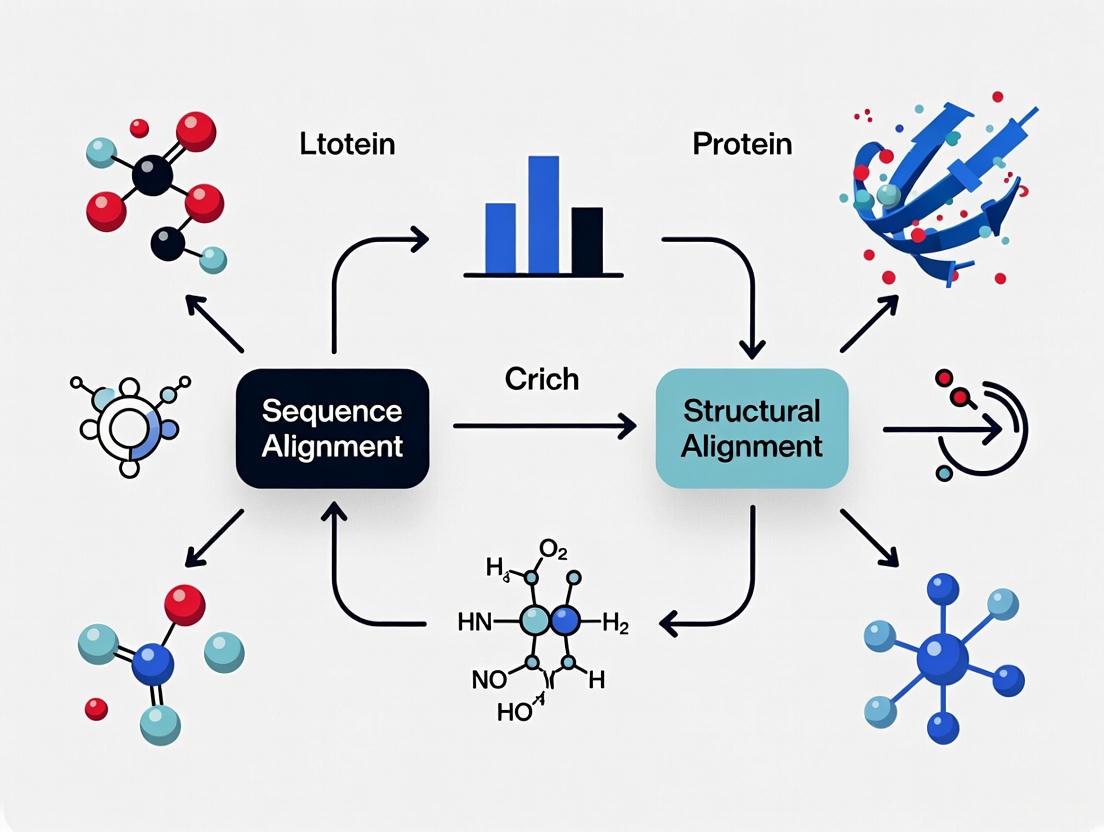
This article provides a comprehensive guide for researchers and drug development professionals on the complementary roles of structural and sequence alignment in protein analysis.
Protein Comparison in Biomedical Research: When to Use Structural Alignment vs. Sequence Alignment
Abstract
This article provides a comprehensive guide for researchers and drug development professionals on the complementary roles of structural and sequence alignment in protein analysis. We explore the fundamental principles, comparing how sequence alignment identifies evolutionary relationships through amino acid sequences, while structural alignment reveals functional similarities through three-dimensional shape, even when sequences diverge. The content details key methodologies, from established tools like DALI and CE for structure to PSI-BLAST and HHsearch for sequence profiles, and addresses critical challenges like the 'twilight zone' of low sequence identity and computational complexity. Through a comparative analysis of performance metrics and real-world applications in function annotation and drug design, we offer evidence-based guidance for selecting the optimal approach and leveraging emerging hybrid methods that integrate both techniques for superior results in biomedical research.
Core Principles of Protein Alignment: From Linear Sequences to 3D Structures
In the field of protein science, comparing proteins to uncover functional, evolutionary, and structural relationships is a fundamental task. This relies primarily on two methodological pillars: sequence alignment and structural alignment. While often used in tandem, they are based on different principles and are suited to answering distinct biological questions. This guide provides a objective comparison of these two approaches, framing them within the broader thesis of protein comparison research for scientists and drug development professionals.
Fundamental Principles and Methodologies
At their core, both methods aim to identify equivalent positions between two or more proteins, but they operate on fundamentally different types of data.
Sequence Alignment identifies similarities by arranging protein sequences (the linear chains of amino acids) to maximize residue matches, considering evolutionary substitutions and insertions/deletions (indels) [1]. It can be performed pairwise or with multiple sequences simultaneously (Multiple Sequence Alignment or MSA) [2]. The alignment is typically optimized using a substitution matrix (e.g., BLOSUM, PAM) that encodes the likelihood of one amino acid replacing another over evolutionary time, and algorithms like dynamic programming (e.g., Needleman-Wunsch for global, Smith-Waterman for local alignment) to find the optimal solution [1].
Structural Alignment, in contrast, is based on comparing the three-dimensional shapes of proteins [3]. It is invaluable when sequence similarity is low or undetectable, as structure is often more conserved than sequence over evolution [2] [3]. These methods use the 3D atomic coordinates, typically focusing on the backbone Cα atoms. Unlike sequence alignment, there is no single dominant algorithm. Well-known methods include DALI, which aligns distance matrices, and Mustang, Matt, and FATCAT, which can handle structural flexibility [2] [4] [5].
The following diagram illustrates the core decision-making workflow for choosing and applying these alignment methods in a research context.
Performance and Accuracy Comparison
The choice between sequence and structural alignment has profound implications for accuracy, especially in detecting distant evolutionary relationships and in template-based protein structure prediction.
A comprehensive benchmark study of 20 alignment methods on 538 non-redundant proteins provides clear quantitative data. The study evaluated the quality of protein structural models built from alignments using the TM-score, a metric where a score >0.5 indicates the same fold and a score <0.17 indicates random similarity [6]. The results demonstrate a dominant advantage for methods leveraging more complex information.
Table 1: Performance of Alignment Methods in Protein Fold Recognition [6]
| Alignment Approach | Representative Methods | Average TM-score* | Relative Advantage over Sequence-Sequence |
|---|---|---|---|
| Profile-Profile | HHsearch, HHsearch-II | 0.395 | +49.8% |
| Sequence-Profile | PSI-BLAST, MUSTER | 0.312 | +26.5% |
| Sequence-Sequence | BLAST, NW-align | 0.263 | Baseline |
Note: TM-scores are for models built from the highest-ranked template.
Furthermore, integrating predicted or native structural features (e.g., secondary structure) can improve the TM-score of profile-profile methods by 9.6% or 21.4%, respectively [6]. However, it is critical to note that even the best sequence-based alignments incorporating structural features had TM-scores 37.1% lower than those generated by a pure structural alignment method (TM-align), highlighting the inherent limitation of using sequence-based information alone for precise structural matching [6].
Experimental Protocols and Evaluation
To ensure reproducibility and rigorous assessment, researchers rely on standardized protocols and benchmarks.
Key Experimental Benchmarks Performance validation is conducted against databases of known, curated alignments.
- BAliBASE & HOMSTRAD: Provide reference alignments for protein families and are widely used for benchmarking MSA and structural alignment algorithms [2] [7].
- SABmark: Designed for testing alignment methods on distantly related proteins [7].
Common Evaluation Metrics The quality of an alignment is measured with several key metrics:
- TM-score (Template Modeling Score): Measures structural similarity; topology-dependent and more reliable than RMSD for global fold comparison [6].
- SP score (Sum-of-Pairs score): Used to compare a computed alignment to a reference alignment, ranging from 0 (non-identical) to 1 (identical) [5].
- TC (True Core): Measures the fraction of core alignment columns accurately reproduced in the reference alignment [2].
Detailed Protocol: Structural Alignment with Flexibility Methods like FATCAT and MATT explicitly account for protein flexibility, which is crucial for accurate alignment. A typical workflow involves [5]:
- Input Structures: Provide protein structures in PDB format.
- Initial Rigid Alignment: Generate an initial superposition of the two structures.
- Flexibility Introduction: Identify "pivot points" where the structures can be twisted to improve the alignment of subsequent domains or regions.
- Optimal Alignment Search: Iteratively refine the alignment by evaluating different combinations of rigid blocks and pivot points to maximize a similarity score (e.g., combining structural overlap and penalty for flexibility).
- Statistical Evaluation: Calculate a P-value or Z-score to assess the statistical significance of the alignment against a random background.
The Scientist's Toolkit
Successful protein comparison research requires a suite of computational tools and resources.
Table 2: Essential Research Reagents and Tools for Protein Alignment
| Category | Tool / Resource | Primary Function |
|---|---|---|
| Sequence Alignment | BLAST/PSI-BLAST | Fast sequence database search & profile creation [6]. |
| MUSCLE, MAFFT | Efficient and accurate Multiple Sequence Alignment (MSA) [7]. | |
| Structural Alignment | DALI | Pairwise structure alignment via distance matrix comparison [4] [5]. |
| Mustang, MATT | Multiple Structure Alignment (MStA) of several proteins [2]. | |
| FATCAT | Flexible structural alignment, accounts for hinges and twists [5]. | |
| Benchmarking | BAliBASE, HOMSTRAD | Gold-standard databases for validating alignment accuracy [2] [7]. |
| Unified Models | OneProt | A multi-modal foundation model that integrates sequence, structure, and binding site data in a shared latent space [8]. |
The dichotomy between sequence and structural alignment is a central theme in protein science. Sequence alignment is unparalleled for its speed, scalability, and direct inference of evolutionary relationships. However, structural alignment provides the ultimate validation of homology, especially when sequences have diverged beyond detection. It directly reveals conserved functional cores and active sites that sequence-based methods might miss [5].
The frontier of the field lies in the integration of these modalities. Unified frameworks that treat sequence and structure simultaneously show promise for more reliable alignments, particularly when pure structural methods might be misled by repetitive elements or symmetries [9]. Furthermore, the advent of multi-modal AI systems like OneProt, which align the latent spaces of sequence, structure, and other protein modalities, paves the way for a new generation of powerful, general-purpose protein analysis tools for applications in drug discovery and protein engineering [8].
In conclusion, sequence and structural alignments are complementary tools. The informed researcher must understand their strengths, limitations, and the contexts in which each excels to robustly answer the complex questions of modern molecular biology.
In protein science, sequence identity and structural similarity provide two complementary yet fundamentally different views of the relationship between proteins. Sequence identity, measured by the percentage of identical amino acids at aligned positions, has long served as the foundational metric for inferring homology and transferring functional annotations [10]. Structural similarity, which quantifies the three-dimensional shape resemblance between protein folds, often reveals conserved functional relationships even when sequence signals become undetectable [11] [12].
This divergence stems from the fundamental principle that while sequence dictates structure, and structure determines function, the mapping between sequence and structure is complex and degenerate. Proteins with sequences that have diverged beyond recognition can maintain remarkably similar folds and functions, while minimal sequence changes can sometimes lead to dramatic structural alterations [11] [12]. This guide provides an objective comparison of these two approaches, empowering researchers to select appropriate methodologies for protein comparison in biomedical research and drug discovery.
Quantitative Performance Comparison
Benchmarking Studies and Performance Metrics
Rigorous benchmarking studies demonstrate that the relative performance of sequence- and structure-based methods depends heavily on the evolutionary distance between compared proteins and the specific biological question. The table below summarizes key quantitative findings from comparative studies.
Table 1: Performance Comparison of Sequence vs. Structure-Based Methods
| Comparison Metric | Sequence-Based Methods | Structure-Based Methods | Experimental Context |
|---|---|---|---|
| Fold Recognition Accuracy | 49.8% lower TM-score than profile-profile methods [6] | 26.5% higher TM-score than sequence-profile methods [6] | Benchmark on 538 non-redundant proteins [6] |
| Paralog Function Prediction | Predictive of shared functionality [13] | Outperforms sequence identity for some tasks [13] | Evaluation on human and yeast paralogs [14] |
| Low-Sequence Identity Detection | Limited below 25-30% sequence identity [10] | Detects similarities below 25% sequence identity [12] | Function annotation of novel structures [10] |
| Antibody Clustering | Groups by CDRH3 identity and V/J gene usage [15] | Groups more antibodies despite low sequence identity [15] | Simulated repertoire sequencing data [15] |
When Structural Similarity Outperforms
Structural comparison methods demonstrate particular advantage in the "twilight zone" of sequence similarity (below 25% identity), where sequence-based methods often fail to detect homologous relationships [10] [12]. A comprehensive assessment of 20 alignment methods revealed that profile-profile based methods, which incorporate evolutionary information, generate models with an average TM-score 26.5% higher than sequence-profile methods and 49.8% higher than simple sequence-sequence alignment methods [6].
For predicting shared paralog functions, a 2025 study found that while sequence identity remains predictive, structural similarity metrics or protein language model embeddings outperform sequence identity for specific tasks [13] [14]. Importantly, these alternative similarity metrics are not redundant with sequence identity; combining them leads to improved predictions of shared functionality [14].
Experimental Protocols and Methodologies
Sequence-Based Identification Pipeline
Standard sequence-based identification follows established bioinformatics protocols utilizing tools like BLAST and MMseqs2:
Table 2: Core Components of Sequence Similarity Search
| Component | Description | Typical Parameters |
|---|---|---|
| Search Algorithm | BLAST, MMseqs2, or similar tools [16] | E-value cutoff (e.g., 0.1-0.001) [16] |
| Identity Cutoff | Percentage of identical residues in alignment [16] | 0-100% (often 30-90% based on purpose) [16] |
| Query Sequence | Protein sequence in FASTA format [16] | Minimum 25 residues for reliable search [16] |
| Database | Non-redundant protein sequences, PDB, UniProt [11] | Target database must be specified |
Workflow Protocol:
- Query Submission: Input a protein sequence in FASTA format or a PDB identifier with specific chain [16].
- Parameter Setting: Define sequence identity cutoff (0-100%) and E-value threshold (typically 0.1-0.001) [16].
- Database Search: Execute search against selected database using algorithms like MMseqs2.
- Result Filtering: Exclude matches with E-values above threshold and identity below cutoff.
- Alignment Analysis: Examine sequence identities, mismatches, insertions, and deletions [16].
Structural Comparison Pipeline
Structural comparison methodologies have evolved significantly with advances in structure prediction and alignment algorithms:
Table 3: Core Components of Structural Similarity Analysis
| Component | Description | Common Tools |
|---|---|---|
| Structure Prediction | Generating 3D models from sequence | AlphaFold2, ESMFold, ColabFold [11] [17] |
| Structural Alignment | Comparing 3D coordinates | Foldseek, TM-align, MulPBA [11] [18] |
| Similarity Metrics | Quantifying structural resemblance | TM-score, RMSD, GDT-TS [12] |
| Clustering | Grouping related structures | Leiden algorithm, hierarchical clustering [11] |
Workflow Protocol (based on ProteinCartography pipeline [11]):
- Input Structure: Provide a protein of interest as a PDB file or FASTA sequence.
- Structure-based Search: Perform Foldseek search against structure databases (AlphaFold/UniProt50, AlphaFold/Swiss-Prot) to identify structurally similar proteins [11].
- All-v-All Comparison: Compare structure of every protein to every other protein using
foldseek search[11]. - Similarity Scoring: Calculate TM-scores using
foldseek aln2tmscore(values range 0-1, where 1 indicates identical structures) [11]. - Clustering Analysis: Cluster proteins using algorithms like Leiden clustering based on the all-v-all similarity matrix [11].
- Dimensionality Reduction: Create navigable 2D/3D maps of protein space using techniques like UMAP or t-SNE for visualization [11].
The Scientist's Toolkit: Essential Research Reagents
Table 4: Key Resources for Protein Comparison Studies
| Resource | Type | Function | Access |
|---|---|---|---|
| AlphaFold Database [13] | Database | Repository of predicted protein structures | https://alphafold.ebi.ac.uk/ |
| Foldseek [11] | Software | Fast structural similarity search & alignment | https://foldseek.com/ |
| RCSB PDB [16] | Database | Experimental protein structures & search tools | https://www.rcsb.org/ |
| MMseqs2 [16] | Software | Sensitive sequence similarity searching | https://github.com/soedinglab/MMseqs2 |
| UniProt [11] | Database | Comprehensive protein sequence & functional information | https://www.uniprot.org/ |
| ProteinCartography [11] | Pipeline | Creates interactive maps of protein families | https://github.com/arcadia-science/ |
| PDB Protein Blocks [18] | Method Library | Library of local backbone conformations for structural alignment | Research tools |
Integrated Decision Framework
For comprehensive protein analysis, researchers should adopt a integrated approach that leverages both sequence and structural information:
The most powerful contemporary approaches combine both methodologies. As demonstrated in recent protein function prediction studies, integrating sequence identity with structural similarity and protein language model embeddings provides complementary information that significantly enhances predictions of shared paralog functionality beyond what either method can achieve alone [13] [14]. Tools like ProteinCartography exemplify this integration by beginning with sequence-based searches (BLAST), incorporating structure-based searches (Foldseek), and creating unified navigable maps that cluster proteins based on comprehensive similarity metrics [11].
This combined approach is particularly valuable for drug discovery applications, where understanding functional convergence despite sequence divergence can reveal new therapeutic targets and antibody candidates that might be missed by sequence-only methods [15].
Why Protein Structure is More Conserved Than Sequence in Evolution
Evolutionary Foundation and Core Principles
The observation that protein three-dimensional structure is more conserved than the primary amino acid sequence is a fundamental principle in molecular evolution. While sequences mutate and diverge over evolutionary time, the structural scaffolds and functional motifs of proteins demonstrate remarkable persistence. This conservation occurs because natural selection acts primarily on the function of proteins, which is dictated by their three-dimensional architecture rather than their linear sequence composition. Proteins with vastly different sequences can fold into remarkably similar structures and perform equivalent biological functions, illustrating that evolutionary constraints have limited the ability of proteins to become vastly different in their structural organization [19].
The underlying mechanism for this phenomenon stems from the degeneracy of the genetic code and the robustness of protein folds to amino acid substitutions. A protein's structure is determined by the physical and chemical properties of its amino acids and their interactions, not merely by their specific identity. Hydrophobic interactions, which drive the burial of non-polar residues in the protein core, and tertiary interactions, which stabilize the overall fold, can be maintained by a variety of amino acids with similar biochemical properties [20] [21]. Consequently, a protein fold can remain stable even as its sequence undergoes substantial change, provided that the key residues responsible for stabilizing the fold and function are preserved, or conservatively substituted [21] [19]. Research has shown that protein structures can be three to ten times more conserved than the amino acid sequence that encodes them [19].
Quantitative Comparison of Sequence and Structure Conservation
Performance Metrics for Alignment Methods
The divergence between sequence and structure conservation becomes particularly evident when comparing the performance of different alignment methodologies. The accuracy of protein structure prediction and homology detection is highly dependent on the type of alignment method used, with structure-based methods consistently outperforming sequence-based ones, especially for distantly related proteins.
Table 1: Comparative Performance of Alignment Methods in Fold Recognition
| Alignment Method Category | Average TM-score on Benchmark | Key Characteristics | Representative Tools |
|---|---|---|---|
| Sequence-Sequence | Lowest (Baseline) | Fast but limited sensitivity for distant homology. | BLAST, FASTA, Smith-Waterman [6] |
| Sequence-Profile | 26.5% higher than Sequence-Sequence | Uses evolutionary information from MSAs; moderate sensitivity. | PSI-BLAST [6] |
| Profile-Profile | 49.8% higher than Sequence-Sequence | Compares evolutionary profiles; high sensitivity for remote homology. | HHsearch [6] |
| Structure-Based | 37.1% higher than Profile-Profile | Directly uses 3D structural coordinates; highest accuracy. | TM-align, FATCAT, SARST2 [22] [23] [6] |
TM-score (Template Modeling Score) is a key metric for measuring structural similarity, ranging from 0 to 1, where a score >0.5 indicates generally the same fold, and a score <0.2 suggests unrelated structures [22]. The data clearly demonstrates a hierarchy of accuracy, with methods leveraging more complex evolutionary and structural information yielding superior results.
Empirical Evidence from Benchmarking Studies
Large-scale benchmarking studies provide concrete evidence for the superiority of structure-based comparisons. An assessment of 20 representative sequence alignment methods on 538 non-redundant proteins revealed that even the most advanced profile-profile methods produce models with TM-scores significantly lower than those from structural alignment programs like TM-align [6]. This performance gap is most pronounced for "Hard" targets with very distant evolutionary relationships, where sequence signals are often too weak to detect.
Furthermore, modern structural alignment tools have achieved remarkable speed and accuracy. For instance, SARST2, a high-throughput algorithm, recently demonstrated an information retrieval accuracy of 96.3% when identifying family-level homologs in the SCOP database, outperforming other state-of-the-art methods like FAST (95.3%), TM-align (94.1%), and Foldseek (95.9%) [23]. This highlights that structural alignment is not only more accurate but can also be implemented efficiently enough to search massive databases containing hundreds of millions of predicted structures.
Experimental Approaches and Methodologies
Protocols for Studying Conservation
Investigating the relationship between sequence and structure conservation relies on specific experimental and computational workflows. The following protocols outline key methodologies cited in the literature.
Protocol 1: Multiple Structure Alignment and Sequence Profile Analysis This procedure, used to identify conserved residues critical for fold stability, involves [20]:
- Protein Set Selection: A non-redundant set of protein structures sharing a common fold is assembled. The structural similarity is quantitatively defined using a metric like the Protein Structural Distance (PSD).
- Multiple Structure Alignment: A structure alignment algorithm (e.g., FATCAT, CE) is used to superimpose the 3D coordinates of the selected proteins optimally.
- Structure-Based Sequence Profile Generation: The multiple structure alignment is used to create a structure-guided sequence alignment. From this, a sequence profile is built, highlighting positions where amino acids are conserved.
- Analysis of Conserved Residues: The locations and chemical properties of the conserved residues are analyzed. Studies show the most conserved residues are typically involved in core tertiary interactions and are located in structurally conserved regions, rather than being distributed randomly [20].
Protocol 2: Assessing Structural Conservation in Non-Homologous Proteins This protocol is designed to identify and analyze structural motifs shared by proteins with no detectable sequence homology [19]:
- Structure Database Search: A tool like the Vector Alignment Search Tool (VAST), which uses geometric criteria, is employed to search the PDB for proteins with similar 3D structures to a query.
- Structure Alignment and Metric Calculation: The identified structures are superposed using software like PyMOL. The Root Mean Square Deviation (RMSD) of the atomic positions is calculated to quantify structural similarity. The amino acid sequence identity is also calculated from the structural alignment.
- Identification of Dissimilar Sequences/Similar Structures: Protein pairs are identified that have a low sequence identity (e.g., <25%) but also a low RMSD (e.g., <3.5 Å), indicating high structural conservation despite sequence divergence. Examples include the globin fold found in oxygen-transport proteins and light-absorbing pigments [19].
The following diagram illustrates the logical decision process and key metrics used in Protocol 2 for identifying structural conservation in the absence of sequence homology.
Table 2: Essential Resources for Protein Structure and Sequence Analysis
| Resource Name | Type | Primary Function in Research |
|---|---|---|
| Protein Data Bank (PDB) | Database | Central repository for experimentally determined 3D structures of proteins and nucleic acids [22]. |
| AlphaFold Database | Database | Resource of protein structure predictions for a vast range of organisms, expanding the structural universe [24] [23]. |
| DALI | Software | Algorithm for pairwise structure comparison; a pioneering tool for structural alignment [25] [23]. |
| TM-align | Software | Algorithm for fast protein structure comparison based on TM-score, sensitive to global topology [22] [23]. |
| FATCAT (jFATCAT) | Software | Flexible structure alignment algorithm that accounts for conformational changes and circular permutations [22]. |
| SARST2 | Software | High-throughput structural alignment search algorithm for massive databases, combining speed and accuracy [23]. |
| PSI-BLAST | Software | Sequence-profile search tool used to create position-specific scoring matrices (PSSMs) from MSAs [6]. |
| HHsearch | Software | Profile-profile alignment method using hidden Markov models (HMMs) for sensitive homology detection [6]. |
| PyMOL | Software | Molecular visualization system for rendering and analyzing 3D molecular structures [19]. |
| CLUSTAL Omega | Software | Tool for performing multiple sequence alignments, used to visualize sequence conservation [26] [21]. |
Implications for Biological Research and Drug Development
The greater conservation of structure over sequence has profound implications for fundamental research and applied biotechnology. In evolutionary biology and phylogenetics, it allows researchers to uncover deep evolutionary relationships between proteins that are obscured at the sequence level, enabling the construction of more accurate phylogenetic trees [21] [19]. For functional annotation, identifying a conserved structural fold in a protein of unknown function can provide the first, and often most reliable, clue about its biological role, as structure is a direct reflection of function [21].
In the field of drug development, this principle is critically important. Many successful drugs target conserved functional sites on proteins, such as active sites of enzymes or binding pockets of receptors. These sites are often structurally conserved even across different protein families. Understanding the conserved structural architecture of a target protein family, such as G-protein coupled receptors (GPCRs) or kinases, allows for the rational design of broad-spectrum inhibitors or drugs with higher specificity, reducing off-target effects [23]. Furthermore, the rise of efficient structure alignment tools like SARST2 enables high-throughput virtual screening against massive structural databases, dramatically accelerating the early stages of drug discovery by identifying novel drug targets and potential lead compounds [23].
In the field of comparative protein analysis, sequence alignment and structural alignment offer complementary perspectives for uncovering evolutionary relationships and functional annotations. While sequence-based methods compare the linear order of amino acids, structural alignment focuses on the three-dimensional spatial arrangement of atoms, capturing conserved architectural features that often persist long after sequence similarity has faded into the "twilight zone" of detection [27] [28]. This divergence in fundamental approach leads to significant differences in what each method can reveal about protein function and evolutionary history. Proteins with low sequence identity can share remarkable structural similarity, reflecting distant evolutionary relationships undetectable by sequence alone [27] [29]. Conversely, sequence alignment remains indispensable for identifying conserved functional residues and analyzing evolutionary rates across protein families [30] [31]. This guide provides an objective comparison of these methodologies, their performance characteristics, and their respective capacities for biological insight, with particular relevance for researchers in molecular biology and drug development.
Core Methodology Comparison
Fundamental Principles and Technical Approaches
Sequence alignment operates on the primary principle of comparing linear amino acid sequences using substitution matrices and gap penalties to maximize identity or similarity. Advanced methods employ position-specific scoring matrices (PSSM) from tools like PSI-BLAST or hidden Markov models (HMMs) to detect distant homologs by leveraging evolutionary information from multiple sequence alignments [31]. The alignment process can be global (Needleman-Wunsch) or local (Smith-Waterman), with modern implementations focusing on progressive alignment strategies that build multiple alignments following phylogenetic guide trees [32].
Structural alignment compares the three-dimensional coordinates of protein structures, typically focusing on Cα atoms. The core algorithms include rigid-body superposition (Kabsch algorithm), distance matrix approaches (DALI), combinatorial extension (CE), and flexible alignment methods (FATCAT) that account for conformational changes through introduced twists [27] [28]. These methods fundamentally seek to maximize the number of equivalent residues while minimizing the root-mean-square deviation (RMSD) between superimposed atomic positions.
Quantitative Performance Metrics
The quality of structural alignments is typically assessed using three principal metrics: Root Mean Square Deviation (RMSD), which measures the average distance between superimposed atoms; Template Modeling Score (TM-score), a length-independent measure that ranges from 0 to 1 (with values >0.5 indicating the same fold); and Global Distance Test Total Score (GDT_TS), which calculates the average percentage of residues superimposed under multiple distance thresholds [27]. For sequence alignments, accuracy is typically measured against reference alignments from databases like BAliBASE using the sum-of-pairs score (SPS) or developer score, which quantify the agreement with curated reference alignments [32].
Table 1: Key Performance Metrics for Structural and Sequence Alignment Methods
| Method Category | Primary Metric | Typical Range | Interpretation |
|---|---|---|---|
| Structural Alignment | RMSD | 0Å → ∞ | Lower values indicate better structural similarity |
| TM-score | 0-1 | >0.5: same fold; <0.2: random similarity | |
| GDT_TS | 0-100% | Higher percentages indicate better global similarity | |
| Sequence Alignment | Sum-of-Pairs Score | 0-1 | Higher values indicate better agreement with reference |
| Sequence Identity | 0-100% | >25%: typically homologous; <20%: twilight zone | |
| E-value | 0 → ∞ | Lower values indicate more significant matches |
Biological Insights: Functional and Evolutionary Revelations
Detection of Evolutionary Relationships
Structural alignment excels at identifying deep evolutionary relationships that persist when sequence similarity falls below 20-25% identity—the so-called "twilight zone" where sequence-based methods struggle [27] [28]. Structural comparisons can reveal common ancestral folds even when proteins have undergone circular permutations, domain shuffling, or extensive insertions and deletions [28]. The conservation of structural cores, particularly hydrophobic residues essential for folding stability, often provides the only detectable evidence of common ancestry in extremely divergent proteins [28].
Sequence alignment provides superior resolution for recent evolutionary events and detailed phylogenetic analysis. Through methods like Mean Protein Evolutionary Distance (MeaPED), researchers can quantify differential evolutionary pressures across viral proteomes, identifying "hot-spot" proteins with high evolutionary rates (e.g., influenza hemagglutinin) and "cold-spot" proteins with strong purifying selection (e.g., RNA-directed RNA polymerase) [30]. Sequence-based phylogenetic reconstruction enables precise tracing of evolutionary pathways and divergence times, particularly for closely related proteins where structural comparisons would lack discriminatory power.
Functional Annotation and Prediction
Structural alignment enables function prediction through structural motifs and active site identification, even without sequence similarity. The spatial arrangement of residues in three dimensions often reveals conserved functional mechanisms that are undetectable at the sequence level [27]. Structural comparisons can identify catalytic triads, binding pockets, and allosteric sites through spatial conservation patterns, making them particularly valuable for annotating proteins of unknown function [27] [28]. This approach has proven especially powerful for identifying distant relationships in enzyme families where the structural scaffold supporting the active site remains conserved despite extensive sequence divergence.
Sequence alignment enables domain architecture analysis and conserved motif identification through multiple sequence alignments of protein families. The identification of specificity-determining positions (SDPs) through sequence analysis helps elucidate functional specificities within protein subfamilies [32]. Sequence methods also excel at identifying linear binding motifs, signal peptides, and post-translational modification sites that may not manifest obvious structural signatures [32]. For drug development, sequence-based approaches can identify functionally important residues through conservation patterns across entire protein families.
Table 2: Functional and Evolutionary Insights Revealed by Each Method
| Biological Insight | Structural Alignment Strength | Sequence Alignment Strength |
|---|---|---|
| Distant Homology Detection | Excellent for folds conserved despite low sequence identity | Limited to "twilight zone" (>20% identity) |
| Active Site Identification | Through 3D spatial conservation patterns | Through linear conserved motifs |
| Evolutionary Rate Analysis | Limited to major structural changes | Precise quantification using methods like MeaPED |
| Domain Architecture | Through 3D spatial arrangement | Through linear sequence analysis |
| Functional Specificity | Limited to structural determinants | Excellent for specificity-determining positions |
| Binding Site Prediction | Excellent through pocket geometry | Limited to sequence motifs |
Experimental Data and Benchmarking
Performance on Standardized Datasets
Comprehensive benchmarking studies reveal distinct performance characteristics for structural and sequence alignment methods. In assessments using the ASTRAL40 dataset (remote homologs with <40% sequence identity from SCOP), structural alignment methods like CE and DALI show high correlation in identifying equivalent residues, with alignments agreeing on more than half of aligned positions on average [28]. The number of equivalent residues identified by CE and DALI is highly correlated (Pearson correlation coefficient of 0.97), though RMSD values show more variation [28].
For sequence-based methods, large-scale benchmarking on 538 non-redundant proteins demonstrates that profile-profile alignment methods generate models with average TM-scores 26.5% higher than sequence-profile methods and 49.8% higher than sequence-sequence alignment methods [31]. The advantage of profile-based methods becomes increasingly pronounced as sequence identity decreases, with no obvious performance difference between PSSM-based and HMM-based profiles [31].
Performance in Challenging Cases
The performance gap between methodologies widens significantly for particularly challenging alignment scenarios. In the RIPC dataset (protein pairs requiring large indels, containing circular permutations, repetitions, or conformational variability), structural alignment methods produce considerably different alignments that match reference alignments less successfully compared to easier cases [28]. This highlights the ongoing challenges in aligning proteins with substantial structural flexibility or unusual evolutionary relationships.
For RNA alignment, benchmark studies using BRAliBase reveal that sequence identity directly impacts performance, with most sequence alignment programs producing high-quality alignments down to approximately 55% average pairwise sequence identity (APSI), below which structural alignment methods become necessary [33]. Performance drops dramatically in the "twilight zone" for RNA (starting at 60% APSI, compared to 20% for proteins), reflecting the additional constraints of structural conservation in functional RNAs [33].
Table 3: Benchmark Performance Across Method Types and Difficulty Levels
| Method Category | Specific Methods | Easy Targets (High Identity) | Hard Targets (Low Identity) |
|---|---|---|---|
| Sequence-Sequence | BLAST, FASTA | Excellent performance | Poor performance (<20% identity) |
| Sequence-Profile | PSI-BLAST | Very good performance | Moderate performance |
| Profile-Profile | HHsearch, PRC | Excellent performance | Good performance |
| Rigid Structural | DALI, CE | Excellent performance | Good performance |
| Flexible Structural | FATCAT | Excellent performance | Very good performance |
Key Databases and Software Tools
Table 4: Essential Research Reagents and Resources for Protein Comparison
| Resource Name | Type | Function/Purpose |
|---|---|---|
| PDB (Protein Data Bank) | Database | Repository of experimentally determined 3D structures |
| SCOP/CATH | Database | Hierarchical classification of protein domains |
| FSSP | Database | Families of Structurally Similar Proteins based on DALI |
| BAliBASE | Database | Benchmark alignment database for method evaluation |
| DALI | Software | Distance matrix alignment for structural comparison |
| FATCAT | Software | Flexible structural alignment allowing twists |
| TM-align | Software | Sequence-order independent structural alignment |
| CE | Software | Combinatorial Extension algorithm for structural alignment |
| PSI-BLAST | Software | Position-Specific Iterated BLAST for profile creation |
| HHsearch | Software | HMM-HMM comparison for remote homology detection |
| RCSB Comparison Tool | Web Service | Integrated platform for sequence and structure alignment |
Standard Experimental Workflows
The standard workflow for sequence-based evolutionary analysis typically begins with database search using BLAST or similar tools, followed by multiple sequence alignment construction, phylogenetic tree building, and evolutionary rate calculation using methods like MeaPED or dN/dS ratios [30] [32]. For structure-based function annotation, the process involves structural alignment to known folds, identification of conserved structural motifs, analysis of binding site geometry, and inference of molecular function through structural similarity [27] [28].
Diagram 1: Structural Analysis Workflow for Function Prediction
Diagram 2: Sequence Analysis Workflow for Evolutionary Studies
Integrated Approaches and Future Perspectives
The most powerful contemporary approaches integrate both sequence and structural alignment methodologies to leverage their complementary strengths. Structure-guided sequence alignment improves accuracy for distantly related proteins by using structurally conserved regions to anchor sequence alignments [27]. Similarly, the combination of sequence profiles with predicted structural features (secondary structure, solvent accessibility) significantly enhances remote homology detection [31].
Emerging methods like GRAFENE represent the next generation of integrated approaches, using graphlet-based alignment-free networks to combine 3D structural data with sequence residue order information [29]. Similarly, energy profile comparison approaches leverage knowledge-based potentials to assign energetic feature vectors to proteins, enabling rapid comparison based on structural stability patterns derived from either sequence or structure [34]. These methods demonstrate that the integration of complementary information types substantially improves both the accuracy and efficiency of protein comparison.
For drug development professionals, these integrated approaches are particularly valuable for identifying functional sites and assessing binding pocket conservation across protein families. Structural alignment reveals conserved geometry of potential drug binding sites, while sequence analysis identifies functionally critical residues and assesses conservation across orthologs and paralogs—critical information for evaluating potential side effects and species specificity in preclinical development.
Both structural and sequence alignment methods provide unique yet complementary biological insights. Structural alignment reveals deep evolutionary relationships through conserved architectural principles and enables function prediction through spatial conservation patterns. Sequence alignment provides superior resolution for recent evolutionary events, functional specificities, and phylogenetic analysis. The integration of both approaches, augmented by emerging methodologies like energy profile comparison and graphlet-based network analysis, represents the most promising path forward for comprehensive protein function and evolution analysis. For researchers in drug development, understanding the strengths and limitations of each method is crucial for effective target assessment, binding site identification, and evaluation of conservation across species.
In the fields of structural biology and bioinformatics, comparing proteins is fundamental to understanding their function, evolution, and potential as drug targets. Two primary philosophical approaches underpin this analysis: sequence alignment and structural alignment. Sequence alignment identifies similarities in the linear arrangement of amino acids, operating on the principle that sequence defines structure. Structural alignment compares the three-dimensional shapes of proteins, based on the paradigm that structure defines function. Each approach relies on distinct metrics for quantification: E-value and Sequence Identity for sequence analysis, and RMSD and TM-score for structural comparison. This guide provides an objective comparison of these four key terminologies, detailing their methodologies, interpretations, and applications in protein research.
Metric Definitions and Comparative Analysis
The following table summarizes the core characteristics, interpretation, and primary applications of RMSD, TM-score, E-value, and Sequence Identity.
| Metric | Full Name | Type of Alignment | Core Principle | Value Range & Interpretation | Primary Application |
|---|---|---|---|---|---|
| RMSD [12] | Root-Mean-Square Deviation | Structural | Average distance between equivalent atoms after superposition. | 0 Å: Perfect match.<2 Å: High similarity.>3-4 Å: Notable differences. [12] | Quantifying local, atom-level accuracy in structural superimposition. Sensitive to local errors. |
| TM-score [35] [12] | Template Modeling Score | Structural | Normalized, length-independent score measuring global fold similarity. | (0, 1]~1: Perfect match.>0.5: Same fold.<0.17: Random, unrelated proteins. [35] [36] [12] | Assessing global, topological similarity. Robust to local structural variations. |
| E-value [1] [37] | Expectation Value | Sequence | Number of matches with a similar score expected by chance in a database search. | ~0: Highly significant.<0.001: Significant.> 0.001: Potentially non-significant. | Assessing statistical significance in database searches (e.g., BLAST). |
| Sequence Identity [1] | Sequence Identity | Sequence | Percentage of identical residues in the aligned sequence regions. | 0-100%>25%: Often indicates homology.<25%: "Twilight zone" of remote homology. [12] | Inferring evolutionary relationships and homology at the sequence level. |
A critical insight from comparative analyses is that Sequence Identity and structural similarity can be decoupled. Proteins with sequence identity below 25% can still share highly similar three-dimensional folds, a phenomenon often observed in remote homologs [12]. This underscores the necessity of structural comparison metrics for a complete understanding of protein relationships, especially in the "twilight zone" of sequence similarity.
Experimental Protocols for Benchmarking
To objectively evaluate the performance of alignment methods and their associated metrics, the scientific community relies on standardized benchmark studies. The following workflow outlines a typical protocol for comparing sequence and structural alignment methods.
Detailed Protocol Steps
Select Benchmark Datasets: Curated datasets with known "ground truth" alignments or classifications are essential.
- For Sequence Alignment: The BAliBASE dataset is widely used, providing reference alignments based on 3D structural superpositions and manual refinement [37].
- For Structural Alignment: Datasets derived from structural classifications like SCOP (Structural Classification of Proteins) or CATH are common. For instance, a benchmark might use a set of protein pairs from the same SCOP superfamily but different families to test remote homology detection [28] [12].
Generate Alignments: The selected dataset is analyzed using various alignment tools.
Calculate Metrics: For each alignment produced, the relevant metrics are computed.
- For structural alignments, both RMSD and TM-score are calculated from the same superposition to compare their utility [28].
- For sequence alignments from a database search, E-value and Sequence Identity are recorded for each hit.
Validate Against Ground Truth: The accuracy of the alignments is assessed by comparing them to the reference data.
- One method is to calculate the extent of agreement with a manually curated reference alignment, often reporting the fraction of correctly aligned residues [28].
- Another approach, used in clustering studies, is to use cluster validity criteria to measure how well the alignment-based groupings match the known biological classifications (e.g., SCOP families) [37].
Analyze Performance: The final step involves synthesizing the results. A key finding from such benchmarks is that while sequence-based methods are extremely fast, structure-based methods can identify homologous relationships that sequence-based methods miss in the "twilight zone" of low sequence identity [12]. Furthermore, among structural metrics, TM-score is often favored over RMSD for assessing global fold similarity because it is less sensitive to local variations and is normalized for protein length [35] [28].
Interplay of Alignment Metrics
In practice, these metrics are not used in isolation. The following diagram illustrates how RMSD, TM-score, E-value, and Sequence Identity can be integrated into a research workflow to provide a multi-faceted assessment of protein similarity.
To implement the experimental protocols and utilize these metrics, researchers rely on a suite of software tools and databases. The following table lists key resources.
| Tool / Database | Type | Primary Function | Key Metric(s) Reported |
|---|---|---|---|
| BLAST [1] [37] | Software Suite | Fast sequence similarity search and alignment. | E-value, Sequence Identity |
| TM-align [38] | Software Algorithm | Rapid protein structure alignment. | TM-score, RMSD |
| US-align [39] | Software Algorithm | Universal structure alignment of proteins, RNAs, and DNAs. | TM-score |
| DALI [28] | Software Algorithm & Database | Pairwise structure comparison and database search. | Z-score (structural similarity) |
| CE (Combinatorial Extension) [28] | Software Algorithm | Pairwise protein structure alignment. | RMSD, Alignment Length |
| BAliBASE [37] | Benchmark Dataset | Reference dataset for evaluating sequence alignment methods. | N/A (Reference Standard) |
| SCOP [28] [12] | Database | Manual classification of protein structural relationships. | N/A (Classification System) |
The choice between sequence-based and structure-based alignment, and their associated metrics, is dictated by the biological question. For rapid database screening and analyzing close homologs, E-value and Sequence Identity are indispensable. However, for confirming fold similarity, analyzing remote evolutionary relationships, or assessing protein models where global topology is key, TM-score provides a robust, length-independent measure that surpasses RMSD's sensitivity to local deviations. A comprehensive protein comparison strategy often leverages the speed of sequence-based metrics to triage results, followed by the deep, topological insights provided by structural alignment and metrics like TM-score to draw biologically meaningful conclusions.
A Practical Guide to Alignment Tools and Their Real-World Applications
In the field of structural biology, comparing protein three-dimensional structures is fundamental for establishing evolutionary relationships, annotating function, and understanding functional mechanisms. While sequence-based alignment methods are invaluable, they suffer from a critical limitation: protein sequence evolves and diverges much faster than protein structure. Consequently, structural alignment methods become essential tools for detecting similarities between proteins when their sequences have diverged beyond recognition by standard sequence alignment techniques [28] [40]. These methods establish residue-residue correspondences based on the optimal superposition of three-dimensional shapes and conformations, requiring no prior knowledge of equivalent residues and largely ignoring amino acid type [22]. This guide provides a comprehensive comparison of four leading structural alignment algorithms—DALI, CE, FATCAT, and TM-align—focusing on their algorithmic approaches, performance characteristics, and optimal applications within biomedical research and drug development.
Algorithmic Approaches and Methodologies
Core Principles and Alignment Strategies
Each major structural alignment algorithm employs a distinct strategy for identifying structurally equivalent regions between proteins.
DALI (Distance Matrix Alignment) uses an exhaustive all-against-all comparison of protein structures in the Protein Data Bank (PDB). Its method involves breaking protein structures into short peptide fragments and building a distance matrix for each structure based on the intramolecular distances between Cα atoms. DALI then searches for similar contact patterns between pairs of fragments from the two proteins being compared, combining these matches into a final alignment [28] [41].
CE (Combinatorial Extension) operates by identifying segments of two structures with similar local structures, then combinatorially combining these regions to align the maximum number of residues while minimizing the root mean square deviation (RMSD). The algorithm uses a rigid-body approach, keeping relative orientations of atoms fixed during superposition and assuming aligned residues occur in the same order in both proteins [22].
FATCAT (Flexible structure AlignmenT by Chaining Aligned fragment pairs allowing Twists) introduces a groundbreaking approach by accommodating protein flexibility during alignment. It builds alignments by chaining aligned fragment pairs (AFPs) together, allowing for twists between rigid domains. This innovative strategy permits independent alignment of different protein regions, making it particularly valuable for comparing structures that undergo conformational changes [42] [22].
TM-align utilizes a heuristic dynamic programming iteration approach optimized through a TM-score rotation matrix. This algorithm is specifically designed for sensitivity to global topology rather than local geometry. It performs sequence-independent residue-to-residue alignments, making it exceptionally fast compared to other methods—approximately four times faster than CE and 20 times faster than DALI according to published benchmarks [38] [43].
Visualization of Algorithmic Relationships and Workflows
The following diagram summarizes the core methodological relationships and workflows among the four structural alignment algorithms:
Performance Comparison and Experimental Assessment
Quantitative Benchmarking Across Protein Classes
Rigorous benchmarking of structural alignment algorithms typically employs datasets categorized by difficulty, often derived from curated resources like SCOP, ASTRAL, SISYPHUS, and HOMSTRAD [28] [40]. Performance is evaluated using multiple metrics, including RMSD, number of equivalent residues, alignment coverage, and TM-score, which normalizes for protein size and provides a more reliable measure of global similarity [43] [22].
Table 1: Performance Comparison Across Different Difficulty Categories
| Algorithm | Easy Targets (High Seq Identity) | Medium Targets (Remote Homology) | Hard Targets (Circular Permutations/Repetitions) | Reference |
|---|---|---|---|---|
| DALI | High agreement with reference alignments | Correlated with CE (Spearman: 0.96 EQR) | Lower agreement with reference alignments | [28] |
| CE | High agreement with reference alignments | Correlated with DALI (Spearman: 0.96 EQR) | Agreement decreases for challenging pairs | [28] |
| FATCAT | Comparable to CE performance | Effective for beta-rich proteins | Handles flexibility; better with TOPS++ extension | [42] [22] |
| TM-align | Higher accuracy and coverage | Fast, topology-sensitive | Detects global fold similarity despite local variations | [38] |
EQR: Equivalent Residues
Key Performance Metrics and Statistical Correlations
Analysis of 355 pairs of remote homologous proteins from the ASTRAL40 set revealed that CE and DALI show strong correlation in identifying structurally similar regions. The number of equivalent residues (EQR) between these methods demonstrated a Pearson correlation coefficient of 0.97 and Spearman correlation coefficient of 0.96, indicating remarkable consistency in detecting the extent of structural similarity. However, RMSD values normalized for 100 residues (RMSD100) showed lower correlation (Pearson: 0.72, Spearman: 0.86), suggesting greater variability in assessing the geometric quality of alignments [28].
Table 2: Statistical Correlation Between CE and DALI on ASTRAL40 Set
| Structural Similarity Metric | Pearson Correlation Coefficient | Spearman Correlation Coefficient | Interpretation |
|---|---|---|---|
| Equivalent Residues (EQR) | 0.97 | 0.96 | Very high agreement on alignment length |
| RMSD100 | 0.72 | 0.86 | Moderate agreement on structural quality |
When applied to more challenging datasets containing proteins with repetitions, indels, permutations, and conformational variability (RIPC set), all methods showed decreased performance, though structure-based methods consistently outperformed sequence-based approaches, particularly at low sequence identity levels [28] [40].
Experimental Protocols for Method Evaluation
Standardized Benchmarking Workflow
To ensure reproducible evaluation of structural alignment algorithms, researchers should follow a standardized experimental protocol:
Dataset Preparation: Curate benchmark sets from reliable databases such as:
Structure Preprocessing:
- Extract protein chains and remove ligands, ions, and water molecules
- Ensure all structures contain complete Cα atom coordinates
- For flexibility analysis, identify conformational variants of the same protein
Alignment Execution:
- Run each algorithm with default parameters for fair comparison
- For flexible methods like FATCAT, compare both rigid and flexible modes
- For TM-align, utilize both global and local alignment options
Result Analysis:
- Compute standard metrics: RMSD, TM-score, sequence identity, number of equivalent residues
- Compare to reference structural alignments where available
- Statistically analyze correlation between different methods
Assessment of Alignment Accuracy
The accuracy of structure-based alignments is typically assessed by comparison to manually curated reference alignments from databases like SISYPHUS and HOMSTRAD [28] [40]. Performance is measured by the extent to which computational alignments match the reference in identifying equivalent residues. Studies have demonstrated that structure-based methods consistently produce more reliable alignments than sequence-based methods, with the advantage becoming particularly pronounced at sequence identities below 20-30% [40]. For residues in regular secondary structures or buried in the protein core, structure-based methods show even greater superiority, as these regions maintain structural integrity even when sequences have diverged significantly.
Key Databases and Software Tools
Table 3: Essential Resources for Structural Alignment Research
| Resource Name | Type | Function | Access |
|---|---|---|---|
| Protein Data Bank (PDB) | Database | Repository for experimental protein structures | https://www.rcsb.org/ |
| Dali Server | Web Server | Pairwise and multiple structure comparisons using DALI | http://ekhidna2.biocenter.helsinki.fi/dali/ |
| FATCAT Server | Web Server | Flexible structure alignment with rigid and twist-enabled modes | http://fatcat.burnham.org/ |
| TM-align | Standalone Tool | Fast topology-based structure alignment | https://zhanggroup.org/TM-align/ |
| CE-MC Server | Web Server | Multiple structure alignment using CE algorithm | http://cemc.sdsc.edu |
| RCSB Pairwise Alignment | Web Tool | Multiple algorithm comparison interface | https://www.rcsb.org/docs/tools/pairwise-structure-alignment |
| HOMSTRAD | Database | Curated structure-based alignments for homologous families | http://www.homstrad.org/ |
| SISYPHUS | Database | Manually curated alignments with complex relationships | [28] |
Implementation and Accessibility
Most leading structural alignment algorithms are accessible through multiple interfaces. DALI offers a web server for database searches and pairwise comparisons, with the entire PDB pre-computed for similarity searches [41]. The FATCAT algorithm is implemented in the RCSB PDB's pairwise structure alignment tool as both jFATCAT-rigid and jFATCAT-flexible, providing user-friendly access to both modes [22]. TM-align is available as downloadable standalone software in both C++ and Fortran implementations, facilitating integration into high-throughput structural bioinformatics pipelines [43]. CE is accessible through web servers including the CE-MC multiple structure alignment server and the RCSB PDB interface [44] [22].
Application Guidelines for Research and Development
Algorithm Selection Based on Research Objectives
Choosing the appropriate structural alignment algorithm depends heavily on the specific research question and protein systems under investigation:
For Detecting Remote Homology and Evolutionary Relationships: DALI and CE provide robust performance for identifying evolutionarily related proteins through their focus on structural conservation patterns [28].
For Analyzing Proteins with Conformational Flexibility: FATCAT is uniquely suited for comparing structures that undergo domain movements, hinge bending, or other structural rearrangements, as it explicitly accommodates flexibility through introduced twists [42] [22].
For Fold Recognition and Structural Classification: TM-align excels at detecting global topological similarity, making it ideal for categorizing proteins into fold classes and for rapid database searches [38] [43].
For Handling Topological Variations: CE-CP (Combinatorial Extension with Circular Permutations) specifically addresses proteins related by circular permutations or different connectivity patterns [22].
Interpretation of Key Metrics and Scores
Proper interpretation of alignment metrics is crucial for drawing biologically meaningful conclusions:
TM-score: Values range between 0 and 1, where scores <0.2 indicate randomly unrelated proteins, and scores >0.5 generally assume the same fold in SCOP/CATH classification systems [43] [22].
RMSD: Lower values indicate better geometric superposition, but RMSD is highly sensitive to alignment length and should always be interpreted in conjunction with the number of aligned residues.
Equivalent Residues: Represents the size of the structurally conserved core, with larger values indicating more extensive structural similarity.
Sequence Identity: Provides context for the evolutionary distance between proteins, with structural alignment often revealing relationships even when sequence identity falls below 10%.
Structural alignment algorithms have revolutionized our ability to detect deep evolutionary relationships and functional similarities that remain invisible to sequence-based methods. As structural biology continues to generate experimental data at an accelerating pace, these computational tools will play an increasingly vital role in unlocking the functional secrets encoded in protein three-dimensional structures.
The fundamental challenge in protein bioinformatics is detecting evolutionary and functional relationships when sequence similarity becomes minimal. Traditional sequence-based methods like BLAST, while revolutionary, quickly lose sensitivity as evolutionary distance increases. The field has progressively addressed this limitation through an evolutionary trajectory of methodologies: from sequence-sequence comparisons (BLAST), to profile-sequence methods (PSI-BLAST), to profile-profile alignment tools (COMPASS), and ultimately to HMM-HMM comparisons (HHsearch). This guide objectively compares these advanced sequence-based methods, framing their development and performance within the broader context of structural versus sequence alignment for protein comparison research. Understanding this hierarchy is crucial for researchers and drug development professionals to select the optimal tool for detecting remote homologies, which is often a critical step in functional annotation and target identification.
The transition between these methodological classes represents a continuous effort to extract more signal from diminishing sequence similarity. Profile-based methods leverage the evolutionary information contained in multiple sequence alignments (MSAs) of protein families, which describe the conservation of amino acids across homologs [45]. The core innovation lies in moving beyond comparing single sequences to comparing the consensus and variation patterns of entire protein families. This guide provides a comprehensive comparison of these methods, detailing their experimental protocols, performance metrics, and practical applications in modern bioinformatics pipelines.
Methodological Foundations and Evolutionary Trajectory
From Sequence-Search to Profile-Based Comparisons
The earliest methods for protein comparison performed simple sequence-sequence alignment using tools like BLAST or FASTA [45]. These methods are effective for detecting clear homologs but fail when sequences diverge beyond a certain threshold. A significant advance came with profile-sequence methods like PSI-BLAST (Position-Specific Iterated BLAST), which iteratively builds a position-specific scoring matrix (PSSM) from a multiple sequence alignment of significant hits and uses this profile to search the database again, detecting more distant relatives [45] [46].
A more sensitive approach involves profile-profile comparison, which directly measures the similarity between two MSAs. Early tools in this category included COMPASS and PROF-SIM [45] [47]. COMPASS, for instance, derives numerical profiles from alignments, constructs optimal local profile-profile alignments, and analytically estimates E-values for the detected similarities [47] [48]. Its scoring system and E-value calculation are based on a generalization of the PSI-BLAST approach adapted for the profile-profile case [47].
The HMM-HMM Revolution: HHsearch
The most sophisticated evolution in this trajectory is HMM-HMM alignment, exemplified by HHsearch [45]. Instead of using simple profiles, HHsearch represents each protein family as a Hidden Markov Model (HMM), a probabilistic model that captures not only amino acid emission probabilities at each position but also the transition probabilities between match, insert, and delete states [45]. This provides a more nuanced model of the protein family's evolutionary constraints.
HHsearch operates by aligning two HMMs using a modified Viterbi algorithm to find the optimal path through the pair-HMM state space [45]. The scoring function for aligning two columns from query and template HMMs incorporates both the log-sum-odds score and additional terms for secondary structure similarity and long-range correlations. The algorithm uses five dynamic programming matrices corresponding to different pair states to handle the complexity of the alignment [45]. The incorporation of predicted secondary structure elements, scored using statistical scores derived by the authors, further enhances its sensitivity for detecting remote homologs [45].
Table 1: Key Methodological Transitions in Protein Comparison
| Method Type | Representative Tools | Core Innovation | Data Input | Output |
|---|---|---|---|---|
| Sequence-Sequence | BLAST, FASTA | Pairwise sequence alignment | Single sequence | E-value, bit score |
| Profile-Sequence | PSI-BLAST | Iterative profile building | Single sequence | PSSM, E-values |
| Profile-Profile | COMPASS, PROF-SIM | Alignment-to-alignment comparison | Multiple Sequence Alignment | E-value, alignment score |
| HMM-HMM | HHsearch, HHblits | Probabilistic model comparison | HMMs built from MSAs | Probability, E-value |
Experimental Benchmarking and Performance Comparison
Standardized Evaluation Protocols
The performance of homology detection methods is typically evaluated using datasets with known ground truth, such as SCOP (Structural Classification of Proteins) or CATH, which provide hierarchical classifications of protein domains based on evolutionary and structural relationships [45]. A standard protocol involves:
- Dataset Curation: Using a curated set of protein sequences with low sequence identity (e.g., SCOP-20, with ≤20% sequence identity) to avoid bias [45].
- Homology Definition: Defining true positives (TPs) as domain pairs within the same SCOP superfamily and true negatives (FPs) as pairs from different SCOP classes [45]. Alternative definitions based on structural similarity (e.g., MaxSub score ≥0.1) can also be employed [45].
- Performance Metrics: Generating true positive (TP) vs. false positive (FP) curves across all-against-all comparisons and calculating the proportion of homologs detected at fixed error rates [45].
- Alignment Quality Assessment: Superimposing 3D structures based on sequence alignments and computing scores like MaxSub or Sbalance, which measure spatial agreement [45].
Quantitative Performance Analysis
In a comprehensive benchmark described in the HHsearch publication, multiple methods were evaluated on their ability to detect homologs within the SCOP-20 dataset [45]. The results demonstrated a clear hierarchy of sensitivity:
Table 2: Homolog Detection Performance at 10% Error Rate (Adapted from [45])
| Method | Category | Approximate Homologs Detected | Key Strengths |
|---|---|---|---|
| BLAST | Sequence-Sequence | ~22% | Speed, simplicity for close homologs |
| PSI-BLAST | Profile-Sequence | Better than BLAST | Iterative search, database size |
| HMMER | HMM-Sequence | Better than PSI-BLAST | Probabilistic foundations |
| COMPASS | Profile-Profile | Better than HMMER | Sensitive for remote homologs |
| HHsearch0 | Basic HMM-HMM | Better than COMPASS | Foundation for advanced variants |
| HHsearch4 | Full HMM-HMM | Best performance | Incorporates secondary structure |
The benchmark further revealed that methods incorporating evolutionary and structural information show particularly dramatic improvements when detecting the most challenging remote homologs (pairs from different families) [45]. When evaluating alignment quality using metrics like MaxSub and Sbalance, the hierarchy generally held, with HHsearch variants incorporating secondary structure (HHsearch3 and HHsearch4) producing the most accurate alignments for distant homologs, which is crucial for reliable homology modeling [45].
The Structural Alignment Context
While advanced sequence methods push the boundaries of homology detection, structural alignment remains the gold standard for establishing evolutionary relationships when sequence similarity is undetectable. Structure alignment algorithms like TM-align and FATCAT operate on fundamentally different principles [43] [22].
TM-align is a sequence-independent algorithm that generates optimized residue-to-residue alignment based on structural similarity using heuristic dynamic programming iterations [43]. It returns a TM-score, which scales structural similarity between 0 and 1, where 1 indicates a perfect match. Scores below 0.2 suggest unrelated proteins, while scores above 0.5 generally indicate the same fold [43]. The FATCAT (Flexible structure AlignmenT by Chaining Aligned fragment pairs allowing Twists) algorithm offers both rigid-body and flexible alignment, the latter of which introduces twists to accommodate conformational changes between compared structures [22].
These tools are invaluable for validating predictions made by sensitive sequence-based methods like HHsearch, especially when they confidently group domains from different superfamilies or folds [45]. The convergence of evidence from both sequence-based and structure-based approaches provides the strongest foundation for inferring deep evolutionary relationships and functional annotations.
The Modern Toolkit: Integrated Approaches and Research Reagents
Contemporary protein function prediction pipelines, such as the one that excelled in the Critical Assessment of Function Annotation (CAFA), leverage a three-level hierarchical approach combining complementary methods [46]:
- Profile-Sequence Alignment (PSI-BLAST): For detecting clear homologs in databases like SwissProt.
- Profile-Profile Alignment (HHSearch): For gathering remote homologs from domain databases like Pfam.
- Domain Co-Occurrence Networks (DCN): For ab initio function prediction when no homology is detectable, based on contextual genomic information [46].
This integration "effectively increased the recall of function prediction while maintaining a reasonable precision" and is particularly adept at handling multi-domain proteins [46].
Table 3: Essential Research Reagents for Protein Comparison Studies
| Research Reagent / Resource | Type | Function in Analysis | Example Sources |
|---|---|---|---|
| SCOP / CATH Databases | Classification Database | Provide ground truth for fold/superfamily for benchmarking | SCOP, CATH |
| Pfam Database | Protein Family Database | Source of curated multiple sequence alignments and HMMs | Pfam [46] |
| PDB (Protein Data Bank) | Structure Repository | Source of 3D coordinates for structure validation and comparison | RCSB PDB [22] |
| SwissProt Database | Annotated Sequence Database | High-quality source of sequences and functional annotations | SwissProt [46] |
| Multiple Sequence Alignment (MSA) | Data Structure | Input for building profiles and HMMs; represents evolutionary history | Generated by tools like PSI-BLAST, HHblits |
| Position-Specific Scoring Matrix (PSSM) | Data Structure | Profile representation used by PSI-BLAST for sensitive search | Generated by PSI-BLAST |
| Hidden Markov Model (HMM) | Probabilistic Model | Enhanced profile with state transitions; input for HHsearch | Generated by tools like HHblits, HMMER |
Experimental Workflow and Visualization
The typical workflow for detecting remote homologs using the most sensitive methods involves a multi-step process that transforms sequence data into increasingly informative comparative models. The following diagram illustrates the key stages from initial sequence input to final homology assessment:
Diagram 1: Workflow for Remote Homology Detection
A critical experimental protocol in benchmarking these methods is the all-against-all comparison on a curated dataset like SCOP-20, which allows for the calculation of sensitivity and precision. The following workflow details this evaluation process:
Diagram 2: Protein Comparison Method Benchmarking
The evolution from PSI-BLAST to HHsearch represents a fundamental shift in how we detect protein relationships, moving from comparing sequences to comparing evolutionary histories encapsulated in profiles and HMMs. The experimental data clearly demonstrates that HMM-HMM comparison methods, particularly those incorporating secondary structure like HHsearch, provide superior sensitivity for detecting remote homologs and generating accurate alignments compared to profile-sequence or sequence-sequence methods [45].
Nevertheless, the most effective modern approaches combine these sensitive sequence-based methods with structural validation and other contextual information like domain co-occurrence networks [46]. For researchers in drug development and functional genomics, this integrated strategy offers the most powerful framework for annotating the ever-growing universe of protein sequences, ensuring that even the most evolutionarily distant relationships can be uncovered to drive biological discovery and therapeutic innovation.
In the field of protein science, comparing proteins to identify evolutionary, functional, or structural relationships is a fundamental task. Two primary computational approaches exist for this purpose: sequence-based alignment and structure-based alignment. Sequence-based methods, which include tools like BLAST and ClustalW, identify similarities by aligning the primary amino acid sequences of proteins. In contrast, structure-based methods, such as TM-align and MADOKA, compare the three-dimensional spatial arrangements of protein structures. While sequence comparison has been the traditional workhorse due to its computational efficiency, structural alignment can reveal deep evolutionary relationships that persist even when sequence similarity has faded to undetectable levels. The exponential growth of protein structure databases, fueled by advances in AI-based prediction tools like AlphaFold, has made structural comparison increasingly accessible and critical for modern research. This guide provides an objective framework for selecting the optimal protein comparison tool based on specific research scenarios, particularly in drug discovery and functional annotation.
Performance Comparison: Quantitative Data Analysis
Accuracy and Speed Benchmarks
The performance of alignment tools varies significantly across different metrics. The following table summarizes experimental data from large-scale benchmark studies evaluating common software.
Table 1: Performance Comparison of Protein Alignment Tools
| Tool | Alignment Type | Average Precision | Relative Speed | Key Strength | Primary Use Case |
|---|---|---|---|---|---|
| SARST2 [49] | Structure | 96.3% | Very High (Fastest) | Accuracy & efficiency | Massive database searches |
| Foldseek [49] | Structure | 95.9% | High | Speed with good accuracy | Large-scale structural searches |
| TM-align [50] [49] | Structure | 94.1% | Moderate | Robustness, interface alignment | General-purpose structural alignment |
| MAMMOTH [40] | Structure | High (Specific value not reported) | Moderate | Reliability at low sequence identity | Challenging, low-similarity alignments |
| MUSTANG [40] | Structure | High (Specific value not reported) | Moderate | Handling of distantly related proteins | Multiple structure alignment |
| BLAST [49] | Sequence | Lower than structure-based | High (Sequence-based) | Established, fast for clear homologs | Initial sequence similarity search |
| MADOKA [51] | Structure | High TM-score | Very High | Ultra-fast similarity searching | Rapid structural neighbor identification |
Performance in Critical Research Scenarios
Tool performance is highly dependent on the research context. The data below highlights how different tools perform under specific, common research challenges.
Table 2: Tool Performance in Specific Research Scenarios
| Research Scenario | Performance Finding | Implication for Tool Selection |
|---|---|---|
| Low Sequence Identity (<30%) [40] | Structure-based methods (e.g., MAMMOTH, MATRAS) show significantly higher accuracy than sequence-based methods. | Structural alignment is essential for detecting distant evolutionary relationships. |
| Protein-Protein Interface Alignment [50] | TM-align excels at maximizing matched residues while maintaining low Root-Mean-Square Deviation (RMSD), especially for larger interfaces. | Prefer TM-align for predicting protein-protein interactions and binding sites. |
| Buried Residues & Regular Secondary Structures [40] | Structure-based programs compute more reliable alignments for these core structural elements. | Use structure-based methods for fold recognition and core stability analysis. |
| Gap Placement [40] | Sequence-based programs introduce fewer gaps than structure-based programs. | Sequence-based tools may be preferable for initial analyses where over-prediction of gaps is a concern. |
| Massive Database Searches [49] | SARST2 completes AlphaFold DB searches ~5x faster than Foldseek and ~15x faster than BLAST, with less memory. | For proteome-scale studies, next-generation tools like SARST2 offer unprecedented efficiency. |
Decision Framework: Selecting the Optimal Tool
Choosing the right tool requires a systematic assessment of your research goals, data characteristics, and computational constraints. The following diagram provides a visual workflow for this decision process.
Tool Selection Workflow
Key Decision Factors
- Data Availability: The presence of a reliable 3D structure for your target protein is the primary determinant. Without a structure, sequence-based methods or homology modeling are the only options [52] [53].
- Sequence Identity: For sequences with low identity (<30%), structure-based methods are vastly superior. Homology modeling becomes viable only when a template with >30% sequence identity is available [40] [52].
- Research Objective: If the goal is to find remote homologs, analyze protein folds, or predict interaction interfaces, structural alignment is necessary. For rapid functional annotation where sequences are clearly related, sequence methods are sufficient and faster [40] [50].
- Computational Scale & Resources: For searches against massive databases like the AlphaFold Database, next-generation tools like SARST2 are designed for efficiency, requiring significantly less time and memory than even sequence-based BLAST [49].
Experimental Protocols and Methodologies
Standard Evaluation Benchmarks
The performance data cited in this guide is derived from rigorous, standardized experimental protocols. Understanding these methodologies is critical for interpreting results and designing your own validation experiments.
Information Retrieval (IR) Benchmark [49]: This is a common technique for evaluating search algorithms. The protocol typically involves:
- Dataset Curation: Using a reference set of proteins with known structural classifications, such as SCOP (Structural Classification of Proteins) or CATH.
- Query Execution: Running each tool to retrieve homologous proteins for a set of query proteins (e.g., 400 diverse queries) from a large target database.
- Result Validation: Checking each retrieved subject protein in the hit list against the reference database to determine if it is a true family-level homolog.
- Metric Calculation: Calculating standard IR metrics:
- Recall: The proportion of all true homologs in the database that were successfully retrieved.
- Precision: The proportion of retrieved proteins that are true homologs.
Four-Case Interface Analysis [50]: This protocol is specifically designed for evaluating tools in the context of protein-protein interactions and template-based docking:
- Case 1 (Within-Cluster): Align interface regions of representative structures against all member structures within the same cluster.
- Case 2 (Interface-to-Global): Align interface regions of proteins against their full global structures to assess alignment accuracy.
- Case 3 (Cross-Member): Compare interfaces among different members of the same cluster.
- Case 4 (Negative Control): Align interfaces of non-similar representatives to identify false positives and assess specificity.
Key Metrics for Comparison
- TM-score: A more accurate measure than RMSD for evaluating the global similarity of full-length protein structures. It is length-independent, with a score >0.5 indicating a similar fold and <0.17 indicating random similarity [51].
- Root-Mean-Square Deviation (RMSD): Measures the average distance between aligned atoms in superimposed structures. Lower values indicate better geometric similarity, but it can be sensitive to local deviations [51].
- Number of Aligned Residues (Nali): The total count of residue pairs successfully matched in the alignment [51].
- Precision/Recall: Standard information retrieval metrics that quantify the completeness and accuracy of database search results [49].
Implementation Guide: Research Reagent Solutions
Translating methodological knowledge into practical action requires access to the right software and data resources. The following table catalogs essential "research reagents" for computational protein comparison.
Table 3: Essential Research Reagent Solutions for Protein Comparison
| Resource Name | Type | Function & Application | Access Information |
|---|---|---|---|
| SARST2 [49] | Standalone Program | Ultra-fast structural alignment against massive databases (e.g., AlphaFold DB) with high accuracy. | https://github.com/NYCU-10lab/sarst |
| TM-align [50] [51] | Standalone Program | Robust pairwise structural alignment, particularly effective for protein-protein interfaces. | http://zhanggroup.org/TM-align/ |
| MADOKA [51] | Web Server / Program | Ultra-fast approach for large-scale protein structure similarity searching in the PDB. | http://madoka.denglab.org/ |
| Foldseek [49] | Standalone Program | Rapid structural search by converting 3D structures into structural strings using deep learning. | https://github.com/steineggerlab/foldseek |
| PSI-BLAST [52] [54] | Web Server / Program | Sensitive sequence-based search that uses profiles to detect distant evolutionary relationships. | https://www.ncbi.nlm.nih.gov/blast/ |
| AlphaFold Database [49] | Data Resource | Repository of over 214 million predicted protein structures for use as a search space or reference. | https://alphafold.ebi.ac.uk/ |
| Protein Data Bank (PDB) [52] | Data Resource | Primary archive of experimentally determined 3D structures of proteins, nucleic acids, and complex assemblies. | https://www.rcsb.org/ |
| SCOP / CATH [51] | Data Resource | Curated databases that provide hierarchical, evolutionary-based classifications of protein structures. | SCOP: http://scop.mrc-lmb.cam.ac.ukCATH: http://www.cathdb.info |
The paradigm for protein comparison is shifting from a purely sequence-based approach to an integrated strategy that leverages the growing power of structural alignment. As structural data continues to expand, tools like SARST2 and Foldseek are breaking previous speed barriers, making structural searches as feasible as sequence searches for massive databases. For scenarios involving low sequence identity, protein-protein interactions, or detailed fold analysis, structure-based methods are unequivocally more reliable. Sequence-based methods remain vital for high-identity comparisons, rapid database screening, and situations where structural data is unavailable.
Future developments will likely focus on deeper integration of machine learning to further improve speed and accuracy. The distinction between sequence and structure may continue to blur, with methods like Foldseek using structural information to create advanced sequence-like representations. As these tools become more efficient and accessible, they will undoubtedly become a standard component of the researcher's toolkit, accelerating discovery in fields ranging from basic biology to drug development.
In modern drug discovery, the comparison of protein structures and sequences is a fundamental step for identifying novel drug targets and designing effective therapeutic molecules. This process hinges on two complementary computational approaches: structural alignment and sequence alignment. Structural alignment compares proteins based on their three-dimensional shapes, providing critical insights into binding sites and functional mechanics even in the absence of sequence similarity. Sequence alignment, by contrast, identifies evolutionary relationships and conserved regions by comparing the linear amino acid sequences, enabling researchers to infer function and structure across homologous proteins. The strategic integration of these methods provides a powerful framework for addressing key challenges in structure-based drug design, particularly in the accurate identification of binding sites and the rational design of small molecules that modulate protein function.
The selection between structural and sequence-based methodologies carries significant implications for drug discovery pipelines. While sequence-based searches using tools like BLAST and MMseqs2 can rapidly identify homologous proteins and generate functional hypotheses, they often struggle with distantly related proteins where sequence conservation is low but structural and functional similarity remains. Structural alignment tools address this limitation by directly comparing the spatial arrangements of atoms, enabling the detection of analogous binding sites and functional domains that have diverged in sequence over evolutionary time. This capability is particularly valuable for drug discovery, as it facilitates the identification of previously unknown ligand-binding pockets and enables the repurposing of existing drug compounds for new protein targets through the detection of structural mimicry. As the volume of protein structural data in repositories like the Protein Data Bank continues to expand, the strategic application of structural alignment methods is becoming increasingly central to rational drug design campaigns.
Performance Comparison of Leading Structural Alignment Tools
Quantitative Benchmarking of Structural Alignment Tools
The effectiveness of structural alignment tools in drug discovery applications is quantitatively assessed through standardized benchmarking studies. These evaluations typically measure a tool's ability to correctly identify interacting residues in protein-protein interfaces—a critical capability for template-based docking in drug design. Key performance metrics include the root mean square deviation (RMSD), which measures structural divergence, the TM-score for assessing global fold similarity, and the fraction of correctly identified interface residues.
A comprehensive 2024 study evaluated four widely used structural alignment tools—TM-align, Mican, SPalign-NS, and MultiProt—using the PIFACE dataset, which contains over 130,000 protein interfaces clustered by structural similarity [50]. The evaluation employed a four-case analysis: comparing representative structures against cluster members (Case 1), aligning interface regions with global structures (Case 2), comparing interfaces within the same cluster (Case 3), and a negative control with non-similar interfaces (Case 4) [50].
Table 1: Performance Metrics of Structural Alignment Tools on Protein Interfaces
| Tool | Alignment Quality | Best Use Case | Key Strength | Runtime Efficiency |
|---|---|---|---|---|
| TM-align | High TM-score, lower RMSD, longer alignments | General protein structure alignment, larger proteins | Maximizes matched residues while maintaining low RMSD | Fast execution |
| Mican | High quality, comparable to TM-align | Interface alignment, non-continuous segments | Effective at finding matching regions | Good performance |
| SPalign-NS | Moderate, more mismatches in residues | Specific alignment scenarios | Competes on number of aligned residues | Not specified |
| MultiProt | Lower residue alignment accuracy | Scenarios requiring low RMSD | Achieves smallest RMSD in some benchmarks | Struggles with longer regions |
The benchmark results demonstrated that TM-align consistently performed well across multiple datasets, achieving longer alignments with lower RMSD values and higher TM-scores [50]. In Case 2 of the analysis, where accurate matches were expected, TM-align identified almost all pairs correctly [50]. While MultiProt occasionally achieved the lowest RMSD in specific benchmarks like MALISAM, it generally struggled to align longer protein fragments effectively [50]. For researchers focused on protein-protein interactions and binding site characterization, TM-align's ability to maximize correctly matched interface residues makes it particularly valuable for template-based docking pipelines in drug discovery.
Performance of Sequence Alignment Tools in Modern Workflows
Sequence alignment remains a fundamental process in drug discovery for identifying homologous proteins, reconstructing evolutionary relationships, and generating multiple sequence alignments (MSAs) that inform protein structure prediction. The computational efficiency of these tools directly impacts research timelines, especially with the exponential growth of genomic and metagenomic databases.
Traditional tools like BLAST revolutionized biological sequence search in the 1990s but struggle with contemporary data volumes [55]. This limitation led to the development of faster successors such as DIAMOND and MMseqs2, with the latter achieving "sensitivities better than PSI-BLAST while running over 400 times faster" [55]. The recent introduction of MMseqs2-GPU represents a further quantum leap in performance, leveraging GPU-specific accelerations and a novel gapless filtering algorithm to achieve unprecedented speed [55].
Table 2: Performance Comparison of Sequence Alignment Tools
| Tool | Search Speed | Sensitivity | Hardware Requirements | Key Innovation |
|---|---|---|---|---|
| BLAST | Baseline | High (PSI-BLAST) | Standard CPU | Heuristic search algorithm |
| MMseqs2 (CPU) | 400x faster than PSI-BLAST | Better than PSI-BLAST | 128-core CPU | k-mer-based prefilter |
| MMseqs2-GPU | 20x faster than CPU MMseqs2; 23x faster than JackHMMER in ColabFold | Equivalent to CPU version | Single NVIDIA L40S GPU | GPU-optimized gapless filtering |
| DIAMOND | Significant acceleration over BLAST | High | Standard CPU | Double-indexing for reduced memory |
Performance benchmarks demonstrate that on a single NVIDIA L40S GPU, MMseqs2-GPU achieves a 20x speedup and reduces costs by 71x compared to running MMseqs2 on a 128-core CPU for protein sequence searches [55]. This acceleration is particularly valuable in AI-driven protein structure prediction workflows, where MSA generation can consume 70-90% of the total inference time for models like AlphaFold2 and OpenFold [55]. By dramatically reducing this bottleneck, MMseqs2-GPU enables more rapid iteration in structure-based drug design campaigns.
Experimental Protocols for Alignment Tool Evaluation
Standardized Protocol for Benchmarking Structural Alignment Tools
To ensure reproducible and objective comparisons of structural alignment tools, researchers employ standardized experimental protocols centered on carefully curated datasets. The PIFACE (Protein Interface Faces) dataset has emerged as a valuable resource for these evaluations, containing over 130,000 protein interfaces systematically clustered based on structural similarity [50]. A typical benchmarking protocol involves the following methodology:
Dataset Preparation and Curation: The PIFACE dataset is organized into clusters of structurally similar interfaces, with an average of approximately 125 member structures per cluster [50]. The average RMSD within these clusters is approximately 0.99 Å, indicating generally high structural similarity among members of the same cluster [50]. Before analysis, researchers often apply filtering to eliminate less relevant structures, which has been shown to improve alignment quality across all tools [50].
Four-Case Analytical Framework:
- Case 1: Representative structures from each cluster are aligned against all member structures within the same cluster to evaluate how well tools identify conserved interacting regions [50].
- Case 2: Interface regions of proteins are aligned with their corresponding global structures to assess accuracy in matching local binding sites to overall protein folds [50].
- Case 3: Interfaces are compared among different members of the same cluster to evaluate performance on structurally similar but non-identical protein pairs [50].
- Case 4: A negative control alignment interfaces of representative structures that are not expected to be similar, helping identify false positives and establish baseline performance [50].
Performance Metrics and Evaluation: Tools are assessed based on multiple quantitative metrics, including the fraction of correctly identified interface residues, alignment lengths, and RMSD values [50]. The benchmarking process typically evaluates both the quality of the alignments and computational efficiency, including runtime performance [50]. This comprehensive approach ensures that tools are assessed not only on their ability to generate structurally accurate alignments but also on their practical utility in large-scale drug discovery applications where computational efficiency is paramount.
Protocol for Accelerated Sequence Alignment in Drug Discovery Workflows
The integration of GPU-accelerated sequence alignment into structure-based drug design represents a significant advancement in workflow efficiency. The following protocol outlines how to leverage MMseqs2-GPU in conjunction with protein structure prediction tools to rapidly generate structural models for drug target analysis:
MSA Generation with MMseqs2-GPU:
- Begin with a query protein sequence in FASTA format that represents the potential drug target [55].
- Submit the sequence to an MMseqs2-GPU accelerated search against standard protein databases such as UniRef90 and PDB70 [55].
- The tool employs a novel GPU-optimized gapless filtering algorithm that replaces the traditional CPU k-mer-based prefilter, enabling processing speeds of up to 100 TCUPS (trillions of cell updates per second) across eight GPUs [55].
- The output is a comprehensive multiple sequence alignment (A3M format) plus a template-hit list (HHR format) identifying structurally homologous proteins [55].
Multi-Conformational Structure Prediction:
- To model different conformational states of a drug target (e.g., active vs. inactive states), select multiple template structures from the HHR output that represent these distinct states [55].
- For each conformational state, extract the corresponding HHR block using a slicing function that isolates alignment data for specific PDB IDs [55].
- Submit the same A3M alignment but different HHR template slices to protein structure prediction tools like OpenFold2 in an iterative process [55].
- Save the resulting PDB structures for each conformational state (e.g., "hClpPactive.pdb" and "hClpPinactive.pdb") for subsequent binding site analysis and molecular docking studies [55].
This integrated protocol demonstrates how accelerated sequence alignment serves as the critical first step in AI-driven structure prediction workflows, enabling researchers to rapidly generate structural models that inform rational drug design decisions. By significantly reducing the time required for MSA generation—traditionally the bottleneck in structure prediction pipelines—MMseqs2-GPU allows for more rapid exploration of conformational states and binding site dynamics that are essential for understanding drug-target interactions.
Workflow Visualization: From Alignment to Drug Design
The integration of structural and sequence alignment into drug discovery pipelines follows a logical progression from target identification to compound optimization. The following workflow diagram illustrates this process, highlighting decision points and methodological choices:
Diagram 1: From alignment to lead optimization in drug discovery.
The workflow demonstrates how sequence and structural alignment methods provide complementary pathways for target characterization. Sequence alignment excels at identifying evolutionary relationships and generating MSAs that inform binding site prediction, while structural alignment directly identifies analogous binding sites through three-dimensional shape comparison. These approaches converge at the critical stage of binding site identification, which subsequently informs compound screening and lead optimization.
Research Reagent Solutions for Alignment Studies
The experimental evaluation and application of alignment tools in drug discovery relies on specific computational "reagents"—including software tools, datasets, and hardware platforms. The following table catalogues essential resources referenced in the studies:
Table 3: Essential Research Reagents for Alignment Studies in Drug Discovery
| Resource Name | Type | Primary Function in Research | Relevance to Drug Discovery |
|---|---|---|---|
| TM-align | Software Tool | Protein structural alignment | Predicts protein-protein interactions; identifies binding sites [50] |
| MMseqs2-GPU | Software Tool | Accelerated sequence alignment | Rapid homology search for structure prediction workflows [55] |
| PIFACE Dataset | Benchmark Data | Protein interface structures | Evaluates alignment tool performance on binding sites [50] |
| NVIDIA L40S GPU | Hardware | Computational acceleration | Enables fast sequence searches with MMseqs2-GPU [55] |
| MAPGAPS | Software Tool | Curated hierarchical MSAs | Generates large, accurate MSAs for machine learning [56] |
| Clustal Omega | Software Tool | Multiple sequence alignment | Aligns similar regions across multiple sequences [57] |
| UniRef90 | Database | Non-redundant protein sequences | Reference database for homology searches [55] |
These research reagents form the foundation for rigorous alignment studies in drug discovery. The PIFACE dataset provides standardized benchmarking capabilities specifically for protein interface alignment [50]. TM-align serves as a top-performing tool for structural comparison in template-based docking [50]. MMseqs2-GPU delivers the computational efficiency needed for large-scale sequence analyses [55]. Specialized resources like MAPGAPS address the critical need for high-quality curated multiple sequence alignments, which are essential for machine learning applications in drug discovery [56]. Together, these resources enable researchers to effectively implement alignment strategies that accelerate target identification and drug design.
Emerging Trends and Future Directions
The field of protein alignment in drug discovery is rapidly evolving, with several emerging trends poised to reshape computational approaches to target identification and drug design. Deep interactome learning represents a significant advancement, combining graph neural networks with chemical language models to enable "zero-shot" construction of compound libraries tailored for specific bioactivity and synthesizability [58]. The DRAGONFLY model exemplifies this approach, processing both small-molecule ligand templates and three-dimensional protein binding site information without requiring application-specific fine-tuning [58]. This methodology has demonstrated prospective success in generating potent partial agonists for the human peroxisome proliferator-activated receptor gamma, with crystal structure confirmation of the predicted binding mode [58].
Another transformative trend is the integration of physics-based digital twins with data-driven artificial intelligence, creating what researchers term "Big AI" for personalized medicine [59]. This combined approach leverages the individual predictive accuracy of digital twins with the speed and flexibility of AI, enabling faster, more reliable predictions from diagnostics to drug discovery [59]. The restoration of mechanistic insights to AI-driven discovery aligns with the scientific method and shows particular promise for predicting drug efficacy and side effects while enabling de novo design of novel molecular structures [59].
Looking forward, the continuous improvement of alignment tools and methods will further enhance predictions of protein-protein interactions [50]. Future developments will likely explore the integration of more diverse data types and refined machine learning approaches [50]. These advancements promise to unlock new insights into biological mechanisms at the molecular level, ultimately enabling more targeted therapies for various diseases. As these computational methods mature, they will increasingly bridge the gap between protein structure determination and functional annotation, accelerating the entire drug discovery pipeline from target identification to lead optimization.
Functional Annotation of Unknown Proteins Through Structural Homology Detection
The rapid expansion of genomic sequencing has created a significant bottleneck in protein science: the functional annotation of the millions of discovered proteins. For decades, sequence-based homology detection using tools like BLAST has been the cornerstone of functional inference [60]. However, these methods fail dramatically when sequence similarity drops below the "twilight zone" of 25-30% identity, which is common for many proteins, including 1,137 identified but uncharacterized human proteins (uPE1) [60] [61]. The fundamental insight driving the field forward is that protein structure is far more conserved than sequence over evolutionary timescales [62]. While sequence-based methods can correctly align only 28-46% of residues at 10-15% sequence identity, structural alignment methods identically align 75% of residue pairs at the same identity level [61]. This significant performance gap has catalyzed the development of sophisticated structural homology detection methods, enabling functional annotation for the vast dark space of the protein universe where sequence-based methods fall short.
Performance Comparison of Structural Homology Detection Methods
Quantitative Performance Benchmarks
The table below summarizes the performance of major structural homology detection tools based on large-scale independent benchmarks:
Table 1: Performance comparison of structural homology detection methods
| Method | Approach | Key Metric | Performance Advantages | Limitations |
|---|---|---|---|---|
| TM-Vec + DeepBLAST [63] | Neural network predicting TM-scores & structural alignments from sequence | TM-score prediction error: 0.026 at <0.1% sequence identity | Enables structural similarity search in large sequence databases without 3D structure prediction; 97% correlation with TM-align scores | Accuracy declines on held-out protein folds (median error: 0.042) |
| AlphaFun [60] | Structural alignment using deep-learning-predicted structures (AlphaFold2) | 99% coverage of human proteome, including uPE1 proteins | Functionally annotated nearly the entire human proteome; validated on proteins with known functions | Pipeline depends on quality of AlphaFold2 predictions |
| CEthreader [64] | Contact map prediction + profile alignment | 176% more correct templates (TM-score >0.5) than best profile-based method for Hard targets | Efficiently combines contact maps with profile alignments; superior for distant-homology detection | Computationally intensive; requires multiple feature predictions |
| FR-TM-align [65] | Fragment-based structural alignment | Most useful for membrane proteins and structures with large conformational changes | Superior performance on membrane protein structures; handles structural flexibility | No single method superior for all protein classes |
| DaliLite [65] | Distance matrix comparison of hexapeptide fragments | Dali Z-score | Identifies structural similarities regardless of sequence order; comprehensive fold database | Memory-intensive due to symmetrical matrix representation |
Specialized Performance in Challenging Scenarios
For membrane proteins—particularly important drug targets that constitute ~30% of genes—specialized assessment reveals that fragment-based approaches like FR-TM-align demonstrate particular advantage, though no single method dominates all scenarios [65]. A consensus approach combining FR-TM-align, DaliLite, MATT, and FATCAT has been proposed to increase reliability, using inter-method agreement to assign confidence values to each alignment position [65].
In direct fold-recognition capability, profile-profile alignment methods generate models with average TM-score 26.5% higher than sequence-profile methods and 49.8% higher than sequence-sequence alignment methods [31]. However, even the best profile-profile methods incorporating structural features produce TM-scores still 37.1% lower than structure-based TM-align, indicating significant room for improvement [31].
Experimental Protocols for Benchmarking Structural Annotation Tools
Standardized Benchmarking Framework
To ensure fair comparison across methods, researchers have established rigorous benchmarking protocols:
Table 2: Key datasets for benchmarking structural homology detection methods
| Dataset | Composition | Specialization | Application |
|---|---|---|---|
| HOMEP3 [65] | 159 α-helical & 68 β-barrel membrane protein chains | Membrane protein-specific assessment | Testing performance on distinct structural classes |
| CATH/SWISS-MODEL [63] | Domain-based classification; high-quality models | General protein structure assessment | Evaluating TM-score prediction accuracy |
| SCOP-based sets [61] [31] | Non-redundant proteins with <30% sequence identity | Fold recognition capability | Testing remote homology detection |
| uPE1 proteins [60] | 1,137 human proteins without functional annotation | Real-world functional annotation challenge | Validating practical utility for proteome annotation |
The AlphaFun Protocol for Proteome-Wide Annotation
The AlphaFun pipeline provides a comprehensive workflow for functional annotation of unknown proteins:
- Input Preparation: Download protein sequences from neXtProt and predicted structures from AlphaFold database [60].
- Sequence Alignment: Perform BLAST alignment against a reference database (CCDS) to identify candidate proteins, removing different isoforms [60].
- Structural Alignment: Calculate TM-scores between query and candidate proteins using TM-align [60].
- Function Transfer: Extract Gene Ontology (GO) terms for top structural matches using GOATOOLS and QuickGO [60].
Validation: Assess precision and recall against proteins with known functions using the metrics below:
Recall = Number of positive functions in predicted set / Total number of positive functions in manual annotation [60]
Precision = Number of positive functions in predicted set / Total number of functions in prediction set [60]
Figure 1: AlphaFun workflow for structural annotation
TM-Vec and DeepBLAST Validation Protocol
The neural network-based approach undergoes rigorous validation:
- Training: Train twin neural networks on ~150 million protein pairs from SWISS-MODEL to approximate TM-scores [63].
- Database Encoding: Encode entire protein sequence databases into structure-aware vector embeddings [63].
- Querying: Perform rapid structural similarity searches using nearest-neighbor algorithms in embedding space [63].
- Alignment: Generate structural alignments using DeepBLAST's differentiable Needleman-Wunsch algorithm trained on TM-align output [63].
- Validation: Assess on held-out CATH datasets (pairs, domains, and folds) to measure generalization capability [63].
Table 3: Essential research reagents and computational tools for structural homology detection
| Resource | Type | Function | Access |
|---|---|---|---|
| AlphaFold Protein Structure Database [60] | Database | Predicted structures for proteomes | https://alphafold.ebi.ac.uk/ |
| TM-align [60] | Software tool | Structure alignment and TM-score calculation | https://seq2fun.dcmb.med.umich.edu/TM-align/ |
| QuickGO [60] | Database | Gene Ontology term retrieval and validation | https://www.ebi.ac.uk/QuickGO/ |
| GOATOOLS [60] | Python library | Functional analysis of Gene Ontology annotations | Python package |
| neXtProt [60] | Database | Human protein data, including uPE1 proteins | https://www.nextprot.org/ |
| PDB | Database | Experimentally determined protein structures | https://www.rcsb.org/ |
| CEthreader [64] | Web server/software | Contact-assisted threading for distant homology | https://zhanglab.ccmb.med.umich.edu/CEthreader/ |
| DaliLite [65] | Software | Pairwise structure comparison | http://ekhidna2.biocenter.helsinki.fi/dali/ |
Integrated Workflow for Optimal Structural Annotation
Figure 2: Decision workflow for protein functional annotation
Based on comparative performance data, we recommend this integrated workflow for optimal functional annotation of unknown proteins:
- Start with Sequence: Begin with PSI-BLAST or HHsearch to identify close homologs; if successful, use traditional sequence-based annotation [66] [31].
- Predict Structure: For sequences without clear homologs, generate a 3D structure using AlphaFold2 [60].
- Database Search: Use TM-Vec for efficient structural similarity search across large sequence databases [63].
- Specialized Alignment: For distant homology with low confidence, apply CEthreader to leverage predicted contact maps [64].
- Membrane Protein Considerations: For membrane proteins, prioritize FR-TM-align and consider consensus approaches [65].
- Validation: Use multiple methods and select annotations with cross-method support, particularly for critical applications.
The comparative analysis reveals that structural homology detection has fundamentally transformed our ability to annotate unknown proteins, with methods like AlphaFun achieving 99% coverage of the human proteome. The performance advantage of structural approaches over sequence-based methods is most dramatic precisely where it matters most: in the "twilight zone" of remote homology where traditional methods fail. While current tools already provide tremendous utility, challenges remain in handling extreme structural plasticity, improving accuracy for the most distantly related proteins, and developing specialized approaches for difficult protein classes like membrane proteins. The emerging trend of integrating deep learning with structural principles—exemplified by TM-Vec and DeepBLAST—points toward a future where structural similarity can be rapidly and accurately inferred directly from sequence, potentially making structural annotation as accessible as BLAST search while dramatically expanding our ability to illuminate the functional dark matter of the protein universe.
The accurate detection of evolutionary relationships between proteins is a cornerstone of modern biology, with profound implications for understanding cellular function, tracing evolutionary pathways, and facilitating drug discovery by identifying novel protein targets. These relationships often extend into the realm of remote homology, where protein sequences have diverged significantly over evolutionary time, retaining similar three-dimensional structures and functions despite minimal sequence similarity. Traditional sequence-based comparison methods struggle to detect these distant relationships, creating a critical need for more sophisticated structural alignment approaches. Furthermore, proteins can evolve through complex mechanisms such as circular permutation, where the N and C-terminal regions are rearranged, preserving the structural core but fundamentally altering the sequence order and confounding conventional sequence alignment algorithms. This guide provides a comprehensive comparison of computational tools for tracing remote homology and circular permutations, framing the analysis within the broader thesis that structural alignment methods offer a decisive advantage over sequence-based methods for detecting these complex evolutionary relationships, especially at sequence identities below 25% [61] [22].
Methodological Foundations: Alignment Algorithms and Their Mechanisms
Sequence-Based Alignment Approaches
Sequence alignment algorithms operate by identifying optimal residue-residue correspondences between two or more sequences, typically using substitution matrices and gap penalties to maximize a similarity score.
- BLAST and PSI-BLAST: The Basic Local Alignment Search Tool (BLAST) identifies local regions of similarity between sequences. Its extension, PSI-BLAST (Position-Specific Iterated BLAST), constructs a position-specific scoring matrix from significant hits in an initial search and iterates the process to detect more distant relatives, improving sensitivity to remote homology [61].
- CLUSTALW: This tool generates global multiple sequence alignments through progressive alignment methods. However, its performance degrades significantly at low sequence identities, making it less suitable for detecting remote homology [61].
- Intermediate Sequence Search (ISS): This method detects relationships between two proteins by finding an intermediate sequence that connects them via significant pairwise similarities (e.g., through PSI-BLAST). This approach can uncover evolutionary links that are not apparent from direct sequence comparison [61].
Structure-Based Alignment Approaches
Structural alignment algorithms establish residue correspondences based on the three-dimensional conformation and shape of proteins, independent of sequence similarity.
- CE (Combinatorial Extension): This algorithm identifies pairs of protein fragments from two structures that are similar in length and geometry. It then combines these aligned fragment pairs (AFPs) to build a complete alignment, optimizing the overall topology and maintaining sequence order [61] [22].
- FATCAT (Flexible structure AlignmenT by Chaining Aligned fragment pairs allowing Twists): FATCAT performs flexible structure alignment, introducing "twists" between rigid domains to accommodate structural variations caused by conformational changes, ligand binding, or mutations. Its rigid-body variant, jFATCAT-rigid, is suitable for comparing proteins with minimal internal flexibility [22].
- TM-align: This algorithm uses a scoring function based on the TM-score, a measure of global topological similarity that is less sensitive than RMSD to local structural deviations. It employs dynamic programming to generate residue alignments that maximize this score, making it robust for comparing proteins with the same fold but different domain arrangements [22] [51].
- jCE-CP (Combinatorial Extension with Circular Permutations): A specialized extension of the CE algorithm designed to detect structural similarities in proteins related by circular permutations. It allows for the structural comparison of proteins with different connectivity, where the N-terminal part of one protein aligns with the C-terminal part of another [22].
Performance Comparison: Quantitative Benchmarks
The relative performance of these methods has been rigorously evaluated in large-scale studies. Key metrics include the percentage of correctly aligned residues (when benchmarked against a reference structural alignment), the TM-score (a measure of topological similarity where >0.5 indicates the same fold), and computational efficiency.
Table 1: Residue Alignment Accuracy at Low Sequence Identity (10-15%)
| Method | Type | % of Correctly Aligned Residues | Key Characteristic |
|---|---|---|---|
| BLAST | Sequence | 28% | Standard for local sequence alignment |
| PSI-BLAST | Sequence | 40% | Uses evolutionary profiles for sensitivity |
| ISS | Sequence | 46% | Connects proteins via intermediate sequences |
| CE vs. DALI | Structure | 75% | Represents the benchmark for structural alignment [61] |
Table 2: Performance of Structural Alignment Algorithms
| Algorithm | Key Feature | Typical Application | Reported Advantage |
|---|---|---|---|
| MADOKA | Two-phase, ultra-fast search | Large-scale structural neighbor searching | 6-100x faster than TM-align, SAL; better TM-score & aligned residues [51] |
| jFATCAT-flexible | Allows twists between domains | Proteins with large conformational changes | Handles different functional states (e.g., ligand-bound) [22] |
| jCE | Rigid-body, topology-focused | General purpose, sequence-order dependent | Identifies optimal set of substructural similarities [22] |
| jCE-CP | Detects circular permutations | Proteins with rearranged termini | Identifies similar folds with different connectivity [22] |
| TM-align | TM-score optimization, fast | Fold-level comparison, remote homology | Sensitive to global topology, less sensitive to local errors [22] [51] |
Table 3: Coverage in Detecting Superfamily Relationships This table shows the percentage of 10,665 non-immunoglobulin SCOP superfamily sequence pairs (nearly all with <25% sequence identity) that were aligned with an E-value < 10.0 [61].
| Method | Coverage of Superfamily Pairs |
|---|---|
| BLAST | 8% |
| PSI-BLAST | 17% |
| Double-PSI-BLAST ISS | 38% |
The data consistently demonstrates that structural alignment methods provide a more complete and accurate picture of evolutionary relationships when sequence similarity is low. The 75% residue agreement between expert structural alignment systems like CE and DALI underscores the high consistency of the structural paradigm, while the performance gap between sequence and structure methods highlights the limitation of relying solely on sequence information [61].
Experimental Protocols for Method Benchmarking
To ensure the validity and reproducibility of performance claims, benchmark studies follow standardized protocols. The following workflow visualizes a typical large-scale comparison experiment.
Figure 1: Workflow for a large-scale alignment benchmark. The protocol starts with a curated dataset like SCOP, where proteins are classified into families and superfamilies based on structural and evolutionary evidence [61]. A reference structural alignment, considered the "ground truth," is derived using a robust structural aligner like CE. Target algorithms are then run against all sequence pairs in the dataset. Their outputs are compared to the ground truth to calculate the percentage of correctly aligned residues and the coverage of known homologous pairs.
Protocol for a Large-Scale Comparison Study
A typical large-scale benchmark, as described in the 2000 study by [61], involves the following steps:
- Reference Dataset Curation: A non-redundant set of protein domains with known structures and established evolutionary relationships is used. The SCOP (Structural Classification of Proteins) database is a common choice, as it provides a hand-curated hierarchy (Family, Superfamily, Fold) based on structural and evolutionary evidence [61].
- Ground Truth Derivation: Structural alignments for all related domain pairs within SCOP superfamilies are generated using a method like CE. These alignments are treated as the reference standard for evaluating sequence-based methods [61].
- Target Algorithm Execution: The sequence-based methods being evaluated (e.g., BLAST, PSI-BLAST, ISS) are run on all sequence pairs within the dataset. For PSI-BLAST, this involves searching the non-redundant sequence database with every SCOP sequence using multiple iterations [61].
- Performance Quantification:
- Per-Residue Accuracy: For each sequence pair aligned by a target method, the alignment is compared to the CE structural alignment. The percentage of residue pairs that are identically aligned in both methods is calculated.
- Coverage: The fraction of all known related SCOP superfamily pairs that each method can detect with a statistically significant E-value (e.g., < 10.0) is computed [61].
Beyond alignment algorithms, a full suite of software tools is essential for visualization, analysis, and data retrieval in evolutionary protein studies.
Table 4: Key Research Reagent Solutions for Protein Comparison
| Tool Name | Category | Primary Function | Relevance to Remote Homology/Circular Permutations |
|---|---|---|---|
| RCSB PDB Pairwise Structure Alignment [22] | Web Server | Provides unified interface for multiple structural alignment algorithms (jFATCAT, jCE, jCE-CP, TM-align). | Directly enables detection of remote homology and circular permutations via specialized algorithms. Critical for experimental validation. |
| Jalview [67] | Desktop/Web Application | Multiple sequence alignment editing, visualization, and analysis. Links sequences to structures and phylogenetic trees. | Aids in visualizing and curating alignments derived from structural methods. Useful for interpreting results in an evolutionary context. |
| MADOKA [51] | Web Server / Algorithm | Ultra-fast structural similarity search against the entire PDB. | Allows researchers to quickly find structural neighbors for a query protein, facilitating large-scale evolutionary studies. |
| ESM-1b & ProtBert-BFD [68] | Protein Language Model (PLM) | Deep learning models that convert protein sequences into feature-rich numerical embeddings capturing evolutionary and structural information. | Emerging technology. PLM embeddings can be used as input for classifiers to predict function or resistance genes, offering a complementary approach to alignment. |
| SCOP Database [61] | Curated Database | Hierarchical classification of protein domains based on structure and evolutionary origin. | Provides the gold-standard dataset for training and benchmarking methods designed to detect remote homology. |
The empirical data leaves little doubt: structural alignment is an indispensable tool for tracing remote homology and circular permutations, far surpassing the capabilities of sequence-only methods in the "twilight zone" of low sequence similarity. While sequence-based methods like PSI-BLAST and ISS provide valuable initial insights and are computationally efficient, their alignment accuracy and coverage of distant relationships are fundamentally limited. Structural aligners like CE, FATCAT, and TM-align, along with specialized tools like jCE-CP for circular permutations, provide a more accurate and complete view of the evolutionary landscape.
The future of this field lies in integration and acceleration. The use of protein language models like ESM-1b and ProtBert represents a paradigm shift, offering a way to encode evolutionary information directly from sequences without explicit alignment, showing great promise for function prediction [68] [69]. Furthermore, the development of ultra-fast tools like MADOKA makes large-scale structural genomics a practical reality [51]. As these technologies mature, the combined power of structural alignment, deep learning, and rapidly expanding databases will continue to deepen our understanding of protein evolution and function.
Overcoming Key Challenges: The Twilight Zone and Computational Trade-offs
In protein comparison research, the "twilight zone" of sequence identity below 25% represents a significant challenge where traditional sequence-based methods often fail to detect evolutionary relationships. At these low identity levels, proteins may share nearly identical three-dimensional structures and functions despite minimal sequence similarity, creating critical gaps in functional annotation and homology detection [12]. This guide objectively compares the performance of various alignment strategies, from traditional sequence methods to cutting-edge structural approaches, providing researchers with evidence-based recommendations for navigating this difficult regime.
The fundamental limitation of sequence-based methods in the twilight zone stems from the degeneracy of the sequence-structure-function relationship. As noted in recent analyses, "proteins with sequence identity below 25% can still have similar structures" [12], and conversely, advances in protein design have enabled the creation of "highly diverse sequences that fold into identical structures" [12]. This disconnect necessitates alternative strategies that leverage structural information either directly or through predictive modeling.
Quantitative Performance Comparison of Alignment Methods
Traditional Sequence Alignment Methods at Low Sequence Identity
Early large-scale comparisons revealed significant limitations of traditional sequence alignment methods in the twilight zone. A comprehensive 2000 study comparing protein sequence alignment algorithms with structure alignments found dramatic differences in performance at 10-15% sequence identity, with BLAST correctly aligning only 28% of residues according to structure alignments [61]. PSI-BLAST, which uses position-specific scoring matrices derived from multiple sequence alignments, showed improvement at 40%, while intermediate sequence search (ISS) methods that identify proteins connected through intermediate sequences in databases achieved 46% residue accuracy [61].
Table 1: Performance of Traditional Alignment Methods at 10-15% Sequence Identity
| Method | Type | Residues Correctly Aligned | Key Mechanism |
|---|---|---|---|
| BLAST | Sequence-sequence | 28% | Heuristic word-based alignment |
| PSI-BLAST | Sequence-profile | 40% | Position-specific scoring matrices |
| ISS | Intermediate sequence | 46% | Connection through intermediate sequences in databases |
| CLUSTALW | Global alignment | Very poor | Global optimization using dynamic programming |
The same study highlighted coverage limitations, with BLAST producing alignments for only 8% of superfamily sequence pairs, PSI-BLAST for 17%, and the double-PSI-BLAST ISS method for 38% with E-values <10.0 [61]. This demonstrates that even the best traditional methods fail to identify relationships for a majority of twilight zone protein pairs.
Modern Machine Learning Approaches
Recent advances in machine learning have dramatically improved twilight zone performance. Deep learning methods like TM-Vec and DeepBLAST leverage protein language models trained on structural data to enable structural similarity detection and alignment directly from sequences [63]. TM-Vec uses twin neural networks to produce protein vector embeddings whose cosine distance approximates TM-score, enabling efficient database indexing and sublinear search times of O(log₂n) for n proteins [63].
Benchmarks on held-out CATH domains show TM-Vec maintains strong TM-score prediction accuracy (r=0.901, median error=0.023) even for domains not seen during training, and performs substantially better than traditional methods at extremely low sequence identities (<0.1%) [63]. DeepBLAST generates structural alignments from sequence pairs and outperforms traditional sequence alignment methods, performing similarly to structure-based alignment methods even for remote homologs [63].
Table 2: Performance of Modern Structural Alignment Methods
| Method | Input | Output | Key Advantage | Typical Performance |
|---|---|---|---|---|
| TM-align | Structure | Structure alignment | Robust structural similarity measure | Reference standard for structural comparison |
| DALI | Structure | Structure alignment | Distance matrix approach effective for remote homologs | Identically aligns 75% of residue pairs at 10-15% sequence identity |
| FoldSeek | Sequence/Structure | Structure alignment | Fast structural database search | Excellent retrospective and prospective virtual screening performance |
| TM-Vec + DeepBLAST | Sequence | Structural alignment & TM-score | Predicts structural similarity and alignments from sequence only | r=0.97 correlation with TM-align TM-scores; works at <0.1% sequence identity |
Structural Similarity Metrics and Interpretation
Quantifying structural similarity requires specialized metrics that capture different aspects of alignment quality. The most commonly used scores include:
RMSD (Root Mean Square Deviation): Measures average atomic displacement between equivalent atoms after superposition. Lower values indicate better similarity, with RMSD <2Å generally reflecting high structural similarity. However, RMSD is sensitive to outliers and doesn't account for protein size [12] [27].
TM-score (Template Modeling Score): Normalized measure (0-1) that accounts for protein size and alignment length, with scores >0.5 indicating the same fold. TM-score is less sensitive to local structural variations than RMSD [12].
GDT (Global Distance Test): Measures percentage of residues within specified distance cutoffs (typically 1Å, 2Å, 4Å, 8Å), with GDT_TS combining results from multiple thresholds. Scores >90% indicate very high similarity [12].
LDDT (Local Distance Difference Test): Assesses local accuracy even with domain movements, with scores >80 indicating high local confidence. The per-residue version (pLDDT) is particularly useful for evaluating model quality [12].
Experimental Protocols for Method Evaluation
Benchmarking Datasets and Evaluation Criteria
Rigorous evaluation of twilight zone methods requires standardized datasets and criteria. The most widely used benchmarks include:
SCOP (Structural Classification of Proteins) and CATH: Curated databases providing hierarchical classifications of protein domains used as gold standards for evaluating alignment methods [27] [70]. These are particularly valuable because they group proteins by structural and evolutionary relationships.
SABmark (Sequence Alignment Benchmark): Contains challenging alignment cases specifically designed to test method performance at twilight zone identities [27].
CASP (Critical Assessment of protein Structure Prediction): Biennial community-wide experiment that evaluates state-of-the-art structure prediction and alignment methods on blind targets [12] [27].
A comprehensive 2013 benchmark study of 20 sequence alignment methods used a balanced set of 538 non-redundant proteins categorized by difficulty (137 Easy, 177 Medium, 224 Hard targets) based on consensus confidence scores from the LOMETS meta-threading program [70]. This study demonstrated the "dominant advantage of profile-profile based methods, which generate models with average TM-score 26.5% higher than sequence-profile methods and 49.8% higher than sequence-sequence alignment methods" [70].
Workflow for Comprehensive Method Assessment
Implementation Guide: Selecting the Right Tool
Decision Framework for Method Selection
Choosing the appropriate method for twilight zone scenarios depends on available input data and research objectives:
When only sequences are available: Modern machine learning methods like TM-Vec and DeepBLAST provide the best performance, leveraging deep learning on known structures to predict structural similarity directly from sequences [63]. Profile-profile methods like HHsearch also perform well, achieving significantly better accuracy than sequence-profile or sequence-sequence methods [70].
When structures are available: Traditional structural alignment algorithms like TM-align, DALI, CE, and FATCAT provide robust similarity assessments. FATCAT is particularly valuable for comparing proteins with flexibility or domain movements as it allows "twists" between rigid body segments [27].
For large-scale database searches: Efficient methods like FoldSeek and USR (Ultrafast Shape Recognition) enable rapid screening of large compound databases. USR calculates "distribution of all atom distances from four reference positions: the molecular centroid, the closest atom to molecular centroid, the farthest atom from molecular centroid and the atom farthest away from fct" [71], providing extremely fast shape comparison.
The Scientist's Toolkit: Essential Research Reagents
Table 3: Key Research Tools for Twilight Zone Analysis
| Tool Name | Type | Primary Function | Application Context |
|---|---|---|---|
| TM-align | Structure alignment algorithm | Quantifies structural similarity using TM-score | Gold standard for structural comparison when structures available |
| DALI | Structure alignment algorithm | Distance matrix alignment for detecting remote homologs | Structural database searches and classification |
| FoldSeek | Structural search tool | Fast structural similarity search in large databases | Metagenomics analysis and large-scale structural comparisons |
| TM-Vec | Machine learning model | Predicts TM-scores directly from protein sequences | Structural similarity search when only sequences available |
| DeepBLAST | Machine learning model | Predicts structural alignments from sequences | Remote homology detection and alignment without structures |
| USR (Ultrafast Shape Recognition) | Shape similarity method | Rapid molecular shape comparison without alignment | Virtual screening and scaffold hopping in drug discovery |
| PyMOL/Chimera | Visualization software | Interactive 3D structure visualization and analysis | Result interpretation and publication-quality figures |
| CATH/SCOP | Classification databases | Hierarchical organization of protein structures | Benchmarking and evolutionary relationship studies |
Navigating the twilight zone of low sequence identity requires moving beyond traditional sequence-based methods toward approaches that leverage structural information either directly or through predictive modeling. The quantitative data presented in this guide demonstrates that profile-based methods significantly outperform sequence-based approaches, and emerging machine learning methods like TM-Vec and DeepBLAST show remarkable ability to detect structural similarities even at extremely low sequence identities (<0.1%).
Future methodological developments will likely focus on integrating multiple sources of information—sequence, structure, evolutionary constraints, and functional data—to further improve detection of remote homologous relationships. As structural coverage of protein space expands through experimental determination and accurate prediction, structure-based methods will become increasingly central to protein annotation and comparative analysis, particularly for the challenging twilight zone cases that remain refractory to sequence-only approaches.
For researchers working in drug discovery and functional annotation, adopting these advanced structural alignment strategies enables identification of previously missed relationships, opening new avenues for understanding protein function and evolution in the biologically rich but computationally challenging twilight zone.
In protein comparison research, the choice between sequence-based and structure-based alignment methods represents a fundamental speed-accuracy trade-off. Sequence alignments, which compare proteins at the amino acid level, offer computational efficiency and are scalable to massive datasets. In contrast, structural alignments, which compare proteins based on their three-dimensional shapes, provide superior biological accuracy but at a significantly higher computational cost. This guide objectively compares the performance of these approaches, providing researchers and drug development professionals with the experimental data necessary to select the optimal tool for their specific sensitivity and resource requirements.
The core challenge lies in the fact that protein function is determined by structure, yet structural data is less abundant than sequence data. While sequence alignment is a cornerstone of bioinformatics, its reliability diminishes with evolutionary distance. Benchmarking studies have identified a "twilight zone" below 50-60% sequence identity where pure sequence alignment becomes unreliable for structural RNAs, necessitating the integration of auxiliary information like secondary structure [72]. This guide synthesizes evidence from multiple performance benchmarks to navigate this critical trade-off.
Quantitative Performance Comparison of Alignment Methods
The table below summarizes the performance characteristics of major alignment types and representative tools, based on consolidated benchmark studies.
Table 1: Overall Performance of Alignment Approaches
| Alignment Type / Tool | Typical Use Case | Relative Speed | Key Strength | Key Weakness |
|---|---|---|---|---|
| Pairwise Sequence (PSA) | Fast database search, clustering | Very High | Scalability for large datasets [37] | Lacks contextual information from multiple sequences |
| Multiple Sequence (MSA) | Identifying conserved motifs, phylogenetics | Medium to High | Identifies family-wide conserved residues | Performance degrades with sequence diversity [37] |
| Structural Alignment (TM-align) | Template-based docking, fold comparison | Low to Medium | High accuracy in interface residue alignment [50] | Requires 3D structural data, which can be limiting |
| Deep Learning (DEDAL) | Remote homology detection | Varies (GPU-dependent) | Up to 2-3x correctness on remote homologs [73] | Complex training, computational demands |
Performance on Specific Benchmark Metrics
Benchmarking using structured datasets like BAliBASE provides a direct comparison of how different methods handle proteins with known structural alignments.
Table 2: Benchmark Performance on Structured Datasets
| Metric / Tool | PSA Methods | MSA Methods | TM-align | DEDAL |
|---|---|---|---|---|
| Cluster Validity Score | Higher on most BAliBASE sets [37] | Lower | Not Fully Benchmarked | Not Applicable |
| Alignment Correctness | Moderate on remote homologs | Moderate on remote homologs | High (longer alignments, lower RMSD) [50] | High (2-3x improvement) on remote homologs [73] |
| Remote Homology Discrimination | Limited | Limited | Good | Best (better discrimination from unrelated sequences) [73] |
| Typical Application | Database clustering, quick comparisons | Phylogenetics, consensus | Template-based docking, PPI prediction [50] | Functional annotation of distant homologs |
Experimental Protocols and Methodologies
Benchmarking Structural Alignment Tools
A critical 2024 study conducted a comparative analysis of four structural alignment tools—Mican, TM-align, SPalign-NS, and MultiProt—focusing on their utility in template-based docking, where aligning protein-protein interfaces is key [50].
Experimental Workflow:
- Dataset: The PIFACE dataset, containing over 130,000 protein interfaces grouped into clusters of structurally similar proteins, was used [50].
- Alignment Cases: The evaluation involved a four-case analysis:
- Case 1: Aligning interface regions of representative structures against all member structures within a cluster.
- Case 2: Aligning interface regions against the full global structure of the same protein to assess self-consistency.
- Case 3: Aligning interfaces among different member structures within the same cluster.
- Case 4 (Negative Control): Aligning interfaces of non-similar representatives to identify false positives.
- Performance Metrics: Tools were assessed on the Fraction of correctly identified interface residues, alignment length, and Root Mean Square Deviation (RMSD).
Key Finding: TM-align consistently produced longer alignments with lower RMSD values and higher TM-scores, identifying almost all correct pairs in Case 2. It emerged as a strong candidate for the structural alignment step in template-docking pipelines despite not being explicitly designed for sequence-order-independent alignment [50].
Evaluating Sequence vs. Structural Alignment for Clustering
A 2018 benchmark proposed a novel framework to evaluate PSA and MSA methods based on cluster validity, which directly reflects biological ground truth (i.e., how well the alignment recapitulates known protein families) rather than just computational scores [37].
Experimental Workflow:
- Datasets: The study used standard benchmark datasets like BAliBASE, which contain reference alignments based on 3D structural superpositions [37].
- Distance Calculation: For a given dataset with known protein family divisions, both PSA and MSA methods were used to generate alignments.
- Cluster Validity Scoring: Instead of using the alignments to perform clustering, sequence distances were calculated directly from the alignment results. Cluster validity scores (e.g., Silhouette Width) were then computed based on these distances and the known family labels. A higher score indicates the alignment method better separates the true biological groups.
- Resampling: The analysis was reinforced by testing on 80 re-sampled datasets created by randomly selecting 90% of each original dataset.
Key Finding: PSA methods demonstrated higher cluster validity scores than MSA methods on most benchmark datasets, revealing that drawbacks of MSA observed in nucleotide-level analyses also affect protein sequence alignment [37].
Table 3: Key Resources for Alignment Benchmarking and Analysis
| Resource Name | Type | Primary Function in Research |
|---|---|---|
| BAliBASE [74] [37] | Benchmark Dataset | Provides high-quality, manually refined reference alignments based on 3D structural superpositions for evaluating alignment tools. |
| PIFACE [50] | Specialized Dataset | A large collection of protein-protein interfaces used for benchmarking tools in the context of docking and interaction studies. |
| TM-align [50] | Software Tool | A structural alignment algorithm that maximizes the number of matched residues while minimizing RMSD. Known for speed and accuracy. |
| DEDAL [73] | Software Tool | A deep learning-based model that uses differentiable programming to improve alignment correctness for remote homologs. |
| Pfam [73] | Protein Family Database | A large collection of protein families and domains, often used as a source of curated sequences and alignments for training and testing. |
Integrated Workflow for Informed Tool Selection
The following diagram integrates the concepts of the speed-accuracy trade-off with a decision-making workflow to guide researchers in selecting the most appropriate alignment method.
The evidence demonstrates that no single alignment method is superior for all scenarios. The choice is a direct application of the speed-accuracy trade-off. PSA methods offer the best speed and scalability for clustering and database searches, while structural aligners like TM-align provide the highest accuracy for tasks like template-based docking when structural data is available. For the challenging problem of detecting remote homology from sequence alone, deep learning models like DEDAL represent a promising frontier, leveraging pattern recognition to achieve gains in accuracy at the cost of computational complexity and transparency [73].
Future developments will likely focus on hybrid approaches that intelligently combine the scalability of sequence methods with the accuracy of structural insights. Multi-modal AI systems, such as OneProt, which align protein sequence, structure, and functional data in a shared latent space, are already paving this way [8]. As these technologies mature, they will further empower researchers to balance computational resources with sensitivity, accelerating discoveries in fundamental biology and drug development.
Handling Protein Flexibility and Conformational Changes in Structural Alignments
Proteins are dynamic entities that exist as ensembles of conformations, undergoing functional motions that include side-chain rearrangements, loop movements, and domain shifts [75] [76]. Structural alignment provides a powerful approach for comparing protein three-dimensional structures beyond what sequence-based methods can achieve, revealing evolutionary relationships and functional insights even when sequence similarity is low [27] [22]. However, a significant challenge emerges when comparing proteins that exhibit structural flexibility—whether from conformational changes upon ligand binding, domain movements, or intrinsic disorder [77] [75]. Traditional rigid-body alignment methods, which treat proteins as static entities, often fail to capture meaningful similarities in such cases, leading to suboptimal alignments with poor coverage or high root-mean-square deviation (RMSD) [77] [22].
The biological implications of properly handling flexibility are substantial. Proteins like α-synuclein, associated with Parkinson's disease, exhibit remarkable conformational heterogeneity, transitioning from disordered states to aggregated forms [78] [79]. Similarly, drug targets such as BACE-1 in Alzheimer's disease undergo significant structural rearrangements upon inhibitor binding, particularly in their flap regions [75] [80]. For researchers in structural biology and drug development, accurately aligning such flexible structures is essential for understanding function, evolution, and facilitating structure-based drug design [27] [75].
This guide provides an objective comparison of methods specifically designed to handle protein flexibility in structural alignments, evaluating their performance, underlying algorithms, and practical applications to inform selection for research applications.
Flexible Structural Alignment Algorithms: Mechanisms and Approaches
Key Algorithms and Their Methodological Foundations
Several computational strategies have been developed to address protein flexibility in structural alignments, each with distinct approaches to handling conformational diversity:
FATCAT (Flexible structure AlignmenT by Chaining Aligned fragment pairs allowing Twists) employs a hybrid method that identifies local similarities through Aligned Fragment Pairs (AFPs) and connects them while introducing optional "twists" (hinges) between rigid segments [77] [22]. This approach allows different parts of the protein to align independently, mimicking domain movements or conformational changes. The algorithm uses dynamic programming to chain AFPs while penalizing excessive flexibility, striking a balance between alignment quality and biological plausibility [22].
FlexSnap utilizes a greedy chaining algorithm that assembles alignments from short well-aligned fragment pairs while allowing for both sequential and non-sequential alignments and introducing hinges when necessary [77]. Its scoring function rewards longer alignments with small RMSD while penalizing gaps and hinge introductions. A key advantage is its ability to detect non-sequential similarities, making it suitable for proteins with circular permutations or different topological connectivities [77].
TM-align is a TM-score based algorithm that combines dynamic programming with iterative matrix manipulations to identify optimal alignments based on global topology rather than local geometry [38] [22]. While not explicitly designed for flexibility, its scoring function is less sensitive to local structural variations than traditional RMSD, making it more robust for comparing proteins with conformational differences [38] [27].
SARST2 represents a newer generation of methods employing a filter-and-refine strategy that integrates primary, secondary, and tertiary structural features with evolutionary statistics [49]. It uses machine learning acceleration and multiple filtration steps to rapidly eliminate irrelevant structures before performing detailed alignments, making it suitable for massive database searches while maintaining accuracy [49].
Algorithm Workflows and Logical Relationships
The following diagram illustrates the general workflow and logical relationships shared by flexible structural alignment methods:
Performance Comparison: Quantitative Assessment of Flexible Alignment Methods
Accuracy and Coverage Metrics Across Methods
Comparative performance evaluation reveals distinct strengths and limitations across flexible alignment algorithms. The table below summarizes key metrics based on published benchmark assessments:
Table 1: Performance Comparison of Flexible Structural Alignment Methods
| Method | Alignment Approach | RMSD Range (Å) | Coverage Range (%) | TM-score Range | Key Strengths |
|---|---|---|---|---|---|
| FATCAT (Flexible) | AFP chaining with twists | 2.5-4.2 | 65-92 | 0.45-0.82 | Excellent for large conformational changes; biologically meaningful hinges |
| FlexSnap | Greedy AFP chaining | 2.1-3.8 | 70-95 | 0.52-0.85 | Handles non-sequential alignments; good coverage/rmsd balance |
| TM-align | TM-score optimized DP | 2.8-4.5 | 75-90 | 0.50-0.80 | Fast; sensitive to global topology; less sensitive to local variations |
| SARST2 | Filter-and-refine with ML | 2.5-4.0 | 78-94 | 0.58-0.88 | High speed and accuracy; efficient for large databases |
| jCE-CP | Combinatorial extension | 3.0-4.8 | 60-85 | 0.40-0.75 | Specialized for circular permutations; topology-independent |
Performance data compiled from [77] [22] [49].
In benchmark evaluations using the FlexProt dataset, FlexSnap demonstrated competitive performance against state-of-the-art algorithms, reporting longer alignments with smaller RMSD on the DynDom dataset [77]. SARST2 achieved 96.3% accuracy in information retrieval experiments using SCOP family-level homologs, outperforming FAST (95.3%), TM-align (94.1%), and Foldseek (95.9%) [49]. FATCAT has shown particular effectiveness for proteins undergoing conformational changes, with its hinge model successfully capturing domain movements while maintaining alignment continuity [77] [22].
Computational Efficiency and Scalability
For researchers working with large datasets or performing database searches, computational efficiency represents a critical practical consideration:
Table 2: Computational Efficiency and Resource Requirements
| Method | Relative Speed | Memory Usage | Scalability | Best Application Context |
|---|---|---|---|---|
| FATCAT | Medium | Medium | Moderate | Individual protein pairs with conformational changes |
| FlexSnap | Medium to Fast | Medium | Moderate | Medium-scale datasets requiring non-sequential alignment |
| TM-align | Fast | Low | Good | Large-scale comparisons where global fold similarity is key |
| SARST2 | Very Fast | Low | Excellent | Massive database searches (e.g., entire AlphaFold Database) |
| jCE-CP | Medium | Medium | Moderate | Specific cases of circular permutations |
Performance data compiled from [38] [77] [49].
SARST2 demonstrates exceptional efficiency, completing AlphaFold Database searches in just 3.4 minutes using 9.4 GiB memory with 32 processors, significantly faster than Foldseek (18.6 minutes) and BLAST (52.5 minutes) [49]. TM-align is approximately 4 times faster than CE and 20 times faster than DALI and SAL, making it suitable for large-scale comparisons [38]. FlexSnap and FATCAT offer intermediate efficiency, with the flexibility to handle more complex structural rearrangements at the cost of increased computational demands [77] [22].
Experimental Protocols and Methodologies
Standardized Benchmarking Framework
To ensure fair and reproducible comparisons between flexible alignment methods, researchers should implement standardized benchmarking protocols:
Dataset Preparation
- Select diverse protein pairs with documented conformational changes from databases like DynDom or flexProt
- Include representatives of different flexibility types: hinge motions, shear movements, and random fluctuations
- Ensure variety in structural classes (all-α, all-β, α/β, α+β) and chain lengths
- Annotate reference alignments based on manual curation or experimental data
Evaluation Metrics Calculation
- Compute RMSD for aligned regions after optimal superposition
- Calculate TM-score to assess topological similarity: TM-score = (\frac{1}{L{\text{target}}} \sum{i=1}^{L{\text{ali}}} \frac{1}{1 + (di/d0)^2}) where Ltarget is the length of the target protein, Lali is the number of aligned residues, di is the distance between the i-th pair of residues, and d_0 is a normalization constant [27]
- Determine alignment coverage: Coverage = (Number of aligned residues) / (Length of shorter protein)
- Assess statistical significance using Z-scores or P-values against random alignments
Validation Procedures
- Compare against manually curated reference alignments
- Validate biological relevance through functional site alignment
- Test robustness with subsets of structural data (e.g., Cα atoms only vs. full backbone)
Protocol for Flexible Alignment Using FATCAT
The following workflow provides a detailed protocol for conducting flexible structural alignments using the FATCAT algorithm, as implemented in the RCSB PDB structural alignment tool:
Input Structure Preparation
- Obtain protein structures in PDB format from Protein Data Bank or predicted structure databases
- Preprocess structures to ensure consistent chain IDs and residue numbering
- Select specific chains or residue ranges for alignment if needed
Algorithm Parameterization
- Set flexibility penalty factor (default: 0.00-0.20 range)
- Define AFP threshold parameters for local similarity detection
- Specify iteration limits for convergence (default: 20-40 iterations)
Alignment Execution
- Perform initial rigid-body superposition to identify common cores
- Detect AFPs using local geometry similarity measures
- Chain AFPs using dynamic programming with flexibility penalties
- Introduce twists between consistently aligned rigid blocks
- Iteratively refine alignment through matrix manipulations
Result Interpretation
- Analyze alignment statistics: RMSD, TM-score, alignment length
- Identify hinge regions and their locations in protein sequences
- Visualize structural superposition with different colors for rigid blocks
- Assess biological plausibility of identified flexible regions
This protocol can be adapted for other flexible alignment methods with appropriate parameter adjustments [77] [22].
Computational Tools and Databases
Table 3: Essential Research Reagents and Computational Tools
| Resource Name | Type | Function | Access |
|---|---|---|---|
| RCSB PDB Pairwise Structure Alignment | Web Tool | Interactive flexible alignment using multiple algorithms | https://www.rcsb.org/docs/tools/pairwise-structure-alignment |
| FATCAT Standalone | Software | Flexible structure alignment with twists for local installations | Download from https://fatcat.godziklab.org/ |
| FlexSnap Implementation | Software | Non-sequential flexible alignment algorithm | http://www.cs.rpi.edu/~zaki/software/flexsnap |
| TM-align Executable | Software | Fast TM-score based structural alignment | http://bioinformatics.buffalo.edu/TM-align |
| SARST2 | Software | High-throughput flexible alignment for massive databases | https://10lab.ceb.nycu.edu.tw/sarst2 |
| DynDom Database | Database | Protein domain movements and hinge bending | http://dyndom.cmp.uea.ac.uk |
| flexProt Dataset | Benchmark | Proteins with documented conformational changes | Referenced in [77] |
Effective analysis of flexible alignments requires specialized visualization tools capable of representing conformational changes and hinge regions:
PyMOL and Chimera provide superposition visualization with color-coding of aligned regions and flexible segments [27]. These tools can highlight hinge points and display morphing animations between conformations.
Mol*, integrated into the RCSB PDB platform, offers interactive exploration of alignment results with linked sequence-structure views [22]. This enables researchers to identify correlated movements and conservation patterns.
Custom Scripting using Python or R with structural biology libraries (BioPython, bio3d) facilitates quantitative analysis of alignment metrics and generation of publication-quality figures depicting flexibility patterns.
The comparative analysis presented in this guide demonstrates that method selection for handling protein flexibility in structural alignments depends critically on research goals and constraints. For database-scale analyses where efficiency is paramount, SARST2 and TM-align provide the best balance of speed and accuracy. For detailed investigation of proteins with large conformational changes, FATCAT and FlexSnap offer sophisticated handling of flexibility through explicit hinge modeling.
The emerging trend in structural bioinformatics points toward integration of multiple approaches, leveraging the strengths of different algorithms to address specific flexibility challenges. As structural databases expand with AI-predicted models, efficient flexible alignment methods will become increasingly essential for extracting biological insights from the wealth of structural data. Researchers should consider implementing hierarchical approaches that use fast methods for initial screening followed by more sophisticated flexible alignment for promising candidates, optimizing both computational efficiency and biological accuracy in their structural comparison workflows.
Addressing the Computational Complexity of Large-Scale Structural Comparisons
The rapid expansion of protein structure databases, driven by advances in structural biology and the breakthrough predictions of deep learning models like AlphaFold, has fundamentally transformed the field of bioinformatics [81] [82]. Where researchers once struggled with a scarcity of structural data, they now face the opposite challenge: efficiently extracting biological insights from millions of available protein structures. This deluge of structural information has placed unprecedented demands on computational methods for protein comparison, particularly those based on three-dimensional structure alignment. The computational complexity of these methods represents a significant bottleneck for large-scale analyses in comparative genomics, evolutionary biology, and drug discovery.
The core challenge lies in the fundamental difference between sequence-based and structure-based comparison methodologies. While sequence alignment operates in a linear, one-dimensional space with well-established dynamic programming solutions, structural alignment must navigate the complexities of three-dimensional space, accounting for rotational and translational relationships while identifying geometrically equivalent regions [83] [84]. This distinction becomes critically important as databases continue to grow, making computational efficiency as essential as accuracy for practical research applications. Understanding these complexity constraints is not merely an academic exercise—it directly impacts the feasibility of research projects, allocation of computational resources, and ultimately, the pace of biological discovery.
Theoretical Foundations: Sequence vs. Structural Alignment
Algorithmic Principles and Complexity Classes
Protein comparison methodologies generally fall into two categories: sequence-based and structure-based approaches. Sequence alignment, the more established of the two, operates on the principle of identifying linear correspondence between amino acid sequences. Global alignment algorithms like Needleman-Wunsch and local alignment algorithms like Smith-Waterman employ dynamic programming to find optimal alignments, with time and space complexity of O(mn) for two sequences of lengths m and n [84] [85]. These methods use scoring matrices such as BLOSUM and PAM to quantify biological similarity, with gap penalties accounting for evolutionary insertions and deletions [84].
In contrast, structural alignment methods compare proteins based on their three-dimensional configurations, which often reveal evolutionary relationships that sequence-based methods miss due to evolutionary divergence. The fundamental process involves finding a spatial superposition that maximizes the equivalence between residue pairs from two structures [83] [81]. This process is inherently more complex than sequence alignment, as it must account for rotational and translational transformations in three-dimensional space while maintaining protein topology. Whereas sequence alignment dynamic programming guarantees optimality, structural alignment often requires heuristic approaches or iterative refinement to manage computational complexity [83] [81].
Table 1: Fundamental Differences Between Sequence and Structural Alignment
| Characteristic | Sequence Alignment | Structural Alignment |
|---|---|---|
| Input Data | Linear amino acid sequences | 3D atomic coordinates |
| Core Algorithm | Dynamic programming | Spatial indexing, iterative superposition |
| Primary Challenge | Handling indels and substitutions | Accounting for structural flexibility and rigid-body transformations |
| Theoretical Complexity | O(mn) for pairwise alignment | Often heuristic with iterative refinement steps |
| Evolutionary Insight | Direct evolutionary relationships | Distant homology, functional similarities |
The Biological Significance of Structural Comparison
Structural alignment offers unique biological insights that complement sequence-based analyses. Protein structure is generally more conserved than sequence over evolutionary timescales, meaning that structural comparisons can detect distant homologies that sequence methods miss [86]. This capability is crucial for functional annotation, as structure typically determines function in proteins. Additionally, structural alignment enables the identification of conserved active sites, binding pockets, and structural motifs that may not be apparent from sequence alone [83] [81]. These insights are invaluable for understanding protein function, evolutionary relationships, and for applications in drug discovery where compound binding depends on three-dimensional configuration rather than linear sequence.
Performance Benchmarking: A Multi-Tool Analysis
Experimental Framework and Evaluation Metrics
To objectively assess the current landscape of structural alignment tools, we examine a comprehensive benchmark evaluation conducted across four diverse datasets: SCOPe 2.08 protein domains filtered to 40% sequence identity, PDB full-length structures filtered to 20% sequence identity, UniProtKB/Swiss-Prot structures from the AlphaFold Database, and the HOMSTRAD database of curated structural alignments [81]. This evaluation employed a reference-free approach that quantifies alignment accuracy through the TM-score (Template Modeling Score), a metric that measures structural similarity on a scale from 0 to 1, where 1 represents perfect structural match [81]. A TM-score ≥ 0.5 indicates proteins likely share the same fold, making the range 0.5-1 particularly biologically significant [81].
The benchmark compared GTalign against established structural aligners including TM-align, Dali, FATCAT, DeepAlign, and Foldseek [81]. Various parameterizations of each tool were tested to ensure fair comparison. Execution time was measured across all datasets to evaluate computational efficiency, with all tools running on identical hardware configurations to enable direct comparison. This rigorous methodology provides insights into both accuracy and speed—the two critical dimensions for assessing practical utility in large-scale comparative studies.
Table 2: Structural Alignment Tool Performance Comparison
| Tool | Alignment Approach | TM-score ≥0.5 (SCOPe40) | Relative Speed | Key Strengths |
|---|---|---|---|---|
| GTalign | Spatial index-driven superposition | 732,024 | 1424x faster than TM-align | Highest accuracy, optimal superpositions |
| TM-align | Iterative fragment assembly | 683,996 | 1x (baseline) | Established reliability, good balance |
| Dali | Distance matrix comparison | Not reported | Slower than TM-align | Sensitivity to distant relationships |
| FATCAT | Flexible alignment with twists | Not reported | Moderate | Handles structural flexibility |
| Foldseek | Structural alphabet to sequence | Lower than GTalign/TM-align | Fastest but less accurate | Extreme speed, good for initial screening |
Accuracy and Speed Trade-offs in Modern Aligners
The benchmark results reveal significant differences in both accuracy and computational efficiency across structural alignment tools. GTalign emerged as the most accurate method, producing up to 7% more alignments with TM-score ≥0.5 than TM-align, the second-most accurate tool (732,024 vs. 683,996 on the SCOPe40 dataset) [81]. This accuracy advantage persisted across the biologically significant TM-score range from 0.5 to 1.0, demonstrating GTalign's superior ability to identify structurally similar regions across diverse protein families [81].
Computational performance varied dramatically between tools. GTalign demonstrated remarkable speed, achieving a 1424x speedup over TM-align on the Swiss-Prot dataset (618 seconds vs. 879,965 seconds) [81]. This performance advantage stems from GTalign's novel spatial indexing approach, which enables O(1) time complexity for alignment derivation compared to the quadratic complexity of traditional dynamic programming approaches [81]. Foldseek, which converts structural alignment to a sequence comparison problem using a structural alphabet, was the fastest tool but achieved lower accuracy than both GTalign and TM-align [81]. This illustrates the fundamental trade-off between computational efficiency and alignment precision in structural bioinformatics.
Methodological Deep Dive: Experimental Protocols
Reference-Free Alignment Evaluation Protocol
The benchmark study employed a rigorous, reference-free methodology to evaluate alignment quality [81]. The protocol follows these key steps:
Input Preparation: Structures are prepared by extracting atomic coordinates from PDB or AlphaFold database files. Hydrogen atoms and alternate conformations are typically removed for consistency.
Pairwise Alignment Execution: Each tool is run on all possible pairs within the evaluation dataset using default parameters, with specialized parameterizations tested separately.
TM-score Calculation: The resulting alignments are used to superimpose structures, and TM-scores are calculated from the superpositions. TM-score is defined as:
[ \text{TM-score} = \frac{1}{L{\text{target}}} \sum{i=1}^{L{\text{align}}} \frac{1}{1 + \left( \frac{di}{d0(L{\text{target}})} \right)^2 } ]
where (L{\text{target}}) is the length of the target protein, (L{\text{align}}) is the length of the alignment, (di) is the distance between the (i)th pair of residues after superposition, and (d0) is a scaling factor [81].
Statistical Aggregation: Results are aggregated across all pairs in the dataset, and the proportion of alignments exceeding TM-score thresholds (0.5, 0.7, 0.8) is calculated for each tool.
Runtime Measurement: Execution time is measured from alignment initiation to completion, excluding file I/O operations to focus on computational efficiency.
This evaluation methodology directly measures the quality of structural superpositions, which is the ultimate goal of structural alignment, rather than relying on potentially biased reference alignments [81].
High-Performance Computing Approaches
To address the computational complexity of structural alignment at scale, researchers have developed parallel computing strategies using technologies like CUDA and MPI [85]. The hybrid CUDA-MPI implementation follows this workflow:
Diagram 1: Hybrid CUDA-MPI Parallelization
This hybrid approach distributes protein pairs across multiple compute nodes using MPI, with each node leveraging GPU acceleration through CUDA to align its assigned pairs [85]. Within each GPU, the alignment task is further parallelized by assigning independent calculation threads to different components of the scoring matrix or different superposition trials [85]. This two-level parallelization strategy achieves near-linear speedup, enabling large-scale structural comparisons that would be computationally prohibitive with serial approaches.
The Scientist's Toolkit: Essential Research Reagents
Implementing and applying structural alignment methods requires both computational tools and biological data resources. The following table catalogues essential "research reagents" for scientists working in this field:
Table 3: Essential Research Reagents for Structural Comparison Studies
| Resource | Type | Function | Representative Examples |
|---|---|---|---|
| Structural Aligners | Software Tool | Computes optimal superpositions between protein structures | GTalign, TM-align, Dali, FATCAT [81] |
| Structure Databases | Data Resource | Provides experimentally determined and predicted protein structures | Protein Data Bank (PDB), AlphaFold Database [81] [82] |
| Benchmark Datasets | Curated Data | Standardized sets for method evaluation and comparison | SCOPe, HOMSTRAD, PDB filtered subsets [81] |
| Scoring Libraries | Software Library | Implements metrics for evaluating alignment quality | TM-score, RMSD, GDT_TS calculation tools [81] |
| Parallel Computing Frameworks | Development Framework | Enables high-performance implementation of alignment algorithms | CUDA, MPI, OpenMP [85] |
The computational complexity of large-scale structural comparisons presents both a challenge and an opportunity for structural bioinformatics. As protein structure databases continue to expand, the development of efficient algorithms becomes increasingly critical for extracting biological insights. Current tools like GTalign demonstrate that innovative algorithmic approaches can yield substantial improvements in both accuracy and speed, leveraging spatial indexing and parallel computing to overcome traditional complexity barriers [81].
The comparison between sequence and structural alignment methods reveals complementary strengths: sequence-based approaches provide computational efficiency for initial screening, while structure-based methods offer deeper biological insights, particularly for distantly related proteins [86]. For researchers tackling large-scale structural comparisons, the optimal strategy often involves a hierarchical approach—using fast screening tools followed by rigorous structural alignment for promising candidates. As high-performance computing technologies continue to evolve and algorithmic innovations emerge, the field moves closer to making comprehensive structural comparison a routine component of biological discovery, with profound implications for understanding protein function, evolution, and therapeutic design.
The rapid expansion of protein structure databases, driven by advances in artificial intelligence like AlphaFold, has created an urgent need for efficient comparison tools. These databases now contain hundreds of millions of predicted structures, making traditional analysis methods impractical [87] [88]. This challenge has accelerated the development of new computational tools that bridge the historical divide between sequence-based and structure-based comparison approaches, each with distinct advantages and limitations.
Sequence alignment, which arranges protein sequences to identify regions of similarity, is well-established for detecting evolutionary relationships. However, its sensitivity declines dramatically for distantly related proteins where sequence similarity is low but structural and functional similarities may persist [1] [88]. Structural alignment addresses this limitation by comparing the three-dimensional configurations of proteins, often revealing deep evolutionary relationships invisible to sequence-based methods. Until recently, this approach came with prohibitive computational costs, making large-scale comparisons infeasible [87].
In this context, next-generation tools like Foldseek and GTalign represent significant innovations. They employ distinct strategies to overcome the speed limitations of traditional structural aligners while maintaining high accuracy, effectively bridging the gap between sequence-based speed and structure-based sensitivity for protein comparison research.
Tool Methodologies: A Technical Breakdown
Foldseek: Reducing 3D Structures to 1D Sequences
Foldseek employs an innovative approach that transforms the computationally complex problem of 3D structure comparison into a much faster 1D sequence comparison. Its core innovation lies in the 3D interaction (3Di) alphabet – a structural alphabet that describes the geometric conformation of each residue with its spatially closest neighbor rather than describing the protein backbone [88].
The Foldseek workflow comprises several key stages:
- Structure Discretization: Query and target protein structures are converted into sequences of 3Di letters.
- Prefiltering: A fast, k-mer-based prefilter adapted from MMseqs2 software rapidly identifies potential matches from large databases.
- Alignment: High-scoring candidates are aligned using a local alignment algorithm that combines 3Di and amino acid substitution scores [88] [89].
This strategy allows Foldseek to leverage the extreme efficiency of mature sequence search algorithms, achieving speed improvements of four to five orders of magnitude over traditional structural aligners while maintaining competitive sensitivity [88].
GTalign: Spatial Indexing for High-Speed Superposition
In contrast to Foldseek's approach, GTalign maintains a traditional rigid-body superposition optimization method but dramatically accelerates it through spatial structure indexing and parallel processing. The algorithm seeks to find the optimal spatial overlay for protein pairs and derives alignments from this superposition [87] [90].
GTalign's iterative process involves:
- Pair Selection: Selecting subsets of atom pairs from the proteins being compared.
- Transformation: Calculating the transformation matrix for superposition.
- Alignment Derivation: Generating alignments based on the resulting superposition.
- Scoring: Selecting the alignment that maximizes the TM-score, a measure of structural similarity [87].
The key innovation addresses a computational bottleneck: the step of finding the closest residue between superposed structures while preserving sequence order. GTalign's spatial index allows it to consider atoms independently with constant time complexity (O(1)), enabling effective parallelization of all computational stages [87] [90].
Table 1: Core Methodological Differences Between Foldseek and GTalign
| Aspect | Foldseek | GTalign |
|---|---|---|
| Fundamental Approach | Reduces 3D structure to 1D structural sequence | Direct rigid-body superposition optimization |
| Core Innovation | 3D interaction (3Di) alphabet | Spatial structure indexing |
| Alignment Strategy | Local (default) or global with TM-align | Global superposition maximizing TM-score |
| Prefiltering | k-mer matching adapted from MMseqs2 | Spatial indexing for candidate selection |
| Primary Output | Local structural alignments, E-values | Optimal superpositions, TM-scores |
Workflow Visualization
The following diagram illustrates the core methodological differences and workflows for Foldseek and GTalign:
Diagram 1: Comparative workflows of Foldseek and GTalign.
Performance Comparison: Rigorous Benchmarking
Independent evaluations across diverse datasets reveal distinct performance characteristics for both tools, measured against established aligners like TM-align, Dali, FATCAT, and DeepAlign.
Accuracy Metrics
GTalign consistently demonstrates superior accuracy in reference-free evaluations. When assessing the ability to identify structurally similar proteins (TM-score ≥0.5, indicating same fold), GTalign identified up to 7% more correct alignments than TM-align, the second most accurate tool, on the SCOPe40 2.08 dataset (732,024 vs. 683,996 alignments) [87]. This trend persisted across most significance thresholds and datasets, including full-length PDB structures and AlphaFold-predicted proteomes [87].
Foldseek shows competitive but slightly lower sensitivity compared to top structural aligners in family-level relationship detection, achieving approximately 86% of Dali's sensitivity and 88% of TM-align's sensitivity on the SCOPe40 benchmark [88]. However, Foldseek's alignment quality remains high, with precision and sensitivity comparable to established tools in residue-level evaluation [88].
Speed Benchmarks
The most dramatic differences emerge in computational performance, where both tools offer extraordinary speed improvements but through different mechanisms.
Foldseek achieves speedups of four to five orders of magnitude over traditional structural aligners [88]. In practical terms, searching the massive AlphaFold database with a single query takes Foldseek approximately 6 seconds compared to 10 days for Dali and 33 hours for TM-align, making it ~23,000x faster than TM-align for this task [88].
GTalign demonstrates remarkable efficiency, being 104-1,424x faster than TM-align when processing large datasets like the Swiss-Prot AlphaFold structures [87]. This performance stems from its parallelization across residues and protein pairs, efficiently leveraging modern computing hardware [87].
Table 2: Comprehensive Performance Comparison Across Evaluation Datasets
| Dataset | Metric | Foldseek | GTalign | TM-align | Dali |
|---|---|---|---|---|---|
| SCOPe40 2.08 | Alignments with TM-score ≥0.5 | 88% of TM-align [88] | 732,024 (7% > TM-align) [87] | 683,996 [87] | Not specified |
| AlphaFoldDB Search | Search time (single query) | ~6 seconds [88] | Not specified | ~33 hours [88] | ~10 days [88] |
| Swiss-Prot Dataset | Processing speed (relative) | Not specified | 104-1,424x faster than TM-align [87] | 1x (baseline) [87] | Slower than TM-align |
| HOMSTRAD | Reference alignment quality | Slightly below CE/Dali/TM-align [88] | More accurate than reference [87] | High [88] | High [88] |
| Alignment Strategy | Default: Local 3Di+AAOptional: TM-align [89] | Global superposition maximizing TM-score [87] | Global superposition [87] | Local optimization [88] |
Experimental Protocols for Benchmarking
The performance claims for both tools derive from rigorous, standardized evaluations:
- Datasets: Both tools were evaluated on the SCOPe 2.08 database (filtered to 40% sequence identity), PDB30 full-length structures (20% identity), AlphaFold Database predictions, and the HOMSTRAD database of curated alignments [87] [88].
- Accuracy Evaluation: A reference-free approach assessed alignment quality by superposing structures based on produced alignments and calculating TM-score (0-1 scale, where >0.5 indicates same fold) [87].
- Sensitivity Analysis: For database search, tools were evaluated by their ability to identify proteins from the same SCOPe family, superfamily, or fold before encountering the first false positive [88].
- Speed Measurement: Computational performance was measured via all-against-all comparisons on standardized datasets, recording wall-clock time on comparable hardware [87] [88].
Implementation and Practical Application
Installation and Usage
Foldseek offers extensive installation options including precompiled binaries for Linux (AVX2, ARM64) and macOS, Conda installation, and a user-friendly webserver for quick searches [89]. Its command-line interface supports multiple search modes, with the easy-search module providing straightforward querying against structural databases [89].
GTalign is available as source code that can be compiled for various operating systems, with support for multiple GPU architectures to accelerate computation [87] [90]. It accepts standard PDB format files and generates superpositions and alignments through command-line execution.
Key Parameters and Customization
Both tools offer adjustable parameters to balance sensitivity and speed:
Foldseek:
-s: Adjusts sensitivity/speed trade-off (lower=faster)--alignment-type: Chooses alignment method (3Di+AA default, TM-align global)-e: Sets E-value threshold for reporting hits-c: Controls minimum coverage threshold [89]
GTalign:
--speed: Controls algorithm execution speed (higher values prioritize speed)--pre-similarityand--pre-score: Enable initial similarity screening [87]
Research Applications
These tools enable previously impractical research applications:
- Large-scale evolutionary analyses: Comparing entire proteomes across species to understand evolutionary relationships [87]
- Function annotation: Transferring functional information from characterized proteins to uncharacterized structural neighbors [87] [91]
- Drug discovery: Identifying potential off-target interactions by screening compounds against structural databases [87] [92]
- Protein design: Generating backbone seeds for binder design pipelines, as demonstrated in peptide binder development [92]
Table 3: Essential Resources for Protein Structure Comparison Research
| Resource | Type | Function | Example Sources |
|---|---|---|---|
| Protein Structure Databases | Data repository | Provides experimental and predicted structures for comparison | PDB, AlphaFold DB, ESM Atlas [88] [89] |
| Benchmark Datasets | Curated data | Standardized sets for tool evaluation and validation | SCOPe, HOMSTRAD, CATH [87] [88] |
| Reference Alignments | Validation data | Manually curated alignments for accuracy assessment | HOMSTRAD [87] [88] |
| Structural Alphabet | Computational method | Discretizes 3D structure into 1D representation for fast comparison | 3Di alphabet (Foldseek) [88] |
| Spatial Indexing | Algorithm | Enables efficient spatial queries for neighbor identification | GTalign implementation [87] |
| TM-score | Metric | Quantifies structural similarity, normalized for protein size | Standard in field [87] |
| LDDT | Metric | Measures local distance difference test for quality assessment | Used in AlphaFold, Foldseek [88] [92] |
Foldseek and GTalign represent complementary approaches to overcoming the computational bottleneck in protein structure comparison. Foldseek's revolutionary reduction of 3D structures to 1D sequences achieves unprecedented speed for database-scale searches, making structural annotation of massive datasets practically feasible. GTalign's spatial indexing innovation dramatically accelerates precise superposition-based alignment, delivering exceptional accuracy for detailed structural analyses.
These tools collectively bridge the critical gap between sequence-based and structure-based comparison methods, each offering distinct advantages for different research scenarios. Foldseek excels in rapid database mining and large-scale classification tasks, while GTalign provides superior accuracy for detailed structural comparison and analysis. Their development marks a significant advancement in structural bioinformatics, enabling researchers to extract biological insights from the rapidly expanding universe of protein structural data and opening new possibilities for evolutionary analysis, function prediction, and drug discovery [87] [90].
In protein comparison research, a fundamental divide exists between methodologies relying solely on sequence information and those incorporating three-dimensional structural data. Sequence alignments, the longstanding workhorse of bioinformatics, identify regions of similarity to infer functional, structural, or evolutionary relationships between proteins [93] [94]. These methods, including tools like BLAST and PSI-BLAST, are computationally efficient and scale well to massive databases. However, they often fail to accurately align highly divergent sequences because they cannot leverage the physical constraints and conserved spatial arrangements that persist even when sequences diverge [73] [95]. Consequently, leaving many proteins or open reading frames poorly annotated [73].
In contrast, structural alignment algorithms operate directly on three-dimensional protein coordinates, using methods like FATCAT, CE, or TM-align to identify geometric similarities [96]. These approaches can uncover deep evolutionary relationships invisible to sequence-based methods, as protein structure is often more conserved than sequence over evolutionary time. The core thesis of modern protein research is that neither approach alone is sufficient for maximum accuracy; instead, integrating sequence and structural information creates a synergistic effect that significantly outperforms either method in isolation, enabling breakthroughs in functional annotation, drug discovery, and protein engineering.
Quantitative Comparison: Integrated Methods Outperform Single-Modality Approaches
Rigorous benchmarking demonstrates that hybrid methods consistently achieve superior performance across diverse bioinformatics tasks. The table below summarizes key experimental results from recent studies comparing traditional and integrated approaches.
Table 1: Performance Comparison of Alignment and Prediction Methods
| Method | Type | Key Performance Metric | Result | Reference |
|---|---|---|---|---|
| DEDAL | Deep learning-based sequence alignment | Alignment correctness on remote homologs | Up to 2-3x improvement over existing methods | [73] |
| PROTEUS | Structural alignment-integrated secondary structure prediction | Q3 accuracy (sequence-unique test set) | 81.3% (≈4-5% better than other methods) | [97] |
| PSI-BLAST-based CNN | Alignment-based subcellular localization | Prediction accuracy (8 classes) | ≈15-16% higher than alignment-free models | [94] |
| Template-based Modeling | Machine learning-guided alignment | Model accuracy from remote homologs | Significantly higher than homology-detection-based alignments | [95] |
The performance advantages are particularly pronounced for challenging targets like remote homologs, where sequence identity falls below the "twilight zone" (<25%). For these proteins, conventional sequence alignment tools exhibit rapid performance decay, whereas integrated methods maintain robust accuracy by leveraging structural constraints. In practical applications like protein subcellular localization prediction, the inclusion of evolutionary information from multiple sequence alignments provides an average performance improvement exceeding 15% compared to alignment-free approaches [94]. This performance gap highlights the critical importance of evolutionary context, which alignment-based methods explicitly capture.
Experimental Protocols: How Integrated Methods Work in Practice
Machine Learning for Template-Based Modeling Alignment
This protocol generates superior pairwise sequence alignments for homology modeling by learning from known structural alignments [95].
Procedure:
- Model Training:
- Data Preparation: Download a non-redundant protein domain database (e.g., SCOP40 with <40% sequence identity).
- Structural Alignment: Generate reference structural alignments for domain pairs within the same superfamily using TM-align, retaining pairs with TM-score ≥0.5.
- Feature Generation: Compute Position-Specific Scoring Matrices (PSSMs) for each domain using three-iteration PSI-BLAST against the UniRef90 database.
- Model Construction: Assemble training data using feature vectors (e.g., using a window size of 5 residues from the PSSMs) with labels derived from the structural alignments. Train a k-Nearest Neighbor (k-NN) model on a reduced random sample of this data.
- Prediction and Alignment Generation:
- Input Preparation: Provide two homologous amino acid sequences (ideally as individual domains).
- PSSM Calculation: Generate PSSMs for each input sequence using PSI-BLAST.
- Score Prediction: Use the trained k-NN model to dynamically predict a substitution score for every possible residue pair between the two sequences, instead of using a fixed substitution matrix.
- Alignment Construction: Generate the final local sequence alignment using the Smith-Waterman algorithm, employing the predicted substitution scores during the dynamic programming process.
Deep Embedding and Differentiable Alignment (DEDAL)
DEDAL leverages deep learning for protein sequence alignment and homology detection, demonstrating that learning from data can overcome limitations of classical algorithms [73].
Procedure:
- Training Setup:
- Architecture: Employ a deep learning model based on transformer architectures, often used for language modeling.
- Training Data: Train the model on large datasets of raw protein sequences (e.g., UniRef50) and correct alignments (e.g., from the Pfam seed database).
- Learning Objective: The model learns to generate accurate alignments by optimizing a differentiable objective function, often incorporating a smoothed version of the Smith-Waterman algorithm to allow gradient-based learning.
- Inference:
- Sequence Input: Provide a pair of protein sequences to be aligned.
- Embedding and Alignment: The model processes the sequences to produce embeddings and jointly predicts the alignment and homology score.
- Output: Returns an optimal alignment and a reliability score indicating the confidence in the detected homology.
Workflow Visualization: From Isolation to Integration
The following diagram illustrates the fundamental shift from using sequence and structure in isolation to a powerful integrated workflow.
Modern multi-modal systems like OneProt exemplify the integrated approach, aligning latent spaces from sequence, structure, binding sites, and text encoders within a unified deep-learning framework [8]. This architecture enables powerful capabilities such as cross-modal retrieval and enhanced function prediction, where information from one modality (e.g., a conserved binding site structure) can inform predictions about another (e.g., sequence-based functional classification).
Successful implementation of integrated sequence-structure methods requires a curated set of computational tools and data resources.
Table 2: Essential Research Reagents and Resources for Integrated Protein Analysis
| Category | Item/Resource | Function | Key Features / Examples |
|---|---|---|---|
| Software & Algorithms | DEDAL | Deep learning-based sequence alignment & homology detection | Differentiable alignment; up to 3x improvement on remote homologs [73] |
| RCSB PDB Comparison Tool | Calculates pairwise sequence & structure alignments | Integrates multiple algorithms (BLAST, FATCAT, CE, TM-align) [96] | |
| PSI-BLAST | Generates position-specific scoring matrices (PSSMs) | Captures evolutionary information for sequences [94] [95] | |
| TM-align | Generates structural alignments | Measures structural similarity; used for training data [95] | |
| Databases | Protein Data Bank (PDB) | Repository for 3D structural data | Source of templates for structural alignment & modeling [96] |
| Pfam Database | Curated collection of protein families and alignments | Source of correct alignments for training models [73] | |
| UniRef (UniRef50/90) | Non-redundant protein sequence databases | Used for generating PSSMs and training models [73] [95] | |
| SCOP Database | Manually curated structural classification of proteins | Provides classified domains for training and testing [95] |
The integration of sequence and structural information represents a paradigm shift in protein bioinformatics, moving beyond the historical dichotomy to a synergistic future. As the quantitative data and experimental protocols detailed in this guide demonstrate, hybrid methods consistently deliver superior accuracy across critical tasks—from detecting remote homologies and predicting secondary structure to annotating subcellular localization. For researchers and drug development professionals, adopting these integrated approaches is no longer optional but essential for pushing the boundaries of what is computationally possible. The continued development of multi-modal, machine-learning frameworks promises to further close the gap between computational prediction and experimental reality, accelerating discovery in structural genomics and therapeutic development.
Evidence-Based Comparison: Measuring Alignment Quality and Performance
In the field of computational biology, accurately comparing protein structures and sequences is fundamental to understanding evolutionary relationships, predicting molecular functions, and facilitating drug discovery. This complex task relies heavily on gold standard databases that provide expert-curated classifications of known protein structures, serving as essential benchmarks for developing and evaluating computational methods. The Structural Classification of Proteins (SCOP) and Class, Architecture, Topology, Homologous superfamily (CATH) databases represent the two principal manual classification systems, while the Critical Assessment of Structure Prediction (CASP) experiment provides a community-wide framework for blind assessment of prediction methodologies [98] [99]. These resources have become indispensable for objective benchmarking of protein alignment tools, enabling researchers to quantify progress in the rapidly advancing field of structural bioinformatics.
The distinction between structural alignment and sequence alignment represents a fundamental divide in protein comparison approaches. Sequence-based methods primarily utilize amino acid similarity, while structure-based approaches compare three-dimensional geometries, often revealing evolutionary relationships that sequence alone cannot detect. This guide provides a comprehensive comparison of how SCOP, CATH, and CASP serve as reference standards for evaluating both approaches, complete with experimental data and protocols used in benchmarking studies.
Understanding the Gold Standard Databases
SCOP: Structural Classification of Proteins
SCOP is a primarily manual, expert-driven classification system that organizes protein domains into a hierarchical structure based on their structural and evolutionary relationships [98] [100]. Created through careful human curation, SCOP's classification levels include:
- Family: Groups proteins with clear evolutionary relationships, typically sharing significant sequence identity and similar functions
- Superfamily: Contains domains with low sequence identities but whose structural and functional features suggest a common evolutionary origin
- Fold: Groups domains whose major secondary structures are in the same arrangement with the same topological connections, regardless of evolutionary relationships
- Class: The highest level describing the overall secondary structure content (all α, all β, α/β, α+β) [98]
A unique feature of SCOP is its explicit distinction between evolutionary relationships (family and superfamily levels) and those that arise from the physics and chemistry of proteins (fold level) [100]. This distinction makes SCOP particularly valuable for benchmarking methods aimed at detecting distant evolutionary relationships versus those focused on structural similarity.
CATH: Class, Architecture, Topology, Homologous Superfamily
CATH employs a hybrid approach combining automated protocols with manual validation to classify protein domains [98]. Its hierarchical levels include:
- Class (C): Describes the secondary structure composition (mainly α, mainly β, mixed α-β, few secondary structures)
- Architecture (A): Clusters domains with similar overall shape without considering connectivity
- Topology (T): Groups structures with similar number and arrangement of secondary structure elements with the same connectivity (analogous to SCOP fold level)
- Homologous Superfamily (H): Clusters domains with high structural similarity and similar functions, suggesting a common evolutionary ancestor [98]
Unlike SCOP, CATH's building process contains more automated steps and less human intervention, which can lead to differing classifications for the same protein [98]. The architecture level in CATH represents a unique conceptual layer not present in SCOP, focusing on the overall protein fold shape without considering connectivity.
CASP: Critical Assessment of Structure Prediction
CASP takes a fundamentally different approach as a community-wide blind assessment experiment rather than a static database [99]. Held biennially since 1994, CASP provides:
- Double-blind evaluation: Participants predict structures for amino acid sequences whose experimental structures are unknown but soon to be published; assessors evaluate submissions without knowing their origins
- Multiple prediction categories: Template-Based Modeling (TBM), Template-Free Modeling (FM), model refinement, accuracy estimation, and protein assemblies
- Standardized metrics: Uses measures like GDT_TS (Global Distance Test Total Score) and TM-score to quantitatively assess prediction accuracy [99]
CASP has documented dramatic progress in protein structure prediction, particularly with the introduction of deep learning methods in recent years that have substantially improved the accuracy of contact and distance prediction [99].
Table 1: Key Characteristics of Major Protein Classification Resources
| Feature | SCOP | CATH | CASP |
|---|---|---|---|
| Primary Approach | Manual expert curation | Hybrid (automated + manual validation) | Community-wide blind assessment |
| Classification Levels | Class, Fold, Superfamily, Family | Class, Architecture, Topology, Homologous Superfamily | Template-Based (TBM), Template-Free (FM) |
| Domain Definition | Tends toward larger domains | Often defines smaller domains | Dependent on target proteins |
| Update Frequency | Periodic major releases | Periodic major releases | Biennial experiments |
| Key Strength | Clear evolutionary distinction | Architecture level captures shape similarity | Real-world assessment of prediction methods |
Comparative Analysis of SCOP and CATH Classifications
Despite classifying the same protein structures, SCOP and CATH show significant discrepancies in their domain definitions and hierarchical placements. A systematic comparison revealed that only 27,553 PDB proteins were classified in both hierarchies out of a union set of 36,970 proteins, indicating substantial differences in coverage [98]. When analyzing domain definitions, SCOP tends to define larger domains that may be represented by several smaller domains in CATH [98]. These differences stem from their distinct classification philosophies—SCOP's emphasis on evolutionary relationships versus CATH's more automated protocol.
The implications of these discrepancies are profound for benchmarking alignment methods. When used as training data for machine learning approaches or for benchmarking structure comparison methods, these inconsistencies can lead to misleading performance estimates [98]. For instance, a structure comparison method might be penalized for correctly identifying similarity between two domains that are classified differently in SCOP and CATH. To address this problem, researchers have created consistent benchmark sets that only include protein domain pairs classified similarly by both SCOP and CATH, substantially reducing errors made by structure comparison methods [98].
Table 2: Quantitative Comparison of SCOP and CATH Database Contents
| Metric | SCOP 1.73 | CATH 3.1.0 |
|---|---|---|
| Number of PDB Proteins | 34,495 | 30,028 |
| Number of Domains | 97,178 | 93,885 |
| Number of Folds/Topologies | 1,283 | 1,084 |
| Number of Superfamilies | 2,034 | 2,091 |
| Number of Families | 3,751 | Not specified |
| Release Date | September 2007 | January 2007 |
Benchmarking Structural Alignment Methods
Performance Metrics for Structural Alignment
Protein structure alignment methods are evaluated using several quantitative metrics, each capturing different aspects of alignment quality:
- TM-score: A metric for measuring structural similarity that is less sensitive to local variations than RMSD. Values range from 0-1, with scores >0.5 indicating generally correct topology and >0.7 indicating high accuracy [101]
- Root Mean Square Deviation (RMSD): Measures the average distance between aligned atoms after optimal superposition. Lower values indicate better alignment, though it's sensitive to outliers [101]
- SAS (Structural Alignment Score): Combines both alignment length and RMSD into a single score, with lower values preferred [101]
- GDT_TS (Global Distance Test Total Score): Measures the percentage of residues under a defined distance cutoff after optimal superposition, expressed as a percentage [99]
- N-align Ratio: The percentage of aligned protein lengths in relation to total lengths [101]
Comparative Performance of Structural Alignment Methods
A comprehensive benchmarking study evaluating 18 protein structure alignment methods revealed significant differences in their performance [102]. Another meta-analysis that compared five popular algorithms (TM-align, Smolign, jFATCAT, jCE, and CE) found that TM-align generally outperformed other methods across most metrics except RMSD [101]. The study utilized 1704 protein domain pairs from the CATH database to ensure sequence diversity and statistical significance.
Table 3: Performance Comparison of Structural Alignment Methods on 1704 Protein Pairs
| Method | Time (seconds) | N-align Ratio | SAS Score | RMSD (Å) | Min-TM-score |
|---|---|---|---|---|---|
| TM-align | 0.49 | 0.49 | 5.84 | 4.99 | 0.36 |
| Smolign | 16.66 | 0.25 | 7.67 | 2.92 | 0.23 |
| jFATCAT | 4.24 | 0.42 | 8.31 | 5.70 | 0.25 |
| jCE | 4.01 | 0.41 | 8.60 | 5.87 | 0.23 |
| CE | 20.43 | 0.41 | 8.61 | 5.89 | 0.23 |
The benchmarking results indicate that newer structural alignment programs generally outperform older ones. TM-align's combination of high speed, extensive coverage (N-align ratio), and good TM-score makes it particularly effective for most applications [101]. However, Smolign achieved the lowest RMSD values, indicating superior performance for applications requiring precise atomic-level alignment, though at the cost of substantially longer computation time and smaller aligned regions [101].
Benchmarking Sequence Alignment Methods
Sequence Alignment Method Categories
Sequence alignment methods for protein structure prediction can be broadly categorized into three approaches:
- Sequence-sequence alignment: Basic comparison using algorithms like BLAST or Smith-Waterman [6]
- Sequence-profile alignment: Using position-specific scoring matrices (PSSMs) from tools like PSI-BLAST to compare a sequence against a profile [6]
- Profile-profile alignment: Comparing two sequence profiles, which has been shown to provide superior sensitivity for detecting remote homologs [6]
Large-Scale Comparison of Sequence Alignment Methods
A comprehensive assessment of 20 representative sequence alignment methods on 538 non-redundant proteins demonstrated the dominant advantage of profile-profile methods [6]. The benchmark included a balanced distribution of easy, medium, and hard targets based on the confidence scores from the LOMETS meta-threading program to ensure fair evaluation across difficulty levels.
The results showed that profile-profile based methods generated models with average TM-scores that were 26.5% higher than sequence-profile methods and 49.8% higher than sequence-sequence alignment methods [6]. Interestingly, there was no obvious performance difference between methods using profiles generated from PSI-BLAST PSSM matrices versus hidden Markov models (HMMs) [6]. The accuracy of profile-profile alignments could be further improved by 9.6% with predicted structural features and 21.4% with native structure features incorporated [6].
Advanced Machine Learning Approaches
Recent approaches have leveraged machine learning to further improve alignment quality. One method used Support Vector Regression (SVR) to predict the quality of alignments between query and template proteins based on feature vectors derived from profile-profile alignment scores [103]. This approach achieved a Pearson correlation coefficient of 0.945 between predicted and observed MaxSub scores (a measure of alignment quality) and led to a 7.4% improvement in MaxSub scores compared to using fixed alignment parameters [103].
Experimental Protocols for Benchmarking Studies
Standard Benchmarking Protocol for Structure Alignment
Benchmarking protein structure alignment methods typically follows a standardized protocol:
- Dataset Selection: Curate a non-redundant set of protein domains with known structures, typically from SCOP or CATH
- Reference Alignment: Generate reference alignments using structure-based methods for "gold standard" comparisons
- Method Application: Run multiple structure alignment methods on the test dataset
- Metric Calculation: Compute quantitative metrics (TM-score, RMSD, etc.) for each method
- Statistical Analysis: Perform comparative analysis to determine significant performance differences
For example, the benchmarking study cited in Table 3 used 1704 protein domain pairs from CATH to ensure sequence diversity and statistical significance [101].
Benchmarking Protocol for Multiple Sequence Alignment
Evaluating multiple sequence alignment (MSA) methods presents unique challenges. Traditional benchmarks like BAliBASE rely on manual curation and structure-based reference alignments but are constrained by small alignment sizes [32] [104]. Newer approaches include:
- Secondary Structure Prediction Accuracy (SSPA): Uses the accuracy of secondary structure predictions derived from MSAs as a proxy for alignment quality [104]
- Contact Map Prediction (ContTest): Measures the quality of contact predictions derived from MSAs [104]
- Embedded Reference Sequences: Includes sequences of known structure within larger test sets to evaluate alignment accuracy [104]
The QuanTest benchmark utilizes SSPA under the assumption that better MSAs will yield more accurate secondary structure predictions when including sequences of known structure [104]. This approach can be scaled to alignments of any size, addressing a key limitation of earlier benchmarks.
Diagram 1: Protein Alignment Benchmarking Workflow. This diagram illustrates the standard protocol for benchmarking protein alignment methods, from gold standard selection through performance evaluation.
- SCOP Database: Provides detailed evolutionary and structural classification of protein domains through manual curation. Essential for benchmarking methods focused on evolutionary relationships [98] [100]
- CATH Database: Offers automated classification with manual validation, particularly valuable for studying architectural similarities and large-scale benchmarking [98]
- Protein Data Bank (PDB): The primary repository of experimentally determined protein structures that serves as the foundation for both SCOP and CATH [98] [6]
Software Tools
- TM-align: Efficient protein structure alignment algorithm that performs well across multiple metrics; useful for rapid and accurate structural comparisons [101]
- CE (Combinatorial Extension): Older but established method for structure alignment; serves as a useful baseline for comparison studies [101]
- FATCAT: Flexible structure alignment tool that accounts for conformational flexibility; valuable for comparing proteins with structural rearrangements [101]
- JPred: Secondary structure prediction server used in benchmarks like QuanTest to evaluate MSA quality through SSPA [104]
- HMMER3: Profile HMM-based search tool that provides sensitive sequence comparisons; faster and more sensitive than earlier versions [105]
- BAliBASE: Manually curated benchmark for multiple sequence alignment methods; useful for testing on small, reliable reference alignments [32] [104]
- CASP Results: Provide biennial snapshots of state-of-the-art in structure prediction; essential for tracking methodological progress [99]
- HomFam: Embedded benchmark dataset that enables testing on large alignments while measuring accuracy on a subset of sequences with known structure [104]
The choice of gold standard database significantly impacts the evaluation and development of protein alignment methods. SCOP's manual curation provides evolutionarily informed classifications that are particularly valuable for studying distant homology. CATH's hybrid approach offers more comprehensive coverage and is often preferred for large-scale benchmarking studies. CASP's blind assessment provides real-world evaluation of predictive methodologies unconstrained by existing classifications.
For researchers benchmarking alignment methods, we recommend:
- Using consistent mapping between SCOP and CATH when possible to minimize classification discrepancies [98]
- Employing multiple metrics (TM-score, RMSD, coverage) to capture different aspects of alignment quality [101]
- Testing on balanced datasets with easy, medium, and hard targets to ensure comprehensive evaluation [6]
- Considering the biological question when selecting a gold standard—SCOP for evolutionary studies, CATH for structural comparisons
As protein structure prediction continues to advance rapidly, particularly with deep learning approaches [99], these gold standard databases will remain essential for quantifying progress and directing future methodological developments. The integration of orthogonal evidence from multiple databases provides the most robust framework for benchmarking alignment quality in protein structure research.
In the field of bioinformatics and protein science, two fundamental approaches have emerged for comparing proteins: sequence-based alignment and structure-based alignment. Sequence alignment methods, which include pairwise sequence alignment (PSA) and multiple sequence alignment (MSA), compare proteins at the amino acid level, relying on substitution matrices and evolutionary models to identify similarities. In contrast, structure alignment methods compare the three-dimensional configurations of proteins, identifying similarities in spatial organization that often persist even when sequence similarity has faded to undetectable levels. The distinction is critical because structural conservation is three to ten times stronger than sequence conservation across evolution, suggesting that local structural comparison can reveal functional relationships invisible to sequence-based methods [106]. This comprehensive analysis examines the quantitative performance metrics of both approaches based on large-scale benchmark studies, providing researchers with evidence-based guidance for selecting appropriate protein comparison methods.
Performance Benchmarking of Protein Structure Alignment Methods
Key Structure Alignment Algorithms and Their Mechanisms
Protein structure alignment (PSA) methods employ sophisticated algorithms to compare the three-dimensional configurations of proteins. Rigid-body alignment algorithms, such as jFATCAT-rigid and jCE, maintain fixed relative orientations of atoms within each structure during alignment, making them suitable for comparing proteins with similar conformational states [22]. Flexible alignment methods, including jFATCAT-flexible, introduce twists between different protein domains to accommodate conformational changes that may have occurred due to post-translational modifications or ligand binding [22]. For proteins with similar overall shapes but different connectivity, topology-independent methods like jCE-CP can identify structural similarities even in cases of circular permutation where the N-terminal part of one protein corresponds to the C-terminal part of another [22].
The TM-align algorithm represents another significant approach, using dynamic programming iterations to generate sequence-independent residue-to-residue alignments based on global topology similarity [22]. Each method employs distinct optimization strategies: CE (Combinatorial Extension) identifies segments with similar local structure and combines them to maximize aligned residues while minimizing root mean square deviation (RMSD), while FATCAT (Flexible structure AlignmentT by Chaining Aligned fragment pairs allowing Twists) incorporates both rigid-body alignment and flexible hinge regions to accommodate structural variations [22].
Quantitative Performance Metrics for Structure Alignment
Large-scale benchmarking studies have evaluated structure alignment methods using multiple quantitative metrics. A comprehensive investigation of eighteen PSA methods revealed that SP-AlignNS (non-sequential) demonstrated the best overall performance for classification tasks and ranked among the top methods for clustering protein domains into evolutionarily related groups [102] [107]. The study assessed methods based on their ability to identify pairs of protein domains with varying levels of structural similarity and to cluster domains into known structural groups.
Table 1: Key Metrics for Evaluating Protein Structure Alignment Methods
| Metric | Definition | Interpretation | Optimal Range |
|---|---|---|---|
| TM-score | Template Modeling Score measuring topological similarity | Ranges 0-1; >0.5 indicates same fold, <0.2 suggests unrelated proteins | >0.5 [22] |
| RMSD | Root Mean Square Deviation between superposed C-alpha atoms | Measures average distance between aligned atoms; lower values indicate better alignment | Lower values preferred [22] |
| Sequence Identity | Percentage of identical residues in aligned regions | Higher values indicate closer evolutionary relationship | Context-dependent [22] |
| Equivalent Residues | Number of residue pairs deemed structurally equivalent | More equivalents indicate larger structurally conserved core | Higher values preferred [22] |
Interestingly, the benchmarking study found that hybrid approaches combining algorithms with mismatched scoring functions sometimes outperformed native method combinations in both classification and clustering tasks [107]. This suggests that optimal structure alignment may require careful selection of both alignment algorithms and similarity scoring functions tailored to specific biological questions.
Performance Benchmarking of Sequence Alignment Methods
Sequence Alignment Method Categories and Evolution
Sequence alignment methods have evolved significantly from early dynamic programming approaches to modern profile-based methods. The development of BLAST and FASTA represented major advances through their use of heuristic word-based searches that dramatically improved speed without substantial sacrifice in sensitivity [6]. The introduction of PSI-BLAST (Position-Specific Iterative BLAST) revolutionized the field by constructing position-specific scoring matrices (PSSMs) from multiple sequence alignments, enabling more sensitive detection of distant homologs [6]. Concurrently, hidden Markov models (HMMs) emerged as a powerful alternative for representing sequence families and detecting remote homologies, as implemented in tools like SAM and HHsearch [6].
Modern sequence alignment methods can be broadly categorized into three tiers: sequence-sequence methods (e.g., BLAST, FASTA), sequence-profile methods (e.g., PSI-BLAST), and profile-profile methods (e.g., HHsearch) [6]. Profile-profile methods compare two position-specific scoring matrices, leveraging evolutionary information from multiple sequence alignments on both sides of the comparison, which significantly enhances sensitivity for detecting distant evolutionary relationships.
Quantitative Performance of Sequence Alignment Methods
A comprehensive assessment of 20 representative sequence alignment methods on 538 non-redundant proteins revealed clear performance hierarchies [6]. The study categorized proteins into Easy, Medium, and Hard targets based on the consensus confidence score of the meta-threading LOMETS program, which includes nine protein threading algorithms [6].
Table 2: Relative Performance of Sequence Alignment Method Categories
| Method Category | Average TM-score | Performance Advantage | Best For |
|---|---|---|---|
| Profile-Profile | Highest | 26.5% higher than sequence-profile methods | Distant homology detection [6] |
| Sequence-Profile | Medium | 49.8% higher than sequence-sequence methods | Moderate homology detection [6] |
| Sequence-Sequence | Lowest | Baseline performance | High-identity comparisons [6] |
The benchmark demonstrated that profile-profile alignment methods generate structural models with an average TM-score 26.5% higher than sequence-profile methods and 49.8% higher than basic sequence-sequence alignment methods [6]. Interestingly, the study found no obvious performance difference between profiles generated from PSI-BLAST PSSM matrices and hidden Markov models in terms of overall alignment quality [6].
When structural features were incorporated into profile-profile methods, alignment accuracy improved substantially—by 9.6% with predicted structural features and 21.4% with native structural features [6]. Despite these improvements, the TM-scores from profile-profile methods that included experimental structural features remained 37.1% lower than those from TM-align, a structure-based alignment method, highlighting the persistent advantage of structural information for fold recognition [6].
Direct Comparative Performance: Structure vs Sequence Alignment
Performance in Biological Contexts
The relative performance of structure and sequence alignment methods varies significantly depending on the biological context and application requirements. A benchmark study comparing MSA and PSA methods for protein clustering found that PSA methods generally outperformed MSA methods on most BAliBASE benchmark datasets [37]. This finding challenges the conventional wisdom that multiple sequence alignment methods are universally superior for identifying evolutionary relationships, particularly for applications requiring accurate protein family classification.
The performance advantage of PSA methods for clustering tasks appears to stem from several factors: MSA methods often assume global alignability of input sequences, which may not hold for diverse protein families; many MSA methods employ heuristic approaches that can converge on locally optimal solutions; and MSA scoring functions may prioritize mathematical consistency over biological meaning [37]. These limitations become particularly pronounced when aligning sequences with nested domains, circular permutations, or extensive indel regions.
Specialized Benchmarking Approaches
To address the limitations of traditional benchmarking, researchers have developed innovative assessment methods that evaluate alignment quality based on downstream biological applications rather than direct alignment comparison. The QuanTest benchmark uses secondary structure prediction accuracy (SSPA) to evaluate multiple sequence alignment quality, operating on the principle that better alignments should produce more accurate secondary structure predictions [108]. This approach provides a fully automated, highly scalable testing system that can evaluate alignments of any size, addressing a significant limitation of earlier benchmarks like BAliBASE, which were constrained to small test cases or required manual curation [108].
Another specialized benchmark, ContTest, evaluates alignment quality through contact map prediction accuracy, leveraging the relationship between co-evolving positions in multiple sequence alignments and three-dimensional structural contacts [108]. This method works best for large alignments (typically >1000 sequences) where sufficient evolutionary information is available to detect co-evolutionary signals.
Experimental Protocols for Method Benchmarking
Standardized Benchmarking Frameworks
Rigorous benchmarking of alignment methods requires standardized datasets, evaluation metrics, and experimental protocols. The BAliBASE benchmark suite provides reference alignments based on 3D structural superpositions that have been manually refined to ensure correct alignment of conserved residues [32] [37]. This resource has been expanded to include Reference Set 10, comprising 218 reference alignments with a total of 17,892 protein sequences, designed to address contemporary challenges including subfamily-specific features, motifs in disordered regions, and the impact of fragmentary sequences [32].
Standardized evaluation metrics include the Sum-of-Pairs score (SPS), which measures the proportion of correctly aligned residue pairs; the Column Score (CS), which assesses the ability to align all sequences correctly; and the Position Shift Error (PSE), which quantifies alignment errors based on the magnitude of positional deviations [37]. For structure alignment assessment, TM-score provides a global measure of topological similarity that is less sensitive to local variations than traditional RMSD [22].
Cluster Validity Assessment Protocol
A novel benchmarking framework for protein sequence alignment methods evaluates performance based on cluster validity criteria rather than direct alignment comparison [37]. This approach calculates cluster validity scores directly from sequence distances, avoiding biases introduced by alignment scores or manual alignment templates. The protocol involves:
- Dataset Preparation: Using standardized benchmark datasets with known protein family classifications
- Distance Calculation: Computing sequence distances based on alignment methods
- Validity Measurement: Applying cluster validity indices (e.g., Silhouette Width, Davies-Bouldin Index) to assess how well alignment-derived distances separate known protein families
- Performance Ranking: Comparing alignment methods based on their cluster validity scores
This method directly reflects the biological utility of alignments for protein classification, addressing a key application scenario in comparative genomics and functional annotation [37].
Research Reagent Solutions
Table 3: Essential Resources for Protein Alignment Research
| Resource | Type | Function | Access |
|---|---|---|---|
| BAliBASE | Benchmark dataset | Provides reference alignments for method validation | Publicly available [32] |
| RCSB PDB Structure Alignment Tool | Web service | Performs pairwise structure alignment using multiple algorithms | Online access [22] |
| HomFam | Benchmark dataset | Tests alignment quality with embedded reference sequences | Publicly available [108] |
| JPred | Secondary structure prediction | Used in QuanTest to assess alignment quality via SSPA | Web service/API [108] |
| LOMETS | Meta-threading server | Provides consensus template detection for target difficulty classification | Online service [6] |
| PLASMA | Software tool | Performs interpretable residue-level protein substructure alignment via optimal transport | GitHub repository [106] |
Workflow Diagram: Protein Alignment Method Selection
Diagram 1: Method selection workflow for protein alignment tasks. Green nodes indicate sequence-based approaches; red nodes indicate structure-based methods. The pathway highlights how biological questions and data availability dictate optimal method selection.
Based on comprehensive benchmark studies, the selection between sequence and structure alignment methods should be guided by specific research goals and data characteristics. Structure-based alignment methods consistently demonstrate superiority for detecting remote homologies and functional relationships when sequence similarity falls below 30% identity, with SP-AlignNS and TM-align representing top-performing options [102] [22]. For sequence-based methods, profile-profile approaches like HHsearch provide the highest sensitivity for detecting distant evolutionary relationships, outperforming sequence-profile and sequence-sequence methods by significant margins [6].
Emerging methods like PLASMA, which implements optimal transport theory for residue-level substructure alignment, address the critical need for interpretable local alignment to identify functional motifs like active sites and binding pockets [106]. This approach is particularly valuable for protein engineering and functional annotation where global fold similarity may be less informative than local structural conservation.
Researchers should consider a hierarchical approach: beginning with rapid sequence-based methods to identify clear homologs, progressing to profile-based methods for more distant relationships, and employing structure-based alignment when sequence-based methods fail or when structural insights are specifically required. As benchmark studies consistently show, understanding the performance characteristics and limitations of each method class enables more effective protein analysis and more accurate biological conclusions.
In protein science, the "twilight zone" of remote homology—typically characterized by sequence identities below 20-25%—represents a fundamental challenge for conventional bioinformatics tools [63] [109]. In this region, evolutionary relationships become obscured at the primary sequence level, yet proteins often retain remarkably similar three-dimensional structures and biological functions. Traditional sequence-based methods like BLAST struggle significantly in this regime, frequently failing to detect these distant evolutionary relationships [109]. This limitation has profound implications for functional annotation, evolutionary studies, and drug discovery, where accurately identifying homologous proteins can illuminate biological mechanisms and reveal new therapeutic targets.
The core hypothesis underlying structural alignment's superiority is that protein structure is more evolutionarily conserved than sequence. Over extended evolutionary timescales, while amino acid sequences diverge beyond recognition through accumulated mutations, the fundamental architectural scaffolds of proteins often remain identifiable [63] [110]. This conservation principle enables structure-based methods to detect homologous relationships that have become invisible to sequence-based approaches. As the volume of protein sequence data explodes—with metagenomics alone revealing billions of unique proteins—developing sensitive methods to navigate the twilight zone has become increasingly urgent for the research community [63].
Methodological Comparison: Sequence-Based vs. Structure-Based Approaches
Traditional Sequence Alignment Methods
Traditional homology detection has relied heavily on sequence-based methods, which can be categorized into several generations of technological development. Pairwise methods like BLAST and FASTA represented the first generation, using heuristic algorithms to quickly identify regions of local similarity [1] [55]. While extremely fast, these methods rapidly lose sensitivity as sequence identity drops below 20-25% [109]. The second generation introduced profile-based methods such as PSI-BLAST and HMMER, which build evolutionary profiles from multiple sequence alignments to capture conserved patterns [109] [111]. These methods significantly extend into the twilight zone but require slow preprocessing steps and substantial computational resources for building multiple sequence alignments [109].
More recently, protein language models (pLMs) like ESM-2 have emerged as a powerful third generation of sequence-based approaches [109]. These deep learning models, pretrained on millions of protein sequences, learn to generate meaningful representations (embeddings) that capture subtle evolutionary patterns. Research shows that converting primary sequences directly into predicted 3D interaction (3Di) alphabets or amino acid profiles using pLMs can dramatically improve sensitivity over conventional amino acid sequence searches [109]. However, even these advanced methods have limitations, particularly in discriminating individual domains in multi-domain proteins [109].
Table 1: Comparison of Protein Homology Detection Methods
| Method Category | Representative Tools | Key Input Data | Key Output | Twilight Zone Performance | Major Limitations |
|---|---|---|---|---|---|
| Pairwise Sequence Alignment | BLAST, FASTA, MMseqs2 | Amino acid sequences | Sequence alignments | Limited below 20% identity | Rapidly loses sensitivity with decreasing sequence identity |
| Profile-Based Methods | PSI-BLAST, HMMER, HHsearch | Multiple sequence alignments, Profile HMMs | Profile-profile alignments | Moderate (extends sensitivity) | Computationally intensive database construction |
| Structure-Based Alignment | TM-align, Dali, FATCAT | 3D atomic coordinates | Structural superpositions | High (primary strength) | Requires known or predicted structures |
| Deep Learning Approaches | TM-Vec, DeepBLAST, ESM-2 3Di | Sequences or embeddings | TM-score predictions, structural alignments | Very high | Training data requirements, computational resources |
Structural Alignment Fundamentals
Structural alignment methods operate on a fundamentally different principle than sequence-based approaches: they directly compare the three-dimensional arrangements of atoms in protein structures, typically focusing on C-alpha atoms of the polypeptide backbone [22]. Unlike sequence alignment, structural alignment requires no prior knowledge of equivalent residues and does not rely on sequence order [22]. This allows structural methods to detect similarities even when circular permutations, insertions, or deletions have dramatically altered the sequence context while preserving the overall fold.
The computational workflow for structural alignment typically involves three key steps: (1) identifying initial correspondences between structural elements, (2) optimizing the superposition through rotational and translational calculations to minimize spatial distances, and (3) refining the alignment through iterative dynamic programming [38] [22]. Methods like TM-align combine TM-score rotation matrices with dynamic programming to efficiently identify the best structural alignment between protein pairs [38]. The TM-score (Template Modeling Score) has emerged as a particularly valuable metric, providing a length-normalized measure of structural similarity that ranges from 0-1, where scores >0.5 generally indicate proteins share the same fold [22].
Table 2: Key Structural Alignment Algorithms and Their Characteristics
| Algorithm | Alignment Approach | Key Features | Special Capabilities | Performance Claims |
|---|---|---|---|---|
| TM-align | Dynamic programming with TM-score optimization | Sequence-independent, fast | Global topology sensitivity | 4x faster than CE, 20x faster than DALI [38] |
| Dali | Distance matrix comparison | Exhaustive all-against-all comparison | Detects common substructures | High accuracy but computationally intensive |
| FATCAT (Flexible) | Chained aligned fragment pairs with twists | Accommodates structural flexibility | Identifies rigid domains with conformational changes | Effective for proteins with different functional states [22] |
| CE (Combinatorial Extension) | Combination of aligned fragments | Rigid-body alignment | Optimal substructural similarity identification | Balanced speed and accuracy [22] |
| MAMMOTH | Sequence-independent structural alignment | Rapid database searching | Useful for low-resolution models | Efficient for large-scale comparisons [41] |
Experimental Evidence: Quantitative Benchmarks of Performance
Benchmarking Protocols and Datasets
Rigorous benchmarking of homology detection methods requires standardized datasets with known evolutionary relationships. Several curated databases have been developed for this purpose, including CATH and SWISS-MODEL, which provide structural classifications of protein domains [63]. The BAliBASE benchmark offers manually refined reference alignments based on 3D structural superpositions [37], while Pfam provides clustered splits of protein families with test sequences having less than 25% identity to training sequences [109]. These resources enable fair comparisons by providing ground truth for evaluating alignment accuracy and detection sensitivity.
Performance is typically measured using several key metrics. Sensitivity measures the ability to correctly identify true homologs, often reported as the number of detected relationships at a fixed false positive rate [111]. Alignment quality assesses how well the residue-residue correspondences match the reference alignment, with metrics like TM-score for structural comparisons [63] [22]. Computational efficiency measures the time and resources required for database searches, crucial for large-scale applications [55]. These metrics collectively provide a comprehensive picture of method performance across different operational scenarios.
Comparative Performance Data
Multiple studies have demonstrated the superior sensitivity of structural alignment methods in the twilight zone. In benchmark tests on CATH and SWISS-MODEL datasets, the deep learning-based structural alignment tool TM-Vec accurately predicted TM-scores for protein pairs with sequence identity below 0.1% (median error = 0.026), a regime where traditional sequence alignment methods completely fail [63]. TM-Vec showed strong correlation with actual TM-scores computed by TM-align (r = 0.97, P < 1×10⁻⁵) even for these extremely divergent sequences [63].
In another comprehensive evaluation, HHsearch, which incorporates predicted secondary structure into profile HMMs, detected between 2.7 and 4.2 times more homologs than PSI-BLAST or HMMER at a false positive rate of 10% [111]. This enhanced sensitivity was particularly pronounced at the fold level, where HHsearch produced 9.4 times more good alignments than PSI-BLAST [111]. Similarly, methods using predicted 3Di sequences from protein language models showed dramatically improved accuracy over conventional phmmer searches across all identity bins, particularly below 20% sequence identity [109].
Table 3: Quantitative Performance Comparison Across Method Types
| Method | Sensitivity vs PSI-BLAST | Alignment Quality Improvement | Speed Relative to Alternatives | Key Application Context |
|---|---|---|---|---|
| HHsearch with secondary structure | 2.7-4.2x more homologs at 10% FPR [111] | 1.2-3.3x more good alignments [111] | 10x faster than PROF_SIM [111] | Distant homology detection without structures |
| TM-Vec (deep learning) | Better than state-of-the-art sequence methods [63] | Strong TM-score correlation (r=0.97) [63] | Enables sublinear search scaling [63] | Large-scale structural similarity search |
| MMseqs2-GPU | Higher sensitivity than PSI-BLAST [55] | Comparable alignment quality | 20x faster, 71x cheaper than CPU MMseqs2 [55] | Accelerated database searches |
| Predicted 3Di + Foldseek | Significantly improved over phmmer [109] | High structural alignment accuracy | Faster than structure prediction [109] | Remote homology using pLMs |
Emerging Paradigms: Integrating Deep Learning with Structural Alignment
Protein Language Models and Structural Embeddings
The integration of protein language models with structural alignment represents a paradigm shift in remote homology detection. Models like ESM-2 learn to convert primary sequences directly into meaningful representations that capture structural information without explicit structure prediction [109]. Researchers have demonstrated that low-dimensionality positional embeddings from these models can be used in speed-optimized local search algorithms, providing dramatically improved sensitivity over amino acid sequence searches without sacrificing search speed [109].
These approaches essentially bridge the gap between sequence and structure by creating a unified representation space. For example, fine-tuned ESM-2 models can convert amino acid sequences directly into 3Di alphabets with 64% accuracy compared to 3Di sequences derived from AlphaFold2-predicted structures [109]. This enables tools like Foldseek to perform structure-like searches using only sequence information, leveraging the highly optimized algorithms originally developed for amino acid sequences while operating in a structurally informative feature space [109].
End-to-End Structural Similarity Search
TM-Vec exemplifies the next generation of structural alignment tools, using twin neural networks to produce protein vector embeddings that can be efficiently indexed and queried [63]. The system is trained to approximate TM-scores between pairs of proteins with known structures, learning to encode structural information directly from sequences. Once trained, TM-Vec can encode large databases of protein sequences into structure-aware vector embeddings, enabling rapid protein structure search through nearest-neighbor queries in the embedding space [63].
This approach addresses one of the major limitations of traditional structural alignment: computational scalability. While methods like DeepBLAST can perform structural alignments from sequence information, each alignment takes milliseconds and scales linearly with database size [63]. In contrast, TM-Vec's embedding strategy allows sublinear scaling through efficient indexing, making structural similarity searches feasible on database sizes that would be prohibitive for pairwise alignment methods [63].
Deep Learning-Enhanced Structural Similarity Workflow
Practical Implementation: Workflows and Research Tools
Integrated Structural Bioinformatics Pipelines
Modern structural alignment tools are increasingly integrated into comprehensive bioinformatics platforms. The RCSB PDB protein structure database provides a web-accessible interface for performing diverse structural alignments, including rigid-body (jFATCAT-rigid), flexible (jFATCAT-flexible), and topology-independent (jCE-CP) methods [22]. These tools enable researchers to select protein structures by Entry ID, UniProt ID, or through direct file upload, making sophisticated structural comparisons accessible to non-specialists [22].
For large-scale analyses, tools like Foldseek and MMseqs2-GPU leverage GPU acceleration to achieve unprecedented search speeds. MMseqs2-GPU implements a novel GPU-optimized "gapless" filtering algorithm that achieves up to 100 TCUPS (trillions of cell updates per second) across eight GPUs, providing a 20x speedup and 71x cost reduction compared to CPU-based MMseqs2 [55]. These performance gains are particularly valuable in AI-driven protein structure prediction workflows like OpenFold2, where MSA search can consume 70-90% of total inference time [55].
Table 4: Essential Research Resources for Structural Alignment Studies
| Resource Category | Specific Tools/Databases | Primary Function | Application Context |
|---|---|---|---|
| Structural Databases | PDB, CATH, SWISS-MODEL | Source of experimental structures | Reference data for benchmarking and training |
| Structure Prediction | AlphaFold2, ESMFold, OmegaFold | Generate predicted structures | When experimental structures unavailable |
| Structural Alignment Servers | TM-align, Dali, FATCAT | Perform pairwise structure comparisons | Detailed structural analysis of specific pairs |
| Web Platforms | RCSB PDB Structure Alignment Tool | User-friendly structural comparison | Interactive analyses without local installation |
| Database Search Tools | Foldseek, TM-Vec, DaliLite | Scan query against structure databases | Large-scale homology detection |
| Deep Learning Frameworks | ESM-2, ProtT5, DeepBLAST | Generate embeddings or structural predictions | Integrating sequence and structure information |
| Benchmark Datasets | BAliBASE, HOMSTRAD, Pfam splits | Method evaluation and validation | Comparative performance assessments |
Decision Framework for Homology Detection Method Selection
The experimental evidence unequivocally demonstrates that structural alignment methods offer superior sensitivity for remote homology detection in the twilight zone of sequence similarity. While traditional sequence-based methods remain valuable for detecting close homologs, structural approaches—including both direct structural comparison and emerging deep learning methods that leverage structural information—consistently outperform sequence-only methods when evolutionary relationships become distant [63] [109] [111].
The future of remote homology detection lies in the continued integration of structural information with scalable deep learning approaches. Methods like TM-Vec and DeepBLAST that can infer structural relationships directly from sequence information represent a promising direction, potentially offering the sensitivity of structural alignment with the scalability of sequence-based search [63]. As protein language models continue to improve and computational resources expand, these hybrid approaches are likely to become increasingly central to protein bioinformatics, enabling researchers to navigate the twilight zone with unprecedented accuracy and efficiency. For practicing researchers, the optimal strategy involves selecting methods based on the specific biological question, available data, and computational resources, while remaining aware of the rapidly evolving toolkit for structural bioinformatics.
In the field of computational biology, researchers primarily rely on two distinct methodologies for comparing proteins: sequence-based alignment and structure-based alignment. While sequence methods excel at identifying closely related homologs, they face significant limitations when analyzing distantly related proteins where evolutionary relationships have become obscured at the sequence level but remain evident in the three-dimensional structure. This case study analysis investigates specific scenarios where structural alignment methods demonstrably outperform sequence-based approaches, providing crucial insights for researchers and drug development professionals working with evolutionarily distant proteins.
The fundamental premise underlying this comparison is that protein structure is more conserved than sequence over evolutionary timescales. As sequences diverge beyond recognition, their structural scaffolds often remain remarkably similar, preserving functional information that sequence-only methods cannot detect. This analysis presents experimental evidence from multiple studies that quantify the performance advantage of structural alignment in specific biological contexts, particularly for remote homology detection, function annotation, and evolutionary analysis of distantly related protein families.
Performance Comparison: Quantitative Evidence
Extensive benchmarking studies have systematically evaluated the performance of structural versus sequence alignment methods. The table below summarizes key performance metrics across multiple manually-curated reference databases, demonstrating the consistent advantage of structure-based approaches, particularly at lower sequence identities.
Table 1: Performance comparison of alignment methods across different benchmarks
| Benchmark Database | Alignment Method | Reference Accuracy | Alignment Length | Evolutionary Score | Key Insight |
|---|---|---|---|---|---|
| CDD (3,591 alignments) | DeepAlign (structure) | 93.8% | Moderate | High | Most consistent with manual curation [112] |
| CDD (3,591 alignments) | TMalign (structure) | <87.8% | Longer | Lower | Better geometric score but less biologically meaningful [112] |
| CDD (3,591 alignments) | Sequence-based | ~70% | Shorter | Low | Fails to identify distant relationships [112] |
| MALIDUP (241 alignments) | DeepAlign (structure) | 92% | Moderate | High | 6% better than second-best method [112] |
| MALIDUP (241 alignments) | TMalign/MATT | <86% | Variable | Lower | Good geometric scores but poor biological relevance [112] |
| BALIBASE/HOMSTRAD | Structure-based | Superior | N/A | N/A | Advantage increases with lower sequence identity [40] |
| BALIBASE/HOMSTRAD | Sequence-based | Lower | N/A | N/A | Less reliable for buried/regular secondary structures [40] |
Performance at Different Sequence Identity Levels
A critical finding across multiple studies is that the performance advantage of structural alignment methods becomes increasingly pronounced as sequence similarity decreases. Research has demonstrated that structure-based methods achieve significantly higher accuracy and biological relevance for protein pairs with sequence identity below 25%, where traditional sequence-based methods often fail entirely [40] [63]. At sequence identities above 40%, both approaches typically perform well, with sequence methods being computationally more efficient for large-scale analyses.
Table 2: Method performance across sequence similarity ranges
| Sequence Identity Range | Optimal Method | Typical Application | Limitations |
|---|---|---|---|
| >40% | Sequence-based | High-throughput annotation | May miss subtle structural variations |
| 25%-40% | Hybrid approaches | Family analysis | Requires careful parameterization |
| <25% | Structure-based | Remote homology detection | Computationally intensive |
| <10% | Advanced structural (DeepAlign/DeepBLAST) | Functional annotation of orphans | Requires predicted/experimental structures |
Experimental Protocols & Methodologies
Standardized Benchmarking Framework
To ensure fair comparison between alignment methods, researchers have established rigorous benchmarking protocols using manually-curated reference databases. The following workflow outlines the standard methodology for evaluating alignment performance:
Figure 1: Standardized workflow for benchmarking protein alignment methods.
Key Experimental Parameters
When conducting alignment comparisons, researchers must control for several critical parameters:
Reference Standards: Use manually-curated alignments from databases like CDD, MALIDUP, and MALISAM, which incorporate biological expertise beyond pure geometric similarity [112].
Evaluation Metrics: Employ multiple metrics including:
- Reference-dependent accuracy: Percentage of correctly aligned positions compared to manual alignments
- TM-score: Measures topological similarity (range 0-1, where >0.5 indicates same fold)
- RMSD: Measures atomic-distance differences after superposition
- Evolutionary scores: BLOSUM and CLESUM matrices assessing biological plausibility
Statistical Validation: Perform significance testing across multiple protein families and fold types to ensure robust conclusions about method performance [107] [112].
Case Studies: Structural Alignment in Action
Remote Homology Detection with DeepBLAST
Recent advances in machine learning have produced tools like DeepBLAST that specifically address the challenge of remote homology detection. This method uses protein language models trained on known structures to predict structural alignments directly from sequence information, effectively bridging the gap between sequence-based and structure-based approaches.
In benchmark tests on the MALIDUP and MALISAM databases, DeepBLAST demonstrated superior performance compared to traditional sequence alignment methods, particularly for proteins with sequence identity below 10% [63]. The method achieved alignment accuracy comparable to explicit structure-based aligners like TM-align while operating solely from sequence information, making it scalable for large database searches.
Biological Context Alignment with DeepAlign
DeepAlign represents another significant advancement that incorporates evolutionary information directly into the structural alignment process. Unlike purely geometric methods, DeepAlign uses:
- Amino acid substitution matrices (BLOSUM) for sequence similarity
- Local substructure mutation matrices (CLESUM) for structural similarity
- Hydrogen-bonding similarity for functional relevance
This multi-faceted approach allows DeepAlign to generate alignments that are more biologically meaningful than those produced by geometry-only methods. When evaluated on the CDD benchmark, DeepAlign achieved 93.8% agreement with manually curated reference alignments, significantly outperforming DALI, MATT, and TMalign in biological relevance despite slightly lower geometric scores in some cases [112].
The Protein Structural Alignment Toolkit
Essential Research Reagents and Computational Tools
Table 3: Essential resources for protein structure alignment research
| Resource Category | Specific Tools/Databases | Primary Function | Application Context |
|---|---|---|---|
| Reference Databases | CDD, MALIDUP, MALISAM, SABmark | Benchmark validation | Method evaluation and comparison |
| Structure Alignment Algorithms | TM-align, DeepAlign, DALI, FATCAT | Pairwise structure comparison | Remote homology detection |
| Sequence-Structure Hybrid Tools | DeepBLAST, TM-Vec, PROMAL3D | Leveraging both modalities | Large-scale database searches |
| Visualization Platforms | Mol*, RCSB PDB alignment tool | Results interpretation | Analysis and publication |
| Scoring Metrics | TM-score, RMSD, GDT-HA, ES | Performance quantification | Method optimization |
Implementation Workflow for Structural Analysis
The following diagram illustrates a recommended workflow for researchers seeking to incorporate structural alignment into their protein analysis pipeline:
Figure 2: Recommended workflow for protein analysis incorporating structural alignment.
Discussion and Research Implications
Key Advantages of Structural Alignment
The case studies presented demonstrate several consistent advantages of structural alignment methods:
Detection of Evolutionary Distant Relationships: Structural alignment can identify homologous relationships even when sequence identity falls to essentially random levels (<10%) [63].
Biologically Meaningful Alignments: Methods that incorporate evolutionary information (like DeepAlign) produce alignments more consistent with manual curation by experts [112].
Functional Insights: Structural alignments often reveal functionally important regions that are misaligned or overlooked by sequence-only methods, particularly around active sites and binding pockets.
Handling Structural Flexibility: Flexible alignment algorithms (like FATCAT) can accommodate conformational changes between related proteins, providing more comprehensive matching of structural domains [22].
Limitations and Practical Considerations
Despite their advantages, structural alignment methods present several practical challenges:
Computational Demand: Structural alignment is significantly more computationally intensive than sequence alignment, making large-scale database searches challenging [63].
Structure Availability: The requirement for three-dimensional structures (experimental or predicted) creates a dependency on structural databases or prediction tools [63].
Method Selection: No single structural alignment method outperforms all others in every scenario—method selection must be tailored to the specific research question [107].
Interpretation Complexity: Structural alignment results often require more sophisticated interpretation than sequence alignments, necessitating greater expertise.
Future Directions and Emerging Technologies
The field of protein structural alignment is rapidly evolving, with several promising directions emerging:
Deep Learning Integration: Tools like DeepBLAST and TM-Vec demonstrate how machine learning can bridge the sequence-structure gap, enabling structure-aware searching of sequence databases [63].
Multi-Modal Approaches: Frameworks like OneProt that align sequence, structure, binding sites, and text annotations in a unified latent space represent the next frontier in protein representation learning [8].
Scalable Infrastructure: Cloud-based structural alignment services and pre-computed databases are making structural comparisons more accessible to researchers without specialized computational resources.
Enhanced Benchmarking: As methods grow more sophisticated, benchmarking efforts are expanding to include more diverse protein classes and functional metrics beyond pure structural similarity.
For researchers in drug discovery and functional annotation, these advances promise increasingly powerful tools for uncovering functional relationships between proteins that would remain hidden to sequence-only approaches, potentially opening new avenues for understanding protein function and evolution.
The Impact of Method Choice on Downstream Applications like Homology Modeling
In the field of computational biology, the accurate comparison of proteins is a foundational step for predicting structure, annotating function, and guiding drug discovery. This process primarily relies on two methodological philosophies: sequence alignment, which identifies similarity based on amino acid sequences, and structural alignment, which compares proteins based on their three-dimensional shapes. The choice between these methods is not merely a technical detail; it fundamentally influences the success of downstream applications, with homology modeling being one of the most critical. Homology modeling, or comparative modeling, is a key technique for predicting the 3D structure of a protein (the "target") based on its alignment to one or more proteins of known structure (the "templates") [113] [114]. The quality of the initial alignment directly dictates the accuracy of the resulting model, which in turn impacts structure-based drug design and functional analysis [113]. This guide objectively compares the performance of different alignment methodologies, providing experimental data to help researchers select the optimal tool for their homology modeling projects.
Methodological Foundations: Alignment at a Glance
Sequence Alignment
Sequence alignment involves arranging protein sequences to identify regions of similarity, which are assumed to arise from functional, structural, or evolutionary relationships [1]. These methods range from simple pairwise comparisons to sophisticated profile-based searches.
- Global vs. Local Alignment: Global alignment (e.g., Needleman-Wunsch algorithm) attempts to align the entire length of the sequences and is best for similar-length sequences. In contrast, local alignment (e.g., Smith-Waterman algorithm) finds regions of high similarity within larger sequences and is more useful for divergent sequences or identifying domains [1].
- From Sequence to Profile: Basic sequence-sequence alignment tools like BLAST are efficient but lack sensitivity for detecting distant homologies. This limitation led to the development of sequence-profile methods like PSI-BLAST, which iteratively builds a Position-Specific Scoring Matrix (PSSM) from multiple sequence alignments to detect more remote relationships [113] [6].
- Profile-Profile Alignment: The most sensitive sequence-based methods, such as HHsearch, involve comparing hidden Markov models (HMMs) or PSSMs of the target and template. These methods effectively compare the evolutionary context of two proteins, significantly improving alignment accuracy for distantly related proteins [6].
Structural Alignment
Structural alignment bypasses sequence information to directly compare the three-dimensional coordinates of protein structures. It is based on the principle that protein structure is more conserved than sequence over evolution.
- The Core Principle: These methods superpose protein backbones in 3D space to minimize the root-mean-square deviation (RMSD) of equivalent atoms. They can identify structural similarities even in the absence of any detectable sequence homology, revealing deep evolutionary relationships [34].
- Energy-Based Comparisons: Emerging approaches now leverage knowledge-based potential functions to assign an energy profile to a protein structure. Similarity is then measured by comparing these energy vectors, offering a fast and efficient way to classify proteins and predict evolutionary relationships without complex structural superposition calculations [34].
Comparative Performance Analysis
A comprehensive benchmark study assessing 20 different alignment algorithms on 538 non-redundant proteins provides clear, quantitative evidence of their performance in a fold-recognition context, a key step for homology modeling [6]. The quality of the resulting structural models was measured by TM-score, a metric for assessing structural similarity.
Table 1: Performance of Alignment Method Categories on Protein Structure Prediction
| Alignment Method Category | Average TM-score | Relative Performance vs. Sequence-Sequence | Key Characteristics |
|---|---|---|---|
| Sequence-Sequence Alignment | Lowest | Baseline | Fast, but limited sensitivity for distant homology. |
| Sequence-Profile Alignment | 26.5% higher | Moderate improvement | Better sensitivity using evolutionary information (e.g., PSI-BLAST). |
| Profile-Profile Alignment | 49.8% higher | Significant improvement | High sensitivity for remote homologs (e.g., HHsearch). |
| Profile-Profile + Predicted Structural Features | 59.4% higher | Further improvement | Integrates secondary structure prediction. |
| Profile-Profile + Native Structural Features | 71.2% higher | Best possible | Represents the upper limit with perfect feature prediction. |
The data reveals a clear performance hierarchy. Profile-profile methods demonstrably outperform both sequence-profile and sequence-sequence methods, generating structural models that are significantly closer to the native structure [6]. This is because profile-profile comparisons encapsulate the evolutionary history of a protein family, providing a richer and more informative signal for alignment. Furthermore, the incorporation of structural features, even predicted ones, provides an additional boost to alignment accuracy.
Impact on Homology Modeling Viability
The success of homology modeling is directly constrained by the quality of the initial alignment and the sequence similarity between the target and template. The following table summarizes the applicability of homology modeling based on target-template sequence identity, which is directly influenced by the alignment method's sensitivity.
Table 2: Homology Modeling Applicability Based on Sequence Identity
| Sequence Identity to Template | Expected Model Quality | Recommended Applications |
|---|---|---|
| >50% | High | Suitable for drug discovery applications, including virtual screening and ligand design. |
| 25% - 50% | Medium | Useful for designing mutagenesis experiments and generating functional hypotheses. |
| 10% - 25% | Low (Tentative) | Models are speculative; require careful validation and are less reliable for application. |
Models based on alignments with over 50% sequence identity are generally accurate enough for drug discovery, while those in the 25-50% range are useful for guiding mutagenesis experiments. Below 25% identity, models become increasingly unreliable without sophisticated validation [113]. Sensitive profile-based alignment methods are therefore essential for pushing the boundaries of homology modeling into the "twilight zone" of low sequence similarity.
Experimental Protocols for Method Evaluation
To ensure reproducible and objective comparisons, researchers often adhere to standardized benchmarking protocols. The following workflow visualizes a typical pipeline for evaluating alignment methods and their impact on homology modeling.
Title: Alignment Method Evaluation Workflow
Detailed Experimental Steps
Benchmark Dataset Curation: The first step involves selecting a non-redundant set of proteins with experimentally solved structures. A robust benchmark, like the one used in the study of 538 proteins, should include a balanced mix of "Easy," "Medium," and "Hard" targets based on the confidence of template detection by meta-threading servers [6]. This ensures a comprehensive evaluation across varying difficulty levels.
Uniform Template Library and Alignment: All alignment algorithms must be tested against the same template library, constructed with a consistent sequence identity cutoff (e.g., 70%) to eliminate bias from template availability [6]. Each method then generates a target-template alignment.
Model Building and Validation: The alignments serve as input for homology modeling programs (e.g., MODELLER) to generate 3D coordinate files for the target protein [114]. The quality of these models is assessed using both geometry checks (e.g., Ramachandran plots via VADAR) and structural similarity metrics (e.g., TM-score and RMSD) when compared to the experimentally solved native structure [6] [115].
Comparative Analysis: The final step is a head-to-head comparison of the models produced from different alignment methods. The method that consistently produces models with higher TM-scores and lower RMSDs, while also passing geometric validation, is considered superior for that particular class of target protein.
The Scientist's Toolkit: Essential Research Reagents
Table 3: Key Computational Tools for Alignment and Homology Modeling
| Tool Name | Type | Primary Function | Relevance to Downstream Applications |
|---|---|---|---|
| BLAST [113] | Sequence Alignment | Fast sequence-sequence search for template identification. | Initial template screening; less reliable for low-identity targets. |
| PSI-BLAST [113] [6] | Sequence-Profile Alignment | Builds PSSM profiles for more sensitive homology detection. | Improves template finding and alignment for moderate-homology targets. |
| HHsearch [6] | Profile-Profile Alignment | Compares HMMs for sensitive detection of remote homologs. | Critical for building reliable models when sequence identity is low (<30%). |
| MODELLER [114] [115] | Homology Modeling | Builds 3D models from target-template alignments. | The core downstream application; converts a 1D alignment into a 3D structure. |
| VADAR [115] | Model Validation | Analyzes stereo-chemical quality of protein structures. | Essential for assessing the validity and reliability of a generated model. |
| DFIRE [116] | Energy Function | Knowledge-based potential for scoring protein structures. | Used to rank models and discriminate near-native from non-native structures. |
| AlphaFold [115] | Deep Learning Modeling | Predicts protein structures from sequence with high accuracy. | A modern alternative that integrates alignment and modeling; sets a new benchmark. |
Advanced Considerations and Future Directions
The Rise of Deep Learning and Language Models
The field is being transformed by deep learning. Protein Language Models (PLMs) like ESM-1b and ProtBert are pre-trained on millions of protein sequences, learning fundamental principles of protein evolution and structure [68] [69]. These models generate rich, contextual embeddings from amino acid sequences that can be used for highly accurate prediction of protein function and, by extension, can inform alignment and structure prediction [68] [69]. Tools like AlphaFold represent the culmination of this trend, integrating MSAs and structural information through deep learning to achieve unprecedented accuracy in structure prediction, often surpassing traditional homology modeling for targets with very distant templates [114] [115].
Algorithmic Performance on Short Peptides
The performance of different algorithms can vary significantly depending on the target. A 2025 comparative study on short peptides found that complementary approaches are often necessary. For more hydrophobic peptides, AlphaFold and Threading complemented each other, whereas for more hydrophilic peptides, PEP-FOLD and Homology Modeling were more effective [115]. This highlights that there is no single "best" method for all scenarios, and researchers may need to employ and compare multiple approaches for challenging targets.
The Critical Role of Model Validation
Regardless of the method chosen, rigorous model validation is a non-negotiable final step. A model might have a good overall fold (high TM-score) but contain local steric clashes or unrealistic bond angles. Tools like VADAR and MolProbity provide critical checks on the stereochemical quality of a model, ensuring it is not only accurate but also physically plausible before it is used in downstream drug design applications [115].
The choice of alignment method has a profound and quantifiable impact on the success of homology modeling. The experimental evidence clearly shows that sensitive, profile-based alignment methods are superior to simpler sequence-based approaches for generating accurate structural models, especially for distantly related proteins.
To guide researchers, the following decision workflow synthesizes the key findings:
Title: Alignment Method Selection Guide
In summary, for robust homology modeling, researchers should prioritize profile-based alignment methods and integrate structural features whenever possible. The emerging paradigm involves complementing these traditional methods with the power of deep learning models like AlphaFold for the most challenging cases, while always adhering to a strict protocol of model validation before any downstream application.
The long-standing paradigm in bioinformatics has positioned structural alignment and sequence alignment as complementary strategies for protein comparison and function annotation. Structural alignment, which compares proteins based on their three-dimensional configurations, is often considered the gold standard for identifying deep evolutionary relationships that sequence-based methods may miss. In contrast, sequence alignment methods—ranging from basic pairwise to sophisticated multiple sequence alignment (MSA) approaches—have served as the foundational workhorse for annotating genomes and predicting protein function based on evolutionary relationships [32] [6]. However, this traditional dichotomy is being fundamentally transformed by the emergence of deep learning and hybrid methodologies that seamlessly integrate both structural and sequential information.
The limitations of traditional approaches have become increasingly apparent. Sequence-only methods struggle in the "twilight zone" of low sequence similarity where structural information becomes essential, while structural alignment depends on experimentally solved structures that remain scarce compared to the explosive growth of sequence data [114]. This gap has created an urgent need for more sophisticated approaches that can leverage the complementary strengths of both paradigms. The integration of artificial intelligence with traditional biophysical principles is now creating a new generation of protein analysis tools that transcend the historical sequence-structure divide, offering unprecedented accuracy in predicting protein interactions, functions, and designs [117] [118].
The Evolution of Alignment Methods: From Sequence to Structure
Traditional Sequence and Structural Alignment
Traditional protein sequence alignment methods have evolved into two primary categories: pairwise sequence alignment (PSA) and multiple sequence alignment (MSA). PSA methods like BLAST and FASTA perform comparisons between two sequences at a time, while MSA methods such as MUSCLE, MAFFT, and CLUSTALW arrange multiple sequences into a rectangular array to identify conserved residues and homologous regions [37]. These methods have been indispensable for database searching, identifying homologous regions, and predicting functional sites.
The transition to profile-based methods marked a significant advancement. Position-Specific Scoring Matrices (PSSM) generated by PSI-BLAST and Hidden Markov Models (HMM) enabled more sensitive detection of remote homologs by capturing position-specific conservation patterns [6]. Benchmark studies demonstrated the clear superiority of profile-based approaches, with profile-profile methods generating structural models with average TM-scores 26.5% higher than sequence-profile methods and 49.8% higher than basic sequence-sequence alignment methods [6].
However, traditional MSA methods face persistent challenges including difficulty with disordered regions, sensitivity to sequence errors, and limited accuracy when aligning sequences with low similarity or diverse subfamilies [32]. Notably, benchmark studies have revealed that PSA methods can outperform MSA methods in protein clustering tasks that reflect biological ground truth, suggesting that MSAs may introduce alignment errors that negatively impact downstream biological applications [37].
The Rise of Structural Alignment
Structural alignment methods emerged to address the limitations of sequence-based approaches, particularly when sequence similarity falls below the "twilight zone" of 20-30% identity where evolutionary relationships become difficult to detect. By comparing the three-dimensional arrangements of residues in space, structural alignment can identify evolutionary relationships and functional similarities even when sequences have diverged beyond recognition.
The fundamental advantage of structural information lies in its high conservation; protein structures evolve at a much slower rate than their corresponding sequences. This conservation enables structural alignment to reveal deep homologous relationships that provide insights into molecular function, evolutionary history, and functional mechanisms. Until recently, the application of structural alignment was limited by the relatively small number of experimentally solved structures in databases like the Protein Data Bank (PDB). This limitation created a significant gap between the millions of known protein sequences and the thousands of available structures [114].
Table 1: Comparative Performance of Traditional Alignment Approaches
| Method Category | Representative Tools | Key Strengths | Major Limitations | Typical Applications |
|---|---|---|---|---|
| Pairwise Sequence Alignment (PSA) | BLAST, FASTA, EMBOSS | Fast execution, simple interpretation, excellent for database search | Limited evolutionary context, lower sensitivity for distant homologs | Database searching, quick similarity checks |
| Multiple Sequence Alignment (MSA) | MUSCLE, MAFFT, CLUSTAL Omega | Identifies conserved domains, provides evolutionary context | Computationally intensive, sensitive to sequence errors | Phylogenetic analysis, conserved motif identification |
| Profile-Based Methods | PSI-BLAST, HMMER, HHsearch | Enhanced remote homolog detection, captures evolutionary constraints | Dependent on quality of underlying sequence databases | Protein family characterization, remote homology detection |
| Structural Alignment | TM-align, DALI, CE | Identifies structural similarities despite low sequence identity | Requires known structures, limited by structural database size | Fold assignment, functional annotation, evolutionary studies |
Deep Learning Revolution: Transcending Traditional Boundaries
Protein Structure Prediction Breakthroughs
The protein folding problem—predicting a protein's three-dimensional structure from its amino acid sequence—represented one of the grand challenges in biology for decades. The breakthrough came with deep learning approaches, most notably AlphaFold 2, which demonstrated accuracy comparable to experimental methods [114]. This revolutionary system combines multiple deep learning components including attention mechanisms and transformer architectures to process sequence and evolutionary information, effectively bridging the sequence-structure divide.
The success of AlphaFold 2 has catalyzed the development of other deep learning structure prediction tools such as RoseTTAFold and ESMFold, which have made high-accuracy structure prediction accessible and scalable [118] [114]. These systems have essentially dissolved the boundary between sequence and structure-based approaches by demonstrating that three-dimensional structural information can be reliably inferred directly from sequence data through sophisticated pattern recognition in deep neural networks.
These advances have profound implications for protein comparison research. With reliable structures now predictable for most protein sequences, structural comparison methods can be applied to entire proteomes rather than just the limited subset of experimentally solved structures. This effectively eliminates the traditional limitation of structural alignment approaches and enables a new paradigm where every sequence can be analyzed through both sequence-based and structure-based lenses.
Deep Learning Architectures for Protein Analysis
Several specialized deep learning architectures have emerged as particularly powerful for protein-related tasks:
Graph Neural Networks (GNNs) have proven exceptionally well-suited for modeling protein structures and interactions. By representing proteins as graphs with residues as nodes and interactions as edges, GNNs can capture both local patterns and global relationships within protein structures [117]. Variants such as Graph Convolutional Networks (GCNs), Graph Attention Networks (GATs), and Graph Autoencoders provide flexible frameworks for analyzing structural relationships. For instance, the AG-GATCN framework integrates GAT and temporal convolutional networks to provide robust solutions against noise interference in protein-protein interaction analysis, while RGCNPPIS combines GCN and GraphSAGE to simultaneously extract macro-scale topological patterns and micro-scale structural motifs [117].
Transformers and Attention Mechanisms have revolutionized protein sequence analysis much as they transformed natural language processing. Models like the Evolutionary Scale Modeling (ESM) series leverage self-attention to capture long-range dependencies and evolutionary patterns in protein sequences [119] [69]. The Deep-ProBind model exemplifies this approach, employing a transformer-based attention mechanism alongside evolutionary information from Position-Specific Scoring Matrices to predict protein-binding peptides with over 92% accuracy [119].
Convolutional Neural Networks (CNNs) continue to play important roles in detecting local sequence motifs and structural patterns, often in combination with other architectures. Traditional CNN modules consisting of convolutional layers, pooling layers, and fully connected layers, sometimes enhanced with residual shortcuts, remain effective for many protein classification and prediction tasks [117].
Table 2: Performance Comparison of Deep Learning Models in Protein Design
| Model | Architecture | Key Application | Reported Performance | Advantages |
|---|---|---|---|---|
| ProteinMPNN [120] | Message Passing Neural Network | Protein sequence design | 52.4% sequence recovery (vs. 32.9% for Rosetta) | Robust performance, handles symmetric oligomers |
| Deep-ProBind [119] | Transformer + PSSM-DWT | Binding site prediction | 92.67% accuracy (benchmark), 93.62% (independent test) | Integrates sequence and evolutionary information |
| ESM-1b [69] | Transformer-based Language Model | Function prediction, fitness prediction | State-of-art in CAFA function prediction challenge | Captures evolutionary constraints from sequences |
| AG-GATCN [117] | GAT + Temporal CNN | PPI prediction with noise resistance | Improved robustness against noisy data | Combines spatial and temporal feature extraction |
Hybrid Approaches: Integrating AI with Physics-Based Methods
The Hybrid Paradigm
While deep learning models have demonstrated remarkable performance across various protein-related tasks, they often function as "black boxes" with limited interpretability and physical grounding. Hybrid approaches that combine AI with physics-based methods have emerged as a powerful solution, leveraging the pattern recognition strength of deep learning while maintaining the biophysical plausibility of first-principles methods [118].
These hybrid systems typically employ a division of labor: deep learning components rapidly explore the vast sequence or structure space and identify promising regions, while physics-based methods like FoldX, Rosetta, or Gromacs provide refined scoring and validation based on biophysical principles [118]. This synergy addresses fundamental limitations of both approaches—deep learning models can guide physical simulations away from local minima, while physics-based methods provide grounding in real-world biophysical constraints.
The TriCombine tool exemplifies this hybrid philosophy. It identifies residue triangles in input structures, matches them to a structural database (TriXDB), and scores mutants based on substitution frequencies. The shortlisted candidates are then modeled using FoldX, combining data-driven mining of structural patterns with physics-based energy calculations [118]. This approach has successfully generated 16 SH3 domain mutants carrying up to 9 concurrent substitutions, demonstrating the power of hybrid methods for complex protein redesign tasks.
Experimental Validation of Hybrid Methods
Rigorous benchmarking has confirmed the advantages of hybrid approaches. In one comprehensive assessment, researchers evaluated tools across three categories: structure prediction (AlphaFold2, RoseTTAFold, ESMFold), sequence prediction (ProteinMPNN, ESM-Inverse, TriCombine), and force fields (Rosetta, FoldX) [118]. The study revealed that combining AI-based modeling tools with force field scoring functions yielded the most reliable results for protein redesign tasks.
Notably, the benchmarking exposed context-dependent performance characteristics. Inverse folding tools like ProteinMPNN and ESM-Inverse excelled at native sequence recovery but showed reduced accuracy on non-natural proteins or less-represented protein families. Physics-based force fields like FoldX maintained high accuracy for point mutations but struggled with large backbone rearrangements. The hybrid approach proved most versatile, adapting to different protein engineering scenarios by leveraging the complementary strengths of its components [118].
Diagram 1: Hybrid Protein Design Workflow. This workflow illustrates the iterative integration of deep learning and physics-based methods, augmented by structural databases and experimental validation.
Experimental Protocols and Benchmarking
Standard Evaluation Frameworks
Robust benchmarking is essential for evaluating the performance of protein comparison and design methods. Community-wide initiatives like CASP (Critical Assessment of Protein Structure Prediction) and CAFASP have provided valuable platforms for comparing protein structure prediction methods [6]. More recently, specialized benchmarks have emerged for protein design tasks, including ProteinGym for fitness prediction and PDBench for sequence design methods [121].
These benchmarks typically employ key metrics such as:
- Sequence Recovery: The percentage of native amino acids recovered in designed sequences
- TM-score: A metric for measuring structural similarity (ranges 0-1, with >0.5 indicating same fold)
- Root-mean-square deviation (RMSD): Measures average distance between aligned atoms
- Accuracy/Precision/Recall: Standard classification metrics for binding site prediction
- Fitness Predictions: Correlation between predicted and experimentally measured variant effects
For example, in the benchmark evaluating Deep-ProBind, researchers used standard 10-fold cross-validation on balanced training datasets (800 positive and 800 negative samples) followed by evaluation on independent unbalanced test sets (200 positive and 800 negative samples) to realistically assess performance on class-imbalanced real-world data [119].
Comparative Performance Analysis
Experimental comparisons consistently demonstrate the superiority of deep learning and hybrid methods over traditional approaches. In protein sequence design, ProteinMPNN achieves a sequence recovery of 52.4% on native protein backbones compared to 32.9% for the physics-based Rosetta [120]. This substantial improvement demonstrates the power of learning from evolutionary patterns in protein families rather than relying solely on physical principles.
For binding site prediction, Deep-ProBind's integration of transformer architectures with evolutionary information from PSSM matrices enables it to outperform traditional machine learning models by 3.57% on training data and 1.52% on independent tests [119]. These gains, while seemingly modest in percentage terms, can be significant for practical applications in drug discovery where reducing false positives directly impacts research efficiency.
Table 3: Hybrid Method Performance in Protein Design Challenges
| Design Challenge | Best Performing Approach | Key Metrics | Traditional Methods | Reference |
|---|---|---|---|---|
| SH3 Core Redesign | TriCombine + FoldX (Hybrid) | Successful stabilization of multi-mutant variants | Limited success with >3 concurrent mutations | [118] |
| General Sequence Design | ProteinMPNN (DL) | 52.4% sequence recovery | 32.9% sequence recovery (Rosetta) | [120] |
| Binding Site Prediction | Deep-ProBind (Transformer + PSSM) | 92.67% accuracy, 93.62% on independent test | ~89% accuracy (traditional ML) | [119] |
| Antibody Design | Language Models + Structure Refinement | Improved affinity and developability | Limited to CDR grafting and humanization | [121] |
Computational Tools and Frameworks
The modern protein researcher's toolkit has expanded dramatically to include both traditional biological databases and advanced computational frameworks:
Protein Data Bank (PDB) remains the foundational resource for experimentally determined protein structures, providing essential training data and validation benchmarks for structural prediction tools [114]. The UniProt database serves a parallel role for sequence information, containing over 240 million protein sequences with varying levels of functional annotation [69].
Specialized protein design platforms have emerged to support different aspects of the design process. The ModelX toolsuite provides integrated environments for DNA, RNA, and protein design, with tools like TriCombine specifically focused on fragment-based protein redesign [118]. AlphaFold and ESMFold offer complementary approaches to structure prediction, with the former providing higher accuracy for most targets and the latter offering faster inference for high-throughput applications [114].
Force field and molecular dynamics packages including FoldX, Rosetta, and Gromacs continue to play crucial roles in energy evaluation and structural refinement, particularly in hybrid workflows where they validate and optimize deep learning-generated designs [118].
Rigorous evaluation requires standardized benchmarks and datasets:
BAliBASE provides expertly curated reference alignments for evaluating multiple sequence alignment methods, with specialized sets for assessing performance on disordered regions, subfamily-specific features, and fragmentary sequences [37] [32].
ProteinGym offers large-scale benchmarks for protein design and fitness prediction, aggregating massive mutational scanning data across numerous proteins to enable comprehensive evaluation of design methods [121].
TDC (Therapeutics Data Commons) maintains resources for 22 tasks related to small molecules and macromolecules, including protein-protein interactions (PPI) and drug-drug interactions (DDI), facilitating standardized evaluation across therapeutic development tasks [121].
Diagram 2: Essential Research Resources for Modern Protein Science. This diagram categorizes key databases, tools, and evaluation frameworks that constitute the modern protein researcher's toolkit.
Future Perspectives and Emerging Trends
Knowledge-Enabled Dynamic Systems
The next evolutionary step in protein analysis involves the development of knowledge-enabled, dynamic systems that can adaptively integrate multiple information sources and alignment strategies based on the specific protein family and research question [32]. Rather than relying on a single algorithmic approach, these systems would dynamically combine sequence, structural, evolutionary, and functional information depending on data availability and quality.
These systems will likely leverage multi-scale modeling that simultaneously considers atomic-level interactions, residue-level contacts, and domain-level arrangements. For instance, the Relational Graph Network (RGN) approach establishes hierarchical graph representations of protein structures through coordinated integration of spectral graph convolutions and attention-based edge weighting, enabling multi-scale topological feature extraction [117]. This hierarchical understanding will be particularly valuable for designing proteins with complex functional requirements.
Generalist Protein AI Models
Following trends in other AI domains, protein informatics is moving toward generalist models capable of handling diverse tasks from structure prediction and function annotation to interaction mapping and design. Models like the Evolutionary Scale Modeling (ESM) series are progressing in this direction, serving as foundational architectures that can be fine-tuned for specific downstream applications [69].
The integration of large language models specifically trained on protein sequences represents another frontier. These models learn the "syntax" and "grammar" of protein sequences from millions of natural examples, enabling them to generate novel, functional sequences and predict the effects of mutations [121] [69]. When combined with structural prediction capabilities, these approaches promise an integrated understanding of the sequence-structure-function relationship.
Challenges and Opportunities
Despite remarkable progress, significant challenges remain. Data scarcity for certain protein families and functional classes limits model generalizability. Interpretability of deep learning models continues to pose challenges for biological insight generation. Computational resource requirements constrain accessibility for researchers without specialized hardware.
However, the trajectory of progress suggests these challenges will be addressed through continued methodological innovations, expanding biological databases, and increased computational efficiency. The growing role of deep learning and hybrid approaches ensures that the distinction between sequence-based and structure-based protein comparison will continue to blur, ultimately leading to more integrated, accurate, and predictive models of protein function and evolution.
For researchers and drug development professionals, these advances translate to increasingly powerful tools for therapeutic design, functional annotation, and evolutionary analysis. By staying abreast of these methodological developments and understanding their complementary strengths, the scientific community can leverage these technologies to accelerate discovery and innovation across the biological sciences.
Conclusion
Structural and sequence alignment are not competing but complementary techniques, each with distinct strengths for protein comparison. Sequence alignment excels for identifying clear evolutionary relationships and is computationally efficient, while structural alignment is indispensable for detecting remote homologies, annotating function in the 'twilight zone' of low sequence identity, and guiding drug discovery. The integration of both approaches, along with emerging methods that leverage deep learning and hybrid strategies, represents the future of protein bioinformatics. For biomedical researchers, the key is understanding the context-specific application of each method—using sequence-based profiling for initial analysis and structural comparison for deeper functional insights, particularly for proteins with predicted low-confidence structures. As structural databases expand with AlphaFold predictions, the ability to quickly and accurately compare protein structures will become increasingly critical for advancing functional genomics, understanding disease mechanisms, and accelerating therapeutic development.
References
- 1. - Wikipedia Sequence alignment [https://en.wikipedia.org/wiki/Sequence_alignment]
- 2. Navigating Protein Techniques and Challenges Alignment [https://scisimple.com/en/articles/2025-06-23-navigating-protein-alignment-techniques-and-challenges--akel781]
- 3. (genomics) Structural alignment [https://www.sciencedaily.com/terms/structural_alignment.htm]
- 4. by Protein of distance matrices structure comparison alignment [https://pubmed.ncbi.nlm.nih.gov/8377180/]
- 5. The meaning of alignment : lessons from structural diversity - PMC [https://pmc.ncbi.nlm.nih.gov/articles/PMC2630330/]
- 6. A comparative assessment and analysis of 20 representative sequence alignment methods for protein structure prediction | Scientific Reports [https://www.nature.com/articles/srep02619]
- 7. Evaluating Statistical Multiple Sequence Alignment in Comparison to Other Alignment Methods on Protein Data Sets - PMC [https://pmc.ncbi.nlm.nih.gov/articles/PMC6472439/]
- 8. OneProt: Towards multi-modal protein foundation models via latent... [https://journals.plos.org/ploscompbiol/article?id=10.1371/journal.pcbi.1013679]
- 9. and Protein within one framework sequence structure alignments [https://almob.biomedcentral.com/articles/10.1186/1748-7188-3-4]
- 10. The SeqFEATURE library of 3D functional site models: comparison to... [https://genomebiology.biomedcentral.com/articles/10.1186/gb-2008-9-1-r8]
- 11. ProteinCartography: Comparing with proteins -based maps... structure [https://research.arcadiascience.com/pub/resource-protein-cartography/release/9/]
- 12. I have several protein structures – what to do and where to start? [https://310.ai/blog/several-protein-structures]
- 13. Evaluating sequence and structural metrics for predicting... similarity [https://pubmed.ncbi.nlm.nih.gov/40290317/]
- 14. Evaluating sequence and structural metrics for predicting... similarity [https://pmc.ncbi.nlm.nih.gov/articles/PMC12034104/]
- 15. of Comparison - and sequence -based antibody clustering... structure [https://journals.plos.org/ploscompbiol/article?id=10.1371/journal.pcbi.1013057]
- 16. Search Sequence Similarity [https://www.rcsb.org/docs/search-and-browse/advanced-search/sequence-similarity-search]
- 17. Predicting the structural impact of human alternative splicing [https://genomebiology.biomedcentral.com/articles/10.1186/s13059-025-03744-x]
- 18. Progressive structure-based alignment of homologous proteins: Adopting sequence comparison strategies - ScienceDirect [https://www.sciencedirect.com/science/article/abs/pii/S0300908412002167]
- 19. of the three-dimensional Conservation in non-homologous... structure [https://humgenomics.biomedcentral.com/articles/10.1186/1479-7364-6-10]
- 20. An integrated approach to the analysis and modeling of protein ... [https://pubmed.ncbi.nlm.nih.gov/10966778/]
- 21. Conserved sequence - Wikipedia [https://en.wikipedia.org/wiki/Conserved_sequence]
- 22. Pairwise Structure Alignment [https://www.rcsb.org/docs/tools/pairwise-structure-alignment]
- 23. SARST2 high-throughput and resource-efficient protein structure alignment against massive databases | Nature Communications [https://www.nature.com/articles/s41467-025-63757-9]
- 24. A method for multiple-sequence-alignment-free protein structure prediction using a protein language model | Nature Machine Intelligence [https://www.nature.com/articles/s42256-023-00721-6]
- 25. of Evolution and protein sequences structures [https://pubmed.ncbi.nlm.nih.gov/10452901/]
- 26. Evolutionary conservation of sequence motifs at sites of protein modification - PMC [https://pmc.ncbi.nlm.nih.gov/articles/PMC10139944/]
- 27. | Bioinformatics Class Notes | Fiveable Structural alignment [https://fiveable.me/bioinformatics/unit-10/structural-alignment/study-guide/7iNXKN0fUcEzP3hI]
- 28. Analysis of Comparative - PMC Protein Structure Alignments [https://pmc.ncbi.nlm.nih.gov/articles/PMC1959231/]
- 29. GRAFENE: Graphlet-based alignment -free network approach... [https://www.nature.com/articles/s41598-017-14411-y?error=cookies_not_supported]
- 30. Mean Protein Evolutionary Distance: A Method for Comparative Protein Evolution and Its Application - PMC [https://pmc.ncbi.nlm.nih.gov/articles/PMC3626687/]
- 31. A comparative assessment and analysis of 20 representative... [https://www.nature.com/articles/srep02619?error=cookies_not_supported&code=c7950718-e323-4113-8c6b-ba19b256900f]
- 32. A Comprehensive Benchmark Study of Multiple Sequence Alignment Methods: Current Challenges and Future Perspectives | PLOS One [https://journals.plos.org/plosone/article?id=10.1371/journal.pone.0018093]
- 33. An enhanced RNA alignment benchmark for sequence alignment programs | Algorithms for Molecular Biology | Full Text [https://almob.biomedcentral.com/articles/10.1186/1748-7188-1-19]
- 34. A fast approach for structural and evolutionary analysis based on energetic profile protein comparison | Nature Communications [https://www.nature.com/articles/s41467-025-57374-9]
- 35. Template modeling score - Wikipedia [https://en.wikipedia.org/wiki/Template_modeling_score]
- 36. - TM : Quantitative assessment of similarity between protein... score [https://aideepmed.com/TM-score/]
- 37. A benchmark study of sequence alignment methods for protein clustering | BMC Bioinformatics | Full Text [https://bmcbioinformatics.biomedcentral.com/articles/10.1186/s12859-018-2524-4]
- 38. TM-align: a protein structure alignment algorithm based on the TM - score [https://pubmed.ncbi.nlm.nih.gov/15849316/]
- 39. US- align : universal structure of alignments , nucleic acids... proteins [https://www.nature.com/articles/s41592-022-01585-1?error=cookies_not_supported&code=f9ae1ee9-6513-469e-8bfd-021bf5e73f79]
- 40. Protein multiple alignments: sequence-based versus structure-based programs - PubMed [https://pubmed.ncbi.nlm.nih.gov/30942864/]
- 41. Online resources for macromolecule structure alignmenet & comparison [https://geneinfinity.org/sp/sp_structcompare.html]
- 42. TOPS++ FATCAT : Fast flexible structural using constraints... alignment [https://pmc.ncbi.nlm.nih.gov/articles/PMC2553092/]
- 43. TM-align: A protein structure alignment algorithm using TM-score ... [https://zhanggroup.org/TM-align/]
- 44. -MC: a multiple protein CE server-Bohrium structure alignment [https://www.bohrium.com/paper-details/ce-mc-a-multiple-protein-structure-alignment-server/812016713980706816-5005]
- 45. | Oxford Protein Informatics Group HHSearch [https://www.blopig.com/blog/2014/08/hhsearch/]
- 46. Three-Level Prediction of Protein Function by Combining... [https://pmc.ncbi.nlm.nih.gov/articles/PMC3584933/]
- 47. COMPASS: a tool for comparison of multiple protein with... alignments [https://pubmed.ncbi.nlm.nih.gov/12547212/]
- 48. (PDF) Profile – profile by COMPASS predict intricate... comparisons [https://www.academia.edu/4866237/Profile_profile_comparisons_by_COMPASS_predict_intricate_homologies_between_protein_families]
- 49. SARST2 high-throughput and resource-efficient protein ... structure [https://www.nature.com/articles/s41467-025-63757-9?error=cookies_not_supported&code=fac9b47b-cba3-430b-83f2-670982cd34c9]
- 50. Evaluating Tools for Protein - Simple Science Structure Alignment [https://scisimple.com/en/articles/2025-10-30-evaluating-tools-for-protein-structure-alignment--a9rp28q]
- 51. MADOKA: an ultra-fast approach for large-scale protein ... structure [https://bmcbioinformatics.biomedcentral.com/articles/10.1186/s12859-019-3235-1]
- 52. A Guide to In Silico Drug Design - PMC [https://pmc.ncbi.nlm.nih.gov/articles/PMC9867171/]
- 53. -based Sequence -target affinity prediction using weighted graph... drug [https://bmcgenomics.biomedcentral.com/articles/10.1186/s12864-022-08648-9]
- 54. Discovery | GPCRs | Homology Modeling | Ligand Design Drug [https://www.ijpsonline.com/articles/homology-modeling-a-fast-tool-for-drug-discovery-current-perspectives.html?view=mobile]
- 55. Accelerated Sequence Alignment for Protein Science with MMseqs2-GPU and NVIDIA NIM | NVIDIA Technical Blog [https://developer.nvidia.com/blog/accelerated-sequence-alignment-for-protein-design-with-mmseqs2-and-nvidia-nim/]
- 56. Obtaining extremely large and accurate protein multiple sequence alignments from curated hierarchical alignments - PubMed [https://pubmed.ncbi.nlm.nih.gov/32500917/]
- 57. Sequence Alignment - Bioinformatics Tools - Research Guides at Bates College [https://libguides.bates.edu/bioinformatics/sequence-alignment]
- 58. Prospective de novo drug design with deep interactome learning | Nature Communications [https://www.nature.com/articles/s41467-024-47613-w]
- 59. Structure-based drug design - Latest research and news | Nature [https://www.nature.com/subjects/structure-based-drug-design]
- 60. AlphaFun: Structural -Alignment-Based Proteome Annotation Reveals... [https://pmc.ncbi.nlm.nih.gov/articles/PMC11078154/]
- 61. Large-scale comparison of protein algorithms... sequence alignment [https://pubmed.ncbi.nlm.nih.gov/10813826/]
- 62. Homology Modeling a Fast Tool for Drug Discovery: Current Perspectives - PMC [https://www.ncbi.nlm.nih.gov/pmc/articles/PMC3507339/]
- 63. remote Protein and homology alignment using... detection structural [https://pmc.ncbi.nlm.nih.gov/articles/PMC11180608/]
- 64. distant- Detecting by aligning deep... homology protein structures [https://journals.plos.org/ploscompbiol/article?id=10.1371/journal.pcbi.1007411]
- 65. Structure Alignment of Membrane Proteins: Accuracy of Available Tools and a Consensus Strategy - PMC [https://pmc.ncbi.nlm.nih.gov/articles/PMC4545697/]
- 66. Setting up a Protein BLAST (blastp) - Sequence Similarity Searching - GalterGuides at Northwestern University Feinberg School of Medicine [https://libguides.galter.northwestern.edu/sequence-similarity/blastp]
- 67. Jalview Home Page - Jalview [https://www.jalview.org/]
- 68. Frontiers | Predicting antibiotic resistance genes and bacterial phenotypes based on protein language models [https://www.frontiersin.org/journals/microbiology/articles/10.3389/fmicb.2025.1628952/full]
- 69. Frontiers | Evaluating the advancements in protein language models for encoding strategies in protein function prediction: a comprehensive review [https://www.frontiersin.org/journals/bioengineering-and-biotechnology/articles/10.3389/fbioe.2025.1506508/full]
- 70. A comparative assessment and analysis of 20 representative... [https://www.nature.com/articles/srep02619?error=cookies_not_supported]
- 71. Advances in the Development of Shape Similarity Methods and Their Application in Drug Discovery - PMC [https://www.ncbi.nlm.nih.gov/pmc/articles/PMC6068280/]
- 72. A benchmark of multiple sequence alignment programs upon structural RNAs - PMC [https://www.ncbi.nlm.nih.gov/pmc/articles/PMC1087786/]
- 73. Deep embedding and alignment of protein sequences [https://www.nature.com/articles/s41592-022-01700-2?error=cookies_not_supported&code=7688e37f-6f6e-42e2-8941-6dc3794cb32b]
- 74. BAliBASE (Benchmark Alignment dataBASE): enhancements for repeats, transmembrane sequences and circular permutations - PMC [https://pmc.ncbi.nlm.nih.gov/articles/PMC29792/]
- 75. Protein Flexibility in Virtual Screening: The BACE-1 Case Study - PMC [https://pmc.ncbi.nlm.nih.gov/articles/PMC3523752/]
- 76. Incorporation of protein flexibility and conformational energy penalties in docking screens to improve ligand discovery | Nature Chemistry [https://www.nature.com/articles/nchem.1954]
- 77. FlexSnap: Flexible Non-sequential Protein - PMC Structure Alignment [https://pmc.ncbi.nlm.nih.gov/articles/PMC2846951/]
- 78. Conformational dynamics of α-synuclein and study of its intramolecular forces in the presence of selected compounds | Scientific Reports [https://www.nature.com/articles/s41598-023-46181-1]
- 79. Conformational dynamics of α-synuclein: insights from mass spectrometry - Analyst (RSC Publishing) [https://pubs.rsc.org/en/content/articlelanding/2015/an/c4an02306d]
- 80. Protein flexibility in virtual screening: the BACE-1 case study - PubMed [https://pubmed.ncbi.nlm.nih.gov/23005250/]
- 81. GTalign: spatial index-driven protein ... structure alignment [https://www.nature.com/articles/s41467-024-51669-z?error=cookies_not_supported&code=4761366a-bf4f-4488-80ea-11114cffd857]
- 82. Methods for Computational Prediction – IJERT Protein Structure [https://www.ijert.org/computational-methods-for-protein-structure-prediction]
- 83. Theoretical and Computational Aspects of Protein ... Structural [https://link.springer.com/chapter/10.1007/978-3-642-28554-7_17]
- 84. Pairwise sequence | Bioinformatics Class Notes | Fiveable alignment [https://fiveable.me/bioinformatics/unit-3/pairwise-sequence-alignment/study-guide/X75d1KtnnunHWZyJ]
- 85. Speeding Up DNA Sequence with CUDA and MPI Alignment [https://scisimple.com/en/articles/2025-01-18-speeding-up-dna-sequence-alignment-with-cuda-and-mpi--ak4op5w]
- 86. Comparison of sequence and structure alignments for protein domains - PubMed [https://pubmed.ncbi.nlm.nih.gov/12112669/]
- 87. : spatial index-driven protein structure alignment, superposition... GTalign [https://pmc.ncbi.nlm.nih.gov/articles/PMC11344802/]
- 88. Fast and accurate protein structure search with Foldseek [https://www.nature.com/articles/s41587-023-01773-0?error=cookies_not_supported]
- 89. GitHub - steineggerlab/ foldseek : Foldseek enables fast and sensitive... [https://github.com/steineggerlab/foldseek]
- 90. : A New Tool for Protein Structure Analysis - Simple Science GTalign [https://scisimple.com/en/articles/2025-08-12-gtalign-a-new-tool-for-protein-structure-analysis--a3qn1m5]
- 91. VenusX: Unlocking Fine-Grained Functional Understanding of Proteins [https://arxiv.org/html/2505.11812v1]
- 92. Peptide binder design with inverse folding and protein structure prediction | Communications Chemistry [https://www.nature.com/articles/s42004-023-01029-7]
- 93. Tool | VectorBuilder Sequence Alignment [https://en.vectorbuilder.com/tool/sequence-alignment.html]
- 94. Impact of Alignments on the Accuracy of Protein Subcellular... [https://pmc.ncbi.nlm.nih.gov/articles/PMC11809130/]
- 95. Sequence Alignment Using Machine Learning for Accurate Template-based Protein Structure Prediction - PMC [https://pmc.ncbi.nlm.nih.gov/articles/PMC7842780/]
- 96. Tool for Exploring Comparison and Sequence Structure Alignments [https://www.rcsb.org/news/5764422199cccf72e74ca3dc]
- 97. Improving the accuracy of protein secondary structure prediction using structural alignment - PubMed [https://pubmed.ncbi.nlm.nih.gov/16774686/]
- 98. Systematic comparison of SCOP and CATH: a new gold for... standard [https://bmcstructbiol.biomedcentral.com/articles/10.1186/1472-6807-9-23]
- 99. Critical Assessment of Methods of Protein Structure Prediction (CASP) – Round XIII - PMC [https://pmc.ncbi.nlm.nih.gov/articles/PMC6927249/]
- 100. (PDF) SCOP , Structural Classification of Proteins Database... [https://www.academia.edu/69890290/SCOP_Structural_Classification_of_Proteins_Database_Applications_to_Evaluation_of_the_Effectiveness_of_Sequence_Alignment_Methods_and_Statistics_of_Protein_Structural_Data]
- 101. Meta-analysis of Protein Structural Alignment [https://www.longdom.org/open-access/metaanalysis-of-protein-structural-alignment-33267.html]
- 102. Benchmarking Methods of Protein Structure Alignment - PubMed [https://pubmed.ncbi.nlm.nih.gov/32725409/]
- 103. Predicting and improving the protein sequence alignment quality by support vector regression - PMC [https://pmc.ncbi.nlm.nih.gov/articles/PMC2222655/]
- 104. Protein multiple sequence alignment benchmarking through secondary structure prediction - PMC [https://www.ncbi.nlm.nih.gov/pmc/articles/PMC5408826/]
- 105. Protein sequence comparison and fold recognition: progress and good-practice benchmarking - ScienceDirect [https://www.sciencedirect.com/science/article/abs/pii/S0959440X11000418]
- 106. Fast and Interpretable Protein Substructure Alignment via Optimal... [https://arxiv.org/html/2510.11752v1]
- 107. of Benchmarking | Journal of... Methods Protein Structure Alignment [https://link.springer.com/article/10.1007/s00239-020-09960-2]
- 108. Protein multiple sequence alignment benchmarking through secondary structure prediction - PMC [https://pmc.ncbi.nlm.nih.gov/articles/PMC5408826/]
- 109. Sensitive remote search by local homology of small... alignment [https://elifesciences.org/articles/91415]
- 110. (PDF) On the Role of Structural Information in Remote ... Homology [https://www.academia.edu/23872450/On_the_Role_of_Structural_Information_in_Remote_Homology_Detection_and_Sequence_Alignment_New_Methods_Using_Hybrid_Sequence_Profiles]
- 111. Protein homology by HMM-HMM detection | CoLab comparison [https://colab.ws/articles/10.1093/bioinformatics/bti125]
- 112. Protein structure alignment beyond spatial proximity | Scientific Reports [https://www.nature.com/articles/srep01448]
- 113. a Fast Tool for Drug Discovery: Current... Homology Modeling [https://pmc.ncbi.nlm.nih.gov/articles/PMC3507339/]
- 114. Frontiers | Protein structure prediction via deep learning: an in-depth review [https://www.frontiersin.org/journals/pharmacology/articles/10.3389/fphar.2025.1498662/full]
- 115. A comparative study of computational modeling approaches for... [https://www.nature.com/articles/s41598-025-16866-w?error=cookies_not_supported&code=85f331cd-4cfa-4ab6-b0a4-0d59cdbae5cd]
- 116. of protein-protein complexes: a simple Homology ... modelling method [https://bmcbioinformatics.biomedcentral.com/articles/10.1186/1471-2105-9-427]
- 117. Recent advances in deep for learning - protein interaction... protein [https://biodatamining.biomedcentral.com/articles/10.1186/s13040-025-00457-6]
- 118. Artificial intelligence and first‐principle methods in protein redesign: A marriage of convenience? - PMC [https://pmc.ncbi.nlm.nih.gov/articles/PMC12267658/]
- 119. Deep-ProBind: binding protein prediction with transformer-based deep learning model | BMC Bioinformatics | Full Text [https://bmcbioinformatics.biomedcentral.com/articles/10.1186/s12859-025-06101-8]
- 120. Robust deep -based learning sequence design using... protein [https://pubmed.ncbi.nlm.nih.gov/36108050/]
- 121. GitHub - Peldom/papers_for_protein_design_using_DL: List of papers about Proteins Design using Deep Learning [https://github.com/Peldom/papers_for_protein_design_using_DL]