Protein-Small Molecule Binding Thermodynamics: From Molecular Basis to Drug Discovery Applications
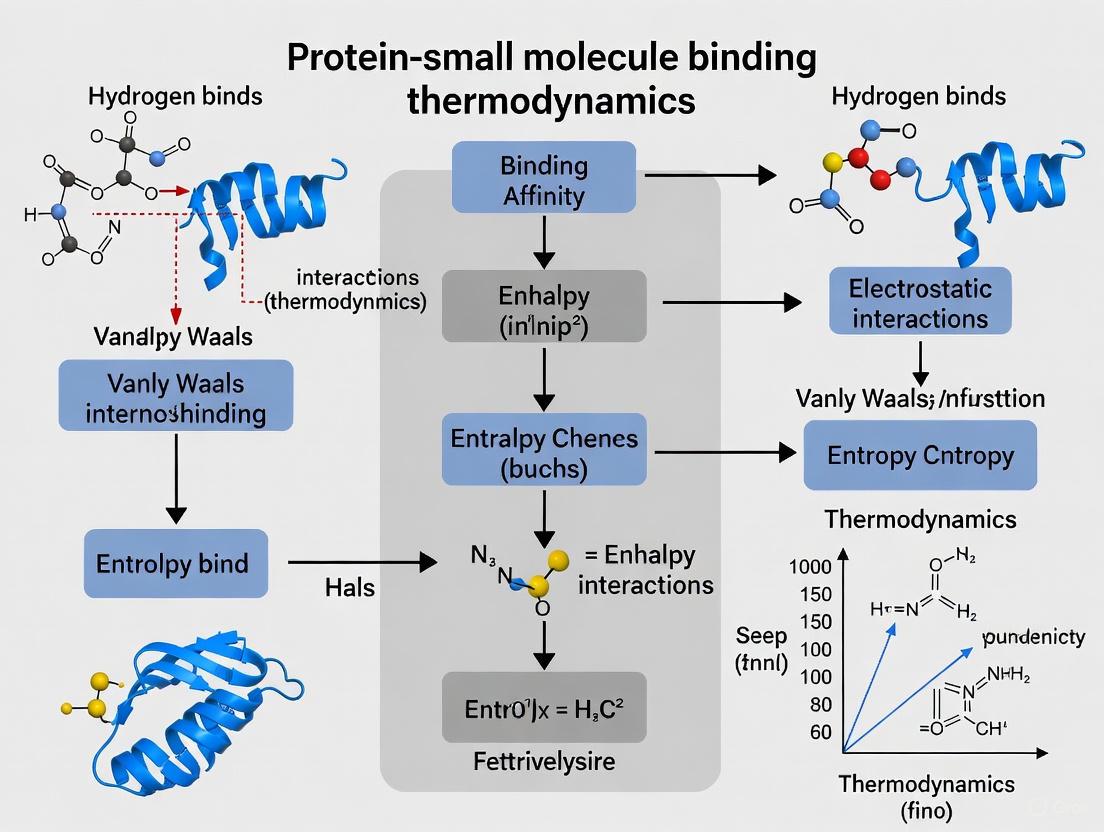
This comprehensive review explores the molecular basis of protein-small molecule binding thermodynamics, addressing the critical needs of researchers and drug development professionals.
Protein-Small Molecule Binding Thermodynamics: From Molecular Basis to Drug Discovery Applications
Abstract
This comprehensive review explores the molecular basis of protein-small molecule binding thermodynamics, addressing the critical needs of researchers and drug development professionals. The article covers fundamental principles including binding mechanisms, allosteric regulation, and the growing importance of binding kinetics beyond traditional affinity measurements. It provides a detailed analysis of both experimental and computational methods for quantifying binding interactions, from established techniques like ITC and SPR to emerging computational approaches including deep learning and free energy calculations. The content addresses common challenges in binding affinity prediction and offers optimization strategies for handling complex systems like intrinsically disordered proteins. Through comparative validation of different methodologies and discussion of current limitations, this review serves as an essential resource for advancing drug discovery and protein engineering efforts.
Fundamental Principles of Molecular Recognition and Binding Energetics
Protein-ligand interactions are fundamental to biochemical processes in living organisms, governing enzyme catalysis, signal transduction, and gene regulation [1]. Understanding the precise mechanisms through which proteins recognize and bind their molecular partners—ranging from small molecules to other macromolecules—is crucial for unraveling biological function and enabling rational drug design [1] [2]. The study of these interactions has evolved from early conceptual models to sophisticated experimental and computational approaches that capture atomic-resolution details and dynamic processes [1]. This guide examines the progression of theoretical models explaining protein-ligand binding, the experimental methodologies used to investigate these mechanisms, and their direct applications to pharmaceutical research and development.
Historical Evolution of Binding Models
The understanding of molecular recognition has progressed through several key paradigms, each building upon and refining the previous one.
Lock-and-Key Model
Proposed by Emil Fischer in 1894, the lock-and-key principle represents the earliest model of molecular recognition [1]. This model posits that proteins and ligands are pre-existing, rigid structures with complementary binding interfaces that fit together perfectly, much like a key fits into its specific lock [2]. The ligand (key) is presumed to have a fixed conformation that matches the binding site on the protein (lock) without requiring any structural adjustments from either molecule [2]. This model implies an entropy-dominated binding process where the principal driving force is the favorable interaction between complementary shapes [2].
Induced-Fit Model
In 1958, Koshland introduced the induced-fit theory to address limitations in the lock-and-key model [1] [2]. This model recognizes that both proteins and ligands possess inherent flexibility. It proposes that the ligand initially binds to the protein with moderate affinity, inducing conformational changes in the protein structure that optimize the binding interface and enhance binding affinity [2]. This sequential process—binding followed by structural adjustment—can be described as a "hand in glove" mechanism rather than a rigid lock-and-key [2]. Induced fit remains a fundamental mechanism in many protein-ligand interactions, particularly in periplasmic substrate-binding proteins [3].
Conformational Selection Model
A more recent development in molecular recognition theory, conformational selection proposes that proteins exist in an equilibrium of multiple conformational states before ligand binding occurs [1]. The ligand does not induce a new conformation but rather selectively binds to and stabilizes a pre-existing complementary conformation from this ensemble [1] [2]. This mechanism, where conformational changes precede binding, suggests that the ligand binding event shifts the equilibrium toward the complementary conformation by increasing its population according to the principle of Le Chatelier [2]. Current understanding indicates that conformational selection is likely at least as common as induced fit, and both mechanisms may operate in the same binding process [1].
Table 1: Comparative Analysis of Protein-Ligand Binding Models
| Feature | Lock-and-Key | Induced-Fit | Conformational Selection |
|---|---|---|---|
| Proposer & Year | Emil Fischer (1894) [1] | Daniel Koshland (1958) [1] | Developed from ensemble theory [1] |
| Protein Flexibility | Rigid | Flexible upon binding | Intrinsically flexible (pre-existing ensemble) |
| Temporal Sequence | Simultaneous fit | Ligand binding precedes conformational change | Conformational change precedes ligand binding |
| Driving Force | Shape complementarity | Binding-induced optimization | Population shift toward complementary state |
| Experimental Evidence | Indirect structural evidence [1] | Atomic-resolution structures, kinetics [1] [3] | NMR, smFRET, MD simulations [1] [3] |
Advanced Binding Concepts
Beyond the primary models, several sophisticated binding mechanisms play crucial roles in biological systems and therapeutic interventions.
Allosteric Modulation
Allosteric binding occurs when a molecule interacts with a protein at a site distinct from the active site, causing conformational changes that alter the protein's activity [1]. This mechanism plays an important role in signaling and regulatory pathways and enables the design of pharmacologically active allosteric modulators that can fine-tune protein function with high specificity [1].
Multivalent Binding
Multivalent binding involves ligands with multiple binding elements simultaneously interacting with several receptors or a single receptor with multiple binding sites [1]. This mechanism, typical for antibody-antigen interactions and protein-polysaccharide binding, results in enhanced affinity and sometimes selectivity, which can be utilized in therapeutic agent development [1].
Weak and Transient Interactions
Weak and transient protein-ligand interactions characterized by low affinity constants and short lifetimes are widespread and biologically relevant [1]. These interactions play crucial roles in signaling cascades and regulatory processes where permanent binding would be disadvantageous.
Thermodynamic and Kinetic Foundations
The formation of a protein-ligand complex is governed by the fundamental equation for Gibbs free energy:
ΔGbind = ΔH - TΔS [2]
Where ΔGbind represents the change in free energy, ΔH represents the enthalpic contribution from chemical bonds and noncovalent interactions, T is the absolute temperature, and ΔS represents the change in system randomness [2]. The binding free energy directly determines the equilibrium binding constant (Keq), which quantifies complex stability [2]:
ΔGbind = -RT ln Keq = -RT ln (kon/koff) [2]
Table 2: Major Non-Covalent Interactions in Protein-Ligand Complexes
| Interaction Type | Strength (kcal/mol) | Characteristics | Biological Role |
|---|---|---|---|
| Hydrogen Bonds | ~5 [2] | Polar electrostatic (D-H···A); donor/acceptor | Stabilizes macromolecular structure; highly specific |
| Ionic Interactions | Variable | Attraction between oppositely charged pairs; highly specific | Strong electrostatic complementarity |
| Van der Waals | ~1 [2] | Nonspecific; transient dipole-induced dipole | Universal proximity-based interaction |
| Hydrophobic Effect | Entropy-driven [2] | Nonpolar aggregation excluding water | Major driving force for binding |
Experimental Methodologies and Protocols
A combination of biophysical techniques is typically required to distinguish between binding mechanisms and quantify interaction parameters.
Isothermal Titration Calorimetry (ITC)
Protocol: The protein solution is placed in the sample cell, and the ligand solution is loaded into the syringe. The ligand is titrated into the protein solution in a series of injections while the instrument measures the heat released or absorbed. A control experiment titrating ligand into buffer is performed to account for dilution effects [3].
Data Analysis: The integrated heat peaks are plotted against the molar ratio. Nonlinear regression fitting provides the binding constant (Ka), stoichiometry (n), enthalpy change (ΔH), and entropy change (ΔS). ITC provides a complete thermodynamic profile but requires relatively high sample concentrations [3].
Single-Molecule Förster Resonance Energy Transfer (smFRET)
Protocol: The protein is site-specifically labeled with donor and acceptor fluorophores. The labeled protein is immobilized or freely diffusing in solution. A laser excites the donor fluorophore, and emission from both donor and acceptor is detected. For immobilized molecules, time traces are recorded; for diffusing molecules, bursts of fluorescence are detected [3].
Data Analysis: FRET efficiency (E) is calculated from donor and acceptor intensities. Histograms of E reveal distinct conformational states. Analysis of dwell times in each state and transitions between states provides information on conformational dynamics and their correlation with ligand binding on timescales from nanoseconds to seconds [3].
Surface Plasmon Resonance (SPR)
Protocol: The protein is immobilized on a sensor chip surface. Ligand solutions at different concentrations are flowed over the surface. The instrument detects changes in refractive index at the surface, reporting on mass accumulation (association) and dissociation [3].
Data Analysis: Sensoryrams (response vs. time) are globally fitted to binding models to determine association (kon) and dissociation (koff) rate constants. The equilibrium dissociation constant (KD) is calculated as koff/kon. SPR is particularly valuable for measuring binding kinetics [3].
Case Study: Glutamine-Binding Protein (GlnBP)
A comprehensive study on E. coli GlnBP utilizing ITC, smFRET, and SPR demonstrated that both apo- and holo-GlnBP show no detectable exchange between open and (semi-)closed conformations on timescales between 100 ns and 10 ms [3]. Ligand binding and conformational changes were found to be highly correlated, with global analysis of kinetic parameters supporting a dominant induced-fit mechanism where the ligand binds prior to conformational rearrangements [3]. This case highlights the importance of combining multiple techniques to distinguish between binding mechanisms.
The Scientist's Toolkit: Research Reagents and Materials
Table 3: Essential Research Reagents for Protein-Ligand Interaction Studies
| Reagent/Material | Function/Application | Technical Notes |
|---|---|---|
| Purified Protein Samples | Target for binding studies; requires high purity and proper folding | Recombinant expression systems (E. coli, mammalian cells) with affinity tags |
| Ligand Library | Small molecules, peptides, or fragments for screening | Commercial libraries (e.g., ChEMBL, BindingDB) or custom synthesis [1] |
| Fluorophore Pairs | Donor/acceptor dyes for smFRET (e.g., Cy3/Cy5) | Site-specific labeling via cysteine or unnatural amino acids [3] |
| SPR Sensor Chips | Immobilization surface for biospecific interaction analysis | CMS chips with carboxymethylated dextran for amine coupling |
| ITC Reaction Buffer | Provides optimal pH and ionic conditions | Must match dialysis buffer; avoid non-matched buffers with strong heats of dilution |
| Crystallization Kits | Sparse matrix screens for protein-ligand co-crystallization | Commercial screens (Hampton Research, Molecular Dimensions) |
| Molecular Biology Kits | Site-directed mutagenesis for binding site characterization | Alanine scanning mutagenesis to identify critical residues |
Computational Approaches and Applications
Computational methods have become indispensable for studying protein-ligand interactions and facilitating drug discovery.
Molecular Docking
Molecular docking employs computational algorithms to predict the bound association state between proteins and ligands by identifying the best match between two molecules [2]. Docking approaches are widely applied to structure-activity relationships, virtual screening, and lead optimization in pharmaceutical research [2]. The success of docking depends on accurate scoring functions that account for the various noncovalent interactions governing molecular recognition.
Binding Free Energy Calculations
Rigorous statistical thermodynamic approaches for binding free energy prediction reach relatively high accuracy but are extremely time-consuming due to the need for exhaustive conformational sampling [1]. Faster deep learning methods may soon achieve comparable precision for small ligands and are increasingly used in large-scale virtual screening campaigns that utilize make-on-demand libraries containing billions of chemical compounds [1].
Deep Learning Structure Prediction
The success of AlphaFold 2 in predicting protein folds paved the way for structure prediction of protein complexes using deep learning models [1]. Recently released models, such as RosettaFold All-Atom, AlphaFold 3, Chai-1, and Boltz-1, provide 3D structures of different types of biomolecular assemblies using only primary sequence information [1]. While these models do not always outperform conventional molecular docking in accuracy for small ligand binding, they offer significant development potential [1].
Implications for Drug Discovery and Design
Understanding protein-ligand interaction mechanisms has direct applications in pharmaceutical development and therapeutic intervention.
The affinity constant represents a fundamental property for drug design, typically improved during lead optimization to at least nanomolar affinity [1]. Beyond thermodynamic affinity, ligand binding/unbinding kinetics and drug-target residence time significantly influence drug efficacy and have attracted considerable research attention [1]. Allosteric modulators that bind at sites distinct from active sites play increasingly important roles in signaling and regulatory pathways, enabling the design of pharmacologically active compounds with novel mechanisms of action [1].
Fragment-based drug design in combination with evolutionary or Monte-Carlo optimization algorithms and deep-learning generative models that output prospective ligands for target proteins represent promising approaches for leveraging binding mechanism knowledge in therapeutic development [1]. These approaches can be based on recurrent neural networks, variational autoencoders, generative adversarial networks, or diffusion models to design small molecules, peptides, or proteins with optimized binding characteristics [1].
The molecular basis of protein-small molecule binding is fundamentally governed by thermodynamics. For researchers and drug development professionals, a deep understanding of the key thermodynamic parameters—binding free energy (ΔG), enthalpy (ΔH), and entropy (ΔS)—is crucial for rational drug design. These parameters dictate the affinity, specificity, and stability of molecular complexes, determining whether a potential drug candidate will succeed or fail [4].
The binding process is described by the central thermodynamic equation: ΔG = ΔH - TΔS, where ΔG represents the change in Gibbs free energy, ΔH the change in enthalpy, T the absolute temperature, and ΔS the change in entropy. A spontaneous binding reaction requires a negative ΔG value, which can result from favorable enthalpy (negative ΔH, typically from strong intermolecular interactions like hydrogen bonds or van der Waals forces) or favorable entropy (positive ΔS, often associated with the release of water molecules or increased disorder) [5]. The intricate balance between these parameters, including the often-observed phenomenon of enthalpy-entropy compensation, presents both challenges and opportunities in molecular design [5].
This whitepaper provides an in-depth technical examination of these thermodynamic parameters within the context of modern drug discovery. We explore computational and experimental methodologies for their determination, analyze their biological implications through case studies, and discuss emerging trends that are shaping the future of molecular binding research.
Fundamental Thermodynamic Principles
The Thermodynamic Equation of Binding
The formation of a protein-ligand complex can be represented by the reversible reaction: P + L ⇌ PL. The equilibrium constant (K) for this reaction is related to the binding free energy by ΔG = -RT lnK, where R is the gas constant and T is the absolute temperature [5]. This fundamental relationship connects experimentally measurable quantities (K) with the theoretical framework of free energy.
The overall binding free energy is composed of enthalpic and entropic components: ΔG = ΔH - TΔS. The enthalpic component (ΔH) primarily reflects changes in potential energy due to the formation of non-covalent interactions between the protein and ligand, and the disruption of interactions with solvent molecules. The entropic component (-TΔS) encompasses changes in the degrees of freedom of the system, including the disordering of solvent molecules released from binding surfaces, changes in conformational flexibility of the protein and ligand, and changes in rotational and translational freedom [4] [5].
Enthalpy-Entropy Compensation
A widespread phenomenon in protein-ligand interactions is enthalpy-entropy compensation, where favorable changes in enthalpy are partially offset by unfavorable changes in entropy, and vice versa [5]. This compensation effect results in binding affinities (ΔG) that vary over a much narrower range than their constituent ΔH and TΔS components.
Statistical analysis of data from 32 diverse proteins shows this significant and widespread tendency toward compensation. When analyzing differences between ligand pairs (ΔΔH versus ΔΔG), strong compensation (where ΔΔH and -TΔΔS are opposed and differ by less than 20% in magnitude) is observed for approximately 22% of modifications—roughly twice that expected without compensation [5]. However, compensation is not universal; about 15% of modifications result in reinforcement (ΔΔH and -TΔΔS share the same sign) [5]. This variation indicates that the extent of compensation depends on the specific molecular modifications and the local environment of the binding site.
Computational Methods for Determining Thermodynamic Parameters
Computational methods for predicting binding affinities and thermodynamics have advanced significantly, offering insights at atomic resolution that complement experimental approaches [4]. These methods vary in their computational cost, accuracy, and the specific thermodynamic information they provide.
Table 1: Computational Methods for Binding Free Energy Calculation
| Method | Theoretical Basis | Accuracy | Computational Cost | Key Applications |
|---|---|---|---|---|
| MM/PB(GB)SA | Molecular mechanics combined with implicit solvation models | Moderate | Medium | Virtual screening, binding mode prediction, residue decomposition [4] |
| Free Energy Perturbation (FEP) | Alchemical transformations between ligands | High | High | Lead optimization, relative binding affinities for congeneric series [4] |
| Thermodynamic Integration (TI) | Similar to FEP, different pathway implementation | High | High | Lead optimization, challenging transformations [4] |
| Enhanced Sampling (Umbrella Sampling, MetaD) | Biased sampling along collective variables | Moderate to High | High | Binding pathways, kinetic parameters, complex transitions [6] [7] |
| Semi-empirical (g-xTB) | Approximate quantum mechanics | Good for interaction energies | Low | Initial screening, large systems [8] |
| Neural Network Potentials Machine learning on quantum data | Varies (improving rapidly) | Low to Medium | Emerging method for complex systems [8] |
End-Point Free Energy Methods
MM/PBSA and MM/GBSA are popular end-point methods that calculate binding free energy using the equation: ΔGbind = GPL - (GP + GL), where GPL, GP, and GL represent the free energies of the protein-ligand complex, unbound protein, and unbound ligand, respectively [4]. These methods decompose the total free energy into components including van der Waals interactions, electrostatic interactions, and solvation effects, providing insights into the driving forces of binding.
The strategic value of MM/PB(GB)SA lies in balancing computational efficiency with reasonable accuracy, enabling the study of molecular interactions within practical timeframes [4]. Parameter tuning is crucial for accuracy; for example, specific dielectric constants (membrane dielectric constant of 7.0 and internal dielectric constant of 20.0) have been found to improve agreement with experimental binding affinities for both soluble and membrane-bound proteins [4].
Alchemical Free Energy Methods
Free Energy Perturbation (FEP) and Thermodynamic Integration (TI) are considered more rigorous approaches for calculating binding free energies. These methods use an "alchemical" pathway to transform one ligand into another through a series of non-physical intermediate states, typically parameterized by a coupling parameter λ [4]. Recent innovations, such as the λ-dependent weight functions and softcore potential developed by the York lab in 2023, have optimized sampling of these alchemical transformation pathways in the AMBER software suite, increasing sampling efficiency and ensuring stable performance [4].
While FEP and TI provide high accuracy, their substantial computational demands have led to the development of specialized approaches for challenging cases, such as systems with "trapped" water molecules. Novel non-equilibrium switching (NES) methods have demonstrated the ability to calculate relative binding free energies within 1.1 kcal/mol of experimental values for such systems, with statistical errors under 0.4 kcal/mol [9].
Enhanced Sampling and Kinetics
Enhanced sampling techniques have emerged as powerful tools for studying both binding thermodynamics and kinetics. Methods such as umbrella sampling, metadynamics, and Gaussian accelerated molecular dynamics (GaMD) overcome the timescale limitations of conventional molecular dynamics by biasing simulations to explore high-energy states and transition pathways [4] [6] [7].
These approaches can capture repetitive ligand binding and dissociation events, enabling calculations of not only binding free energies but also kinetic parameters such as dissociation (koff) and association (kon) rates [4]. Recent microsecond-timescale enhanced sampling simulations have made it possible to accurately capture complete binding and dissociation cycles, providing a more comprehensive understanding of the binding process [4].
Diagram 1: Computational Workflow for Binding Free Energy Calculation
Experimental Determination of Thermodynamic Parameters
Isothermal Titration Calorimetry (ITC)
Isothermal Titration Calorimetry (ITC) is the primary experimental method for directly measuring the thermodynamic parameters of binding interactions. ITC measures the heat released or absorbed during the binding reaction, providing direct measurements of ΔH, the binding constant (Ka, from which ΔG is calculated), and the stoichiometry of interaction [5]. The entropy change (ΔS) is then derived using the fundamental equation ΔG = ΔH - TΔS.
The precision of modern ITC measurements is remarkable, with mean reported errors for ΔH and ΔG of approximately 1.5 and 0.5 kJ mol⁻¹, respectively [5]. This precision enables detailed studies of subtle thermodynamic changes resulting from molecular modifications. However, ITC measurements operate within an "affinity window" constrained by protein solubility and instrument sensitivity, which can limit the range of accurately measurable binding constants [5].
Data Analysis and Compensation Effects
When analyzing ITC data, traditional ΔH versus -TΔS plots often show high correlation, but this can be misleading. Quantitative models demonstrate that experimental constraints alone can produce correlation coefficients of 0.82 to 0.93, accounting for more than 95% of the observed correlation in datasets combining multiple protein systems [5].
To distinguish true compensation from artefactual correlation, researchers have developed ΔΔ-analysis, which examines differences between pairs of ligands binding to the same protein [5]. This approach diminishes the influence of experimental constraints and reveals the genuine compensation behavior intrinsic to the molecular system. The resulting data serves as a benchmark for theoretical models of the thermodynamic consequences of ligand modification [5].
The Scientist's Toolkit: Essential Research Reagents and Methods
Table 2: Essential Research Reagents and Computational Tools
| Tool/Reagent | Function/Application | Key Features |
|---|---|---|
| Isothermal Titration Calorimeter | Direct measurement of ΔH, Ka, and stoichiometry | Gold standard for experimental thermodynamics; requires relatively high protein concentrations [5] |
| Molecular Dynamics Software (AMBER, GROMACS) | Simulation of molecular motion and interactions | Atomistic detail; can incorporate enhanced sampling algorithms [4] |
| MM/PBSA and MM/GBSA Modules | End-point free energy calculations | Computational efficiency; residue energy decomposition [4] |
| Free Energy Perturbation Software | Relative binding free energy calculations | High accuracy for congeneric series; computational intensity [4] [9] |
| Semi-empirical Methods (g-xTB) | Quantum-based interaction energy calculations | Speed and accuracy balance; mean absolute percent error 6.1% on PLA15 benchmark [8] |
| Neural Network Potentials (UMA-m) | Machine learning force fields | Emerging technology; 9.57% mean absolute error on PLA15 benchmark [8] |
| Enhanced Sampling Algorithms | Accelerate rare events in simulation | Study complete binding pathways and kinetics [4] [6] |
Biological Significance and Research Applications
Temperature Dependence and Heat Capacity Changes
Biological systems exhibit complex temperature-dependent binding behavior that reflects their adaptation to physiological conditions. The heat capacity change (ΔCp) upon binding is a crucial parameter that influences how ΔH and ΔS vary with temperature [10]. Some systems display a "thermodynamic molecular switch" where ΔCp changes sign at temperatures below the ambient range, resulting in a characteristic pattern where ΔG(T) changes from positive to negative, reaches a maximum favorable value, and then becomes positive again as temperature increases [10].
This behavior has profound biological implications, as it ensures optimal binding within narrow physiological temperature ranges. The mathematical predictability of changes in ΔH°(T), ΔS°(T), and ΔG°(T) arising from temperature-dependent ΔCp gives rise to the classically observed behavior patterns in biological reactivity [10].
Role of Water Molecules and Solvation Effects
Water molecules play a critical role in binding thermodynamics, particularly when "trapped" waters mediate interactions between the ligand and protein [9]. The displacement of water molecules from binding sites contributes significantly to entropy changes, while the formation of ordered water networks can impose entropic penalties. The balance between these effects often determines the overall binding affinity.
Computational studies have revealed that failures to account for water rearrangement during binding can lead to inaccurate free energy predictions [9]. Specialized methods, including non-equilibrium switching approaches and enhanced sampling techniques, have been developed to address the challenge of simulating water rearrangements within practical computational timescales [9].
Applications in Drug Discovery
Understanding binding thermodynamics provides crucial insights for optimizing drug candidates. Energetic decomposition in MM/PB(GB)SA calculations identifies specific residues that contribute most significantly to binding, guiding structure-based drug design [4]. Similarly, the ability to accurately predict relative binding affinities for congeneric series using FEP/TI methods enables rational optimization of lead compounds [4].
Virtual screening combined with MM/PB(GB)SA has proven highly effective in drug discovery, improving the ranking of binding affinities and accurately predicting binding modes [4]. This approach enhances the precision of identifying promising compounds early in the drug discovery workflow, potentially reducing the need for expensive synthetic efforts on poorly performing candidates.
Diagram 2: Thermodynamic Relationships in Molecular Binding
Emerging Trends and Future Perspectives
The field of binding thermodynamics is rapidly evolving, driven by advances in computational power and methodological innovations. Several key trends are shaping current research:
Integration of Machine Learning Methods
Machine learning approaches, particularly neural network potentials (NNPs), are showing promise in predicting protein-ligand interaction energies [8]. While current NNPs still trail semi-empirical methods like g-xTB in accuracy (with mean absolute percent errors of 9.57% for the best NNP vs. 6.09% for g-xTB on the PLA15 benchmark), they are improving rapidly [8]. These methods face particular challenges in handling charge effects across large systems, an area requiring further development [8].
The combination of machine learning with enhanced sampling techniques is creating powerful hybrid approaches. For instance, machine-learning-enhanced umbrella sampling simulations using neural network potentials trained on higher-level quantum chemistry data demonstrate the potential for improving accuracy while maintaining computational efficiency [6] [7].
Kinetics and Drug Residence Times
There is growing recognition that binding kinetics (kon and koff rates) are as important as thermodynamics for drug efficacy, influencing residence time and functional activity [4]. Enhanced sampling simulations now enable the calculation of both thermodynamic and kinetic parameters, providing a more complete picture of the binding process [4]. This integrated approach supports the optimization of drug candidates for both binding affinity and residence time.
Accessible Workflows and Benchmarking
Efforts to make advanced computational methods more accessible continue, with developments such as the fastDRH webserver that integrates docking with streamlined MM/PB(GB)SA calculations [4]. At the same time, rigorous benchmarking studies using datasets like PLA15 provide critical performance assessments of various computational methods [8]. These developments help bridge the gap between methodological advances and practical application in drug discovery pipelines.
The thermodynamic parameters of binding free energy, enthalpy, and entropy provide fundamental insights into the molecular basis of protein-small molecule interactions. While the relationship ΔG = ΔH - TΔS appears simple in form, its application to biological systems reveals remarkable complexity, including widespread enthalpy-entropy compensation and temperature-dependent behavior.
Computational methods for predicting these parameters have advanced substantially, with options ranging from efficient end-point methods to rigorous alchemical free energy calculations. Experimental techniques, particularly ITC, provide essential validation and high-precision measurements of binding thermodynamics. The integration of these approaches, along with emerging machine learning and enhanced sampling methods, continues to enhance our understanding of molecular recognition.
For researchers and drug development professionals, mastery of these thermodynamic principles and methods is increasingly essential for rational design of therapeutic compounds. As the field progresses, the ability to accurately predict and optimize both binding affinity and kinetics will play a crucial role in accelerating drug discovery and improving success rates in pharmaceutical development.
For decades, the primary metric for evaluating a potential drug's interaction with its target has been binding affinity, quantified as the dissociation constant (KD). This thermodynamic parameter reflects the compound's potency at equilibrium. However, it provides a static snapshot that often fails to predict in vivo efficacy. In living systems, drug concentrations are dynamic, fluctuating with absorption, distribution, metabolism, and excretion (ADME). Consequently, the drug residence time (RT), defined as the reciprocal of the dissociation rate constant (RT = 1/koff), has emerged as a critical and often superior predictor of pharmacodynamic effects [11]. A longer residence time意味着 the drug-target complex remains intact longer, sustaining the therapeutic effect even after systemic drug concentrations have declined [11]. This review delves into the molecular basis of protein-small molecule binding kinetics, framing it within thermodynamic research and equipping scientists with the knowledge and tools to leverage this parameter in drug discovery.
Theoretical Foundations: Binding Models and Energetics
Conceptual Models of Ligand Binding
The process of ligand binding is described by three principal models, each with distinct kinetic implications:
- Lock-and-Key Model: This simplest model posits a preformed, rigid binding site. Binding is a one-step process: L + R ⇌ LR. The residence time is simply the inverse of the dissociation rate constant (RT = 1/koff) [11] [12].
- Induced-Fit Model: Here, the initial binding of the ligand induces a conformational change in the protein, leading to a stabilized active complex (LR*). This multi-step process introduces additional kinetic barriers, potentially prolonging the residence time beyond what the initial lock-and-key interaction would allow [11].
- Conformational Selection Model: The protein exists in an equilibrium of multiple conformations. The ligand selectively binds to and stabilizes a pre-existing, low-population conformation (e.g., the active state R). This model, now often intertwined with induced-fit, explains how ligands can bias signaling pathways and highlights that RT is governed by the dissociation from the final stabilized complex (LR) [11].
The following diagram illustrates the pathways and kinetic constants associated with these models.
Thermodynamic and Kinetic Relationships
The binding process is governed by fundamental physicochemical principles [12]. The formation of the protein-ligand complex (PL) from protein (P) and ligand (L) is described by: P + L ⇌ PL At equilibrium, the association and dissociation rates are equal: kon[P][L] = koff[PL]. This defines the binding constant Kb = kon/koff = [PL]/([P][L]), and its inverse, the dissociation constant KD = koff/kon [12]. The standard free energy of binding (ΔG°) is related to Kb by: ΔG° = -RT ln Kb where R is the gas constant and T is the temperature. While ΔG° determines the overall affinity, its enthalpic (ΔH) and entropic (-TΔS) components, along with the kinetic rates kon and koff, reveal the mechanism of binding. A slow koff (long RT) often results from high energy barriers associated with breaking specific, non-covalent interactions or escaping a conformational "energy cage" formed by the protein [11].
Experimental Characterization of Binding Kinetics
Key Experimental Techniques
A range of biophysical techniques is available to measure kon and koff directly.
- Surface Plasmon Resonance (SPR): A label-free technique where the ligand flows over a chip immobilized with the protein. Binding changes the refractive index, allowing real-time monitoring of association and dissociation phases to extract kinetic rates [13].
- Spectroscopic Assays: These include fluorescent resonance energy transfer (FRET) or fluorescence polarization (FP). Ligands are labeled with fluorophores, and binding events cause measurable changes in fluorescence, providing kinetic data [13] [12].
- Native Mass Spectrometry: This method can probe protein-small molecule interactions with high sensitivity, providing insights into stoichiometry, thermodynamics, and kinetics, even for heterogeneous systems [14].
- Cellular Thermal Shift Assay (CETSA): This method confirms target engagement in a physiologically relevant context (intact cells) by measuring ligand-induced thermal stabilization of the target protein, offering a functional correlate to binding [15].
The workflow for an SPR-based kinetic assay, a gold-standard method, is detailed below.
Publicly Available Kinetic Databases
The growth of kinetic studies has led to curated databases, invaluable for model validation and chemoinformatic analyses.
Table 1: Key Databases for Biomolecular Binding Kinetic Data
| Database Name | Description | Key Content | Website |
|---|---|---|---|
| KDBI [13] | Kinetic Data of Biomolecular Interactions | 19,263+ entries for protein & nucleic acid interactions | http://xin.cz3.nus.edu.sg/group/kdbi/kdbi.asp |
| BindingDB [13] | Protein-Ligand Binding Data | ~1.1M compounds, 8.9K targets; includes kinetic data | https://bindingdb.org/rwd/bind/ByKI.jsp?specified=Kn |
| KOFFI [13] | Kinetics of Featured Interactions | 1,705 entries with quality rating for experimental data | http://koffidb.org/ |
| PDBbind [13] | Complex Structures & Binding Data | koff dataset with 169 protein-small molecule complexes | http://www.pdbbind.org.cn/ |
| SKEMPI [13] | Energetics of Mutant Protein Interactions | 713 binding kinetic rates for protein-protein mutants | http://life.bsc.es/pid/mutation_database/ |
Computational Prediction and Molecular Determinants
Computational Workflows for Kinetic Prediction
Computational methods have become indispensable for predicting and rationalizing binding kinetics, operating at different levels of accuracy and computational cost [16] [17].
- Molecular Docking: Rapidly screens large compound libraries by predicting the bound conformation (pose) of a ligand in a protein's binding site. While fast, it often treats the protein as rigid and is limited in accurately predicting affinities, especially kinetics [16] [18].
- Molecular Dynamics (MD) Simulations: All-atom MD simulations model the time-dependent evolution of the protein-ligand complex. By capturing full atomistic detail and flexibility, MD can reveal dissociation pathways and, with enhanced sampling methods, directly estimate koff rates [13] [18] [17].
- MM/PBSA and MM/GBSA: These methods (Molecular Mechanics with Poisson-Boltzmann/Generalized Born Surface Area) use snapshots from MD simulations to calculate binding free energies by combining molecular mechanics energies with implicit solvation models. They offer a balance between speed and accuracy for affinity ranking [16] [18].
- Alchemical Free Energy Calculations: These are among the most rigorous methods, using MD simulations to compute the free energy difference of transforming one ligand into another within the binding site (relative binding free energy) or of absolutely binding a ligand. They are computationally intensive but highly accurate [16].
- Machine Learning (ML): Emerging ML techniques analyze simulation trajectories or structural data to identify patterns and molecular descriptors that correlate with long residence time, enabling faster predictions [17].
A typical integrated computational workflow is shown below.
Molecular Features Prolonging Residence Time
Computational and experimental studies have identified key structural features that can lead to a slow koff:
- Conformational Changes and the "Energy Cage": A ligand may bind initially, inducing protein dynamics (e.g., "flap closing") that create steric hindrance, trapping the ligand. Dissociation requires overcoming a high energy barrier to reverse this conformational change [11].
- Solvent Displacement and Rebinding: The dissociation path may involve energetically unfavorable displacement of water molecules, or the ligand may encounter opportunities for transient "rebinding" within the binding pocket, both of which delay full dissociation [16].
- Electrostatic and Desolvation Effects: Introducing charged or highly polar groups can slow kon due to desolvation penalties but, if positioned to form stable interactions in the bound state, can significantly slow koff by creating strong, specific interactions that are difficult to break [13].
Successful investigation of binding kinetics relies on a suite of specialized reagents and computational resources.
Table 2: Key Research Reagent Solutions for Binding Kinetics Studies
| Category / Item | Function and Application in Kinetic Studies |
|---|---|
| Purified Target Protein | High-purity, functional protein is essential for all in vitro biophysical assays (SPR, ITC, MS). |
| Stabilized Lipids / Detergents | For studying membrane protein targets (e.g., GPCRs, ion channels) in native-like environments. |
| Biosensor Chips (e.g., CM5, NTA) | Specialized surfaces for immobilizing proteins in SPR instruments. |
| Fluorescently-Labeled Ligands | Tracer compounds for spectroscopic assays (FP, FRET) to monitor binding events. |
| CETSA Kits | Reagents and protocols for measuring target engagement and stabilization in cells. |
| Molecular Dynamics Software | Software like GROMACS, AMBER, or NAMD for running MD simulations. |
| Docking & Virtual Screening Suites | Platforms like AutoDock Vina, Glide, or DOCK for rapid pose prediction and library screening. |
| Force Fields | Parameter sets (e.g., AMBER, CHARMM) defining atomic interactions for MD and energy calculations. |
The paradigm in drug discovery is decisively shifting from a sole focus on thermodynamic affinity to an integrated view that includes binding kinetics and residence time. This transition is powered by advances in experimental techniques, the proliferation of public kinetic data, and the increasing predictive power of computational models, particularly all-atom molecular dynamics and machine learning [13] [17]. Future progress will hinge on our ability to further refine these computational methods, making accurate koff prediction a high-throughput reality, and to more deeply understand the molecular determinants of prolonged target engagement across different target classes. By strategically designing for optimal residence time alongside high affinity, drug hunters can significantly improve the probability of developing candidates with superior efficacy and safety profiles in the clinic.
Allosteric Binding and Multivalent Interactions in Complex Biological Systems
Allosteric binding and multivalent interactions represent two fundamental mechanisms that govern the regulation of complex biological systems. Allosteric regulation occurs when an effector molecule binds to a site on a protein that is topographically distinct from the active, or orthosteric, site, thereby modulating the protein's activity, structure, or flexibility through long-range communication [19] [20]. This mechanism serves as an efficient and robust tool for molecular communication and signaling within the cell, playing critical roles in processes including signal transduction, catalysis, and gene regulation [21]. The biological importance and complexity of allosteric processes require a multi-faceted platform of synergistically integrated approaches for prediction and characterization [21].
Simultaneously, multivalent binding involves interactions where multivalent ligands simultaneously engage with multiple receptors or a single receptor possessing multiple binding sites [1]. This phenomenon is typified by antibody-antigen interactions, protein-polysaccharide binding, and complexes of nucleic acids with DNA/RNA-binding proteins and transcription factors [1]. Multivalency results in significantly enhanced binding affinity and often greater selectivity compared to monovalent interactions, properties that can be strategically utilized in therapeutic development [1]. Together, these mechanisms enable exquisite control over biochemical processes, from fine-tuning metabolic pathways to orchestrating complex cellular signaling cascades, making them crucial for understanding biological function and designing targeted interventions.
The thermodynamic and kinetic principles underlying these interactions provide the foundation for their biological functions. Allosteric drugs exhibit several distinct advantages over their orthosteric counterparts, including enhanced selectivity, decreased toxicity, and the ability to modulate protein activity without directly competing with endogenous ligands [19]. This increased selectivity arises from the observation that allosteric sites are often less evolutionarily conserved than orthosteric sites, allowing ligands to specifically target certain protein isoforms or conformations while sparing related proteins, thereby minimizing off-target effects [19]. Furthermore, allosteric ligands can preserve baseline biological signaling and reduce toxicity risks associated with complete inhibition or overactivation by modulating protein activity indirectly, such as through stabilizing specific active or inactive states [19].
Molecular Mechanisms of Allosteric Regulation
Historical Evolution of Allosteric Theory
Our understanding of allosteric mechanisms has evolved significantly from early rigid structural models to dynamic, network-driven paradigms [19]. The classic two-state model, exemplified by the Monod-Wyman-Changeux (MWC) and Koshland-Némethy-Filmer (KNF) models, posited that allostery arises from an equilibrium between distinct inactive ("tense" or T) and active ("relaxed" or R) conformational states [19]. In this framework, allosteric effectors function by shifting this pre-existing equilibrium toward one state or the other. While these models successfully explained many cooperative phenomena, they presented an oversimplified view of protein dynamics, failing to fully capture the continuous spectrum of conformational states that proteins can adopt and the intricate nature of allosteric communication pathways.
Modern understanding recognizes that allosteric regulation is a global property of protein systems that can be described by residue interaction networks, where effector binding initiates a cascade of coupled fluctuations that propagate through the network, eliciting functional responses at distal sites [21]. This network-centric perspective has been empowered by advances in computational structural biology and experimental biophysics, which have revealed that proteins exist as dynamic ensembles of interconverting conformations rather than as static structures. Within these ensembles, allosteric signals can be transmitted through various physical mechanisms, including changes in amino acid side-chain rearrangements, backbone conformational shifts, alterations in dynamics and flexibility, and modulation of collective motions [21].
Key Mechanisms of Allosteric Communication
The contemporary understanding of allostery encompasses several interconnected mechanisms that govern how binding at one site influences function at a distant location:
Conformational Selection and Induced Fit: The mechanism of molecular recognition has progressed from the lock-and-key principle proposed by Emil Fischer in 1894 and the induced-fit theory suggested in 1958 to a more nuanced understanding that includes conformational selection [1]. Conformational selection assumes that the crossing of free-energy barriers between protein conformations before the binding event is likely to be at least as common as the induced fit mechanism, where ligand binding induces a conformational change in the protein [1]. Frequently, both mechanisms operate in the same binding process, with proteins sampling multiple conformational states and ligands selectively binding to and stabilizing particular states from this ensemble [1].
Dynamic Allostery: Some allosteric processes occur without appreciable structural transformations, representing "entropy-driven" mechanisms where allosteric interactions are mediated through alterations of functional motions and rebalancing of rigid and flexible protein regions [21]. In these cases, binding of an allosteric effector changes the protein's dynamic landscape, altering conformational entropy and flexibility at distant sites, which in turn affects function. Nuclear Magnetic Resonance (NMR) spectroscopy has been particularly instrumental in characterizing these dynamic allosteric mechanisms, as it can probe biomolecular motions across multiple timescales [21].
Allosteric Communication Pipelines: Network analyses have revealed that allosteric signals often propagate through specific pathways of interacting residues that serve as communication pipelines within the protein structure [19] [21]. These pathways may involve physically contiguous residues or seemingly discontinuous networks that are connected through space. The organization of these networks often follows "small-world" principles, where any two residues can be connected through only a few intermediates, enabling efficient long-range communication [21]. Key residues within these networks, sometimes termed "hotspots," play disproportionately important roles in allosteric communication and can be critical targets for therapeutic intervention.
Table 1: Comparative Analysis of Allosteric Mechanisms
| Mechanism | Fundamental Principle | Key Experimental Techniques | Biological Examples |
|---|---|---|---|
| Conformational Selection | Ligand selects pre-existing conformations from protein ensemble | NMR, Molecular Dynamics Simulations | Enzyme catalysis, Receptor activation [1] |
| Induced Fit | Ligand binding induces conformational changes | X-ray crystallography, Cryo-EM | Signal transduction, Gene regulation [1] |
| Dynamic Allostery | Allosteric modulation without major structural changes | NMR relaxation, Residual Dipolar Couplings | Metabolic enzymes, Signaling proteins [21] |
| Network-Driven Allostery | Signal propagation through residue interaction networks | Network analysis, Molecular Dynamics | GPCRs, Kinases, Ion channels [19] [21] |
Principles and Applications of Multivalent Interactions
Fundamental Characteristics of Multivalent Binding
Multivalent interactions occur when multiple recognition elements between biological entities act in concert, resulting in binding properties that are qualitatively different from monovalent interactions [1]. This phenomenon is widespread in biological systems and is characterized by several key principles:
Enhanced Affinity: Multivalent binding typically results in a dramatic increase in functional affinity (avidity) compared to monovalent interactions. This enhancement arises from the statistical rebinding effect, where the simultaneous dissociation of multiple individual interactions is statistically improbable [1]. While individual binding events may be relatively weak, their collective action produces a stable interaction with significantly longer lifetime and higher overall binding strength.
Increased Specificity: Multivalency can enhance binding specificity through the requirement for spatial pattern matching between multiple binding sites on both the ligand and receptor [1]. This spatial organization creates a "recognition code" where only the correct arrangement of binding elements results in optimal interaction, reducing cross-reactivity with similar but non-identical partners.
Cooperativity Effects: In many multivalent systems, binding at one site influences binding at other sites, resulting in positive or negative cooperativity [1]. Positive cooperativity, where initial binding events facilitate subsequent ones, can lead to sharp, switch-like responses to ligand concentration changes, which is particularly valuable in signaling processes requiring binary decisions.
Multivalent interactions are particularly prevalent in immune recognition, viral entry, cellular adhesion, and signal transduction complexes. Antibody-antigen interactions represent a classic example, where the multivalent binding of antibodies to repetitive epitopes on pathogens significantly enhances immune recognition and effector functions [1]. Similarly, many viruses employ multivalent attachment to host cells through numerous copies of surface proteins interacting with cellular receptors, enabling firm adhesion despite individual low-affinity interactions [1].
Structural Basis of Multivalent Interactions
The structural implementation of multivalency varies considerably across biological systems, encompassing several distinct architectures:
Multivalent Ligands with Multiple Receptors: This configuration involves ligands displaying multiple binding elements that simultaneously engage with separate receptor molecules, often leading to receptor clustering and downstream signaling activation [1]. This mechanism is common in growth factor signaling and immune cell activation.
Multivalent Receptors with Multiple Ligands: Some receptors contain multiple binding sites that can simultaneously engage with several ligand molecules or a single multivalent ligand [1]. This arrangement is frequently observed in scavenger receptors and pattern recognition receptors of the innate immune system.
Multivalent Interactions in Macromolecular Assemblies: Large cellular machines often assemble through multivalent interactions between components, creating stable complexes through the cumulative effect of multiple moderate-affinity interactions [1]. This assembly strategy allows for regulated formation and disassembly of complexes in response to cellular signals.
The structural organization of multivalent interactions directly influences their functional outcomes. Linear arrangements of binding elements produce different properties than two-dimensional arrays or three-dimensional clusters, with implications for binding kinetics, cooperativity, and regulatory potential [1].
Table 2: Classification of Multivalent Interactions in Biological Systems
| Interaction Type | Structural Basis | Affinity Enhancement | Biological Examples |
|---|---|---|---|
| Homomultivalent | Identical binding elements | 10-1000 fold | Antibody-antigen recognition, Viral capsid assembly [1] |
| Heteromultivalent | Different binding elements | 100-10,000 fold | Cell adhesion complexes, Receptor tyrosine kinase signaling [1] |
| Chelation | Multiple binding sites on one entity targeting single molecule | 100-1000 fold | Avidin-biotin systems, His-tag/NTA interactions [1] |
| Statistical Rebinding | Multiple identical interactions with neighbor switching | 10-100 fold | Carbohydrate-lectin interactions, Heparin-binding proteins [1] |
Integrated Computational and Experimental Methodologies
Computational Strategies for Allosteric Site Prediction
Modern computational approaches have dramatically advanced the prediction and characterization of allosteric sites and mechanisms, overcoming many limitations of traditional experimental methods:
Machine Learning (ML) Approaches: The integration of ML, particularly deep learning, has introduced transformative methods for allosteric site prediction [19]. Following standard ML workflows, these approaches involve data preparation, feature engineering, and model selection/development. The remarkable success of AlphaFold2 in predicting protein structures with high accuracy through deep learning has spurred growing interest in leveraging its capabilities to accelerate allosteric drug discovery [19]. ML models trained on known allosteric sites from databases like ASD2023 can identify potential allosteric pockets based on evolutionary, structural, and physicochemical features, even in the absence of experimental data for specific targets [19].
Molecular Dynamics (MD) Simulations: MD simulations have become an essential tool for probing biomolecular conformational dynamics, offering atomic-level insights into transient structural states and allosteric communication pathways [19]. These simulations numerically solve Newton's equations of motion for systems comprising thousands to millions of atoms across timescales ranging from nanoseconds to milliseconds, effectively capturing thermal fluctuations and collective motions that underlie functional protein dynamics and allostery [19]. Advanced MD techniques can now capture drug binding to proteins undergoing large conformational changes at the microsecond scale, revealing transient pockets accompanied by conformational shifts that lead to post-drug binding [19].
Network-Based Analyses: The understanding of allostery has evolved significantly from rigid structural models to dynamic, network-driven paradigms [19] [21]. Network-based approaches map communication pathways within proteins, pinpointing residues critical for allosteric signaling and contributing to locating allosteric sites [19]. In these methods, dynamic correlations from MD simulations or co-evolutionary information from multiple sequence alignments are used to construct residue interaction networks, which are then analyzed using graph theory algorithms to identify key allosteric hotspots and communication pathways [21].
Diagram 1: Integrated computational workflow for allosteric site prediction, combining molecular dynamics, network analysis, and machine learning approaches.
Experimental Techniques for Validation and Characterization
While computational methods provide powerful prediction capabilities, experimental validation remains essential for confirming allosteric mechanisms and multivalent interactions:
Biophysical Methods for Binding Characterization: Surface plasmon resonance (SPR) and high-throughput mass spectrometry (HT-MS) enable direct probing of protein-ligand binding affinities and kinetics [1]. These techniques are particularly valuable for characterizing the enhanced avidity of multivalent interactions and the modulated binding kinetics of allosteric effectors. High-throughput SPR (HT-SPR) expands the breadth of targets for which screening can be performed and enables direct measurement of binding parameters without interfering optical or fluorescent labels [1].
Structural Biology Techniques: X-ray crystallography and cryogenic electron microscopy (cryo-EM) provide high-resolution structural information for protein-ligand complexes [1] [20]. An increasing number of contributions to the Protein Data Bank (PDB) are obtained using cryo-EM technique, offering high-resolution and avoiding the need for protein crystallization, which allows for the visualization of even previously inaccessible large molecular weight complexes in a near-native hydrated state [1]. For dynamic characterization, NMR spectroscopy serves as a critical validation tool for computational predictions and provides valuable insights into dynamic conformational changes and allosteric communication pathways [20] [21].
Competitive Binding Assays: These traditional methods offer high accuracy in experimental validation of binding interactions, particularly for characterizing competition between ligands for shared binding sites [22]. While time-consuming, they provide direct evidence of binding relationships and can be implemented in various formats including fluorescence polarization, enzyme-linked immunosorbent assays (ELISA), and radioligand binding assays.
The integration of computational and experimental approaches has proven particularly powerful for studying challenging systems such as intrinsically disordered proteins (IDPs) and their interactions with ligands [1]. IDPs and intrinsically disordered regions (IDRs) are involved in various diseases including presently incurable cancers and neurodegenerative disorders, making them attractive pharmacological targets [1]. However, they typically interact with low affinity, especially with small molecule ligands, due to the absence of well-defined binding pockets, necessitating a combination of experimental and computational approaches to understand the influence of ligands on their broad conformational ensembles [1].
Research Reagent Solutions and Methodological Toolkit
Table 3: Essential Research Reagents and Resources for Studying Allosteric and Multivalent Interactions
| Reagent/Resource | Type | Primary Function | Key Features |
|---|---|---|---|
| BindingDB | Database | Experimental binding data repository | Binding affinity data for protein-ligand interactions [1] |
| Protein Data Bank (PDB) | Database | 3D structural data for biological macromolecules | Structures of protein-ligand complexes [1] |
| Allosteric Database (ASD2023) | Database | Curated allosteric interactions | Allosteric proteins, modulators, and pathways [19] |
| GPCRmd Database | Database | MD simulations of GPCRs | Dynamics of allosteric signaling in GPCRs [19] |
| HT-SPR Platforms | Instrumentation | High-throughput binding kinetics | Label-free binding constant measurement [1] |
| Cryo-EM Systems | Instrumentation | High-resolution structure determination | Visualization of large complexes without crystallization [1] |
| NMR Spectrometers | Instrumentation | Dynamic studies of biomolecules | Atomic-resolution dynamics in solution [20] [21] |
| AlphaFold2/3 | Software | Protein structure prediction | Accurate 3D structure prediction from sequence [1] [19] |
Thermodynamic and Kinetic Characterization
Binding Affinity Prediction and Measurement
Accurate determination of binding affinities is fundamental for understanding both allosteric and multivalent interactions. Binding affinity, quantified as the free energy change (ΔG) upon complex formation, is a critical parameter in drug discovery and biochemical mechanism studies [23]. For drug candidates, binding affinity is usually optimized to at least nanomolar affinity during lead optimization [1]. The accurate computational prediction of ligand affinity presents significant challenges even after correct binding pose prediction. Binding free energy calculations using rigorous statistical thermodynamic approaches reach relatively high accuracy but are extremely time-consuming due to the need for exhaustive conformational sampling [1] [23].
Current computational methods for binding affinity prediction span a wide spectrum of speed and accuracy trade-offs. At one extreme, molecular docking offers fast but relatively inaccurate results, generally taking less than a minute on CPU and delivering results with 2-4 kcal/mol root-mean-square error (RMSE) [23]. At the other extreme, methods like free energy perturbation (FEP) and thermodynamic integration (TI) make use of extensive molecular dynamics simulation to achieve impressive accuracy, with correlation coefficients of 0.65+ and RMSE values around just below 1 kcal/mol, but require 12+ hours of GPU time, rendering them impractical for screening tens of thousands of candidates [23]. This clear methods gap has motivated research into intermediate approaches that offer better accuracy than docking with lower computational cost than FEP, though success has been limited [23].
Kinetic Parameters and Their Functional Significance
Beyond thermodynamic affinity, ligand binding/unbinding kinetics and drug-target residence time significantly influence drug efficacy and have attracted substantial research attention [1]. The residence time, which is inversely related to the dissociation rate constant (k¬off), can be more important than binding affinity for in vivo drug efficacy, as longer residence times can prolong pharmacological effects even after free drug concentrations have declined [1].
For allosteric modulators, binding kinetics can be particularly complex due to the conformational changes involved in their mechanism of action. The interplay between conformational selection and induced fit mechanisms influences both association and dissociation rates, creating rich kinetic behavior that cannot be captured by simple bimolecular binding models [1]. Similarly, multivalent interactions typically exhibit dramatically slowed dissociation rates compared to monovalent interactions, contributing to their enhanced functional avidity despite potentially moderate binding affinities for individual binding events [1].
Diagram 2: Spectrum of binding affinity prediction methods showing the trade-off between computational speed and prediction accuracy.
Therapeutic Applications and Drug Discovery Implications
Allosteric Modulators as Therapeutic Agents
Allosteric modulation has gained significant attention in drug discovery, particularly for targeting traditionally 'undruggable' targets that lack deep, well-defined binding pockets suitable for orthosteric inhibitors [19]. Several prominent drug target classes have benefited from allosteric approaches:
G-Protein-Coupled Receptors (GPCRs): GPCRs represent one of the most successful target classes for allosteric drug discovery [19]. Positive allosteric modulators (PAMs) amplify receptor activation by enhancing the affinity or efficacy of an orthosteric agonist, negative allosteric modulators (NAMs) suppress pathological overactivity, and neutral allosteric ligands subtly modulate endogenous signaling, collectively enabling fine-tuned therapeutic effects with reduced toxicity [19]. The recent identification of peripherally restricted cannabinoid receptor (CB1) agonists targeting cryptic allosteric sites demonstrates significant promise for chronic pain, a previously challenging therapeutic target [19].
Protein Kinases: Kinases are critical in cellular signaling pathways governing processes like proliferation and survival [19]. Allosteric inhibitors or activators bind to sites distinct from the ATP-binding pocket, offering enhanced selectivity over orthosteric inhibitors that typically target the conserved ATP-binding site [19]. By stabilizing specific kinase conformations, allosteric modulators can fine-tune signaling cascades, avoiding broad suppression or overstimulation that could lead to off-target effects or resistance, as evidenced in cancer therapies [19].
Ion Channels: These proteins regulate ion flow across cell membranes to control processes like neuronal signaling and muscle contraction [19]. Allosteric modulators offer precise control over channel activity, potentially with improved safety profiles compared to compounds that directly block ion conduction pathways [19].
Therapeutic Exploitation of Multivalent Interactions
Multivalent interactions offer powerful strategies for developing therapeutics with enhanced potency and specificity:
Enhanced Targeting Specificity: Multivalent ligands can achieve dramatically improved specificity through pattern recognition, where simultaneous engagement with multiple target sites creates a requirement for precise spatial organization that may be unique to particular cell types or pathological states [1]. This approach is particularly valuable in cancer therapeutics, where targeting tumor-specific antigen patterns can improve therapeutic indices.
Avidity Effects in Therapeutics: Many biologic therapeutics, including antibodies, antibody-drug conjugates, and fusion proteins, naturally exploit multivalency to achieve enhanced functional affinity [1]. Engineering additional valency into these molecules can further improve their potency and duration of action. Similarly, multivalent inhibitor design can transform weak binders into potent antagonists by combining multiple copies or incorporating them into scaffolds that enable simultaneous engagement with multiple binding sites on the target [1].
Nanoparticle and Materials Applications: Synthetic multivalent systems, including nanoparticles, dendrimers, and polymers, can be decorated with multiple binding elements to create high-avidity therapeutic and diagnostic agents [1]. These systems can simultaneously target multiple receptors or engage with both therapeutic targets and imaging agents, creating multifunctional platforms for theranostic applications.
Future Perspectives and Emerging Methodologies
The field of allosteric and multivalent interactions is rapidly evolving, driven by advances in computational methods, experimental techniques, and theoretical frameworks. Several emerging trends are likely to shape future research directions:
Integration of Artificial Intelligence and Physical Models: While pure deep learning approaches have shown remarkable success in protein structure prediction, their application to allosteric mechanisms and binding affinity prediction remains challenging due to data scarcity and the complex physical principles involved [19]. Future progress will likely come from hybrid approaches that integrate physical models with machine learning, leveraging the strengths of both paradigms [19] [21]. The rising power of machine learning approaches, particularly deep learning and reinforcement learning, is being increasingly applied to model molecular mechanisms and allosteric proteins [21].
Time-Resolved Structural Biology: Emerging techniques in time-resolved crystallography, cryo-EM, and NMR promise to reveal the dynamic trajectories of allosteric transitions and multivalent assembly processes, moving beyond static structural snapshots to capture these phenomena in action [20]. These approaches will be particularly valuable for understanding the temporal sequence of events in complex allosteric regulations and the kinetics of multivalent complex formation.
Multiscale Modeling of Cellular Networks: As allosteric and multivalent interactions are ultimately embedded within larger cellular networks, understanding their functional consequences requires modeling across multiple spatial and temporal scales [21]. Future research will increasingly focus on integrating molecular-level descriptions of these interactions with cellular-level signaling and regulatory networks, providing a more comprehensive understanding of their physiological roles and therapeutic potential.
The continued advancement in understanding allosteric binding and multivalent interactions will undoubtedly open new avenues for therapeutic intervention and biological engineering. By leveraging the unique properties of these mechanisms—the fine-tuned regulatability of allostery and the enhanced avidity and specificity of multivalency—researchers can develop increasingly sophisticated tools for manipulating biological systems with unprecedented precision. As these efforts progress, they will further illuminate the intricate molecular logic that underlies cellular function and provide powerful new strategies for addressing complex diseases.
Challenges with Intrinsically Disordered Proteins and Transient Binding Events
Intrinsically Disordered Proteins (IDPs) and Intrinsically Disordered Regions (IDRs) represent a significant frontier in structural biology and drug discovery, constituting approximately 30% of the human proteome [24]. Unlike their structured counterparts, IDPs exist as dynamic conformational ensembles under physiological conditions, challenging the traditional structure-function paradigm [25]. This inherent flexibility leads to transient binding events that are crucial for cellular signaling, transcriptional regulation, and molecular recognition, yet they create profound challenges for characterizing the molecular basis of protein-small molecule binding thermodynamics [26]. The thermodynamic characterization of these interactions is complicated by the shallow energy landscapes and conformational heterogeneity that define IDP-ligand complexes, making standard approaches for predicting binding affinity and mechanism insufficient [23]. This whitepaper examines the core challenges in IDP-targeted drug design and outlines advanced computational and experimental methodologies that are advancing our understanding of these dynamic systems within the broader context of molecular recognition thermodynamics.
Computational Challenges and Recent Advances
The Prediction Gap in IDP-Targeted Drug Design
Traditional structure-based drug design approaches face fundamental limitations when applied to IDPs due to the absence of stable binding pockets and the context-dependent nature of their molecular interactions. Even powerful AI tools like AlphaFold, which have revolutionized structured protein prediction, cannot reliably model IDPs because these systems never settle into a single conformation [24]. This represents a significant methodological gap in molecular biophysics, as approximately 30% of human proteins contain extensive disordered regions that are increasingly recognized as valuable therapeutic targets [27] [24]. The transient binding events characteristic of IDP-ligand interactions create particular challenges for binding-affinity prediction, as standard molecular docking approaches achieve only modest accuracy (∼2-4 kcal/mol RMSE) and correlation coefficients (∼0.3) due to their inability to capture conformational heterogeneity and the subtle thermodynamic forces governing these interactions [23].
Emerging Computational Methodologies
Recent advances in computational methods have begun to address these challenges through innovative approaches specifically designed for disordered proteins:
DIRseq represents a novel sequence-based method for predicting drug-interacting residues in IDPs. This approach operates on the principle that all residues in a sequence contribute to the propensity of a particular residue to be drug-interacting, with the amplitude determined by amino-acid type and attenuating with increasing sequence distance from the residue of interest [27]. DIRseq has demonstrated remarkable accuracy in identifying binding sites, successfully predicting experimentally confirmed drug-interacting residues including L22WK24 and Q52WFT55 in the tumor suppressor protein p53 [27]. The method is available as a web server and enables virtual screening against IDPs and designing IDP fragments for detailed experimental validation.
Differentiable Protein Design represents a physics-based approach developed by researchers at Harvard and Northwestern that uses automatic differentiation algorithms to optimize protein sequences for desired properties [24]. This method leverages gradient-based optimization traditionally used for training neural networks to efficiently identify sequences with target behaviors directly from molecular dynamics simulations, effectively creating a "search engine" for amino acid sequences that fulfill specific functional criteria based on real physical principles rather than statistical predictions alone [24].
Ensemble Deep Learning and Language Models have emerged as powerful tools for IDP characterization. Frameworks like IDP-EDL integrate task-specific predictors, while transformer-based models including ProtT5 and ESM-2 provide rich residue-level embeddings for disorder and Molecular Recognition Feature (MoRF) prediction [26]. These approaches are enhanced by multi-feature fusion models such as FusionEncoder that combine evolutionary, physicochemical, and semantic features to improve boundary accuracy in disorder prediction [26].
Table 1: Quantitative Performance Metrics of Computational Methods for IDP Characterization
| Method | Type | Application | Key Metrics | Theoretical Basis |
|---|---|---|---|---|
| DIRseq | Sequence-based prediction | Drug-interacting residue identification | Matches NMR-identified residues in p53 [27] | Distance-dependent residue contribution factors |
| Differentiable Protein Design | Physics-based optimization | De novo IDP design | Demonstrates single amino acid sensitivity [24] | Automatic differentiation of molecular dynamics |
| DR/SPIT Analysis | Statistical NMR analysis | Secondary structure propensity | Identifies propensities in α-synuclein, WIPc, p53TAD [25] | Multiple RCCS predictor integration |
| MM/GBSA | Binding affinity prediction | Thermodynamic characterization | 2-4 kcal/mol RMSE in binding affinity [23] | Molecular mechanics with implicit solvation |
| IDP-EDL | Ensemble deep learning | Disorder prediction | CAID2 benchmark performance [26] | Multiple predictor integration |
Experimental Characterization of Transient Binding Events
NMR Spectroscopy and the RCCS Challenge
Nuclear Magnetic Resonance (NMR) spectroscopy remains the primary experimental technique for atomic-level characterization of IDP structural propensities and transient binding events, as it can capture the dynamic ensembles that defy crystallization for X-ray diffraction or produce heterogeneous samples for cryo-electron microscopy [25]. The foundation of secondary structure analysis via NMR relies on calculating Secondary Chemical Shifts (SCSs), which represent the deviation of measured chemical shifts from random coil reference values (SCSi = δm,i - RCCSi) [25]. However, this approach faces a fundamental challenge: there is no golden standard for Random Coil Chemical Shift (RCCS) prediction, with multiple competing predictors generating significantly different results that introduce substantial "noise" in SCS calculations [25]. This ambiguity is particularly problematic for IDPs, where SCS values are typically small (±1 ppm) and comparable to the uncertainty of RCCS values, potentially obscuring or falsely creating structural propensities.
Advanced Statistical Frameworks for NMR Data Interpretation
To address the limitations of conventional NMR analysis for IDPs, researchers have developed novel statistical frameworks that enable more reliable identification of structural propensities:
Discordance Ratio (DR) Analysis provides a metric for evaluating the self-consistency of RCCS predictors by analyzing the concordance/discordance between Cα and Hα SCS values [25]. The method is based on the well-established principle that Cα and Hα chemical shifts respond in opposite directions to secondary structure formation: Cα experiences deshielding in helices and shielding in strands, while Hα shows the inverse behavior. The Discordance Ratio (DRCα-Hα) is calculated as the number of discordant SCS pairs divided by the total number of available Cα-Hα pairs, with values approaching 1.0 indicating high-quality predictors, values near 0.5 representing random performance, and values significantly below 0.5 indicating generally contradictory information [25]. The statistical significance of DR values is determined through binomial testing, providing a rigorous framework for RCCS predictor selection.
Structural Propensity Identification by t-statistics (SPIT) represents a complementary approach that leverages multiple RCCS predictors simultaneously to distinguish genuine structural propensities from methodological noise [25]. This method extracts maximum information from SCS data by integrating results across predictors, effectively mitigating individual limitations while leveraging collective strengths. The SPIT approach has been validated across proteins with varying degrees of disorder, including ubiquitin (globular benchmark), α-synuclein (disordered benchmark), and proline-rich IDPs (WIPc and p53TAD1-60), which present particular challenges for secondary structure analysis [25].
Diagram Title: NMR Workflow for IDP Structural Propensity
Integrative Approaches and Methodological Synergy
Hybrid Computational-Experimental Frameworks
The most significant advances in understanding IDP binding thermodynamics have emerged from integrative approaches that combine computational predictions with experimental validation. DIRseq exemplifies this paradigm, with its sequence-based predictions directly validated against NMR chemical shift perturbation data and all-atom molecular dynamics simulations [27]. This methodological triangulation provides a robust framework for verifying predicted drug-interacting residues and refining computational models. Similarly, the differentiable protein design approach bridges physics-based simulation and functional protein engineering, enabling the creation of IDPs with tailored properties that can be experimentally characterized to test fundamental principles of disorder-function relationships [24]. These integrative frameworks are particularly valuable for elucidating the sequence determinants of IDP-drug binding, moving the field toward a more comprehensive understanding of the molecular grammar governing these interactions.
Addressing the Binding Affinity Prediction Challenge
Accurate prediction of binding affinities for IDP-ligand complexes remains a formidable challenge in molecular biophysics. Current methods span a wide spectrum of speed and accuracy, with docking approaches providing rapid but approximate results (2-4 kcal/mol RMSE), while rigorous methods like free energy perturbation (FEP) and thermodynamic integration (TI) offer higher accuracy (sub-1 kcal/mol RMSE) at substantial computational cost (12+ hours GPU time) [23]. Intermediate approaches like MM/GBSA and MM/PBSA attempt to balance these factors by decomposing binding free energy into gas phase enthalpy (ΔHgas), solvent correction (ΔGsolvent), and entropy penalty (-TΔS) terms, though these methods face limitations due to the large opposing magnitudes of the enthalpy and solvent terms (∼100 kcal/mol) compared to the net binding affinity [23]. Recent efforts to enhance these approaches with machine learning and neural network potentials have shown promise but encounter challenges with error propagation and data quality issues in binding affinity datasets [23].
Table 2: Research Reagent Solutions for IDP Binding Studies
| Research Reagent | Function/Application | Technical Specifications | Therapeutic Relevance |
|---|---|---|---|
| DIRseq Web Server | Prediction of drug-interacting residues from sequence | Available at: https://zhougroup-uic.github.io/DIRseq/ [27] | Virtual screening against IDPs; Fragment design for NMR/MD |
| DR/SPIT Statistical Package | Identification of structural propensities from NMR data | Integrates multiple RCCS predictors; Validated on α-synuclein, p53TAD [25] | Pinpointing targetable regions in disease-linked IDPs |
| Automatic Differentiation Framework | Physics-based IDP design with tailored properties | Optimizes sequences via gradient-based optimization [24] | Engineering novel IDPs for synthetic biology and therapeutics |
| IDP-EDL | Ensemble deep learning for disorder prediction | Integrates task-specific predictors; CAID2 benchmarked [26] | Proteome-wide disorder annotation and MoRF identification |
| Molecular Dynamics Force Fields | Simulation of IDP conformational ensembles | Implicit solvent models (GBSA); Neural network potentials [23] | Atomic-level characterization of binding mechanisms |
The study of intrinsically disordered proteins and transient binding events represents both a formidable challenge and exceptional opportunity in molecular biophysics and drug discovery. While IDPs defy conventional structural and thermodynamic analysis frameworks, recent methodological innovations are rapidly advancing our ability to characterize these dynamic systems. The integration of sequence-based predictors like DIRseq, advanced statistical frameworks for NMR analysis including DR and SPIT, physics-based design approaches using automatic differentiation, and ensemble deep learning models creates a powerful toolkit for deciphering the molecular basis of IDP-ligand binding thermodynamics [27] [25] [24]. As these methods continue to mature and integrate, they promise to unlock the therapeutic potential of disordered proteins that constitute nearly one-third of the human proteome, opening new frontiers in targeted drug design and expanding our fundamental understanding of molecular recognition principles beyond the structure-function paradigm.
Diagram Title: Integrative Framework for IDP Binding Studies
Experimental and Computational Methods for Quantifying Binding Interactions
This technical guide provides an in-depth examination of four pivotal experimental techniques—Isothermal Titration Calorimetry (ITC), Surface Plasmon Resonance (SPR), Native Mass Spectrometry (Native MS), and High-Throughput Screening (HTS)—for investigating protein-small molecule interactions. Framed within the context of binding thermodynamics research, this whitepaper details the fundamental principles, methodological workflows, and key applications of each technique in modern drug discovery. The content is structured to equip researchers and drug development professionals with practical knowledge for selecting and implementing appropriate biophysical methods to characterize the molecular basis of binding interactions, with particular emphasis on thermodynamic profiling and its implications for rational drug design.
Understanding the molecular mechanisms and thermodynamic principles governing protein-small molecule interactions is fundamental to drug discovery and basic biomedical research. The binding affinity between a biological target and its ligand is governed by the Gibbs free energy change (ΔG), which comprises both enthalpy (ΔH) and entropy (ΔS) components according to the relationship ΔG = ΔH - TΔS. Each term provides distinct insights into the nature of the molecular interaction: enthalpy reflects the energy changes from formation and breaking of specific non-covalent bonds, while entropy relates to changes in molecular disorder, including solvation effects and conformational flexibility [28] [29].
Experimental characterization of these parameters provides crucial insights for drug development, where more than 30% of current therapeutics target membrane proteins [28]. Different binding modes exhibit characteristic thermodynamic signatures; for instance, hydrogen bonding and van der Waals interactions typically contribute favorably to ΔH, while hydrophobic effects and conformational changes often drive ΔS. This guide explores how ITC, SPR, Native MS, and HTS methodologies collectively enable researchers to deconstruct these complex thermodynamic profiles and leverage them for optimizing therapeutic compounds.
The following table summarizes the core capabilities, key parameters, and sample requirements for the four techniques discussed in this guide.
Table 1: Comparative Analysis of Key Experimental Techniques for Studying Protein-Small Molecule Interactions
| Technique | Key Measured Parameters | Thermodynamic Information | Sample Consumption | Throughput | Key Applications |
|---|---|---|---|---|---|
| ITC | Binding affinity (KD), enthalpy (ΔH), entropy (ΔS), stoichiometry (N) | Direct measurement of ΔH, ΔG, and ΔS | High (mg quantities) | Low | Complete thermodynamic profiling, binding mechanism studies |
| SPR | Binding affinity (KD), association rate (kon), dissociation rate (koff) | ΔG from KD; ΔH and ΔS via temperature dependence | Moderate | Medium-high | Kinetic profiling, concentration assays, competition studies |
| Native MS | Binding stoichiometry, molecular weights, binding affinity (KD) | Indirect thermodynamic insights via binding detection | Low (picomoles) | Medium | Target identification, complex stoichiometry, fragment screening |
| HTS | Binding or activity readouts, hit identification | Limited to binding confirmation | Variable (often low per assay) | Very high | Primary compound screening, library profiling |
Isothermal Titration Calorimetry (ITC)
Fundamental Principles and Thermodynamic Basis
Isothermal Titration Calorimetry is unique among biophysical techniques in its ability to directly measure the heat changes associated with binding interactions in a single experiment, without requiring labeling or immobilization [28]. As a binding reaction occurs in the calorimetry cell, the instrument either adds or removes heat to maintain constant temperature, providing a direct measurement of the enthalpy change (ΔH). By integrating these heat changes over multiple injections and fitting the resulting binding isotherm, ITC yields the complete thermodynamic profile of the interaction: binding constant (KD), stoichiometry (N), enthalpy (ΔH), and entropy (ΔS) through the relationship ΔG = -RTln(KA) = ΔH - TΔS, where KA = 1/KD [28].
ITC is particularly valuable for drug discovery because it can reveal subtle aspects of binding mechanisms that affinity measurements alone cannot discern. For instance, two compounds with identical affinity may achieve binding through entirely different thermodynamic mechanisms—one enthalpically driven with favorable specific interactions, the other entropically driven through hydrophobic effects or conformational changes [28]. This information is crucial for structure-based drug design, as it guides optimization strategies toward specific molecular interactions.
Experimental Protocol and Design Considerations
Instrument Preparation and Sample Requirements:
- Equilibrate the ITC instrument at the desired experimental temperature (typically 25-37°C)
- Thoroughly degas all solutions to prevent bubble formation during titration
- Prepare protein solution in the sample cell (typically 1-100 μM concentration depending on expected affinity)
- Prepare ligand solution in the injection syringe at 10-30 times higher concentration than the protein [28]
- Precisely match buffer composition between protein and ligand solutions to minimize dilution heats
The "30, 30, 30" Approach for Initial Experiments:
- Set protein concentration in the cell approximately 30 times the expected KD
- Prepare ligand concentration in the syringe approximately 30 times the protein concentration
- Program approximately 30 injections of small volume (e.g., 5-10 μL) [28]
Critical Parameter: c-Value Optimization: The c-value, defined as c = [P]N/KD, where [P] is the protein concentration and N is the stoichiometry, critically determines the shape of the binding isotherm and the reliability of fitted parameters [28]:
- c-values between 1-100 are generally acceptable
- c-values between 10-100 provide optimal determination of all parameters
- c-values >500 yield only stoichiometry and ΔH
- c-values <1 require fixed stoichiometry for reliable fitting
Data Collection and Analysis:
- Perform baseline determination with buffer in both cell and syringe
- Run the automated titration program with sufficient time between injections for signal return to baseline
- Integrate peak areas to determine heat per injection
- Fit the binding isotherm using appropriate models (e.g., single-site, multiple-site, or competitive binding)
- For membrane proteins, ensure detergent consistency between all solutions [28]
Applications and Recent Advances
ITC has been successfully applied to challenging systems including G protein-coupled receptors (GPCRs) and ion channels, despite historical difficulties with membrane protein preparation [28]. Recent methodological advances have improved sensitivity and reduced sample requirements, expanding applications to high-affinity interactions (KD values from ~100 μM to 1 nM) [28]. In drug discovery, ITC profiles help identify compounds with optimal specificity by characterizing the energetic contributions of specific molecular interactions, potentially reducing late-stage attrition due to off-target effects [28].
Surface Plasmon Resonance (SPR)
Fundamental Principles and Kinetic Profiling
Surface Plasmon Resonance is a label-free technique that measures biomolecular interactions in real-time by detecting changes in refractive index at a sensor surface [30]. One binding partner (ligand) is immobilized on the sensor chip, while the other (analyte) flows over the surface in solution. When binding occurs, the accumulated mass alters the refractive index, producing a response signal proportional to the bound complex [30]. This continuous monitoring enables direct determination of binding kinetics—association rate (kon) and dissociation rate (koff)—from which the equilibrium dissociation constant (KD = koff/kon) is derived [30].
SPR provides complementary information to ITC by resolving the kinetic components of binding affinity. Two interactions with identical KD values may have dramatically different kinetic profiles: one with fast association and fast dissociation, another with slow association and slow dissociation. These kinetic properties have profound implications for drug efficacy and duration of action, making SPR invaluable for therapeutic optimization.
Experimental Protocol and Methodological Variations
General Binding Kinetics Assay:
- Immobilize the ligand to a sensor chip via appropriate chemistry (e.g., amine coupling, streptavidin-biotin)
- Prepare analyte solutions at 3-5 different concentrations spanning above and below expected KD
- Inject analyte solutions over the sensor surface using continuous flow
- Monitor association phase during injection
- Monitor dissociation phase during buffer flow after injection
- Regenerate surface if necessary to remove bound analyte
- Reference subtract responses from control flow cells
- Fit sensorgrams to appropriate binding models (e.g., 1:1 Langmuir, conformational change) [30]
Competition Assay for Small Molecule Characterization:
- Immobilize an alternative ligand that binds the target protein at a different site
- Perform binding kinetics assay with the target protein as analyte
- Introduce the small molecule competitor at varying concentrations
- Observe reduction in binding signal as small molecule competes for binding
- Calculate apparent KD for the small molecule interaction [30]
Thermodynamics Assay via Temperature Dependence:
- Perform binding kinetics assays at multiple temperatures (typically 4-6 points between 4-37°C)
- Calculate KD values at each temperature
- Apply van't Hoff analysis: plot ln(KD) versus 1/T
- Determine ΔH from slope (ΔH = -R × slope)
- Determine ΔS from intercept (ΔS = R × intercept) [30]
Concentration Assay for Unknown Samples:
- Establish a standard curve by measuring binding responses for known protein concentrations
- Inject unknown sample and measure binding response
- Interpolate concentration from the standard curve [30]
Applications in Drug Discovery and Recent Innovations
SPR has become indispensable in drug discovery for characterizing antibody-antigen interactions, small molecule targeting, and biosimilarity assessments [31]. Recent advances include the Sensor-Integrated Proteome on Chip (SPOC) technology, which enables high-density protein production directly onto SPR biosensors for cost-efficient, high-throughput screening [31]. This innovation is particularly valuable for detecting transient interactions with fast dissociation rates that might be missed in endpoint assays, reducing false negatives in off-target screening [31].
Native Mass Spectrometry
Fundamental Principles and Gas-Phase Thermodynamics
Native Mass Spectrometry preserves non-covalent protein-ligand complexes during ionization and mass analysis, enabling direct detection of interaction stoichiometry and composition [32]. By employing "soft" ionization conditions and non-denaturing solvent environments, nMS maintains proteins in their folded state, allowing characterization of biological assemblies that retain aspects of their solution-phase structure [32] [33]. The technique identifies ligands by precise mass-to-charge ratio shifts compared to the unbound protein, with the molecular weight of the ligand determined from the mass difference [33].
While nMS does not directly measure binding affinities with the precision of ITC or SPR, it can quantify binding constants by monitoring the relative abundances of free and ligand-bound protein states across a range of ligand concentrations [32]. The technique is particularly powerful for resolving complex binding scenarios with multiple stoichiometries or simultaneous binding of different ligands.
Experimental Protocol and Methodological Considerations
Sample Preparation for Native Conditions:
- Exchange protein into volatile ammonium acetate buffer (typically 50-200 mM, pH 6-8)
- Avoid non-volatile salts and detergents that interfere with ionization
- Maintain protein concentration in the 1-10 μM range
- For membrane proteins, use native nanodiscs or gentle detergents compatible with MS [32]
Instrumentation and Ionization Parameters:
- Use nanoelectrospray ionization (nano-ESI) sources with sub-micrometer emitters for improved sensitivity [32]
- Apply low declustering and collision energies to preserve non-covalent interactions
- Employ high-mass accuracy mass analyzers (Q-TOF, Orbitrap, FT-ICR) for precise mass determination
- Optimize desolvation conditions to balance signal intensity with complex preservation
Binding Affinity Determination:
- Incubate protein with ligand at varying concentrations covering below and above expected KD
- Acquire mass spectra for each mixture under identical instrument conditions
- Measure relative intensities of free and bound protein species
- Plot fraction bound versus ligand concentration and fit to binding isotherm
- Account for nonspecific binding using appropriate controls [32]
Target Identification in Complex Mixtures:
- Incute small molecule with protein mixture or cell lysate
- Acquire native mass spectra under preserving conditions
- Identify binding partners by detecting mass shifts specific to particular proteins
- Confirm interactions through tandem MS and competition experiments [33]
Applications in Drug Discovery and Recent Advances
Native MS has emerged as particularly valuable for target identification, using unmodified small molecules to probe protein partners in complex mixtures [33]. The technique successfully identified the interaction between parthenolide and thioredoxin (PfTrx) in a five-protein mixture and in bacterial cell lysate spiked with PfTrx, demonstrating its potential for deorphaning bioactive compounds [33]. Recent instrumental advances have improved sensitivity to detect low-abundance complexes and extended applications to membrane proteins and large macromolecular assemblies [32].
High-Throughput Screening (HTS)
Fundamental Principles and Screening Methodologies
High-Throughput Screening employs automated assays to rapidly test thousands to millions of compounds for biological activity or binding, serving as the primary engine for hit identification in modern drug discovery. While traditional HTS focused primarily on functional readouts, recent approaches increasingly incorporate binding measurements through various detection technologies. The thermodynamic basis of HTS lies in its ability to detect the population of bound complexes according to the law of mass action, though it typically provides less detailed energetic information than the other techniques discussed.
Experimental Protocol and Design Considerations
FRET-Based Binding Screening:
- Label protein with donor fluorophore (e.g., Cy3) via amine or cysteine coupling
- Label polymer or binding partner with acceptor fluorophore (e.g., Cy5)
- Incubate labeled partners in multi-well plates
- Measure FRET ratio upon donor excitation
- Correlate FRET efficiency with binding strength [34]
Critical Assay Design Considerations:
- Optimize protein and ligand concentrations based on expected KD values
- Include appropriate controls for false positives and compound interference
- Implement robust statistical criteria for hit identification
- Balance throughput with assay quality and reproducibility
Library Design and Screening Strategies:
- For polymer-protein interactions, design libraries varying hydrophilic, hydrophobic, anionic, and cationic monomers [34]
- Employ automated synthesis platforms for library generation
- Implement iterative "learn-design-build-test" cycles for optimization [34]
- Use appropriate orthogonal assays for hit validation
Applications in Drug Discovery and Recent Innovations
HTS has been successfully applied to design polymers for protein encapsulation, identifying structures that enhance stability in processing environments and prolong activity in vivo [34]. Recent innovations include oxygen-tolerant polymerization methods compatible with enzyme-assisted synthesis, enabling rapid exploration of chemical space [34]. In one application, researchers screened 288 polymers containing varying monomers against eight different enzymes, identifying selective binders and elucidating general trends in polymer design that lead to strong binding [34].
Integrated Workflows and Data Correlation
Complementary Technique Applications
The most powerful insights into protein-small molecule interactions emerge from integrated approaches that combine multiple techniques. The following diagram illustrates a potential workflow integrating all four techniques:
This workflow demonstrates how techniques can be strategically combined: HTS identifies initial hits from large compound libraries; Native MS confirms binding and determines stoichiometry; SPR characterizes binding kinetics and specificity; and ITC provides complete thermodynamic profiling of optimized candidates.
Case Study: Integrated Characterization
In practice, researchers might employ Native MS for initial target identification of unmodified small molecules in complex mixtures [33], followed by SPR for kinetic profiling of confirmed interactions [30] [31], and finally ITC for complete thermodynamic characterization of promising candidates [28]. For challenging systems like membrane proteins, SPR competition assays can overcome size limitations when studying small molecule interactions [30], while specialized ITC protocols address detergent compatibility issues [28].
Essential Research Reagents and Materials
Table 2: Key Research Reagent Solutions for Protein-Small Molecule Binding Studies
| Reagent Category | Specific Examples | Function and Application | Technique Relevance |
|---|---|---|---|
| Buffers & Solvents | Ammonium acetate, PBS, HEPES | Maintain native protein structure and compatible conditions | All techniques (specific requirements for each) |
| Detergents & Lipids | Mild detergents, nanodiscs, amphipols | Solubilize and stabilize membrane proteins | ITC, Native MS, SPR for membrane targets |
| Labeling Reagents | Cy3, Cy5, amine-reactive tags | Enable detection in fluorescence-based assays | HTS (FRET), SPR (some formats) |
| Immobilization Chemistry | Amine coupling reagents, streptavidin chips, HaloTag ligand | Secure one binding partner to surface | SPR, some HTS formats |
| Reference Proteins | BSA, lysozyme, carbonic anhydrase | System calibration and control experiments | All techniques for validation |
| Small Molecule Libraries | Diverse chemical scaffolds, fragment libraries | Source of potential binders for screening | HTS, Native MS, SPR |
The comprehensive characterization of protein-small molecule binding thermodynamics requires a multifaceted experimental approach, with each major technique offering unique and complementary insights. ITC provides direct, label-free measurement of complete thermodynamic parameters; SPR delivers real-time kinetic profiling and versatile assay formats; Native MS enables rapid stoichiometry determination and target identification in complex mixtures; and HTS facilitates rapid exploration of chemical space. By understanding the principles, protocols, and applications of each method—and strategically integrating them into coordinated workflows—researchers can obtain unprecedented insights into the molecular basis of binding interactions, accelerating both fundamental biological discovery and rational drug design.
The continuing evolution of these techniques, including improved sensitivity, reduced sample requirements, and enhanced throughput, promises to further expand their applications in characterizing challenging targets such as membrane proteins and transient interactions. As drug discovery increasingly focuses on achieving optimal selectivity and kinetic profiles, these biophysical methods will remain essential tools for elucidating the thermodynamic principles that govern molecular recognition.
The study of protein-small molecule interactions is fundamental to understanding biological processes and lies at the heart of rational drug discovery [2]. Experimental techniques for determining three-dimensional structures of protein-ligand complexes, such as X-ray crystallography, cryo-electron microscopy, and NMR spectroscopy, are often limited by factors including time, cost, and technical challenges like protein crystallization [2]. These limitations have spurred the development of computational methods that can predict interaction modes and binding affinities, providing crucial insights into the molecular basis of binding thermodynamics [2]. Among these, molecular docking, molecular dynamics (MD) simulations, and free energy calculations have emerged as pivotal tools for elucidating the physicochemical underpinnings of molecular recognition [2]. This technical guide examines these core computational approaches, their integration, and their application within modern drug development pipelines.
Physical Basis of Protein-Ligand Interactions
Protein-ligand binding is driven by a combination of non-covalent interactions and thermodynamic changes that collectively determine the binding affinity and specificity [2]. The formation of a protein-ligand complex is governed by a decrease in the system's total Gibbs free energy, as described by the equation:
ΔGbind = ΔH - TΔS (1)
where ΔGbind represents the change in Gibbs free energy, ΔH is the change in enthalpy, T is the absolute temperature, and ΔS is the change in entropy [2]. The binding free energy can be experimentally quantified using the equilibrium binding constant (Keq):
ΔGbind = -RT ln Keq (2)
where R is the gas constant [2].
Non-Covalent Interactions
The major types of non-covalent interactions that stabilize protein-ligand complexes include [2]:
- Hydrogen bonds: Polar electrostatic interactions between an electron donor (D) and acceptor (A), typically with a strength of approximately 5 kcal/mol.
- Ionic interactions: Electrostatic attractions between oppositely charged ionic pairs.
- Van der Waals interactions: Non-specific forces arising from transient dipoles in electron clouds, with strengths of roughly 1 kcal/mol.
- Hydrophobic interactions: Entropically-driven associations between nonpolar molecules in an aqueous environment.
Table 1: Major Non-Covalent Interactions in Protein-Ligand Complexes
| Interaction Type | Strength (kcal/mol) | Characteristics |
|---|---|---|
| Hydrogen Bonds | ~5 | Polar, electrostatic, directional |
| Ionic Interactions | Variable | Between oppositely charged groups |
| Van der Waals | ~1 | Non-specific, transient |
| Hydrophobic | Entropy-driven | Entropic gain from water exclusion |
Molecular Recognition Models
Three conceptual models explain the mechanisms of molecular recognition [2]:
- Lock-and-Key Model: Proposes rigid complementarity between protein and ligand, dominated by entropy.
- Induced-Fit Model: Allows conformational changes in the protein to better accommodate the ligand.
- Conformational Selection Model: Ligands selectively bind to pre-existing protein conformational states from an ensemble.
Methodological Approaches
Computational methods for evaluating protein-small molecule binding can be broadly categorized into two classes based on their accuracy and computational efficiency [35].
Class 1 Methods: Accurate but Slow
Class 1 methods provide quantitatively accurate binding free energies but are computationally intensive. They explicitly account for protein flexibility and include atomic-level descriptions of solvation through molecular dynamics (MD) simulations [35].
Free Energy Perturbation (FEP) and Thermodynamic Integration (TI)
These methods calculate free energy differences by gradually transforming one state to another. The "double decoupling" or "annihilation" approach involves simulating two systems [35]:
- System 1: Protein-ligand complex in water
- System 2: Ligand in water
The ligand is computationally "annihilated" from System 1 and "created" in System 2 through multiple stages, with free energy change (ΔGstage) computed for each stage using FEP or TI formalism [35]. The sum of ΔGstage values gives the total free energy change (ΔGtotal) for ligand transfer from the protein binding site to bulk solution [35].
Separation Methods
This approach involves gradually moving the ligand from the bound state to an unbound state while maintaining full interactions, using a biasing potential to maintain separation distance [35]. The free energy profile along the separation path provides insights into binding energetics and barriers [35].
A recent advancement (2025) introduces a high-throughput, formally exact method for absolute binding free-energy calculations that enhances computational efficiency [36]. This method utilizes a thermodynamic cycle that minimizes protein-ligand relative motion, reducing system perturbations and achieving up to an eightfold gain in efficiency over traditional double-decoupling methods when combined with double-wide sampling and hydrogen-mass repartitioning algorithms [36]. Applied to 45 diverse protein-ligand complexes, this method achieved an average unsigned error of less than 1 kcal mol-1 for 34 complexes with validated force-field accuracy [36].
Table 2: Class 1 Free Energy Calculation Methods
| Method | Key Features | Applications | Limitations |
|---|---|---|---|
| Free Energy Perturbation (FEP) | Double-decoupling, explicit solvent, atomic detail | Absolute binding free energies, water displacement energies | Computationally expensive (days to weeks per complex) |
| Thermodynamic Integration (TI) | Continuous coupling parameter, explicit solvent | Absolute/relative binding free energies | Requires significant sampling for convergence |
| Separation Methods | Free energy profile along separation path | Binding pathways, energy barriers | Not practical for large protein conformational changes |
| High-Throughput Exact Method (2025) | Minimized protein-ligand motion, double-wide sampling | High-throughput screening for diverse complexes | Force-field dependent accuracy |
Class 2 Methods: Fast but Approximate
Class 2 methods prioritize speed over accuracy, enabling virtual screening of thousands to millions of compounds. These methods treat the protein as rigid and replace explicit water molecules with continuum solvation models [35]. The primary Class 2 approach is molecular docking, which involves two steps [2]:
- Posing: Computational prediction of the ligand's binding orientation (conformation and position) within the protein's binding site.
- Scoring: Ranking of different poses using approximate scoring functions.
Scoring functions fall into three categories [35]:
- Force-field based: Calculate energies using molecular mechanics terms.
- Empirical: Use weighted physicochemical parameters fit to experimental data.
- Knowledge-based: Derive potentials from statistical analyses of known protein-ligand structures.
Class 2 methods suffer from limited descriptions of protein flexibility and solvation, which restricts their accuracy in selecting and rank-ordering small molecules by binding affinity [35]. Consensus scoring methods that combine multiple scoring functions can improve reliability [35].
Integrative Docking Strategies
Advanced docking strategies integrate molecular dynamics for generating transient cavities and docking-based interface hot-spot prediction for cavity selection [37]. This approach is particularly valuable for identifying binding sites for protein-protein interaction inhibitors, where interfaces often lack clear cavities [37]. Local conformational sampling with short MD simulations can generate transient cavities similar to known inhibitor binding sites, enabling identification of suitable pockets for protein-ligand docking even when complex structures are unavailable [37].
Experimental Protocols and Workflows
Molecular Docking Protocol
A standard molecular docking workflow includes the following steps [2]:
- Target Preparation: Obtain the three-dimensional structure of the protein target from experimental sources (PDB) or homology modeling. Add hydrogen atoms, assign partial charges, and define protonation states.
- Ligand Preparation: Obtain small molecule structures from chemical databases. Generate 3D coordinates, assign proper bond orders, and enumerate possible tautomers and stereoisomers.
- Binding Site Definition: Define the spatial coordinates of the binding site, either from known experimental data or through binding site prediction algorithms.
- Docking Simulation: Perform the docking search algorithm to generate multiple ligand poses within the binding site.
- Pose Scoring and Ranking: Evaluate generated poses using scoring functions and rank them by predicted binding affinity.
- Result Analysis: Visually inspect top-ranked poses and analyze interaction patterns (hydrogen bonds, hydrophobic contacts, etc.).
Absolute Binding Free Energy Calculation Protocol
A protocol for absolute binding free energy calculations using the double-decoupling method includes [35]:
- System Setup: Prepare the protein-ligand complex solvated in a water box with appropriate ions for neutralization.
- Equilibration: Perform energy minimization and MD simulation to equilibrate the system.
- Ligand Decoupling: Run a series of simulations where the ligand interactions with the environment are gradually turned off in discrete steps (λ windows).
- Ligand Coupling in Solvent: Simultaneously, run a series of simulations where the ligand is gradually coupled with water molecules in a pure solvent system.
- Free Energy Analysis: Calculate the free energy difference for each λ window using FEP or TI, and sum these values to obtain the absolute binding free energy, including correction terms for standard state and rotational/translational entropy.
Molecular Docking Workflow
Integrated MD-Docking Protocol
For challenging targets such as protein-protein interfaces with no clear cavities [37]:
- Conformational Sampling: Perform short molecular dynamics simulations on the unbound protein structure to generate an ensemble of conformations.
- Cavity Detection: Identify transient cavities in the MD trajectories using pocket detection algorithms.
- Hot-Spot Prediction: Use docking-based methods (e.g., pyDock) to predict interaction hot-spots on the unbound protein surfaces.
- Binding Site Selection: Select cavities that coincide with predicted hot-spot residues.
- Virtual Screening: Perform molecular docking of small molecules into the selected cavities to identify potential inhibitors.
MD and Free Energy Calculation Workflow
Table 3: Essential Computational Tools and Resources
| Resource Category | Examples | Key Functions |
|---|---|---|
| Protein Structure Databases | Protein Data Bank (PDB) [2] | Repository of experimentally determined 3D structures of proteins and nucleic acids |
| Small Molecule Databases | ZINC, ChEMBL | Libraries of commercially available and bioactive compounds for virtual screening |
| Molecular Docking Software | AutoDock, GOLD, Glide, DOCK | Pose generation and scoring of protein-ligand complexes |
| Molecular Dynamics Packages | AMBER, GROMACS, NAMD, CHARMM | Simulation of molecular systems with explicit solvent and full atomistic detail |
| Free Energy Calculation Tools | FEP+, AMBER FEP, CHARMM FEP | Absolute and relative binding free energy calculations |
| Force Fields | CHARMM, AMBER, OPLS-AA | Parameter sets describing interatomic interactions for MD simulations |
| Visualization Software | PyMOL, Chimera, VMD | Visualization and analysis of molecular structures and trajectories |
Applications in Drug Discovery
Computational approaches for predicting protein-small molecule interactions have transformed structure-based drug design [2]. Key applications include:
- Virtual Screening: Rapid computational screening of large compound libraries to identify potential hits [2] [35]. Class 2 methods are particularly valuable for this application due to their speed.
- Lead Optimization: Using Class 1 methods to guide chemical modifications that improve binding affinity and selectivity [2].
- Mechanistic Studies: Elucidating binding mechanisms and understanding the physicochemical basis of molecular recognition [2].
- Target Identification: Predicting potential protein targets for small molecules through reverse docking approaches.
The successful development of STI571 (Gleevec, imatinib mesylate) for treating chronic myelogenous leukemia by inhibiting Bcr-Abl tyrosine kinase exemplifies the power of structure-based drug design [2].
Current Challenges and Future Directions
Despite significant advances, current computational methods face several challenges:
- Accuracy of Scoring Functions: Class 2 methods suffer from limited accuracy in predicting binding affinities due to simplified treatment of flexibility and solvation [35].
- Computational Cost: Class 1 methods, while accurate, remain computationally prohibitive for large-scale virtual screening [35].
- Force Field Limitations: Inadequate treatment of electronic polarizability and charge transfer effects can limit accuracy for certain protein-ligand systems [35].
- Protein Flexibility: Handling large-scale conformational changes during binding remains challenging for both Class 1 and Class 2 methods.
Future developments will likely focus on improving the accuracy and efficiency of these methods. Recent advances in machine learning approaches for binding affinity prediction, more efficient free energy methods [36], and the incorporation of electronic polarizability into force fields [35] represent promising directions. The integration of multiple computational approaches—combining the speed of docking with the accuracy of free energy calculations—will continue to enhance their utility in pharmaceutical research and mechanistic studies of protein-ligand interactions.
The prediction of protein structures and their interactions with small molecules is a cornerstone of modern drug discovery and biochemical research. For decades, methods based on physical energy functions, such as those in the Rosetta software suite, provided the primary computational approach. The molecular basis of protein-small molecule binding thermodynamics research has been fundamentally transformed by the advent of deep learning (DL) methods including AlphaFold2 (AF2), RoseTTAFold, and, more recently, Physics-Informed Neural Networks (PINNs). These technologies offer complementary strengths: AF2 and RoseTTAFold provide unprecedented structural accuracy from sequence, while PINNs integrate physical laws with data-driven models to enhance predictions under non-ambient conditions. This whitepaper details the core algorithms, benchmarks their performance against traditional methods, provides protocols for their application, and visualizes their workflows, serving as a technical guide for researchers and drug development professionals.
Methodological Foundations and Performance Benchmarks
Deep Learning-Based Structure Prediction
AlphaFold2 (AF2) revolutionized protein structure prediction by employing an end-to-end deep neural network. Its architecture consists of two primary components: an Evoformer module, a specialized transformer that processes evolutionary information from Multiple Sequence Alignments (MSAs) to deduce residue-residue contacts, and a structural module that iteratively refines the atomic coordinates. A key innovation is its direct output of a full 3D atomic model, along with per-residue (pLDDT) and paired (pAE) confidence metrics, rather than relying on traditional conformational sampling [38] [39].
RoseTTAFold from the Baker lab employs a three-track neural network architecture. These tracks simultaneously process information from one-dimensional sequences, two-dimensional distance maps, and three-dimensional atomic coordinates, allowing the model to reason across sequence, distance, and structure spaces. Like AF2, it can accurately predict monomeric structures and has demonstrated particular utility in modeling protein-protein complexes directly from sequence [40] [41].
The performance of these models is quantitatively superior to previous methods. The following table summarizes a key benchmark comparing a traditional physics-based design method with a DL-augmented pipeline.
Table 1: Benchmarking Binder Design Success Rates
| Design Method | Primary Scoring Function | Experimental Success Rate | Key Metric |
|---|---|---|---|
| Rosetta (Energy-Based) | Rosetta ddG & energy terms |
Low (Baseline) | Fraction of experimentally confirmed binders [40] |
| DL-Augmented (AF2/RF) | pLDDT & predicted Aligned Error (pAE) | ~10x higher than baseline | Nearly 10-fold increase in design success rate [40] |
Physics-Informed Neural Networks (PINNs) for Molecular Design
While AF2 and RoseTTAFold excel at predicting native structures, Physics-Informed Neural Networks (PINNs) offer a powerful, hybrid approach for tasks where physical constraints and specific environmental conditions are critical, such as protein design for non-ambient temperatures or ionic solvents [42].
PINNs are trained to approximate quantities derived from Molecular Dynamics (MD) simulations, such as a protein's average energy and its structural deviation from a target. The key innovation is the integration of physical laws directly into the loss function of the neural network. For instance, in thermodynamic property prediction, a PINN can be configured to simultaneously predict a system's energy (E) and entropy (S), with the Gibbs Free Energy (G) being calculated via the physical equation ( G = E - TS ), where T is temperature. This physical equation is embedded as a constraint (MSE_Thermo) during training, ensuring the model's predictions are not just data-driven but also physically plausible [42] [43].
Table 2: Comparison of Key Protein Design and Modeling Approaches
| Methodology | Core Principle | Strengths | Limitations |
|---|---|---|---|
| Traditional Physics-Based (e.g., Rosetta) | Energy minimization using empirical force fields. | Physically interpretable; flexible for de novo design. | Computationally expensive; sensitive to inaccuracies in energy function [42] [41]. |
| Deep Learning (AF2/RoseTTAFold) | Statistical learning from vast sequence-structure databases. | High speed and accuracy for structure prediction; excellent confidence metrics. | Limited explicit physics; performance can drop for proteins with few homologs [38] [41]. |
| Physics-Informed Neural Networks (PINNs) | Hybrid models constrained by physical laws and/or MD data. | Physically plausible predictions; efficient for optimization under specific conditions. | Dependent on the quality of the underlying simulation or physical model [42] [43]. |
Experimental and Computational Protocols
Protocol: Deep Learning-Augmented Protein Binder Design
This protocol, derived from successful implementations, leverages AF2/RoseTTAFold to filter designs from a physics-based generator like Rosetta, increasing experimental success rates nearly 10-fold [40].
- Generate Candidate Sequences: Use a de novo protein design tool (e.g., Rosetta) to generate a large library of amino acid sequences predicted to fold into a structure complementary to the target protein's surface.
- Predict Monomer Structures (Type I Filter): For each designed sequence, use AF2 or RoseTTAFold in single-sequence mode to predict its folded structure in isolation.
- Filtering Criterion: Calculate the Cα RMSD between the DL-predicted structure and the original designed model. Retain only sequences where the RMSD is low (e.g., <2.0 Å) and the per-residue confidence (pLDDT) is high. This eliminates sequences unlikely to fold as intended [40].
- Predict Complex Structures (Type II Filter): For the filtered set, use AF2 or RoseTTAFold to predict the structure of the designed binder in complex with the target protein. Specialized protocols like "AF2 initial guess" (initializing the pair representation with the Rosetta-designed complex) may improve performance [40].
- Filtering Criterion: Retain designs where the predicted complex has low Cα RMSD to the designed interface and, crucially, exhibits high interface confidence as measured by the predicted Aligned Error (pAE) metric [40].
- Experimental Validation: The final, highly filtered list of designs is prioritized for experimental characterization.
Protocol: PINN-Based Protein Sequence Design
This framework is designed for optimizing protein sequences under specific environmental conditions [42].
- Define Target and Conditions: Specify the target protein structure ((x_{\text{tar}})) and the environmental conditions of interest (e.g., high temperature, specific pH).
- Generate Training Data via MD: For an initial set of sequences, run all-atom Molecular Dynamics (MD) simulations under the target conditions.
- Compute Target Quantities: From each MD trajectory, calculate the time-averaged values for:
- Structural stability ((r(s))): The average RMSD from the target structure.
- Average energy ((E^*(s))): The potential energy of the system.
- Train the PINN Surrogate Model: Train a neural network to approximate the functions (r(s)) and (E^*(s)) using the MD data. The loss function includes a term that enforces the physical relationship between energy, entropy, and free energy [42] [43].
- Solve the Optimization Problem: Using the trained PINN as a fast surrogate for expensive MD, solve a constrained optimization problem to find the sequence (s) that minimizes (E^*(s)) subject to (r(s) \leq \delta), where (\delta) is an acceptable deviation from the target fold. This is often framed as a binary programming problem [42].
Workflow Visualization and Research Toolkit
Diagram: Deep Learning-Augmented Binder Design
Diagram: PINN-Based Protein Design
Table 3: Key Software and Database Resources
| Resource Name | Type | Primary Function in Research | Application Context |
|---|---|---|---|
| AlphaFold2 (AF2) [38] | Deep Learning Model | Predicts 3D protein structures from amino acid sequences with high accuracy. | Structure determination, binder design, function annotation. |
| RoseTTAFold (RF) [40] [41] | Deep Learning Model | Predicts protein structures and protein-protein complexes using a three-track network. | Complex prediction, de novo binder design. |
| Rosetta [40] [41] | Software Suite | Provides energy-based methods for protein structure prediction, design, and docking. | De novo protein design, docking refinement, protocol development. |
| AlphaFold DB [38] | Database | Repository of over 200 million pre-computed AF2 protein structure predictions. | Rapid access to models without local computation. |
| ColabFold [38] | Software Tool | User-friendly, cloud-based interface for running AF2 and RoseTTAFold. | Accessible structure prediction for non-specialists and rapid prototyping. |
| Molecular Dynamics (MD) [42] | Simulation Method | Models physical movements of atoms and molecules over time. | Generating training data for PINNs; studying dynamics and free energy. |
| PDBbind [44] | Database | Curated database of protein-ligand complexes with binding affinity data. | Benchmarking binding affinity prediction methods. |
The field of protein science and drug discovery is in the midst of a paradigm shift driven by deep learning. AlphaFold2 and RoseTTAFold provide structurally accurate models that serve as excellent starting points for inquiry. However, for the nuanced prediction of binding thermodynamics and the design of proteins functioning under non-standard conditions, purely data-driven models have limitations. The emerging synergy between physical models and deep learning, exemplified by Physics-Informed Neural Networks, creates a powerful dialogue. PINNs incorporate the generalizability of physical laws, enabling robust predictions even with limited data and offering a direct connection to thermodynamic quantities like free energy. As these methods continue to co-evolve, they form an increasingly sophisticated toolkit for deciphering the molecular basis of binding and accelerating the rational design of therapeutics.
The accurate prediction of protein-ligand binding free energies represents a central challenge in computational chemistry and structural bioinformatics. As a critical component of understanding the molecular basis of protein-small molecule binding thermodynamics, these calculations provide the fundamental link between structural models and experimentally measurable binding affinities [1]. In modern drug discovery, computational techniques can significantly accelerate the identification of hits and development of candidate molecules by providing reliable affinity estimates before synthetic efforts are undertaken [45] [46].
The landscape of binding free energy methods spans a spectrum of computational cost and accuracy, from rapid endpoint approaches to rigorous alchemical techniques. This review provides an in-depth technical examination of four principal methodologies: Free Energy Perturbation (FEP), Thermodynamic Integration (TI), Molecular Mechanics Poisson-Boltzmann Surface Area (MM/PBSA), and endpoint methods. We assess their theoretical foundations, current capabilities, implementation protocols, and integration within modern drug discovery workflows, with particular emphasis on their applicability to protein-small molecule binding thermodynamics research.
Theoretical Foundations
Statistical Thermodynamics of Binding
The binding free energy (ΔGbind) for the protein-ligand interaction reaction R + L ⇌ RL is defined by the expression:
ΔGbind = -RTlnKbind
where Kbind is the binding constant, R is the gas constant, and T is the absolute temperature [47]. Computational methods aim to calculate this quantity through different approximations of the configurational integral over all possible states of the system.
The fundamental challenge lies in adequately sampling the relevant conformational space and accurately evaluating the energy of each configuration. Protein-ligand binding involves complex changes in solvation, conformational entropy, and molecular interactions that span multiple time and energy scales [1].
Method Classifications
Binding free energy methods can be categorized by their treatment of the pathway between bound and unbound states:
- Alchemical methods (FEP, TI) compute free energy differences along a non-physical pathway using statistical mechanical relationships [45] [48].
- Endpoint methods (MM/PBSA, LIE) estimate binding affinities using only the initial and final states, with approximations for intermediate states [47].
- Path-based methods (umbrella sampling) simulate physical pathways along reaction coordinates but are computationally intensive for protein-ligand systems.
Methodological Approaches
Free Energy Perturbation (FEP)
Free Energy Perturbation is a rigorous, physics-based method for calculating free energy differences through statistical mechanics [48]. The approach employs the Zwanzig equation, which relates the free energy difference between two states A and B:
ΔF(A→B) = -kBTln⟨exp(-(EB-EA)/kBT)⟩A
where T is temperature, kB is Boltzmann's constant, and the angle brackets denote an ensemble average over configurations sampled from state A [48].
In practice, FEP calculations transform one ligand into another through a series of non-physical intermediate states, typically denoted by a coupling parameter λ that interpolates between the systems [45] [46]. This "alchemical" transformation allows efficient computation of relative binding free energies within congeneric series, making it particularly valuable for lead optimization in drug discovery [45].
Table 1: Key Characteristics of Free Energy Perturbation
| Aspect | Description |
|---|---|
| Theoretical Basis | Zwanzig equation, statistical mechanics |
| Required Input | Protein structure, ligand binding poses, force field parameters |
| Typical Applications | Relative binding affinities for congeneric series, R-group modifications, scaffold hopping |
| Strengths | High accuracy when carefully applied, rigorous theoretical foundation |
| Limitations | Computationally intensive, requires careful system preparation |
Thermodynamic Integration (TI)
Thermodynamic Integration provides an alternative framework for calculating free energy differences along an alchemical pathway. In TI, the free energy difference is computed by integrating the ensemble average of the derivative of the Hamiltonian with respect to the coupling parameter λ:
ΔF = ∫₀¹ ⟨∂H(λ)/∂λ⟩λ dλ
where H(λ) is the system Hamiltonian at a specific λ value [48]. This approach often demonstrates better numerical stability than FEP for certain transformations, as it avoids the exponential averaging required in the Zwanzig equation.
Both FEP and TI are considered "alchemical" methods and share similar requirements for system preparation and sampling. They represent the most rigorous approaches currently available for binding affinity prediction and have demonstrated accuracy approaching experimental reproducibility when carefully applied [45] [46].
MM/PBSA and MM/GBSA
The Molecular Mechanics Poisson-Boltzmann Surface Area (MM/PBSA) and its generalized Born approximation variant (MM/GBSA) are popular endpoint methods that estimate binding free energies from molecular dynamics simulations of the complex [47]. In this approach, the binding free energy is decomposed as:
ΔGbind = ΔEMM + ΔGsolv - TΔS
where ΔEMM represents the gas-phase molecular mechanics energy (including bonded, electrostatic, and van der Waals terms), ΔGsolv is the solvation free energy change, and -TΔS is the entropic contribution [47].
The solvation free energy is further partitioned into polar (ΔGpol) and non-polar (ΔGnp) components. The polar component is computed by solving the Poisson-Boltzmann equation or using the Generalized Born model, while the non-polar component is typically estimated from solvent-accessible surface area [47].
Table 2: Comparison of Binding Free Energy Prediction Methods
| Method | Theoretical Rigor | Computational Cost | Typical Accuracy | Best Use Cases |
|---|---|---|---|---|
| FEP | High | Very High | 0.77-1.0 kcal/mol [45] [46] | Lead optimization, congeneric series |
| TI | High | Very High | Similar to FEP [48] | Challenging transformations |
| MM/PBSA | Medium | Medium | Variable; often >2 kcal/mol [47] [49] | Binding hotspot identification, trend analysis |
| Endpoint Methods | Low | Low | Limited rank-ordering capability [47] | Initial screening, qualitative assessment |
MM/PBSA is typically applied using one of two approaches: the one-average (1A) method extracts all energy components from a single simulation of the complex, while the three-average (3A) method uses separate simulations of the complex, receptor, and ligand [47]. The 1A approach is more common due to better convergence properties, though it neglects conformational changes upon binding.
Endpoint Methods
Endpoint methods represent the simplest class of binding affinity predictors, using only the initial and final states of the binding process. The most common endpoint approach is the Linear Interaction Energy (LIE) method, which estimates binding free energies from simulations of the bound and unbound states [47]:
ΔGbind = α⟨VvdWbound - VvdWfree⟩ + β⟨Veletbound - Veletfree⟩
where VvdW and Velec are van der Waals and electrostatic interaction energies, respectively, and α and β are empirical parameters [47].
These methods offer computational efficiency but generally provide lower accuracy than more rigorous approaches. They are primarily useful for qualitative ranking or initial screening where computational resources are limited.
Experimental Protocols and Workflows
FEP/TI Implementation Protocol
Successful implementation of alchemical free energy calculations requires careful attention to system preparation, sampling, and analysis:
System Preparation
- Obtain high-quality protein structures from crystallography or homology modeling
- Determine protonation states of ionizable residues using tools like PROPKA
- Model missing loops or flexible regions
- Assign appropriate tautomeric states for ligands
Ligand Parameterization
- Generate force field parameters for ligands using tools like antechamber with GAFF
- Derive partial charges using quantum mechanical methods (e.g., RESP, AM1-BCC) [49]
Simulation Setup
- Solvate the system in explicit water (e.g., TIP3P model) [49]
- Add counterions to neutralize system charge
- Apply appropriate boundary conditions
Equilibration Protocol
Production Simulation
Free Energy Calculation
- Divide transformation into multiple λ windows (typically 10-20)
- Run simulations at each λ window with overlapping potential energy distributions
- Analyze using MBAR or Bennett Acceptance Ratio for optimal precision
MM/PBSA Implementation Protocol
The MM/PBSA workflow typically follows these steps:
- System Preparation (similar to FEP/TI protocol)
- Molecular Dynamics Simulation
- Run production MD simulation of the protein-ligand complex
- Ensure adequate sampling of relevant conformational states
- Trajectory Processing
- Extract snapshots at regular intervals (e.g., every 100ps)
- Remove solvent molecules and counterions
- Energy Calculations
- Compute gas-phase molecular mechanics energies for complex, receptor, and ligand
- Calculate polar solvation energies using PB or GB models
- Estimate non-polar solvation contributions from SASA
- Entropy Estimation (optional)
- Perform normal mode analysis on representative structures
- Use quasiharmonic or interaction entropy approximations
- Binding Free Energy Calculation
- Combine energy components according to MM/PBSA equation
- Statistical analysis across trajectory frames
Recent studies suggest that MM/GBSA can achieve reasonable correlation with experimental data (Pearson r = 0.57-0.78) for certain kinase systems when using sufficiently long MD simulations (50-100ns) [49].
Performance Assessment and Current Capabilities
Accuracy of FEP Methods
Comprehensive validation studies demonstrate that carefully applied FEP can achieve accuracy comparable to experimental reproducibility. The apparent accuracy of FEP is fundamentally limited by the reproducibility of experimental affinity measurements, which show root-mean-square differences between independent measurements ranging from 0.56-0.69 pKi units (0.77-0.95 kcal/mol) [45] [46].
When proper protocols are followed, FEP+ (Schrödinger's implementation) can achieve accuracy approaching 1.0 kcal/mol for diverse protein classes and transformation types [45] [50]. The method has been successfully applied to challenging scenarios including macrocyclization, scaffold hopping, covalent inhibitors, and buried water displacement [45] [46].
MM/PBSA Performance Characteristics
MM/PBSA demonstrates more variable performance compared to rigorous alchemical methods. Studies report Pearson correlation coefficients ranging from 0.14-0.78 with experimental binding affinities, depending on the system and implementation details [47] [49]. Key factors influencing accuracy include:
- Sampling time: Longer simulations (100ns) generally improve results [49]
- Dielectric constant: Internal dielectric values of 1-4 are typically used
- Entropy treatment: Normal mode analysis is computationally expensive and may not improve correlations
- Solvation model: GB models often perform similarly to more computationally expensive PB approaches
Despite its approximations, MM/PBSA remains popular due to its favorable balance between computational cost and physical meaningfulness, particularly for identifying key interactions and explaining binding trends.
Emerging Methods and Innovations
Recent methodological advances continue to push the boundaries of binding free energy predictions:
- Non-equilibrium methods: OpenEye's FE-NES uses non-equilibrium switching for faster calculations while maintaining accuracy comparable to FEP [51]
- Machine learning integration: Active learning approaches combine FEP with ML models to screen ultra-large chemical spaces [50]
- Improved force fields: Continued refinement of protein (e.g., ff14SB, ff19SB) and small molecule (OPLS4, GAFF2) force fields enhance accuracy [45] [49]
- Automated workflows: Platforms like Orion and Schrodinger's FEP+ streamline setup and execution [50] [51]
Table 3: Essential Computational Tools for Binding Free Energy Calculations
| Tool Category | Representative Software | Primary Function | Key Applications |
|---|---|---|---|
| Molecular Dynamics Engines | AMBER [49], GROMACS, NAMD, Desmond | Perform MD simulations with explicit solvent | Sampling conformational ensembles, FEP/TI calculations |
| Free Energy Platforms | Schrödinger FEP+ [45] [50], OpenEye FE-NES [51], Cresset Flare FEP | Automated free energy workflows | Relative binding affinity predictions, lead optimization |
| Force Fields | AMBER ff14SB/ff19SB [49], OPLS4 [45], CHARMM, GAFF [49] | Molecular mechanical parameter sets | Energy evaluation during simulations |
| System Preparation | tleap [49], antechamber [49], Swiss-Model [49] | Model building, parameterization | Adding missing residues, ligand parameterization |
| Analysis Tools | MMPBSA.py [49], VMD, PyMOL, MDTraj | Trajectory analysis and visualization | MM/PBSA calculations, structural analysis |
| Quantum Chemistry | Gaussian, ORCA, PSI4 | Electronic structure calculations | Ligand charge derivation, QM/MM simulations |
Binding free energy prediction methods have evolved from theoretical curiosities to practical tools that impact real-world drug discovery projects. The rigorous alchemical methods (FEP and TI) now provide accuracy that begins to approach experimental reproducibility, making them valuable for lead optimization campaigns. MM/PBSA offers a cost-effective alternative for system analysis and trend prediction, despite its more approximate nature.
The field continues to advance through improvements in force fields, sampling algorithms, and workflow automation. Integration with machine learning methods and high-performance computing resources will further expand the applicability of these techniques. For researchers investigating the molecular basis of protein-small molecule binding thermodynamics, current methods provide powerful tools to connect structural models with thermodynamic properties, enabling deeper understanding of molecular recognition phenomena and accelerating the development of therapeutic compounds.
The process of discovering a new drug is fundamentally guided by the principles of molecular recognition and binding thermodynamics. The non-covalent association between a small molecule (ligand) and its target protein is driven by the interplay of energy (ΔE) and entropy (ΔS), culminating in the binding free energy (ΔG°) according to the equation ΔG° = ΔE - TΔS [52]. A more negative ΔG° signifies stronger, more favorable binding. In living organisms, these protein-ligand interactions govern critical biochemical processes, including enzyme catalysis, signal transduction, and gene regulation [1]. The "lock-and-key" and "induced fit" models have historically described this interplay, though our understanding has evolved to include mechanisms like conformational selection, where the protein pre-exists in multiple conformations, and the ligand selectively binds to the most compatible one [1].
Virtual screening and lead optimization are the computational and experimental practices that leverage this thermodynamic understanding to efficiently identify and refine potential drug candidates. The primary goal is to select molecules that form a stable complex with the target protein, a state characterized by a favorable balance of enthalpic (interaction energy) and entropic (disorder) components. This involves not only optimizing the direct protein-ligand interaction energy but also managing the complex solvation effects, as water molecules play a critical and often decisive role in binding [52]. The displacement and reorganization of water molecules from the binding pocket can provide a significant thermodynamic driving force, a phenomenon central to the classical "hydrophobic effect" [52].
Virtual Screening: Theory and Workflows
Virtual screening is a computational technique for identifying hit compounds from vast chemical libraries by prioritizing those with a high predicted probability of binding to a therapeutic target. It serves as a critical funnel, reducing millions of virtual compounds to a manageable number for experimental testing.
Key Methodologies and Approaches
- Structure-Based Virtual Screening (SBVS): This method relies on the 3D structure of the target protein, typically obtained from X-ray crystallography, Cryo-EM, or computational models. The core technique is molecular docking, which predicts the binding pose of a small molecule within a defined binding site and scores it based on an energy function [1].
- Ligand-Based Virtual Screening (LBVS): Used when the protein structure is unknown but active compounds are known. It employs techniques like similarity searching and pharmacophore modeling to find new molecules that share key chemical features with known actives [53].
- AI-Powered Screening: Modern platforms now use machine learning (ML) and deep learning (DL) to analyze vast chemical and biological datasets for pattern recognition. These models can predict binding affinities and bioactivity, enabling the screening of ultra-large libraries containing billions of make-on-demand compounds [1] [53]. Companies like Exscientia and Schrödinger have integrated these AI tools into their platforms to dramatically accelerate this stage [54] [55].
Advanced Tools and AI Platforms
The landscape of virtual screening has been transformed by artificial intelligence. Leading AI-driven drug discovery platforms have demonstrated remarkable efficiency gains.
Table 1: Selected AI-Driven Platforms for Virtual Screening and Lead Optimization
| Company/Platform | Core Approach | Reported Metrics / Impact |
|---|---|---|
| Exscientia | Generative AI for small-molecule design, "Centaur Chemist" approach [54]. | Design cycles ~70% faster; required 10x fewer synthesized compounds; achieved clinical candidate with only 136 compounds [54]. |
| Insilico Medicine | Generative adversarial networks (GANs) for novel molecular structure generation [53]. | Progressed an idiopathic pulmonary fibrosis drug from target to Phase I trials in 18 months, far less than the typical 3-6 years [54] [53]. |
| Schrödinger | Physics-based simulations (e.g., free energy perturbation) combined with ML [54]. | Provides software for computational drug design and chemical simulation; used for virtual screening and lead optimization [54] [55]. |
| BenevolentAI | Knowledge-graph-driven target and drug discovery [54]. | AI platform used to predict novel targets in complex diseases like glioblastoma [53]. |
The following workflow diagram illustrates the integrated process of modern virtual screening, highlighting the decision points between different methodological branches.
Figure 1: A generalized workflow for modern virtual screening, incorporating both traditional and AI-driven approaches.
Lead Optimization: From Hits to Drug Candidates
Lead optimization is the iterative process of transforming a promising "hit" compound into a pre-clinical "lead" candidate with improved potency, selectivity, and drug-like properties. This phase is deeply rooted in the quantitative analysis of protein-ligand binding thermodynamics.
Thermodynamic Profiling in Optimization
The binding affinity of a ligand is not merely a function of strong intermolecular interactions. It is the net result of a complex thermodynamic process. Advanced methods allow researchers to spatially resolve the thermodynamic contributions of different components.
- Enthalpy-Entropy Compensation: Strong, rigid interactions (e.g., hydrogen bonds) often lead to a favorable binding enthalpy (ΔH) but can incur an entropic penalty ( -TΔS ) due to reduced flexibility in the ligand, protein, or surrounding water. A successful optimization strategy must balance these competing factors [52].
- Role of Water Reorganization: The classical hydrophobic effect is often described as entropy-driven. However, computational studies using methods like Grid Inhomogeneous Solvation Theory (GIST) reveal that the energy and entropy changes of water molecules upon binding are complex and context-specific. The entropy of water reorganization often favors binding, but the overall mechanism can involve both compensation and reinforcement between energy and entropy components [52].
- Binding Kinetics: Beyond thermodynamic affinity, the kinetics of binding (association and dissociation rates) and drug-target residence time are increasingly recognized as critical factors for in vivo drug efficacy [1].
Computational and AI-Driven Optimization Techniques
- Free Energy Perturbation (FEP): A rigorous, physics-based method for calculating the relative binding free energy between related ligands. It provides high accuracy for predicting potency but is computationally demanding [1].
- AI-Powered Generative Models: Models such as variational autoencoders (VAEs) and generative adversarial networks (GANs) can design novel molecular structures with optimized properties (potency, selectivity, ADME - Absorption, Distribution, Metabolism, and Excretion) [54] [53]. This approach, exemplified by companies like Exscientia, can drastically reduce the number of compounds that need to be synthesized and tested physically [54].
- Focus on Membrane Proteins: A significant frontier in lead optimization involves targeting membrane protein sites embedded in the lipid bilayer. Ligands for these sites often have distinct chemical properties, such as higher lipophilicity (clogP) and molecular weight. Understanding a molecule's preferred depth, orientation, and conformation within the bilayer is crucial for optimizing binding to these therapeutically relevant targets [56].
Table 2: Key Thermodynamic and Kinetic Parameters in Lead Optimization
| Parameter | Description | Experimental & Computational Methods |
|---|---|---|
| Binding Affinity (Kd, IC50) | Equilibrium constant for the protein-ligand complex; measures potency. | Isothermal Titration Calorimetry (ITC), surface plasmon resonance (SPR), high-throughput screening (HTS) assays, free energy calculations [1] [52]. |
| Enthalpy (ΔH) | Heat change upon binding; reflects the strength of non-covalent interactions. | Primarily measured via ITC; computed via energy component analysis in simulations [52]. |
| Entropy (-TΔS) | Contribution from changes in disorder (of ligand, protein, and solvent). | Derived from ITC measurements; computed using methods like GIST or normal mode analysis [52]. |
| Residence Time | The lifetime of the protein-ligand complex; influences duration of pharmacological effect. | Surface Plasmon Resonance (SPR), stopped-flow spectrometry, molecular dynamics simulations [1]. |
Integrated Protocols and the Scientist's Toolkit
Detailed Protocol: Structure-Based Virtual Screening to Hit Validation
This protocol outlines a standard workflow for identifying hit compounds using a structure-based approach, incorporating AI and classical methods.
Target Preparation (Step 1)
- Input: Obtain the 3D structure of the target protein from the Protein Data Bank (PDB) or generate a high-quality model using tools like AlphaFold 2/3 or RosettaFold [1].
- Processing: Prepare the protein structure by adding hydrogen atoms, assigning protonation states, and optimizing side-chain conformations. Define the binding site coordinates based on known catalytic residues or co-crystallized ligands.
Library Preparation (Step 2)
- Source: Select a chemical library, such as ZINC, ChEMBL, or a corporate collection. Libraries can range from millions to billions of compounds [1].
- Curation: Filter the library based on drug-likeness (e.g., Lipinski's Rule of Five), remove undesirable functional groups, and generate plausible 3D conformations for each molecule.
Molecular Docking & AI Prioritization (Step 3)
- Docking: Perform molecular docking of the entire prepared library into the defined binding site using software like AutoDock Vina, Glide (Schrödinger), or GOLD.
- AI Ranking: Pass the docked poses and their scores to a machine learning model. This model, trained on known active and inactive compounds, can re-rank the library to improve the identification of true hits, moving beyond simple scoring functions [53].
Hit Analysis & Validation (Step 4)
- Selection: Visually inspect the top-ranked compounds for sensible binding interactions (e.g., hydrogen bonds, hydrophobic contacts, pi-stacking).
- Experimental Validation: Procure the top 100-500 virtual hits and test them in a primary biochemical or biophysical assay (e.g., fluorescence polarization, HT-MS, HT-SPR) to confirm activity [1]. Positive hits from this stage move into the lead optimization pipeline.
The Scientist's Toolkit: Essential Research Reagent Solutions
This table details key software, databases, and tools that form the backbone of modern virtual screening and lead optimization efforts.
Table 3: Essential Research Reagent Solutions for Computational Drug Discovery
| Tool / Resource | Type | Function in Research |
|---|---|---|
| AlphaFold 3 / RosettaFold All-Atom | Software Suite | Predicts the 3D structure of protein-ligand complexes using deep learning, providing models for targets with no experimental structure [1]. |
| CDD Vault | Collaborative Database | A hosted platform to securely manage, analyze, and share private and external biological and chemical data throughout the discovery pipeline [55]. |
| ChEMBL / BindingDB | Public Database | Curated databases of bioactive molecules with drug-like properties, containing binding constants and other assay data for model training and validation [1]. |
| LILAC-DB | Specialized Database | A curated dataset of ligands bound at the protein-lipid bilayer interface, providing guidelines for designing drugs targeting membrane proteins [56]. |
| Generative AI Platforms (e.g., Exscientia, Insilico) | AI Platform | Uses generative models to design novel molecular structures with desired properties, dramatically compressing the early design cycle [54] [53]. |
The following diagram maps the logical and iterative process of lead optimization, showing how data from one cycle informs the design of molecules in the next.
Figure 2: The iterative "Design-Make-Test-Analyze" (DMTA) cycle of lead optimization.
Virtual screening and lead optimization represent the critical, applied translation of fundamental research on protein-small molecule binding thermodynamics into tangible therapeutic candidates. The field is undergoing a paradigm shift, moving from labor-intensive, human-driven workflows to integrated, AI-powered discovery engines [54]. By leveraging sophisticated computational models that account for the nuanced balance of enthalpic and entropic driving forces—including the crucial role of water and the unique environment of membrane proteins [52] [56]—researchers can now compress discovery timelines and explore broader chemical spaces. As AI models and thermodynamic profiling techniques continue to mature, their deep integration into these processes promises to further increase the efficiency and success rate of bringing new, effective drugs to patients.
Addressing Challenges and Improving Prediction Accuracy in Binding Studies
Overcoming Limitations in Experimental Binding Constant Measurements
Protein-ligand interactions are fundamental to biochemical processes such as enzyme catalysis, signal transduction, and gene regulation [1]. The equilibrium dissociation constant (Kd), a quantitative measure of binding affinity, serves as a critical parameter in fundamental research and drug development, as drug efficacy largely depends on its binding affinity to the target [57]. However, quantitative measurements of biomolecule associations face significant challenges that can compromise their reliability and accuracy.
A survey of 100 binding studies revealed that most lack essential controls for establishing appropriate incubation time and concentration regime, making it impossible to determine measurement reliability [58]. In many cases, these methodological shortcomings lead to incorrect affinity measurements, potentially impacting biological interpretations and drug development outcomes. This technical guide examines the principal limitations in current experimental approaches for determining binding constants and presents advanced methodologies to overcome these challenges, framed within the context of protein-small molecule binding thermodynamics research.
Key Limitations in Conventional Binding Assays
Methodological and Thermodynamic Constraints
Traditional techniques for measuring binding constants, including isothermal titration calorimetry (ITC), surface plasmon resonance (SPR), and fluorescence spectroscopy, suffer from inherent methodological limitations [57] [58]. These methods often require specific sample preparation steps such as purification, immobilization, or labeling, restricting their application to simplified, modified sample systems rather than complex biological environments [57]. The requirement for protein purification presents a particularly significant bottleneck, as it is notoriously laborious and may alter native protein behavior [57].
Perhaps most critically, essential controls for establishing reliable binding measurements are frequently overlooked. A comprehensive review found that 70% of published binding studies failed to report varying incubation time to demonstrate equilibration, while only 5% reported systematically varying the concentration of the limiting component to control for titration effects [58]. These omissions are particularly concerning given that improper controls can lead to discrepancies in Kd values by up to 1000-fold in extreme cases [58].
Table 1: Common Limitations in Binding Constant Measurements
| Limitation Category | Specific Challenges | Impact on Measurement Reliability |
|---|---|---|
| Methodological Constraints | Requirement for protein purification, immobilization, or labeling [57] | Restricted application to complex biological samples; potential alteration of native protein behavior |
| Equilibration Issues | Failure to demonstrate time-invariant complex formation [58] | Incorrect Kd values; underestimation of specificity by orders of magnitude |
| Titration Artifacts | Limited component concentration too high relative to Kd [58] | Significant deviation from true binding affinity |
| Technical Limitations | In-source dissociation of labile complexes; non-specific binding; non-uniform response factors [57] | Compromised accuracy, especially for hydrophobic interactions |
Challenges with Specific Binding Regimes
Understanding the thermodynamic and kinetic principles governing binding interactions is essential for designing robust experiments. The equilibration rate constant (k~equil~) is concentration-dependent and described by the equation:
k~equil~ = k~on~[P] + k~off~ [58]
where k~on~ is the association rate constant, [P] is the concentration of the binding partner in excess, and k~off~ is the dissociation rate constant. This relationship reveals that equilibration is slowest at the lowest protein concentrations, establishing that equilibration times must be determined from the low end of the concentration range [58]. In the limiting case where protein concentration approaches zero, the equation simplifies to k~equil,limit~ = k~off~, indicating that complexes with lower dissociation rate constants require longer incubation times to reach equilibrium [58].
The relationship between Kd and equilibration time presents practical challenges for experimental design. Assuming binding occurs at the diffusion-limited rate (k~on~ = 10⁸ M⁻¹s⁻¹), a binding interaction with Kd = 1 pM would require approximately 10 hours to reach equilibrium, while a 1 μM Kd interaction would reach equilibrium in just 40 milliseconds [58]. These dramatic differences highlight the necessity of establishing equilibration times for each specific protein-ligand system rather than relying on standardized incubation periods.
Advanced Methodologies for Improved Binding Measurements
Innovative Experimental Approaches
Native Mass Spectrometry with Dilution Method
Native mass spectrometry (MS) has emerged as a powerful tool for analyzing macromolecule-ligand interactions, offering advantages of minimal sample consumption, high sensitivity, and accuracy without requiring labeling [57]. A recently developed dilution method using native MS enables estimation of protein-ligand binding affinity without prior knowledge of protein concentration, making it applicable to complex mixtures including direct tissue sampling [57].
This innovative approach involves a workflow (see Diagram 1) where a ligand-doped solvent extracts the target protein from a tissue surface, forming a liquid microjunction. The extracted protein-ligand mixture is then serially diluted and incubated before infusion ESI-MS analysis. When the protein-bound fraction remains constant upon dilution, the calculation method enables accurate determination of binding affinities without requiring protein concentration values [57].
The technique has been successfully demonstrated for determining binding affinity of therapeutic target fatty acid binding protein (FABP) to approved drugs such as fenofibric acid directly from mouse liver tissue—one of the most complex biological systems [57]. The measured Kd values (44.0 ± 5.0 μM for Kd1 and 46.9 ± 6.8 μM for Kd2) aligned well with results obtained by conventional native MS requiring known protein concentration, validating the method's reliability [57].
Diagram 1: Native MS workflow with dilution method for determining binding affinity from tissue samples
In Situ Binding Measurements in Living Cells
For studying protein interactions in their native physiological context, fluorescence-based techniques enable visualization and quantification of binding events in living cells [59]. These methods are particularly valuable for understanding how membrane compartmentalization, subcellular organization, and whole-cell dynamics influence ligand recognition by cell surface receptors [59].
FRET (Förster Resonance Energy Transfer) microscopy represents the most powerful and popular approach, detecting nanometer-range proximity between appropriately labeled proteins as well as conformational changes [59]. The efficiency of FRET is exquisitely sensitive to the distance and orientation between fluorophores, providing quantitative information about protein interactions with subcellular resolution [59].
Complementary approaches include Bimolecular Fluorescence Complementation (BiFC), which detects protein interactions through de novo fluorescence resulting from refolding of nonfluorescent complementary fragments of fluorescent proteins [59]. While BiFC is less suitable for monitoring interaction dynamics due to irreversible refolding, it excels as an end-point kinetic assay [59]. Fluorescence Correlation Microscopy (FCM) provides information about diffusion coefficients and stoichiometry of large protein complexes by analyzing fluorescence fluctuations as single fluorophores diffuse through a small observation volume [59].
Table 2: Advanced Methodologies for Binding Constant Determination
| Methodology | Key Features | Applications | Technical Considerations |
|---|---|---|---|
| Native MS with Dilution | Does not require protein concentration; applicable to complex mixtures and tissue samples [57] | Direct tissue binding measurements; ligand screening in complex biological systems [57] | Potential in-source dissociation of labile complexes; non-specific binding; requires mild MS conditions [57] |
| FRET Microscopy | Nanometer-range proximity detection; suitable for living cells; conformational monitoring [59] | Receptor signaling studies; conformational changes; protein interactions in physiological environment [59] | Requires fluorescent labeling; sensitive to dipole orientation; potential photobleaching [59] |
| Fluorescence Correlation Microscopy (FCM) | Single-molecule sensitivity; diffusion coefficient measurement; stoichiometry determination [59] | Molecular mass determination; interaction studies in cytosol and membranes [59] | Requires low fluorophore concentrations; prolonged acquisition times; not suitable for full-frame imaging [59] |
| Knowledge-Guided Scoring (KGS) | Computational approach using reference complexes with known binding data [60] | Binding affinity prediction for drug discovery; virtual screening [60] | Dependent on availability of relevant reference complexes; requires similar interaction patterns [60] |
Computational and Knowledge-Based Strategies
Computational approaches offer complementary strategies for predicting binding affinities, particularly valuable in early drug discovery stages. The Knowledge-Guided Scoring (KGS) strategy computes the binding constant of a given protein-ligand complex based on the known binding constant of an appropriate reference complex that shares a similar pattern of key protein-ligand interactions [60]. This method leverages the fundamental principle that molecular systems with similar structures have similar properties, allowing uncertain factors in protein-ligand binding to cancel out, resulting in more accurate prediction of absolute binding constants [60].
The KGS strategy does not require re-parameterization or modification of current scoring functions and its application is not restricted to specific biological systems [60]. Instead, it depends on the availability of experimental protein-ligand binding data, making it increasingly effective as structural and thermodynamic databases continue to expand [60]. When tested in combination with standard scoring functions (X-Score and PLP) on HIV protease, carbonic anhydrase, and trypsin complexes, the KGS strategy produced more accurate predictions, particularly when the underlying scoring functions alone performed poorly [60].
Deep learning models represent another frontier in binding affinity prediction. Recent advances in structure prediction of protein complexes using models such as RosettaFold All-Atom, AlphaFold 3, Chai-1, and Boltz-1 provide 3D structures of different types of biomolecular assemblies using only primary sequence information [1]. While these models do not always outperform conventional molecular docking in accuracy for small ligand binding pose prediction, they offer significant development potential for the future of binding affinity prediction [1].
Experimental Protocols and Best Practices
Essential Controls for Reliable Binding Measurements
Establishing Equilibration
To ensure binding measurements reflect true equilibrium conditions, the incubation time must be systematically varied to demonstrate time-invariant complex formation [58]. The following protocol outlines the essential steps:
- Perform time course experiments at the low end of the concentration range where equilibration is slowest [58].
- Monitor complex formation over multiple time points spanning at least an order of magnitude in time.
- Continue measurements until the fraction of complex formed remains constant, indicating equilibrium has been reached.
- Use a minimum of five half-lives for experimental incubation times to ensure >96% completion of the binding reaction [58].
Binding processes follow exponential curves with constant half-lives (t~1/2~), the time required for the reaction to proceed from 0% to 50% completion [58]. After three half-lives, an exponential process is nearly 90% complete, while five half-lives provide 96.6% completion—a more conservative standard that accounts for multiple potential error sources in practice [58].
Avoiding Titration Artifacts
To prevent titration artifacts that occur when the concentration of the constant limiting component is too high relative to the dissociation constant, the following controls are essential:
- Systematically vary the concentration of the limiting component while maintaining other parameters constant.
- Demonstrate that the apparent Kd is unaffected by this variation, confirming measurement in the proper regime.
- Use appropriately low concentrations of the limiting component, typically below the Kd value being measured.
- Employ advanced analysis methods that account for potential titration effects when low concentrations are not experimentally feasible.
For Puf4 binding, neglecting these controls resulted in apparent Kd values up to seven-fold higher than actual Kd values [58]. More extreme examples in literature show discrepancies reaching 1000-fold, highlighting the critical importance of these controls even when pursuing relative rather than absolute affinities [58].
Practical Implementation Guidance
Special Cases: Intrinsically Disordered Proteins
Intrinsically disordered proteins (IDPs) and protein regions (IDRs) represent particularly challenging targets for binding measurements due to their lack of fixed tertiary structure and well-defined binding pockets [1]. These proteins are involved in various diseases including cancers and neurodegenerative disorders, making them attractive pharmacological targets despite technical challenges [1].
A combination of experimental and computational approaches is necessary to understand ligand effects on the broad conformational ensembles of IDPs [1]. Native MS methods that require minimal sample processing may be particularly valuable for these systems, as they can capture binding interactions without forcing proteins into artificial conformational states. Additionally, developing rational design approaches to discover promising binders for IDPs requires specialized strategies that account for their dynamic nature [1].
Addressing Weak and Transient Interactions
Weak and transient protein-ligand interactions characterized by low affinity constants and short lifetimes are widespread and biologically relevant, yet challenging to quantify [1]. Techniques with high temporal resolution such as fluorescence correlation spectroscopy may capture these dynamic interactions better than methods requiring stable complex formation [59]. For weak interactions, the dilution method with native MS offers particular advantages as it can detect binding even when complexes have limited stability [57].
The Scientist's Toolkit: Research Reagent Solutions
Table 3: Essential Research Reagents and Materials for Binding Studies
| Reagent/Material | Function and Application | Technical Considerations |
|---|---|---|
| Tetracysteine Motif Tags | Small biarsenical fluorophores (FlAsH, ReAsH) react specifically with these motifs for protein labeling [59] | Less bulky than fluorescent proteins; can be incorporated almost anywhere via genetic modification; optimized motifs improve selectivity [59] |
| O6-benzylguanine (O6-BG) Derivatives | Fluorophores for labeling O6-alkylguanine-DNA alkyltransferase (AGT) fusion domains [59] | Suitable for multiplexed labeling and pulse-chase studies; specific binding domain for small fluorophores [59] |
| Acyl-Fluorophores | Labels for acyl carrier protein (ACP) fusion tags [59] | Alternative labeling system for specific protein attachment of fluorescent probes [59] |
| Nitrilotriacetate Fluorophores | Labeling of oligohistidine sequences on cell surfaces [59] | Specific binding to histidine tags; suitable for cell surface protein labeling [59] |
| Quantum Dots | Highly fluorescent nanocrystals for imaging low-abundance proteins [59] | Advantages: brightness, good spectral separation (Stokes shift); useful for FRET studies [59] |
| Monomeric Fluorescent Proteins | Genetic fusion tags for protein labeling (e.g., mCerulean, mVenus, mCitrine) [59] | Recommended pairs: mCerulean/CyPet/SCFP3A (donors) with mVenus/mCitrine/SYFP2 (acceptors); green-red pairs also available [59] |
| Surface Sampling Solvents | Ligand-doped solvents for protein extraction in native MS [57] | Must maintain protein stability and native interactions; typically contain limited organic solvent (e.g., 2-5% methanol) [57] |
Accurate determination of binding constants remains challenging yet essential for understanding biological processes and developing effective therapeutics. Traditional methods often suffer from methodological limitations and inadequate controls that compromise reliability. Advanced approaches including native mass spectrometry with dilution methods, fluorescence techniques for living cells, and knowledge-guided computational strategies offer powerful alternatives that address these limitations. By implementing rigorous equilibration controls, avoiding titration artifacts, and selecting appropriate methodologies for specific biological questions, researchers can overcome current limitations in experimental binding constant measurements. As these advanced techniques continue to evolve and integrate with growing structural and thermodynamic databases, they promise to enhance our understanding of the molecular basis of protein-small molecule binding thermodynamics and accelerate the development of novel pharmaceuticals.
Strategies for Handling Protein Flexibility and Conformational Ensembles
The molecular basis of protein-small molecule binding thermodynamics has traditionally been studied through the lens of static structures. However, the lock-and-key paradigm has given way to a dynamic understanding where conformational ensembles and population shifts fundamentally govern binding mechanisms and affinities [1]. Proteins exist not as single rigid structures but as collections of interconverting states, and their binding function is dictated by this inherent flexibility [61]. This shift from a static to an ensemble-based perspective is crucial for advancing research in molecular thermodynamics and overcoming persistent challenges in drug development, particularly for targets that have historically been considered "undruggable" [62]. This guide outlines the core principles, computational and experimental methodologies, and practical protocols for integrating protein conformational ensembles into the study of binding thermodynamics.
Core Principles of Conformational Ensembles
The Energy Landscape and Conformational States
The functional properties of a protein are best described by a conformational free energy landscape [61]. On this landscape, a protein samples a multitude of states, including:
- Stable State: The global free energy minimum, representing the most populated conformation.
- Metastable States: Local free energy minima that are significantly populated and may be functionally relevant.
- Transition States: Higher-energy, sparsely populated states that form the barriers between stable and metastable states.
The collection of structures representing these states constitutes the conformational ensemble, which characterizes the protein's structural diversity under given thermodynamic conditions [61].
Mechanisms of Molecular Recognition
The existence of conformational ensembles directly informs two primary, non-mutually exclusive mechanisms for ligand binding:
- Conformational Selection: The ligand selectively binds to and stabilizes a pre-existing, minor conformation from the ensemble, shifting the equilibrium toward that state [1].
- Induced Fit: The ligand binds to one conformation and induces a structural change to form a new, complementary state [1].
Distinguishing between these mechanisms is essential for a thermodynamically complete understanding of the binding event. The conformational selection model, in particular, emphasizes that the energy landscape and the pre-existence of certain states are encoded by the protein sequence [61].
Computational Methodologies
Computational approaches are indispensable for probing conformational ensembles at atomic resolution and with high temporal resolution.
Single-Structure vs. Ensemble Prediction Algorithms
Recent deep learning methods have revolutionized static structure prediction. However, their integration into ensemble modeling is key. The table below compares major algorithms, including a novel ensemble method.
Table 1: Comparison of Protein Structure Prediction Algorithms and an Ensemble Approach
| Algorithm | Core Methodology | Input Requirements | Strengths | Limitations for Ensemble Studies |
|---|---|---|---|---|
| AlphaFold2 [62] | MSA-based Deep Learning | Multiple Sequence Alignment (MSA) | High accuracy for globular folds, excellent long-range contacts | Focuses on single, stable state; MSA-dependent |
| RoseTTAFold [62] | MSA-based Deep Learning (3-track network) | MSA | High accuracy, integrates MSA and structural information | Similar to AlphaFold2, targets a single conformation |
| ESMFold [62] | Protein Language Model | Single Sequence | Fast predictions, handles orphans/sequences with poor MSAs | Lower accuracy on complex folds compared to MSA-based methods |
| FiveFold (Ensemble Method) [62] | Consensus of five algorithms (AF2, RF, etc.) | Sequence (MSA if needed by components) | Generates multiple conformations; mitigates individual algorithm biases; better models Intrinsically Disordered Proteins (IDPs) | Computationally more intensive than single methods |
The FiveFold Ensemble Framework
The FiveFold methodology is a specific framework designed to explicitly model conformational diversity [62]. It operates on the principle that combining predictions from five complementary algorithms—AlphaFold2, RoseTTAFold, OmegaFold, ESMFold, and EMBER3D—creates a more robust ensemble than any single method.
- Architecture: It integrates both MSA-dependent and MSA-independent methods, balancing their respective strengths and weaknesses to reduce overall bias [62].
- Protein Folding Shape Code (PFSC): This is a standardized encoding system that assigns characters to detailed secondary structure elements (e.g., 'H' for alpha-helix, 'E' for beta-strand, 'C' for coil), enabling quantitative comparison across different predicted structures [62].
- Protein Folding Variation Matrix (PFVM): This is the core innovation for capturing diversity. The PFVM is constructed by analyzing local structural preferences across all five algorithms for every residue window. It records the frequency and probability of each secondary structure state, creating a probability matrix that is subsequently used to sample diverse, plausible conformations [62].
The following workflow diagram illustrates the process of generating conformational ensembles using the FiveFold methodology:
Diagram 1: The FiveFold workflow for ensemble generation, integrating multiple algorithms to create a Protein Folding Variation Matrix (PFVM) for sampling.
Molecular Dynamics Simulations and Analysis Tools
Molecular Dynamics (MD) Simulations provide a physics-based method for sampling conformational states by numerically solving Newton's equations of motion for all atoms in the system. They can capture transient states and the continuous pathways of conformational transitions [61]. Specialized databases like ATLAS and GPCRmd archive MD simulation trajectories for thousands of proteins, providing a rich resource for ensemble analysis [61].
To extract meaningful information from ensembles (whether from MD or experiment), tools like EnsembleFlex are critical. EnsembleFlex is a computational suite that performs key analyses on sets of structures (PDB files) [63]:
- Dual-scale Flexibility Analysis: Calculates Root-Mean-Square Deviation (RMSD) and Root-Mean-Square Fluctuation (RMSF) for backbone and side chains.
- Dimensionality Reduction: Uses Principal Component Analysis (PCA) and Uniform Manifold Approximation and Projection (UMAP) to identify major conformational states from a cloud of structures.
- Binding-Site Variability Mapping: Automatically quantifies structural heterogeneity within ligand-binding sites across an ensemble.
- Conserved Water Detection: Identifies structurally conserved water molecules in experimental ensembles, which can be critical for binding thermodynamics.
Experimental and Hybrid Approaches
Integrating Experimental Data
While computational methods are powerful, they must be integrated with experimental data to ensure biological relevance. Several techniques provide ensemble-averaged or time-resolved data.
- Nuclear Magnetic Resonance (NMR): Can measure parameters like chemical shifts, residual dipolar couplings, and relaxation rates that report on dynamics and conformational distributions at atomic resolution.
- Cryo-Electron Microscopy (Cryo-EM): Single-particle analysis can often resolve multiple conformational states from a single sample, especially for large complexes.
- High-Throughput Biophysical Screens: Techniques like high-throughput Surface Plasmon Resonance (HT-SPR) and Mass Spectrometry (HT-MS) provide binding affinity and kinetics data across many conditions, which can be used to validate or refine computational ensemble models [1].
The following diagram illustrates a framework for integrating computational and experimental data to build and validate a thermodynamic model of a conformational ensemble:
Diagram 2: A cyclical workflow for integrating computational and experimental data to build a validated thermodynamic model of a conformational ensemble.
A Case Study on Lipid Solvation
A seminal study on the membrane protein CLC-ec1 illustrates the importance of ensemble thermodynamics in a biological context. Regulation of its dimerization equilibrium by lipid composition was shown not to occur through specific, long-lived lipid binding, but through preferential lipid solvation [64]. This is a dynamic effect where shorter-chain lipids are thermodynamically favored to solvate the membrane-embedded surface of the monomeric state. This preferential solvation alters the relative stability of the monomer and dimer states without requiring stable lipid binding, a mechanism that could not be deduced from static structures alone [64].
Practical Protocols and the Scientist's Toolkit
Protocol for Ensemble-Based Binding Site Analysis
This protocol uses publicly available tools to analyze flexibility and identify cryptic pockets from a conformational ensemble.
Ensemble Generation:
- Use the FiveFold web server if available, or run AlphaFold2/ESMFold with different MSA subsampling or clustering strategies to generate a set of diverse structures for your target of interest [62] [61].
- Alternatively, use a known set of experimental structures (e.g., from PDBFlex) for the same protein under different conditions or from different crystal forms.
Ensemble Flexibility Analysis with EnsembleFlex:
- Input the ensemble of structures (in PDB format) into EnsembleFlex.
- Run the superposition algorithm to structurally align the models.
- Execute the RMSF analysis to quantify per-residue flexibility across the ensemble.
- Perform PCA to identify the major collective motions that distinguish the different conformations.
Binding Site Variability Mapping:
- Within EnsembleFlex, define the region of interest (e.g., a known active site or a protein-protein interface).
- Run the binding-site frequency mapping tool to visualize and quantify the conformational heterogeneity of side-chain rotamers and backbone positions in that site [63].
Identification of Cryptic Pockets:
- Analyze the ensemble for conformations where transient pockets, not apparent in the ground state structure, have opened.
- Use pocket detection algorithms (e.g., FPocket, MDpocket) on the entire ensemble to systematically identify and track such pockets.
The Scientist's Toolkit
Table 2: Essential Research Reagents and Tools for Ensemble Studies
| Item | Function/Brief Explanation | Example Use Case |
|---|---|---|
| AlphaFold2/3 & ColabFold [62] [65] | Deep learning for high-accuracy static structure prediction; accessible via servers or local installation. | Generating a reliable starting structure and initial conformational variations via MSA manipulation. |
| FiveFold Framework [62] | Ensemble method combining five algorithms to generate multiple conformations and capture diversity. | Systematically exploring the conformational landscape of an IDP or a flexible protein target. |
| GROMACS/AMBER/OpenMM [61] | High-performance MD simulation software packages for physics-based ensemble sampling. | Simulating ligand binding pathways, allosteric transitions, and the effect of mutations on the energy landscape. |
| EnsembleFlex [63] | Computational suite for analyzing conformational heterogeneity from experimental or computational PDB ensembles. | Quantifying backbone and side-chain flexibility, and identifying conserved waters from a set of crystal structures. |
| GPCRmd Database [61] | A specialized database of MD trajectories for G Protein-Coupled Receptors. | Accessing pre-computed ensembles for a membrane protein target to inform drug discovery. |
| HT-SPR/HT-MS [1] | High-throughput experimental methods for label-free detection of binding events (kinetics and affinity). | Rapidly validating computational predictions of ligand binding across a wide range of compounds and conditions. |
Embracing conformational ensembles opens new avenues in structure-based drug design. Key applications include:
- Allosteric Drug Discovery: Ensembles can reveal allosteric sites and the communication pathways between them and orthosteric sites, enabling the design of allosteric modulators [62] [1].
- Targeting Protein-Protein Interactions (PPIs): PPIs often involve shallow, flexible interfaces. Ensemble-based methods can identify "hot spots" and key conformational states that stabilize the interaction, guiding the design of PPI inhibitors [62] [65].
- Expanding the Druggable Proteome: Intrinsically Disordered Proteins (IDPs) and proteins with large flexible regions represent a vast, untapped class of targets. Ensemble methods like FiveFold are better suited to model their conformational landscapes, enabling the identification of transient pockets for therapeutic intervention [62] [1].
In conclusion, a robust strategy for handling protein flexibility is no longer optional but is a fundamental requirement for a thermodynamically complete understanding of protein-small molecule binding. By integrating computational ensemble generation, experimental validation, and sophisticated analysis tools, researchers can move beyond static snapshots to model the dynamic reality of protein function, thereby accelerating the discovery of novel therapeutics.
A fundamental challenge in structure-based drug design is accurately predicting the binding affinity of a small molecule for its target protein. Computational methods for this task are broadly divided into two categories: fast, approximate techniques like molecular docking, and highly accurate, but computationally intensive, physics-based methods like Free Energy Perturbation (FEP). Docking scoring functions, while capable of screening thousands of compounds quickly, often produce results with root-mean-square errors (RMSE) of 2–4 kcal/mol and exhibit low correlation with experimental data. [23] At the other extreme, FEP calculations can achieve correlation coefficients exceeding 0.85 and RMSE values below 1 kcal/mol, approaching the accuracy of experimental reproducibility. [66] [46] However, this high accuracy comes at a high computational cost, requiring extensive molecular dynamics simulations that can take 12+ hours of GPU time per compound, rendering them impractical for high-throughput virtual screening. [23] This disparity creates a significant "accuracy-speed gap" in computational workflows. Fortunately, several intermediate approaches have emerged that bridge this gap, offering a favorable balance between computational efficiency and predictive accuracy. This whitepaper examines these bridging methods—MM/GBSA, machine learning scoring functions, and the Mining Minima approach—within the broader context of protein-small molecule binding thermodynamics research, providing researchers with a guide to their application and performance.
Theoretical Foundations of Binding Affinity Prediction
The binding affinity between a protein and a ligand is quantified as the standard Gibbs free energy change (ΔG°) of the binding reaction. This thermodynamic quantity reflects the balance of enthalpy (ΔH°) and entropy (ΔS°) changes, according to the fundamental equation: ΔG° = ΔH° - TΔS°. Computational methods approximate these components through different physical models and approximations.
Docking relies on empirical, knowledge-based, or force field-based scoring functions that make severe approximations of the true energetics to maintain speed. [66] FEP, as a rigorous alchemical method, uses molecular dynamics simulations in explicit solvent to numerically compute free energy differences along a defined thermodynamic pathway, providing a more complete description of the system but at great computational expense. [46] The intermediate methods discussed in this review employ various strategies to simplify these calculations while retaining more physical fidelity than docking. For instance, MM/GBSA (Molecular Mechanics with Generalized Born Surface Area) decomposes the binding free energy into gas-phase enthalpy, solvation free energy, and entropy terms: ΔG ≈ ΔH(gas) + ΔG(solvent) - TΔS. [23] The Mining Minima approach computes the standard chemical potentials of the free and bound states by identifying and characterizing their main local energy minima, effectively "mining" the configuration integral that defines the free energy. [67]
Bridging Method 1: End-Point Methods (MM/GBSA and Variants)
MM/GBSA and its variants represent a popular class of "end-point" methods that calculate binding free energies using only the initial (unbound) and final (bound) states, without simulating the intermediate pathway.
Methodological Protocol
A typical MM/GBSA protocol involves multiple stages of molecular dynamics simulation and energy analysis: [23]
- System Preparation: The protein-ligand complex is pruned to a fixed radius around the binding site, followed by the addition of solvent and ions, and subsequent energy minimization.
- Equilibration: The system is gradually heated to 300 K to avoid large initial forces that cause convergence issues.
- Production MD: A short (e.g., 4 ns) isothermal-isobaric (NPT) molecular dynamics simulation is run after equilibration.
- Snapshot Extraction: Multiple snapshots (e.g., 300 frames) are collected from the trajectory at regular intervals (e.g., every 10 ps).
- Free Energy Calculation: For each snapshot, the gas-phase enthalpy (ΔH(gas)) is computed using molecular mechanics force fields, and the solvation free energy (ΔG(solvent)) is decomposed into polar (Generalized Born or Poisson-Boltzmann) and non-polar (Solvent Accessible Surface Area) components. Entropic contributions (-TΔS) are sometimes included via normal-mode or quasi-harmonic analysis, though these are computationally demanding and often omitted.
Performance and Optimization
Research on Polo-like kinase 1 (PLK1) inhibitors demonstrates that MM/GBSA can achieve a ranking correlation (rs) of 0.767, requiring about one-eighth the simulation time of FEP for the same system. [66] The study further revealed that employing a single long molecular dynamics (SLMD) trajectory surpasses multiple short MD (MSMD) trajectories in ranking performance. Incorporating quantum mechanics treatments for the ligands (QM/MM-GBSA) can significantly improve ranking performance, albeit at increased computational cost. [66]
Table 1: Performance Comparison of MM/GBSA Variants for PLK1 Inhibitors [66]
| Method | Sampling Protocol | Ranking Correlation (rs) | Relative Computational Cost |
|---|---|---|---|
| FEP | REST | 0.854 | High (Reference) |
| QM/MM-GBSA | SLMD (mbondi2, PM6, igb5) | 0.767 | ~1/8x FEP |
| MM/GBSA | MSMD (mbondi, PM3, igb5) | ~0.65 (estimated) | Lower |
Bridging Method 2: Machine Learning Scoring Functions
Machine learning (ML) has emerged as a powerful paradigm for developing fast and accurate scoring functions by learning the relationship between protein-ligand complex features and binding affinities from large datasets.
Methodological Advances
ML scoring functions use various representations of protein-ligand complexes, including intermolecular interaction fingerprints, extended connectivity fingerprints, and ligand-based descriptors. [68] More recently, deep learning architectures like convolutional neural networks (CNNs) and graph neural networks (GNNs) that process raw structural data have shown remarkable performance. A notable example is the AEV-PLIG (Atomic Environment Vector–Protein Ligand Interaction Graph) model, which combines atomic environment vectors with protein-ligand interaction graphs using an attention-based GNN architecture to capture nuanced intermolecular interactions. [68] A key challenge is data scarcity and model generalization. To address this, researchers are exploring data augmentation strategies, such as generating synthetic protein-ligand complexes using template-based modeling or molecular docking, which has been shown to significantly improve prediction correlation and ranking on FEP benchmarks. [68]
Performance and Limitations
When properly trained with augmented data, models like AEV-PLIG can achieve a weighted mean Pearson correlation coefficient (PCC) of 0.59 and Kendall's τ of 0.42 on benchmarks used for FEP calculations. [68] While this performance narrows the gap with FEP+ (which achieves a PCC of 0.68 and τ of 0.49 on the same benchmark), the ML model is approximately 400,000 times faster, enabling high-throughput screening. [68] However, ML models can struggle with out-of-distribution complexes and cases involving significant conformational changes or displaced water molecules, which are better handled by physics-based methods. [68] [69] For example, Boltz-2, a recent co-folding model, shows a tendency to compress the predicted range of binding affinities and underperforms in cases where buried water plays a critical role. [69]
Table 2: Performance of Machine Learning vs. FEP on Congeneric Series [68]
| Method | Weighted Mean PCC | Kendall's τ | Relative Speed |
|---|---|---|---|
| FEP+ | 0.68 | 0.49 | 1x (Reference) |
| AEV-PLIG (with Augmented Data) | 0.59 | 0.42 | ~400,000x Faster |
| AEV-PLIG (without Augmented Data) | 0.41 | 0.26 | ~400,000x Faster |
Bridging Method 3: The Mining Minima Approach
The Mining Minima approach, implemented in tools like the VeraChem VM2 code, offers a distinct strategy that aims to directly compute the configurational integral defining the free energy.
Methodological Protocol
The VM2 algorithm calculates the standard chemical potentials (μ°) of the protein-ligand complex (PL), the free protein (P), and the free ligand (L) to determine the binding free energy: ΔG°(bind) = μ°(PL) - μ°(P) - μ°(L). [67] The chemical potential of each species is approximated by identifying its most stable local energy minima (conformational states) and summing their contributions to the total configuration integral. The key steps are:
- Conformational Search: A robust search algorithm identifies low-energy minima for the free and bound states.
- Local Chemical Potential Calculation: For each minimum, a local configuration integral (z_i) is computed using the HAMS (Harmonic Approximation with Mode Scanning) method, which corrects for anharmonicity.
- Solvation Correction: Solvation free energies are initially estimated with a Generalized Born (GB) model during geometry optimization but are corrected to the more accurate Poisson-Boltzmann (PB) model for the final energy of each well.
- Free Energy Summation: The total chemical potential is obtained by summing the contributions from all significant local minima.
Performance and Utility
Benchmarking across standard datasets shows that VM2's accuracy approaches that of explicit-solvent FEP methods but at a significantly lower computational cost, positioning it as a strong option for lead optimization. [67] The method provides a favorable balance, offering more physical rigor and accuracy than MM/GBSA while being efficient enough to handle dozens of ligands within hours on modest computing resources. [67] The incorporation of the PB correction consistently improves accuracy with only a modest increase in computational expense. [67]
VM2 Mining Minima Workflow
Table 3: The Scientist's Toolkit: Key Software and Resources
| Tool/Resource | Type | Primary Function | Application Context |
|---|---|---|---|
| VM2 (VeraChem) [67] | Mining Minima | Computes binding free energy by summing contributions from local energy minima. | Lead optimization for congeneric series. |
| AEV-PLIG [68] | ML Scoring Function | Graph neural network using atomic environment vectors for affinity prediction. | High-throughput virtual screening. |
| FEP+ [46] | Free Energy Perturbation | Calculates relative binding free energies via alchemical transformations. | Late-stage lead optimization with high accuracy requirements. |
| GBSA/PBSA Modules (e.g., in AMBER) [66] [23] | End-Point Method | Calculates binding free energy from MD snapshots using implicit solvent models. | Post-docking refinement and ranking. |
| Boltz-2 [69] | Co-folding ML Model | Predicts protein-ligand structure and binding affinity end-to-end. | Zero-shot screening when no complex structure is available. |
Integrated Workflows and Practical Recommendations
No single method is universally superior; the choice depends on the project stage, available structural information, and computational resources. For initial screening of large libraries, ML scoring functions like AEV-PLIG offer the best speed-accuracy balance. [68] For refining hits and optimizing lead series, MM/GBSA (with careful protocol selection) and Mining Minima (VM2) provide valuable insights with intermediate computational cost. [66] [67] Finally, for critical decisions on a handful of candidates, FEP remains the gold standard where its high cost is justified. [46] Successful application requires careful system preparation, including attention to protonation states, tautomers, and the treatment of crystallographic water molecules. [46] [67] Furthermore, researchers must be cognizant of the inherent limitations of experimental affinity data used for validation, as reproducibility between assays introduces a fundamental uncertainty against which computational accuracy must be measured. [46]
Speed-Accuracy Spectrum of Methods
The gap between fast docking and accurate FEP is no longer unbridgeable. Methods like MM/GBSA, advanced machine learning scoring functions, and the Mining Minima approach provide a spectrum of solutions that balance computational efficiency with thermodynamic rigor. As these intermediate techniques continue to mature, aided by better force fields, enhanced sampling algorithms, and more sophisticated ML models, they are poised to become indispensable tools in the computational drug discovery pipeline, enabling researchers to navigate the complex thermodynamic landscape of protein-ligand binding more effectively.
Data Scarcity and Quality Issues in Machine Learning Approaches
The application of machine learning (ML) has revolutionized research into the molecular basis of protein-small molecule binding thermodynamics, a field critical to structure-based drug design. The accuracy of binding affinity predictions directly impacts the efficiency of screening potential drug candidates [70]. However, the performance and reliability of these data-driven models are critically dependent on the quality and quantity of the underlying training data. Data scarcity and pervasive data quality issues present significant bottlenecks, hindering the development of accurate, generalizable models and ultimately the pace of drug discovery. This guide examines these challenges within the context of binding thermodynamics research and outlines systematic methodologies to overcome them.
Core Data Challenges in Binding Affinity Prediction
In protein-small molecule research, the fundamental challenge is that binding affinity is determined by a thermodynamic ensemble of conformations, not a single static crystal structure [70]. This reality creates unique data problems that impact model development.
The Data Scarcity Problem
The curation of large, high-quality datasets for binding affinity prediction is a major obstacle. The underlying issue is the prohibitive cost and time required for experimental methods like Isothermal Titration Calorimetry (ITC) or Surface Plasmon Resonance (SPR) to measure affinities. Furthermore, generating conformational ensembles through Molecular Dynamics (MD) simulations is computationally expensive, limiting the scale of available data [70]. The table below summarizes the scarcity in key public datasets.
Table 1: Overview of Public Datasets for Protein-Ligand and Protein-Protein Binding Affinity
| Dataset Name | Focus | Sample Size | Key Limitations |
|---|---|---|---|
| PDBbind v2020 [71] | Protein-small molecule complexes | 23,496 complexes | Does not provide thermodynamic ensembles; only static structures. |
| PPB-Affinity [71] | Protein-protein complexes | Largest available (specific size not given) | Manually curated from multiple sources; scarcity of high-quality affinity data persists. |
| Affinity Benchmark v5.5 [71] | Protein-protein complexes | 207 complexes | Very small sample size limits deep learning applications. |
| CASF-2016 [70] | Benchmark for scoring & ranking | Not specified | A benchmark set, not a primary training dataset. |
Prevalent Data Quality Issues
Beyond scarcity, the available data suffers from several quality issues that directly compromise model performance [72] [73] [74].
- Data Sparsity and Incompleteness: Datasets often have missing values for key attributes (e.g., specific thermodynamic parameters, experimental conditions), leading to biased or inaccurate models [72] [74].
- Noisy and Inaccurate Data: Experimental affinity data can contain errors or inconsistencies. Noisy data obscures the underlying physical patterns ML models aim to detect [72] [73].
- Static Data vs. Dynamic Reality: Most datasets contain only static crystal structures, which are averages of conformational distributions. They fail to capture the dynamic nature of binding, a critical factor for affinity [70].
- Data Bias and Lack of Representativeness: Available structures in databases like the PDB are biased toward tightly-binding ligands and well-behaved proteins, leading to models that perform poorly on novel scaffold types or flexible targets [74].
The negative impacts are severe: poor data quality affects model training and accuracy, reduces generalizability to real-world scenarios, and obscures model interpretability, which is crucial for scientific discovery [72].
Methodologies for Data Generation and Curation
To address scarcity and quality, robust experimental and computational protocols are essential.
Generating High-Quality Affinity Data
Accurate measurement of protein-small molecule binding affinity is the foundation of any reliable dataset. The following protocol outlines key steps using Isothermal Titration Calorimetry (ITC), a gold-standard method that directly measures binding thermodynamics.
Table 2: Key Research Reagents and Materials for ITC Experiments
| Item Name | Function/Description | Critical Quality Parameters |
|---|---|---|
| Isothermal Titration Calorimeter | Measures heat change upon binding to determine K~D~, ΔH, and ΔS. | High sensitivity (nano-calorie range), stable baseline. |
| Purified Target Protein | The protein of interest whose binding is being characterized. | High purity (>95%), confirmed activity, stable monodisperse state in buffer. |
| High-Purity Ligand | The small molecule whose binding affinity is being measured. | High purity (>98%), known accurate molecular weight, soluble in assay buffer. |
| Assay Buffer | The solution environment for the binding reaction. | Chemically defined, matched pH and ionic strength, minimal heat of dilution. |
Experimental Protocol: Isothermal Titration Calorimetry (ITC)
Sample Preparation:
- Protein: Dilute the purified target protein into the assay buffer. Ensure exact concentration determination via UV-Vis spectroscopy (using theoretical extinction coefficient) or amino acid analysis.
- Ligand: Dissolve the high-purity ligand in the identical assay buffer used for the protein to minimize heats of dilution.
- Degassing: Degas both protein and ligand solutions to prevent bubble formation in the instrument during the experiment.
Instrument Loading:
- Load the protein solution into the sample cell.
- Load the ligand solution into the injection syringe.
Experimental Parameter Setup:
- Set the target temperature (typically 25°C or 37°C).
- Define the stirring speed (e.g., 750 rpm).
- Program the injection sequence: number of injections, injection volume, and duration between injections.
Data Collection:
- Run the experiment. The instrument automatically injects the ligand and measures the heat released or absorbed with each injection.
Data Analysis:
- Integrate the raw heat peaks from each injection to obtain a plot of total heat per mole of injectant versus the molar ratio.
- Fit the binding isotherm to a suitable model (e.g., one-set-of-sites model) using the instrument's software to derive the dissociation constant (K~D~), enthalpy change (ΔH), and stoichiometry (N).
- Calculate the entropy change (ΔS) and Gibbs free energy (ΔG) using the fundamental equations of thermodynamics.
The following workflow diagram illustrates the key steps in this experimental process:
Curating Thermodynamic Ensembles with MD Simulations
To overcome the limitation of static structures, Molecular Dynamics (MD) simulations are used to approximate the thermodynamic ensemble of a protein-ligand complex [70]. The protocol below details this process.
Computational Protocol: MD Simulation for Ensemble Generation
System Preparation:
- Start with a high-resolution crystal structure of the protein-ligand complex from the PDB.
- Add missing hydrogen atoms and assign protonation states to residues based on the system's pH.
- Place the complex in a simulation box (e.g., a cubic or rhombic dodecahedron box) with a buffer distance from the box edge.
- Solvate the system with explicit water molecules (e.g., TIP3P water model).
- Add ions (e.g., Na+, Cl-) to neutralize the system's charge and achieve a physiologically relevant ionic concentration.
Energy Minimization:
- Run an energy minimization step (e.g., using steepest descent or conjugate gradient algorithms) to remove any steric clashes introduced during system setup.
System Equilibration:
- Perform a short simulation in the NVT ensemble (constant Number of particles, Volume, and Temperature) to stabilize the system temperature.
- Follow with a simulation in the NPT ensemble (constant Number of particles, Pressure, and Temperature) to equilibrate the system density.
Production MD Run:
- Run a production simulation in the NPT ensemble for a sufficient duration to sample relevant conformational states (typically tens to hundreds of nanoseconds). The Dynaformer study, for instance, used 10-nanosecond simulations [70].
- Save atomic coordinates (snapshots) of the system at regular intervals (e.g., every 100 picoseconds) to form the MD trajectory.
Trajectory Processing:
- Center the protein in the box and remove periodicity for analysis.
- Align all snapshots to a reference structure (e.g., the initial protein backbone) to analyze conformational changes.
- Sample a manageable number of snapshots (e.g., 100 per complex as in Dynaformer [70]) from the trajectory for ML model training.
The logical flow from a static structure to a usable thermodynamic ensemble is shown below:
Best Practices for Data Quality Assurance
Implementing rigorous data quality management throughout the ML lifecycle is non-negotiable for producing reliable models in binding affinity prediction [72] [73] [74].
Data Collection and Preprocessing
- Strategic Data Collection: Prioritize data that is representative, reliable, and directly relevant to the specific research question. In thermodynamics research, this means seeking diverse protein-ligand complexes with high-quality, experimentally measured affinities, not just those with available crystal structures [74].
- Robust Data Validation and Cleansing:
- Handling Missing Values: For missing data points, employ techniques like mean/mode imputation or more advanced methods like K-Nearest Neighbors (KNN) imputation [72].
- Outlier Treatment: Identify and treat outliers using statistical methods to prevent skewed results, while being careful not to remove legitimate edge cases that may represent important conformational states [72].
- Deduplication: Remove duplicate entries in datasets to maintain data integrity and prevent overrepresentation bias [72].
- Consistency Checks: Address inconsistencies in data formats and units to ensure uniformity. This is critical when merging data from multiple sources like SKEMPI and PDBbind [72] [71].
Data Exploration and Continuous Monitoring
- Exploratory Data Analysis (EDA): Conduct thorough EDA before model training. This includes:
- Univariate Analysis: Examine the distribution of individual variables (e.g., affinity values, molecular weight) through histograms and box plots [72] [73].
- Bivariate Analysis: Explore relationships between pairs of variables (e.g., affinity vs. lipophilicity) using scatter plots and correlation matrices [72] [73].
- Multivariate Analysis: Use techniques like Principal Component Analysis (PCA) to visualize high-dimensional data and identify potential clusters or outliers [72] [73].
- Automated Data Quality Checks: Implement automated pipelines for continuous validation [72] [73] [74].
- Schema Validation: Ensure incoming data adheres to the expected schema (e.g., correct data types for PDB IDs, affinity values).
- Statistical Checks: Monitor for sudden changes in data distributions that could indicate problems or "data drift" [74].
- Completeness Checks: Flag instances of missing data or incomplete records.
- Adapting Models to Data Drift: Regularly update models to accommodate changes in data patterns over time. This can be achieved through periodic retraining on fresh data or implementing online learning techniques that learn incrementally from new data in real-time [72] [73] [74].
In the field of protein-small molecule binding thermodynamics, the adage "garbage in, garbage out" is particularly pertinent. Data scarcity and quality issues are fundamental challenges that can undermine even the most sophisticated machine learning models. By understanding these challenges—from the scarcity of thermodynamic ensemble data to the noise in experimental measurements—and by implementing rigorous methodologies for data generation, curation, and continuous quality assurance, researchers can build more accurate, reliable, and generalizable predictive models. Prioritizing high-quality, dynamically-informed data is the cornerstone for accelerating drug discovery and deepening our understanding of molecular interactions.
The molecular basis of protein-small molecule binding is a cornerstone of biochemical research and therapeutic development. While traditional paradigms often revolve around structured proteins with well-defined binding pockets, a significant portion of the proteome challenges this framework. Intrinsically disordered proteins (IDPs) and membrane proteins represent two major classes of proteins that exhibit complex binding behaviors, making them critical yet difficult targets for thermodynamic and kinetic studies. IDPs, which lack a fixed three-dimensional structure, constitute approximately 60% of the human proteome and are involved in crucial cellular functions and diseases, including neurodegenerative disorders and cancer [75]. Membrane proteins, particularly those with binding sites at the protein-lipid interface, represent the majority of drug targets but exist in the unique anisotropic environment of the lipid bilayer, which profoundly influences ligand binding properties [56]. This technical guide synthesizes recent methodological advances for studying these complex systems, providing researchers with optimized protocols and analytical frameworks to advance the understanding of protein-small molecule binding thermodynamics.
Methodological Challenges in Complex System Analysis
Fundamental Obstacles for IDPs and Membrane Proteins
The structural plasticity of IDPs means they exist as conformational ensembles rather than single defined states, precluding standard structural biology approaches that rely on well-defined binding pockets. This disorder complicates binding affinity and kinetic measurements, as interactions are often transient and exhibit low affinity [1]. For membrane proteins, the lipid bilayer creates a unique thermodynamic environment with varying dielectric constants, hydrogen-bonding capacity, and chemical composition across the bilayer normal [56]. This anisotropy means that ligands must first partition into the membrane before binding their target, creating a multi-step binding process that differs fundamentally from soluble protein-ligand interactions.
The diagram below illustrates the stark methodological divergence required for studying these two complex protein classes compared to traditional structured, soluble proteins.
Thermodynamic and Kinetic Considerations
The binding mechanisms for both IDPs and membrane proteins often deviate from classical induced-fit models. For IDPs, conformational selection—where the ligand selects pre-existing conformations from the structural ensemble—is frequently as important as induced fit [1]. For membrane proteins, binding thermodynamics are influenced by the lipid bilayer effect on ligand partitioning, positioning, and conformation [56]. Ligands binding at protein-lipid interfaces often exhibit distinct chemical properties compared to those targeting soluble proteins, including higher calculated partition coefficients (clogP), molecular weights, and greater numbers of halogen atoms [56].
Kinetic parameters present particular challenges and opportunities for these systems. For membrane proteins, the local concentration enhancement of lipophilic ligands within the bilayer can significantly accelerate association rates. For IDPs, the dynamic nature of interactions often results in faster dissociation rates, complicating measurement but offering potential regulatory advantages in cellular signaling [1] [13].
Advanced Methodological Approaches
Computational Design and Prediction Tools
RFdiffusion for IDP Binder Design
The RFdiffusion method represents a breakthrough for targeting IDPs and intrinsically disordered regions (IDRs). This approach generates binders starting only from the target sequence, freely sampling both target and binding protein conformations without pre-specification of target geometry [75]. The methodology involves:
- Input Preparation: Provide only the amino acid sequence of the target IDP/IDR.
- Conformational Sampling: RFdiffusion performs two-sided partial diffusion, sampling varied target and binder conformations simultaneously, resulting in greater shape complementarity than one-sided approaches.
- Sequence Design: ProteinMPNN designs sequences for generated backbones.
- Filtering: AlphaFold2 assesses monomer conformation and complex formation.
- Validation: Experimental testing via biolayer interferometry (BLI) and cellular assays.
This approach has successfully generated binders to diverse IDPs including amylin, C-peptide, and VP48 with dissociation constants (Kd) ranging from 3 to 100 nM [75]. The method is particularly valuable because the resulting designed binders are well-folded proteins that interact with specific subregions of the target in specific conformations, effectively implementing an induced-fit mechanism where the binder selects a specific conformation from the broad disordered ensemble.
Energy Landscape Analysis for IDPs
Understanding IDP conformational dynamics requires methods that go beyond structural sampling to provide quantitative descriptions of thermodynamics and kinetics. The Distribution of Reciprocal Interatomic Distances (DRID) metric offers a robust approach for reducing the dimensionality of MD trajectories while preserving essential structural and kinetic features [76]. The protocol involves:
- Atom Selection: Define sets of centroid atoms (typically Cα atoms) and reference atoms.
- Feature Calculation: For each centroid, compute the first three moments (mean, variance, and skewness) of the reciprocal interatomic distance distribution to reference atoms.
- Dimensionality Reduction: Represent each structure by a 3m-dimensional feature vector (where m is the number of centroids).
- Clustering: Perform regular space clustering in DRID space to group structures into discrete states.
- Free Energy Calculation: Compute state free energies from equilibrium probabilities: Fi = -kBT ln(p_i).
- Kinetic Analysis: Construct rate matrices from observed transitions and compute transition state energies using Eyring-Polanyi formalism.
- Visualization: Generate disconnectivity graphs to represent the hierarchical organization of the free energy landscape.
This approach has been successfully applied to the Alzheimer's amyloid-β peptide, revealing how lipid and glycosaminoglycan interactions reshape folding funnels and transition barriers [76].
Binding Kinetics Prediction
Predicting biomolecular binding kinetics (association rate kon, dissociation rate koff) is critical for therapeutic design, with drug residence time often correlating better with efficacy than binding affinity [13]. Computational approaches include:
- Quantitative Structure-Kinetic Relationships (QSKR): Using molecular descriptors to predict kinetic parameters.
- Molecular Dynamics (MD) and Enhanced Sampling: Simulating binding and dissociation events.
- Machine Learning Models: Leveraging increasing experimental kinetic data from databases.
Key databases for binding kinetics include:
- KDBI: 19,263 entries for protein-nucleic acid-ligand interactions [13]
- BindingDB: ~1.1 million compounds with 8,900 targets, including kinetic data [13]
- KOFFI: 1,705 entries with quality rating system [13]
- PDBbind koff set: 680 protein-small molecule dissociation rates with structures [13]
Experimental and Analytical Techniques
Native Mass Spectrometry for Complex Systems
Native mass spectrometry (MS) has emerged as a powerful technique for studying protein-ligand interactions in complex systems, including direct tissue analysis. A recently developed dilution method enables determination of binding affinities for proteins of unknown concentration in biological tissues [77]. The workflow consists of:
- Surface Sampling: A conductive pipette tip containing ligand-doped solvent forms a liquid microjunction with the sample surface.
- Protein Extraction: Target proteins are extracted from the surface into the ligand-doped solvent.
- Serial Dilution: The protein-ligand mixture is serially diluted while maintaining fixed ligand concentration.
- Nano-ESI MS Measurement: Solutions are infused through conductive pipette tips and analyzed.
- K_d Determination: When the protein-bound fraction remains constant upon dilution, binding affinity can be calculated without protein concentration knowledge.
This method has been successfully applied to measure binding affinities of fatty acid binding protein (FABP) to drug ligands directly from mouse liver tissue sections, demonstrating applicability to one of the most complex biological systems [77].
Table 1: Experimental Techniques for Studying Complex Protein-Ligand Systems
| Technique | Application Scope | Key Advantages | Limitations | Typical Data Output |
|---|---|---|---|---|
| RFdiffusion with BLI validation [75] | IDP/IDR binder generation | No pre-specification of target geometry; high-affinity binders (nM K_d) | Computational resource intensity | K_d values (3-100 nM for validated designs) |
| Native MS with dilution method [77] | Binding affinity in complex mixtures | No protein concentration knowledge required; works with tissues | Potential in-source dissociation of complexes | K_d from tissue samples (e.g., 44.0 μM for FABP-fenofibric acid) |
| LILAC-DB analysis [56] | Membrane protein-lipid interface binding | Curated database for interface binding properties | Limited to characterized systems | Ligand properties (clogP, molecular weight, halogen count) |
| Energy landscape with DRID [76] | IDP conformational dynamics | Quantitative thermodynamics and kinetics from MD | Computational intensity for large systems | Free energy surfaces, transition barriers |
| Surface Plasmon Resonance (SPR) [13] | Binding kinetics | Label-free; direct kinetic measurement | Immobilization requirements; mass transport limitations | kon, koff, K_d |
LILAC-DB for Membrane Protein Interface Analysis
The Lipid-Interacting LigAnd Complexes Database (LILAC-DB) provides a curated dataset of 413 structures of ligands bound at the protein-bilayer interface, enabling systematic analysis of ligands targeting membrane protein interfaces [56]. Analysis reveals that these ligands exhibit distinct properties compared to those binding soluble proteins, including higher hydrophobicity, molecular weight, and halogen atom count. The database also identifies characteristic amino acid compositions at lipid-exposed binding sites, aiding in the identification of such sites in uncharacterized membrane proteins.
Integrated Workflows and Protocols
Complete Protocol for IDP Binder Design and Validation
Based on the RFdiffusion approach [75], here is a detailed protocol for generating and validating binders to IDPs:
Stage 1: Computational Design
- Input Preparation: Obtain the amino acid sequence of the target IDP/IDR.
- RFdiffusion Execution: Run two-sided partial diffusion to sample diverse target and binder conformations.
- Critical Parameter: Use two-sided (not one-sided) diffusion for better shape complementarity.
- Sequence Design: Apply ProteinMPNN to generate sequences for designed backbones.
- Filtering: Use AlphaFold2 to predict monomer stability and complex formation.
- Selection Criterion: Prioritize designs with predicted hydrogen bonds between target and binder.
Stage 2: Experimental Validation
- Protein Expression: Express and purify designed binders using standard recombinant methods.
- Affinity Measurement: Determine Kd using biolayer interferometry (BLI).
- Protocol: Immobilize target or binder, measure binding responses at varying concentrations.
- Analysis: Fit binding isotherms to obtain Kd values.
- Specificity Testing: Validate binding specificity against related proteins.
- Functional Assays: Perform cellular or biochemical assays to test functional effects.
- Examples: Stress granule formation disruption for G3BP1 binders; amyloid fibril inhibition for amylin binders.
Integrated Workflow for Membrane Protein-Ligand Analysis
The diagram below illustrates an integrated approach combining LILAC-DB analysis with native MS for studying membrane protein-ligand interactions.
Essential Research Reagent Solutions
Table 2: Key Research Reagents and Materials for Complex Protein Studies
| Reagent/Material | Specific Application | Function/Rationale | Example Sources/Formats |
|---|---|---|---|
| RFdiffusion Software [75] | IDP/IDR binder design | Generative AI for protein design without fixed target geometry | GitHub repository with trained models |
| LILAC-DB Database [56] | Membrane protein-ligand interface studies | Curated structural database for interface binding properties | Publicly accessible database (413 structures) |
| ProteinMPNN [75] | Protein sequence design | Robust sequence design for generated backbones | Web server or standalone package |
| AlphaFold2 [75] | Structure prediction and validation | Monomer and complex structure assessment | Local installation or Colab notebook |
| CHARMM36m Force Field [76] | IDP molecular dynamics | Accurate modeling of disordered proteins | MD simulation packages (GROMACS, NAMD) |
| TriVersa NanoMate [77] | Native MS with surface sampling | Automated surface sampling and nano-ESI MS | Commercial instrument (Advion) |
| POPC Lipids [76] | Membrane protein and IDP-lipid studies | Model membrane composition for biophysical studies | Commercial synthetic lipids |
The study of membrane proteins and IDPs requires specialized methodologies that account for their unique structural and environmental characteristics. Computational approaches like RFdiffusion and energy landscape analysis provide powerful tools for tackling IDP complexity, while native MS and curated databases like LILAC-DB offer experimental pathways for membrane protein investigation. The continued development and integration of these methods will deepen our understanding of protein-small molecule binding thermodynamics in these challenging but biologically crucial systems, ultimately advancing drug discovery and fundamental biochemical knowledge. As these methodologies mature, they promise to transform previously "undruggable" targets into tractable ones, opening new therapeutic possibilities for numerous diseases.
Benchmarking Method Performance and Validating Predictive Accuracy
Within the research on the molecular basis of protein-small molecule interactions, binding thermodynamics and kinetics provide the fundamental forces driving biological processes and therapeutic efficacy. The accurate prediction of these parameters through computational models is a cornerstone of modern drug discovery. However, the development and validation of such models are critically dependent on access to high-quality, experimentally determined structural and binding data [78] [13]. Public databases serve as the essential repositories for this information, providing the standardized benchmarks needed to train, test, and advance computational methodologies. This guide provides an in-depth technical examination of three key databases—BindingDB, PDBbind, and KOFFI—framed within the context of protein-small molecule binding thermodynamics research for scientists and drug development professionals.
Core Database Specifications
The table below summarizes the primary focus, content, and key applications of BindingDB, PDBbind, and KOFFI.
Table 1: Core Specifications of Public Validation Databases
| Database | Primary Focus | Key Contents | Quantitative Scale (as of 2024/2025) | Primary Application in Research |
|---|---|---|---|---|
| BindingDB [13] | Binding affinities & kinetics | Protein-ligand interaction data (affinities, kinetic rates) | ~2.9 million binding measurements, 1.3 million compounds, ~9,300 targets [78] [13] [79] | Training & validation of scoring functions (SFs) and QSKR models; virtual screening. |
| PDBbind [13] | Structures & affinities | Curated set of biomolecular complex structures with experimentally measured binding affinities [78] | ~19,500 complexes (v2020) [78]; General, Refined, and Core subsets [78] | Primary resource for developing and benchmarking structure-based SFs, pose prediction. |
| KOFFI [13] | Binding kinetics | Biomolecular binding kinetic rates with curated experimental protocols | ~1,700 individual entries [13] | Developing quantitative structure-kinetics relationship (QSKR) models; studying kinetic mechanisms. |
Data Quality and Curation Workflows
The utility of these databases is not only in their size but also in the rigor of their curation, which directly impacts the reliability of research outcomes.
- PDBbind and Structural Artifacts: Although a foundational resource, PDBbind is known to contain structural artifacts that can compromise the accuracy and generalizability of scoring functions. Common issues include incorrect ligand bond orders, unreasonable protonation states, missing protein atoms, and severe steric clashes between protein and ligand heavy atoms [78]. Advanced curation workflows like HiQBind-WF have been developed to address these problems through a semi-automated process that includes:
- Covalent Binder Filter: Excluding ligands covalently bound to the protein.
- Rare Element Filter: Removing ligands with elements beyond the common biochemical set (H, C, N, O, F, P, S, Cl, Br, I).
- Steric Clashes Filter: Rejecting structures with non-physical short distances (< 2 Å) between protein and ligand heavy atoms [78].
- KOFFI and Experimental Metadata: KOFFI's distinctive feature is its rating system to assess the quality of the experimental data for each entry [13]. This provides researchers with critical metadata to judge the reliability of kinetic parameters, which is crucial for building robust predictive models.
- Emerging High-Quality Datasets: Community efforts are addressing data quality issues. The HiQBind dataset, created using the HiQBind-WF workflow, and MISATO, which combines quantum-mechanically refined structures with molecular dynamics traces, represent the next generation of datasets designed for higher reliability in machine learning applications [78] [80].
Experimental Protocols for Data Utilization
Protocol 1: Building a Benchmark Set for Scoring Function Validation
A critical step in validating new scoring functions is the creation of a high-quality benchmark dataset, typically derived from PDBbind's Core set but subject to further refinement.
- Data Retrieval: Download the PDBbind "Core" set, which is a curated subset of protein-ligand complexes with the highest structural quality and reliable binding affinity data, intended for testing [78].
- Structure Preparation:
- Apply the HiQBind-WF filtering protocol to remove problematic complexes [78].
- Utilize a tool like the Protein-Ligand Interaction Profiler (PLIP) to analyze non-covalent interactions (e.g., hydrogen bonds, hydrophobic contacts, pi-stacking) in the refined complexes. PLIP can validate the molecular interactions within a structure [81].
- Affinity Data Assignment: Use the provided binding affinity data (typically Kd, Ki, or IC50 values) from PDBbind.
- Model Testing: Use the prepared benchmark set to evaluate the scoring power (ability to predict binding affinity), docking power (ability to identify correct binding poses), and screening power (ability to identify true binders) of the scoring function [78].
Protocol 2: Developing a Quantitative Structure-Kinetics Relationship (QSKR) Model
Predicting binding kinetics, particularly the dissociation rate (koff), is increasingly important in drug discovery.
- Data Curation from KOFFI and BindingDB:
- Descriptor Calculation:
- For each complex, obtain the 3D structure from the PDB.
- Static Interaction Fingerprints: Compute interaction fingerprints (IFPs) from the crystallographic pose to capture the binding mode [82].
- Dynamic Interaction Fingerprints (Advanced): Perform short molecular dynamics (MD) simulations of the bound complex. Trajectories from resources like MISATO (~170 μs total simulation time) can be used for this purpose [80]. Calculate IFPs along the simulation trajectory to capture the dynamic profile of interactions [82].
- Model Training and Validation:
- Combine static and dynamic IFPs as descriptors for a machine learning algorithm, such as Random Forest (RF) [82].
- Train the model to predict the experimental log(koff) values.
- Validate the model using rigorous cross-validation and on an external test set not used during training.
Diagram 1: QSKR model development workflow, integrating structural and dynamic data from multiple databases.
Table 2: Key Resources for Database Curation and Analysis
| Resource / Tool | Type | Primary Function in Research |
|---|---|---|
| HiQBind-WF [78] | Software Workflow | Corrects common structural artifacts in PDB structures (bond orders, protonation, clashes). |
| PLIP [81] | Analysis Tool | Detects and analyzes non-covalent protein-ligand interactions in 3D structures. |
| BindingNet v2 [79] | Modeled Dataset | Provides ~690,000 modeled protein-ligand complexes to augment training data for deep learning models. |
| MISATO [80] | Multimodal Dataset | Provides quantum-mechanically refined structures and MD trajectories for enhanced ML training. |
| MM-GB/SA [79] | Scoring Method | Physics-based method used to refine and score ligand binding poses in modeled complexes. |
BindingDB, PDBbind, and KOFFI constitute a critical infrastructure for research into protein-small molecule binding thermodynamics and kinetics. While BindingDB offers extensive coverage of binding measurements, PDBbind provides the essential link between structure and affinity, and KOFFI enables a focused study on binding kinetics with quality metrics. The ongoing evolution of these resources, driven by improved curation workflows like HiQBind-WF and the integration of dynamic data from simulations, is directly addressing historical challenges of data quality and complexity. For researchers, a sophisticated approach that leverages the unique strengths of each database, while rigorously applying modern data preparation and validation protocols, is paramount for developing predictive models that truly advance the field of drug discovery.
The computational prediction of protein-ligand binding affinity represents a cornerstone of structure-based drug design, enabling researchers to identify and optimize small molecules that bind to therapeutic targets [83]. At the heart of molecular docking and virtual screening methodologies lie scoring functions—mathematical models that evaluate the strength and feasibility of interactions between a protein and a ligand [84]. The accuracy of these scoring functions directly impacts the success of computational campaigns in drug discovery, making the selection of an appropriate function critical for any structure-based endeavor [85].
Within the context of protein-small molecule binding thermodynamics, scoring functions aim to approximate the Gibbs free energy of binding (ΔG), a thermodynamic quantity that dictates the binding equilibrium between a protein (P), a ligand (L), and their resulting complex (PL) [86]. The binding affinity, expressed as the equilibrium constant (KB), is directly related to ΔG through the fundamental equation ΔG° = -RT lnKB, where R is the gas constant and T is the temperature [86]. Accurate prediction of this parameter remains one of the most challenging tasks in computational chemistry, driving the continuous development and refinement of scoring methodologies.
This whitepaper provides a comprehensive technical comparison of the three classical types of scoring functions—force-field-based, empirical, and knowledge-based—evaluating their theoretical foundations, performance characteristics, and suitability for different stages of the drug discovery pipeline.
Theoretical Foundations and Methodologies
Thermodynamic Basis of Protein-Ligand Binding
The binding of a small molecule to a protein is governed by the intricate balance of enthalpic (ΔH) and entropic (ΔS) contributions to the overall free energy change, as described by ΔG° = ΔH° - TΔS° [86]. Favorable binding typically involves a complex interplay of direct molecular interactions (e.g., hydrogen bonding, electrostatic, and van der Waals forces) and profound changes in solvation states for both the ligand and the protein binding site. The hydrophobic effect, driven largely by entropy changes as ordered water molecules are displaced from apolar surfaces, often constitutes a major driving force for association [86]. Different scoring functions attempt to capture these diverse physicochemical phenomena through varying theoretical frameworks and approximations.
Classification of Scoring Functions
Scoring functions are traditionally classified into three main categories based on their fundamental design principles and parameterization strategies [83] [84]. While this classification remains standard, some researchers have proposed updated schemas to accommodate modern machine-learning-based approaches [87]. The table below summarizes the core characteristics of the three classical types.
Table 1: Fundamental Characteristics of Classical Scoring Function Types
| Feature | Force-Field-Based | Empirical | Knowledge-Based |
|---|---|---|---|
| Theoretical Basis | Molecular mechanics, physics principles [83] | Linear regression to experimental data [84] | Inverse Boltzmann statistics on structural databases [88] |
| Primary Data Source | Quantum mechanical calculations & experimental observables [83] | Experimental binding affinities and 3D structures [84] | Atom-pair contact frequencies in PDB complexes [88] |
| Typical Energy Terms | Van der Waals, electrostatics, sometimes solvation [83] | Hydrogen bonding, hydrophobic contact, rotatable bond penalty [84] | Atom pair potentials, sometimes buried surface area [88] |
| Parametrization | Pre-defined force field parameters [83] | Fitted coefficients to training set [84] | Derived from observed distance distributions [88] |
| Physical Interpretation | High; based on physical forces [83] | Moderate; mixture of physical and heuristic terms [84] | Low; statistical preferences [88] |
Figure 1: Classification and foundational principles of the three major scoring function types.
Key Development Workflows
The development of a robust scoring function requires carefully designed protocols for parameterization and validation. The methodologies differ significantly across the three types.
Figure 2: Characteristic development workflows for the different scoring function classes.
Detailed Technical Examination
Force-Field-Based Scoring Functions
Force-field-based scoring functions are rooted in the principles of molecular mechanics, treating molecules as collections of atoms with assigned parameters that describe their intrinsic properties and interactions [83]. The total interaction energy is typically calculated as a sum of individual energy terms, most commonly the van der Waals (VDW) and electrostatic components [83] [87]. A general form of such a function, sometimes extended to include other terms, can be represented as:
ΔGbinding = ΔEVdW + ΔEel + ΔEH-bond + ΔG_sol [87]
Where ΔEVdW is often modeled by a Lennard-Jones potential, ΔEel by a Coulombic potential, and ΔG_sol represents the solvation free energy change [83] [87]. A significant challenge for these methods is the accurate and efficient treatment of solvent effects. While explicit solvent simulations are possible, they are computationally prohibitive for virtual screening. Therefore, implicit solvent models like Poisson-Boltzmann/Surface Area (PB/SA) and Generalized Born/Surface Area (GB/SA) are often employed as a compromise between speed and accuracy [83]. These functions are physically intuitive and benefit from continuous advances in force field development (e.g., AMBER, CHARMM, OPLS) [89]. However, they often require empirical weighting of the different energy components and may overlook certain entropic contributions unless specifically parameterized to include them [83].
Empirical Scoring Functions
Empirical scoring functions operate on the principle that the binding free energy can be correlated with a set of uncorrelated structural descriptors or "terms" that are indicative of favorable interactions [84]. The coefficients (weights) of these terms are determined by fitting them to a dataset of experimentally determined protein-ligand complexes with known binding affinities using statistical methods, most commonly multiple linear regression (MLR) [84] [90]. The general form is:
ΔGbinding = Σ wi * n_i
Here, w_i is the regression-derived weight for a particular type of interaction, and n_i is a count or measure of that interaction (e.g., number of hydrogen bonds, amount of buried surface area, etc.) [84]. The development of an empirical scoring function requires three key components: (1) descriptors that describe the binding event, (2) a dataset of 3D protein-ligand complexes with associated experimental affinity data, and (3) a regression algorithm to calibrate the model [84] [90]. The performance of these functions is heavily dependent on the size, diversity, and quality of the training set. While they are computationally efficient and can achieve good accuracy for systems similar to their training data, their transferability to novel target classes can be limited [85].
Knowledge-Based Scoring Functions
Knowledge-based scoring functions derive their parameters from statistical analyses of the observed frequencies of interatomic contacts in large databases of experimentally solved protein-ligand structures, such as the Protein Data Bank (PDB) [88]. The fundamental assumption is that more frequently observed atom-pair interactions at specific distances are energetically more favorable. These observed frequencies are converted into pseudo-energy potentials using the inverse Boltzmann relationship, resulting in a "Potential of Mean Force" (PMF) [88]. The score is typically calculated as a sum over all protein-ligand atom pairs:
Score = Σ Σ u_ij (r)
Where u_ij(r) is the pairwise potential for protein atom type i and ligand atom type j at distance r [88]. The derivation process involves defining a comprehensive atom typing scheme, compiling distance-dependent occurrence frequencies for all possible atom pairs, and converting these frequencies into potentials by comparing them to a reference state where interactions are random [88]. The primary strength of knowledge-based functions is their ability to capture complex interaction patterns that are difficult to model explicitly. However, they lack a direct physical interpretation, and their performance is contingent on the quality and size of the structural database used for their derivation [88].
Performance Comparison and Applications
Quantitative Performance Metrics
The performance of scoring functions is typically evaluated against three primary tasks: pose prediction (identifying the correct binding mode), virtual screening (distinguishing binders from non-binders), and binding affinity prediction (ranking compounds by their binding strength) [84]. The following table synthesizes the comparative performance of the three scoring function classes based on these criteria.
Table 2: Performance Comparison Across Different Docking Tasks
| Task | Force-Field-Based | Empirical | Knowledge-Based |
|---|---|---|---|
| Pose Prediction Accuracy | Moderate to High [83] | Generally High [84] | High (specifically designed for this) [88] |
| Virtual Screening Enrichment | Variable; can be biased toward charged ligands without solvation terms [83] [85] | Good, but depends on target similarity to training set [84] | Generally good and robust [88] |
| Binding Affinity Prediction (R²) | ~0.5 - 0.6 (with good solvation treatment) [83] | ~0.5 - 0.65 (varies with training set) [84] | ~0.5 - 0.6 (standard deviation ~1.8 log K_i units) [88] |
| Computational Speed | Fast (simple) to Slow (with PB/GB) [83] | Very Fast [84] | Very Fast [88] |
| Key Strengths | Strong physical basis; transferable parameters [83] | Optimized for specific tasks like pose prediction [84] | Captures implicit effects via statistics; no need for training on affinity data [88] |
| Key Limitations | Treatment of solvation/entropy; may need empirical weighting [83] [87] | Limited transferability; risk of overfitting [84] [85] | Lack of direct physical meaning; database size/quality dependence [88] |
Experimental Validation Protocols
To ensure the reliability and generalizability of a scoring function, rigorous validation using standardized, unbiased datasets is crucial. A common pitfall is validating a function on the same data used for its parameterization, which can lead to overly optimistic performance estimates [85]. The recommended protocol involves:
- Dataset Curation: Using a large, diverse, and high-quality set of protein-ligand complexes with experimentally determined structures and binding affinities. Publicly available databases such as the PDB bind or specialized benchmarking sets like DUD-E (Directory of Useful Decoys: Extended) are invaluable for this purpose [85]. The DUD-E dataset, for instance, contains 22,886 ligands against 102 targets, each with 50 "decooys"—molecules with similar physicochemical properties but dissimilar 2D topology—making it a challenging test for virtual screening [85].
- Pose Prediction Test: For a set of native complexes, multiple non-native ligand poses are generated. The scoring function's ability to identify the pose closest to the crystallographic structure as the best-ranked one is measured, typically using the success rate or root-mean-square deviation (RMSD) of the top-ranked pose [88].
- Affinity Prediction Test: The predicted binding scores are correlated against the experimental binding affinities (e.g., Kd, Ki, or IC₅₀ values) across a diverse set of complexes. The Pearson correlation coefficient (R) or coefficient of determination (R²) is reported to quantify predictive accuracy [83] [88].
- Virtual Screening Test: The function is used to rank a library of known active compounds mixed with a large number of decoy molecules. Performance is evaluated using enrichment factors (EF), which measure the concentration of true actives in the top-ranked fraction of the library compared to a random selection, or via Receiver Operating Characteristic (ROC) curves [84] [85].
Table 3: Essential Computational Tools and Databases for Scoring Function R&D
| Resource Name | Type | Primary Function | Relevance to Scoring Functions |
|---|---|---|---|
| PDB Bind [83] | Database | Curated collection of protein-ligand complexes with binding affinity data. | Primary source for training and testing empirical and knowledge-based functions. |
| DUD-E [85] | Database | Benchmark set for virtual screening with targets, known binders, and decoys. | Standardized validation of virtual screening performance and enrichment. |
| AMBER [89] | Force Field | Suite of biomolecular force fields and simulation programs. | Provides physics-based parameters for VDW and electrostatic terms in force-field-based scoring. |
| CHARMM [89] | Force Field | All-atom and united-atom force fields for biomolecular simulation. | Alternative source for physics-based parameters; used in some docking programs. |
| GROMOS [89] [91] | Force Field | United-atom force field parameterized for thermodynamic properties. | Often used for simulation of membrane proteins and in force-field development. |
| AutoDock Vina [84] | Docking Program | Widely used molecular docking software. | Implements an empirical scoring function; common platform for method comparison. |
| Glide [84] | Docking Program | High-performance docking tool within the Schrödinger suite. | Uses the empirical GlideScore function; known for accurate pose prediction. |
| SCORPIO [86] | Database | Online repository of protein-ligand ITC data and structures. | Provides thermodynamic data (ΔH, ΔS) for deeper analysis of binding interactions. |
The quest for a universal, highly accurate scoring function remains an ongoing challenge in computational drug discovery [83] [84] [85]. Force-field-based functions offer a strong physical foundation but struggle with efficiently modeling solvation and entropy. Empirical functions excel in pose prediction and can be highly accurate within their domain but may lack transferability. Knowledge-based functions provide a robust, statistics-driven approach to capture complex interaction patterns but are inherently limited by the data in structural archives.
The choice of a scoring function is not one-size-fits-all; it must be tailored to the specific application, whether it is identifying the correct binding mode for mechanistic studies or screening millions of compounds for initial hits. The field is increasingly moving toward consensus scoring (combining multiple functions) and leveraging machine learning techniques to overcome the limitations of classical approaches [87] [85]. For researchers focused on the molecular basis of binding thermodynamics, a nuanced understanding of the strengths and weaknesses inherent to each class of scoring function is indispensable for the judicious application and critical interpretation of molecular docking simulations.
Benchmarking Computational Methods Against Experimental Gold Standards
The accurate prediction of protein-small molecule binding is a cornerstone of modern drug discovery and biochemical research. Understanding the molecular basis of binding thermodynamics provides critical insights for therapeutic development, yet a significant gap persists between computational predictions and experimental reality. While computational methods offer the tantalizing promise of rapid, high-throughput binding affinity estimation, their real-world utility has been hampered by a critical challenge: limited generalizability to novel protein families and chemical scaffolds unseen during training [92]. This generalizability problem represents a fundamental barrier to progress in structure-based drug design.
The underlying issue stems from a competition within machine learning models during training, where the learning of spurious correlations from structural motifs prevalent in training data competes with the learning of transferable, physicochemical principles governing molecular interaction [92]. Many current models inadvertently develop a bias toward structure-specific correlations rather than learning the fundamental physics of binding interactions. This limitation manifests particularly in out-of-distribution scenarios where models encounter unfamiliar protein architectures or ligand chemotypes.
Experimental techniques for measuring binding constants, while invaluable, face their own challenges including methodological limitations, restricted accuracy, and resource intensiveness [1]. High-throughput mass spectrometry (HT-MS) and surface plasmon resonance (HT-SPR) have expanded screening capabilities, but comprehensive experimental characterization remains impractical for the vastness of druglike chemical space (estimated at 10¹⁸ to 10²⁴ compounds) [92]. This reality necessitates reliable computational approaches that can accurately generalize beyond their training distributions.
Experimental Gold Standards
Thermodynamic Measurement Techniques
Experimental quantification of protein-ligand interactions relies on several well-established biophysical techniques that provide the gold standard reference data for computational benchmarking. These methods yield complementary information about binding mechanisms, affinities, and kinetics.
Isothermal Titration Calorimetry (ITC) directly measures the heat change associated with binding events, providing comprehensive thermodynamic profiles including binding constant (Kb), enthalpy change (ΔH), entropy change (ΔS), and stoichiometry. ITC requires no labeling or immobilization and works effectively for binding constants ranging from 10² to 10⁹ M⁻¹, making it particularly valuable for characterizing the enthalpy-entropy compensation phenomena that often govern binding interactions [12].
Surface Plasmon Resonance (SPR) enables real-time monitoring of binding interactions by detecting changes in refractive index at a sensor surface. SPR provides both kinetic parameters (association rate kon and dissociation rate koff) and equilibrium binding constants (Kd = koff/kon). Modern high-throughput SPR (HT-SPR) systems have significantly increased throughput for screening applications [1]. The kinetic information from SPR is particularly valuable as binding kinetics often correlate better with drug efficacy than equilibrium affinity alone [93].
Fluorescence Polarization (FP) measures the change in molecular rotation upon binding through fluorescence anisotropy. When a small fluorescent ligand binds to a larger protein, its rotational correlation time increases, leading to higher polarization. FP is homogeneous, rapid, and well-suited to high-throughput screening, though it requires labeling with fluorescent probes [12].
Reference Datasets and Benchmarks
Rigorous benchmarking requires carefully curated experimental datasets with high-quality reference measurements. Several community-standard datasets serve this purpose:
PLA15 Benchmark Set provides fragment-based decomposition estimates of interaction energies for 15 protein-ligand complexes at the DLPNO-CCSD(T) level of theory, which serves as a quantum chemical gold standard [8]. This benchmark enables evaluation of interaction energy prediction methods without the complications of conformational sampling and entropy estimation.
CATH-Based Leave-Superfamily-Out (LSO) Benchmark represents a stringent validation framework designed to simulate prospective screening against novel protein families. By withholding entire protein homologous superfamilies and their associated chemical scaffolds from training data, the LSO protocol provides a robust measure of a model's ability to generalize to novel protein architectures and chemistries [92].
Table 1: Key Experimental Benchmark Datasets
| Dataset | Reference Data | System Size | Primary Application |
|---|---|---|---|
| PLA15 | DLPNO-CCSD(T) interaction energies | 15 complexes | Interaction energy method validation |
| CATH-LSO | Experimental binding affinities | 1,000+ complexes | Generalizability to novel protein folds |
| BindingDB | Kd, Ki, IC₅₀ values | 500,000+ entries | Affinity prediction benchmarking |
Computational Methodologies
Physical Simulation Methods
Physics-based computational methods attempt to model biomolecular systems using principles of statistical mechanics and quantum chemistry, providing theoretically rigorous but computationally demanding approaches to binding affinity prediction.
Alchemical Free Energy Perturbation (FEP) uses molecular dynamics simulations to compute free energy differences between related ligands by gradually transforming one molecule into another through non-physical pathways. While FEP can provide high accuracy when properly executed, its computational cost prohibits exploration of vast chemical spaces [92]. The method requires extensive sampling and careful parameterization to achieve reliable results.
Neural Network Potentials (NNPs) represent an emerging class of methods that aim to combine quantum mechanical accuracy with molecular mechanics efficiency. These machine-learned force fields are trained on quantum chemical data and can potentially scale to protein-sized systems. Recent benchmarking against the PLA15 dataset reveals significant variations in NNP performance, with models trained on the OMol25 dataset showing mean absolute percent errors around 11%, while other NNPs exhibit errors up to 67% [8]. A critical challenge for NNPs is proper handling of electrostatic interactions and charge distribution in complex biological systems.
Semiempirical Quantum Methods such as GFN2-xTB and g-xTB offer a balanced compromise between accuracy and computational efficiency. On the PLA15 benchmark, g-xTB achieves a remarkably low mean absolute percent error of 6.1%, outperforming all tested NNPs and suggesting its potential as a efficient method for protein-ligand interaction energy estimation [8].
Machine Learning Approaches
Machine learning methods for binding affinity prediction have evolved rapidly, with diverse architectural strategies employing different representations of protein-ligand complexes.
Structure-Centric Models include graph neural networks (GNNs) and 3D convolutional neural networks (3D-CNNs) that directly parameterize chemical structures. These approaches have demonstrated strong performance on in-distribution test sets but often suffer from performance degradation when applied to novel protein families outside their training distribution [92]. The inductive biases of these architectures appear to encourage learning of spurious correlations tied to specific substructures rather than fundamental interaction principles.
Interaction-Focused Models represent an alternative paradigm that explicitly avoids direct parameterization of chemical structures. The CORDIAL (COnvolutional Representation of Distance-dependent Interactions with Attention Learning) framework exemplifies this approach by creating interaction radial distribution functions from distance-dependent cross-correlations of physicochemical properties between protein-ligand atom pairs [92]. This representation forces the model to learn generalizable relationships within interaction space rather than memorizing structural motifs.
Table 2: Performance Comparison of Computational Methods
| Method | Type | PLA15 MAPE (%) | CATH-LSO Performance | Computational Cost |
|---|---|---|---|---|
| g-xTB | Semiempirical QM | 6.1 | Not reported | Medium |
| UMA-medium | NNP | 9.6 | Not reported | Medium |
| OMol25 eSEN-s | NNP | 10.9 | Not reported | Medium |
| CORDIAL | Interaction ML | Not reported | Maintains performance | Low |
| 3D-CNN | Structure ML | Not reported | Degraded performance | Medium |
| GNN | Structure ML | Not reported | Degraded performance | Medium |
| FEP | Physical simulation | Not applicable | Not reported | Very High |
Generative Models including variational autoencoders (VAEs) and generative adversarial networks (GANs) have shown transformative potential for de novo molecular design. These approaches learn compressed latent spaces of molecules that can be explored to generate novel structures with specific pharmacological properties [94]. When combined with reinforcement learning, generative models can optimize compounds toward multi-parameter objectives including binding affinity, selectivity, and ADMET properties.
Validation Strategies
Robust Benchmarking Protocols
A critical aspect of method evaluation is the implementation of validation strategies that accurately reflect real-world application scenarios. Traditional random k-fold cross-validation often overestimates performance by ensuring training and test sets share similar data distributions [92]. More rigorous approaches are necessary to assess true generalizability.
Temporal Splits arrange data chronologically to simulate real-world progression, but can still contain high target and chemical scaffold similarity within large, well-studied protein families [92]. This approach may not adequately probe generalization to truly novel targets.
Leave-One-Protein-Out Protocols risk data leakage when other members of the same protein family remain in the training set. Proteins with low sequence identity can share identical folds, creating potential for chemotype contamination across training and test splits [92].
CATH-Based Leave-Superfamily-Out (LSO) represents a stringent validation framework where entire protein homologous superfamilies are withheld during training. This approach directly tests a model's ability to generalize to novel protein architectures and implicitly associated chemical scaffolds, providing a more realistic assessment of prospective performance in drug discovery applications [92].
Performance Metrics and Evaluation
Comprehensive benchmarking requires multiple performance metrics that capture different aspects of predictive capability:
Binding Affinity Ranking evaluates how well methods order compounds by binding strength. The one-vs.-rest (OvR) receiver operating characteristic area under the curve (ROC AUC) for ordinally ranked affinity thresholds assesses a model's ability to discriminate between affinity classes [92].
Binding Pose Prediction measures the root-mean-square deviation (RMSD) between predicted and experimentally determined ligand conformations in the binding site. Successful pose prediction typically requires RMSD values below 2.0 Å.
Generalization Gap quantifies the performance difference between in-distribution and out-of-distribution test sets, with smaller gaps indicating more robust models. The CORDIAL framework demonstrates minimal generalization gap under CATH-LSO validation compared to structure-centric models [92].
Diagram 1: Benchmarking workflow showing the relationship between experimental data, computational methods, validation strategies, and performance metrics.
Experimental Protocols
Protein-Ligand Docking Methodology
Molecular docking represents a widely used computational approach for predicting binding modes and affinities. The protocol involves two essential components: search algorithms and scoring functions [95].
System Preparation begins with obtaining high-quality protein structures from the Protein Data Bank or through computational prediction tools like AlphaFold 2. Structures require preprocessing including hydrogen addition, assignment of protonation states, and optimization of hydrogen bonding networks. Ligand structures must be prepared with proper ionization, tautomerization, and 3D conformation generation.
Search Algorithms explore possible ligand orientations and conformations within the binding site. Rigid-body algorithms treat both protein and ligand as fixed structures, exploring only rotational and translational degrees of freedom. Flexible-ligand algorithms consider ligand conformational flexibility through on-the-fly conformation generation or fragmentation-based approaches. Flexible ligand-protein algorithms represent the highest-end approach, incorporating protein flexibility through multiple static structures, energy minimization, or side-chain rotamer exploration [95].
Scoring Functions evaluate predicted binding poses through three primary categories: force-field-based methods using physical energy terms; empirical functions parameterized against experimental data; and knowledge-based potentials derived from statistical analysis of protein-ligand structures [95]. Each approach has distinct advantages and limitations, with empirical and knowledge-based functions generally offering better computational efficiency for virtual screening applications.
Binding Free Energy Calculation Protocol
Accurate binding free energy calculation requires careful system setup and extensive sampling:
System Setup involves placing the protein-ligand complex in a solvation box with appropriate buffer ions to neutralize system charge. The size of the solvation shell should ensure no direct interaction between periodic images, typically requiring at least 10 Å between the solute and box boundaries.
Equilibration begins with energy minimization to remove steric clashes, followed by gradual heating to the target temperature (typically 300 K) and pressure equilibration. Constraints on heavy atoms are gradually released during this process to allow proper relaxation of the system.
Production Simulation uses molecular dynamics to sample configurations of the system. Multiple independent replicates enhance sampling reliability. For absolute free energy calculations, the double-decoupling method involves gradually turning off interactions between the ligand and its environment. For relative free energy calculations, alchemical transformations between similar ligands are performed [95].
Analysis involves calculating free energy differences through thermodynamic integration, free energy perturbation, or Bennett acceptance ratio methods. Proper error analysis through bootstrapping or block averaging is essential for assessing statistical uncertainty.
Diagram 2: Computational workflow for structure-based binding affinity prediction, showing parallel paths for molecular docking and molecular dynamics approaches.
The Scientist's Toolkit
Research Reagent Solutions
Table 3: Essential Computational Tools for Protein-Ligand Binding Studies
| Tool Category | Representative Software | Primary Function | Application Context |
|---|---|---|---|
| Molecular Docking | AutoDock, GOLD, DOCK, Glide | Binding pose prediction | Virtual screening, binding mode analysis |
| Molecular Dynamics | AMBER, GROMACS, NAMD | Conformational sampling | Mechanism studies, free energy calculations |
| Free Energy Methods | FEP+, PMX, SOMD | Absolute/relative binding affinity | Lead optimization |
| Machine Learning | CORDIAL, AtomNet, PotentialNet | Affinity prediction | Virtual screening, activity profiling |
| Quantum Chemistry | g-xTB, ORCA, Gaussian | Interaction energy calculation | Benchmarking, force field development |
| Visualization | PyMOL, VMD, ChimeraX | Structural analysis | Result interpretation, publication figures |
Experimental Reference Materials
Reference Datasets: The PLA15 benchmark provides quantum chemical reference interaction energies for 15 protein-ligand complexes, enabling validation of interaction energy methods without conformational sampling complications [8]. Larger datasets like BindingDB and ChEMBL offer extensive experimental binding affinity data across diverse protein targets, though with varying data quality and consistency.
Standardized Protein Constructs: Well-characterized model systems including trypsin, carbonic anhydrase, and T4 lysozyme provide consistent experimental benchmarks due to their extensive characterization, stability, and relevance to drug discovery.
Control Compounds: Known binders and non-binders for specific protein targets enable method validation and system calibration. These include FDA-approved drugs with well-characterized binding properties and tool compounds with carefully measured affinities.
Benchmarking computational methods against experimental gold standards remains challenging yet essential for advancing predictive capabilities in protein-ligand interactions. The field has progressed beyond simple affinity prediction to address more complex challenges including binding kinetics, conformational selection mechanisms, and generalizability to novel targets. Recent approaches like the CORDIAL framework demonstrate that incorporating appropriate physicochemical inductive biases can significantly enhance model transferability, while rigorous validation strategies like CATH-based leave-superfamily-out testing provide more realistic assessment of real-world utility [92].
The integration of artificial intelligence across the drug discovery pipeline continues to accelerate, with generative models enabling de novo molecular design and multi-parameter optimization [94]. However, these advances must be grounded in rigorous experimental validation to ensure biological relevance. Future progress will likely involve closer integration of physical principles with data-driven approaches, development of standardized benchmarking protocols, and increased emphasis on transient binding interactions and disordered protein systems that represent important but challenging targets for therapeutic intervention [1]. As computational methods continue to evolve, their successful application will depend on maintaining strong connections to experimental reality through continuous benchmarking against gold standard measurements.
The rational design of therapeutics relies fundamentally on understanding the molecular basis of protein-ligand interactions. The thermodynamic parameters governing these binding events—including binding affinity (Kd), enthalpy (ΔH), and entropy (ΔS)—provide critical insights for optimizing drug efficacy and specificity [96] [97]. This article examines successful applications of protein engineering and drug design, focusing on methodologies that characterize these interactions and their direct translation to novel therapeutics. The field has progressively shifted from a protein-centric view towards a pathway-centric approach, leveraging advanced biophysical, biochemical, and computational tools to target previously undruggable pathways [96] [98]. Through specific case studies, we will explore how thermodynamic profiling and protein engineering strategies are transforming drug discovery.
Thermodynamic Principles of Protein-Small Molecule Binding
Protein-small molecule binding is governed by the Gibbs free energy equation (ΔG = ΔH - TΔS), where a negative ΔG indicates a spontaneous binding event. The dissociation constant (Kd) provides a direct measure of binding affinity, with lower Kd values reflecting stronger interactions [96] [97]. These thermodynamic parameters reveal the driving forces behind molecular recognition—whether binding is enthalpically driven through specific hydrogen bonds and van der Waals interactions, or entropically driven through hydrophobic effects and conformational changes.
Techniques such as Isothermal Titration Calorimetry (ITC) provide label-free measurement of these thermodynamic parameters, while Surface Plasmon Resonance (SPR) enables real-time kinetic analysis of association (ka) and dissociation (kd) rates [96]. The Stability of Proteins from Rates of Oxidation (SPROX) methodology utilizes the denaturant dependence of hydrogen peroxide-mediated methionine oxidation to measure folding free energies and Kd values of protein-ligand complexes in complex biological mixtures [97]. These methods form the foundational toolkit for characterizing interactions in the case studies that follow.
Case Study 1: Targeted Protein Degradation with PROTACs
Background and Rationale
PROteolysis TArgeting Chimeras (PROTACs) represent a paradigm shift in drug discovery, enabling targeted degradation of disease-causing proteins through hijacking the ubiquitin-proteasome system. These heterobifunctional molecules consist of three moieties: a target-binding ligand, an E3 ubiquitin ligase recruiter, and a linker connecting them [99] [100]. This approach effectively expands the druggable proteome beyond traditional targets to include scaffolding proteins and regulatory factors previously considered undruggable.
Key Methodologies and Experimental Protocols
3.2.1 PROTAC Design and Optimization:
- Ligand Selection: Identify high-affinity ligands for the target protein through fragment-based screening or structure-based design.
- E3 Ligase Recruitment: Select E3 ligase binders from available ligands for CRBN, VHL, MDM2, or novel E3 ligases [99] [100].
- Linker Optimization: Systematically vary linker length and composition using polyethylene glycol, alkyl chains, or rigid aromatic spacers to optimize molecular orientation and degradation efficiency.
3.2.2 Binding Characterization:
- Surface Plasmon Resonance (SPR): Immobilize the target protein or E3 ligase on a sensor chip and measure PROTAC binding kinetics (ka, kd) and affinity (Kd) under physiological conditions [96].
- Cellular Thermal Shift Assay (CETSA): Monitor target engagement and stabilization in cells by measuring protein thermal stability shifts after PROTAC treatment.
3.2.3 Degradation Efficacy Assessment:
- Western Blotting: Quantify target protein levels in cells following PROTAC treatment over time (typically 4-24 hours).
- Quantitative Proteomics: Utilize tandem mass tag (TMT) or iTRAQ-based mass spectrometry to assess proteome-wide specificity and off-target effects [97].
Research Reagent Solutions
Table 1: Essential Research Reagents for PROTAC Development
| Reagent/Category | Specific Examples | Function/Application |
|---|---|---|
| E3 Ligase Ligands | Cereblon (lenalidomide derivatives), VHL ligands | Recruit endogenous ubiquitin machinery |
| Linker Chemistry | PEG-based linkers, alkyl chains | Optimize spatial geometry and physicochemical properties |
| Cell Lines | HEK293, MCF-7, patient-derived xenograft cells | Evaluate cellular degradation efficacy and specificity |
| Proteomics Kits | iTRAQ 8-plex, TMT 6-plex kits | Quantify proteome-wide degradation specificity |
| Ubiquitination Assays | Ubiquitin conjugation kits | Confirm mechanism of action |
Results and Impact
The PROTAC approach has yielded clinical candidates targeting previously recalcitrant targets. As of 2025, over 80 PROTAC drugs are in development pipelines, with more than 100 organizations active in this field [100]. Cancer remains the primary indication, with extensions to neurodegenerative, infectious, and autoimmune diseases. Key successes include:
- Expanding E3 Ligase Toolbox: Moving beyond CRBN and VHL to incorporate DCAF16, DCAF15, KEAP1, and FEM1B ligases, enabling tissue-specific targeting and reducing potential resistance [100].
- Degrader Antibody Conjugates (DACs): Combining antibody targeting with degraders to achieve cell-specific protein degradation, particularly valuable for oncology applications [99].
- Catalytic Extracellular TPD: Technologies like CYpHER enable degradation of central nervous system and oncology targets by leveraging pH-engineered molecules that bind both target and transferrin receptor for enhanced cellular uptake [99].
Case Study 2: Engineered Antibodies and Multispecific Biologics
Background and Rationale
Monoclonal antibodies have revolutionized treatment across multiple disease areas, but their inherent limitations—including specificity restrictions and manufacturing challenges—have driven the development of engineered variants. Protein engineering enables the creation of antibodies with enhanced specificity, reduced immunogenicity, and novel functions such as bispecific engagement and conditional activation [98].
Key Methodologies and Experimental Protocols
4.2.1 Antibody Engineering Techniques:
- Phage/Yeast Display: Construct diverse antibody libraries (≥1010 variants) and perform iterative selection rounds against target antigens under increasingly stringent conditions.
- CRISPR-Mediated Genome Engineering: Precisely modify antibody genes in hybridoma cells or primary B-cells to enhance affinity and express bispecific formats.
- Computational Design: Utilize molecular dynamics simulations and machine learning to predict mutation effects on stability and binding [98].
4.2.2 Affinity and Stability Assessment:
- Bio-Layer Interferometry (BLI): Immobilize antigen on biosensor tips and measure antibody binding kinetics to select clones with optimal association and dissociation rates.
- Differential Scanning Calorimetry (DSC): Determine melting temperatures (Tm) to assess thermal stability of engineered variants.
- Molecular Dynamics (MD) Simulations: Analyze the dynamic behavior of antibody-antigen complexes at atomic resolution to guide engineering efforts [98].
4.2.3 Bispecific Antibody Production:
- Knob-into-Hole Technology: Engineer complementary mutations in CH3 domains to facilitate heterodimerization of heavy chains.
- CrossMab Platform: Exchange antibody domains between heavy and light chains to enforce correct light chain pairing.
Research Reagent Solutions
Table 2: Essential Research Reagents for Antibody Engineering
| Reagent/Category | Specific Examples | Function/Application |
|---|---|---|
| Display Systems | Phage display libraries, yeast surface display | High-throughput screening of antibody variants |
| Cell Culture Systems | CHO cells, HEK293 cells | Recombinant antibody production and expression |
| Chromatography | Protein A/G affinity columns, size exclusion columns | Purification of engineered antibodies and fragments |
| Biosensor Systems | BLI biosensors, SPR chips | Kinetic characterization of binding interactions |
| Stability Reagents | Thermal shift dyes, formulation buffers | Assessment of physicochemical properties |
Results and Impact
Engineered antibodies have yielded transformative therapies across diverse disease areas:
- EpiTACs: Bispecific antibodies that bind both a target protein and tissue-specific degrading receptors, enabling selective degradation of membrane and soluble proteins with demonstrated preclinical efficacy superior to neutralizing antibodies [99].
- Single-Domain Antibody-Based Degraders: Leveraging nanobodies for neurodegenerative diseases like synucleinopathies and tauopathies, demonstrating excellent brain and neuronal uptake with enhanced capacity for pathological protein clearance [99].
- Optimized HER2-Targeting Immunotoxins: MD simulations guided the engineering of immunotoxins with improved stability and binding characteristics for HER2-positive breast cancer, paving the way for clinical development [98].
Case Study 3: AI-Driven Protein Design and Engineering
Background and Rationale
Artificial intelligence has revolutionized protein engineering by enabling predictive modeling of structure-function relationships from sequence data alone. These approaches have dramatically accelerated the design of novel proteins with customized functions, overcoming traditional limitations of rational design and directed evolution [98].
Key Methodologies and Experimental Protocols
5.2.1 AI-Assisted Protein Design:
- Sequence-Based Prediction: Utilize deep learning models (e.g., AlphaFold, ESMFold) to predict three-dimensional structures from amino acid sequences with atomic accuracy [98].
- Generative Design: Implement variational autoencoders or generative adversarial networks to create novel protein sequences that adopt target structures and functions.
- Molecular Dynamics (MD) Simulations: Employ all-atom MD simulations in explicit solvent to assess the dynamic stability and conformational landscape of designed proteins [98].
5.2.2 Validation Experiments:
- X-ray Crystallography/Cryo-EM: Determine high-resolution structures of designed proteins to validate computational predictions.
- Stability Measurements: Use circular dichroism to monitor secondary structure and thermal denaturation profiles.
- Functional Assays: Develop target-specific activity assays to quantify functional performance of designed proteins.
Research Reagent Solutions
Table 3: Essential Research Reagents for AI-Driven Protein Design
| Reagent/Category | Specific Examples | Function/Application |
|---|---|---|
| AI/ML Platforms | AlphaFold, RoseTTAFold, ESMFold | Protein structure prediction from sequence |
| Molecular Biology | Gibson assembly kits, site-directed mutagenesis kits | Construction of designed protein variants |
| Expression Systems | E. coli, P. pastoris, mammalian cell lines | Heterologous protein production |
| Structural Biology | Crystallization screens, cryo-EM grids | Experimental structure determination |
| Bioinformatics | PDB databases, multiple sequence alignment tools | Analysis and interpretation of results |
Results and Impact
AI-driven approaches have generated notable successes in protein engineering and drug discovery:
- AI-Powered Systems Pharmacology: This approach integrates patient and perturbation omics data to predict genome-wide PROTAC targets and cell type-specific phenotypes, successfully applied to personalized Alzheimer's disease drug repurposing and cancer polypharmacology [99].
- Rapid-Response Gene Editing: In 2025, a seven-month-old infant with CPS1 deficiency received personalized CRISPR base-editing therapy developed in just six months, demonstrating the feasibility of rapid, individualized protein engineering for life-threatening mutations [100].
- Generative AI for Antibiotic Discovery: Researchers at MIT reported the invention of antibiotics using generative AI against drug-resistant strains of gonorrhea and Staphylococcus aureus, highlighting the potential for addressing antimicrobial resistance [100].
Comparative Analysis of Key Methodologies
Table 4: Biophysical Methods for Characterizing Protein-Ligand Interactions
| Method | Advantages | Disadvantages | Affinity Range | Sample Consumption |
|---|---|---|---|---|
| Fluorescence Polarization (FP) | Automated high throughput; mix-and-read format; low cost | Requires large size change upon binding; interference from autofluorescence | nM to mM | Dozens of μL at nM concentration |
| Surface Plasmon Resonance (SPR) | Label-free; real-time kinetic measurement | Surface immobilization may interfere with binding | sub-nM to low mM | Several μg per sensor chip |
| Isothermal Titration Calorimetry (ITC) | Label-free; provides full thermodynamic parameters | Low throughput and sensitivity; buffer limitations | nM to sub-mM | Several hundred μg per binding assay |
| SPROX | Detects direct and indirect binding in complex mixtures | Requires methionine residues; complex data analysis | μM to mM | 2-3 mg total protein for proteomic analysis |
| Microscale Thermophoresis (MST) | Fast measurement times; low sample consumption | Requires fluorescent labelling | pM to mM | Several μL at nM concentration |
The case studies presented demonstrate how advanced protein engineering strategies and detailed thermodynamic characterization are driving innovations in drug design. PROTACs have created a new paradigm for targeted protein degradation, engineered antibodies have expanded the scope of biologics, and AI-driven design has accelerated the creation of novel therapeutics. The continued integration of computational and experimental approaches, coupled with methodologies that provide detailed thermodynamic insights into binding interactions, will further advance our ability to design precision therapeutics for previously intractable diseases. As these fields mature, we anticipate increased focus on enhancing delivery, specificity, and tissue targeting while addressing challenges related to stability and immunogenicity.
Visual Appendix
Experimental Workflow for SPROX Methodology
PROTAC Mechanism of Action
Assessing Generalizability and Limitations Across Different Protein Classes
The rational design of therapeutics hinges on a precise understanding of the molecular basis of protein-small molecule binding. The binding affinity, quantified by the dissociation constant ((Kd)), is governed by the fundamental equation (\Delta G = -RT \ln Ka), where (Ka = 1/Kd) and (\Delta G) is the change in Gibbs free energy [101]. This free energy change comprises both enthalpic ((\Delta H)) and entropic ((\Delta S)) components, such that (\Delta G = \Delta H - T\Delta S) [101]. A comprehensive thermodynamic profile, providing these individual components, is critical for assessing the generalizability of binding mechanisms across diverse protein classes. Isothermal Titration Calorimetry (ITC) is the only technique that directly measures the heat of binding, thereby allowing for the direct experimental resolution of (\Delta H) and the subsequent calculation of (\Delta S) and (\Delta G) [101]. The interplay of these thermodynamic parameters is influenced by protein class-specific features, including flexibility, solvation, and the presence of coupled equilibria (e.g., protonation), which in turn dictate the limitations and applicability of both experimental and computational assessment methods [35] [101].
Core Quantitative Relationships in Binding Thermodynamics
Fundamental Equations and Fraction Bound
The binding equilibrium between a protein ((P)) and a ligand ((L)) to form a complex ((PL)) is described by the dissociation constant: [Kd = \frac{[P{free}][L{free}]}{[PL]}] where ([P{free}]), ([L_{free}]), and ([PL]) are the concentrations of free protein, free ligand, and the protein-ligand complex at equilibrium, respectively [29].
A critical parameter in experimental design is the fraction of protein or ligand that is bound. For a system with total protein concentration ([P{total}]) and total ligand concentration ([L{total}]), the concentration of the complex is given by the solution to the quadratic equation derived from the law of mass conservation and the (Kd) definition: [[PL] = \frac{([P{total}] + [L{total}] + Kd) - \sqrt{([P{total}] + [L{total}] + Kd)^2 - 4[P{total}][L{total}]}}{2}] The fraction of protein bound ((\ThetaP)) is then (\ThetaP = [PL] / [P{total}]) [29]. This relationship is foundational, as it dictates the required concentrations for detecting binding in any assay. A key insight is that when ([P{total}] = [L{total}] = Kd), the fraction bound is approximately 38%, not 50% [29]. The 50% binding condition is achieved only when the concentration of the more abundant binding partner (in vast excess) equals the (Kd) [29].
Thermodynamic Parameter Correlations by Protein Class
Table 1: Representative Thermodynamic Parameters for Different Protein Classes. This data is derived from literature surveys and illustrates typical values and correlations.
| Protein Class | Typical (\mathbf{\Delta G}) (kcal/mol) | Typical (\mathbf{\Delta H}) (kcal/mol) | Typical (\mathbf{-T\Delta S}) (kcal/mol) | Dominant Force | Common Limitations in Assessment |
|---|---|---|---|---|---|
| Serine Proteases | -7 to -12 | Highly variable (exothermic to endothermic) | Highly variable | Mixed, often enthalpy-driven at primary site | Protonation linkage to buffer; charged binding pockets limit computational accuracy [101] [35]. |
| Kinases | -9 to -13 | Large, favorable (negative) | Small, unfavorable (positive) | Enthalpy-driven | Significant conformational entropy penalty upon binding; flexible loops hinder posing [35]. |
| Nuclear Receptors | -10 to -14 | Small, favorable | Large, favorable | Entropy-driven (hydrophobic effect) | Large, dry binding pockets challenge solvation models; coupled allostery [35]. |
| Protein-Protein Interfaces | -8 to -11 | Variable | Variable | Mixed, can be entropy-driven | Large, shallow binding surfaces; high flexibility [35] [101]. |
Experimental Methodologies for Thermodynamic Profiling
Isothermal Titration Calorimetry (ITC)
Protocol Overview: ITC directly measures the heat released or absorbed during the stepwise addition of one binding partner (typically the ligand) into a solution containing the other (the protein) [101]. A typical experiment involves adding ~10 µL aliquots of a ligand solution into a ~1 mL reaction cell containing the protein. Each injection produces a heat pulse ((q_i)) proportional to the amount of complex formed in that injection [101].
Data Analysis: For a 1:1 binding model, the heat for the (i^{th}) injection is given by: [qi = v \times \Delta H \times ([PL]i - [PL]{i-1})] where (v) is the cell volume, (\Delta H) is the binding enthalpy, and ([PL]i) is the concentration of the bound complex after the (i^{th}) injection [101]. The functional form of ([PL]) is: [[PL] = \frac{[P] \times Ka[L]}{1 + Ka[L]}] where (Ka) is the association constant and ([L]) is the free ligand concentration. Since the total concentrations are known, the data is fitted by rewriting the equation in terms of total concentrations. Nonlinear regression of the data (heat vs. molar ratio) yields (Ka) (and thus (K_d) and (\Delta G)), (\Delta H), and the stoichiometry ((n)). The entropy change is calculated as (\Delta S = (\Delta H - \Delta G)/T) [101].
Coupled Protonation Reactions: Many binding events are coupled to protonation/deprotonation. The measured enthalpy ((\Delta H{obs})) includes the buffer ionization enthalpy. To dissect this, titrations are performed in buffers with different ionization enthalpies (e.g., phosphate vs. Tris). The number of protons coupled ((np)) and the true binding enthalpy ((\Delta H{binding})) can be found from the slope of a plot of (\Delta H{obs}) vs. (\Delta H{ionization}) of the buffer: (\Delta H{obs} = \Delta H{binding} + np \times \Delta H_{ionization}) [101].
Class 1 Computational Methods: Accurate but Slow
Class 1 methods use molecular dynamics (MD) simulations with explicit solvent and a fully mobile protein to compute absolute binding free energies with high accuracy [35]. Two primary approaches are used:
- Annihilation (Double Decoupling): The ligand is computationally "annihilated" from the bound state in the protein binding site and separately "created" in bulk solution. The free energy difference for this thermodynamic cycle equals the absolute binding free energy. This is formalized using Free Energy Perturbation (FEP) or Thermodynamic Integration (TI) [35].
- Separation: The ligand is physically pulled from the binding pocket to a distance representative of the unbound state along a reaction coordinate. The potential of mean force (PMF) along this path is integrated to yield (\Delta G) [35].
These methods are considered the gold standard for computational affinity prediction but are prohibitively slow for screening large compound libraries [35].
Diagram 1: Class 1 annihilation method for absolute binding free energy calculation.
Class 2 Computational Methods: Fast but Approximate
Class 2 methods, used for virtual screening, make two key approximations: treating the protein as rigid and representing solvent as a continuum [35]. This drastically reduces computational cost, allowing for the screening of thousands to millions of compounds. The process involves:
- Docking: Sampling possible poses (orientations and conformations) of the small molecule within the protein's binding site.
- Scoring: Ranking these poses using a scoring function, which is an approximate mathematical model of the binding energy. These functions can be force-field based, empirical, or knowledge-based [35].
The major limitations are the treatment of protein flexibility and the simplified description of solvation, which limit their accuracy in rank-ordering compounds by affinity [35].
Generalizability and Limitations Across Protein Classes
The generalizability of thermodynamic principles is challenged by intrinsic properties of different protein classes, which also impose specific limitations on experimental and computational methods.
Table 2: Key Research Reagent Solutions and Their Functional Context in Binding Assays.
| Research Reagent / Material | Primary Function | Considerations for Generalizability |
|---|---|---|
| Sypro Orange Dye | Fluorescent dye used in Differential Scanning Fluorimetry (DSF) to detect protein unfolding. | Signal depends on exposed hydrophobic patches; performance can vary with protein surface chemistry across classes. |
| DNA-Encoded Library (DEL) | Pooled library of small molecules, each conjugated to a unique DNA barcode for identification. | Requires immobilized, pure protein. Binding can be influenced by immobilization chemistry, which may affect some protein classes (e.g., membrane proteins) more than others. |
| ITC Buffers (e.g., Phosphate, Tris) | Maintain constant pH during titration. | The ionization enthalpy ((\Delta H_{ionization})) of the buffer is critical for accurately dissecting protonation-coupled binding, which is common in certain classes like proteases [101]. |
| Crystallization Reagents | Solutions to promote protein crystallization for structural studies. | Crystallization can trap non-physiological conformations. The relevance of these structures for understanding binding dynamics varies by protein class, especially for highly flexible systems. |
Flexibility and Conformational Entropy: Proteins exhibit a spectrum of flexibility, from rigid binding pockets to highly adaptable interfaces. Kinases and proteases often have flexible loops that reorganize upon ligand binding. This conformational change incurs an entropic penalty that is difficult to measure experimentally and to compute accurately, complicating affinity predictions for these classes [35].
Solvation and the Hydrophobic Effect: The thermodynamic signature of binding is strongly influenced by solvent reorganization. Nuclear receptors often feature large, hydrophobic binding pockets. Their binding is frequently entropy-driven, dominated by the release of ordered water molecules (the hydrophobic effect) [35] [101]. Computational methods struggle to accurately model the thermodynamics of these water networks, limiting predictive accuracy for this class [35].
Electrostatics and Protonation Coupling: Serine proteases (e.g., trypsin) often have charged residues in their active sites. Binding can be coupled to protonation events, meaning the observed thermodynamics are dependent on pH and buffer choice [101]. This coupling must be explicitly dissected for the results to be generalizable and transferable across different experimental conditions.
Assay-Specific Limitations and Their Impact on Generalizability
The choice of binding assay itself imposes constraints that can affect the interpretation of results and their applicability across protein classes.
Differential Scanning Fluorimetry (DSF): DSF requires a high ligand-to-protein ratio (e.g., 10:1) to drive the fraction bound high enough to detect a melting temperature shift. This is because at 1:1 stoichiometry with (K_d)-level affinity, only ~38% of the protein is bound, which may be insufficient for a robust signal [29]. This constraint makes DSF less suitable for proteins that are unstable at high concentrations or for ligands with poor solubility.
DNA-Encoded Library (DEL) Selection: DEL operates under very different thermodynamic conditions. A single small molecule in a DEL is present at extremely low concentrations (e.g., 100 aM). However, the protein is immobilized and present in vast excess (e.g., 50 µM). This reverses the standard binding equation, meaning that even a ligand with a weak (K_d) (e.g., 10 µM) can be >98% bound to the protein [29]. This principle allows for the detection of very weak binders but is only applicable when the protein can be immobilized without losing function.
Small Molecule Microarray (SMM): Similar to DEL, this method involves immobilized small molecules probed with a protein solution. The effective local concentration and the avidity effects from surface immobilization can alter apparent affinities, making it difficult to extract true thermodynamic parameters for solution-based drug action [29].
Diagram 2: Key factors and constraints affecting the generalizability of thermodynamic data.
A deep understanding of the molecular basis of protein-small molecule binding requires more than just measuring (K_d). It demands a full thermodynamic profile ((\Delta G), (\Delta H), (\Delta S)) resolved by robust techniques like ITC and interpreted in the context of protein class-specific characteristics. The generalizability of research findings is inherently limited by factors such as conformational flexibility, solvation effects, and coupled protonation events, which vary significantly across protein classes. Furthermore, the choice of experimental or computational method introduces its own set of constraints, from concentration requirements in DSF to the rigid-protein approximation in virtual screening. Therefore, for research in drug discovery and structural biology to be truly predictive and generalizable, it is imperative to cross-validate findings using multiple techniques and to consciously frame thermodynamic results within the specific context of the protein class and the methodological limitations employed.
Conclusion
The field of protein-small molecule binding thermodynamics has evolved significantly from simple lock-and-key models to sophisticated understanding of conformational selection, allosteric regulation, and kinetic parameters that often correlate better with drug efficacy than binding affinity alone. While traditional computational methods like FEP provide high accuracy at substantial computational cost, emerging deep learning approaches such as LumiNet and advanced co-folding methods offer promising alternatives by integrating physical principles with data-driven insights. The development of novel experimental techniques, including native mass spectrometry for complex biological samples, continues to expand our capability to measure binding interactions under physiologically relevant conditions. Future directions will likely focus on improving methods for challenging targets like intrinsically disordered proteins, enhancing the interpretability and generalizability of machine learning models, and integrating multi-scale approaches that bridge atomic-level interactions with cellular outcomes. These advances will further accelerate rational drug design and deepen our fundamental understanding of biological function at the molecular level.
References
- 1. Protein–Ligand Interactions: Recent Advances in ... [https://pmc.ncbi.nlm.nih.gov/articles/PMC12525376/]
- 2. Docking strategies for predicting protein-ligand interactions ... [https://pmc.ncbi.nlm.nih.gov/articles/PMC11583305/]
- 3. Dissecting Mechanisms of Ligand Binding and ... [https://elifesciences.org/reviewed-preprints/95304]
- 4. Understanding the impact of binding free energy and kinetics ... [https://pmc.ncbi.nlm.nih.gov/articles/PMC11108734/]
- 5. Extent of enthalpy–entropy compensation in protein–ligand ... [https://pmc.ncbi.nlm.nih.gov/articles/PMC3190155/]
- 6. Thermodynamics of molecular binding and clustering in the ... [https://chemrxiv.org/engage/chemrxiv/article-details/684a4a081a8f9bdab5b2d2eb]
- 7. Thermodynamics of Molecular Binding and Clustering in ... [https://pubmed.ncbi.nlm.nih.gov/40918357/]
- 8. Benchmarking Protein–Ligand Interaction Energy | Rowan [https://www.rowansci.com/blog/benchmarking-protein-ligand-interaction-energy]
- 9. Advancing Binding Affinity Calculations: A Non-Equilibrium ... [https://chemrxiv.org/engage/chemrxiv/article-details/681feb71927d1c2e66017612]
- 10. A Thermodynamic Molecular Switch in Biological Systems [https://www.sciencedirect.com/science/article/pii/S0006349500766045]
- 11. Residence time in drug discovery: current insights and ... [https://pmc.ncbi.nlm.nih.gov/articles/PMC12241192/]
- 12. Insights into Protein–Ligand Interactions: Mechanisms ... [https://pmc.ncbi.nlm.nih.gov/articles/PMC4783878/]
- 13. Predicting biomolecular binding kinetics: A review - PMC [https://pmc.ncbi.nlm.nih.gov/articles/PMC12264704/]
- 14. Protein-Small Molecule Interactions in Native Mass ... [https://pubmed.ncbi.nlm.nih.gov/34449207/]
- 15. Top 5 Drug Discovery Trends 2025 Driving Breakthroughs [https://www.pelagobio.com/cetsa-drug-discovery-resources/blog/drug-discovery-trends-2025/]
- 16. Binding of Small-Molecule Ligands to Proteins: “What You ... [https://pmc.ncbi.nlm.nih.gov/articles/PMC2756098/]
- 17. Editorial: Mechanisms, thermodynamics and kinetics of ... [https://www.frontiersin.org/journals/molecular-biosciences/articles/10.3389/fmolb.2023.1139471/full]
- 18. Binding kinetics of ten small-molecule drug candidates on ... [https://www.sciencedirect.com/science/article/pii/S2590093523000528]
- 19. Recent advances in computational strategies for allosteric ... [https://www.sciencedirect.com/science/article/abs/pii/S1359644625001795]
- 20. The Evolving Landscape of Protein Allostery - PubMed - NIH [https://pubmed.ncbi.nlm.nih.gov/40043838/]
- 21. Allosteric Regulation at the Crossroads of New Technologies [https://pmc.ncbi.nlm.nih.gov/articles/PMC7363947/]
- 22. Unraveling competitive protein interactions: A critical step ... [https://www.sciencedirect.com/science/article/pii/S2090123225009099]
- 23. Exploring Protein–Ligand Binding-Affinity Prediction | Rowan [https://rowansci.com/blog/exploring-protein-ligand-binding-affinity-prediction]
- 24. Order from disordered proteins [https://seas.harvard.edu/news/2025/10/order-disordered-proteins]
- 25. DR and SPIT: Statistical approaches for identifying ... [https://pmc.ncbi.nlm.nih.gov/articles/PMC12356139/]
- 26. Decoding disorder: Advances in predicting intrinsically ... [https://www.sciencedirect.com/science/article/pii/S157016462500030X]
- 27. DIRseq as a method for predicting drug-interacting residues of ... [https://pubmed.ncbi.nlm.nih.gov/41055109/]
- 28. Isothermal Titration Calorimetry of Membrane Proteins [https://pmc.ncbi.nlm.nih.gov/articles/PMC3825846/]
- 29. Thermodynamics in binding assays [https://www.cureffi.org/2016/11/14/thermodynamics-in-binding-assays/]
- 30. 4 Types of Binding Assays you can do with SPR - OpenSPR [https://nicoyalife.com/blog/types-of-binding-assays-with-spr/]
- 31. Real-Time SPR Biosensing to Detect and Characterize ... [https://pmc.ncbi.nlm.nih.gov/articles/PMC12190930/]
- 32. Native mass spectrometry for characterization of proteins ... [https://www.sciencedirect.com/science/article/abs/pii/S0165993624001833]
- 33. Development of a target identification approach using ... [https://www.nature.com/articles/s41598-021-81859-4]
- 34. High throughput screening for the design of protein binding ... [https://pubs.rsc.org/en/content/articlehtml/2025/sc/d5sc04391c]
- 35. Computational evaluation of protein – small molecule binding [https://pmc.ncbi.nlm.nih.gov/articles/PMC2671234/]
- 36. A formally exact method for high-throughput absolute ... [https://pubmed.ncbi.nlm.nih.gov/40533510/]
- 37. Docking-based identification of small-molecule binding ... [https://www.sciencedirect.com/science/article/pii/S2001037020304967]
- 38. Emerging frontiers in protein structure prediction following ... [https://pmc.ncbi.nlm.nih.gov/articles/PMC11999738/]
- 39. The physics-AI dialogue in drug design - RSC Publishing [https://pubs.rsc.org/en/content/articlehtml/2025/md/d4md00869c]
- 40. Improving de novo protein binder design with deep learning [https://www.nature.com/articles/s41467-023-38328-5]
- 41. Protein structure prediction with energy minimization and ... [https://link.springer.com/article/10.1007/s11047-023-09943-4]
- 42. Protein Design Using Physics Informed Neural Networks [https://pmc.ncbi.nlm.nih.gov/articles/PMC10046838/]
- 43. a multi-output thermodynamics-informed neural network ... [https://jcheminf.biomedcentral.com/articles/10.1186/s13321-025-01033-0]
- 44. Accurate Binding Free Energy Prediction Using Protein ... [https://chemrxiv.org/engage/chemrxiv/article-details/68d33efd3e708a7649edf48b]
- 45. The maximal and current accuracy of rigorous protein-ligand binding ... [https://pmc.ncbi.nlm.nih.gov/articles/PMC10576784/]
- 46. The maximal and current accuracy of rigorous protein ... [https://www.nature.com/articles/s42004-023-01019-9]
- 47. The MM/PBSA and MM/GBSA methods to estimate ligand- ... [https://pmc.ncbi.nlm.nih.gov/articles/PMC4487606/]
- 48. - Free perturbation - Wikipedia energy [https://en.wikipedia.org/wiki/Free-energy_perturbation]
- 49. Evaluating the ability of end-point methods to predict ... [https://pmc.ncbi.nlm.nih.gov/articles/PMC10443623/]
- 50. High-performance free calculations for drug discovery energy [https://www.schrodinger.com/platform/products/fep/]
- 51. Lead Optimization - Relative Binding Free Energy ... [https://www.eyesopen.com/relative-binding-free-energy]
- 52. Spatial Analysis and Quantification of the Thermodynamic ... [https://pmc.ncbi.nlm.nih.gov/articles/PMC4342289/]
- 53. Artificial Intelligence in Cancer Drug Discovery in 2025 [https://oncodaily.com/oncolibrary/artificial-intelligence-in-cancer-drug-discovery]
- 54. Leading AI-Driven Drug Discovery Platforms [https://www.sciencedirect.com/science/article/abs/pii/S0031699725075118]
- 55. Accelerating Drug Discovery from Virtual Screening to ... [https://xtalks.com/webinars/accelerating-drug-discovery-from-virtual-screening-to-lead-optimization/]
- 56. A quantitative analysis of ligand binding at the protein-lipid ... [https://www.nature.com/articles/s42004-025-01472-8]
- 57. A straightforward method for measuring binding affinities of ... [https://pmc.ncbi.nlm.nih.gov/articles/PMC12042207/]
- 58. How to measure and evaluate binding affinities [https://elifesciences.org/articles/57264]
- 59. Visualization of Protein Interactions in Living Cells - PMC [https://pmc.ncbi.nlm.nih.gov/articles/PMC5788009/]
- 60. A knowledge-guided strategy for improving the accuracy of ... [https://bmcbioinformatics.biomedcentral.com/articles/10.1186/1471-2105-11-193]
- 61. Beyond static structures: protein dynamic conformations ... [https://pmc.ncbi.nlm.nih.gov/articles/PMC12262120/]
- 62. A comprehensive application of FiveFold for conformation ... [https://www.nature.com/articles/s41598-025-17022-0]
- 63. EnsembleFlex: Protein structure ensemble analysis made ... [https://www.sciencedirect.com/science/article/pii/S0969212625002497]
- 64. Molecular basis for the regulation of membrane proteins ... [https://www.nature.com/articles/s41589-025-02032-w]
- 65. AlphaFold3 prediction of protein-protein complex [https://pmc.ncbi.nlm.nih.gov/articles/PMC12550796/]
- 66. Assessing the performance of docking scoring function ... [https://pmc.ncbi.nlm.nih.gov/articles/PMC6072424/]
- 67. Rapid, Accurate, Ranking of Protein-Ligand Binding Affinities ... [https://pmc.ncbi.nlm.nih.gov/articles/PMC11392596/]
- 68. Narrowing the gap between machine learning scoring ... [https://www.nature.com/articles/s42004-025-01428-y]
- 69. Tracking Boltz-2 Benchmarks - Rowan Scientific [https://www.rowansci.com/blog/boltz2-benchmarks]
- 70. Improving Binding Affinity Prediction with Graph‐Based ... [https://pmc.ncbi.nlm.nih.gov/articles/PMC11516055/]
- 71. PPB-Affinity: Protein-Protein Binding Affinity dataset for AI- ... [https://www.nature.com/articles/s41597-024-03997-4]
- 72. Best Practices for Data Quality in Machine Learning [https://www.anomalo.com/blog/data-quality-in-machine-learning-best-practices-and-techniques/]
- 73. Navigating Challenges of Data Quality in Machine Learning [https://www.granica.ai/blog/data-quality-in-machine-learning-grc]
- 74. Data quality in AI: 9 common issues and best practices [https://www.techtarget.com/searchenterpriseai/feature/9-data-quality-issues-that-can-sideline-AI-projects]
- 75. Diffusing protein binders to intrinsically disordered proteins [https://www.nature.com/articles/s41586-025-09248-9]
- 76. Energy Landscape and Kinetic Analysis of Molecular ... [https://pmc.ncbi.nlm.nih.gov/articles/PMC12598854/]
- 77. A straightforward method for measuring binding affinities of ... [https://pubs.rsc.org/en/content/articlehtml/2025/sc/d5sc02460a]
- 78. A workflow to create a high-quality protein–ligand binding ... [https://pmc.ncbi.nlm.nih.gov/articles/PMC11967698/]
- 79. Augmented BindingNet dataset for enhanced ligand ... [https://www.nature.com/articles/s44386-024-00003-0]
- 80. MISATO: machine learning dataset of protein–ligand ... [https://www.nature.com/articles/s43588-024-00627-2]
- 81. PLIP 2025: introducing protein-protein interactions to the ... [https://pubmed.ncbi.nlm.nih.gov/40347107/]
- 82. Using Dynamic Interaction Fingerprints to Derive Baseline ... [https://chemrxiv.org/engage/chemrxiv/article-details/65e9021ae9ebbb4db9190e80]
- 83. Scoring functions and their evaluation methods for protein- ... [https://pmc.ncbi.nlm.nih.gov/articles/PMC11103779/]
- 84. Empirical Scoring Functions for Structure-Based Virtual ... [https://pmc.ncbi.nlm.nih.gov/articles/PMC6165880/]
- 85. Tailoring Specialized Scoring Functions For More Efficient ... [https://www.oatext.com/tailoring-specialized-scoring-functions-for-more-efficient-virtual-screening.php]
- 86. The Thermodynamics of Protein–Ligand Interaction and ... [https://www.sciencedirect.com/science/article/abs/pii/S0022283608012473]
- 87. Scoring Functions for Protein-Ligand Binding Affinity ... [https://pmc.ncbi.nlm.nih.gov/articles/PMC7613667/]
- 88. Knowledge-based scoring function to predict protein-ligand ... [https://www.sciencedirect.com/science/article/abs/pii/S0022283699933715]
- 89. Force fields in GROMACS [https://manual.gromacs.org/current/user-guide/force-fields.html]
- 90. Empirical Scoring Functions for Structure-Based Virtual ... [https://www.frontiersin.org/journals/pharmacology/articles/10.3389/fphar.2018.01089/full]
- 91. GROMOS - an overview [https://www.sciencedirect.com/topics/biochemistry-genetics-and-molecular-biology/gromos]
- 92. A generalizable deep learning framework for structure ... [https://pmc.ncbi.nlm.nih.gov/articles/PMC12557521/]
- 93. Predicting and understanding drug-target binding kinetics ... [https://www.cecam.org/workshop-details/predicting-and-understanding-drug-target-binding-kinetics-via-molecular-simulations-1292]
- 94. Integrating artificial intelligence into small molecule ... [https://www.nature.com/articles/s44386-025-00029-y]
- 95. 4.2. Theoretical/Computational Methods [https://bio-protocol.org/exchange/minidetail?id=991271&type=30]
- 96. Current Experimental Methods for Characterizing Protein ... [https://pmc.ncbi.nlm.nih.gov/articles/PMC7162211/]
- 97. Thermodynamic Analysis of Protein-Ligand Binding ... [https://pmc.ncbi.nlm.nih.gov/articles/PMC3717606/]
- 98. Protein Engineering and Drug Discovery [https://www.mdpi.com/2218-273X/15/11/1628]
- 99. Next-Generation Protein Degradation - 2025 Archive [https://www.chi-peptalk.com/25/protacs-protein-degradation]
- 100. The latest trends in drug discovery [https://www.cas.org/resources/cas-insights/2025-drug-discovery-trends]
- 101. Direct measurement of protein binding energetics by ... [https://www.sciencedirect.com/science/article/abs/pii/S0959440X00002487]