Synchrotron Radiation in Protein Crystallography: Accelerating Structural Biology and Drug Discovery
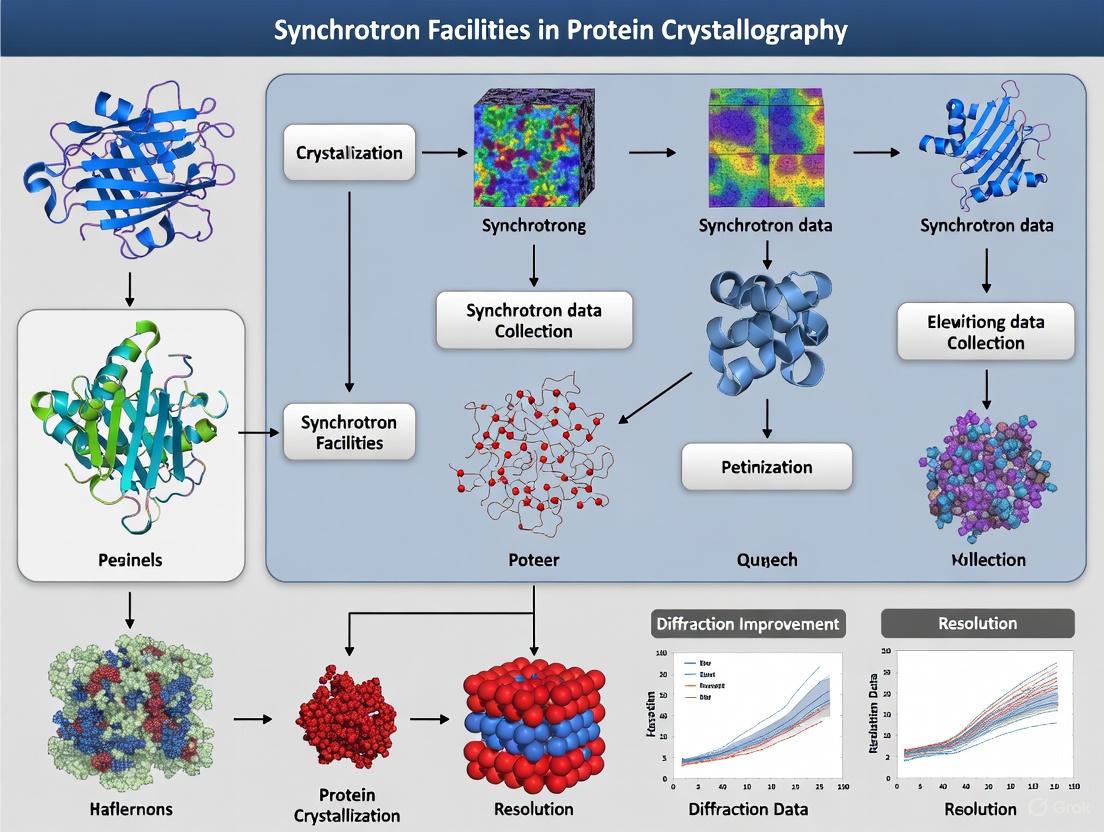
This article explores the transformative role of synchrotron facilities in protein crystallography, a cornerstone technique in modern structural biology.
Synchrotron Radiation in Protein Crystallography: Accelerating Structural Biology and Drug Discovery
Abstract
This article explores the transformative role of synchrotron facilities in protein crystallography, a cornerstone technique in modern structural biology. Aimed at researchers and drug development professionals, it covers the foundational principles of synchrotron radiation, from its historical development to current third- and fourth-generation light sources. It delves into advanced methodological applications, including high-throughput crystallography and serial synchrotron crystallography (SSX), which are crucial for studying complex biological mechanisms and membrane proteins. The article also addresses common challenges in sample preparation and data collection, offering troubleshooting and optimization strategies to maximize success. Finally, it provides a comparative analysis, validating the continued critical importance of synchrotron-derived structures against emerging techniques like cryo-EM and AI-predicted models, highlighting its indispensable role in structure-based drug design and the development of new therapeutics.
From Parasitic Mode to Powerhouse: The Foundation of Synchrotron Radiation in Biology
The evolution of synchrotron light sources from third-generation facilities to the fourth-generation era has fundamentally transformed structural biology research capabilities. This whitepaper examines how synchrotron facilities, particularly those employing multi-bend achromat (MBA) technology, have revolutionized protein crystallography by enabling studies of increasingly challenging biological systems. We document the technical specifications and performance metrics of modern beamlines, detail experimental methodologies for cutting-edge approaches like serial crystallography, and analyze the direct implications for drug discovery pipelines. The integration of these advanced capabilities with complementary structural techniques has established synchrotron facilities as indispensable tools for elucidating biological mechanisms and facilitating structure-based drug design.
The impact of structural biology over the past five decades has been tremendous, with protein structures providing fundamental insights into biological function, molecular interactions, and the mechanistic underpinnings of life itself [1]. Macromolecular structures have become essential tools for rational drug development and engineering of enzymes for green chemistry applications. The growth of this field is quantitatively demonstrated by the Protein Data Bank (PDB), which has expanded from its inaugural 7 structures to a repository containing over 220,000 structures as of August 2024 [1]. This exponential growth has been critically dependent on parallel advances in synchrotron radiation sources, which have evolved through multiple generations to dramatically enhance the capabilities of macromolecular crystallography (MX).
The transition to fourth-generation synchrotron facilities using multi-bend achromat (MBA) technology represents the most recent revolutionary leap, delivering significant reductions in electron beam emittance that result in increased X-ray brightness and coherence [1]. These technical advances produce more stable X-ray beams that enable faster data collection, reducing experimental time requirements and opening new possibilities for high-throughput crystallography applications. The enhanced beam characteristics have been particularly transformative for studying difficult-to-crystallize targets such as membrane proteins and large complexes, while simultaneously enabling time-resolved studies of enzymatic mechanisms.
The Evolution of Synchrotron Facilities and Beamline Capabilities
The development of synchrotron facilities has progressed through distinct generations characterized by fundamental improvements in source design and performance. Third-generation sources provided substantial gains in brightness through the implementation of insertion devices such as undulators and wigglers. However, the introduction of multi-bend achromat lattice structures in fourth-generation machines represents a qualitative leap in performance, enabling dramatic reductions in emittance that yield X-ray beams with unprecedented brightness and coherence [1].
The MAX IV Laboratory in Lund, Sweden, stands as the pioneer of fourth-generation storage ring technology, having been inaugurated in 2016 as the first facility to implement MBA technology in its storage ring design [1]. The 3 GeV ring at MAX IV, with a 528 m circumference operating at 400 mA current, has achieved a horizontal emittance of just 328 pm rad [1]. This exceptional performance establishes it as an ideal source for hard X-ray experiments including protein crystallography, providing the foundation for two dedicated protein crystallography beamlines: BioMAX and MicroMAX.
Complementary Beamline Design at MAX IV
The strategic design of BioMAX and MicroMAX exemplifies how modern synchrotron facilities optimize beamline capabilities to address diverse research needs while maintaining some operational overlap for flexibility [1].
BioMAX is conceived as a versatile, stable, high-throughput beamline catering to most protein crystallography experiments [1]. Its technical configuration includes an in-vacuum, room temperature permanent magnet undulator with an 18 mm magnetic period, 111 periods, and a minimum gap of 4.2 mm [1]. The beamline employs an Si(111) horizontal double-crystal monochromator followed by Kirkpatrick-Baez (KB) focusing mirrors, enabling stable operation between 6-24 keV with a relative bandwidth of 2×10⁻⁴ [1]. BioMAX offers four major focusing modes (100×100 μm², 50×50 μm², 20×20 μm², and 20×5 μm²), with the 50×50 μm² option being predominantly used as it aligns with average crystal sizes typically employed by users [1].
MicroMAX represents a more specialized facility dedicated to serial crystallography approaches including time-resolved experiments [1]. As the latest addition to MAX IV's structural biology portfolio, becoming operational in 2024, it is designed to exploit the special characteristics of fourth-generation beamlines provided by the 3 GeV ring [1]. The beamline shares common instruments, control software, computing facilities, and support staff with BioMAX, benefiting from integrated development while concentrating on advancing specific capabilities for serial crystallography.
Table 1: Technical Specifications of MAX IV Protein Crystallography Beamlines
| Parameter | BioMAX | MicroMAX |
|---|---|---|
| Primary Focus | High-throughput macromolecular crystallography | Serial crystallography and time-resolved studies |
| X-ray Source | In-vacuum undulator (18 mm period) | Fourth-generation MBA source |
| Energy Range | 6-24 keV | Optimized for serial experiments |
| Focusing Modes | 100×100 μm², 50×50 μm², 20×20 μm², 20×5 μm² | Specialized for microcrystals |
| Special Capabilities | Continuous fast energy scanning (~1 s for absorption spectra) | Time-resolved measurements from ms to μs |
| Sample Environment | Automated sample changer (464 samples), room temperature capability | Optimized for serial sample delivery |
Additional Specialized Facilities
Beyond the dedicated protein crystallography beamlines, MAX IV hosts complementary facilities that expand the experimental possibilities for structural biologists. The FragMAX fragment-based drug discovery platform is hosted at BioMAX, supporting screening campaigns directly at the beamline [1]. Additionally, the FemtoMAX beamline at the short pulse facility located at the end of the linear accelerator enables protein diffraction experiments exploring ultrafast time resolution, bridging the gap between synchrotron and X-ray free-electron laser (XFEL) capabilities [1].
Technical Advancements Enabling New Biological Insights
Serial Crystallography: Overcoming Traditional Limitations
Serial crystallography (SX) has emerged as a transformative methodology that liberates researchers from traditional constraints of macromolecular crystallography. This approach revolutionized structural biology by enabling high-resolution structure determination for important classes of proteins that were previously intractable, including studies of relevant biomolecular reaction mechanisms [2]. The technique addresses one of the most significant historical challenges in structural biology: the requirement for large, well-diffracting single crystals.
The fundamental principle of serial crystallography involves collecting diffraction data from thousands of microcrystals, with each crystal typically exposed to X-rays only once before replacement [2]. This "diffraction before destruction" approach was initially pioneered at X-ray free-electron lasers (XFELs), where ultra-bright femtosecond X-ray pulses outrun radiation damage processes [3]. The method was subsequently adapted for synchrotron sources as serial millisecond crystallography (SMX), leveraging the increased brightness of modern beamlines to enable data collection from crystal slurries [2].
The implementation of SX at synchrotron sources has been particularly enabled by the improved performance of fourth-generation facilities [1]. The higher brightness and stability of MBA-based beamlines allow for precise focusing to micrometer-sized beams, making it possible to employ serial crystallography approaches with micrometre-sized crystals [1]. This capability has opened new opportunities for studying membrane proteins and other challenging systems that typically produce only microcrystals in crystallization experiments.
Sample Consumption and Delivery Methodologies
A persistent challenge in serial crystallography has been the efficient utilization of precious macromolecular samples, whose availability is often limited [2]. Early SX experiments required gram quantities of purified protein, making studies of biologically and medically relevant targets prohibitive for many research groups [2]. Advances in sample delivery technologies have progressively reduced these requirements, with modern approaches consuming microgram amounts rather than milligrams [2].
Table 2: Sample Delivery Methods for Serial Crystallography
| Delivery Method | Mechanism | Advantages | Sample Consumption |
|---|---|---|---|
| Liquid Injection | Continuous jet of crystal suspension | High data collection rates | Historically high (grams), now reduced to milligrams |
| Fixed-Target | Crystals loaded on reusable chips | Minimal sample waste between pulses | Microgram amounts achievable |
| High-Viscosity Extrusion | Crystal suspension in viscous matrix | Reduced flow rates, lower background | Significantly reduced consumption |
| Hybrid Methods | Combination of approaches | Customized for specific experiments | Variable, optimized for specific needs |
The theoretical minimum sample requirement for a complete SX dataset has been estimated based on specific experimental parameters. Assuming 10,000 indexed patterns are sufficient for a full dataset, with microcrystal dimensions of 4×4×4 μm and a protein concentration in the crystal of approximately 700 mg/mL, the ideal sample consumption would be approximately 450 ng of protein [2]. While practical implementations have not yet reached this theoretical minimum, current methodologies have dramatically reduced sample requirements compared to early SX experiments.
Time-Resolved Studies: Capturing Molecular Movies
The high brightness and rapid data collection capabilities of modern synchrotron beamlines have enabled time-resolved structural studies that capture enzymatic reactions and conformational changes in real time. Time-resolved serial femtosecond crystallography (TR-SFX) experiments can be performed using photosensitive proteins with pump-probe lasers to study light-activated proteins with typical reaction timescales from microseconds to femtoseconds [2]. An alternative approach, mix-and-inject serial crystallography (MISC), involves mixing reactants and substrates with protein crystals to induce conformational changes immediately before X-ray exposure, enabling structural studies over second to sub-millisecond timescales [2].
These time-resolved approaches have led to the conceptualization of "molecular movies" that allow researchers to visualize various biomolecular reactions as they occur [2]. The ability to capture intermediate states in enzymatic cycles and signaling processes provides unprecedented insights into biological mechanism that static structures cannot reveal.
Experimental Protocols for Serial Crystallography
Sample Preparation and Characterization
Successful serial crystallography experiments require optimization of microcrystal growth conditions and thorough characterization of crystal quality and size distribution. The following protocol outlines key steps for sample preparation:
Microcrystal Optimization: Screen crystallization conditions using standard vapor diffusion or batch methods while varying precipitant concentration, temperature, and incubation time to identify conditions yielding abundant microcrystals (1-20 μm in size).
Size Homogenization: Pass crystal suspensions through appropriately sized mesh filters or perform density gradient centrifugation to ensure uniform crystal size distribution, which improves data quality and reduces sample consumption.
Crystal Stability Assessment: Monitor diffraction quality over time using a test dataset collected at a synchrotron microfocus beamline to ensure crystals maintain integrity during data collection.
Concentration Adjustment: Concentrate crystal suspensions to optimal density (typically 10⁸-10¹⁰ crystals/mL) using gentle centrifugation or filtration to balance hit rate against crystal wastage.
Fixed-Target Data Collection
Fixed-target approaches offer minimal sample consumption and are particularly suitable for precious samples where crystal supply is limited:
Chip Loading: Apply 0.5-2 μL of crystal suspension to fixed-target chips composed of low-X-ray-background materials such as silicon nitride or polymer-based substrates.
Excess Solution Removal: Briefly blot chips to remove excess mother liquor while maintaining crystal hydration, typically leaving a thin film of approximately 1-5 μm thickness.
Mounting and Alignment: Secure the chip in the beamline sample holder and align using on-axis video microscopy to ensure the crystal-containing region is positioned in the X-ray beam path.
Raster Scanning: Program a raster pattern with step size matching the beam diameter (typically 5-20 μm) to ensure most crystals are centered during exposure while minimizing repeated measurements of the same crystal.
Data Collection: Collect diffraction patterns at each raster position with exposure times typically ranging from 1-100 ms per location depending on beam intensity and crystal diffracting power.
Liquid Jet Injection for Time-Resolved Studies
Liquid injection methods enable truly continuous data collection and are preferred for time-resolved experiments:
Injector Setup: Assemble gas dynamic virtual nozzle (GDVN) or similar liquid injector system, ensuring all components are clean and properly aligned.
Sample Loading: Transfer crystal suspension into the injector reservoir, taking care to avoid introduction of air bubbles that would disrupt stable jet formation.
Jet Optimization: Adjust flow rate (typically 10-50 μL/min) and nozzle position to establish a stable liquid jet of consistent diameter (10-50 μm) at the X-ray interaction point.
Beline Synchronization: Synchronize X-ray pulse timing with jet position for maximum hit rate, typically achieved through optical imaging and feedback systems.
Data Collection: Continuously collect diffraction patterns at the maximum repetition rate supported by the detector system, typically achieving hit rates of 5-20% depending on crystal density and jet stability.
Visualization of Serial Crystallography Workflow
The following diagram illustrates the integrated workflow for serial crystallography experiments at modern synchrotron facilities:
Diagram 1: Serial Crystallography Workflow. This flowchart illustrates the comprehensive process from sample preparation to final structure deposition, highlighting the iterative data collection and processing steps characteristic of serial methods.
The Scientist's Toolkit: Essential Research Reagents and Materials
Table 3: Key Research Reagents and Materials for Synchrotron-Based Crystallography
| Item | Function | Application Notes |
|---|---|---|
| Crystallization Screens | Initial identification of crystallization conditions | Commercial sparse matrix screens (e.g., from Hampton Research) cover diverse chemical space |
| Microseeding Tools | Improve crystal size and quality homogeneity | Essential for generating microcrystals suitable for serial studies |
| Cryoprotectants | Prevent ice formation during cryo-cooling | Glycerol, ethylene glycol, or sucrose solutions at appropriate concentrations |
| Fixed-Target Chips | Sample support for minimal consumption approaches | Silicon nitride membranes or polymer-based chips with predefined apertures |
| Liquid Injectors | Continuous sample delivery for time-resolved studies | Gas dynamic virtual nozzles (GDVNs) provide stable micron-diameter jets |
| Sample Pucks/Cassettes | Standardized sample storage and handling | UNI pucks compatible with automated sample changers enable high-throughput |
| Crystal Harvesting Tools | Manipulation of microcrystals | Specialized loops and micromeshes for crystal mounting and cryo-cooling |
Impact on Drug Discovery and Future Perspectives
The advanced capabilities of modern synchrotron beamlines have profoundly impacted structure-based drug design, particularly through the implementation of fragment-based drug discovery (FBDD) platforms. The FragMAX platform at BioMAX exemplifies this integration, enabling direct screening of fragment libraries against pharmaceutical targets at the beamline [1]. This approach leverages the high-throughput capabilities of fourth-generation beamlines to rapidly identify and characterize weak-binding fragments that can be developed into potent drug leads.
The future development of synchrotron-based structural biology will focus on further integration of complementary techniques, including small-angle X-ray scattering (SAXS) and cryo-electron microscopy (cryo-EM) [1]. This multi-modal approach will provide comprehensive insights into macromolecular function across multiple spatial and temporal resolutions. Additionally, ongoing developments in sample delivery methods aim to further reduce sample requirements, potentially approaching the theoretical minimum of 450 ng of protein per complete dataset [2]. These advancements will continue to expand the accessible range of biological targets, particularly for proteins that are difficult to express or purify in large quantities.
As synchrotron facilities continue to evolve, the accidental tool that revolutionized structural biology has become an indispensable foundation for understanding biological mechanism and developing therapeutic interventions. The integration of advanced beamline capabilities with innovative experimental approaches ensures that synchrotron-based structural biology will remain central to biological discovery for decades to come.
Synchrotron radiation, the powerful electromagnetic light produced by particle accelerators, has fundamentally transformed structural biology. Within protein crystallography, its unique properties have enabled researchers to determine the three-dimensional structures of biological molecules with unprecedented speed and precision, providing critical insights for understanding disease mechanisms and guiding rational drug design [4] [5]. This technical guide details the core properties of this exceptional light source and its pivotal role in modern scientific discovery.
Key Properties of Synchrotron Radiation
The utility of synchrotron radiation in protein crystallography stems from a combination of exceptional properties that far surpass those of conventional laboratory X-ray sources.
Table 1: Key Properties of Synchrotron Radiation and Their Impact on Protein Crystallography
| Property | Technical Description | Significance for Protein Crystallography |
|---|---|---|
| High Brilliance | Ultra-high photon flux per unit area, solid angle, and bandwidth [6]. | Enables data collection from micro-crystals and weakly diffracting samples [4]. |
| Broad Spectrum | Continuous wavelength range from infrared to hard X-rays [4]. | Allows tuning to optimal wavelengths for experiments like MAD phasing [4]. |
| High Collimation | Light emitted with very low divergence (nearly parallel beams) [4]. | Results in higher resolution diffraction data and sharper spots on detectors. |
| Pulsed Time Structure | Light emitted in short, femtosecond-to-picosecond pulses [6]. | Facilitates time-resolved studies to observe molecular dynamics in real-time [6]. |
| Partial Coherence | High degree of spatial coherence [6]. | Enables advanced imaging techniques and methods to mitigate radiation damage. |
| Polarization | Primarily linearly polarized in the plane of the electron orbit. | Reduces background noise in certain experimental geometries. |
The historical impact is clear; early experiments demonstrated that synchrotron radiation could provide at least 60 times greater diffracted intensity than a sealed X-ray tube, allowing data collection to higher resolution from smaller crystals [4].
The Role of Synchrotron Light in Protein Crystallography
The properties of synchrotron radiation directly address key challenges in protein crystallography.
Overcoming Technical Limitations
The high intensity and brilliance of synchrotron beams mitigate the primary bottlenecks of crystallography. Researchers can now work with crystals that are orders of magnitude smaller than previously possible. Furthermore, the tunable nature of the source allows for the optimization of anomalous scattering, which is fundamental to solving the crystallographic "phase problem" [4].
Enabling Cutting-Edge Methodologies
- Serial Femtosecond Crystallography (SFX): Performed at X-ray free-electron lasers (XFELs) like the Linac Coherent Light Source (LCLS), this technique uses ultra-bright, femtosecond pulses to obtain high-resolution data from a stream of microcrystals before the onset of radiation damage [6].
- Time-Resolved Studies: The pulsed time structure of synchrotrons and XFELs enables "molecular movies," allowing scientists to image transient states and functional dynamics of proteins at atomic resolution [6].
- Operando and In Situ Studies: The high penetration of high-energy beams allows for novel experimental setups, such as studying the atomic structure of battery electrode materials while the battery is charging or discharging [7].
Experimental Protocols & Workflows
Leveraging synchrotron light requires specialized experimental setups and protocols.
Key Experimental Methodology: Operando X-ray Diffraction
This protocol is used to study structural changes in functional devices, such as a battery, in real-time [7].
- Sample Environment Preparation: A specially designed battery test cell is constructed. This cell must allow the X-ray beam to penetrate through the entire battery assembly, including its casing and electrodes [7].
- Synchrotron Beamline Setup: The experiment is conducted at a beamline equipped for high-energy, penetrating diffraction. The beam is focused on the sample [7].
- Data Collection: The battery is connected to a cycler and placed in the beam path. A sequence of high-resolution X-ray diffraction images is collected continuously at regular intervals (e.g., every 10-30 seconds) during battery charge and discharge cycles [7].
- Data Processing & Analysis: The series of diffraction images are processed to create an "X-ray movie." Changes in the diffraction patterns are analyzed to reveal how the atomic structure of the electrode materials evolves during operation [7].
Key Experimental Methodology: Serial Femtosecond Crystallography (SFX)
This protocol describes the general workflow for collecting data at an XFEL [6].
- Sample Delivery: A suspension of microcrystals is injected into the path of the X-ray pulses in a continuous stream or as droplets.
- Pump-Probe Initiation (for time-resolved studies): A laser pulse ("pump") is fired to initiate a photochemical reaction in the crystals. After a precisely controlled time delay, an X-ray pulse ("probe") arrives to collect the diffraction pattern.
- Data Acquisition: The ultrashort X-ray pulse (<100 femtoseconds) diffracts from a single microcrystal, and a "snapshot" is recorded on a high-speed detector before the crystal is destroyed. This process is repeated for thousands of crystals in random orientations.
- "Still" Shot Indexing: The individual diffraction snapshots are indexed and integrated using specialized software.
- Data Merging: The integrated intensities from hundreds of thousands of snapshots are merged to produce a complete, high-resolution dataset.
Experimental Workflow Visualization
The following diagram illustrates the logical flow of a time-resolved SFX experiment at an XFEL.
The Scientist's Toolkit: Essential Research Reagents & Materials
Successful synchrotron-based research relies on specialized tools and computational resources.
Table 2: Essential Tools and Resources for Synchrotron-Based Research
| Tool / Resource | Category | Primary Function |
|---|---|---|
| Specialized Sample Cells | Sample Environment | Allows X-ray penetration and controlled conditions for operando studies (e.g., of batteries) [7]. |
| Grating Monochromators | Beamline Optics | Selects a specific wavelength from the broad synchrotron spectrum for the experiment [6]. |
| Laue Analyzer Crystals | Instrumentation | Used in advanced spectrometers to achieve high energy resolution for emission studies [6]. |
| Serial Crystallography Injectors | Sample Delivery | Delivers a continuous stream of microcrystals into the X-ray beam for SFX experiments [6]. |
| Synchrotron Radiation Workshop (SRW) | Software | A powerful tool for simulating the propagation of synchrotron radiation through beamline optics and samples [8]. |
| Conditional Generative Adversarial Networks (cGANs) | Software/Data Processing | A machine learning approach used to suppress artifacts (e.g., from air) in phase-contrast micro-CT data, improving visualization [6]. |
The unique properties of synchrotron radiation—high brilliance, broad spectrum, and pulsed time structure—have made it an indispensable tool for protein crystallography. By enabling the study of smaller crystals, more complex molecular machines, and faster dynamic processes, it continues to push the boundaries of structural biology. As synchrotron facilities worldwide undergo continuous upgrades, the brightness and capabilities of these light sources will only increase, ensuring their central role in scientific innovation and drug development for years to come.
Synchrotron light sources have revolutionized the field of structural biology, enabling scientists to determine the three-dimensional structures of biological molecules at atomic resolution. For protein crystallography, which informs on the function of biological molecules and drives processes in drug development and green chemistry, synchrotron radiation has been transformative [1]. The growth of structural information is evidenced by the Protein Data Bank, which has expanded from an initial 7 structures to over 220,000 structures today, largely enabled by synchrotron-based macromolecular crystallography (MX) [1]. This technical guide traces the evolution of synchrotron technology through four distinct generations, examining how each advancement has expanded capabilities for protein structure determination within the broader context of a thesis on the role of synchrotron facilities in protein crystallography research.
The exceptional importance of X-rays was recognized from their discovery in 1895, with Röntgen receiving the first Nobel Prize in Physics in 1901 [9]. However, synchrotron radiation itself was first observed decades later on April 24, 1947, at the General Electric Research Laboratory in Schenectady, New York [9] [10]. This discovery initiated a technological revolution that has seen the brightness of X-ray sources increase by approximately 12 orders of magnitude over 60 years, with each generation of synchrotrons bringing new capabilities to protein crystallography [11].
The Theoretical Foundation of Synchrotron Radiation
The theoretical basis for synchrotron radiation dates to the late 19th century. In 1897, Larmor derived an expression for the instantaneous total power radiated by an accelerated charged particle from classical electrodynamics [9]. Liénard extended this result in 1898 to the case of a relativistic particle undergoing centripetal acceleration in a circular trajectory, showing the radiated power to be proportional to (E/mc²)⁴/R², where E is particle energy, m is the rest mass, and R is the trajectory radius [9]. Later work by Schwinger in the 1940s provided a detailed classical theory of radiation from accelerated relativistic electrons, demonstrating major features including the strongly forward-peaked distribution that gives synchrotron radiation its highly collimated property [9].
Synchrotron radiation is characterized by several unique properties that make it particularly valuable for protein crystallography: high brilliance (photons per second per unit area per solid angle per bandwidth), broad spectral distribution from infrared to hard X-rays, strong polarization, and pulsed time structure [11]. The spectral distribution is characterized by the critical energy (εc), which depends on the electron beam energy (Ee) and magnetic field (B), expressed as εc(keV) = 0.665Ee²(GeV)B(T) [11]. For a typical 3 GeV storage ring, this provides useful photon energies up to about 30 keV, ideal for protein crystallography experiments.
First Generation: Parasitic Facilities
The first generation of synchrotron radiation facilities emerged as parasitic operations on accelerators built primarily for high-energy physics research [9] [12]. The first experimental program using synchrotron radiation began in 1961 when the National Bureau of Standards modified its 180-MeV electron synchrotron to allow access to radiation via a tangent section into the machine's vacuum system [9]. This facility, named SURF (Synchrotron Ultraviolet Radiation Facility), began measurements to determine the potential of synchrotron radiation for standards and spectroscopy in the ultraviolet region [9].
Early first-generation facilities also included the 1.15-GeV synchrotron at Frascati laboratory near Rome, where researchers measured absorption in thin metal films, and the 750-MeV synchrotron in Tokyo, where scientists formed the INS-SOR group and made measurements of soft X-ray absorption spectra of solids by 1965 [9]. A significant advancement came with the use of the 6-GeV Deutsches Elektronen-Synchrotron (DESY) in Hamburg, which began operating in 1964 and provided synchrotron radiation at wavelengths in the X-ray region down to 0.1 Å [9]. Despite their parasitic nature, these first-generation facilities demonstrated the potential of synchrotron radiation for scientific research, particularly in spectroscopy and absorption measurements.
Table 1: Key Characteristics of First-Generation Synchrotron Facilities
| Facility | Location | Energy | Primary Research Applications |
|---|---|---|---|
| NBS (SURF) | USA | 180 MeV | Ultraviolet standards and spectroscopy |
| Frascati Synchrotron | Italy | 1.15 GeV | Absorption in thin metal films |
| INS-SOR | Japan | 750 MeV | Soft X-ray absorption spectra of solids |
| DESY | Germany | 6 GeV | Spectral distribution verification, absorption measurements |
Second Generation: Dedicated Storage Rings
Second-generation synchrotron light sources represented a significant advancement through the development of dedicated electron storage rings designed specifically to produce synchrotron radiation [12]. These facilities, including BESSY I in Berlin and the National Synchrotron Light Source (NSLS) at Brookhaven, employed storage rings where electrons circulated at constant energy, with radiation loss replenished by RF power [11]. The key innovation was that these facilities were optimized specifically for synchrotron radiation production rather than particle physics.
The transition to storage rings provided more stable and reliable beams for experimental users. These facilities incorporated bending magnets as the primary source of synchrotron radiation, where electrons were deflected by uniform magnetic fields to produce broadband radiation [12]. The second generation established the dedicated user facility model, where scientists from various disciplines could apply for beamtime to conduct experiments, laying the foundation for the expanding scientific applications of synchrotron radiation.
Third Generation: Insertion Devices and Beamline Optimization
Third-generation synchrotron light sources marked another substantial leap forward by optimizing the intensity of radiation through the incorporation of long straight sections in the storage rings for "insertion devices" - undulator and wiggler magnets [12]. These facilities, including the European Synchrotron Radiation Facility (ESRF) in France, the Advanced Photon Source (APS) in the United States, and SPring-8 in Japan, represented the state of the art for decades [13].
Insertion devices dramatically enhanced the capabilities of synchrotron sources. Wigglers create a broad but intense beam of incoherent light, effectively extending the usable photon energy range to higher energies through larger magnetic fields [11]. Undulators, consisting of periodic magnet structures with many periods, produce a narrower and significantly more intense beam of coherent light through constructive interference of emission as electrons traverse each period [10]. The radiation from undulators is characterized by the dimensionless deflection parameter K, calculated as K = 0.934λu(cm)Bo(T), where K < 1 defines an undulator [11].
For protein crystallography, third-generation sources enabled routine high-resolution structure determination through dedicated macromolecular crystallography beamlines. The high brilliance allowed for smaller crystals and faster data collection, while the tunability of undulator radiation facilitated advanced techniques like multi-wavelength anomalous dispersion (MAD) phasing [1].
Table 2: Major Third-Generation Synchrotron Facilities for Protein Crystallography
| Facility | Location | Energy | Notable MX Beamlines |
|---|---|---|---|
| ESRF | Grenoble, France | 6 GeV | ID23, ID29, ID30 |
| APS | Lemont, USA | 7 GeV | GM/CA-CAT, NE-CAT, SBC-CAT |
| SPring-8 | Hyōgo, Japan | 8 GeV | BL41XU, BL32XU |
| Diamond Light Source | Oxfordshire, UK | 3 GeV | I02, I03, I04, I24 |
Fourth Generation: Multi-Bend Achromats and Diffraction Limited Storage Rings
Fourth-generation synchrotron sources represent the current frontier, characterized by the implementation of multi-bend achromat (MBA) lattices in storage ring design to achieve dramatically reduced electron beam emittance [1] [10]. This technology, pioneered by MAX IV in Lund, Sweden, which opened in 2016, enables storage rings to approach the diffraction limit across a wide energy range [1] [14]. The MBA concept provides a way to control the trajectories of giga-electron-volt electrons to micrometer precision, resulting in X-ray beams with significantly increased brightness and coherence [10].
The revolutionary improvement in fourth-generation sources is quantified by brightness (or brilliance), which describes how much light a source emits per second and unit area into each solid angle over a particular bandwidth [10]. For an intrinsically incoherent source like a synchrotron, the coherence of the X-ray beam is directly proportional to the source size and inversely proportional to the distance at which it is measured [14]. The MBA lattice minimizes both the transverse size and divergence of the electron beam, increasing the coherent flux by up to a factor of 200 in the 6-10 keV energy range compared to third-generation sources [14].
Following MAX IV, other facilities have implemented MBA upgrades, including ESRF-EBS (Extremely Brilliant Source) in 2020, which achieved a 30-fold increase in brightness, and Sirius at the Brazilian Synchrotron Light Laboratory [10]. Other major facilities including the Advanced Photon Source, Advanced Light Source, SPring-8, and Diamond Light Source are pursuing similar upgrades [10]. This new generation enables techniques that demand high coherence, such as ptychography and coherent diffraction imaging, while dramatically improving the performance of more established methods like protein crystallography [14].
Table 3: Comparison of Synchrotron Generations
| Characteristic | First Generation | Second Generation | Third Generation | Fourth Generation |
|---|---|---|---|---|
| Primary Source | Bending magnets from particle physics accelerators | Bending magnets in dedicated storage rings | Undulators in optimized storage rings | Undulators in MBA lattice storage rings |
| Emittance | High | Medium | Low | Ultra-low (diffraction limited) |
| Brightness | Low | Medium | High | Very high (100-1000× improvement over 3rd gen) |
| Coherence | Minimal | Partial | Significant | High (full transverse coherence for softer X-rays) |
| Example Facilities | DESY, SURF | BESSY I, NSLS | ESRF, APS, SPring-8 | MAX IV, ESRF-EBS, Sirius |
Synchrotron Applications in Protein Crystallography: Methodologies and Workflows
Evolution of Crystallography Techniques at Synchrotrons
The development of synchrotron sources has directly enabled increasingly sophisticated protein crystallography methodologies. Traditional macromolecular crystallography (MX) requires large, well-diffracting crystals and involves collecting complete datasets from single crystals at cryogenic temperatures to mitigate radiation damage [1]. At third-generation sources, microfocus beamlines allowed work with smaller crystals (10-50 μm), while tunable beams enabled multi-wavelength anomalous dispersion (MAD) phasing [1].
The advent of fourth-generation sources has facilitated the adoption of serial crystallography approaches, particularly serial synchrotron crystallography (SSX) [1]. This method involves collecting diffraction patterns from thousands of microcrystals, with each crystal exposed only once to X-rays before replacement [2]. SSX can be performed at room temperature, enabling time-resolved studies of enzymatic reactions and the investigation of membrane proteins and other challenging systems that typically produce only microcrystals [1].
Diagram 1: Protein Crystallography Workflows
Serial crystallography at synchrotrons, often called serial millisecond crystallography (SMX), has been particularly advanced by fourth-generation sources [2]. The high brightness and coherence of MBA-based storage rings enable the collection of usable diffraction patterns from micrometer-sized crystals, while the stability of these sources supports the high data rates required for serial approaches [1].
Two primary sample delivery methods have been developed for serial crystallography. Fixed-target approaches mount microcrystals on a solid support that is raster-scanned through the X-ray beam, minimizing sample consumption by precisely positioning crystals [2]. Liquid injection methods continuously deliver crystal slurries to the interaction point via thin tubes or high-viscosity extruders, allowing high data rates but typically consuming more sample [2]. For a complete dataset requiring approximately 10,000 indexed patterns from 4×4×4 μm microcrystals with a protein concentration of ~700 mg/mL, the theoretical minimum sample consumption is approximately 450 ng of protein [2].
Time-resolved serial crystallography (TR-SX) enables the study of biomolecular reaction mechanisms by initiating reactions through light activation (for photosensitive proteins) or rapid mixing of substrates with enzymes [2]. The mix-and-inject serial crystallography (MISC) approach combines reactants with protein crystals immediately before X-ray exposure to study structural changes on timescales from seconds to sub-milliseconds [2].
Table 4: Sample Delivery Methods for Serial Crystallography
| Method | Principle | Advantages | Limitations | Sample Consumption |
|---|---|---|---|---|
| Fixed-Target | Crystals mounted on solid support and raster-scanned | Minimal sample consumption, compatible with various sample environments | Lower data rate, potential crystal harvesting issues | As low as micrograms |
| Liquid Injection | Crystal slurry continuously delivered to beam | High data rate, efficient for abundant samples | High sample consumption, jetting stability issues | Typically milligrams |
| High-Viscosity Extrusion | Crystal suspension in viscous matrix | Reduced flow speed, lower sample consumption | Potential background scattering, matrix compatibility | Hundreds of micrograms |
The Scientist's Toolkit: Essential Research Reagents and Materials
Table 5: Key Research Reagent Solutions for Protein Crystallography
| Reagent/Material | Function | Application in Experiments |
|---|---|---|
| Crystallization Screens | Sparse matrix of chemical conditions to promote crystal formation | Initial crystal screening and optimization |
| Cryoprotectants | Prevent ice formation during cryo-cooling | Crystal preservation for data collection at cryogenic temperatures |
| LCP (Lipidic Cubic Phase) | Membrane mimetic environment for crystallization | Particularly for membrane proteins |
| High-Viscosity Carriers | Matrix for crystal suspension and delivery | High-viscosity extrusion serial crystallography |
| Microfluidic Chips | Miniaturized platforms for crystal growth and manipulation | High-throughput screening and fixed-target data collection |
| In Situ Crystallization Plates | Integrated crystal growth and data collection platforms | Minimizing crystal handling damage |
Case Study: MAX IV - A Fourth-Generation Facility for Protein Crystallography
The MAX IV Laboratory in Lund, Sweden represents the pioneering implementation of fourth-generation synchrotron technology, featuring a 3 GeV storage ring with a 528 m circumference that achieves a horizontal emittance of 328 pm rad through its multi-bend achromat lattice [1]. This facility operates two dedicated protein crystallography beamlines - BioMAX and MicroMAX - designed to complement each other while maintaining some experimental overlap [1].
BioMAX serves as a versatile, stable, high-throughput beamline catering to most protein crystallography experiments [1]. Its technical specifications include an in-vacuum, room temperature permanent magnet undulator with an 18 mm magnetic period, an Si(111) double-crystal monochromator, and Kirkpatrick-Baez focusing mirrors that provide a stable beam between 6-24 keV [1]. The beamline offers four major focusing modes (100×100, 50×50, 20×20, and 20×5 μm²) and is equipped with an ISARA robotics sample changer capable of storing 464 samples [1]. Continuous fast energy scanning enables measurement of X-ray absorption spectra near absorption edges in approximately one second [1].
MicroMAX, operational since 2024, specializes in serial crystallography including time-resolved experiments [1]. Designed to exploit the special characteristics of fourth-generation beamlines, it enables data collection from micrometre-sized crystals using serial approaches, particularly valuable for membrane proteins and other challenging systems that typically produce only microcrystal slurries [1]. Additionally, MAX IV hosts the FragMAX platform for fragment-based drug discovery and the FemtoMAX beamline for studying ultrafast structural dynamics in proteins [1].
The performance advantages of fourth-generation sources are quantifiable in experimental outcomes. At the NanoMAX beamline of MAX IV, Bragg ptychography experiments demonstrated the ability to retrieve high-quality images of crystalline samples with unprecedented quality, achieving results that would not be possible with third-generation sources due to limited coherent flux [14]. The increased available coherent flux produces datasets with sufficient information to overcome experimental limitations such as deteriorated scanning conditions, making advanced microscopy methods more accessible and suitable for high-throughput studies [14].
The evolution from first-generation to fourth-generation synchrotron sources represents a remarkable technological journey that has fundamentally transformed protein crystallography and structural biology. Each generation has brought orders-of-magnitude improvements in source performance, particularly in brilliance and coherence, enabling increasingly sophisticated experiments with smaller samples, higher resolution, and time-resolved capabilities.
The ongoing development of synchrotron light sources continues to push scientific boundaries. Future directions include further optimization of MBA lattices, development of diffraction-limited storage rings for higher energy ranges, and increased integration between storage rings and free-electron lasers [10]. The challenges of fourth-generation facilities - including managing vast data volumes, developing high-speed detectors, and creating automated experimental workflows - are being addressed through synergies with X-ray free-electron laser facilities [10].
For protein crystallography, fourth-generation synchrotrons enable structural biology to address increasingly complex biological questions. The integration of crystallography with complementary techniques like cryo-electron microscopy and small-angle X-ray scattering provides comprehensive views of biological systems [1]. High-throughput approaches facilitated by these sources allow crystallography to be used as a screening method in drug discovery, while time-resolved studies provide "molecular movies" of enzymatic reactions and biological processes [1] [2].
In conclusion, the generational progress in synchrotron technology has positioned these facilities as indispensable tools for understanding biological systems at atomic resolution. From their origins as parasitic operations on particle physics accelerators to the dedicated, ultra-bright sources of today, synchrotrons have continually expanded the frontiers of structural biology. As fourth-generation facilities mature and new technologies emerge, synchrotron-based protein crystallography will continue to drive advances in basic science, drug development, and our fundamental understanding of life processes.
The determination of macromolecular structures through X-ray crystallography has been revolutionized by the development of anomalous diffraction methods, which directly address the fundamental phase problem in crystallography. These techniques, predominantly multi-wavelength anomalous diffraction (MAD) and single-wavelength anomalous diffraction (SAD), now dominate de novo structure determination of biological macromolecules. This transformation has been enabled by tunable X-ray sources at synchrotron facilities, which provide the precise wavelength control required to exploit elemental absorption edges. Within the broader context of synchrotron facilities' role in structural biology, this technical guide examines the physical principles, methodologies, and cutting-edge applications of anomalous dispersion techniques that have become cornerstone approaches in modern drug development and protein engineering.
The Phase Problem in X-ray Crystallography
Fundamental Challenge
In X-ray crystallography, diffraction patterns from crystals contain decisive information for determining atomic-level structures. When X-rays scatter from a crystal, we measure the intensities of the diffracted waves, from which we can derive the amplitudes of the structure factors. However, the experimental measurement systematically loses information about the phase of these diffracted waves [15] [16]. This constitutes the fundamental phase problem: without phase information, atomic positions cannot be directly determined from diffraction data alone [17].
The electron density ρ(xyz) at a position in the unit cell is calculated by the Fourier synthesis: [ ρ(xyz) = \frac{1}{V} \sum{h} \sum{k} \sum{l} |F{hkl}| \cos[2π(hx + ky + lz) - α{hkl}] ] where |Fhkl| represents the structure factor amplitude and α_hkl is the required phase angle for each reflection (hkl) [17]. The critical importance of phases is visually demonstrated when calculated electron density maps using correct phases yield interpretable atomic structures, while maps with incorrect phases are unrecognizable.
Historical Solutions
Traditional approaches to solving the phase problem in macromolecular crystallography included:
- Multiple Isomorphous Replacement (MIR): Using heavy-atom derivatives to create isomorphic crystals [15]
- Molecular Replacement: Using known structures of homologous proteins [16] [17]
- Direct Methods: Extracting phase information from intensity relationships (effective only at very high resolution) [17]
These methods presented significant challenges including the need for multiple crystals, difficulties finding suitable heavy-atom derivatives, and limitations for novel structures without known homologs.
Physical Basis of Anomalous Scattering
Theoretical Foundation
Anomalous scattering arises from interactions between X-rays and bound electrons in atomic orbitals. Unlike the "normal" Thomson scattering from free electrons, anomalous scattering occurs when the X-ray frequency approaches resonant frequencies of electronic transitions [15]. This phenomenon perturbs the atomic scattering factor, making it a complex quantity:
[ f = f^\circ + f^\Delta = f^\circ + |f^\Delta|e^{iδ} = f^\circ + f' + if'' ]
where:
- (f^\circ) is the normal atomic scattering factor
- (f') is the real part of the anomalous dispersion correction
- (f'') is the imaginary part of the anomalous dispersion correction [15] [18]
The (f'') component is related to absorption and is maximum at the absorption edge, while (f') decreases sharply through the absorption edge [15]. These wavelength-dependent effects create measurable differences in diffraction intensities that contain phase information.
Breakdown of Friedel's Law
In conventional scattering, Friedel's law states that |F(hkl)| = |F(-h-k-l)| for a given reflection and its Friedel mate. Anomalous scattering causes breakdown of this symmetry, creating measurable differences between |F(+)| and |F(-)| [19]. These anomalous differences provide the key experimental observables that enable phase determination in SAD and MAD methods.
Table 1: Characteristics of Anomalous Scattering Components
| Component | Symbol | Physical Meaning | Spectral Behavior |
|---|---|---|---|
| Normal scattering | (f^\circ) | Thomson scattering from free electrons | Decreases with scattering angle |
| Real anomalous component | (f') | Dispersion correction | Decreases sharply at absorption edge |
| Imaginary anomalous component | (f'') | Absorption component | Maximum at absorption edge |
Anomalous Diffraction Methodologies
Multi-Wavelength Anomalous Diffraction (MAD)
The MAD method exploits anomalous scattering effects at multiple wavelengths near an absorption edge of an incorporated element. By collecting data at different wavelengths, the variations in both (f') and (f'') components provide sufficient information to determine phases [15] [18].
Key requirements for MAD phasing:
- Tunable X-ray source (synchrotron radiation)
- Element with strong anomalous scattering signal (selenium, sulfur, metals)
- Data collection at 2-3 wavelengths optimally chosen around absorption edge
The typical MAD experiment utilizes:
- Remote wavelength (above edge, low (f''))
- Peak wavelength (maximum (f''))
- Inflection point (maximum change in (f'))
Single-Wavelength Anomalous Diffraction (SAD)
SAD phasing uses anomalous diffraction data collected at a single wavelength, making it more efficient but potentially more challenging [19]. The technique leverages both the anomalous differences and the heavy-atom substructure information to resolve phase ambiguities [19].
Advantages of SAD:
- Single data set collection
- No non-isomorphism issues
- Does not require scanning across absorption edge
- Wider range of usable anomalous scatterers [19]
SAD has become the dominant method for de novo structure determination due to its efficiency and reliability, particularly with selenomethionine-labeled proteins.
Synchrotron Enabling Technology
Synchrotron radiation provides the essential characteristics for anomalous diffraction experiments:
- High spectral brightness: Enables measurement of weak anomalous signals
- Tunability: Precise wavelength selection for optimizing anomalous signals
- Beam stability: Essential for accurate measurement of small intensity differences [20]
The development of third-generation synchrotron sources (ESRF, APS, SPring-8) dramatically expanded MAD and SAD capabilities through increased flux and beam stability [20]. Modern facilities operate in "top-up" mode to maximize X-ray output and stability, improving accuracy in measuring weak anomalous signals [20].
Current Source Developments
Recent advancements continue to enhance anomalous diffraction capabilities:
- Ultimate storage ring designs: MAX IV and ESRF Upgrade Phase II promise increased coherence and flux density [20]
- X-ray free-electron lasers (XFELs): Enable time-resolved studies and damage-free diffraction [20] [21]
- Two-colour XFEL operation: Simultaneous data collection at two wavelengths for MAD phasing [21]
Table 2: Evolution of Synchrotron Sources for Anomalous Diffraction
| Generation | Key Facilities | Impact on Anomalous Diffraction |
|---|---|---|
| First Generation | SPEAR, DORIS | Demonstrated tunability for absorption spectroscopy |
| Second Generation | NSLS, Photon Factory | Early MAD experiments |
| Third Generation | ESRF, APS, SPring-8 | Routine MAD/SAD phasing, automation |
| Fourth Generation | MAX IV, ESRF-EBS | Enhanced signal from microcrystals |
Experimental Protocols and Methodologies
MAD Data Collection Protocol
Sample Preparation
- Incorporate anomalous scatterers (selenomethionine, heavy atoms)
- Cryo-cool crystals for radiation damage reduction
- Characterize crystal quality and check for anisotropy
Absorption Edge Determination
- Collect X-ray fluorescence scan around predicted edge
- Identify precise inflection point (maximum f') and peak (maximum f")
- Select remote wavelength (high energy side of edge)
Data Collection Strategy
- Collect complete dataset at each wavelength (peak, inflection, remote)
- Maintain similar completeness, resolution, and redundancy
- Use inverse beam geometry or high redundancy to measure Friedel mates closely in time
Critical Parameters
- Resolution: As high as possible (typically 2.0-2.5 Å minimum)
- Redundancy: High to measure weak anomalous signal accurately
- Completeness: >95% for overall and anomalous signals
- Signal-to-noise:
Two-Colour XFEL MAD Protocol
Recent developments at XFELs enable simultaneous two-colour data collection:
- Beam generation: Split undulator operation produces two colours with large energy separation [21]
- Spatial separation: Two diffraction patterns recorded simultaneously on one detector [21]
- Data processing: Specialized pipelines (CASS, Cheetah) handle wavelength assignment and integration [21]
- Phase determination: MAD phasing from simultaneous two-wavelength datasets [21]
This approach halves sample consumption and eliminates non-isomorphism between wavelengths, demonstrating the ongoing innovation in anomalous diffraction methodologies.
Research Reagent Solutions
Successful anomalous diffraction experiments require careful selection and preparation of phasing reagents. The table below summarizes key reagents and their applications.
Table 3: Essential Research Reagents for Anomalous Diffraction Phasing
| Reagent/Element | Typical Incorporation Method | Absorption Edge | Applications & Advantages |
|---|---|---|---|
| Selenomethionine | Biosynthetic incorporation | Se K-edge (0.9795 Å) | Standard for MAD/SAD; minimal perturbation |
| Iodine | Soaking or chemical modification | I K-edge (0.3748 Å) | Strong anomalous signal |
| Lanthanides (Gd, Sm, Yb) | Soaking or engineered tags | L-edges (1.0-1.9 Å) | Very strong anomalous signal |
| Zinc, Iron, Copper | Native metalloproteins | K-edges | Phasing without modification |
| Sulfur | Native methionine and cysteine | S K-edge (5.02 Å) | Native SAD phasing |
| Halogen compounds | Soaking or covalent modification | Varies | Convenient for crystal soaking |
Visualization of Methodologies
Phase Problem in Crystallography
MAD Experimental Workflow
Impact and Current Applications
Anomalous diffraction methods have transformed structural biology, with MAD and SAD now dominating de novo protein structure determination [15]. Approximately 90% of X-ray single-crystal structure determinations now utilize synchrotron sources [20], with anomalous phasing playing a crucial role.
Key impact areas:
- Drug discovery: Structure-based drug design against novel targets
- Enzyme mechanisms: Understanding catalytic centers in metalloenzymes
- Membrane proteins: Structural insights into transporters and receptors
- Macromolecular complexes: Elucidating molecular machines
The ongoing development of XFEL sources has enabled two-colour MAD phasing, which provides more accurate phase angles than single-colour phasing while halving sample consumption [21]. This represents the cutting edge of anomalous diffraction methodology.
Tunable wavelengths at synchrotron facilities have fundamentally enabled the anomalous dispersion techniques that now dominate macromolecular structure determination. The physical phenomenon of anomalous scattering, when coupled with precision wavelength control, provides a powerful solution to the phase problem that once limited crystallographic progress. As synchrotron and XFEL technologies continue to advance with brighter beams, better detectors, and innovative methodologies like two-colour operation, anomalous diffraction will remain essential for elucidating biological structures and mechanisms relevant to therapeutic development. The integration of these technical capabilities with robust experimental protocols ensures that MAD and SAD phasing will continue to drive discoveries in structural biology and drug development for the foreseeable future.
Beyond Static Structures: Advanced Synchrotron Methods Driving Discovery
The evolution of structural biology has been profoundly accelerated by the integration of high-throughput methodologies within synchrotron facilities. These advancements have transformed macromolecular crystallography (MX), enabling a dramatic increase in the pace of structure determination, particularly for challenging targets like membrane proteins. The progress in X-ray microbeam applications using synchrotron radiation has been fundamental to structure determination from macromolecular microcrystals, such as small in meso crystals [22]. Synchrotron radiation provides highly brilliant X-ray beams across a wide range of wavelengths, improving data quality while simultaneously decreasing the crystal size required for successful structure determination [22]. This technological revolution has positioned synchrotron MX beamlines as the primary source for the majority of X-ray structures deposited annually in the Protein Data Bank, which contained over 120,000 structures by September 2016 and continues to grow exponentially [22].
The critical importance of high-throughput crystallography extends beyond mere efficiency. It enables researchers to tackle scientifically pressing targets that were previously inaccessible, including human membrane proteins with direct relevance to disease mechanisms and drug discovery [22]. The demanding nature of these targets—often yielding crystals with limited size and diffracting power—has driven the development of sophisticated experimental apparatus, novel data-collection strategies, and automated processing protocols. Within this context, synchrotron facilities have emerged as indispensable hubs, providing the specialized instrumentation and computational infrastructure necessary to support the streamlined workflows from crystal to structure that define modern structural biology.
Core Technologies Enabling High-Throughput workflows
Microfocus Beamlines and Advanced Detection
The development of microfocus beamlines represents a cornerstone of high-throughput crystallography. These specialized beamlines provide a high-flux microbeam with a focal size smaller than a few tens of micrometers and a flux density exceeding 10¹⁰ photons μm⁻² s⁻¹ at the sample position [22]. The relationship between the number of incident photons and the obtained resolution limit is direct; as crystals are exposed to more X-ray photons, the achievable resolution improves significantly [22]. For microcrystals, which have a smaller diffraction volume and consequently weaker diffraction intensities, maximizing the signal-to-noise ratio is paramount. Using a high-intensity microbeam with a size comparable to the target crystal is therefore essential for successful structure determination from microcrystalline samples [22].
High-speed detectors represent another critical technological advancement. Modern detectors with fast readout capabilities dramatically increase the number of datasets that can be collected within a practical beamtime allocation. This speed is crucial for serial crystallography approaches, which rely on collecting data from hundreds or thousands of crystals. When combined with automated sample changers that allow rapid sample exchange without manual intervention, these systems create a seamless pipeline for high-volume data acquisition. Furthermore, the development of sophisticated software has made it feasible to process and merge the multiple datasets generated by these methods, completing the technological ecosystem for high-throughput operations [22].
Serial Crystallography Methods
Inspired by the success of serial femtosecond crystallography (SFX) with X-ray free-electron lasers, serial synchrotron crystallography (SSX) has emerged as a powerful method for high-throughput data collection at synchrotron microfocus beamlines [22]. This method overcomes the radiation-dose limit in diffraction data collection by distributing the dose across a sufficient number of microcrystals [22]. SSX encompasses two primary approaches:
- Fixed-target SSX: In this method, large numbers of diffraction images are collected through two-dimensional raster scanning from multiple crystals loaded on specialized substrates such as nylon loops or thin films [22].
- Injection-based SSX: This approach utilizes a continuous flow of a microcrystal suspension through a capillary or injectors, often in combination with a high-viscosity medium to maintain crystal stability during data collection [22].
The transition toward multi-crystal data collection strategies marks a significant shift in crystallographic methodology. While traditional approaches relied on single, well-diffracting crystals, modern high-throughput workflows frequently employ data collection from dozens of crystals [22]. This approach is particularly valuable for challenging systems where crystal size or quality is limited, as it allows researchers to merge partial datasets from multiple crystals to obtain a complete, high-quality structure.
Time-Resolved and Cryo-Trapping Methodologies
Recent advancements in time-resolved crystallography have expanded the capabilities of high-throughput synchrotron-based research. The introduction of integrated benchtop devices like the spitrobot-2 has enabled time-resolved cryo-trapping crystallography with unprecedented time resolution [23]. This automated crystal plunging system permits reaction quenching via cryo-trapping with a delay time of under 25 milliseconds, facilitating the observation of conformational changes and ligand binding events that occur on fast timescales [23].
A key advantage of cryo-trapping approaches lies in their ability to uncouple sample preparation from data collection. Researchers can prepare their samples well in advance of a beamtime, focusing exclusively on data collection during their synchrotron access period [23]. This methodology is compatible with established high-throughput infrastructure and automated data-processing routines, making it particularly valuable for studying enzymatic mechanisms and transient reaction intermediates. Furthermore, its compatibility with both macroscopic and micro-crystals, as well as canonical rotation and serial data collection methods, makes it a versatile tool in the high-throughput crystallographer's arsenal [23].
High-Throughput Workflow: From Crystal to Structure
Integrated Experimental Pipeline
The high-throughput crystallography workflow represents an integrated pipeline that transforms protein crystals into atomic structures through a series of optimized, interconnected steps. The workflow begins with crystal generation and proceeds through sample mounting, data collection, and computational analysis, with each stage incorporating specialized technologies to maximize efficiency and success rates.
Figure 1: High-Throughput Crystallography Workflow. This diagram illustrates the integrated pipeline from crystal generation to structure analysis, highlighting the automated transitions between stages that enable rapid structure determination.
Data Collection Strategies and Decision Matrix
Selecting the appropriate data collection strategy is crucial for successful high-throughput crystallography. The choice depends on multiple factors, including crystal characteristics, scientific objectives, and available instrumentation. The table below summarizes the key methodologies and their optimal applications.
Table 1: Data Collection Strategies in High-Throughput Crystallography
| Method | Crystal Requirements | Radiation Damage Management | Time Resolution | Primary Applications |
|---|---|---|---|---|
| Single-Crystal Rotation | Large, well-diffracting crystals (>20 μm) | Cryo-cooling, dose attenuation | Seconds to minutes | Standard structure determination, ligand screening |
| Multi-Crystal Merging | Multiple microcrystals (5-20 μm) | Dose fractionation across crystals | Minutes to hours | Challenging targets, difficult-to-grow crystals |
| Serial Synchrotron Crystallography (SSX) | Hundreds to thousands of microcrystals (<10 μm) | Ultra-low dose per crystal | Milliseconds to seconds | Time-resolved studies, radiation-sensitive systems |
| Cryo-Trapping TRX | Macroscopic or microcrystals | Rapid vitrification of intermediates | 25 ms and longer [23] | Enzymatic mechanisms, reaction intermediates |
The implementation of these strategies at synchrotron facilities has been facilitated by specialized sample handling technologies. For fixed-target approaches, crystals are mounted on specialized substrates that allow automated rastering through the X-ray beam. For injection-based methods, high-viscosity injectors enable stable delivery of crystal suspensions while minimizing sample consumption [22]. The compatibility of these approaches with the SPINE standard allows direct integration with high-throughput infrastructure available at most synchrotrons, including automated sample changers and sample tracking systems [23].
Essential Research Reagent Solutions
Successful implementation of high-throughput crystallography relies on a suite of specialized reagents and materials that optimize each stage of the workflow. The table below details key solutions and their specific functions in the experimental pipeline.
Table 2: Essential Research Reagent Solutions for High-Throughput Crystallography
| Reagent/Material | Function | Application Notes |
|---|---|---|
| Lipidic Mesophases | Membrane protein crystallization matrix | Essential for in meso crystallization of challenging targets like GPCRs [22] |
| High-Viscosity Carriers | Crystal suspension medium for injection | Reduces flow turbulence and crystal settling during serial data collection [22] |
| Cryoprotectants | Prevent ice formation during vitrification | Critical for maintaining crystal integrity during cryo-cooling procedures |
| LAMA Nozzles | Precise ligand application for time-resolved studies | Enables reaction initiation with picoliter droplets; adjustable deposition up to 3 nL/ms [23] |
| SPINE Standardized Sample Containers | Universal sample holder system | Ensures compatibility with automated sample changers and storage systems at synchrotrons [23] |
The selection and optimization of these reagents directly impact experimental success rates. For example, the development of lipidic mesophases as crystallization matrices has been instrumental for membrane protein structural biology, enabling the determination of groundbreaking structures like the β2-adrenergic receptor [22]. Similarly, specialized nozzles for the liquid application method for time-resolved applications (LAMA) permit in situ mixing with minimal substrate volumes while achieving reaction initiation times in the millisecond domain, which is crucial for capturing transient reaction intermediates [23].
Data Management and Processing Pipelines
The exponential growth in structural data generated by high-throughput crystallography has been supported by the development of sophisticated data management resources. The Protein Data Bank (PDB) serves as the primary worldwide repository for biological macromolecular structure data, providing critical archival and distribution functions for the global research community [24]. Specialized databases complement the PDB for specific applications, including the Cambridge Structural Database (CSD) for small molecules, the Inorganic Crystal Structure Database (ICSD) for inorganic compounds, and the Nucleic Acid Database (NDB) dedicated to nucleic acid structures [24].
These resources are interconnected through standardized data formats and access protocols, facilitating seamless data retrieval and integration. The Reciprocal Net represents a distributed database used by research crystallographers to store molecular structure information, with much of the data accessible to the public [24]. This ecosystem of data resources ensures that structural information generated through high-throughput methods is preserved, curated, and made available to support further scientific discovery.
Automated Data Processing
The volume of data produced by high-throughput crystallography, particularly serial methods, necessitates automated processing pipelines. These pipelines integrate multiple software components to handle data from raw diffraction images to refined structural models with minimal manual intervention. For serial crystallography approaches, specialized algorithms process thousands of diffraction patterns, identifying hit rates, indexing patterns, and merging partial datasets from multiple crystals into complete data sets [22].
Modern processing pipelines incorporate radiation damage assessment protocols that monitor metrics like diffraction resolution decay and specific structural signatures of damage during data collection [22]. This capability is particularly important for high-throughput operations where multiple samples may be screened sequentially, as it allows researchers to adjust collection strategies in real-time to optimize data quality. The integration of these automated systems with synchrotron beamline controls enables feedback loops where processing results can inform subsequent data collection parameters, creating an adaptive, intelligent experimental workflow.
High-throughput crystallography, empowered by synchrotron radiation, has fundamentally transformed structural biology, enabling researchers to address increasingly complex biological questions with unprecedented efficiency. The field continues to evolve through several key trends that will further streamline workflows and expand scientific capabilities. The ongoing development of time-resolved methodologies promises to provide deeper insights into dynamic biological processes, with devices like spitrobot-2 pushing the temporal resolution for cryo-trapping experiments to under 25 milliseconds [23]. This advancement expands the range of target systems that can be studied using cryo-trapping time-resolved crystallography [23].
The proliferation of serial data collection methods at synchrotron facilities represents another significant trend, making time-resolved studies more accessible to a broader research community [23]. As these methods become more robust and user-friendly, they enable more researchers to undertake ambitious structural studies of dynamic processes. Furthermore, the integration of artificial intelligence and machine learning in various stages of the crystallographic pipeline, from crystal recognition to molecular replacement, promises to further accelerate structure determination and reduce manual intervention requirements.
In conclusion, high-throughput crystallography at synchrotron facilities has matured into a sophisticated, integrated pipeline that efficiently transforms protein crystals into biological insights. By combining advanced instrumentation, automated workflows, and specialized reagent systems, this approach has dramatically accelerated structural biology research, particularly for challenging targets like membrane proteins. As synchrotron technologies continue to advance and computational methods become increasingly powerful, high-throughput crystallography will remain a cornerstone technique for elucidating biological mechanisms and supporting structure-based drug design efforts.
Serial Synchrotron Crystallography (SSX) has emerged as a transformative methodology within structural biology, enabling high-resolution structure determination from microcrystals at physiological temperatures. By leveraging the intense, focused X-ray beams of modern synchrotron facilities, SSX facilitates time-resolved studies of enzymatic reactions and ligand binding processes. This technical guide details the core principles, methodologies, and applications of SSX, with a special emphasis on its capacity to produce "molecular movies" that capture protein dynamics in action, thereby playing a pivotal role in modern drug development and biomedical research [2] [25].
Synchrotron facilities are paramount for protein crystallography, providing the high-brilliance X-ray beams essential for probing macromolecular structures. The advent of fourth-generation synchrotrons, such as MAX IV, with their multi-bend achromat (MBA) storage ring designs, has significantly reduced beam emittance, resulting in unprecedented brightness and beam coherence [1]. This technological leap has been instrumental in the rise of SSX.
Traditional macromolecular crystallography often relied on large, single crystals flash-cooled to cryogenic temperatures. This approach can obscure functionally relevant conformational states and is not amenable to studying rapid, dynamic processes [26] [27]. SSX circumvents these limitations by collecting diffraction data from thousands of microcrystals in a serial fashion, with each crystal exposed to the X-ray beam only once. This "diffraction-before-destruction" approach, pioneered at X-ray free-electron lasers (XFELs) and now robustly implemented at synchrotrons, allows data collection at room temperature and enables time-resolved studies [1] [25]. Facilities like MicroMAX at MAX IV are dedicated to such serial and time-resolved experiments, showcasing the central role of synchrotron beamlines in advancing this field [1].
Technical Foundations of SSX
The power of SSX stems from the synergistic combination of microcrystals, advanced beamlines, and innovative sample delivery methods.
- The Microcrystal Advantage: Microcrystals (typically only a few micrometres in size) are not merely a fallback for samples that fail to produce larger crystals; they are often the preferred sample form. Their small size ensures rapid and uniform diffusion of substrates or ligands, which is crucial for synchronized reaction initiation in time-resolved studies [25]. Furthermore, their minimal dimensions mitigate X-ray radiation damage during the brief exposure, allowing data collection under near-physiological conditions [28].
- Synchrotron Beamline Capabilities: Modern beamlines like BioMAX and MicroMAX at MAX IV are engineered for SSX. They feature micro-focused beams (e.g., 20 × 5 µm²), fast-readout detectors, and high-precision goniometers capable of rapid raster scanning [1]. The high photon flux of these beamlines enables the collection of usable diffraction patterns from crystals once considered too small for structural analysis.
Key Methodologies and Experimental Protocols
A successful SSX experiment integrates several critical components, from sample preparation to data collection.
Sample Delivery Systems
Efficient sample delivery is crucial for minimizing sample consumption and maximizing data quality. The following table compares the primary methods.
Table 1: Sample Delivery Methods in Serial Synchrotron Crystallography
| Method | Principle | Advantages | Limitations | Typical Sample Consumption for a Full Dataset |
|---|---|---|---|---|
| Liquid Injection | A crystal slurry is continuously injected as a liquid jet or stream across the X-ray beam. | High data collection rates; suitable for ultra-fast time-resolved studies. | High sample waste; potential for nozzle clogging; requires large crystal volumes. | Early experiments: grams of protein; Recent advances: microgram amounts [2]. |
| Fixed-Target | Crystals are loaded onto a solid support (e.g., silicon nitride chip with a grid of wells) and raster-scanned through the beam. | Minimal sample waste; low background scattering; compatible with reaction initiation methods like photocages. | Slower data collection than liquid jets; requires precise crystal deposition. | A few microlitres of crystal suspension [29]. |
| High-Viscosity Extruder | Crystal slurry is suspended in a viscous matrix (e.g., lipidic cubic phase) and extruded slowly through a nozzle. | Reduced sample flow rate and consumption; stabilizes crystals. | Higher background scattering from the matrix; can be technically challenging to operate. | Significantly less than standard liquid jets [30] [2]. |
Time-Resolved SSX (TR-SSX) Experimental Protocols
TR-SSX aims to capture structural snapshots of a protein during a biochemical reaction. Two primary methods for reaction initiation are employed:
1. Mix-and-Inject Serial Crystallography (MISC) This protocol involves mixing microcrystals with a substrate or ligand immediately before X-ray exposure.
- Workflow:
- Crystal Preparation: Generate a slurry of protein microcrystals in their mother liquor.
- Mixing: The crystal slurry is mixed with a substrate solution within a microfluidic mixer.
- Incubation & Delivery: The mixed stream travels through a delay line, allowing the reaction to proceed for a specific time (from milliseconds to seconds) before being injected into the X-ray beam for diffraction data collection [2] [25].
- Data Collection: By varying the length of the delay line or the flow rate, a series of time-delayed structural snapshots are collected.
2. Optical Pump-Probe with Photocages For non-photoactive proteins, photocaged compounds are used to achieve uniform, light-triggered reaction initiation on fast timescales [30].
- Workflow:
- Soaking: Microcrystals are soaked with a photocaged molecule (e.g., a caged substrate or ligand).
- Photoactivation: A laser pulse (the "pump") is used to cleave the photocage and release the active molecule uniformly throughout the crystal volume.
- Probe: After a defined time delay (from microseconds to seconds), a synchrotron X-ray pulse (the "probe") collects a diffraction image.
- Data Collection: Repeating this process at various time delays creates a stop-motion movie of the structural changes [30].
Diagram: Generalized Workflow for Time-Resolved SSX
Diagram 1: This workflow illustrates the core principle of TR-SSX, where a reaction is initiated (via mixing or light) and probed by X-rays after a controlled delay.
Advanced Method: 5D-SSX
A recent groundbreaking advancement is 5D Serial Synchrotron Crystallography (5D-SSX), which adds temperature as a controlled dimension to time-resolved studies. This method allows researchers to perform SSX at defined time points across a wide temperature range (from below 10 °C to above 70 °C) [26] [27].
- Protocol: An environmental chamber is used to precisely control the temperature of the crystal sample (e.g., on a fixed-target mount) during the TR-SSX experiment.
- Application: This enables the direct observation of how temperature modulates enzyme kinetics and conformational landscapes, providing insights into protein function under truly physiologically relevant conditions. Proof-of-concept studies have demonstrated temperature-dependent turnover in β-lactamase and xylose isomerase [31] [27].
Diagram: The 5D-SSX Conceptual Framework
Diagram 2: 5D-SSX integrates the three spatial dimensions of structure with the dimensions of time and temperature, creating a comprehensive experimental framework.
The Scientist's Toolkit: Essential Research Reagents and Materials
Table 2: Key Reagent Solutions for SSX Experiments
| Item | Function in SSX | Specific Example |
|---|---|---|
| Photocaged Compounds | Enable light-triggered, uniform release of substrates or ligands for fast time-resolved studies. | N,N′-bis-(carboxymethyl)-N,N′-dinitroso-1,4-phenylenediamine (NO cage); releases nitric oxide (NO) upon ~300 nm laser illumination [30]. |
| Fixed-Target Sample Grids | Solid supports with micro-wells to hold crystals for raster-scanning, minimizing sample consumption. | Silicon nitride "city block" grids (e.g., 20x20 well arrays) [29]. |
| High-Viscosity Carriers | Media to suspend and deliver crystals at slow flow rates, reducing sample consumption. | Lipid cubic phase (LCP) or other viscous polymers used in extruder systems [2]. |
| Microfluidic Mixers | Devices for rapid and efficient mixing of crystal slurries with substrates in MISC experiments. | Microfluidic chips with sub-millisecond mixing capabilities [2] [25]. |
Data Collection, Analysis, and Advanced Applications
Data Processing Pipeline: A single SSX dataset comprises tens to hundreds of thousands of still diffraction images. Processing requires specialized software pipelines that perform:
- Hit Finding: Identifying images with valid diffraction patterns.
- Indexing: Determining the orientation of each crystal.
- Integration and Merging: Extracting reflection intensities and merging them from all crystals to form a complete dataset [25] [29]. For samples with very small unit cells, a Small-Rotative Fixed-Target (SR-FT) approach can be used, where a small rotation (e.g., 5°) is applied at each crystal position. This provides more complete reflection profiles, facilitating ab initio structure determination [29].
Application in Drug Discovery: SSX is particularly impactful for studying enzyme mechanisms and antibiotic resistance. The 5D-SSX studies on the mesophilic β-lactamase CTX-M-14 provide a atomic-level view of how this drug-targeting enzyme's kinetics and conformational states change with temperature, information that is critical for designing more effective inhibitors and next-generation antibiotics [26] [27].
Serial Synchrotron Crystallography represents a paradigm shift in structural biology, directly enabled by the advanced capabilities of modern synchrotron facilities. By turning the challenge of microcrystallization into an opportunity, SSX and its time-resolved and temperature-resolved extensions allow researchers to visualize biomacromolecules in action under physiologically relevant conditions. As beamline technology continues to evolve and methodologies become more refined, SSX is poised to unlock even deeper insights into the dynamic mechanisms that underpin life and disease, solidifying its role as an indispensable tool for scientific and pharmaceutical innovation.
Serial crystallography (SX) has revolutionized structural biology by enabling high-resolution structure determination from micro- and nanocrystals at room temperature, facilitating the study of biomolecular reaction mechanisms in real-time [2]. This technique, employed at both synchrotrons and X-ray free-electron lasers (XFELs), has opened the field to a wider array of biological samples, including membrane proteins and large complexes that were previously intractable to crystallographic studies [2] [32]. However, the inherent pulsed nature of these bright X-ray sources—operating at repetition rates from 30 Hz to 4.5 MHz—presents a significant challenge: each crystal can be exposed only once before being destroyed, requiring continuous replenishment of crystals to acquire complete datasets [2].
The core challenge lies in the massive sample consumption required for early SX experiments. Pioneering studies required samples to be injected at high flow rates (>10 µL/min) and crystal densities (~10⁹ crystals/mL) for extended periods, necessitating grams of purified protein—a prohibitive requirement for biologically relevant and hard-to-crystallize proteins [2] [32]. This sample consumption bottleneck is further exacerbated in time-resolved studies, where consumption is multiplied for each time point probed [2]. Within this context, synchrotron facilities have become crucial enablers of structural biology research, providing the infrastructure and technological innovation necessary to overcome these challenges. Their role in advancing sample delivery methods has been instrumental in making SX accessible to a broader scientific community [33] [34].
This whitepaper examines the fundamental sample delivery innovations that have transformed protein crystallography, with particular focus on fixed-target technologies, liquid injection systems, and their critical role in reducing sample consumption. We provide a comprehensive technical analysis of these methodologies, detailed experimental protocols, and quantitative comparisons to guide researchers and drug development professionals in leveraging these advancements at synchrotron facilities worldwide.
Theoretical Framework: The Ideal Sample Consumption in Serial Crystallography
To contextualize the advancements in sample delivery, it is essential to establish a theoretical minimum for sample consumption in serial crystallography. Based on fundamental physical parameters, we can calculate the ideal amount of protein required to obtain a complete dataset [2].
Theoretical Minimum Calculation: Assuming 10,000 indexed diffraction patterns are sufficient for a full dataset, with each crystal hit by an X-ray pulse providing an indexable pattern, and considering a microcrystal size of 4 × 4 × 4 µm with a protein concentration in the crystal of ~700 mg/mL (based on a 31 kDa protein such as NAD(P)H:quinone oxidoreductase 1), the theoretical minimum protein requirement is approximately 450 nanograms [2].
This ideal scenario represents the target for sample delivery innovation, though practical implementations must account for various inefficiencies including hit rates, crystal distribution, and data collection statistics. The following sections explore how current technologies approach this theoretical minimum.
Fixed-Target Sample Delivery Systems
Fixed-target methods involve mounting protein crystals on solid supports that are systematically rastered through the X-ray beam. This approach represents a paradigm shift from continuous flow methods, offering significantly reduced sample consumption and increased hit rates.
Device Architectures and Materials
Silicon Nitride Chips: Conventional fixed-target devices often use silicon nitride chips containing arrays of micro-apertures or wells. These devices typically require ∼100–200 µl of crystal slurry for manual loading, with crystals drawn to apertures through application of a weak vacuum [35]. Each aperture has a volume of approximately 160 pL, with apertures spaced by 125 µm (center-to-center distance) [35].
Advanced Polymer-Based Devices: Recent innovations focus on polymeric materials offering superior properties:
- Cyclic Olefin Copolymer (COC) Devices: Feature symmetric sections with up to 18,000 crystal traps per device, each designed to hold one crystal up to 50 µm in size. COC provides excellent X-ray transparency with low background scattering [36].
- Array-Type Fixed-Target Device (AFD-X): Utilizes novel polymers with enhanced optical properties and X-ray compatibility, fabricated using roll-to-roll manufacturing for cost-effective production [37].
Table 1: Comparison of Fixed-Target Device Materials
| Material | X-ray Background | Optical Transparency | Manufacturing Method | Compatibility |
|---|---|---|---|---|
| Silicon Nitride | Low | Opaque | Batch lithography | High vacuum |
| Cyclic Olefin Copolymer (COC) | Very Low | High | Injection molding | High vacuum |
| SU-8 Photoresist | Low | High | Batch photolithography | Ambient conditions |
| Polyimide | Moderate | Orange tint | Batch processing | Ambient conditions |
Acoustic Drop Ejection Loading Protocol
A breakthrough in fixed-target loading methodology, Acoustic Drop Ejection (ADE) dramatically reduces sample consumption and improves loading efficiency [35].
Experimental Workflow:
Drop Calibration:
- Load 10–20 µL of crystal slurry into a disposable cartridge with aperture diameter approximately twice the crystal size
- Tune acoustic wave parameters (width, amplitude, frequency) until stable droplets are ejected
- Using a 1 kHz acoustic wave and 100 µm cartridge aperture, achieve droplets of 80–100 pL (approximately 60 µm diameter)
Chip Loading:
- Mount fixed-target chip on a three-axis stage with dispensing head within 0.5 mm of chip surface
- Enclose chip and dispensing head in high-humidity environment (>90% RH)
- Align chip fiducials and program stage to send TTL pulse to dispensing head at each aperture position
- Eject user-defined number of droplets (typically 2) at 1 kHz frequency
- For 14,400 apertures, loading time is approximately 2 minutes 15 seconds with total slurry consumption <4 µL
Sealing and Storage:
- Seal loaded chip with thin film (typically 6 µm mylar)
- Store in controlled humidity conditions for shipment or immediate use
Performance Metrics and Applications
Fixed-target approaches demonstrate remarkable efficiency improvements:
- Sample Consumption Reduction: ADE loading consumes <4 µL of slurry compared to 100–200 µL for manual pipette loading [35]
- Hit Rate Improvements: Acoustic loading provides higher diffraction hits per dispensed microliter of crystal slurry despite slightly lower absolute hit rates compared to pipette loading [35]
- Automation Compatibility: Fixed-target devices integrate with robotic sample handling systems like the Stanford Automated Mounter (SAM) for fully remote-access data collection [37]
Liquid Injection Delivery Systems
Liquid injection methods deliver crystal slurries as continuous streams or droplets into the X-ray beam path, enabling high-speed serial data collection.
Gas Dynamic Virtual Nozzle (GDVN)
The GDVN represents the most common liquid injection system for structural biology experiments at XFELs [38].
Operating Principle:
- Uses a co-flowing gas stream to focus a liquid jet to diameters smaller than the orifice
- Typical parameters: 50 µm inner diameter capillary, 10 µL/min flow rate, 4 µm jet diameter, ~10 m/s flow speed
- Achieves liquid jet diameters as small as 0.3 µm with flow speeds of ~100 m/s
Sample Consumption Challenge:
- For typical SFX measurements with crystal concentration of 10⁹/mL, jet diameter of 5 µm, and flow speed of 10 m/s
- Approximately 1.6 nL of sample suspension (~1600 crystals) wasted between X-ray pulses at 120 Hz repetition rate
- Complete dataset requires ~10 mL of sample suspension or ~10 mg of protein [38]
High-Viscosity Extrusion Injectors
To address the sample waste issue of GDVNs, high-viscosity extrusion methods have been developed:
Lipidic Cubic Phase (LCP) Injectors:
- Extrude extremely high-viscosity material (∼500 Pa·s at 25°C) through 10–50 µm diameter capillaries
- Operate at high pressures (several thousand psi) to produce continuous linear streams
- Achieve flow rates as low as 300 pL/min – significantly reduced compared to GDVN
- Particularly suited for membrane protein crystals grown in LCP [38]
Electrospinning Injectors:
- Use electrostatic charging to emit continuous filaments that dehydrate into solid threads
- Employ glycerol and/or polyethylene glycol to delay droplet formation
- Operate at flow rates of 0.17–3.1 µL/min
- Require protein crystals stable in antifreeze and against electrostatic charging [38]
Droplet-Based Injection Methods
Rayleigh Jet Injectors:
- Form liquid jets by pressurizing liquid through an orifice
- Generate high flow rates (0.4–7 mL/min for 10–40 µm diameters)
- Suffer from susceptibility to clogging and high sample consumption
- Modified versions use electrospray assistance to reduce flow rates [38]
Table 2: Quantitative Comparison of Liquid Injection Methods
| Method | Flow Rate | Jet Diameter | Sample Consumption per Dataset | Best Application |
|---|---|---|---|---|
| GDVN | ~10 µL/min | 0.3-4 µm | ~10 mg protein | Standard SFX experiments |
| LCP Extruder | 0.3-10 nL/min | 10-50 µm | ~µg-mg scale | Membrane proteins in LCP |
| Electrospinning | 0.17-3.1 µL/min | 20-50 µm | ~mg scale | Crystals stable in antifreeze |
| Rayleigh Jet | 400-7000 µL/min | 10-40 µm | ~grams protein | High-concentration samples |
Synchrotron Facility Integration and Automation
Synchrotron facilities worldwide have played a pivotal role in developing and implementing sample delivery innovations. The integration of these technologies into beamline operations has been essential for advancing structural biology research [33] [34].
Robotic Sample Handling
Stanford Automated Mounter (SAM):
- Enables fully remote-access data collection at controlled humidity conditions
- Stores and handles fixed-target devices in compatible crystallization plates
- Eliminates manual sample swapping, increasing throughput and reproducibility
- Implemented at both SSRL and LCLS facilities [37]
Beamline Automation:
- High-precision stages enable rapid rastering of fixed-target devices through X-ray beam
- Optical mapping systems identify crystal locations for targeted data collection
- Automated data processing pipelines provide real-time feedback on data quality
Case Study: SSRL Beam Line 12-1
The Stanford Synchrotron Radiation Lightsource (SSRL) exemplifies the integration of advanced sample delivery with beamline capabilities:
Application in Viral Protein Research:
- Used to study H5N1 avian flu hemagglutinin (HA) protein evolution
- Remote data collection with assistance from on-site scientists
- Bright X-ray microbeams enable high-resolution structure determination
- Automated experimental control interface simplifies user operation [39]
Technical Capabilities:
- High-flux X-ray beams suitable for microcrystals
- Robotic sample handling for fixed-target devices
- Environmental controls for room-temperature data collection
- Rapid data collection and processing pipelines
The Researcher's Toolkit: Essential Materials and Reagents
Table 3: Key Research Reagent Solutions for Sample Delivery
| Item | Function | Application Notes |
|---|---|---|
| Silicon Nitride Chips | Fixed-target support | Low X-ray background, compatible with vacuum |
| Cyclic Olefin Copolymer | Device material | High X-ray transparency, excellent optical properties |
| PolyPico Dispenser Cartridges | Acoustic drop ejection | Apertures 30-150 µm, reusable for multiple samples |
| Lipidic Cubic Phase (LCP) | Crystallization medium | Membrane protein stabilization, high-viscosity extrusion |
| Sucrose Solutions | Density matching | Neutral buoyancy for crystals in injection systems |
| Glycerol/PEG Mixtures | Antifreeze | Electrospinning applications, crystal stabilization |
| NORLAND Optical Adhesives | Device fabrication | UV-curable polymers for microfluidic devices |
| SU-8 Photoresist | Lithography material | Batch fabrication of microfluidic features |
Sample delivery innovations have fundamentally transformed the landscape of protein crystallography, reducing sample consumption from gram to microgram levels and enabling previously intractable biological questions to be addressed. Fixed-target methods, particularly when combined with acoustic drop ejection, offer unprecedented efficiency for precious samples, while advanced liquid injection systems enable time-resolved studies and membrane protein structure determination.
The ongoing development of these technologies at synchrotron facilities worldwide ensures that structural biology will continue to advance, providing insights into fundamental biological processes and facilitating structure-based drug design. As these methods become more automated and accessible, they will empower a broader community of researchers to leverage serial crystallography in their investigative work.
Future directions include further miniaturization of fixed-target devices, development of hybrid delivery methods, increased integration with machine learning for crystal recognition and data analysis, and enhanced time-resolved capabilities for capturing biomolecular dynamics at atomic resolution.
Synchrotron radiation has revolutionized structural biology by providing intense, focused X-ray beams essential for determining the three-dimensional structures of biological macromolecules. This capability is particularly vital for drug discovery, where understanding the atomic-level interaction between a drug candidate and its target protein can significantly accelerate development cycles [34]. The high brightness, broad spectrum, and excellent collimation of synchrotron light sources enable researchers to tackle increasingly challenging targets, including membrane proteins, which represent over 60% of current drug targets yet constitute only about 2% of the structures in the Protein Data Bank due to their complexity [40] [41]. This technical guide examines cutting-edge applications of synchrotron radiation in pharmaceutical research and membrane protein structural biology, providing detailed case studies and methodologies that demonstrate how these powerful tools are advancing our understanding of disease mechanisms and therapeutic intervention.
Synchrotron Applications in Drug Discovery
Industrial-Scale Structure-Based Drug Design
Case Study: AstraZeneca's Synchrotron-Enabled Pipeline AstraZeneca's structural biology program exemplifies the industrial application of synchrotron radiation in drug discovery. Over a 20-year period, the company transitioned from a mixed model (utilizing both in-house sources and synchrotrons) to a fully synchrotron-dependent approach for X-ray data collection [42]. This strategic shift was driven by significant technological advancements at synchrotron facilities, including stable beams, fast detectors, effective sample changers, and automated crystal characterization systems.
Quantitative Impact Analysis: Analysis of AstraZeneca's internal repository reveals compelling metrics:
Table 1: Evolution of Synchrotron Use in Pharmaceutical R&D at AstraZeneca (2004-2023)
| Parameter | 2004-2006 | 2021-2023 | Change |
|---|---|---|---|
| Unique structures delivered (3-year average) | Baseline | >100% increase | +>100% |
| Synchrotron datasets collected | Baseline | >10x increase | +>1000% |
| Data collection success rate | >35% | ~10% | -25% |
| Data collection time per dataset | 20 min to several hours | Minutes | ~10x faster |
| Weekly data collection capacity | Limited | 120-160 datasets per 8-hour shift | Massive increase |
The decreased success rate reflects a strategic shift toward a "shoot-first-ask-questions-later" approach, where full datasets are collected from multiple crystals rather than pre-screening individual crystals [42]. This approach leverages the high throughput capabilities of modern synchrotron beamlines to maximize the chances of obtaining usable structural data.
Drug Discovery Impact: A recent analysis indicates that 80% of anti-cancer drugs approved between 2019-2023 were designed with structural information [42]. A prominent example is Capivasertib, an AKT inhibitor recently approved for breast cancer treatment, which was discovered through fragment-based drug discovery and structure-based design enabled by synchrotron crystallography [42].
High-Throughput Crystallography Workflows
Modern synchrotron facilities enable remarkably efficient structural determination pipelines. For robust crystallization systems that tolerate ligand soaking, new structures can be delivered within a working week following a standardized workflow [42]:
- Day 1: Ligand soaking of pre-grown crystals
- Day 2: Crystal harvesting and shipping to synchrotron facility
- Day 4: Data collection at synchrotron beamline
- Day 5: Structure solution and dissemination to project teams
This accelerated timeline demonstrates how synchrotron access has eliminated traditional bottlenecks in structure-based drug design, allowing medicinal chemists to make iterative design decisions based on structural data.
Membrane Protein Structure Determination
Technical Challenges and Innovative Solutions
Membrane proteins present unique challenges for structural biologists, including poor expression, limited extraction success, low purification yields, and difficulties in obtaining well-ordered three-dimensional crystals [40]. These proteins require specialized environments to maintain their structural integrity, typically employing detergents or lipid systems that mimic their native membrane surroundings.
Detergent Selection Strategies: The choice of detergent is critical for membrane protein structural studies [40]:
Table 2: Detergent Classes for Membrane Protein Research
| Detergent Class | Properties | Common Applications | Examples |
|---|---|---|---|
| Ionic | Charged head groups (cationic or anionic); often harsh | Protein solubilization; denatured state studies | Sodium dodecyl sulfate (SDS); Sodium cholate |
| Nonionic | Uncharged hydrophilic head groups; mild | Solubilization, purification, stabilization, crystallization, functional assays | n-Dodecyl-β-D-maltoside (DDM); n-Decyl-β-D-maltoside (DM) |
| Zwitterionic | Combine properties of ionic and nonionic detergents | Crystallization; NMR studies | CHAPS; CHAPSO |
The development of new detergents and lipids continues to expand the range of membrane proteins amenable to structural studies [40]. Additionally, technical improvements in protein engineering through mutations, deletions, and fusion partners have enhanced stability and promoted diffraction-quality crystals.
Case Study: In Meso In Situ Serial Crystallography (IMISX-EP)
The IMISX-EP method represents a significant advancement for de novo membrane protein structure determination, particularly valuable when molecular replacement is not feasible due to the lack of suitable homologous structures [43].
Methodology Overview: IMISX-EP integrates three key components:
- In meso crystallization: Proteins crystallize within a lipidic cubic phase that mimics their native membrane environment
- Automated grid scanning and serial data collection: Enables high-throughput in situ data collection without crystal harvesting
- Real-time data processing and selection: Identifies isomorphous datasets for merging to enhance phasing power
Experimental Validation: The IMISX-EP approach has been successfully demonstrated with multiple integral membrane proteins using various phasing methods [43]:
Table 3: IMISX-EP Application to Membrane Protein Structure Determination
| Protein Target | Phasing Method | Crystals Used | Key Outcome |
|---|---|---|---|
| PepTSt | Se-SAD | 89 crystals from 210 measured | Successful de novo structure determination |
| LspA | Se-SAD (59% incorporation) | 497 crystals from 974 measured | Structure solved despite partial Se-Met labeling |
| BacA | Hg-SAD & SIRAS | 360 crystals (SAD); 271 crystals (SIRAS) | Successful heavy atom derivatization by in situ soaking |
| PgpB | Tungsten-SAD | Single crystal (140° data) | Demonstrated applicability to larger crystals |
This method eliminates one of the major bottlenecks in membrane protein crystallography—crystal harvesting—while providing convenient and effective in situ soaking capabilities for introducing heavy atoms or substrates [43].
Figure 1: IMISX-EP Workflow for Membrane Protein Structure Determination
Advanced Methodologies and Protocols
Serial Crystallography Techniques
Serial crystallography (SX) methods, initially developed at X-ray free-electron lasers (XFELs) and subsequently adapted to synchrotron sources, have revolutionized structural biology by enabling data collection from microcrystals at room temperature [41]. These techniques address radiation damage limitations and facilitate time-resolved studies of dynamic processes.
Sample Delivery Systems: Various sample delivery methods have been developed to optimize serial crystallography experiments [2]:
- Fixed-target systems: Crystals are deposited on solid supports (silicon chips, microfluidic devices)
- Liquid injection systems: Continuous flow of crystal suspensions (GDVN, DFFN)
- High-viscosity extruders: Specialized injectors for lipidic cubic phase samples (HVE)
- Hybrid methods: Combining elements of fixed-target and injection approaches
Sample Consumption Optimization: Recent technical advances have dramatically reduced protein requirements for serial crystallography. While early SX experiments required gram quantities of protein, modern approaches can achieve complete datasets with microgram amounts [2]. Theoretical calculations suggest that, under ideal conditions, only ~450 ng of protein may be sufficient to obtain a full dataset from 4×4×4 μm microcrystals [2].
Small-Wedge Synchrotron Crystallography (SWSX)
Small-wedge synchrotron crystallography (SWSX) represents an intermediate approach between conventional rotation and full serial crystallography [44]. This method collects partial datasets (typically 2-10° rotation) from multiple microcrystals, which are subsequently merged to produce complete datasets.
Technical Implementation at SPring-8: The BL32XU beamline at SPring-8 has implemented an automated SWSX pipeline for challenging membrane protein targets [44]:
- Crystal mounting: 5-20 μm crystals mounted on 600 μm long MicroMounts
- Raster scanning: Automated grid scanning with a 10×10 μm beam
- Wedged data collection: 2-5° oscillation data collected from identified crystal positions
- Data processing: Hierarchical clustering analysis to identify isomorphous datasets
- Scaling and merging: Integration of qualified datasets to produce complete structure factors
This approach has been successfully applied to determine the structure of the type 2 angiotensin II receptor (AT2R), a G protein-coupled receptor important in blood pressure regulation [44].
Figure 2: Small-Wedge Synchrotron Crystallography (SWSX) Workflow
The Scientist's Toolkit: Essential Research Reagents and Materials
Table 4: Key Research Reagent Solutions for Synchrotron-Based Structural Biology
| Reagent/Material | Function | Application Notes |
|---|---|---|
| Lipidic Cubic Phase (LCP) | Membrane protein crystallization matrix | Mimics native membrane environment; suitable for in meso crystallization [43] |
| Detergents (DDM, DM) | Membrane protein solubilization and stabilization | Mild nonionic detergents maintain protein function [40] |
| Se-Met Labeled Media | Incorporation of anomalous scatterers | Enables SAD/MAD phasing; may require optimization for membrane proteins [43] |
| Heavy Atom Soaks | Experimental phasing | Hg, Au, or Pt compounds for traditional heavy atom derivatization [43] |
| High-Viscosity Carriers | Serial crystallography sample delivery | LCP, hydroxyethyl cellulose, or PEG for HVE injectors [41] |
| Cryoprotectants | Crystal preservation for cryo-cooling | Glycerol, ethylene glycol, or sucrose solutions [42] |
Synchrotron Facility Capabilities
Fourth-generation synchrotron sources like MAX IV (Sweden) feature multi-bend achromat (MBA) technology that reduces electron beam emittance, resulting in increased brightness and coherence of the X-ray beam [1]. These facilities offer specialized beamlines tailored to different experimental needs:
- BioMAX (MAX IV): Versatile, stable, high-throughput beamline for most protein crystallography experiments
- MicroMAX (MAX IV): Dedicated to serial crystallography including time-resolved studies
- FragMAX (MAX IV): Fragment-based drug discovery platform
- FemtoMAX (MAX IV): Ultrafast time-resolution experiments [1]
Similar capabilities are available at other major synchrotron facilities worldwide, including ESRF (France), Diamond Light Source (UK), SPring-8 (Japan), and Advanced Photon Source (USA) [42] [41] [44].
Synchrotron radiation facilities have become indispensable tools for modern drug discovery and membrane protein structural biology. The case studies and methodologies presented in this technical guide demonstrate how continued developments in synchrotron technology—including high-throughput data collection, serial crystallography methods, and specialized sample environments—are enabling researchers to tackle increasingly challenging biological targets. As synchrotron facilities continue to evolve with fourth-generation sources and improved detector technologies, the capabilities for structural biology will expand further, potentially enabling more time-resolved studies, reduced sample requirements, and broader application to difficult targets such as membrane protein complexes. These advances will undoubtedly accelerate structure-based drug discovery and deepen our understanding of fundamental biological processes.
Maximizing Success: Strategies for Optimizing Synchrotron Experiments
The determination of high-resolution protein structures through crystallography at synchrotron facilities represents a cornerstone of modern structural biology, enabling drug discovery and functional mechanistic studies. The revolutionary capabilities of fourth-generation synchrotron facilities, such as the multi-bend achromat-based MAX IV laboratory, have dramatically advanced the field through techniques like high-throughput macromolecular crystallography and serial crystallography [45]. However, even the most advanced X-ray source cannot compensate for inadequate sample preparation. Approximately 85% of all biomolecular structural models in the Protein Data Bank originate from crystal-based experiments, highlighting the method's importance [46]. The path to a successful diffraction experiment begins long before the sample reaches the beamline—it starts with overcoming the first and most critical hurdle: producing protein samples of exceptional purity, stability, and crystallization propensity. This technical guide provides researchers with a comprehensive framework for optimizing these prerequisite steps, framed within the context of modern synchrotron-based structural biology.
The Pursuit of High Purity: Foundational Chromatography Techniques
Protein purification forms the essential foundation for all subsequent structural studies. The goal is to isolate a target protein from cellular material while maintaining its biological activity, with purity levels directly impacting downstream crystallization success and data quality [47]. Achieving high purity (typically >95%) is a fundamental requirement for biomolecules to crystallize, as impurities and heterogeneity disrupt the ordered crystal lattice necessary for high-resolution diffraction [46].
Core Chromatography Methods
Modern purification leverages differences in protein properties including size, charge, hydrophobicity, and specific ligand affinity through complementary chromatographic techniques [48] [47]. The table below summarizes the primary methods used in protein purification workflows:
Table 1: Core Protein Purification Chromatography Techniques
| Method | Separation Principle | Selectivity | Target Protein Yield | Typical Applications |
|---|---|---|---|---|
| Affinity Chromatography | Specific ligand-protein binding | Very High | High | Tagged protein recovery; antibody purification [48] [47] |
| Ion Exchange Chromatography | Protein surface charge | High-Medium | High | Enzyme purification; charged protein separation [48] [47] |
| Gel Filtration Chromatography | Molecular size and shape | Medium | High | Desalting; molecular weight estimation; polishing step [48] [47] |
| Hydrophobic Interaction Chromatography | Protein hydrophobicity | High | Medium-High | Separation based on hydrophobic surface patches [48] |
Tag-Based Affinity Purification
Genetic fusion tags have revolutionized recombinant protein purification by enabling highly specific single-step purification. Affinity chromatography exploiting these tags often achieves near-homogeneity efficiently and is particularly valuable for structural biology pipelines [47].
Table 2: Common Affinity Tags for Protein Purification
| Tag | Ligand | Advantages | Considerations |
|---|---|---|---|
| His-Tag | Ni²⁺, Co²⁺, Zn²⁺, Cu²⁺ chelating resins | Small size, low immunogenicity, minimal impact on function [48] | May require optimization of metal ion and binding conditions [49] |
| GST-Tag | Glutathione resin | Can enhance solubility | Larger size may affect structure/function |
| Strep-II Tag | Streptavidin resin | High specificity and purity | Higher cost for resins |
| MBP-Tag | Maltose resin | Often improves solubility of fusion partners | Larger size may interfere with crystallization |
Optimizing His-Tag Purification: For the commonly used His-tag, resin selection significantly impacts yield and purity. Nickel (Ni²⁺) resins typically provide high yields, while cobalt (Co²⁺) resins often yield higher purity. Zinc (Zn²⁺) represents an excellent, less toxic alternative for bioprocess scale-up [49]. Practical optimization includes adjusting imidazole concentration in wash and elution buffers, using high-quality imidazole, and potentially adding a second purification step such as size exclusion chromatography for demanding applications like crystallography [49].
Figure 1: Protein Purification and Crystallization Workflow. This diagram outlines the key stages in preparing protein samples for crystallization experiments.
Ensuring Sample Stability for Crystallization
Protein stability—the ability to maintain structural integrity and function over time under various conditions—is critical for successful crystallization [50]. Crystals can take days to months to nucleate and grow, requiring proteins to remain stable throughout this extended period [46].
Buffer Optimization and Reductant Selection
Buffer components should ideally be kept below approximately 25 mM concentration, with salt components like sodium chloride below 200 mM. Phosphate buffers should generally be avoided as they easily form insoluble salts [46]. For proteins requiring reducing environments, the choice of reductant is crucial due to their varying half-lives, particularly at different pH levels:
Table 3: Solution Half-Lives of Common Biochemical Reducing Agents
| Chemical Reductant | Solution Half-Life (pH 6.5) | Solution Half-Life (pH 8.5) | Stability Considerations |
|---|---|---|---|
| Dithiothreitol (DTT) | 40 hours | 1.5 hours | Short half-life at basic pH limits usefulness |
| β-Mercaptoethanol (BME) | 100 hours | 4.0 hours | Longer half-life than DTT but still pH-sensitive |
| Tris(2-carboxyethyl)phosphine hydrochloride (TCEP) | >500 hours (pH 1.5–11.1) | >500 hours (pH 1.5–11.1) | Exceptional stability across broad pH range [46] |
Assessing Stability and Homogeneity
Biophysical characterization methods are essential for evaluating sample quality prior to crystallization trials:
- Differential Scanning Fluorimetry (DSF): Identifies optimal buffer conditions and stabilizing ligands by measuring protein thermal stability.
- Dynamic Light Scattering (DLS): Assesses sample monodispersity and aggregation state—ideal crystallization samples are monodisperse [46].
- Size Exclusion Chromatography (SEC): Separates proteins based on hydrodynamic size, revealing aggregation and impurities.
- SEC-MALS: Couples SEC with multi-angle light scattering for absolute molecular weight determination and aggregation assessment.
Construct Design and Engineering Strategies
Careful construct design significantly improves crystallization success. Flexible regions induce conformational heterogeneity unfavorable to crystallization. AlphaFold3 now provides an excellent resource to guide construct design by eliminating floppy regions that may interfere with crystallization [46]. For challenging targets, several advanced strategies can enhance stability:
Computational Stabilization: ABACUS-T represents a recent advance in multimodal inverse folding that enables protein redesign with dramatically increased thermostability (∆Tm ≥ 10°C) while maintaining or even improving functional activity. This method unifies detailed atomic sidechains, ligand interactions, a pre-trained protein language model, multiple backbone conformational states, and evolutionary information from multiple sequence alignment [51].
Directed Evolution: This powerful protein engineering approach applies iterative cycles of genetic diversification and selection to enhance stability and function without requiring detailed structural knowledge. The process typically involves:
- Library Creation: Using error-prone PCR or gene shuffling to generate diverse variants [52].
- High-Throughput Screening: Identifying stabilized variants through heat challenge or chemical denaturation [52].
- Iterative Improvement: Accumulating beneficial mutations over multiple generations [52].
Destabilizing Mutations for Enhanced Interactions: Interestingly, strategic destabilization of the unbound state can enhance protein-protein interactions for therapeutic benefit, as demonstrated by Fc mutations in monoclonal antibodies that improve pharmacokinetics [53].
Practical Crystallization Strategies
Crystallization represents the phase transition where soluble proteins form ordered three-dimensional crystals. This process requires traversing from an undersaturated phase into nucleation and metastable phases through careful manipulation of solution conditions [46].
Biochemical and Physical Considerations
Successful crystallization requires optimizing both biochemical and physical parameters:
- Salting-Out: Salts like ammonium sulfate reduce biomolecule solubility by competing for water molecules, forcing proteins to form weaker intermolecular interactions that lead to lattice formation [46].
- Polymers: Polyethylene glycols (PEGs) induce macromolecular crowding that increases biomolecular encounters conducive to lattice formation [46].
- pH Control: Biomolecules frequently crystallize within 1–2 pH units of their isoelectric point (pI), as pH affects ionization states of amino acids that mediate crystal contacts [46].
- Additives: Molecules like 2-methyl-2,4-pentanediol (MPD) bind hydrophobic protein regions and affect hydration shells, often promoting crystallization [46].
Practical Crystallization Screen Setup
For initial screening, consider these strategic approaches:
- Sparse Matrix Screens: Commercial screens (e.g., from Hampton Research, Molecular Dimensions) sample diverse chemical space.
- Optimized Buffer Conditions: Use the simplest buffer formulation that maintains stability, solubility, and activity, with glycerol below 5% (v/v) in final crystallization drops [46].
- Temperature Variation: Set up parallel experiments at both 4°C and 20°C.
- Homology-Based Screening: Extract crystallization conditions for homologous proteins from the PDB to inform initial trials [46].
Figure 2: Crystallization Development Pathway. This workflow outlines the iterative process from initial screening to obtaining diffraction-quality crystals.
Modern synchrotron facilities offer unprecedented capabilities for protein crystallography but impose specific sample requirements. Facilities like BioMAX and MicroMAX at MAX IV Laboratory provide complementary capabilities for high-throughput experiments and serial crystallography, respectively [45].
Evolving Techniques and Sample Implications
Serial Crystallography (SX): This method, encompassing both serial femtosecond crystallography (SFX) at X-ray free-electron lasers (XFELs) and serial millisecond crystallography (SMX) at synchrotrons, has revolutionized the field by enabling data collection from microcrystals at room temperature, studying reaction mechanisms, and accommodating systems that only produce microcrystals [2] [45]. However, traditional SX experiments consumed massive protein quantities (grams) in early implementations [2].
Sample Consumption Reduction: Advanced sample delivery systems have dramatically reduced protein requirements:
- Fixed-Target Systems: Microfluidic chips that immobilize crystals for efficient scanning [2].
- Liquid Injection: Focuses crystals in a liquid stream within the X-ray beam path [2].
- Hybrid Methods: Combine aspects of both approaches [2].
The theoretical minimum sample consumption for a complete SX dataset is approximately 450 ng of protein, estimated based on 10,000 indexed patterns from 4×4×4 μm crystals with a protein concentration of ~700 mg/mL [2]. While practical implementations vary, modern methods increasingly approach this efficiency, making SX accessible for precious biological targets.
Beamline Selection Strategy
Different synchrotron beamlines offer specialized capabilities that should inform sample preparation:
- BioMAX-type beamlines: Optimized for high-throughput with automated sample changers, ideal for well-diffracting crystals requiring standard data collection [45].
- MicroMAX-type beamlines: Designed for serial crystallography and time-resolved studies, suitable for microcrystals and dynamic experiments [45].
- Beam Characteristics: Smaller beam sizes (e.g., 20×5 μm² or smaller) enable data collection from correspondingly smaller crystals, influencing crystallization target size [45].
The Scientist's Toolkit: Essential Reagents and Materials
Table 4: Key Research Reagent Solutions for Protein Crystallography
| Reagent/Material | Function/Application | Examples & Notes |
|---|---|---|
| Affinity Resins | Tagged protein purification | Ni-NTA resin (yield), Co-NTA resin (purity), Glutathione resin (GST-tag) [48] [49] |
| Proteases | Removal of fusion tags | Recombinant Enterokinase (cleaves DDDDK), rTEV Protease, Thrombin [48] |
| Chromatography Media | Polishing and purification | Ion exchange (Q, SP), Hydrophobic interaction, Gel filtration resins [48] |
| Crystallization Screens | Initial crystal screening | Commercial sparse matrix screens, Grid screens for optimization |
| Cryoprotectants | Crystal cryopreservation | Glycerol, PEGs, MPD, ethylene glycol for flash-cooling |
| Reducing Agents | Maintaining reduction state | TCEP (pH-independent stability), DTT, BME [46] |
| Detergents | Membrane protein solubilization | Various detergents for extracting and stabilizing membrane proteins |
| Ligands/Substrates | Complex stabilization | Often required to stabilize specific conformational states |
The optimization of protein sample purity, stability, and crystallization represents an indispensable prerequisite for successful structural determination at modern synchrotron facilities. As beamline technology advances toward brighter sources, smaller beams, and more specialized techniques like serial crystallography, the standards for sample quality continue to rise in parallel. The integration of robust biochemical purification with biophysical characterization and systematic crystallization screening creates a pipeline that maximizes the potential of these extraordinary scientific instruments. By mastering these foundational techniques—from selecting appropriate purification tags and stability enhancers to optimizing crystallization strategies—researchers can transform challenging biological targets into high-resolution structural insights, thereby accelerating drug discovery and advancing our understanding of molecular machinery. The future of structural biology lies not only in more powerful light sources but equally in our ability to prepare samples worthy of their analytical capabilities.
Serial crystallography (SX) at synchrotron facilities has revolutionized structural biology by enabling high-resolution structure determination from microcrystals, a common product of challenging crystallization experiments. However, the extensive sample consumption traditionally associated with SX has limited its application for precious biological samples where protein availability is often a major constraint. This technical guide explores the critical strategies and innovations in sample delivery that are minimizing sample consumption at synchrotron facilities. By focusing on fixed-target, liquid injection, and hybrid methods, we provide a comprehensive overview of how researchers can maximize structural information from minimal material, thereby expanding the scope of proteins amenable to structural analysis and accelerating drug discovery pipelines.
The evolution of structural biology at synchrotron facilities has been marked by a paradigm shift from traditional macro-crystallography to serial methods. Serial crystallography (SX), encompassing both serial femtosecond crystallography (SFX) at X-ray free-electron lasers (XFELs) and serial millisecond crystallography (SMX) at synchrotrons, has liberated researchers from the stringent requirement of large, single crystals [2]. This revolution has been particularly impactful for hard-to-crystallize proteins, including membrane proteins, large complexes, and flexible macromolecules, which often form only microcrystals. However, this advancement introduced a new challenge: the efficient use of precious macromolecular samples, as crystals are continuously replenished before the X-ray beam to collect complete datasets [2].
The core of the problem lies in the pulsed nature of bright X-ray sources. Each crystal can typically be exposed only once before it is destroyed or damaged by radiation, requiring constant replenishment for data collection. Traditional SX experiments consumed grams of protein, making them prohibitive for biologically relevant proteins that are difficult to produce in large quantities [2]. Within the ecosystem of synchrotron facilities, addressing this sample consumption problem has become a primary driver of technological innovation. Fourth-generation synchrotrons, such as MAX IV with its BioMAX and MicroMAX beamlines, are specifically designed with the low-emittance sources and micro-focusing optics necessary to exploit microcrystals and minimize sample waste [54]. The strategic reduction of sample consumption is therefore not merely a technical improvement but a fundamental enabler, allowing a broader range of significant biological questions to be addressed through structural biology.
Theoretical Minimum and Current Consumption Landscape
To critically assess sample delivery methods, it is essential to establish a theoretical baseline for minimum sample consumption. Assuming a typical SX dataset requires 10,000 indexed diffraction patterns, and each pattern comes from a single crystal hit, the total sample volume is determined by the crystal size and density [2].
For a microcrystal of 4 × 4 × 4 µm and a standard protein concentration in the crystal of approximately 700 mg/mL, the protein mass per crystal is calculated as follows:
- Crystal volume = 4 µm × 4 µm × 4 µm = 64 µm³
- Mass of protein per crystal = (64 µm³) × (700 mg/mL) × (1 mL/10¹² µm³) = 44.8 picograms
For 10,000 such crystals, the total ideal protein mass required is ~450 nanograms [2]. This calculation provides a benchmark against which all practical sample delivery methods can be measured. It starkly highlights the efficiency gap between ideal and current practical applications, and serves as a target for technological development. The following sections and tables compare how close current methods come to this theoretical minimum, considering practical realities such as non-hit rates, sample waste, and device-specific losses.
Sample Delivery Methods: A Comparative Analysis
The primary strategies for sample delivery in low-consumption crystallography fall into three categories: fixed-target, liquid injection, and hybrid methods. Each presents distinct trade-offs between sample consumption, ease of use, and compatibility with time-resolved studies.
Fixed-Target Methods
Fixed-target approaches involve depositing a crystal slurry onto a solid, reusable support that is then raster-scanned through the X-ray beam. These methods are inherently efficient because the sample is stationary and spatially localized, allowing nearly all deposited sample to be theoretically addressable by the beam.
Key Advantages: Fixed-target systems significantly reduce the total sample volume required and eliminate the continuous waste associated with flowing jets. They are particularly suited to the high-stability environments of synchrotron beamlines like MicroMAX at MAX IV, which are equipped with precise raster scanning capabilities [54].
Key Challenges: Potential issues include crystal harvesting and uniform distribution, non-specific crystal binding to the substrate, and the risk of crystal damage during the loading process. Furthermore, the X-ray background scattering from the substrate material must be minimized to avoid interfering with the diffraction data.
Table 1: Overview of Fixed-Target Approaches
| Feature | Silicon-based Chips | Polymer-based Films | Graphene-coated Grids |
|---|---|---|---|
| Sample Consumption | Very Low (nanogram range) | Very Low (nanogram range) | Extremely Low (sub-nanogram possible) |
| Key Advantage | Low background, high durability | Flexibility, cost-effectiveness | Minimal background, optimal for smallest crystals |
| Primary Limitation | Fabrication complexity | Higher background scattering | Handling fragility, cost |
| Best For | High-throughput, routine microcrystallography | Resource-limited settings, screening | Ultra-precious samples, nano-crystals |
Liquid Injection Methods
Liquid injectors deliver a stream of crystal suspension directly into the X-ray beam. While early implementations were notorious for high sample waste, recent advancements have drastically improved their efficiency.
Key Advantages: Liquid jets are superb for time-resolved studies, such as mix-and-inject serial crystallography (MISC), as they allow for rapid and continuous mixing of crystals with substrates or ligands [2]. They also avoid the potential physical handling that can damage crystals in fixed-target setups.
Key Challenges: The primary drawback is sample waste; the vast majority of the injected slurry flows between X-ray pulses and is never probed. This is being mitigated by the development of miniaturized nozzles, high-viscosity extruders, and droplet-based injection systems that create segmented flow to reduce radial diffusion and waste [2] [55].
Table 2: Liquid Injection Methodologies and Consumption
| Method | Principle | Estimated Consumption for a Dataset | Notes |
|---|---|---|---|
| Gas Dynamic Virtual Nozzle (GDVN) | Focuses a liquid sample stream with a coaxial gas flow | ~1-10 milligrams | Pioneering but high-consumption; useful for time-resolved studies. |
| High-Viscosity Extrusion | Suspends crystals in a viscous matrix (e.g., LCP) | ~1-5 milligrams | Reduces stream diameter and waste; ideal for membrane proteins. |
| Droplet Injection | Generates segmented flow (sample separated by oil or air) | < 1 milligram | Significantly reduces waste between pulses; requires precise synchronization. |
| Co-flow Injection | Concentrically flows sample around a thicker, slower-moving carrier liquid | Sub-milligram | Protects crystals, reduces clogging, and minimizes sample dilution. |
Hybrid and Emerging Methods
Hybrid methods seek to combine the low waste of fixed targets with the fresh-sample-per-pulse advantage of liquid jets. These include acoustic droplet ejection, which uses sound waves to precisely pico-liter droplets of crystal slurry onto a moving tape or into a jet, and microfluidic devices that integrate on-chip crystallization with direct, addressable sample delivery [2] [55]. These approaches represent the cutting edge in sample conservation and are increasingly being integrated into the automated workflows at modern synchrotron facilities.
The Scientist's Toolkit: Essential Reagents and Materials
Successful low-consumption crystallography relies on a suite of specialized reagents and materials designed to optimize every step from crystal growth to data collection.
Table 3: Key Research Reagent Solutions
| Reagent/Material | Function | Application Example |
|---|---|---|
| Surface Entropy Reduction (SER) Kits | Mutagenesis kits to replace flexible surface residues, promoting crystal contacts. | Aiding crystallization of proteins with flexible loops or charged surfaces [56]. |
| Lipidic Cubic Phase (LCP) Materials | A lipid-based matrix to mimic the native membrane environment for membrane protein crystallization. | Crystallization of G protein-coupled receptors (GPCRs) and other membrane proteins [56]. |
| Microseed Matrix Screening (MMS) Kits | Kits containing beads and buffers to create a seed stock from microcrystals for optimized growth. | Improving crystal size and quality from initial microcrystal hits [56] [57]. |
| Crystal Harvesting Cryoloops & Micromeshes | Low-background supports for mounting and cryo-cooling single crystals or microcrystal slurries. | Traditional single-crystal mounting and some fixed-target applications. |
| Silicon Nitride Windows & Chips | Low-X-ray-absorbing substrates for fixed-target sample delivery. | Mounting crystal slurries for raster scanning at micro-focus beamlines [2]. |
| High-Viscosity Extruders | Syringe-based devices for loading and extruding crystal-laden viscous media (e.g., LCP). | Direct injection of membrane protein crystals for serial crystallography. |
Detailed Experimental Protocols
Seed Bead Microseeding for Crystal Optimization
This protocol is used to improve crystal size and quality from initial microcrystal hits, a critical step before data collection [57].
- Seed Stock Generation: Transfer a few microliters of the droplet containing microcrystals (the "donor" crystals) into a microtube containing a small, inert seed bead (e.g., from a Hampton Research Seed Bead kit).
- Homogenization: Vortex the mixture vigorously for 10-30 seconds. This physically disrupts the crystals, creating a homogeneous stock of microscopic seeds.
- Dilution Series: Prepare a serial dilution of the seed stock (e.g., 1:10, 1:100, 1:1000) using the corresponding mother liquor or a stabilizing buffer.
- Setting Up Seeding Trials: For each new crystallization drop, mix the protein solution, fresh crystallization solution, and diluted seed stock. A typical sitting-drop ratio is 2:1.5:0.5 µL (protein:solution:seed stock).
- Incubation and Monitoring: Seal the plates and incubate at the appropriate temperature. Monitor crystal growth regularly. The optimal dilution often yields a small number of large, single crystals.
Fixed-Target Raster Scanning at a Synchrotron Beamline
This protocol outlines the process for data collection using a fixed-target chip at a beamline like MicroMAX [2] [54].
- Chip Preparation: Clean and mount a compatible fixed-target chip (e.g., silicon with micro-wells) on the goniometer stage within the beamline chamber.
- Sample Loading: Pipette a small volume (e.g., 0.1 - 0.5 µL) of the concentrated microcrystal slurry onto the chip surface. Use a wicking tool or gentle airflow to remove excess liquid, leaving crystals trapped in the wells or on the surface.
- Grid Definition: Using the beamline control software, define a raster scan grid that covers the loaded area of the chip. The step size should be slightly smaller than the X-ray beam diameter to ensure complete coverage.
- Data Collection Setup: Set the exposure time per position (typically milliseconds) and define the data collection sequence. The MD3 diffractometer at TPS 07A, for instance, enables fast and precise raster scanning [58].
- Automated Data Acquisition: Initiate the automated scan. The system will move the chip to each predefined position, fire the X-ray pulse, and record the diffraction pattern using a high-frame-rate detector like the Eiger2 X.
- Chip Recovery: After the scan, the chip can be cleaned for reuse or stored.
The Central Role of Modern Synchrotron Facilities
Modern synchrotron facilities are not merely passive providers of X-ray beams; they are active enablers of low-consumption crystallography. The development of fourth-generation sources, such as MAX IV's 3 GeV ring, has been a game-changer. The extremely low emittance of these rings produces X-ray beams of unprecedented brightness and stability in a micro-focus, which is perfectly matched to the size of microcrystals [54].
Beamlines like BioMAX and MicroMAX at MAX IV are specifically designed to leverage these properties. BioMAX serves as a high-throughput workhorse for a wide range of crystal sizes, while MicroMAX is purpose-built for the most challenging SX experiments, including time-resolved studies [54]. Similarly, the TPS 05A and TPS 07A beamlines at the Taiwan Photon Source provide highly focused micro-beams (down to 2.9 µm × 1.8 µm at TPS 07A) that are ideal for data collection from microcrystals with minimal sample consumption [58]. These facilities integrate the sophisticated goniometers, fast-readout detectors, and automated control software required to efficiently execute fixed-target raster scanning and liquid jet experiments, thereby providing the end-to-end infrastructure necessary to solve the sample consumption problem.
The strategic navigation of sample consumption is fundamental to expanding the frontiers of structural biology. Through continuous innovation in sample delivery methods, driven by the capabilities of advanced synchrotron facilities, the amount of protein required for a complete structure has been reduced from grams to milligrams and, in the most advanced applications, to the nanogram scale. Fixed-target and efficient liquid injection methods now allow researchers to tackle previously intractable targets, from human membrane proteins critical to drug discovery to large, dynamic complexes.
The future trajectory points toward even greater integration and miniaturization. The combination of microfluidics for on-chip crystal growth and direct data collection, the use of AI and machine learning for smart raster scanning that identifies and targets only the best crystals, and the development of even more efficient hybrid delivery systems will continue to push consumption toward the theoretical minimum [59]. As these technologies become standardized at synchrotron facilities worldwide, low-consumption serial crystallography will solidify its role as a cornerstone technique for drug development professionals and researchers, turning the most precious and challenging proteins into high-resolution structural information.
The evolution of synchrotron light sources into fourth-generation facilities with multi-bend achromat (MBA) technology has fundamentally transformed the landscape of protein crystallography [1]. These advancements, yielding unprecedented beam brightness and stability, have enabled sophisticated experimental techniques like serial crystallography and high-throughput screening, which are crucial for modern drug discovery [1] [34]. This technical guide outlines best practices for leveraging these capabilities through effective remote access, automation, and strategic beamline selection, framing them within the essential role of synchrotron facilities in structural biology.
Synchrotron Beamlines for Protein Crystallography: Capabilities and Selection
The core of a successful experiment lies in matching the scientific question to the appropriate beamline instrumentation. Modern facilities typically offer complementary beamlines specialized for different crystallography modalities.
Beamline Specializations and Technical Specifications
The following table summarizes the technical specifications and primary focus of different beamlines, illustrating the specialization available to researchers.
Table 1: Technical Specifications and Specializations of Select Protein Crystallography Beamlines
| Beamline / Facility | X-ray Source & Energy | Beletron Size (µm²) | Primary Specialization | Notable Features |
|---|---|---|---|---|
| BioMAX / MAX IV [1] | In-vacuum undulator, 6-24 keV | 100x100, 50x50, 20x20, 20x5 | High-throughput macromolecular crystallography | High reliability & stability; Automated sample changer (464 samples); Fast continuous energy scanning |
| MicroMAX / MAX IV [1] | N/A | N/A | Serial & time-resolved crystallography | Designed for microcrystals; Exploits high brightness of 4th-gen source |
| SPXF Beamlines / NSRRC [33] | Taiwan Light Source & Taiwan Photon Source | N/A | Diverse protein crystallography | Moving towards automation & in-situ serial synchrotron crystallography |
| FemtoMAX / MAX IV [1] | Linear accelerator | N/A | Ultrafast structural dynamics | Studies protein dynamics in the ultrafast time regime |
Sample Consumption in Serial Crystallography
A critical consideration for experimental design, especially in serial crystallography, is sample consumption. The theoretical minimum sample requirement can be calculated based on key parameters [2].
Table 2: Key Parameters for Estimating Theoretical Minimum Sample Consumption in Serial Crystallography
| Parameter | Description | Example Value |
|---|---|---|
| Indexed Patterns Required | Number of diffraction patterns needed for a complete dataset. | 10,000 |
| Microcrystal Size | Dimensions of a single microcrystal (µm). | 4 x 4 x 4 |
| Protein Concentration in Crystal | Typical protein concentration inside a crystal (mg/mL). | ~700 mg/mL |
| Theoretical Minimum Protein Mass | Calculated minimum amount of protein required for a full dataset. | ~450 ng |
Remote Data Collection: Protocols and Best Practices
Remote access has evolved from a convenience to a standard operational mode, maximizing efficiency and accessibility [60] [61].
Pre-Session Preparation and Sample Shipment
- Beamtime Application: Indicate the intention for remote operation at the time of the beamtime application (e.g., via the A-form at EMBL) [61].
- Software and Connectivity:
- Install necessary remote access software (e.g., TeamViewer). Ensure the workstation is powerful enough to handle the software's CPU and RAM requirements [61].
- Verify a stable internet connection with a download bandwidth of at least 30 Mbit/s; >50 Mbit/s is recommended for comfortable operation [61].
- Test communication tools like Zoom for hands-free communication with the beamline staff [61].
- Sample Preparation and Shipment:
Remote Data Collection Workflow
The following diagram illustrates the typical workflow for a remote data collection session.
Remote Data Collection Workflow
Automation in Synchrotron Experiments
Automation is the backbone of efficient remote operation and high-throughput science, spanning from beamline setup to data analysis [60] [1].
Key Areas of Automation
- Beamline Optical Setup: Automated procedures for setting crystal monochromator parallelism, mirror adjustments, and harmonic rejection ensure optimal beam quality and stability without manual intervention [60]. At BioMAX, a beam conditioning unit with continuous feedback to the focusing mirrors prevents beam drift, making changes in focus and energy transparent to the user [1].
- Sample Handling and Data Collection: Robotic sample changers, like the ISARA system at BioMAX with a capacity of 464 samples, enable unattended operation [1]. Data collection software can automatically manage routines such as sample centering, raster scanning, and data collection strategy calculation [60].
- Data Processing and Analysis: Integrated, automated data-processing pipelines process diffraction images in real-time, providing immediate feedback on data quality [1]. The application of machine learning for classifying massive datasets is emerging as a crucial tool for enhancing data quality and efficiency [62].
Essential Research Reagent Solutions
Successful protein crystallography experiments rely on a suite of specialized materials and reagents.
Table 3: Key Research Reagent Solutions in Protein Crystallography
| Reagent / Material | Function | Application Example |
|---|---|---|
| Microcrystal Slurries | A suspension of micrometre-sized protein crystals in their mother liquor. | The essential sample for Serial Crystallography (SX) experiments at beamlines like MicroMAX [1]. |
| Standardized Sample Holders (SPINE Puck) | A standardized container for mounting and storing cryo-cooled crystals. | Ensures compatibility with automated robotic sample changers at high-throughput beamlines like BioMAX [61]. |
| Cryoprotectants | Chemicals (e.g., glycerol, ethylene glycol) added to solution to prevent ice crystal formation during flash-cooling. | Essential for preparing frozen crystals for data collection, preserving diffraction quality. |
| Liposomes / Nanoliposomes | Phospholipid vesicles used as drug delivery carriers or to create membrane-like environments. | Studied using synchrotron scattering techniques to characterize their physicochemical properties for drug formulation [34]. |
| High-Viscosity Carriers (e.g., LCP) | A lipidic cubic phase matrix used for crystallization and delivery of membrane proteins. | A common medium for growing and delivering microcrystals of membrane proteins in SX [2]. |
The synergy of advanced fourth-generation beamlines, robust remote access protocols, and comprehensive automation has solidified the role of synchrotron facilities as an indispensable tool in protein crystallography. By adhering to the best practices outlined in this guide—from strategic beamline selection and meticulous remote session preparation to leveraging automated systems—researchers can efficiently obtain high-quality structural data. This capability is paramount for accelerating drug discovery and deepening our understanding of biological function at the molecular level.
Overcoming Radiation Damage and Ligand Solubility Challenges
Synchrotron radiation facilities have revolutionized protein crystallography, providing the intense X-ray beams necessary to determine macromolecular structures at atomic resolution. These facilities are indispensable for modern drug discovery, enabling researchers to visualize protein-ligand interactions and guide the design of novel therapeutics [34]. However, two persistent technical challenges can compromise data quality and hinder progress: radiation damage to crystals during X-ray exposure, and the poor solubility of ligand compounds used in co-crystallization experiments. This technical guide examines the mechanisms of these challenges and presents advanced mitigation strategies employed at state-of-the-art synchrotron facilities, with a special focus on their application in structure-based drug design.
Understanding and Quantifying Radiation Damage in Protein Crystallography
Fundamental Mechanisms and Manifestations
Radiation damage in protein crystallography arises from the interaction of X-rays with the crystal, generating solvated electrons and free radicals that subsequently react with and degrade the macromolecules [63]. This damage manifests in two primary forms:
- Global Radiation Damage (GRD): An overall degradation of crystal diffraction quality, observed as fading of high-resolution diffraction spots, unit cell expansion, increased mosaicity, and higher Wilson B-factors [63] [64].
- Specific Radiation Damage (SRD): Localized chemical modifications to the macromolecule and bound ligands, including decarboxylation of acidic residues (Asp, Glu), disulfide bond breakage, and cleavage of carbon-halogen bonds in halogenated ligands [65] [63].
The susceptibility of specific chemical groups varies significantly. Active site residues and solvent-exposed acidic residues are particularly vulnerable, which can alter the interpretation of ligand binding and catalytic mechanisms [66].
Quantitative Dose Metrics and Damage Thresholds
Accurate quantification of radiation exposure is essential for damage mitigation. The preferred metric is dose, measured in Grays (Gy, J/kg), which represents absorbed energy per unit mass [65]. Protein crystals are typically exposed to millions of Gray (MGy). At cryogenic temperatures (∼100 K), the widely referenced "Garman limit" suggests a maximum tolerable dose of approximately 30 MGy before significant resolution loss occurs, though recent studies indicate a more conservative limit of 10 MGy for atomic-resolution data collection [64].
The relationship between experimental parameters and dose is expressed as:
Dose (Gy) = (Fluence × μ) / ρ
Where Fluence is incident photons/μm², μ is the absorption coefficient, and ρ is density [65]. A typical "dose ratio" for metal-free protein crystals is approximately 2000 photons μm⁻² Gy⁻¹ at 1 Å wavelength [65].
Table 1: Radiation Damage Effects at Different Temperatures
| Temperature | Radiation Sensitivity | Primary Damage Mechanisms | Typical Dose Limits |
|---|---|---|---|
| 300 K (Room Temperature) | 20-50× higher than 100 K | Diffusive motions of solvents and radicals; extensive specific damage | ~0.2-1 MGy |
| 200-240 K | Intermediate | Onset of dark progression effects; partial solvent mobility | ~5-15 MGy |
| 100 K (Cryogenic) | Baseline (1×) | Localized bond breakage; limited radical migration | ~10-30 MGy |
Advanced Strategies for Mitigating Radiation Damage
Cryocooling and Temperature Management
Cryocooling crystals to approximately 100 K remains the most effective and widely adopted strategy for reducing global radiation damage [64]. The temperature dependence of radiation damage reveals two distinct regimes:
- Above ∼200 K: Damage follows Arrhenius behavior with an activation energy of 18 kJ/mol, dominated by diffusive motions of solvent, radicals, and protein segments.
- Below ∼200 K: A low-temperature regime with activation energy of 1 kJ/mol, where diffusive motions are largely suppressed [64].
This understanding has led to the development of "serendipitous cryo-protection" strategies, where data collection at temperatures just below the solvent glass transition (∼200 K) provides enhanced radiation resistance while potentially preserving more native protein conformations compared to standard 100 K cryocooling [64].
Data Collection Strategies and Dose Management
Modern synchrotron facilities implement sophisticated data collection protocols to minimize radiation damage:
- Low-Dose Data Collection: Careful pre-characterization of crystal dimensions and beam properties allows researchers to calculate the maximum exposure time before critical damage occurs. Automated software tools like RADDOSE enable precise dose calculations for specific experimental setups [65].
- Attenuation and Beam Sizing: Using beam attenuators or defocusing to reduce flux density, and matching beam size to crystal dimensions to minimize unnecessary irradiation of surrounding material [63].
- Multi-Crystal Data Collection: Merging partial datasets from multiple crystals ensures no single crystal receives excessive dose, particularly valuable for studying radiation-sensitive systems like halogenated protein-ligand complexes [63].
Table 2: Radiation Damage Mitigation Strategies and Their Applications
| Strategy | Mechanism of Action | Effectiveness | Best Use Cases |
|---|---|---|---|
| Cryocooling (100 K) | Suppresses radical diffusion and secondary damage | High (∼20-50× damage reduction) | Standard macromolecular crystallography |
| Serial Crystallography | "Diffraction-before-destruction" using micron-sized crystals | Very High (outruns damage) | Time-resolved studies; microcrystals |
| Radical Scavengers | Competitively absorbs reactive species | Limited at 100 K; variable at 300 K | Room temperature data collection |
| Dose Management | Limits total energy deposited per crystal | Moderate to High | All experiments, especially halogenated ligands |
| MSOX Approach | Collects multiple partial datasets from one crystal | High for mapping damage progression | Systematic damage studies |
Serial Crystallography: Outrunning Radiation Damage
Serial crystallography (SX) approaches, including serial femtosecond crystallography (SFX) at X-ray free-electron lasers (XFELs) and serial synchrotron crystallography (SSX) at advanced synchrotrons, represent a paradigm shift in damage management [2]. These techniques exploit the "diffraction-before-destruction" principle, where ultrashort X-ray pulses (femtoseconds to milliseconds) capture diffraction patterns before the manifestation of significant radiation damage [2] [1].
The development of sophisticated sample delivery systems has been crucial for implementing SX:
- Fixed-Target Systems: Crystals are arrayed on solid supports and raster-scanned through the beam, minimizing sample consumption [2].
- Liquid Injection Methods: Crystal slurries are continuously injected in a liquid stream, enabling high-throughput data collection [2].
- High-Viscosity Extruders: Use of viscous media like LCP to slow crystal flow, particularly beneficial for membrane proteins [2].
These approaches have reduced sample consumption from gram quantities in early SX experiments to microgram amounts today, dramatically expanding the range of accessible biological targets [2].
Addressing Ligand Solubility Challenges in Co-crystallization
Understanding Solubility Limitations
The poor aqueous solubility of many drug-like compounds presents a major obstacle in obtaining protein-ligand complexes for structural studies. When ligands are poorly soluble in stable crystallization solutions, researchers must often use organic co-solvents which can potentially denature the protein or disrupt crystal packing [34]. This challenge is particularly acute in fragment-based drug discovery, where initial lead compounds typically exhibit low solubility.
Strategic Solutions for Solubility Challenges
Co-solvent Approaches and Soaking Strategies
- DMSO Titration: Dimethyl sulfoxide (DMSO) is the most common co-solvent, typically used at concentrations below 30% (v/v) to maintain protein stability while enhancing ligand solubility [34].
- Optimized Soaking Protocols: Ligand soaking involves transferring pre-formed native crystals into stabilization solutions containing the dissolved ligand. This approach separates crystal growth from complex formation, allowing systematic optimization of each step. Soaking times must be carefully calibrated to ensure complete ligand binding without crystal degradation [63].
- Counter-Diffusion Methods: Gradual mixing of protein and precipitant through a gel matrix enables precise control of supersaturation, improving crystallization outcomes for challenging complexes [66].
Advanced Crystallization Technologies
- Lipidic Cubic Phase (LCP) Crystallization: Particularly valuable for membrane proteins, LCP provides a native-like lipid environment that can enhance solubility and stability of both protein and ligand [66].
- Heterogeneous Nucleation: Porous materials like SDB microspheres or Bioglass can reduce the nucleation energy barrier, promoting controlled crystal growth of difficult complexes [66].
- Automated High-Throughput Screening: Robotic liquid handling systems (e.g., Crystal Gryphon) enable nanoliter-scale screening of thousands of crystallization conditions, maximizing the efficient use of precious protein-ligand complex samples [66].
Integrated Experimental Workflows: Case Studies and Applications
Combatting Radiation Damage in Halogenated Protein-Inhibitor Complexes
Recent systematic studies of cancer therapeutic targets BCL6 and HSP72 complexed with halogenated inhibitors reveal specific vulnerabilities to radiation damage [63]. These studies found that carbon-halogen bond cleavage occurs in a dose-dependent manner, with sensitivity varying by halogen type (I > Br > Cl) and chemical environment. The research demonstrated that standard data collection strategies can obliterate the anomalous signal from brominated ligands, complicating the accurate placement of fragments in electron density maps [63].
The recommended mitigation protocol for such systems includes:
- Low-Dose Data Collection Strategy: Calculate maximum tolerable dose using RADDOSE and adjust exposure times accordingly.
- Occupancy Refinement of Halogen Atoms: Systematically refine halogen atom occupancies to account for partial radiation-induced cleavage.
- Multiple Serial Structures from One Crystal (MSOX) Approach: Collect multiple partial datasets from a single crystal to map damage progression and identify a "point of diminishing returns" for data collection [63].
Diagram 1: Radiation Damage Mitigation for Halogenated Complexes
Advanced Workflow for Challenging Protein-Ligand Complexes
Diagram 2: Protein-Ligand Structure Determination Workflow
The Scientist's Toolkit: Essential Reagents and Materials
Table 3: Key Research Reagent Solutions for Radiation Damage and Solubility Challenges
| Reagent/Material | Function | Application Notes |
|---|---|---|
| Cryoprotectants (e.g., ethylene glycol, glycerol) | Prevents ice formation during cryocooling; stabilizes crystal structure | Typically used at 20-30% (v/v) concentration; must be compatible with crystal system [63] |
| Halogen-Enriched Fragment Libraries | Provides compounds for fragment-based drug discovery | Bromine-containing fragments valuable for native SAD phasing; susceptible to radiation damage [63] |
| Lipidic Cubic Phase (LCP) Materials | Creates membrane-mimetic environment for crystallization | Particularly valuable for membrane proteins; enhances stability [66] |
| DMSO (Dimethyl Sulfoxide) | Organic co-solvent for ligand solubility enhancement | Maintain concentrations <30% to avoid protein denaturation [34] |
| Radical Scavengers (e.g., sodium nitrate) | Competitively absorbs reactive radical species | Limited effectiveness at 100 K; variable results at room temperature [64] |
| Microseeds (for MMS) | Provides nucleation sites for crystal growth | Expands crystallization condition range for difficult complexes [66] |
The evolving capabilities of synchrotron facilities continue to address the persistent challenges of radiation damage and ligand solubility. Fourth-generation synchrotrons like MAX IV with multi-bend achromat technology provide unprecedented beam brightness and stability, enabling more efficient data collection from smaller crystals before significant damage occurs [1]. The complementary development of XFEL sources has opened new possibilities for time-resolved structural studies using the "diffraction-before-destruction" approach [2].
Automation and remote access at facilities like SSRL, NSRRC, and ESRF have democratized access to cutting-edge instrumentation, allowing researchers to implement sophisticated damage mitigation protocols regardless of their physical location [39] [67]. The integration of machine learning methods for crystal recognition, data processing, and even phase determination further enhances the efficiency of structural studies [66].
For the practicing structural biologist, successful navigation of radiation damage and ligand solubility challenges requires an integrated strategy combining appropriate cryocooling, careful dose management, optimized sample delivery systems, and creative approaches to complex formation. As synchrotron facilities continue to evolve, their role in enabling high-fidelity structure determination of biologically and pharmacologically relevant complexes will only expand, solidifying their position as essential tools for modern drug discovery and structural biology.
Synchrotrons in the Modern Era: Validation, Comparison, and Coexistence
The field of structural biology is undergoing a revolutionary transformation, driven by the synergistic convergence of artificial intelligence (AI)-based protein structure prediction and cutting-edge experimental techniques at synchrotron facilities. The advent of deep learning tools such as AlphaFold2, RoseTTAFold, and ESMFold has dramatically expanded the repository of predicted protein structures, enabling researchers to generate highly accurate models for nearly the entire human proteome and countless other organisms [68] [69]. However, these AI-predicted models, while remarkably accurate, remain computational predictions. Their validation and refinement against experimental data are paramount, especially when these structures inform critical applications like rational drug design and protein engineering [68].
Within this context, fourth-generation synchrotron facilities, such as the MAX IV Laboratory, have emerged as indispensable hubs for high-resolution structural validation. These facilities provide the extreme brightness, beam stability, and advanced instrumentation necessary to collect the high-quality X-ray diffraction data required to rigorously test and improve AI-generated models [1]. This article explores the established framework for validating AI-predicted protein models using experimental synchrotron data, detailing the methodologies, metrics, and practical protocols that define the gold standard in the field.
The Synchrotron Advantage for the AI Era
Modern synchrotron beamlines are engineered to meet the demands of contemporary structural biology, which increasingly involves challenging targets like membrane proteins, large complexes, and microcrystals. The 3 GeV ring at MAX IV, as the pioneer of multi-bend achromat (MBA) technology, achieves an exceptionally low horizontal emittance of 328 pm rad, resulting in a highly brilliant and coherent X-ray beam [1]. This performance is critical for experiments with very small or weakly diffracting crystals.
Two dedicated protein crystallography beamlines at MAX IV, BioMAX and MicroMAX, exemplify this capability [1]:
- BioMAX: Serves as a versatile, high-throughput beamline for standard macromolecular crystallography (MX), featuring a high level of automation and reliability for routine data collection.
- MicroMAX: Designed as a more ambitious beamline dedicated to serial crystallography (SX), including time-resolved experiments. It leverages the brighter beam to perform serial femtosecond crystallography (SFX) and serial millisecond crystallography (SMX) approaches, which are essential for studying microcrystals and capturing reaction intermediates [1] [2].
These beamlines address a key market in the life sciences: the need for atomic-level detail to understand biological function and accelerate drug discovery. The fragment-based drug discovery platform, FragMAX, hosted at BioMAX, directly supports this market by enabling high-throughput screening of small molecule fragments against protein targets [1].
Table 1: Key Beamlines for Protein Crystallography at MAX IV
| Beamline Name | Primary Focus | Key Techniques | Special Features |
|---|---|---|---|
| BioMAX | High-throughput MX | Single-crystal diffraction, MAD/SAD | Fully automated sample changer, FragMAX platform |
| MicroMAX | Serial & Time-Resolved Crystallography | SFX, SMX, Time-resolved studies | Optimized for microbeams and serial data collection |
| FemtoMAX | Ultrafast Dynamics | Ultrafast time-resolved diffraction | Located at the linear accelerator short-pulse facility |
A significant challenge in serial crystallography, however, is sample consumption. Early SX experiments required grams of purified protein, but advances in sample delivery have reduced this to microgram quantities [2]. The theoretical minimum sample required for a complete dataset is estimated at approximately 450 nanograms of protein, assuming 10,000 indexable patterns from 4µm cubic crystals with a protein concentration of ~700 mg/mL [2].
Validation Framework and Metrics
The validation of an AI-predicted model against experimental synchrotron data is a multi-stage process that progresses from global structure assessment to local atomic detail. The following workflow outlines the core steps, from initial model preparation to final refinement and quality assessment.
Diagram 1: AI Model Validation Workflow
Key Validation Metrics
Once a model is built into the experimental electron density map, several quantitative metrics are used to judge its quality:
- R-work and R-free: These measure the agreement between the model and the experimental diffraction data. R-free, calculated using a subset of data excluded from refinement, is a crucial indicator for overfitting. A difference of more than 5% between R-work and R-free can indicate problems.
- Root-Mean-Square Deviation (RMSD): This measures the average distance between atoms in the AI-predicted model and the final refined experimental structure. A lower RMSD indicates a more accurate initial prediction.
- Clashscore and Ramachandran Outliers: These assess the stereochemical quality of the model. A low clashscore and a high percentage of residues in the favored regions of the Ramachandran plot are expected for a well-refined structure.
Table 2: Key Metrics for Validating AI Models Against Experimental Data
| Validation Metric | Description | Ideal Value/Range | Significance for AI Model Validation |
|---|---|---|---|
| R-free | Measures model agreement with untrained data | < 0.25 for high-resolution | Guards against overfitting; high value suggests poor model fit to true density. |
| RMSD (Backbone) | Average atomic distance between models | < 1.0 Å | Quantifies overall accuracy of the AI-predicted fold. |
| Clashscore | Number of steric overlaps per 1000 atoms | < 5 | Indicates stereochemical quality and realistic atom packing. |
| Ramachandran Favored | % residues in optimal phi/psi angles | > 98% | Ensures protein backbone conformations are energetically favorable. |
| Real-Space Correlation Coefficient (RSCC) | Local fit of model to electron density map | > 0.8 for well-defined regions | Directly measures how well the atomic model explains the experimental density. |
Methodologies and Protocols
Molecular Replacement with AI Models
Molecular replacement (MR) is now the dominant method for initial phasing in MX, largely due to the availability of high-quality AI models [1]. The protocol involves:
- Model Preparation: The AI-predicted model (e.g., from AlphaFold DB) is often supplied as a full-length protein. For MR, it is essential to trim flexible regions like long, unstructured loops or termini that are not well-predicted and can hinder the phasing process.
- Search Model Generation: Use software like Chainsaw or MR-ready to create a poly-alanine version of the core structural elements or to prune side chains with low confidence (pLDDT < 70).
- Phasing Execution: Run MR programs such as Phaser or Molrep using the prepared AI model as the search ensemble. The high accuracy of AI models often results in a clear solution even with relatively low sequence identity.
Model Building and Improvement in Ambiguous Density
AI models are particularly powerful for interpreting ambiguous or poorly resolved electron density maps. A case study on the lumenal domain of calnexin (PDB: 1JHN) demonstrated this application [68]. The original experimental structure, determined at 3.1 Å resolution, had a disconnected region between residues Asn262 and Pro270 with a weak and ambiguous electron density map. By superposing the AlphaFold-predicted model, researchers could trace the main chain through this disconnected region with high reliability (average pLDDT > 90), leading to a corrected and more accurate structural model after re-refinement [68].
Protocol for Model Improvement:
- Superposition: Align the AI-predicted model with the experimental model in a molecular graphics program like Coot or UCSF Chimera.
- Local Real-Space Refinement: For regions with poor density, use the AI model's conformation as a guide to manually rebuild the main chain and side chains into the experimental density.
- Validation: After rebuilding, ensure the new model has improved real-space correlation coefficients (RSCC) for the corrected residues and that the geometry remains within allowed parameters.
The Scientist's Toolkit: Research Reagent Solutions
The following table details essential materials and software used in the validation pipeline.
Table 3: Essential Research Reagents and Tools for AI Model Validation
| Item/Tool Name | Type | Primary Function |
|---|---|---|
| Microcrystals | Sample | The fundamental material for serial crystallography at beamlines like MicroMAX [2]. |
| High-Viscosity Extruder (HVE) | Sample Delivery | Injects crystal slurries in a grease matrix, drastically reducing sample consumption [2]. |
| Fixed-Target Chips | Sample Delivery | Silicon or polymer chips with micro-wells that hold crystals for raster scanning, enabling low-volume data collection [2]. |
| AlphaFold2 / RoseTTAfold | AI Modeling Software | Generates highly accurate protein structure predictions for use as molecular replacement search models [68] [69]. |
| Coot | Molecular Graphics | Interactive tool for model building, validation, and fitting atoms into electron density maps [68]. |
| PHENIX / Refmac5 | Refinement Software | Software suites for refining atomic models against X-ray diffraction data to maximize agreement while maintaining proper stereochemistry [68]. |
| FoldX | Force Field Software | A first-principle force field used for precise energy calculations on point mutations and protein variants [69]. |
Hybrid Strategies and Future Outlook
The integration of AI and first-principle methods represents the most robust path forward for protein design and validation. A 2025 study demonstrates that while AI-based inverse folding tools (e.g., ProteinMPNN, Esm_inverse) excel at native sequence recovery, first-principle force fields like FoldX remain the most accurate for predicting the effects of point mutations [69]. The study concludes that combining AI-based modeling tools with force field scoring functions yields the most reliable results, particularly for multi-site protein redesign where subtle structural changes are critical [69].
The role of synchrotrons will continue to evolve beyond mere validation. Time-resolved serial crystallography at facilities like MicroMAX will allow researchers to create "molecular movies" of dynamic processes, providing data against which AI-predicted conformational changes and reaction pathways can be tested [1] [2]. Furthermore, as AI models are increasingly used to guide the engineering of novel proteins, synchrotron-derived structures will provide the essential ground-truth data required to retrain and improve the next generation of AI algorithms, creating a virtuous cycle of discovery. This synergy between computational prediction and experimental validation at state-of-the-art light sources solidifies the role of synchrotron facilities as the cornerstone of structural biology in the age of artificial intelligence.
Structural biology has been fundamentally transformed by two powerful experimental techniques: synchrotron-based macromolecular crystallography (MX) and cryo-electron microscopy (cryo-EM). These methods have become indispensable pillars for determining the three-dimensional structures of biological macromolecules, thereby providing profound insights into molecular functions and mechanisms. Understanding their complementary strengths, limitations, and technical requirements is crucial for researchers in structural biology and drug development. According to recent statistics from the Protein Data Bank (PDB), X-ray crystallography remains the dominant method, accounting for over 66% of structures released in 2023, while cryo-EM has experienced dramatic growth, now contributing approximately 31.7% of new deposits [70]. Nuclear magnetic resonance (NMR) spectroscopy, by comparison, accounted for only 1.9% of structures, highlighting the predominant role of synchrotron MX and cryo-EM in contemporary structural biology [70].
The emergence of fourth-generation synchrotron facilities like MAX IV Laboratory in Sweden, featuring multi-bend achromat (MBA) technology, has significantly advanced MX capabilities through increased brightness and beam stability [54]. Concurrently, cryo-EM has undergone a "resolution revolution" driven by direct electron detectors and advanced image processing software, enabling near-atomic resolution structure determination without crystallization [71] [72]. This technical guide provides an in-depth comparative analysis of these two foundational methods, framed within the context of their evolving roles in protein research and drug discovery.
Technical Foundations and Methodological Principles
Synchrotron-Based Macromolecular Crystallography
Synchrotron radiation facilities generate extremely intense, tunable X-ray beams through the acceleration of charged particles in storage rings. Macromolecular crystallography (MX) at these facilities involves several critical steps. First, the biological sample must be crystallized—a process that remains challenging for many complex macromolecules, particularly membrane proteins [70] [71]. These protein crystals are then exposed to the high-intensity X-ray beam, producing diffraction patterns that are recorded by specialized detectors. The positions and intensities of diffraction spots are used to calculate electron density maps, from which atomic models are built and refined [70].
Modern synchrotrons offer sophisticated beamlines specifically designed for MX experiments. For instance, the BioMAX beamline at MAX IV Laboratory provides a versatile, stable platform for high-throughput crystallography with multiple focusing options (100×100 μm² to 20×5 μm²) and an energy range of 6-24 keV [54]. The complementary MicroMAX beamline specializes in serial crystallography approaches, including time-resolved studies that capture molecular dynamics [54]. These technological advancements have transformed synchrotrons into highly automated facilities capable of remote operation and unassisted data collection, significantly accelerating structural determination pipelines [54].
Table 1: Key Technical Specifications of Representative Synchrotron MX Beamlines
| Beamline Parameter | BioMAX (MAX IV) | MicroMAX (MAX IV) |
|---|---|---|
| Energy Range | 6-24 keV | 6-24 keV |
| Focusing Modes | 100×100, 50×50, 20×20, 20×5 μm² | Optimized for microbeams |
| Primary Applications | High-throughput MX, MAD/SAD phasing | Serial crystallography, time-resolved studies |
| Special Features | Fully automated data collection, fragment screening (FragMAX) | Microcrystal analysis, dynamic processes |
Cryo-Electron Microscopy
Cryo-EM employs a fundamentally different approach to structure determination. In this technique, protein samples are rapidly frozen in vitreous ice, preserving them in a near-native hydrated state [73]. These vitrified samples are then imaged under a transmission electron microscope, generating multiple two-dimensional projection images of individual particles [71]. Through sophisticated computational processing, including particle picking, classification, and alignment, these 2D images are reconstructed into a 3D density map [73].
The resolution revolution in cryo-EM has been driven by several technological breakthroughs. Direct electron detectors (DEDs) have dramatically improved signal-to-noise ratios by accurately counting individual electron events [71]. Advanced image processing algorithms, particularly those leveraging deep learning, have enhanced capabilities for motion correction, particle picking, and 3D reconstruction [73]. Recent developments have pushed resolution limits further, with sub-3 Å structures now achievable even on 100 keV instruments, making high-resolution cryo-EM more accessible to research institutions [72].
A significant challenge in cryo-EM has been the study of proteins smaller than 50 kDa, as their low molecular mass provides insufficient contrast for high-resolution reconstruction [74]. Innovative solutions to this limitation include scaffold fusion strategies, where small proteins are rigidly attached to larger structural modules such as coiled-coil motifs (e.g., APH2), designed ankyrin repeat proteins (DARPins), or binding partners like nanobodies [74]. For example, the structure of kRasG12C (19 kDa) was determined at 3.7 Å resolution by fusing it to the APH2 coiled-coil motif and complexing it with nanobodies, creating a larger assembly amenable to cryo-EM analysis [74].
Diagram 1: Comparative Workflows of Synchrotron MX and Cryo-EM. The methodologies share initial sample preparation steps but diverge significantly in data collection and processing approaches.
Comparative Analysis of Strengths and Limitations
Resolution and Throughput
Synchrotron MX traditionally provides atomic-resolution structures (typically 1-2 Å), enabling precise visualization of side-chain conformations, water molecules, and ions within the structure [70] [71]. The high throughput of modern synchrotron beamlines allows for rapid data collection from hundreds of crystals per day, making it particularly suitable for fragment-based drug discovery campaigns and structural genomics initiatives [54]. The FragMAX platform at BioMAX exemplifies this capability, supporting high-throughput screening of compound libraries against protein targets [54].
Cryo-EM typically achieves slightly lower resolutions (2-4 Å) for most biological specimens, though near-atomic resolution (<2.5 Å) is increasingly common for well-behaved samples [72]. While data collection times have improved significantly, cryo-EM generally offers lower throughput compared to synchrotron MX, primarily due to the time-consuming grid preparation, screening, and data processing steps [73]. However, continuous advancements in automation, including high-throughput grid loaders and faster direct electron detectors, are steadily improving cryo-EM throughput [72].
Sample Requirements and Applications
Cryo-EM requires only minimal amounts of protein (typically 0.1-0.5 mg for a full dataset) and does not require crystallization, making it uniquely suited for studying large macromolecular complexes, membrane proteins, and heterogeneous samples that are difficult to crystallize [71] [73]. This technique excels at capturing multiple conformational states within a single sample, providing insights into functional mechanisms and structural dynamics [71]. Recent methodological advances have extended cryo-EM to smaller protein targets through fusion strategies, as demonstrated by the 3.7 Å structure of kRasG12C determined using a coiled-coil fusion approach [74].
Synchrotron MX typically requires well-diffracting crystals of substantial size (usually 10-50 μm in smallest dimension), which can be challenging to obtain for many biologically important targets [70]. However, the development of microfocus beamlines and serial crystallography approaches has progressively reduced crystal size requirements, enabling data collection from crystals as small as 1 μm [54]. Serial femtosecond crystallography (SFX) at X-ray free-electron lasers (XFELs) represents an extension of MX that can utilize nanocrystals and capture ultra-fast molecular dynamics, though this approach remains less accessible than standard synchrotron MX [70].
Table 2: Comparative Analysis of Synchrotron MX and Cryo-EM Techniques
| Parameter | Synchrotron MX | Cryo-EM |
|---|---|---|
| Sample Requirement | High-quality crystals (≥1-10 μm) | Purified protein in solution (≥50 kDa for single particle) |
| Sample Consumption | ~1 crystal per dataset (nanograms) | ~0.1-0.5 mg protein |
| Typical Resolution | 1.0-2.5 Å | 2.0-4.0 Å (up to 1.5-2.0 Å for ideal samples) |
| Throughput | High (100+ datasets per day) | Medium (1-3 datasets per week) |
| Membrane Protein Success | Moderate (requires stabilization) | High (native nanodiscs possible) |
| Size Limitations | Minimal lower limit | Theoretical limit ~38 kDa (small proteins require scaffolds) |
| Dynamic Information | Time-resolved crystallography (ms-s) | Multi-conformational reconstruction |
Advanced Applications and Recent Innovations
Time-Resolved and Room-Temperature Studies
Both synchrotron MX and cryo-EM have seen significant advancements in capturing dynamic structural information. Time-resolved serial crystallography at synchrotrons enables the visualization of molecular events across timescales from milliseconds to seconds, providing insights into enzymatic mechanisms and conformational changes [54]. The MicroMAX beamline at MAX IV Laboratory specializes in such time-resolved studies, exploiting the high brightness of fourth-generation synchrotrons to capture structural intermediates along reaction pathways [54].
A recent innovation in MX is the Cryo2RT method, which enables high-throughput room-temperature data collection from cryo-cooled crystals by leveraging standard cryo-crystallography workflows [75]. This approach involves crystal cooling in liquid nitrogen at the laboratory, shipping to the synchrotron under cryogenic conditions, and thawing crystals on the goniometer immediately before X-ray data collection. Applied to endothiapepsin crystals with soaked fragments, thaumatin, and SARS-CoV-2 3CLpro, Cryo2RT revealed unique ligand-binding poses not observed in cryogenic structures, highlighting the importance of temperature in studying molecular interactions [75].
In cryo-EM, structural dynamics are captured through the classification of heterogeneous particle populations, enabling the reconstruction of multiple conformational states from a single sample [71]. This capability is particularly valuable for studying allosteric mechanisms, conformational equilibria, and structural transitions in large macromolecular machines like ribosomes, proteasomes, and membrane transporters [71].
Integration with Artificial Intelligence and Deep Learning
Artificial intelligence (AI) and deep learning algorithms are revolutionizing both synchrotron MX and cryo-EM. In cryo-EM, AI-driven tools have dramatically improved multiple steps in the image processing pipeline, including motion correction with tools like Noiseflow and DST-net, particle picking with crYOLO and Topaz, and 3D reconstruction with CryoSPARC [73]. Foundation models pretrained on large-scale cryo-EM datasets like CryoCRAB—which contains 152,385 sets of raw movie frames from 746 distinct proteins—show great promise for advancing denoising, feature extraction, and general image analysis tasks [73].
In MX, AI-based structure prediction tools like AlphaFold 2 and AlphaFold 3 have transformed molecular replacement, facilitating phasing when experimental phase information is unavailable [71]. The integration of AlphaFold predictions with experimental cryo-EM maps has proven particularly powerful for exploring conformational diversity in systems like cytochrome P450 enzymes [71]. At synchrotron beamlines, machine learning algorithms are increasingly employed for automated crystal recognition, data quality assessment, and real-time processing decisions [54].
The Scientist's Toolkit: Essential Research Reagents and Materials
Successful structural biology research requires specialized reagents and materials optimized for each technique. The following table details key solutions for both synchrotron MX and cryo-EM experiments.
Table 3: Essential Research Reagent Solutions for Structural Biology Techniques
| Reagent/Material | Function/Application | Technical Specifications |
|---|---|---|
| Crystallization Screens | Sparse matrix screening for crystal formation | 96-condition commercial screens (e.g., Hampton Research) |
| Cryoprotectants | Prevent ice formation during cryo-cooling | Glycerol, ethylene glycol, sucrose in various concentrations |
| Lipidic Cubic Phase (LCP) | Membrane protein crystallization | Monoolein-based matrix for stabilizing membrane proteins |
| Gold Grids | Cryo-EM sample support | 200-300 mesh grids with ultrathin carbon support |
| Vitreous Ice | Native-state preservation for cryo-EM | Ethane/propane mixture for rapid freezing |
| Scaffold Proteins | Size enhancement for small protein cryo-EM | Coiled-coil motifs (APH2), DARPins, nanobodies |
| Fragment Libraries | Ligand screening in MX | 100-1000 compound collections for initial screening |
Future Perspectives and Concluding Remarks
The future of structural biology lies in the integrated application of synchrotron MX, cryo-EM, and computational prediction methods like AlphaFold. Each technique offers complementary information that, when combined, provides a more comprehensive understanding of protein structure and function. Synchrotron MX continues to excel in providing ultra-high-resolution structures for drug discovery, particularly for characterizing small molecule interactions at atomic resolution [54] [75]. Meanwhile, cryo-EM has established itself as the method of choice for large macromolecular complexes, membrane proteins, and multi-conformational systems that resist crystallization [71] [72].
Technological advancements in both fields continue to push boundaries. Fourth-generation synchrotrons with multi-bend achromat lattice designs offer unprecedented beam brightness and stability, enabling faster data collection from smaller crystals and expanding capabilities for time-resolved studies [54]. In cryo-EM, developments in detector technology, phase plates, and deep learning-based processing are steadily improving resolution limits and applicability to increasingly challenging biological systems [73] [72]. The recent demonstration of sub-3 Å resolution structures at 100 keV makes high-resolution cryo-EM more accessible, potentially expanding its adoption in individual research laboratories [72].
For the structural biology and drug discovery community, the choice between synchrotron MX and cryo-EM depends on multiple factors, including protein characteristics, research objectives, and available resources. Synchrotron MX remains the preferred method for high-throughput ligand screening, ultra-high-resolution structure determination, and time-resolved studies of crystallizable proteins. Cryo-EM offers distinct advantages for studying large complexes, membrane proteins in near-native environments, and samples exhibiting structural heterogeneity. As both technologies continue to evolve and integrate with computational approaches, they will undoubtedly drive further breakthroughs in understanding biological mechanisms and developing novel therapeutics.
Structure-based drug design has been an integral part of drug discovery for over three decades, contributing to the development of numerous approved drugs [76]. The application of synchrotron radiation has revolutionized this field by providing precise structural insights into protein determinations, thus accelerating the process of drug discovery [34]. Statistical evidence underscores this impact dramatically: a recent analysis shows that 80% of anti-cancer drugs approved between 2019 and 2023 were designed with structural information at hand [76]. This whitepaper examines the quantitative evidence demonstrating the critical role of synchrotron radiation in pharmaceutical development, detailing the technological evolution and methodologies that have established synchrotron facilities as indispensable tools for structural biology within drug discovery pipelines.
The unique properties of synchrotron radiation—including high brightness, broad spectrum, high purity, temporal resolution, excellent collimation, and microbeam diameter—make it particularly suitable for probing the intricate three-dimensional structures of biological macromolecules and their interactions with potential drug compounds [34]. As the pharmaceutical industry faces increasing pressure to deliver effective therapeutics for complex diseases, synchrotron facilities have evolved to support high-throughput structural determination workflows that directly inform rational drug design.
Quantitative Impact: Statistical Evidence of Synchrotron Contributions to Drug Approval
Large-Scale Industrial Deployment and Output
Comprehensive data from major pharmaceutical companies provides compelling evidence of synchrotron technology's central role in modern drug discovery. At AstraZeneca, dedicated crystallography teams now deliver approximately 800 unique protein-ligand complex structures annually to support discovery projects across multiple therapeutic areas [76]. This substantial output enables structure-based design throughout the drug discovery value chain, from target validation to candidate optimization.
Analysis of AstraZeneca's internal repository reveals a dramatic transformation in structural biology practices over a 20-year period from 2004 to 2023:
Table 1: Evolution of Synchrotron Use in Drug Discovery at AstraZeneca (2004-2023)
| Metric | 2004-2006 Period | 2021-2023 Period | Change |
|---|---|---|---|
| Unique structures delivered (3-year average) | Baseline | >100% increase | >2x increase |
| Synchrotron-collected datasets | Baseline | >10x increase | >10x increase |
| Data collection success rate | >35% | ~10% | ~3.5x decrease |
| Primary data collection model | Mixed in-house/synchrotron | Synchrotron-only | Complete transition |
This data reveals a strategic shift toward high-throughput synchrotron usage, where decreased success rates per dataset are offset by massively increased data collection capacity, resulting in net gains in structural output [76].
Specific Drug Development Success Stories
The impact of synchrotron-based structural biology extends beyond general metrics to specific therapeutic breakthroughs. Capivasertib, an AKT inhibitor recently approved for breast cancer treatment, was discovered through fragment-based drug discovery and structure-based design informed by synchrotron-derived structures [76]. This example illustrates how synchrotron facilities enable the identification and optimization of drug candidates targeting specific molecular pathways in oncology.
Additionally, synchrotron methods have proven essential for challenging drug targets such as membrane proteins. Recent work on the adenosine A2A receptor, a G protein-coupled receptor (GPCR) target for Parkinson's disease treatment, utilized serial microsecond crystallography (SµX) at the ESRF-EBS beamline ID29 to determine the receptor structure bound to istradefylline, a selective antagonist [77]. This approach provided critical insights into the antagonist binding mode, demonstrating how advanced synchrotron techniques enable structure-based drug design for difficult target classes.
Technological Evolution: From First-Generation Synchrotrons to Fourth-Generation Facilities
Synchrotron radiation facilities have undergone significant technological advancement since the first observation of synchrotron radiation in 1947 [34]. The development of these facilities can be categorized into distinct generations, each bringing transformative capabilities to structural biology and drug discovery.
Table 2: Generations of Synchrotron Radiation Facilities and Their Impact on Structural Biology
| Generation | Time Period | Key Technological Features | Impact on Drug Discovery |
|---|---|---|---|
| First Generation | 1960s-1970s | Parasitic use of accelerators built for high-energy physics | Enabled initial protein structure determinations |
| Second Generation | 1970s-1980s | Dedicated storage rings | Improved brightness and stability for more reliable data collection |
| Third Generation | 1990s-2010s | Undulator and wiggler insertion devices | Enabled high-throughput crystallography and routine SAD/MAD phasing |
| Fourth Generation | 2010s-present | Multi-bend achromat (MBA) lattice; Diffraction-limited storage rings | Microsecond pulses for time-resolved studies; serial crystallography of microcrystals |
The advent of fourth-generation synchrotrons like MAX IV in Sweden represents the current state-of-the-art, featuring multi-bend achromat (MBA) technology that significantly reduces emittance of the electron beam, resulting in increased brightness and coherence of the X-ray beam [1]. These facilities enable new experimental modalities such as serial crystallography with microsecond time resolution, opening possibilities for studying enzyme mechanisms and drug-target interactions in real time [77].
MAX IV laboratory operates two protein crystallography beamlines designed to complement each other: BioMAX, dedicated to fully automated high-throughput macromolecular diffraction, and MicroMAX, focused on serial and time-resolved crystallography [1]. BioMAX hosts the FragMAX fragment-screening platform for drug discovery, integrating synchrotron capabilities directly into early-stage compound screening workflows.
Methodological Advances: Experimental Workflows in Synchrotron-Based Drug Discovery
High-Throughput Crystallography Workflow
The implementation of high-throughput crystallography at synchrotron facilities has streamlined the process of obtaining structural information for drug discovery projects. AstraZeneca has developed optimized workflows that can deliver new protein-ligand complex structures within a working week from compound receipt [76]:
This accelerated timeline is enabled by remote data collection capabilities, automated sample changers, and streamlined data processing pipelines that minimize manual intervention. During a single 8-hour synchrotron shift, modern beamlines can collect 120-160 complete datasets, making data collection capacity seldom a bottleneck for structure delivery [76].
Serial Crystallography for Challenging Targets
Serial crystallography (SX) methods have emerged as powerful approaches for studying targets that produce only microcrystals or require room-temperature data collection. The serial microsecond crystallography (SµX) methodology developed at the ID29 beamline of the ESRF-EBS represents the cutting edge of this approach [77]. SµX utilizes short (90 µs) X-ray pulses at high repetition rates (231.25 Hz) to collect complete datasets from thousands of microcrystals, minimizing radiation damage while enabling time-resolved studies.
The SµX workflow incorporates multiple sample delivery methods optimized for different experimental needs:
- High Viscosity Extruders (HVEs): Deliver crystal slurries in a viscous medium, reducing sample consumption
- Fixed Target Approaches: Crystals mounted on silicon chips or other substrates, enabling efficient rastering
- Liquid Injection Systems: Continuous delivery of crystal suspensions, suitable for time-resolved studies
This methodological diversity allows researchers to select the optimal approach based on crystal characteristics, sample availability, and scientific objectives [2].
Small-Wedge Synchrotron Crystallography (SWSX)
Recent advances in low-emittance synchrotron technology and highly sensitive photon-counting detectors have enabled small-wedge synchrotron crystallography (SWSX), which dramatically improves measurement efficiency through automated data collection [62]. SWSX exploits the capability to collect "massive data sets with multiplicity exceeding 100" from minimal crystal rotation, making it particularly valuable for difficult-to-crystallize targets such as membrane proteins and large complexes.
The integration of machine learning approaches for data classification and quality assessment further enhances the efficiency of SWSX experiments, ensuring optimal use of limited synchrotron beam time while maximizing structural insights from precious crystal samples [62].
Essential Research Reagents and Tools for Synchrotron-Based Structural Biology
Successful synchrotron-based drug discovery relies on a comprehensive toolkit of specialized reagents and materials that enable protein production, crystallization, and structure determination.
Table 3: Essential Research Reagent Solutions for Synchrotron-Based Drug Discovery
| Reagent/Material | Function | Application Notes |
|---|---|---|
| Polyethylene Glycol (PEG) | Precipitating agent for crystallization | Most commonly successful precipitant; various molecular weights available [78] |
| Ammonium Sulfate | Precipitating agent for crystallization | Second most common precipitant; often used in combination with PEGs [78] |
| Cryoprotectants (e.g., glycerol, ethylene glycol) | Prevent ice formation during cryocooling | Essential for cryogenic data collection; concentration must be optimized for each crystal [79] |
| Siliconized Cover Slides | Surface for crystallization drops | Prevent nonspecific protein binding and promote proper crystal growth [78] |
| Sparse Matrix Screening Kits | Initial crystallization condition screening | Commercial available screens based on incomplete factorial method [78] |
| Universal Pucks (Unipucks) | Standardized sample containers | Enable automated sample handling at beamlines; hold 16 samples each [1] |
| High-Viscosity Media (e.g., LCP) | Matrix for membrane protein crystallization | Essential for serial crystallography of membrane proteins [2] |
The selection and optimization of these reagents significantly impact the success of structural biology efforts. For example, crystallization condition screening must account for factors such as protein concentration, buffer composition, pH, and temperature to obtain diffraction-quality crystals [78]. The transition to high-throughput workflows at synchrotron facilities has necessitated standardization of sample packaging and handling, with universal pucks becoming the de facto standard for automated sample changers [1].
The strategic transition to synchrotron-only data collection models in pharmaceutical industry settings reflects significant advantages of synchrotron sources compared to laboratory X-ray instruments. While modern laboratory diffractometers equipped with advanced detector technology can provide reliable electron density maps for well-behaved small molecule crystals [80], synchrotron sources offer distinct benefits for drug discovery applications:
- Higher photon flux enables data collection from smaller crystals and weaker diffractors
- Tunable wavelength facilitates experimental phasing methods (MAD/SAD)
- Advanced detectors allow fine φ-slicing and high-speed data collection
- Microfocus beams permit data collection from microcrystals
Comparative studies on model compounds have demonstrated that while state-of-the-art laboratory instruments can provide reliable electron density maps, synchrotron data collected at lower temperatures with higher resolution reveals finer structural details, such as hydrogen κ parameters [80]. This increased structural precision directly impacts drug design by providing more accurate information about ligand binding interactions and protein conformational states.
Future Perspectives: Emerging Applications and Methodological Frontiers
The ongoing development of synchrotron facilities and methodologies continues to expand the applications of synchrotron radiation in drug discovery. Fourth-generation synchrotrons are pushing the boundaries of temporal and spatial resolution, enabling new experimental approaches including:
- Time-resolved structural studies of enzymatic reactions and conformational changes
- Serial crystallography of membrane protein targets traditionally difficult to crystallize
- Structural analysis of protein-drug interactions at physiological temperatures
- Integrated structural biology approaches combining crystallography with spectroscopy and scattering
The implementation of serial microsecond crystallography (SµX) at beamlines like ID29 demonstrates how these advances directly impact drug discovery, enabling structure determination of challenging targets like GPCRs with minimal sample consumption [77]. As these methodologies become more widely available at fourth-generation facilities worldwide, they are expected to significantly accelerate the development of therapeutics for currently intractable targets.
Quantitative evidence from pharmaceutical industry workflows and published studies unequivocally demonstrates the critical role of synchrotron radiation in modern drug discovery. The strategic transition to synchrotron-only data collection models, coupled with technological advances in beamline instrumentation and data collection methodologies, has established synchrotron facilities as essential contributors to the development of approved drugs. As synchrotron technology continues to evolve toward fourth-generation sources and beyond, these facilities will remain indispensable for unraveling the structural basis of disease and accelerating the development of novel therapeutics.
The field of structural biology is undergoing a profound transformation, driven by synergies between cutting-edge synchrotron radiation sources, artificial intelligence, and automated workflows. This whitepaper examines the evolution of protein crystallography facilities into integrated, multi-technique hubs that leverage fourth-generation synchrotron technology to address previously intractable biological questions. By analyzing current implementations and emerging trends, we document how these advanced facilities are enabling unprecedented capabilities in high-throughput structural analysis, time-resolved enzymatic studies, and drug discovery. The integration of AI and automation throughout the experimental pipeline—from crystal screening to data analysis—is dramatically accelerating the pace of structural science while reducing traditional bottlenecks. Within the context of a broader thesis on the role of synchrotron facilities in protein crystallography research, this technical guide provides researchers and drug development professionals with a comprehensive overview of the methodologies, technologies, and experimental protocols shaping the future of structural biology.
Synchrotron radiation has revolutionized structural biology since its first application to protein crystallography, enabling the determination of atomic-resolution structures that inform drug design and functional mechanism elucidation. The growth of structural information in the Protein Data Bank from merely 7 structures to over 220,000 today stands as testament to this impact [1]. Modern synchrotron facilities have evolved through distinct generations, with each advancement bringing significant improvements in brightness, stability, and beam quality. The ongoing development of multi-bend achromat (MBA) technology in storage ring design marks the beginning of the fourth-generation synchrotron era, characterized by dramatically reduced emittance and increased brightness [1]. These technological advances have transformed synchrotron facilities from specialized beamlines for basic structural studies into integrated hubs capable of supporting a diverse range of experimental techniques from macromolecular crystallography (MX) to small-angle X-ray scattering (SAXS) and X-ray fluorescence.
The emergence of integrated facilities coincides with a pivotal moment in structural biology, where techniques like cryo-electron microscopy (cryo-EM) and computational structure prediction via AlphaFold have reshaped the scientific landscape [1]. In response, synchrotron facilities have adapted by specializing in areas where they provide unique value, particularly in time-resolved studies, membrane protein structural determination, and high-throughput fragment screening for drug discovery. This whitepaper examines how the integration of AI, automation, and multiple structural biology techniques within modern synchrotron facilities is addressing current scientific challenges while opening new frontiers for research.
Next-Generation Synchrotron Facilities: Technical Foundations
The technical specifications of fourth-generation synchrotrons represent a quantum leap in capabilities that enable previously impossible experiments. Facilities like MAX IV in Sweden utilize multi-bend achromat technology to achieve dramatically reduced horizontal emittance of 328 pm rad at 3 GeV with a 400 mA current [1]. This reduced emittance translates directly to increased brightness and coherence of the X-ray beam, which in turn enables the study of smaller and more challenging crystal systems, including membrane proteins and large complexes that often produce only microcrystals.
Beamline Design and Capabilities
Modern protein crystallography beamlines are designed with specialized complementary capabilities. At MAX IV, the BioMAX beamline serves as a versatile, stable, high-throughput facility catering to most protein crystallography experiments, while MicroMAX specializes in serial crystallography including time-resolved studies [1]. Similarly, the Taiwan Photon Source (TPS) features two specialized beamlines: TPS 05A for protein microcrystallography and TPS 07A with a micro-focus capability down to 2.9 × 1.8 μm [58]. These beamlines employ sophisticated optical systems including in-vacuum undulators, double-crystal monochromators, and Kirkpatrick-Baez (KB) mirror systems for precise beam focusing [58].
Table 1: Technical Specifications of Representative Fourth-Generation Beamlines
| Beamline Parameter | MAX IV BioMAX | TPS 05A | TPS 07A |
|---|---|---|---|
| Energy Range | 6-24 keV | 5.7-20 keV | 5.7-20 keV |
| Beam Size | 5-100 μm (variable) | 32 × 51 μm | 1.8 × 2.9 μm |
| Photon Flux | Not specified | 1 × 10^13 photons/s | 8.6 × 10^11 photons/s |
| Focusing System | KB mirrors | KB mirrors | Two-stage KB system |
| Specialization | High-throughput MX | Microcrystallography | Micro-focus, serial crystallography |
The higher brightness and stability of these beamlines enable faster data collection, which is particularly advantageous for high-throughput crystallography and serial crystallography approaches [1]. The extremely stable X-ray beams also facilitate more precise measurements and enable longer collection times without sample degradation, which is essential for challenging systems with weak diffraction.
Serial Crystallography at Synchrotrons
The development of serial crystallography methods, originally pioneered at X-ray free-electron lasers (XFELs), has been successfully adapted to synchrotron sources as serial millisecond crystallography (SMX) [2] [1]. This approach enables data collection from micrometre-sized crystals at room temperature, bypassing radiation damage limitations by distributing the dose across thousands of crystals [1]. Serial methods have proven particularly valuable for membrane proteins and time-resolved studies, expanding the range of biological systems accessible to structural analysis [2].
The implementation of serial crystallography at synchrotrons has driven innovation in sample delivery methods, with three primary approaches emerging: fixed-target systems, liquid injection, and hybrid methods [2]. Each method presents distinct advantages and limitations concerning sample consumption, with ongoing development focused on reducing the protein quantities required for complete data sets. Theoretical calculations suggest that, under ideal conditions, a full dataset could be obtained from as little as 450 ng of protein [2], making previously prohibitive projects feasible.
AI and Automation: Transforming Experimental Workflows
Artificial intelligence and automation technologies are being integrated throughout the protein crystallography pipeline, from initial crystal screening to final structure refinement. This transformation addresses key limitations in traditional approaches, particularly the shortage of highly skilled crystallographers and the high capital costs of instrumentation [81].
Automated Sample Handling and Data Collection
Modern beamlines incorporate sophisticated robotics for sample handling, such as the ISARA robotics sample changer at BioMAX with capacity for 29 standard universal pucks (464 samples total) [1]. These systems enable high-throughput data collection with minimal human intervention, dramatically increasing facility throughput. Advanced goniometry systems like the MD3 diffractometer at TPS 07A support fast raster scanning (60 Hz) combined with small beam size and high flux density, enabling X-ray-based crystal centering in near-real-time [58]. This capability is particularly valuable for locating microcrystals within samples or identifying well-diffracting regions in heterogeneous crystals.
Automation extends beyond sample handling to the data collection process itself. The "mesh and collect" data collection method combines high flux density, fast detectors, and precise rapid diffractometers to aggregate data from multiple small crystals, obtaining usable datasets despite radiation damage limitations [58]. This approach, combined with automated data processing pipelines, enables researchers to collect and process dozens of datasets in a single session.
AI-Driven Data Analysis and Interpretation
Artificial intelligence is revolutionizing how crystallographic data is processed and interpreted. AI algorithms can efficiently process complex high-dimensional synchrotron data, automate analysis workflows, discover hidden patterns, and build predictive models [82]. These capabilities are particularly valuable for challenging structural problems where traditional methods may fail.
The integration of AI extends to experimental design and decision-making. At Diamond Light Source, the OpenBind consortium aims to create the world's largest collection of protein-ligand interaction data, generating more than 500,000 protein-ligand structures over five years using automated chemistry and high-throughput X-ray crystallography [83]. This massive dataset will train AI models to predict molecular structures, design new molecules, and optimize research workflows, ultimately reducing trial-and-error experimentation [83].
Table 2: AI and Automation Applications in Protein Crystallography
| Application Area | Technology | Impact |
|---|---|---|
| Crystal Screening | Automated imaging with machine learning classification | Redces manual inspection time; improves hit identification accuracy |
| Sample Handling | Robotic sample changers | Enables unattended operation; increases throughput |
| Data Collection | Automated centering and rastering | Optimizes data quality from challenging samples |
| Structure Solution | AI-powered molecular replacement and model building | Accelerates structure determination; handles difficult cases |
| Drug Discovery | High-throughput fragment screening with AI analysis | Generates massive protein-ligand datasets for AI training |
Multi-Technique Integration: Beyond Traditional Crystallography
Modern synchrotron facilities increasingly function as integrated hubs combining multiple structural biology techniques. This multi-technique approach provides researchers with complementary data that offers more comprehensive biological insights than crystallography alone.
Complementary Techniques at Single Facilities
The co-location of techniques such as small-angle X-ray scattering (SAXS), X-ray fluorescence, and cryo-electron microscopy with protein crystallography beamlines enables correlated studies that capture different aspects of macromolecular structure and function. For example, SAXS can reveal conformational ensembles and dynamics in solution, while crystallography provides atomic-resolution snapshots [1]. The FemtoMAX beamline at MAX IV extends these capabilities into the ultrafast time domain, enabling studies of protein dynamics on femtosecond timescales [1].
This integrated approach is particularly powerful for studying complex biological systems that resist characterization by single methods. Membrane proteins, large complexes, and flexible systems often require multiple techniques to build complete structural models. The availability of complementary methods within a single facility streamlines these investigations, reducing the logistical barriers to comprehensive structural studies.
Fixed-Target Serial Crystallography with Photoactivation
The integration of time-resolved capabilities with serial crystallography represents a particularly powerful combination for studying enzymatic mechanisms and signaling processes. Fixed-target sample delivery systems enable efficient reaction initiation using photocaged compounds, as demonstrated in recent studies of nitric oxide binding to heme proteins [30].
Table 3: Research Reagent Solutions for Time-Resolved Serial Crystallography
| Reagent/Material | Function | Application Example |
|---|---|---|
| NO Photocage (N,N′-bis-(carboxymethyl)-N,N′-dinitroso-1,4-phenylenediamine) | Releases nitric oxide upon UV illumination | Uniform reaction initiation in time-resolved studies of heme proteins [30] |
| High-Viscosity Extruder Matrices | Protects crystals; enables precise timing | Sample delivery for mix-and-inject serial crystallography (MISC) [2] |
| Microfluidic Chips | Miniaturized crystal screening | Redces sample consumption by an order of magnitude [81] |
| Lipid Cubic Phase (LCP) | Membrane protein crystallization | Enables crystallization of membrane proteins for structural studies [81] |
The following diagram illustrates the integrated experimental workflow for fixed-target time-resolved serial crystallography using photoactivation:
Diagram 1: Time-Resolved Serial Crystallography Workflow Using Photoactivation
This workflow enables the collection of structural snapshots across timepoints ranging from microseconds to seconds, producing "molecular movies" of biological processes [30]. The fixed-target approach minimizes sample consumption while allowing precise control over reaction initiation and timing.
Detailed Methodologies: Experimental Protocols for Time-Resolved Studies
To illustrate the advanced capabilities of modern integrated facilities, this section provides detailed methodologies for key experiments leveraging AI, automation, and multi-technique approaches.
Time-Resolved Serial Crystallography with Photocage Activation
Objective: Determine transient structures of heme proteins during nitric oxide binding using photocage activation and fixed-target serial crystallography.
Materials and Methods:
- Protein Crystallization: Grow microcrystals (5-20 μm) of target heme protein using standard vapor diffusion or batch methods. For cytochrome c′-β and dye-decolourizing peroxidase B, crystals were grown to approximately 10-15 μm dimensions [30].
- Photocage Soaking: Incubate crystals with 5-10 mM N,N′-bis-(carboxymethyl)-N,N′-dinitroso-1,4-phenylenediamine (NO photocage) for 30-60 minutes before data collection. The photocage releases two NO molecules upon illumination at ~300 nm with quantum yield of 1.4 [30].
- Sample Loading: Transfer crystal slurry to fixed-target sample holder (e.g., silicon chips with micro-wells). Remove excess mother liquor to ensure single crystal layer deposition.
- Data Collection: Collect reference dataset before photoactivation. For time-resolved studies, initiate reaction with 300 nm laser pulse (5-10 ns duration, 1-5 mJ/mm² fluence). Collect single diffraction patterns at defined time delays (100 μs to 1.4 s) using X-ray pulses at 30-100 Hz repetition rate [30].
- Data Processing: Index and integrate diffraction patterns using standard serial crystallography software (e.g., CrystFEL, DIALS). Merge partial datasets from thousands of crystals to obtain complete structures at each timepoint.
Analysis: The resulting time-resolved structures reveal NO binding dynamics, with particular insights into differences in binding kinetics between the six heme centers in the hexameric DtpB protein [30].
High-Throughput Fragment Screening for Drug Discovery
Objective: Identify binding sites and affinity of small molecule fragments against disease targets using high-throughput crystallography.
Materials and Methods:
- Protein Preparation: Express and purify target protein (typically disease-associated enzyme or receptor). Ensure high homogeneity and stability.
- Crystallization: Optimize crystallization conditions for high reproducibility and diffraction quality. Consider micro-crystallization for efficient fragment soaking.
- Fragment Soaking: Incubate crystals with individual fragments or fragment libraries (typically 100-500 compounds) at high concentration (10-100 mM) for short durations (minutes to hours).
- High-Throughput Data Collection: Utilize automated sample changers and robotic systems to collect datasets from hundreds of crystals in single session. Implementation at Diamond's XChem facility enables collection of up to 40 datasets per hour [83].
- AI-Enhanced Analysis: Use automated processing pipelines (e.g., FragMAX pipeline) for rapid structure solution. Apply machine learning algorithms to identify binding events and classify binding modes.
Analysis: The OpenBind consortium at Diamond aims to scale this approach dramatically, generating over 500,000 protein-ligand structures in five years to create training datasets for AI-driven drug discovery [83].
Future Perspectives and Challenges
The integration of AI, automation, and multiple techniques within synchrotron facilities continues to evolve, presenting both opportunities and challenges for the structural biology community.
Emerging Trends and Developments
The ongoing development of fourth-generation synchrotron sources, including upgrades such as the Diamond-II project, will further enhance beam brightness and stability [81]. These improvements will enable more demanding applications, including the study of smaller crystals, faster time-resolved experiments, and more complex biological systems.
AI integration is expected to deepen, with machine learning algorithms increasingly guiding experimental design and decision-making in real-time. The creation of large, standardized datasets through initiatives like OpenBind will fuel this AI revolution in structural biology [83]. Additionally, the combination of predictive models like AlphaFold with experimental structural data offers powerful synergies for structure determination and functional annotation.
Addressing Current Limitations
Despite significant progress, challenges remain in the widespread implementation of these advanced approaches. The shortage of highly skilled crystallographers continues to constrain growth, with demand for expertise outstripping supply [81]. While AI tools can assist with data interpretation, complex targets still require human judgment and experience.
The high capital cost of instrumentation presents another barrier, with cutting-edge diffractometers and cryo-EM systems costing up to $7 million each [81]. Creative funding models, shared facilities, and consortium approaches are helping to mitigate these cost barriers and expand access to advanced structural biology capabilities.
Sample consumption, while dramatically reduced from early serial crystallography experiments, remains a concern for precious biological samples [2]. Ongoing development of miniaturized and more efficient sample delivery methods will continue to address this challenge, making structural biology accessible for an ever-broadening range of biological systems.
Synchrotron facilities have evolved from specialized tools for atomic structure determination into integrated hubs combining AI, automation, and multiple structural biology techniques. This transformation addresses critical challenges in modern structural biology while opening new frontiers for research on membrane proteins, enzymatic mechanisms, and drug discovery. The integration of fourth-generation synchrotron technology with advanced computational methods creates a powerful ecosystem for structural science that continues to drive innovation. As these facilities become increasingly automated and connected, they offer the structural biology community unprecedented capabilities to tackle complex biological problems that were once considered intractable. For researchers and drug development professionals, understanding and leveraging these integrated approaches is essential for maximizing the impact of structural studies in basic science and therapeutic development.
Conclusion
Synchrotron facilities have irrevocably shaped the landscape of structural biology, evolving from a physicist's tool into an indispensable resource for determining high-resolution protein structures. As demonstrated, their unique capabilities—from enabling high-throughput drug discovery to capturing molecular movies with time-resolved methods—solidify their central role in biomedical research. Despite the impressive rise of complementary techniques like cryo-EM and AI-based modeling, experimental structures from synchrotrons remain the gold standard for validation and provide the critical, actionable insights needed for rational drug design. The future of these facilities lies not in isolation, but in deeper integration; they are evolving into versatile life science centers where crystallography, cryo-EM, computational resources, and AI-driven automation converge. This synergistic approach, combined with next-generation light sources, promises to unlock previously intractable biological problems, accelerate the development of new therapeutics for complex diseases, and continue driving innovation for decades to come.
References
- 1. Status and perspective of protein crystallography at the first ... [https://journals.iucr.org/paper?sze5001]
- 2. Sample delivery methods for protein X-ray crystallography ... [https://www.nature.com/articles/s41467-025-65173-5]
- 3. Structure Determination Using X-Ray Free-Electron Laser ... [https://pubmed.ncbi.nlm.nih.gov/28573578/]
- 4. Applications of synchrotron radiation to protein ... [https://pubmed.ncbi.nlm.nih.gov/1061106/]
- 5. The use of synchrotron radiation in protein crystallography [https://www.sciencedirect.com/science/article/pii/0969806X93E0005P]
- 6. May 2025 issue - IUCr Journals [https://journals.iucr.org/s/issues/2025/03/00/]
- 7. Synchrotron experiments [https://ravnsbaekgroup.com/synchrotron-experiments/]
- 8. BNL | National Synchrotron Light Source II [https://www.bnl.gov/nsls2/experiment-development/resources.php]
- 9. History of Synchrotron Radiation Sources [https://xdb.lbl.gov/Section2/Sec_2-2.html]
- 10. Fourth-generation light sources - PMC [https://pmc.ncbi.nlm.nih.gov/articles/PMC10161768/]
- 11. Synchrotron radiation: A continuing revolution in X-ray ... [https://www.sciencedirect.com/science/article/abs/pii/S0368204815001383]
- 12. Development of synchrotron light sources - ANSTO [http://archive.synchrotron.org.au/about-us/our-facilities/accelerator-physics/development-of-synchrotron-light-sources]
- 13. Synchrotron [https://en.wikipedia.org/wiki/Synchrotron]
- 14. 4th generation synchrotron source boosts crystalline ... [https://www.nature.com/articles/s41377-022-00758-z]
- 15. Anomalous Diffraction in Crystallographic Phase Evaluation [https://pmc.ncbi.nlm.nih.gov/articles/PMC4128195/]
- 16. Phase problem [https://en.wikipedia.org/wiki/Phase_problem]
- 17. Introduction to phasing - PMC [https://pmc.ncbi.nlm.nih.gov/articles/PMC2852296/]
- 18. 10.5: Multiwavelength anomalous diffraction (MAD) [https://chem.libretexts.org/Bookshelves/Inorganic_Chemistry/Online_Dictionary_of_Crystallography_(IUCr_Commission)/10%3A_Biological_Crystallography/10.05%3A_Multiwavelength_anomalous_diffraction_(MAD)]
- 19. SAD phasing: History, current impact and future opportunities [https://www.sciencedirect.com/science/article/abs/pii/S0003986116300698]
- 20. Synchrotron radiation macromolecular crystallography [https://pmc.ncbi.nlm.nih.gov/articles/PMC4392420/]
- 21. Multi-wavelength anomalous diffraction de novo phasing ... [https://www.nature.com/articles/s41467-017-00754-7]
- 22. Protein microcrystallography using synchrotron radiation [https://pmc.ncbi.nlm.nih.gov/articles/PMC5619846/]
- 23. Spitrobot-2 advances time-resolved cryo-trapping ... [https://www.nature.com/articles/s42004-025-01784-9]
- 24. Crystallographic Data - Chemical and Physical Property ... [https://guides.lib.purdue.edu/c.php?g=352618&p=2377702]
- 25. Microcrystals in structural biology: small samples, big insights [https://pmc.ncbi.nlm.nih.gov/articles/PMC12044849/]
- 26. Tracking enzymes in action – new 5D crystallography ... - MPSD [https://www.mpsd.mpg.de/1075698/2025-07-schulz-enzymes]
- 27. Probing the modulation of enzyme kinetics by multi- ... [https://pubmed.ncbi.nlm.nih.gov/40670369/]
- 28. Small but mighty: the power of microcrystals in structural biology [https://journals.iucr.org/m/issues/2025/03/00/zf5026/]
- 29. Small-rotative fixed-target serial synchrotron ... [https://www.nature.com/articles/s42004-024-01360-7]
- 30. Time-resolved serial synchrotron and serial femtosecond ... [https://pmc.ncbi.nlm.nih.gov/articles/PMC12403166/]
- 31. new 5D crystallography method captures protein dynamics ... [https://www.cui-advanced.uni-hamburg.de/en/research/wissenschaftsnews/25-07-30-5d-crystallography.html]
- 32. Sample delivery methods for protein X-ray crystallography ... [https://pmc.ncbi.nlm.nih.gov/articles/PMC12594859/]
- 33. a focus on the TPS 05A, TPS 07A and TLS 15A1 beamlines [https://pubmed.ncbi.nlm.nih.gov/39913306/]
- 34. Synchrotron Radiation: A Key Tool for Drug Discovery [https://www.sciencedirect.com/science/article/abs/pii/S0960894X24003925]
- 35. Reducing sample consumption for serial crystallography using ... [https://journals.iucr.org/paper?gb5089]
- 36. Cyclic Olefin Copolymer-Based Fixed-Target Sample Delivery ... [https://pubmed.ncbi.nlm.nih.gov/39679637/]
- 37. Scalable fabrication of an array-type fixed-target device for ... [https://www.nature.com/articles/s41598-024-83341-3]
- 38. Liquid sample delivery techniques for serial femtosecond ... [https://pmc.ncbi.nlm.nih.gov/articles/PMC4052872/]
- 39. Researchers use SLAC's synchrotron to monitor how one ... [https://www6.slac.stanford.edu/news/2025-04-24-researchers-use-slacs-synchrotron-monitor-how-one-proteins-evolution-could-affect]
- 40. Membrane protein structure determination - PubMed Central [https://pmc.ncbi.nlm.nih.gov/articles/PMC3898769/]
- 41. Serial crystallography for structure-based drug discovery [https://pmc.ncbi.nlm.nih.gov/articles/PMC7572805/]
- 42. the impact of synchrotron radiation on structure-based drug ... [https://journals.iucr.org/s/issues/2025/02/00/he5682/]
- 43. In situ serial crystallography for rapid de novo membrane ... [https://www.nature.com/articles/s42003-018-0123-6]
- 44. Useful experimental aspects of small-wedge synchrotron ... [https://journals.iucr.org/d/issues/2025/01/00/wa5149/]
- 45. Status and perspective of protein crystallography at the first ... [https://journals.iucr.org/s/issues/2025/03/00/sze5001/]
- 46. Preparing for successful protein crystallization experiments [https://pmc.ncbi.nlm.nih.gov/articles/PMC12210191/]
- 47. Ultimate Guide to Protein Purification Methods [https://chromtech.com/blog/ultimate-guide-to-protein-purification-methods/]
- 48. Free Guide: Optimizing Protein Purification Workflows - Yeasen [https://www.yeasenbio.com/blogs/protein/free-guide-optimizing-protein-purification-workflows]
- 49. Addressing the challenge of optimizing His-tagged protein ... [https://www.bio-works.com/blog/addressing-the-challenge-of-optimizing-his-tagged-protein-purifications]
- 50. What is Protein Stability? Uses, How It Works & Top ... [https://www.linkedin.com/pulse/what-protein-stability-uses-how-works-dxcse/]
- 51. Enhancing functional proteins through multimodal inverse ... [https://www.nature.com/articles/s41467-025-65175-3]
- 52. A Technical Guide to Directed Evolution for Enhancing ... [https://www.ranomics.com/a-technical-guide-to-directed-evolution-for-enhancing-protein-stability-and-function]
- 53. Enhancement of Protein-Protein Interactions by ... [https://pubmed.ncbi.nlm.nih.gov/40867645/]
- 54. Status and perspective of protein crystallography at the first ... [https://pmc.ncbi.nlm.nih.gov/articles/PMC12067333/]
- 55. Sample delivery methods for protein X-ray crystallography ... [https://pubmed.ncbi.nlm.nih.gov/41203635/]
- 56. Common Problems in Protein X-ray Crystallography and ... [https://www.creative-biostructure.com/resource-common-problems-protein-xray-crystallography.htm?srsltid=AfmBOop95-f_9ynQ3WWXphHri8zJ80KRtoCWvx-Vv3eHO5MKzQAU_NLU]
- 57. 5 Protein Crystallization Seeding Methods for Bigger Crystals [https://bitesizebio.com/59302/protein-crystallization-seeding/]
- 58. a focus on the TPS 05A, TPS 07A and TLS 15A1 beamlines [https://journals.iucr.org/s/issues/2025/02/00/he5684/]
- 59. Protein Crystallography Market Overview 2025: Key Trends ... [https://www.linkedin.com/pulse/protein-crystallography-market-overview-2025-key-trends-nbvce/]
- 60. Steps towards XAFS beamline automation and remote ... [https://pmc.ncbi.nlm.nih.gov/articles/PMC6038596/]
- 61. Remote data collection – Macromolecular Crystallography [https://www.embl.org/groups/macromolecular-crystallography/user-information/remote-data-collection/]
- 62. Useful experimental aspects of small-wedge synchrotron ... [https://pubmed.ncbi.nlm.nih.gov/39718396/]
- 63. Specific radiation damage to halogenated inhibitors and ... [https://pmc.ncbi.nlm.nih.gov/articles/PMC11611281/]
- 64. Mechanisms and Mitigation of Radiation Damage in X-ray ... [http://thorne.lassp.cornell.edu/radiationdamage.html]
- 65. A beginner's guide to radiation damage - PMC - PubMed Central [https://pmc.ncbi.nlm.nih.gov/articles/PMC2651760/]
- 66. Common Problems in Protein X-ray Crystallography and ... [https://www.creative-biostructure.com/resource-common-problems-protein-xray-crystallography.htm?srsltid=AfmBOoor_0cg7aOQ_vKNTeJyPncYbZYVvxyeTePpJqEbErg68jlOQ8-c]
- 67. Structural biology - European Synchrotron Radiation Facility ... [https://www.esrf.fr/UsersAndScience/Experiments/MX]
- 68. AI-based protein models enhance the accuracy of ... [https://pmc.ncbi.nlm.nih.gov/articles/PMC10324573/]
- 69. Artificial intelligence and first‐principle methods in protein ... [https://pmc.ncbi.nlm.nih.gov/articles/PMC12267658/]
- 70. Comparison of X-ray Crystallography, NMR and EM [https://www.creative-biostructure.com/comparison-of-crystallography-nmr-and-em_6.htm?srsltid=AfmBOorXUYCVjj3MsSnGppsGi2P0SjXGUSp2ecyOnnux3WPg4B1Ap8YH]
- 71. High-resolution protein modeling through Cryo-EM and AI [https://pmc.ncbi.nlm.nih.gov/articles/PMC12590954/]
- 72. Sub-3 Å resolution protein structure determination by single ... [https://pubmed.ncbi.nlm.nih.gov/40744008/]
- 73. A large-scale curated and filterable dataset for cryo-EM ... [https://www.nature.com/articles/s41597-025-05179-2]
- 74. Structural determination of small proteins by cryo-EM using ... [https://www.nature.com/articles/s41598-025-20608-3]
- 75. Cryo2RT: a high-throughput method for room-temperature ... [https://pmc.ncbi.nlm.nih.gov/articles/PMC11301757/]
- 76. the impact of synchrotron radiation on structure-based drug ... [https://pmc.ncbi.nlm.nih.gov/articles/PMC11892899/]
- 77. Advancing macromolecular structure determination with ... [https://www.nature.com/articles/s42004-024-01404-y]
- 78. Protein Crystallization for X-ray Crystallography - PMC [https://pmc.ncbi.nlm.nih.gov/articles/PMC3182643/]
- 79. X-ray Crystallography [https://jeffjar.me/biochem/proteins/crystallography.html]
- 80. Comparative study of conventional and synchrotron X-ray ... [https://pmc.ncbi.nlm.nih.gov/articles/PMC10552600/]
- 81. Protein Crystallization Market Size, Growth, Trends & ... [https://www.mordorintelligence.com/industry-reports/protein-crystallization-market]
- 82. Synchrotron radiation data-driven artificial intelligence ... [https://www.sciencedirect.com/science/article/pii/S2949747724000034]
- 83. Diamond will host a pioneering AI-driven drug discovery ... [https://www.diamond.ac.uk/Home/News/LatestNews/2025/Diamond-Light-Source-will-host-a-new-pioneering-AI-driven-drug-discovery-consortium.html]